
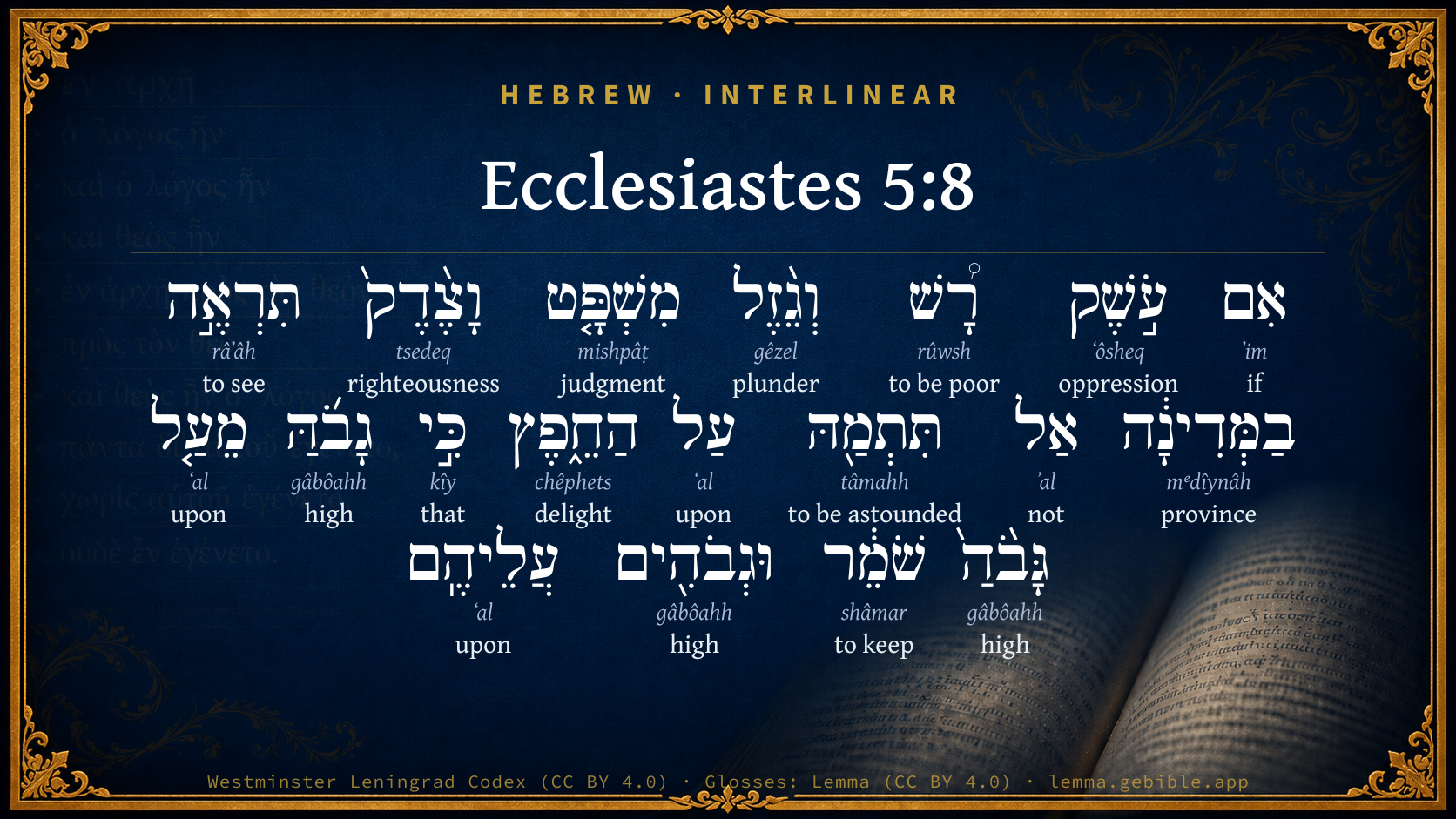
Ecclesiastes 5:8

Hebrew (Westminster Leningrad Codex) Ecclesiastes 5:8 appears in the Hebrew Old Testament. The text above is from the Westminster Leningrad Codex. Each word links to its Strong’s number, a concise gloss, and parsing drawn from the Open Scriptures Hebrew Bible morphology. Click any word for its full Brown-Driver-Briggs (BDB) entry.
Download image
Cite this verse

Ecclesiastes 5:8 (World English Bible). Public Domain. Lemma interlinear Bible study tool, https://lemma.gebible.app/v/ecclesiastes/5/8.

Show BibTeX & RIS
BibTeX
RIS
English Translation
If you see the oppression of the poor, and the violent taking away of justice and righteousness in a district, don't marvel at the matter: for one official is eyed by a higher one; and there are officials over them.
World English Bible · Public Domain
Highlights Full analysis ↓
Download a study sheet

One document with this verse’s original text, its word-by-word gloss line, the meaning frame, cross-references with their text, attributed commentary, and full source and license credits — printable, and it pastes into notes with its structure intact.

This verse Autodidact and up

Study sheet (.html) Plain text (.txt)

A passage Seminary Student

Up to 50 verses in one chapter. A passage sheet keeps up to 6 commentary sources and 12 cross-references per verse, in the order this page ranks them, and says so on the sheet whenever that leaves anything out. Ask for a single verse and you get the Autodidact verse sheet above.

Everything on this page stays free to read, with no account — the sheet is a download of what is already on screen, not access to it.

Want to remove ads? Support Godless Engineer
Compare translations 3

The same verse in 3 English versions, stacked beneath the original-language interlinear above. Click any original word for its lexicon entry.

Each is an independent rendering of the whole verse — the interlinear is not word-aligned to these translations.

Highlighted words mark where these versions differ — a whole-verse word diff, not a word-by-word alignment.

  • World English Bible Public Domain
    If you see the oppression of the poor, and the violent taking away of justice and righteousness in a district, don't marvel at the matter: for one official is eyed by a higher one; and there are officials over them.
  • King James Version Public Domain
    If thou seest the oppression of the poor, and violent perverting of judgment and justice in a province, marvel not at the matter: for he that is higher than the highest regardeth; and there be higher than they.
  • unfoldingWord Literal Text CC BY-SA 4.0
    If extortion of poor and robbery of justice and equity you see in the province, do not be amazed concerning the matter, for a high one over a high one is watching, and high ones over them.

unfoldingWord Literal Text — © unfoldingWord, licensed CC BY-SA 4.0. Word-aligned USFM3 via Door43 (git.door43.org/unfoldingWord/en_ult).

Versions to compare (up to 4)

3 of 4 selected

Show all 18 translations

Every available English version of this verse, each an independent rendering of the whole verse.

  • World English Bible Public Domain
    If you see the oppression of the poor, and the violent taking away of justice and righteousness in a district, don't marvel at the matter: for one official is eyed by a higher one; and there are officials over them.
  • Berean Standard Bible Public Domain
    If you see the oppression of the poor and the denial of justice and righteousness in the province, do not be astonished at the matter; for one official is watched by a superior, and others higher still are over them.
  • Majority Standard Bible Public Domain
    If you see the oppression of the poor and the denial of justice and righteousness in the province, do not be astonished at the matter; for one official is watched by a superior, and others higher still are over them.
  • King James Version Public Domain
    If thou seest the oppression of the poor, and violent perverting of judgment and justice in a province, marvel not at the matter: for he that is higher than the highest regardeth; and there be higher than they.
  • American Standard Version (1901) Public Domain
    If thou seest the oppression of the poor, and the violent taking away of justice and righteousness in a province, marvel not at the matter: for one higher than the high regardeth; and there are higher than they.
  • Revised Version (1885) Public Domain
    If thou seest the oppression of the poor, and the violent taking away of judgment and justice in a province, marvel not at the matter: for one higher than the high regardeth; and there be higher than they.
  • Geneva Bible (1599) Public Domain
    And the abundance of the earth is ouer all: the King also consisteth by the fielde that is tilled.
  • Douay-Rheims (1899) Public Domain
    Moreover there is the king that reigneth over all the land subject to him.
  • Young's Literal Translation Public Domain
    If oppression of the poor, and violent taking away of judgment and righteousness thou seest in a province, do not marvel at the matter, for a higher than the high is observing, and high ones `are' over them.
  • Literal Standard Version CC BY-SA 4.0
    If oppression of the poor, and violent taking away of judgment and righteousness you see in a province, do not marvel at the matter, for a higher than the high is observing, and high ones [are] over them.
  • Unlocked Literal Bible CC BY-SA 4.0
    When you see the poor being oppressed and robbed of just and right treatment in your province, do not be astonished as if no one knows, because there are people in power who watch those under them, and there are even higher ones over them.
  • unfoldingWord Literal Text CC BY-SA 4.0
    If extortion of poor and robbery of justice and equity you see in the province, do not be amazed concerning the matter, for a high one over a high one is watching, and high ones over them.
  • Darby Bible Public Domain
    If thou seest the oppression of the poor, and violent perverting of judgment and justice in a province, marvel not at the matter; for a higher than the high is watching, and there are higher than they.
  • World Messianic Bible Public Domain
    If you see the oppression of the poor, and the violent taking away of justice and righteousness in a district, don’t marvel at the matter, for one official is eyed by a higher one, and there are officials over them.
  • Webster's Bible Public Domain
    \\5:9\\Moreover, the profit of the earth is for all: the king himself is served by the field.
  • Free Bible Version CC BY-SA 4.0
    If you see poor people somewhere being oppressed, or truth and justice violated, don't be shocked at it, for every official is responsible to others higher up, and there are officials over them as well.
  • Bible in Basic English Public Domain
    It is good generally for a country where the land is worked to have a king.
  • JPS Tanakh (1917) Public Domain
    (5-7) If thou seest the oppression of the poor, and the violent perverting of justice and righteousness in the state, marvel not at the matter; for one higher than the high watcheth, and there are higher than they.

Literal Standard Version (2020), Covenant Press — licensed CC BY-SA 4.0. Text via the HelloAO Bible API (eBible.org). Unlocked Literal Bible (unfoldingWord) — licensed CC BY-SA 4.0. Text via the HelloAO Bible API (eBible.org). unfoldingWord Literal Text — © unfoldingWord, licensed CC BY-SA 4.0. Word-aligned USFM3 via Door43 (git.door43.org/unfoldingWord/en_ult). Free Bible Version, Dr. Jonathan Gallagher — licensed CC BY-SA 4.0. Text via the HelloAO Bible API (eBible.org).

Word by word

More ways to search: Search by grammar → Find every occurrence → Compare this word →

Practice this passage: Drill this verse → Learn its vocabulary →

וְגֵ֨זֶל
gêzel
H1499
“and · plunder of”
Conjunction + Noun, Common, Masculine, Singular, Construct
Part of Speech
Conjunction + Noun
Type
Common
Gender
Masculine
Number
Singular
State
Construct
Full BDB Definition

Origin: from H1497

TWOT: None

robbery, plunder
  1. אִם ʼim H518 “if” Conjunction
  2. עֹ֣שֶׁק ʻôsheq H6233 “oppression of” Noun, Common, Masculine, Singular, Construct
  3. רָ֠שׁ rûwsh H7326 “being poor” Verb, Qal, Participle Active, Masculine, Singular, Absolute
  4. מִשְׁפָּ֤ט mishpâṭ H4941 “judgment” Noun, Common, Masculine, Singular, Absolute
  5. וָצֶ֨דֶק֙ tsedeq H6664 “and · righteousness” Conjunction + Noun, Common, Masculine, Singular, Absolute
  6. תִּרְאֶ֣ה râʼâh H7200 “to see” Verb, Qal, Imperfect, 2nd Person, Masculine, Singular
  7. בַמְּדִינָ֔ה mᵉdîynâh H4082 “in/at the · province” Preposition, Determined + Noun, Common, Feminine, Singular, Absolute
  8. אַל ʼal H408 “not” Particle, Negative
  9. תִּתְמַ֖הּ tâmahh H8539 “to be astounded” Verb, Qal, Jussive, 2nd Person, Masculine, Singular
  10. עַל ʻal H5921 “upon” Preposition
  11. הַחֵ֑פֶץ chêphets H2656 “the · delight” Particle, Definite Article + Noun, Common, Masculine, Singular, Absolute
  12. כִּ֣י kîy H3588 “that” Conjunction
  13. גָבֹ֜הַּ gâbôahh H1364 “high” Adjective, Adjective, Masculine, Singular, Absolute
  14. מֵעַ֤ל ʻal H5921 “from · upon” Preposition + Preposition
  15. גָּבֹ֨הַ֙ gâbôahh H1364 “high” Adjective, Adjective, Masculine, Singular, Absolute
  16. שֹׁמֵ֔ר shâmar H8104 “keeping” Verb, Qal, Participle Active, Masculine, Singular, Absolute
  17. וּגְבֹהִ֖ים gâbôahh H1364 “and · high” Conjunction + Adjective, Adjective, Masculine, Plural, Absolute
  18. עֲלֵיהֶֽם ʻal H5921 “upon · them” Preposition + Suffix, Personal, 3rd Person, Masculine, Plural

About this verse

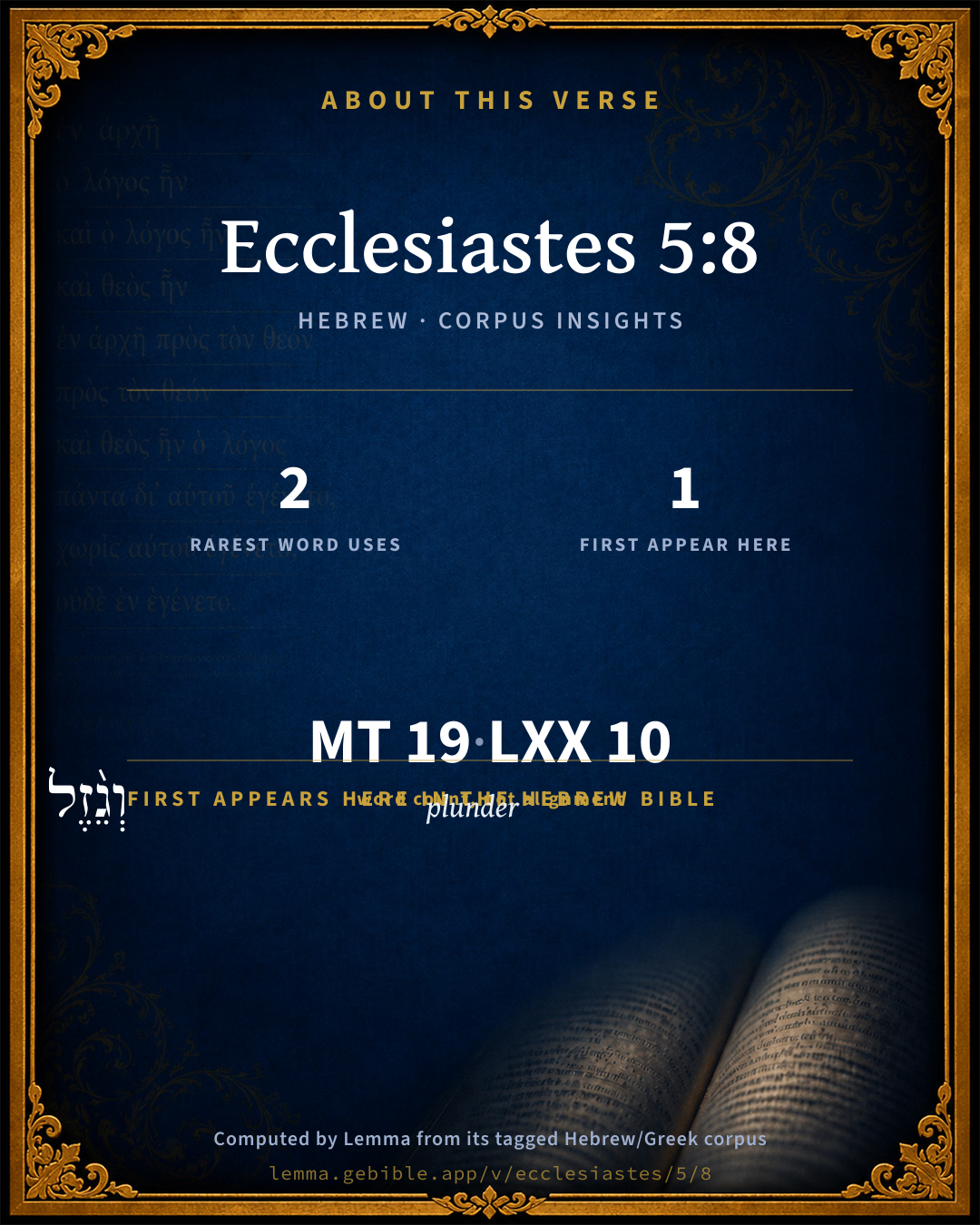
These counts appear in no published source. They are computed here, from the morphology-tagged text and Lemma’s own curated glosses. What Lemma adds →

19
words
15
distinct lemmas
Wisdom
section

Notable vocabulary

The rarest word here is וְגֵ֨זֶל plunder H1499 — appearing just 2 times in the whole Hebrew Bible.

First appearance in Scripture

This word makes its first canonical appearance in the Hebrew Bible here:

  • וְגֵ֨זֶל plunder H1499

Shared distinctive vocabulary

וְגֵ֨זֶל plunder H1499 occurs in 2 verses of the Hebrew Bible. Also found in:

Grammatical profile

  • 4 verbs
  • 6 nouns
  • 3 adjectives
  • 3 prepositions
  • 2 conjunctions
  • 1 particle

Verb forms

  • רָ֠שׁ Qal · Participle Active
  • תִּרְאֶ֣ה Qal · Imperfect
  • תִּתְמַ֖הּ Qal · Jussive
  • שֹׁמֵ֔ר Qal · Participle Active

Repetition

Words recur within this verse — often emphatic in Hebrew:

  • עַל upon H5921 ×3
  • גָבֹ֜הַּ high H1364 ×3

Hebrew & Septuagint length

In English translation the verse runs 40 words from the Hebrew and 18 from the Septuagint (LXX English) — the Septuagint runs noticeably shorter here. See the side-by-side →

A rough comparison of the two English renderings, which tokenize alike — not a word-level alignment.

Word counts can differ between the Hebrew and the Greek without any difference in meaning — e.g. the Hebrew direct-object marker אֵת has no separate Greek word, and Greek often adds the article ὁ.

In the original languages it is 19 Hebrew tokens and 10 Greek tokens — but the two are counted differently (Hebrew bundles its prefixes and suffixes into one token; the Greek is in lemma form), so that isn’t a like-for-like length.

Cross-references

52

Topical passages linked to Ecclesiastes 5:8 in the Treasury of Scripture Knowledge — connected by theme and wording, ordered by reader-vote popularity; previews shown in the World English Bible.

  • Psalms 12:5 "Because of the oppression of the weak and because of the groaning of the needy, I will now arise," says Yahweh; "I will set him in safety from those who malign him."
  • Ecclesiastes 4:1 Then I returned and saw all the oppressions that are done under the sun: and, behold, the tears of those who were oppressed, and they had no comforter; and on the side of their oppressors there was power; but they had no comforter.
  • Ecclesiastes 3:16 Moreover I saw under the sun, in the place of justice, that wickedness was there; and in the place of righteousness, that wickedness was there.
  • 1 Kings 21:19–20 You shall speak to him, saying, Thus says Yahweh, Have you killed and also taken possession? You shall speak to him, saying, Thus says Yahweh, In the place where dogs licked the blood of Naboth shall dogs lick your blood, even yours.
  • Psalms 58:10–11 The righteous shall rejoice when he sees the vengeance. He shall wash his feet in the blood of the wicked;
  • Psalms 82:1 God presides in the great assembly. He judges among the gods.
  • Matthew 13:41–42 The Son of Man will send out his angels, and they will gather out of his Kingdom all things that cause stumbling, and those who do iniquity,
  • Revelation 17:6–7 I saw the woman drunken with the blood of the saints, and with the blood of the martyrs of Jesus. When I saw her, I wondered with great amazement.
  • 1 Chronicles 21:15–16 God sent an angel to Jerusalem to destroy it: and as he was about to destroy, Yahweh saw, and he repented him of the evil, and said to the destroying angel, It is enough; now stay your hand. The angel of Yahweh was standing by the threshing floor of Ornan the Jebusite.
  • Job 27:8–23 For what is the hope of the godless, when he is cut off, When God takes away his life?
  • Psalms 10:17–18 Yahweh, you have heard the desire of the humble. You will prepare their heart. You will cause your ear to hear,
  • Psalms 55:9 Confuse them, Lord, and confound their language, For I have seen violence and strife in the city.
  • Psalms 83:18 That they may know that you alone, whose name is Yahweh, Are the Most High over all the earth.
  • Psalms 95:3 For Yahweh is a great God, A great King above all gods.
  • Psalms 140:11–12 An evil speaker won't be established in the earth. Evil will hunt the violent man to overthrow him.
  • Proverbs 8:17 I love those who love me. Those who seek me diligently will find me.
  • Isaiah 3:15 What do you mean that you crush my people, And grind the face of the poor?" says the Lord, Yahweh of Hosts.
  • Isaiah 5:7 For the vineyard of Yahweh of Hosts is the house of Israel, And the men of Judah his pleasant plant: And he looked for justice, but, behold, oppression; For righteousness, but, behold, a cry of distress.
  • Isaiah 10:5–7 Ho Assyrian, the rod of my anger, the staff in whose hand is my indignation!
  • Isaiah 10:12 Therefore it shall happen that, when the Lord has performed his whole work on Mount Zion and on Jerusalem, I will punish the fruit of the stout heart of the king of Assyria, and the glory of his high looks.
  • Isaiah 37:36 The angel of Yahweh went forth, and struck in the camp of the Assyrians one hundred and eighty-five thousand; and when men arose early in the morning, behold, these were all dead bodies.
  • Isaiah 46:10–11 declaring the end from the beginning, and from ancient times things that are not [yet] done; saying, My counsel shall stand, and I will do all my pleasure;
  • Isaiah 57:15 For thus says the high and lofty One who inhabits eternity, whose name is Holy: I dwell in the high and holy place, with him also who is of a contrite and humble spirit, to revive the spirit of the humble, and to revive the heart of the contrite.
  • Isaiah 59:13–16 transgressing and denying Yahweh, and turning away from following our God, speaking oppression and revolt, conceiving and uttering from the heart words of falsehood.
  • Jeremiah 22:17–19 But your eyes and your heart are not but for your covetousness, and for shedding innocent blood, and for oppression, and for violence, to do it.
  • Ezekiel 22:6–14 Behold, the princes of Israel, everyone according to his power, have been in you to shed blood.
  • Amos 5:12 For I know how many your offenses, And how great are your sins-- You who afflict the just, Who take a bribe, And who turn aside the needy in the courts.
  • Amos 6:2–6 Go to Calneh, and see; And from there go to Hamath the great; Then go down to Gath of the Philistines. Are they better than these kingdoms? Or is their border greater than your border?
  • Amos 6:12 Do horses run on the rocky crags? Does one plow there with oxen? But you have turned justice into poison, And the fruit of righteousness into bitterness;
  • Micah 2:1–3 Woe to those who devise iniquity And work evil on their beds! When the morning is light, they practice it, Because it is in the power of their hand.
  • Micah 2:9 You drive the women of my people out from their pleasant houses; From their young children you take away my blessing forever.
  • Micah 3:1–4 I said, "Please listen, you heads of Jacob, And rulers of the house of Israel: Isn't it for you to know justice?
  • Micah 3:9–12 Please listen to this, you heads of the house of Jacob, And rulers of the house of Israel, Who abhor justice, And pervert all equity.
  • Habakkuk 1:2–3 Yahweh, how long will I cry, and you will not hear? I cry out to you "Violence!" and will you not save?
  • Habakkuk 1:12–13 Aren't you from everlasting, Yahweh my God, my Holy One? We will not die. Yahweh, you have appointed him for judgment. You, Rock, have established him to punish.
  • Zechariah 7:9–13 "Thus has Yahweh of Hosts spoken, saying, 'Execute true judgment, and show kindness and compassion every man to his brother.
  • Zechariah 8:6 Thus says Yahweh of Hosts: "If it is marvelous in the eyes of the remnant of this people in those days, should it also be marvelous in my eyes?" says Yahweh of Hosts.
  • Malachi 3:5 I will come near to you to judgment; and I will be a swift witness against the sorcerers, and against the adulterers, and against the perjurers, and against those who oppress the hireling in his wages, the widow, and the fatherless, and who deprive the foreigner of justice, and don't fear me," says Yahweh of Hosts.
  • Luke 1:32 He will be great, and will be called the Son of the Most High. The Lord God will give him the throne of his father, David,
  • Luke 1:35 The angel answered her, "The Holy Spirit will come on you, and the power of the Most High will overshadow you. Therefore also the holy one who is born from you will be called the Son of God.
  • Luke 1:76 And you, child, will be called a prophet of the Most High, For you will go before the face of the Lord to make ready his ways,
  • Acts 4:27–28 For truly, in this city against your holy servant, Jesus, whom you anointed, both Herod and Pontius Pilate, with the Gentiles and the people of Israel, were gathered together
  • Acts 12:7–10 And behold, an angel of the Lord stood by him, and a light shone in the cell. He struck Peter on the side, and woke him up, saying, "Stand up quickly!" His chains fell off from his hands.
  • Acts 12:23 Immediately an angel of the Lord struck him, because he didn't give God the glory, and he was eaten by worms and died.
  • James 2:13 For judgment is without mercy to him who has shown no mercy. Mercy triumphs over judgment.
  • James 5:2–7 Your riches are corrupted and your garments are moth-eaten.
  • Job 20:19–29 For he has oppressed and forsaken the poor. He has violently taken away a house, and he shall not build it up.
  • Amos 8:4–7 Hear this, you who desire to swallow up the needy, And cause the poor of the land to fail,
  • Micah 6:10–13 Are there yet treasures of wickedness in the house of the wicked, And a short ephah that is accursed?
  • Romans 11:33 Oh the depth of the riches both of the wisdom and the knowledge of God! How unsearchable are his judgments, and his ways past tracing out!
  • 1 Peter 4:12 Beloved, don't be astonished at the fiery trial which has come upon you, to test you, as though a strange thing happened to you.
  • 1 John 3:13 Don't be surprised, my brothers, if the world hates you.

Cross-references courtesy of OpenBible.info (CC BY 4.0).

Hebrew and Greek witnesses Masoretic Hebrew ↔ Greek Septuagint

The same verse in the two great witnesses to the Old Testament, shown verse-for-verse.

Here the Septuagint runs noticeably shorter than the Hebrew — LXX2012 (modern English Septuagint) 18 words vs World English Bible 40. A rough length comparison of the two English translations, not a word-level alignment — read both below.

These are two independent witnesses, not word-aligned to each other, and the Septuagint is shown in lemma (dictionary) form.

Hebrew Ecclesiastes 5:8 Masoretic · Westminster Leningrad Codex

אִם עֹ֣שֶׁק רָ֠שׁ וְגֵ֨זֶל מִשְׁפָּ֤ט וָצֶ֨דֶק֙ תִּרְאֶ֣ה בַמְּדִינָ֔ה אַל תִּתְמַ֖הּ עַל הַחֵ֑פֶץ כִּ֣י גָבֹ֜הַּ מֵעַ֤ל גָּבֹ֨הַ֙ שֹׁמֵ֔ר וּגְבֹהִ֖ים עֲלֵיהֶֽם

If you see the oppression of the poor, and the violent taking away of justice and righteousness in a district, don't marvel at the matter: for one official is eyed by a higher one; and there are officials over them.

World English Bible · Public Domain

Greek LXX Ecclesiastes 5:8 Septuagint · lemma form

καί περισσεία γῆ ἐν πᾶς εἰμί βασιλεύς ὁ ἀγρός ἐργάζομαι

Also the abundance of the earth is for every one: the king is dependent on the tilled field.

LXX2012 (modern English Septuagint) · Public Domain

On this verse, Keil & Delitzsch discusses the Septuagint’s reading. Read the note in Commentary ↓

Hebrew: Westminster Leningrad Codex (CC BY 4.0). Greek: Septuagint (public domain); English from LXX2012 (modern English Septuagint) (Public Domain). How the Septuagint differs from the Hebrew →

Commentary

Notes on Ecclesiastes 5:8 from classic Christian and Jewish commentators (each source and its license shown beneath its notes). The classic Christian expositions comment on the surrounding passage and are grouped to its opening verse, so a note may address several verses; the Jewish commentaries on the Tanakh (Rashi and others) are per-verse, so they appear only where the commentator wrote on this verse.

Lemma curates 59 commentaries, every one of them public domain or Creative Commons licensed, each selected and text-cleaned for this edition rather than reprinted as found. About our sources →

Trapp's Complete Commentary

John Trapp

Ecc 5:8 If thou seest the oppression of the poor, and violent perverting of judgment and justice in a province, marvel not at the matter: for [he that is] higher than the highest regardeth; and [there be] higher than they.

Ver. 8. If thou seest the oppression of the poor.] And so mayest be drawn to doubt of Divine providence, and to withdraw thine awful regard to the divine Majesty, to forego godliness, and to turn fiat atheist, as Diagoras and Averroes did.

Marvel not at the matter.] Nil admirari prope res est una Numici. {a} A wise man wonders at nothing; he knows there is good cause why God should allow it so to be, and gives him his glory. Opera Dei sunt in mediis contrariis, saith Luther: {b} God’s works are effected usually by contraries. And this he doth ινα και μαλλον θαυμαζηται, that he may be the more marvelled at, saith Nazianzen. Hence he commonly goes a way by himself, drawing light out of darkness, good out of evil, heaven out of hell, that his people may feelingly say, "Who is like unto thee, O Lord, glorious in holiness, fearful in praises, doing wonders." {Exo 15:11} "Verily there is a reward for the righteous; verily he is a God that judgeth in the earth." {Psa 58:11}

For he that is higher than the highest regardeth.] And "wherein they deal proudly, he is above them," {Exo 18:11} and overtops them; {Psa 2:4} sets a day for them, and "sees that their day is coming." {Psa 37:13} "The Most High cuts off the spirit of princes" {Psa 76:12} - he slips them off, as one should slip off a flower between his fingers; or he cuts them off, as grapegatherers do the clusters off the vines; such a metaphor there is in the original - "He is terrible to all the kings of the earth," those dread sovereigns, those hammers of the earth and scourges of the world, {c} as Atillas styled himself; such as Sennacherib, whom God so subdued and mastered, that the Egyptians, in memory of it, set up his statue in the temple of Vulcan, with this inscription, Eμε τις ορεων ευσεβης εστο: {d} Let all that behold me learn to fear God. It was therefore excellent counsel that Jehoshaphat gave his judges: "Take heed what you do, for ye judge not for man, but for the Lord, who is with you in the judgment. Wherefore now let the fear of the Lord our God be upon you; take heed and do it." {2Ch 19:6} Look upon him that overlooks all your doings, saith he, and then learn to sit upon the tribunal, in as great though not in so slavish a fear of doing wrong, as Olanes in the history did upon the flayed skin of his father Sisannus, nailed by Cambyses on the judgment seat; or as a Russian judge that fears the boiling caldron or open battocking; or the Turkish senate, when they think the great Turk to stand behind the arras {e} at the dangerous door. In fine, let the grandees and potentates of the earth know and acknowledge with Constantine, Valentinian, and Theodosius, three great emperors, as Socrates reports of them, that they are but Christi vasalli, Christ’s vassals; and that as he is Excelsus super excelsos, high above all, even the highest, so he hath other high ones at hand - viz., the holy angels, who can "resist the King of Persia," as Michael the prince did; {Dan 10:13} fright the Syrians with a panic terror; {2Ki 7:6} smite the Assyrians with an utter destruction; {Isa 37:36} deliver Peter from the hand of Herod, and from the expectation of the Jews. {Act 12:11} What a wonderful difference in the slaughter of the firstborn of Egypt! {Exo 12:23-32} Tyrants shall be sure, sooner or later, to meet with their match. Look what a hand the Ephori had over the King of Sparta; the tribunes had over the Roman consuls; and the Prince Palgrave of Rhine ought, by the ancient orders, to have over the Emperor of Germany ( Palatino haec dignitatis praerogativa est, ut ipsum Caesarem iudicare et damnare possit, quoties scilicet lis ei ab aliquo ordinum imperii movetur; { f} the Palgrave hath power to judge and pass sentence upon the emperor himself, when any of the states of Germany do sue him at the law); the same and more hath God and his angels over the mightiest magnificoes in the world. "Lebanon shall fail by a mighty one," {Isa 10:34} i.e., by an angel, as some interpret it.

{a} Horat.

{b} Luther. in Genes.

{c} Mundi flagellum. Scourge of the world.

{d} Herodot.

{e} A hanging screen of this material formerly placed round the walls of household apartments, often at such a distance from them as to allow of people being concealed in the space between.

{f} Parei Hist. pros. med., 771.

John Trapp, A Commentary or Exposition upon All the Books of the Old and New Testament (1647–1656) — public domain. Text from a community e-Sword module.

Joseph Benson's Commentary

Ecc 5:8. If thou seest the oppression: &c. — Here is an account of another vanity, and a sovereign antidote against it. Marvel not — As if it were inconsistent with God’s wisdom and justice to suffer such disorders. For he that is higher than the highest — The most high God, who is infinitely above the greatest of men. Regardeth — Not like an idle spectator, but a judge, who diligently observes, and will effectually punish them. And there be higher than they — Namely, God; it is an emphatical repetition of the same thing.

Joseph Benson's Commentary on the Old and New Testaments (1811–1818) — public domain. Text from a community e-Sword module.

The Preacher's Complete Homiletical Commentary

Joseph S. Exell (gen. ed.)

CRITICAL NOTES.—

Ecc_5:8. In a province] Such being far distant from the seat of government it was more likely that there oppression would be practised by subordinate rulers. Higher than the highest, and there be higher than they. The king is over the oppressive ruler, and over him there is the Supreme and Infinite Power, the King of Kings. They. Principalities and Powers all along the scale, at the summit of which is God.

MAIN HOMILETICS OF THE PARAGRAPH.—Ecc_5:8-9

THE OPPRESSORS OF MANKIND WAITING FOR THE JUDGMENT

IF man would enjoy true happiness, he must study his duty to society; and abstain from deeds of violence and oppression. Though the dark pages of history, stained with tyranny and injustice, must fill him with sorrow, yet he may be comforted by the conviction that God will, in the end, interfere and redress all wrongs.

I. The Existence of Human Wrongs calls for such an Interference. There have ever been, and still are, social wrongs in the world of appalling magnitude. There is,

1. The tyranny of class over class. The natural temptations of pomp and power are haughty indifference to the evils of those beneath them, and the spirit of cruelty and oppression. Men take advantage of the accidents of position to inflict misery upon others. The power of wealth has been often used to crush the poor. And not alone to the great in high places is this vice to be imputed. Smaller communities, and almost every parish, has its little tyrant. There is,

2. The perversion of Justice. (Ecc_5:8.) Under the pretence of administering justice many wrongs have been inflicted. Even laws themselves have often been partial to the more favoured classes, but cruel in their general tendency and effect. The sacred name of justice has been prostituted to serve the basest ends. Tyrants have proceeded to their cruel work with the hypocrisy of loud professions of virtue. There is,

3. The indulgence of the wild passions of human nature. Extreme depravity may, for a time, be held in check by circumstances; but when the occasion arises, the envious flood bursts the bonds which held it, and spreads desolation far and wide. How many fair lands have been despoiled, and unutterable cruelties inflicted, when the loose rein has been given to the depraved passions of human nature!

II. That these Sad Facts of Human History need not excite Surprise. “Marvel not at the matter.” (Ecc_5:8.) And why?

1. Because the facts of human nature lead us to expect such a condition of things. The evil taint clings to our nature still, however disguised by the outward proprieties of life, or held in check by righteous power. The violence of temptation, conflicting interests—the impulse of ambition and of savage cruelty, still exist, in spite of civilization and the restraints of religion. The facts of human nature remaining, the wise man cannot expect otherwise than that some wrongs shall always exist: history having a tendency to repeat itself in the same sad and weary round.

2. Because the best ordering of human society cannot put an end to every social wrong. Laws may be improved, and the most laudable endeavours made to reduce, and even banish, all the evils that afflict society; still there will be room for much social injustice and oppression. Society can never be made good from the outside. While our natural corruption remains, and the prevalent evil of selfishness, there must be tyranny, oppression, and wrong. The most ardent dreamer of a social millennium must make up his mind to accept the facts of human nature; and the true prophet, gifted with sight into futurity, can, at best, have but a melancholy burden.

III. That during the course of History, God uses Human Authority to mitigate this Condition. There are gradations in human authority—one rank above another. There are high, higher, and highest. (Ecc_5:8.) The case is here supposed of an oppressor in a “province,” remote from the central and chief authority. This subordinate governor takes advantage of his position to oppress his subjects. But above him there are superior authorities, and the “king” over all. (Ecc_5:9.) Hence those who are wronged may obtain redress, and tardy justice at length come to their aid.

1. Constituted authority stands in the place of God. He reserves the complete and final adjustment of human affairs for Himself; but for the present He makes use of human authority in the government of mankind. Every representative of that authority is “the minister of God.” (Rom_13:4.) The special form of government is a human ordinance, but government itself is of divine appointment.

2. The gradations of rank in human authority tend to secure the proper carriage of justice. The lesser ruler is responsible to the greater, so that the dread of censure often serves to check those who are inclined to be tyrannical. Divine Providence thus uses the complications of human government to lessen the sum total of social wrongs.

3. The protection of earthly kings is of immense benefit. By the administration of wise laws, they protect the people and maintain peace; they secure for us the fruits of the earth by preserving our fields from invasion. The produce of the land is the source of the real wealth of the nation. It is for the advantage of the authorities themselves to promote the general wealth, for “the king himself is served by the field.” (Ecc_5:9.) Mankind are bound together by the ties of a common interest, and attain to the best social condition under the protection of wise laws. Hence though there is a heavenly King, the benefits derived from earthly governors are not to be despised.

IV. That when Human History closes, God Himself will Interfere. There will be a personal manifestation of the King who is over all. If earthly authorities will not come to the aid of the oppressed and redress their wrongs, there is One above who will do it.

1. There is a Supreme Authority. Of the highest earthly rulers, it may be said that “there be higher than they.” (Ecc_5:8.) There is One who has absolute dominion and power, whose throne of justice is raised on eternal foundations, the highest resource of troubled souls, and the ultimate appeal of the oppressed. An earthly king, after all, is but a symbol. His power really resides with his subjects. He is merely clothed with power and authority. But the Heavenly King has power in Himself. Hence his dominion is the only reality of government—the only “everlasting kingdom.”

2. Though God promotes the welfare of society by means of earthly governors, yet He has reserved the final adjustment of human affairs for Himself. The best human governments cannot prevent the essential evils of our present state. They can only reach the outward conduct as far as it affects the happiness of society. Human laws cannot touch the question of sin. They cannot enforce the kinder and milder graces of life—those which have the greatest potency to aid human necessity and assuage sorrow. Human justice, in its best estate, is cold and severe; which, though it may command admiration, has no power to melt the heart, or touch the springs of human tenderness. This imperfection cannot go on for ever—the Divine governor must interfere to usher in His perfect kingdom. There are duties of piety and religion with which the Supreme Judge alone can deal. There are moral discrepancies requiring such an adjustment. Here, vice is often prosperous, enjoying the magnificence and splendour of life, while virtue is condemned to the grief of apparent failure. The happiness and misery of this world are not distributed according to the laws of eternal reason and high justice; the wise, the true, and the good, do not in the present state stand in their proper lot. There must be for these a better and a higher place, the lofty vindication of Eternal Justice, a perpetual reward. The oppressors of mankind will have to come to reckoning with the Righteous Judge, and for all the down-trodden and persecuted the Avenger will arise. Lessons,—

1. Be patient under the evils of the present.

2. Have confidence in the justice of the Eternal King.

3. Beware lest thou oppress any: if thou hast done so, seek reconciliation: lest they take their cause to the Supreme Court. (Mat_5:25.)

SUGGESTIVE COMMENTS ON THE VERSES

Ecc_5:8. In this small province of God’s dominions, the good have been persecuted, and justice, at best, but imperfectly rendered. The complaints of the oppressed have passed on from one human governor to another—many still standing to their account. But He who is “higher than they” will interfere, and redress the wrongs of His people, “redeeming their souls from deceit and violence.”

Deep knowledge of human nature and history blunts the sense of wonder. He who has the widest experience of mankind comes at length to marvel at nothing.

The nature of evil men is to hate and to oppress. Their deeds need not excite astonishment. The righteous must not think it strange that they have to pass through fiery trials.

Why dost thou marvel that good men are shaken that they may be settled? A tree is not firm in the ground unless the wind do often beat upon it; the very shaking of it doth fasten the root more surely. They are weak that do grow in the warm valley [Seneca].

The righteous soul, who sees the oppression of the poor, and the perverting of justice, opens another eye, fixing it upon one bright spot in the future where the majesty of Eternal Justice will be asserted.

The Heavenly King waits long through the slow rolling of the ages: meantime the world’s burden of oppression and wrong grows larger! But the avenger is afoot, and will at length overtake all tyrants.

The Highest is the strong refuge of the persecuted.

Let every man, according to his rank and God’s command, do his work with the best industry; other things let him commend to God. Let him be patient and wait for Him who is able to find out and judge the ungodly and unjust. He who cannot lift a great stone, let him leave it lying and lift what he can. Wherefore, when thou seest that kings, princes, and lords misuse their power, that judges and advocates take bribes and allow causes to sink or swim as they can, being wise and sensible, thou wilt think within thyself, God will sometime bring about a better state [Luther].

Ecc_5:9. In all grades of society, human subsistence is very much the same. “The profit of the earth is for all; the king himself is served by the field.” “What hath the wise man more than the fool?” Even princes are not fed with ambrosia, nor do poets subsist on asphodel. Bread and water, the produce of the flocks and herds, and a few homely vegetables, form the staple of his food who can lay the globe under tribute; and these essentials of healthful existence are within the attainment of ordinary industry [Dr. J. Hamilton].

The great Roman poet has said that, “The Father of mankind Himself hath willed it that the way of cultivating the ground should not be easy.” Hence the ingenuity of man has been stimulated to invent the means of subduing the soil. A wise king will, therefore, encourage agriculture and the arts and sciences.

The first of all human occupations is still the foundation of wealth, and the chief promoter of the industrial arts.

Mutual dependence is the law of society. The tiller of the soil spreads the benefits of his labour to all ranks, to the very highest. They, in turn, secure for him the protection of Government.

The Preacher's Complete Homiletical Commentary (gen. ed. Joseph S. Exell; Funk & Wagnalls, c. 1892) — public domain (pre-1929). A full-Bible homiletical/sermon-outline anthology covering 65 of 66 books (2 John is absent from the source module). Text from a community e-Sword module.

Keil & Delitzsch

C. F. Keil & F. Delitzsch

"If thou seest the oppression of the poor and the robbery of right and of justice in the state, marvel not at the matter: for one higher watches over him who is high; and others are high above both." Like rash, mishpat vatsěděq are also the gen. of the obj.; "robbery of the right and of justice" is an expression not found elsewhere, but not on that account, as Grtz supposes, impossible: mishpat is right, rectitude, and conformity to law; and ]], judicial administration, or also social deportment according to these norms; גּזל, a wicked, shameless depriving of a just claim, and withholding of the showing of right which is due. If one gets a sight of such things as these in a medinah, i.e., in a territorial district under a common government, he ought not to wonder at the matter.

תּמהּ means to be startled, astonished, and, in the sense of "to wonder," is the word commonly used in modern Heb. But חפץ has here the colourless general signification of res, according to which the Syr. translates it (vid., under Ecc 3:1); every attempt in passages such as this to retain the unweakened primary meaning of the word runs out into groundless and fruitless subtlety. Cf. Berachoth 5a, חפץ לח ... אדם, "a man who buys a thing from another." On the other hand, there is doubt about the meaning of the clause assigning the reason. It seems to be intended, that over him who is high, who oppresses those under him, there stands one who is higher, who in turn oppresses him, and thereby becomes the executor of punishment upon him; and that these, the high and the higher, have over them a Most High, viz., God, who will bring them to an account (Knobel, Ew., Elst., Vaih., Hengst., Zckl.). None of the old translators and expositors rises, it is true, to the knowledge that גּבהים may be pl. majestatis,

(Note: That is surprising, since the Talm. interpretation, Menachoth 110a, even brings it about that לב, Ecc 5:10, is to be understood of God.)

but the first גּבהּ the Targ. renders by אל אדּיר. This was natural to the Jewish usus loq., for gbwh in the post-bibl. Heb. is a favourite name for God, e.g., Beza 20b, Jebamoth 87a, Kamma 13a: "from the table of God" (משלחן גבוה), i.e., the altar (cf. Heb 13:10; Co1 10:21).

(Note: חלק גבוה is also a common Rabbin. name for the tithes and offerings (cf. e.g., Nachmani under Gen 14:20). Along with חלק הגבוה, the sacrifices are also called (in Hurwitz' work on the Heb. rites, known by the abbreviated title ש''לה) לגבוה; vid., 85b of the ed. 1764, and 23b of the Amsterdam ed. 1707 of the abridgment.)

The interpretation of גב, however, as the pl. majest., has in the Book of Koheleth itself a support in בּוראיך, Ecc 12:1; and the thought in which Ecc 5:7 climactically terminates accords essentially with Ecc 3:17. This explanation, however, of Ecc 5:7 does not stand the test. For if an unrighteous administration of justice, if violence is in vogue instead of right, that is an actual proof that over him who is high no human higher one watches who may put a check upon him, and to whom he feels that he is responsible. And that above them both one who is Most High stands, who will punish injustice and avenge it, is a consolatory argument against vexation, but is no explanatory reason of the phenomenon, such as we expect after the noli mirari; for אל־תתמה does not signify "be not offended" (Joh 16:1), or, "think it not strange" (Pe1 4:12), which would be otherwise expressed (cf. under Psa 37:1), but μή θαυμάσης (lxx). Also the contrast, Ecc 5:8, warrants the conclusion that in Ecc 5:7 the author seeks to explain the want of legal order from the constitution of a despotic state as distinguished from patriarchal government. For this reason שׁמר will not be meant of over-watching, which has its aim in the execution of legal justice and official duty, but of egoistic watching, - not, however, as Hitzig understands it: "they mutually protect each other's advantage; one crow does not peck out the eyes of another," - but, on the contrary, in the sense of hostile watching, as at Sa1 19:11; Sa2 11:16, as B. Bardach understands it: "he watches for the time when he may gain the advantage over him who is high, who is yet lower than himself, and may strengthen and enrich himself with his flesh or his goods." Over the one who is high, who oppresses the poor and is a robber in respect of right and justice, there stands a higher, who on his part watches how he can plunder him to his own aggrandisement; and over both there are again other high ones, who in their own interest oppress these, as these do such as are under them. This was the state of matters in the Persian Empire in the time of the author. The satrap stood at the head of state officers. In many cases he fleeced the province to fatten himself. But over the satrap stood inspectors, who often enough built up their own fortunes by fatal denunciations; and over all stood the king, or rather the court, with its rivalry of intrigues among courtiers and royal women. The cruel death-punishments to which disagreeable officials were subjected were fearful. There was a gradation of bad government and arbitrary domination from high to low and from low to high, and no word is more fitting for this state of things in Persia than שׁמר; for watching, artfully lurking as spies for an opportunity to accomplish the downfall of each other, was prevalent in the Persian Empire, especially when falling into decay.

Keil & Delitzsch — Biblical Commentary on the Old Testament (1861–1891) — public domain (CC PDM 1.0). Text via the HelloAO Bible API. (Old Testament only.)

Tyndale Open Study Notes

Tyndale Open Resources

5:8-9 For every official is under orders from higher up, and matters of justice get lost in red tape and bureaucracy. Even the king milks the land for his own profit! Or For one official watches over another, and higher officials are over them. The land benefits from a king who cultivates the field. The NLT understands these verses to mean that bureaucracy brings oppression rather than justice, all the way up to the king (see also 1 Sam 8:11-18). This should not be surprising because that is how bureaucracies tend to function. Others interpret the verses along the lines of the alternate translation above: The king and his officials provide oversight to restrain injustice and oppression. The former view is more in keeping with the realistic perspective of the Teacher.

Tyndale Open Study Notes — © Tyndale Open Resources, licensed CC BY-SA 4.0. Text via the HelloAO Bible API.

Geneva Bible (1599)

Geneva Bible translators

The earth is to be preferred above all things which appertain to this life.

Kings and Princes cannot maintain their estate without tillage, which thing commendeth the excellency of tillage.

Geneva Bible (1599) marginal notes — public domain. Text via Bolls.life.

Jamieson, Fausset & Brown

Robert Jamieson, A. R. Fausset & David Brown

As in Ecc 3:16, so here the difficulty suggests itself. If God is so exact in even punishing hasty words (Ecc 5:1-6), why does He allow gross injustice? In the remote "provinces," the "poor" often had to put themselves for protection from the inroads of Philistines, &c., under chieftains, who oppressed them even in Solomon's reign (Kg1 12:4).

the matter--literally, "the pleasure," or purpose (Isa 53:10). Marvel not at this dispensation of God's will, as if He had abandoned the world. Nay, there is coming a capital judgment at last, and an earnest of it in partial punishments of sinners meanwhile.

higher than the highest-- (Dan 7:18).

regardeth-- (Ch2 16:9).

there be higher--plural, that is, the three persons of the Godhead, or else, "regardeth not only the 'highest' kings, than whom He 'is higher,' but even the petty tyrants of the provinces, namely, the high ones who are above them" (the poor) [WEISS].

Jamieson, Fausset & Brown — Commentary Critical and Explanatory on the Whole Bible (1871) — public domain (CC PDM 1.0). Text via the HelloAO Bible API.

Adam Clarke's Commentary

Verse 8. If thou seest the oppression of the poor] For this was a frequent case under all governments; and especially in the provinces or colonies which being far from the seat of government, were generally oppressed by the sovereign's deputies.

Marvel not at the matter] החפץ hachephets, the will, i.e., of God; which permits such evils to take place; for all things shall work together for good to them that love him.

"Marvel not,

Ye righteous, if his dispensations here

Unequal seem. What, though disorders reign?

He still presides, and with unerring hand

Directs the vast machine. His wisdom can

From discord harmony produce; and make

Even vice itself subservient to his ends."

Adam Clarke's Commentary on the Bible (1810–1826) — public domain. Text from a community e-Sword/MySword module.

Ellicott's Commentary for English Readers

(8) The interpretation of this verse depends on the sense we give to “marvel.” There are some who take it of simple surprise. “You need not think it strange; the instances of oppression which you observe are only parts of a gigantic scheme of mutual wrong-doing, the oppressors of one being themselves oppressed in turn by their superiors.” But instead of “Do not wonder,” the meaning “be not dismayed” is preferable. (Comp. Psa_48:5; Job_26:11; Isa_13:8; Jer_4:9.) The verse then supplies the answer to the gloomy view of Ecc_4:4. In the view that the last clause speaks of the Divine rectification of earthly injustice, I am confirmed by observing that the author of this book delights in verbal assonances, and constantly links together words similar in sound. An English version might admit the meaning: “Over the high oppressor stands a higher, and over both, those who are higher still; “though even here there is the difficulty that the highest of all are spoken of in the plural number, of which it is a very awkward explanation that the “higher” is the king, and that the women and favourites who govern him are the “higher still.” But I cannot but think that the language of the Hebrew, that over the “gebôh” there be “gebôhim,” is intended to suggest Elohim to the reader’s mind.

On the word “province,” see Note, Ecc_2:8; and on “matter,” Ecc_3:1.

A Bible Commentary for English Readers, edited by Charles John Ellicott (1878–1897) — public domain. Text from a community e-Sword module.

The Cambridge Bible for Schools and Colleges

gen. ed. J. J. S. Perowne

8. If thou seest the oppression of the poor] From the follies of the religious life we pass to the disorders of the political. As in ch. Ecc_4:16, the thinker looks on those disorders of the world, “the poor man’s wrong, the proud man’s contumely,” and teaches others how he has learnt to think of them. The words “wonder not” tells us with scarcely the shadow of a doubt who had been his teachers. In that counsel we have a distinct echo from one of the floating maxims of Greek proverbial wisdom, from the Μηδὲν θαυμάζειν (“wonder at nothing”) of Pythagoras, and Cebes (Tabula, p. 232), which has become more widely known through the Nil admirari of Horace (Epist. i. 6. 1). Why men were not to wonder at the prevalence of oppression is explained afterwards. The word for “province” may be noted as one distinctly belonging to later Hebrew, found chiefly in the books of the Persian period, Ezra, Nehemiah, Esther and Daniel; once only in those of earlier date, 1Ki_20:14-17.

for he that is higher than the highest] The first impression made by the verse is that the Debater tells men not to wonder or be dismayed at the prevalence of wrong, on the ground that God is higher than the highest of the tyrants of the earth and will in the end punish their wrong-doing. So understood, the first and the last “higher” both refer to “God,” or, as some take it, the last only, the first referring to the king as distinct from satraps or other officers, and the train of thought is supposed to be “Wonder not with the wonder of despair, at the seeming triumph of evil. The Supreme Judge (ch. Ecc_3:17) will one day set all things right.” The last “higher” is however plural in the Hebrew, and if it be understood of God, it must be by a somewhat unusual construction connecting it with the plural form (Elohim) of the name of God. We have, it may be noted, another example of a like construction in the use of the plural form for Creator in ch. Ecc_12:1, and for “the Holy” in Pro_9:10; Pro_30:3. Over and above the grammatical difficulties, however (which, as has been shewn, are not insuperable), it may be said that this thought is hardly in keeping with the tone of the Debater’s mind at this stage of his progress. Belief in the righteous government of God can hardly remove, though it may perhaps silence, the wonder which men feel at the prevalence of evil. It seems better accordingly to fall back upon another interpretation. The observer looks upon the state of the Persian or Syrian or Egyptian Monarchy and sees a system of Satraps and Governors which works like that of the Pachas in modern Asiatic Turkey. There is one higher than the high one, the king who is despotic over the satraps: there are others (the court favourites, king’s friends, eunuchs, chamberlains) who are higher or, at least, of more power, than both together, each jealously watching the others, and bent on self-aggrandisement. Who can wonder that the result should be injustice and oppression? The system of government was rotten from the highest to the lowest, suspicion and distrust pervading its whole administration. Comp. Aristotle’s description of Asiatic monarchies as suppressing all public spirit and mutual confidence (Pol. Ecc_5:11). It may be suggested, lastly, that the enigmatic form of the maxim may have been deliberately chosen, so that men might read either the higher or the lower interpretation into it, according to their capacities. It was a “word to the wise” after the measure of their wisdom. The grave irony of such an ambiguous utterance was quite after the Teacher’s method. See notes on ch. Ecc_11:1-2.

The Cambridge Bible for Schools and Colleges (gen. ed. J. J. S. Perowne; Cambridge University Press, 1878–1918) — public domain. Text from a community e-Sword module.

John Gill's Exposition

If thou seest the oppression of the poor, and violent perverting of justice in a province,.... Which is a very disagreeable sight, but often seen; the poor are oppressed, and judgment and justice perverted, and that in a very violent and flagrant manner, in open courts of judicature, in the several provinces and kingdoms of the world;

marvel not at the matter; as though it was some strange and uncommon thing, when nothing is more common: or "marvel not at the will" or "pleasure" (t); that is, of God, who suffers such things to be. So the Targum, Jarchi, and Aben Ezra, interpret it; stumble not at it, nor arraign the wisdom and justice of God; let not that temptation prevail in thee as it has done in some good men, who have been tempted from hence to think there was nothing in religion, nor no providence attending the affairs of this world; do not be frightened and astonished, and hurried into such a thought; nor be distressed at the calamities and oppressions of poor and innocent men;

for he that is higher than the highest regardeth: that is, God, who is the most high in all the earth; higher, than the kings of the earth, and all high and haughty oppressors; higher indeed than the heavens, and the angels there: he "regards" all his people, his eyes are on them, and he never withdraws them from them; he regards their cries, and hears and answers them; he regards their oppressors, and their oppressions; and will, in his own time, deliver them; or he "keeps" (u) his people as the apple of his eye, in the hollow of his hand, night and day, lest any hurt them; he keeps them by his power through faith unto salvation. It may be rendered, "the high One from on high observes" (w); God, who is the high and lofty One, looks down from the high heavens where he dwells, and takes notice of all the sons of men, and considers all their works; see Psa 33:13;

and there be higher than they; either the holy angels, who are higher than tyrannical oppressors, higher in nature, and excel in strength and power; and these are on the side of the oppressed, have the charge of saints, and encamp about them; and, whenever they have an order, can destroy their enemies in a moment: or rather the three divine Persons are meant, by the plural expression used, Father, Son, and Spirit; Jehovah the Father is above men, the greatest of men, in the things in which they deal proudly; be is greater than all, and none can pluck his sheep out of his hands, and worry them: Christ, the Son of the Highest, is higher than the kings, of the earth; he is King of kings, and Lord of lords, and able to deliver and save his people; and the Holy Spirit is the power of the Highest, and is greater than he or they that are in the world, the avowed enemies of the saints. Aben Ezra interprets it of the secret of the name of God, which he says is inexplicable. So the Midrash understands it of the holy blessed God; and in another tract it is said, on mention of this passage, there are three superiors above them in the way of emanation, and of them it is said (x), "there be higher than they."

(t) "super voluntate", Montanus, Cocceius; "de divina volantate", Pagninus, Mercerus; "divinam voluntatem", Tigurine version; "de ista voluntate", Junius & Tremellius, Gejerus. (u) "custodiens", Montanus; "custodit", Pagninus; "custos", Tigurine version. (w) "Observat", Junius & Tremellius, Piscator, Mercerus, Gejerus; "observans, observator est", Rambachius. (x) Tikkune Zohar Correct. 69. fol. 114. 1.

John Gill's Exposition of the Whole Bible (1746–1763) — public domain (CC PDM 1.0). Text via the HelloAO Bible API.

Albert Barnes' Notes on the Bible

Matter - Rather, purpose (as in the margin, and Ecc 3:1), referring either to the will of God or to the edict of an oppressive ruler.

For he ... they - literally, for high watches over high and the highest over them, i. e., the king in the capital watches over the judge or governor in the province, and God over both. This seems more in harmony with the preceding verses, and more agreeable to the scope of this passage than to understand the passage only of earthly rulers.

Albert Barnes' Notes on the Bible (1834–1885) — public domain. Text from a community e-Sword/MySword module.

Haydock's Catholic Bible Commentary

Him. An appeal may be made to the king or to God. Reges in ipsos imperium est Jovis. (Horace, iii. ode 1.) --- Hebrew, "the king serves, (Montanus) or is served by the field." (Protestants) (Haydock) --- All have a mutual dependence on each other, and thus the vanity of men and the order of Providence appear. (Calmet)

George Leo Haydock (1774–1849), Haydock's Catholic Family Bible and Commentary, 1859 edition — public domain. Excludes Psalms (Douay-Rheims chapter numbering differs from Protestant) and Deuterocanonical books (Catholic canon only).

Matthew Poole's English Annotations

Here is an account of another vanity, and a sovereign antidote against it.

Marvel not, as if it were inconsistent with God’s wisdom, and justice, and truth to suffer such disorders, or a just cause for any man to throw off that fear and service of God which I have now commended to thee.

He that is higher than the highest, the most high God, who is infinitely above the greatest of men, and therefore, if he saw meet, could crush them in an instant,

regardeth, not like an idle spectator, but like a judge, who diligently observes and records all these miscarriages, and will so effectually punish them, that neither they shall have any cause of triumph in their former successes, nor good men to be grieved at the remembrance of them.

There be higher than they; either,

1. The high and holy angels, who are employed by God in the government of kings and kingdoms, as we read in the Book of Daniel, and elsewhere, and for the defence of God’s people, Psa 34:7; 91:11; Heb 1:14. Or,

2. God; and so it is an emphatical repetition of the same thing, which is frequent in Scripture; there is a higher than they. Or, as the words are by others fitly rendered, the Most High (for plural words are oft understood of God singularly) is above them, and therefore can control them, and will certainly call them to an account.

Matthew Poole's English Annotations on the Holy Bible (1683–1685) — public domain. Text from a community e-Sword/MySword module.

Whedon's Commentary on the Bible

Daniel D. Whedon

8. From thoughts of the majesty of God the transition is easy to the authority and government — alas! so often mis-government! — established among men. Solomon well knew that human history has been and would be full of oppression. The tribes of Israel, during the days of the Judges especially, both suffered and inflicted it; and so in the days of his father David. His own royalty was very expensive; his exactions of tribute upon the foreign population in Palestine were severe, (1Ki_9:20-21,) and even the tribes of Israel after his death declared that his “yoke” was “grievous.” (1Ki_12:4.)

Marvel not — As if evil had no check.

Highest regardeth — Divine retribution rules over all. Verified in his own case; for from oppression his own kingdom was finally divided.

Daniel D. Whedon (gen. ed.), Commentary on the Old and New Testaments (1874–1909) — public domain. Text from a community e-Sword module.

The Pulpit Commentary

Vers. 8-17. Section 7. Perils to which one is exposed in a despotic state, and the unprofitableness of riches.

Vers. 8, 9. In political life there is little that is satisfactory; yet one must not surrender one"s belief in a superintending Providence.

If thou seest the oppression of the poor. From errors in the service of God, it is natural to turn to faults in the administration of the (Pro_24:21) Koheleth has already alluded to these anomalies Ecc_3:16 and Ecc_4:1. Violent perverting; literally, robbery; so that judgment is never rightly given, and justice is withheld from applicants. In a province; (me dinah, Ecc_2:8) the district in which the person addressed dwells. It may, perhaps, to implied that his is remote from the central authority, and therefore more liable to be injuriously dealt with by unscrupulous rulers. Marvel not at the matter. (chephets, Ecc_3:1) Be not surprised or dismayed (Job_26:11) at such evil doings, as though they were unheard of, or inexperienced, or disregarded. There is here nothing of the Greek maxim, reproduced by Horace in his "Nil admirari" ("Epist.," 1:6. 1). It is like St. John"s "Marvel not, my brethren, if the world hate you"; (1Jn_3:13) or St. Peter"s "Think it not strange concerning the fiery trial among" you". (1Pe_4:12) The stupid and unintelligent observation of such disorders might lead to arraignment of Providence and distrust in the moral government of God. Against such mistakes the writer guards. For he that is higher than the highest regardeth. Both the words are in the singular number. Septuagint, JUyhlonw uJyhlou fulaxai. One thinks of the Persian satraps, who acted much as the Turkish pashas in later times, the petty rulers oppressing the people, and being themselves treated in the same fashion by their superiors. The whole is a system of wrong-doing, where the weaker always suffers, and the only comfort is that the oppressor himself is subject to higher supervision. The verb (shamar) translated "regardeth" means to observe in a hostile sense, to watch for occasions of reprisal, as 1Sa_19:11; and the idea intended is that in the province there were endless plottings and counterplottings, mutual denunciations and recriminations; that such things were only to be expected, and were no sufficient cause for infidelity or despair. "The higher one" is the monarch, the despotic king who holds the supreme power over all these malad-ministrators and perverters of justice. And there be higher than they. "Higher" is here plural (gebohgm) the plural of majesty, as it is called, (comp. Ecc_12:1) like Elohim, the word for "God," the assonance being probably here suggestive. Over the highest of earthly rulers there are other powers, angels, principalities, up to God himself, who governs the course of this world, and to whom we may leave the final adjustment. Who are meant seems purposely to be left undetermined; but the thought of the righteous Judge of all is intimated in accordance with the view of Ecc_3:17. This is a far more satisfactory explanation of the passage than that which regards as the highest of all "the court favorites, king"s friends, eunuchs, chamberlains," etc. In this view Koheleth is merely asserting the general system of injustice and oppression, and neither accounting for it nor offering any comfort under the circumstances. But his object throughout is to show man"s inability to secure his own happiness, and the need of submission to Divine providence. To demonstrate the anomalies in the events of the world, the circumstances of men"s lives would be only one part of his task, which would not be completed without turning attention to the remedy against hasty and unfair conclusions. This remedy is the thought of the supreme Disposer of events, who holds all the strings in his hand, and will in the end bring good out of evil.

Vers. 8, 9.

The picture of an ideal state.

I THE SOIL WELL CULTIVATED. As the land of a country is its principal source of wealth, where this is left untilled only destitution to the people upon it can ensue. Access to the broad acres of earth, to extract therefrom by means of labor the treasures therein deposited, constitutes an indispensable prerequisite to the material prosperity of any province or empire. Hence the Preacher depicts, or enables us to depict, a state or condition of things in which this is realized the common people spread abroad upon the soil and engaged in its cultivation; the upper classes or feudal lords deriving their support from the same soil in the shape of rents, and even the king receiving from it in the form of taxes his imperial revenues.

II THE LAW EQUALLY ADMINISTERED. The opposite of this is the picture sketched by the Preacher, who probably transferred to his pages a spectacle often witnessed in Palestine during the years of Persian domination oppression of the poor, and violent perverting of judgment and justice in a province;" the laboring classes despoiled of their scanty savings, and even denied their fair share in the fruits of their own industry, ground down and oppressed by the tyranny and avarice of their social and political superiors, the satraps and other officers who ruled them, and these again preyed on by fiercer harpies above them, and so on, up through each ascending rank of dignitaries, till the last and highest was reached. Reverse the state of matters thus described, and imagine all classes in the community dwelling together in harmony, and conspiring to advance each other"s comfort and happiness the toiling millions cheerfully, honestly, and diligently cultivating the soil, and manufacturing its products into higher forms of wealth and beauty, the upper classes jealously guarding the rights and furthering the welfare of these industrious artisans, and each regarding the other with confidence and esteem the poet"s dream of Utopia, in which "all men"s good" should be "each man"s rule," would then be realized:

III THE SOVEREIGN BENEFICENTLY ENTERPRISING. Not in pushing forward his own personal aggrandizement, which in ancient Oriental countries was often done at the expense of his subjects, as by Pharaoh of Egypt (Exo_1:11) and Solomon of Israel and Judah, (1Ki_12:4) but by devoting his energies to further the material (and intellectual) advancement of his people. "But the profit of a land every way is a king that maketh himself servant to the field," or "is a king over the cultivated field" (Revised Version margin), or is a king devoted to agriculture (Rosenm Delitzsch, Wright), like Uzziah of Judah, who "loved husbandry". (2Ch_26:10) It is only amplifying this thought to represent the ideal state as one in which the king or emperor consecrates his life and powers to the honorable and laborious task of promoting the material prosperity and temporal happiness of his subjects by removing the yoke from agriculture, fostering trade and commerce, encouraging manufactures and inventions aiding science and art, diffusing education, and stimulating his people upward in every possible way towards the ideal of all free peoples, viz. self-government.

IV THE DEITY APPROVING. Here again the Preacher"s picture must be changed. What he beheld was wholesale oppression and robbery practiced by the upper and powerful classes against the under and powerless classes, or in modern phrase, "the masses; and God over both looking on in calm silence, (Psa_50:21) but by no means unperturbed indifference, (Zep_1:12) accurately noting all the wickedness going on beneath the sun, (Psa_33:13-15) and quietly waiting his own time to call it to account. (Ecc_3:15, 17 11:9 12:14)

What must be substituted is a state of matters in which over the well-organized, industrious, peaceful, co-operating community the almighty Disposer of events, the King of nations and King of kings, presides, beaming on them with his gracious smile (Num_6:24-26) and establishing the work of their hands upon them. (Psa_90:17)

Learn:

1. The duty of the state to seek the welfare of all.

2. The duty of each to promote the welfare of the state.

Vers. 8-17.

A sermon on the vanity of riches.

I FREQUENTLY ACQUIRED BY WRONG. AS, for instance, by oppression and robbery (ver. 8). That honest labor sometimes leads to affluence cannot be denied; (Pro_10:4) more often, however, it is the ungodly who increase in riches, (Psa_73:12) and that, too, by means of their ungodliness (Pro_1:19 Pro_22:16 Pro_28:20; Hab_2:6, Hab_2:9; 1Ti_6:9, 1Ti_6:10) Hence the question arises whether, if riches cannot be obtained without plunging into all sorts of wickedness, they are worth seeking to obtain at all; whether, if to secure them a man must not only practice dishonesty, theft, oppression, and perhaps worse, but convert his soul into a harbor of divers pernicious lusts, such as avarice, covetousness, and envy, it is really a good bargain to secure them at such a cost. Christ"s question, "What shall it profit a man," etc.? (Mat_16:26) has a bearing on this. (On the evils that have come with the great accumulation of wealth, see "Socialism New and Old," p. 38. International Scientific Series.)

II ALWAYS INCAPABLE OF YIELDING SATISFACTION. "He that loveth silver shall not be satisfied with silver; nor he that loveth abundance with increase" (ver. 10). In addition to the well-known fact that material wealth has no power to impart solid satisfaction to the better instincts of the soul (Luk_12:15) a fact eloquently commented on by Burns ("Epistle to Davie")

It"s no in titles nor in rank, It"s no in wealth like Lou"on Bank, To purchase peace and rest," etc.

the appetite for wealth grows by what it feeds on. The rich are evercraving for more. "The avaricious man is always wanting," said Horace ("Epist.," 1:2. 26); while Ovid ("Fasti," 1:211, 212) wrote of rich men, "Both their wealth and a furious lust of wealth increase, and when they possess the most they seek for more." Hence, to use another rendering, "He whose love cleaveth to abundance hath nothing of it" (Delitzsch). "He who hangs his heart on the continual tumult, noise, pomp, of more numerous and greater possessions if possible, to all real profiti.e., all pleasant, peaceful enjoyment is lost" (ibid.).

III OFTEN MULTIPLY THEIR OWNER"S CARES.

1. Numerous dependents. Unless he is a miser, "who shuts up his money in chests and only feeds himself in looking at it with closed doors" (Delitzsch), the rich man, like Job (Job_1:3) and Solomon, (1Ki_4:2, etc.) will maintain a large and expensive household, which will eat up his substance, so that, notwithstanding all his wealth, he shall have little more for his portion in the same than the satisfaction of seeing it pass through his hands (ver. 11). As Pheraulas the Persian observed to a Sacian youth, who congratulated him on being rich, "Do you think, Sacian, that I live with more pleasure the more I possess? Do you not know that I neither eat nor drink nor sleep with a particle more pleasure now than when I was poor? But by having this abundance I gain merely this, that I have to guard more, to distribute more to others, and to have the trouble of taking care of more; for a great many domestics now demand of me their food, their drink, and their clothes Whosoever, therefore, is greatly pleased with the possession of riches will, be assured, feel annoyed at the expenditure of them" (Xenophon, "Cyropaedia," 8:3, 39-44).

2. Increased anxieties. The rich man, through the abundance of his riches, is worried with cares, which pursue him into the night, and will not suffer hint to sleep (ver. 12), for thinking of how he shall protect his wealth against the midnight prowler, of how he shall increase it by successful trade and profitable investment, of how he shall employ it so as to extract from it the largest quantity of enjoyment; whereas the laboring man, whether he eats little or much, drops into refreshing slumber the moment he lays his head upon his pillow, untroubled by anxious thoughts as to how he shall dispose of his wealth, which consists chiefly in the fewness of his wants. So sang Horace long ago of "gentle sleep," which "scorns not the humble abodes of ploughmen" ("Odes," 3:1.21-23), and Virgil of the tillers of the soil, who "want not slumber sweet beneath the trees" ("Georg.," 2:469); so wrote Shakespeare of the "honey-heavy dew of slumber" ("Julius Caesar," act it. sc. 1), describing it as

Sore labor"s bath, Balm of hurt minds, great nature"s second course, Chief nourisher in life"s feast; ("Macbeth," act 2. sc. 2. )

representing it as lying rather

In smoky cribs Than in the perfumed chambers of the great: ("Henry IV," Part Ii,ac 3. sc. 1. )

and depicting the shepherd"s "wonted sleep under a fresh tree"s shade" as "far beyond a prince"s delicates" ("Henry VI," act it. sc. 5).

IV NOT SELDOM DISAPPOINT THE HOPES THEY HAVE RAISED.

1. The hope of never-failing happiness. The rich man hopes that in future years his wealth will be to him a source of comfort. (Luk_12:19) As the years go by he discovers they have only been kept to his hurt (ver. 13) if not physically or mentally, at least morally and spiritually; (1Ti_6:10, 1Ti_6:17) and the fact is often so, whether he discovers it or not.

1. The hope of never knowing waist. The rich man expects that, having safely locked them up in a prudent speculation, he will keep them at least during his lifetime; but alas! the speculation turns out "an evil adventure," and his much-prized riches perish (ver. 14).

2. The hope of perpetuating his name. Once more the rich man pleases himself with the prospect of founding a family by leaving his son the fortune he has heaped up by toil, thrift, and profitable speculation. By the time he comes to die he has nothing in his hand to bequeath, and so is forced to bid farewell to his hopes and leave his son a pauper.

V MUST EVENTUALLY BE LEFT BY ALL.

1. Absolutely. However rich a man may grow in his lifetime, of all he has amassed he must divest himself at the grave"s mouth, as Claudio in the prison is reminded by the duke

If thou art rich, thou art poor; For, like an ass whose back with ingots bows, Thou bent"st thy riches but a journey, And death unloads thee. ("Measure for Measure," act 3. se. 1.)

"As he came forth of his mother"s womb, naked shall he return to go as he came, and shall take nothing of his labor, which he may carry away in his hand" (ver. 15; cf.; Job_1:21) for as "we brought nothing into this world," so it is "certain we can carry nothing out". (1Ti_6:7)

2. Without compensation. "What profit," then, the Preacher asks, has the rich man who has labored all his days to amass wealth? The answer is, "Nothing! he has simply labored for the wind." Igor is this the worst. To have had a pleasant time of it before being obliged to part with his wealth would have been a compensation, however slight, to the rich man; but for the most part even this is denied him. In order to amass his riches he has commonly been found to play the part of a miser, "eating in the dark to save candle-light, or working all day and waiting till nightfall before he sits down to a meal" (Plumptre); or, if the words "eating in darkness" be taken metaphorically, while gathering gold he has passed his existence in gloom and sadness, having no light in his heart (Hengstenberg), he has fallen into sore vexation at the failure of many of his plans, become morbidly disposed, "diseased in mind and body," and even waxed wrathful at God, himself, and all the world.

LESSONS.

1. The duty of moderating one"s pursuit of earthly fiches.

2. The wisdom of laying up for one"s self treasures in heaven.

3. The happiness enjoyed by the poor.

The oppressor"s accountability.

We are not taught in this verse to disregard the wrongs of our fellow-creatures, to shut our eyes to deeds of iniquity, to close our ears against the cry of the suffering, to steel our heart against the anguish of the oppressed. But we are cautioned against drawing hasty and ill-considered conclusions from the prevalence of injustice; we are encouraged to cherish faith in the overruling and retributive providence of God.

I THE FACT OF OPPRESSION. Such cases as are here referred to exist in every state; but in the East they have always existed in great numbers. Despotic governments are more favorable to oppression than those states where free institutions are established and where popular rights are respected. Reference is made:

1. To the maltreatment of the poor, who are powerless to defend themselves, and who have no helper.

2. To the withholding and perversion of justice.

II THE DISTRESS AND PERPLEXITY NATURALLY OCCASIONED BY THE EXISTENCE OF OPPRESSION.

1. To the sufferers themselves; who are in some cases deprived of liberty, in some cases robbed of their property, in other cases injured in their person.

2. The spectators of such wrongs are aroused to sympathy, pity, and indignation. No rightly constituted mind can witness injustice without resentment. Even those who themselves exercise rights and enjoy privileges lose much of the pleasure and advantage of their own position by reason of the wrongs which their neighbors endure at the hand of power and cruelty.

3. Society is in danger of corruption when the laws are overridden by selfishness, avarice, and lust; when righteousness is scoffed at, and when men"s best instincts and convictions are outraged.

III THE REDRESS FOR WRONG IN THE UNIVERSAL GOVERNMENT OF GOD.

1. Oppression is not unnoticed. Whether the oppressor hopes to escape, or fears to be called to account, it is for the spectator of his evil deeds to remember that "One higher than the high regardeth.

2. Oppression is not unrecorded. The iniquities of the unjust judge, of the arbitrary sovereign, of the villainous workman who violently hinders his fellow-workman from earning an honest livelihood, all are written in the book of God. Even when deeds of oppression are wrought in the sacred name of religion by the persecutor and the inquisitor, such deeds are remembered, and will in due time be brought to light.

3. Oppression will not be unavenged. Either now in this world, or hereafter in the state of retribution, the oppressor, like every other sinner, shall be brought to the bar of Divine justice. God shall bring every man into judgment. As a man soweth, so shall he also reap. The wicked shall not go unpunished. T.

Vers. 8-16.

Comfort in confusion.

In the time and the country to which the text belongs there was a very large amount of injustice, rapacity, insecurity. Men could not count on enjoying the fruits of their labor; they were in serious danger of being wronged, or even "done to death;" there were not the constitutional guards and fences with which we are familiar now and here. The political and social conditions of the age and of the land. added much to the seriousness of the great problems of the moralist. But though he was perplexed, he was not without light and comfort. There was that

I AFFORDED BY REASON AND EXPERIENCE. What if it were true that oppression was often to be witnessed, and, with oppression, the suffering of the weak, yet it was to be remembered that:

1. There was often an appeal to a higher authority, and the unrighteous sentence was reversed (ver. 8).

2. There was always reason to hope that injustice and tyranny would be short-lived (ver. 9). The king was served by the field; he was by no means independent of those who lived by manual labor; he was as much their subject in fact and truth as they were his in form and in law; he could not afford to live in their disregard and disapproval.

3. Successful oppression was far from being satisfactory to those who practiced it.

(1) No avaricious man was ever satisfied with the money he made; he was always coveting more; the thirst for gold lived on, and grew by what it gained (ver. 10).

(2) The wealthy man found that he could not enjoy more than a fraction of what he acquired; he was compelled to see others partaking of that which his own toil had earned (ver. 11).

(3) The successful man was worried and burdened with his own wealth; the fear of losing balanced, if it did not more than counterbalance, the enjoyment of acquisition (ver. 12).

(4) No rich man could be sure of the disposition of his hardly won and carefully stored treasure his son might scatter it in sin and folly (vers. 13, 14).

(5) No man can take a solitary fraction of his goods beyond the boundary of life (vers. 15, 16).

4. Obscurity is not without its own advantage.

(1) It sleeps the sweet sleep of security; it has nothing to lose; it holds out no bait to the despoiler (ver. 12).

(2) It enjoys the fruit of its labor, untroubled by the ambitions, unwearied with the excessive toils, unworried by the frequent vexations of those who aim at higher posts and move in larger spheres.

II AFFORDED BY REVELATION. The godly man, and more especially he to whom Jesus Christ has spoken, contents himself so far as it is right and welt to be contented in the midst of confusion and perversion with the peace-bringing considerations:

1. That Infinite Wisdom is overruling, and will direct all things to a right issue.

2. That it is not our circumstances, but our character, that should chiefly concern us. To be pure, true, loyal, helpful, Christ-like, is immeasurably more than to have and to hold any quantity of treasure, any place or rank whatsoever.

3. That we who travel to a heavenly home, who look forward to a "crown of life," can afford to wait for our heritage. C.

A misgoverned state.

From the follies only too prevalent in the religious world, the Preacher turns to the disorders of the political; and although he admonishes his readers in a later section of the book (Ecc_8:2) to be mindful of the duties to which they are pledged by their oath of allegiance, it is very evident that he felt keenly the misery and oppression caused by misgovernment. For these evils he could suggest no cure; a hopeless submission to the inevitable is his only counsel. Like Hamlet, his heart is wrung by the thought of evils against which it was almost useless to strive

The oppressor"s wrong, the proud man"s contumely the law"s delay, The insolence of office, and the spurns That patient merit of the unworthy takes.

The subordinate magistrates tyrannized over the people, those who were higher in office watched their opportunity for oppressing them. From the lowest up to the very highest rank of officials the same system of violence and jealous espionage prevailed. Those that were in the royal household and had the ear of the king, his most intimate counselors, who were in a sense higher than any of the satraps or governors he employed, were able to urge him to use his power for the destruction of any whose ill-gotten riches made him an object of envy. (comp. Ecc_10:4, Ecc_10:7, Ecc_10:16, etc.) The whole system of government was rotten to the core, the same distrust and jealousy pervaded every part of it. "Marvel not," says the Preacher, "at oppression and injustice in the lower departments of official life, for those who are the superiors of the tyrannical judge or governor, and should be a check on him, are as bad as he." Such seems to be the sense of the words. At first sight, indeed, the impression left on one"s mind is that the Preacher counsels his readers not to be perplexed or unduly dismayed at the wrong they are forced to witness, on the ground that over and above the highest of earthly tyrants is the power of God, and that it will in due time be manifested in the punishment of the evil-doer. As though he had said, God who is "higher than the highest regardeth," beholds the wrong-doing; and when he comes to judgment, the proudest will have to submit to his power. (comp. Ecc_3:17) But this interpretation, though very ancient, is not in harmony with the general character of the utterance. The thought of God"s power and justice is indeed calculated to give some consolation to the oppressed, but not to explain why they are oppressed. The latter part of the verse is assigned as a reason for not marveling at the prevalence of evil. If, therefore, reference be made to the power of God, by which the evil might be restrained or abolished, the marvel of its prevalence would only be increased. We are, therefore, to understand his words as meaning, "Do not be surprised at the corruption and baseness of the lower officials, in so much as the same corruption prevails among those in far higher positions." He is not here seeking to cheer up the sufferer by bidding him look higher; he is describing the evil state of affairs everywhere existing in the empire in his own day (Wright). There is nothing very heroic or inspiring in the counsel. It is simply an admonition, based on prudence, to escape personal danger by stolidly submitting to evils which one"s own power can do nothing to abolish or alleviate. To those who under an Oriental despotism had become hopeless and dispirited, the words might seem worthy of a wise counselor; but surely there is a servile ring about them which ill harmonizes with the love of freedom and intolerance of tyranny which are native to a European mind. There is but one relieving circumstance in connection with them, and that is that submission to oppression is not commanded in them or asserted to be a duty; and therefore those in whose hearts the love of country and of justice burns brightly, and who find that a pure and devoted patriotism moves them to make many sacrifices for the good of their fellows, violate no canon of Scripture when they rise superior to the prudential considerations dwelt upon here. Granted that submission to the inevitable is the price at which material safety and happiness may be bought, it is still a question at many times whether the patriot should not hazard material safety and happiness in the attempt to win for his country and for himself a higher boon. J.W.

The Pulpit Commentary (1880–1919), ed. H.D.M. Spence-Jones & Joseph S. Exell — public domain. Text from a community e-Sword module.

John Wesley's Explanatory Notes

If - Here is an account of another vanity, and a sovereign antidote against it. Marvel not - As if it were inconsistent with God's wisdom, and justice, to suffer such disorders. For - The most high God who is infinitely above the greatest of men. Regardeth - Not like an idle spectator, but a judge, who diligently observes, and will effectually punish them. Higher - God: it is an emphatical repetition of the same thing.

John Wesley, Explanatory Notes Upon the Whole Bible (1754–1765) — public domain. Text via the GEBible commentary corpus.

Kretzmann's Popular Commentary

Paul E. Kretzmann

Abstaining from Vices and Fostering Virtues

v. 8. If thou seest the oppression of the poor, 4:1, and violent perverting of judgment and justice in a province, 3:16, marvel not at the matter, for such things are to be expected in this wicked world, 1Pe 4:12, wherefore the believers should also not be worried about the eventual trend of justice; for He that is higher than the highest regardeth, and there be higher than they, above all the rulers of this world is the great Sovereign of them all, who will finally adjudicate all matters which now often seem mingled in a hopeless muddle.

v. 9. Moreover, the profit of the earth, the increase or produce of the land, is for all; the king himself is served by the field, and therefore the great Lord of all will finally punish all those who abused their authority and robbed the poor of their share in this world’s goods.

v. 10. He that loveth silver shall not be satisfied with silver, for the covetous is never satisfied, never happy; nor he that loveth abundance with increase, having his heart set on a multitude of possessions, for the more he has, the more he wants; this is also vanity, for it cannot yield true happiness.

v. 11. When goods increase, they are increased that eat them, for with in. creasing wealth comes the demand for more servants, and they and other dependents are consumers rather than producers; and what good is there to the owners thereof, what benefit have they of all their possessions, saving the beholding of them with their eyes? a feeling of pleasure which cannot permanently satisfy.

v. 12. The sleep of a laboring man is sweet, sound and healthful, whether he eat little or much, whether he has a generous supply of food or must be satisfied with nourishment just sufficient to sustain life; but the abundance of the rich will not suffer him to sleep, rich foods together with worry over his possessions drive the sleep from the eyes of the wealthy.

v. 13. There is a sore evil which I have seen under the sun, namely, riches kept for the owners thereof to their hurt, carefully taken care of by guardians, but later a snare to the possessors, plunging them into many evil and hurtful lusts.

v. 14. But those riches perish by evil travail, they are lost by the various misfortunes attending wealth; and he begetteth a son, and there is nothing in his hand, he is an heir of poverty.

v. 15. As he came forth of his mother’s womb, naked shall be return to go as he came, and shall take nothing of his labor, which he may carry away in his hand, whatever treasures be has gained he must leave behind. Cf Job 1:21; Psa 49:17; 1Ti 6:7.

v. 16. And this also is a sore evil, not only the fact that the rich must leave all his wealth behind, but that he is subject to death, as are all human beings, that in all points as he came, so shall he go, departing without a cent; and what profit hath he that hath labored for the wind? for he stored up his wealth without use and benefit, since he must leave all behind.

v. 17. All his days also he eateth in darkness, always under a gloomy cloud, never sure of the continuance of his wealth, and he hath much sorrow and wrath with his sickness, nothing but annoyance and dissatisfaction on account of the anxiety connected with the acquiring and maintaining of his riches.

v. 18. Behold that which I have seen, the conclusion which he reaches also in this chapter: It is good and comely for one to eat and to drink, and to enjoy the good of all his labor that he taketh under the sun all the days of his life, which God giveth him, without avarice on the one hand, and without care and worry on the other; for it is his portion, which he should use properly while living in this world.

v. 19. Every man also to whom God hath given riches and wealth, as a blessing bestowed by God’s loving-kindness, and hath given him power to eat thereof, and to take his portion, in a lawful use of his wealth, and to rejoice in his labor, enjoying the fruit thereof according to God’s will; this is the gift of God, to be accepted and used in that sense only, and not after the manner of the avaricious fool who hoards his riches and spoils his chances for happiness.

v. 20. For he shall not much remember the days of his life, for the memory of any earthly enjoyment is brief; because God answereth him in the joy of his heart, vouchsafing to him such happiness in this life as will enable him to sojourn amidst the disappointments of this earth with a heart resting in trust in the heavenly Father, that being the ideal which the believer should keep before his eyes always.

Paul E. Kretzmann, Popular Commentary of the Bible (1921–1924) — public domain. Text from a community e-Sword module.

unfoldingWord translationNotes

Door43 World Missions Community

the poor being oppressed and robbed

This can be stated in active form. AT: "people oppressing the poor and robbing them" (See: Active or Passive)

the poor

This refers to poor people. AT: "those who are poor" or "poor people" (See: Nominal Adjectives)

just and right treatment

The words "just" and "right" mean basically the same thing and refer to the kind of treatment that people deserve. AT: "fair treatment" (See: Doublet)

do not be astonished as if no one knows, because there are people

"do not be surprised, for there are people

there are people in power

"there are people with authority"

even higher ones over them

There are other men who rule over the men in authority. AT: "men who have even more authority than they do" (See: Idiom)

the produce of the land ... produce from the fields

The word "produce" may be expressed as a verb. AT: "the food that the land produces ... crops from the fields" (See: Abstract Nouns)

translationWords

oppress

just

province

amazed

know

power

king

unfoldingWord translationNotes — © Distant Shores Media and the Door43 World Missions Community, licensed CC BY-SA 4.0. Source: git.door43.org/Door43/en_tn.

Rashi

Rabbi Shlomo Yitzchaki (Rashi)

And the loftiness of the earth is in everything and the loftiness of the dwellers of the earth, who are haughty and provoke the Omnipresent. is in everything In everything, he performs His agency to recompense them, even through mosquitoes, as He did to Titus.

even the King is subservient to the field The Holy One, blessed be He, became subservient to Zion, to demand [the punishment for] their mistreatment from her destroyers and to pay her reward to her builders.

Rashi on the Tanakh — English translations: “The Judaica Press complete Tanach with Rashi, translated by A. J. Rosenberg” (CC BY 4.0); “Pentateuch with Rashi's commentary by M. Rosenbaum and A.M. Silbermann, 1929-1934” (public domain); “The Metsudah Tanach series, Lakewood, N.J” (CC BY 4.0); and “The Book of Joshua, Metsudah Publications, 1997” (CC BY 4.0). Text via Sefaria.

Lesson kit

Teaching starters — assembled from the data on this page, not authored interpretation. Every prompt links to the verse data it draws on. Edit before teaching.

Ecclesiastes, in the Wisdom, opens this verse with 19 words (15 distinct Hebrew lemmas). Its most distinctive word is gêzel (“plunder”). The Greek Septuagint runs shorter here. A historical commentator’s framing appears above. Read the whole chapter for the surrounding context.

Discussion questions

  1. How does “plunder” (gêzel) shape what this verse is saying?
  2. This is the first place “plunder” appears in Scripture (first appears here). What does its debut here establish?
  3. How does Ezekiel 18:18, which shares the word «plunder», read alongside this verse?
  4. What does the repetition of “upon” (3× in this one verse) do in this verse?
  5. The Septuagint runs shorter here than the Hebrew. What might account for the difference?
  6. The translations on this page render this verse differently — a whole-verse word diff, not a word-by-word alignment. What might account for the different wordings?
  7. «רָ֠שׁ» is a Qal Participle Active verb. How does that grammatical form shape the action described?
  8. Compare how Trapp's Complete Commentary and Joseph Benson's Commentary read this verse. Where do they agree or differ?

Things to notice

Reading settings

Reading text

Shown beneath each verse's original-language words.

Old Testament
Old Testament edition

Read the OT as the Masoretic Hebrew (MT) or the Greek Septuagint (LXX).

English shown for the Greek Septuagint (in the Hebrew ↔ Greek comparison).

Comparing translations? Open the Compare panel on any verse page to stack up to four side by side.