
Proverbs 8:32

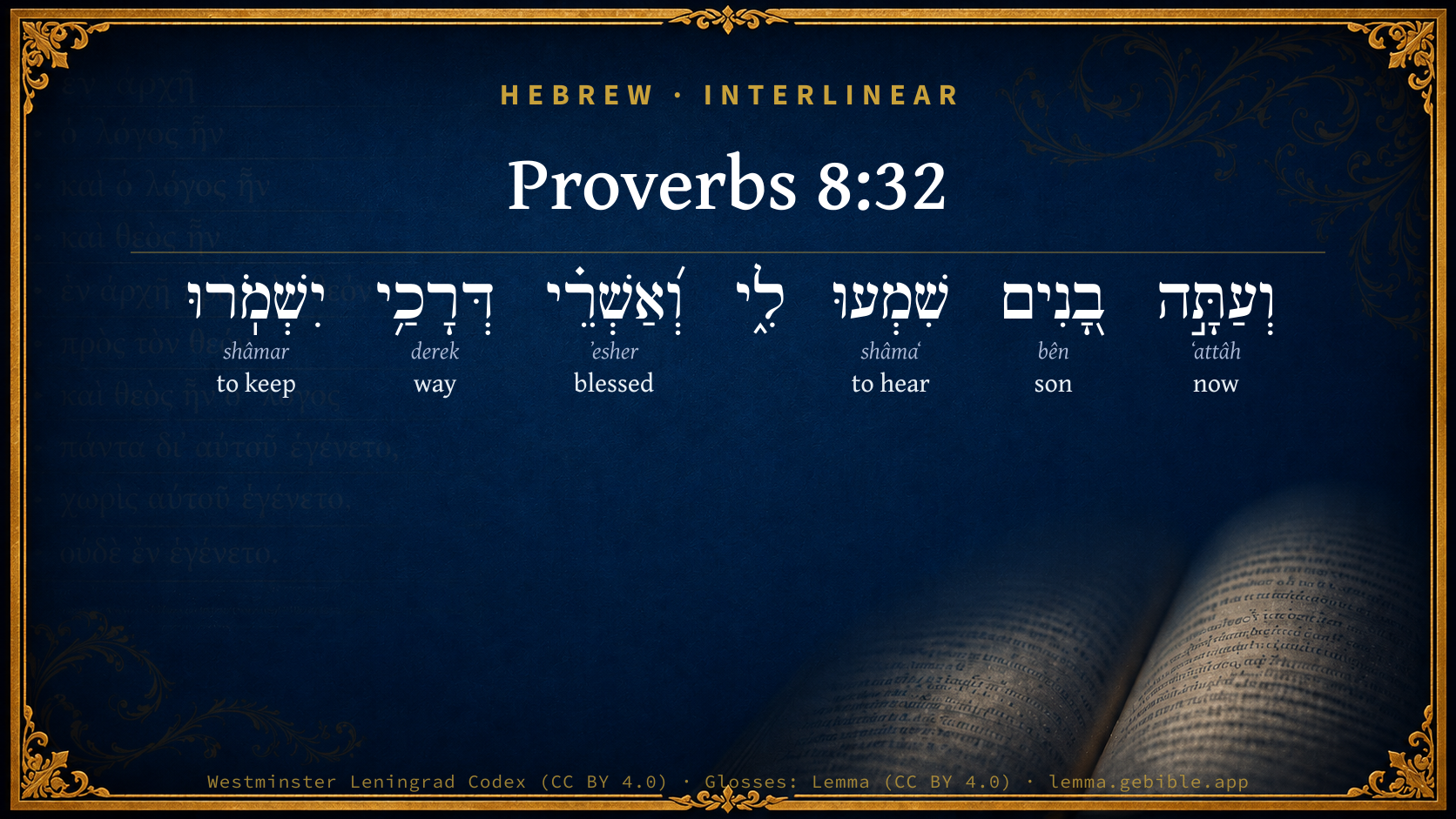
Hebrew (Westminster Leningrad Codex) Proverbs 8:32 appears in the Hebrew Old Testament. The text above is from the Westminster Leningrad Codex. Each word links to its Strong’s number, a concise gloss, and parsing drawn from the Open Scriptures Hebrew Bible morphology. Click any word for its full Brown-Driver-Briggs (BDB) entry.
Download image
Cite this verse

Proverbs 8:32 (World English Bible). Public Domain. Lemma interlinear Bible study tool, https://lemma.gebible.app/v/proverbs/8/32.

Show BibTeX & RIS
BibTeX
RIS
English Translation
"Now therefore, my sons, listen to me, For blessed are those who keep my ways.
World English Bible · Public Domain
Download a study sheet

One document with this verse’s original text, its word-by-word gloss line, the meaning frame, cross-references with their text, attributed commentary, and full source and license credits — printable, and it pastes into notes with its structure intact.

This verse Autodidact and up

Study sheet (.html) Plain text (.txt)

A passage Seminary Student

Up to 50 verses in one chapter. A passage sheet keeps up to 6 commentary sources and 12 cross-references per verse, in the order this page ranks them, and says so on the sheet whenever that leaves anything out. Ask for a single verse and you get the Autodidact verse sheet above.

Everything on this page stays free to read, with no account — the sheet is a download of what is already on screen, not access to it.

Want to remove ads? Support Godless Engineer
Compare translations 3

The same verse in 3 English versions, stacked beneath the original-language interlinear above. Click any original word for its lexicon entry.

Each is an independent rendering of the whole verse — the interlinear is not word-aligned to these translations.

Highlighted words mark where these versions differ — a whole-verse word diff, not a word-by-word alignment.

  • World English Bible Public Domain
    "Now therefore, my sons, listen to me, For blessed are those who keep my ways.
  • King James Version Public Domain
    Now therefore hearken unto me, O ye children: for blessed are they that keep my ways.
  • unfoldingWord Literal Text CC BY-SA 4.0
    And now, sons, listen to me, and happy they keep my ways.

unfoldingWord Literal Text — © unfoldingWord, licensed CC BY-SA 4.0. Word-aligned USFM3 via Door43 (git.door43.org/unfoldingWord/en_ult).

Versions to compare (up to 4)

3 of 4 selected

Show all 18 translations

Every available English version of this verse, each an independent rendering of the whole verse.

  • World English Bible Public Domain
    "Now therefore, my sons, listen to me, For blessed are those who keep my ways.
  • Berean Standard Bible Public Domain
    Now therefore, my sons, listen to me, for blessed are those who keep my ways.
  • Majority Standard Bible Public Domain
    Now therefore, my sons, listen to me, for blessed are those who keep my ways.
  • King James Version Public Domain
    Now therefore hearken unto me, O ye children: for blessed are they that keep my ways.
  • American Standard Version (1901) Public Domain
    Now therefore, `my' sons, hearken unto me; For blessed are they that keep my ways.
  • Revised Version (1885) Public Domain
    Now therefore, my sons, hearken unto me: for blessed are they that keep my ways.
  • Geneva Bible (1599) Public Domain
    Therefore nowe hearken, O children, vnto me: for blessed are they that keepe my wayes.
  • Douay-Rheims (1899) Public Domain
    Now therefore, ye children, hear me: Blessed are they that keep my ways.
  • Young's Literal Translation Public Domain
    And now, ye sons, hearken to me, Yea, happy are they who keep my ways.
  • Literal Standard Version CC BY-SA 4.0
    And now, you sons, listen to me, || Indeed, blessed are they who keep my ways.
  • Unlocked Literal Bible CC BY-SA 4.0
    Now, my sons, listen to me, for those who keep my ways will be blessed.
  • unfoldingWord Literal Text CC BY-SA 4.0
    And now, sons, listen to me, and happy they keep my ways.
  • Darby Bible Public Domain
    And now, sons, hearken unto me, and blessed are they that keep my ways:
  • World Messianic Bible Public Domain
    “Now therefore, my sons, listen to me, for blessed are those who keep my ways.
  • Webster's Bible Public Domain
    Now therefore hearken to me, O ye children: for blessed are they that keep my ways.
  • Free Bible Version CC BY-SA 4.0
    And now, my sons, listen to me, for happy are those who follow my ways.
  • Bible in Basic English Public Domain
    Give ear to me then, my sons: for happy are those who keep my ways.
  • JPS Tanakh (1917) Public Domain
    Now therefore, ye children, hearken unto me; for happy are they that keep my ways.

Literal Standard Version (2020), Covenant Press — licensed CC BY-SA 4.0. Text via the HelloAO Bible API (eBible.org). Unlocked Literal Bible (unfoldingWord) — licensed CC BY-SA 4.0. Text via the HelloAO Bible API (eBible.org). unfoldingWord Literal Text — © unfoldingWord, licensed CC BY-SA 4.0. Word-aligned USFM3 via Door43 (git.door43.org/unfoldingWord/en_ult). Free Bible Version, Dr. Jonathan Gallagher — licensed CC BY-SA 4.0. Text via the HelloAO Bible API (eBible.org).

Word by word

More ways to search: Search by grammar → Find every occurrence → Compare this word →

Practice this passage: Drill this verse → Learn its vocabulary →

About this verse

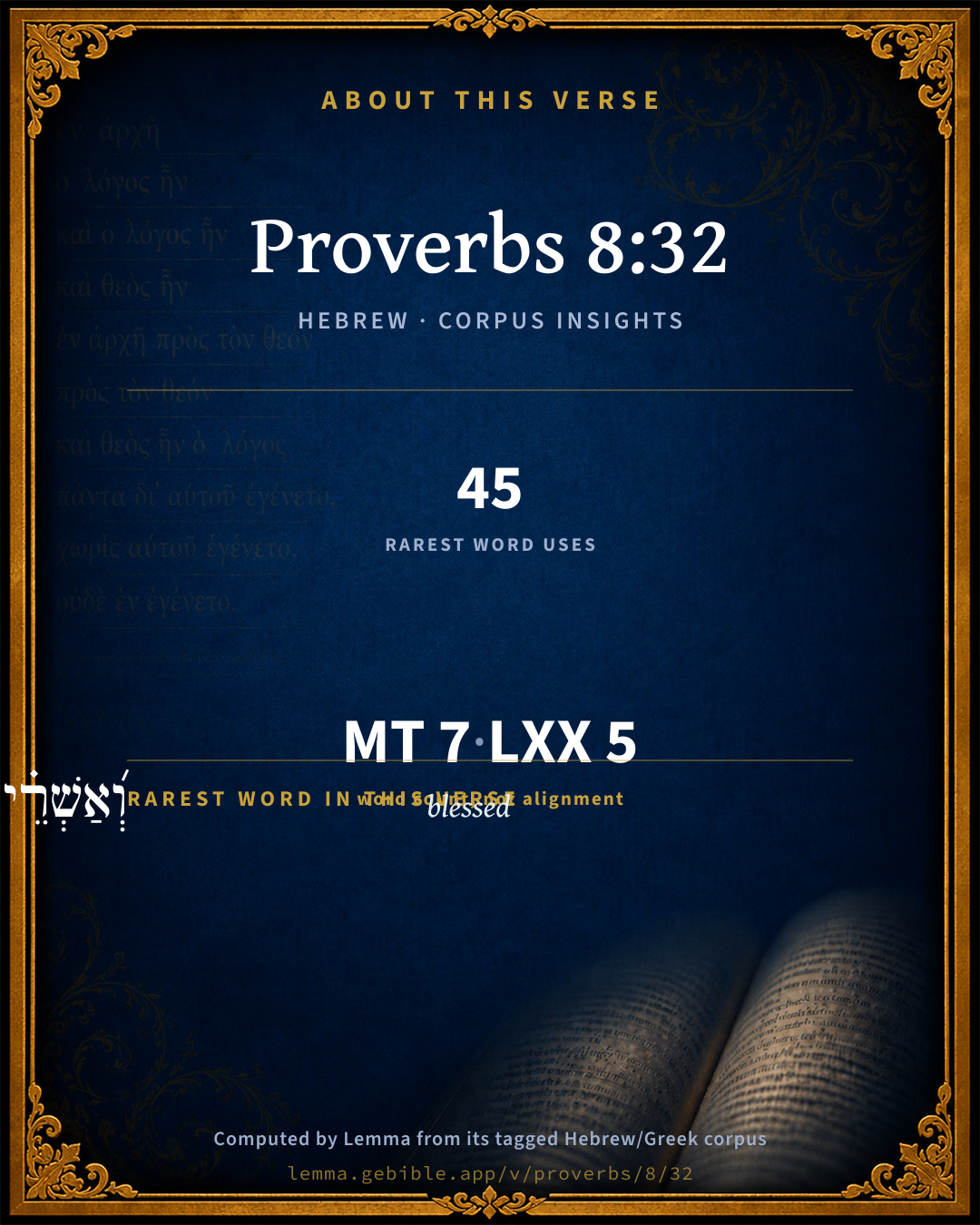
These counts appear in no published source. They are computed here, from the morphology-tagged text and Lemma’s own curated glosses. What Lemma adds →

7
words
6
distinct lemmas
Wisdom
section

Shared distinctive vocabulary

וְ֝אַשְׁרֵ֗י blessed H835 occurs in 42 verses of the Hebrew Bible. Also found in:

Grammatical profile

  • 2 verbs
  • 3 nouns
  • 1 preposition
  • 1 adverb

Verb forms

  • שִׁמְעוּ Qal · Imperative
  • יִשְׁמֹֽרוּ Qal · Imperfect

Hebrew & Septuagint length

In English translation the verse runs 15 words from the Hebrew and 23 from the Septuagint (LXX English) — the Septuagint runs noticeably longer here. See the side-by-side →

A rough comparison of the two English renderings, which tokenize alike — not a word-level alignment.

Word counts can differ between the Hebrew and the Greek without any difference in meaning — e.g. the Hebrew direct-object marker אֵת has no separate Greek word, and Greek often adds the article ὁ.

In the original languages it is 7 Hebrew tokens and 5 Greek tokens — but the two are counted differently (Hebrew bundles its prefixes and suffixes into one token; the Greek is in lemma form), so that isn’t a like-for-like length.

Cross-references

6

Topical passages linked to Proverbs 8:32 in the Treasury of Scripture Knowledge — connected by theme and wording, ordered by reader-vote popularity; previews shown in the World English Bible.

  • Luke 11:28 But he said, "On the contrary, blessed are those who hear the word of God, and keep it."
  • Psalms 119:1–2 Blessed are those whose ways are blameless, Who walk according to Yahweh's law.
  • Psalms 1:1–4 Blessed is the man who doesn't walk in the counsel of the wicked, Nor stand in the way of sinners, Nor sit in the seat of scoffers;
  • Psalms 128:1 Blessed is everyone who fears Yahweh, Who walks in his ways.
  • Proverbs 5:7 Now therefore, my sons, listen to me. Don't depart from the words of my mouth.
  • Proverbs 7:24 Now therefore, sons, listen to me. Pay attention to the words of my mouth.

Cross-references courtesy of OpenBible.info (CC BY 4.0).

Hebrew and Greek witnesses Masoretic Hebrew ↔ Greek Septuagint

The same verse in the two great witnesses to the Old Testament, shown verse-for-verse.

Here the Septuagint runs noticeably longer than the Hebrew — LXX2012 (modern English Septuagint) 23 words vs World English Bible 15. A rough length comparison of the two English translations, not a word-level alignment — read both below.

These are two independent witnesses, not word-aligned to each other, and the Septuagint is shown in lemma (dictionary) form.

Hebrew Proverbs 8:32 Masoretic · Westminster Leningrad Codex

וְעַתָּ֣ה בָ֭נִים שִׁמְעוּ לִ֑י וְ֝אַשְׁרֵ֗י דְּרָכַ֥י יִשְׁמֹֽרוּ

"Now therefore, my sons, listen to me, For blessed are those who keep my ways.

World English Bible · Public Domain

Greek LXX Proverbs 8:32 Septuagint · lemma form

νῦν οὖν υἱός ἀκούω ἐγώ

Now then, my son, hear me: blessed is the man who shall listen to me, and the mortal who shall keep my ways;

LXX2012 (modern English Septuagint) · Public Domain

On this verse, The Pulpit Commentary discusses the Septuagint’s reading. Read the note in Commentary ↓

Hebrew: Westminster Leningrad Codex (CC BY 4.0). Greek: Septuagint (public domain); English from LXX2012 (modern English Septuagint) (Public Domain). How the Septuagint differs from the Hebrew →

Commentary

Notes on Proverbs 8:32 from classic Christian and Jewish commentators (each source and its license shown beneath its notes). The classic Christian expositions comment on the surrounding passage and are grouped to its opening verse, so a note may address several verses; the Jewish commentaries on the Tanakh (Rashi and others) are per-verse, so they appear only where the commentator wrote on this verse.

Lemma curates 59 commentaries, every one of them public domain or Creative Commons licensed, each selected and text-cleaned for this edition rather than reprinted as found. About our sources →

Matthew Henry's Commentary

We have here the application of Wisdom's discourse; the design and tendency of it is to bring us all into an entire subjection to the laws of religion, to make us wise and good, not to fill our heads with speculations, or our tongues with disputes, but to rectify what is amiss in our hearts and lives. In order to this, here is,

I. An exhortation to hear and obey the voice of Wisdom, to attend and comply with the good instructions that the word of God gives us, and in them to discern the voice of Christ, as the sheep know the shepherd's voice.

1. We must be diligent hearers of the word; for how can we believe in him of whom we have not heart? "Hearken unto me, O you children!" Pro 8:32. "Read the word written, sit under the word preached, bless God for both, and hear him in both speaking to you." Let children age, and what they hearken to then, it is likely, they will be so seasoned by as to be governed by all their days. Let Wisdom's children justify Wisdom by hearkening to her and show themselves to be indeed her children. We must hear Wisdom's words, (1.) Submissively, and with a willing heart (Pro 8:33): "Hear instruction, and refuse it not, either as that which you need not or as that which you like not; it is offered you as a kindness, and it is at your peril if you refuse it." Those that reject the counsel of God reject it against themselves, Luk 7:30. "Refuse it not now, lest you should not have another offer." (2.) Constantly, and with an attentive ear. We must hear Wisdom so as to watch daily at her gates, as beggars to receive an alms, as clients and patients to receive advice, and to wait as servants, with humility, and patience, and ready observance, at the posts of her doors. See here what a good house Wisdom keeps, for every day is dole-day; what a good school, for every day is lecture-day. While we have God's works before our eyes, and his word in our hand, we may be every day hearing Wisdom, and learning instruction from her. See here what a dutiful and diligent attendance is required of all Christ's disciples; they must watch at the gates. [1.] We must lay hold on all opportunities of getting knowledge and grace, and must get into, and keep in, a constant settled course of communion with God. [2.] We must be very humble in our attendance on divine instructions, and be glad of any place, even the meanest, so we may but be within hearing of them, as David, who would gladly be a door-keeper in the house of God. [3.] We must raise our expectations of these instructions, and hearken to them with care, and patience, and perseverance, must watch and wait, as Christ's hearers, that hanged on him to hear him, as the word in the original is (Luk 19:48) and (Luk 21:38) came early in the morning to hear him.

2. We must be conscientious doers of the work, for we are blessed only in our deed. It is not enough to hearken unto Wisdom's words, but we must keep her ways (Pro 8:32), do every thing that she prescribes, keep within the hedges of her ways, and not transgress them, keep in the tracks of her ways, proceed and persevere in them. "Hear instruction and be wise; let it be a means to make you wise in ordering your conversation." What we know is known in vain if it do not make us wise, Pro 8:33.

II. An assurance of happiness to all those that do hearken to Wisdom. They are blessed, Pro 8:32, and again Pro 8:34. Those are blessed that watch and wait at Wisdom's gates; even their attendance there is their happiness; it is the best place they can be in. Those are blessed that wait there, for they shall not be put to wait long; let them continue to knock awhile and it shall be opened to them. They are seeking Wisdom, and they shall find what they seek. But will it make them amends if they do find it? Yes (Pro 8:35): Whoso finds me finds life, that is, all happiness, all that good which he needs or can desire. He finds life in that grace which is the principle of spiritual life and the pledge of eternal life. He finds life, for he shall obtain favour of the Lord, and in his favour is life. If the king's favour is towards a wise son, much more the favour of the King of kings. Christ is Wisdom, and he that finds Christ, that obtains an interest in him, he finds life; for Christ is life to all believers. He that has the Son of God has life, eternal life, and he shall obtain favour of the Lord, who is well-pleased with all those that are in Christ; nor can we obtain God's favour, unless we find Christ and be found in him.

III. The doom passed upon all those that reject Wisdom and her proposals, Pro 8:36. They are left to ruin themselves, and Wisdom will not hinder them, because they have set at nought all her counsel. 1. Their crime is very great; they sin against Wisdom, rebel against its light and laws, thwart its designs, and by their folly offend it. They sin against Christ; they act in contempt of his authority, and in contradiction to all the purposes of his life and death. This is construed into hating Wisdom, hating Christ; they are his enemies, who will not have him to reign over them. What can appear worse than hating him who is the centre of all beauty and fountain of all goodness, love itself? 2. Their punishment will be very just, for they wilfully bring it upon themselves. (1.) Those that offend Christ do the greatest wrong to themselves; they wrong their own souls; they wound their own consciences, bring a blot and stain upon their souls, which renders them odious in the eyes of God, and unfit for communion with him; they deceive themselves, disturb themselves, destroy themselves. Sin is a wrong to the soul. (2.) Those that are at variance with Christ are in love with their own ruin: Those that hate me love death; they love that which will be their death, and put that from them which would be their life. Sinners die because they will die, which leaves them inexcusable, makes their condemnation the more intolerable, and will for ever justify God when he judges. O Israel! thou hast destroyed thyself.

Matthew Henry's Commentary on the Whole Bible (1708–1710) — public domain (CC PDM 1.0). Text via the HelloAO Bible API.

The Cambridge Bible for Schools and Colleges

gen. ed. J. J. S. Perowne

Pro_8:32-36. The consequent Appeal of Wisdom

32. Now, therefore] Because I give, and am, all this; and because in and from their first creation my delight was and is with the sons of men.

O ye children] Rather, my sons, R.V.

The Cambridge Bible for Schools and Colleges (gen. ed. J. J. S. Perowne; Cambridge University Press, 1878–1918) — public domain. Text from a community e-Sword module.

Trapp's Complete Commentary

John Trapp

Pro 8:32 Now therefore hearken unto me, O ye children: for blessed [are they that] keep my ways.

Ver. 32. Now therefore hearken unto me.] Audite senem iuvenes, said Augustus to his seditious soldiers, and had audience: and shall not wisdom, that is so ancient, as before the creation, so eminent, as to make and conserve a world, so gracious with the Father, shall not she be hearkened to?

For blessed are they.] And blessedness is the mark that every man shoots at.

John Trapp, A Commentary or Exposition upon All the Books of the Old and New Testament (1647–1656) — public domain. Text from a community e-Sword module.

The Biblical Illustrator

Joseph S. Exell

Pro_8:32

Blessed are they that keep My ways.

The claims of Divine Wisdom

I. These are very simple.

1. Diligently study its counsels.

2. Constantly obey its precepts. The teachings of Divine Wisdom arc not speculative, but regulative. They are maxims to rule the life.

II. Very important.

1. Obedience to them is happiness.

2. To neglect them is ruin. (David Thomas, D. D.)

The Biblical Illustrator, edited by Joseph S. Exell (c. 1880s–1900s) — public domain. Text from a community e-Sword module.

Joseph Benson's Commentary

Pro 8:32-35. Now therefore hearken, &c. — Seeing I have a true love to you, and seeing I am so thoroughly acquainted with my Father’s mind, and so excellently qualified to be your Counsellor and Ruler; hear instruction and be wise — Hearken, I beseech you, and yield to the voice of your own reason, and of God’s holy word; and refuse not — Hebrew, ואל תפרעו, et non abstrahite vos, and do not withdraw yourselves: be so wise and considerate as not to decline hearing, receiving, and obeying it; do not, in any way, reject or slight it. But rather invite such instructions, by giving them thankful entertainment, and going thither where you may meet with them. For blessed is the man that heareth me — Who not only hearkens obediently when he is told his duty, but makes it his business to be rightly informed; watching daily at my gates — Neglecting no opportunity, but constantly and diligently attending there where he may be taught how he ought to live; waiting at the posts of my doors — As servants, and clients, and others wait at the doors of princes, or persons eminent for place, power, or wisdom, that they may be admitted to speak to, or converse with them. Whoso findeth me findeth life — The wisdom here intended, when attained, is the life, salvation, and happiness of men. Christ, the Wisdom and Word of God incarnate, to whom all these attributes agree perfectly, is peculiarly so. But he must be found; that is, known, believed in, loved, and obeyed; he must be revealed to and in us.

Joseph Benson's Commentary on the Old and New Testaments (1811–1818) — public domain. Text from a community e-Sword module.

Whedon's Commentary on the Bible

Daniel D. Whedon

BLESSEDNESS RESULTING FROM ATTENDING TO THE INSTRUCTIONS OF WISDOM, Pro_8:32-36.

32, 33. Now therefore — Considering all these preceding things.

Ye children — Compare Pro_4:1; Pro_5:7; Pro_7:24; Pro_8:32. The old exhortation returns now with a new force. The counsels are no longer those of prudence, calculation, human experience; but that of a wisdom wide as the universe, eternal as Jehovah, ordering all things.

Refuse it not — Do not let it go.

Daniel D. Whedon (gen. ed.), Commentary on the Old and New Testaments (1874–1909) — public domain. Text from a community e-Sword module.

The Preacher's Complete Homiletical Commentary

Joseph S. Exell (gen. ed.)

CRITICAL NOTES.—

Pro_8:36. Sinneth against, “misseth,” so Stuart, Delitzsch, and Miller.

MAIN HOMILETICS OF THE PARAGRAPH—Pro_8:32-36

EXHORTATION FOUNDED ON HUMAN OBLIGATIONS TO DIVINE WISDOM

I. Because Christ, the Eternal Wisdom, has manifested His sympathy with man, we are under obligations to come into sympathy with Him. A man who has manifested his sympathy with, and delight in, another’s welfare by most substantial acts of benevolence and self-denial, has taken the most reasonable method of awakening an answering sympathy in the breast of him whom he has thus regarded. And the obligation on the part of the recipient is increased in proportion to the amount of self-sacrifice undergone on his behalf. If such a benefactor desires and asks for the friendship of him whom he has befriended, it would seem impossible that such an appeal could be made in vain. The eternal wisdom of God has gone to the utmost of even His infinite capacity of self-denial to show His delight in, and regard for the human race. This, coupled with His eternal existence and His almighty power, is here made the basis of an exhortation to men to listen to His words, “Now, therefore, hearken unto me, O ye children!”

II. Those who are thus drawn into sympathy with Eternal Wisdom come under conditions of life. Here is a repetition of an oft-repeated truth of revelation, that life and God’s favour are inseparable—identical (Pro_8:35). We can see shadows of this truth in the intercourse of men with their fellow-creatures. If a poor outcast child, surrounded by influences of evil to which he must yield if left to fight them single-handed, is lifted out of his degradation into a godly home, the favour of the friend who thus raises him changes his miserable existence into something worth calling life in comparison. The child who, by wilfulness, has forfeited the favour of a good parent, feels his entire existence clouded, but forgiveness through reconciliation brings light and life back to his spirit. The favour, therefore, of a fellow-creature is sometimes, by comparison, life. How much more is it so when we come into sympathy with Christ by hearkening to His voice and taking His yoke, and are by Him lifted out of a life of bondage to sin into the glorious liberty of the sons of God.

III. Those who refuse thus to come into sympathy with Eternal Wisdom are self-destroyers, because they are God-haters. He who refuses to drink of the Fountain of Life, must, of necessity, be left to soul-death. There is nothing that gives more sorrow to a human being than to know that the evil from which he is suffering is self-inflicted. If a man loses his sight through a wound which he receives from another, although he feels his blindness to be a terrible calamity, it lacks the element of bitterness which would be added to it if it had been brought about by his own wilfulness. The man who loses a limb in lawful battle looks upon his loss as an honour, because it was inevitable. But his feeling would be very different if he knew that he had been crippled for life by his own folly. It will be the main ingredient in the bitter cup of those who disregard the invitations of Divine Wisdom that they are moral suicides. The consciousness of this is a perpetual hell to the human spirit. And the mere neglect is sufficient to give the death-blow. It is not necessary to be in positive opposition to God and goodness. Not to listen is to refuse. Not to wait on God is to sin against Him—is to despise the provisions of His mercy.

ILLUSTRATION OF Pro_8:34

Hovering about the avenues of a royal residence, there are in Eastern as well as in other countries, always to be seen groups of people, some of whom are attracted by the impulse of curiosity, others by the hope of obtaining some mark of royal favour. The assiduity and perseverance requisite for succeding in their suit, and waiting the propitious moment of presenting themselves in the presence of their sovereign, is not, as may be easily supposed, at all times consistent with personal ease and convenience, and, accordingly, here and there may be observed individuals seated upon a stone, or reclining upon the grass, in anxious expectation for the appearance of the sovereign on his way to daily exercise. To sit at the gates of a king is a custom of great antiquity.—Paxton’s Illustrations of Scripture.

OUTLINES AND SUGGESTIVE COMMENTS

Pro_8:32. O sweet courtesy! as if it were but a small matter that the Eternal Wisdom should become our Master, and teach us as His scholars; or that, being our Lord, He should teach us as His servants; or that, being God, He should teach us as men; yet greater is His love, and, as a Father, He teacheth us as His children. And well may He call us His children, for it is He that teacheth us who, by adoption, hath made us to be His children, which by hearkening unto Him we show ourselves to be.—Jermin.

Pro_8:34. Uriah watched at David’s gate as a token of service (2Sa_11:9). Lazarus watched at Dives’ gate as a token of dependence (Luk_16:20). Courtiers at royal entrances for smiles of favour. Let the sinner do all these things.—Miller.

Not watching awhile, and then going away if they be not let in presently, but waiting patiently till they be let in. Not only taking occasion of learning offered, but waiting to find occasions, as petitioners wait on great men till their causes be ended.—Francis Taylor.

Wisdom here appears as a sovereign, separate and secluded, in the style of Oriental monarchs, so that only those know anything of her who diligently keep watch at her doors. Wisdom, who is universal in her call and invitation (Pro_8:1-3), yet, in the course of communication, in order to test the fidelity of her admirers, veils herself at times in a mysterious darkness, and reveals herself only to those who never intermit their search (Mat_7:7).—Von Gerlach, in Lange’s Commentary.

There ought to be an expectation raised in us that the vital savour diffused in and by the Word may reach us; and many are ruined for not expecting it—not waiting at the posts of Wisdom’s door.—John Howe.

Pro_8:35.

1. Natural life is found by it, not in regard of the beginning of it, but in regard of the comfort and continuance.

2. Spiritual life, or the life of grace. Wisdom is the life of the soul, and what were the world worth if there were no light?

3. Eternal life, or the life of glory. This is indeed the life that Christ, the wisdom of God, died to purchase for us, and lived among us to show us the way to it.—Francis Taylor.

Pro_8:36. Doing without is a stupid misery; but hating wisdom is an insane marvel.—Miller.

Not to love and earnestly seek Wisdom is to sin against her. To disregard her is to hate her, and is virtually, though unconsciously, to love death: for it is loving things, which as being opposed to wisdom, bring with them death.—Fausset.

What meaneth this all, where one would think there could be none? Can there be an all to hate Him who loveth all that is? But if it were not so, why do so many resist His holy will, despise His heavenly laws, rebel against His sacred pleasure? Are not these effects of hatred? Besides, so doth He challenge the all of our affection, as not to hate all things for His sake, is to hate Him. Now they that hate Him, what can they love? Surely it must needs be death, because in all things else He is. But that is the fruit of sin, and they that love the tree must needs love the fruit also. But to whom do we speak these things, or why do we speak them? Where shall we find open ears, or seeing eyes, when now almost men care not whom they look after, so that they do not look after themselves?—Jermin.

A child or an idiot may kindle a fire which all the city cannot quench. In spite of their utmost efforts, it might destroy both the homes of the poor and the palaces of majesty. So a sinner, though he cannot do the least good, can do the greatest evil. The Almighty only can save him, but he can destroy himself.—Arnot.

Sin a self-injury. There are three facts implied in these words: Firstly, That man is capable of sinning. This capability distinguishes man from the brute, and belongs to all moral beings.… It is our glory that we can sin; it is our disgrace and ruin that we do. Secondly, That sin is something directed against God. All the laws of man’s being—physical, organic, intellectual, and moral—are God’s laws, and violation of them is rebellion against heaven. Thirdly, That sin against God is a wrong done to our nature. This is true of all sin, physical as well as spiritual. We cannot violate the laws of physical health, without losing at the same time something of the life, elasticity, and vigour of the mind. That sin injures the soul admits of no debate: it is a patent fact written on every page of history, and proclaimed by the deep consciousness of humanity. From this unquestionable fact we may fairly deduce three general truths. I. That God’s laws are essentially connected with the constitution of man. From this fact two things follow.

(1.) That all sin is unnatural.

(2.) That an evasion of the penalties of sin is beyond the power of the creature. II. That God’s laws are the expression of benevolence. We wrong our souls by not keeping God’s laws. Obedience to them is happiness. The voice of all Divine prohibitions is, “Do thyself no harm,” the voice of all Divine injunctions is, “Rejoice evermore.” We infer from this fact—III. That God’s laws should be studiously obeyed.

(1.) Right requires it. All God’s laws are righteously binding upon the subject, and disobedience is a crime.

(2.) Expediency requires it. A life of sin is a life of folly, for it must ever be a life of misery.—Dr. David Thomas.

Pro_8:30-36. I. From the beginning the welfare of man engaged the complacent regard of God our Saviour. He derived delight from the material creation because it was to be subservient to man. II. We may therefore expect that all His communications and intercourse with us would be made to harmonise with our welfare also. We are warranted in expecting that all His communications with us will harmonise with the wants of our nature—that the means will be adapted to the end. Accordingly Pro_8:35-36 imply that so perfect is the adaptation between the provisions of mercy and the necessity of man, that he who rejects them wrongs his own soul, that who receives them receives life. III. May we not infer that, even of this habitable part, He would rejoice in some spots more than in others, especially in such as are set apart for the diffusion of His truth and the promotion of His designs.—Dr. J. Harris.

The Preacher's Complete Homiletical Commentary (gen. ed. Joseph S. Exell; Funk & Wagnalls, c. 1892) — public domain (pre-1929). A full-Bible homiletical/sermon-outline anthology covering 65 of 66 books (2 John is absent from the source module). Text from a community e-Sword module.

Tyndale Open Study Notes

Tyndale Open Resources

8:32-36 Wisdom offers great rewards to those who listen to and follow wisdom.

Tyndale Open Study Notes — © Tyndale Open Resources, licensed CC BY-SA 4.0. Text via the HelloAO Bible API.

Jamieson, Fausset & Brown

Robert Jamieson, A. R. Fausset & David Brown

Such an attribute men are urged to seek.

Jamieson, Fausset & Brown — Commentary Critical and Explanatory on the Whole Bible (1871) — public domain (CC PDM 1.0). Text via the HelloAO Bible API.

Adam Clarke's Commentary

Verse 32. Now therefore] Since I delight so much in conveying instruction; since I have the happiness of the children of Adam so much at heart, hearken unto me; and this is for your own interest, for blessed are they who keep my ways.

Adam Clarke's Commentary on the Bible (1810–1826) — public domain. Text from a community e-Sword/MySword module.

Ellicott's Commentary for English Readers

(32) Now therefore hearken—i.e., now that ye know how great my power is, and what love I have to you, in that I rejoice in you, and call you my sons. (Comp. 1Jn_3:1.)

A Bible Commentary for English Readers, edited by Charles John Ellicott (1878–1897) — public domain. Text from a community e-Sword module.

John Gill's Exposition

Now therefore hearken unto me, O ye children,.... Children of his and his Father, with whom his delights were; predestinated to the adoption of children; children of the covenant and promise, given to him as such in the covenant; for whom he became man, suffered and died, to gather together regenerated ones, by which they appear to be the children of God: these Wisdom here addresses in the most affectionate manner; Christ, having finished the account and description of himself, reassumes his former exhortation, Pro 8:5; and enforces it by the several particulars in the above description. From the consideration of his wisdom, riches, eternity, nearness to God, and his delights with men, he exhorts them to "hearken" to him, to his voice in the Gospel, and to what he says there; such who see themselves lost and perishing, the hungry and thirsty, the naked and weary, the disconsolate and afflicted, the poor and indigent; and also to his voice in his precepts and commands, to embrace his doctrines, and submit to his ordinances;

for blessed are they that keep my ways; it is a happiness to be in the ways of Christ, to be kept in them, and to keep them; Christ has promised and does vouchsafe his presence in them; there is a pleasure enjoyed in observing them; and though not for keeping, yet in keeping Christ's commands, there is great reward, Psa 19:11.

John Gill's Exposition of the Whole Bible (1746–1763) — public domain (CC PDM 1.0). Text via the HelloAO Bible API.

Albert Barnes' Notes on the Bible

The old exhortation with a new force. The counsels are no longer those of prudence and human experience, but of a Wisdom eternal as Yahweh, ordering all things.

Albert Barnes' Notes on the Bible (1834–1885) — public domain. Text from a community e-Sword/MySword module.

Matthew Poole's English Annotations

Now therefore; seeing I have such a true love to you, and seeing I am so thoroughly acquainted with my Father’s mind, and so excellently qualified to be your Counsellor and Ruler.

Matthew Poole's English Annotations on the Holy Bible (1683–1685) — public domain. Text from a community e-Sword/MySword module.

The Pulpit Commentary

Vers. 32-36. Wisdom renews the exhortation before given Pro_5:7 Pro_7:20, but now on higher, and not merely moral or social grounds. She deduces, from her Divine origin and her care for man, the lesson that she is to be sought and prized and obeyed above all things.

Now therefore having regard. to what I have revealed of myselfhearken unto me, O ye children; Septuagint, "Hear me, my son." Blessed are they that keep my ways. The expression is interjectional: "Blessings on the man! salvation to the man!" as in Pro_3:13. For the ways of Wisdom, see Pro_3:17.

Vers. 32-36. The convincing argument.

Here is a very strong, "Now, therefore." The excellency of Divine wisdom has been so forcibly, so irresistibly urged that the speaker is entitled to drive his argument home and make a practical application. But the urgency of the case is summed up in the few following sentences. This is the reasoning: since

I INATTENTION TO THE VOICE OF WISDOM IS THE DEPTH OF FOLLY. For:

1. It is self-robbery. "He that sinneth against me wrongeth his own soul" (ver. 36). The man that shuts his ears when God speaks robs himself of all those precious things which might make his heart rich and his life noble of spiritual peace, of sacred joy, of heavenly hope, of an elevating faith, of holy love, of Divine comfort, of the best forms of usefulness.

2. It is self-destruction. "All they that hate me love death" (ver. 36). To harden our heart against the invitations and warnings of Divine wisdom is to tread the path which leads straight to the gates of spiritual and eternal death.

II ATTENTION TO THE VOICE OF WISDOM IS OUR HIGHEST INTEREST.

1. It leads to "blessedness" (vers. 32, 34); it ensures that state of soul which the eternal God declares to be the only enviable one, to be that which should be the object of our earnest aspiration.

2. It secures his own Divine favour (ver. 35) the "favour of the Lord," the sunshine of his smile, the benediction of his voice; he will "lay his hand upon us" in fatherly love; he will surround us with his "everlasting arms" of powerful protection.

3. It constitutes life in its very essence and substance. "Whoso findeth me findeth life" (ver. 35). To be wise with the wisdom which is from above, to "know God and Jesus Christ whom he has sent," "to understand and know the Lord that exerciseth loving kindness, judgment, and righteousness," to have gained "the secret of the Lord," to have learnt by blessed experience "that the Lord is gracious," "to be filled with the knowledge of his will, this is life, human life at its highest, its best, its noblest. Moreover, it is that which issues in the eternal life on the other side the river, in the land where life is enlarged and ennobled far beyond the reach of our present thought. Since these things are so, "now, therefore," we conclude that

III DILIGENT DISCIPLESHIP IS THE ONLY OPEN COURSE. "Hearken," "hear instruction," "refuse it not," etc. (vers. 32-34). This includes:

1. Earnest attention, hearkening, watching, waiting. Something much more than allowing ourselves by force of custom to be found where wisdom is discoursed, "putting in an appearance" at the sanctuary. It implies an earnest heedfulness of spirit; a diligent, intelligent, patient inquiry of the soul; a hungering of the heart for the saving truth of the living God.

2. Practical obedience the ways" of wisdom (ver. 32). "If we know these things, happy are we if we do them". (Joh_13:17; see Mat_7:21-27) As earnest disciples of Jesus Christ, the way to "keep his ways" is

(1) to accept himself as our Saviour and Lord, with our whole heart;

(2) to strive daily to embody his will in all the relations we sustain. That is to say, first enter into right relation to himself, making him the Saviour of our soul, the Friend of our heart, the Lord of our life; then strive to carry out his commandments in all the transactions and relationships of our human life. C.

The Pulpit Commentary (1880–1919), ed. H.D.M. Spence-Jones & Joseph S. Exell — public domain. Text from a community e-Sword module.

Keil & Delitzsch

C. F. Keil & F. Delitzsch

After that Wisdom has shown in Pro 8:22-31 how worthy her fellowship is of being an object of desire from her mediating place between God and the world, she begins with this verse (as Pro 7:24; Pro 5:7) the hortatory (parnetische) concluding part of her discourse:

"And now, ye sons, hearken unto me,

And salvation to those who keep my ways!"

The lxx omits Pro 8:33, and obviates the disturbing element of ואשׁרי, 32b, arising from its ו, by a transposition of the stichs. But this ואשרי is the same as the καὶ μακάριος, Mat 11:6; the organic connection lies hid, as Schleiermacher (Hermeneutik, p. 73) well expresses it, in the mere sequence; the clause containing the proof is connected by ו with that for which proof is to be assigned, instead of subordinating itself to it with כּי. Such an exclamatory clause has already been met with in Pro 3:13, there אדם follows as the governed genitive, here a complete sentence (instead of the usual participial construction, שׁמרי דרכי) forms this genitive, Gesen. 123, 3, Anm. 1.

Keil & Delitzsch — Biblical Commentary on the Old Testament (1861–1891) — public domain (CC PDM 1.0). Text via the HelloAO Bible API. (Old Testament only.)

Bridges on Proverbs

Charles Bridges

Now therefore hearken. It is no mean and undeserving person that calls. It is none other than the Wisdom of God; the source of all light and knowledge (Pro 8:12-14 ); the King of kings (Pro 8:15-16 ); the loving rewarder of his children, especially of his young children (Pro 8:17 . Compare Heb 11:6 ); the rich portion and unfailing guide of his people. (Pro 8:18-19 .) Look at him once again in his Divine glory, as "the only-begotten Son of God" (Pro 8:22, Pro 8:24 ); the Mediator in the everlasting Councils of Redemption (Pro 8:23 ); the Almighty Creator of the world (Pro 8:27-30 ); the adorable Friend of sinners (Pro 8:31 ). How should his Divine Majesty and condescending love endear his instruction to us!†1 Yet his promised blessing belongs only to practical hearing — to those that keep his ways (Isa 55:2-3 . Luk 11:28 . Joh 14:21-23 . Jas 1:25 ) with godly fear, constancy, and perseverance; keeping their eye on them, their hearts towards them, their feet in them. Such are truly blessed. They choose rightly; they walk surely; they live happily; they progress honourably; they end gloriously. Is it not therefore our wisdom to hear instruction with "the obedience of faith" — not doing what he commands — (in which we may sometimes do — not his will, but our own) but doing because he commands — doing his will in it — obeying as well when it crosses our nature, as when it is more congenial with it? But for this cheerful, child-like obedience, sovereign grace must open the heart, and give the ear. (Pro 20:12, with Act 16:14 .) The guilt of refusing is inexcusable — a resolved will against the most gracious call. (Act 3:22-23 . Heb 2:1-3 .)

Now therefore, hearken, O ye children. Oh! happy moment, when the soul is made "willing in the day of his power" (Psa 110:3 ); when "the bands of love are drawing" (Hos 11:4 ) unto him! The cold, dead indifference is gone. The enmity is slain. And who will not now joyfully swear fealty; yea, count it his unspeakable delight to take such a yoke; to be bound to such a service, where there is nothing but for our good? (Deu 10:12-13 .) Oh, my Prince — my Savior! thou hast based thy dominion on thy blood. Thou hast purchased thy right by thy cross. (1Co 6:19-20 . Rom 14:9 .) Thou rulest, only that thou mightest save. Take to thyself the glory of thy victory. I am thine — not my own — for ever.

Footnotes:

†1 See how the Father manifested the glory of his Divine Son to give constraining force to his instruction. Mat 17:1-5 .

Charles Bridges, An Exposition of the Book of Proverbs (1846) — public domain. Text from a community e-Sword module.

unfoldingWord translationNotes

Door43 World Missions Community

Now

This is to focus the attention of the children to the conclusion of this lesson.

listen to me

This is still wisdom talking about herself. (See: Personification)

those who keep my ways

Here "my ways" represents wisdom's behavior. AT: "those who do what I teach" or "the people who follow my example" (See: Metaphor)

do not neglect

"do not disregard" AT: "be sure to pay attention to" or "be sure to follow" (See: Litotes)

watching every day at my doors, waiting beside the posts of my doors

These two phrases basically mean the same thing. Wisdom is described as having a home; possible meanings of "watching" are 1) a wise person waits outside wisdom's home in the morning in order to serve her, or 2) a wise person waits outside wisdom's house for her to come and teach him. (See: Parallelism)

translationWords

wise

unfoldingWord translationNotes — © Distant Shores Media and the Door43 World Missions Community, licensed CC BY-SA 4.0. Source: git.door43.org/Door43/en_tn.

Lesson kit

Teaching starters — assembled from the data on this page, not authored interpretation. Every prompt links to the verse data it draws on. Edit before teaching.

Proverbs, in the Wisdom, opens this verse with 7 words (6 distinct Hebrew lemmas). Its most distinctive word is ʼesher (“blessed”). The Greek Septuagint runs longer here. A historical commentator’s framing appears above. Read the whole chapter for the surrounding context.

Discussion questions

  1. The word ʼesher carries the sense “blessed.” How does it shape the verse?
  2. Deuteronomy 33:29 shares the word «blessed» with this verse. How do the two illuminate each other?
  3. Compared with the Hebrew, the Septuagint runs longer here. What questions does that raise?
  4. The translations on this page render this verse differently — a whole-verse word diff, not a word-by-word alignment. What might account for the different wordings?
  5. The verb «שִׁמְעוּ» is Qal Imperative. How does its form color the action?
  6. Reading how Matthew Henry's Commentary and The Cambridge Bible for Schools and Colleges read this verse, where do the two commentators agree and where do they part?

Things to notice

Reading settings

Reading text

Shown beneath each verse's original-language words.

Old Testament
Old Testament edition

Read the OT as the Masoretic Hebrew (MT) or the Greek Septuagint (LXX).

English shown for the Greek Septuagint (in the Hebrew ↔ Greek comparison).

Comparing translations? Open the Compare panel on any verse page to stack up to four side by side.