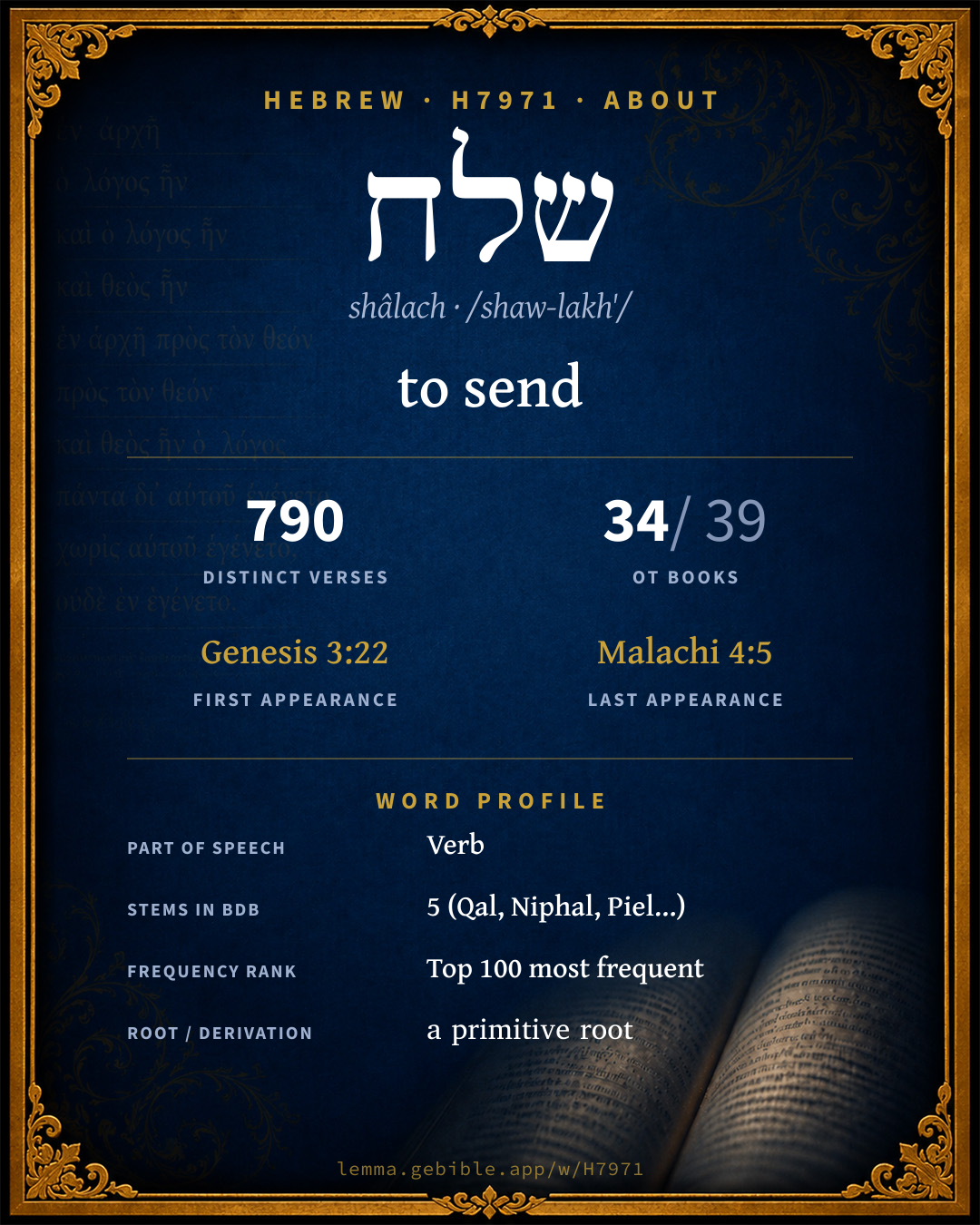
שָׁלַח
to send
also: send away, let go, stretch out fuller range ↓
Full lexicon entry — Brown-Driver-Briggs (BDB)
From Brown-Driver-Briggs (BDB)
Where this word appears
See every Pual verb in the Hebrew Bible →
Grammar key — what these labels mean
Part of speech
- Verb
- An action or state-of-being word.
- Preposition
- A relational word (e.g. “in,” “to,” “from”) governing a noun.
Stem
- Qal
- The basic, simple active stem — the plain form of the verb (“he wrote”). Here: ‘send’
- Piel
- An intensive or resultative active stem. Here: ‘send off’
- Hiphil
- The causative active stem (“he caused / brought about”).
- Pual
- The passive counterpart of the Piel.
- Niphal
- Usually the simple passive or reflexive of the Qal (“he was written”).
Form
- Sequential Imperfect
- An imperfect with prefixed waw — the standard past-narrative form (waw-consecutive imperfect).
- Perfect
- A completed action or state — Hebrew marks aspect (completeness) more than strict tense (“he wrote”).
- Sequential Perfect
- A perfect with prefixed waw continuing a preceding imperfect or command (waw-consecutive perfect).
- Participle Active
- A verbal adjective expressing ongoing or characteristic action (“writing / one who writes”).
- Infinitive Construct
- A bound verbal noun, frequently with prepositions (“to write / in writing”).
- Imperfect
- An incomplete, ongoing, or future action (“he will / would write”).
- Imperative
- A direct command (“write!”).
- Infinitive Absolute
- An unbound verbal noun, often intensifying or standing in for a finite verb.
- Participle Passive
- A verbal adjective expressing action received (“written”).
- Cohortative
- A first-person volitional form expressing wish or resolve (“let me / let us write”).
- Jussive
- A third- or second-person volitional form expressing wish or command (“let him write”).
State
- Absolute
- The independent form of a noun, not bound to a following word.
- Construct
- A noun bound to a following noun in a possessive / “of” relationship (the construct chain).
Person
- 3rd Person
- The one spoken about (“he / she / it / they”).
- 1st Person
- The speaker (“I / we”).
- 2nd Person
- The one addressed (“you”).
Gender
- Masculine
- Grammatically masculine.
- Common
- Either gender — not distinguished for this form.
- Feminine
- Grammatically feminine.
Number
- Singular
- One.
- Plural
- More than one (in Hebrew, generally three or more).
Every verse where H7971 appears in the Book of Daniel — 2 distinct verses. Click any verse to open its interlinear word-by-word view. Verse text shown in the World English Bible for context — . Each verse’s Hebrew form is shown with its reference; the English is not keyword-highlighted, since the data carries no word-level English alignment. Use “Compare translations” on any verse to read it across multiple English versions. This concordance covers the Hebrew Bible; Septuagint (Greek Old Testament) occurrences are not indexed here.
Daniel
- Daniel 10:11 שֻׁלַּ֣חְתִּי Pual pf 1cs He said to me, Daniel, you man greatly beloved, understand the words that I speak to you, and stand upright; for to you am I now sent. When he had spoken this word to me, I stood trembling.
- Daniel 11:42 וְ/יִשְׁלַ֥ח conj + Qal impf 3ms He shall stretch forth his hand also on the countries; and the land of Egypt shall not escape.
About this entry
At a glance — auto-summarized from this page’s data, not written by a person. Every figure links to its source below. This summary describes the numbers; it doesn’t interpret them.
At its core, שלח (shâlach) means “to send.” Across 5 stems, its meaning turns on the binyan (Qal, Niphal). It turns up in 790 verses across 34 books, one of the most common footprint. It first appears in Genesis 3:22. It clusters with משלוח, שלוח and שלח under a shared root. Each statement above links to its evidence; the full detail follows below.
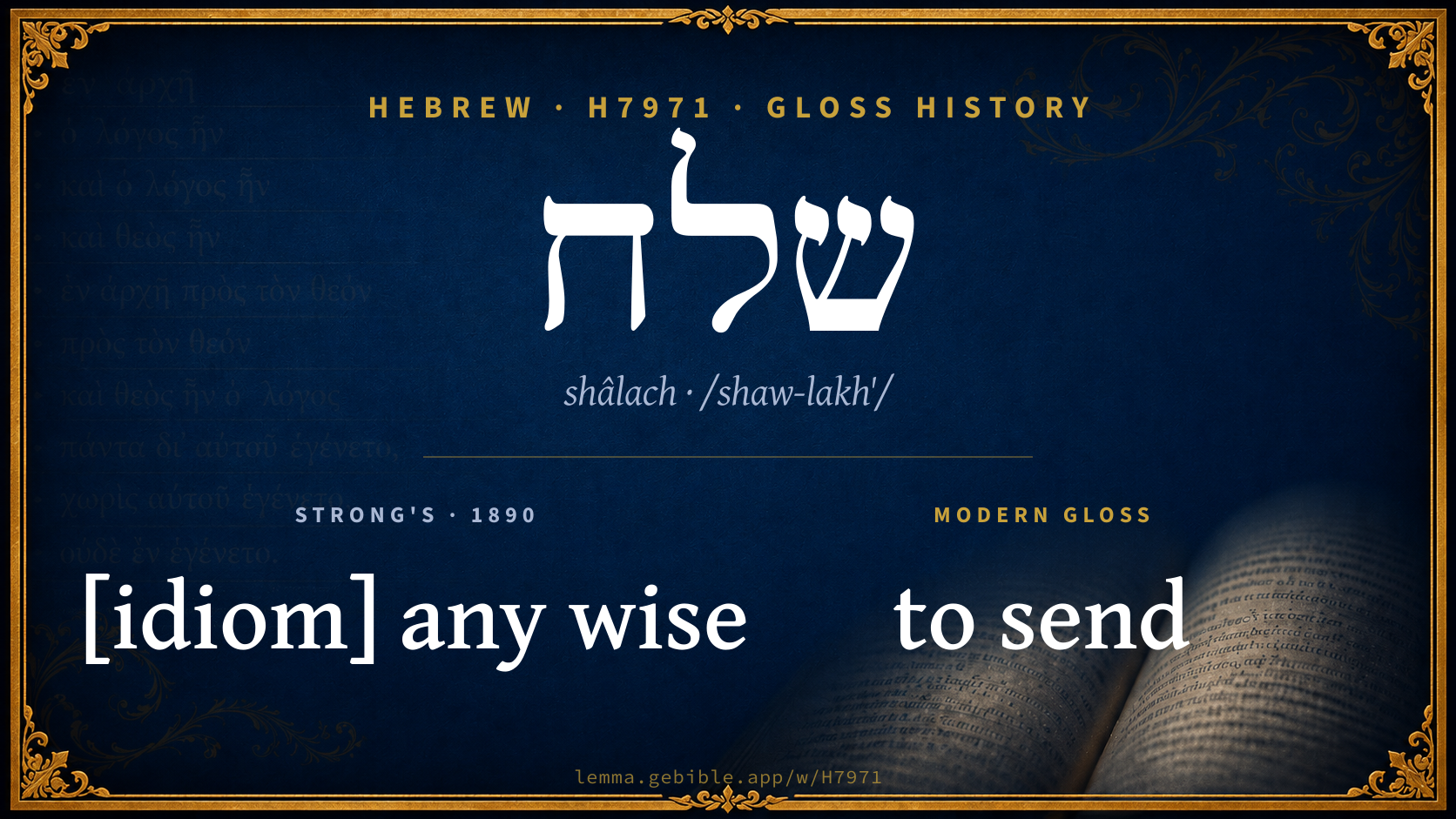
Gloss history
Strong's 1890 vs modern scholarship
About this word
Strong's H7971 catalogs a Hebrew word from the Hebrew Old Testament.
These counts are not copied from any lexicon or concordance. They are computed here, from the morphology-tagged Hebrew Old Testament. What Lemma adds →
- 790
- distinct verses
- The word appears in 790 distinct verses.
- 34 / 39
- OT books
- The word appears in 34 of 39 Old Testament books.
- #52
- by frequency
- Top 100 most frequent Hebrew words (rank 52 of 8,640 Hebrew words by occurrence).
View all 790 occurrences in the concordance →
By section of the Old Testament
By traditional corpus
Conventional, traditional groupings — biblical authorship is debated, so this is a traditional corpus grouping, not an authorship claim. Each share is this word’s portion of its verses in that division of the Hebrew canon. Each figure is a share of the word’s 790 distinct verses.
- Prophets (Nevi'im) 456 verses · 58%
- Torah (Pentateuch) 185 verses · 23%
- Writings (Ketuvim) 149 verses · 19%
How translations render this word
Counts come from each version’s own published word-to-Strong’s tagging or interlinear alignment — an approximate guide to how each version renders this word, not a word-level alignment the data otherwise carries. Because each total is that version’s own tagged count, the per-version totals vary from one another and need not match the appearance or distinct-verse counts above. These counts may also differ from a printed concordance because Lemma counts each distinctly tagged rendering and does not collapse phrase taggings into a single head-word total. This is a fixed set of word-tagged versions (KJV, ASV, BSB, ULT) and does not change with the reading translation you choose elsewhere. Each version’s license is shown beside its name below (and on Sources).
- King James Version: Sent 211×, He sent 53×, Send 35×
- American Standard Version: Sent 194×, He sent 48×, Send 35×
- Berean Standard Bible: Sent 148×, I will send 34×, Send 28×
- unfoldingWord Literal Text: Sent 176×, And 106×, He sent 69×
King James Version Public Domain
Renders H7971 across 852 tagged occurrences — most commonly:
Plus other, less common renderings. Plus 223 renderings that appear only once — usually multi-word phrases or single function words the recovered tagging swept in, not distinct renderings.
American Standard Version Public Domain
Renders H7971 across 851 tagged occurrences — most commonly:
Plus other, less common renderings. Plus 242 renderings that appear only once — usually multi-word phrases or single function words the recovered tagging swept in, not distinct renderings.
Berean Standard Bible Public Domain
Renders H7971 across 827 tagged occurrences — most commonly:
Plus other, less common renderings. Plus 253 renderings that appear only once — usually multi-word phrases or single function words the recovered tagging swept in, not distinct renderings. Not rendered by a distinct English word in 19 further occurrences.
unfoldingWord Literal Text CC BY-SA 4.0
Renders H7971 across 1,063 tagged occurrences — most commonly:
Plus other, less common renderings. Plus 170 renderings that appear only once — usually multi-word phrases or single function words the recovered tagging swept in, not distinct renderings.
35 senses and sub-senses in the full BDB
Hebrew verbs can shift meaning by stem (binyan): Qal is the basic action, Niphal is often passive or reflexive, Piel often intensifies or makes it factitive, and Hiphil is typically causative. The senses below are grouped under the stem BDB assigns to each. This entry also uses Pual (the passive of Piel).
What do BDB’s symbols mean?
BDB uses these scholarly abbreviations:
| Symbol | Meaning |
|---|---|
| 𝔊 | the Septuagint (the ancient Greek translation, LXX) |
| 𝔙 | the Vulgate (the Latin translation) |
| 𝔖 | the Syriac version (the Peshitta) |
| 𝔗 | the Targum (the Aramaic translation) |
| ψ | the Psalms |
| √ | root (the underlying root or stem) |
| ‖ | parallel passage (a synonymous or contrasted parallel) |
| † | the dagger: every passage where the word occurs is cited |
The 35 senses and sub-senses the full Brown-Driver-Briggs lexicon distinguishes for this word, in lexicon order (not ranked by frequency), with BDB’s own verbatim wording and sub-sense lettering. Shown in Hebrew script with BDB’s own scholarly abbreviations. The condensed entry is in the Lexicon Entry tab. See also the Forms in the corpus table below.
Qal
- Pf. 3 ms. שׁ׳ Gn 42:4 +, 2 ms. sf. שְׁלַחְתָּ֑נִי Ex 5:22, etc.; Impf. 3 ms. יִשְׁלַח Gn 3:22 +, 2 fpl. תִּשְׁלַ֫חְנָה Ez 23:40 (Ju 5:26 read תִּשְׁלָחֶנָּה? Ob 3 תִּשְׁלַח יָד? Ges§ 47 k); Imv. ms. שְׁלַח 1 S 20:31 +, mpl. שְׁלָ֑חוּ 2 K 2:17; Inf. abs. שָׁל(וֹ)חַ Nu 22:37 +; cstr. שְׁלֹחַ v 15 +, שְׁלַח Is 58:9, sf. שָׁלְחֶ֑ךָ Gn 38:17, etc.; Pt. act. שֹׁלֵחַ Ex 9:14 +, etc.; שָׁלוּחַ 1 K 14:6 +, etc.;— e.g. Genesis 42:4
- 1. send: human subj., especially
- a. acc. pers. Gn 42:4; 43:8 (both J; c. אֵת with, pers.) Nu 22:15 (E) + often, c. ל rei for which Je 14:3; 16:16; sq. אֶל pers. Gn 37:13 (J), 2 S 11:6; Ne 6:5 +; rarely c. ל pers. Gn 32:19 (J; pass.), אֶל loc. 2 Ch 16:4, ב loc. 1 S 11:3, acc. loc. 2 K 22:3, -ה loc. 1 K 5:28, -ה loc. + מֵעַל pers. 2 S 13:17, מִן loc. Gn 37:14 (J), Nu 13:3 (P), etc.; sq. inf. purpose 1 S 25:14 (+ מִן loc.), 2 K 1:16 Je 40:14 +, אֶל pers. c. inf. purpose 2 S 10:3; Je 42:9 +, c. ו subord. 2 K 5:6, c. vb. fin. actionis Ex 2:5 (E), sent her maid and took, +, etc. (many combinations); acc. pers. alone 24:5 (E), Jos 7:22 (E), 2 S 10:7 + often e.g. Genesis 42:4
- b. less often acc. rei (sometimes c. בְּיַד of agent), c. אֶל pers. 1 S 16:20; 2 K 5:5; 20:12 +, 1 K 5:23 (= designate by sending unto), ל pers. Ju 3:15; 1 K 5:22 +, אֶל loc. Est 1:22, שָׁ֫מָּה 2 K 6:14; + inf. purpose 1 Ch 19:4; Est 4:4; + vb. fin. action. ψ 105:28; acc. of kid, alone, Gn 38:23 also (acc. om.) v 17, etc. e.g. 1 Samuel 16:20
- c. very often without obj.: + vb. fin. action., send and do so and so, Gn 27:45 (E), 2 K 11:4; Jb 1:5 +; c. אֶל pers. Ho 5:13; 2 S 11:6 +, especially + לֵאמֹר Gn 38:25 (J), 1 K 20:5 (often S K), Je 29:28 +; c. inf. purpose Gn 32:6 (J), Nu 21:32 (J), 1 S 22:11 +, etc. (and so 1 S 31:9, reading וַיִּשְׁלְחוּ, for Pi., Th We Dr Now, not HPS Bu); abs. 2 K 2:16, 17; 2 S 14:29; = send to inquire 1 K 20:17, etc. e.g. Genesis 27:45
- 2. send: subj. י׳ (God),
- a. acc. pers. Gn 45:5 (E; לִפְנֵי pers.), 1 S 15:18 (בְּדָ֑רֶךְ), + אֶל pers. 2 S 12:1; acc. of angel, לִפְנֵי pers. Gn 24:7; Ex 33:2 (both J), אֵת with Gn 24:40 (J), etc.; c. acc. pers. = commission Ex 3:12 (E), Ju 6:14; Is 6:8; Je 14:14, 15 + often Je, Zc 2:13 +; also (c. אֶל pers.) Ex 3:13 (E), Je 25:4; Ez 3:6 +, etc.; especially of sending prophet, (שָׁלַח), הַשְׁכֵּם וְשָׁלוֹחַ Je 7:25 + (v. [שָׁכַם]); acc. pers. + inf. purpose 1 S 15:1; Je 19:14 +; + עַד loc. 2 K 2:2, acc. loc. v 4, ה—ָ loc. v 6, etc. e.g. Genesis 45:5
- b. c. acc. rei, plagues Ex 9:14 (c. אֶל־לֵב, ב pers.), fig. arrows 2 S 22:15 = ψ 18:15 (+ vb. fin. action.), ψ 144:6, cf. Je 25:16 al.; his word Is 9:7 (ב gent.), 55:11 (אשׁר to which), Zc 7:12 (ב agent.), ψ 107:20 (+ vb. fin. action.), 147:15 (+ acc. אֶרֶץ); acc. help 20:3 (מִן loc.), light and truth 43:3 (+ vb. fin. action.), cf. 57:4. e.g. Exodus 9:14
- 3. stretch out, especially acc. hand:
- a. human subj., c. ב pers. against, Gn 37:22 (E), 1 S 24:11; Est 2:21 +; c. ב rei (property of others) Ex 22:7, 10 (E), Est 9:10 +, בַּחַלָּמִישׁ Jb 28:9; c. אֶל pers. against Gn 22:12 (E), 2 S 18:12, עַל pers. 1 K 13:4, etc.; אֶל rei (for good) 2 S 6:6 (יָד om.); from outside, inward, Ct 5:4 (מִן loc.); abs. Jb 30:24 (read טֹבֵעַ for בְּעִי Di Bi Bu). + inf. purpose 1 S 22:17; 2 S 1:14; 1 Ch 13:9; + vb. fin. act. Gn 3:22 (J) Dt 25:11; Ju 15:15 +; שׁ׳ אֶצְבַּע Is 58:9, in token of scorn; c. acc. of rod 1 S 14:27; שִׁלֳחוּ מַגָּל Jo 4:13 stretch out (the) sickle. e.g. Genesis 37:22
- b. י׳ subj., acc. hand, + אֶל pers. against Ex 24:11 (E), cf. (עַל) ψ 138:7; + vb. fin. act. †Ex 3:20 (JE), 9:15 (J), Jb 1:11; 2:5; in favour, Je 1:9, abs. ψ 144:7 (מִן loc.), also (pass.) Ez 2:9 and (acc. תַּבְנִית יָד), 8:3. e.g. Exodus 24:11
- c. acc. hand, subj. angel, + acc. loc., inf. purpose 2 S 24:16, cherub, אֶל rei, מִן loc. Ez 10:7; adversary, אֶל pers. Jb 1:12; subj. angle, acc. rod Ju 6:21. e.g. 2 Samuel 24:16
- d. stretched out, slender, of tree Gn 49:21 (poem in J), v. i. אֵלָה supr. p. 18b. e.g. Genesis 49:21
- e. perhaps extend, direct, acc. rei Ez 8:17 (v. זְמוֹרָה supr. p. 274b, also conj. in Toy Krae). e.g. Ezekiel 8:17
- 4. rarely send away (v. Pi.): human subj., acc. pers. Ju 11:38 (+ acc. temp.), Gn 28:5 (P). e.g. Judges 11:38
- 5. let loose (v. Pi.), perhaps only ψ 50:19 (fig.) thy mouth hast thou let loose in evil. e.g. Psalms 50:19
Niphal
- Inf. abs. וְנִשְׁלוֹחַ סְפָרִים = letters were sent (Ges§ 114 z gg) Est 3:13 (+ אֶל pers., בְּיַד agent., inf. purpose). e.g. Esther 3:13
Piel
- Pf. 3 ms. שִׁלַּח Ex 8:28 +, sf. שִׁלַּחֲךָ 1 S 20:22, etc.; Impf. 3 ms. יְשַׁלַּח Je 3:1 +, יְשַׁלֵּ֑חַ Is 45:13; Pr 6:14; 1 s. sf. אֲשַׁלֵּחֲךָ Gn 32:27, אֲשַׁלְּחֶ֫ךָּ 2 S 11:12 1 K 20:34, etc.; Imv. ms. שַׁלַּח Ex 4:23 +, etc.; Inf. abs. Dt 22:7 1 K 11:22; cstr. שַׁלַּח Gn 8:10 +, שַׁלֵּ֑חַ Ex 7:27 +, etc.; Pt. מְשַׁלֵּחַ Gn 43:4 +, etc.;— e.g. Exodus 8:28
- 1. send off, away, human subj.:
- a. acc. pers. + ל loc. Jos 24:28 (E), Ju 7:8; 1 S 10:25 +; + ל pers. Je 48:12; + -ה loc. Ju 12:9 and (c. inf. purpose) Gn 28:6 (P); acc. of goat, לַעֲזָאזֵל Lv 16:10 (-ה loc.), v 26; send out, different ways, acc. pers., ב loc. Ju 19:29; 20:6; send into exile, י׳ subj., c. מִן loc. Je 24:5, -ה loc. 29:20. e.g. Joshua 24:28
- b. send away, dismiss, acc. pers. Gn 21:14 (E), 25:6 (J; מֵעַל pers.), 2 S 13:16 +; specif., c. acc. of wife (= divorce), Dt 22:19, 29; 24:1, 3; Je 3:1 +, abs. Mal 2:16. e.g. Genesis 21:14
- c. send away empty (-handed) רֵיקָם, + acc. pers. Gn 31:42 (E), Dt 15:13; Jb 22:9. e.g. Genesis 31:41
- d. send off, give a ‘send-off’ (sometimes escort part way), acc. pers., Gn 18:16; 24:59; 31:27 (all J), 1 S 9:26; 2 S 19:32; 2 K 5:24; 6:23; Ob 7. e.g. Genesis 18:16
- e. acc. rei 1 S 6:8 Ne 8:12 +, c. acc. loc. 1 S 5:10; 6:3, אֶל pers. Je 27:3, etc. e.g. 1 Samuel 6:8
- 2.
- a. send away, subj. י׳, acc. pers. Gn 19:29 (J; מִתּוֹךְ), 1 K 9:7 (מֵעַל פְּנֵי). e.g. Genesis 19:29
- b. give over, acc. pers. ψ 81:13 (ב of evil). e.g. Psalms 81:13
- c. cast out, acc. pers. Je 28:16 (מֵעַל־פְּנֵי), Lv 18:24; 20:23 (both מִפְּנֵי). e.g. Jeremiah 28:16
- d. send out, forth, send on a mission, especially of י׳, c. acc. of hornet Dt 7:20, cf. 28:20; 32:24 (all ב pers.), serpents Nu 21:6 (E; ב pers.), lions 2 K 17:25, 26 (both id.), foes 2 K 24:2(×2) (+ inf. purpose); pestilence Am 4:10; Ez 28:23 (ב pers.), etc.; also springs into (ב) channel ψ 104:10. e.g. Deuteronomy 7:20
- 3. let go, set free (sometimes c. חָפְשִׁי) Ex 4:23; 5:2(×2) (all JE), 2 S 3:21, 23, 24 +; = cease to abuse Ju 19:25; + inf. purpose Gn 24:56 (J), Ex 5:1 (E; + 10 times Ex), 1 S 5:11; c. acc. of bird Gn 8:7, 8 (+ מֵאִתּוֹ) +; + עַל־פְּנֵי הַשָּׂדֶה Lv 14:7, cf. v 53 (both P); = let loose, acc. of beast, Ex 22:4 (E), Lv 16:22 (ב loc.); acc. of bridle Jb 30:11 (fig.); metaph. of strife Pr 6:14, 19; 16:28; let loose waters, subj. י׳, Jb 12:15. e.g. Exodus 4:23
- 4. shoot forth branches, Je 17:8 ψ 80:12 Ez 31:5 (but v. i. שֶׁלַח 2); cf. of locks (פֶּרַע) Ez 44:20 = let grow long. e.g. Jeremiah 17:8
- 5. let down, acc. pers. Je 38:6 (ב instr.), acc. rei v 11 (id. + אֶל pers. et loc.). e.g. Jeremiah 38:6
- 6. shoot (acc. of arrow om.), לְשַׁ׳ לִי לְמַטָּרָה 1 S 20:20. e.g. 1 Samuel 20:20
- 7. phrases: שִׁלַּח (אֶת־)הָעִיר בָּאֵשׁ †Ju 1:8; 20:48, cf. 2 K 8:12 ψ 74:7; but also שׁ׳ אֵשׁ בְּ †Am 1:4, 7, 10, 12; 2:2, 5; Ho 8:14; Ez 39:6; rare expressions are: וַיְשַׁלְּחֵם בְּיַד־פִּשְׁעָם Jb 8:4 (God subj.); stretch out hand, ב rei (for use) Pr 31:19, ל pers. (charity) v 20; חֶבְלֵיהֶם תְּשַׁלַּחְנָה Jb 39:3 (of hinds, bearing); שַׁלַּח לַחְמְךָ עַל־פְּנֵי הַמָּ֑יִם Ec 11:1.—רַגְלַי שִׁלֵּ֑חוּ Jb 30:12 is corrupt; Theod Ew Di רַגְלָם שִׁלֵּ֑חוּ; Me Bu Be al. dittogr. from v 11 b. e.g. Judges 1:8
Pual
- Pf. 3 ms. שֻׁלַּח Ju 5:15; Jb 18:8, etc.; Impf. 3 ms. יְשֻׁלַּח Pr 17:11; Pt. מְשֻׁלָּח Is 16:2 +;—be sent off (started on journey) Gn 44:3 (J); with commission, ב pers. Ob 1; Pr 17:11, אֶל pers. Dn 10:11; be put away, divorced, of wife Is 50:1 (fig.); be impelled (?), בְּרַגְלָיו (= at his heels?), c. ב loc. Ju 5:15 (vb. dub.), cf. שֻׁלַּח בְּרֶשֶׁת בְּרַגְלָיו Jb 18:8 he is hurried into the net with his feet (? 𝔊 Du שֻׁלְּחָה רַגְלוֹ); קֵן מְשֻׁלָּח Is 16:2 a driven (scattered) nest (‖ עוֹף נוֹדֵד), cf. נָוֶה מְשׁ׳ וְנֶעֱזָב כַּמִּדְבָּר 27:10; נַעַר מְשׁ׳ Pr 29:15 a boy let loose (unrestrained). e.g. Judges 5:15
Hiphil
- Pf. 1 s. וְהִשְׁלַחְתִּ֫י and I (י׳) will send famine, בָּאָרֶץ Am 8:11, cf. Ez 14:13, wild beasts; ב pers. Lv 26:22 (H); Pt. מַשְׁלִיחַ, acc. of flies, ב pers. Ex 8:17 (J); Inf. cstr. לְהַשְׁלִיחַ, acc. of foe, ב gent. 2 K 15:37. e.g. Amos 8:11
Senses from the full Brown-Driver-Briggs lexicon (Brown, Driver, Briggs; Oxford 1906 — public domain), digitized via Sefaria, supplemented by the OpenScriptures HebrewLexicon (CC BY 4.0). Full attribution on Sources.
Word origin
vb. send (NH id.; Ecclus 48:18 +; Aramaic שְׁלַח, ܫܠܰܚ, SoBuhl BaES 41 cp. Arabic سَرَحَ (r = l), send forth, drive cattle to pasture, send messenger, etc., but then diff. √ for i. שֶׁלַח, Arabic سِلَاحٌ, سِلَحٌ weapon; Assyrian prob. šalû (send, hurl?), whence tešlîtu, command);—
— Brown-Driver-Briggs (Oxford 1906, public domain), digitized via Sefaria, supplemented by the OpenScriptures HebrewLexicon (CC BY 4.0). See Sources.
Origin: a primitive root
Jastrow Dictionary
A second Hebrew/Aramaic lexicon for comparison, covering Aramaic and post-biblical (Talmudic, Targumic, Midrashic) usage that the biblical-Hebrew BDB does not. Matched by lemma rather than by Strong’s number, so a lemma may carry more than one Jastrow headword (shown separately below), and the entries cover usage well beyond the Bible.
שָׁלַח
- to draw out; to stretch forth; to send. Erub. III, 2 השׁוֹלֵחַ ערובו וכ׳ if one sends his ‘Erub (עֵרוּב) forth to be laid by a deaf and dumb person. Ḥull. 59ᵇ, a. fr. שָׁלְחוּ מתם they sent word from there (from Palestine to Babylonia). Gitt. IV, 1 השולח גט וכ׳ if a man sends a letter of divorce to his wife &c. B. Kam. VI, 4, v. בְּעֵרָה. Ib. ש׳ ביד פיקח (ib. 60ᵃ שִׁילֵּחַ) if he sent out fire through a sane person; a. fr.—Part. pass. שָׁלוּחַ q. v.—ש׳ יד ב־ [to stretch out a hand against,] to make illegitimate use of, to misappropriate (Ex. XXII, 10). B. Mets. III, 12 השולח יד בפקדון if a person makes use of a trust. Ib. החושב לִשְׁלוֹחַ יד וכ׳ if he declares his intention to use a trust; אינו חייב עד שיִשְׁלַח בו יד he is not responsible (for loss), until he has used it; a. fr. e.g. Exodus 22:10
- same, to send; to send away, dismiss. Bets. I, 9 אין מְשַׁלְּחִין בי"ט וכ׳ on the Holy Day you dare not send (to a friend) anything except portions (of eatables, ready for use); משלחין בהמה וכ׳ you may send cattle … alive or slaughtered. Ḥull. XII, 3 שִׁלְּחָהּ וחזרה if he sent the mother bird away, and she came back. Ib. אמר … ומְשַׁלֵּחַ הבנים if he says, I will take the mother, and send the young away; חייב לשַׁלֵּחַ he is bound to send her away. Gen. R. s. 21 שִׁלְּחוֹ מגן … ושלחו וכ׳ he banished him (Adam) from the paradise of this world and from that of the other world; a. fr.
- to be sent off; to be commissioned. Yoma VI, 2, a. e. המִשְׁתַּלֵּחַ the goat that is to be sent away (Lev. XVI, 10), the scapegoat. Ib. 1 נשפך … המשתלח if the blood (of the goat designated for sacrifice) was spilt, the scapegoat is to be put to death (cannot be used for the ceremony). Gen. R. s. 49 מעשה באחד שנש׳ לגבות וכ׳ it happened that one was commissioned to tax the inhabitants &c.; a. fr. e.g. Leviticus 16:10
שְׁלַח
- 1. to send, send off. Targ. Num. XIII, 2. Targ. O. ib. 16. Targ. Ps. XLIV, 3 Ms. (ed. פסד׳). Targ. Jer. XLII, 6 שָׁלְחִין (not שולחין); a. fr.—Part. pass. שְׁלִיחַ; f. שְׁלִיחָא; pl. שְׁלִיחִין, שְׁלִיחָן. Ob. I, 1. Targ. Is. XLIV, 26 שְׁלִיחוֹהִי ed. Lag. (ed. Wil. שְׁלוּח׳). Targ. I Chr. XIV, 15; a. fr.—Ber. 28ᵃ ש׳ להו וכ׳ R. J. sent them word to the school house; a. fr.—Koh. R. to III, 2 שְׁלִיחְהוֹן דברייתא the messenger of men (men’s guardian angel). e.g. Obadiah 1:1
- 2. to throw off, undress, flay (cmp. פָּשַׁט). Targ. Esth. V, 14. Targ. Is. XXXII, 11. Targ. II Chr. XXIX, 34; a. fr.—Ber. l. c. שְׁלַח מדך take off thy cloak (v. מַדָּא). Y. Taan. III, end, 67ᵃ הוה ש׳ מסאניה he took off one shoe; כד הוה ש׳ תריהון when he had taken off both of them; a. fr.—Part. pass. as ab. Sot. 8ᵇ (proverbial expression) ש׳ ערטילאי וכ׳ undressed, naked, but with shoes on (a person cares more for shoes than for any other article of dress); Keth. 65ᵇ top האי תנא ש׳ וכ׳ this Tannai (who gave the wife the right to ask for three pairs of shoes and one suit of clothes) seems to assume that a woman cares more for shoes &c. Koh. R. to V, 10 איך אינון אתיין שליחין וכ׳ (not שלו׳) how will they come (on resurrection day), naked, or dressed? Ib. היך זרעתין ש׳ וכ׳ how didst thou plant them (the beans), undressed or dressed (in the pods)? a. e.
- 1. to send; to send off, dismiss. Targ. O. Lev. XVI, 21, sq. Targ. O. Ex. VIII, 17; a. fr.—Part. pass. מְשַׁלַּח; f. מְשַׁלְּחָא &c. Targ. O. Gen. XXXII, 19.
- 2. to strip, undress. Y. R. Hash. II, 58ᵇ top ובטול … יְשַׁלַּח and in the shade of the fig tree he (the ox) would shed his skin (feeling warm, he would rub himself against the tree); Snh. 18ᵇ. Sabb. 33ᵇ הוו מְשַׁלְּחֵי מנייהו used to put off their clothes. Shebu. 41ᵃ צורבא דרבנן משלח וכ׳ may a scholar strip a man of his cloak? (i.e. should a scholar as such have any prerogatives in law?); a. fr.
- 1. to send off, let loose. Targ. O. Ex. VIII, 17.
- 2. to strip, throw off; to flay. Targ. I Sam. XIX, 24. Targ. II Chr. XXXV, 11. Targ. Lev. I, 6 (Y. II ויחליש). Targ. Num. XX, 26; a. fr.
- 1. to be sent, sent off. Targ. Jud. V, 15. Targ. Y. Gen. XXXII, 19; a. fr.
- 2. to be stripped; to shed the skin. Ib. III, 21.—Ḥull. 59ᵃ מאן … מִישְׁתַּלַּח משכיה he who eats three Tiḳlas of asafoetida on an empty stomach, will shed his skin; ואי לא … מישת׳ משכאי had I not sat in water, I should have &c.
שֶׁלַח I
- (preced.) hide, fresh skin. Makhsh. V, 6 החובט על הש׳ he who beats upon a (wetted) hide. Bekh. IX, 4 נשחטה … והש׳ קיים when its mother has been killed, but the hide is still intact. Tosef. Sabb. VIII (IX), 1; a. e.—Pl. שְׁלָחִין. Sabb. IV, 2 טומנין בש׳ you may keep dishes warm (for the Sabbath) in fresh hides. Ib. 49ᵃ ש׳ של בעה"ב hides belonging to a private man; של אומן to a mechanic (shoemaker &c.). Ib.ᵇ הביאו ש׳ וכ׳ bring us hides to sit down on them; a. e.
שֶׁלַח
- (שָׁלַח) [stripped of its skin,] a pressed olive the stone of which slips out at a touch.—Pl. שְׁלָחִין, שְׁלוּ׳. Ab. Zar. II, 7 (39ᵇ; Mish. a. Y. ed. שלו׳). Ib. 40ᵇ היכי דמי ש׳ וכ׳ when are they called Sh’laḥin? When the stone slips out as you take the olive in your hand.
שֶׁלַח III
- , pl. שְׁלָחִין (tradit. pronunc. שַׁלְחִין) (שלח; cmp. Job V, 10, a. Neh. III, 15) arms, ditches for irrigation; בית הש׳ (שדה) a field which needs irrigation, opp. בית הבעל (v. בַּעַל). M. Kat. I, 1. Tosef. ib. I, 1 שדה בית הש׳ שחרבה a field dependent on irrigation which has become dry. Ib. 4 השלוחין ed. Zuck. (Var. השלח׳). M. Kat. 2ᵃ מאי משמע דהאי בית הש׳ לישנא דצחותא וכ׳ what evidence is there that beth hash-sh’laḥin has the meaning of thirstiness (dryness)? Answ. ref. to מְשַׁלְהֵי for עָיֵף (v. שַׁלְהֵי I). B. Bath. IV, 7 בית הש׳ the fields belonging to a township; expl. ib. 68ᵃ באגי fields, גינונייתא gardens (ref. to Cant. IV, 13). Ib. 99ᵇ; a. e. e.g. Job 5:10
שֶׁלַח IV
- (שָׁלַח) extension, stepping space or depth of a step. Midd. II, 3; III, 6 ושִׁלְחָהּ אמה and the depth of each step was one cubit, v. רוּם II.
A Dictionary of the Targumim, the Talmud Babli and Yerushalmi, and the Midrashic Literature (Marcus Jastrow; London, Luzac, 1903) — Public Domain. Digitized via Sefaria. Digitized via Sefaria. Full attribution on Sources.
Forms in the corpus
The 457 distinct written forms H7971 takes in the Hebrew Bible, most frequent first — each parse links to that stem’s occurrences in the concordance. Hebrew forms include their vowel points and cantillation, so a single lemma takes many written forms.
The 60 most common forms are shown; 397 rarer forms follow in the full concordance.
Same root — word family
Other BDB entries built from the same root as H7971, grouped by Strong’s listed origin. These share a root / origin per the lexicon — not necessarily a shared meaning. Each links to that word’s own entry.
Derived from this word
- משלוח mishlôwach H4916 pasture
- שלוח shillûwach H7964 parting gift
- שלח shᵉlach H7972 to send
- שלח shelach H7973 weapon
- שלחן shulchân H7979 table
Proper names from this root
People and places named from this root — a name, not an additional meaning of the word.
Compare all same-root words → Showing 4 of 7 — not the complete family. 1 of the same-root words is a proper name (a person or place). They share a root, not necessarily a meaning.
Septuagint verse parallels
This word appears in 745 verses that also exist in the Greek Old Testament (Septuagint), out of the 790 Hebrew verses it occurs in. You can read those verses in Greek by switching the Old Testament edition to the Septuagint.
Read these verses in the Septuagint
- Genesis 3:22
- Exodus 2:5
- Leviticus 14:7
- Numbers 5:2
- Deuteronomy 1:22
- Joshua 1:16
- Judges 1:8
- 1 Samuel 4:4
- 2 Samuel 1:14
- 1 Kings 1:44
- 2 Kings 1:2
- 1 Chronicles 8:8
This is a verse-level parallel only — the same verses exist in both the Hebrew and Greek Old Testaments. No word-level Hebrew↔Greek correspondence is claimed: the data carries no such alignment, so no Greek word is shown as this Hebrew word’s translation. Coverage is not total — the Septuagint omits the deuterocanon and renumbers the Psalms, so some Hebrew verses have no direct Greek parallel.