
2 Chronicles 34:26

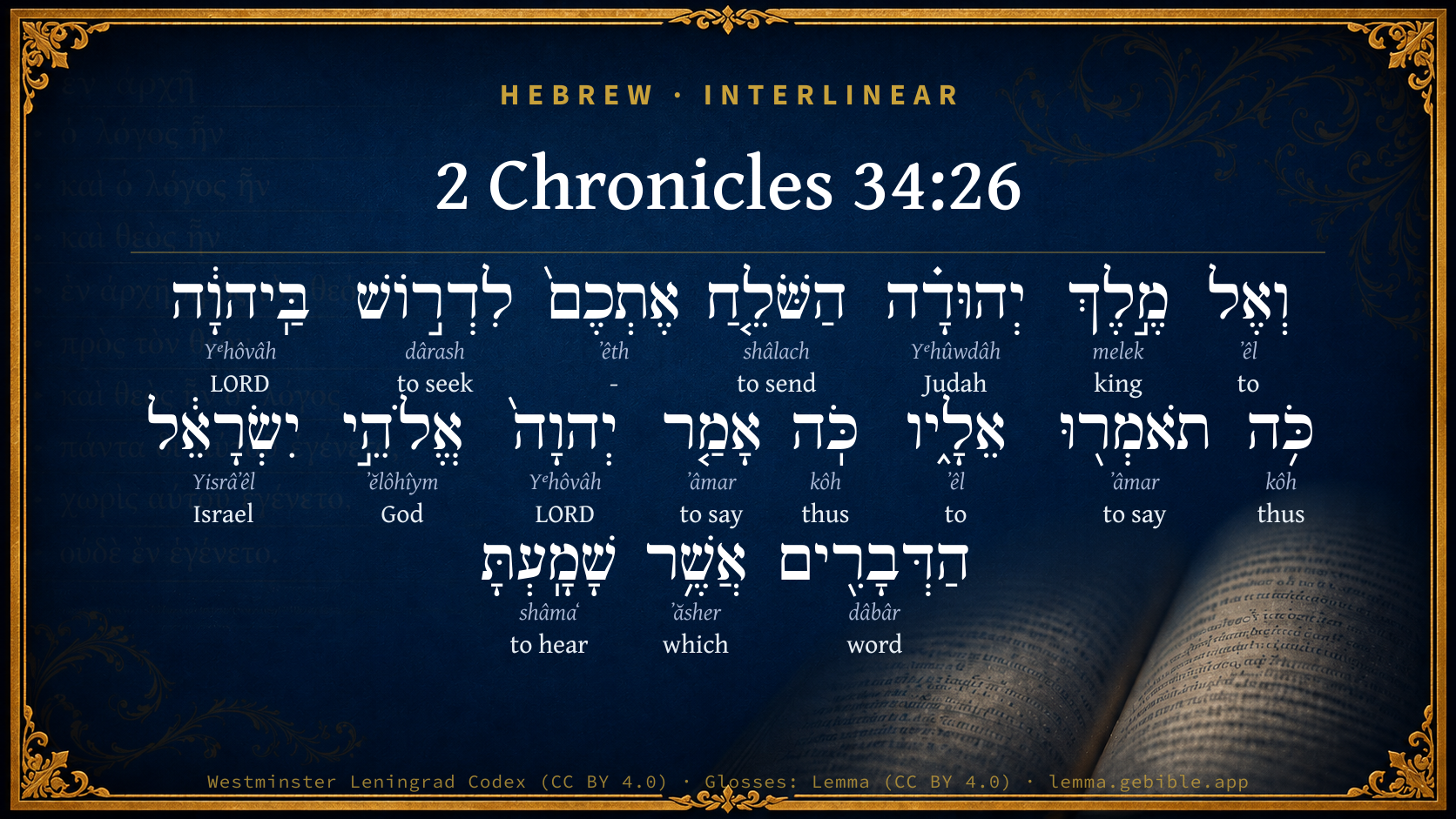
Hebrew (Westminster Leningrad Codex) 2 Chronicles 34:26 appears in the Hebrew Old Testament. The text above is from the Westminster Leningrad Codex. Each word links to its Strong’s number, a concise gloss, and parsing drawn from the Open Scriptures Hebrew Bible morphology. Click any word for its full Brown-Driver-Briggs (BDB) entry.
Download image
Cite this verse

2 Chronicles 34:26 (World English Bible). Public Domain. Lemma interlinear Bible study tool, https://lemma.gebible.app/v/2-chronicles/34/26.

Show BibTeX & RIS
BibTeX
RIS
English Translation
But to the king of Judah, who sent you to inquire of Yahweh, thus shall you tell him, Thus says Yahweh, the God of Israel: As touching the words which you have heard,
World English Bible · Public Domain
Download a study sheet

One document with this verse’s original text, its word-by-word gloss line, the meaning frame, cross-references with their text, attributed commentary, and full source and license credits — printable, and it pastes into notes with its structure intact.

This verse Autodidact and up

Study sheet (.html) Plain text (.txt)

A passage Seminary Student

Up to 50 verses in one chapter. A passage sheet keeps up to 6 commentary sources and 12 cross-references per verse, in the order this page ranks them, and says so on the sheet whenever that leaves anything out. Ask for a single verse and you get the Autodidact verse sheet above.

Everything on this page stays free to read, with no account — the sheet is a download of what is already on screen, not access to it.

Want to remove ads? Support Godless Engineer
Compare translations 3

The same verse in 3 English versions, stacked beneath the original-language interlinear above. Click any original word for its lexicon entry.

Each is an independent rendering of the whole verse — the interlinear is not word-aligned to these translations.

Highlighted words mark where these versions differ — a whole-verse word diff, not a word-by-word alignment.

  • World English Bible Public Domain
    But to the king of Judah, who sent you to inquire of Yahweh, thus shall you tell him, Thus says Yahweh, the God of Israel: As touching the words which you have heard,
  • King James Version Public Domain
    And as for the king of Judah, who sent you to enquire of the LORD, so shall ye say unto him, Thus saith the LORD God of Israel concerning the words which thou hast heard;
  • unfoldingWord Literal Text CC BY-SA 4.0
    But to the king of Judah, the one who sent you all to seek Yahweh, thus you all shall say to him, ‘Thus says Yahweh, the God of Israel about the words that you heard:

unfoldingWord Literal Text — © unfoldingWord, licensed CC BY-SA 4.0. Word-aligned USFM3 via Door43 (git.door43.org/unfoldingWord/en_ult).

Versions to compare (up to 4)

3 of 4 selected

Show all 18 translations

Every available English version of this verse, each an independent rendering of the whole verse.

  • World English Bible Public Domain
    But to the king of Judah, who sent you to inquire of Yahweh, thus shall you tell him, Thus says Yahweh, the God of Israel: As touching the words which you have heard,
  • Berean Standard Bible Public Domain
    But as for the king of Judah, who sent you to inquire of the LORD, tell him that this is what the LORD, the God of Israel, says: ‘As for the words that you heard,
  • Majority Standard Bible Public Domain
    But as for the king of Judah, who sent you to inquire of the LORD, tell him that this is what the LORD, the God of Israel, says: ‘As for the words that you heard,
  • King James Version Public Domain
    And as for the king of Judah, who sent you to enquire of the LORD, so shall ye say unto him, Thus saith the LORD God of Israel concerning the words which thou hast heard;
  • American Standard Version (1901) Public Domain
    But unto the king of Judah, who sent you to inquire of Jehovah, thus shall ye say to him, Thus saith Jehovah, the God of Israel: As touching the words which thou hast heard,
  • Revised Version (1885) Public Domain
    But unto the king of Judah, who sent you to inquire of the LORD, thus shall ye say to him, Thus saith the LORD, the God of Israel: As touching the words which thou hast heard,
  • Geneva Bible (1599) Public Domain
    But to the King of Iudah, who sent you to enquire of the Lord, so shall ye say vnto him, Thus saith the Lord God of Israel, The words which thou hast heard, shall come to passe.
  • Douay-Rheims (1899) Public Domain
    But as to the king of Juda that sent you to beseech the Lord, thus shall you say to him: Thus saith the Lord the God of Israel: Because thou hast heard the words of this book,
  • Young's Literal Translation Public Domain
    `And unto the king of Judah, who is sending you to inquire of Jehovah, thus do ye say unto him: Thus said Jehovah God of Israel, whose words thou hast heard:
  • Literal Standard Version CC BY-SA 4.0
    And to the king of Judah who is sending you to inquire of YHWH, thus you say to him, Thus said YHWH God of Israel, whose words you have heard:
  • Unlocked Literal Bible CC BY-SA 4.0
    But to the king of Judah, who sent you to ask Yahweh what he should do, this is what you will say to him, 'Yahweh, the God of Israel says this: About the words that you heard,
  • unfoldingWord Literal Text CC BY-SA 4.0
    But to the king of Judah, the one who sent you all to seek Yahweh, thus you all shall say to him, ‘Thus says Yahweh, the God of Israel about the words that you heard:
  • Darby Bible Public Domain
    But to the king of Judah, who sent you to inquire of Jehovah, thus shall ye say to him: Thus saith Jehovah the God of Israel touching the words which thou hast heard:
  • World Messianic Bible Public Domain
    But to the king of Judah, who sent you to inquire of the LORD, you shall tell him this, ‘The LORD, the God of Israel says: “About the words which you have heard,
  • Webster's Bible Public Domain
    And as for the king of Judah, who sent you to inquire of the LORD, so shall ye say to him, Thus saith the LORD God of Israel concerning the words which thou hast heard;
  • Free Bible Version CC BY-SA 4.0
    But tell the king of Judah who sent you to ask the Lord, tell him this is what the Lord, the God of Israel, says: As for the what you heard read to you—
  • Bible in Basic English Public Domain
    But to the king of Judah who sent you to get directions from the Lord, say, This is what the Lord, the God of Israel, has said: Because you have given ear to my words,
  • JPS Tanakh (1917) Public Domain
    But unto the king of Judah, who sent you to inquire of the LORD, thus shall ye say to him: Thus saith the LORD, the God of Israel: As touching the words which thou hast heard,

Literal Standard Version (2020), Covenant Press — licensed CC BY-SA 4.0. Text via the HelloAO Bible API (eBible.org). Unlocked Literal Bible (unfoldingWord) — licensed CC BY-SA 4.0. Text via the HelloAO Bible API (eBible.org). unfoldingWord Literal Text — © unfoldingWord, licensed CC BY-SA 4.0. Word-aligned USFM3 via Door43 (git.door43.org/unfoldingWord/en_ult). Free Bible Version, Dr. Jonathan Gallagher — licensed CC BY-SA 4.0. Text via the HelloAO Bible API (eBible.org).

Word by word

More ways to search: Search by grammar → Find every occurrence → Compare this word →

Practice this passage: Drill this verse → Learn its vocabulary →

לִדְר֣וֹשׁ
dârash
H1875
“to seek”
Preposition + Verb, Qal, Infinitive Construct
Part of Speech
Preposition + Verb
Stem
Qal
Form
Infinitive Construct
Full BDB Definition

Origin: a primitive root

TWOT: 455

to resort to, seek, seek with care, enquire, require - (Qal) - to resort to, frequent (a place), (tread a place) - to consult, enquire of, seek - of God - of heathen gods, necromancers - to seek deity in prayer and worship - God - heathen deities - to seek (with a demand), demand, require - to investigate, enquire - to ask for, require, demand - to practice, study, follow, seek with application - to seek with care, care for - (Niphal) - to allow oneself to be enquired of, consulted (only of God) - to be sought, be sought out - to be required (of blood)
  1. וְאֶל ʼêl H413 “and · to” Conjunction + Preposition
  2. מֶ֣לֶךְ melek H4428 “king of” Noun, Common, Masculine, Singular, Construct
  3. יְהוּדָ֗ה Yᵉhûwdâh H3063 “Judah” Noun, Proper
  4. הַשֹּׁלֵ֤חַ shâlach H7971 “the · sending” Particle, Definite Article + Verb, Qal, Participle Active, Masculine, Singular, Absolute
  5. אֶתְכֶם֙ ʼêth H853 “- · you” Particle, Direct Object + Suffix, Personal, 2nd Person, Masculine, Plural
  6. בַּֽיהוָ֔ה Yᵉhôvâh H3068 “in/at · LORD” Preposition + Noun, Proper
  7. כֹּ֥ה kôh H3541 “thus” Adverb
  8. תֹאמְר֖וּ ʼâmar H559 “to say” Verb, Qal, Imperfect, 2nd Person, Masculine, Plural
  9. אֵלָ֑יו ʼêl H413 “to · him” Preposition + Suffix, Personal, 3rd Person, Masculine, Singular
  10. כֹּֽה kôh H3541 “thus” Adverb
  11. אָמַ֤ר ʼâmar H559 “to say” Verb, Qal, Perfect, 3rd Person, Masculine, Singular
  12. יְהוָה֙ Yᵉhôvâh H3068 “LORD” Noun, Proper
  13. אֱלֹהֵ֣י ʼĕlôhîym H430 “God(s) of” Noun, Common, Masculine, Plural, Construct
  14. יִשְׂרָאֵ֔ל Yisrâʼêl H3478 “Israel” Noun, Proper
  15. הַדְּבָרִ֖ים dâbâr H1697 “the · words” Particle, Definite Article + Noun, Common, Masculine, Plural, Absolute
  16. אֲשֶׁ֥ר ʼăsher H834 “which” Particle, Relative
  17. שָׁמָֽעְתָּ shâmaʻ H8085 “to hear” Verb, Qal, Perfect, 2nd Person, Masculine, Singular

About this verse

These counts appear in no published source. They are computed here, from the morphology-tagged text and Lemma’s own curated glosses. What Lemma adds →

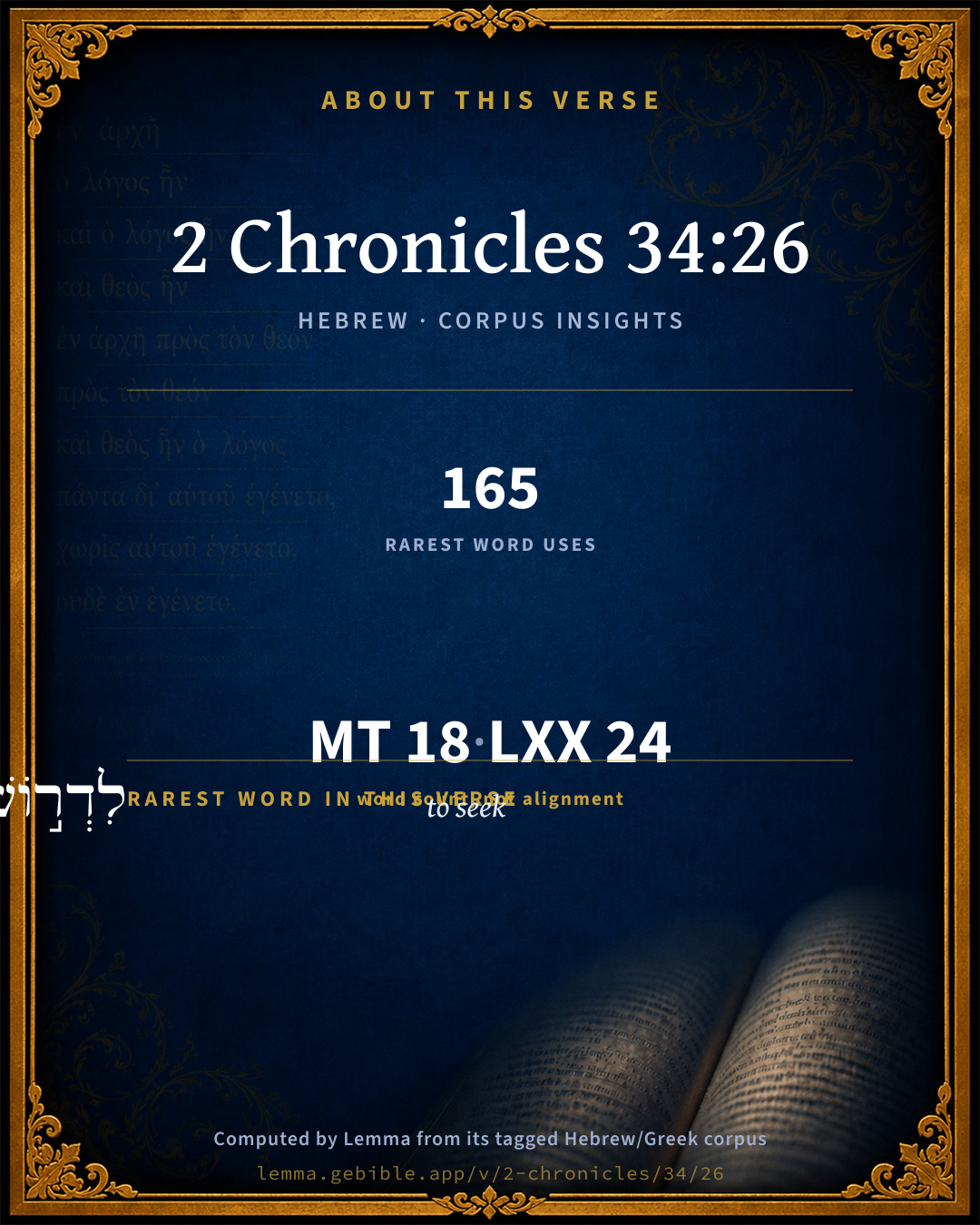
18
words
14
distinct lemmas
Historical
section

Grammatical profile

  • 5 verbs
  • 7 nouns
  • 2 prepositions
  • 2 adverbs
  • 2 particles

Verb forms

  • הַשֹּׁלֵ֤חַ Qal · Participle Active
  • לִדְר֣וֹשׁ Qal · Infinitive Construct
  • תֹאמְר֖וּ Qal · Imperfect
  • אָמַ֤ר Qal · Perfect
  • שָׁמָֽעְתָּ Qal · Perfect

Repetition

Words recur within this verse — often emphatic in Hebrew:

  • בַּֽיהוָ֔ה LORD H3068 ×2
  • כֹּ֥ה thus H3541 ×2
  • תֹאמְר֖וּ to say H559 ×2
  • וְאֶל to H413 ×2

Hebrew & Septuagint length

In English translation the verse runs 33 words from the Hebrew and 34 from the Septuagint (LXX English) — closely comparable.

A rough comparison of the two English renderings, which tokenize alike — not a word-level alignment.

Word counts can differ between the Hebrew and the Greek without any difference in meaning — e.g. the Hebrew direct-object marker אֵת has no separate Greek word, and Greek often adds the article ὁ.

In the original languages it is 18 Hebrew tokens and 24 Greek tokens — but the two are counted differently (Hebrew bundles its prefixes and suffixes into one token; the Greek is in lemma form), so that isn’t a like-for-like length.

Cross-references

2

Topical passages linked to 2 Chronicles 34:26 in the Treasury of Scripture Knowledge — connected by theme and wording, ordered by reader-vote popularity; previews shown in the World English Bible.

  • 2 Chronicles 34:21 Go you, inquire of Yahweh for me, and for those who are left in Israel and in Judah, concerning the words of the book that is found; for great is the wrath of Yahweh that is poured out on us, because our fathers have not kept the word of Yahweh, to do according to all that is written in this book.
  • 2 Chronicles 34:23 She said to them, Thus says Yahweh, the God of Israel: Tell you the man who sent you to me,

Cross-references courtesy of OpenBible.info (CC BY 4.0).

Hebrew and Greek witnesses Masoretic Hebrew ↔ Greek Septuagint

The same verse in the two great witnesses to the Old Testament, shown verse-for-verse.

These are two independent witnesses, not word-aligned to each other, and the Septuagint is shown in lemma (dictionary) form.

Hebrew 2 Chronicles 34:26 Masoretic · Westminster Leningrad Codex

וְאֶל מֶ֣לֶךְ יְהוּדָ֗ה הַשֹּׁלֵ֤חַ אֶתְכֶם֙ לִדְר֣וֹשׁ בַּֽיהוָ֔ה כֹּ֥ה תֹאמְר֖וּ אֵלָ֑יו כֹּֽה אָמַ֤ר יְהוָה֙ אֱלֹהֵ֣י יִשְׂרָאֵ֔ל הַדְּבָרִ֖ים אֲשֶׁ֥ר שָׁמָֽעְתָּ

But to the king of Judah, who sent you to inquire of Yahweh, thus shall you tell him, Thus says Yahweh, the God of Israel: As touching the words which you have heard,

World English Bible · Public Domain

Greek LXX 2 Chronicles 34:26 Septuagint · lemma form

καί ἐπί βασιλεύς ἰουδά ὁ ἀποστέλλω σύ ὁ ζητέω ὁ κύριος οὕτως εἶπον αὐτός οὕτως λέγω κύριος ὁ θεός ἰσραήλ ὁ λόγος ὅς ἀκούω

And concerning the king of Juda, who sent you to seek the Lord, —thus shall you⌃ say to him, Thus says the Lord God of Israel, As for the words which you have heard,

LXX2012 (modern English Septuagint) · Public Domain

Hebrew: Westminster Leningrad Codex (CC BY 4.0). Greek: Septuagint (public domain); English from LXX2012 (modern English Septuagint) (Public Domain). How the Septuagint differs from the Hebrew →

Commentary

Notes on 2 Chronicles 34:26 from classic Christian and Jewish commentators (each source and its license shown beneath its notes). The classic Christian expositions comment on the surrounding passage and are grouped to its opening verse, so a note may address several verses; the Jewish commentaries on the Tanakh (Rashi and others) are per-verse, so they appear only where the commentator wrote on this verse.

Lemma curates 59 commentaries, every one of them public domain or Creative Commons licensed, each selected and text-cleaned for this edition rather than reprinted as found. About our sources →

Ellicott's Commentary for English Readers

(26) To enquire of the Lord.—Strictly, through the Lord. Kings has the accusative.

Against this place.—Kings adds, “that it should become an astonishment and a curse.”

And humbledst thyself before me.—Not in Kings. A characteristic repetition.

And weep.—Shorter form of the verb; a correction of Kings (wattçbk for wattebkeh).

I.—Emphatic. (Kings has the longer form ‘anokî for our ‘anî.)

Saith the Lord.—Is the utterance of Jehovah (ne’ûm Iahweh).

Grave.—Heb., graves. (Comp. 2Ch_16:14.)

And upon the inhabitants of the same.—Added by the chronicler.

A Bible Commentary for English Readers, edited by Charles John Ellicott (1878–1897) — public domain. Text from a community e-Sword module.

The Cambridge Bible for Schools and Colleges

gen. ed. J. J. S. Perowne

26. And as for the king] R.V. But unto the king.

the Lord God of Israel concerning the words] R.V. the LORD, the God of Israel: As touching the words.

The Cambridge Bible for Schools and Colleges (gen. ed. J. J. S. Perowne; Cambridge University Press, 1878–1918) — public domain. Text from a community e-Sword module.

unfoldingWord translationNotes

Door43 World Missions Community

About the words that you heard

"About the message that you heard"

because your heart was tender

Here "heart" represents a person's inner being. Feeling sorry is spoken of as if the heart were tender. AT: "because you felt sorry" or "because you repented" (See: Metonymy and Metaphor)

torn your clothes

This is a symbolic action that indicates intense grief or sadness. (See: Symbolic Action)

this is Yahweh's declaration

Yahweh speaks of himself by name to express the certainty of what he is declaring. AT: "this is what Yahweh has declared" or "this is what I, Yahweh, have declared" (See: First, Second, or Third Person)

see, I will gather you to your ancestors. You will be gathered to your grave in peace

Both statements mean basically the same thing. They are polite ways of saying he will die. AT: "so I will allow you to die and be buried peacefully" (See: Parallelism and Euphemism)

You will be gathered to your grave

This can be stated in active form. AT: "I will gather you to your grave" (See: Active or Passive)

your eyes will not see

Here "eyes" represents the whole person. Also, the phrase "will not see" represents not experiencing something. AT: "you will not experience" (See: Synecdoche and Metonymy)

the disaster I will bring on this place

Yahweh causing terrible things to happen is spoken of as if disaster were an object that Yahweh would bring to a place. AT: "the terrible things I will cause to happen to this place" (See: Metaphor)

translationWords

word

heart

humble

declare

peace

unfoldingWord translationNotes — © Distant Shores Media and the Door43 World Missions Community, licensed CC BY-SA 4.0. Source: git.door43.org/Door43/en_tn.

Lesson kit

Teaching starters — assembled from the data on this page, not authored interpretation. Every prompt links to the verse data it draws on. Edit before teaching.

2 Chronicles, in the Historical, opens this verse with 18 words (14 distinct Hebrew lemmas). Its most distinctive word is dârash (“to seek”). A historical commentator’s framing appears above. Read the whole chapter for the surrounding context.

Discussion questions

  1. The word dârash carries the sense “to seek.” How does it shape the verse?
  2. How does 2 Chronicles 34:21, which shares this passage’s theme, read alongside this verse?
  3. What does the repetition of “LORD” (2× in this one verse) do in this verse?
  4. These translations render this verse differently; the difference is in the English rendering, not the original. What questions does that raise?
  5. «הַשֹּׁלֵ֤חַ» is a Qal Participle Active verb. How does that grammatical form shape the action described?
  6. Compare how Ellicott's Commentary for English Readers and The Cambridge Bible for Schools and Colleges read this verse. Where do they agree or differ?

Things to notice

Reading settings

Reading text

Shown beneath each verse's original-language words.

Old Testament
Old Testament edition

Read the OT as the Masoretic Hebrew (MT) or the Greek Septuagint (LXX).

English shown for the Greek Septuagint (in the Hebrew ↔ Greek comparison).

Comparing translations? Open the Compare panel on any verse page to stack up to four side by side.