
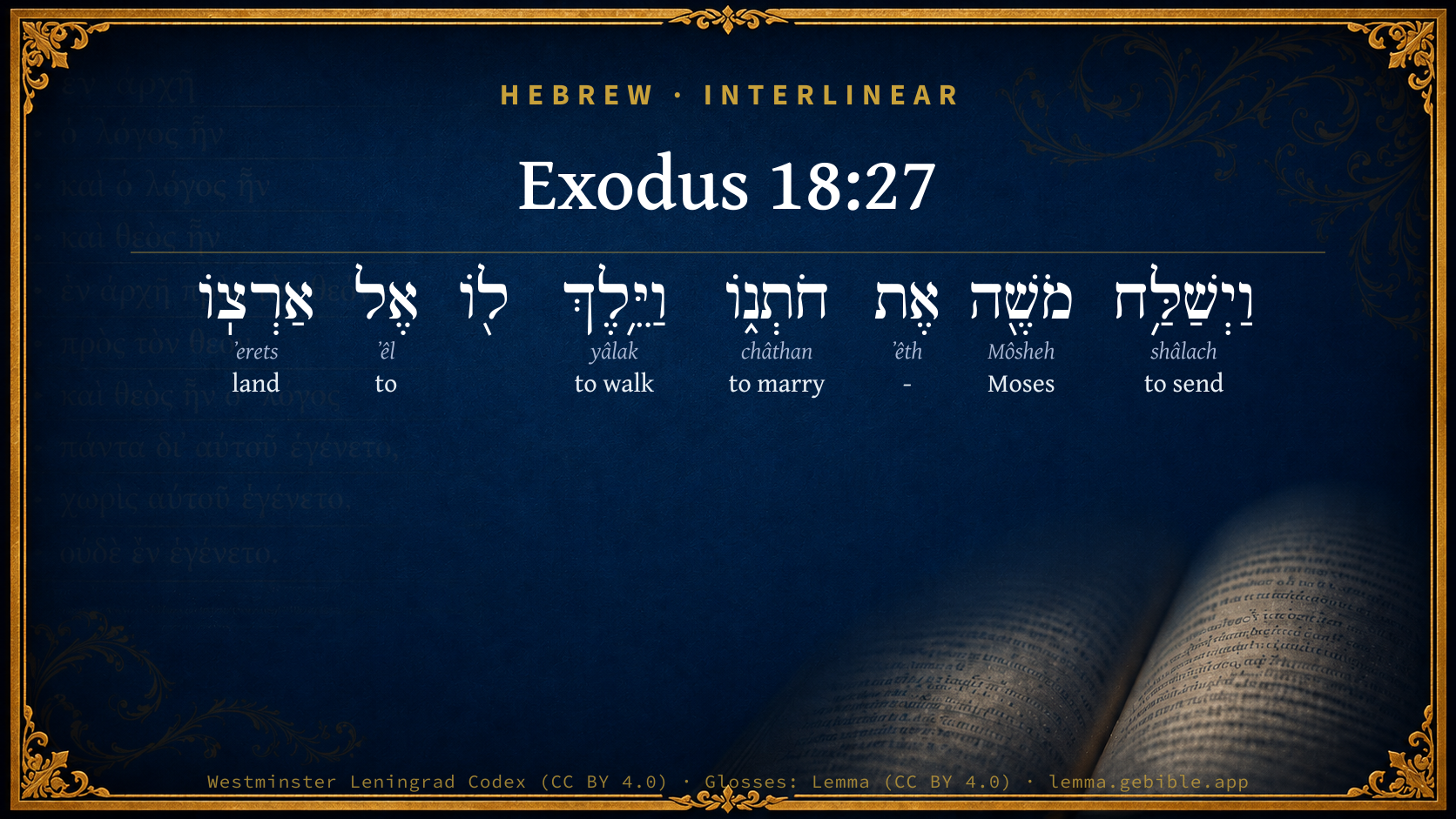
Exodus 18:27

Hebrew (Westminster Leningrad Codex) Exodus 18:27 appears in the Hebrew Old Testament. The text above is from the Westminster Leningrad Codex. Each word links to its Strong’s number, a concise gloss, and parsing drawn from the Open Scriptures Hebrew Bible morphology. Click any word for its full Brown-Driver-Briggs (BDB) entry.
Download image
Cite this verse

Exodus 18:27 (World English Bible). Public Domain. Lemma interlinear Bible study tool, https://lemma.gebible.app/v/exodus/18/27.

Show BibTeX & RIS
BibTeX
RIS
English Translation
Moses let his father-in-law depart, and he went his way into his own land.
World English Bible · Public Domain
Download a study sheet

One document with this verse’s original text, its word-by-word gloss line, the meaning frame, cross-references with their text, attributed commentary, and full source and license credits — printable, and it pastes into notes with its structure intact.

This verse Autodidact and up

Study sheet (.html) Plain text (.txt)

A passage Seminary Student

Up to 50 verses in one chapter. A passage sheet keeps up to 6 commentary sources and 12 cross-references per verse, in the order this page ranks them, and says so on the sheet whenever that leaves anything out. Ask for a single verse and you get the Autodidact verse sheet above.

Everything on this page stays free to read, with no account — the sheet is a download of what is already on screen, not access to it.

Want to remove ads? Support Godless Engineer
Compare translations 3

The same verse in 3 English versions, stacked beneath the original-language interlinear above. Click any original word for its lexicon entry.

Each is an independent rendering of the whole verse — the interlinear is not word-aligned to these translations.

Highlighted words mark where these versions differ — a whole-verse word diff, not a word-by-word alignment.

  • World English Bible Public Domain
    Moses let his father-in-law depart, and he went his way into his own land.
  • King James Version Public Domain
    And Moses let his father in law depart; and he went his way into his own land.
  • unfoldingWord Literal Text CC BY-SA 4.0
    And Moses let his father-in-law go, and he went into his own land.

unfoldingWord Literal Text — © unfoldingWord, licensed CC BY-SA 4.0. Word-aligned USFM3 via Door43 (git.door43.org/unfoldingWord/en_ult).

Versions to compare (up to 4)

3 of 4 selected

Show all 18 translations

Every available English version of this verse, each an independent rendering of the whole verse.

  • World English Bible Public Domain
    Moses let his father-in-law depart, and he went his way into his own land.
  • Berean Standard Bible Public Domain
    Then Moses sent his father-in-law on his way, and Jethro returned to his own land.
  • Majority Standard Bible Public Domain
    Then Moses sent his father-in-law on his way, and Jethro returned to his own land.
  • King James Version Public Domain
    And Moses let his father in law depart; and he went his way into his own land.
  • American Standard Version (1901) Public Domain
    And Moses let his father-in-law depart; and he went his way into his own land.
  • Revised Version (1885) Public Domain
    And Moses let his father in law depart; and he went his way into his own land.
  • Geneva Bible (1599) Public Domain
    Afterward Moses let his father in law depart, and he went into his countrey.
  • Douay-Rheims (1899) Public Domain
    And he let his kinsman depart: and he returned and went into his own country.
  • Young's Literal Translation Public Domain
    And Moses sendeth his father-in-law away, and he goeth away unto his own land.
  • Literal Standard Version CC BY-SA 4.0
    And Moses sends his father-in-law away, and he goes away to his own land.
  • Unlocked Literal Bible CC BY-SA 4.0
    Then Moses let his father-in-law leave, and Jethro went back into his own land.
  • unfoldingWord Literal Text CC BY-SA 4.0
    And Moses let his father-in-law go, and he went into his own land.
  • Darby Bible Public Domain
    And Moses sent away his father-in-law, and he departed into his land.
  • World Messianic Bible Public Domain
    Moses let his father-in-law depart, and he went his way into his own land.
  • Webster's Bible Public Domain
    And Moses let his father-in-law depart; and he went his way into his own land.
  • Free Bible Version CC BY-SA 4.0
    Then Moses sent Jethro on his way, and he went back to his own country.
  • Bible in Basic English Public Domain
    And Moses let his father-in-law go away, and he went back to his land.
  • JPS Tanakh (1917) Public Domain
    And Moses let his father-in-law depart; and he went his way into his own land.

Literal Standard Version (2020), Covenant Press — licensed CC BY-SA 4.0. Text via the HelloAO Bible API (eBible.org). Unlocked Literal Bible (unfoldingWord) — licensed CC BY-SA 4.0. Text via the HelloAO Bible API (eBible.org). unfoldingWord Literal Text — © unfoldingWord, licensed CC BY-SA 4.0. Word-aligned USFM3 via Door43 (git.door43.org/unfoldingWord/en_ult). Free Bible Version, Dr. Jonathan Gallagher — licensed CC BY-SA 4.0. Text via the HelloAO Bible API (eBible.org).

Word by word

More ways to search: Search by grammar → Find every occurrence → Compare this word →

Practice this passage: Drill this verse → Learn its vocabulary →

חֹתְנ֑וֹ
châthan
H2859
“marrying · him”
Verb, Qal, Participle Active, Masculine, Singular, Construct + Suffix, Personal, 3rd Person, Masculine, Singular
Part of Speech
Verb
Stem
Qal
Form
Participle Active
Gender
Masculine
Number
Singular
State
Construct
Full BDB Definition

Origin: a primitive root

TWOT: 781b

to become a son-in-law, make oneself a daughter's husband - (Qal) wife's father, wife's mother, father-in-law, mother-in-law (participle) - (Hithpael) to make oneself a daughter's husband
  1. וַיְשַׁלַּ֥ח shâlach H7971 “and · to send” Conjunction + Verb, Piel, Sequential Imperfect, 3rd Person, Masculine, Singular
  2. מֹשֶׁ֖ה Môsheh H4872 “Moses” Noun, Proper
  3. אֶת ʼêth H853 “-” Particle, Direct Object
  4. וַיֵּ֥לֶךְ yâlak H3212 “and · to walk” Conjunction + Verb, Qal, Sequential Imperfect, 3rd Person, Masculine, Singular
  5. אֶל ʼêl H413 “to” Preposition
  6. אַרְצֽוֹ ʼerets H776 “land · his” Noun, Common, Both, Singular, Construct + Suffix, Personal, 3rd Person, Masculine, Singular

About this verse

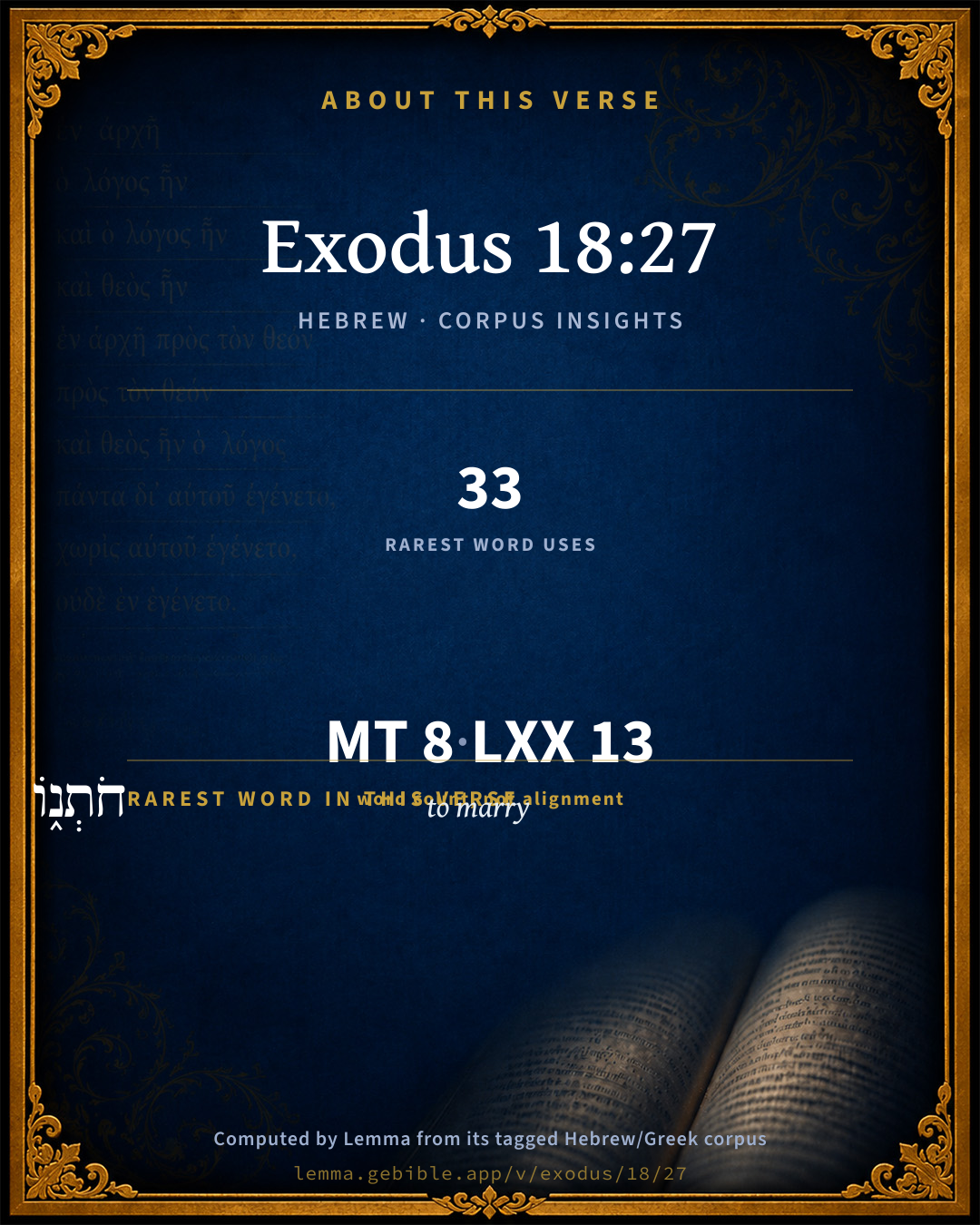
These counts appear in no published source. They are computed here, from the morphology-tagged text and Lemma’s own curated glosses. What Lemma adds →

8
words
7
distinct lemmas
Pentateuch
section

Shared distinctive vocabulary

חֹתְנ֑וֹ to marry H2859 occurs in 32 verses of the Hebrew Bible. Also found in:

Grammatical profile

  • 3 verbs
  • 2 nouns
  • 2 prepositions
  • 1 particle

Verb forms

  • וַיְשַׁלַּ֥ח Piel · Sequential Imperfect
  • חֹתְנ֑וֹ Qal · Participle Active
  • וַיֵּ֥לֶךְ Qal · Sequential Imperfect

Hebrew & Septuagint length

In English translation the verse runs 14 words from the Hebrew and 12 from the Septuagint (LXX English) — closely comparable.

A rough comparison of the two English renderings, which tokenize alike — not a word-level alignment.

Word counts can differ between the Hebrew and the Greek without any difference in meaning — e.g. the Hebrew direct-object marker אֵת has no separate Greek word, and Greek often adds the article ὁ.

In the original languages it is 8 Hebrew tokens and 13 Greek tokens — but the two are counted differently (Hebrew bundles its prefixes and suffixes into one token; the Greek is in lemma form), so that isn’t a like-for-like length.

Cross-references

4

Topical passages linked to Exodus 18:27 in the Treasury of Scripture Knowledge — connected by theme and wording, ordered by reader-vote popularity; previews shown in the World English Bible.

  • Numbers 10:29–30 Moses said to Hobab, the son of Reuel the Midianite, Moses' father-in-law, We are journeying to the place of which Yahweh said, I will give it you: come you with us, and we will do you good; for Yahweh has spoken good concerning Israel.
  • Judges 19:9 When the man rose up to depart, he, and his concubine, and his servant, his father-in-law, the young lady's father, said to him, Behold, now the day draws toward evening, please stay all night: behold, the day grows to an end, lodge here, that your heart may be merry; and tomorrow get you early on your way, that you may go home.
  • Genesis 24:59 They sent away Rebekah, their sister, with her nurse, Abraham's servant, and his men.
  • Genesis 31:55 Early in the morning, Laban rose up, and kissed his sons and his daughters, and blessed them. Laban departed and returned to his place.

Cross-references courtesy of OpenBible.info (CC BY 4.0).

Hebrew and Greek witnesses Masoretic Hebrew ↔ Greek Septuagint

The same verse in the two great witnesses to the Old Testament, shown verse-for-verse.

These are two independent witnesses, not word-aligned to each other, and the Septuagint is shown in lemma (dictionary) form.

Hebrew Exodus 18:27 Masoretic · Westminster Leningrad Codex

וַיְשַׁלַּ֥ח מֹשֶׁ֖ה אֶת חֹתְנ֑וֹ וַיֵּ֥לֶךְ ל֖וֹ אֶל אַרְצֽוֹ

Moses let his father-in-law depart, and he went his way into his own land.

World English Bible · Public Domain

Greek LXX Exodus 18:27 Septuagint · lemma form

ἐκ ἀποστέλλω δέ μωυσῆς ὁ ἑαυτοῦ γαμβρός καί ἀποἔρχομαι εἰς ὁ γῆ αὐτός

And Moses dismissed his father-in-law, and he returned to his own land.

LXX2012 (modern English Septuagint) · Public Domain

Hebrew: Westminster Leningrad Codex (CC BY 4.0). Greek: Septuagint (public domain); English from LXX2012 (modern English Septuagint) (Public Domain). How the Septuagint differs from the Hebrew →

Targum (Aramaic paraphrase)

2

The Targum is the ancient Jewish Aramaic paraphrase of the Hebrew Scriptures — an interpretive translation, not the Hebrew text itself. Onkelos (literal) and Pseudo-Jonathan (expansive) render the Torah, and Jonathan the Prophets. Coverage is partial: where no permissively-licensed English translation exists for a verse, only the Aramaic is shown. This is verse-level text, not a word-by-word alignment to the Hebrew.

  1. Targum Onkelos Torah (Genesis–Deuteronomy)
    וְשַׁלַח משֶׁה יָת חֲמוּהִי וַאֲזַל לֵהּ לְאַרְעֵהּ:

    (no public-domain English translation for this verse)

    Targum Onkelos — Aramaic: “Onkelos Genesis” (public domain); “Onkelos Exodus” (public domain); “Onkelos Leviticus” (public domain); “Onkelos Numbers” (public domain); “Onkelos Deuteronomy” (public domain). English: “Sefaria Community Translation” (CC0 1.0 (public-domain dedication)); “J.W. Etheridge. The Targums of Onkelos and Jonathan Ben Uzziel on the Pentateuch. London: Longmans, Green, 1862” (public domain). Text via Sefaria.

  2. Targum Pseudo-Jonathan Torah (Genesis–Deuteronomy)
    וּפְטַר משֶׁה יַת חָמוֹי וְאָזַל לֵיהּ לְגַיְירָא כָּל בְּנֵי אַרְעֵיהּ

    And Mosheh parted from his father-in-law, and he went, and himself made proselytes of all the children of his land.

    Targum Pseudo-Jonathan — Aramaic: “Targum Jonathan on Genesis” (public domain); “Targum Jonathan on Exodus” (public domain); “Targum Jonathan on Leviticus” (public domain); “Targum Jonathan on Numbers” (public domain); “Targum Jonathan on Deuteronomy” (public domain). English: “The Targum of Jonathan ben Uzziel, trans. J. W. Etheridge, London, 1862” (public domain). Text via Sefaria.

Commentary

Notes on Exodus 18:27 from classic Christian and Jewish commentators (each source and its license shown beneath its notes). The classic Christian expositions comment on the surrounding passage and are grouped to its opening verse, so a note may address several verses; the Jewish commentaries on the Tanakh (Rashi and others) are per-verse, so they appear only where the commentator wrote on this verse.

Lemma curates 59 commentaries, every one of them public domain or Creative Commons licensed, each selected and text-cleaned for this edition rather than reprinted as found. About our sources →

Trapp's Complete Commentary

John Trapp

Exo 18:27 And Moses let his father in law depart; and he went his way into his own land.

Ver. 27. Into his own land.] An honest man’s heart is the place where his calling is: such a one when he is abroad is like a fish in the air; whereinto if it leap for recreation or necessity, yet it soon returns to its own element.

John Trapp, A Commentary or Exposition upon All the Books of the Old and New Testament (1647–1656) — public domain. Text from a community e-Sword module.

Joseph Benson's Commentary

Exo 18:27. He went into his own land — It is supposed the Kenites, mentioned 1Sa 15:6, were the posterity of Jethro, (compare Jdg 1:16,) and they were taken under special protection, for the kindness their ancestor showed to Israel.

Joseph Benson's Commentary on the Old and New Testaments (1811–1818) — public domain. Text from a community e-Sword module.

Geneva Bible (1599)

Geneva Bible translators

Read the occasion, Num. 10:29.

Geneva Bible (1599) marginal notes — public domain. Text via Bolls.life.

Adam Clarke's Commentary

Verse 27. And Moses let his father-in-law depart] But if this be the same transaction with that mentioned Nu 10:29, c., we find that it was with great reluctance that Moses permitted so able a counsellor to leave him for, having the highest opinion of his judgment, experience, and discretion, he pressed him to stay with them, that he might be instead of eyes to them in the desert. But Jethro chose rather to return to his own country, where probably his family were so settled and circumstanced that they could not be conveniently removed, and it was more his duty to stay with them, to assist them with his counsel and advice, than to travel with the Israelites. Many others might be found that could be eyes to the Hebrews in the desert, but no man could be found capable of being a father to his family, but himself. It is well to labour for the public good, but our own families are the first claimants on our care, attention, and time. He who neglects his own household on pretence of labouring even for the good of the public, has surely denied the faith, and is worse than an infidel.

IT is strange that after this we hear no more of Zipporah! Why is she forgotten? Merely because she was the wife of Moses; for he chose to conduct himself so that to the remotest ages there should be the utmost proofs of his disinterestedness. While multitudes or the families of Israel are celebrated and dignified, his own he writes in the dust. He had no interest but that of God and his people; to promote this, he employed his whole time and his uncommon talents. His body, his soul, his whole life, were a continual offering to God. They were always on the Divine altar; and God had from his creature all the praise, glory, and honour that a creature could possibly give. Like his great antitype, he went about doing good; and God was with him. The zeal of God's house consumed him, for in that house, in all its concerns, we have the testimony of God himself that he was faithful, Heb 3:2; and a higher character was never given, nor can be given of any governor, sacred or civil. He made no provision even for his own sons, Gershom and Eliezer; they and their families were incorporated with the Levites, 1Ch 23:14; and had no higher employment than that of taking care of the tabernacle and the tent, Nu 3:21-26, and merely to serve at the tabernacle and to carry burdens, Nu 4:24-28. No history, sacred or profane, has been able to produce a complete parallel to the disinterestedness of Moses. This one consideration is sufficient to refute every charge of imposture brought against him and his laws. There never was an imposture in the world (says Dr. PRIDEAUX, Letter to the Deists) that had not the following characters: -

1. It must always have for its end some carnal interest.

2. It can have none but wicked men for its authors.

3. Both of these must necessarily appear in the very contexture of the imposture itself.

4. That it can never be so framed, that it will not contain some palpable falsities, which will discover the falsity of all the rest.

5. That wherever it is first propagated, it must be done by craft and fraud.

6. That when intrusted to many persons, it cannot be long concealed.

1. The keenest-eyed adversary of Moses has never been able to fix on him any carnal interest. No gratification of sensual passions, no accumulation of wealth, no aggrandizement of his family or relatives, no pursuit of worldly honour, has ever been laid to his charge.

2. His life was unspotted, and all his actions the offspring of the purest benevolence.

3. As his own hands were pure, so were the hands of those whom he associated with himself in the work.

4. No palpable falsity has ever been detected in his writings, though they have for their subject the most complicate, abstruse, and difficult topics that ever came under the pen of man.

5. No craft, no fraud, not even what one of his own countrymen thought he might lawfully use, innocent guile, because he had to do with a people greatly degraded and grossly stupid, can be laid to his charge. His conduct was as open as the day; and though continually watched by a people who were ever ready to murmur and rebel, and industrious to find an excuse for their repeated seditious conduct, yet none could be found either in his spirit, private life, or public conduct.

6. None ever came after to say, "We have joined with Moses in a plot, we have feigned a Divine authority and mission, we have succeeded in our innocent imposture, and now the mask may be laid aside." The whole work proved itself so fully to be of God that even the person who might wish to discredit Moses and his mission, could find no ground of this kind to stand on. The ten plagues of Egypt, the passage of the Red Sea, the destruction of the king of Egypt and his immense host, the quails, the rock of Horeb, the supernatural supply by the forty years' manna, the continual miracle of the Sabbath, on which the preceding day's manna kept good, though, if thus kept, it became putrid on any other day, together with the constantly attending supernatural cloud, in its threefold office of a guide by day, a light by night, and a covering from the ardours of the sun, all invincibly proclaim that God brought out this people from Egypt; that Moses was the man of God, chosen by him, and fully accredited in his mission; and that the laws and statutes which he gave were the offspring of the wisdom and goodness of Him who is the Father of Lights, the fountain of truth and justice, and the continual and unbounded benefactor of the human race.

Adam Clarke's Commentary on the Bible (1810–1826) — public domain. Text from a community e-Sword/MySword module.

Ellicott's Commentary for English Readers

(27) Moses let his father in law depart.—Heb. Moses dismissed his connection. The supposed identity of Hobab (Num_10:29; Jdg_4:11) with Jethro seems precluded by this statement, for Hobab clearly remained with Moses till the close of the stay at Sinai, and Moses, instead of “dismissing” him, was most unwilling that he should depart.

A Bible Commentary for English Readers, edited by Charles John Ellicott (1878–1897) — public domain. Text from a community e-Sword module.

The Cambridge Bible for Schools and Colleges

gen. ed. J. J. S. Perowne

27. into his own land] Midian: see on Exo_2:15. Cf. Num_10:30.

The Cambridge Bible for Schools and Colleges (gen. ed. J. J. S. Perowne; Cambridge University Press, 1878–1918) — public domain. Text from a community e-Sword module.

Albert Barnes' Notes on the Bible

Into his own land - Midian Exo 2:15.

Albert Barnes' Notes on the Bible (1834–1885) — public domain. Text from a community e-Sword/MySword module.

Haydock's Catholic Bible Commentary

Depart, upon his consenting to leave his son Hobab, for a guide, (Bonfrere on Numbers x. 29,) or perhaps he departed for a time, and returned again. (Calmet) --- Moses shews by his example, that superiors ought not to disdain receiving prudent admonitions from any one. (St. Chrysostom) (Worthington)

George Leo Haydock (1774–1849), Haydock's Catholic Family Bible and Commentary, 1859 edition — public domain. Excludes Psalms (Douay-Rheims chapter numbering differs from Protestant) and Deuterocanonical books (Catholic canon only).

Matthew Poole's English Annotations

i.e. Moses dismissed him honourably. See Num 10:29.

Matthew Poole's English Annotations on the Holy Bible (1683–1685) — public domain. Text from a community e-Sword/MySword module.

The Pulpit Commentary

DEPARTURE OF JETHRO. The time of Jethro"s departure, and indeed of his entire visit, has been matter of controversy. Kurtz is of opinion that Jethro waited till the news of Israel"s victory over Amalek reached him, before setting out from his own country. Hence he concludes, that "a whole month or more may easily have intervened between the victory over Amalek and the arrival of Jethro," whose arrival in that case "would not even fall into the very earliest period of the sojourn at Sinai, but after the promulgation of the first Sinaitic law." Those who identify Hobab with Jethro find in Num_10:29-32 a proof that at any rate Jethro prolonged his visit until after the law was given, and did not "depart to his own land" before the removal of the people from the wilderness of Sinai to that of Paran, "in the 20th day of the second month of the second year" (ib, ver. 11). The position, however, of ch. 18., together with its contents beth what it says and what it omits are conclusive against this view. Jethro started on his journey when he heard "that the Lord had brought Israel out of Egypt" (ver. 1), not when he heard that Israel had been victorious over Amalek. His conversation with Moses (vers. 7-11) ranged over the entire series of deliverances from the night of the departure out of Egypt to the Amalekite defeat, but contained no allusion to the giving of the law. The occupation of Moses on the day after his arrival (ver. 13) is suitable to the quiet period which followed the Amalekite defeat, but not to the exciting time of the Sinaitic manifestations. It may be added that the practice of inculcating general principles on occasion of his particular judgments, of which Moses speaks (ver. 16), is suitable to the period anterior to the promulgation of the law, but not to that following it. The argument from, Num_10:29-32 fails altogether, so soon as it is seen that Jethro and Hobab are distinct persons, probably brothers, sons of Reuel (or Raguel) and brothers-in-law of Moses.

Moses let his father-in-law depart. Literally, "dismissed him," "sent him away." This single expression is quite enough to prove that the Hobab, whom Moses made strenuous efforts to keep with him after Sinai was left, is not the Jethro whom he was quite content to let go. He went his way into his own land. He returned to Midian, probably crossing the Elanitic gulf, which divided Midian from the Sinaitic region. The exact time of the departure is uncertain; but it was probably before the main events related in ch. 19.

HOMILETICS.

Ver. 27. Jethro the model of a friendly adviser.

A man"s friends often hesitate to offer advice, from the fear of its being ill received. Jethro showed himself superior to this weakness, and risked being rebuffed for officiousness, confident in his singleness of purpose and honest intentions. He had all the qualities of a good adviser. He was

1. SAGACIOUS. There can be no doubt that he rightly forecast the results,if Moses had continued his unwise monopoly of the judicial office, or that he suggested a prudent course in place of that whereof he disapproved. His reservation of a certain judicial power to Moses (vers. 20-22) was especially wise, since had he not done so, it is highly probable that his counsel would not have been followed;

2. SYMPATHETIC. Kindness and. warm feeling breathed in his warningwords: wilt surely wear away, both thou and this people for this thing is too heavy for thee; thou art not able to perform it thyself alone." He feels for Moses; he feels for the people; he has no thought for himself; he is solely anxious, and deeply anxious, to save others from unnecessary suffering;

3. STRAIGHTFORWARD. He does not use periphrases, or beat about thebush, but goes straight to his point, making his purpose clearly intelligible, and indeed unmistakable thing that thou doest is not good out of the people able men.

4. WHOLLY DISINTERESTED. The advice which he tenders can do himno good. He asks no employment, no place for himself. He will not even participate in the general prosperity of Israel if good results follow the adoption of his counsel; for he is not about to cast in his lot with the Israelites. On the contrary, he is bent on withdrawing at once into his own country. Moses will not find him that keen annoyance, an ever-present friend, who because his advice has been taken once, regards himself as entitled to obtrude it whenever he pleases, and to feel aggrieved if it is not in every case followed. If advisers generally acted in the spirit of Jethro, there would be far less unwillingness than there is to ask advice, and far more gratitude felt towards those who volunteer it.

HOMILIES BY D. YOUNG Ver. 27. Jethro"s departure.

I JETHRO DEPARTS AFTER A MOST SATISFACTORY VISIT. That visit was made not perhaps without some anxiety and doubt as to the results, but still under the clear dictation of duty. Therefore, it would have been satisfactory even if less successful. Moses might, conceivably, have looked on Zipporah coldly and. received her reluctantly; but there would have remained to Jethro the priceless satisfaction that he had done the right thing. But Jethro, we have seen, had more even than the satisfaction of a good conscience; he had been successful, and successful beyond all that he could have anticipated when he set out. To a man of Jethro"s disposition, that would indeed be a joyous visit, which had proved so useful to Moses, to Zipporah, to their children, to Israel, and may we not add, towards the glorifying of Jethro himself? Keep ever in the path that is clearly right, and you have Jethro"s experience to encourage you in the expectation that it may also be the path of noble and joyous opportunities.

II JETHRO DEPARTS, AND MOSES IS MADE TO FEEL, MORE THAN EVER, THAT JEHOVAH REMAINS. Very helpful are human counsel and sympathy, and especially when they come from old friends. There are no friends like old friends, and Jethro was a very old friend t o Moses. But Jethro"s abilities and opportunities as adviser extended only a little way. Like Moses we may all have our Jethros whom we may love, cherish and venerate; for God distributes such men everywhere about the world to be, as it were, fellow-workers with trim in giving stability and illumination to the perplexed. But we cannot keep them; we may lose them at any moment; and while it is great wisdom to listen to them, it would be great folly to put them in the place of God. Though Jethro was very decided in the counsels he gave, he knew equally when to stop. We may look at him as coming in here to teach us that what we can expect from the most competent and loving of human friends is but a trifle compared with the great total of our needs. We are allowed to have but small expectations from the brother sinner, the brother mortal, the brother who is liable to ignorance and error, just as much as we are ourselves. When Jethro went away, Moses would feel himself all the more shut up to Jehovah. When the earthly is dumb, misleading, estranged, or dead, then the heavenly will speak in clear and loving accents to all who have ears to hear.

III Jethro departs into his own land, for HE HAD DOUBTLESS PRESSING CLAIMS UPON HIM THERE. He was just the kind of man to make his presence, as long as he lived, a kind of necessity to his neighbours, he had come on a matter of urgency, not for his own pleasure or ease; and we may imagine he went back as soon as he conveniently could to finish such affairs at home as had been left unfinished. Note, however, that in going back to his own land, and away from Moses, he did not therefore retire from the service of God and the reach of God"s blessings. Jethro and Moses seemed to be going different ways; but they only differed in external circumstances. Moses does not seem even to have asked Jethro to stay with him; whereas we know that he pressed and urged Hobab. Perhaps he felt that he had no sufficient reason for asking Jethro, or that it would be of no use. Y.

The Pulpit Commentary (1880–1919), ed. H.D.M. Spence-Jones & Joseph S. Exell — public domain. Text from a community e-Sword module.

John Wesley's Explanatory Notes

He went into his own land - It is supposed the Kenites mentioned 1 Sam. xv, 6, were the posterity of Jethro, (compare Jude i, 16,) and they are taken under special protection, for the kindness their ancestor shewed to Israel.

John Wesley, Explanatory Notes Upon the Whole Bible (1754–1765) — public domain. Text via the GEBible commentary corpus.

Rashi

Rabbi Shlomo Yitzchaki (Rashi)

וילך לו אל ארצו AND HE WENT HIS WAY INTO HIS OWN LAND, for the purpose of making proselytes of the members of his family (Mekhilta).

Rashi on the Tanakh — English translations: “The Judaica Press complete Tanach with Rashi, translated by A. J. Rosenberg” (CC BY 4.0); “Pentateuch with Rashi's commentary by M. Rosenbaum and A.M. Silbermann, 1929-1934” (public domain); “The Metsudah Tanach series, Lakewood, N.J” (CC BY 4.0); and “The Book of Joshua, Metsudah Publications, 1997” (CC BY 4.0). Text via Sefaria.

Lesson kit

Teaching starters — assembled from the data on this page, not authored interpretation. Every prompt links to the verse data it draws on. Edit before teaching.

Exodus, in the Pentateuch, opens this verse with 8 words (7 distinct Hebrew lemmas). Its most distinctive word is châthan (“to marry”). A historical commentator’s framing appears above. Read the whole chapter for the surrounding context.

Discussion questions

  1. What does “to marry” (châthan) contribute to the verse as a whole?
  2. Genesis 34:9 shares the word «to marry» with this verse. How do the two illuminate each other?
  3. These translations render this verse differently; the difference is in the English rendering, not the original. What questions does that raise?
  4. The verb «וַיְשַׁלַּ֥ח» is Piel Sequential Imperfect. How does its form color the action?
  5. Reading how Trapp's Complete Commentary and Joseph Benson's Commentary read this verse, where do the two commentators agree and where do they part?

Things to notice

Reading settings

Reading text

Shown beneath each verse's original-language words.

Old Testament
Old Testament edition

Read the OT as the Masoretic Hebrew (MT) or the Greek Septuagint (LXX).

English shown for the Greek Septuagint (in the Hebrew ↔ Greek comparison).

Comparing translations? Open the Compare panel on any verse page to stack up to four side by side.