
Judges 5:15

Hebrew (Westminster Leningrad Codex) Judges 5:15 appears in the Hebrew Old Testament. The text above is from the Westminster Leningrad Codex. Each word links to its Strong’s number, a concise gloss, and parsing drawn from the Open Scriptures Hebrew Bible morphology. Click any word for its full Brown-Driver-Briggs (BDB) entry.
Download image
Cite this verse

Judges 5:15 (World English Bible). Public Domain. Lemma interlinear Bible study tool, https://lemma.gebible.app/v/judges/5/15.

Show BibTeX & RIS
BibTeX
RIS
English Translation
The princes of Issachar were with Deborah; As was Issachar, so was Barak; Into the valley they rushed forth at his feet. By the watercourses of Reuben There were great resolves of heart.
World English Bible · Public Domain
Highlights
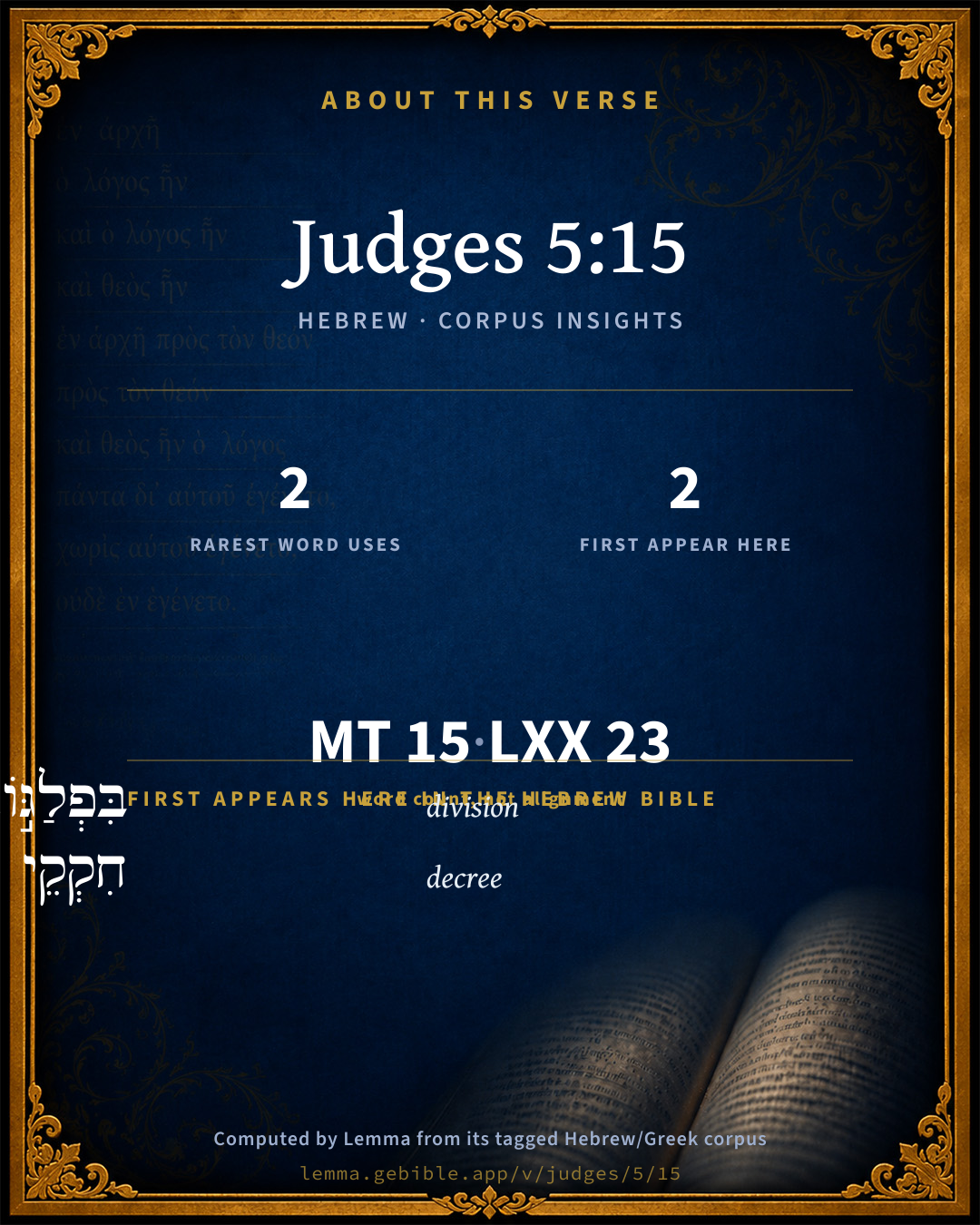
  • 2 first appearances in the Hebrew Bible
Full analysis ↓
Download a study sheet

One document with this verse’s original text, its word-by-word gloss line, the meaning frame, cross-references with their text, attributed commentary, and full source and license credits — printable, and it pastes into notes with its structure intact.

This verse Autodidact and up

Study sheet (.html) Plain text (.txt)

A passage Seminary Student

Up to 50 verses in one chapter. A passage sheet keeps up to 6 commentary sources and 12 cross-references per verse, in the order this page ranks them, and says so on the sheet whenever that leaves anything out. Ask for a single verse and you get the Autodidact verse sheet above.

Everything on this page stays free to read, with no account — the sheet is a download of what is already on screen, not access to it.

Want to remove ads? Support Godless Engineer
Compare translations 3

The same verse in 3 English versions, stacked beneath the original-language interlinear above. Click any original word for its lexicon entry.

Each is an independent rendering of the whole verse — the interlinear is not word-aligned to these translations.

Highlighted words mark where these versions differ — a whole-verse word diff, not a word-by-word alignment.

  • World English Bible Public Domain
    The princes of Issachar were with Deborah; As was Issachar, so was Barak; Into the valley they rushed forth at his feet. By the watercourses of Reuben There were great resolves of heart.
  • King James Version Public Domain
    And the princes of Issachar were with Deborah; even Issachar, and also Barak: he was sent on foot into the valley. For the divisions of Reuben there were great thoughts of heart.
  • unfoldingWord Literal Text CC BY-SA 4.0
    And my commanders in Issachar with Deborah, and Issachar, so Barak; into a valley he was sent at his feet. Among the divisions of Reuben, great the searchings of the heart.

unfoldingWord Literal Text — © unfoldingWord, licensed CC BY-SA 4.0. Word-aligned USFM3 via Door43 (git.door43.org/unfoldingWord/en_ult).

Versions to compare (up to 4)

3 of 4 selected

Show all 18 translations

Every available English version of this verse, each an independent rendering of the whole verse.

  • World English Bible Public Domain
    The princes of Issachar were with Deborah; As was Issachar, so was Barak; Into the valley they rushed forth at his feet. By the watercourses of Reuben There were great resolves of heart.
  • Berean Standard Bible Public Domain
    The princes of Issachar were with Deborah, and Issachar was with Barak, rushing into the valley at his heels. In the clans of Reuben there was great indecision.
  • Majority Standard Bible Public Domain
    The princes of Issachar were with Deborah, and Issachar was with Barak, rushing into the valley at his heels. In the clans of Reuben there was great indecision.
  • King James Version Public Domain
    And the princes of Issachar were with Deborah; even Issachar, and also Barak: he was sent on foot into the valley. For the divisions of Reuben there were great thoughts of heart.
  • American Standard Version (1901) Public Domain
    And the princes of Issachar were with Deborah; As was Issachar, so was Barak; Into the valley they rushed forth at his feet. By the watercourses of Reuben There were great resolves of heart.
  • Revised Version (1885) Public Domain
    And the princes of Issachar were with Deborah; as was Issachar, so was Barak; into the valley they rushed forth at his feet. By the watercourses of Reuben there were great resolves of heart.
  • Geneva Bible (1599) Public Domain
    And the Princes of Issachar were with Deborah, and Issachar, and also Barak: he was set on his feete in the valley: for the diuisions of Reuben were great thoughts of heart.
  • Douay-Rheims (1899) Public Domain
    The captains of Issachar were with Debbora, and followed the steps of Barac, who exposed himself to danger, as one going headlong, and into a pit. Ruben being divided against himself, there was found a strife of courageous men.
  • Young's Literal Translation Public Domain
    And princes in Issachar `are' with Deborah, Yea, Issachar `is' right with Barak, Into the valley he was sent on his feet. In the divisions of Reuben, Great `are' the decrees of heart!
  • Literal Standard Version CC BY-SA 4.0
    And princes in Issachar [are] with Deborah, || Indeed, Issachar [is] right with Barak, || Into the valley he was sent on his feet. In the divisions of Reuben, || The decrees of heart [are] great!
  • Unlocked Literal Bible CC BY-SA 4.0
    My princes in Issachar were with Deborah; and Issachar was with Barak rushing after him into the valley under his command. Among the clans of Reuben there were great searchings of heart.
  • unfoldingWord Literal Text CC BY-SA 4.0
    And my commanders in Issachar with Deborah, and Issachar, so Barak; into a valley he was sent at his feet. Among the divisions of Reuben, great the searchings of the heart.
  • Darby Bible Public Domain
    the princes of Is'sachar came with Deb'orah, and Is'sachar faithful to Barak; into the valley they rushed forth at his heels. Among the clans of Reuben there were great searchings of heart.
  • World Messianic Bible Public Domain
    The princes of Issachar were with Deborah. As was Issachar, so was Barak. They rushed into the valley at his feet. By the watercourses of Reuben, there were great resolves of heart.
  • Webster's Bible Public Domain
    And the princes of Issachar were with Deborah: even Issachar, and also Barak: he was sent on foot into the valley. For the divisions of Reuben there were great thoughts of heart.
  • Free Bible Version CC BY-SA 4.0
    The leaders of Issachar supported Deborah and Barak; they raced into the valley following Barak. But the tribe of Reuben was very undecided.
  • Bible in Basic English Public Domain
    Your chiefs, Issachar, were with Deborah; and Naphtali was true to Barak; into the valley they went rushing out at his feet. In Reuben there were divisions, and great searchings of heart.
  • JPS Tanakh (1917) Public Domain
    And the princes of Issachar were with Deborah; as was Issachar, so was Barak; into the valley they rushed forth at his feet. Among the divisions of Reuben there were great resolves of heart.

Literal Standard Version (2020), Covenant Press — licensed CC BY-SA 4.0. Text via the HelloAO Bible API (eBible.org). Unlocked Literal Bible (unfoldingWord) — licensed CC BY-SA 4.0. Text via the HelloAO Bible API (eBible.org). unfoldingWord Literal Text — © unfoldingWord, licensed CC BY-SA 4.0. Word-aligned USFM3 via Door43 (git.door43.org/unfoldingWord/en_ult). Free Bible Version, Dr. Jonathan Gallagher — licensed CC BY-SA 4.0. Text via the HelloAO Bible API (eBible.org).

Word by word

More ways to search: Search by grammar → Find every occurrence → Compare this word →

Practice this passage: Drill this verse → Learn its vocabulary →

חִקְקֵי
chêqeq
H2711
“decrees of”
Noun, Common, Masculine, Plural, Construct
Part of Speech
Noun
Type
Common
Gender
Masculine
Number
Plural
State
Construct
Full BDB Definition

Origin: from H2710

TWOT: 728a

decree, resolve, statute, action prescribed
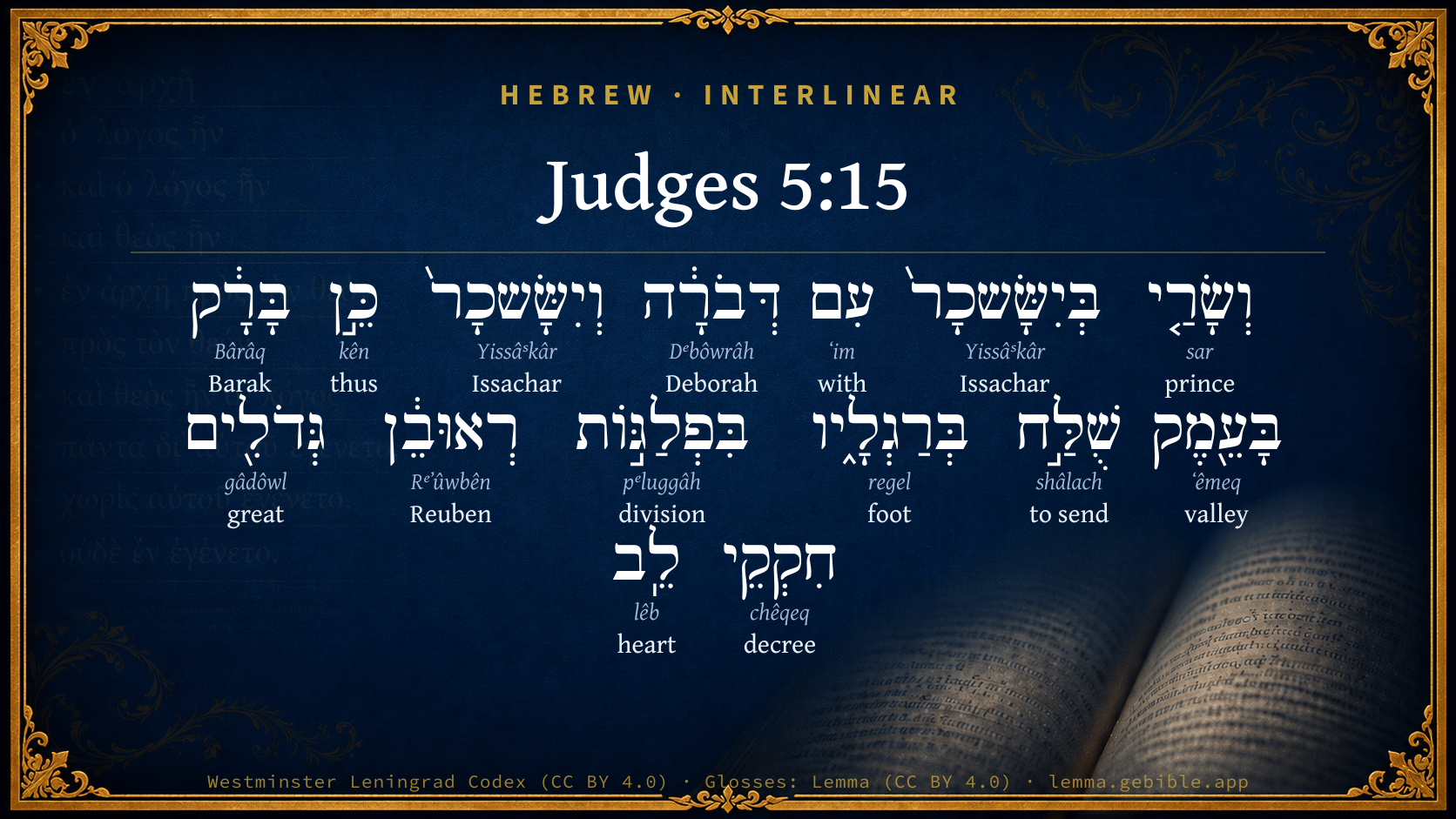
  1. וְשָׂרַ֤י sar H8269 “and · princes · my” Conjunction + Noun, Common, Masculine, Plural, Construct + Suffix, Personal, 1st Person, Common, Singular
  2. בְּיִשָּׂשכָר֙ Yissâˢkâr H3485 “in/at · Issachar” Preposition + Noun, Proper
  3. עִם ʻim H5973 “with” Preposition
  4. דְּבֹרָ֔ה Dᵉbôwrâh H1683 “Deborah” Noun, Proper
  5. וְיִשָּׂשכָר֙ Yissâˢkâr H3485 “and · Issachar” Conjunction + Noun, Proper
  6. כֵּ֣ן kên H3651 “thus” Particle, Demonstrative
  7. בָּרָ֔ק Bârâq H1301 “Barak” Noun, Proper
  8. בָּעֵ֖מֶק ʻêmeq H6010 “in/at the · valley” Preposition, Determined + Noun, Common, Masculine, Singular, Absolute
  9. שֻׁלַּ֣ח shâlach H7971 “to send” Verb, Pual, Perfect, 3rd Person, Masculine, Singular
  10. בְּרַגְלָ֑יו regel H7272 “in/at · feet · his” Preposition + Noun, Common, Feminine, Dual, Construct + Suffix, Personal, 3rd Person, Masculine, Singular
  11. בִּפְלַגּ֣וֹת pᵉluggâh H6391 “in/at · divisions of” Preposition + Noun, Common, Feminine, Plural, Construct
  12. רְאוּבֵ֔ן Rᵉʼûwbên H7205 “Reuben” Noun, Proper
  13. גְּדֹלִ֖ים gâdôwl H1419 “great” Adjective, Adjective, Masculine, Plural, Absolute
  14. לֵֽב lêb H3820 “heart” Noun, Common, Masculine, Singular, Absolute

About this verse

These counts appear in no published source. They are computed here, from the morphology-tagged text and Lemma’s own curated glosses. What Lemma adds →

15
words
14
distinct lemmas
Historical
section

Notable vocabulary

The rarest word here is חִקְקֵי decree H2711 — appearing just 2 times in the whole Hebrew Bible.

First appearance in Scripture

These words make their first canonical appearance in the Hebrew Bible here:

  • בִּפְלַגּ֣וֹת division H6391
  • חִקְקֵי decree H2711

Shared distinctive vocabulary

חִקְקֵי decree H2711 occurs in 2 verses of the Hebrew Bible. Also found in:

Grammatical profile

  • 1 verb
  • 11 nouns
  • 1 adjective
  • 1 preposition
  • 1 particle

Verb forms

  • שֻׁלַּ֣ח Pual · Perfect

Repetition

A word recurs within this verse — often emphatic in Hebrew:

  • בְּיִשָּׂשכָר֙ Issachar H3485 ×2

Hebrew & Septuagint length

In English translation the verse runs 33 words from the Hebrew and 30 from the Septuagint (LXX English) — closely comparable.

A rough comparison of the two English renderings, which tokenize alike — not a word-level alignment.

Word counts can differ between the Hebrew and the Greek without any difference in meaning — e.g. the Hebrew direct-object marker אֵת has no separate Greek word, and Greek often adds the article ὁ.

In the original languages it is 15 Hebrew tokens and 23 Greek tokens — but the two are counted differently (Hebrew bundles its prefixes and suffixes into one token; the Greek is in lemma form), so that isn’t a like-for-like length.

Cross-references

8

Topical passages linked to Judges 5:15 in the Treasury of Scripture Knowledge — connected by theme and wording, ordered by reader-vote popularity; previews shown in the World English Bible.

  • Judges 4:14 Deborah said to Barak, Up; for this is the day in which Yahweh has delivered Sisera into your hand; hasn't Yahweh gone out before you? So Barak went down from Mount Tabor, and ten thousand men after him.
  • Judges 4:6 She sent and called Barak the son of Abinoam out of Kedesh-naphtali, and said to him, Hasn't Yahweh, the God of Israel, commanded, [saying], Go and draw to Mount Tabor, and take with you ten thousand men of the children of Naphtali and of the children of Zebulun?
  • Judges 4:10 Barak called Zebulun and Naphtali together to Kedesh; and there went up ten thousand men at his feet: and Deborah went up with him.
  • 1 Chronicles 12:32 Of the children of Issachar, men who had understanding of the times, to know what Israel ought to do, the heads of them were two hundred; and all their brothers were at their commandment.
  • Proverbs 22:13 The sluggard says, "There is a lion outside! I will be killed in the streets!"
  • Acts 15:39 Then the contention grew so sharp that they separated from each other. Barnabas took Mark with him, and sailed away to Cyprus,
  • Acts 20:13 But we who went ahead to the ship set sail for Assos, intending to take Paul aboard there, for he had so arranged, intending himself to go by land.
  • 2 Corinthians 11:2 For I am jealous over you with a godly jealousy. For I married you to one husband, that I might present you as a pure virgin to Christ.

Cross-references courtesy of OpenBible.info (CC BY 4.0).

Hebrew and Greek witnesses Masoretic Hebrew ↔ Greek Septuagint

The same verse in the two great witnesses to the Old Testament, shown verse-for-verse.

These are two independent witnesses, not word-aligned to each other, and the Septuagint is shown in lemma (dictionary) form.

Hebrew Judges 5:15 Masoretic · Westminster Leningrad Codex

וְשָׂרַ֤י בְּיִשָּׂשכָר֙ עִם דְּבֹרָ֔ה וְיִשָּׂשכָר֙ כֵּ֣ן בָּרָ֔ק בָּעֵ֖מֶק שֻׁלַּ֣ח בְּרַגְלָ֑יו בִּפְלַגּ֣וֹת רְאוּבֵ֔ן גְּדֹלִ֖ים חִקְקֵי לֵֽב

The princes of Issachar were with Deborah; As was Issachar, so was Barak; Into the valley they rushed forth at his feet. By the watercourses of Reuben There were great resolves of heart.

World English Bible · Public Domain

Greek LXX Judges 5:15 Septuagint · lemma form

καί ἀρχηγός ἐν ισσαχαρ μετά δεββωρα καί βαρακ οὕτως βαρακ ἐν κοιλάς ἀποστέλλω ἐν πούς αὐτός εἰς ὁ μερίς ρουβην μέγας ἐκἱκνέομαι καρδία

And princes in Issachar were with Debbora and Barac, thus she sent Barac on his feet in the valleys into the portions of Ruben; great pangs reached to the heart.

LXX2012 (modern English Septuagint) · Public Domain

On this verse, Adam Clarke's Commentary discusses the Septuagint’s reading. Read the note in Commentary ↓

Hebrew: Westminster Leningrad Codex (CC BY 4.0). Greek: Septuagint (public domain); English from LXX2012 (modern English Septuagint) (Public Domain). How the Septuagint differs from the Hebrew →

Targum (Aramaic paraphrase)

1

The Targum is the ancient Jewish Aramaic paraphrase of the Hebrew Scriptures — an interpretive translation, not the Hebrew text itself. Onkelos (literal) and Pseudo-Jonathan (expansive) render the Torah, and Jonathan the Prophets. Coverage is partial: where no permissively-licensed English translation exists for a verse, only the Aramaic is shown. This is verse-level text, not a word-by-word alignment to the Hebrew.

  1. Targum Jonathan Prophets (Joshua–Malachi)
    וְרַבְרְבֵי יִשָׂשכָר מִשְׁתַּמְעִין לְמִילֵי דְבוֹרָה וּשְׁאַר שִׁבְטָא דְיִשָׂשכָר מְשַׁמְשִׁין קֳדָם בָּרָק מִשְׁתַּלְחִין בְּקִרְוֵי מַשְׁרָא לְכָל אֲתַר דְצָרִיךְ לְתַּמָן בְּתוּשְׁלַחְתֵּיה אַזְלִין בְּזַרְעִית רְאוּבֵן סַגִיאִין נִבְלֵי לִבָּא:

    (no public-domain English translation for this verse)

    Targum Jonathan — Aramaic: “Mikraot Gedolot” (public domain). English: “Sefaria Community Translation” (CC0 1.0 (public-domain dedication)); “London "Chaldee Paraphrase," 1871” (public domain). Text via Sefaria.

Commentary

Notes on Judges 5:15 from classic Christian and Jewish commentators (each source and its license shown beneath its notes). The classic Christian expositions comment on the surrounding passage and are grouped to its opening verse, so a note may address several verses; the Jewish commentaries on the Tanakh (Rashi and others) are per-verse, so they appear only where the commentator wrote on this verse.

Lemma curates 59 commentaries, every one of them public domain or Creative Commons licensed, each selected and text-cleaned for this edition rather than reprinted as found. About our sources →

Trapp's Complete Commentary

John Trapp

Jdg 5:15 And the princes of Issachar [were] with Deborah; even Issachar, and also Barak: he was sent on foot into the valley. For the divisions of Reuben [there were] great thoughts of heart.

Ver. 15. For the divisions of Reuben.] Who deserted their brethren in this war, there were great thoughts of heart, that is, great heart burnings and inward turmoil of discontent against them: they were very ill thought of, and hardly censured. Others, reading the words thus, In the divisions of Reuben, make this the sense, That the Reubenites are so divided among themselves, and cannot agree upon it to help their brethren against the common enemy; the true cause is their pride and haughtiness of spirit. The truth is, pride is a dividing distemper. Gouty swollen legs keep at a distance. Bladders blown up with wind spurt else from another, they will not close; but if you prick them, you may pack a thousand in a little room. {a}

{a} Burr’s Heart Divisions.

John Trapp, A Commentary or Exposition upon All the Books of the Old and New Testament (1647–1656) — public domain. Text from a community e-Sword module.

Joseph Benson's Commentary

Jdg 5:15. He was sent on foot — Or, when he was sent, with his foot, into the valley. This is not an immaterial remark of the prophetess. It expresses that the tribe or people of Issachar, following the counsel and example of their princes, were as hearty and valiant in the cause as Barak their general; and as he marched on foot to attack Sisera with his horses and nine hundred armed chariots, and that into the valley or plain, where horses and chariots are chiefly useful, so did they, with no less courage and resolution. This she said to show that the battle was Jehovah’s, and that he saveth not by horses, nor by chariots. For the divisions of Reuben — Or, separations, not so much of one from another, (for they seem to have been all well agreed in abiding at home with their sheep,) as of all from their brethren, from whom they were divided no less in their designs and affections than in their situation by the river Jordan: and they would not join their interests and forces with them in this common cause. Great thoughts — Or, great searchings, great and sad thoughts, and debates, and perplexities of mind among the Israelites, to see themselves deserted by so great and potent a tribe as Reuben was.

Joseph Benson's Commentary on the Old and New Testaments (1811–1818) — public domain. Text from a community e-Sword module.

Keil & Delitzsch

C. F. Keil & F. Delitzsch

שׂרי, "my princes," does not furnish any appropriate meaning, as neither Deborah nor Barak was of the tribe of Issachar, and it is not stated anywhere that the Issacharites gathered round Deborah as their leaders. The reading שׂרי (stat. constr.), adopted by the old versions, must be taken as the correct one, and the introduction of the preposition בּ does not preclude this (compare בגּלבּע הרי, Sa2 1:21, and Ewald, 289, b.). עם, which is used to denote an outward equality, as in Sa1 17:42, and is substantially the same as the כּן which follows ("just as"), is construed without כּ in the first clause, as in Psa 48:6. בּעמק: into the valley of Jezreel, the plain of Kishon. בּרגליו שׁלּח, as in Job 18:8, to be sent off, i.e., incessantly impelled, through his feet; here it is applied to an irresistible force of enthusiasm for the battle. The nominative to שׁלּח is Issachar and Barak.

15b At the brooks of Reuben were great resolutions of heart.

16 Why remainest thou between the hurdles,

To hear the piping of the flocks?

At the brooks of Reuben were great projects of heart.

17 Gilead rests on the other side of the Jordan;

And Dan ... why tarries he by ships?

Asher sits on the shore of the sea,

And by his bays he reposes.

18 Zebulun, a people that despises its soul even to death,

And Naphtali upon the heights of the field.

In this strophe Deborah first of all mentions the tribes which took no part in the conflict (Jdg 5:15-17), and then returns in Jdg 5:18 to the Zebulunites, who staked their life along with Naphtali for the deliverance of Israel from the yoke of the enemy. The enumeration of the tribes who remained at a distance from the conflict commences with Reuben (Jdg 5:15 and Jdg 5:16). In this tribe there did arise a lively sympathy with the national elevation. They held meetings, passed great resolutions, but it led to no practical result; and at length they preferred to remain quietly at home in their own comfortable pastoral life. The meaning brooks for פּלגּות is well established by Job 20:17, and there is no reason whatever for explaining the word as equivalent to פּלגּות, מפלגּות, divisions (Ch2 35:5, Ch2 35:12; Ezr 6:18). The territory of Reuben, which was celebrated for its splendid pastures, must have abounded in brooks. The question, Why satest thou, or remainedst thou sitting between the hurdles? i.e., in the comfortable repose of a shepherd's life, is an utterance of amazement; and the irony is very apparent in the next clause, to hear the bleating of the flocks, i.e., the piping of the shepherds, instead of the blast of the war-trumpets.

Keil & Delitzsch — Biblical Commentary on the Old Testament (1861–1891) — public domain (CC PDM 1.0). Text via the HelloAO Bible API. (Old Testament only.)

Geneva Bible (1599)

Geneva Bible translators

They marveled, that they came not over Jordan to help them.

Even the whole tribe.

Geneva Bible (1599) marginal notes — public domain. Text via Bolls.life.

Jamieson, Fausset & Brown

Robert Jamieson, A. R. Fausset & David Brown

Then comes a reproachful notice of the tribes which did not obey the summons to take the field against the common enemy of Israel. By the

divisions--that is, the watercourses which descend from the eastern hills unto the Jordan and Dead Sea.

For the divisions of Reuben there were great thoughts of heart--They felt the patriotic impulse and determined, at first, to join the ranks of their western brethren, but resiled from the purpose, preferring their peaceful shepherd songs to the trumpet sound of war.

Jamieson, Fausset & Brown — Commentary Critical and Explanatory on the Whole Bible (1871) — public domain (CC PDM 1.0). Text via the HelloAO Bible API.

Adam Clarke's Commentary

Verse 15. The princes of Issachar] They were at hand and came willingly forth, at the call of Deborah, to this important war.

Barak - was sent on foot] I have no doubt that ברגלין, without regarding the points, should be translated with his footmen or infantry. Thus the Alexandrian Septuagint understood it, rendering the clause thus: Οὑτω Βαρακ εξαπεστειλεν πεζους αυτου εις την κοιλαδα, "Barak also sent forth his footmen into the valley." Luther has perfectly hit the meaning, Barak mit seinen fussvoleke, "Barak with his footmen."

For the divisions of Reuben] Either the Reubenites were divided among themselves into factions, which prevented their co-operation with their brethren, or they were divided in their judgment concerning the measures now to be pursued, which prevented them from joining with the other tribes till the business was entirely settled.

The thoughts of heart, and searchings of heart, might refer to the doubts and uneasiness felt by the other tribes, when they found the Reubenites did not join them; for they might have conjectured that they were either unconcerned about their liberty, or were meditating a coalition with the Canaanites.

Adam Clarke's Commentary on the Bible (1810–1826) — public domain. Text from a community e-Sword/MySword module.

Ellicott's Commentary for English Readers

(15) And the princes of Issachar.—The ordinary reading of the Hebrew gives the meaning, “And my princes in Issachar (came down to battle) with Deborah.” If this be the right reading, Deborah calls them “my princes” with a touch of pride, and hence some have assumed that she belonged to the tribe of Issachar, not to that of Ephraim. But a very slight change gives the meaning of “the princes in Issachar.” Deborah did not take actual part in the battle, like Boadicea or Joan of Arc, but seems to have been close at hand, in the rear, to encourage the combatants, as the ancient British and German women used to do, and as Arab women do to this day.

Even Issachar, and also Barak: he was sent on foot into the valley.—Rather, even Issachar, as well as Barak, rushed down at his feet (i.e., after Barak) into the plain (emek).” It is a pity that the verse does not end here, for the next clause begins the description of “the malingerers,” whose cowardice or selfishness is triumphantly contrasted with the heroic daring of Zebulon and Naphtali in Jdg_5:18.

For the divisions of Reuben there were great thoughts of heart.—The word for “divisions” (pelagoth) might mean “families” or “clans,” as the LXX., or “factions,” as the Vulgate seems to have understood it; but it almost certainly means streams, as in Job_20:17 (margin, “streaming brooks”), where alone it recurs. The allusion is to the Jabbok and its numerous affluents. “Thoughts of heart” only occurs elsewhere in Isa_12:1. where it is rendered “decrees,” with the epithet “empty,” or “vain.” Possibly, therefore, an ironic contrast is intended between the magnanimous “decisions” (chikekey lçbh) of Reuben and his evanescent “projects”( chikerey lçbh). The play of words is almost certainly contemptuous, and there may be some lurking scorn in the word pelagoth to imply either “rivers” or “factions.” Reuben debated and stayed at home on frivolous pretences, as Sparta did in the days of Marathon. But even then the sting of the reproach lies in the taunting question of the next verse.

A Bible Commentary for English Readers, edited by Charles John Ellicott (1878–1897) — public domain. Text from a community e-Sword module.

The Cambridge Bible for Schools and Colleges

gen. ed. J. J. S. Perowne

15. the princes of Issachar were with Deborah] This seems to be the meaning; if Deborah belonged to the tribe of Issachar we can understand why she accompanied it; contrast Jdg_4:5 n. Issachar is not mentioned in ch. 1 (see p. 3). The settlements of the tribe lay S.E. of the Plain, S. of Naphtali, and S.E. of Zebulun, to judge from Jos_19:17-23, which, however, defines the boundaries of a much later age. At this period Issachar had not earned the ignoble reputation with which it is taunted in Gen_49:14 f.

As was Issachar, so was Barak] What can this mean? The construction of the sentence is harsh, and the second Issachar is omitted by LXX and Vulgate We should expect the name of another tribe here; in view of Jdg_5:18, cf. Jdg_4:6, Naphtali deserved honourable mention at this point.

Into the valley they rushed forth at his feet] i.e. at his heels, after him, cf. Jdg_4:10, Jdg_8:5. The rendering they rushed is a questionable paraphrase of the verb which lit. = he was sent, i.e. according to usage was let go Gen_44:3, or dismissed Isa_50:1; the form must be incorrect. Winckler repeats the verb which he suggests for Jdg_5:14 a.

15b–18. The reluctant and the ready.

By the watercourses of Reuben] For the rendering watercourses cf. Job_20:17. But the territory of Reuben was dry rather than well-watered (like that of Gad); perhaps the old rendering divisions (LXX, Vulgate), i.e. sections of the tribe, is to be preferred; for this use of the word cf. 2Ch_35:5. Instead of resolves, lit. decisions, the form in Jdg_5:16 b is better, soundings, lit. investigations, cf. 1Sa_20:12 ‘when I have sounded my father.’ Transl. Among the divisions of Reuben great were the soundings of heart, i.e. to find out one another’s sentiments. Note the character of Reuben given in Gen_49:4.

The Cambridge Bible for Schools and Colleges (gen. ed. J. J. S. Perowne; Cambridge University Press, 1878–1918) — public domain. Text from a community e-Sword module.

John Gill's Exposition

And the princes of Issachar were with Deborah,.... On Mount Tabor, whither they came to offer themselves to join in the war against Jabin; or to assist with their counsels, the men of this tribe being understanding of the times, to know what Israel ought to do, Ch1 12:32.

even Issachar: not the princes only, but the whole tribe also; so the Targum paraphrases it,"the rest of the tribe of Issachar:"

and also Barak, he was sent on foot into the valley; which was at the bottom of Mount Tabor, from whence he was sent down by Deborah, when Sisera's army was come thither; and where he went cheerfully on foot at the head of his 10,000 men, to engage Sisera with his horse and chariots; and which latter were capable of doing great execution in the valley, by running among the foot, and cutting them in pieces with the scythes at the side of them; but Barak, fearless of danger, readily obeyed the command of the judge and prophetess, believing it was of God: or the words may be rendered, as by Noldius (h).

as Issachar, so Barak; he was sent, &c. the one as the other, with equal readiness and cheerfulness, courage and intrepidity, descended the mountain, at the order of Deborah, and took the field in the open plain, to engage with Sisera and his numerous host:

for the division of Reuben there were great thoughts of heart; either for their divisions among themselves in their own councils, some being for going over Jordan to assist their brethren the Israelites against Jabin, and free them from his yoke, pitying their distressed state and condition; and others were for keeping at home, and taking care of their flocks, and not intermeddle in the quarrel; judging it to be most for their worldly peace and profit to observe a neutrality: by reason of which divisions no assistance was given. Or for their divisions and separations from their brethren the Israelites, from whom they were not only separated by the river Jordan, but in their affections to them, and regards for them; keeping at a distance from them, when their help was required: and this conduct of theirs caused many thoughts of heart in Deborah and Barak, in the princes and people of Israel, who could not well understand the reason of it; and which caused much grief and uneasiness of mind, that so powerful a tribe, and who had been assisting to them in the conquest of the land, and lay convenient to help them, yet should be so very indifferent to them.

(h) "sicut Issachar sic Barach", Concord. Ebr. part. p. 305. No. 1214. So Belg.

John Gill's Exposition of the Whole Bible (1746–1763) — public domain (CC PDM 1.0). Text via the HelloAO Bible API.

Albert Barnes' Notes on the Bible

Even Issachar ... - i. e. “and, as well as Issachar, Barak also with the tribes of Zebulun and Naphtali, rushed down on foot from Mount Tabor into the valley to attack the iron chariots of Sisera.”

For the divisions - Better: “among the brooks.” Reuben ought to have followed in this catalogue of patriots, but with that abruptness for which this poem is so conspicuous, Deborah adverts to his absence instead.

Albert Barnes' Notes on the Bible (1834–1885) — public domain. Text from a community e-Sword/MySword module.

Haydock's Catholic Bible Commentary

Exposed. Hebrew, "he was sent on foot into the vale," to contend with the 900 chariots of Sisara. Issachar boldly followed him in battle. They came down with such fury and speed, as if they were falling headlong down a precipice. (Haydock) --- Sisara presently turned his back, being affrighted with the apparition of angels, who probably fought at the head of Barac’s troop. (Salien) --- Only three tribes exposed themselves to danger, while the rest were either engaged in civil broils, or in their usual employments. (Calmet) --- Divided. By this it seems that the valiant men of the tribe of Ruben were divided in their sentiments, with relation to this war; which division kept them at home within their own borders, to hear the bleating of their flocks. (Challoner) --- Hebrew may have different explanations, "In the divisions (families) of Ruben, there are princes of a great heart," renowned for their prudence and valour: or "Ruben dwelt in his division, (or territory) there are chiefs," &c. (Calmet) --- Protestants, "for the divisions of Ruben, there were great thoughts of heart." Bonfrere supposes that these disputes excited the surprise and observations of all. (Haydock)

George Leo Haydock (1774–1849), Haydock's Catholic Family Bible and Commentary, 1859 edition — public domain. Excludes Psalms (Douay-Rheims chapter numbering differs from Protestant) and Deuterocanonical books (Catholic canon only).

Matthew Poole's English Annotations

Were with Deborah, i.e. ready to assist her. Even Issachar. Heb. and Issachar, i.e. the tribe or people of Issachar, following the counsel and example of their princes, and being now at their commandments, as they were afterwards upon another occasion, 1Ch 12:32.

And also Barak, or, even as Barak, i.e. they were as hearty and valiant as Barak their general; and as he marched on foot here and Jdg 4:10, against their enemies’ horses and chariots, and that

into the valley, where the main use of horses and chariots lies; so did they with no less courage and resolution.

The divisions, or separations; whereby they were divided or separated, not so much one from another in their thoughts, counsels, and carriage in this war, (for they seem to be all too well agreed in abiding at home with their sheep, as it follows,) as all from their brethren, from whom they were divided no less in their designs and affections, than in their situation by the river Jordan; and they would not join their interests and forces with them in this common cause.

Great thoughts, or, great searchings, as it is Jdg 5:16; great and sad thoughts, and debates, and perplexities of mind among the Israelites, to see themselves deserted by so great and potent a tribe as Reuben was.

Matthew Poole's English Annotations on the Holy Bible (1683–1685) — public domain. Text from a community e-Sword/MySword module.

Whedon's Commentary on the Bible

Daniel D. Whedon

15. Was he sent at his feet — This was the way in which Issachar was Barak’s support. Obedient to orders he followed at his feet (that is, immediately after him, as in Jdg_4:10) in the valley of the Kishon, and assisted Barak in the fight.

Determinations of heart — This must be taken in connexion with deliberations of heart in the next verse, when this whole reference to Reuben will appear as a masterpiece of irony. They heard the call of Deborah, and at once began to make great plans and lofty resolutions and determinations to give their help to the war; but, as if charmed by the pipings among the flocks, all their great resolutions end in deliberations!

Daniel D. Whedon (gen. ed.), Commentary on the Old and New Testaments (1874–1909) — public domain. Text from a community e-Sword module.

The Pulpit Commentary

He was sent on foot into the valley. It was a mark of extraordinary valour that he rushed down from Mount Tabor on foot against the 900 iron chariots in the plain. (Jud_1:4:14) For the divisions, etc. Or, among the water-brooks, i.e. the Reubenites, dwelling amidst their flocks among the water-brooks, were much perplexed with doubts whether they should stay still or join their countrymen.

The Pulpit Commentary (1880–1919), ed. H.D.M. Spence-Jones & Joseph S. Exell — public domain. Text from a community e-Sword module.

John Wesley's Explanatory Notes

With Deborah - Ready to assist her. Issachar - Hebrew. and Issachar, that is, the tribe or people of Issachar, following the counsel and example of their princes. Barak - That is, they were as hearty and valiant as Barak their general; and as he marched on foot against their enemies horses and chariots, and that into the valley, where the main use of horses and chariots lies; so did they with no less courage and resolution. Divisions - Or, separations, not so much one from another, (for they seem to be all so well agreed in abiding at home with their sheep) as all from their brethren, from whom they were divided no less in their designs and affections, than in their situation by the river Jordan: and they would not join their interests and forces with them in this common cause. Great thoughts - Or, great searchings, great and sad thoughts, and debates, and perplexities of mind among the Israelites, to see themselves deserted by so great and potent a tribe as Reuben was.

John Wesley, Explanatory Notes Upon the Whole Bible (1754–1765) — public domain. Text via the GEBible commentary corpus.

unfoldingWord translationNotes

Door43 World Missions Community

My princes in Issachar were with Deborah

Here "My" refers to Deborah. This whole statement can be translated in first person. AT: "My princes in Issachar were with me" (See: First, Second, or Third Person)

Deborah

See how you translated this name in Judges 4:4.

Issachar was with Barak

Here "Issachar" refers to the tribe of Issachar. AT: "the tribe of Issachar was with Barak" (See: Metonymy)

Barak

See how you translated this name in Judges 4:6.

rushing after him into the valley under his command

"obeying his command and rushing after him into the valley"

rushing after

"following after" or "hurrying after"

there were great searchings of heart

Here "heart" represents thoughts. The people discussing with each other but being unable to decide what they should do is spoken of as if they were searching their heart. AT: "there was a lot of discussing about what they should do" (See: Metonymy and Metaphor)

translationWords

prince

Issachar

command

clan

Reuben

heart

unfoldingWord translationNotes — © Distant Shores Media and the Door43 World Missions Community, licensed CC BY-SA 4.0. Source: git.door43.org/Door43/en_tn.

Rashi

Rabbi Shlomo Yitzchaki (Rashi)

Yesochar's nobles. The noblemen of Yesochar. This refers to members of the Sanhedrin who were engrossed in Torah study, and who knew and understood the times. They constantly accompanied Devorah, teaching the Yisroelites the laws and precepts.

Yesochar's nobles. The "י" in שׇׂרַי [lit. "my" nobles] is ancillary, fulfilling no grammatic function. It is similar to the "י" in "the animals in the field," or "he cut open, for himself, a window."

Yesochar with Barak. The remainder of Yesochar's constituency were likewise at Barak's disposal whenever he issued orders.

Dispatched to the valley at his heels. He dispatched them on all of his missions—to mobilize the people, and for all military needs.

However, in Reuven's equivocation. However, in Reuven's ambiguity was great cunning. "Craftiness of heart," cunning. In what way was he cunning? He straddled the battle lines to learn who would emerge the victor so that he could join them.

Rashi on the Tanakh — English translations: “The Judaica Press complete Tanach with Rashi, translated by A. J. Rosenberg” (CC BY 4.0); “Pentateuch with Rashi's commentary by M. Rosenbaum and A.M. Silbermann, 1929-1934” (public domain); “The Metsudah Tanach series, Lakewood, N.J” (CC BY 4.0); and “The Book of Joshua, Metsudah Publications, 1997” (CC BY 4.0). Text via Sefaria.

Radak

Rabbi David Kimhi (Radak)

And sarai: It is like sarim (leaders); as (Jeremiah 22:14), "and he cuts him out chalonai," is like chalonim; and like (Isaiah 20:4), "and the chasufai of buttocks"; and those that are similar to them. And so too did the whole tribe of Yissachar go out, and so too did Barak go out with Devorah.

Dispatched to the valley, at his heels/with his feet: As he did not request an animal to ride upon, due to his great desire for the war. But about the separation of Reuven - who separated and split [to] the other side of the Jordan and did not come to the war - great are the decisions of the heart and the searchings of the heart about him.

Radak on the Tanakh — English translations: “Sefaria Community Translation” (CC0 1.0 (public-domain dedication)); “Eliyahu Munk, HaChut Hameshulash” (CC BY 4.0); “Rabbi Mike Feuer, Jerusalem Anthology” (CC BY 4.0); and “R. David Kimhi on the first book of Psalms, Translated by R.G. Finch, London, 1919” (public domain). Text via Sefaria.

Lesson kit

Teaching starters — assembled from the data on this page, not authored interpretation. Every prompt links to the verse data it draws on. Edit before teaching.

Judges, in the Historical, opens this verse with 15 words (14 distinct Hebrew lemmas). Its most distinctive word is chêqeq (“decree”). A historical commentator’s framing appears above. Read the whole chapter for the surrounding context.

Discussion questions

  1. How does “decree” (chêqeq) shape what this verse is saying?
  2. 2 words make their first appearance in Scripture here. What does this debut establish?
  3. How does Isaiah 10:1, which shares the word «decree», read alongside this verse?
  4. What does the repetition of “Issachar” (2× in this one verse) do in this verse?
  5. The translations on this page render this verse differently — a whole-verse word diff, not a word-by-word alignment. What might account for the different wordings?
  6. «שֻׁלַּ֣ח» is a Pual Perfect verb. How does that grammatical form shape the action described?
  7. Compare how Trapp's Complete Commentary and Joseph Benson's Commentary read this verse. Where do they agree or differ?

Things to notice

Reading settings

Reading text

Shown beneath each verse's original-language words.

Old Testament
Old Testament edition

Read the OT as the Masoretic Hebrew (MT) or the Greek Septuagint (LXX).

English shown for the Greek Septuagint (in the Hebrew ↔ Greek comparison).

Comparing translations? Open the Compare panel on any verse page to stack up to four side by side.