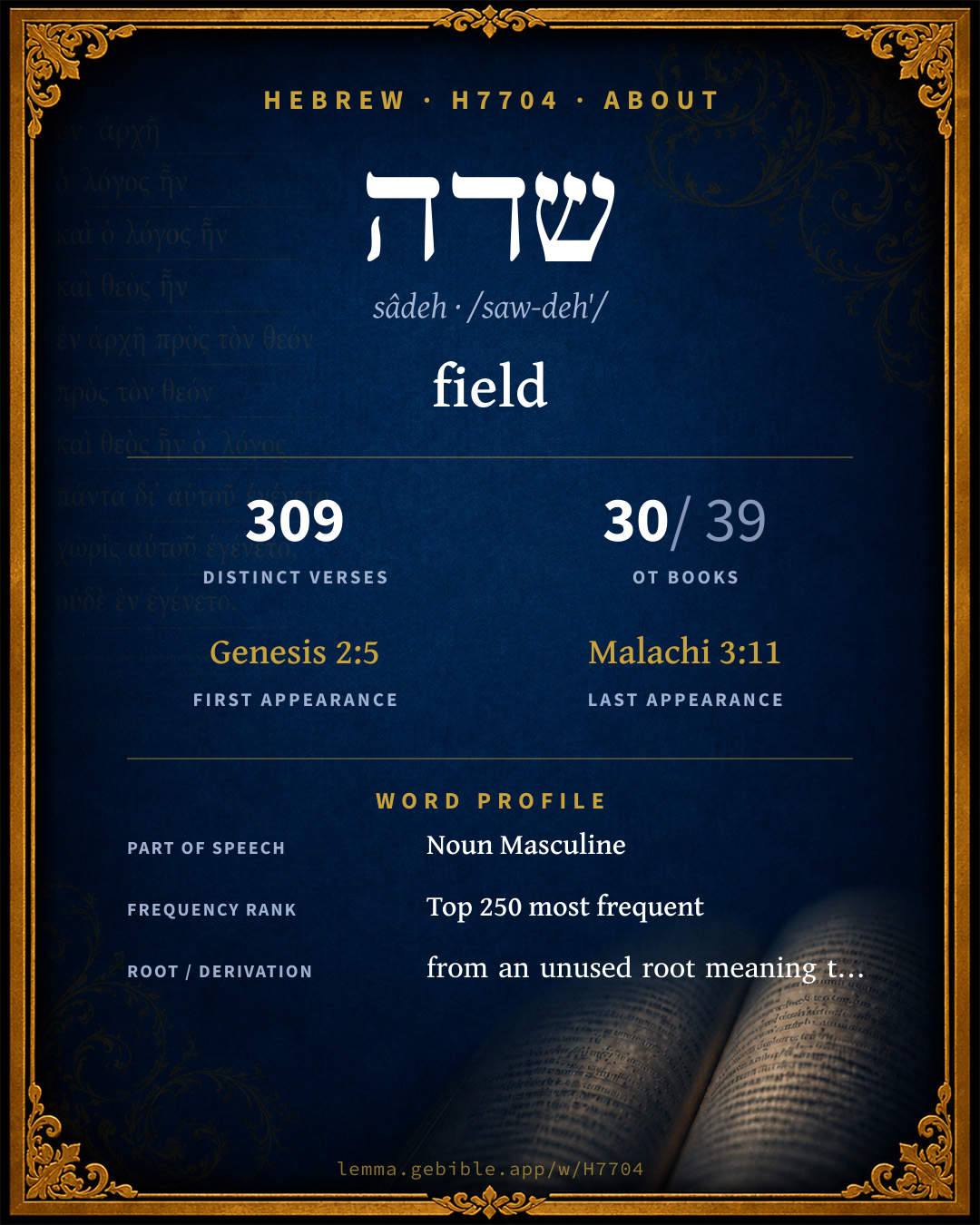
שָׂדֶה
field
‘field’ is one of 5 main senses fuller range ↓
Full lexicon entry — Brown-Driver-Briggs (BDB)
From Brown-Driver-Briggs (BDB)
Where this word appears
See every Absolute-state word in the Hebrew Bible →
Grammar key — what these labels mean
Part of speech
- Noun
- A naming word — a person, place, thing, or idea.
Noun type
- Common
- A common noun — a general class of person, place, or thing (“king,” “city,” “water”), not a specific name.
State
- Absolute
- The independent form of a noun, not bound to a following word.
- Construct
- A noun bound to a following noun in a possessive / “of” relationship (the construct chain).
Gender
- Masculine
- Grammatically masculine.
Number
- Singular
- One.
- Plural
- More than one (in Hebrew, generally three or more).
24 verses where H7704 appears in the Absolute state in the Book of Jeremiah. Filtered view — show all forms. Click any verse to open its interlinear word-by-word view. Verse text shown in the World English Bible for context — . Each verse’s Hebrew form is shown with its reference; the English is not keyword-highlighted, since the data carries no word-level English alignment. Use “Compare translations” on any verse to read it across multiple English versions. This concordance covers the Hebrew Bible; Septuagint (Greek Old Testament) occurrences are not indexed here.
Jeremiah
- Jeremiah 4:17 שָׂדַ֔י n c ms As keepers of a field are they against her round about, because she has been rebellious against me, says Yahweh.
- Jeremiah 6:12 שָׂד֥וֹת n c mp Their houses shall be turned to others, their fields and their wives together; for I will stretch out my hand on the inhabitants of the land, says Yahweh.
- Jeremiah 6:25 הַ/שָּׂדֶ֔ה ptcl def.art + n c ms Don't go forth into the field, nor walk by the way; for the sword of the enemy, [and] terror, are on every side.
- Jeremiah 7:20 הַ/שָּׂדֶ֖ה ptcl def.art + n c ms Therefore thus says the Lord Yahweh: Behold, my anger and my wrath shall be poured out on this place, on man, and on animal, and on the trees of the field, and on the fruit of the ground; and it shall burn, and shall not be quenched.
- Jeremiah 9:22 הַ/שָּׂדֶ֑ה ptcl def.art + n c ms Speak, Thus says Yahweh, The dead bodies of men shall fall as dung on the open field, and as the handful after the harvester; and none shall gather [them].
- Jeremiah 12:4 הַ/שָּׂדֶ֖ה ptcl def.art + n c ms How long shall the land mourn, and the herbs of the whole country wither? for the wickedness of those who dwell therein, the animals are consumed, and the birds; because they said, He shall not see our latter end.
- Jeremiah 12:9 הַ/שָּׂדֶ֖ה ptcl def.art + n c ms Is my heritage to me as a speckled bird of prey? are the birds of prey against her round about? go you, assemble all the animals of the field, bring them to devour.
- Jeremiah 13:27 בַּ/שָּׂדֶ֔ה prep det + n c ms I have seen your abominations, even your adulteries, and your neighing, the lewdness of your prostitution, on the hills in the field. Woe to you, Jerusalem! you will not be made clean; how long shall it yet be?
- Jeremiah 14:5 בַּ/שָּׂדֶ֔ה prep det + n c ms Yes, the hind also in the field calves, and forsakes [her young], because there is no grass.
- Jeremiah 14:18 הַ/שָּׂדֶ֗ה ptcl def.art + n c ms If I go forth into the field, then, behold, the slain with the sword! and if I enter into the city, then, behold, those who are sick with famine! for both the prophet and the priest go about in the land, and have no knowledge.
- Jeremiah 17:3 בַּ/שָּׂדֶ֔ה prep det + n c ms My mountain in the field, I will give your substance and all your treasures for a spoil, [and] your high places, because of sin, throughout all your borders.
- Jeremiah 18:14 שָׂדַ֖י n c ms Shall the snow of Lebanon fail from the rock of the field? [or] shall the cold waters that flow down from afar be dried up?
- Jeremiah 26:18 שָׂדֶ֤ה n c ms Micah the Morashtite prophesied in the days of Hezekiah king of Judah; and he spoke to all the people of Judah, saying, Thus says Yahweh of Hosts: Zion shall be plowed as a field, and Jerusalem shall become heaps, and the mountain of the house as the high places of a forest.
- Jeremiah 27:6 הַ/שָּׂדֶ֔ה ptcl def.art + n c ms Now have I given all these lands into the hand of Nebuchadnezzar the king of Babylon, my servant; and the animals of the field also have I given him to serve him.
- Jeremiah 28:14 הַ/שָּׂדֶ֖ה ptcl def.art + n c ms For thus says Yahweh of Hosts, the God of Israel: I have put a yoke of iron on the neck of all these nations, that they may serve Nebuchadnezzar king of Babylon; and they shall serve him: and I have given him the animals of the field also.
- Jeremiah 32:9 הַ/שָּׂדֶ֔ה ptcl def.art + n c ms I bought the field that was in Anathoth of Hanamel my uncle's son, and weighed him the money, even seventeen shekels of silver.
- Jeremiah 32:15 וְ/שָׂד֥וֹת conj + n c mp For thus says Yahweh of Hosts, the God of Israel: Houses and fields and vineyards shall yet again be bought in this land.
- Jeremiah 32:25 הַ/שָּׂדֶ֛ה ptcl def.art + n c ms You have said to me, Lord Yahweh, Buy you the field for money, and call witnesses; whereas the city is given into the hand of the Chaldeans.
- Jeremiah 32:43 הַ/שָּׂדֶ֖ה ptcl def.art + n c ms Fields shall be bought in this land, about which you say, It is desolate, without man or animal; it is given into the hand of the Chaldeans.
- Jeremiah 32:44 שָׂד֞וֹת n c mp Men shall buy fields for money, and subscribe the deeds, and seal them, and call witnesses, in the land of Benjamin, and in the places about Jerusalem, and in the cities of Judah, and in the cities of the hill-country, and in the cities of the lowland, and in the cities of the South: for I will cause their captivity to return, says Yahweh.
- Jeremiah 35:9 וְ/שָׂדֶ֛ה conj + n c ms nor to build houses for us to dwell in; neither have we vineyard, nor field, nor seed:
- Jeremiah 40:7 בַּ/שָּׂדֶ֗ה prep det + n c ms Now when all the captains of the forces who were in the fields, even they and their men, heard that the king of Babylon had made Gedaliah the son of Ahikam governor in the land, and had committed to him men, and women, and children, and of the poorest of the land, of those who were not carried away captive to Babylon;
- Jeremiah 40:13 בַּ/שָּׂדֶ֑ה prep det + n c ms Moreover Johanan the son of Kareah, and all the captains of the forces who were in the fields, came to Gedaliah to Mizpah,
- Jeremiah 41:8 בַּ/שָּׂדֶ֔ה prep det + n c ms But ten men were found among those who said to Ishmael, Don't kill us; for we have stores hidden in the field, of wheat, and of barley, and of oil, and of honey. So he stopped, and didn't kill them among their brothers.
About this entry
At a glance — auto-summarized from this page’s data, not written by a person. Every figure links to its source below. This summary describes the numbers; it doesn’t interpret them.
שדה (sâdeh) is a Hebrew noun most often rendered “field.” Not a single-sense word: explore its full sense range. The Hebrew Bible uses it across 309 verses — common. It first appears in Genesis 2:5. Sharing its root, it stands alongside שדמה, שדיאור and שדים. The sections below give every sense, occurrence, and version rendering.
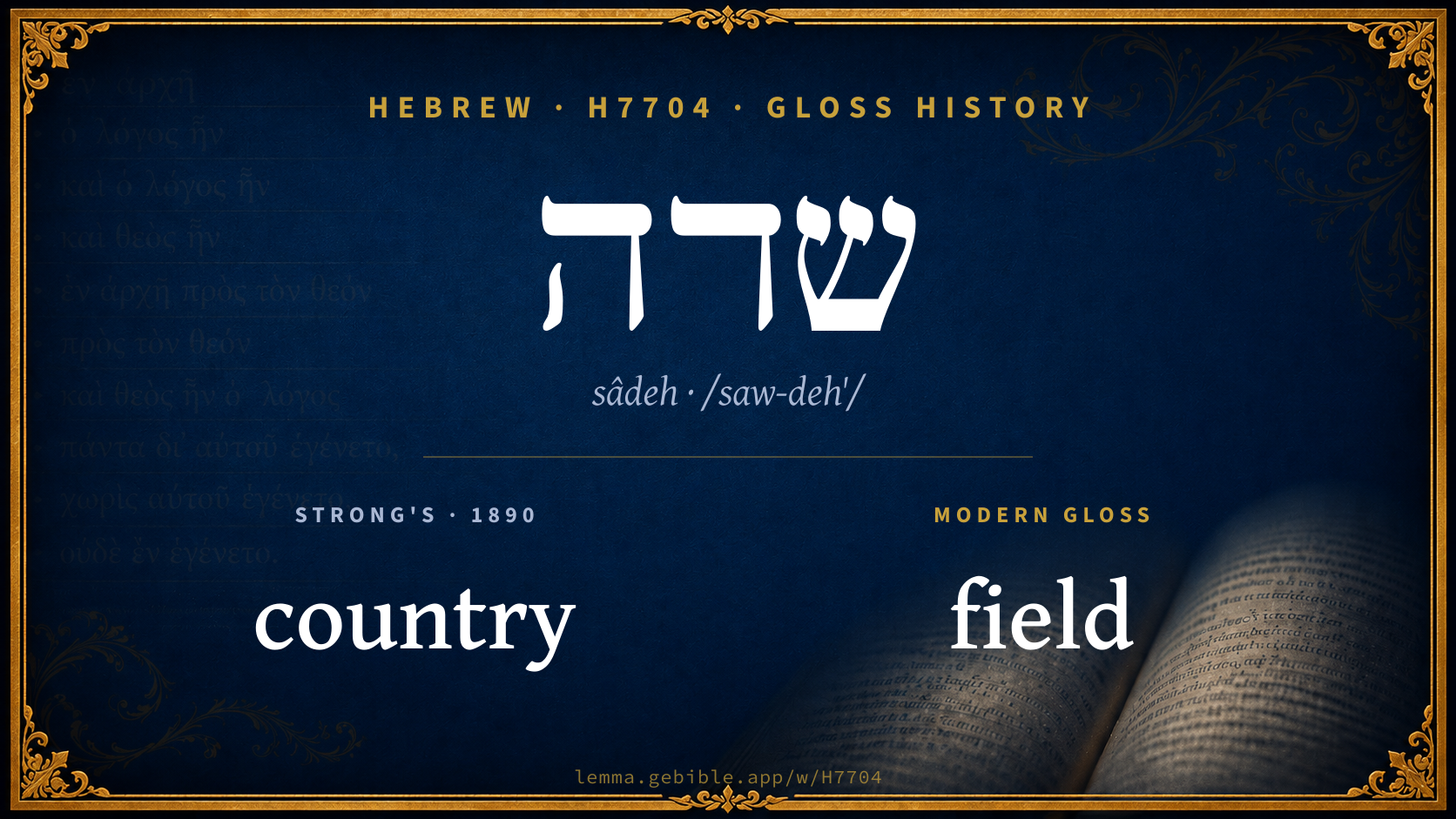
Gloss history
Strong's 1890 vs modern scholarship
About this word
Strong's H7704 catalogs a Hebrew word from the Hebrew Old Testament.
These counts are not copied from any lexicon or concordance. They are computed here, from the morphology-tagged Hebrew Old Testament. What Lemma adds →
- 309
- distinct verses
- The word appears in 309 distinct verses.
- 30 / 39
- OT books
- The word appears in 30 of 39 Old Testament books.
- #147
- by frequency
- Top 250 most frequent Hebrew words (rank 147 of 8,640 Hebrew words by occurrence).
View all 309 occurrences in the concordance →
By section of the Old Testament
By traditional corpus
Conventional, traditional groupings — biblical authorship is debated, so this is a traditional corpus grouping, not an authorship claim. Each share is this word’s portion of its verses in that division of the Hebrew canon. Each figure is a share of the word’s 309 distinct verses.
- Prophets (Nevi'im) 148 verses · 48%
- Torah (Pentateuch) 102 verses · 33%
- Writings (Ketuvim) 59 verses · 19%
How translations render this word
Counts come from each version’s own published word-to-Strong’s tagging or interlinear alignment — an approximate guide to how each version renders this word, not a word-level alignment the data otherwise carries. Because each total is that version’s own tagged count, the per-version totals vary from one another and need not match the appearance or distinct-verse counts above. These counts may also differ from a printed concordance because Lemma counts each distinctly tagged rendering and does not collapse phrase taggings into a single head-word total. This is a fixed set of word-tagged versions (KJV, ASV, BSB, ULT) and does not change with the reading translation you choose elsewhere. Each version’s license is shown beside its name below (and on Sources).
BDB lists this Strong’s number as 2 distinct words (homographs). Each count above pools all of them and is not split by sense — see the Senses section below. A low-frequency rendering may belong to a different one of those words, not the primary meaning.
- King James Version†: Field 214×, Fields 35×, Country 12×
- American Standard Version†: Field 204×, Fields 23×, Country 9×
- Berean Standard Bible†: Field 176×, Fields 50×, Land 18×
- unfoldingWord Literal Text†: Field 221×, Field of 35×, Fields 34×
King James Version Public Domain
Renders H7704 across 333† tagged occurrences — most commonly:
Plus 46 renderings that appear only once — usually multi-word phrases or single function words the recovered tagging swept in, not distinct renderings.
American Standard Version Public Domain
Renders H7704 across 331† tagged occurrences — most commonly:
Plus other, less common renderings. Plus 59 renderings that appear only once — usually multi-word phrases or single function words the recovered tagging swept in, not distinct renderings.
Berean Standard Bible Public Domain
Renders H7704 across 317† tagged occurrences — most commonly:
Plus other, less common renderings. Plus 28 renderings that appear only once — usually multi-word phrases or single function words the recovered tagging swept in, not distinct renderings. Not rendered by a distinct English word in 15 further occurrences.
unfoldingWord Literal Text CC BY-SA 4.0
Renders H7704 across 330† tagged occurrences — most commonly:
Plus 16 renderings that appear only once — usually multi-word phrases or single function words the recovered tagging swept in, not distinct renderings.
19 senses and sub-senses in the full BDB
What do BDB’s symbols mean?
BDB uses these scholarly abbreviations:
| Symbol | Meaning |
|---|---|
| 𝔊 | the Septuagint (the ancient Greek translation, LXX) |
| 𝔙 | the Vulgate (the Latin translation) |
| 𝔖 | the Syriac version (the Peshitta) |
| 𝔗 | the Targum (the Aramaic translation) |
| ψ | the Psalms |
| √ | root (the underlying root or stem) |
| ‖ | parallel passage (a synonymous or contrasted parallel) |
| † | the dagger: every passage where the word occurs is cited |
The 19 senses and sub-senses the full Brown-Driver-Briggs lexicon distinguishes for this word, in lexicon order (not ranked by frequency), with BDB’s own verbatim wording and sub-sense lettering. Shown in Hebrew script with BDB’s own scholarly abbreviations. The condensed entry is in the Lexicon Entry tab. See also the Forms in the corpus table below.
שדה I
- 1. cultivated field 12:12, also 10:4 (si vera l., but v. Now), yielding food Dt 32:13 La 4:9; שֹׁמְרֵי שׂ׳ Je 4:17 keepers, watchmen, of a field. e.g. Hosea 12:12
- 2. home of wild beasts: בְּהֵמוֹת שׂ׳ ψ 8:8 Jo 2:22, חַיְתוֹ שׂ׳ Is 56:9 ψ 104:11, זִיז שׂ׳ 50:11; 80:14. e.g. Psalms 8:8
- 3. plain, opp. mt., Je 18:14 (but dub., Co Du שִׂרְיֹן). e.g. Jeremiah 18:14
- 4. land, opp. sea, ψ 96:12 (cf. שָׂדֶה 3; ‖ תֵּבֵל ψ 98:7). e.g. Psalms 96:12
שדה II
- 1. open field, country:
- a. pasture-land Gn 29:2; 30:16; Ex 9:3 (all J), Dt 11:15; 1 S 11:5 + 10 times J, JE. e.g. Genesis 29:2
- b. unfrequented Gn 24:63, 65, exposed to violence 4:8 (J), 2 S 14:6; Dt 21:1; 22:25, 27, to wild beasts Ex 22:30 (E), Ez 33:27. e.g. Genesis 24:63
- c. specif. home of beasts: 2 S 17:8; Je 14:5; especially phr. חַיַּת הַשּׂ׳ Gn 2:19, 20; 3:1, 14 (all J) of beasts in gen., and, of wild beasts, Ex 23:11, 29 (E), Ho 2:14, 20; 4:3; 13:8; Dt 7:22; Lv 26:22 (H), Jb 5:23 (‖ חַיַּת הָאָרֶץ), + 16 times; בֶּהֱמַת הַשּׂ׳ 1 S 17:44 cf. Jo 1:20; אַיְלוֹת הַשּׂ׳ Ct 2:7; 3:5, cf. הַצְּבָיִם אֲשֶׁר בַּשּׂ׳ 2 S 2:18; hunting-ground Gn 25:29; 27:3, 5 (all JE), cf. אִישׁ שׂ׳ 25:27 (JE; ‖ אִישׁ יֹדֵעַ צַיִד). e.g. 2 Samuel 17:8
- d. yielding plants and trees: Gn 25:27 (JE), 30:14 (J), Ex 10:5 (JE), 2 K 4:39; Ez 21:2; 39:10; especially phr. עֵשֶׂב הַשּׂ׳ Gn 2:5; 3:18 (both J), + 6 times + ע׳ בַּשּׂ׳ Zc 10:1; שִׂיחַ הַשּׂ׳ Gn 2:5, גֶּפֶן שׂ׳ 2 K 4:39, פַּקֻּעֹת שׂ׳ v 39, צִיץ הַשּׂ׳ Is 40:15 ψ 103:15, צֶמַח הַשּׂ׳ Ez 16:7; עֵץ חַשּׂ׳ (4 times עֲצֵי) Ex 9:25 (JE), Dt 20:19; Lv 26:4 (H) Is 55:12 + 8 times; 2 S 1:21 v. תְּרוּמָה, √ רום. e.g. Genesis 25:27
- e. stony, אַבְנֵי הַשּׂ׳ Jb 5:23. e.g. Job 5:23
- f. open country, outside of walled city Ju 9:32, 42, 43, 44; 19:16; 1 S 19:3; 20:5, 11(×2), 24, 35; 2 K 7:12 Mi 4:10; as battle-ground Jos 8:24 (J), 2 S 10:8 = 1 Ch 19:9; 2 S 11:23; 18:6, outside of military camp 1 S 4:2; 14:15; opp. city (in formula) 1 K 14:11; 16:4; 21:24; Je 14:18; Ez 7:15; שְׂדֵה אֶרֶץ Lv 25:31; as site of small town, country-town 1 S 27:5 (opp. royal city), cf. 1 Ch 27:25; of high places, גְּבָעוֹת בַּשּׂ׳ Je 13:27; quite gen., 1 S 30:11; Je 40:7, 13; including road Ju 20:31; 1 K 11:29; Je 6:25; disting. from road Nu 22:23 (JE), 2 S 20:12; outside houses and courtyards Ex 8:9 (P), 1 S 25:15; בַּשּׂ׳ nearly = outdoors Ex 1:14 (P), Ju 13:9; of surface of country or ground, בַּשּׂ׳ Ex 16:25 (JE); = עַל־פְּנֵי הַמִּדְבָּר v 14), cf. 1 S 14:25; so עַל־פְּנֵי הַשּׂ׳ (אֶל) 2 K 9:37; Je 9:22; Ez 29:5 (‖ הַמִּדְבָּ֫רָה), 32:4; 39:5; sample phr. opp. house, comfort, etc., 2 S 11:11; Ez 16:5, opp. city Lv 14:7, 53, opp. tent Nu 19:16 (all P), opp. tent of meeting Lv 17:5 (H). e.g. Judges 9:32
- g. = expanse of country, opp. mt., in phr. מְרוֹמֵי שׂ׳ Ju 5:18; הֲרָרִי בַּשּׂ׳ Je 17:3 (of Jerus.) is dub.; cf. לְעִי הַשּׂ׳ Mi 1:6 (Je 18:14 v. שָׂדַי). e.g. Judges 5:18
- 2. definite portion of ground, field, land:
- a. cultivated ground Gn 37:7 (E), 47:24 (J; זֶרַע הַשָּׂדֶה), Ex 22:4(×3), 5 (E), Lv 27:16, 17 (P), Mi 3:12 (in sim.) Ru 2:2 + 47 times, + שְׂדֵי תְרוּמוֹת 2 S 1:21, שׂ׳־זָ֑רַע Ez 17:5, שָׂדֶה טוֹב v 8 good soil. e.g. Genesis 37:7
- b. as private property, Mi 2:2, 4; Is 5:8(×2); Gn 47:20 (J), 23:9, 11, 13 (P) + 50 times, + 2 Ch 26:23 (as burial-place); also חֶלְקַת (הַ)שּׂ׳, v. חֶלְקָה; and שׂ׳ צֹפִים, v. צפה. e.g. Micah 2:2
- c. city-land, adjacent to city (town) and subject to its control: Gn 41:48 (E), Lv 25:34 (P), Jos 21:12 (P) = 1 Ch 6:41; Ne 11:25; 30; 12:39, 44; specif. of Zoan ψ 78:12, 43. e.g. Genesis 41:48
- d. territory of nation, tribe: Gn 32:4; Nu 21:20 (both JE), Ju 5:4; Ru 1:1, 2; Gn 14:7 + 13 times + שְׂדֵה נַחֲלַת יִשׂ׳ Ju 20:6. e.g. Genesis 32:4
- e. personal estate of king, 2 S 9:7; 19:30. e.g. 2 Samuel 9:7
- 3. land, opp. sea, 1 Ch 16:32 (opp. הַיָּם; = שָׂדַי ψ 96:12), perhaps also mainland Ez 26:6, 8 (Co Krae Toy al.; not Sm). e.g. 1 Chronicles 16:32
Senses from the full Brown-Driver-Briggs lexicon (Brown, Driver, Briggs; Oxford 1906 — public domain), digitized via Sefaria, supplemented by the OpenScriptures HebrewLexicon (CC BY 4.0). Full attribution on Sources.
Word origin
I. n.m. ψ 96:12 field, land (rare orig. form of שָׂדֶה (q.v. infr.), only poet.);—abs. שׂ׳ Je 4:17, שָׂדָ֑י Ho 10:4 +;—
I. n.m. Lv 27:24 id. (ordinary contr. form Ges§ 84 a f);—abs. שׂ׳ Gn 2:5(×2) +; cstr. שְׂדֵה 14:7 +; sf. שָׂדִי Je 32:7, 8, שָֽׂדְךָ Dt 11:15 +, שָׂדֶ֑ךָ 24:19 Lv 25:3, etc.; pl. שָׂדוֹת 1 S 22:7 +, cstr. שְׂדוֹת Ne 12:29; also שְׂדֵי 2 S 1:21; Is 32:12; Ru 1:1 + 8 times (some might be sg. = שְׂדֵה cf. BaZMG xiii (1888), 351 SS Buhl; note, e.g. שְׂדֵי Ru 1:6a, = שְׂדֵה v b; 4:3; but v. Köii. 1, 77); sf. שְׂדֹתֶיהָ Ne 11:30, etc.; also שָׂדֶיךָ 1 K 2:26, שָׂדֵינוּ Mi 2:4;—
— Brown-Driver-Briggs (Oxford 1906, public domain), digitized via Sefaria, supplemented by the OpenScriptures HebrewLexicon (CC BY 4.0). See Sources.
Origin: from an unused root meaning to spread out
Jastrow Dictionary
A second Hebrew/Aramaic lexicon for comparison, covering Aramaic and post-biblical (Talmudic, Targumic, Midrashic) usage that the biblical-Hebrew BDB does not. Matched by lemma rather than by Strong’s number, so a lemma may carry more than one Jastrow headword (shown separately below), and the entries cover usage well beyond the Bible.
שֵׁדָה
- , pl. שֵׁדוֹת, v. שֵׁד.
שִׁדָּה
- , v. שִׁידָּה
שָׂדֶה
- c. (b. h.; cmp. שָׂדַד; v. Del. Assyr. Handw. s. v. šid(d) u, p. 64
- 2. tract of land, field. Shebi. I, 1, a. fr. שְׂדֵה האילן a cultivated field in which trees grow, opp. שְׂ׳ הלבן, v. לָבָן. Sifra B’ḥuck., Par. 4, ch. XI (ref. to Lev. XXVII, 21) מגיד שהש׳ קרוי לשון זכר וכ׳ this proves that sadeh is of masculine gender in the sacred (Biblical) language. Arakh. VIII, 1 המקדיש את שָׂדֵהוּ if a man consecrates his field. Ib. VII, 5 הלוקח … כשְׂ׳ אחוזה if a man bought a field of his father, and his father died, and after this he consecrated it, it is legally treated as an inherited field (Lev. XXVII, 16), contrad. to שְׂ׳ מקנה a purchased field (ib. 22); a. fr.—Keth. I, 6, a. e. נסתחפה שדהו, שָׂדְךָ, v. סָחַף.—Tosef. Shebi. VI, 21 ירקות סָדֶה ed. Zuck. (Var. ש׳) vegetable growing in the field (in the Sabbatical year).—Pl. שָׂדוֹת. Arakh. IX, 5 כל שהוא … חוץ מן הש׳ whatever is within a city wall is legally the same as houses, except fields. Ib. 7; a. fr. e.g. Leviticus 27:21
A Dictionary of the Targumim, the Talmud Babli and Yerushalmi, and the Midrashic Literature (Marcus Jastrow; London, Luzac, 1903) — Public Domain. Digitized via Sefaria. Digitized via Sefaria. Full attribution on Sources.
Forms in the corpus
The 113 distinct written forms H7704 takes in the Hebrew Bible, most frequent first — each parse links to that state’s occurrences in the concordance. Hebrew forms include their vowel points and cantillation, so a single lemma takes many written forms.
The 60 most common forms are shown; 53 rarer forms follow in the full concordance.
Same root — word family
Other BDB entries built from the same root as H7704, grouped by Strong’s listed origin. These share a root / origin per the lexicon — not necessarily a shared meaning. Each links to that word’s own entry.
Derived from this word
Proper names from this root
People and places named from this root — a name, not an additional meaning of the word.
Compare all same-root words → 2 of the same-root words are proper names (people or places). They share a root, not necessarily a meaning.
Septuagint verse parallels
This word appears in 289 verses that also exist in the Greek Old Testament (Septuagint), out of the 309 Hebrew verses it occurs in. You can read those verses in Greek by switching the Old Testament edition to the Septuagint.
Read these verses in the Septuagint
- Genesis 2:5
- Exodus 1:14
- Leviticus 14:7
- Numbers 16:14
- Deuteronomy 5:21
- Joshua 8:24
- Judges 1:14
- Ruth 1:1
- 1 Samuel 4:2
- 2 Samuel 1:21
- 1 Kings 2:26
- 2 Kings 4:39
This is a verse-level parallel only — the same verses exist in both the Hebrew and Greek Old Testaments. No word-level Hebrew↔Greek correspondence is claimed: the data carries no such alignment, so no Greek word is shown as this Hebrew word’s translation. Coverage is not total — the Septuagint omits the deuterocanon and renumbers the Psalms, so some Hebrew verses have no direct Greek parallel.