
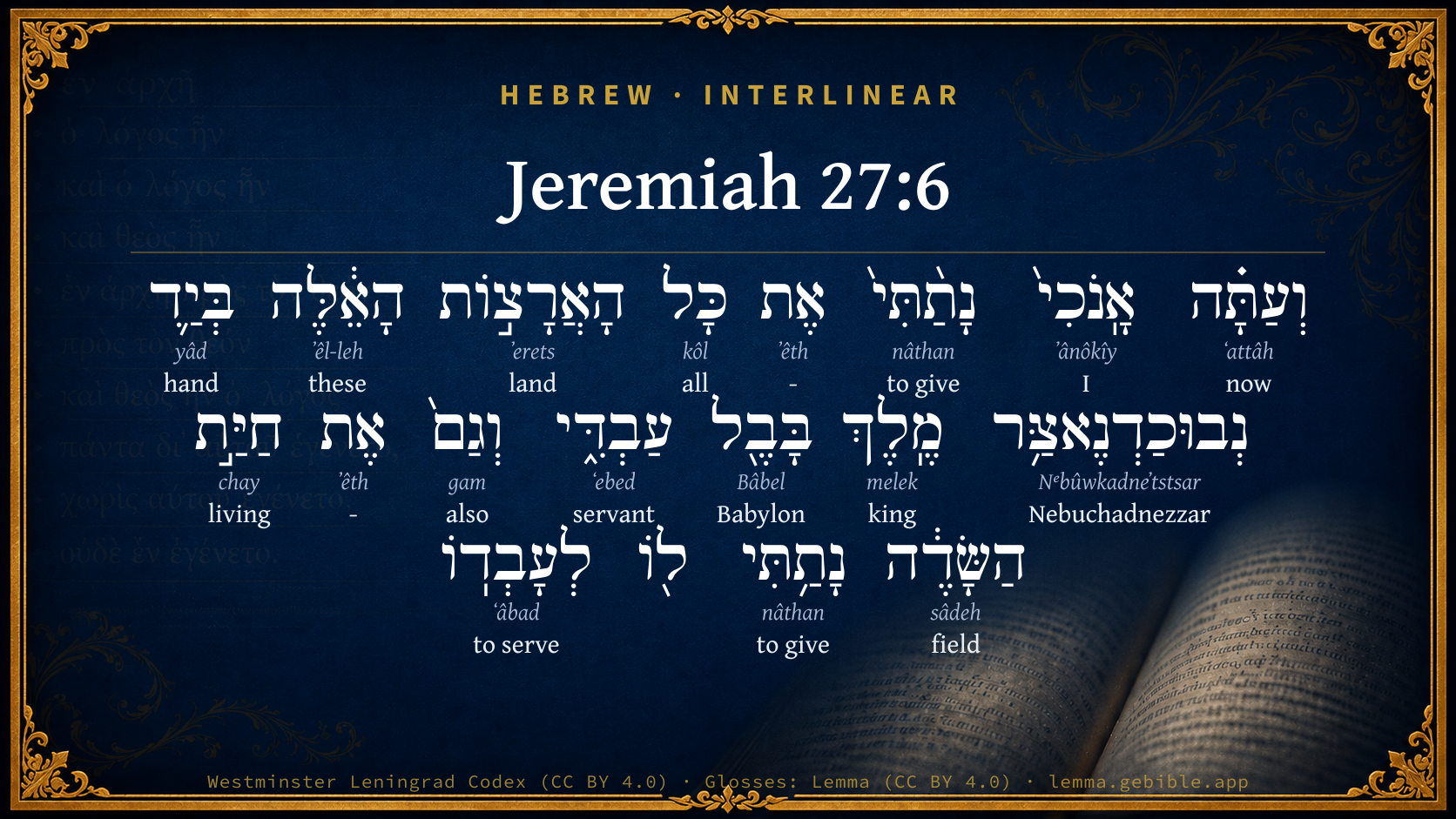
Jeremiah 27:6

Hebrew (Westminster Leningrad Codex) Jeremiah 27:6 appears in the Hebrew Old Testament. The text above is from the Westminster Leningrad Codex. Each word links to its Strong’s number, a concise gloss, and parsing drawn from the Open Scriptures Hebrew Bible morphology. Click any word for its full Brown-Driver-Briggs (BDB) entry.
Download image
Cite this verse

Jeremiah 27:6 (World English Bible). Public Domain. Lemma interlinear Bible study tool, https://lemma.gebible.app/v/jeremiah/27/6.

Show BibTeX & RIS
BibTeX
RIS
English Translation
Now have I given all these lands into the hand of Nebuchadnezzar the king of Babylon, my servant; and the animals of the field also have I given him to serve him.
World English Bible · Public Domain
Download a study sheet

One document with this verse’s original text, its word-by-word gloss line, the meaning frame, cross-references with their text, attributed commentary, and full source and license credits — printable, and it pastes into notes with its structure intact.

This verse Autodidact and up

Study sheet (.html) Plain text (.txt)

A passage Seminary Student

Up to 50 verses in one chapter. A passage sheet keeps up to 6 commentary sources and 12 cross-references per verse, in the order this page ranks them, and says so on the sheet whenever that leaves anything out. Ask for a single verse and you get the Autodidact verse sheet above.

Everything on this page stays free to read, with no account — the sheet is a download of what is already on screen, not access to it.

Want to remove ads? Support Godless Engineer
Compare translations 3

The same verse in 3 English versions, stacked beneath the original-language interlinear above. Click any original word for its lexicon entry.

Each is an independent rendering of the whole verse — the interlinear is not word-aligned to these translations.

Highlighted words mark where these versions differ — a whole-verse word diff, not a word-by-word alignment.

  • World English Bible Public Domain
    Now have I given all these lands into the hand of Nebuchadnezzar the king of Babylon, my servant; and the animals of the field also have I given him to serve him.
  • King James Version Public Domain
    And now have I given all these lands into the hand of Nebuchadnezzar the king of Babylon, my servant; and the beasts of the field have I given him also to serve him.
  • unfoldingWord Literal Text CC BY-SA 4.0
    And now I myself have given all these lands into the hand of Nebuchadnezzar king of Babylon, my servant. And also the living creatures of the field I have given to him to serve him.

unfoldingWord Literal Text — © unfoldingWord, licensed CC BY-SA 4.0. Word-aligned USFM3 via Door43 (git.door43.org/unfoldingWord/en_ult).

Versions to compare (up to 4)

3 of 4 selected

Show all 18 translations

Every available English version of this verse, each an independent rendering of the whole verse.

  • World English Bible Public Domain
    Now have I given all these lands into the hand of Nebuchadnezzar the king of Babylon, my servant; and the animals of the field also have I given him to serve him.
  • Berean Standard Bible Public Domain
    So now I have placed all these lands under the authority of My servant Nebuchadnezzar king of Babylon. I have even made the beasts of the field subject to him.
  • Majority Standard Bible Public Domain
    So now I have placed all these lands under the authority of My servant Nebuchadnezzar king of Babylon. I have even made the beasts of the field subject to him.
  • King James Version Public Domain
    And now have I given all these lands into the hand of Nebuchadnezzar the king of Babylon, my servant; and the beasts of the field have I given him also to serve him.
  • American Standard Version (1901) Public Domain
    And now have I given all these lands into the hand of Nebuchadnezzar the king of Babylon, my servant; and the beasts of the field also have I given him to serve him.
  • Revised Version (1885) Public Domain
    And now have I given all these lands into the hand of Nebuchadnezzar the king of Babylon, my servant; and the beasts of the field also have I given him to serve him.
  • Geneva Bible (1599) Public Domain
    But nowe I haue giuen all these landes into the hand of Nebuchad-nezzar the King of Babel my seruant, and the beastes of the fielde haue I also giuen him to serue him.
  • Douay-Rheims (1899) Public Domain
    And now I have given all these lands into the hand of Nabuchodonosor king of Babylon my servant: moreover also the beasts of the field I have given him to serve him.
  • Young's Literal Translation Public Domain
    `And now, I -- I have given all these lands into the hand of Nebuchadnezzar king of Babylon, My servant, and also the beast of the field I have given to him to serve him;
  • Literal Standard Version CC BY-SA 4.0
    And now, I have given all these lands into the hand of Nebuchadnezzar king of Babylon, My servant, and I have also given the beast of the field to him to serve him;
  • Unlocked Literal Bible CC BY-SA 4.0
    So now, I myself am giving all these lands into the hand of Nebuchadnezzar, king of Babylon, my servant. Also, I am giving the living things in the fields to him to serve him.
  • unfoldingWord Literal Text CC BY-SA 4.0
    And now I myself have given all these lands into the hand of Nebuchadnezzar king of Babylon, my servant. And also the living creatures of the field I have given to him to serve him.
  • Darby Bible Public Domain
    And now have I given all these lands into the hand of Nebuchadnezzar king of Babylon, my servant; and the beasts of the field also have I given him to serve him.
  • World Messianic Bible Public Domain
    Now I have given all these lands into the hand of Nebuchadnezzar the king of Babylon, my servant. I have also given the animals of the field to him to serve him.
  • Webster's Bible Public Domain
    And now have I given all these lands into the hand of Nebuchadnezzar the king of Babylon, my servant; and the beasts of the field have I given him also to serve him.
  • Free Bible Version CC BY-SA 4.0
    Now I have placed my servant Nebuchadnezzar king of Babylon in charge of all these countries. I have even given him control over the wild animals.
  • Bible in Basic English Public Domain
    And now I have given all these lands into the hands of Nebuchadnezzar, the king of Babylon, my servant; and I have given the beasts of the field to him for his use.
  • JPS Tanakh (1917) Public Domain
    And now have I given all these lands into the hand of Nebuchadnezzar the king of Babylon, My servant; and the beasts of the field also have I given him to serve him.

Literal Standard Version (2020), Covenant Press — licensed CC BY-SA 4.0. Text via the HelloAO Bible API (eBible.org). Unlocked Literal Bible (unfoldingWord) — licensed CC BY-SA 4.0. Text via the HelloAO Bible API (eBible.org). unfoldingWord Literal Text — © unfoldingWord, licensed CC BY-SA 4.0. Word-aligned USFM3 via Door43 (git.door43.org/unfoldingWord/en_ult). Free Bible Version, Dr. Jonathan Gallagher — licensed CC BY-SA 4.0. Text via the HelloAO Bible API (eBible.org).

Word by word

More ways to search: Search by grammar → Find every occurrence → Compare this word →

Practice this passage: Drill this verse → Learn its vocabulary →

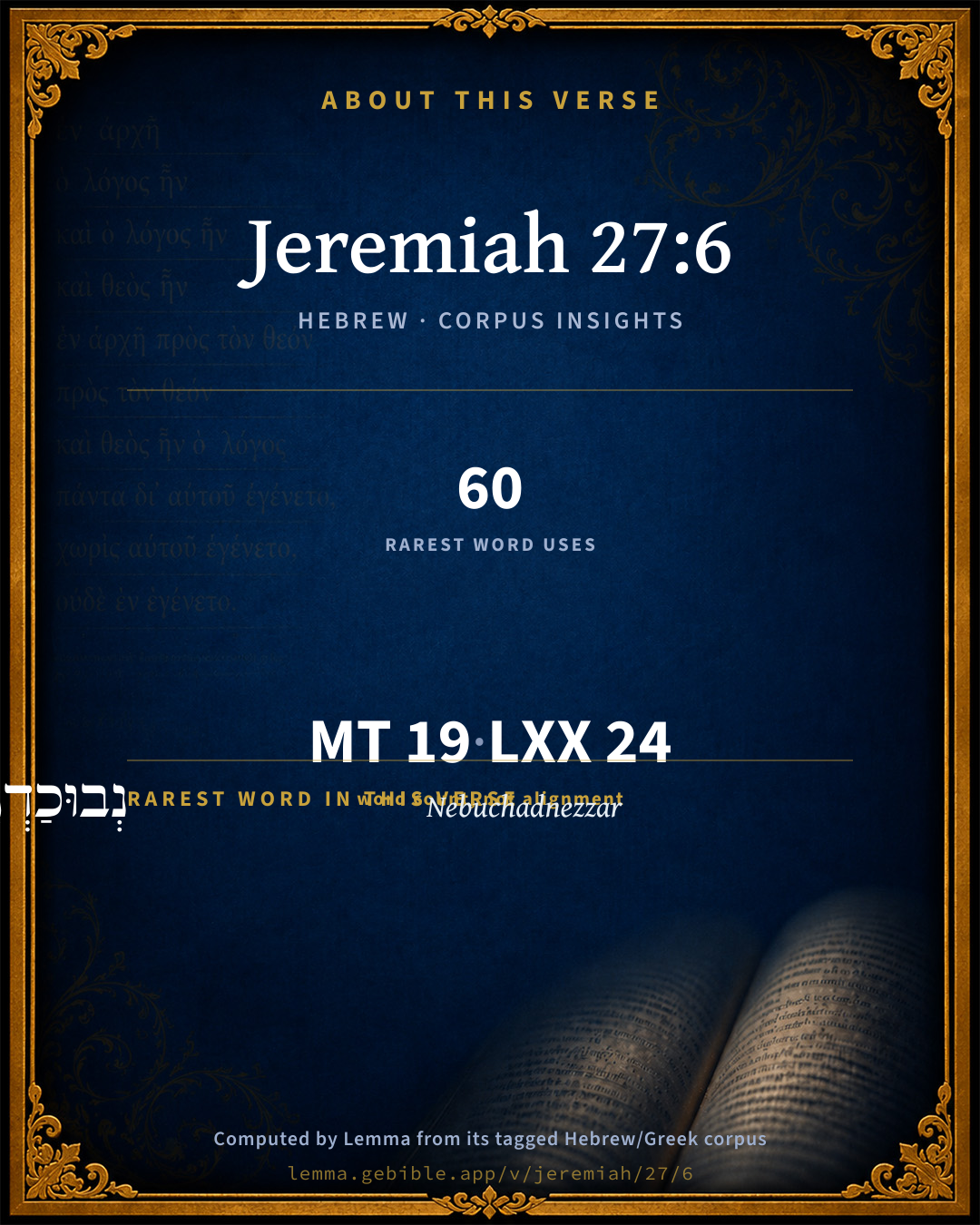
נְבוּכַדְנֶאצַּ֥ר
Nᵉbûwkadneʼtstsar
H5019
“Nebuchadnezzar”
Noun, Proper
Part of Speech
Noun
Type
Proper
Full BDB Definition

Origin: of foreign derivation

TWOT: None

Nebuchadnezzar or Nebuchadrezzar = "may Nebo protect the crown" - the great king of Babylon who captured Jerusalem and carried Judah captive
  1. וְעַתָּ֗ה ʻattâh H6258 “and · now” Conjunction + Adverb
  2. אָֽנֹכִי֙ ʼânôkîy H595 “I” Pronoun, Personal, 1st Person, Common, Singular
  3. נָתַ֨תִּי֙ nâthan H5414 “to give” Verb, Qal, Perfect, 1st Person, Common, Singular
  4. אֶת ʼêth H853 “-” Particle, Direct Object
  5. כָּל kôl H3605 “all of” Noun, Common, Masculine, Singular, Construct
  6. הָאֲרָצ֣וֹת ʼerets H776 “the · lands” Particle, Definite Article + Noun, Common, Both, Plural, Absolute
  7. הָאֵ֔לֶּה ʼêl-leh H428 “the · these” Particle, Definite Article + Pronoun, Demonstrative, Common, Plural
  8. בְּיַ֛ד yâd H3027 “in/at · hand of” Preposition + Noun, Common, Both, Singular, Construct
  9. מֶֽלֶךְ melek H4428 “king of” Noun, Common, Masculine, Singular, Construct
  10. בָּבֶ֖ל Bâbel H894 “Babylon” Noun, Proper
  11. עַבְדִּ֑י ʻebed H5650 “servant · my” Noun, Common, Masculine, Singular, Construct + Suffix, Personal, 1st Person, Common, Singular
  12. וְגַם֙ gam H1571 “and · also” Conjunction + Particle, Accusative
  13. אֶת ʼêth H853 “-” Particle, Direct Object
  14. חַיַּ֣ת chay H2416 “living of” Noun, Common, Feminine, Singular, Construct
  15. הַשָּׂדֶ֔ה sâdeh H7704 “the · field” Particle, Definite Article + Noun, Common, Masculine, Singular, Absolute
  16. נָתַ֥תִּי nâthan H5414 “to give” Verb, Qal, Perfect, 1st Person, Common, Singular
  17. לְעָבְדֽוֹ ʻâbad H5647 “to serve · him” Preposition + Verb, Qal, Infinitive Construct + Suffix, Personal, 3rd Person, Masculine, Singular

About this verse

These counts appear in no published source. They are computed here, from the morphology-tagged text and Lemma’s own curated glosses. What Lemma adds →

19
words
16
distinct lemmas
Prophets
section

Shared distinctive vocabulary

נְבוּכַדְנֶאצַּ֥ר Nebuchadnezzar H5019 occurs in 58 verses of the Hebrew Bible. Also found in:

Grammatical profile

  • 3 verbs
  • 9 nouns
  • 2 pronouns
  • 1 preposition
  • 1 adverb
  • 3 particles

Verb forms

  • נָתַ֨תִּי֙ Qal · Perfect
  • נָתַ֥תִּי Qal · Perfect
  • לְעָבְדֽוֹ Qal · Infinitive Construct

Repetition

A word recurs within this verse — often emphatic in Hebrew:

  • נָתַ֨תִּי֙ to give H5414 ×2

Hebrew & Septuagint length

In the original languages it is 19 Hebrew tokens and 24 Greek tokens — but the two are counted differently (Hebrew bundles its prefixes and suffixes into one token; the Greek is in lemma form), so that isn’t a like-for-like length.

Cross-references

11

Topical passages linked to Jeremiah 27:6 in the Treasury of Scripture Knowledge — connected by theme and wording, ordered by reader-vote popularity; previews shown in the World English Bible.

  • Jeremiah 28:14 For thus says Yahweh of Hosts, the God of Israel: I have put a yoke of iron on the neck of all these nations, that they may serve Nebuchadnezzar king of Babylon; and they shall serve him: and I have given him the animals of the field also.
  • Jeremiah 25:9 behold, I will send and take all the families of the north, says Yahweh, and [I will send] to Nebuchadrezzar the king of Babylon, my servant, and will bring them against this land, and against the inhabitants of it, and against all these nations round about; and I will utterly destroy them, and make them an astonishment, and a hissing, and perpetual desolations.
  • Daniel 2:37–38 You, O king, are king of kings, to whom the God of heaven has given the kingdom, the power, and the strength, and the glory;
  • Jeremiah 43:10 and tell them, Thus says Yahweh of Hosts, the God of Israel: Behold, I will send and take Nebuchadrezzar the king of Babylon, my servant, and will set his throne on these stones that I have hidden; and he shall spread his royal pavilion over them.
  • Ezekiel 29:18–20 Son of man, Nebuchadrezzar king of Babylon caused his army to serve a great service against Tyre: every head was made bald, and every shoulder was worn; yet had he no wages, nor his army, from Tyre, for the service that he had served against it.
  • Isaiah 44:28 Who says of Cyrus, [He is] my shepherd, and shall perform all my pleasure, even saying of Jerusalem, She shall be built; and of the temple, Your foundation shall be laid.
  • Psalms 50:10–12 For every animal of the forest is mine, And the cattle on a thousand hills.
  • Jeremiah 21:7 Afterward, says Yahweh, I will deliver Zedekiah king of Judah, and his servants, and the people, even such as are left in this city from the pestilence, from the sword, and from the famine, into the hand of Nebuchadrezzar king of Babylon, and into the hand of their enemies, and into the hand of those who seek their life: and he shall strike them with the edge of the sword; he shall not spare them, neither have pity, nor have mercy.
  • Jeremiah 24:1 Yahweh shown me, and, behold, two baskets of figs set before the temple of Yahweh, after that Nebuchadrezzar king of Babylon had carried away captive Jeconiah the son of Jehoiakim, king of Judah, and the princes of Judah, with the craftsmen and smiths, from Jerusalem, and had brought them to Babylon.
  • Jeremiah 51:20–23 You are my battle-axe and weapons of war: and with you will I break in pieces the nations; and with you will I destroy kingdoms;
  • Daniel 5:18–19 You king, the Most High God gave Nebuchadnezzar your father the kingdom, and greatness, and glory, and majesty:

Cross-references courtesy of OpenBible.info (CC BY 4.0).

Hebrew and Greek witnesses Masoretic Hebrew ↔ Greek Septuagint

The same verse in the two great witnesses to the Old Testament, shown verse-for-verse.

These are two independent witnesses, not word-aligned to each other, and the Septuagint is shown in lemma (dictionary) form.

Hebrew Jeremiah 27:6 Masoretic · Westminster Leningrad Codex

וְעַתָּ֗ה אָֽנֹכִי֙ נָתַ֨תִּי֙ אֶת כָּל הָאֲרָצ֣וֹת הָאֵ֔לֶּה בְּיַ֛ד נְבוּכַדְנֶאצַּ֥ר מֶֽלֶךְ בָּבֶ֖ל עַבְדִּ֑י וְגַם֙ אֶת חַיַּ֣ת הַשָּׂדֶ֔ה נָתַ֥תִּי ל֖וֹ לְעָבְדֽוֹ

Now have I given all these lands into the hand of Nebuchadnezzar the king of Babylon, my servant; and the animals of the field also have I given him to serve him.

World English Bible · Public Domain

Greek LXX Structure differs

In the Septuagint, Jeremiah is about an eighth shorter than the Hebrew and arranges its material differently — the Oracles Against the Nations (Hebrew chapters 46–51) appear in the middle of the Greek book, after 25:13. Because the chapter and verse boundaries do not line up, a verse-for-verse comparison with the Hebrew is not shown.

A verse-for-verse comparison isn’t shown here because the chapters and verses don’t line up. Switch to the LXX edition with the MT / LXX toggle above to read the Greek directly.

On this verse, The Cambridge Bible for Schools and Colleges discusses the Septuagint’s reading. Read the note in Commentary ↓

Hebrew: Westminster Leningrad Codex (CC BY 4.0). Greek: Septuagint (public domain); English from a public-domain English Septuagint. How the Septuagint differs from the Hebrew →

Targum (Aramaic paraphrase)

1

The Targum is the ancient Jewish Aramaic paraphrase of the Hebrew Scriptures — an interpretive translation, not the Hebrew text itself. Onkelos (literal) and Pseudo-Jonathan (expansive) render the Torah, and Jonathan the Prophets. Coverage is partial: where no permissively-licensed English translation exists for a verse, only the Aramaic is shown. This is verse-level text, not a word-by-word alignment to the Hebrew.

  1. Targum Jonathan Prophets (Joshua–Malachi)
    וּכְעַן אֲנָא יְהָבֵית יַת כָּל מְדִינְתָא הָאִלֵין בְּיַד נְבוּכַדְנֶאצַר מַלְכָּא דְבָבֶל עַבְדִי וְאַף יַת חַיַת בָּרָא יְהָבִית לֵיהּ לְמִפְלְחֵיהּ:

    (no public-domain English translation for this verse)

    Targum Jonathan — Aramaic: “Mikraot Gedolot” (public domain). English: “Sefaria Community Translation” (CC0 1.0 (public-domain dedication)); “London "Chaldee Paraphrase," 1871” (public domain). Text via Sefaria.

Commentary

Notes on Jeremiah 27:6 from classic Christian and Jewish commentators (each source and its license shown beneath its notes). The classic Christian expositions comment on the surrounding passage and are grouped to its opening verse, so a note may address several verses; the Jewish commentaries on the Tanakh (Rashi and others) are per-verse, so they appear only where the commentator wrote on this verse.

Lemma curates 59 commentaries, every one of them public domain or Creative Commons licensed, each selected and text-cleaned for this edition rather than reprinted as found. About our sources →

Trapp's Complete Commentary

John Trapp

Jer 27:6 And now have I given all these lands into the hand of Nebuchadnezzar the king of Babylon, my servant; and the beasts of the field have I given him also to serve him.

Ver. 6. And now have I given all these lands.] Nebuchadnezzar shall be monarch contra Gentes. Dicunt nugatores equitasse Nabuchodonosor super leonem, et infraenasse draconem. {a}

{a} Oecolamp.

John Trapp, A Commentary or Exposition upon All the Books of the Old and New Testament (1647–1656) — public domain. Text from a community e-Sword module.

Joseph Benson's Commentary

Jer 27:6. I have given all these lands into the hand of Nebuchadnezzar — “God is the sole lord and proprietor of the world; and, by virtue of his absolute sovereignty and dominion, has a right to give the kingdoms of the earth to whomsoever he pleases, Dan 4:17, and he exercises this authority by changing times and seasons, by removing kings, and setting up kings, Dan 2:21. The king of Babylon, my servant — One whom I have made use of as an instrument to execute my purposes in inflicting punishment on many nations: see note on Jer 25:9. And the beasts of the field have I given him — This is a hyperbolical way of speaking, to signify the most ample authority and dominion.

Joseph Benson's Commentary on the Old and New Testaments (1811–1818) — public domain. Text from a community e-Sword module.

Tyndale Open Study Notes

Tyndale Open Resources

27:6-8 God had given Nebuchadnezzar authority over the whole region, so resistance to him was futile. All the nations would serve him and his descendants. The fall of Babylon at the hand of Cyrus took place in 539 BC during the reign of Belshazzar, a grandson of Nebuchadnezzar.

Tyndale Open Study Notes — © Tyndale Open Resources, licensed CC BY-SA 4.0. Text via the HelloAO Bible API.

Geneva Bible (1599)

Geneva Bible translators

Read Jer. 25:9.

Geneva Bible (1599) marginal notes — public domain. Text via Bolls.life.

Jamieson, Fausset & Brown

Robert Jamieson, A. R. Fausset & David Brown

beasts of the field--not merely the horses to carry his Chaldean soldiers, and oxen to draw his provisions [GROTIUS]; not merely the deserts, mountains, and woods, the haunts of wild beasts, implying his unlimited extent of empire [ESTIUS]; but the beasts themselves by a mysterious instinct of nature. A reproof to men that they did not recognize God's will, which the very beasts acknowledged (compare Isa 1:3). As the beasts are to submit to Christ, the Restorer of the dominion over nature, lost by the first Adam (compare Gen 1:28; Gen 2:19-20; Psa 8:6-8), so they were appointed to submit to Nebuchadnezzar, the representative of the world power and prefigurer of Antichrist; this universal power was suffered to be held by him to show the unfitness of any to wield it "until He come whose right it is" (Eze 21:27).

Jamieson, Fausset & Brown — Commentary Critical and Explanatory on the Whole Bible (1871) — public domain (CC PDM 1.0). Text via the HelloAO Bible API.

Adam Clarke's Commentary

Verse 6. And now have I given] These kingdoms are at my sovereign disposal; and at present, for the punishment of their rulers and people, I shall give them into the hands of Nebuchadnezzar, king of Babylon.

Adam Clarke's Commentary on the Bible (1810–1826) — public domain. Text from a community e-Sword/MySword module.

John Calvin's Commentaries

God, after having claimed to himself the government of the whole earth, and shewn that it is in his power to transfer kingdoms to whom he pleases, now declares his decree — that he would subject to the king of Babylon all the neighboring lands, even Tyrus and Sidon, the country of Moab, the country of Ammon, the country of Edom, and even Judea itself. If Jeremiah had begun by saying, that God had given to King Nebuchadnezzar these lands, the prediction would not have been so easily received, for pride would have been as it were an obstacle to bolt up their minds and hearts. But the preface, as it has been stated, served to shew that they were not to think that they could stand against the will of God. After having then brought down the great height which seemed fixed in their hearts, he now declares that King Nebuchadnezzar would be the lord over Judah as well as over all the countries around, for God had set him over these lands.

He extends also this subjection, of which he speaks, over the very beasts, and not without reason; for he thus indirectly condemns the hardness of men, if they resisted, as though he had said, “What will it avail you to attempt with refractory hearts to shake off the yoke? for the very beasts, tigers, wolves, lions, and every fierce and savage animal in the land, even all these beasts shall know that the King Nebuchadnezzar is their master, even by a hidden instinct. Since, then, these beasts shall obey King Nebuchadnezzar, because he has been raised by God to that dignity, how great must be the stupidity of men in not acknowledging what the very beasts understand?” We hence see the design of mentioning the beasts; the Prophet upbraided men with their madness, if they ferociously resisted the King Nebuchadnezzar; for in that, case the beasts of the field were endued with more intelligence than they. For whence is it that beasts have fear, except that God has imprinted certain marks of dignity on kings, according to what is said by Daniel. (Daniel 2:38.) As, then, the majesty of God appears in kings, the very beasts, though void of reason and judgment, yet willingly obey through a hidden impulse of nature. Hence inexcusable is the pride of men, if at least they do not imitate the example of the very beasts.

Nebuchadnezzar is afterwards called the servant of God, not that he was worthy of such an honor, as it had never been his purpose to labor for God; but he was called a servant, because God designed to employ him in his service, as those are called in the Psalm the sons of God, to whom the word of God was addressed, that is, to whom he gave authority to rule. (Psalm 82:6; John 10:35.) So also Nebuchadnezzar was God’s servant, because he was divinely endued with sovereign power. This he did not know, nor was this said for his sake, nor was he honored with such a name, as though God regarded him as one of his own people; but this had a reference to the Jews and to all the other nations, in order that they might be fully persuaded that they were obeying God in humbling themselves and in undertaking the yoke of the king of Babylon, for this pleased God. There is no power, says Paul, but from God, (Romans 13:1,) and that sentence is derived from this principle, that all power is from God; for he gives the power to rule and to govern to whom he pleases. Whosoever, then, are endued with the power of the sword and public authority, are God’s servants, though they exercise tyranny and be robbers. They are servants, not with respect to themselves, but because God would have them to be acknowledged as his ministers until their time shall come, according to what follows —

John Calvin's Commentaries (1540-1563) — public domain. Text from the Calvin Translation Society English edition (1840s-50s) via the Christian Classics Ethereal Library (ccel.org). Calvin's coverage is partial (roughly two-thirds of the Bible); uncommented books and verses are honest gaps, never fabricated. The 19th-century editor's footnotes and remarks are omitted so the notes are faithfully Calvin's own voice.

Ellicott's Commentary for English Readers

(6) Nebuchadnezzar . . . my servant.—See Note on Jer_25:9 for the title thus given. The special stress laid on “the beasts of the field” is, perhaps, connected with the resistance of the nations to the levies made by the Babylonian officers upon their horses and cattle, or their claim to use the land they had subdued, after the manner which we see depicted on Assyrian sculptures, as a hunting-ground. Compare especially the account of Tiglath-Pileser I.’s hunting expedition in Records of the Past, xi., p. 9.

A Bible Commentary for English Readers, edited by Charles John Ellicott (1878–1897) — public domain. Text from a community e-Sword module.

The Cambridge Bible for Schools and Colleges

gen. ed. J. J. S. Perowne

6. all these lands] Gi. omits “these,” as inserted with a view to the countries just mentioned. The LXX has simply “the earth,” which is probably (Co. says “undoubtedly”) right (Du. hesitates). Subsequent scruples as to attributing a world-wide dominion to the king of Babylon induced MT. and various versions to modify the statement.

the king of Babylon, my servant] See on Jer_25:9.

and the beasts of the field] Cp. Jer_28:14; Dan_2:38.

The Cambridge Bible for Schools and Colleges (gen. ed. J. J. S. Perowne; Cambridge University Press, 1878–1918) — public domain. Text from a community e-Sword module.

John Gill's Exposition

And now I have given all these lands,.... Before mentioned; of Edom, Moab, Ammon, Tyre, Zidon, and Judea:

into the hand of Nebuchadnezzar the king of Babylon, my servant; whom God used as an instrument in correcting and chastising the nations; and who obeyed his will, though he knew it not; nor did what he did in obedience to it; and yet had the honour of being called his servant, and of being rewarded with a very large empire; which was owing, not so much to his prowess and valour, wisdom and management, as to the providence of God; who delivered the above kingdoms, with others, into his hands, as being the sole proprietor and sovereign disposer of them:

and the beasts of the field have I given him also to serve him; either to bring him, and his armies, and his carriages of provisions for them, and warlike stores, for the invasion and taking the above countries; or the cattle found there, which belonged to these countries, and the inhabitants thereof, which would fall into his hands with them.

John Gill's Exposition of the Whole Bible (1746–1763) — public domain (CC PDM 1.0). Text via the HelloAO Bible API.

Haydock's Catholic Bible Commentary

Beasts. The property of those people, or the most barbarous nations. (St. Jerome) --- Hangmen and executioners may in the same sense be styled God’s servants. (Worthington)

George Leo Haydock (1774–1849), Haydock's Catholic Family Bible and Commentary, 1859 edition — public domain. Excludes Psalms (Douay-Rheims chapter numbering differs from Protestant) and Deuterocanonical books (Catholic canon only).

Matthew Poole's English Annotations

By the former words God gave the prophet authority to assert his dominion, and right to dispose of all creatures; by these he authorizeth him to reveal his will, concerning the disposal of the lands of Edom, Moab, Ammon, Tyre, and Zidon, viz. that he had disposed of them to

Nebuchadnezzar the king of Babylon, whom he calleth his servant, because he did the work which he would have him to do; though, as God said of the Assyrian, Isa 10:7, he meaned not so, he had nothing less in his thoughts than to obey any command of God; wicked men being God’s servants, as the hawk is the prudent falconer’s servant, who maketh use of the ravenous quality of the hawk to get game for him. Twice more at least we find Nebuchadnezzar thus called, Jer 25:9; 43:10. God further adds that

the beasts should serve him, by which he either means that the cattle which were in the possession of the men of those nations should also come into his power; or that God had also given the horses, and oxen, and other beasts which he should use in his wars for carriages, or conveniency to him, so as they should be really serviceable to him in his conquests of those countries.

Matthew Poole's English Annotations on the Holy Bible (1683–1685) — public domain. Text from a community e-Sword/MySword module.

The Pulpit Commentary

My servant. (see on Jer_25:9) The Beasts of the field; i.e. the wild beasts. This last feature indicates the unlimited character of Nebuchadnezzar"s power.

Vers. 6, 7. God"s disposal of man"s possessions.

I GOD HAS A RIGHT TO DISPOSE OF MAN"S POSSESSIONS. He made them, and they are always his, only lent to be withdrawn or transferred when he wills. If the Lord gave, he has a right to take away. (Job_1:21) If he takes much, we should be thankful for what he leaves for this even we have no claim. Nations should feel that God has rightsover them. Their liberties are subject to his government, their territory to his disposal.

II GOD DOES DISPOSE OF MAN"S POSSESSIONS. He exercises his right. He is no roi faineant. God does not reserve his interference for the last Day of Judgment. He is always working among the nations. In a national disaster we should recognize the hand of Providence; so should we in the advent of national glory. God does not only overthrow; he appoints, prospers, gladdens.

III GOD DOES NOT ALWAYS GIVE THE GREATEST POWER TO THE BEST MEN. Nebuchadnezzar was a bad man; yet God gave him the largest dominion in the world. We may believe that he was best suited for the work that was required of him. His mission was to be a scourge of the nations. An angel would find himself ill at ease in such a work. In appointing a hangman we do not expect to get the most high-souled person in the kingdom for the post. God can overrule the evil nature of bad men and make it serve some good end, as we can employ the refuse of one factory as useful materials in another.

IV GOD DOES NOT ALWAYS GIVE THE MOST ABUNDANT POSSESSIONS TO THE BEST MEN. We see bad men enriched, good men pauperized. Goodness seems on the whole to be favorable to temporal prosperity, but with innumerable exceptions. Therefore we must conclude that God does not value earthly prosperity so highly as we value it. He regards it as subordinate to higher interests.

V GOD"S DISPOSAL OF MAN"S POSSESSIONS DOES NOT HINDER THE FREE EXERCISE OF MAN"S POWERS. God gave Nebuchadnezzar his powers, but the king put these forth of his own will. By his daring, his energy, the use of his resources, he won his brilliant victories and conquered his vast dominions. God works through our work. He gives to the diligent.

VI GOD"S DISPOSAL OF MAN"S POSSESSIONS DOES NOT LIMIT MAN"S RESPONSIBILITY. It Nebuchadnezzar got his territory by violence and rapacity, he was not the less guilty because God assigned it to him. For he was responsible for his own actions and their motives, irrespective of any unknown design that God might work out through them. We cannot throw the blame of our misconduct on the providence of God. He overrules the issue of our actions, but he does not fetter or force the choice of our wills.

The Pulpit Commentary (1880–1919), ed. H.D.M. Spence-Jones & Joseph S. Exell — public domain. Text from a community e-Sword module.

Rashi

Rabbi Shlomo Yitzchaki (Rashi)

My servant Who will perform My will to requite My enemies.

Rashi on the Tanakh — English translations: “The Judaica Press complete Tanach with Rashi, translated by A. J. Rosenberg” (CC BY 4.0); “Pentateuch with Rashi's commentary by M. Rosenbaum and A.M. Silbermann, 1929-1934” (public domain); “The Metsudah Tanach series, Lakewood, N.J” (CC BY 4.0); and “The Book of Joshua, Metsudah Publications, 1997” (CC BY 4.0). Text via Sefaria.

Lesson kit

Teaching starters — assembled from the data on this page, not authored interpretation. Every prompt links to the verse data it draws on. Edit before teaching.

Jeremiah, in the Prophets, opens this verse with 19 words (16 distinct Hebrew lemmas). Its most distinctive word is Nᵉbûwkadneʼtstsar (“Nebuchadnezzar”). A historical commentator’s framing appears above. Read the whole chapter for the surrounding context.

Discussion questions

  1. How does “Nebuchadnezzar” (Nᵉbûwkadneʼtstsar) shape what this verse is saying?
  2. 2 Kings 24:1 shares the word «Nebuchadnezzar» with this verse. How do the two illuminate each other?
  3. “to give” occurs 2× in this one verse. What is the effect of the repetition?
  4. These translations render this verse differently; the difference is in the English rendering, not the original. What questions does that raise?
  5. The verb «נָתַ֨תִּי֙» is Qal Perfect. How does its form color the action?
  6. Reading how Trapp's Complete Commentary and Joseph Benson's Commentary read this verse, where do the two commentators agree and where do they part?

Things to notice

Reading settings

Reading text

Shown beneath each verse's original-language words.

Old Testament
Old Testament edition

Read the OT as the Masoretic Hebrew (MT) or the Greek Septuagint (LXX).

English shown for the Greek Septuagint (in the Hebrew ↔ Greek comparison).

Comparing translations? Open the Compare panel on any verse page to stack up to four side by side.