Jeremiah 32:15

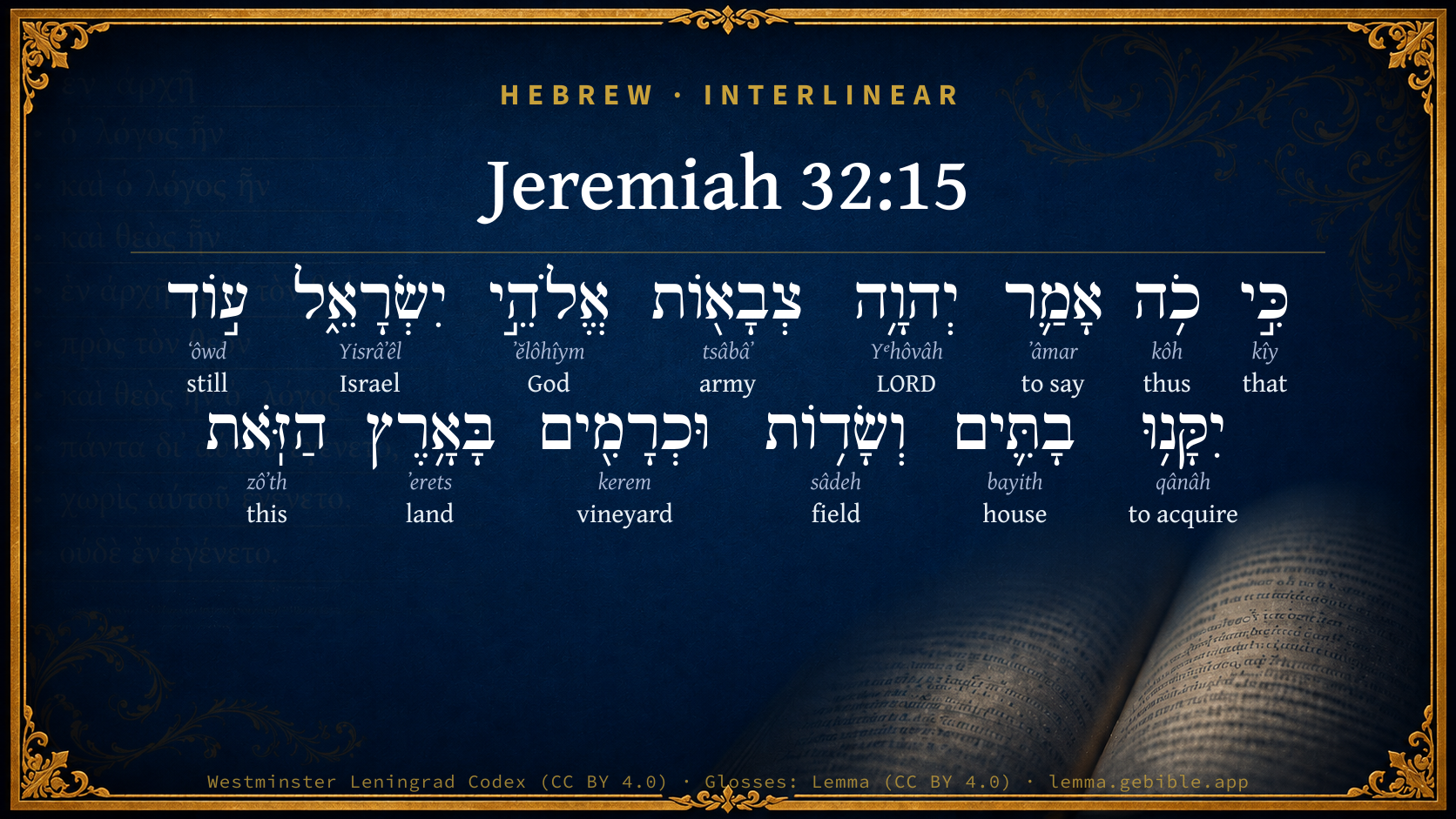
Hebrew (Westminster Leningrad Codex) Jeremiah 32:15 appears in the Hebrew Old Testament. The text above is from the Westminster Leningrad Codex. Each word links to its Strong’s number, a concise gloss, and parsing drawn from the Open Scriptures Hebrew Bible morphology. Click any word for its full Brown-Driver-Briggs (BDB) entry.
Download image
Cite this verse

Jeremiah 32:15 (World English Bible). Public Domain. Lemma interlinear Bible study tool, https://lemma.gebible.app/v/jeremiah/32/15.

Show BibTeX & RIS
BibTeX
RIS
English Translation
For thus says Yahweh of Hosts, the God of Israel: Houses and fields and vineyards shall yet again be bought in this land.
World English Bible · Public Domain
Download a study sheet

One document with this verse’s original text, its word-by-word gloss line, the meaning frame, cross-references with their text, attributed commentary, and full source and license credits — printable, and it pastes into notes with its structure intact.

This verse Autodidact and up

Study sheet (.html) Plain text (.txt)

A passage Seminary Student

Up to 50 verses in one chapter. A passage sheet keeps up to 6 commentary sources and 12 cross-references per verse, in the order this page ranks them, and says so on the sheet whenever that leaves anything out. Ask for a single verse and you get the Autodidact verse sheet above.

Everything on this page stays free to read, with no account — the sheet is a download of what is already on screen, not access to it.

Want to remove ads? Support Godless Engineer
Compare translations 3

The same verse in 3 English versions, stacked beneath the original-language interlinear above. Click any original word for its lexicon entry.

Each is an independent rendering of the whole verse — the interlinear is not word-aligned to these translations.

Highlighted words mark where these versions differ — a whole-verse word diff, not a word-by-word alignment.

  • World English Bible Public Domain
    For thus says Yahweh of Hosts, the God of Israel: Houses and fields and vineyards shall yet again be bought in this land.
  • King James Version Public Domain
    For thus saith the LORD of hosts, the God of Israel; Houses and fields and vineyards shall be possessed again in this land.
  • unfoldingWord Literal Text CC BY-SA 4.0
    For Yahweh of hosts, God of Israel, says this: Houses, fields, and vineyards will again be bought in this land.”

unfoldingWord Literal Text — © unfoldingWord, licensed CC BY-SA 4.0. Word-aligned USFM3 via Door43 (git.door43.org/unfoldingWord/en_ult).

Versions to compare (up to 4)

3 of 4 selected

Show all 18 translations

Every available English version of this verse, each an independent rendering of the whole verse.

  • World English Bible Public Domain
    For thus says Yahweh of Hosts, the God of Israel: Houses and fields and vineyards shall yet again be bought in this land.
  • Berean Standard Bible Public Domain
    For this is what the LORD of Hosts, the God of Israel, says: Houses, fields, and vineyards will again be bought in this land.”
  • Majority Standard Bible Public Domain
    For this is what the LORD of Hosts, the God of Israel, says: Houses, fields, and vineyards will again be bought in this land.”
  • King James Version Public Domain
    For thus saith the LORD of hosts, the God of Israel; Houses and fields and vineyards shall be possessed again in this land.
  • American Standard Version (1901) Public Domain
    For thus saith Jehovah of hosts, the God of Israel: Houses and fields and vineyards shall yet again be bought in this land.
  • Revised Version (1885) Public Domain
    For thus saith the LORD of hosts, the God of Israel: Houses and fields and vineyards shall yet again be bought in this land.
  • Geneva Bible (1599) Public Domain
    For the Lord of hostes, the God of Israel saith thus, Houses and fieldes, and vineyardes shall be possessed againe in this land.
  • Douay-Rheims (1899) Public Domain
    For thus saith the Lord of hosts the God of Israel: Houses, and fields, and vineyards shall be possessed again in this land.
  • Young's Literal Translation Public Domain
    For thus said Jehovah of Hosts, God of Israel, Again are houses and fields and vineyards bought in this land.'
  • Literal Standard Version CC BY-SA 4.0
    For thus said YHWH of Hosts, God of Israel: Houses and fields and vineyards are bought in this land again.”
  • Unlocked Literal Bible CC BY-SA 4.0
    For Yahweh of hosts, God of Israel, says this: Houses, fields, and vineyards will again be bought in this land.”
  • unfoldingWord Literal Text CC BY-SA 4.0
    For Yahweh of hosts, God of Israel, says this: Houses, fields, and vineyards will again be bought in this land.”
  • Darby Bible Public Domain
    For thus saith Jehovah of hosts, the God of Israel: Houses and fields and vineyards shall again be purchased in this land.
  • World Messianic Bible Public Domain
    For the LORD of Hosts, the God of Israel says: ‘Houses and fields and vineyards will yet again be bought in this land.’
  • Webster's Bible Public Domain
    For thus saith the LORD of hosts, the God of Israel; Houses and fields and vineyards shall be possessed again in this land.
  • Free Bible Version CC BY-SA 4.0
    For this is what the Lord Almighty, the God of Israel, says: The time will come when once again houses, fields, and vineyards will be bought in this country.”
  • Bible in Basic English Public Domain
    For the Lord of armies, the God of Israel, has said, There will again be trading in houses and fields and vine-gardens in this land.
  • JPS Tanakh (1917) Public Domain
    For thus saith the LORD of hosts, the God of Israel: Houses and fields and vineyards shall yet again be bought in this land.'

Literal Standard Version (2020), Covenant Press — licensed CC BY-SA 4.0. Text via the HelloAO Bible API (eBible.org). Unlocked Literal Bible (unfoldingWord) — licensed CC BY-SA 4.0. Text via the HelloAO Bible API (eBible.org). unfoldingWord Literal Text — © unfoldingWord, licensed CC BY-SA 4.0. Word-aligned USFM3 via Door43 (git.door43.org/unfoldingWord/en_ult). Free Bible Version, Dr. Jonathan Gallagher — licensed CC BY-SA 4.0. Text via the HelloAO Bible API (eBible.org).

Word by word

More ways to search: Search by grammar → Find every occurrence → Compare this word →

Practice this passage: Drill this verse → Learn its vocabulary →

יִקָּנ֥וּ
qânâh
H7069
“to acquire”
Verb, Niphal, Imperfect, 3rd Person, Masculine, Plural
Part of Speech
Verb
Stem
Niphal
Form
Imperfect
Person
3rd Person
Gender
Masculine
Number
Plural
Full BDB Definition

Origin: a primitive root

TWOT: 2039

to get, acquire, create, buy, possess - (Qal) - to get, acquire, obtain - of God originating, creating, redeeming His people - possessor - of Eve acquiring - of acquiring knowledge, wisdom - to buy - (Niphal) to be bought - (Hiphil) to cause to possess
  1. כִּ֣י kîy H3588 “that” Conjunction
  2. כֹ֥ה kôh H3541 “thus” Adverb
  3. אָמַ֛ר ʼâmar H559 “to say” Verb, Qal, Perfect, 3rd Person, Masculine, Singular
  4. יְהוָ֥ה Yᵉhôvâh H3068 “LORD” Noun, Proper
  5. צְבָא֖וֹת tsâbâʼ H6635 “armies” Noun, Common, Both, Plural, Absolute
  6. אֱלֹהֵ֣י ʼĕlôhîym H430 “God(s) of” Noun, Common, Masculine, Plural, Construct
  7. יִשְׂרָאֵ֑ל Yisrâʼêl H3478 “Israel” Noun, Proper
  8. ע֣וֹד ʻôwd H5750 “still” Adverb
  9. בָתִּ֛ים bayith H1004 “houses” Noun, Common, Masculine, Plural, Absolute
  10. וְשָׂד֥וֹת sâdeh H7704 “and · fields” Conjunction + Noun, Common, Masculine, Plural, Absolute
  11. וּכְרָמִ֖ים kerem H3754 “and · vineyards” Conjunction + Noun, Common, Both, Plural, Absolute
  12. בָּאָ֥רֶץ ʼerets H776 “in/at the · land” Preposition, Determined + Noun, Common, Both, Singular, Absolute
  13. הַזֹּֽאת zôʼth H2063 “the · this” Particle, Definite Article + Pronoun, Demonstrative, Feminine, Singular

About this verse

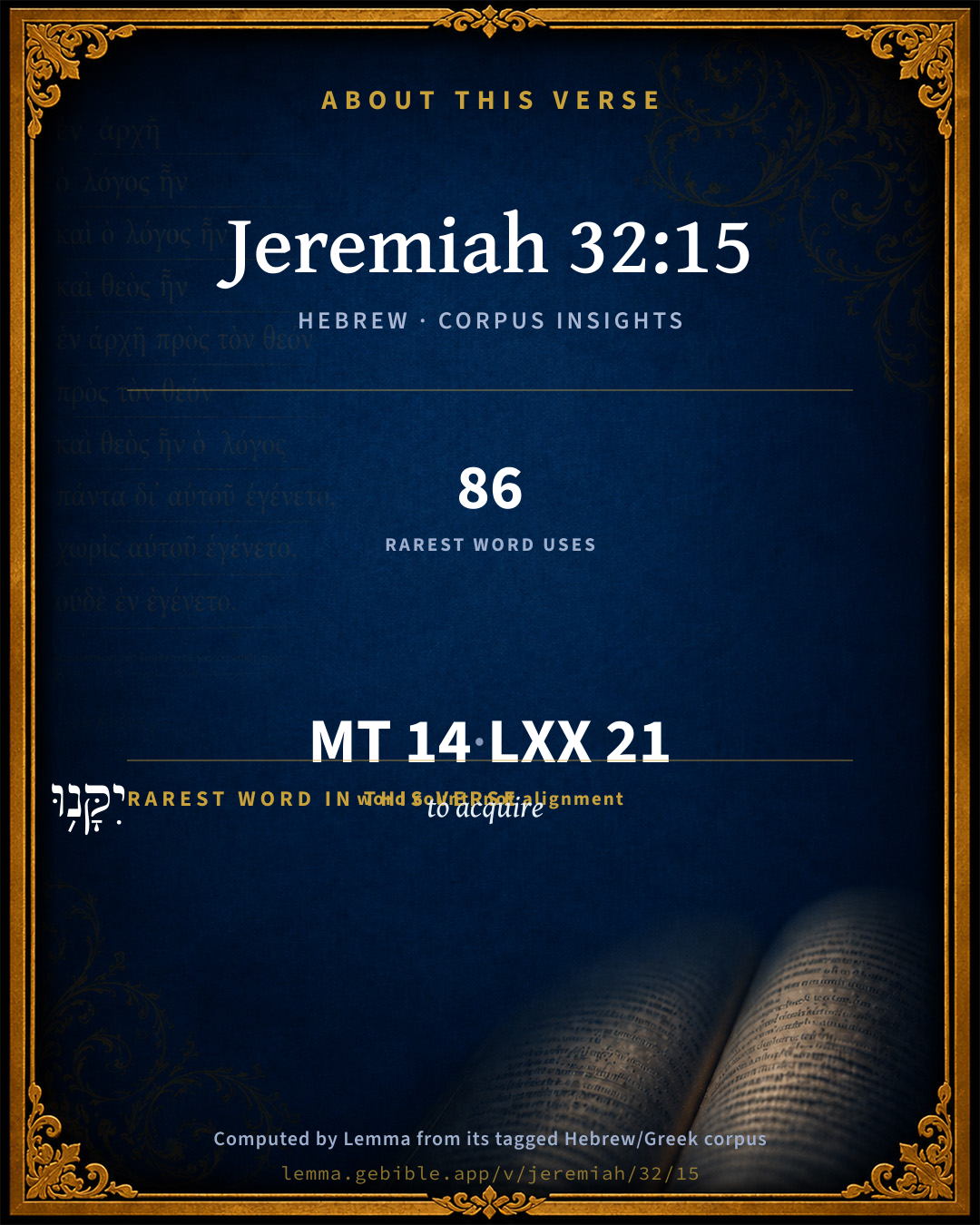
These counts appear in no published source. They are computed here, from the morphology-tagged text and Lemma’s own curated glosses. What Lemma adds →

14
words
14
distinct lemmas
Prophets
section

Grammatical profile

  • 2 verbs
  • 8 nouns
  • 1 pronoun
  • 1 conjunction
  • 2 adverbs

Verb forms

  • אָמַ֛ר Qal · Perfect
  • יִקָּנ֥וּ Niphal · Imperfect

Hebrew & Septuagint length

In the original languages it is 14 Hebrew tokens and 21 Greek tokens — but the two are counted differently (Hebrew bundles its prefixes and suffixes into one token; the Greek is in lemma form), so that isn’t a like-for-like length.

Cross-references

9

Topical passages linked to Jeremiah 32:15 in the Treasury of Scripture Knowledge — connected by theme and wording, ordered by reader-vote popularity; previews shown in the World English Bible.

  • Amos 9:14–15 I will bring back the captivity of my people Israel, And they will rebuild the ruined cities, and inhabit them; and they will plant vineyards, and drink wine from them. They shall also make gardens, And eat the fruit of them.
  • Zechariah 3:10 In that day,' says Yahweh of hosts, 'you will invite every man his neighbor under the vine and under the fig tree.'"
  • Jeremiah 30:18 Thus says Yahweh: Behold, I will turn again the captivity of Jacob's tents, and have compassion on his dwelling-places; and the city shall be built on its own hill, and the palace shall be inhabited after its own manner.
  • Jeremiah 31:5 Again shall you plant vineyards on the mountains of Samaria; the planters shall plant, and shall enjoy [the fruit of it].
  • Jeremiah 31:12 They shall come and sing in the height of Zion, and shall flow to the goodness of Yahweh, to the grain, and to the new wine, and to the oil, and to the young of the flock and of the herd: and their soul shall be as a watered garden; and they shall not sorrow any more at all.
  • Jeremiah 31:24 Judah and all the cities of it shall dwell therein together, the farmers, and those who go about with flocks.
  • Jeremiah 32:37 Behold, I will gather them out of all the countries, where I have driven them in my anger, and in my wrath, and in great indignation; and I will bring them again to this place, and I will cause them to dwell safely:
  • Jeremiah 32:43–44 Fields shall be bought in this land, about which you say, It is desolate, without man or animal; it is given into the hand of the Chaldeans.
  • Jeremiah 33:12–13 Thus says Yahweh of Hosts: Yet again shall there be in this place, which is waste, without man and without animal, and in all the cities of it, a habitation of shepherds causing their flocks to lie down.

Cross-references courtesy of OpenBible.info (CC BY 4.0).

Hebrew and Greek witnesses Masoretic Hebrew ↔ Greek Septuagint

The same verse in the two great witnesses to the Old Testament, shown verse-for-verse.

These are two independent witnesses, not word-aligned to each other, and the Septuagint is shown in lemma (dictionary) form.

Hebrew Jeremiah 32:15 Masoretic · Westminster Leningrad Codex

כִּ֣י כֹ֥ה אָמַ֛ר יְהוָ֥ה צְבָא֖וֹת אֱלֹהֵ֣י יִשְׂרָאֵ֑ל ע֣וֹד יִקָּנ֥וּ בָתִּ֛ים וְשָׂד֥וֹת וּכְרָמִ֖ים בָּאָ֥רֶץ הַזֹּֽאת

For thus says Yahweh of Hosts, the God of Israel: Houses and fields and vineyards shall yet again be bought in this land.

World English Bible · Public Domain

Greek LXX Structure differs

In the Septuagint, Jeremiah is about an eighth shorter than the Hebrew and arranges its material differently — the Oracles Against the Nations (Hebrew chapters 46–51) appear in the middle of the Greek book, after 25:13. Because the chapter and verse boundaries do not line up, a verse-for-verse comparison with the Hebrew is not shown.

A verse-for-verse comparison isn’t shown here because the chapters and verses don’t line up. Switch to the LXX edition with the MT / LXX toggle above to read the Greek directly.

Hebrew: Westminster Leningrad Codex (CC BY 4.0). Greek: Septuagint (public domain); English from a public-domain English Septuagint. How the Septuagint differs from the Hebrew →

Targum (Aramaic paraphrase)

1

The Targum is the ancient Jewish Aramaic paraphrase of the Hebrew Scriptures — an interpretive translation, not the Hebrew text itself. Onkelos (literal) and Pseudo-Jonathan (expansive) render the Torah, and Jonathan the Prophets. Coverage is partial: where no permissively-licensed English translation exists for a verse, only the Aramaic is shown. This is verse-level text, not a word-by-word alignment to the Hebrew.

  1. Targum Jonathan Prophets (Joshua–Malachi)
    אֲרֵי כִדְנַן אֲמַר יְיָ צְבָאוֹת אֱלָהָא דְיִשְׂרָאֵל עוֹד יִזְדַבְּנוּן בָּתִּין וְחַקְלִין וְכַרְמִין בְּאַרְעָא הָדָא:

    (no public-domain English translation for this verse)

    Targum Jonathan — Aramaic: “Mikraot Gedolot” (public domain). English: “Sefaria Community Translation” (CC0 1.0 (public-domain dedication)); “London "Chaldee Paraphrase," 1871” (public domain). Text via Sefaria.

Commentary

Notes on Jeremiah 32:15 from classic Christian and Jewish commentators (each source and its license shown beneath its notes). The classic Christian expositions comment on the surrounding passage and are grouped to its opening verse, so a note may address several verses; the Jewish commentaries on the Tanakh (Rashi and others) are per-verse, so they appear only where the commentator wrote on this verse.

Lemma curates 59 commentaries, every one of them public domain or Creative Commons licensed, each selected and text-cleaned for this edition rather than reprinted as found. About our sources →

Trapp's Complete Commentary

John Trapp

Jer 32:15 For thus saith the LORD of hosts, the God of Israel; Houses and fields and vineyards shall be possessed again in this land.

Ver. 15. Houses and fields and vineyards, &c.] However unlikely it may seem, like as it did to Moses, that the people should eat flesh a month together. He thought that God had made an unadvised promise, and prays him to consider that the people were six hundred thousand footmen, and that the flocks and herds would not suffice them. Jeremiah seemeth to object some such matter in his following prayer, especially Jer 32:25. But God answereth them both alike - viz., that his hand was not waxen short, that nothing was too hard for him, that he was never nonplussed, &c. See Jer 32:27 Num 11:23.

John Trapp, A Commentary or Exposition upon All the Books of the Old and New Testament (1647–1656) — public domain. Text from a community e-Sword module.

Matthew Poole's English Annotations

Here is nothing of any seeming difficulty in these verses, but only why the prophet commandeth Baruch to put the evidences in an earthen vessel, which himself also expounds, that they might continue many days, that is, not defaced: had they been hid many days in the earth, they would have been rotten; had they been above ground in a box or chest, they might have been lost, or taken away by the soldiers plundering houses, or at least burnt with fire. Jer 32:15, the prophet expounds God’s meaning in this command to him, and his own design, in so formal a buying of so small a purchase, especially considering, that, very probably, Jeremiah was no great purchaser, nor very greedy of purchases. He lets them know that all this was for a sign of the truth of what God had revealed to him concerning the people’s return, though after many days, (sixty years from this time,) and also of the firm assent he gave to that Divine revelation, that purchases should one day be enjoyed again in Judea, and houses, fields, and vineyards in it should be again possessed.

Matthew Poole's English Annotations on the Holy Bible (1683–1685) — public domain. Text from a community e-Sword/MySword module.

Tyndale Open Study Notes

Tyndale Open Resources

32:15 Jeremiah explained the reason for his purchase: He was making an investment in the future that God had promised. Someday exiled survivors of the destruction of Judah would return, and worthless land would again become productive and valuable. Jeremiah had already predicted that the exile would last for seventy years (25:11-12; 29:10). Jeremiah’s purchase was a declaration of faith in the Lord’s plan for restoring his people.

Tyndale Open Study Notes — © Tyndale Open Resources, licensed CC BY-SA 4.0. Text via the HelloAO Bible API.

Jamieson, Fausset & Brown

Robert Jamieson, A. R. Fausset & David Brown

(Compare Jer 32:24-25, Jer 32:37, Jer 32:43-44).

Jamieson, Fausset & Brown — Commentary Critical and Explanatory on the Whole Bible (1871) — public domain (CC PDM 1.0). Text via the HelloAO Bible API.

Adam Clarke's Commentary

Verse 15. Houses and fields - shall be possessed again] That is, this is an evidence that the captivity shall not last long: houses, c., shall here be possessed again, either by their present owners or immediate descendants. The young might return at least, all under ten years of age: there was no natural impossibility that they should not live till they should be fourscore.

Adam Clarke's Commentary on the Bible (1810–1826) — public domain. Text from a community e-Sword/MySword module.

Ellicott's Commentary for English Readers

(15) Houses and fields and vineyards . . .—It is a natural, though, of course, not a certain inference, that the land which Jeremiah had purchased included the three items that are thus specified.

A Bible Commentary for English Readers, edited by Charles John Ellicott (1878–1897) — public domain. Text from a community e-Sword module.

The Cambridge Bible for Schools and Colleges

gen. ed. J. J. S. Perowne

15. “It is not the only time in the history of States and Churches that he who has been denounced as a deserter and traitor [see note on the tenth year of Zedekiah, Jer_32:1] becomes in the last extremity the best comforter and counsellor. Demosthenes, who had warned his fellow countrymen in his earlier days against their excessive confidence, in his later days was the only man who could reassure their excessive despondency. Stanley’s J. Ch. II. 465.

For an illustration of the above transaction from Roman history see Intr. p. xviii.

The Cambridge Bible for Schools and Colleges (gen. ed. J. J. S. Perowne; Cambridge University Press, 1878–1918) — public domain. Text from a community e-Sword module.

John Gill's Exposition

Now when I had delivered the evidence of the purchase unto Baruch the son of Neriah,.... When he had finished his worldly business, and which yet was by a divine order, and to answer a divine purpose, then he betook himself to prayer; and it is proper we should be quite free from worldly cares and concerns when we enter upon religious duties, particularly prayer to God; when the soul ought to be separated from the world and the things of it, and wholly devoted to God:

I prayed unto the Lord; either for further information in this matter, of the use and design of buying the field; and how this part of the prophecy, signified by it, concerning the Jews buying and possessing houses and fields, can be made to agree with the other prophecy, that the city should be delivered into the hands of the Chaldeans; or, at least, that he might be able to answer the cavils and objections made by the Jews to it: that he was in some puzzle, perplexity, and distress, appears by his prayer, which begins,

saying, as follows:

John Gill's Exposition of the Whole Bible (1746–1763) — public domain (CC PDM 1.0). Text via the HelloAO Bible API.

Albert Barnes' Notes on the Bible

Possessed - bought.

Albert Barnes' Notes on the Bible (1834–1885) — public domain. Text from a community e-Sword/MySword module.

Whedon's Commentary on the Bible

Daniel D. Whedon

15. Possessed — Literally, bought. The impending ruin would not be permanent, but there would be a restoration, and hence title deeds would be important.

Daniel D. Whedon (gen. ed.), Commentary on the Old and New Testaments (1874–1909) — public domain. Text from a community e-Sword module.

The Pulpit Commentary

Shall be possessed; rather, shall be bought.

The Pulpit Commentary (1880–1919), ed. H.D.M. Spence-Jones & Joseph S. Exell — public domain. Text from a community e-Sword module.

Rashi

Rabbi Shlomo Yitzchaki (Rashi)

For so says the Lord They will ultimately purchase houses.

Rashi on the Tanakh — English translations: “The Judaica Press complete Tanach with Rashi, translated by A. J. Rosenberg” (CC BY 4.0); “Pentateuch with Rashi's commentary by M. Rosenbaum and A.M. Silbermann, 1929-1934” (public domain); “The Metsudah Tanach series, Lakewood, N.J” (CC BY 4.0); and “The Book of Joshua, Metsudah Publications, 1997” (CC BY 4.0). Text via Sefaria.

Lesson kit

Teaching starters — assembled from the data on this page, not authored interpretation. Every prompt links to the verse data it draws on. Edit before teaching.

Jeremiah, in the Prophets, opens this verse with 14 words (14 distinct Hebrew lemmas). Its most distinctive word is qânâh (“to acquire”). A historical commentator’s framing appears above. Read the whole chapter for the surrounding context.

Discussion questions

  1. What does “to acquire” (qânâh) contribute to the verse as a whole?
  2. Amos 9:14–15 shares this passage’s theme. How do the two illuminate each other?
  3. These translations render this verse differently; the difference is in the English rendering, not the original. What questions does that raise?
  4. The verb «אָמַ֛ר» is Qal Perfect. How does its form color the action?
  5. Reading how Trapp's Complete Commentary and Matthew Poole's English Annotations read this verse, where do the two commentators agree and where do they part?

Things to notice

Reading settings

Reading text

Shown beneath each verse's original-language words.

Old Testament
Old Testament edition

Read the OT as the Masoretic Hebrew (MT) or the Greek Septuagint (LXX).

English shown for the Greek Septuagint (in the Hebrew ↔ Greek comparison).

Comparing translations? Open the Compare panel on any verse page to stack up to four side by side.