
Jeremiah 28:14

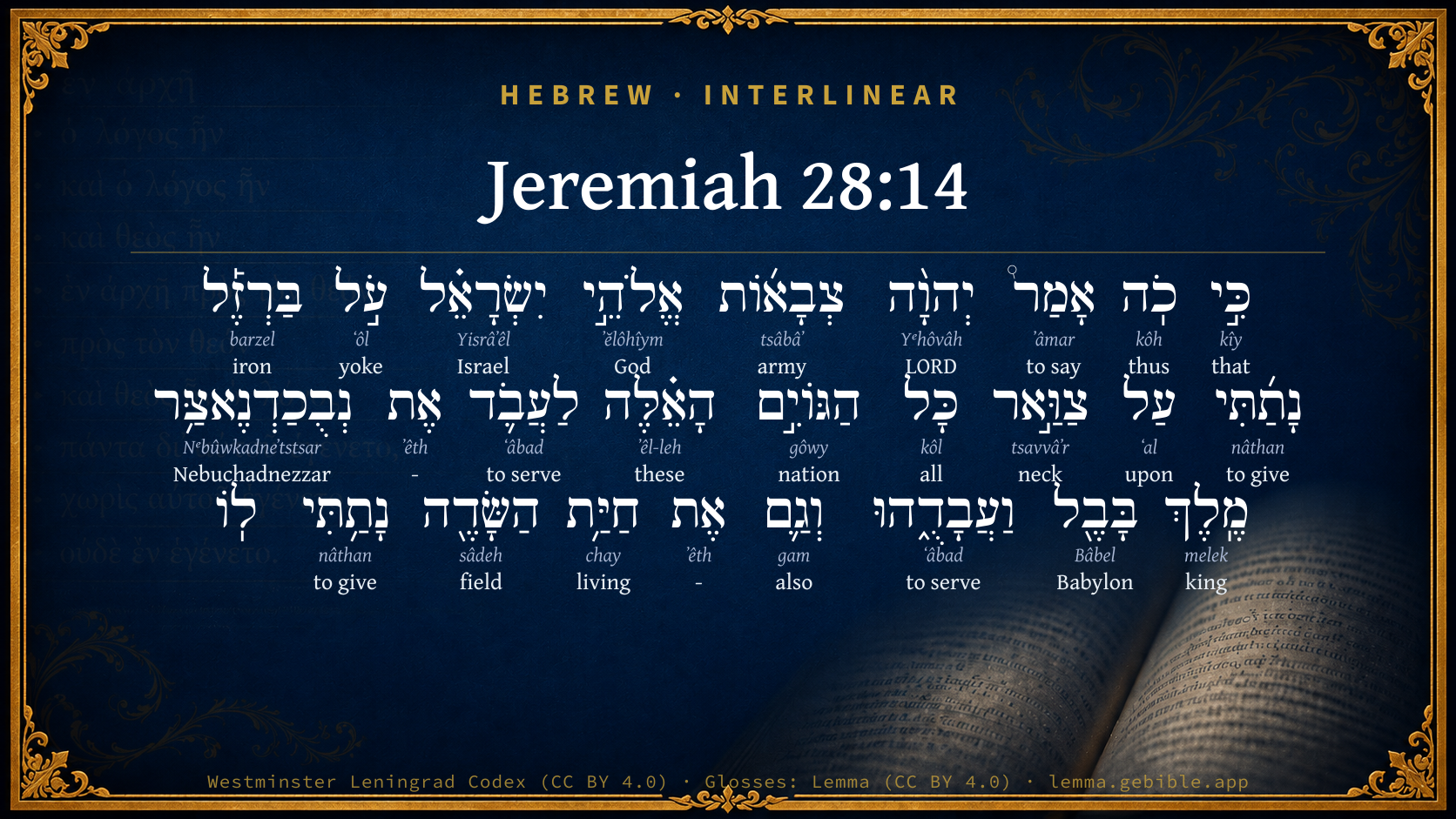
Hebrew (Westminster Leningrad Codex) Jeremiah 28:14 appears in the Hebrew Old Testament. The text above is from the Westminster Leningrad Codex. Each word links to its Strong’s number, a concise gloss, and parsing drawn from the Open Scriptures Hebrew Bible morphology. Click any word for its full Brown-Driver-Briggs (BDB) entry.
Download image
Cite this verse

Jeremiah 28:14 (World English Bible). Public Domain. Lemma interlinear Bible study tool, https://lemma.gebible.app/v/jeremiah/28/14.

Show BibTeX & RIS
BibTeX
RIS
English Translation
For thus says Yahweh of Hosts, the God of Israel: I have put a yoke of iron on the neck of all these nations, that they may serve Nebuchadnezzar king of Babylon; and they shall serve him: and I have given him the animals of the field also.
World English Bible · Public Domain
Download a study sheet

One document with this verse’s original text, its word-by-word gloss line, the meaning frame, cross-references with their text, attributed commentary, and full source and license credits — printable, and it pastes into notes with its structure intact.

This verse Autodidact and up

Study sheet (.html) Plain text (.txt)

A passage Seminary Student

Up to 50 verses in one chapter. A passage sheet keeps up to 6 commentary sources and 12 cross-references per verse, in the order this page ranks them, and says so on the sheet whenever that leaves anything out. Ask for a single verse and you get the Autodidact verse sheet above.

Everything on this page stays free to read, with no account — the sheet is a download of what is already on screen, not access to it.

Want to remove ads? Support Godless Engineer
Compare translations 3

The same verse in 3 English versions, stacked beneath the original-language interlinear above. Click any original word for its lexicon entry.

Each is an independent rendering of the whole verse — the interlinear is not word-aligned to these translations.

Highlighted words mark where these versions differ — a whole-verse word diff, not a word-by-word alignment.

  • World English Bible Public Domain
    For thus says Yahweh of Hosts, the God of Israel: I have put a yoke of iron on the neck of all these nations, that they may serve Nebuchadnezzar king of Babylon; and they shall serve him: and I have given him the animals of the field also.
  • King James Version Public Domain
    For thus saith the LORD of hosts, the God of Israel; I have put a yoke of iron upon the neck of all these nations, that they may serve Nebuchadnezzar king of Babylon; and they shall serve him: and I have given him the beasts of the field also.
  • unfoldingWord Literal Text CC BY-SA 4.0
    For thus says Yahweh of Armies, the God of Israel: ‘I have put a yoke of iron on the neck of all these nations to serve Nebuchadnezzar king of Babylon, and they will serve him. And also the beasts of the field I have given to him.’”

unfoldingWord Literal Text — © unfoldingWord, licensed CC BY-SA 4.0. Word-aligned USFM3 via Door43 (git.door43.org/unfoldingWord/en_ult).

Versions to compare (up to 4)

3 of 4 selected

Show all 18 translations

Every available English version of this verse, each an independent rendering of the whole verse.

  • World English Bible Public Domain
    For thus says Yahweh of Hosts, the God of Israel: I have put a yoke of iron on the neck of all these nations, that they may serve Nebuchadnezzar king of Babylon; and they shall serve him: and I have given him the animals of the field also.
  • Berean Standard Bible Public Domain
    For this is what the LORD of Hosts, the God of Israel, says: ‘I have put a yoke of iron on the neck of all these nations to make them serve Nebuchadnezzar king of Babylon, and they will serve him. I have even given him control of the beasts of the field.’”
  • Majority Standard Bible Public Domain
    For this is what the LORD of Hosts, the God of Israel, says: ‘I have put a yoke of iron on the neck of all these nations to make them serve Nebuchadnezzar king of Babylon, and they will serve him. I have even given him control of the beasts of the field.’”
  • King James Version Public Domain
    For thus saith the LORD of hosts, the God of Israel; I have put a yoke of iron upon the neck of all these nations, that they may serve Nebuchadnezzar king of Babylon; and they shall serve him: and I have given him the beasts of the field also.
  • American Standard Version (1901) Public Domain
    For thus saith Jehovah of hosts, the God of Israel: I have put a yoke of iron upon the neck of all these nations, that they may served Nebuchadnezzar king of Babylon; and they shall serve him: and I have given him the beasts of the field also.
  • Revised Version (1885) Public Domain
    For thus saith the LORD of hosts, the God of Israel: I have put a yoke of iron upon the neck of all these nations, that they may serve Nebuchadnezzar king of Babylon; and they shall serve him: and I have given him the beasts of the field also.
  • Geneva Bible (1599) Public Domain
    For thus saith the Lord of hostes the God of Israel, I haue put a yoke of yron vpon the necke of all these nations, that they may serue Nebuchad-nezzar King of Babel: for they shall serue him, and I haue giuen him the beasts of the fielde also.
  • Douay-Rheims (1899) Public Domain
    For thus saith the Lord of hosts the God of Israel: I have put a yoke of iron upon the neck of all these nations, to serve Nabuchodonosor king of Babylon, and they shall serve him: moreover also I have given him the beasts of the earth.
  • Young's Literal Translation Public Domain
    For thus said Jehovah of Hosts, God of Israel, A yoke of iron I have put on the neck of all these nations to serve Nebuchadnezzar king of Babylon, and they have served him, and also the beast of the field I have given to him.'
  • Literal Standard Version CC BY-SA 4.0
    For thus said YHWH of Hosts, God of Israel: I have put a yoke of iron on the neck of all these nations to serve Nebuchadnezzar king of Babylon, and they have served him, and I have also given the beast of the field to him.”
  • Unlocked Literal Bible CC BY-SA 4.0
    For Yahweh of hosts, God of Israel, says this: I have placed a yoke of iron on the neck of all of these nations to serve Nebuchadnezzar king of Babylon, and they will serve him. I have also given him the wild beasts in the fields to rule over.”
  • unfoldingWord Literal Text CC BY-SA 4.0
    For thus says Yahweh of Armies, the God of Israel: ‘I have put a yoke of iron on the neck of all these nations to serve Nebuchadnezzar king of Babylon, and they will serve him. And also the beasts of the field I have given to him.’”
  • Darby Bible Public Domain
    For thus saith Jehovah of hosts, the God of Israel: I have put a yoke of iron upon the neck of all these nations, that they may serve Nebuchadnezzar king of Babylon; and they shall serve him: and I have given him the beasts of the field also.
  • World Messianic Bible Public Domain
    For the LORD of Hosts, the God of Israel says, “I have put a yoke of iron on the neck of all these nations, that they may serve Nebuchadnezzar king of Babylon; and they will serve him. I have also given him the animals of the field.”’”
  • Webster's Bible Public Domain
    For thus saith the LORD of hosts, the God of Israel; I have put a yoke of iron upon the neck of all these nations, that they may serve Nebuchadnezzar king of Babylon; and they shall serve him: and I have given him the beasts of the field also.
  • Free Bible Version CC BY-SA 4.0
    This is what the Lord Almighty, the God of Israel, says: I have tied iron yokes on the necks of all these nations to force them to serve Nebuchadnezzar king of Babylon, and they will serve him. I have even given him control over the wild animals.”
  • Bible in Basic English Public Domain
    For the Lord of armies, the God of Israel, has said: I have put a yoke of iron on the necks of all these nations, making them servants to Nebuchadnezzar, king of Babylon; and they are to be his servants: and in addition I have given him the beasts of the field.
  • JPS Tanakh (1917) Public Domain
    For thus saith the LORD of hosts, the God of Israel: I have put a yoke of iron upon the neck of all these nations, that they may serve Nebuchadnezzar king of Babylon; and they shall serve him; and I have given him the beasts of the field also.'

Literal Standard Version (2020), Covenant Press — licensed CC BY-SA 4.0. Text via the HelloAO Bible API (eBible.org). Unlocked Literal Bible (unfoldingWord) — licensed CC BY-SA 4.0. Text via the HelloAO Bible API (eBible.org). unfoldingWord Literal Text — © unfoldingWord, licensed CC BY-SA 4.0. Word-aligned USFM3 via Door43 (git.door43.org/unfoldingWord/en_ult). Free Bible Version, Dr. Jonathan Gallagher — licensed CC BY-SA 4.0. Text via the HelloAO Bible API (eBible.org).

Word by word

More ways to search: Search by grammar → Find every occurrence → Compare this word →

Practice this passage: Drill this verse → Learn its vocabulary →

עֹ֣ל
ʻôl
H5923
“yoke of”
Noun, Common, Masculine, Singular, Construct
Part of Speech
Noun
Type
Common
Gender
Masculine
Number
Singular
State
Construct
Full BDB Definition

Origin: from H5953

TWOT: 1628a

yoke
  1. כִּ֣י kîy H3588 “that” Conjunction
  2. כֹֽה kôh H3541 “thus” Adverb
  3. אָמַר֩ ʼâmar H559 “to say” Verb, Qal, Perfect, 3rd Person, Masculine, Singular
  4. יְהוָ֨ה Yᵉhôvâh H3068 “LORD” Noun, Proper
  5. צְבָא֜וֹת tsâbâʼ H6635 “armies” Noun, Common, Both, Plural, Absolute
  6. אֱלֹהֵ֣י ʼĕlôhîym H430 “God(s) of” Noun, Common, Masculine, Plural, Construct
  7. יִשְׂרָאֵ֗ל Yisrâʼêl H3478 “Israel” Noun, Proper
  8. בַּרְזֶ֡ל barzel H1270 “iron” Noun, Common, Masculine, Singular, Absolute
  9. נָתַ֜תִּי nâthan H5414 “to give” Verb, Qal, Perfect, 1st Person, Common, Singular
  10. עַל ʻal H5921 “upon” Preposition
  11. צַוַּ֣אר tsavvâʼr H6677 “neck of” Noun, Common, Masculine, Singular, Construct
  12. כָּל kôl H3605 “all of” Noun, Common, Masculine, Singular, Construct
  13. הַגּוֹיִ֣ם gôwy H1471 “the · nations” Particle, Definite Article + Noun, Common, Masculine, Plural, Absolute
  14. הָאֵ֗לֶּה ʼêl-leh H428 “the · these” Particle, Definite Article + Pronoun, Demonstrative, Common, Plural
  15. לַעֲבֹ֛ד ʻâbad H5647 “to serve” Preposition + Verb, Qal, Infinitive Construct
  16. אֶת ʼêth H853 “-” Particle, Direct Object
  17. נְבֻכַדְנֶאצַּ֥ר Nᵉbûwkadneʼtstsar H5019 “Nebuchadnezzar” Noun, Proper
  18. מֶֽלֶךְ melek H4428 “king of” Noun, Common, Masculine, Singular, Construct
  19. בָּבֶ֖ל Bâbel H894 “Babylon” Noun, Proper
  20. וַעֲבָדֻ֑הוּ ʻâbad H5647 “and · to serve · him” Conjunction + Verb, Qal, Sequential Perfect, 3rd Person, Common, Plural + Suffix, Personal, 3rd Person, Masculine, Singular
  21. וְגַ֛ם gam H1571 “and · also” Conjunction + Particle, Accusative
  22. אֶת ʼêth H853 “-” Particle, Direct Object
  23. חַיַּ֥ת chay H2416 “living of” Noun, Common, Feminine, Singular, Construct
  24. הַשָּׂדֶ֖ה sâdeh H7704 “the · field” Particle, Definite Article + Noun, Common, Masculine, Singular, Absolute
  25. נָתַ֥תִּי nâthan H5414 “to give” Verb, Qal, Perfect, 1st Person, Common, Singular

About this verse

These counts appear in no published source. They are computed here, from the morphology-tagged text and Lemma’s own curated glosses. What Lemma adds →

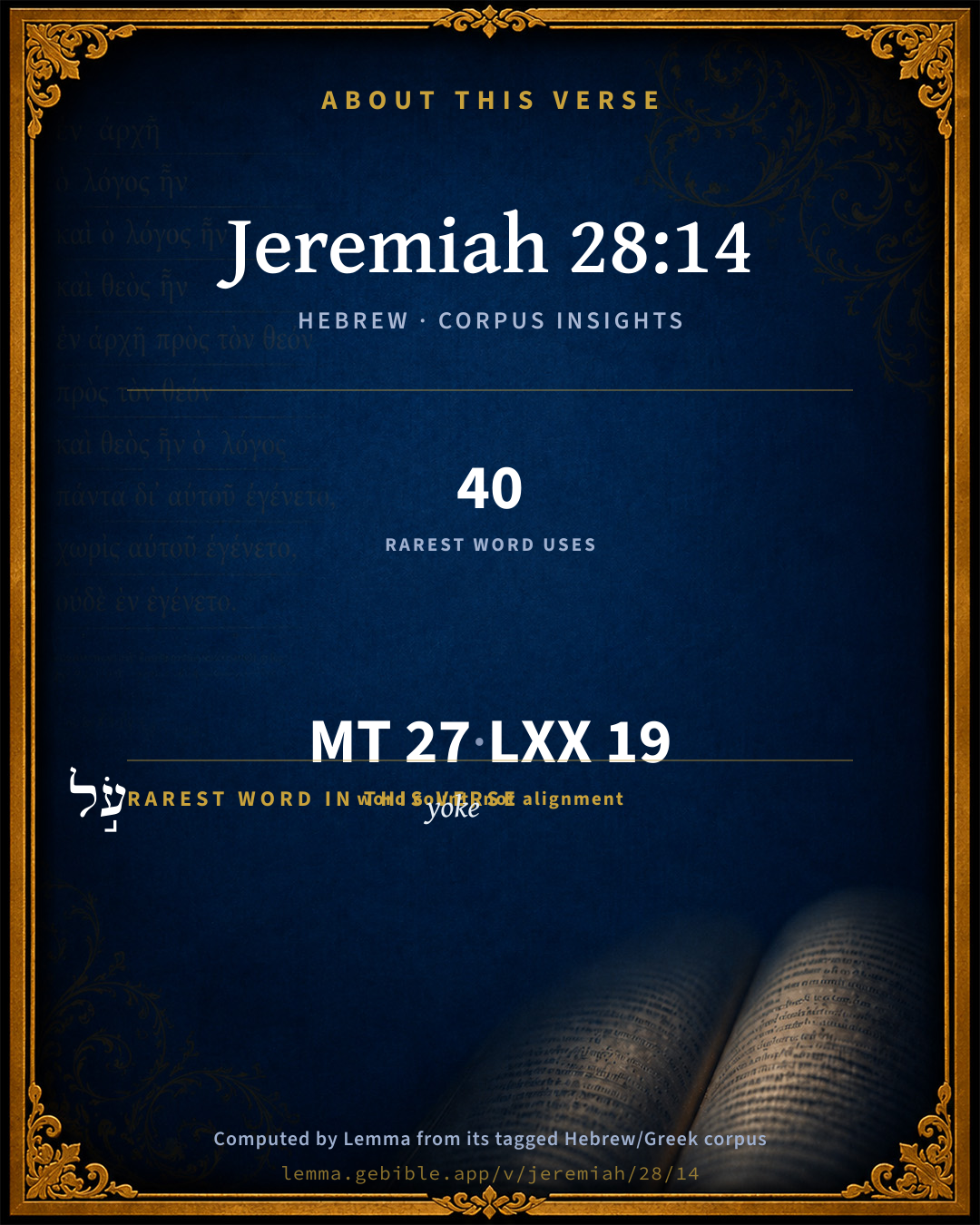
27
words
23
distinct lemmas
Prophets
section

Shared distinctive vocabulary

עֹ֣ל yoke H5923 occurs in 34 verses of the Hebrew Bible. Also found in:

Grammatical profile

  • 5 verbs
  • 14 nouns
  • 1 pronoun
  • 2 prepositions
  • 1 conjunction
  • 1 adverb
  • 3 particles

Verb forms

  • אָמַר֩ Qal · Perfect
  • נָתַ֜תִּי Qal · Perfect
  • לַעֲבֹ֛ד Qal · Infinitive Construct
  • וַעֲבָדֻ֑הוּ Qal · Sequential Perfect
  • נָתַ֥תִּי Qal · Perfect

Repetition

Words recur within this verse — often emphatic in Hebrew:

  • נָתַ֜תִּי to give H5414 ×2
  • לַעֲבֹ֛ד to serve H5647 ×2

Hebrew & Septuagint length

In the original languages it is 27 Hebrew tokens and 19 Greek tokens — but the two are counted differently (Hebrew bundles its prefixes and suffixes into one token; the Greek is in lemma form), so that isn’t a like-for-like length.

Cross-references

9

Topical passages linked to Jeremiah 28:14 in the Treasury of Scripture Knowledge — connected by theme and wording, ordered by reader-vote popularity; previews shown in the World English Bible.

  • Deuteronomy 28:48 therefore shall you serve your enemies whom Yahweh shall send against you, in hunger, and in thirst, and in nakedness, and in want of all things: and he shall put a yoke of iron on your neck, until he have destroyed you.
  • Jeremiah 27:6–7 Now have I given all these lands into the hand of Nebuchadnezzar the king of Babylon, my servant; and the animals of the field also have I given him to serve him.
  • Deuteronomy 4:20 But Yahweh has taken you, and brought you forth out of the iron furnace, out of Egypt, to be to him a people of inheritance, as at this day.
  • Isaiah 14:4–6 that you shall take up this parable against the king of Babylon, and say, How has the oppressor ceased! the golden city ceased!
  • Jeremiah 25:9–26 behold, I will send and take all the families of the north, says Yahweh, and [I will send] to Nebuchadrezzar the king of Babylon, my servant, and will bring them against this land, and against the inhabitants of it, and against all these nations round about; and I will utterly destroy them, and make them an astonishment, and a hissing, and perpetual desolations.
  • Jeremiah 27:4 and give them a charge to their masters, saying, Thus says Yahweh of Hosts, the God of Israel, Thus shall you tell your masters:
  • Jeremiah 40:4 Now, behold, I loose you this day from the chains which are on your hand. If it seem good to you to come with me into Babylon, come, and I will look well to you; but if it seem ill to you to come with me into Babylon, forbear: behold, all the land is before you; where it seems good and right to you to go, there go.
  • Daniel 2:38 and wherever the children of men dwell, the animals of the field and the birds of the sky has he given into your hand, and has made you to rule over them all: you are the head of gold.
  • Revelation 17:12–13 The ten horns that you saw are ten kings who have received no kingdom as yet, but they receive authority as kings, with the beast, for one hour.

Cross-references courtesy of OpenBible.info (CC BY 4.0).

Hebrew and Greek witnesses Masoretic Hebrew ↔ Greek Septuagint

The same verse in the two great witnesses to the Old Testament, shown verse-for-verse.

These are two independent witnesses, not word-aligned to each other, and the Septuagint is shown in lemma (dictionary) form.

Hebrew Jeremiah 28:14 Masoretic · Westminster Leningrad Codex

כִּ֣י כֹֽה אָמַר֩ יְהוָ֨ה צְבָא֜וֹת אֱלֹהֵ֣י יִשְׂרָאֵ֗ל עֹ֣ל בַּרְזֶ֡ל נָתַ֜תִּי עַל צַוַּ֣אר כָּל הַגּוֹיִ֣ם הָאֵ֗לֶּה לַעֲבֹ֛ד אֶת נְבֻכַדְנֶאצַּ֥ר מֶֽלֶךְ בָּבֶ֖ל וַעֲבָדֻ֑הוּ וְגַ֛ם אֶת חַיַּ֥ת הַשָּׂדֶ֖ה נָתַ֥תִּי לֽוֹ

For thus says Yahweh of Hosts, the God of Israel: I have put a yoke of iron on the neck of all these nations, that they may serve Nebuchadnezzar king of Babylon; and they shall serve him: and I have given him the animals of the field also.

World English Bible · Public Domain

Greek LXX Structure differs

In the Septuagint, Jeremiah is about an eighth shorter than the Hebrew and arranges its material differently — the Oracles Against the Nations (Hebrew chapters 46–51) appear in the middle of the Greek book, after 25:13. Because the chapter and verse boundaries do not line up, a verse-for-verse comparison with the Hebrew is not shown.

A verse-for-verse comparison isn’t shown here because the chapters and verses don’t line up. Switch to the LXX edition with the MT / LXX toggle above to read the Greek directly.

On this verse, The Cambridge Bible for Schools and Colleges discusses the Septuagint’s reading. Read the note in Commentary ↓

Hebrew: Westminster Leningrad Codex (CC BY 4.0). Greek: Septuagint (public domain); English from a public-domain English Septuagint. How the Septuagint differs from the Hebrew →

Targum (Aramaic paraphrase)

1

The Targum is the ancient Jewish Aramaic paraphrase of the Hebrew Scriptures — an interpretive translation, not the Hebrew text itself. Onkelos (literal) and Pseudo-Jonathan (expansive) render the Torah, and Jonathan the Prophets. Coverage is partial: where no permissively-licensed English translation exists for a verse, only the Aramaic is shown. This is verse-level text, not a word-by-word alignment to the Hebrew.

  1. Targum Jonathan Prophets (Joshua–Malachi)
    אֲרֵי כִדְנַן אֲמַר יְיָ צְבָאוֹת אֱלָהָא דְיִשְׂרָאֵל נִיר דְבַרְזֶל יְהָבִית עַל צַוַר כָּל עַמְמַיָא הָאִלֵין לְמִפְלַח יַת נְבוּכַדְנֶאצַר מַלְכָּא דְבָבֶל וְיִפְלְחוּנֵיהּ וְאַף יַת חֵיוַת בָּרָא יְהָבִית לֵיהּ:

    (no public-domain English translation for this verse)

    Targum Jonathan — Aramaic: “Mikraot Gedolot” (public domain). English: “Sefaria Community Translation” (CC0 1.0 (public-domain dedication)); “London "Chaldee Paraphrase," 1871” (public domain). Text via Sefaria.

Commentary

Notes on Jeremiah 28:14 from classic Christian and Jewish commentators (each source and its license shown beneath its notes). The classic Christian expositions comment on the surrounding passage and are grouped to its opening verse, so a note may address several verses; the Jewish commentaries on the Tanakh (Rashi and others) are per-verse, so they appear only where the commentator wrote on this verse.

Lemma curates 59 commentaries, every one of them public domain or Creative Commons licensed, each selected and text-cleaned for this edition rather than reprinted as found. About our sources →

Trapp's Complete Commentary

John Trapp

Jer 28:14 For thus saith the LORD of hosts, the God of Israel; I have put a yoke of iron upon the neck of all these nations, that they may serve Nebuchadnezzar king of Babylon; and they shall serve him: and I have given him the beasts of the field also.

Ver. 14. For thus saith the Lord of hosts.] Here were right words, not as Jer 28:2, in labris nata, non in fibris, and therefore very forcible. {Job 6:25}

I have put a yoke of iron.] See on Jer 28:13.

And have given him the beasts.] All shall be his, and he shall sovereign it over all, as the lion doth over the beasts of the field.

John Trapp, A Commentary or Exposition upon All the Books of the Old and New Testament (1647–1656) — public domain. Text from a community e-Sword module.

Geneva Bible (1599)

Geneva Bible translators

Signifying, that all should be his, as Dan. 2:38.

That is, a hard and cruel servitude.

Geneva Bible (1599) marginal notes — public domain. Text via Bolls.life.

Jamieson, Fausset & Brown

Robert Jamieson, A. R. Fausset & David Brown

I have put--Though Hananiah and those like him were secondary instruments in bringing the iron yoke on Judea, God was the great First Cause (Jer 27:4-7).

Jamieson, Fausset & Brown — Commentary Critical and Explanatory on the Whole Bible (1871) — public domain (CC PDM 1.0). Text via the HelloAO Bible API.

John Calvin's Commentaries

It would have been a vain spectacle, had Jeremiah brought only his iron band around his neck; but when he added an explanation of the symbol, he no doubt prevailed on many to believe his prophecy, and rendered those inexcusable who had hardened themselves in their wickedness. But it is worthy of being observed, that God replaced the wooden bands with iron bands; and he did this, because the whole people had through their foolish and wicked consent approved of the madness of that impostor, who had dared to profane that symbol, by which God had testified that he did not speak in vain, but seriously by the mouth of his servant.

A profitable doctrine may be hence elicited, — that the ungodly by barking against God gain nothing, except that they kindle more and more his wrath, and thus render double their own evils, like a dog, who being ensnared obstinately strives to extricate himself from the snare and to shake it off, and thus strangles himself. In like manner the ungodly, the more they resist God, the heavier judgment they procure for themselves. And, therefore, whenever God declares to us that he is offended with our sins, we ought to take heed, lest while we seek to break the wooden bands, he be preparing and forming for us iron bands. Our condition will ever become worse, unless we humbly deprecate God’s wrath as soon as it appears, and also patiently submit to his scourges when he chastises us for our offenses. We ought then to bear this in mind as to the wooden and iron bands.

He adds, Upon the neck of all these nations The Jews, as it has been stated, hoped that Nebuchadnezzar could be in a moment driven back beyond the Euphrates, and would be made to surrender other countries which he had occupied; and all the neighboring nations had conspired, and sent ambassadors here and there; and when the Amorites, the Moabites, and other nations gave encouragement to the Jews, they also in their turn animated others, so that they might all make an assault on the Babylonians. As, then, such a secret conspiracy gave courage to the Jews, this was the reason why the Prophet spoke of other nations. He says, And they shall serve him He had, indeed, already subdued all these countries; but the Prophet means, that the domination of the king of Babylon would continue, though Hananiah had said, that it would stand only for two years. Continuance, then, is set in opposition to a short time, as though the Prophet had said, “Let, indeed, the nations chafe and fret, but they shall abide under the yoke of King Nebuchadnezzar, and in vain shall they attempt to extricate themselves, for God has delivered them up to bondage.”

This servitude may at the same time be explained in another way; the condition of these nations was bearable, as long as Nebuchadnezzar ordered tribute to be paid; and when he sent his prefects, the object was no other than to retain possession; but when he found that they could not be otherwise subdued than by a harder servitude, he began to exercise great tyranny, though he had been before an endurable master. The same thing may be also said of the Jews; for we know that they had been tributaries to the king of Babylon; and as he had spared them, his humanity might have been deemed a sort of liberty; but when he found that a hard wood could not be split but by a hard wedge, he began more violently to oppress them. Then that servitude began which is now mentioned. The Jews, therefore, began then really to serve the king of Babylon, when he saw that they would not endure that bearable yoke which he had laid on them, but in their obstinacy and pride ever struggled against it.

The Prophet adds, The beast of the field have 1 also given him By these words he indirectly upbraids the Jews, as we have before reminded you, with their perverseness, because they perceived not that it was the righteous judgment of God, that Nebuchadnezzar imposed laws on them as a conqueror; for they would have been defended by a celestial aid, as it is said by Moses, had they not deprived themselves of it. (Deuteronomy 29:25.) As, then, they had long rejected the protection of God, hence it was that Nebuchadnezzar invaded their country and conquered them. As they now continued to bite and champ their bridle, the Prophet exposes their madness; for they did not humble themselves under the mighty hand of God, while wild beasts, void of reason and understanding, perceived that it happened through God’s secret and wonderful providence, that Nebuchadnezzar took possession of these lands. This, then, is the reason why the Prophet expressly mentioned wild beasts, as though he said, that the Jews were so refractory, that there was in them less reason, humility, and solicitude than in lions, bears, and animals of the like kind; for through the secret impulse of God the wild beasts submitted to the authority of King Nebuchadnezzar, while the Jews became more and more insolent. It was the highest madness not to acknowledge God’s judgment, while this was done by wild and savage animals. It follows, —

John Calvin's Commentaries (1540-1563) — public domain. Text from the Calvin Translation Society English edition (1840s-50s) via the Christian Classics Ethereal Library (ccel.org). Calvin's coverage is partial (roughly two-thirds of the Bible); uncommented books and verses are honest gaps, never fabricated. The 19th-century editor's footnotes and remarks are omitted so the notes are faithfully Calvin's own voice.

Ellicott's Commentary for English Readers

(14) I have given him the beasts of the field also.—On the significance of this addition see Note on Jer_27:6.

A Bible Commentary for English Readers, edited by Charles John Ellicott (1878–1897) — public domain. Text from a community e-Sword module.

The Cambridge Bible for Schools and Colleges

gen. ed. J. J. S. Perowne

14. and they shall … field also] LXX (probably rightly) omit. The insertion may have been suggested by Jer_27:6, where see note.

The Cambridge Bible for Schools and Colleges (gen. ed. J. J. S. Perowne; Cambridge University Press, 1878–1918) — public domain. Text from a community e-Sword module.

John Gill's Exposition

For thus saith the Lord of hosts, the God of Israel,.... Under which titles he is often spoken of; and which he uses, when he delivered anything to his prophets to declare in his name to others:

I have put a yoke of iron upon the neck of all these nations: mentioned in Jer 27:3;

that they may serve Nebuchadnezzar king of Babylon, and they shall serve him; directly contrary to what Hananiah had prophesied, Jer 28:11; that his yoke should be broke off from them; but instead of that, it should become heavier unto them, and they should be obliged to serve him, whether they would or not; and refusing to pay tribute to him, should be carried captive by him, as had been foretold:

and I have given him the beasts of the field also; as he had said he would, Jer 27:6; and which is repeated, to show that the whole would be punctually fulfilled; that not only those nations, the men, the inhabitants of them, would be delivered to him; but even the very cattle, and all that belonged to them.

John Gill's Exposition of the Whole Bible (1746–1763) — public domain (CC PDM 1.0). Text via the HelloAO Bible API.

Matthew Poole's English Annotations

For notwithstanding all he had said, God was resolved to justify his word, and to bring them under subjection to Nebuchadnezzar, and to give all they had also into his power.

Matthew Poole's English Annotations on the Holy Bible (1683–1685) — public domain. Text from a community e-Sword/MySword module.

The Pulpit Commentary

The beasts of the field. (see on Jer_27:6)

The Pulpit Commentary (1880–1919), ed. H.D.M. Spence-Jones & Joseph S. Exell — public domain. Text from a community e-Sword module.

Rashi

Rabbi Shlomo Yitzchaki (Rashi)

the beasts of the field have I given to him He rode on a lion and tied a serpent on its head.

Rashi on the Tanakh — English translations: “The Judaica Press complete Tanach with Rashi, translated by A. J. Rosenberg” (CC BY 4.0); “Pentateuch with Rashi's commentary by M. Rosenbaum and A.M. Silbermann, 1929-1934” (public domain); “The Metsudah Tanach series, Lakewood, N.J” (CC BY 4.0); and “The Book of Joshua, Metsudah Publications, 1997” (CC BY 4.0). Text via Sefaria.

Lesson kit

Teaching starters — assembled from the data on this page, not authored interpretation. Every prompt links to the verse data it draws on. Edit before teaching.

Jeremiah, in the Prophets, opens this verse with 27 words (23 distinct Hebrew lemmas). Its most distinctive word is ʻôl (“yoke”). A historical commentator’s framing appears above. Read the whole chapter for the surrounding context.

Discussion questions

  1. The word ʻôl carries the sense “yoke.” How does it shape the verse?
  2. Genesis 27:40 shares the word «yoke» with this verse. How do the two illuminate each other?
  3. “to give” occurs 2× in this one verse. What is the effect of the repetition?
  4. The translations on this page render this verse differently — a whole-verse word diff, not a word-by-word alignment. What might account for the different wordings?
  5. The verb «אָמַר֩» is Qal Perfect. How does its form color the action?
  6. Reading how Trapp's Complete Commentary and Geneva Bible (1599) read this verse, where do the two commentators agree and where do they part?

Things to notice

Reading settings

Reading text

Shown beneath each verse's original-language words.

Old Testament
Old Testament edition

Read the OT as the Masoretic Hebrew (MT) or the Greek Septuagint (LXX).

English shown for the Greek Septuagint (in the Hebrew ↔ Greek comparison).

Comparing translations? Open the Compare panel on any verse page to stack up to four side by side.