Jeremiah 32:9

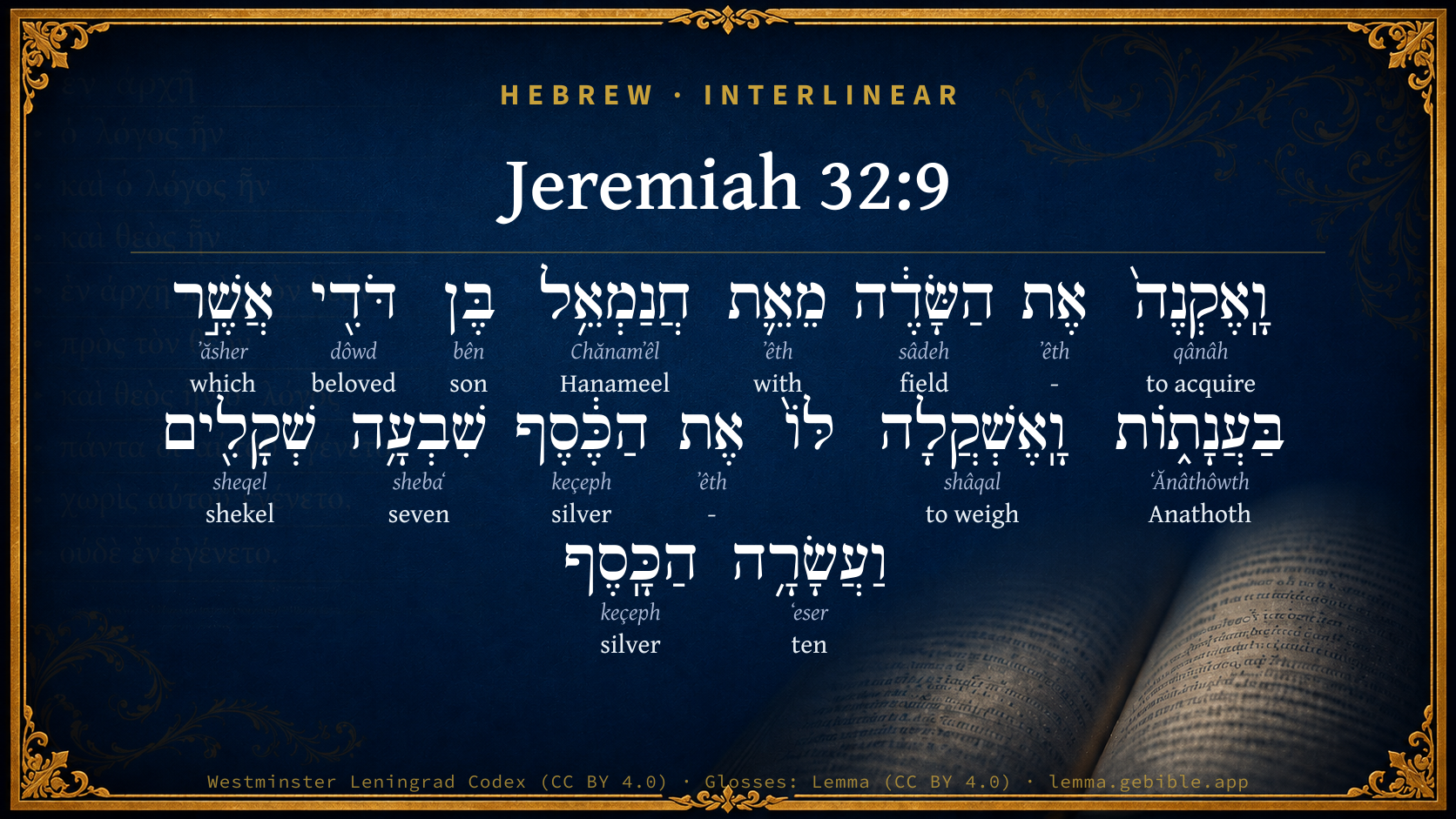
Hebrew (Westminster Leningrad Codex) Jeremiah 32:9 appears in the Hebrew Old Testament. The text above is from the Westminster Leningrad Codex. Each word links to its Strong’s number, a concise gloss, and parsing drawn from the Open Scriptures Hebrew Bible morphology. Click any word for its full Brown-Driver-Briggs (BDB) entry.
Download image
Cite this verse

Jeremiah 32:9 (World English Bible). Public Domain. Lemma interlinear Bible study tool, https://lemma.gebible.app/v/jeremiah/32/9.

Show BibTeX & RIS
BibTeX
RIS
English Translation
I bought the field that was in Anathoth of Hanamel my uncle's son, and weighed him the money, even seventeen shekels of silver.
World English Bible · Public Domain
Download a study sheet

One document with this verse’s original text, its word-by-word gloss line, the meaning frame, cross-references with their text, attributed commentary, and full source and license credits — printable, and it pastes into notes with its structure intact.

This verse Autodidact and up

Study sheet (.html) Plain text (.txt)

A passage Seminary Student

Up to 50 verses in one chapter. A passage sheet keeps up to 6 commentary sources and 12 cross-references per verse, in the order this page ranks them, and says so on the sheet whenever that leaves anything out. Ask for a single verse and you get the Autodidact verse sheet above.

Everything on this page stays free to read, with no account — the sheet is a download of what is already on screen, not access to it.

Want to remove ads? Support Godless Engineer
Compare translations 3

The same verse in 3 English versions, stacked beneath the original-language interlinear above. Click any original word for its lexicon entry.

Each is an independent rendering of the whole verse — the interlinear is not word-aligned to these translations.

Highlighted words mark where these versions differ — a whole-verse word diff, not a word-by-word alignment.

  • World English Bible Public Domain
    I bought the field that was in Anathoth of Hanamel my uncle's son, and weighed him the money, even seventeen shekels of silver.
  • King James Version Public Domain
    And I bought the field of Hanameel my uncle's son, that was in Anathoth, and weighed him the money, even seventeen shekels of silver.
  • unfoldingWord Literal Text CC BY-SA 4.0
    So I bought the field in Anathoth from Hanamel, the son of my uncle, and I weighed out for him the silver, seventeen shekels in weight.

unfoldingWord Literal Text — © unfoldingWord, licensed CC BY-SA 4.0. Word-aligned USFM3 via Door43 (git.door43.org/unfoldingWord/en_ult).

Versions to compare (up to 4)

3 of 4 selected

Show all 18 translations

Every available English version of this verse, each an independent rendering of the whole verse.

  • World English Bible Public Domain
    I bought the field that was in Anathoth of Hanamel my uncle's son, and weighed him the money, even seventeen shekels of silver.
  • Berean Standard Bible Public Domain
    So I bought the field in Anathoth from my cousin Hanamel, and I weighed out seventeen shekels of silver.
  • Majority Standard Bible Public Domain
    So I bought the field in Anathoth from my cousin Hanamel, and I weighed out seventeen shekels of silver.
  • King James Version Public Domain
    And I bought the field of Hanameel my uncle's son, that was in Anathoth, and weighed him the money, even seventeen shekels of silver.
  • American Standard Version (1901) Public Domain
    And I bought the field that was in Anathoth of Hanamel mine uncle's son, and weighed him the money, even seventeen shekels of silver.
  • Revised Version (1885) Public Domain
    And I bought the field that was in Anathoth of Hanamel mine uncle’s son, and weighed him the money, even seventeen shekels of silver.
  • Geneva Bible (1599) Public Domain
    And I bought the field of Hanameel, mine vncles sonne, that was in Anathoth, and weighed him the siluer, euen seuen shekels, and tenne pieces of siluer.
  • Douay-Rheims (1899) Public Domain
    And I bought the held of my uncle's son, that is in Anathoth: and I weighed him the money, seven staters, and ten pieces of silver.
  • Young's Literal Translation Public Domain
    And I buy the field, that `is' in Anathoth, from Hanameel, my uncle's son, and I weigh to him the money -- seventeen shekels of silver.
  • Literal Standard Version CC BY-SA 4.0
    and I buy the field that [is] in Anathoth from Hanameel, my uncle’s son, and I weigh the money to him—seventeen shekels of silver.
  • Unlocked Literal Bible CC BY-SA 4.0
    So I bought the field in Anathoth from Hanamel, the son of my uncle, and I weighed out for him the silver, seventeen shekels in weight.
  • unfoldingWord Literal Text CC BY-SA 4.0
    So I bought the field in Anathoth from Hanamel, the son of my uncle, and I weighed out for him the silver, seventeen shekels in weight.
  • Darby Bible Public Domain
    And I bought of Hanameel, mine uncle's son, the field which is in Anathoth, and weighed him the money, seventeen shekels of silver.
  • World Messianic Bible Public Domain
    I bought the field that was in Anathoth of Hanamel my uncle’s son, and weighed him the money, even seventeen shekels of silver.
  • Webster's Bible Public Domain
    And I bought the field of Hanameel my uncle's son, that was in Anathoth, and weighed him the money, even seventeen shekels of silver.
  • Free Bible Version CC BY-SA 4.0
    So I bought the field in Anathoth from my cousin Hanamel. I weighed out seventeen shekels of silver to pay him.
  • Bible in Basic English Public Domain
    So I got for a price the property in Anathoth from Hanamel, the son of my father's brother, and gave him the money, seventeen shekels of silver;
  • JPS Tanakh (1917) Public Domain
    And I bought the field that was in Anathoth of Hanamel mine uncle's son, and weighed him the money, even seventeen shekels of silver.

Literal Standard Version (2020), Covenant Press — licensed CC BY-SA 4.0. Text via the HelloAO Bible API (eBible.org). Unlocked Literal Bible (unfoldingWord) — licensed CC BY-SA 4.0. Text via the HelloAO Bible API (eBible.org). unfoldingWord Literal Text — © unfoldingWord, licensed CC BY-SA 4.0. Word-aligned USFM3 via Door43 (git.door43.org/unfoldingWord/en_ult). Free Bible Version, Dr. Jonathan Gallagher — licensed CC BY-SA 4.0. Text via the HelloAO Bible API (eBible.org).

Word by word

More ways to search: Search by grammar → Find every occurrence → Compare this word →

Practice this passage: Drill this verse → Learn its vocabulary →

חֲנַמְאֵ֥ל
Chănamʼêl
H2601
“Hanameel”
Noun, Proper
Part of Speech
Noun
Type
Proper
Full BDB Definition

Origin: probably by orthographical variation for H2606

TWOT: None

Hanameel = "God is gracious" - son of Shallum and cousin of Jeremiah
  1. וָֽאֶקְנֶה֙ qânâh H7069 “and · to acquire” Conjunction + Verb, Qal, Sequential Imperfect, 1st Person, Common, Singular
  2. אֶת ʼêth H853 “-” Particle, Direct Object
  3. הַשָּׂדֶ֔ה sâdeh H7704 “the · field” Particle, Definite Article + Noun, Common, Masculine, Singular, Absolute
  4. מֵאֵ֛ת ʼêth H854 “from · with” Preposition + Preposition
  5. בֶּן bên H1121 “son of” Noun, Common, Masculine, Singular, Construct
  6. דֹּדִ֖י dôwd H1730 “beloved · my” Noun, Common, Masculine, Singular, Construct + Suffix, Personal, 1st Person, Common, Singular
  7. אֲשֶׁ֣ר ʼăsher H834 “which” Particle, Relative
  8. בַּעֲנָת֑וֹת ʻĂnâthôwth H6068 “in/at · Anathoth” Preposition + Noun, Proper
  9. וָֽאֶשְׁקֲלָה shâqal H8254 “and · to weigh” Conjunction + Verb, Qal, Sequential Imperfect, 1st Person, Common, Singular + Suffix, h
  10. אֶת ʼêth H853 “-” Particle, Direct Object
  11. הַכֶּ֔סֶף keçeph H3701 “the · silver” Particle, Definite Article + Noun, Common, Masculine, Singular, Absolute
  12. שִׁבְעָ֥ה shebaʻ H7651 “seven” Adjective, Cardinal number, Masculine, Singular, Absolute
  13. שְׁקָלִ֖ים sheqel H8255 “shekels” Noun, Common, Masculine, Plural, Absolute
  14. וַעֲשָׂרָ֥ה ʻeser H6235 “and · ten” Conjunction + Adjective, Cardinal number, Masculine, Singular, Absolute
  15. הַכָּֽסֶף keçeph H3701 “the · silver” Particle, Definite Article + Noun, Common, Masculine, Singular, Absolute

About this verse

These counts appear in no published source. They are computed here, from the morphology-tagged text and Lemma’s own curated glosses. What Lemma adds →

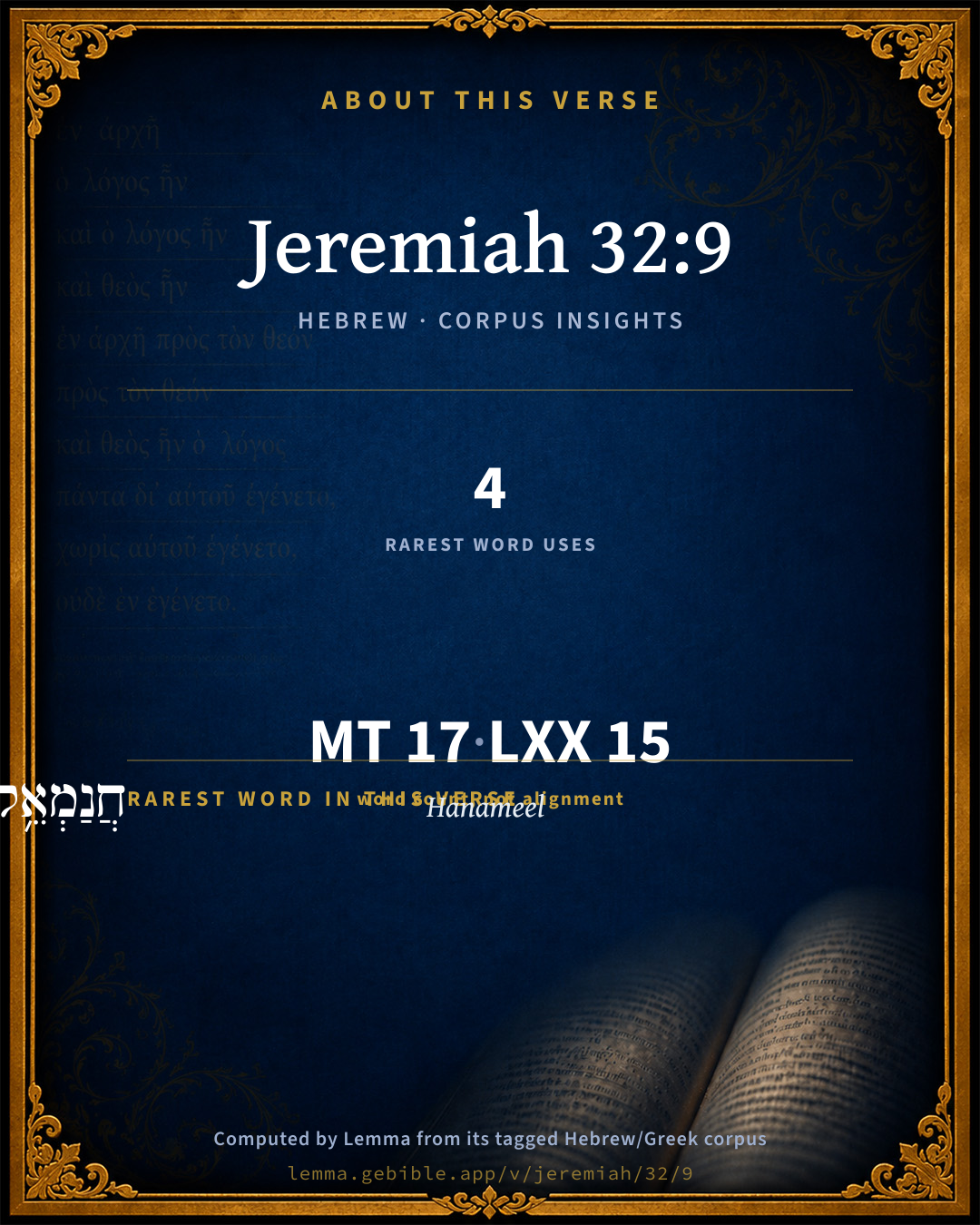
17
words
14
distinct lemmas
Prophets
section

Notable vocabulary

The rarest word here is חֲנַמְאֵ֥ל Hanameel H2601 — appearing just 4 times in the whole Hebrew Bible.

Shared distinctive vocabulary

חֲנַמְאֵ֥ל Hanameel H2601 occurs in 4 verses of the Hebrew Bible. Also found in:

Grammatical profile

  • 2 verbs
  • 8 nouns
  • 2 adjectives
  • 2 prepositions
  • 3 particles

Verb forms

  • וָֽאֶקְנֶה֙ Qal · Sequential Imperfect
  • וָֽאֶשְׁקֲלָה Qal · Sequential Imperfect

Repetition

A word recurs within this verse — often emphatic in Hebrew:

  • הַכֶּ֔סֶף silver H3701 ×2

Hebrew & Septuagint length

In the original languages it is 17 Hebrew tokens and 15 Greek tokens — but the two are counted differently (Hebrew bundles its prefixes and suffixes into one token; the Greek is in lemma form), so that isn’t a like-for-like length.

Cross-references

7

Topical passages linked to Jeremiah 32:9 in the Treasury of Scripture Knowledge — connected by theme and wording, ordered by reader-vote popularity; previews shown in the World English Bible.

  • 1 Kings 20:39 As the king passed by, he cried to the king; and he said, Your servant went out into the midst of the battle; and, behold, a man turned aside, and brought a man to me, and said, Keep this man: if by any means he be missing, then shall your life be for his life, or else you shall pay a talent of silver.
  • Esther 3:9 If it please the king, let it be written that they be destroyed: and I will pay ten thousand talents of silver into the hands of those who have the charge of the [king's] business, to bring it into the king's treasuries.
  • Zechariah 11:12–13 I said to them, "If you think it best, give me my wages; and if not, keep them." So they weighed for my wages thirty pieces of silver.
  • Genesis 23:15–16 "My lord, listen to me. What is a piece of land worth four hundred shekels of silver between me and you? Therefore bury your dead."
  • Genesis 37:28 Midianites who were merchants passed by, and they drew and lifted up Joseph out of the pit, and sold Joseph to the Ishmaelites for twenty pieces of silver. They brought Joseph into Egypt.
  • Isaiah 55:2 Why do you spend money for that which is not bread? and your labor for that which doesn't satisfy? listen diligently to me, and eat you that which is good, and let your soul delight itself in fatness.
  • Hosea 3:2 So I bought her for myself for fifteen pieces of silver and a homer and a half of barley.

Cross-references courtesy of OpenBible.info (CC BY 4.0).

Hebrew and Greek witnesses Masoretic Hebrew ↔ Greek Septuagint

The same verse in the two great witnesses to the Old Testament, shown verse-for-verse.

These are two independent witnesses, not word-aligned to each other, and the Septuagint is shown in lemma (dictionary) form.

Hebrew Jeremiah 32:9 Masoretic · Westminster Leningrad Codex

וָֽאֶקְנֶה֙ אֶת הַשָּׂדֶ֔ה מֵאֵ֛ת חֲנַמְאֵ֥ל בֶּן דֹּדִ֖י אֲשֶׁ֣ר בַּעֲנָת֑וֹת וָֽאֶשְׁקֲלָה לּוֹ֙ אֶת הַכֶּ֔סֶף שִׁבְעָ֥ה שְׁקָלִ֖ים וַעֲשָׂרָ֥ה הַכָּֽסֶף

I bought the field that was in Anathoth of Hanamel my uncle's son, and weighed him the money, even seventeen shekels of silver.

World English Bible · Public Domain

Greek LXX Structure differs

In the Septuagint, Jeremiah is about an eighth shorter than the Hebrew and arranges its material differently — the Oracles Against the Nations (Hebrew chapters 46–51) appear in the middle of the Greek book, after 25:13. Because the chapter and verse boundaries do not line up, a verse-for-verse comparison with the Hebrew is not shown.

A verse-for-verse comparison isn’t shown here because the chapters and verses don’t line up. Switch to the LXX edition with the MT / LXX toggle above to read the Greek directly.

On this verse, Ellicott's Commentary for English Readers discusses the Septuagint’s reading. Read the note in Commentary ↓

Hebrew: Westminster Leningrad Codex (CC BY 4.0). Greek: Septuagint (public domain); English from a public-domain English Septuagint. How the Septuagint differs from the Hebrew →

Targum (Aramaic paraphrase)

1

The Targum is the ancient Jewish Aramaic paraphrase of the Hebrew Scriptures — an interpretive translation, not the Hebrew text itself. Onkelos (literal) and Pseudo-Jonathan (expansive) render the Torah, and Jonathan the Prophets. Coverage is partial: where no permissively-licensed English translation exists for a verse, only the Aramaic is shown. This is verse-level text, not a word-by-word alignment to the Hebrew.

  1. Targum Jonathan Prophets (Joshua–Malachi)
    וּזְבַנֵית יַת חַקְלָא מִן חֲנַמְאֵל בַּר אַחֲבִי דְבַעֲנָתוֹת וּתְקָלֵית לֵיהּ יַת כַּסְפָּא שַׁבְעָא מָנָן וַעֲסַר סִלְעִין דִכְסַף:

    (no public-domain English translation for this verse)

    Targum Jonathan — Aramaic: “Mikraot Gedolot” (public domain). English: “Sefaria Community Translation” (CC0 1.0 (public-domain dedication)); “London "Chaldee Paraphrase," 1871” (public domain). Text via Sefaria.

Commentary

Notes on Jeremiah 32:9 from classic Christian and Jewish commentators (each source and its license shown beneath its notes). The classic Christian expositions comment on the surrounding passage and are grouped to its opening verse, so a note may address several verses; the Jewish commentaries on the Tanakh (Rashi and others) are per-verse, so they appear only where the commentator wrote on this verse.

Lemma curates 59 commentaries, every one of them public domain or Creative Commons licensed, each selected and text-cleaned for this edition rather than reprinted as found. About our sources →

Trapp's Complete Commentary

John Trapp

Jer 32:9 And I bought the field of Hanameel my uncle’s son, that [was] in Anathoth, and weighed him the money, [even] seventeen shekels of silver.

Ver. 9. And I bought the field.] This was bravely done, to make a purchase at such a time, when the enemy was seizing upon all. That Roman is famous in history who dared to purchase that field near Rome wherein Hannibal had pitched his camp. {a} Verum eorum res non erant ita deplorates; but the Romans were nothing near so low at that time as the Jews were at this.

And weighed him the money.] That was the manner of payment in those times. {b} Hence the Hebrew shekel from shakal, to weigh {Gen 23:16} - our English word scale seemeth to come from it), the Greek στατηρ from ισταναι ponderare to weigh {Exo 30:13 Mat 27:9} or of statera, for a balance the Dutch and English mark {c} cometh from a similar origin.

Even seventeen shekels of silver.] No great sum, not much over forty shillings; but it might be as much as the thing was worth, considering the times especially.

{a} Liv., lib. xxvi. Plutar. in Annib. Flor., lib. ii. c. 6.

{b} Olim moneta librabatur. Pater puellae id aurum in dotem viro appendit

{c} Unde et nomen marcharum hodie nobis superest. - Zegedin.

John Trapp, A Commentary or Exposition upon All the Books of the Old and New Testament (1647–1656) — public domain. Text from a community e-Sword module.

Joseph Benson's Commentary

Jer 32:9. I weighed him the money — In ancient times all money was paid by weight, a custom still used in several countries; even seventeen shekels of silver — A sum which, in our money, is not much above forty shillings; a small price for a field or piece of ground. It must be considered, however, “that the quantity of land is uncertain, and that the circumstances of the times must have greatly tended to lessen the value of land. The field in question was at the time of the purchase in the enemy’s possession; and the purchaser well knew that he or his heirs had no chance of entering upon it till after the expiration of the seventy years’ captivity. Besides, the seller, it is likely, was in the immediate want of the money, and could get no one else to purchase in the precarious situation things were in. He might therefore be glad to take what the prophet, who, doubtless, was not rich, was able to give, and who would not have thought of making the purchase at any rate had he not acted under the divine direction for a special purpose.” — Blaney.

Joseph Benson's Commentary on the Old and New Testaments (1811–1818) — public domain. Text from a community e-Sword module.

Tyndale Open Study Notes

Tyndale Open Resources

32:9-12 Many people might have thought that Jeremiah did a foolish thing when he agreed to buy the land. After the fall of Jerusalem and the exile of many people, the value of the land would drop to almost nothing. Still, Jeremiah immediately bought the field. • Matthew 27:9-10 refers to the “prophecy of Jeremiah,” which might be an allusion to this event.

Tyndale Open Study Notes — © Tyndale Open Resources, licensed CC BY-SA 4.0. Text via the HelloAO Bible API.

Geneva Bible (1599)

Geneva Bible translators

Which mounteth to of our money about ten shillings six pence, if this shekel were the common shekel, read Gen. 23:15, for the shekel of the Temple was of double value, and ten pieces of silver were half a shekel: for twenty made the shekel.

Geneva Bible (1599) marginal notes — public domain. Text via Bolls.life.

Jamieson, Fausset & Brown

Robert Jamieson, A. R. Fausset & David Brown

seventeen shekels of silver--As the shekel was only 2s. 4d.., the whole would be under £2, a rather small sum, even taking into account the fact of the Chaldean occupation of the land, and the uncertainty of the time when it might come to Jeremiah or his heirs. Perhaps the "seven shekels," which in the Hebrew (see Margin) are distinguished from the "ten pieces of silver," were shekels of gold [MAURER].

Jamieson, Fausset & Brown — Commentary Critical and Explanatory on the Whole Bible (1871) — public domain (CC PDM 1.0). Text via the HelloAO Bible API.

Adam Clarke's Commentary

Verse 9. Weighed him the money] It does not appear that there was any coined or stamped money among the Jews before the captivity; the Scripture, therefore, never speaks of counting money, but of weighing it.

Seventeen shekels of silver.] The shekel at this time must have been a nominal coin; it was a thing of a certain weight, or a certain worth. Seventeen shekels was the weight of the silver paid: but it might have been in one ingot, or piece. The shekel has been valued at from two shillings and threepence to two shillings and sixpence, and even at three shillings; taking the purchase-money at a medium of the value of the shekel, it would amount only to about two pounds two shillings and sixpence. But as estates bore value only in proportion to the number of years before the jubilee, and the field in question was then in the hands of the Chaldeans, and this cousin of Jeremiah was not likely to come back to enjoy it after seventy years, (nor could he then have it, as a jubilee would intervene and restore it to the original family,) and money must now be very scarce and high in its value, the seventeen shekels might have been a sufficient sum for a field in those circumstances, and one probably not large in its dimensions.

Adam Clarke's Commentary on the Bible (1810–1826) — public domain. Text from a community e-Sword/MySword module.

John Calvin's Commentaries

He afterwards adds, that he bought the field of Hanameel his uncle’s son, which was in Anathoth, in the land of Benjamin There is nothing superfluous in these words, for though the Prophet speaks of places well known, yet he had a regard to the time of the purchase, for the land of Benjamin was then in the power of enemies: the Jews had been reduced to such straits that they were not safe at Jerusalem. Anathoth was a village, as it was well known, exposed to the ravages of enemies, and was seized on as a prey at their first coming. And he adds, in the land of Benjamin, for it was nigh the borders of Judah, but it had been forsaken by its inhabitants, and all had fled to Jerusalem. As then the land of Benjamin had no inhabitant, it was by no means reasonable for the Prophet to pay even the smallest sum for a field there.

John Calvin's Commentaries (1540-1563) — public domain. Text from the Calvin Translation Society English edition (1840s-50s) via the Christian Classics Ethereal Library (ccel.org). Calvin's coverage is partial (roughly two-thirds of the Bible); uncommented books and verses are honest gaps, never fabricated. The 19th-century editor's footnotes and remarks are omitted so the notes are faithfully Calvin's own voice.

Ellicott's Commentary for English Readers

(9) Weighed him the money, even seventeen shekels of silver.—The Hebrew presents the singular combination, seven shekels and ten [pieces of] silver, and is followed by the LXX. and Vulg. There is no ground for thinking that there is any difference between the coins or bullion so described, and the formula was probably one of the technicalities of Jewish conveyancing. As regards the price it is not easy, in the absence of any measurement of the field, to form an estimate of its value; but, speaking roughly, as compared with the four hundred shekels paid by Abraham for the field of Ephron (Gen_23:16), or the fifty paid by David for the threshing-floor and oxen of Araunah (2Sa_24:24; in 1Ch_21:25 the price is fixed at six hundred shekels of gold), or to the thirty shekels paid for the potter’s field in Mat_27:9, or to the market price of a slave varying from fifteen (Hos_3:2) to thirty shekels (Zec_11:12), the price, under £2 sterling, would seem to have been far below its average market value, and in this respect the story falls short of the dignity of its Roman parallel (see Note on Jer_32:7). Hanameel, as said above, was probably glad to part with it at any price. It is possible, however, that the smallness of the sum was owing to the fact that the sale, as above suggested, conveyed possession only for the unexpired term of a tenancy which was to end with the next year of Jubilee. On that assumption the prophet’s motive in purchasing may have been to keep it in the family instead of letting it pass to a stranger who might be unwilling to surrender it when the year of Jubilee arrived. As the prophet was unmarried he had no son to inherit it. The precise sum fixed, perhaps even the form in which the sum is stated, may have originated in Jeremiah’s wish to connect in this way the two numbers, ten and seven, which when multiplied together produced the number which he had fixed for the years of captivity, and therefore for the term of restoration. Such an elaborate artifice of symbolism would, at least, be quite in character in a prophet who adopts the acrostic form in his Lamentations and the cypher of an inverted alphabet known as the Athbash. (See Note on Jer_25:26.)

A Bible Commentary for English Readers, edited by Charles John Ellicott (1878–1897) — public domain. Text from a community e-Sword module.

The Cambridge Bible for Schools and Colleges

gen. ed. J. J. S. Perowne

9. that was in Anathoth] Omit with LXX.

weighed him the money, even seventeen shekels of silver] The shekel weighed about 220 of our grains. The amount may appear small (about £2. 6s. 6d. of our money), but we do not know the size of the field. It is clear from the aim of the whole transaction that it was a fair price in ordinary times. We must remember also that in those days the purchasing power of silver was much greater. Araunah’s threshing floor, oxen, and implements were bought at a time of great prosperity for fifty shekels (2Sa_24:24).

The Cambridge Bible for Schools and Colleges (gen. ed. J. J. S. Perowne; Cambridge University Press, 1878–1918) — public domain. Text from a community e-Sword module.

John Gill's Exposition

And I subscribed the evidence,.... Or, "wrote in a book" (u); the instrument or bill of sale, the deed of purchase; which described the field sold, and expressed the condition on which the purchase was made; and by subscribing it he agreed to it, and laid himself under obligation to perform it:

and sealed it; for the further confirmation of it:

and took witnesses; to be present at the payment of the money, and to sign the deed likewise:

and weighed him the money in the balances; this he did a second time; he weighed it first before Hanameel himself, and then before the witnesses; everything was done fairly, and with great exactness.

(u) "et scripsi in libro", V. L. Munster, Pagninus, Montanus; "in libello", Cocceius.

John Gill's Exposition of the Whole Bible (1746–1763) — public domain (CC PDM 1.0). Text via the HelloAO Bible API.

Albert Barnes' Notes on the Bible

Seventeen shekels of silver - literally, as in the margin, probably a legal formula. Jeremiah bought Hanameel’s life-interest up to the year of Jubilee, and no man’s life was worth much in a siege like that of Jerusalem. As Jeremiah had no children, at his death the land would devolve to the person who would have inherited it had Jeremiah not bought it. He therefore bought what never was and never could have been of the slightest use to him, and gave for it what in the growing urgency of the siege might have been very serviceable to himself. Still, as the next heir. it was Jeremiah’s duty to buy the estate, independently of the importance of the act as a sign to the people; and evidently he gave the full value.

Albert Barnes' Notes on the Bible (1834–1885) — public domain. Text from a community e-Sword/MySword module.

Haydock's Catholic Bible Commentary

Silver. Hebrew, "seventeen sicles of silver." (Haydock) --- Coin was not yet used. (Calmet)

George Leo Haydock (1774–1849), Haydock's Catholic Family Bible and Commentary, 1859 edition — public domain. Excludes Psalms (Douay-Rheims chapter numbering differs from Protestant) and Deuterocanonical books (Catholic canon only).

Matthew Poole's English Annotations

That is, about £21. 2s. 6d., a small purchase, which argues the field here mentioned to be but some orchard or garden; though we must allow the price of land strangely fallen at this time, when the enemy was besieging the chief city of the country. It should seem they were wont there to make their payments more by weight than by tale.

Matthew Poole's English Annotations on the Holy Bible (1683–1685) — public domain. Text from a community e-Sword/MySword module.

Whedon's Commentary on the Bible

Daniel D. Whedon

9. Seventeen shekels — Two things arrest attention in this price: 1) The peculiar form, literally “seven shekels and ten of silver.” 2) Its smallness, about ten dollars. Possibly the first may be explained as a legal formula, while the second may be due to the consideration that the sale of land was, correctly speaking, only the sale of the use of it up to the year of jubilee. And then, the value of land depends largely on the state of society and the political prospects of the country. Other cases in which the price of land in Palestine is mentioned are the sale of Araunah’s threshing-floor with the oxen and implements for fifty shekels, (2Sa_24:24,) and the potter’s field to the chief priests for thirty shekels. Mat_27:7.

Daniel D. Whedon (gen. ed.), Commentary on the Old and New Testaments (1874–1909) — public domain. Text from a community e-Sword module.

The Pulpit Commentary

Seventeen shekels of silver; i.e. about 5 s. 4 d. (taking the shekel at 2 s. 8 d. ). This has been thought a small price. Thirty shekels were paid for the potter"s field; (Mat_27:7) fifty by David, for Araunah"s threshing floor and oxen. (2Sa_24:4) The Hebrew has "seven shekels and ten of silver;" hence the Targum increases the price by supplying "minas" before "of silver," bringing up the sum to one hundred and seven shekels. This, however, seems too much. Even if Jeremiah wished to be liberal, he would hardly have been able to go so far (probably) in excess of the market price. Who would have purchased the land on speculation, if Jeremiah had refused? The famine made life, the siege, a continuance of personal liberty, terribly uncertain. And, putting this out of the question, there may have been but a short time to elapse before the year of jubilee, when the land would revert to its original occupant (see above). The singular form of expression in the Hebrew, at which the Targum stumbled, may, perhaps, be the usual style of legal documents.

The Pulpit Commentary (1880–1919), ed. H.D.M. Spence-Jones & Joseph S. Exell — public domain. Text from a community e-Sword module.

John Wesley's Explanatory Notes

The money - The price of land was strangely fallen at this time, when the enemy was besieging the chief city of the country.

John Wesley, Explanatory Notes Upon the Whole Bible (1754–1765) — public domain. Text via the GEBible commentary corpus.

Scofield Reference Notes

C. I. Scofield

bought

(1) A sign of Jeremiah’s faith in his own predictions of the restoration of Judah Jer 32:15 for the field was then occupied by the Babylonian army; and

(2) a sign to Judah of that coming restoration.

The Scofield Reference Bible (1917 edition), notes by C. I. Scofield — public domain. Text from a community e-Sword module.

Lesson kit

Teaching starters — assembled from the data on this page, not authored interpretation. Every prompt links to the verse data it draws on. Edit before teaching.

Jeremiah, in the Prophets, opens this verse with 17 words (14 distinct Hebrew lemmas). Its most distinctive word is Chănamʼêl (“Hanameel”). A historical commentator’s framing appears above. Read the whole chapter for the surrounding context.

Discussion questions

  1. What does “Hanameel” (Chănamʼêl) contribute to the verse as a whole?
  2. How does Jeremiah 32:7, which shares the word «Hanameel», read alongside this verse?
  3. What does the repetition of “silver” (2× in this one verse) do in this verse?
  4. These translations render this verse differently. What is at stake in choosing one wording over another?
  5. «וָֽאֶקְנֶה֙» is a Qal Sequential Imperfect verb. How does that grammatical form shape the action described?
  6. Compare how Trapp's Complete Commentary and Joseph Benson's Commentary read this verse. Where do they agree or differ?

Things to notice

Reading settings

Reading text

Shown beneath each verse's original-language words.

Old Testament
Old Testament edition

Read the OT as the Masoretic Hebrew (MT) or the Greek Septuagint (LXX).

English shown for the Greek Septuagint (in the Hebrew ↔ Greek comparison).

Comparing translations? Open the Compare panel on any verse page to stack up to four side by side.