Jeremiah 6:25

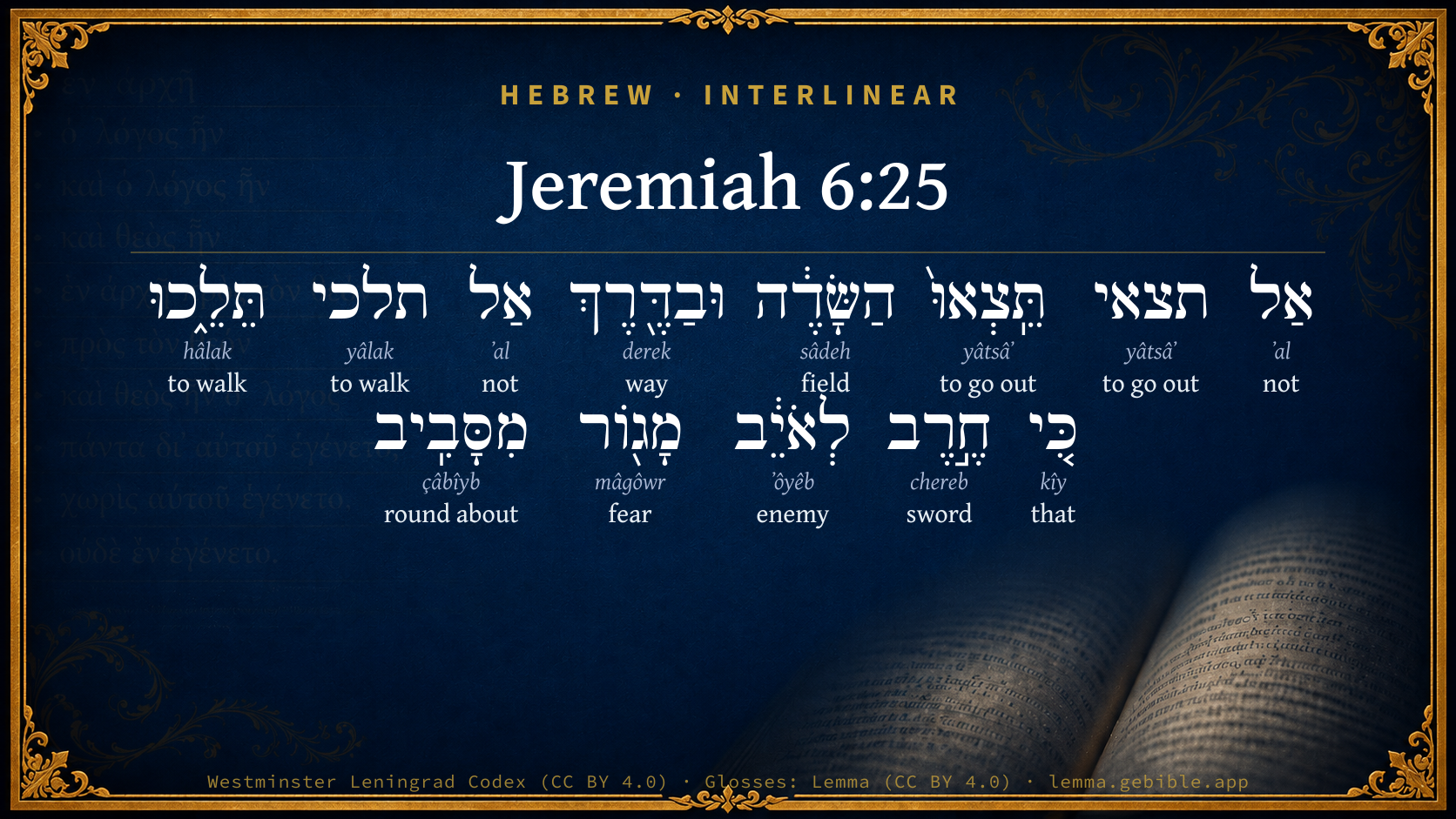
Hebrew (Westminster Leningrad Codex) Jeremiah 6:25 appears in the Hebrew Old Testament. The text above is from the Westminster Leningrad Codex. Each word links to its Strong’s number, a concise gloss, and parsing drawn from the Open Scriptures Hebrew Bible morphology. Click any word for its full Brown-Driver-Briggs (BDB) entry.
Download image
Cite this verse

Jeremiah 6:25 (World English Bible). Public Domain. Lemma interlinear Bible study tool, https://lemma.gebible.app/v/jeremiah/6/25.

Show BibTeX & RIS
BibTeX
RIS
English Translation
Don't go forth into the field, nor walk by the way; for the sword of the enemy, [and] terror, are on every side.
World English Bible · Public Domain
Download a study sheet

One document with this verse’s original text, its word-by-word gloss line, the meaning frame, cross-references with their text, attributed commentary, and full source and license credits — printable, and it pastes into notes with its structure intact.

This verse Autodidact and up

Study sheet (.html) Plain text (.txt)

A passage Seminary Student

Up to 50 verses in one chapter. A passage sheet keeps up to 6 commentary sources and 12 cross-references per verse, in the order this page ranks them, and says so on the sheet whenever that leaves anything out. Ask for a single verse and you get the Autodidact verse sheet above.

Everything on this page stays free to read, with no account — the sheet is a download of what is already on screen, not access to it.

Want to remove ads? Support Godless Engineer
Compare translations 3

The same verse in 3 English versions, stacked beneath the original-language interlinear above. Click any original word for its lexicon entry.

Each is an independent rendering of the whole verse — the interlinear is not word-aligned to these translations.

Highlighted words mark where these versions differ — a whole-verse word diff, not a word-by-word alignment.

  • World English Bible Public Domain
    Don't go forth into the field, nor walk by the way; for the sword of the enemy, [and] terror, are on every side.
  • King James Version Public Domain
    Go not forth into the field, nor walk by the way; for the sword of the enemy and fear is on every side.
  • unfoldingWord Literal Text CC BY-SA 4.0
    Do not go out the field, and do not walk the road, for the sword of the enemy, terror from all around.

unfoldingWord Literal Text — © unfoldingWord, licensed CC BY-SA 4.0. Word-aligned USFM3 via Door43 (git.door43.org/unfoldingWord/en_ult).

Versions to compare (up to 4)

3 of 4 selected

Show all 18 translations

Every available English version of this verse, each an independent rendering of the whole verse.

  • World English Bible Public Domain
    Don't go forth into the field, nor walk by the way; for the sword of the enemy, [and] terror, are on every side.
  • Berean Standard Bible Public Domain
    Do not go out to the fields; do not walk the road. For the enemy has a sword; terror is on every side.
  • Majority Standard Bible Public Domain
    Do not go out to the fields; do not walk the road. For the enemy has a sword; terror is on every side.
  • King James Version Public Domain
    Go not forth into the field, nor walk by the way; for the sword of the enemy and fear is on every side.
  • American Standard Version (1901) Public Domain
    Go not forth into the field, nor walk by the way; for the sword of the enemy, `and' terror, are on every side.
  • Revised Version (1885) Public Domain
    Go not forth into the field, nor walk by the way; for there is the sword of the enemy, and terror on every side.
  • Geneva Bible (1599) Public Domain
    Goe not foorth into the fielde, nor walke by the way: for the sword of the enemie and feare is on euery side.
  • Douay-Rheims (1899) Public Domain
    Go not out into the fields, nor walk in the highway: for the sword of the enemy, and fear is on every side.
  • Young's Literal Translation Public Domain
    Go not forth to the field, And in the way walk not, For a sword hath the enemy, fear `is' round about.
  • Literal Standard Version CC BY-SA 4.0
    Do not go forth to the field, || And do not walk in the way, || For the enemy has a sword, || Fear [is] all around.
  • Unlocked Literal Bible CC BY-SA 4.0
    Do not go out to the fields, and do not walk on the roads, for the swords of the enemy and terror are all around.
  • unfoldingWord Literal Text CC BY-SA 4.0
    Do not go out the field, and do not walk the road, for the sword of the enemy, terror from all around.
  • Darby Bible Public Domain
    Go not forth into the field, nor walk by the way; for [there is] the sword of the enemy, terror is on every side.
  • World Messianic Bible Public Domain
    Don’t go out into the field or walk by the way; for the sword of the enemy and terror are on every side.
  • Webster's Bible Public Domain
    Go not forth into the field, nor walk by the way; for the sword of the enemy and fear is on every side.
  • Free Bible Version CC BY-SA 4.0
    Don't go to the field! Don't walk down the road! The enemy is armed with swords! Terror is everywhere!”
  • Bible in Basic English Public Domain
    Go not out into the field or by the way; for there is the sword of the attacker, and fear on every side.
  • JPS Tanakh (1917) Public Domain
    Go not forth into the field, nor walk by the way; for there is the sword of the enemy, and terror on every side.

Literal Standard Version (2020), Covenant Press — licensed CC BY-SA 4.0. Text via the HelloAO Bible API (eBible.org). Unlocked Literal Bible (unfoldingWord) — licensed CC BY-SA 4.0. Text via the HelloAO Bible API (eBible.org). unfoldingWord Literal Text — © unfoldingWord, licensed CC BY-SA 4.0. Word-aligned USFM3 via Door43 (git.door43.org/unfoldingWord/en_ult). Free Bible Version, Dr. Jonathan Gallagher — licensed CC BY-SA 4.0. Text via the HelloAO Bible API (eBible.org).

Word by word

More ways to search: Search by grammar → Find every occurrence → Compare this word →

Practice this passage: Drill this verse → Learn its vocabulary →

מָג֖וֹר
mâgôwr
H4032
“fear”
Noun, Common, Masculine, Singular, Absolute
Part of Speech
Noun
Type
Common
Gender
Masculine
Number
Singular
State
Absolute
Full BDB Definition

Origin: from H1481 in the sense of fearing

TWOT: 332a

fear, terror
  1. אַל ʼal H408 “not” Particle, Negative
  2. תצאי yâtsâʼ H3318 “to go out” Verb, Qal, Jussive, 2nd Person, Feminine, Singular
  3. תֵּֽצְאוּ֙ yâtsâʼ H3318 “to go out” Verb, Qal, Jussive, 2nd Person, Masculine, Plural
  4. הַשָּׂדֶ֔ה sâdeh H7704 “the · field” Particle, Definite Article + Noun, Common, Masculine, Singular, Absolute
  5. וּבַדֶּ֖רֶךְ derek H1870 “and · in/at the · way” Conjunction + Preposition, Determined + Noun, Common, Both, Singular, Absolute
  6. אַל ʼal H408 “not” Particle, Negative
  7. תלכי yâlak H3212 “to walk” Verb, Qal, Jussive, 2nd Person, Feminine, Singular
  8. תֵּלֵ֑כוּ hâlak H1980 “to walk” Verb, Qal, Jussive, 2nd Person, Masculine, Plural
  9. כִּ֚י kîy H3588 “that” Conjunction
  10. חֶ֣רֶב chereb H2719 “sword” Noun, Common, Feminine, Singular, Absolute
  11. לְאֹיֵ֔ב ʼôyêb H341 “to/for · enemy” Preposition + Verb, Qal, Participle Active, Masculine, Singular, Absolute
  12. מִסָּבִֽיב çâbîyb H5439 “from · round about” Preposition + Noun, Common, Both, Singular, Absolute

About this verse

These counts appear in no published source. They are computed here, from the morphology-tagged text and Lemma’s own curated glosses. What Lemma adds →

13
words
11
distinct lemmas
Prophets
section

Notable vocabulary

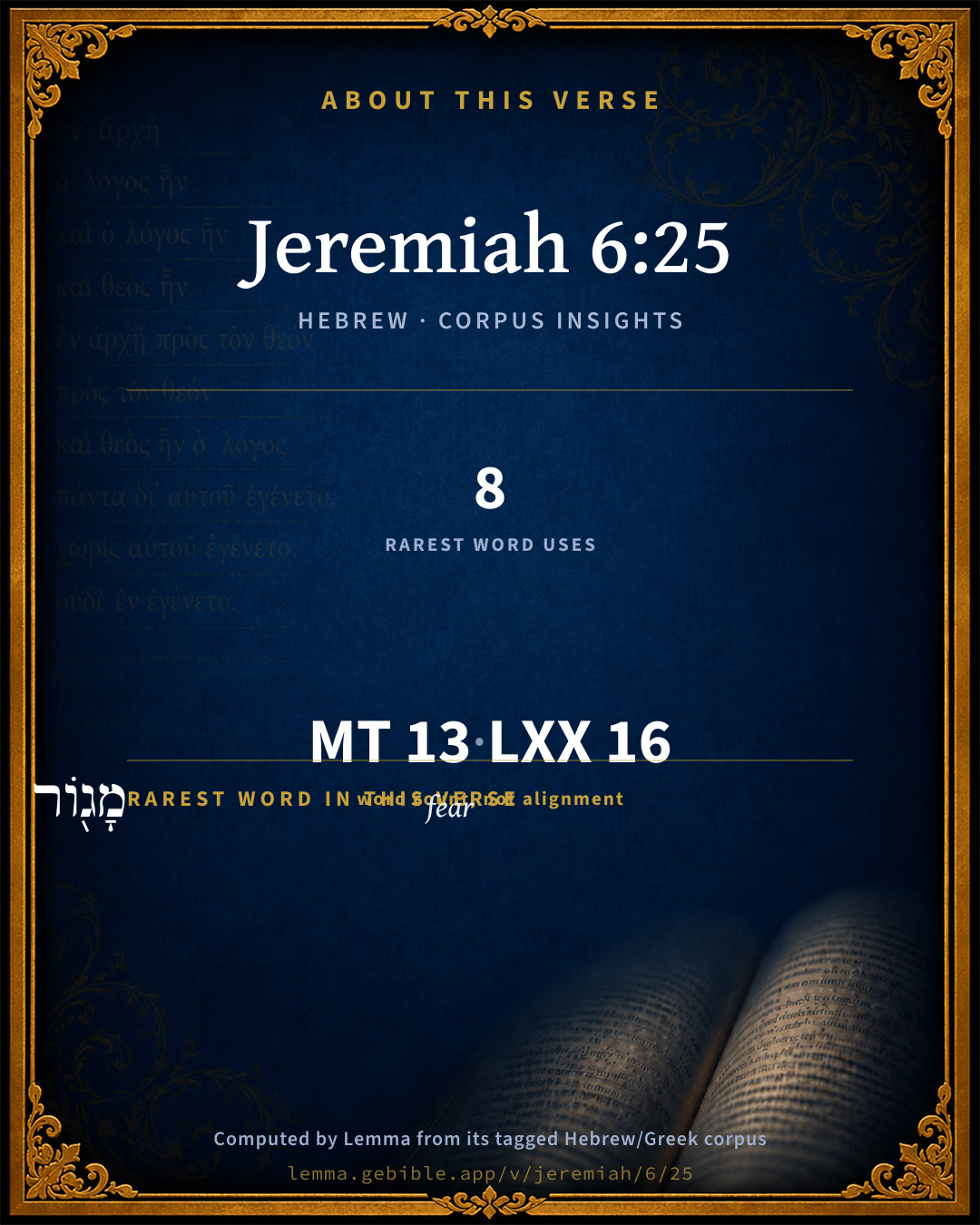
The rarest word here is מָג֖וֹר fear H4032 — appearing just 8 times in the whole Hebrew Bible.

Shared distinctive vocabulary

מָג֖וֹר fear H4032 occurs in 8 verses of the Hebrew Bible. Also found in:

Grammatical profile

  • 5 verbs
  • 5 nouns
  • 1 conjunction
  • 2 particles

Verb forms

  • תצאי Qal · Jussive
  • תֵּֽצְאוּ֙ Qal · Jussive
  • תלכי Qal · Jussive
  • תֵּלֵ֑כוּ Qal · Jussive
  • לְאֹיֵ֔ב Qal · Participle Active

Repetition

Words recur within this verse — often emphatic in Hebrew:

  • תצאי to go out H3318 ×2
  • אַל not H408 ×2

Hebrew & Septuagint length

In the original languages it is 13 Hebrew tokens and 16 Greek tokens — but the two are counted differently (Hebrew bundles its prefixes and suffixes into one token; the Greek is in lemma form), so that isn’t a like-for-like length.

Cross-references

13

Topical passages linked to Jeremiah 6:25 in the Treasury of Scripture Knowledge — connected by theme and wording, ordered by reader-vote popularity; previews shown in the World English Bible.

  • Jeremiah 49:29 Their tents and their flocks shall they take; they shall carry away for themselves their curtains, and all their vessels, and their camels; and they shall cry to them, Terror on every side!
  • Job 18:11 Terrors shall make him afraid on every side, And shall chase him at his heels.
  • Psalms 31:13 For I have heard the slander of many, terror on every side, While they conspire together against me, They plot to take away my life.
  • Jeremiah 14:18 If I go forth into the field, then, behold, the slain with the sword! and if I enter into the city, then, behold, those who are sick with famine! for both the prophet and the priest go about in the land, and have no knowledge.
  • Jeremiah 20:10 For I have heard the defaming of many, terror on every side. Denounce, and we will denounce him, [say] all my familiar friends, those who watch for my fall; peradventure he will be persuaded, and we shall prevail against him, and we shall take our revenge on him.
  • Judges 5:6–7 In the days of Shamgar the son of Anath, In the days of Jael, the highways were unoccupied, The travelers walked through byways.
  • 2 Chronicles 15:5 In those times there was no peace to him who went out, nor to him who came in; but great vexations were on all the inhabitants of the lands.
  • Isaiah 1:20 But if you refuse and rebel, you shall be devoured with the sword; For the mouth of Yahweh has spoken it."
  • Jeremiah 4:5 Declare you in Judah, and publish in Jerusalem; and say, Blow you the trumpet in the land: cry aloud and say, Assemble yourselves, and let us go into the fortified cities.
  • Jeremiah 4:10 Then said I, Ah, Lord Yahweh! surely you have greatly deceived this people and Jerusalem, saying, You shall have peace; whereas the sword reaches to the life.
  • Jeremiah 8:14 Why do we sit still? assemble yourselves, and let us enter into the fortified cities, and let us be silent there; for Yahweh our God has put us to silence, and given us water of gall to drink, because we have sinned against Yahweh.
  • Jeremiah 20:3–4 It happened on the next day, that Pashhur brought forth Jeremiah out of the stocks. Then said Jeremiah to him, Yahweh has not called your name Pashhur, but Magormissabib.
  • Luke 19:43 For the days will come on you, when your enemies will throw up a barricade against you, surround you, hem you in on every side,

Cross-references courtesy of OpenBible.info (CC BY 4.0).

Hebrew and Greek witnesses Masoretic Hebrew ↔ Greek Septuagint

The same verse in the two great witnesses to the Old Testament, shown verse-for-verse.

These are two independent witnesses, not word-aligned to each other, and the Septuagint is shown in lemma (dictionary) form.

Hebrew Jeremiah 6:25 Masoretic · Westminster Leningrad Codex

אַל תצאי תֵּֽצְאוּ֙ הַשָּׂדֶ֔ה וּבַדֶּ֖רֶךְ אַל תלכי תֵּלֵ֑כוּ כִּ֚י חֶ֣רֶב לְאֹיֵ֔ב מָג֖וֹר מִסָּבִֽיב

Don't go forth into the field, nor walk by the way; for the sword of the enemy, [and] terror, are on every side.

World English Bible · Public Domain

Greek LXX Structure differs

In the Septuagint, Jeremiah is about an eighth shorter than the Hebrew and arranges its material differently — the Oracles Against the Nations (Hebrew chapters 46–51) appear in the middle of the Greek book, after 25:13. Because the chapter and verse boundaries do not line up, a verse-for-verse comparison with the Hebrew is not shown.

A verse-for-verse comparison isn’t shown here because the chapters and verses don’t line up. Switch to the LXX edition with the MT / LXX toggle above to read the Greek directly.

Hebrew: Westminster Leningrad Codex (CC BY 4.0). Greek: Septuagint (public domain); English from a public-domain English Septuagint. How the Septuagint differs from the Hebrew →

Targum (Aramaic paraphrase)

1

The Targum is the ancient Jewish Aramaic paraphrase of the Hebrew Scriptures — an interpretive translation, not the Hebrew text itself. Onkelos (literal) and Pseudo-Jonathan (expansive) render the Torah, and Jonathan the Prophets. Coverage is partial: where no permissively-licensed English translation exists for a verse, only the Aramaic is shown. This is verse-level text, not a word-by-word alignment to the Hebrew.

  1. Targum Jonathan Prophets (Joshua–Malachi)
    לָא תִפְקוּן לְחַקְלָא וּבְאוֹרְחָא לָא תְהָכוּן אֲרֵי חַרְבָּא דְסָנְאָה מְקַטְלָא לְמִתְכַּנְשִׁין מִסְחוֹר סְחוֹר:

    (no public-domain English translation for this verse)

    Targum Jonathan — Aramaic: “Mikraot Gedolot” (public domain). English: “Sefaria Community Translation” (CC0 1.0 (public-domain dedication)); “London "Chaldee Paraphrase," 1871” (public domain). Text via Sefaria.

Commentary

Notes on Jeremiah 6:25 from classic Christian and Jewish commentators (each source and its license shown beneath its notes). The classic Christian expositions comment on the surrounding passage and are grouped to its opening verse, so a note may address several verses; the Jewish commentaries on the Tanakh (Rashi and others) are per-verse, so they appear only where the commentator wrote on this verse.

Lemma curates 59 commentaries, every one of them public domain or Creative Commons licensed, each selected and text-cleaned for this edition rather than reprinted as found. About our sources →

Trapp's Complete Commentary

John Trapp

Jer 6:25 Go not forth into the field, nor walk by the way; for the sword of the enemy [and] fear [is] on every side.

Ver. 25. Go not out into the field.] Since there is "no peace to him that goeth out, nor to him that cometh in"; {2Ch 15:5} but

“ Luctus ubique, pavor, et plurima mortis imago. ”

“Everywhere grief, panic and the images of the most dead.”

John Trapp, A Commentary or Exposition upon All the Books of the Old and New Testament (1647–1656) — public domain. Text from a community e-Sword module.

Jamieson, Fausset & Brown

Robert Jamieson, A. R. Fausset & David Brown

He addresses "the daughter of Zion" (Jer 6:23); caution to the citizens of Jerusalem not to expose themselves to the enemy by going outside of the city walls,

sword of the enemy--literally "there is a sword to the enemy"; the enemy hath a sword.

Jamieson, Fausset & Brown — Commentary Critical and Explanatory on the Whole Bible (1871) — public domain (CC PDM 1.0). Text via the HelloAO Bible API.

John Calvin's Commentaries

He confirms the previous verse. For the Jews, as it has been said, regarded all threatenings as nothing: it was hence necessary that they should be taught, not by words only, but be constrained to fear, by having the scene set before their eyes, that being thus constrained they might at least entertain some fear on account of the nearness of God’s vengeance. The Prophet then denounces war, and speaks as though they were already besieged, Go ye not forth, he says, into the field, etc., for the terror of the enemy and fear is on every side; not that the Chaldeans were already laying waste Judea, or that they had even departed from their own country. But we have briefly explained the design of the Prophet: he intended thus vehemently to deal with a hardened and obstinate people, that they might know that he spoke seriously to them, and that his threatenings would not be evanescent. It follows —

John Calvin's Commentaries (1540-1563) — public domain. Text from the Calvin Translation Society English edition (1840s-50s) via the Christian Classics Ethereal Library (ccel.org). Calvin's coverage is partial (roughly two-thirds of the Bible); uncommented books and verses are honest gaps, never fabricated. The 19th-century editor's footnotes and remarks are omitted so the notes are faithfully Calvin's own voice.

Ellicott's Commentary for English Readers

(25) The field.—i.e., the open country. To pass beyond the walls of the beleaguered city would be full of danger. The warning has its parallel in Mat_24:17-18. In the same chapter we find also an echo of the prophet’s reference to the pangs of childbirth (Mat_24:8).

Fear is on every side.—The words are more notable than they seem. They impressed themselves on the prophet’s mind, and became to him as a watchword. So, in Jer_20:3, he gives them as a name (Magor-missabib) to Pashur, and apparently (as in Jer_20:10) it was used as a cry of derision against himself.

A Bible Commentary for English Readers, edited by Charles John Ellicott (1878–1897) — public domain. Text from a community e-Sword module.

The Cambridge Bible for Schools and Colleges

gen. ed. J. J. S. Perowne

25. and terror on every side] Omit “and.” The remaining words are a characteristic expression of Jeremiah. Ch. Jer_20:3 (where see note), 10, Jer_46:5, Jer_49:29; Psa_31:13; cp. Job_18:11.

The Cambridge Bible for Schools and Colleges (gen. ed. J. J. S. Perowne; Cambridge University Press, 1878–1918) — public domain. Text from a community e-Sword module.

John Gill's Exposition

Go not forth into the field,.... Either for pleasure, or for business; to take a walk in it for the air, or to till it, plough, sow, or reap; but keep within the city and its walls, there being danger:

nor walk by the way; in the high road from Jerusalem, to any town or village near it:

for the sword of the enemy: or, "because there is a sword for the enemy" (b); or, "the enemy has a sword"; and that drawn; the enemy is in the field, and in the ways, and there is no escaping him:

and fear is on every side; all round the city, being encompassed by the Assyrian army: or, the enemy's sword "is fear on every side" (c); causes fear in all parts round the city. The Targum is,

"because the sword of the enemy kills those who are gathered round about;''

or on every side.

(b) "quoniam gladius est inimico", Munster, Vatablus, Junius & Tremellius; "quia (ibi) gladius (qui) hosti", Schmidt. (c) Gataker.

John Gill's Exposition of the Whole Bible (1746–1763) — public domain (CC PDM 1.0). Text via the HelloAO Bible API.

Albert Barnes' Notes on the Bible

For the sword of the enemy - literally, “for to the enemy a sword; i. e., for the enemy is armed,” he has a commission from God to execute judgment. See Jer 12:12; Isa 10:5, and Psa 17:13 note.

Fear is on every side - Magor-Missabib, Jeremiah’s watchword (compare Jer 20:3, Jer 20:10). The “and” before it should be omitted.

Albert Barnes' Notes on the Bible (1834–1885) — public domain. Text from a community e-Sword/MySword module.

Matthew Poole's English Annotations

Go not forth into the field, nor walk by the way; expressing the great danger that there would be every where, there would be no stirring out of their fenced cities or houses, Jer 8:14, but great danger to them that go out, and to those that come in, they would find death every where; now seek out some by-ways, venture hot in common roads, Jdg 5:6.

The sword of the enemy and fear is on every side: the language of one speaking to another: it seems to be a proverbial speech, frequently used to express unavoidable dangers, Psa 31:13; Jer 20:3,10; 49:29. All places will be full of soldiers, so that all attempts will be very difficult, Lam 5:9.

Matthew Poole's English Annotations on the Holy Bible (1683–1685) — public domain. Text from a community e-Sword/MySword module.

The Pulpit Commentary

Go not forth into the field. The "daughter of Zion" (i.e. the personific population of Jerusalem) is cautioned against venturing outside the walls. The sword of the enemy; rather, the enemy hath a sword. Fear is on every side; Hebrew, magor missa-bib; one of Jeremiah"s favorite expressions. (see Jer_20:3, 10 46:5 49:29; and comp. Psa_31:13) Naturally of a timid, retiring character, the prophet cannot help feeling the anxious and alarming situation into which at the Divine command he has ventured.

The Pulpit Commentary (1880–1919), ed. H.D.M. Spence-Jones & Joseph S. Exell — public domain. Text from a community e-Sword module.

John Wesley's Explanatory Notes

Go not forth - Expressing the great danger that there would be everywhere.

John Wesley, Explanatory Notes Upon the Whole Bible (1754–1765) — public domain. Text via the GEBible commentary corpus.

unfoldingWord translationNotes

Door43 World Missions Community

General Information:

Jeremiah speaks to the people of Jerusalem. Some versions interpret this as Yahweh speaking to the people of Jerusalem.

for the swords of the enemy and terror are all around

The phrase "swords of the enemy" represents the enemy with their swords ready to attack. The abstract noun "terror" refers to things that cause people to be frightened and can be translated with an adjective. AT: "For the enemy is everywhere with their swords and everyone else is terrified" (See: Metonymy and Abstract Nouns)

Daughter of my people

Jeremiah shows Yahweh's love for his people by speaking to them as a daughter. See how you translated a similar phrase in Jeremiah 4:11. AT: "My people, you who are like a daughter to me" or "My dear people" (See: Metaphor)

put on sackcloth and roll in ashes

People do these things to show that they are extremely sad. AT: "Show how sad you are by wearing sackcloth and rolling in ashes" (See: Symbolic Action)

mourn with painful sobs as for an only son

Jeremiah compares the people's great sadness to the sadness that a mother feels if her only son dies. AT: "mourn with painful sobs as you would if your only son died" (See: Simile)

for the destroyer will suddenly come upon us

"because the enemy army will suddenly come to attack us"

translationWords

sword

adversary

terror

sackcloth

ash

destroy

unfoldingWord translationNotes — © Distant Shores Media and the Door43 World Missions Community, licensed CC BY-SA 4.0. Source: git.door43.org/Door43/en_tn.

Rashi

Rabbi Shlomo Yitzchaki (Rashi)

there is fear Heb. מגור. Another explanation: An expression of gathering. Comp. (Ezekiel 21: 17) “Gathered (מגורי) to the sword.” And in this manner Jonathan renders it.

Rashi on the Tanakh — English translations: “The Judaica Press complete Tanach with Rashi, translated by A. J. Rosenberg” (CC BY 4.0); “Pentateuch with Rashi's commentary by M. Rosenbaum and A.M. Silbermann, 1929-1934” (public domain); “The Metsudah Tanach series, Lakewood, N.J” (CC BY 4.0); and “The Book of Joshua, Metsudah Publications, 1997” (CC BY 4.0). Text via Sefaria.

Lesson kit

Teaching starters — assembled from the data on this page, not authored interpretation. Every prompt links to the verse data it draws on. Edit before teaching.

Jeremiah, in the Prophets, opens this verse with 13 words (11 distinct Hebrew lemmas). Its most distinctive word is mâgôwr (“fear”). A historical commentator’s framing appears above. Read the whole chapter for the surrounding context.

Discussion questions

  1. What does “fear” (mâgôwr) contribute to the verse as a whole?
  2. Psalms 31:13 shares the word «fear» with this verse. How do the two illuminate each other?
  3. “to go out” occurs 2× in this one verse. What is the effect of the repetition?
  4. The translations on this page render this verse differently — a whole-verse word diff, not a word-by-word alignment. What might account for the different wordings?
  5. The verb «תצאי» is Qal Jussive. How does its form color the action?
  6. Reading how Trapp's Complete Commentary and Jamieson, Fausset & Brown read this verse, where do the two commentators agree and where do they part?

Things to notice

Reading settings

Reading text

Shown beneath each verse's original-language words.

Old Testament
Old Testament edition

Read the OT as the Masoretic Hebrew (MT) or the Greek Septuagint (LXX).

English shown for the Greek Septuagint (in the Hebrew ↔ Greek comparison).

Comparing translations? Open the Compare panel on any verse page to stack up to four side by side.