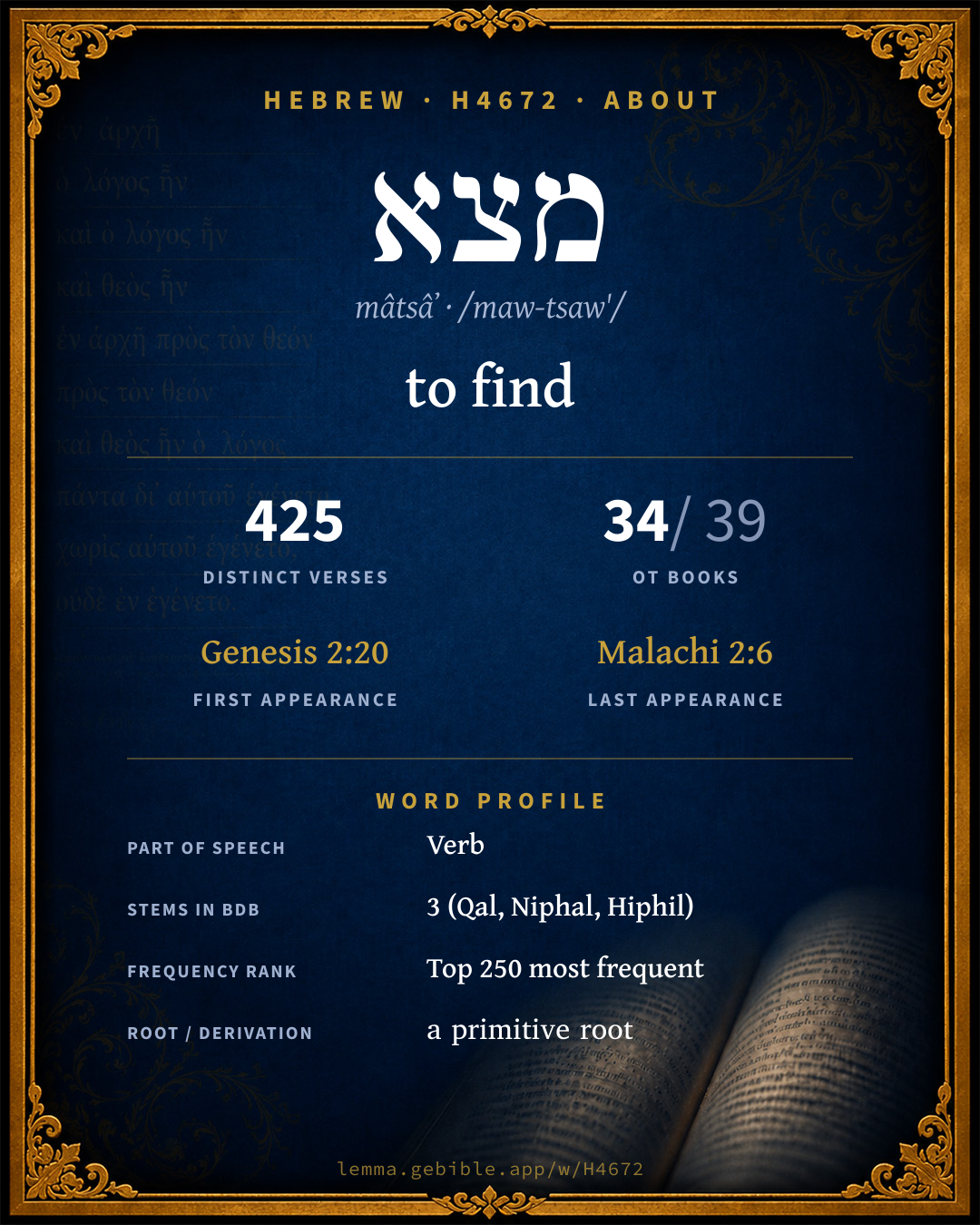
מָצָא
to find
‘to find’ is one of 27 main senses fuller range ↓
Full lexicon entry — Brown-Driver-Briggs (BDB)
From Brown-Driver-Briggs (BDB)
Where this word appears
See every Niphal verb in the Hebrew Bible →
Grammar key — what these labels mean
Part of speech
- Verb
- An action or state-of-being word.
Stem
- Qal
- The basic, simple active stem — the plain form of the verb (“he wrote”). Here: ‘find’
- Niphal
- Usually the simple passive or reflexive of the Qal (“he was written”). Here: ‘be found’
- Hiphil
- The causative active stem (“he caused / brought about”). Here: ‘i s. sf.’
Form
- Perfect
- A completed action or state — Hebrew marks aspect (completeness) more than strict tense (“he wrote”).
- Imperfect
- An incomplete, ongoing, or future action (“he will / would write”).
- Participle Active
- A verbal adjective expressing ongoing or characteristic action (“writing / one who writes”).
- Sequential Imperfect
- An imperfect with prefixed waw — the standard past-narrative form (waw-consecutive imperfect).
- Infinitive Construct
- A bound verbal noun, frequently with prepositions (“to write / in writing”).
- Sequential Perfect
- A perfect with prefixed waw continuing a preceding imperfect or command (waw-consecutive perfect).
- Imperative
- A direct command (“write!”).
- Participle Passive
- A verbal adjective expressing action received (“written”).
- Infinitive Absolute
- An unbound verbal noun, often intensifying or standing in for a finite verb.
- Cohortative
- A first-person volitional form expressing wish or resolve (“let me / let us write”).
- Jussive
- A third- or second-person volitional form expressing wish or command (“let him write”).
State
- Absolute
- The independent form of a noun, not bound to a following word.
- Construct
- A noun bound to a following noun in a possessive / “of” relationship (the construct chain).
Person
- 1st Person
- The speaker (“I / we”).
- 3rd Person
- The one spoken about (“he / she / it / they”).
- 2nd Person
- The one addressed (“you”).
Gender
- Common
- Either gender — not distinguished for this form.
- Masculine
- Grammatically masculine.
- Feminine
- Grammatically feminine.
Number
- Singular
- One.
- Plural
- More than one (in Hebrew, generally three or more).
Every verse where H4672 appears in the Book of Ezekiel — 4 distinct verses. Click any verse to open its interlinear word-by-word view. Verse text shown in the World English Bible for context — . Each verse’s Hebrew form is shown with its reference; the English is not keyword-highlighted, since the data carries no word-level English alignment. Use “Compare translations” on any verse to read it across multiple English versions. This concordance covers the Hebrew Bible; Septuagint (Greek Old Testament) occurrences are not indexed here.
Ezekiel
- Ezekiel 3:1 תִּמְצָ֖א Qal impf 2ms He said to me, Son of man, eat that which you find; eat this scroll, and go, speak to the house of Israel.
- Ezekiel 22:30 מָצָֽאתִי Qal pf 1cs I sought for a man among them, who should build up the wall, and stand in the gap before me for the land, that I should not destroy it; but I found none.
- Ezekiel 26:21 תִמָּצְאִ֥י Niphal impf 2fs I will make you a terror, and you shall no more have any being; though you are sought for, yet shall you never be found again, says the Lord Yahweh.
- Ezekiel 28:15 נִמְצָ֥א Niphal pf 3ms You were perfect in your ways from the day that you were created, until unrighteousness was found in you.
About this entry
At a glance — auto-summarized from this page’s data, not written by a person. Every figure links to its source below. This summary describes the numbers; it doesn’t interpret them.
מצא — transliterated mâtsâʼ — is a Hebrew verb carrying the sense “to find.” It first appears in Genesis 2:20. With 425 verses in 34 books, it is a common word in the Hebrew Bible. Read the stem: it spans 3 stems, including Qal and Niphal. From the same root come מטא and מצביה. See the sense tree, 425-verse concordance, and the renderings breakdown below.
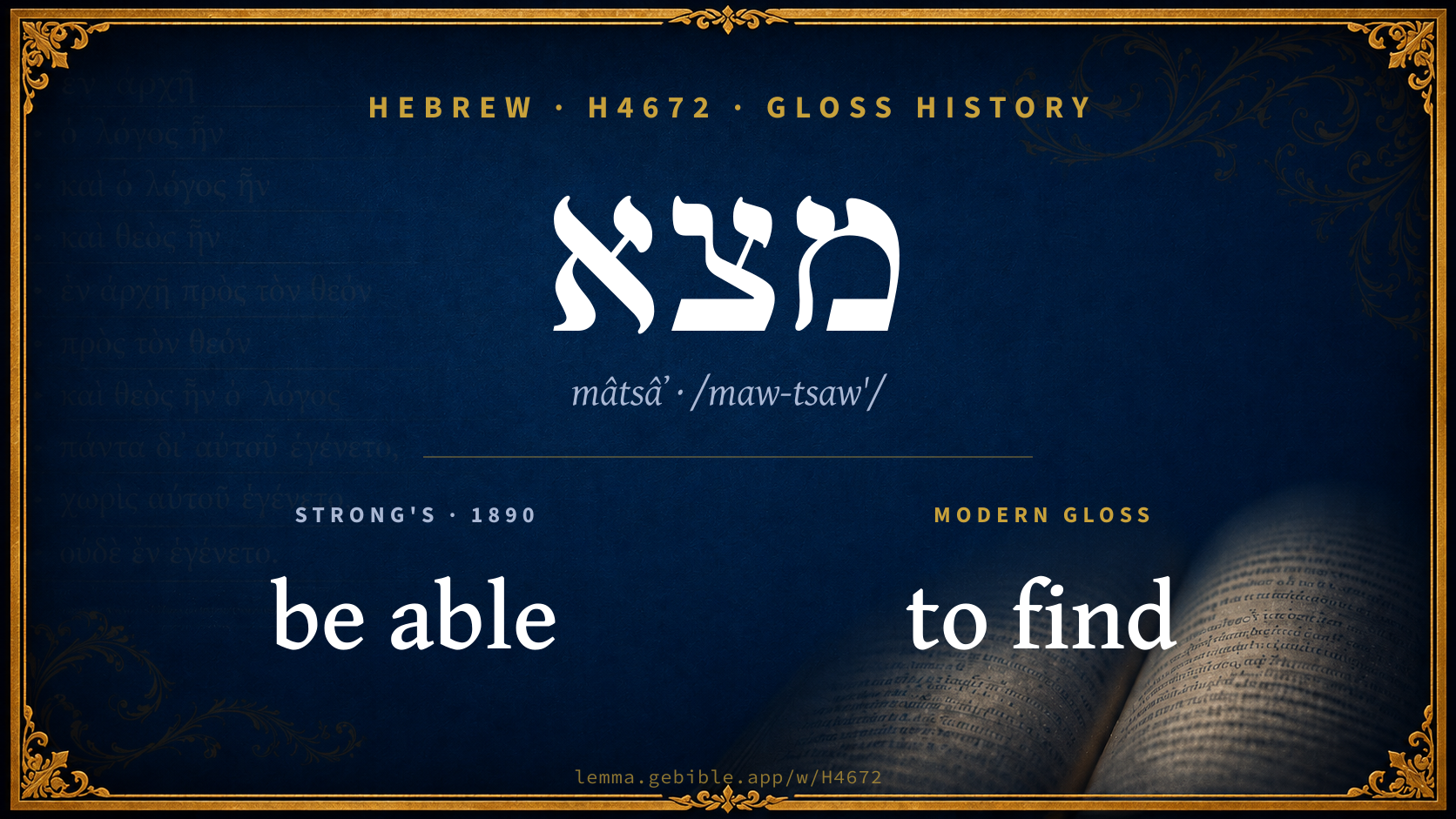
Gloss history
Strong's 1890 vs modern scholarship
About this word
Strong's H4672 catalogs a Hebrew word from the Hebrew Old Testament.
These counts are not copied from any lexicon or concordance. They are computed here, from the morphology-tagged Hebrew Old Testament. What Lemma adds →
- 425
- distinct verses
- The word appears in 425 distinct verses.
- 34 / 39
- OT books
- The word appears in 34 of 39 Old Testament books.
- #109
- by frequency
- Top 250 most frequent Hebrew words (rank 109 of 8,640 Hebrew words by occurrence).
View all 425 occurrences in the concordance →
Most concentrated in
- Genesis 54 verses 13%
- 1 Samuel 34 verses 8%
- 2 Chronicles 28 verses 7%
By section of the Old Testament
By traditional corpus
Conventional, traditional groupings — biblical authorship is debated, so this is a traditional corpus grouping, not an authorship claim. Each share is this word’s portion of its verses in that division of the Hebrew canon. Each figure is a share of the word’s 425 distinct verses.
- Prophets (Nevi'im) 160 verses · 38%
- Writings (Ketuvim) 151 verses · 36%
- Torah (Pentateuch) 114 verses · 27%
How translations render this word
Counts come from each version’s own published word-to-Strong’s tagging or interlinear alignment — an approximate guide to how each version renders this word, not a word-level alignment the data otherwise carries. Because each total is that version’s own tagged count, the per-version totals vary from one another and need not match the appearance or distinct-verse counts above. These counts may also differ from a printed concordance because Lemma counts each distinctly tagged rendering and does not collapse phrase taggings into a single head-word total. This is a fixed set of word-tagged versions (KJV, ASV, BSB, ULT) and does not change with the reading translation you choose elsewhere. Each version’s license is shown beside its name below (and on Sources).
- King James Version: Found 50×, Find 19×, They found 19×
- American Standard Version: Found 45×, Find 17×, They found 15×
- Berean Standard Bible: Found 34×, Find 26×, I have found 23×
- unfoldingWord Literal Text: Found 48×, Find 45×, I have found 26×
King James Version Public Domain
Renders H4672 across 455 tagged occurrences — most commonly:
Plus other, less common renderings. Plus 152 renderings that appear only once — usually multi-word phrases or single function words the recovered tagging swept in, not distinct renderings. Not rendered by a distinct English word in 1 further occurrence.
American Standard Version Public Domain
Renders H4672 across 454 tagged occurrences — most commonly:
Plus other, less common renderings. Plus 169 renderings that appear only once — usually multi-word phrases or single function words the recovered tagging swept in, not distinct renderings.
Berean Standard Bible Public Domain
Renders H4672 across 436 tagged occurrences — most commonly:
Plus other, less common renderings. Plus 141 renderings that appear only once — usually multi-word phrases or single function words the recovered tagging swept in, not distinct renderings. Not rendered by a distinct English word in 19 further occurrences.
unfoldingWord Literal Text CC BY-SA 4.0
Renders H4672 across 560 tagged occurrences — most commonly:
Plus other, less common renderings. Plus 102 renderings that appear only once — usually multi-word phrases or single function words the recovered tagging swept in, not distinct renderings.
42 senses and sub-senses in the full BDB
Hebrew verbs can shift meaning by stem (binyan): Qal is the basic action, Niphal is often passive or reflexive, Piel often intensifies or makes it factitive, and Hiphil is typically causative. The senses below are grouped under the stem BDB assigns to each.
What do BDB’s symbols mean?
BDB uses these scholarly abbreviations:
| Symbol | Meaning |
|---|---|
| 𝔊 | the Septuagint (the ancient Greek translation, LXX) |
| 𝔙 | the Vulgate (the Latin translation) |
| 𝔖 | the Syriac version (the Peshitta) |
| 𝔗 | the Targum (the Aramaic translation) |
| ψ | the Psalms |
| √ | root (the underlying root or stem) |
| ‖ | parallel passage (a synonymous or contrasted parallel) |
| † | the dagger: every passage where the word occurs is cited |
The 42 senses and sub-senses the full Brown-Driver-Briggs lexicon distinguishes for this word, in lexicon order (not ranked by frequency), with BDB’s own verbatim wording and sub-sense lettering. Shown in Hebrew script with BDB’s own scholarly abbreviations. The condensed entry is in the Lexicon Entry tab. See also the Forms in the corpus table below.
Qal
- Pf. מ׳ Gn 2:20 +, sf. מְצָאוֹ Jb 31:29, 3 fs. מָֽצְאָה Gn 8:9 +, sf. מְצָאַתְנוּ Ju 6:13 Ne 9:32, מְצָאָ֫תַם Ex 18:18; 2 ms. מָצָאתָ Gn 31:37 +; i s. מָצָאתִי Gn 18:3 +, מָצָתִי Nu 11:11, sf. מְצָאתִיו Ct 3:1, 2, מְצָאתִיהוּ Ct 5:6; 3 pl. מָֽצְאוּ Ju 21:14 +; sf. מְצָאנֻהוּ Jb 37:23, etc.; Impf. יִמְצָא 1 S 24:20 +, 3 fs. תִּמְצָא 1 S 1:18 +; 3 mpl. יִמְצְאוּ Ju 5:30 +, sf. יִמְצָאֻהוּ Jb 20:8, יִמְצָאֻנְנִי Pr 1:28; 8:17, יִמְצָאוּנְהָ Je 2:24; 3 fpl. תִּמְצֶאןָ Dt 31:21 etc.; Imv. מְצָא 1 S 20:21, 36, וּמְצָא־ Pr 3:4; mpl. מִצְאוּ Je 6:16; fpl. וּמְצֶאןָ Ru 1:9; Inf. מְצֹא, מְצוֹא ψ 32:6 Gn 19:11 +, sf. בְּמֹצַאֲכֶם Gn 32:20 [= מָצְאֲכֶם Ges§ 74, 3, R. 2]; Pt. מוֹצֵא ψ 119:162, מוֹצֶה Ec 7:26, sf. מֹצְאִי Gn 4:14 Pr 8:35; fs. abs. מֹצֵאת 2 S 18:22, מוֹצֵאת Ct 8:10; mpl. מֹצְאִים Nu 15:33, cstr. מֹצְאֵי Pr 8:9; fpl. abs. מֹצְאוֹת Jos 2:23, etc.;— e.g. Genesis 2:20
- 1. find:
- a. thing sought, c. acc. rei, straw Ex 5:11 (J), water Gn 26:32 (J), cf. v 19, Ex 15:22 (J), grass 1 K 18:5, help, consort, Gn 2:20 (J), cf. Pr 18:22 +; with idea of attaining to, arrivig at, a resting-place Gn 8:9 (J) Is 34:14 cf. צִפּוֹר מָֽצְאָה בַּיִת ψ 84:4, Je 45:3 La 1:3; of marriage Ru 1:9; of finding place for temple ψ 132:5; fig. וּמִצְאוּ מַרְגּוֹעַ לְנַפְשְׁכֶם JE 6:16 and find quiet for yourselves; find grave Jb 3:22; reach cities 2 S 20:6 (where read יִמְצָא Vrss Th Dr Kit Bu), cf. ψ 107:4; find=secure prey, booty, plunder Gn 27:20 (J), Ju 5:30; 21:12 1 S 14:30 cf. 2 Ch 20:25 Pr 1:13 ψ 119:162; of securing gain Ho 12:9 (+ לִי; ‖ עשׁר), Jb 31:25; so perhaps also abs. אֵין בְּשׂוֹרָה מֹצֵאת 2 S 18:22 there is no news securing gain i.e. such as to bring you a reward (cf. Th Dr; but text dub.); secure as crop Gn 26:12 (J), cf. Ec 11:1;=acquire, get wounds and dishonour Pr 6:33; מ׳ הֵן בְּעֵינֵי פ׳ find (=gain, secure) favour in the eyes of any one: of י׳, †Gn 6:8 Ex 33:12, 13(×2), 16, 17; 34:9 (all J), Nu 11:11, 15 (JE), Ju 6:17 2 S 15:25†; oftener of men Gn 18:3; 19:19; 30:27; 32:6 + 8 times Gn (all J), Nu 32:5 (JE), Dt 24:1 1 S 1:18 + 7 times S, 1 K 11:19 Ru 2:2, 10, 13 Est 5:8; 7:3; מ׳ חֵן לִפְנֵי פ׳ †Est 8:5; אָז הָיִיתִי בְעֵינָיו כְּמוֹצֵאת שָׁלוֹם †Ct 8:10; abs. מָצָא הֵן †Je 31:2 Pr 3:4; 28:23 †:=seek and find 1 S 20:21 (arrows), so v 36; fig. of grounds of accusation Jb 33:10 he succeeds in finding; so also Is 58:3, 13; find knowledge of God Pr 2:5 cf. 8:9, word of י׳ Am 8:12, words of wisdom Pr 4:22, wisdom Jb 32:13 Pr 24:14 (v. also infr.); ransom Jb 33:24; life Pr 8:35 (Qr מָצָא; > Kt מצאי, i.e. מֹצְאֵי De Str Wild), 21:21; c. acc. pers. Gn 18:26, 28, 30 (J), 41:38 (E), 1 S 9:13(×2) 1 K 1:3; 13:14 cf. v 28, +; of pursuit Jos 2:22 (J); find י׳ †Ho 5:6 Dt 4:29 Je 29:13 Jb 23:3 ψ 32:6 + Ho 6:3 (read כְּשַׁחֲרֵנוּ כֵן נִמְצָאֵהוּ, for MT כְּשַׁחַר נָכוֹן מֹצָאוֹ GieBeitr. z. Jes Krit. 208 We Now); so poss. also (obj. om.) Je 10:18 (so Gf; 𝔙 Or read Niph.; Gie יֶאְשָׁ֑מוּ), (Jb 37:23; 11:7(×2) v. infr.); find wisdom (personif.) Pr 1:28; 8:17, 35 cf. 3:13. e.g. Exodus 5:11
- b. what is lost, missed, c. acc. rei, Gn 31:32, 33, 34, 35, 37 (E), 1 S 9:4(×2) Dt 22:3 Lv 5:22, 23 (P), Gn 36:24 (P) +; וַיִּלְאוּ לִמְצֹא הַפָּ֑תַח Gn 19:11 and they grew weary in finding the door; find a word (to say) Ne 5:8 Ec 12:10, answer Jb 32:3, vision from י׳ La 2:9; c. acc. pers. Gn 38:20, 22, 23 (J), 2 S 17:20 1 K 18:10, 12; 21:20(×2) 2 K 2:17 Ez 22:30 Pr 7:15 Ct 3:1, 2, 4; 5:6 +. e.g. Genesis 31:32
- c. meet, encounter, c. acc. pers. (one expected), Gn 32:20 (E), 2 K 9:21 Je 41:12 2 Ch 20:16; cf. also Nu 35:27 (P). e.g. Genesis 32:20
- d. find a condition, find one in a situation; וְלֹא מ׳ לָהּ בְּתוּלִים Dt 22:14 cf. v 17 24:1; וַיִּמ׳ אֶת־מֶלֶךְ … נִלְחָם 2 K 19:8 and he found the king of Assyria warring against Lachish=Is 37:8; וּמ׳ אֶת־לְבָבוֹ נֶאֱמָן Ne 9:8; מ׳ כָּתוּב בספר Ne 7:5; 8:14; especially late, 1 Ch 20:2 2 Ch 25:5 Dn 1:20 Ec 7:26. e.g. Deuteronomy 22:14
- e. =learn, devise Ec 7:27(×2), 29. e.g. Ecclesiastes 7:27
- f. =experience sorrow ψ 116:3, cf. Ec 7:14. e.g. Psalms 116:3
- 2. find out:
- a. find out thoroughly, explore: obj. God Jb 11:7(×2); 37:23; God’s works Ec 3:11; 8:17(×3), cf. 7:24. e.g. Job 11:7
- b. =detect sin, crime, usually in (ב) one, 2 K 17:4 1 S 29:3, 6, 8 Ho 12:9; לֹא מ׳ בְּיָדִי מְאוּמָה 1 S 12:5; detect evil in God Je 2:5; subj. God Je 2:34; 23:11; מ׳ עֲוֹן עֲבָדֶיךָ Gn 44:16 (J), cf. ψ 36:3; abs. ψ 10:15; 17:3†. e.g. 2 Kings 17:4
- c. =guess, solve riddle Ju 14:12, 18 cf. Pr 8:12. e.g. Judges 14:12
- 3. = come upon, light upon:
- a. often unexpectedly=happen upon, c. acc. rei, money Gn 4:8 (J), book 2 K 22:8; 23:24=2 Ch 34:14, 15, cf. Ne 7:5; honey Pr 25:16, ship Jon 1:3; a plain Gn 11:2 (J), jawbone Ju 15:15; ark of י׳ ψ 132:6 (according to some, but dub.; Bae proposes הוֹצֵאנוּהָ); indef. Ez 3:1 (del. 𝔊 Co); c. acc. pers.=meet, fall in with Gn 4:14, 15 cf. Je 50:7 Gn 37:15, 17 (all J), 1 S 9:11; 30:11 Dt 22:23, 25, 27, 28 1 K 13:24; 20:36 2 K 4:29; 10:13, 15 Ct 3:3; 5:7, 8; 8:1; come upon=discover, Nu 15:22, 33; of י׳ meeting (finding) Isr. in desert Ho 9:10 cf. 12:5 Dt 32:10; angel finding Hagar Gn 16:7 (J); י׳ finding David ψ 89:21. e.g. Genesis 4:8
- b. hit, c. acc. pers. subj. bowmen 1 S 31:3=1 Ch 10:3; subj. axe Dt 19:5. e.g. 1 Samuel 31:3
- c. subj. hand Is 10:14 (fig., in metaph., of reaching nests), cf. v 10, 1 S 23:17 (of Saul’s taking David), ψ 21:9 (sq. לְ), v 9 (c. acc.); כֹּל אֲשֶׁר תִּמְצָא יָֽדְךָ לַעֲשׂוֹת Ec 9:10; sin (i.e. its punishment) will light upon you Nu 32:23. e.g. Isaiah 10:14
- d. †subj. fire, כִּי תֵצֵא אֵשׁ וּמָצְאָה קֹצִים Ex 22:5 (E). e.g. Exodus 22:5
- e. befal, c. acc. pers. Jos 2:23 (JE); of evil Gn 44:34 (J), Dt 4:30; 31:17(×2), 21 Ju 6:13 2 K 7:9 Jb 31:29 ψ 116:3; 119:143 Est 8:6; subj. תְּלָאָה Ex 18:8 (E), Nu 20:14 (JE), Ne 9:32†. e.g. Joshua 2:23
- 4. noteworthy phrases are: כַּאֲשֶׁר תִּמ׳ יָדֶ֑ךָ Ju 9:33 according to what thy hand findeth, i.e. as the occasion may demand, so 1 S 10:7 (c. acc.; cf. Ec 9:10 3 c); but 25:8=what thou chancest to have, cf. אֲשֶׁר מ׳ כְלִי זָהָב Nu 31:50 (P); וְלֹא יִמְצָאֻהוּ Jb 20:8=and he shall not be, shall no longer exist, cf. Is 41:12; Ec 9:15 they found in it=there happened to be in it; מ׳ אֶת־לִבּוֹ לְהִתְפַּלֵּל 2 S 7:27 he found the heart (took courage) to pray=1 Ch 17:25 (om. לבו את־; cf. מָצָא לְ׳ + inf., Ecclus 12:11); לֹא מָֽצְאוּ יְדֵיהֶם ψ 76:6 they did not find their hands, were not able to use them, were paralyzed; חַיַּת יָרֵךְ מָצָאתְ Is 57:10=(perhaps) experience renewal of thy strength (cf. i. חַיָּה p. 312 supr. CheComm.; for other interpr. of ח׳, ידך, v. Ew Di Du CheHpt.); וּמָצָא כְּדֵי גְאֻלָּתוֹ Lv 25:26=and he find (that he has) enough for its redemption (cf. דַּי), so מָֽצְאָה יָדוֹ דֵּי הָשִׁיב v 28, תִּמ׳ יָדָהּ דֵּי שֶׂה 12:8 (cf. תַּגִּיעַ 5:7); without דַּי, וְלֹא מָֽצְאוּ לָהֶם כֵּן Ju 21:14=(prob.) and they (the Israelites) did not find enough for them, even so (cf. GFM); also וּמָצָא לָהֶם Nu 11:22(×2) (JE) and so one find (=there be found) enough for them (cf. Niph. Jos 17:16 Zc 10:10). e.g. Judges 9:33
Niphal
- Pf. נִמְצָא 1 S 13:22 +; 3 fs. נמצאה Je 48:27 Kt Gf; נִמְצָא Qr Gie; 2 fs. נִמְצֵאת Je 50:24; i s. נִמְצֵאתִי Is 65:1, וְנִמְצֵאתִי consec. Je 29:14; 3 pl. נִמְצְאוּ Dt 22:20 +, הַנִּמְצְאוּ 1 Ch 29:17 (הַ·=rel., cf DaSynt. § 22 R. 4 KöSynt. § 52); Impf. יִמָּצֵא Gn 44:9 +; 3 fs. תִּמָּצֵא Ex 22:3 +; 2 fs. תִּמָּֽצְאִי Ez 26:21; 3 mpl. יִמָּֽצְאוּן Gn 18:29, 30, 31, 32, וַיִּמָּֽצְאוּ 1 Ch 24:4 2 Ch 4:16; 3 fpl. תִּמָּצֶ֑אינָה Je 50:20; Inf. הִמָּצֵא Ex 22:3 (=Inf. abs. cf. BaNB 74), sf. הִמָּֽצְאוֹ Is 55:6; Pt. נִמְצָא Ju 20:48 +, fs. נִמְצָאָ֑ה 2 K 19:4=Is 37:4; pl. נִמְצְאִים 1 S 13:15 + 11 times; נִמְצָאִים only Ezr 8:25; sf. 2 fs. נִמְצָאַיִךְ Is 22:3; נִמְצָאוֹת Gn 19:15 Ju 20:48;—pass. of Qal, be found: e.g. 1 Samuel 13:22
- 1.
- a. of a thing lost (asses) 1 S 9:20; 10:2, 16; stolen Gn 44:9, 10, 12, 16, 17 (J), Ex 21:16 (all c. בְּיַד); sought, wisdom Jb 28:12, 13 Pr 10:13. e.g. 1 Samuel 9:20
- b. of thing found unexpectedly, book 2 K 22:13; 23:2=2 Ch 34:21, 30; of corpse Dt 21:1. e.g. 2 Kings 22:13
- c. =be lighted upon, encountered; of breaches in temple 2 K 12:6; of cities Ju 20:48 b; of persons in captured city 2 K 25:19(×2)=Je 52:25(×2), Dt 20:11, cf. Ex 9:19 (J), Ju 20:48a Is 13:15; 22:3 Je 41:8; be discovered, of a condition, situation Dt 22:20 (בתולים); נִמְצָא־בוֹ דָּבָר טוֹב 1 K 14:13, cf. 2 Ch 19:3. e.g. 2 Kings 12:6
- d. be found written (בתוב), Ne 13:1 Est 6:2; of persons Dn 12:1. e.g. Nehemiah 13:1
- e. =appeared, were recognised, of words of י׳ Je 15:16. e.g. Jeremiah 15:16
- f. of persons sought Gn 18:29, 30, 31, 32 (J), Jos 10:17 (JE), 1 S 10:21 2 S 7:12 1 Ch 26:31; in geneal. register Ezr 2:62=Ne 7:64; of י׳, specif., let himself be found of (by) any one: sq. לְ pers. Is 65:1 Je 29:14 1 Ch 28:9 2 Ch 15:2, 4, 15, abs. Is 55:6. e.g. Genesis 18:29
- g. =be discovered, detected: (1) of iniquity, crime: Ex 22:3(×2) (E), 1 S 25:28 1 K 1:52 Je 2:34 Ez 28:15 Jb 19:28 Mal 2:6, cf. Mi 1:13, 2 Ch 36:8 Est 2:23. (2) of wrong-doers Ex 22:1, 6, 7 (E), Dt 22:22, 28; 24:7 Je 2:26; 48:27; 50:24 (‖ נִלְכַּדְתְּ, נִתְפַּשְׂתְּ), Pr 6:31 Ezr 10:18. e.g. Exodus 22:3
- h. =be gained, secured, as a crop, of fruit, fig. מִמֶּנִּי פֶּרְיְךָ נִמְצָא Ho 14:9 (cf. Qal Gn 26:12 Ec 11:1). e.g. Hosea 14:9
- i. =be discoverable to be found Jb 42:15 Dn 1:19 (cf. Is 55:6 supr. 1 f). e.g. Job 42:15
- 2. be found=be:
- a. c. בְּיַד be found in one’s hand=one happens to have 1 S 9:8; 13:22a cf. (without ביד) 13:22b; 21:4. e.g. 1 Samuel 9:8
- b. c. לְ pers.,=be in the possession of: Dt 21:17, c. אֶת־ (prep.) pers. Ex 35:23, 24 1 Ch 29:8. e.g. Deuteronomy 21:17
- c. be found in (ב) a place, especially of wealth, treasure, Gn 47:14 (J), 2 K 12:11, 19; 14:14; 16:8; 18:15; 20:13=Is 39:2, 2 K 22:9 2 Ch 21:17; 25:24; 34:17; cf. Ex 12:19 Je 41:3 1 Ch 4:41;=happen to be, be, Dt 17:2; 18:10 Je 5:26 Is 35:9; 51:3; 65:8; c. neg.=be no more Zp 3:13 Ez 26:21 ψ 37:36 (‖ אֵינֶנּוּ), Dn 11:19. e.g. Genesis 47:14
- d. =be left after war, violence, etc., 1 S 13:19 2 S 17:13 Is 30:14 2 K 19:4=Is 37:4. e.g. 1 Samuel 13:19
- e. =be present Gn 19:15 (J), 1 S 13:15, 16; 21:4; especially late, 1 Ch 29:17 2 Ch 5:11; 29:29; 30:21; 31:1; 34:32, 33; 35:7, 17, 18 Ezr 8:25 Est 1:5; 4:16. e.g. Genesis 19:15
- f. =prove to be, after numbering, 1 Ch 24:4 2 Ch 2:16; of י׳, עֶזְרָה בְצָרוֹת נִמְצָא ψ 46:2. e.g. 1 Chronicles 24:4
- 3. be (found) sufficient: לֹא יִמָּצֵא לָנוּ הָהָר Jos 17:16 (JE), cf. Zc 10:10 (also Qal Nu 11:22 Ju 21:14). e.g. Joshua 17:16
Hiphil
- Pf. i s. sf. הִמְצִיתִךָ 2 S 3:8; 3 mpl. הִמְצִיאוּ Lv 9:13; Impf. 3 ms. sf. 3 ms. יַמְצִאֶנּוּ Jb 34:11, יַמְצִאֵהוּ Jb 37:13; 3 mpl. וַיַּמְצִאוּ Lv 9:12, 18; Pt. מַמְצִיא Zc 11:6;— e.g. 2 Samuel 3:8
- 1. cause to find, attain, c. acc. pers. Jb 34:11 (subj. God). e.g. Job 34:11
- 2. cause to light upon, come upon, come c. acc. of cloud Jb 37:13 (dub.) e.g. Job 37:13
- 3. cause to encounter, deliver up to, c. acc. pers., + בְּיַד 2 S 3:8 (subj. man), Zc 11:6 (subj. God). e.g. 2 Samuel 3:8
- 4. present unto (אֶל־), of Aaron’s sons ministering unto him, c. acc. of offering, and of blood, Lv 9:12, 13, 18. e.g. Leviticus 9:12
Senses from the full Brown-Driver-Briggs lexicon (Brown, Driver, Briggs; Oxford 1906 — public domain), digitized via Sefaria, supplemented by the OpenScriptures HebrewLexicon (CC BY 4.0). Full attribution on Sources.
Word origin
vb. attain to, find (NH id.; Assyrian maṣû, DlHWB421, Ethiopic መጽአ come, arrive; Aramaic [ܡܨܳܐ find], Pt. pass. ܡܨܶܐ able, powerful, and deriv.; cf. NöZMG xl. 1886, 736 Dr 1 S 23:17);—
— Brown-Driver-Briggs (Oxford 1906, public domain), digitized via Sefaria, supplemented by the OpenScriptures HebrewLexicon (CC BY 4.0). See Sources.
Origin: a primitive root
Jastrow Dictionary
A second Hebrew/Aramaic lexicon for comparison, covering Aramaic and post-biblical (Talmudic, Targumic, Midrashic) usage that the biblical-Hebrew BDB does not. Matched by lemma rather than by Strong’s number, so a lemma may carry more than one Jastrow headword (shown separately below), and the entries cover usage well beyond the Bible.
מֹץ
- , v. מוֹץ, מוֹצָא.
מָצָא
- , v. מצי I
מצי
- to reach; to find. B. Mets. I, 1 אניּ מְצָאתִיהָ I found it. Ib. 2ᵃ הואי אמינא מאי מצאתיה ראיתיה וכ׳ I might have thought ‘I found it’ meant ‘I discovered it’, although he had not taken it up &c. Ib., a. e. וּמְצָאתָהּ דאתאי לידיה וכ׳ ‘and which thou hast found’ (Deut. XXII, 3) means that it came into his possession. Gitt. IX, 10 מ׳ בה דבר ערוה he discovered in her something disgraceful (infidelity); מ׳ אחרת וכ׳ he found another woman handsomer than she; a. fr.—מה מָצִינוּ ב־ … אף וכ׳ what do we find with regard to—? So also &c., i.e. as in the case of—, so &c. Sifra Vayikra, N’dab., ch. VIII, Par. 7 מה מצינו בהקטרה … אף מליקה וכ׳ as when burning (the sacrifice on the altar) the head is separated from the trunk, so when pinching the neck of the bird the head must be severed &c.; a. fr.—Part. pass. מָצוּי, f. מְצוּיָה; pl. מְצוּיִין; מְצוּיוֹת accessible, frequent; likely. Arakh. 30ᵇ ומצא פרט למ׳ ‘and he find the means’ (Lev. XXV, 26), this excludes the case of the means being accessible, i.e. of one who had the means at the time being. B. Mets. 27ᵃ (ref. to Deut. XXII, 3, v. supra) מי שאבודה הימנו ומ׳ אצל וכ׳ that which is lost to him but accessible to any body else; אבודה הימנו ואינה מ׳ אצל וכ׳ lost to him and inaccessible to every one else (e. g. swept away by a flood). Sabb. 151ᵇ עשה עד שאתה מוֹצֵא ומ׳ לך וכ׳ do good while thou findest (an opportunity), and it is possible to thee (thou hast the means), and thou art yet in thy own power (possessest thy faculties). Snh. 86ᵃ כי ימצא פרט למ׳ ‘if one be found stealing &c.’ (Deut. XXIV, 7), this excludes the case when the abducted and sold person was in his power (his own child &c.). Ib. כמצויין בידו דמי the case is to be judged as if they (the children) had been in his possession. Gen. R. s. 85 השטר מ׳ להגבות the note can be produced for collection, i.e. evidence can be found against us. Gitt. 2ᵇ אין עדים מ׳ לקיימו no witnesses are to be had to identify it. B. Mets. 18ᵃ במקום שהשיירות מ׳ where caravans pass frequently. Esth. R. to I, 1, v. דִּידְכֵי. Ib. (ref. to Ps. XXI, 9) תהא ידך מ׳ ליפרע מאויביך thou shalt have the opportunity of punishing thy enemies. B. Kam. 4ᵃ הזיקה מ׳ the damage through it is frequent. Ib. 60ᵃ רוח מ׳ an ordinary wind, רוח שאינה מ׳ an extraordinary wind; a. v. fr. e.g. Deuteronomy 22:3
- to be found. Gen. R. s. 85 שנִמְצְאוּ בגניבה who are caught at a theft; a. fr.—Esp. to turn out, to follow, to result. Ḥull. I, 4 נ׳ כשר וכ׳ the result is, what is legal in slaughtering is illegal in pinching. Pes. 25ᵇ ונ׳ למד, v. לָמֵד II. Sifré Deut. 210 נִמְצִּינוּ למדים from which we can consequently derive.—Y. Pes. V, beg. 31ᶜ, a. fr. נִמְצֵאתָ אומר thou turnest out saying, i.e. the result is, consequently.—אם תִּימָּצֵי (תִּמָּצֵא) לומר (abbr. את"ל) if you will say. Gitt. 82ᵇ אם תמצא לומר איתא וכ׳ if you will adopt the opinion of &c. Sabb. 136ᵃ את"ל פליגי וכ׳ if you assume that they differ &c.; a. fr.—Tosef. Ohol. IV, 12 כשתמצא לומר וכ׳ if you assume &c.
- to furnish, provide with. Gen. R. l. c. נאבדו וה׳ הקב"ה וכ׳ they (the tokens) had been lost, and the Lord provided others instead. Ḥag. 5ᵃ (ref. to תמצאן, Deut. XXXI, 21) עבד שרבו מַמְצִיא וכ׳ what remedy is there for a slave for whom his master invents evils and troubles? Ib. הממציא לו מעות לעני וכ׳ he who is ready to furnish the means (of his delivery) to the poor man in distress (by which the persecutor’s greed is increased); [Rashi: he who has money ready for the poor man in extreme distress, instead of helping him to a livelihood in due time]. Arakh. 30ᵇ (ref. to Deut. XIX, 5) ומצא פרט לממציא את עצמו ‘and it strikes’, this excludes the case of one who brings himself within the range of the missile (after it is started); Macc. 8ᵃ; a. e. e.g. Deuteronomy 31:21
מְצִי I
- , to reach, be able; to master. B. Mets. 114ᵇ בארבעה לא מָצִינָא וכ׳ I could not master four orders of the Talmud, how could I master six?—Ib. 14ᵃ, a. fr. מָצֵי אמר ליה he may say to him. B. Bath. 84ᵃ לא (הוה) מָצִית הדרת בך (v. Rabb. D. S. a. l.) thou wouldst not have had the right to retract; השתא … מצית וכ׳ now that thou hast overreached me, canst thou retract?; a. fr.
- [to find one’s self,] to succeed. Keth. 62ᵃ לא אי׳ נכרי וכ׳ the gentile did not succeed in keeping pace with him. Ned. 89ᵇ רהיט … ולא אמ׳ למיתנא he tried his utmost (v. גַּפָּא I), but had no success in his studies; a. e.
- (with נפשיה, or without) to place one’s self within sight of an enemy so as to give him a chance for reconciliation, to be ready for reconciliation. Yoma 87ᵃ הוה מַמְצִיא נפשיה (v. Rabb. D. S. a. l. note; ed. וממציא ליה).—[Keth. 60ᵇ מְמַצְּיָא, v. מְצִי II.]
מצי ²
- (b. h.) to squeeze, wring, esp. to wring out the blood of the bird sacrifice. Sifra Vayikra, N’dab., ch. VIII, Par. 7 הוא מוֹצֶה he wrings it; a. fr.
- 1. same. Zeb. VI, 5, sq.; a. fr.—2) same.
- to pour out to the last drop, to drain. Ib. 64ᵇ מי כתיב יְמַצֶּה יִמָּצֵה וכ׳ (ed. punctuate יַמְצֶה, Hif.) it does not say (Lev. V, 9), ‘he shall pour out (the remainder) at the bottom &c.’, but ‘it shall be wrung out’, which means, that it will run out to the bottom of itself. Ter. XI, 8 הִרְכִּינָהּ ומִיצָּה (Y. ed. ומִיצֵּת; Ms. M. ומִצֵּת) if he bent the vessel and drained it; B. Bath. 87ᵇ (Ms. H. a. R. ומיצת); ib. V, 8 (87ᵃ) הרכינה ומיצה (Y. ed. ומצת; Bab. ed. ומִיצֵּית, Ms. M. ומִיצֵּת; Ms. R. ומִיצְּתָהּ). Gen. R. s. 85; s. 92 (play on מצא, Gen. XLIV, 16) כזה שהוא מְמַצֶּה וכ׳ as one drains a vessel and leaves nothing but the lees. Midr. Till. to Ps. LIX (play on מצא, Prov. XVIII, 22) כשהאשה רעה היא מְמַצָּה (כל) הטובות כולן מביתו וכ׳ ed. Bub. (oth. ed. ממַצֶּאֶת, a. oth. variants) when the wife is bad, she drains all the good things out of his house and makes him poor; Yalk. Prov. 957 ממציא (read: מְמַצֵּית); a. fr. e.g. Leviticus 5:9
- 3. (cmp. מָצַע) מ׳ מידות to measure exactly. Erub. IV, 11 (52ᵇ) אין המשוחות מְמַצִּין וכ׳ the surveyors (in marking distances for Sabbath limits) do not measure exactly (but mark within the limits), in order to allow for mistakes.—Trnsf. to sound one’s learning. Men. 18ᵃ למַצֹּות מידותי to have my own learning examined; למ׳ מידותיו וכ׳ to sound the learning of &c.
- to be wrung out; to be emptied, drained Sifra Vayikra, Ḥob., Par. 10, ch. XVIII; Zeb. 64ᵇ שהשירין מִתְמַצִּים ליסוד where the remainder is poured out towards the bottom of the altar; a. fr. [Ib. VI, 4 (64ᵇ) היה מתמצה, read מְמַצֶּה, v. Rabb. D. S. a. l. note 50.]—Y. R. Hash. I, 56ᵈ top; Y. Shek. III, beg. 47ᵇ עד כאן הן מִתְמַצּוֹת לילד וכ׳ up to that time (the first of Elul) the latest births of the old year (of those conceived before the first of Nisan) take place &c.—Trnsf. (with חשבון) to be exactly counted, to be finally settled. Y. Sot. I, 17ᵃ (he suffers a loss by the death of his ox &c.) והחשבון מִתְמַצֶּה and the account (of his sins) is settled; ib.; Num. R. s. 9 אחת מתארעא וכ׳, v. אָרַע I; Koh. R. to VII, 27.
A Dictionary of the Targumim, the Talmud Babli and Yerushalmi, and the Midrashic Literature (Marcus Jastrow; London, Luzac, 1903) — Public Domain. Digitized via Sefaria. Digitized via Sefaria. Full attribution on Sources.
Forms in the corpus
The 297 distinct written forms H4672 takes in the Hebrew Bible, most frequent first — each parse links to that stem’s occurrences in the concordance. Hebrew forms include their vowel points and cantillation, so a single lemma takes many written forms.
The 60 most common forms are shown; 237 rarer forms follow in the full concordance.
Same root — word family
Other BDB entries built from the same root as H4672, grouped by Strong’s listed origin. These share a root / origin per the lexicon — not necessarily a shared meaning. Each links to that word’s own entry.
Derived from this word
Proper names from this root
People and places named from this root — a name, not an additional meaning of the word.
Compare all same-root words → 1 of the same-root words is a proper name (a person or place). They share a root, not necessarily a meaning.
Septuagint verse parallels
This word appears in 400 verses that also exist in the Greek Old Testament (Septuagint), out of the 425 Hebrew verses it occurs in. You can read those verses in Greek by switching the Old Testament edition to the Septuagint.
Read these verses in the Septuagint
- Genesis 2:20
- Exodus 5:11
- Leviticus 6:3
- Numbers 11:11
- Deuteronomy 4:29
- Joshua 2:22
- Judges 1:5
- Ruth 1:9
- 1 Samuel 1:18
- 2 Samuel 3:8
- 1 Kings 1:3
- 2 Kings 2:17
This is a verse-level parallel only — the same verses exist in both the Hebrew and Greek Old Testaments. No word-level Hebrew↔Greek correspondence is claimed: the data carries no such alignment, so no Greek word is shown as this Hebrew word’s translation. Coverage is not total — the Septuagint omits the deuterocanon and renumbers the Psalms, so some Hebrew verses have no direct Greek parallel.