
Joshua 17:16

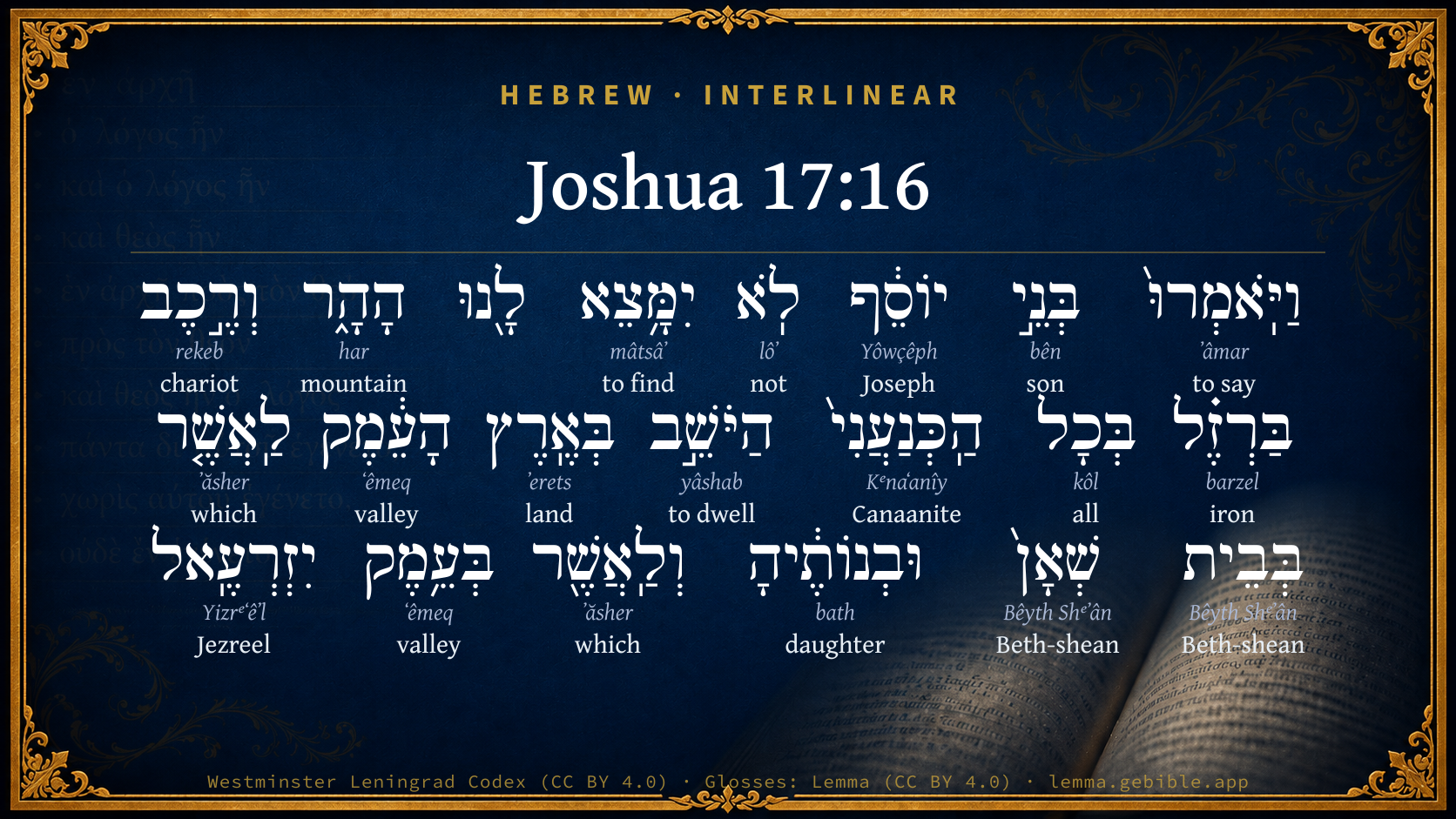
Hebrew (Westminster Leningrad Codex) Joshua 17:16 appears in the Hebrew Old Testament. The text above is from the Westminster Leningrad Codex. Each word links to its Strong’s number, a concise gloss, and parsing drawn from the Open Scriptures Hebrew Bible morphology. Click any word for its full Brown-Driver-Briggs (BDB) entry.
Download image
Cite this verse

Joshua 17:16 (World English Bible). Public Domain. Lemma interlinear Bible study tool, https://lemma.gebible.app/v/joshua/17/16.

Show BibTeX & RIS
BibTeX
RIS
English Translation
The children of Joseph said, The hill-country is not enough for us: and all the Canaanites who dwell in the land of the valley have chariots of iron, both they who are in Beth-shean and its towns, and they who are in the valley of Jezreel.
World English Bible · Public Domain
Download a study sheet

One document with this verse’s original text, its word-by-word gloss line, the meaning frame, cross-references with their text, attributed commentary, and full source and license credits — printable, and it pastes into notes with its structure intact.

This verse Autodidact and up

Study sheet (.html) Plain text (.txt)

A passage Seminary Student

Up to 50 verses in one chapter. A passage sheet keeps up to 6 commentary sources and 12 cross-references per verse, in the order this page ranks them, and says so on the sheet whenever that leaves anything out. Ask for a single verse and you get the Autodidact verse sheet above.

Everything on this page stays free to read, with no account — the sheet is a download of what is already on screen, not access to it.

Want to remove ads? Support Godless Engineer
Compare translations 3

The same verse in 3 English versions, stacked beneath the original-language interlinear above. Click any original word for its lexicon entry.

Each is an independent rendering of the whole verse — the interlinear is not word-aligned to these translations.

Highlighted words mark where these versions differ — a whole-verse word diff, not a word-by-word alignment.

  • World English Bible Public Domain
    The children of Joseph said, The hill-country is not enough for us: and all the Canaanites who dwell in the land of the valley have chariots of iron, both they who are in Beth-shean and its towns, and they who are in the valley of Jezreel.
  • King James Version Public Domain
    And the children of Joseph said, The hill is not enough for us: and all the Canaanites that dwell in the land of the valley have chariots of iron, both they who are of Bethshean and her towns, and they who are of the valley of Jezreel.
  • unfoldingWord Literal Text CC BY-SA 4.0
    But the sons of Joseph said, “The hill country is not enough for us, and a chariot of iron with every Canaanite, the dweller in the land of the valley, to who in Beth Shan and its daughters and to who in the valley of Jezreel.”

unfoldingWord Literal Text — © unfoldingWord, licensed CC BY-SA 4.0. Word-aligned USFM3 via Door43 (git.door43.org/unfoldingWord/en_ult).

Versions to compare (up to 4)

3 of 4 selected

Show all 18 translations

Every available English version of this verse, each an independent rendering of the whole verse.

  • World English Bible Public Domain
    The children of Joseph said, The hill-country is not enough for us: and all the Canaanites who dwell in the land of the valley have chariots of iron, both they who are in Beth-shean and its towns, and they who are in the valley of Jezreel.
  • Berean Standard Bible Public Domain
    “The hill country is not enough for us,” they replied, “and all the Canaanites who live in the valley have iron chariots, both in Beth-shean with its towns and in the Valley of Jezreel.”
  • Majority Standard Bible Public Domain
    “The hill country is not enough for us,” they replied, “and all the Canaanites who live in the valley have iron chariots, both in Beth-shean with its towns and in the Valley of Jezreel.”
  • King James Version Public Domain
    And the children of Joseph said, The hill is not enough for us: and all the Canaanites that dwell in the land of the valley have chariots of iron, both they who are of Bethshean and her towns, and they who are of the valley of Jezreel.
  • American Standard Version (1901) Public Domain
    And the children of Joseph said, The hill-country is not enough for us: and all the Canaanites that dwell in the land of the valley have chariots of iron, both they who are in Beth-shean and its towns, and they who are in the valley of Jezreel.
  • Revised Version (1885) Public Domain
    And the children of Joseph said, The hill country is not enough for us: and all the Canaanites that dwell in the land of the valley have chariots of iron, both they who are in Beth-shean and her towns, and they who are in the valley of Jezreel.
  • Geneva Bible (1599) Public Domain
    Then the children of Ioseph saide, The mountaine will not be ynough for vs: and all the Canaanites that dwell in the lowe countrey haue charets of yron, aswell they in Beth-shean, and in the townes of the same, as they in the valley of Izreel.
  • Douay-Rheims (1899) Public Domain
    And the children of Joseph answered him: We cannot go up to the mountains, for the Chanaanites that dwell in the low lands, wherein are situate Bethsan with its towns, and Jezrael in the midst of the valley, have chariots of iron
  • Young's Literal Translation Public Domain
    And the sons of Joseph say, `The hill is not found to us, and a chariot of iron `is' with every Canaanite who is dwelling in the land of the valley -- to him who `is' in Beth-Shean and its towns, and to him who `is' in the valley of Jezreel.'
  • Literal Standard Version CC BY-SA 4.0
    And the sons of Joseph say, “The mountain is not enough for us, and a chariot of iron [is] with every Canaanite who is dwelling in the land of the valley—to him who [is] in Beth-Shean and its towns, and to him who [is] in the Valley of Jezreel.”
  • Unlocked Literal Bible CC BY-SA 4.0
    The descendants of Joseph said, “The hill country is not enough for us. But all the Canaanites who live in the valley have chariots of iron, both those who are in Beth Shan and its villages, and those who are in the Valley of Jezreel.”
  • unfoldingWord Literal Text CC BY-SA 4.0
    But the sons of Joseph said, “The hill country is not enough for us, and a chariot of iron with every Canaanite, the dweller in the land of the valley, to who in Beth Shan and its daughters and to who in the valley of Jezreel.”
  • Darby Bible Public Domain
    And the children of Joseph said, The hill-country will not be enough for us; and all the Canaanites that dwell in the land of the valley have chariots of iron, those that are of Beth-shean and its dependent villages, and those that are in the valley of Jizreel.
  • World Messianic Bible Public Domain
    The children of Joseph said, “The hill country is not enough for us. All the Canaanites who dwell in the land of the valley have chariots of iron, both those who are in Beth Shean and its towns, and those who are in the valley of Jezreel.”
  • Webster's Bible Public Domain
    And the children of Joseph said, The hill is not enough for us: and all the Canaanites that dwell in the land of the valley have chariots of iron, both they who are of Beth-shean and its towns, and they who are of the valley of Jezreel.
  • Free Bible Version CC BY-SA 4.0
    The descendants of Joseph replied, “The hill country isn't big enough for us, but the Canaanites living in the lowlands have iron chariots, both those in Beth-shan and its villages, and those in the valley of Jezreel.”
  • Bible in Basic English Public Domain
    And the children of Joseph said, The hill-country is not enough for us: and all the Canaanites living in the valley have iron war-carriages, those in Beth-shean and its towns as well as those in the valley of Jezreel.
  • JPS Tanakh (1917) Public Domain
    And the children of Joseph said: 'The hill-country will not be enough for us; and all the Canaanites that dwell in the land of the valley have chariots of iron, both they who are in Beth-shean and its towns, and they who are in the valley of Jezreel.'

Literal Standard Version (2020), Covenant Press — licensed CC BY-SA 4.0. Text via the HelloAO Bible API (eBible.org). Unlocked Literal Bible (unfoldingWord) — licensed CC BY-SA 4.0. Text via the HelloAO Bible API (eBible.org). unfoldingWord Literal Text — © unfoldingWord, licensed CC BY-SA 4.0. Word-aligned USFM3 via Door43 (git.door43.org/unfoldingWord/en_ult). Free Bible Version, Dr. Jonathan Gallagher — licensed CC BY-SA 4.0. Text via the HelloAO Bible API (eBible.org).

Word by word

More ways to search: Search by grammar → Find every occurrence → Compare this word →

Practice this passage: Drill this verse → Learn its vocabulary →

בְּבֵית
Bêyth Shᵉʼân
H1052
“in/at · Beth-shean”
Preposition + Noun, Proper
Part of Speech
Preposition + Noun
Type
Proper
Full BDB Definition

Origin: from H1004 and H7599

TWOT: None

Beth-shean or Beth-Shan = "house of ease" - a place in Manasseh, west of the Jordan
  1. וַיֹּֽאמְרוּ֙ ʼâmar H559 “and · to say” Conjunction + Verb, Qal, Sequential Imperfect, 3rd Person, Masculine, Plural
  2. בְּנֵ֣י bên H1121 “sons of” Noun, Common, Masculine, Plural, Construct
  3. יוֹסֵ֔ף Yôwçêph H3130 “Joseph” Noun, Proper
  4. לֹֽא lôʼ H3808 “not” Particle, Negative
  5. יִמָּ֥צֵא mâtsâʼ H4672 “to find” Verb, Niphal, Imperfect, 3rd Person, Masculine, Singular
  6. הָהָ֑ר har H2022 “the · mountain” Particle, Definite Article + Noun, Common, Masculine, Singular, Absolute
  7. וְרֶ֣כֶב rekeb H7393 “and · chariot of” Conjunction + Noun, Common, Masculine, Singular, Construct
  8. בַּרְזֶ֗ל barzel H1270 “iron” Noun, Common, Masculine, Singular, Absolute
  9. בְּכָל kôl H3605 “in/at · all of” Preposition + Noun, Common, Masculine, Singular, Construct
  10. הַֽכְּנַעֲנִי֙ Kᵉnaʻanîy H3669 “the · Canaanite” Particle, Definite Article + Noun, Gentilic, Masculine, Singular, Absolute
  11. הַיֹּשֵׁ֣ב yâshab H3427 “the · dwelling” Particle, Definite Article + Verb, Qal, Participle Active, Masculine, Singular, Absolute
  12. בְּאֶֽרֶץ ʼerets H776 “in/at · land of” Preposition + Noun, Common, Both, Singular, Construct
  13. הָעֵ֔מֶק ʻêmeq H6010 “the · valley” Particle, Definite Article + Noun, Common, Masculine, Singular, Absolute
  14. לַֽאֲשֶׁ֤ר ʼăsher H834 “to/for · which” Preposition + Particle, Relative
  15. שְׁאָן֙ Bêyth Shᵉʼân H1052 “Beth-shean” Noun, Proper
  16. וּבְנוֹתֶ֔יהָ bath H1323 “and · daughters · her” Conjunction + Noun, Common, Feminine, Plural, Construct + Suffix, Personal, 3rd Person, Feminine, Singular
  17. וְלַֽאֲשֶׁ֖ר ʼăsher H834 “and · to/for · which” Conjunction + Preposition + Particle, Relative
  18. בְּעֵ֥מֶק ʻêmeq H6010 “in/at · valley of” Preposition + Noun, Common, Masculine, Singular, Construct
  19. יִזְרְעֶֽאל Yizrᵉʻêʼl H3157 “Jezreel” Noun, Proper

About this verse

These counts appear in no published source. They are computed here, from the morphology-tagged text and Lemma’s own curated glosses. What Lemma adds →

21
words
17
distinct lemmas
Historical
section

Notable vocabulary

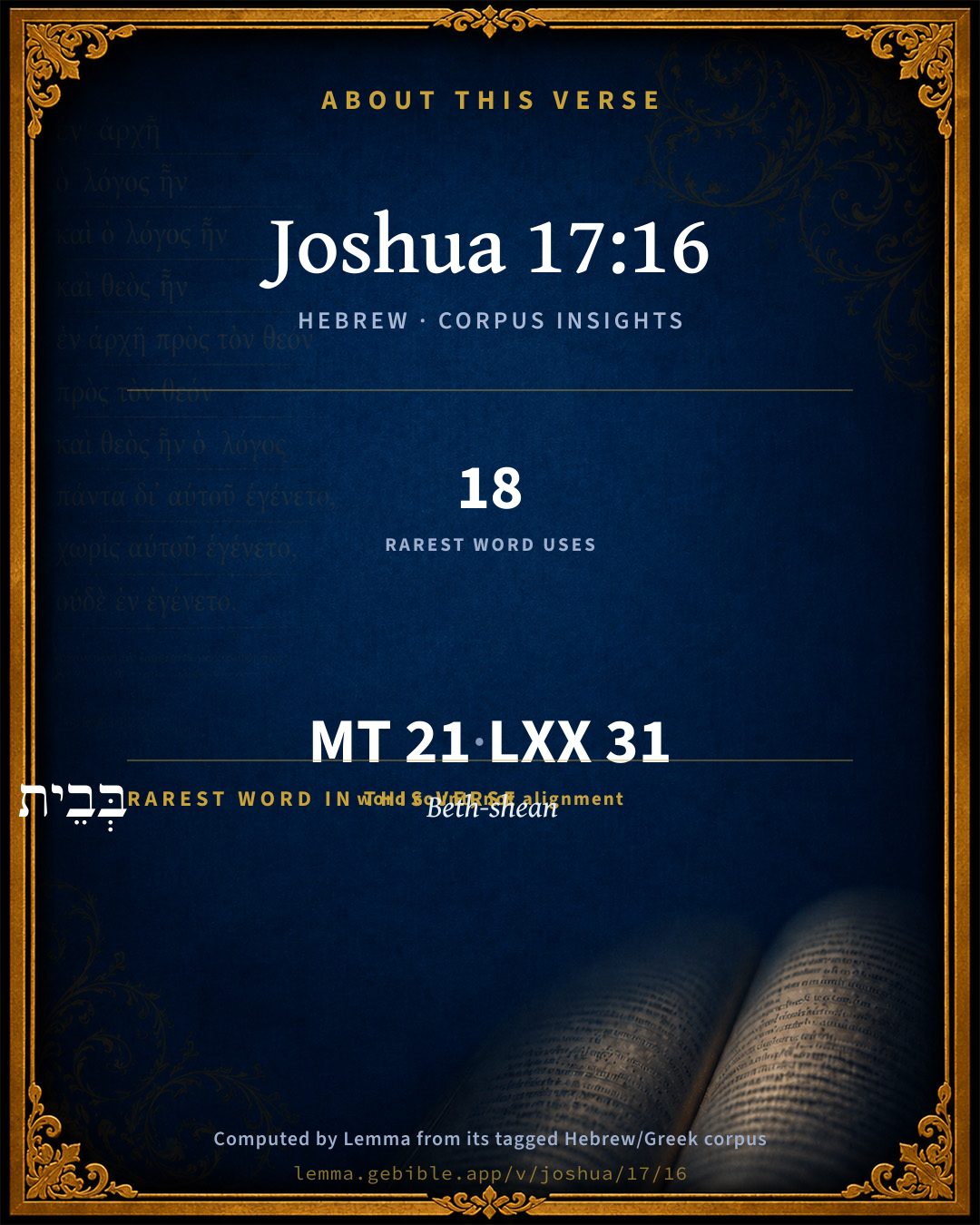
The rarest word here is בְּבֵית Beth-shean H1052 — appearing just 18 times in the whole Hebrew Bible.

Shared distinctive vocabulary

בְּבֵית Beth-shean H1052 occurs in 8 verses of the Hebrew Bible. Also found in:

Grammatical profile

  • 3 verbs
  • 14 nouns
  • 1 preposition
  • 3 particles

Verb forms

  • וַיֹּֽאמְרוּ֙ Qal · Sequential Imperfect
  • יִמָּ֥צֵא Niphal · Imperfect
  • הַיֹּשֵׁ֣ב Qal · Participle Active

Repetition

Words recur within this verse — often emphatic in Hebrew:

  • הָעֵ֔מֶק valley H6010 ×2
  • בְּבֵית Beth-shean H1052 ×2
  • לַֽאֲשֶׁ֤ר which H834 ×2

Hebrew & Septuagint length

In English translation the verse runs 46 words from the Hebrew and 34 from the Septuagint (LXX English) — closely comparable.

A rough comparison of the two English renderings, which tokenize alike — not a word-level alignment.

Word counts can differ between the Hebrew and the Greek without any difference in meaning — e.g. the Hebrew direct-object marker אֵת has no separate Greek word, and Greek often adds the article ὁ.

In the original languages it is 21 Hebrew tokens and 31 Greek tokens — but the two are counted differently (Hebrew bundles its prefixes and suffixes into one token; the Greek is in lemma form), so that isn’t a like-for-like length.

Cross-references

14

Topical passages linked to Joshua 17:16 in the Treasury of Scripture Knowledge — connected by theme and wording, ordered by reader-vote popularity; previews shown in the World English Bible.

  • Judges 1:19 Yahweh was with Judah; and drove out [the inhabitants of] the hill-country; for he could not drive out the inhabitants of the valley, because they had chariots of iron.
  • Judges 4:3 The children of Israel cried to Yahweh: for he had nine hundred chariots of iron; and twenty years he mightily oppressed the children of Israel.
  • 1 Kings 4:12 Baana the son of Ahilud, in Taanach and Megiddo, and all Beth-shean which is beside Zarethan, beneath Jezreel, from Beth-shean to Abel Meholah, as far as beyond Jokmeam;
  • Joshua 17:18 but the hill-country shall be yours; for though it is a forest, you shall cut it down, and the goings out of it shall be yours; for you shall drive out the Canaanites, though they have chariots of iron, and though they are strong.
  • Judges 6:33 Then all the Midianites and the Amalekites and the children of the east assembled themselves together; and they passed over, and encamped in the valley of Jezreel.
  • Joshua 17:11 Manasseh had in Issachar and in Asher Beth-shean and its towns, and Ibleam and its towns, and the inhabitants of Dor and its towns, and the inhabitants of En-dor and its towns, and the inhabitants of Taanach and its towns, and the inhabitants of Megiddo and its towns, even the three heights.
  • Joshua 19:18 Their border was to Jezreel, and Chesulloth, and Shunem,
  • Judges 4:13 Sisera gathered together all his chariots, even nine hundred chariots of iron, and all the people who were with him, from Harosheth of the Gentiles, to the river Kishon.
  • 1 Kings 18:46 and the hand of Yahweh was on Elijah; and he girded up his loins, and ran before Ahab to the entrance of Jezreel.
  • 1 Kings 21:1 It happened after these things, that Naboth the Jezreelite had a vineyard, which was in Jezreel, hard by the palace of Ahab king of Samaria.
  • 1 Kings 21:23 Of Jezebel also spoke Yahweh, saying, The dogs shall eat Jezebel by the rampart of Jezreel.
  • 2 Kings 9:10 The dogs shall eat Jezebel in the portion of Jezreel, and there shall be none to bury her. He opened the door, and fled.
  • 2 Kings 9:37 and the body of Jezebel shall be as dung on the face of the field in the portion of Jezreel, so that they shall not say, This is Jezebel.
  • Hosea 1:4–5 Yahweh said to him, "Call his name Jezreel; for yet a little while, and I will avenge the blood of Jezreel on the house of Jehu, and will cause the kingdom of the house of Israel to cease.

Cross-references courtesy of OpenBible.info (CC BY 4.0).

Hebrew and Greek witnesses Masoretic Hebrew ↔ Greek Septuagint

The same verse in the two great witnesses to the Old Testament, shown verse-for-verse.

These are two independent witnesses, not word-aligned to each other, and the Septuagint is shown in lemma (dictionary) form.

Hebrew Joshua 17:16 Masoretic · Westminster Leningrad Codex

וַיֹּֽאמְרוּ֙ בְּנֵ֣י יוֹסֵ֔ף לֹֽא יִמָּ֥צֵא לָ֖נוּ הָהָ֑ר וְרֶ֣כֶב בַּרְזֶ֗ל בְּכָל הַֽכְּנַעֲנִי֙ הַיֹּשֵׁ֣ב בְּאֶֽרֶץ הָעֵ֔מֶק לַֽאֲשֶׁ֤ר בְּבֵית שְׁאָן֙ וּבְנוֹתֶ֔יהָ וְלַֽאֲשֶׁ֖ר בְּעֵ֥מֶק יִזְרְעֶֽאל

The children of Joseph said, The hill-country is not enough for us: and all the Canaanites who dwell in the land of the valley have chariots of iron, both they who are in Beth-shean and its towns, and they who are in the valley of Jezreel.

World English Bible · Public Domain

Greek LXX Joshua 17:16 Septuagint · lemma form

καί εἶπον οὐ ἀρκέω ἐγώ ὁ ὄρος ὁ ἐφράιμ καί ἵππος ἐπίλεκτος καί σίδηρος ὁ χαναναῖος ὁ καταοἰκέω ἐν αὐτός ἐν βαιθσαν καί ἐν ὁ κώμη αὐτός ἐν ὁ κοιλάς ιεζραελ

And they said, The mount of Ephraim does not please us, and the Chananite dwelling in it in Baethsan, and in its villages, and in the valley of Jezrael, has choice cavalry and iron.

LXX2012 (modern English Septuagint) · Public Domain

Hebrew: Westminster Leningrad Codex (CC BY 4.0). Greek: Septuagint (public domain); English from LXX2012 (modern English Septuagint) (Public Domain). How the Septuagint differs from the Hebrew →

Targum (Aramaic paraphrase)

1

The Targum is the ancient Jewish Aramaic paraphrase of the Hebrew Scriptures — an interpretive translation, not the Hebrew text itself. Onkelos (literal) and Pseudo-Jonathan (expansive) render the Torah, and Jonathan the Prophets. Coverage is partial: where no permissively-licensed English translation exists for a verse, only the Aramaic is shown. This is verse-level text, not a word-by-word alignment to the Hebrew.

  1. Targum Jonathan Prophets (Joshua–Malachi)
    וַאֲמַרוּ בְּנֵי יוֹסֵף לָא יַסְפֵּק לָנָא טוּרָא וּרְתִיכִין דְפַרְזְלָא בְּכָל כְּנַעֲנָאֵי דְיַתְבִין בְּאֲרַע מֵישְׁרָא לְדִי בְּבֵית שְׁאָן וְכַפְרָנָהָא וּלְדִי בְּמֵישַׁר יִזְרְעֶאל:

    (no public-domain English translation for this verse)

    Targum Jonathan — Aramaic: “Mikraot Gedolot” (public domain). English: “Sefaria Community Translation” (CC0 1.0 (public-domain dedication)); “London "Chaldee Paraphrase," 1871” (public domain). Text via Sefaria.

Commentary

Notes on Joshua 17:16 from classic Christian and Jewish commentators (each source and its license shown beneath its notes). The classic Christian expositions comment on the surrounding passage and are grouped to its opening verse, so a note may address several verses; the Jewish commentaries on the Tanakh (Rashi and others) are per-verse, so they appear only where the commentator wrote on this verse.

Lemma curates 59 commentaries, every one of them public domain or Creative Commons licensed, each selected and text-cleaned for this edition rather than reprinted as found. About our sources →

Trapp's Complete Commentary

John Trapp

Jos 17:16 And the children of Joseph said, The hill is not enough for us: and all the Canaanites that dwell in the land of the valley have chariots of iron, [both they] who [are] of Bethshean and her towns, and [they] who [are] of the valley of Jezreel.

Ver. 16. And the Canaanites … have chariots of iron.] Which were first a terror, and then a scorn, as was before noted out of Vegetius. But where there wanteth a heart, there is never wanting some lion in the way, {Pro 22:13; Pro 26:13} yea, two lions for failing, one in the fields, and another in the streets: so here. The hill is not enough for us, and the Canaanites are too hard for us.

John Trapp, A Commentary or Exposition upon All the Books of the Old and New Testament (1647–1656) — public domain. Text from a community e-Sword module.

Joseph Benson's Commentary

Jos 17:16. The hill is not enough for us — That is, if we could get possession of the woody mountain, cut down all its trees, and destroy all its inhabitants, it would not be sufficient for us. But the Hebrew is, The hill will not be found; that is, obtained by us. Those fierce and strong people the Perizzites and the giants will easily defend themselves, and frustrate our attempts, having the advantage of the woods and mountains. The Canaanites that dwell, &c. — They seem to mean that there was another impediment in their way, that before they could come at the mountain to attack it, they would have to encounter those who lived in the valley below it, who were too strong for them. Or that, if Joshua should command them, in case the hill either could not be conquered, or would not be sufficient for them, to go down and take more land out of the pleasant and fruitful valleys, that they would meet with no less difficulty there than in the mountains. Have chariots of iron. — Not all made of iron, but armed with iron, and that not only for defence, but for offence also; having a kind of scythes, of two cubits long, fastened to long axle-trees on both wheels, which being driven swiftly through a body of men, made great slaughter, mowing them down like grass or corn.

Joseph Benson's Commentary on the Old and New Testaments (1811–1818) — public domain. Text from a community e-Sword module.

Tyndale Open Study Notes

Tyndale Open Resources

17:16 As a result of the Canaanites’ iron chariots, Ephraim and Manasseh were restricted to the hill country in the early part of the settlement period (see study note on 11:4). • The valley of Jezreel, a geological interruption of the hill country, separated Lower Galilee to the north from the hill country of Manasseh to the south. The Canaanites living in and near it and the valley of Beth-shan restricted Manasseh’s expansion and apparently Ephraim’s as well. Most of the towns named in 17:11 were on the edges of these valleys.

Tyndale Open Study Notes — © Tyndale Open Resources, licensed CC BY-SA 4.0. Text via the HelloAO Bible API.

Jamieson, Fausset & Brown

Robert Jamieson, A. R. Fausset & David Brown

chariots of iron--unusually strengthened with that metal, and perhaps armed with projecting scythes.

Next: Joshua Chapter 18

Jamieson, Fausset & Brown — Commentary Critical and Explanatory on the Whole Bible (1871) — public domain (CC PDM 1.0). Text via the HelloAO Bible API.

Adam Clarke's Commentary

Verse 16. The hill is not enough for us] The mountain of Gilboa being that which had fallen to them by lot.

Chariots of iron] We cannot possess the plain country, because that is occupied by the Canaanites; and we cannot conquer them, because they have chariots of iron, that is, very strong chariots, and armed with scythes, as is generally supposed.

Adam Clarke's Commentary on the Bible (1810–1826) — public domain. Text from a community e-Sword/MySword module.

John Calvin's Commentaries

16. And the children of Joseph said, etc It is too apparent that they were thinking only of themselves, because they quibble as much as they can, in order to avoid following the suggestion of Joshua, than which, however, nothing was more reasonable. They object, that the mountain is rugged and little better than a desert, and therefore, though it were added to them, they would derive very little benefit from it. In regard to the plain, which was cultivated and fertile, they object that they are shut out and debarred from it because of the formidable array of the enemy. Accordingly, they make mention of their iron chariots, as if they had not already learned by experience that the Lord was able, without any difficulty, to trample down both horses and chariots. Joshua, however, by a simple and right-hearted answer, administers due castigation, as well to their avarice as their effeminacy and torpor. If the forest, as it now stands, is not sufficiently productive, cut down the trees and convert it into good fields; provided you are not sparing of your labor, you will have no reason to be dissatisfied with your habitation. Iron chariots, moreover, cannot prevent the Lord from performing what he has promised to you. The inheritance is yours; do only your part by entering with due confidence on the possession of it.

John Calvin's Commentaries (1540-1563) — public domain. Text from the Calvin Translation Society English edition (1840s-50s) via the Christian Classics Ethereal Library (ccel.org). Calvin's coverage is partial (roughly two-thirds of the Bible); uncommented books and verses are honest gaps, never fabricated. The 19th-century editor's footnotes and remarks are omitted so the notes are faithfully Calvin's own voice.

The Cambridge Bible for Schools and Colleges

gen. ed. J. J. S. Perowne

16. have chariots of iron] The iron chariots of the Canaanites were objects of terror to the Israelites, see above, ch. Jos_11:6-9. They were the main reason why the Israelites could not establish themselves in the plain, on which Beth-shean, Taanach, and Megiddo were situated. The forest they could occupy, but the plain, where the “chariot-cavalry” of their foes were so effective though powerless in the mountains, they could not reduce. Comp. Jdg_1:19; Jdg_4:3; 1Sa_13:5. Compare as to the insecurity of the plains the remarks of Tristram: “No matter how wide, how rich, how well cultivated a plain may be, like Acre or Esdraelon, its tame monotony is never relieved by a single village. These are all hidden in the nooks of the mountains; for no fellâhin or cultivators would venture to dwell where any night they might be harried by a party of Bedouin troopers, and to this risk they gladly prefer an hour or two’s weary climb added to their daily toil: while no traveller would dream of encamping even for a night in the open plain.” Land of Israel, p. 421.

the valley] As the “hill” here denotes Mount Ephraim, so the valley country includes both (a) the valley or ghôr of the Jordan near Bethshean, and (b) the wide plain of Jezreel, between Gilboa and little Hermon, to which, in its widest extent, the name of Esdraelon has been applied in modern times; a name first used in Jdt_1:8. “It was only this plain of Jezreel, and that north of Lake Huleh, that was then accessible to the chariots of the Canaanites. It was in this plain of Jezreel that Joram king of Israel and Ahaziah king of Judah went forth in chariots to meet the enemy (2Ki_9:21). It was here that Jehu passed in a chariot to Samaria, to meet the faithful Jehonadab (2Ki_10:15). And Wilson (Lands of the Bible, ii. 303), in leaving the hilly district of Judæa, wholly unfitted for vehicles, and entering the plain of Esdraelon at Jenin, was surprised to see how entirely it differed from the country which he had previously traversed, and how easily it might be crossed by excellent highways, if the custom of the country admitted of the use of vehicles. In the days of the Jews, the plain was so associated with the use of the chariot, that this term became to a certain extent an exponent of the power of the people inhabiting the plain. The chariot was the glory of Ephraim, as the horse was of Judah (Zec_9:9-10). Carl Ritter’s Geography of Palestine, ii. 327, 328.

The Cambridge Bible for Schools and Colleges (gen. ed. J. J. S. Perowne; Cambridge University Press, 1878–1918) — public domain. Text from a community e-Sword module.

John Gill's Exposition

And the children of Joseph said, the hill is not enough for us,.... Meaning either Mount Ephraim, and all included in it; or it may be rather the wood country on the hills and mountains they were bid to go up to; signifying, that if they could gain that out of the hands of the Perizzites and giants, and clear it of the wood, and make it habitable, even that would not be sufficient for them; or that hill and mountain cannot be "found by us" (r) or obtained and possessed by us; we are not able to get it into our hands; there being a valley between us and that:

and all the Canaanites that dwell in the land of the valley have chariots of iron; not chariots made of iron, but chariots with iron scythes fastened to the sides, or axle trees of them, which when driven with great force and fury, would cut down the infantry in battle, as grass is cut down with scythes, see Jdg 4:2,

both they who are of Bethshean and her towns, and they who are of the valley of Jezreel; both which belonged to the tribe of Manasseh, or were on the borders of it, though as yet they had not got possession, see Jos 17:11; and this circumstance seems to favour the notion, that tribe of Manasseh were at least chiefly concerned in this address.

(r) "non invenietur nobis", Montanus; "non possumus montem istum assequi", Tigurine version; "non obtinebitur a nobis", Masius.

John Gill's Exposition of the Whole Bible (1746–1763) — public domain (CC PDM 1.0). Text via the HelloAO Bible API.

Albert Barnes' Notes on the Bible

The possession by the Canaanites of chariots strengthened and tipped with iron, such as were used by the Egyptians Exo 14:7, is named here by the children of Joseph as a reason why they could not possess themselves of the plains. “The valley of Jezreel” is the broad low valley which sweeps from “Zerin” between the mountains of Gilboa and the range of little Hermon eastward down to the Jordan. It was most likely in this valley that the host of the Midianites was encamped, when attacked by Gideon Jdg 7:1, Jdg 7:8. The great plain of Jezreel, called the plain of Esdraelon (Esdrelom, Judith 1:8), extends from Carmel on the west to the hills of Gilboa, little Hermon, and Tabor on the east, a distance of full sixteen miles; and its breadth between the rocky mass of southern Palestine and the bolder mountains of Galilee on the north, is about twelve miles. Its position as well as its open area make it the natural battlefield of Palestine.

Albert Barnes' Notes on the Bible (1834–1885) — public domain. Text from a community e-Sword/MySword module.

Haydock's Catholic Bible Commentary

Thee. Destroy the Pherezite, &c., (Menochius) take their cities, and destroy the inhabitants, like so many trees, or cut down the wood to build houses, and in order to cultivate the land for the production of corn and grass.

George Leo Haydock (1774–1849), Haydock's Catholic Family Bible and Commentary, 1859 edition — public domain. Excludes Psalms (Douay-Rheims chapter numbering differs from Protestant) and Deuterocanonical books (Catholic canon only).

Matthew Poole's English Annotations

The hill is not enough for us; if we should invade and conquer it, and cut down both wood and men, yet it would not be sufficient for us. Heb. The hill will not be found, i.e. obtained, by us; those fierce and strong people the Perizzites and the giants will easily defend themselves, and frustrate our attempts, having the advantage of the woods and mountains.

The Canaanites that dwell in the land of the valley, i.e. And if thou sayest, as we know thou wilt reply, that if the hill either cannot be conquered, or be not sufficient for us, we may go down and take more land out of the pleasant and fruitful valleys, we shall meet with no less difficulty there than in the mountains. Or thus, In going to the hills to which thou directest us, we must pass through valleys, where we shall be waylaid by powerful and armed enemies.

Chariots of iron; not all made of iron but armed with iron, not only for defence, but for offence also, having as it were scythes and swords fastened to them, to cut down all that stood in their way.

The valley of Jezreel; which was either in the tribe of Issachar, or upon the borders of it, Jos 19:18.

Matthew Poole's English Annotations on the Holy Bible (1683–1685) — public domain. Text from a community e-Sword/MySword module.

Whedon's Commentary on the Bible

Daniel D. Whedon

16. The hill is not enough — And yet they wanted more hill. They did not wish to go into the valleys.

Chariots of iron — Strengthened with iron, and possibly armed with scythes. The timidity and lack of trust in Jehovah evinced by these Josephites is most clearly seen when viewed in the light of the specific command and promise of God: “When thou goest out to battle against thine enemies, and seest horses and chariots and a people more than thou, be not afraid of them, for the Lord thy God is with thee.” Deu_20:1.

Beth-shean — Jos_17:11.

[The valley of Jezreel — That noble and beautiful plain, the richest and most celebrated in Palestine, called in its Greek form Esdraelon, and associated with many of the most famous events of sacred and of common history. It has the form of a triangle, whose base runs fifteen miles southwesterly from the foot of Mount Tabor, and whose southwest side sweeps along the base of Mount Carmel to the Mediterranean Sea. The sons of Joseph were afraid to cope with the inhabitants of this valley, and wanted more territory among the hills. The valley of Jezreel was, strictly speaking, the eastern branch of Esdraelon, running towards the Jordan along the Wady Jalud.]

Daniel D. Whedon (gen. ed.), Commentary on the Old and New Testaments (1874–1909) — public domain. Text from a community e-Sword module.

The Pulpit Commentary

And the children of Joseph said. This reply justifies Joshua"s sarcasm. The Ephraimites and Manassites blame Joshua when they ought to be blaming themselves. They excuse themselves from a task which they are too idle to execute, and wish Joshua to make arrangements for them which are wholly unnecessary. The hill is not enough for us. Literally, the hill is not found for us that is, is not sufficient. (see Num_11:9:2 Zec_10:10) Of the valley of Jezreel. Rather, in the valley of Jezreel. The word for valley in this verse is qm (see note on Jos_8:13). Jezreel abutted on the great plain of Esdraelon, a name which is but a corruption of Jezreel, (see note on Jos_19:18) where the chariots of iron could be used with effect, a thing impossible in the mountain districts. Hence the fact that the hill country of Palestine was more rapidly and permanently occupied than the plains. (see Ewald, "History," 22 C., and Ritter"s "Geography of Palestine," 2:328. Cf. Jud_1:19, and note on Jos_11:6) Here, once more, we have a proof that we have real history before us, and not a collection of poetic myths.

The Pulpit Commentary (1880–1919), ed. H.D.M. Spence-Jones & Joseph S. Exell — public domain. Text from a community e-Sword module.

John Wesley's Explanatory Notes

Is not enough - Hebrew. the hill will not be found, that is, obtained by us; those fierce and strong people the Perizzites and the giants will easily defend themselves, and frustrate our attempts, having the advantage of the woods and mountains. The Canaanites that dwell - That is, and if thou sayest, that if the hill either cannot be conquered, or is not sufficient for us, we may go down and take more land out of the pleasant and fruitful valleys, we shall meet with no less difficulty there than in the mountains. Chariots of iron - Not all made of iron, but armed with iron, not only for defense, but for offense also, having as it were scythes and swords fastened to them, to cut down all that stood in their way.

John Wesley, Explanatory Notes Upon the Whole Bible (1754–1765) — public domain. Text via the GEBible commentary corpus.

unfoldingWord translationNotes

Door43 World Missions Community

Beth Shan ... Jezreel

These are the names of places. (See: How to Translate Names)

the house of Joseph

Here the word "house" refers to the descendants. AT: "the descendants of Joseph" (See: Metonymy)

you will clear it

"you will clear the forest of trees" or "you will cut down its trees"

translationWords

chariot

power

cast out

unfoldingWord translationNotes — © Distant Shores Media and the Door43 World Missions Community, licensed CC BY-SA 4.0. Source: git.door43.org/Door43/en_tn.

Rashi

Rabbi Shlomo Yitzchaki (Rashi)

The mountain will not be sufficient for us. For it is too crowded for us as you [just] said.

It will not be sufficient. It will not be enough.

Iron chariots. ‘And that what you say, go up to the forest and conquer the land of the Perezzites and the Rephaim [is not so simple] because the Canaanites are a mighty people, and they possess iron chariots.’ Do not wonder if Scripture refers to the Perezzites and Rephaim as Canaanites for they were all descendants of the original Canaan.

Rashi on the Tanakh — English translations: “The Judaica Press complete Tanach with Rashi, translated by A. J. Rosenberg” (CC BY 4.0); “Pentateuch with Rashi's commentary by M. Rosenbaum and A.M. Silbermann, 1929-1934” (public domain); “The Metsudah Tanach series, Lakewood, N.J” (CC BY 4.0); and “The Book of Joshua, Metsudah Publications, 1997” (CC BY 4.0). Text via Sefaria.

Lesson kit

Teaching starters — assembled from the data on this page, not authored interpretation. Every prompt links to the verse data it draws on. Edit before teaching.

Joshua, in the Historical, opens this verse with 21 words (17 distinct Hebrew lemmas). Its most distinctive word is Bêyth Shᵉʼân (“Beth-shean”). A historical commentator’s framing appears above. Read the whole chapter for the surrounding context.

Discussion questions

  1. What does “Beth-shean” (Bêyth Shᵉʼân) contribute to the verse as a whole?
  2. How does Joshua 17:11, which shares the word «Beth-shean», read alongside this verse?
  3. What does the repetition of “valley” (2× in this one verse) do in this verse?
  4. These translations render this verse differently. What is at stake in choosing one wording over another?
  5. «וַיֹּֽאמְרוּ֙» is a Qal Sequential Imperfect verb. How does that grammatical form shape the action described?
  6. Compare how Trapp's Complete Commentary and Joseph Benson's Commentary read this verse. Where do they agree or differ?

Things to notice

Reading settings

Reading text

Shown beneath each verse's original-language words.

Old Testament
Old Testament edition

Read the OT as the Masoretic Hebrew (MT) or the Greek Septuagint (LXX).

English shown for the Greek Septuagint (in the Hebrew ↔ Greek comparison).

Comparing translations? Open the Compare panel on any verse page to stack up to four side by side.