Job 42:15

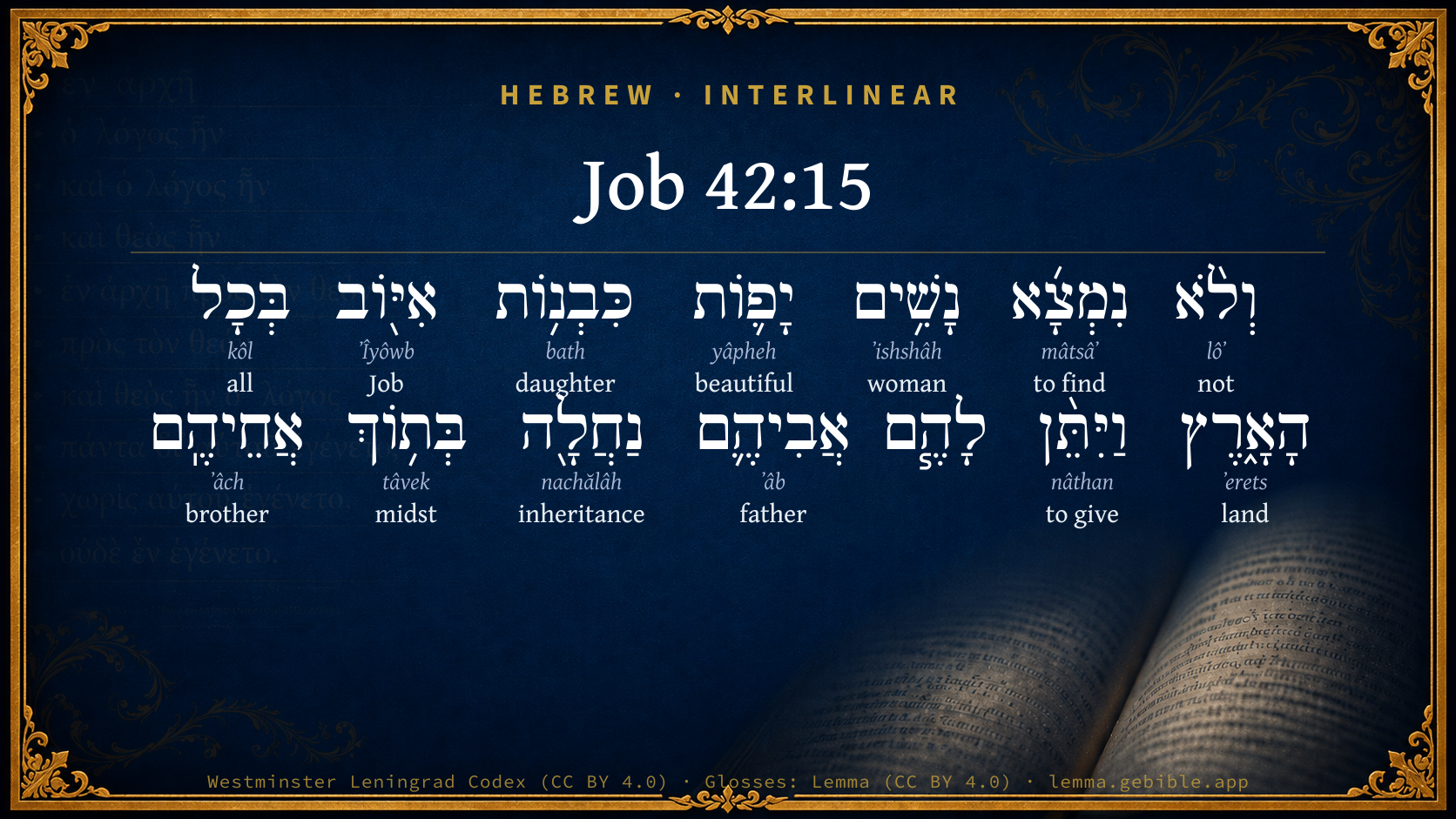
Hebrew (Westminster Leningrad Codex) Job 42:15 appears in the Hebrew Old Testament. The text above is from the Westminster Leningrad Codex. Each word links to its Strong’s number, a concise gloss, and parsing drawn from the Open Scriptures Hebrew Bible morphology. Click any word for its full Brown-Driver-Briggs (BDB) entry.
Download image
Cite this verse

Job 42:15 (World English Bible). Public Domain. Lemma interlinear Bible study tool, https://lemma.gebible.app/v/job/42/15.

Show BibTeX & RIS
BibTeX
RIS
English Translation
In all the land were no women found so beautiful as the daughters of Job. Their father gave them an inheritance among their brothers.
World English Bible · Public Domain
Download a study sheet

One document with this verse’s original text, its word-by-word gloss line, the meaning frame, cross-references with their text, attributed commentary, and full source and license credits — printable, and it pastes into notes with its structure intact.

This verse Autodidact and up

Study sheet (.html) Plain text (.txt)

A passage Seminary Student

Up to 50 verses in one chapter. A passage sheet keeps up to 6 commentary sources and 12 cross-references per verse, in the order this page ranks them, and says so on the sheet whenever that leaves anything out. Ask for a single verse and you get the Autodidact verse sheet above.

Everything on this page stays free to read, with no account — the sheet is a download of what is already on screen, not access to it.

Want to remove ads? Support Godless Engineer
Compare translations 3

The same verse in 3 English versions, stacked beneath the original-language interlinear above. Click any original word for its lexicon entry.

Each is an independent rendering of the whole verse — the interlinear is not word-aligned to these translations.

Highlighted words mark where these versions differ — a whole-verse word diff, not a word-by-word alignment.

  • World English Bible Public Domain
    In all the land were no women found so beautiful as the daughters of Job. Their father gave them an inheritance among their brothers.
  • King James Version Public Domain
    And in all the land were no women found so fair as the daughters of Job: and their father gave them inheritance among their brethren.
  • unfoldingWord Literal Text CC BY-SA 4.0
    And one was not found women beautiful as the daughters of Job in all of the land. And their father gave an inheritance to them in the midst of their brothers.

unfoldingWord Literal Text — © unfoldingWord, licensed CC BY-SA 4.0. Word-aligned USFM3 via Door43 (git.door43.org/unfoldingWord/en_ult).

Versions to compare (up to 4)

3 of 4 selected

Show all 18 translations

Every available English version of this verse, each an independent rendering of the whole verse.

  • World English Bible Public Domain
    In all the land were no women found so beautiful as the daughters of Job. Their father gave them an inheritance among their brothers.
  • Berean Standard Bible Public Domain
    No women as beautiful as Job’s daughters could be found in all the land, and their father granted them an inheritance among their brothers.
  • Majority Standard Bible Public Domain
    No women as beautiful as Job’s daughters could be found in all the land, and their father granted them an inheritance among their brothers.
  • King James Version Public Domain
    And in all the land were no women found so fair as the daughters of Job: and their father gave them inheritance among their brethren.
  • American Standard Version (1901) Public Domain
    And in all the land were no women found so fair as the daughters of Job: and their father gave them inheritance among their brethren.
  • Revised Version (1885) Public Domain
    And in all the land were no women found so fair as the daughters of Job: and their father gave them inheritance among their brethren.
  • Geneva Bible (1599) Public Domain
    In all the lande were no women found so faire as the daughters of Iob, and their father gaue them inheritaunce among their brethren.
  • Douay-Rheims (1899) Public Domain
    And there were not found in all the earth women so beautiful as the daughters of Job: and their father gave them inheritance among their brethren.
  • Young's Literal Translation Public Domain
    And there have not been found women fair as the daughters of Job in all the land, and their father doth give to them an inheritance in the midst of their brethren.
  • Literal Standard Version CC BY-SA 4.0
    And there have not been found women [as] beautiful as the daughters of Job in all the land, and their father gives to them an inheritance in the midst of their brothers.
  • Unlocked Literal Bible CC BY-SA 4.0
    In all the land no women were found as beautiful as Job's daughters. Their father gave them an inheritance along with their brothers.
  • unfoldingWord Literal Text CC BY-SA 4.0
    And one was not found women beautiful as the daughters of Job in all of the land. And their father gave an inheritance to them in the midst of their brothers.
  • Darby Bible Public Domain
    And in all the land were no women found [so] fair as the daughters of Job; and their father gave them inheritance among their brethren.
  • World Messianic Bible Public Domain
    In all the land were no women found so beautiful as the daughters of Job. Their father gave them an inheritance among their brothers.
  • Webster's Bible Public Domain
    And in all the land were no women found so fair as the daughters of Job: and their father gave them inheritance among their brethren.
  • Free Bible Version CC BY-SA 4.0
    Nowhere in all the land were there women as beautiful as Job's daughters, and Job gave them the same inheritance as their brothers.
  • Bible in Basic English Public Domain
    And there were no women so beautiful as the daughters of Job in all the earth: and their father gave them a heritage among their brothers.
  • JPS Tanakh (1917) Public Domain
    And in all the land were no women found so fair as the daughters of Job; and their father gave them inheritance among their brethren.

Literal Standard Version (2020), Covenant Press — licensed CC BY-SA 4.0. Text via the HelloAO Bible API (eBible.org). Unlocked Literal Bible (unfoldingWord) — licensed CC BY-SA 4.0. Text via the HelloAO Bible API (eBible.org). unfoldingWord Literal Text — © unfoldingWord, licensed CC BY-SA 4.0. Word-aligned USFM3 via Door43 (git.door43.org/unfoldingWord/en_ult). Free Bible Version, Dr. Jonathan Gallagher — licensed CC BY-SA 4.0. Text via the HelloAO Bible API (eBible.org).

Word by word

More ways to search: Search by grammar → Find every occurrence → Compare this word →

Practice this passage: Drill this verse → Learn its vocabulary →

יָפ֛וֹת
yâpheh
H3303
“beautiful”
Adjective, Adjective, Feminine, Plural, Absolute
Part of Speech
Adjective
Type
Adjective
Gender
Feminine
Number
Plural
State
Absolute
Full BDB Definition

Origin: from H3302

TWOT: 890a

fair, beautiful, handsome
  1. וְלֹ֨א lôʼ H3808 “and · not” Conjunction + Particle, Negative
  2. נִמְצָ֜א mâtsâʼ H4672 “to find” Verb, Niphal, Perfect, 3rd Person, Masculine, Singular
  3. נָשִׁ֥ים ʼishshâh H802 “women” Noun, Common, Feminine, Plural, Absolute
  4. כִּבְנ֥וֹת bath H1323 “like/as · daughters of” Preposition + Noun, Common, Feminine, Plural, Construct
  5. אִיּ֖וֹב ʼÎyôwb H347 “Job” Noun, Proper
  6. בְּכָל kôl H3605 “in/at · all of” Preposition + Noun, Common, Masculine, Singular, Construct
  7. הָאָ֑רֶץ ʼerets H776 “the · land” Particle, Definite Article + Noun, Common, Both, Singular, Absolute
  8. וַיִּתֵּ֨ן nâthan H5414 “and · to give” Conjunction + Verb, Qal, Sequential Imperfect, 3rd Person, Masculine, Singular
  9. אֲבִיהֶ֛ם ʼâb H1 “father · their” Noun, Common, Masculine, Singular, Construct + Suffix, Personal, 3rd Person, Masculine, Plural
  10. נַחֲלָ֖ה nachălâh H5159 “inheritance” Noun, Common, Feminine, Singular, Absolute
  11. בְּת֥וֹךְ tâvek H8432 “in/at · midst of” Preposition + Noun, Common, Masculine, Singular, Construct
  12. אֲחֵיהֶֽם ʼâch H251 “brothers · their” Noun, Common, Masculine, Plural, Construct + Suffix, Personal, 3rd Person, Masculine, Plural

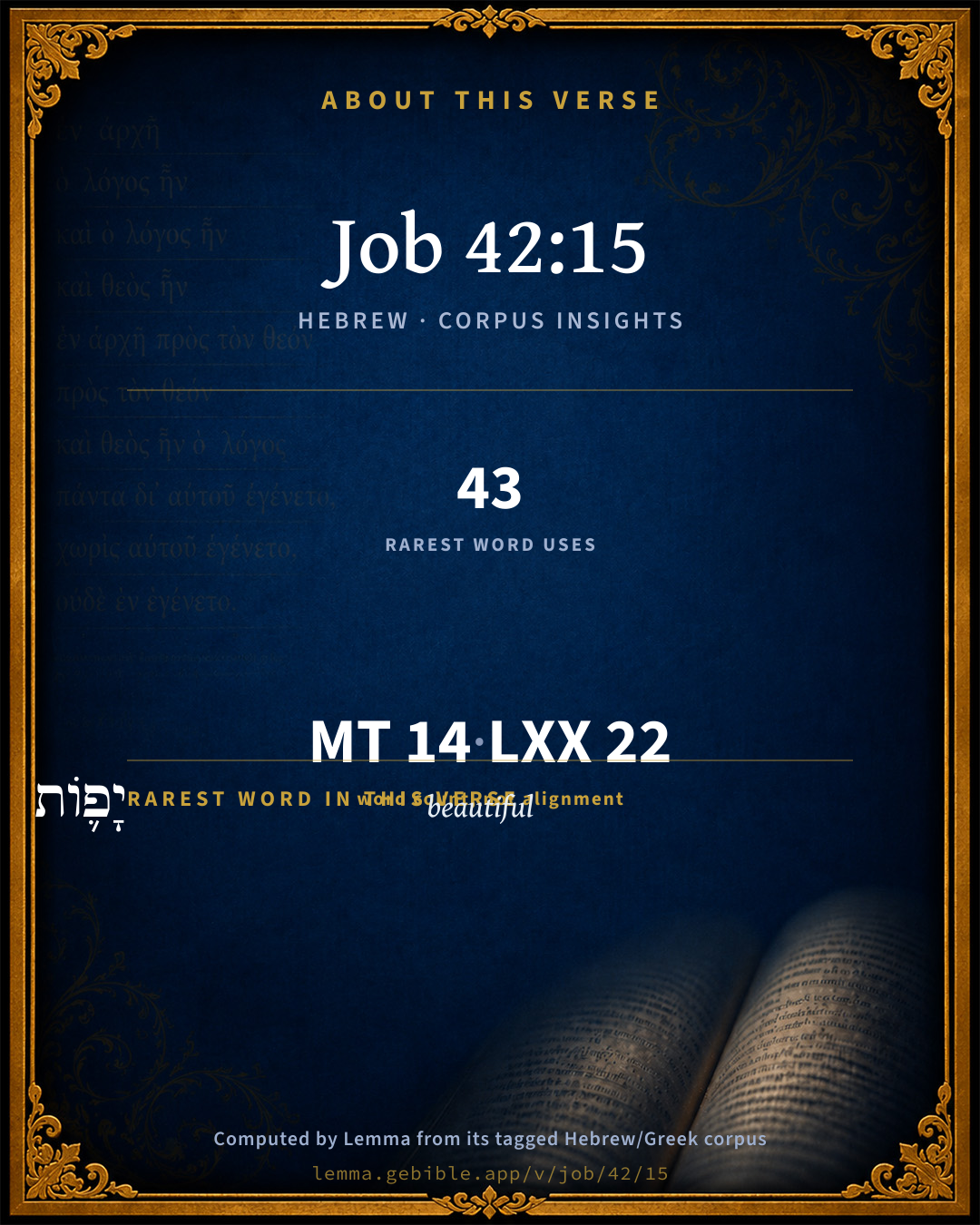
About this verse

These counts appear in no published source. They are computed here, from the morphology-tagged text and Lemma’s own curated glosses. What Lemma adds →

14
words
13
distinct lemmas
Wisdom
section

Shared distinctive vocabulary

יָפ֛וֹת beautiful H3303 occurs in 39 verses of the Hebrew Bible. Also found in:

Grammatical profile

  • 2 verbs
  • 9 nouns
  • 1 adjective
  • 1 preposition
  • 1 particle

Verb forms

  • נִמְצָ֜א Niphal · Perfect
  • וַיִּתֵּ֨ן Qal · Sequential Imperfect

Hebrew & Septuagint length

In English translation the verse runs 24 words from the Hebrew and 30 from the Septuagint (LXX English) — closely comparable.

A rough comparison of the two English renderings, which tokenize alike — not a word-level alignment.

Word counts can differ between the Hebrew and the Greek without any difference in meaning — e.g. the Hebrew direct-object marker אֵת has no separate Greek word, and Greek often adds the article ὁ.

In the original languages it is 14 Hebrew tokens and 22 Greek tokens — but the two are counted differently (Hebrew bundles its prefixes and suffixes into one token; the Greek is in lemma form), so that isn’t a like-for-like length.

Cross-references

5

Topical passages linked to Job 42:15 in the Treasury of Scripture Knowledge — connected by theme and wording, ordered by reader-vote popularity; previews shown in the World English Bible.

  • Numbers 27:7 The daughters of Zelophehad speak right: you shall surely give them a possession of an inheritance among their father's brothers; and you shall cause the inheritance of their father to pass to them.
  • Psalms 144:12 Then our sons will be like well-nurtured plants, Our daughters like pillars carved to adorn a palace.
  • Joshua 18:4 Appoint for you three men of each tribe: and I will send them, and they shall arise, and walk through the land, and describe it according to their inheritance; and they shall come to me.
  • Acts 7:20 At that time Moses was born, and was exceedingly handsome. He was nourished three months in his father's house.
  • Joshua 15:18–19 It happened, when she came [to him], that she moved him to ask of her father a field: and she alighted from off her donkey; and Caleb said, What would you?

Cross-references courtesy of OpenBible.info (CC BY 4.0).

Hebrew and Greek witnesses Masoretic Hebrew ↔ Greek Septuagint

The same verse in the two great witnesses to the Old Testament, shown verse-for-verse.

These are two independent witnesses, not word-aligned to each other, and the Septuagint is shown in lemma (dictionary) form.

Hebrew Job 42:15 Masoretic · Westminster Leningrad Codex

וְלֹ֨א נִמְצָ֜א נָשִׁ֥ים יָפ֛וֹת כִּבְנ֥וֹת אִיּ֖וֹב בְּכָל הָאָ֑רֶץ וַיִּתֵּ֨ן לָהֶ֧ם אֲבִיהֶ֛ם נַחֲלָ֖ה בְּת֥וֹךְ אֲחֵיהֶֽם

In all the land were no women found so beautiful as the daughters of Job. Their father gave them an inheritance among their brothers.

World English Bible · Public Domain

Greek LXX Job 42:15 Septuagint · lemma form

καί οὐ εὑρίσκω κατά ὁ θυγάτηρ ιωβ βελτίων αὐτός ἐν ὁ ὑπό οὐρανός δίδωμι δέ αὐτός ὁ πατήρ κληρονομία ἐν ὁ ἀδελφός

And there were not found in comparison with the daughters of Job, fairer women than they in all the world: and their father gave them an inheritance among their brethren.

LXX2012 (modern English Septuagint) · Public Domain

On this verse, Haydock's Catholic Bible Commentary discusses the Septuagint’s reading. Read the note in Commentary ↓

Hebrew: Westminster Leningrad Codex (CC BY 4.0). Greek: Septuagint (public domain); English from LXX2012 (modern English Septuagint) (Public Domain). How the Septuagint differs from the Hebrew →

Commentary

Notes on Job 42:15 from classic Christian and Jewish commentators (each source and its license shown beneath its notes). The classic Christian expositions comment on the surrounding passage and are grouped to its opening verse, so a note may address several verses; the Jewish commentaries on the Tanakh (Rashi and others) are per-verse, so they appear only where the commentator wrote on this verse.

Lemma curates 59 commentaries, every one of them public domain or Creative Commons licensed, each selected and text-cleaned for this edition rather than reprinted as found. About our sources →

Trapp's Complete Commentary

John Trapp

Job 42:15 And in all the land were no women found [so] fair as the daughters of Job: and their father gave them inheritance among their brethren.

Ver. 15. And in all the land there were no women found so fair, &c.] Beauty, though but a bonum fragile, and one of the gifts of God’s left hand, Pro 3:16, yet is it the flower of virtue, as Chrysippus called it; one of the greatest excellencies of nature, and singular degree of God’s image in man, as another (Plato). And although virtue is Proprio contenta theatro, yet to others

Gratior est pulchro veniens in corpore virtus.

That virtue hath a better grace

That shineth from a beauteous face.

Such probably were Job’s daughters, not fair and foolish, as those daughters of Jerusalem, Isa 3:16, but adorned with all variety of moral virtues, as a clear sky is with stars, as a princely diadem with jewels. Hence their good father so affected them, that he

Gave them inheritance among their brethren] Making them heiresses with them in his estate; which, as it was an extraordinary expression of his love to his daughters, so it importeth, as some think, a desire in him to have his daughters live still with him among the rest of his family; either for that he was loth to part with them (the like whereof is reported of Charles the Great, who, being asked why he did not bestow his daughters in marriage, answered, That he could not be at all without their company, Val. Max. Christian. p. 308), or else as fearing lest they should be defiled with idolaters, which, peradventure, out of Job’s family, were ordinary in that country.

John Trapp, A Commentary or Exposition upon All the Books of the Old and New Testament (1647–1656) — public domain. Text from a community e-Sword module.

The Biblical Illustrator

Joseph S. Exell

Job_42:15

Were no women found so fair as the daughters of Job.

Jobs daughters

It is a long lane that has no turning. Jobs captivity was turned at last. It is a true saying that godliness is profitable for the life that now is. Jobs family was again built up. He had buried all his children, but God had repaired the breach.

I. These daughters of Job were remarkable for their beauty. Whether beauty is a good gift or not depends upon the use made of it. Beauty is a Divine talent, and may be gloriously used for God. The secret of beauty is the shining through of a consecrated spirit.

II. They were remarkable for their character. This appears in their several names.

1. Jemima, or Light of the morning. Let it stand for the influence of young womanhood at home. No one can estimate the influence of a gentle sister among a group of boisterous lads.

2. Kezia or Cassia, Breath of the garden. Let her stand for the influence of young womanhood in social life.

3. Keren-happuch, or All plenteousness. Let her stand for the influence of young womanhood in the Church of God.

III. These daughters were remarkable for their inheritance. Their father gave them an inheritance among their brethren. This was a rare thing in those days. This inheritance means, to begin with, life at the Cross. All sons and daughters are equal here. What else? The joy of service. What else? Participation in the heavenly glory. (D. J. Burrell, D. D.)

The Biblical Illustrator, edited by Joseph S. Exell (c. 1880s–1900s) — public domain. Text from a community e-Sword module.

Joseph Benson's Commentary

Job 42:15. In all the land were no women found so fair, &c. — In the Old Testament we often find women praised for their beauty, but never in the New, because the beauty of holiness is brought to a much clearer light by the gospel. Their father gave them inheritance. &c. — Gave his daughters a share, and, possibly, an equal share with his sons in his inheritance, which, in so plentiful an estate, he might easily do, especially to such amiable sisters, without the envy of their brethren; and which, per- adventure, he did, to oblige them to settle themselves among their brethren, and to marry into their own religious kindred, not to strangers, who, in those times, were generally swallowed up in the gulf of idolatry.

Joseph Benson's Commentary on the Old and New Testaments (1811–1818) — public domain. Text from a community e-Sword module.

Tyndale Open Study Notes

Tyndale Open Resources

42:15 their father put them into his will: Daughters normally inherited only when there were no male heirs (Num 27; 36). Perhaps Job’s unusual action expressed his superabundant prosperity; only a wealthy man could afford to pass some of his wealth to the families into which his daughters would marry.

Tyndale Open Study Notes — © Tyndale Open Resources, licensed CC BY-SA 4.0. Text via the HelloAO Bible API.

Jamieson, Fausset & Brown

Robert Jamieson, A. R. Fausset & David Brown

inheritance among . . . brethren--An unusual favor in the East to daughters, who, in the Jewish law, only inherited, if there were no sons (Num 27:8), a proof of wealth and unanimity.

Jamieson, Fausset & Brown — Commentary Critical and Explanatory on the Whole Bible (1871) — public domain (CC PDM 1.0). Text via the HelloAO Bible API.

Adam Clarke's Commentary

Verse 15. Gave them inheritance among their brethren.] This seems to refer to the history of the daughters of Zelophehad, given Nu 27:1-8, who appear to have been the first who were allowed an inheritance among their brethren.

Adam Clarke's Commentary on the Bible (1810–1826) — public domain. Text from a community e-Sword/MySword module.

The Cambridge Bible for Schools and Colleges

gen. ed. J. J. S. Perowne

15. inheritance among their brethren] The Hebrew practice was that the daughters inherited only when there was no son, Num_27:1 seq. The disposition of his property made by Job would retain the sisters in the midst of their brethren even after marriage, and allow the affectionate relations existing among Job’s children to continue.

The Cambridge Bible for Schools and Colleges (gen. ed. J. J. S. Perowne; Cambridge University Press, 1878–1918) — public domain. Text from a community e-Sword module.

John Gill's Exposition

After this lived Job an hundred and forty years,.... Not after he had arrived to the height of his prosperity; not after the birth of his children, and they were grown up, and had their portions given them, which must take in a considerable number of years; but after his afflictions were over, and his prosperity began: and if his years were doubled, as some think, though that is not certain, then he must be seventy years of age when he was so sorely afflicted and must live to the age of two hundred and ten; which is the common notion of the Jewish writers (z): however, he must be fifty or sixty years of age at that time, since his former children were grown up and were for themselves; and it is said (a), his afflictions continued seven years. So that it is not at all improbable that he lived to be about two hundred years of age; and which was a singular blessing of God to him, if you compare his age with that of Jacob, Joseph, Moses, and Joshua, between the two former and the two latter he may be supposed to live;

and saw his sons, and his sons' sons, even four generations; Joseph saw but the third, Job the fourth, he was a great-great-grandfather. This was no doubt a pleasant sight to him, to see such a numerous offspring descending from him; and especially if they were walking in the ways of God, as probably they were, since no doubt he would take all the care of their education that in him lay. This is the great blessing promised to the Messiah, the antitype of Job, Isa 53:10; see also Isa 59:21.

(z) T. Bava Bathra, fol. 15. 1. Seder Olam Rabba, c. 3. (a) Suidas in voce

John Gill's Exposition of the Whole Bible (1746–1763) — public domain (CC PDM 1.0). Text via the HelloAO Bible API.

Albert Barnes' Notes on the Bible

And their father gave them inheritance among their brethren - This is mentioned as a proof of his special regard, and is also recorded because it was not common. Among the Hebrews the daughter inherited only in the case where there was no son, Num 27:8. The property was divided equally among the sons, with the exception that the oldest received a double portion; see Jahn’s “Bib. Arch.” section 168. This custom, prevailing still extensively in the East, it seems existed in the time of Job, and it is mentioned as a remarkable circumstance that he made his daughters heirs to his property with their brothers. It would also be rather implied in the passage before us that they were equal heirs.

Albert Barnes' Notes on the Bible (1834–1885) — public domain. Text from a community e-Sword/MySword module.

Haydock's Catholic Bible Commentary

Daughters. Alexandrian Septuagint adds, "and sons." --- Brethren. This was contrary to the custom of the Jews, (Numbers xxvii. 8.) but conformable to the Roman laws, and to the Koran. (Sur. 4.) (Calmet)

George Leo Haydock (1774–1849), Haydock's Catholic Family Bible and Commentary, 1859 edition — public domain. Excludes Psalms (Douay-Rheims chapter numbering differs from Protestant) and Deuterocanonical books (Catholic canon only).

Matthew Poole's English Annotations

Gave his daughters a share, and possibly an equal share, with his sons in his inheritance; which in so plentiful an estate he might easily do, especially to such amiable sisters, without the envy of their brethren; and which peradventure he did to oblige them to settle themselves amongst their brethren, and to marry into their own religious kindred, not to strangers, who in those times were generally swallowed up in the gulf of idolatry.

Matthew Poole's English Annotations on the Holy Bible (1683–1685) — public domain. Text from a community e-Sword/MySword module.

Whedon's Commentary on the Bible

Daniel D. Whedon

15. Inheritance among their brethren — According to Mosaic usage daughters inherited only when there were no sons in the family. The remonstrance of the five daughters of Zelophehad against the alienation of their father’s estate, gave rise to legislation through which property descended to daughters. Num_27:1-12. In case there were several sons the whole inheritance was divided equally among the sons, with the exception of the oldest, who received twice as much as either of his brothers. Deu_21:17. “Daughters, in case they were unmarried, were considered as making a part of the estate, and were sold by their brothers into matrimony.” — JAHN, Biblical Archaeology, sec. 168. The Athenian and the early Roman laws resembled the Mosaic in excluding females from inheritance when there were brothers; but in the case of the Greek a moral obligation devolved upon the brother to assign his sister a fortune corresponding to her rank. (See authorities cited in SMITH’S Dictionary of Greek and Roman Antiquities, s.v., Heres, p. 594. Eng. Edit.)

The indications are, that in patriarchal times daughters usually obtained a share in the paternal inheritance. This seems to be implied in the statement of Leah and Rachel, that there, was for them no portion nor inheritance in their father’s house. (Gen_31:14.) Job, with princely magnanimity, includes his daughters among the sharers of the inheritance, not in a manner, as Kitto says, “showing that this power was rarely exercised,” but rather in keeping with ancient Arabian customs, which are perpetuated to the present day by Mohammedans. — SALE’S Prelim. Disc., sec. vi, and the Koran, Sura 4. An inscription of Esarhaddon, found at Kuyunjik, gives the names of eight Arabian sovereigns whom he put to death. Among them are two queens, Tapaa and Bailu. “This was a frequent custom,” says H.F. Talbot, speaking of the sovereignty of queens in the land of Arabia, (Records of the Past, vol. iii, page 107,) “according to the cuneiform inscriptions, but as far as I have observed: it was confined to that country.” Compare the account of the queen of Sheba, 1Ki_10:1-13. In the French National Library is an ovoid bowlder of black basalt, known by the name Caillou Michaux, on which is an Assyrian inscription containing the law concerning landed property as a dowry for a woman on her marriage, and giving the whole measurement of the land to which the stone served as a boundary. — LENORMANT, Chaldaean Magic, 68. For a more detailed description, see Records of the Past, 9:92-95. An old Accadian incantation (see note, Job_1:17) says of the seven evil spirits, “Female they are not, male they are not;” on which Birch remarks, this order is in accordance with the position held by the woman in Accad; in the Accadian Table of Laws (see Records of the Past, Job_3:23) the denial of the father by the son is punished very leniently in comparison with the denial of the mother. (Compare Records of the Past, 9:148.) To account for the distinction made by Job between the sons and daughters, by which the names of the latter only are mentioned, Forster, (Geog. of Arabia, 2:66,) suggests “that the daughters of Job should not only become the mothers of nations, but that they should call the lands after their own names.” More probable than his speculations as to the other daughters, is the one that the name of Jemima is perpetuated in Jemima or Jemama, the name of the central province of the Arabian peninsula. “An Arab tradition, of immemorial standing,” says Forster, “has preserved and handed down the fact that the province of Jemama received its name from Queen Jemama, the first sovereign of the land, who could be no other than Jemima, the daughter of Job.” Consult art. “Inheritance” in FAIRBAIRN, Bib. Dic.; MICHAELIS, Laws of Moses, art. lxxviii; WINER, Rwb., art. “Erbschaft;” MAINE, Anc. Laws, 144-154; SPANHEIM, Hist. Jobi, cap. xv, sec. 18.

Daniel D. Whedon (gen. ed.), Commentary on the Old and New Testaments (1874–1909) — public domain. Text from a community e-Sword module.

The Pulpit Commentary

And in all the land were no women found so fair as the daughters of Job. Beauty has always been highly valued in the East; and Job would feel himself highly favoured in having three beautiful daughters. It may have been on account of their great beauty that their father gave them inheritance among their brethren, which was certainly an unusual practice in the East.

The Pulpit Commentary (1880–1919), ed. H.D.M. Spence-Jones & Joseph S. Exell — public domain. Text from a community e-Sword module.

John Wesley's Explanatory Notes

So fair - In the Old Testament we often find women praised for their beauty, but never in the New, because the beauty of holiness is brought to a much clearer light by the gospel.

John Wesley, Explanatory Notes Upon the Whole Bible (1754–1765) — public domain. Text via the GEBible commentary corpus.

unfoldingWord translationNotes

Door43 World Missions Community

no women were found as beautiful as Job's daughters

"Job's daughters were more beautiful than all the other women"

lived 140 years

"lived 140 years" (See: Numbers)

being old and full of days

The words "full of days" means basically the same thing as "being old." The two phrases form a common idiom. AT: "a very old man" (See: Doublet and Idiom)

translationWords

inherit

generation

die

unfoldingWord translationNotes — © Distant Shores Media and the Door43 World Missions Community, licensed CC BY-SA 4.0. Source: git.door43.org/Door43/en_tn.

Rashi

Rabbi Shlomo Yitzchaki (Rashi)

Nowhere...were women as beautiful as Job’s daughters to be found An instance of beautiful women like the phenomenon of the beauty of Job’s daughters was not found. This verse is on the pattern of (Num. 9:6), “But there was [an incident of] men who were unclean.”

and their father gave them an inheritance among their brothers Because of (their esteem and) their beauty, he gave them an inheritance with their brothers.

Rashi on the Tanakh — English translations: “The Judaica Press complete Tanach with Rashi, translated by A. J. Rosenberg” (CC BY 4.0); “Pentateuch with Rashi's commentary by M. Rosenbaum and A.M. Silbermann, 1929-1934” (public domain); “The Metsudah Tanach series, Lakewood, N.J” (CC BY 4.0); and “The Book of Joshua, Metsudah Publications, 1997” (CC BY 4.0). Text via Sefaria.

Lesson kit

Teaching starters — assembled from the data on this page, not authored interpretation. Every prompt links to the verse data it draws on. Edit before teaching.

Job, in the Wisdom, opens this verse with 14 words (13 distinct Hebrew lemmas). Its most distinctive word is yâpheh (“beautiful”). A historical commentator’s framing appears above. Read the whole chapter for the surrounding context.

Discussion questions

  1. The word yâpheh carries the sense “beautiful.” How does it shape the verse?
  2. How does Genesis 12:11, which shares the word «beautiful», read alongside this verse?
  3. These translations render this verse differently; the difference is in the English rendering, not the original. What questions does that raise?
  4. «נִמְצָ֜א» is a Niphal Perfect verb. How does that grammatical form shape the action described?
  5. Compare how Trapp's Complete Commentary and The Biblical Illustrator read this verse. Where do they agree or differ?

Things to notice

Reading settings

Reading text

Shown beneath each verse's original-language words.

Old Testament
Old Testament edition

Read the OT as the Masoretic Hebrew (MT) or the Greek Septuagint (LXX).

English shown for the Greek Septuagint (in the Hebrew ↔ Greek comparison).

Comparing translations? Open the Compare panel on any verse page to stack up to four side by side.