

Proverbs 1:28

Hebrew (Westminster Leningrad Codex) Proverbs 1:28 appears in the Hebrew Old Testament. The text above is from the Westminster Leningrad Codex. Each word links to its Strong’s number, a concise gloss, and parsing drawn from the Open Scriptures Hebrew Bible morphology. Click any word for its full Brown-Driver-Briggs (BDB) entry.
Download image
Cite this verse

Proverbs 1:28 (World English Bible). Public Domain. Lemma interlinear Bible study tool, https://lemma.gebible.app/v/proverbs/1/28.

Show BibTeX & RIS
BibTeX
RIS
English Translation
Then will they call on me, but I will not answer. They will seek me diligently, but they will not find me;
World English Bible · Public Domain
Download a study sheet

One document with this verse’s original text, its word-by-word gloss line, the meaning frame, cross-references with their text, attributed commentary, and full source and license credits — printable, and it pastes into notes with its structure intact.

This verse Autodidact and up

Study sheet (.html) Plain text (.txt)

A passage Seminary Student

Up to 50 verses in one chapter. A passage sheet keeps up to 6 commentary sources and 12 cross-references per verse, in the order this page ranks them, and says so on the sheet whenever that leaves anything out. Ask for a single verse and you get the Autodidact verse sheet above.

Everything on this page stays free to read, with no account — the sheet is a download of what is already on screen, not access to it.

Want to remove ads? Support Godless Engineer
Compare translations 3

The same verse in 3 English versions, stacked beneath the original-language interlinear above. Click any original word for its lexicon entry.

Each is an independent rendering of the whole verse — the interlinear is not word-aligned to these translations.

Highlighted words mark where these versions differ — a whole-verse word diff, not a word-by-word alignment.

  • World English Bible Public Domain
    Then will they call on me, but I will not answer. They will seek me diligently, but they will not find me;
  • King James Version Public Domain
    Then shall they call upon me, but I will not answer; they shall seek me early, but they shall not find me:
  • unfoldingWord Literal Text CC BY-SA 4.0
    Then they will call out to me, but I will not answer. They will diligently seek me, but they will not find me,

unfoldingWord Literal Text — © unfoldingWord, licensed CC BY-SA 4.0. Word-aligned USFM3 via Door43 (git.door43.org/unfoldingWord/en_ult).

Versions to compare (up to 4)

3 of 4 selected

Show all 18 translations

Every available English version of this verse, each an independent rendering of the whole verse.

  • World English Bible Public Domain
    Then will they call on me, but I will not answer. They will seek me diligently, but they will not find me;
  • Berean Standard Bible Public Domain
    Then they will call on me, but I will not answer; they will earnestly seek me, but will not find me.
  • Majority Standard Bible Public Domain
    Then they will call on me, but I will not answer; they will earnestly seek me, but will not find me.
  • King James Version Public Domain
    Then shall they call upon me, but I will not answer; they shall seek me early, but they shall not find me:
  • American Standard Version (1901) Public Domain
    Then will they call upon me, but I will not answer; They will seek me diligently, but they shall not find me:
  • Revised Version (1885) Public Domain
    Then shall they call upon me, but I will not answer; they shall seek me diligently, but they shall not find me:
  • Geneva Bible (1599) Public Domain
    Then shall they call vpon me, but I will not answere: they shall seeke me early, but they shall not finde me,
  • Douay-Rheims (1899) Public Domain
    Then shall they call upon me, and I will not hear: they shall rise in the morning and shall not find me:
  • Young's Literal Translation Public Domain
    Then they call me, and I do not answer, They seek me earnestly, and find me not.
  • Literal Standard Version CC BY-SA 4.0
    Then they call me, and I do not answer, || They seek me earnestly, and do not find me.
  • Unlocked Literal Bible CC BY-SA 4.0
    Then they will call upon me, and I will not answer; they will desperately call for me, but they will not find me.
  • unfoldingWord Literal Text CC BY-SA 4.0
    Then they will call out to me, but I will not answer. They will diligently seek me, but they will not find me,
  • Darby Bible Public Domain
    -- then will they call upon me, but I will not answer; they will seek me early, and shall not find me.
  • World Messianic Bible Public Domain
    Then they will call on me, but I will not answer. They will seek me diligently, but they will not find me,
  • Webster's Bible Public Domain
    Then shall they call upon me, but I will not answer; they shall seek me early, but they shall not find me:
  • Free Bible Version CC BY-SA 4.0
    then you'll call out to me for help, but I won't answer; you'll search hard for me, but won't find me.
  • Bible in Basic English Public Domain
    Then I will give no answer to their cries; searching for me early, they will not see me:
  • JPS Tanakh (1917) Public Domain
    Then will they call me, but I will not answer, they will seek me earnestly, but they shall not find me.

Literal Standard Version (2020), Covenant Press — licensed CC BY-SA 4.0. Text via the HelloAO Bible API (eBible.org). Unlocked Literal Bible (unfoldingWord) — licensed CC BY-SA 4.0. Text via the HelloAO Bible API (eBible.org). unfoldingWord Literal Text — © unfoldingWord, licensed CC BY-SA 4.0. Word-aligned USFM3 via Door43 (git.door43.org/unfoldingWord/en_ult). Free Bible Version, Dr. Jonathan Gallagher — licensed CC BY-SA 4.0. Text via the HelloAO Bible API (eBible.org).

Word by word

More ways to search: Search by grammar → Find every occurrence → Compare this word →

Practice this passage: Drill this verse → Learn its vocabulary →

About this verse

These counts appear in no published source. They are computed here, from the morphology-tagged text and Lemma’s own curated glosses. What Lemma adds →

7
words
6
distinct lemmas
Wisdom
section

Notable vocabulary

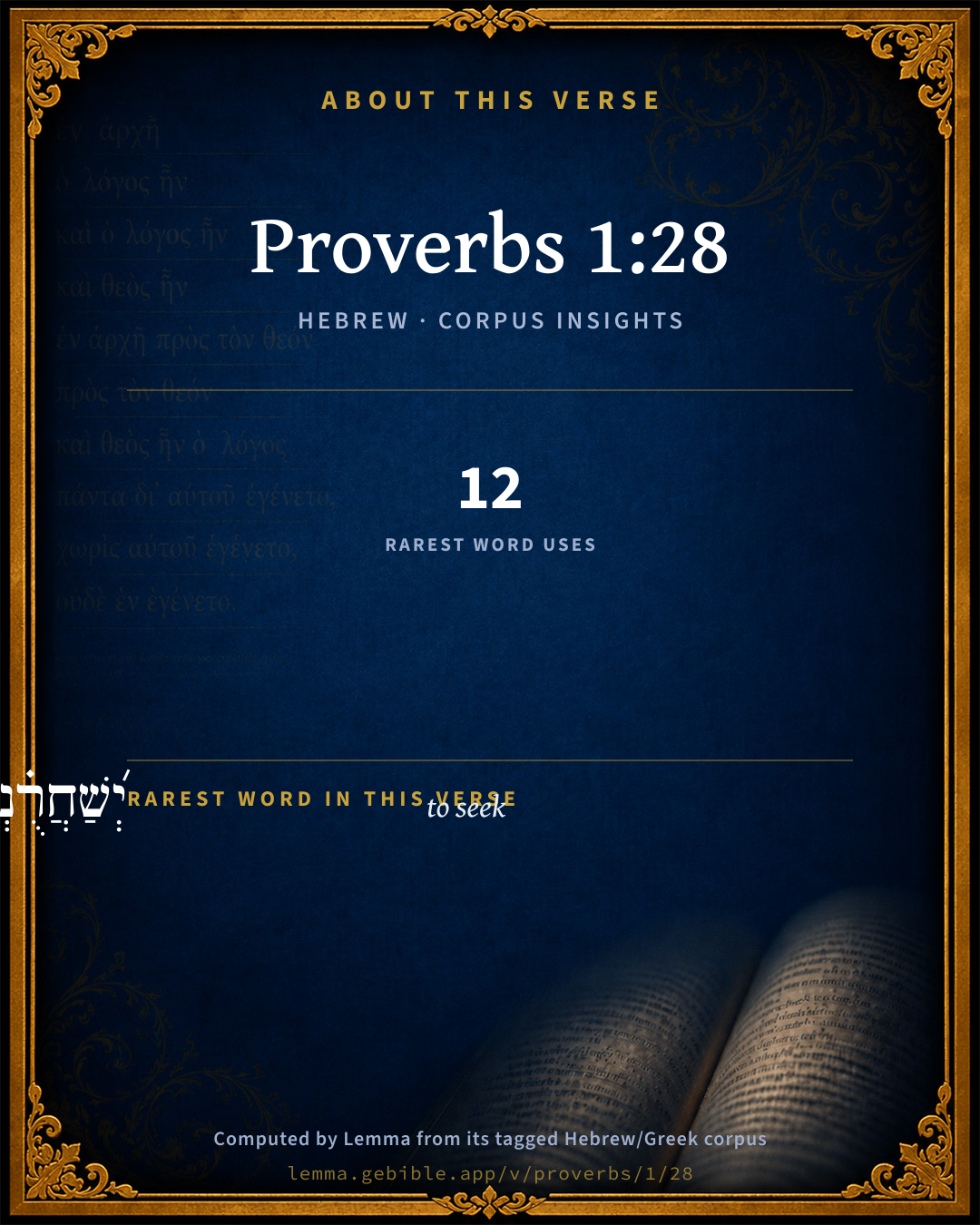
The rarest word here is יְ֝שַׁחֲרֻ֗נְנִי to seek H7836 — appearing just 12 times in the whole Hebrew Bible.

Shared distinctive vocabulary

יְ֝שַׁחֲרֻ֗נְנִי to seek H7836 occurs in 12 verses of the Hebrew Bible. Also found in:

Grammatical profile

  • 4 verbs
  • 1 adverb
  • 2 particles

Verb forms

  • יִ֭קְרָאֻנְנִי Qal · Imperfect
  • אֶֽעֱנֶ֑ה Qal · Imperfect
  • יְ֝שַׁחֲרֻ֗נְנִי Piel · Imperfect
  • יִמְצָאֻֽנְנִי Qal · Imperfect

Repetition

A word recurs within this verse — often emphatic in Hebrew:

  • וְלֹ֣א not H3808 ×2

Hebrew & Septuagint length

In English translation the verse runs 22 words from the Hebrew and 26 from the Septuagint (LXX English) — closely comparable.

A rough comparison of the two English renderings, which tokenize alike — not a word-level alignment.

Word counts can differ between the Hebrew and the Greek without any difference in meaning — e.g. the Hebrew direct-object marker אֵת has no separate Greek word, and Greek often adds the article ὁ.

Cross-references

18

Topical passages linked to Proverbs 1:28 in the Treasury of Scripture Knowledge — connected by theme and wording, ordered by reader-vote popularity; previews shown in the World English Bible.

  • Micah 3:4 Then they will cry to Yahweh, But he will not answer them. Yes, he will hide his face from them at that time, Because they made their deeds evil."
  • Isaiah 1:15 When you spread forth your hands, I will hide my eyes from you; Yes, when you make many prayers, I will not hear. Your hands are full of blood.
  • Jeremiah 11:11 Therefore thus says Yahweh, Behold, I will bring evil on them, which they shall not be able to escape; and they shall cry to me, but I will not listen to them.
  • Zechariah 7:13 It has come to pass that, as he called, and they refused to listen, so they will call, and I will not listen," said Yahweh of Hosts;
  • James 4:3 You ask, and don't receive, because you ask with wrong motives, so that you may spend it for your pleasures.
  • Matthew 25:10–12 While they went away to buy, the bridegroom came, and those who were ready went in with him to the marriage feast, and the door was shut.
  • Job 27:9 Will God hear his cry, When trouble comes on him?
  • 1 Samuel 8:18 You shall cry out in that day because of your king whom you shall have chosen you; and Yahweh will not answer you in that day.
  • Psalms 18:41 They cried, but there was none to save; Even to Yahweh, but he didn't answer them.
  • Jeremiah 14:12 When they fast, I will not hear their cry; and when they offer burnt offering and meal-offering, I will not accept them; but I will consume them by the sword, and by the famine, and by the pestilence.
  • Job 35:12 There they cry, but none gives answer, Because of the pride of evil men.
  • Proverbs 8:17 I love those who love me. Those who seek me diligently will find me.
  • Ezekiel 8:18 Therefore will I also deal in wrath; my eye shall not spare, neither will I have pity; and though they cry in my ears with a loud voice, yet will I not hear them.
  • Genesis 6:3 Yahweh said, "My Spirit will not strive with man forever, because he also is flesh; yet will his days be one hundred twenty years."
  • Hosea 5:15–6:4 I will go and return to my place, until they acknowledge their offense, And seek my face. In their affliction they will seek me earnestly."
  • Matthew 7:22–23 Many will tell me in that day, 'Lord, Lord, didn't we prophesy in your name, in your name cast out demons, and in your name do many mighty works?'
  • Psalms 78:34–36 When he killed them, then they inquired after him. They returned and sought God earnestly.
  • Luke 13:25–28 When once the master of the house has risen up, and has shut the door, and you begin to stand outside, and to knock at the door, saying, 'Lord, Lord, open to us!' then he will answer and tell you, 'I don't know you or where you come from.'

Cross-references courtesy of OpenBible.info (CC BY 4.0).

Hebrew and Greek witnesses Masoretic Hebrew ↔ Greek Septuagint

The same verse in the two great witnesses to the Old Testament, shown verse-for-verse.

These are two independent witnesses, not word-aligned to each other, and the Septuagint is shown in lemma (dictionary) form.

Hebrew Proverbs 1:28 Masoretic · Westminster Leningrad Codex

אָ֣ז יִ֭קְרָאֻנְנִי וְלֹ֣א אֶֽעֱנֶ֑ה יְ֝שַׁחֲרֻ֗נְנִי וְלֹ֣א יִמְצָאֻֽנְנִי

Then will they call on me, but I will not answer. They will seek me diligently, but they will not find me;

World English Bible · Public Domain

Greek LXX Proverbs 1:28 Septuagint · lemma form

εἰμί γάρ ὅταν ἐπικαλέω ἐγώ ἐγώ δέ οὐ εἰςἀκούω σύ ζητέω ἐγώ κακός καί οὐ εὑρίσκω

For it shall be that when you⌃ call upon me, I will not listen to you: wicked men shall seek me, but shall not find me.

LXX2012 (modern English Septuagint) · Public Domain

Hebrew: Westminster Leningrad Codex (CC BY 4.0). Greek: Septuagint (public domain); English from LXX2012 (modern English Septuagint) (Public Domain). How the Septuagint differs from the Hebrew →

Commentary

Notes on Proverbs 1:28 from classic Christian and Jewish commentators (each source and its license shown beneath its notes). The classic Christian expositions comment on the surrounding passage and are grouped to its opening verse, so a note may address several verses; the Jewish commentaries on the Tanakh (Rashi and others) are per-verse, so they appear only where the commentator wrote on this verse.

Lemma curates 59 commentaries, every one of them public domain or Creative Commons licensed, each selected and text-cleaned for this edition rather than reprinted as found. About our sources →

Trapp's Complete Commentary

John Trapp

Pro 1:28 Then shall they call upon me, but I will not answer; they shall seek me early, but they shall not find me:

Ver. 28. Then shall they call, &c.] This was Saul’s misery; - The Philistines are upon me, and God will not answer me. This was Moab’s curse. {Isa 16:12} This was the case of David’s enemies. {Psa 18:41} A doleful case it is surely, when a man shall lose his prayers, and shall not be a button the better for all his pretended prayers and devotions. "He that turneth away his ear from hearing of the law, even his prayer shall be abominable." {Pro 28:9} If God answer him at all, it is according to the idols of his heart, {Eze 14:3-4} with bitter answers, as in Jdg 10:13-14. Or if better, yet it is but as he answered the Israelites for quails, and afterwards for a king; better have been without. Deus saepe dat iratus quod negat propitius. Giftless gifts God gives sometimes. "He will consume you after that he hath done you good." {Jos 24:20}

John Trapp, A Commentary or Exposition upon All the Books of the Old and New Testament (1647–1656) — public domain. Text from a community e-Sword module.

The Biblical Illustrator

Joseph S. Exell

Pro_1:28

Then shall they call upon Me, but I will not answer.

Sowing disobedience, reaping judgment

One of the marvellous reasonings of the Judge with the criminal is recorded here.

I. God in mercy visits a rebellious generation.

1. The call. It is in the earthquake and in the storm. Day unto day proclaims it, and night unto night. There is no speech or language where it is not heard. The call has come with distinct articulation from the lips of prophets and apostles. It sounds with authority in a human conscience.

2. The hands stretched out. There is a way, and the way is open unto the Father. There is no obstruction, there is no forbidding, there is no upbraiding. Sinners are welcomed with open arms.

3. The counsel. Specially addressed to those who procrastinate.

4. Reproof. If they will not be enticed by the promise of heaven, He will threaten them with the fear of hell. Everlasting love needs a strong, hard instrument wherewith to work out her blessed purposes on an unpliant race. Judgment looming in reserve, serving meantime by its blackness to make the invitation more winning.

II. A rebellious generation neglects or resists the gracious visitation of God. Men have ears and stop them.

III. They shall eat the fruit of their own ways, and be filled with their own devices. Judgment will be an exact answer to disobedience, as fruit answers to seed, or an echo to the sound. (William Arnot, D. D.)

The danger of deferring repentance

There is a good English proverb that He who neglects the occasion, the occasion will neglect him. In previous verses we have a general proclamation (Pro_1:20); a merciful reprehension (Pro_1:22); a gracious exhortation (Pro_1:23); a yearning promise (end Pro_1:23); a gracious threatening. The words of the text are underclapt against all those that procrastinate their repentance and returning home to God. Note the parties themselves that do prolong this day of grace; their earnest and diligent seeking after God; the unseasonableness of the time of their seeking; and the frustration of their hopes. Those that will not hear when He calleth them, God will not hear when they call unto Him. Thus the Lord dealt with His people in Ezekiels days. There is a double day, a white day, and a black day; a day of salvation and a day of damnation. There are three reasons for this point.

1. The law of retaliation.

2. The time of Gods attributes. Both mercy and justice have their season in this life; and when mercy hath acted her part, then cometh justice upon the stage, and acteth her part.

3. It is Gods use to do so in other things, even upon the contempt of temporal blessings, and therefore much more in matters of grace and salvation. Illustrated in the cases of the Israelites, Ishmael, King Saul, Esau. If God so severely punish contempt of temporal blessings, how will He punish contempt of proffers of grace and salvation? He will come with martial law against all those that contemn the gospel (Joh_3:18). God doth commonly give men a day, but no man or angel doth know how long this day lasteth. God gave the angels a day, Cain a day, Nineveh a day, the antediluvian world a day. All we know is that this day is for us now. Now is the day of Christ upon you. What is the meaning of all those Scriptures which show how God doth deliver up men unto the spirit of giddiness, and unto the spirit of slumber? And what means the hardening of mens hearts, and searing of mens consciences, but only to show that the day of grace may end unto a particular man, ten, twenty, nay, forty years before his death. If thou refuse this day, thou refusest all; for what knowest thou but this very day may be thy day? The reason is--

1. Because Gods patience is in His own breast, and who can tell how long it will last?

2. Because Gods patience gives no mark or inkling of it before it ends.

3. Because God reckons up every hour.

4. It is a wonder that the day of grace is not ended already, and that thou art not now in hell. When Christ first comes to the soul, He witnesseth grace and mercy to thee if thou wilt repent and amend; yea, He witnesseth forgiveness of sins, redemption, and salvation, if thou wilt believe; but if not, He will be a swift witness against thee. (William Fenner, B.D.)

Natures warning

This is a sublime dramatic utterance. It is Wisdom that is represented as speaking. By wisdom among the Orientals moral philosophy was understood, or science speaking on the side of morality. Taken in its largest way it is as if nature (in the text) had risen up, and had declared from her own seat, and by her own authority, what was the history of transgression against her fundamental laws. It is the voice of physiology; it is the voice of health, it is the voice of natural law. It is the voice of the poorhouse, the gaol, the gallows, speaking out and telling men what are the ends of those ways which are essentially the violation of Gods laws in nature. We see men violating the fundamental laws of health, strength, character, prosperity, and society, little by little, and because sentence is not speedily executed against evildoers, they are presumptuous, and say, How doth God know? At a later stage, when the fatal work is done, and disease, decay, poverty, the coldness of men, the indifference of society, disgrace, neglect, infamy, suffering, and death come upon them, then they begin to call out in these several states, and condemn everybody but themselves. Then they seek to patch up their broken constitutions. Then they attempt to put on the aspects of honesty. Then they try to regraft themselves upon the tree from which they have been broken off, but largely in vain. They call, but nature will not hear. They plead unto deaf ears.

I. Look at the mildest forms of transgression--those of indolence and self-indulgence. How quietly men spend their lives doing nothing! But when they pass the meridian of life, and begin to go down the farther slope, they find that nobody cares for them. They are in everybodys way. The probabilities are that one who has spent the first part of his life in indolence and self-indulgence will spend the last part of his life in the same way.

II. Look at the same thing as it takes place in regard to a mans reputation. Every man is a character-builder. Every man is building himself up by his purposes, his deeds; and these form his character, and it is his character that stands by him. His reputation is simply the shadow that it casts. What a man is, is his character; and what men think him to be is his reputation. Men sometimes think they are building character when they are only getting reputation. Few are aware of this distinction, and so it comes to pass that many men go steadily downward. They begin to violate the truth. They equivocate. They walk on the perilous edge of insincerity. And, notwithstanding this, they do not perceive any change in themselves. But any man who lacks simplicity very soon gets to be suspected by other people. Men are dishonest in the same way. They are tricky. Such a man goes on from day to day, and at last it is whispered of him, That man is not honest, and presently all the world knows it except himself.

III. Look at the same thing in respect to the sins which a man commits against his own self. Of all wastefulness there is none like that which men commit upon their own persons. There are many ways in which men drain off the vitality of their whole brain and nervous system. Excessive virtuous industry will do it. Passionate self-indulgence will do it. Excessive addiction to stimulating drinks will do it. While there may be exceptional cases, the law for all such is destruction. The laws of nature have only a limit of mercy, but they have a limit of mercy. A man may be overtaken and yet may recover himself. There is a limited amount of atonement in nature. But there must be no presuming on it. The laws of nature are made for the obedient. Society is established for the obedient. It has very limited resources for reforming men. You are safe if you do not go down into vice. Let alone mischief before it be meddled with. Keep clear of all evil. Obedience is safe. Obedience to God in nature; in your own body; in the laws of society; obedience to God everywhere--that is absolutely safe, and nothing else is safe. Sin, however sweet and smooth and safe it may seem, is not safe. It is safe to be right; it is dangerous to be wrong. (H. W. Beecher.)

They shall not find Me.--

Who seek and do not find?

Scripture speaks of men calling upon God, and of His refusing to hear them. And yet our Lord said, Ask, and ye shall receive; seek, and ye shall find. How explain this seeming contradiction? These things are not said of the same persons, or rather of the same characters, at the same time. What if I were to say that now, at this very moment, the words of the text are both applicable to us, and not applicable? The words were at no time in any mans earthly life so true an they will be at the day of judgment. Then they may be true in a greater or less degree; they may be substantially true in the life that now is. Is Christs promise, Seek, and ye shall find, equally true to all of us? Take most of us: suppose cite of us to have reached boyhood with a bad disposition, ready for the first temptation, with habits of good uncultivated. Does God hear his prayers? Or in trying to turn from evil to good have you ever found your resolutions give way, till you fell back again to what you were at the beginning? In that case you sought God and failed to find Him. Or has it ever happened to you to have done a mischief to yourselves which you could not undo? Then you may realise that you may seek some good and be unable to attain. We know what it is that hinders God from hearing us always; because we are not thoroughly one in His Son Christ Jesus. The very feeling of coldness and unwillingness to pray, because we have often prayed in vain, is surely working in us that perfect death which is the full truth of the words of the text. (Thomas Arnold, D. D.)

The misery of late repentance after a wicked life

I. There is a time when wicked men will be overtaken with those miseries that no warning would serve them to prevent by repentance and reformation.

II. They will be one day sensible of their own folly, and cry unto God for mercy and deliverance.

III. But God will not then regard their repentance, nor be moved by their prayers. For understanding--

1. Lay down three things.

(1) All sorts of calamities are meant by the wise man, which are either the natural effects of sin or other punishments of sin inflicted by the Divine justice, and that either in this world or in the world to come.

(2) This proposition is not to be understood as if all wicked men were at last reduced to extreme misery in this life. All that need be said is this, either that they do often suffer those punishments in this life which their wicked doings naturally produce, or that the justice of God doth other ways overtake them in punishments that show the finger of God and a more immediate hand of providence.

(3) If any go on in these practices upon which nature itself and Gods curse besides have seemed to sentence miseries in this life, if some of them should happen to escape here, and live out their days without any great misfortune befalling them at last, yet there is a day coming when they shall not escape. One day they will smart for it. Under proposition II., understand that it is not to be understood universally as if every man reduced to extreme misery would infallibly apply himself to God for mercy, for we know there have been examples to the contrary, e.g., Ahab. This seeking Gods favour does frequently happen, but even they who do so are unhappy in their late repentance, especially those that have had the most warnings and convictions, but would not be reclaimed. Under proposition III., show that this is the most awakening consideration of all, and hath the greatest force to make an effectual impression of the two former upon our minds. But this point requires careful interpretation, and a precise distinction between the miseries that an obstinate course of sin produces in this life and those punishments it will bring in another life.

1. How useless the prayers and repentance of wicked men will be as to the recovery of their happiness in this life! They are usually unprofitable as to those advantages which they have lost by their obstinate and, till now, incurable folly; such as health, plenty, and good name. And they will not procure them that comfort from the principles of religion which relieves good men under their adversities.

2. How unprofitable their importunity in seeking the mercy of God will be as to their escape in the day of judgment! For them who repent not till their turn comes in the other world, it will turn to no account for them; they must hear the irreversible sentence, and suffer the unavoidable effect of it for ever. And all this implies no want of goodness in God. (W. Clagett, D.D.)

Counsel rejected

Better stop now. Some years ago, near Princeton, New Jersey, some young men were skating on a pond around an air-hole, and the ice began to break in. Some of them stopped; but a young man said, I am not afraid! Give us one round more! He swung nearly round, when the ice broke, and not until next day was his lifeless body found. So men go on in sin. They are warned. They expect soon to stop. But they cry, Give us one round more! They start, but with a wild crash break through into bottomless perdition. Do not risk it any longer. Stop now. God save us from the foolhardiness of the one round more! I thank God that I have been permitted to tell you which is the right road and which the wrong road. You must take one or the other. I leave you at the forks; choose for yourselves! (T. De Witt Talmage.)

The Biblical Illustrator, edited by Joseph S. Exell (c. 1880s–1900s) — public domain. Text from a community e-Sword module.

Keil & Delitzsch

C. F. Keil & F. Delitzsch

Then - this sublime preacher in the streets continues - distress shall teach them to pray:

28 Then shall they call on me, and I will not answer;

They shall early seek after me, and not find me;

29 Because that they hated knowledge,

And did not choose the fear of Jahve.

30 They have not yielded to my counsel,

Despised all my reproof:

31 Therefore shall they eat of the fruit of their way,

And satiate themselves with their own counsels.

In the full emphatic forms, יקראנני, they shall call on me, ישׁחרנני, they shall seek me, and ימצאנני, they shall find me, the suffix ני may be joined to the old plur. ending ûn (Gesenius, Olshausen, Bttcher); but open forms like יברכנהוּ, He will bless him,יכבּדנני, He will honour me (from יכבּדנּי), and the like, rather favour the conclusion that נ is epenthetic (Ew. 250, b).

(Note: In the Codd. יקראנני is written; in this case the Metheg indicates the tone syllable: vid., Torath Emeth, p. 7 note, p. 21 note; and Accentssystem, ii. 1, note. In ישׁחרנני the Rebia is to be placed over the ר. In the Silluk-word ימצאנני it appears undoubtedly that the form is to be spoken as Milel, i.e., with tone on the penult.)

The address here takes the form of a declaration: Stultos nunc indignos censet ulteriori alloquio (Mich.). It is that laughter and scorn, Pro 1:26, which here sounds forth from the address of the Judge regarding the incorrigible. שׁחר is denom. of שׁחר, to go out and to seek with the morning twilight, as also בּקּר, Psa 27:5, perhaps to appear early, and usually (Arab.) bakar (I, II, IV), to rise early, to be zealous (Lane: "He hastened to do or accomplish, or attain the thing needed"). Zckler, with Hitzig, erroneously regards Pro 1:29, Pro 1:30 as the antecedent to Pro 1:31. With ויאכלוּ, "and they shall eat," the futt. announcing judgment are continued from Pro 1:28; cf. Deu 28:46-48. The conclusion after תּהת כּי, "therefore because," or as usually expressed (except here and Deu 4:37, cf. Gen 4:25), תּהת אשׁר (ἀνθ ̓ ὧν), is otherwise characterized, Deu 22:29; Ch2 21:12; and besides, תהת אשׁר stands after (e.g., Sa1 26:21; Kg2 22:17; Jer 29:19) oftener than before the principal clause. בּחר combines in itself the meanings of eligere and diligere (Fl.). The construction of אבה ל (to be inclining towards) follows that of the analogous שׁמע ל (to hear). Each one eats of the fruit of his way - good fruit of good ways (Isa 3:10), and evil fruit of evil ways. "The מן, 31b, introduces the object from which, as a whole, that which one eats, and with which he is satisfied, is taken as a part, or the object from which, as from a fountain, satisfaction flows forth" (Fl.). In correct texts, ויאכלוּ has the accent Dech, and at the same time Munach as its servant. Regarding the laws of punctuation, according to which וּממּעצתיהם (with Munach on the tone-syllable, Tarcha on the antepenult, and Metheg before the Chateph-Pathach) is to be written, see Baer's Torath Emeth, p. 11, Accentssystem, iv. 4. Norzi accents the word incorrectly with Rebia Mugrash. With the exception of Pro 22:22, the pluralet

(Note: A plur. denoting unity in the circumstances, and a similarity in the relations of time and space.)

מועצות has always the meaning of ungodly counsels.

Keil & Delitzsch — Biblical Commentary on the Old Testament (1861–1891) — public domain (CC PDM 1.0). Text via the HelloAO Bible API. (Old Testament only.)

Tyndale Open Study Notes

Tyndale Open Resources

1:28 I will not answer: If a person has not sought wisdom before calamity strikes, it is often too late to learn.

Tyndale Open Study Notes — © Tyndale Open Resources, licensed CC BY-SA 4.0. Text via the HelloAO Bible API.

Geneva Bible (1599)

Geneva Bible translators

Because they sought not with an affection to God, but for ease of their own grief.

Geneva Bible (1599) marginal notes — public domain. Text via Bolls.life.

Jamieson, Fausset & Brown

Robert Jamieson, A. R. Fausset & David Brown

Now no prayers or most diligent seeking will avail (Pro 8:17).

Jamieson, Fausset & Brown — Commentary Critical and Explanatory on the Whole Bible (1871) — public domain (CC PDM 1.0). Text via the HelloAO Bible API.

Ellicott's Commentary for English Readers

(28) Then shall they call upon me.—They did not call upon Him in an “acceptable time,” in “a day of salvation” (Isa_49:8), while He was “near” (Isa_55:6); so at last the master of the house has “risen up, and shut-to the door” (Luk_13:25), and will not listen to their cries.

They shall seek me early.—As God had done, “daily rising up early,” and sending the prophets unto them (Jer_7:25).

A Bible Commentary for English Readers, edited by Charles John Ellicott (1878–1897) — public domain. Text from a community e-Sword module.

The Cambridge Bible for Schools and Colleges

gen. ed. J. J. S. Perowne

28. early] Rather, earnestly, or diligently, R.V. text. The rendering early is due to the doubtful connection (see Bp Perowne on Psa_63:1) of the Heb. word with the dawn (mane consurgent, Vulg.). Here in fact, so far from being early, it is not only late, but too late. It may of course be urged in favour of retaining the received rendering (as R.V. marg.) that the seeking is early as regards the coming of the calamity (comp. Hos_5:15); but the other sense includes this.

The Cambridge Bible for Schools and Colleges (gen. ed. J. J. S. Perowne; Cambridge University Press, 1878–1918) — public domain. Text from a community e-Sword module.

John Gill's Exposition

Then shall they call upon me, but I will not answer,.... As he called them, and they refused to answer to his call, Pro 1:24; so it was just in him to return no answer to them, when they called on him to deliver them from the Romans, and save them from ruin: for this was what they called out for, and what they expected, that the Messiah would come and deliver them; this was what they buoyed themselves up with, and made them so desperate to the last;

they shall seek me early, but they shall not find me; this is the very thing that Christ told the Jews, and much in the same words with these, Joh 7:34; for when he was gone, and they were in distress, then they sought after the Messiah, in the desert, and in the secret chambers, and in this and the other place, where they were told he was; but, alas! they could not find him: the true Messiah, whom they had rejected, was come and gone, and would return no more, until his second coming to judgment; or, however, till he came in his kingdom and power, to their ruin and destruction; of which coming of his the Scriptures often speak.

John Gill's Exposition of the Whole Bible (1746–1763) — public domain (CC PDM 1.0). Text via the HelloAO Bible API.

Haydock's Catholic Bible Commentary

Find me. Because their repentance was false, like that of Antiochus, 2 Machabees ix. 13., and Psalm xi. 4. (Calmet)

George Leo Haydock (1774–1849), Haydock's Catholic Family Bible and Commentary, 1859 edition — public domain. Excludes Psalms (Douay-Rheims chapter numbering differs from Protestant) and Deuterocanonical books (Catholic canon only).

Matthew Poole's English Annotations

Early; or, in the morning, as the word properly signifies, and is here rendered by others, as soon as their calamity comes; or rather, with great diligence and fervency, as this phrase commonly signifies.

They shall not find me, because they do not seek me by choice and with sincerity, but only by constraint, and that they may be freed from their miseries.

Matthew Poole's English Annotations on the Holy Bible (1683–1685) — public domain. Text from a community e-Sword/MySword module.

Whedon's Commentary on the Bible

Daniel D. Whedon

28. Shall seek me early — Rather, earnestly, urgently. The word primarily means to rise early; but as rising early was an eminent mark of earnestness and diligence in the pursuit of an object, so the sense readily passed over to this.

Daniel D. Whedon (gen. ed.), Commentary on the Old and New Testaments (1874–1909) — public domain. Text from a community e-Sword module.

The Pulpit Commentary

The phase which the address now enters upon continues to the thirty-first verse. The change in this verse from the second to the third person is striking. It implies that Wisdom thinks fools no longer worthy of being addressed personally stultos indignos censunt ulteriori alloquio" (Gejerus and Michaelis). The declaration is the embodiment of the laughter and scorn of ver. 26. The three verbs, "they shall call," "they shall seek," "they shall find," occur in uncommon and emphatic forms in the original. They are some out of the few instances where the future terminations are inserted fully before the pronominal suffix. I will not answer. The distress and anguish consequent upon their calamity and fear lead them to pray, but there will be no answer nor heed given to their cry. They are not heard, because they do not cry rightly nor in the time of grace (Lapide). See the striking parallel to the tenor of this passage in Luk_13:24-28. They shall seek me early; i.e. diligently. The verb rjv (shakhar) is the denominative from the substantive rjv (shakar), "the dawn, morning," and signifies to go out and seek something in the obscurity of the morning twilight (Delitzsch, Zockler), and hence indicates diligence and earnestness in the search. Gesenius gives the same derivation, but connects it with the dawn in the sense of the light breaking forth, and thus, as it were, seeking. (see also Pro_2:2-7 Pro_7:15 Pro_8:17 Hos_5:15)

The Pulpit Commentary (1880–1919), ed. H.D.M. Spence-Jones & Joseph S. Exell — public domain. Text from a community e-Sword module.

John Wesley's Explanatory Notes

Early - With diligence and fervency.

John Wesley, Explanatory Notes Upon the Whole Bible (1754–1765) — public domain. Text via the GEBible commentary corpus.

unfoldingWord translationNotes

Door43 World Missions Community

Connecting Statement:

Wisdom continues speaking. (See: Personification)

Then they will call upon me

"Then those who ignored me will cry out to me for help"

Because they hate knowledge

The abstract noun "knowledge" can be stated as the verb "learn." AT: "Because they refused to learn to be wise" (See: Abstract Nouns)

did not choose the fear of Yahweh

The abstract noun "fear" can be stated as a verb. AT: "did not fear Yahweh" or "did not honor and respect Yahweh" (See: Abstract Nouns)

would not follow my instruction

"would not accept my instruction" or "rejected my advice"

translationWords

call

know

fear

Yahweh

instruct

unfoldingWord translationNotes — © Distant Shores Media and the Door43 World Missions Community, licensed CC BY-SA 4.0. Source: git.door43.org/Door43/en_tn.

Rashi

Rabbi Shlomo Yitzchaki (Rashi)

they shall seek me Heb. ישחרנני, they shall look for me.

Rashi on the Tanakh — English translations: “The Judaica Press complete Tanach with Rashi, translated by A. J. Rosenberg” (CC BY 4.0); “Pentateuch with Rashi's commentary by M. Rosenbaum and A.M. Silbermann, 1929-1934” (public domain); “The Metsudah Tanach series, Lakewood, N.J” (CC BY 4.0); and “The Book of Joshua, Metsudah Publications, 1997” (CC BY 4.0). Text via Sefaria.

Lesson kit

Teaching starters — assembled from the data on this page, not authored interpretation. Every prompt links to the verse data it draws on. Edit before teaching.

Proverbs, in the Wisdom, opens this verse with 7 words (6 distinct Hebrew lemmas). Its most distinctive word is shâchar (“to seek”). A historical commentator’s framing appears above. Read the whole chapter for the surrounding context.

Discussion questions

  1. How does “to seek” (shâchar) shape what this verse is saying?
  2. Job 7:21 shares the word «to seek» with this verse. How do the two illuminate each other?
  3. “not” occurs 2× in this one verse. What is the effect of the repetition?
  4. The translations on this page render this verse differently — a whole-verse word diff, not a word-by-word alignment. What might account for the different wordings?
  5. The verb «יִ֭קְרָאֻנְנִי» is Qal Imperfect. How does its form color the action?
  6. Reading how Trapp's Complete Commentary and The Biblical Illustrator read this verse, where do the two commentators agree and where do they part?

Things to notice

Reading settings

Reading text

Shown beneath each verse's original-language words.

Old Testament
Old Testament edition

Read the OT as the Masoretic Hebrew (MT) or the Greek Septuagint (LXX).

English shown for the Greek Septuagint (in the Hebrew ↔ Greek comparison).

Comparing translations? Open the Compare panel on any verse page to stack up to four side by side.