
Ezra 10:18

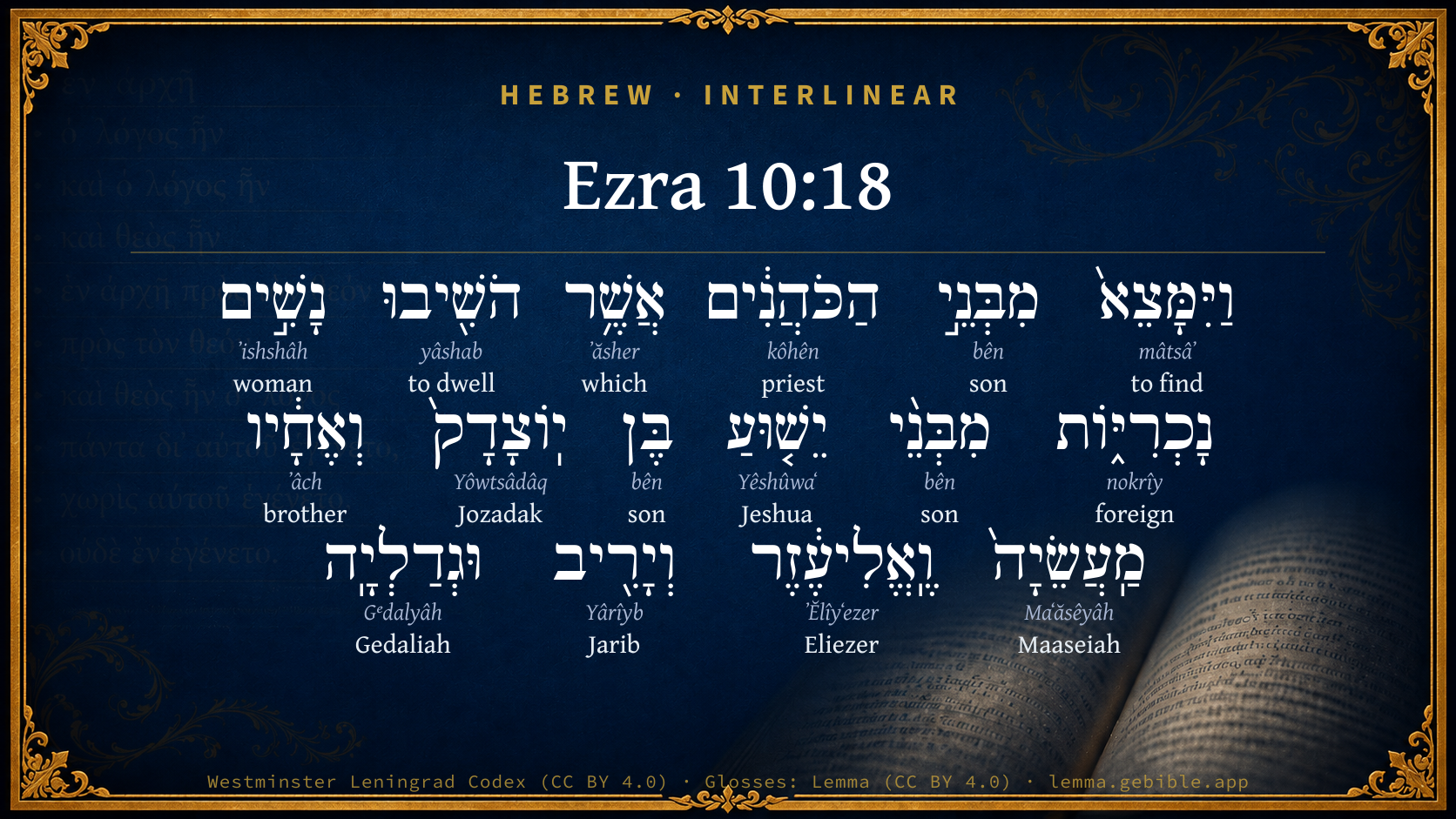
Hebrew (Westminster Leningrad Codex) Ezra 10:18 appears in the Hebrew Old Testament. The text above is from the Westminster Leningrad Codex. Each word links to its Strong’s number, a concise gloss, and parsing drawn from the Open Scriptures Hebrew Bible morphology. Click any word for its full Brown-Driver-Briggs (BDB) entry.
Download image
Cite this verse

Ezra 10:18 (World English Bible). Public Domain. Lemma interlinear Bible study tool, https://lemma.gebible.app/v/ezra/10/18.

Show BibTeX & RIS
BibTeX
RIS
English Translation
Among the sons of the priests there were found who had married foreign women: [namely], of the sons of Jeshua, the son of Jozadak, and his brothers, Maaseiah, and Eliezer, and Jarib, and Gedaliah.
World English Bible · Public Domain
Download a study sheet

One document with this verse’s original text, its word-by-word gloss line, the meaning frame, cross-references with their text, attributed commentary, and full source and license credits — printable, and it pastes into notes with its structure intact.

This verse Autodidact and up

Study sheet (.html) Plain text (.txt)

A passage Seminary Student

Up to 50 verses in one chapter. A passage sheet keeps up to 6 commentary sources and 12 cross-references per verse, in the order this page ranks them, and says so on the sheet whenever that leaves anything out. Ask for a single verse and you get the Autodidact verse sheet above.

Everything on this page stays free to read, with no account — the sheet is a download of what is already on screen, not access to it.

Want to remove ads? Support Godless Engineer
Compare translations 3

The same verse in 3 English versions, stacked beneath the original-language interlinear above. Click any original word for its lexicon entry.

Each is an independent rendering of the whole verse — the interlinear is not word-aligned to these translations.

Highlighted words mark where these versions differ — a whole-verse word diff, not a word-by-word alignment.

  • World English Bible Public Domain
    Among the sons of the priests there were found who had married foreign women: [namely], of the sons of Jeshua, the son of Jozadak, and his brothers, Maaseiah, and Eliezer, and Jarib, and Gedaliah.
  • King James Version Public Domain
    And among the sons of the priests there were found that had taken strange wives: namely, of the sons of Jeshua the son of Jozadak, and his brethren; Maaseiah, and Eliezer, and Jarib, and Gedaliah.
  • unfoldingWord Literal Text CC BY-SA 4.0
    And some were found from the sons of the priests who had caused foreign women to dwell: from the sons of Jeshua, the son of Jozadak, and his brothers: Maaseiah, and Eliezer, and Jarib, and Gedaliah.

unfoldingWord Literal Text — © unfoldingWord, licensed CC BY-SA 4.0. Word-aligned USFM3 via Door43 (git.door43.org/unfoldingWord/en_ult).

Versions to compare (up to 4)

3 of 4 selected

Show all 18 translations

Every available English version of this verse, each an independent rendering of the whole verse.

  • World English Bible Public Domain
    Among the sons of the priests there were found who had married foreign women: [namely], of the sons of Jeshua, the son of Jozadak, and his brothers, Maaseiah, and Eliezer, and Jarib, and Gedaliah.
  • Berean Standard Bible Public Domain
    Among the descendants of the priests who had married foreign women were found these descendants of Jeshua son of Jozadak and his brothers: Maaseiah, Eliezer, Jarib, and Gedaliah.
  • Majority Standard Bible Public Domain
    Among the descendants of the priests who had married foreign women were found these descendants of Jeshua son of Jozadak and his brothers: Maaseiah, Eliezer, Jarib, and Gedaliah.
  • King James Version Public Domain
    And among the sons of the priests there were found that had taken strange wives: namely, of the sons of Jeshua the son of Jozadak, and his brethren; Maaseiah, and Eliezer, and Jarib, and Gedaliah.
  • American Standard Version (1901) Public Domain
    And among the sons of the priests there were found that had married foreign women: `namely', of the sons of Jeshua, the son of Jozadak, and his brethren, Maaseiah, and Eliezer, and Jarib, and Gedaliah.
  • Revised Version (1885) Public Domain
    And among the sons of the priests there were found that had married strange women: namely, of the sons of Jeshua, the son of Jozadak, and his brethren, Maaseiah, and Eliezer, and Jarib, and Gedaliah.
  • Geneva Bible (1599) Public Domain
    And of the sonnes of the Priests there were men founde, that had taken strange wiues, to wit, of the sonnes of Ieshua, the sonne of Iozadak, and of his brethren, Maaseiah, Aeliezer, and Iarib and Gedaliah.
  • Douay-Rheims (1899) Public Domain
    And there were found among the sons of the priests that had taken strange wives: Of the sons of Josue the son of Josedec, and his brethren, Maasia, and Eliezer, and Jarib, and Godolia.
  • Young's Literal Translation Public Domain
    And there are found of the sons of the priests that have settled strange women: of the sons of Jeshua son of Jozadak, and his brethren, Maaseiah, and Eliezer, and Jarib, and Gedaliah;
  • Literal Standard Version CC BY-SA 4.0
    And there are found of the sons of the priests that have settled strange women: of the sons of Jeshua son of Jozadak, and his brothers, Maaseiah, and Eliezer, and Jarib, and Gedaliah;
  • Unlocked Literal Bible CC BY-SA 4.0
    Among the descendants of the priests there were those who had lived with foreign women. Among the descendants of Jeshua son of Jozadak and his brothers there were Maaseiah, Eliezer, Jarib, and Gedaliah.
  • unfoldingWord Literal Text CC BY-SA 4.0
    And some were found from the sons of the priests who had caused foreign women to dwell: from the sons of Jeshua, the son of Jozadak, and his brothers: Maaseiah, and Eliezer, and Jarib, and Gedaliah.
  • Darby Bible Public Domain
    And among the sons of the priests there were found that had taken foreign wives, of the sons of Jeshua the son of Jozadak, and his brethren: Maaseiah, and Eliezer, and Jarib, and Gedaliah.
  • World Messianic Bible Public Domain
    Among the sons of the priests there were found who had married foreign women: of the sons of Yeshua, the son of Jozadak, and his brothers: Maaseiah, Eliezer, Jarib, and Gedaliah.
  • Webster's Bible Public Domain
    And among the sons of the priests there were found that had taken foreign wives: namely, of the sons of Jeshua the son of Jozadak, and his brethren; Maaseiah, and Eliezer, and Jarib, and Gedaliah.
  • Free Bible Version CC BY-SA 4.0
    Among the descendants of the priests, the following had married foreign women: from the sons of Jeshua son of Jozadak, and his brothers Maaseiah, Eliezer, Jarib, and Gedaliah.
  • Bible in Basic English Public Domain
    And among the sons of the priests who were married to strange women were these: of the sons of Jeshua, the son of Jozadak and his brothers, Maaseiah and Eliezer and Jarib and Gedaliah.
  • JPS Tanakh (1917) Public Domain
    And among the sons of the priests there were found that had married foreign women, namely: of the sons of Jeshua, the son of Jozadak, and his brethren, Maaseiah, and Eliezer, and Jarib, and Gedaliah.

Literal Standard Version (2020), Covenant Press — licensed CC BY-SA 4.0. Text via the HelloAO Bible API (eBible.org). Unlocked Literal Bible (unfoldingWord) — licensed CC BY-SA 4.0. Text via the HelloAO Bible API (eBible.org). unfoldingWord Literal Text — © unfoldingWord, licensed CC BY-SA 4.0. Word-aligned USFM3 via Door43 (git.door43.org/unfoldingWord/en_ult). Free Bible Version, Dr. Jonathan Gallagher — licensed CC BY-SA 4.0. Text via the HelloAO Bible API (eBible.org).

Word by word

More ways to search: Search by grammar → Find every occurrence → Compare this word →

Practice this passage: Drill this verse → Learn its vocabulary →

וְיָרִ֖יב
Yârîyb
H3402
“and · Jarib”
Conjunction + Noun, Proper
Part of Speech
Conjunction + Noun
Type
Proper
Full BDB Definition

Origin: the same as H3401

TWOT: None

Jarib = "he contends" - a son of Simeon - one of the chief men of Israel who returned from exile with Ezra - son of Jozadak and a priest of the house of Jeshua who married a foreign wife and was compelled by Ezra to put her away
  1. וַיִּמָּצֵא֙ mâtsâʼ H4672 “and · to find” Conjunction + Verb, Niphal, Sequential Imperfect, 3rd Person, Masculine, Singular
  2. מִבְּנֵ֣י bên H1121 “from · sons of” Preposition + Noun, Common, Masculine, Plural, Construct
  3. הַכֹּהֲנִ֔ים kôhên H3548 “the · priests” Particle, Definite Article + Noun, Common, Masculine, Plural, Absolute
  4. אֲשֶׁ֥ר ʼăsher H834 “which” Particle, Relative
  5. הֹשִׁ֖יבוּ yâshab H3427 “to dwell” Verb, Hiphil, Perfect, 3rd Person, Common, Plural
  6. נָשִׁ֣ים ʼishshâh H802 “women” Noun, Common, Feminine, Plural, Absolute
  7. נָכְרִיּ֑וֹת nokrîy H5237 “foreign” Adjective, Adjective, Feminine, Plural, Absolute
  8. מִבְּנֵ֨י bên H1121 “from · sons of” Preposition + Noun, Common, Masculine, Plural, Construct
  9. יֵשׁ֤וּעַ Yêshûwaʻ H3442 “Jeshua” Noun, Proper
  10. בֶּן bên H1121 “son of” Noun, Common, Masculine, Singular, Construct
  11. יֽוֹצָדָק֙ Yôwtsâdâq H3136 “Jozadak” Noun, Proper
  12. וְאֶחָ֔יו ʼâch H251 “and · brothers · his” Conjunction + Noun, Common, Masculine, Plural, Construct + Suffix, Personal, 3rd Person, Masculine, Singular
  13. מַֽעֲשֵׂיָה֙ Maʻăsêyâh H4641 “Maaseiah” Noun, Proper
  14. וֶֽאֱלִיעֶ֔זֶר ʼĔlîyʻezer H461 “and · Eliezer” Conjunction + Noun, Proper
  15. וּגְדַלְיָֽה Gᵉdalyâh H1436 “and · Gedaliah” Conjunction + Noun, Proper

About this verse

These counts appear in no published source. They are computed here, from the morphology-tagged text and Lemma’s own curated glosses. What Lemma adds →

16
words
14
distinct lemmas
Historical
section

Notable vocabulary

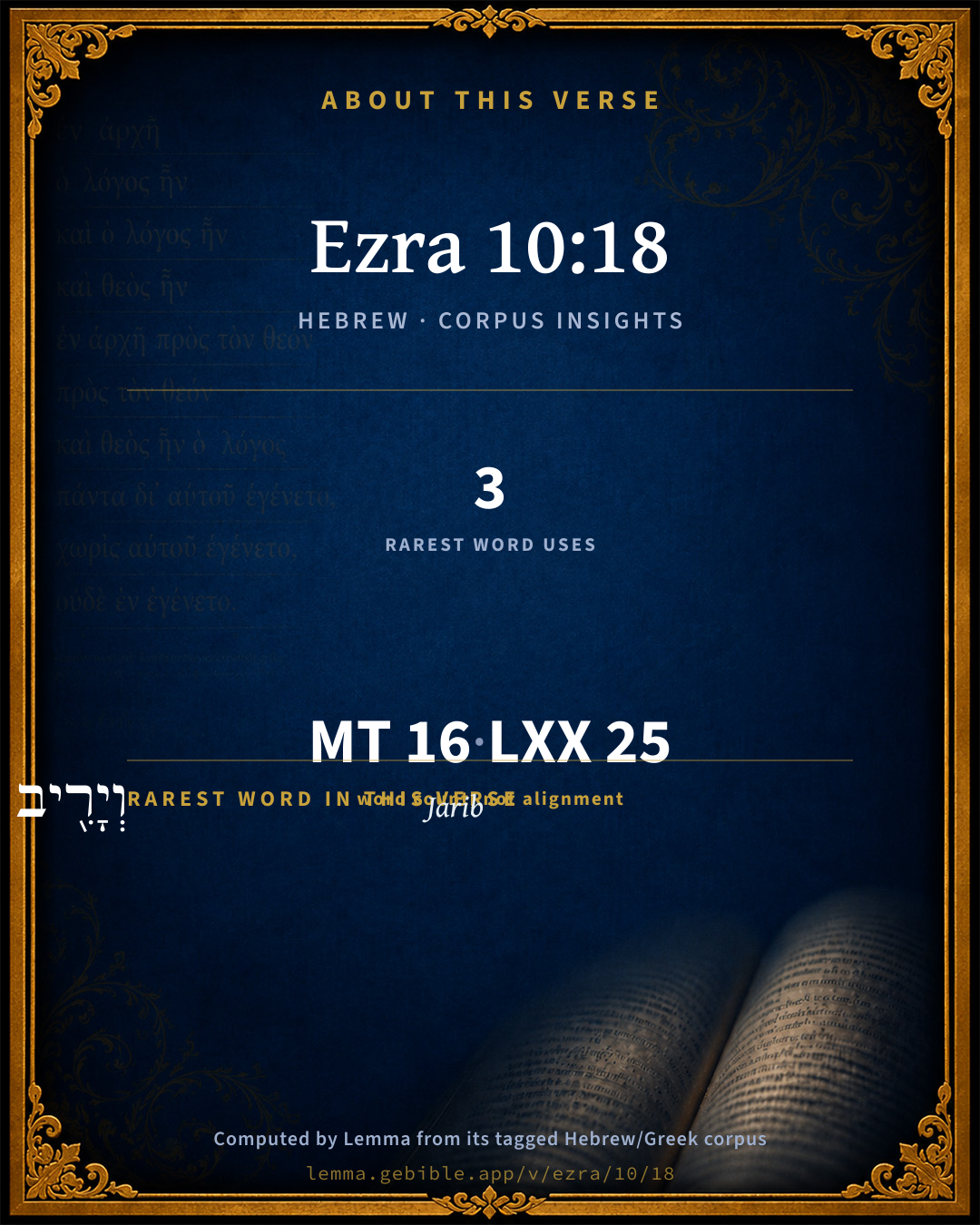
The rarest word here is וְיָרִ֖יב Jarib H3402 — appearing just 3 times in the whole Hebrew Bible.

Shared distinctive vocabulary

וְיָרִ֖יב Jarib H3402 occurs in 3 verses of the Hebrew Bible. Also found in:

Grammatical profile

  • 2 verbs
  • 12 nouns
  • 1 adjective
  • 1 particle

Verb forms

  • וַיִּמָּצֵא֙ Niphal · Sequential Imperfect
  • הֹשִׁ֖יבוּ Hiphil · Perfect

Repetition

A word recurs within this verse — often emphatic in Hebrew:

  • מִבְּנֵ֣י son H1121 ×3

Hebrew & Septuagint length

In English translation the verse runs 34 words from the Hebrew and 35 from the Septuagint (LXX English) — closely comparable.

A rough comparison of the two English renderings, which tokenize alike — not a word-level alignment.

Word counts can differ between the Hebrew and the Greek without any difference in meaning — e.g. the Hebrew direct-object marker אֵת has no separate Greek word, and Greek often adds the article ὁ.

In the original languages it is 16 Hebrew tokens and 25 Greek tokens — but the two are counted differently (Hebrew bundles its prefixes and suffixes into one token; the Greek is in lemma form), so that isn’t a like-for-like length.

Cross-references

19

Topical passages linked to Ezra 10:18 in the Treasury of Scripture Knowledge — connected by theme and wording, ordered by reader-vote popularity; previews shown in the World English Bible.

  • Ezra 2:2 who came with Zerubbabel, Jeshua, Nehemiah, Seraiah, Reelaiah, Mordecai, Bilshan, Mispar, Bigvai, Rehum, Baanah. The number of the men of the people of Israel:
  • Ezra 3:2 Then stood up Jeshua the son of Jozadak, and his brothers the priests, and Zerubbabel the son of Shealtiel, and his brothers, and built the altar of the God of Israel, to offer burnt offerings thereon, as it is written in the law of Moses the man of God.
  • Ezra 5:2 Then rose up Zerubbabel the son of Shealtiel, and Jeshua the son of Jozadak, and began to build the house of God which is at Jerusalem; and with them were the prophets of God, helping them.
  • Haggai 1:1 In the second year of Darius the king, in the sixth month, in the first day of the month, the Word of Yahweh came by Haggai, the prophet, to Zerubbabel, the son of Shealtiel, governor of Judah, and to Joshua, the son of Jehozadak, the high priest, saying,
  • Zechariah 3:1 He showed me Joshua the high priest standing before the angel of Yahweh, and Satan standing at his right hand to be his adversary.
  • Leviticus 21:7 "'They shall not marry a woman who is a prostitute, or profane; neither shall they marry a woman divorced from her husband: for he is holy to his God.
  • Leviticus 21:13–15 "'He shall take a wife in her virginity.
  • 1 Samuel 2:22–24 Now Eli was very old; and he heard all that his sons did to all Israel, and how that they lay with the women who served at the door of the tent of meeting.
  • 1 Chronicles 6:14–15 and Azariah became the father of Seraiah, and Seraiah became the father of Jehozadak;
  • Ezra 9:1 Now when these things were done, the princes drew near to me, saying, The people of Israel, and the priests and the Levites, have not separated themselves from the peoples of the lands, [doing] according to their abominations, even of the Canaanites, the Hittites, the Perizzites, the Jebusites, the Ammonites, the Moabites, the Egyptians, and the Amorites.
  • Nehemiah 8:4 Ezra the scribe stood on a pulpit of wood, which they had made for the purpose; and beside him stood Mattithiah, and Shema, and Anaiah, and Uriah, and Hilkiah, and Maaseiah, on his right hand; and on his left hand, Pedaiah, and Mishael, and Malchijah, and Hashum, and Hashbaddanah, Zechariah, [and] Meshullam.
  • Nehemiah 8:7 Also Jeshua, and Bani, and Sherebiah, Jamin, Akkub, Shabbethai, Hodiah, Maaseiah, Kelita, Azariah, Jozabad, Hanan, Pelaiah, and the Levites, caused the people to understand the law: and the people [stood] in their place.
  • Nehemiah 12:10 Jeshua became the father of Joiakim, and Joiakim became the father of Eliashib, and Eliashib became the father of Joiada,
  • Nehemiah 13:28 One of the sons of Joiada, the son of Eliashib the high priest, was son-in-law to Sanballat the Horonite: therefore I chased him from me.
  • Jeremiah 23:11 for both prophet and priest are profane; yes, in my house have I found their wickedness, says Yahweh.
  • Jeremiah 23:14 In the prophets of Jerusalem also I have seen a horrible thing: they commit adultery, and walk in lies; and they strengthen the hands of evil-doers, so that none does return from his wickedness: they are all of them become to me as Sodom, and the inhabitants of it as Gomorrah.
  • Ezekiel 44:22 Neither shall they take for their wives a widow, nor her who is put away; but they shall take virgins of the seed of the house of Israel, or a widow who is the widow of a priest.
  • Malachi 2:8–9 But you have turned aside out of the way. You have caused many to stumble in the law. You have corrupted the covenant of Levi," says Yahweh of Hosts.
  • 1 Timothy 3:11 Their wives in the same way must be reverent, not slanderers, temperate, faithful in all things.

Cross-references courtesy of OpenBible.info (CC BY 4.0).

Hebrew and Greek witnesses Masoretic Hebrew ↔ Greek Septuagint

The same verse in the two great witnesses to the Old Testament, shown verse-for-verse.

These are two independent witnesses, not word-aligned to each other, and the Septuagint is shown in lemma (dictionary) form.

Hebrew Ezra 10:18 Masoretic · Westminster Leningrad Codex

וַיִּמָּצֵא֙ מִבְּנֵ֣י הַכֹּהֲנִ֔ים אֲשֶׁ֥ר הֹשִׁ֖יבוּ נָשִׁ֣ים נָכְרִיּ֑וֹת מִבְּנֵ֨י יֵשׁ֤וּעַ בֶּן יֽוֹצָדָק֙ וְאֶחָ֔יו מַֽעֲשֵׂיָה֙ וֶֽאֱלִיעֶ֔זֶר וְיָרִ֖יב וּגְדַלְיָֽה

Among the sons of the priests there were found who had married foreign women: [namely], of the sons of Jeshua, the son of Jozadak, and his brothers, Maaseiah, and Eliezer, and Jarib, and Gedaliah.

World English Bible · Public Domain

Greek LXX Ezra 10:18 Septuagint · lemma form

καί εὑρίσκω ἀπό υἱός ὁ ἱερεύς ὅς καταἵζω γυνή ἀλλότριος ἀπό υἱός ἰησοῦς υἱός ιωσεδεκ καί ἀδελφός αὐτός μαασηα καί ελιεζερ καί ιαριβ καί γαδαλια

And there were found some of the sons of the priests who had taken strange wives: of the sons of Jesus the son of Josedec, and his brethren; Maasia, and Eliezer, and Jarib, and Gadalia.

LXX2012 (modern English Septuagint) · Public Domain

In the Septuagint this is one book — Esdras B (2 Esdras): Ezra is chapters 1–10, Nehemiah 11–23.

Hebrew: Westminster Leningrad Codex (CC BY 4.0). Greek: Septuagint (public domain); English from LXX2012 (modern English Septuagint) (Public Domain). How the Septuagint differs from the Hebrew →

Commentary

Notes on Ezra 10:18 from classic Christian and Jewish commentators (each source and its license shown beneath its notes). The classic Christian expositions comment on the surrounding passage and are grouped to its opening verse, so a note may address several verses; the Jewish commentaries on the Tanakh (Rashi and others) are per-verse, so they appear only where the commentator wrote on this verse.

Lemma curates 59 commentaries, every one of them public domain or Creative Commons licensed, each selected and text-cleaned for this edition rather than reprinted as found. About our sources →

Jamieson, Fausset & Brown

Robert Jamieson, A. R. Fausset & David Brown

THOSE THAT HAD TAKEN STRANGE WIVES. (Ezra 10:18-44)

among the sons of the priests--From the names of so many men of rank appearing in the following list, some idea may be formed of the great and complicated difficulties attending the reformatory work.

Jamieson, Fausset & Brown — Commentary Critical and Explanatory on the Whole Bible (1871) — public domain (CC PDM 1.0). Text via the HelloAO Bible API.

Trapp's Complete Commentary

John Trapp

Ezr 10:18 And among the sons of the priests there were found that had taken strange wives: [namely], of the sons of Jeshua the son of Jozadak, and his brethren; Maaseiah, and Eliezer, and Jarib, and Gedaliah.

Ver. 18. And among the sons of the priests, &c.] What a shame was this, and a stain to their cloth! These men’s white ephods covered foul sins; whereas they should have been careful to have kept all clean; as that Eleazar was of whom it is told, that he would not do anything that might seem to be sinful, because he would not spot his white head.

Of the sons of Jeshua the son of Jozadak] This good high priest had sons none of the best. White halcyons hatch black young ones. Caligula fuit optimi viri Germanici filius. Caligula will be the son of the best man, Germanicus. Eli’s sons were sons of Belial. Samuel’s were little better; and yet it is not likely that he was faulty in that indulgence for which his own mouth had denounced God’s judgments against Eli. When Caesar Borgia, duke of Valence, invited his nobility to a feast, and after dinner cut off their heads, Pope Alexander (who was his father) hearing of it, smiled and said, his son had served them a Spanish trick. When Petro Alingi Farnesis had committed an unspeakable violence on the person of Cosmus Cherius, bishop of Fanum, and then poisoned him, he received no other chastisement of his father, Pope Paul III, than Haec vitia me non commonstratore didicit, he never learned these faults of his father. Good Jeshua had better bred his children than thus to break out into an open violation of that law, which they could not but know, and should have observed. But God will show, that grace is by gift, not inheritance; and men will show that though nurture may somewhat amend nature, yet it is grace alone that can keep us within the bounds of obedience.

John Trapp, A Commentary or Exposition upon All the Books of the Old and New Testament (1647–1656) — public domain. Text from a community e-Sword module.

The Biblical Illustrator

Joseph S. Exell

Ezr_10:18-44

And among the sons of the priests there were found that had taken strange wives: namely, of the sons of Jeshua.

The list of offenders

For what purpose is this catalogue of names inserted here?

I. As a warning against sin. This catalogue shows us--

1. Sin extending to all classes.

2. Sin injuring the reputation.

3. Sin corrupting the influence.

II. As an example of genuine repentance.

1. They confessed their sin with sorrow.

2. They offered sacrifice on account of the sin.

3. They forsook the sin.

III. As an encouragement to genuine repentance.

1. Their sin was forgiven (Eze_33:14-16).

2. The Divine favour was vouchsafed. (William Jones.)

A ram of the flock for their trespass.

Cheap expiations

Oh, that poor, poor ram! What a humiliation for the ram! That ram is always being killed, and cannot understand the reason why. A ram cannot save you. You might kill all the flocks that browse on the hill and still your sin would stain the centre of your heart and the palm of your hand. There are some things for which you cannot make up. There are some actions which lie beyond apology. There are some deeds which almost go beyond the large boundary of penitence. Some of us have been in danger of sinning ourselves beyond Gods mercy. Beware of every method of getting out of moral obligation and moral penalty by cheap ways, by expiations that cost you nothing. Every man must have a true expiation, but the true expiation includes the offering of himself as well as the offering of the priest and the victim. It is so in the cram of the Christ. He tasted death for every man; He bore my sins in His own body on the tree; yet I must be crucified with Christ. There is the difference between the true expiation and the false. The true expiation involves self-immolation; it involves fellowship with the sufferings of Christ that we may be made partakers of His resurrection. Christ being crucified for us is an aggravation of our sin it we be not crucified with Christ. Thus there is absolute loneliness in the priesthood of Christ, and thus there is a mysterious fellowship with that loneliness. There is a work which none but Christ could do, and there is a complete work which the poorest, meanest sinner has to do. The sinner does not offer Christ; it he did so that would be what we mean by a cheap or poor expiation. Christ was not offered by man; by man Christ was murdered; by God Christ was offered. Behold the Lamb of God which taketh away the sin of the world. The Christian expiation is not a buying off or a calculated substitution: the expiation of Christ means that we are to enter into it, in a sense share the agony. The offering is all Gods, the substitution is all divine; but man is called upon to enter mystically, spiritually, and really into the offering of Christ and to be offered as it were with Christ--the sinner and the Saviour united in one sublime sacrifice. Do not imagine that you can buy yourself off by offering a ram. Do not suppose that you can make up for your sin by doubling your pew rent. Do not imagine that you can be forgiven every outrage against reason, justice, and conscience by doling out something superfluous from your own table to the hunger of the needy. Expiation touches the soul with agony, or it is a worthless offering. (J. Parker, D. D)

The Biblical Illustrator, edited by Joseph S. Exell (c. 1880s–1900s) — public domain. Text from a community e-Sword module.

Joseph Benson's Commentary

Ezr 10:18-19. Among the sons of the priests there were found, &c. — No wonder the people broke the law, when so many of those who were supposed to understand it best, namely, the priests, yea, some of the sons of the high-priest, set them such a foul example of lust and levity. And they gave their hands — They covenanted or swore by giving their hands, which was the usual ceremony in such cases, to put away their strange wives, and avoid such offences in future. Offered a ram of the flock for their trespass — Hereby confessing their guilt, and the desert of it, humbly suing for pardon, and taking the prescribed way of obtaining it, by bringing the trespass-offering appointed in the law, Lev 6:6. All those named to the end of Ezr 10:22, were priests, who, being deep in this guilt, and public persons, imboldened others to go fearlessly into the same sin.

Joseph Benson's Commentary on the Old and New Testaments (1811–1818) — public domain. Text from a community e-Sword module.

Ellicott's Commentary for English Readers

(18-44) List of the transgressors.

(19) They gave their hands.—The four members of the high priest’s family were peculiarly dealt with. They gave their distinct pledge, and offered each a special trespass offering. It is one among a multitude of similar tokens of authenticity in the history; and inventor would have given some reason for the peculiarity.

(22) Pashur.—Comparing Ezr_2:36-39, we find that all the priestly families that returned with Zerub-babel were implicated in the national offence.

(25) Of Israel.—Of the laity eighty-six are mentioned, belonging to ten races which returned with Zerubbabel.

(34) Bani.—Probably this should be some other name, as Bani occurs before. The peculiarly large number of the representatives of his race suggests that there is some confusion in the present text.

(44) All these had taken strange wives.—Though the numbers are not summed up and distributed, it is evident that this closing sentence is emphatic. Ezra ends his history with a catalogue of the delinquents—strong testimony to the importance he attached to the reformation. The last words—literally, and there were of them wives who had brought forth children—tend in the same direction. Not even this pathetic fact restrained the thoroughness of the excision. But the Book of Nehemiah (Neh_13:23 seq.) will show that it was thorough only for a time.

A Bible Commentary for English Readers, edited by Charles John Ellicott (1878–1897) — public domain. Text from a community e-Sword module.

The Cambridge Bible for Schools and Colleges

gen. ed. J. J. S. Perowne

18–22. Priests

18. that had taken strange wives] R.V. that had married strange women: the R.V. puts a colon after ‘women’, and a comma after ‘brethren’. The ‘Jeshua the son of Jozadak’ here mentioned is clearly the High-priest, the contemporary of Zerubbabel. In chap. Ezr_2:36 we have mention of ‘the children of Jedaiah, of the house of Jeshua, nine hundred seventy and three’. It is to the house of Jedaiah that these four priests belonged; for in that passage as in this, the houses of Immer, Harim and Pashur are mentioned immediately afterwards. Whether Maaseiah, Eliezer, Jarib and Gedaliah were grandsons or only kinsmen of Jeshua the son of Jozadak we are not told.

18–44. The List of those who ‘had married strange women’

The record of the names was probably one of the documents officially preserved. The publicity of such a list was in itself a punishment to the offenders and a warning to others.

As in chap. 2, the list falls into the three groups of Priests, Levites, and Israel (or Laity), i.e. 17 Priests, 10 Levites, 86 ‘of Israel’—113 in all.

The Cambridge Bible for Schools and Colleges (gen. ed. J. J. S. Perowne; Cambridge University Press, 1878–1918) — public domain. Text from a community e-Sword module.

John Gill's Exposition

And among the sons of the priests there were found that had taken strange wives,.... So that it need not be wondered at that this evil should spread among the people, when those who understood the law, and should have instructed the people in it, set such an example: namely:

of the sons of Jeshua the son of Jozadak; who was the high priest; and perhaps for this fault of his, in not restraining his sons from such unlawful marriages, is he represented in filthy garments, Zac 3:3,

and his brethren, Maaseiah, and Eliezer, and Jarib, and Gedaliah; these were the brethren of Jeshua.

John Gill's Exposition of the Whole Bible (1746–1763) — public domain (CC PDM 1.0). Text via the HelloAO Bible API.

Albert Barnes' Notes on the Bible

Compare with the list in Ezra 2.

Ezr 10:19

They gave their hands - i. e., “solemnly pledged themselves” (compare the marginal references).

Ezr 10:44

The guilty persons, it would seem, were 113 in number. They comprised 4 members of the high priest’s family, 13 other priests, 10 Levites, and 86 lay Israelites belonging to at least 10 distinct families. The fact noted in the second clause of the verse must have increased the difficulity of Ezra’s task.

Albert Barnes' Notes on the Bible (1834–1885) — public domain. Text from a community e-Sword/MySword module.

The Pulpit Commentary

THE NAMES OF THOSE WHO HAD MARRIED THE STRANGE WIVES (vers. 18-44). Aware of the danger that the nation might relapse into the sin which he was seeking to root out, Ezra punishes the wrongdoers by placing their names on record, that others might fear to do the like. He assigns the first place in his catalogue of offenders to the priests, doubtless because in them the sin was greatest; they, as the special custodians of the Law, were most bound to have observed the Law. Next to the priests he puts the Levites, on the same principle, because of their semi-sacerdotal character. He then concludes with the laymen, arranged under their several families. By the list of laymen it appears that ten only out of some thirty-six lay families were implicated in the sin. Three of the four priestly families, on the other hand, and even the near-kindred of the high priest, were among the guilty. It is remarkable that it is Ezra, a priest, and one by many accused of over-sacerdotalism, who gives this testimony against his own order.

Joshua the son of Jozadak is, undoubtedly, the high priest of chs. 3. and 5. Four members of his family had committed the sin. (compare Neh_13:28)

The Pulpit Commentary (1880–1919), ed. H.D.M. Spence-Jones & Joseph S. Exell — public domain. Text from a community e-Sword module.

Keil & Delitzsch

C. F. Keil & F. Delitzsch

Among the priests there stand first, four names of sons and brethren of the high priest Jeshua, the son of Jozadak, who returned to Jerusalem with Zerubbabel. אחיו, his (Jeshua's) brethren. Judging by Ezr 2:36, these were among the descendants of Jedaiah, a section of the house of the high-priestly family (see rem. on Ezr 2:36), and were therefore distant cousins of the high priest. They gave their hands, i.e., bound themselves by shaking hands, to put away their wives, i.e., to dismiss them, and to sever them from the congregation of Israel, ואשׁמים, "and guilty a ram for their trespass," i.e., condemned to bring a ram as a trespass-offering. ואשׁמים is to be regarded as the continuation of the infinitive clause להוציא. As elsewhere, infinitive clauses are continued without anything further in the verb. finit. (comp. Ewald, 350); so here also does the adjective אשׁמים follow, requiring that להיות should be mentally supplied. איל־צאן, a ram of the flock, is, as an accusative of more exact definition, dependent on אשׁמים. This trespass-offering was imposed upon them according to the principle of the law, Lev 5:14, etc., because they had committed a מעל against the Lord, which needed expiation; see on Lev 5:14. - In what follows, only the names of the individuals, and a statement of the families they belonged to, are given, without repeating that the same obligations, namely, the dismissal of their strange wives, and the bringing of a trespass-offering, were imposed on them also, this being self-evident from the context. - Among the sons of Immer were three, among the sons of Harim five, among the sons of Pashur six offenders; in all, eighteen priests. By comparing Ezr 2:36-39, we perceive that not one of the orders of priests who returned with Zerubbabel was free from participation in this transgression. Some of the names given, Ezr 10:20-22, reappear in the lists in Neh 8:4 and Neh 10:2-9, and may belong to the same individuals.

Keil & Delitzsch — Biblical Commentary on the Old Testament (1861–1891) — public domain (CC PDM 1.0). Text via the HelloAO Bible API. (Old Testament only.)

Kretzmann's Popular Commentary

Paul E. Kretzmann

Catalog of Men who had taken Strange Wives

v. 18. And among the sons of the priests there were found that had taken strange wives; namely, of the sons of Jeshua, the son of Jozadak, and his brethren: Maaseiah, and Eliezer, and Jarib, and Gedaliah.

v. 19. And they gave their hands that they would put away their wives, pledging themselves most solemnly by giving their right hand; and being guilty, they offered a ram of the flock for their trespass. Cf Lev 5:14-15.

v. 20. And of the sons of Immer: Hanani and Zebadiah.

v. 21. And of the sons of Harim: Maaseiah, and Elijah, and Shemaiah, and Jehiel, and Uzziah.

v. 22. And of the sons of Pashur: Elioenai, Maaseiah, Ishmael, Nethaneel, Jozabad, and Elasah.

v. 23. Also of the Levites: Jozabad, and Shimei, and Xelaiah, (the same is Kelita,) Pethahiah, Judah, and Eliezer.

v. 24. of the singers also: Eliashib; and of the porters: Shallum, and Telem, and Uri.

v. 25. Moreover, of Israel, of the lay-members of the congregation: of the sons of Parosh: Ramiah, and Jeziah, and Malchiah, and Miamin, and Eleazar, and Malchijah, and Benaiah.

v. 26. And of the sons of Elam: Mattaniah, Zechariah, and Jehiel, and Abdi, and Jeremoth, and Eliah.

v. 27. And of the sons of Zattu: Elioenai, Eliashib, Mattaniah, and Jeremoth, and Zabad, and Aziza.

v. 28. of the sons also of Bebai: Jehohanan, Hananiah, Zabbai, and Athlai.

v. 29. And of the sons of Bani: Meshullam, Malluch, and Adaiah, Jashub, and Sheal, and Ramoth.

v. 30. And of the sons of Pahathmoab: Adna, and Chelal, Benaiah, Maaseiah, Mattaniah, Bezaleel, and Binnui, and Manasseh.

v. 31. And of the sons of Harim: Eliezer, Ishljah, Malchiah, Shemalah, Shimeon,

v. 32. Benjamin, Malluch, and Shemariah.

v. 33. of the Sons of Hashum: Mattenai, Mattathah, Zabad, Eliphelet, Jeremai, Manasseh, and Shimei.

v. 34. of the sons of Bani: Maadai, Amram, and Uel,

v. 35. Benaiah, Bedelah, Chelluh,

v. 36. Vaniah, Meremoth, Eliashib,

v. 37. Mattaniah, Mattenai, and Jaasau, V. 38. and Bani, and Binnui, Shimei,

v. 39. and Shelemiah, and Nathan, and Adaiah,

v. 40. Machnadebai, Shashai, Sharai,

v. 41. Azareel, and Shelemiah, Shemariah,

v. 42. Shallum, Amariah, and Joseph.

v. 43. of the sons of Nebo: Jeiel, Mattithiah, Zabad, Zebina, Jadau, and Joel, Benaiah.

v. 44. All these had taken strange wives; and some of them had wives by whom they had children, a fact which, of course, in. creased the difficulties of Ezra’s task. All those who have sinned openly ought to acknowledge their transgression in the same manner and put away the offense. Every Christian congregation should be zealous about the honor of God and the welfare of all the souls in its midst.

Paul E. Kretzmann, Popular Commentary of the Bible (1921–1924) — public domain. Text from a community e-Sword module.

unfoldingWord translationNotes

Door43 World Missions Community

Jeshua

See how you translated this in Esra 2:2.

Jozadak

See how you translated this in Esra 3:2.

Maaseiah ... Gedaliah

names of men (See: How to Translate Names)

Eliezer ... Jarib

See how you translated this in Esra 8:16.

translationWords

descend

ewe

flocks

guilt

unfoldingWord translationNotes — © Distant Shores Media and the Door43 World Missions Community, licensed CC BY-SA 4.0. Source: git.door43.org/Door43/en_tn.

Lesson kit

Teaching starters — assembled from the data on this page, not authored interpretation. Every prompt links to the verse data it draws on. Edit before teaching.

Ezra, in the Historical, opens this verse with 16 words (14 distinct Hebrew lemmas). Its most distinctive word is Yârîyb (“Jarib”). A historical commentator’s framing appears above. Read the whole chapter for the surrounding context.

Discussion questions

  1. How does “Jarib” (Yârîyb) shape what this verse is saying?
  2. 1 Chronicles 4:24 shares the word «Jarib» with this verse. How do the two illuminate each other?
  3. “son” occurs 3× in this one verse. What is the effect of the repetition?
  4. These translations render this verse differently. What is at stake in choosing one wording over another?
  5. The verb «וַיִּמָּצֵא֙» is Niphal Sequential Imperfect. How does its form color the action?
  6. Reading how Jamieson, Fausset & Brown and Trapp's Complete Commentary read this verse, where do the two commentators agree and where do they part?

Things to notice

Reading settings

Reading text

Shown beneath each verse's original-language words.

Old Testament
Old Testament edition

Read the OT as the Masoretic Hebrew (MT) or the Greek Septuagint (LXX).

English shown for the Greek Septuagint (in the Hebrew ↔ Greek comparison).

Comparing translations? Open the Compare panel on any verse page to stack up to four side by side.