
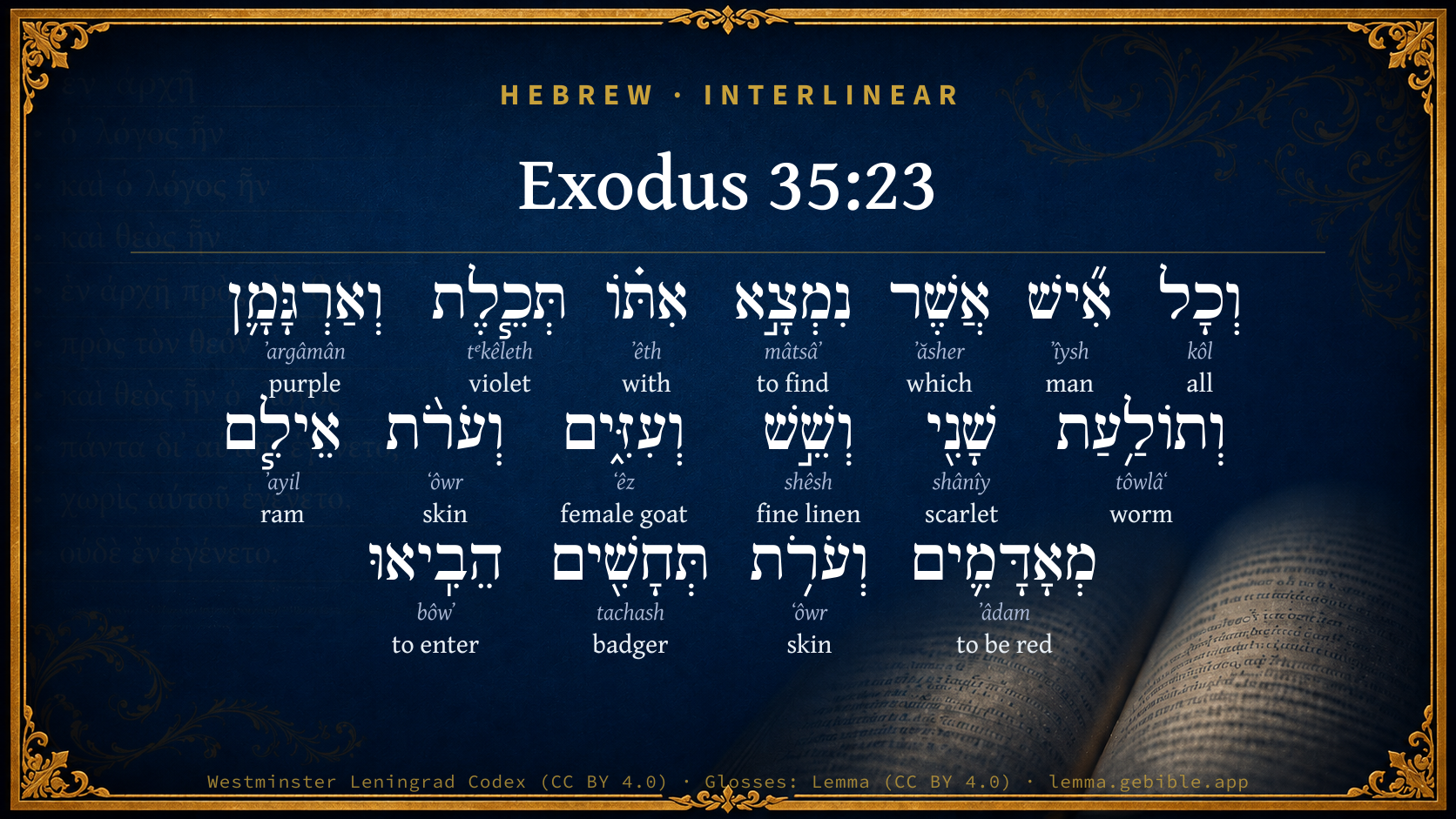
Exodus 35:23

Hebrew (Westminster Leningrad Codex) Exodus 35:23 appears in the Hebrew Old Testament. The text above is from the Westminster Leningrad Codex. Each word links to its Strong’s number, a concise gloss, and parsing drawn from the Open Scriptures Hebrew Bible morphology. Click any word for its full Brown-Driver-Briggs (BDB) entry.
Download image
Cite this verse

Exodus 35:23 (World English Bible). Public Domain. Lemma interlinear Bible study tool, https://lemma.gebible.app/v/exodus/35/23.

Show BibTeX & RIS
BibTeX
RIS
English Translation
Everyone, with whom was found blue, purple, scarlet, fine linen, goats' hair, rams' skins dyed red, and sea cow hides, brought them.
World English Bible · Public Domain
Download a study sheet

One document with this verse’s original text, its word-by-word gloss line, the meaning frame, cross-references with their text, attributed commentary, and full source and license credits — printable, and it pastes into notes with its structure intact.

This verse Autodidact and up

Study sheet (.html) Plain text (.txt)

A passage Seminary Student

Up to 50 verses in one chapter. A passage sheet keeps up to 6 commentary sources and 12 cross-references per verse, in the order this page ranks them, and says so on the sheet whenever that leaves anything out. Ask for a single verse and you get the Autodidact verse sheet above.

Everything on this page stays free to read, with no account — the sheet is a download of what is already on screen, not access to it.

Want to remove ads? Support Godless Engineer
Compare translations 3

The same verse in 3 English versions, stacked beneath the original-language interlinear above. Click any original word for its lexicon entry.

Each is an independent rendering of the whole verse — the interlinear is not word-aligned to these translations.

Highlighted words mark where these versions differ — a whole-verse word diff, not a word-by-word alignment.

  • World English Bible Public Domain
    Everyone, with whom was found blue, purple, scarlet, fine linen, goats' hair, rams' skins dyed red, and sea cow hides, brought them.
  • King James Version Public Domain
    And every man, with whom was found blue, and purple, and scarlet, and fine linen, and goats' hair, and red skins of rams, and badgers' skins, brought them.
  • unfoldingWord Literal Text CC BY-SA 4.0
    And every man with whom was found blue and purple and worm of scarlet and fine linen and goats’ hair and reddened ram skins and hides of sea-cows brought.

unfoldingWord Literal Text — © unfoldingWord, licensed CC BY-SA 4.0. Word-aligned USFM3 via Door43 (git.door43.org/unfoldingWord/en_ult).

Versions to compare (up to 4)

3 of 4 selected

Show all 18 translations

Every available English version of this verse, each an independent rendering of the whole verse.

  • World English Bible Public Domain
    Everyone, with whom was found blue, purple, scarlet, fine linen, goats' hair, rams' skins dyed red, and sea cow hides, brought them.
  • Berean Standard Bible Public Domain
    Everyone who had blue, purple, or scarlet yarn, or fine linen, goat hair, ram skins dyed red, or articles of fine leather, brought them.
  • Majority Standard Bible Public Domain
    Everyone who had blue, purple, or scarlet yarn, or fine linen, goat hair, ram skins dyed red, or articles of fine leather, brought them.
  • King James Version Public Domain
    And every man, with whom was found blue, and purple, and scarlet, and fine linen, and goats' hair, and red skins of rams, and badgers' skins, brought them.
  • American Standard Version (1901) Public Domain
    And every man, with whom was found blue, and purple, and scarlet, and fine linen, and goats' `hair', and rams' skins dyed red, and sealskins, brought them.
  • Revised Version (1885) Public Domain
    And every man, with whom was found blue, and purple, and scarlet, and fine linen, and goats’ hair, and rams’ skins dyed red, and sealskins, brought them.
  • Geneva Bible (1599) Public Domain
    Euery man also, which had blewe silke, and purple, and skarlet, and fine linen, and goates heare, and rammes skinnes died red, and badgers skins, brought them.
  • Douay-Rheims (1899) Public Domain
    If any man had violet, and purple, and scarlet twice dyed, fine linen and goats' hair, rams' skins dyed red, and violet coloured skins,
  • Young's Literal Translation Public Domain
    And every man with whom hath been found blue, and purple, and scarlet, and linen, and goats' `hair', and rams' skins made red, and badgers' skins, have brought `them' in;
  • Literal Standard Version CC BY-SA 4.0
    And every man with whom has been found blue, and purple, and scarlet, and linen, and goats’ [hair], and rams’ skins made red, and tachashim skins, have brought [them] in;
  • Unlocked Literal Bible CC BY-SA 4.0
    Everyone who had blue, purple, or scarlet wool, fine linen, goat hair, ram skins dyed red, or sea cow skins brought them.
  • unfoldingWord Literal Text CC BY-SA 4.0
    And every man with whom was found blue and purple and worm of scarlet and fine linen and goats’ hair and reddened ram skins and hides of sea-cows brought.
  • Darby Bible Public Domain
    And every man with whom was found blue, and purple, and scarlet, and byssus, and goats' [hair], and rams' skins dyed red, and badgers' skins, brought [them].
  • World Messianic Bible Public Domain
    Everyone with whom was found blue, purple, scarlet, fine linen, goats’ hair, rams’ skins dyed red, and sea cow hides, brought them.
  • Webster's Bible Public Domain
    And every man, with whom was found blue, and purple, and scarlet, and fine linen, and goats' hair, and red skins of rams, and badgers' skins, brought them.
  • Free Bible Version CC BY-SA 4.0
    Everyone who had blue, purple, and crimson thread, finely-woven linen, goat hair, tanned ram skins, and fine leather, contributed them.
  • Bible in Basic English Public Domain
    And everyone who had blue and purple and red and the best linen and goats' hair and sheepskins coloured red and leather, gave them.
  • JPS Tanakh (1917) Public Domain
    And every man, with whom was found blue, and purple, and scarlet, and fine linen, and goats' hair, and rams' skins dyed red, and sealskins, brought them.

Literal Standard Version (2020), Covenant Press — licensed CC BY-SA 4.0. Text via the HelloAO Bible API (eBible.org). Unlocked Literal Bible (unfoldingWord) — licensed CC BY-SA 4.0. Text via the HelloAO Bible API (eBible.org). unfoldingWord Literal Text — © unfoldingWord, licensed CC BY-SA 4.0. Word-aligned USFM3 via Door43 (git.door43.org/unfoldingWord/en_ult). Free Bible Version, Dr. Jonathan Gallagher — licensed CC BY-SA 4.0. Text via the HelloAO Bible API (eBible.org).

Word by word

More ways to search: Search by grammar → Find every occurrence → Compare this word →

Practice this passage: Drill this verse → Learn its vocabulary →

מְאָדָּמִ֛ים
ʼâdam
H119
“red”
Verb, Pual, Participle Passive, Masculine, Plural, Absolute
Part of Speech
Verb
Stem
Pual
Form
Participle Passive
Gender
Masculine
Number
Plural
State
Absolute
Full BDB Definition

Origin: of unknown derivation

TWOT: 26b

to be red, red - (Qal) ruddy (of Nazarites) - (Pual) - to be rubbed red - dyed red - reddened - (Hiphil) - to cause to show red - to glare - to emit (show) redness - (Hithpael) - to redden - to grow red - to look red
  1. וְכָל kôl H3605 “and · all of” Conjunction + Noun, Common, Masculine, Singular, Construct
  2. אִ֞ישׁ ʼîysh H376 “man” Noun, Common, Masculine, Singular, Absolute
  3. אֲשֶׁר ʼăsher H834 “which” Particle, Relative
  4. נִמְצָ֣א mâtsâʼ H4672 “to find” Verb, Niphal, Perfect, 3rd Person, Masculine, Singular
  5. אִתּ֗וֹ ʼêth H854 “with · him” Preposition + Suffix, Personal, 3rd Person, Masculine, Singular
  6. תְּכֵ֧לֶת tᵉkêleth H8504 “violet” Noun, Common, Feminine, Singular, Absolute
  7. וְאַרְגָּמָ֛ן ʼargâmân H713 “and · purple” Conjunction + Noun, Common, Masculine, Singular, Absolute
  8. וְתוֹלַ֥עַת tôwlâʻ H8438 “and · worm of” Conjunction + Noun, Common, Feminine, Singular, Construct
  9. שָׁנִ֖י shânîy H8144 “scarlet” Noun, Common, Masculine, Singular, Absolute
  10. וְשֵׁ֣שׁ shêsh H8336 “and · fine linen” Conjunction + Adjective, Cardinal number, Feminine, Singular, Absolute
  11. וְעִזִּ֑ים ʻêz H5795 “and · female goats” Conjunction + Noun, Common, Feminine, Plural, Absolute
  12. וְעֹרֹ֨ת ʻôwr H5785 “and · skins of” Conjunction + Noun, Common, Masculine, Plural, Construct
  13. אֵילִ֧ם ʼayil H352 “rams” Noun, Common, Masculine, Plural, Absolute
  14. וְעֹרֹ֥ת ʻôwr H5785 “and · skins of” Conjunction + Noun, Common, Masculine, Plural, Construct
  15. תְּחָשִׁ֖ים tachash H8476 “badgers” Noun, Common, Masculine, Plural, Absolute
  16. הֵבִֽיאוּ bôwʼ H935 “to enter” Verb, Hiphil, Perfect, 3rd Person, Common, Plural

About this verse

These counts appear in no published source. They are computed here, from the morphology-tagged text and Lemma’s own curated glosses. What Lemma adds →

17
words
16
distinct lemmas
Pentateuch
section

Notable vocabulary

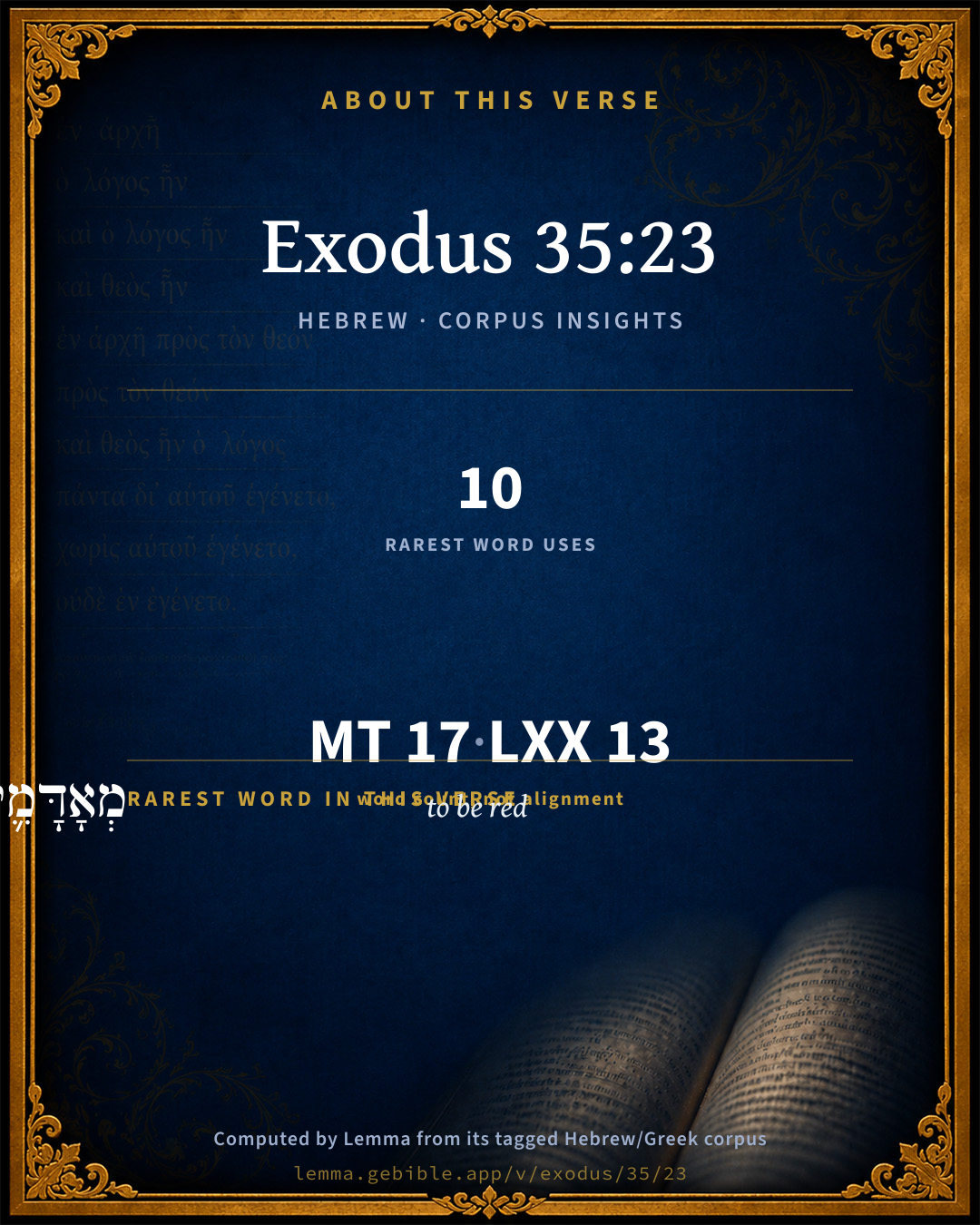
The rarest word here is מְאָדָּמִ֛ים to be red H119 — appearing just 10 times in the whole Hebrew Bible.

Shared distinctive vocabulary

מְאָדָּמִ֛ים to be red H119 occurs in 10 verses of the Hebrew Bible. Also found in:

Grammatical profile

  • 3 verbs
  • 11 nouns
  • 1 adjective
  • 1 preposition
  • 1 particle

Verb forms

  • נִמְצָ֣א Niphal · Perfect
  • מְאָדָּמִ֛ים Pual · Participle Passive
  • הֵבִֽיאוּ Hiphil · Perfect

Repetition

A word recurs within this verse — often emphatic in Hebrew:

  • וְעֹרֹ֨ת skin H5785 ×2

Hebrew & Septuagint length

In English translation the verse runs 22 words from the Hebrew and 30 from the Septuagint (LXX English) — closely comparable.

A rough comparison of the two English renderings, which tokenize alike — not a word-level alignment.

Word counts can differ between the Hebrew and the Greek without any difference in meaning — e.g. the Hebrew direct-object marker אֵת has no separate Greek word, and Greek often adds the article ὁ.

In the original languages it is 17 Hebrew tokens and 13 Greek tokens — but the two are counted differently (Hebrew bundles its prefixes and suffixes into one token; the Greek is in lemma form), so that isn’t a like-for-like length.

Cross-references

3

Topical passages linked to Exodus 35:23 in the Treasury of Scripture Knowledge — connected by theme and wording, ordered by reader-vote popularity; previews shown in the World English Bible.

  • 1 Chronicles 29:8 They with whom [precious] stones were found gave them to the treasure of the house of Yahweh, under the hand of Jehiel the Gershonite.
  • Exodus 25:2–7 "Speak to the children of Israel, that they take an offering for me. From everyone whose heart makes him willing you shall take my offering.
  • Exodus 35:6–10 blue, purple, scarlet, fine linen, goats' hair,

Cross-references courtesy of OpenBible.info (CC BY 4.0).

Hebrew and Greek witnesses Masoretic Hebrew ↔ Greek Septuagint

The same verse in the two great witnesses to the Old Testament, shown verse-for-verse.

These are two independent witnesses, not word-aligned to each other, and the Septuagint is shown in lemma (dictionary) form.

Hebrew Exodus 35:23 Masoretic · Westminster Leningrad Codex

וְכָל אִ֞ישׁ אֲשֶׁר נִמְצָ֣א אִתּ֗וֹ תְּכֵ֧לֶת וְאַרְגָּמָ֛ן וְתוֹלַ֥עַת שָׁנִ֖י וְשֵׁ֣שׁ וְעִזִּ֑ים וְעֹרֹ֨ת אֵילִ֧ם מְאָדָּמִ֛ים וְעֹרֹ֥ת תְּחָשִׁ֖ים הֵבִֽיאוּ

Everyone, with whom was found blue, purple, scarlet, fine linen, goats' hair, rams' skins dyed red, and sea cow hides, brought them.

World English Bible · Public Domain

Greek LXX Exodus 35:23 Septuagint · lemma form

καί παρά ὅς εὑρίσκω βύσσος καί δέρμα ὑακίνθινος καί δέρμα κριός ἐρυθροδανόω φέρω

And all as many as brought ornaments of gold to the Lord, and with whoever fine linen was found; and they brought skins dyed blue, and rams' skins dyed red.

LXX2012 (modern English Septuagint) · Public Domain

Hebrew: Westminster Leningrad Codex (CC BY 4.0). Greek: Septuagint (public domain); English from LXX2012 (modern English Septuagint) (Public Domain). How the Septuagint differs from the Hebrew →

Targum (Aramaic paraphrase)

2

The Targum is the ancient Jewish Aramaic paraphrase of the Hebrew Scriptures — an interpretive translation, not the Hebrew text itself. Onkelos (literal) and Pseudo-Jonathan (expansive) render the Torah, and Jonathan the Prophets. Coverage is partial: where no permissively-licensed English translation exists for a verse, only the Aramaic is shown. This is verse-level text, not a word-by-word alignment to the Hebrew.

  1. Targum Onkelos Torah (Genesis–Deuteronomy)
    וְכָל גְבַר דְאִשְׁתְּכַח עִמֵהּ תִּכְלָא וְאַרְגְוָנָא וּצְבַע זְהוֹרִי וּבוּץ וּמֵעַזֵי וּמַשְׁכֵי דְדִכְרֵי מְסַמְקֵי וּמַשְׁכֵי סַסְגוֹנָא אַיְתִיאוּ:

    (no public-domain English translation for this verse)

    Targum Onkelos — Aramaic: “Onkelos Genesis” (public domain); “Onkelos Exodus” (public domain); “Onkelos Leviticus” (public domain); “Onkelos Numbers” (public domain); “Onkelos Deuteronomy” (public domain). English: “Sefaria Community Translation” (CC0 1.0 (public-domain dedication)); “J.W. Etheridge. The Targums of Onkelos and Jonathan Ben Uzziel on the Pentateuch. London: Longmans, Green, 1862” (public domain). Text via Sefaria.

  2. Targum Pseudo-Jonathan Torah (Genesis–Deuteronomy)
    וְכָל גְּבַר דְּהִשְׁתַּכַּח עִמֵּיהּ תִּכְלָא וְאַרְגְּוָונָא וּצְבַע זְהוֹרֵי וּבוּץ וּמְעִיזֵי וּמַשְׁכֵי דְדִכְרֵי מְסַמְקֵי וּמַשְׁכֵי סַסְגוֹנָא הַיְיתִיוּ

    And every one with whom was found hyacinth, or purple, or crimson, or fine linen, goats' hair, or purple skins, brought the separation before the Lord; ___

    Targum Pseudo-Jonathan — Aramaic: “Targum Jonathan on Genesis” (public domain); “Targum Jonathan on Exodus” (public domain); “Targum Jonathan on Leviticus” (public domain); “Targum Jonathan on Numbers” (public domain); “Targum Jonathan on Deuteronomy” (public domain). English: “The Targum of Jonathan ben Uzziel, trans. J. W. Etheridge, London, 1862” (public domain). Text via Sefaria.

Commentary

Notes on Exodus 35:23 from classic Christian and Jewish commentators (each source and its license shown beneath its notes). The classic Christian expositions comment on the surrounding passage and are grouped to its opening verse, so a note may address several verses; the Jewish commentaries on the Tanakh (Rashi and others) are per-verse, so they appear only where the commentator wrote on this verse.

Lemma curates 59 commentaries, every one of them public domain or Creative Commons licensed, each selected and text-cleaned for this edition rather than reprinted as found. About our sources →

unfoldingWord translationNotes

Door43 World Missions Community

Everyone who had ... brought them

For Exo 35:23 see how you translated many of these words in Exodus 25:4-5.

translationWords

goat

ewe

sacrifice

silver

bronze

Yahweh

acacia

unfoldingWord translationNotes — © Distant Shores Media and the Door43 World Missions Community, licensed CC BY-SA 4.0. Source: git.door43.org/Door43/en_tn.

Ellicott's Commentary for English Readers

(23) Red skins of rams.—Rather, rams’ skins dyed red, as the same words are translated in Exo_25:5; Exo_35:7.

Badgers’ skins.—See Note 2 on Exo_25:5.

A Bible Commentary for English Readers, edited by Charles John Ellicott (1878–1897) — public domain. Text from a community e-Sword module.

The Cambridge Bible for Schools and Colleges

gen. ed. J. J. S. Perowne

23, 24. The contributions of the men; viz. the other things mentioned in vv. 6, 7 (= Exo_25:3-5).

The Cambridge Bible for Schools and Colleges (gen. ed. J. J. S. Perowne; Cambridge University Press, 1878–1918) — public domain. Text from a community e-Sword module.

John Gill's Exposition

Every one that did offer an offering of silver and brass brought the Lord's offering,.... Every one that had any quantity of either of these, whose heart was inclined freely to part therewith, brought it as a freewill offering to the Lord:

and every man with whom was shittim wood; or acacia, a sort of wood which grew pretty plentifully in those parts; and such who had cut it down for some use or another, and were disposed to part with it

for any work of the service; of which many things were to be made, whether they were trees they had felled, or planks and boards they had cut them into:

brought it; a sufficient quantity of it, for the various uses it was to be put unto.

John Gill's Exposition of the Whole Bible (1746–1763) — public domain (CC PDM 1.0). Text via the HelloAO Bible API.

The Pulpit Commentary

Red skins of rams. The words are the same as those translated "rams" skins dyed red" in Exo_25:5. The earlier rendering is the better one. Badger skins. Rather, "seal skins." See the comment on Exo_25:5.

The Pulpit Commentary (1880–1919), ed. H.D.M. Spence-Jones & Joseph S. Exell — public domain. Text from a community e-Sword module.

Rashi

Rabbi Shlomo Yitzchaki (Rashi)

וכל איש אשר נמצא אתו AND EVERY MAN WITH WHOM WAS FOUND blue purple, or red purple, or crimson, or rams’ skins, or tachash skins — all of them brought whatever they had.

Rashi on the Tanakh — English translations: “The Judaica Press complete Tanach with Rashi, translated by A. J. Rosenberg” (CC BY 4.0); “Pentateuch with Rashi's commentary by M. Rosenbaum and A.M. Silbermann, 1929-1934” (public domain); “The Metsudah Tanach series, Lakewood, N.J” (CC BY 4.0); and “The Book of Joshua, Metsudah Publications, 1997” (CC BY 4.0). Text via Sefaria.

Lesson kit

Teaching starters — assembled from the data on this page, not authored interpretation. Every prompt links to the verse data it draws on. Edit before teaching.

Exodus, in the Pentateuch, opens this verse with 17 words (16 distinct Hebrew lemmas). Its most distinctive word is ʼâdam (“to be red”). A historical commentator’s framing appears above. Read the whole chapter for the surrounding context.

Discussion questions

  1. How does “to be red” (ʼâdam) shape what this verse is saying?
  2. How does Exodus 25:5, which shares the word «to be red», read alongside this verse?
  3. What does the repetition of “skin” (2× in this one verse) do in this verse?
  4. These translations render this verse differently. What is at stake in choosing one wording over another?
  5. «נִמְצָ֣א» is a Niphal Perfect verb. How does that grammatical form shape the action described?
  6. Compare how unfoldingWord translationNotes and Ellicott's Commentary for English Readers read this verse. Where do they agree or differ?

Things to notice

Reading settings

Reading text

Shown beneath each verse's original-language words.

Old Testament
Old Testament edition

Read the OT as the Masoretic Hebrew (MT) or the Greek Septuagint (LXX).

English shown for the Greek Septuagint (in the Hebrew ↔ Greek comparison).

Comparing translations? Open the Compare panel on any verse page to stack up to four side by side.