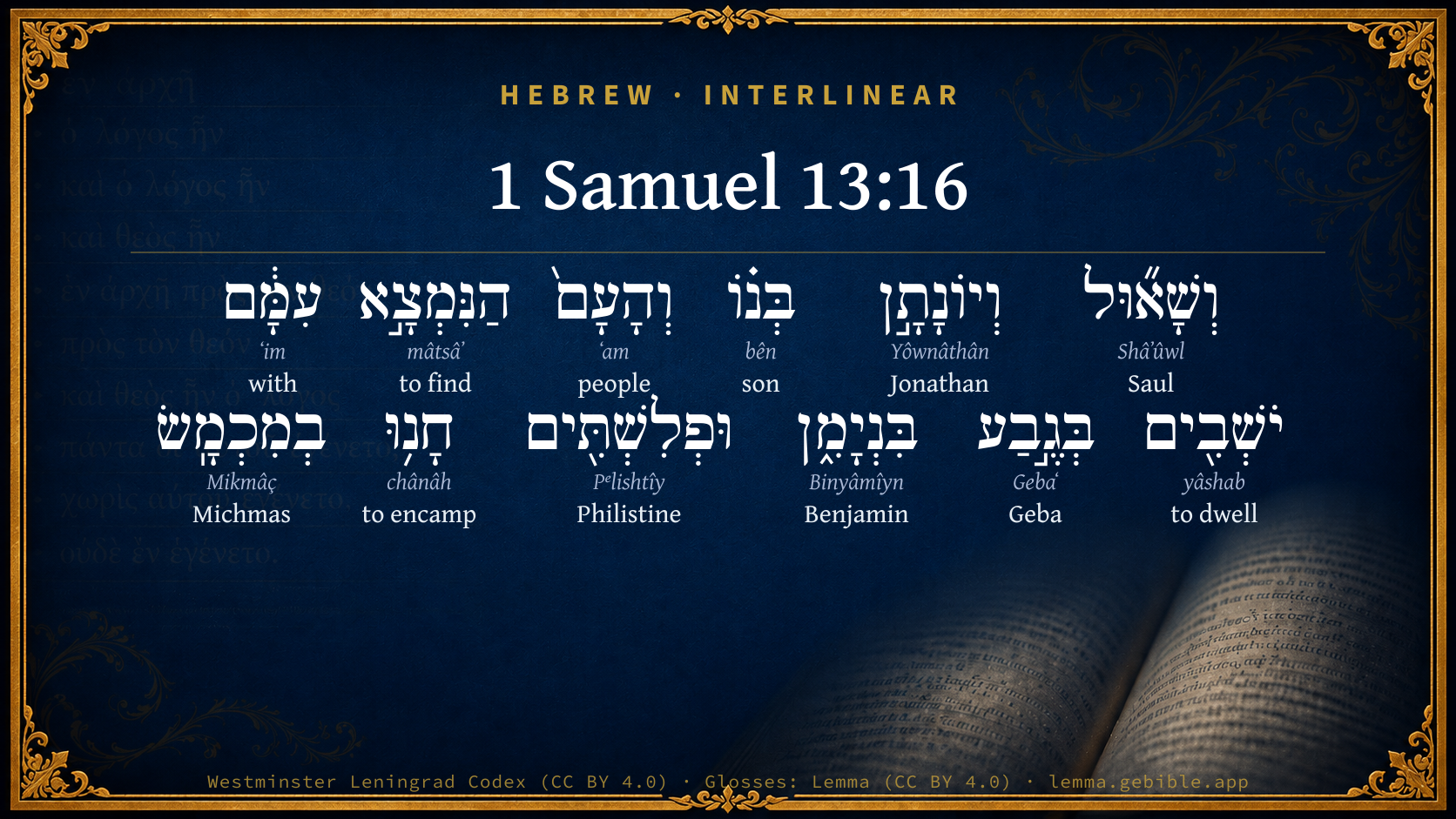
1 Samuel 13:16

Hebrew (Westminster Leningrad Codex) 1 Samuel 13:16 appears in the Hebrew Old Testament. The text above is from the Westminster Leningrad Codex. Each word links to its Strong’s number, a concise gloss, and parsing drawn from the Open Scriptures Hebrew Bible morphology. Click any word for its full Brown-Driver-Briggs (BDB) entry.
Download image
Cite this verse

1 Samuel 13:16 (World English Bible). Public Domain. Lemma interlinear Bible study tool, https://lemma.gebible.app/v/1-samuel/13/16.

Show BibTeX & RIS
BibTeX
RIS
English Translation
Saul, and Jonathan his son, and the people who were present with them, abode in Geba of Benjamin: but the Philistines encamped in Michmash.
World English Bible · Public Domain
Download a study sheet

One document with this verse’s original text, its word-by-word gloss line, the meaning frame, cross-references with their text, attributed commentary, and full source and license credits — printable, and it pastes into notes with its structure intact.

This verse Autodidact and up

Study sheet (.html) Plain text (.txt)

A passage Seminary Student

Up to 50 verses in one chapter. A passage sheet keeps up to 6 commentary sources and 12 cross-references per verse, in the order this page ranks them, and says so on the sheet whenever that leaves anything out. Ask for a single verse and you get the Autodidact verse sheet above.

Everything on this page stays free to read, with no account — the sheet is a download of what is already on screen, not access to it.

Want to remove ads? Support Godless Engineer
Compare translations 3

The same verse in 3 English versions, stacked beneath the original-language interlinear above. Click any original word for its lexicon entry.

Each is an independent rendering of the whole verse — the interlinear is not word-aligned to these translations.

Highlighted words mark where these versions differ — a whole-verse word diff, not a word-by-word alignment.

  • World English Bible Public Domain
    Saul, and Jonathan his son, and the people who were present with them, abode in Geba of Benjamin: but the Philistines encamped in Michmash.
  • King James Version Public Domain
    And Saul, and Jonathan his son, and the people that were present with them, abode in Gibeah of Benjamin: but the Philistines encamped in Michmash.
  • unfoldingWord Literal Text CC BY-SA 4.0
    Now Saul and Jonathan his son and the people being found with them were staying in Geba of Benjamin, and the Philistines had camped at Michmash.

unfoldingWord Literal Text — © unfoldingWord, licensed CC BY-SA 4.0. Word-aligned USFM3 via Door43 (git.door43.org/unfoldingWord/en_ult).

Versions to compare (up to 4)

3 of 4 selected

Show all 18 translations

Every available English version of this verse, each an independent rendering of the whole verse.

  • World English Bible Public Domain
    Saul, and Jonathan his son, and the people who were present with them, abode in Geba of Benjamin: but the Philistines encamped in Michmash.
  • Berean Standard Bible Public Domain
    Now Saul and Jonathan his son and the troops with them were staying in Geba of Benjamin, while the Philistines camped at Michmash.
  • Majority Standard Bible Public Domain
    Now Saul and Jonathan his son and the troops with them were staying in Geba of Benjamin, while the Philistines camped at Michmash.
  • King James Version Public Domain
    And Saul, and Jonathan his son, and the people that were present with them, abode in Gibeah of Benjamin: but the Philistines encamped in Michmash.
  • American Standard Version (1901) Public Domain
    And Saul, and Jonathan his son, and the people that were present with them, abode in Geba of Benjamin: but the Philistines encamped in Michmash.
  • Revised Version (1885) Public Domain
    And Saul, and Jonathan his son, and the people that were present with them, abode in Geba of Benjamin: but the Philistines encamped in Michmash.
  • Geneva Bible (1599) Public Domain
    And Saul and Ionathan his sonne, and the people that were found with them, had their abiding in Gibeah of Beniamin: but the Philistims pitched in Michmash.
  • Douay-Rheims (1899) Public Domain
    And Saul and Jonathan his son, and the people that were present with them, were in Gabaa of Benjamin: but the Philistines encamped in Machmas.
  • Young's Literal Translation Public Domain
    and Saul, and Jonathan his son, and the people who are found with them, are abiding in Gibeah of Benjamin, and the Philistines have encamped in Michmash.
  • Literal Standard Version CC BY-SA 4.0
    and Saul, and his son Jonathan, and the people who are found with them, are abiding in Gibeah of Benjamin, and the Philistines have encamped in Michmash.
  • Unlocked Literal Bible CC BY-SA 4.0
    Saul, his son Jonathan, and the people who were present with them, stayed in Geba of Benjamin. But the Philistines camped at Michmash.
  • unfoldingWord Literal Text CC BY-SA 4.0
    Now Saul and Jonathan his son and the people being found with them were staying in Geba of Benjamin, and the Philistines had camped at Michmash.
  • Darby Bible Public Domain
    And Saul, and Jonathan his son, and the people that were found with them, abode in Geba of Benjamin; and the Philistines encamped in Michmash.
  • World Messianic Bible Public Domain
    Saul, and Jonathan his son, and the people who were present with them, stayed in Geba of Benjamin; but the Philistines encamped in Michmash.
  • Webster's Bible Public Domain
    And Saul, and Jonathan his son, and the people that were present with them, abode in Gibeah of Benjamin: but the Philistines encamped in Michmash.
  • Free Bible Version CC BY-SA 4.0
    Saul, his son Jonathan, and the soldiers with them were staying in Geba of Benjamin, while the Philistines were camped at Michmash.
  • Bible in Basic English Public Domain
    And Saul, with Jonathan his son and the people who were with them, was waiting in Geba in the land of Benjamin: but the tents of the Philistines were in Michmash.
  • JPS Tanakh (1917) Public Domain
    And Saul, and Jonathan his son, and the people that were present with them, abode in Gibeath-benjamin; but the Philistines encamped in Michmas.

Literal Standard Version (2020), Covenant Press — licensed CC BY-SA 4.0. Text via the HelloAO Bible API (eBible.org). Unlocked Literal Bible (unfoldingWord) — licensed CC BY-SA 4.0. Text via the HelloAO Bible API (eBible.org). unfoldingWord Literal Text — © unfoldingWord, licensed CC BY-SA 4.0. Word-aligned USFM3 via Door43 (git.door43.org/unfoldingWord/en_ult). Free Bible Version, Dr. Jonathan Gallagher — licensed CC BY-SA 4.0. Text via the HelloAO Bible API (eBible.org).

Word by word

More ways to search: Search by grammar → Find every occurrence → Compare this word →

Practice this passage: Drill this verse → Learn its vocabulary →

בְמִכְמָֽשׂ
Mikmâç
H4363
“in/at · Michmas”
Preposition + Noun, Proper
Part of Speech
Preposition + Noun
Type
Proper
Full BDB Definition

Origin: from H3647

TWOT: None

Michmas or Michmash = "hidden" - a city in Benjamin lying near Ramah and approximately 10 miles
  1. וְשָׁא֞וּל Shâʼûwl H7586 “and · Saul” Conjunction + Noun, Proper
  2. וְיוֹנָתָ֣ן Yôwnâthân H3129 “and · Jonathan” Conjunction + Noun, Proper
  3. בְּנ֗וֹ bên H1121 “son · his” Noun, Common, Masculine, Singular, Construct + Suffix, Personal, 3rd Person, Masculine, Singular
  4. וְהָעָם֙ ʻam H5971 “and · the · people” Conjunction + Particle, Definite Article + Noun, Common, Masculine, Singular, Absolute
  5. הַנִּמְצָ֣א mâtsâʼ H4672 “the · finding” Particle, Definite Article + Verb, Niphal, Participle Active, Masculine, Singular, Absolute
  6. עִמָּ֔ם ʻim H5973 “with · them” Preposition + Suffix, Personal, 3rd Person, Masculine, Plural
  7. יֹשְׁבִ֖ים yâshab H3427 “dwelling” Verb, Qal, Participle Active, Masculine, Plural, Absolute
  8. בְּגֶ֣בַע Gebaʻ H1387 “in/at · Geba” Preposition + Noun, Proper
  9. בִּנְיָמִ֑ן Binyâmîyn H1144 “Benjamin” Noun, Proper
  10. וּפְלִשְׁתִּ֖ים Pᵉlishtîy H6430 “and · Philistines” Conjunction + Noun, Gentilic, Masculine, Plural, Absolute
  11. חָנ֥וּ chânâh H2583 “to encamp” Verb, Qal, Perfect, 3rd Person, Common, Plural

About this verse

These counts appear in no published source. They are computed here, from the morphology-tagged text and Lemma’s own curated glosses. What Lemma adds →

12
words
12
distinct lemmas
Historical
section

Notable vocabulary

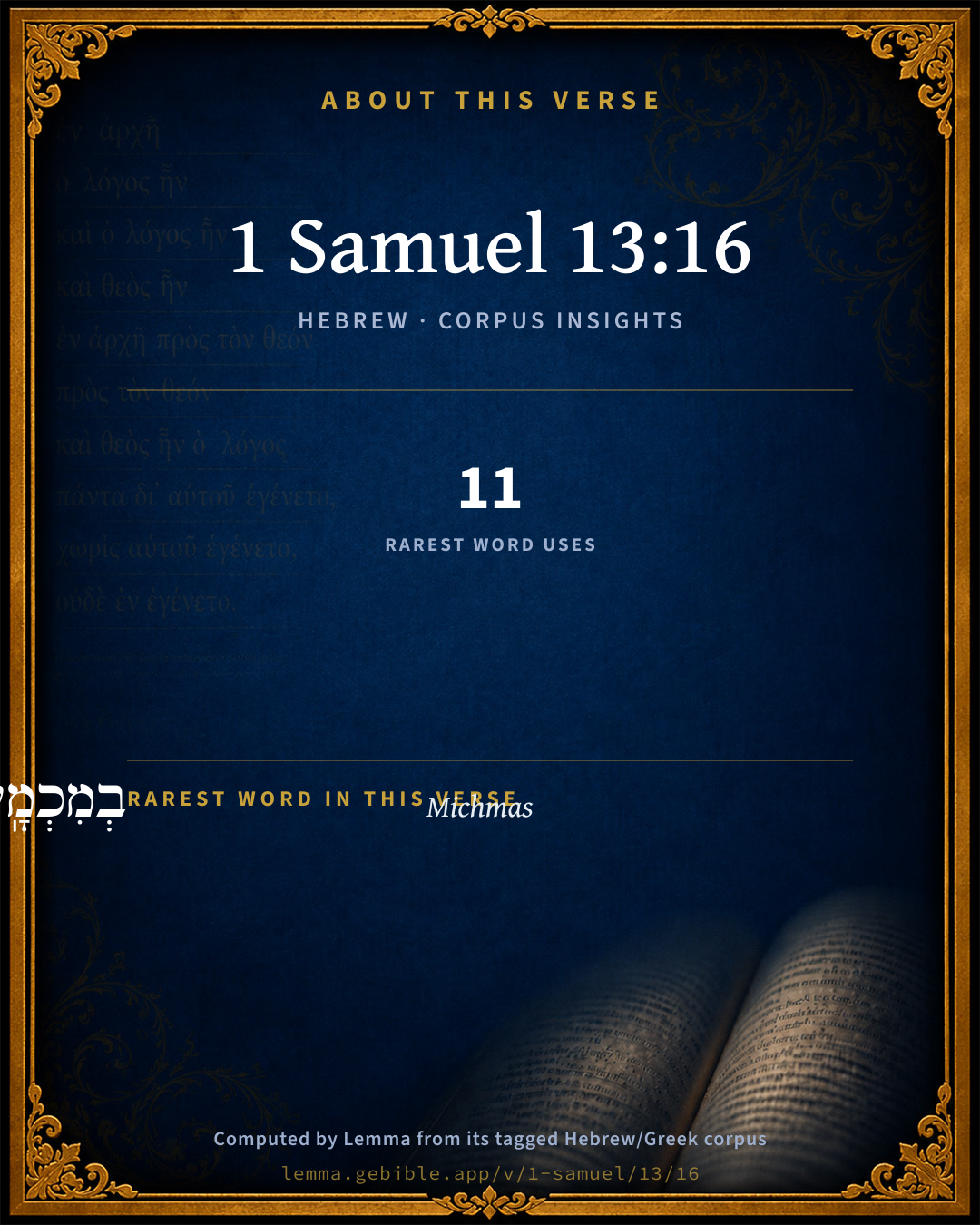
The rarest word here is בְמִכְמָֽשׂ Michmas H4363 — appearing just 11 times in the whole Hebrew Bible.

Shared distinctive vocabulary

בְמִכְמָֽשׂ Michmas H4363 occurs in 11 verses of the Hebrew Bible. Also found in:

Grammatical profile

  • 3 verbs
  • 8 nouns
  • 1 preposition

Verb forms

  • הַנִּמְצָ֣א Niphal · Participle Active
  • יֹשְׁבִ֖ים Qal · Participle Active
  • חָנ֥וּ Qal · Perfect

Hebrew & Septuagint length

In English translation the verse runs 24 words from the Hebrew and 29 from the Septuagint (LXX English) — closely comparable.

A rough comparison of the two English renderings, which tokenize alike — not a word-level alignment.

Word counts can differ between the Hebrew and the Greek without any difference in meaning — e.g. the Hebrew direct-object marker אֵת has no separate Greek word, and Greek often adds the article ὁ.

Cross-references

1

Topical passages linked to 1 Samuel 13:16 in the Treasury of Scripture Knowledge — connected by theme and wording, ordered by reader-vote popularity; previews shown in the World English Bible.

  • 1 Samuel 13:3 Jonathan struck the garrison of the Philistines that was in Geba: and the Philistines heard of it. Saul blew the trumpet throughout all the land, saying, Let the Hebrews hear.

Cross-references courtesy of OpenBible.info (CC BY 4.0).

Hebrew and Greek witnesses Masoretic Hebrew ↔ Greek Septuagint

The same verse in the two great witnesses to the Old Testament, shown verse-for-verse.

These are two independent witnesses, not word-aligned to each other, and the Septuagint is shown in lemma (dictionary) form.

Hebrew 1 Samuel 13:16 Masoretic · Westminster Leningrad Codex

וְשָׁא֞וּל וְיוֹנָתָ֣ן בְּנ֗וֹ וְהָעָם֙ הַנִּמְצָ֣א עִמָּ֔ם יֹשְׁבִ֖ים בְּגֶ֣בַע בִּנְיָמִ֑ן וּפְלִשְׁתִּ֖ים חָנ֥וּ בְמִכְמָֽשׂ

Saul, and Jonathan his son, and the people who were present with them, abode in Geba of Benjamin: but the Philistines encamped in Michmash.

World English Bible · Public Domain

Greek LXX 1 Samuel 13:16 Septuagint · lemma form

καί σαούλ καί ιωναθαν υἱός αὐτός καί ὁ λαός ὁ εὑρίσκω μετά αὐτός καταἵζω ἐν γαβεε βενιαμίν καί κλαίω καί ὁ ἀλλόφυλος παρα ἐνβάλλω εἰς μαχεμας

And Saul and Jonathan his son, and the people that were found with them, halted in Gabaa, of Benjamin; and they wept: and the Philistines had encamped in Machmas.

LXX2012 (modern English Septuagint) · Public Domain

On this verse, Keil & Delitzsch discusses the Septuagint’s reading. Read the note in Commentary ↓

Hebrew: Westminster Leningrad Codex (CC BY 4.0). Greek: Septuagint (public domain); English from LXX2012 (modern English Septuagint) (Public Domain). How the Septuagint differs from the Hebrew →

Targum (Aramaic paraphrase)

1

The Targum is the ancient Jewish Aramaic paraphrase of the Hebrew Scriptures — an interpretive translation, not the Hebrew text itself. Onkelos (literal) and Pseudo-Jonathan (expansive) render the Torah, and Jonathan the Prophets. Coverage is partial: where no permissively-licensed English translation exists for a verse, only the Aramaic is shown. This is verse-level text, not a word-by-word alignment to the Hebrew.

  1. Targum Jonathan Prophets (Joshua–Malachi)
    וְשָׁאוּל וְיוֹנָתָן בְּרֵיהּ וְעַמָא דְאִשְׁתְּכַח עִמְהוֹן יַתְבִין בְּגִבְעֲתָא דְבֵית בִּנְיָמִן וּפְלִשְׁתָּאֵי שְׁרוֹ בְמִכְמָשׁ:

    (no public-domain English translation for this verse)

    Targum Jonathan — Aramaic: “Mikraot Gedolot” (public domain). English: “Sefaria Community Translation” (CC0 1.0 (public-domain dedication)); “London "Chaldee Paraphrase," 1871” (public domain). Text via Sefaria.

Commentary

Notes on 1 Samuel 13:16 from classic Christian and Jewish commentators (each source and its license shown beneath its notes). The classic Christian expositions comment on the surrounding passage and are grouped to its opening verse, so a note may address several verses; the Jewish commentaries on the Tanakh (Rashi and others) are per-verse, so they appear only where the commentator wrote on this verse.

Lemma curates 59 commentaries, every one of them public domain or Creative Commons licensed, each selected and text-cleaned for this edition rather than reprinted as found. About our sources →

Trapp's Complete Commentary

John Trapp

1Sa 13:16 And Saul, and Jonathan his son, and the people [that were] present with them, abode in Gibeah of Benjamin: but the Philistines encamped in Michmash.

Ver. 16. Abode in Gibeah of Benjamin.] His own country, where he was likely to have the best assistance of his allies, but especially of Samuel’s good company and prayers.

John Trapp, A Commentary or Exposition upon All the Books of the Old and New Testament (1647–1656) — public domain. Text from a community e-Sword module.

Whedon's Commentary on the Bible

Daniel D. Whedon

POSITION, MOVEMENTS, AND CONDITION OF THE TWO ARMIES, 1Sa_13:16-23.

16. Gibeah of Benjamin — Rather, Geba, according to the margin, for this also was a city of Benjamin. Jos_18:24; Jos_21:17. Many interpreters have, like our translators, confounded this place with Gibeah; but it was some three miles distant. See on 1Sa_13:3. It is quite likely that after he had smitten the Philistine garrison Jonathan held this place, and did not withdraw to Gilgal with his father; and after Saul’s unsuccessful attempt to muster the people at Gilgal, that monarch, with the six hundred that did not desert him, went up to reinforce Jonathan at Geba. The Philistine army lay encamped upon the heights of Michmash, in full view of Saul and Jonathan, and separated by a deep valley between.

Daniel D. Whedon (gen. ed.), Commentary on the Old and New Testaments (1874–1909) — public domain. Text from a community e-Sword module.

Keil & Delitzsch

C. F. Keil & F. Delitzsch

Disarming of Israel by the Philistines. - The following account is no doubt connected with the foregoing, so far as the facts are concerned, inasmuch as Jonathan's brave heroic deed, which brought the Israelites a splendid victory over the Philistines, terminated the war for which Saul had entreated the help of God by his sacrifice at Gilgal; but it is not formally connected with it, so as to form a compact and complete account of the successive stages of the war. On the contrary, the 16th verse, where we have an account of the Israelitish warriors and their enemies, commences a new section of the history, in which the devastating march of the Philistines through the land, and the disarming of the Israelites by these their enemies, are first of all depicted (Sa1 13:17-23); and then the victory of the Israelites through Jonathan's daring and heroic courage, notwithstanding their utter prostration, is recorded (1 Samuel 14:1-46), for the purpose of showing how the Lord had miraculously helped His people.

(Note: From this arrangement of the history, according to which the only two points that are minutely described in connection with the war with the Philistines are those which bring out the attitude of the king, whom the nation had desired to deliver it from its foes, towards Jehovah, and the way in which Jehovah acted towards His people, whilst all the rest is passed over, we may explain the absence of any closer connection between Sa1 13:15 and Sa1 13:16, and not from a gap in the text. The lxx, however, adopted the latter supposition, and according to the usual fashion filled up the gap by expanding Sa1 13:15 in the following thoughtless manner: καὶ ἀνέστη Σαμουὴλ καὶ ἀπῆλθεν ἐκ Γαλγάλων· καὶ τὸ κατάλειμμα τοῦ λαοῦ ἀνεβη ὀπίσω Σαοὺλ εἰς ἀπάντησιν ὀπίσω τοῦ λαοῦ τοῦ πολεμιστοῦ· αὐτῶν παραγενομένων ἐκ Γαλγάλων εἰς Γαβαὰ Βενιαμὶν καὶ ἐπεσκέψατο Σαοὺλ, κ.τ.λ. For there is no sense in εἰς ἀπάντησιν ὀπίσω, and the whole thought, that the people who were left went up after Saul to meet the people of war, is unintelligible, since it is not stated whence the people of war had come, who are said to have met with those who had remained behind with Saul, and to have gone up with him from Gilgal to Gibeah. If, however, we overlook this, and assume that when Saul returned from Gilgal to Gibeah a further number of fighting men came to him from different parts of the land, how does this assumption agree with the account which follows, viz., that when Saul mustered the people he found only six hundred men, - a statement which is repeated again in Sa1 14:2? The discrepancy remains even if we adopt Ewald's conjecture (Gesch. iii. 43), that εἰς ἀπάντησιν is a false rendering of לקּרב, "to the conflict." Moreover, even with the Alexandrian filling up, no natural connection is secured between Sa1 13:15 and Sa1 13:16, unless we identify Geba of Benjamin with Gibeah, as the Septuagint and its latest defenders have done, and not only change the participle ישׁבים (Sa1 13:16) into the aorist ἐκάθισαν, but interpolate καὶ ἔκλαιον after "at Geba of Benjamin;" whereas the statement of the text "at Geba in Benjamin" is proved to be correct by the simple fact that Jonathan could only attempt or carry out the heroic deed recorded in 1 Samuel 14 from Geba and not from Gibeah; and the alteration of the participle into the aorist is just as arbitrary as the interpolation of καὶ ἔκλαιον. From all this it follows that the Septuagint version has not preserved the original reading, as Ewald and Thenius suppose, but contains nothing more than a mistaken attempt to restore the missing link. It is true the Vulgate contains the same filling up as the Septuagint, but with one alteration, which upsets the assertion made by Thenius, that the repetition of the expression הגּלגּל מן, ἐκ Γαλγάλων, caused the reading contained in the Septuagint to be dropped out of the Hebrew text. For the text of the Vulgate runs as follows: Surrexit autem Samul et ascendit de Galgalis in Gabaa Benjamin. Et reliqui populi ascenderunt post Saul obviam populo, qui expugnabant eos venientes de Galgala in Gabaa in colle Benjamin. Et recensuit Saul, etc. Jerome has therefore rendered the first two clauses of Sa1 13:15 in perfect accordance with the Hebrew text; and the addition which follows is nothing more than a gloss that has found its way into his translation from the Itala, and in which de Galgala in colle Benjamin is still retained, whereas Jerome himself rendered הגּלגּל מן de Galgalis.)

Sa1 13:16

The two clauses of this verse are circumstantial clauses: "But Saul, and Jonathan his son, and the people that were with him, were sitting, i.e., tarrying, in Geba of Benjamin (the present Jeba; see at Sa1 13:3); and the Philistines had encamped at Michmash." Just as in Sa1 13:2-4 it is not stated when or why Saul went from Michmash or Geba to Gilgal, but this change in his position is merely hinted at indirectly at the close of Sa1 13:4; so here Saul's return from Gilgal to Geba with the fighting men who remained with him is not distinctly mentioned, but simply taken for granted as having already occurred.

Sa1 13:17-18

Then the spoiler went out of the camp of the Philistines in three companies. ראשׁים שׁלשׁה is made subject to the verb to define the mode of action (see Ewald, 279, c.); and rashim is used here, as in Sa1 11:11. המּשׁחית, according to the context, is a hostile band that went out to devastate the land. The definite article points it out as well known. One company took the road to Ophrah into the land of Shual, i.e., went in a north-easterly direction, as, according to the Onom., Ophrah of Benjamin was five Roman miles to the east of Bethel (see at Jos 18:23). Robinson supposes it to have been on the site of Tayibeh. The land of Shual (fox-land) is unknown; it may possibly have been identical with the land of Saalim (Sa1 9:5). The other company turned on the road to Beth-horon (Beit-ur: see at Jos 10:11), that is to say, towards the west; the third, "the way to the territory that rises above the valley of Zeboim towards the desert." These descriptions are obscure; and the valley of Zeboim altogether unknown. There is a town of this name (צבעים, different from צביים, Deu 29:22; Gen 14:2, Gen 14:8; or צבאים, Hos 11:8, in the vale of Siddim) mentioned in Neh 11:34, which was inhabited by Benjaminites, and was apparently situated in the south-eastern portion of the land of Benjamin, to the north-east of Jerusalem, from which it follows that the third company pursued its devastating course in a south-easterly direction from Michmash towards Jericho. "The wilderness" is probably the desert of Judah. The intention of the Philistines in carrying out these devastating expeditions, was no doubt to entice the men who were gathered round Saul and Jonathan out of their secure positions at Gibeah and Geba, and force them to fight.

Sa1 13:19-21

The Israelites could not offer a successful resistance to these devastating raids, as there was no smith to be found in the whole land: "For the Philistines thought the Hebrews might make themselves sword or spear" (אמר followed by פּן, "to say, or think, that not," equivalent to being unwilling that it should be done). Consequently (as the words clearly imply) when they proceeded to occupy the land of Israel as described in Sa1 13:5, they disarmed the people throughout, i.e., as far as they penetrated, and carried off the smiths, who might have been able to forge weapons; so that, as is still further related in Sa1 13:20, all Israel was obliged to go to the Philistines, every one to sharpen his edge-tool, and his ploughshare, and his axe, and his chopper. According to Isa 2:4; Mic 4:3, and Joe 3:10, את is an iron instrument used in agriculture; the majority of the ancient versions render it ploughshare. The word מחרשׁתו is striking after the previous מחרשׁתּו (from מחרשׁת); and the meaning of both words is uncertain. According to the etymology, מחרשׁת might denote any kind of edge-tool, even the ploughshare. The second מחרשׁתו is rendered τὸ δρέπανον αὐτοῦ (his sickle) by the lxx, and sarculum by Jerome, a small garden hoe for loosening and weeding the soil. The fact that the word is connected with קרדּם, the axe or hatchet, favours the idea that it signifies a hoe or spade rather than a sickle. Some of the words in Sa1 13:21 are still more obscure. והיתה, which is the reading adopted by all the earlier translators, indicates that the result is about to be given of the facts mentioned before: "And there came to pass," i.e., so that there came to pass (or arose), פּים הפּצירה, "a blunting of the edges." פּצירה, bluntness, from פּצר, to tear, hence to make blunt, is confirmed by the Arabic futâr, gladius fissuras habens, obtusus ensis, whereas the meaning to hammer, i.e., to sharpen by hammering, cannot be established. The insertion of the article before פּצירה is as striking as the omission of it before פּים; also the stat. abs. instead of the construct פּצירת. These anomalies render it a very probable conjecture that the reading may have been הפּים הפציר (inf. Hiph. nomin.). Accordingly the rendering would be, "so that bluntness of the edges occurred in the edge-tools, and the ploughshares, and the trident, and the axes, and the setting of the goad." קלּשׁון שׁלשׁ is to be regarded as a nom. comp. like our trident, denoting an instrument with three prongs, according to the Chaldee and the Rabbins (see Ges. Thes. p. 1219). דּרבן, stimulus, is probably a pointed instrument generally, since the meaning goad is fully established in the case of דּרבון in Ecc 12:11.

(Note: Sa1 13:21 runs very differently in the lxx, namely, καὶ ἦν ὁ τρυγητὸς ἕτοιμος τοῦ θερίζειν, τὰ δὲ σκεύη ἦν τρεῖς σίκλοι εἰς τὸν ὀδόντα, καὶ τῇ ἀξίνῃ καὶ τῷ δρεπάνῳ ὑτόστασις ἦν ἡ αὐτή; and Thenius and Bttcher propose an emendation of the Hebrew text accordingly, so as to obtain the following meaning: "And the sharpening of the edges in the case of the spades and ploughshares was done at three shekels a tooth (i.e., three shekels each), and for the axe and sickle it was the same" (Thenius); or, "and the same for the sickles, and for the axes, and for setting the prong" (Bttcher). But here also it is easy enough to discover that the lxx had not another text before them that was different from the Masoretic text, but merely confounded הפציר with הבציר, τρυγητός, and took קלּשׁון שׁלשׁ, which was unintelligible to them, e conjectura for השּׁן שׁק שׁלשׁ, altogether regardless of the sense or nonsense of their own translation. The latest supporters of this senseless rendering, however, have neither undertaken to prove the possibility of translating ὀδόντα (ὀδούς), "each single piece" (i.e., each), or inquired into the value of money at that time, so as to see whether three shekels would be an unexampled charge for the sharpening of an axe or sickle.)

Sa1 13:22

On the day of battle, therefore, the people with Saul and Jonathan were without either sword or spear; Saul and Jonathan were the only persons provided with them. The account of the expedition of the Israelites, and their victory over the Ammonites, given in Sa1 13:11, is apparently at variance with this description of the situation of the Israelites, since the war in question not only presupposes the possession of weapons by the Israelites, but must also have resulted in their capturing a considerable quantity. The discrepancy is very easily removed, however, when we look carefully at all the circumstances. For instance, we can hardly picture the Israelites to ourselves as amply provided with ordinary weapons in this expedition against the Ammonites. Moreover, the disarming of the Israelites by the Philistines took place for the most part if not entirely after this expedition, viz., at the time when the Philistines swept over the land with an innumerable army after Jonathan had smitten their garrison at Geba (Sa1 13:3, Sa1 13:5), so that the fighting men who gathered round Saul and Jonathan after that could hardly bring many arms with them. Lastly, the words "there was neither sword nor spear found in the hands of all the people with Saul and Jonathan" must not be too closely pressed, but simply affirm that the 600 fighting men of Saul and Jonathan were not provided with the necessary arms, because the Philistines had prevented the possibility of their arming themselves in the ordinary way by depriving the people of all their smiths.

Sa1 13:23

Sa1 13:23 forms the transition to the heroic act of Jonathan described in 1 Samuel 14.: "An outpost of the Philistines went out to the pass of Michmash;" i.e., the Philistines pushed forward a company of soldiers to the pass (מעבר, the crossing place) of Michmash, to prevent an attack being made by the Israelites upon their camp. Between Geba and Michmash there runs the great deep Wady es Suweinit, which goes down from Beitin and Bireh (Bethel and Beeroth) to the valley of the Jordan, and intersects the ridge upon which the two places are situated, so that the sides of the wady form very precipitous walls. When Robinson was travelling from Jeba to Mukhmas he had to go down a very steep and rugged path into this deep wady (Pal. ii. p. 116). "The way," he says in his Biblical Researches, p. 289, "was so steep, and the rocky steps so high, that we were compelled to dismount; while the baggage mules got along with great difficulty. Here, where we crossed, several short side wadys came in from the south-west and north-west. The ridges between these terminate in elevating points projecting into the great wady; and the most easterly of these bluffs on each side were probably the outposts of the two garrisons of Israel and the Philistines. The road passes around the eastern side of the southern hill, the post of Israel, and then strikes up over the western part of the northern one, the post of the Philistines, and the scene of Jonathan's adventure."

Keil & Delitzsch — Biblical Commentary on the Old Testament (1861–1891) — public domain (CC PDM 1.0). Text via the HelloAO Bible API. (Old Testament only.)

Ellicott's Commentary for English Readers

(16) Gibeah of Benjamin.—Saul and his son, uniting their sadly diminished forces, entrench themselves at Geba, in a strong position at the end of a pass, whence they could watch the movements of the Philistines. Their small number forbade any idea of an attack on the enemy.

The English translators wrongly here substitute “Gibeah of Benjamin” for “Geba of Benjamin,” probably led astray by the mention of Gibeah in the preceding verse.

A Bible Commentary for English Readers, edited by Charles John Ellicott (1878–1897) — public domain. Text from a community e-Sword module.

The Cambridge Bible for Schools and Colleges

gen. ed. J. J. S. Perowne

16. in Gibeah of Benjamin] Heb. in Geba of Benjamin. The positions of 1Sa_13:2-3 are now reversed, the Philistines occupying Michmash on the northern side of the valley, Saul and Jonathan holding Geba on the southern side.

The Cambridge Bible for Schools and Colleges (gen. ed. J. J. S. Perowne; Cambridge University Press, 1878–1918) — public domain. Text from a community e-Sword module.

John Gill's Exposition

And Saul, and Jonathan his son,.... Who were now joined to their men, on Saul's coming to Gibeah:

and the people that were present with them; the six hundred men before numbered: abode in Gibeah of Benjamin; being perhaps a strong fortified place, not choosing to go forth to meet the army of the Philistines, so vastly superior to them:

but the Philistines encamped at Michmash; the old quarters of Saul before he went to Gilgal, Sa1 13:2.

John Gill's Exposition of the Whole Bible (1746–1763) — public domain (CC PDM 1.0). Text via the HelloAO Bible API.

The Pulpit Commentary

In Gibeah of Benjamin. This is an arbitrary change of the A.V (in company with the Septuagint and Vulgate) for Geba, which is the word in the Hebrew text. Our translators no doubt considered that as Gibeah of Benjamin occurs in the previous verse, this must be the same place. But our greater knowledge of the geography of the Holy Land enables us to say that Geba is right; for, as we have seen, it was at one end of the defile, at the other end of which was Michmash; and here alone could the small army of Saul have any chance of defending itself against the vast host of the Philistines. However much we may blame Saul"s disobedience, he was a skilful soldier and a brave man, and his going with his little band to the end of the pass to make a last desperate stand was an act worthy of a king.

Vers. 16-23. (MICHMASH.)

Under the heel of the oppressor.

there was no smith found throughout all the land of Israel" (ver. 19). The invasion of the Philistines produced great fear and distress among the people. Many hid themselves in caves, and thickets, and cliffs, and vaults, and pits; others fled across the Jordan; those who followed Saul did so with trembling (vers. 6, 7); his army melted away some deserted to the enemy, or were pressed into their service; (1Sa_14:21) their homes and fields were plundered by marauding bands (ver. 17; 1Sa_14:22) which went forth from Michmash without fear of resistance, for the people had been disarmed and deprived of the means of making weapons of war, and even of sharpening their implements of husbandry (2Ki_24:14) when they became blunt (literally, "there was bluntness of edges;" A.V, "they had a file"), except at the pleasure of their oppressors (ver. 21). The result of the burdensome necessity of going to the Philistines was, that many tools became useless by dulness, so that even this poorer sort of arms did the Israelites not much service at the breaking out of the war" (Bunsen). How long this state of things continued is not recorded; but it was sufficiently long for those who remained with Saul and Jonathan (ver. 22) to be left without "sword or spear," or any regular armament. Their condition was thus one of helplessness, dependence, and wretchedness, and affords a picture of that to which men are reduced by error and sin. In it we see

I THE MANIFEST FAILURE of a self chosen way. "Nay; but we will have a king over us". (1Sa_8:19) They have a king self-willed like themselves; but their way fails, as the way of those who prefer their own plans to the guidance of God must ever fail.

1. In delivering them from the evils of which they complain, (1Sa_8:5) or which they fear. (1Sa_9:16)

2. In preserving to them the advantages which they possess. "Ye dwelled. (1Sa_12:11) Where is their safety now?

3. In procuring for them the good which they desire liberty, power, victory, prosperity, honour, and glory (Joh_11:47, Joh_11:48; Rom_10:2, Rom_10:3) How completely do the prospects that lure men onward in their self-chosen way vanish before them as they advance!

II THE MISERABLE SUBJECTION of those who forsake God. "They have rejected me". (1Sa_8:7) With what result? They are "delivered unto the will of them that hate them" (Eze_16:27; Deu_28:48) and endure

1. Oppression that cannot be effectually resisted. "Of whom a man isovercome, of the same is he brought in bondage", (2Pe_2:19) and without the means of freeing himself.

2. Increased difficulty, toil, and trouble in the necessary pursuits of life.Life itself without the friendship of God is a burden too heavy to be borne.

3. Shame and contempt continually (ver. 4). "Is this the grandeur andpower which they fondly expected under their king? Was it for this they rejected the Shield of their help and the Sword of their excellency?

III THE MERCIFUL PURPOSE to which trial is subservient. "The Lord will not forsake his people". (1Sa_12:22) Their distress has some alleviation, and it is designed (in his abounding goodness)

1. To convince them of the evil of their way.

2. To teach them to put their trust in God, and serve him in truth. (1Sa_14:6)

3. To prepare them for help and Salvation.

Learn that

1. The highest wisdom of man is to submit to the wisdom of God.

2. The service of God is the only true freedom; the way of honour andhappiness. "To serve God is to reign.

3. They who refuse the free service of God fall into the forced service oftheir enemies.

4. In the greatest of earthly calamities there is no room for despair. "If from thence thou shalt seek the Lord thy God, thou shalt find him". D. (Deu_4:29)

The Pulpit Commentary (1880–1919), ed. H.D.M. Spence-Jones & Joseph S. Exell — public domain. Text from a community e-Sword module.

Lesson kit

Teaching starters — assembled from the data on this page, not authored interpretation. Every prompt links to the verse data it draws on. Edit before teaching.

1 Samuel, in the Historical, opens this verse with 12 words (12 distinct Hebrew lemmas). Its most distinctive word is Mikmâç (“Michmas”). A historical commentator’s framing appears above. Read the whole chapter for the surrounding context.

Discussion questions

  1. How does “Michmas” (Mikmâç) shape what this verse is saying?
  2. How does 1 Samuel 13:2, which shares the word «Michmas», read alongside this verse?
  3. These translations render this verse differently. What is at stake in choosing one wording over another?
  4. «הַנִּמְצָ֣א» is a Niphal Participle Active verb. How does that grammatical form shape the action described?
  5. Compare how Trapp's Complete Commentary and Whedon's Commentary on the Bible read this verse. Where do they agree or differ?

Things to notice

Reading settings

Reading text

Shown beneath each verse's original-language words.

Old Testament
Old Testament edition

Read the OT as the Masoretic Hebrew (MT) or the Greek Septuagint (LXX).

English shown for the Greek Septuagint (in the Hebrew ↔ Greek comparison).

Comparing translations? Open the Compare panel on any verse page to stack up to four side by side.