
Esther 5:8

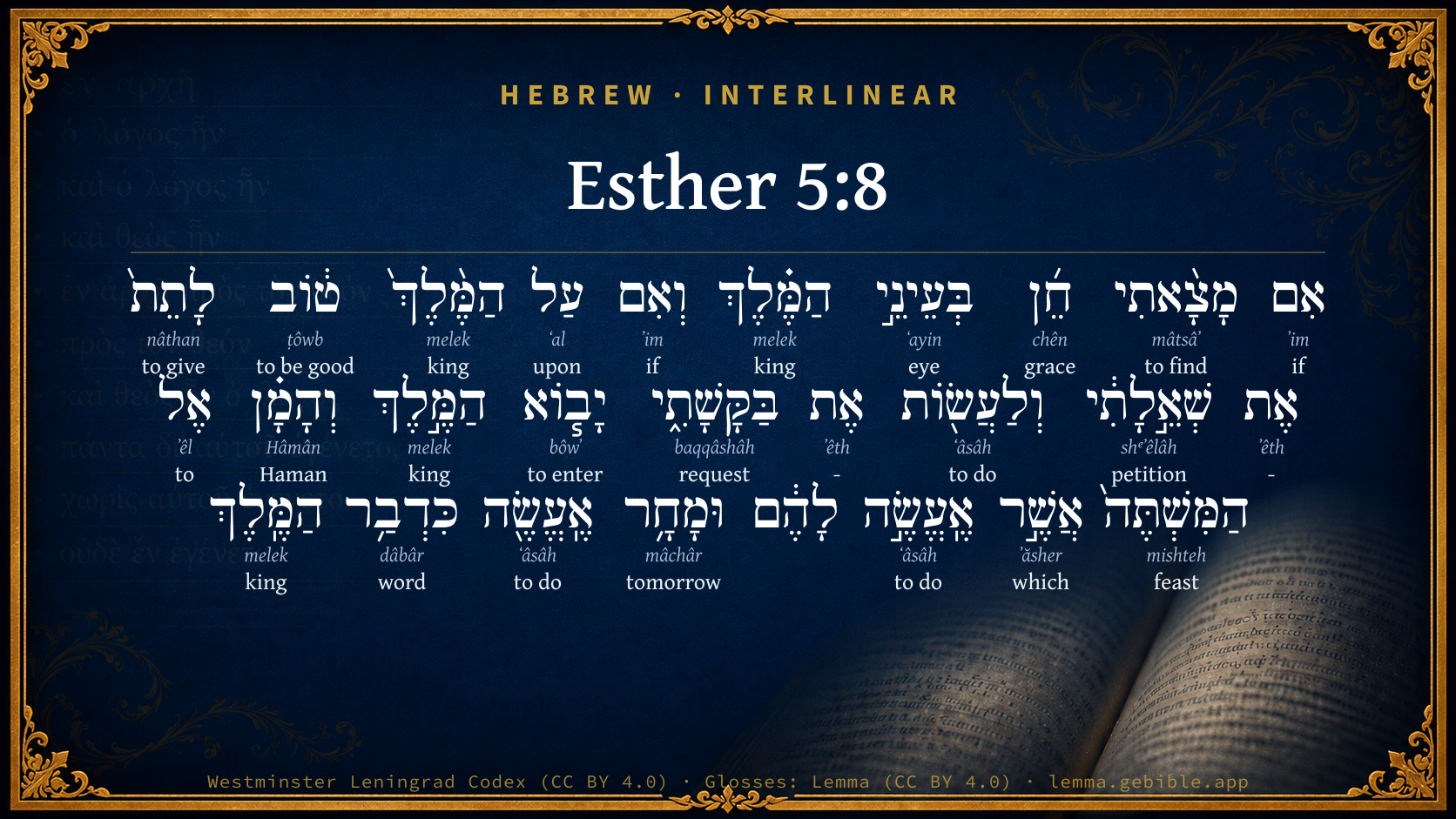
Hebrew (Westminster Leningrad Codex) Esther 5:8 appears in the Hebrew Old Testament. The text above is from the Westminster Leningrad Codex. Each word links to its Strong’s number, a concise gloss, and parsing drawn from the Open Scriptures Hebrew Bible morphology. Click any word for its full Brown-Driver-Briggs (BDB) entry.
Download image
Cite this verse

Esther 5:8 (World English Bible). Public Domain. Lemma interlinear Bible study tool, https://lemma.gebible.app/v/esther/5/8.

Show BibTeX & RIS
BibTeX
RIS
English Translation
if I have found favor in the sight of the king, and if it please the king to grant my petition, and to perform my request, let the king and Haman come to the banquet that I shall prepare for them, and I will do tomorrow as the king has said.
World English Bible · Public Domain
Download a study sheet

One document with this verse’s original text, its word-by-word gloss line, the meaning frame, cross-references with their text, attributed commentary, and full source and license credits — printable, and it pastes into notes with its structure intact.

This verse Autodidact and up

Study sheet (.html) Plain text (.txt)

A passage Seminary Student

Up to 50 verses in one chapter. A passage sheet keeps up to 6 commentary sources and 12 cross-references per verse, in the order this page ranks them, and says so on the sheet whenever that leaves anything out. Ask for a single verse and you get the Autodidact verse sheet above.

Everything on this page stays free to read, with no account — the sheet is a download of what is already on screen, not access to it.

Want to remove ads? Support Godless Engineer
Compare translations 3

The same verse in 3 English versions, stacked beneath the original-language interlinear above. Click any original word for its lexicon entry.

Each is an independent rendering of the whole verse — the interlinear is not word-aligned to these translations.

Highlighted words mark where these versions differ — a whole-verse word diff, not a word-by-word alignment.

  • World English Bible Public Domain
    if I have found favor in the sight of the king, and if it please the king to grant my petition, and to perform my request, let the king and Haman come to the banquet that I shall prepare for them, and I will do tomorrow as the king has said.
  • King James Version Public Domain
    If I have found favour in the sight of the king, and if it please the king to grant my petition, and to perform my request, let the king and Haman come to the banquet that I shall prepare for them, and I will do to morrow as the king hath said.
  • unfoldingWord Literal Text CC BY-SA 4.0
    if I have found favor in the eyes of the king, and if it is good to the king to grant my petition and to perform my request, let the king come with Haman to the banquet that I will make for them, and tomorrow I will do according to the word of the king.”

unfoldingWord Literal Text — © unfoldingWord, licensed CC BY-SA 4.0. Word-aligned USFM3 via Door43 (git.door43.org/unfoldingWord/en_ult).

Versions to compare (up to 4)

3 of 4 selected

Show all 18 translations

Every available English version of this verse, each an independent rendering of the whole verse.

  • World English Bible Public Domain
    if I have found favor in the sight of the king, and if it please the king to grant my petition, and to perform my request, let the king and Haman come to the banquet that I shall prepare for them, and I will do tomorrow as the king has said.
  • Berean Standard Bible Public Domain
    If I have found favor in the sight of the king, and if it pleases the king to grant my petition and fulfill my request, may the king and Haman come tomorrow to the banquet I will prepare for them. Then I will answer the king’s question.”
  • Majority Standard Bible Public Domain
    If I have found favor in the sight of the king, and if it pleases the king to grant my petition and fulfill my request, may the king and Haman come tomorrow to the banquet I will prepare for them. Then I will answer the king’s question.”
  • King James Version Public Domain
    If I have found favour in the sight of the king, and if it please the king to grant my petition, and to perform my request, let the king and Haman come to the banquet that I shall prepare for them, and I will do to morrow as the king hath said.
  • American Standard Version (1901) Public Domain
    if I have found favor in the sight of the king, and if it please the king to grant my petition, and to perform my request, let the king and Haman come to the banquet that I shall prepare for them, and I will do to-morrow as the king hath said.
  • Revised Version (1885) Public Domain
    if I have found favour in the sight of the king, and if it please the king to grant my petition, and to perform my request, let the king and Haman come to the banquet that I shall prepare for them, and I will do tomorrow as the king hath said.
  • Geneva Bible (1599) Public Domain
    If I haue found fauour in the sight of the King, and if it please the King to giue me my petition, and to perfourme my request, let the King and Haman come to the banket that I shall prepare for them, and I will doe to morowe according to the Kings saying.
  • Douay-Rheims (1899) Public Domain
    If I have found favour in the king's sight, and if it please the king to give me what I ask, and to fulfil my petition: let the king and Aman come to the banquet which I have prepared them, and to morrow I will open my mind to the king.
  • Young's Literal Translation Public Domain
    if I have found grace in the eyes of the king, and if unto the king `it be' good, to give my petition, and to perform my request, the king doth come, and Haman, unto the banquet that I make for them, and to-morrow I do according to the word of the king.'
  • Literal Standard Version CC BY-SA 4.0
    if I have found grace in the eyes of the king, and if to the king [it be] good, to give my petition, and to perform my request, the king comes, and Haman, to the banquet that I make for them, and tomorrow I do according to the word of the king.”
  • Unlocked Literal Bible CC BY-SA 4.0
    if I have found favor in the eyes of the king and if it pleases the king to grant my petition and to honor my request, let the king and Haman come to the feast that I will prepare for you tomorrow and I will answer the king's question.”
  • unfoldingWord Literal Text CC BY-SA 4.0
    if I have found favor in the eyes of the king, and if it is good to the king to grant my petition and to perform my request, let the king come with Haman to the banquet that I will make for them, and tomorrow I will do according to the word of the king.”
  • Darby Bible Public Domain
    If I have found grace in the sight of the king, and if it please the king to grant my petition, and to perform my request, let the king and Haman come to the banquet that I shall prepare for them, and I will do to-morrow according to the king's word.
  • World Messianic Bible Public Domain
    If I have found favor in the sight of the king, and if it pleases the king to grant my petition and to perform my request, let the king and Haman come to the banquet that I will prepare for them, and I will do tomorrow as the king has said.”
  • Webster's Bible Public Domain
    If I have found favor in the sight of the king, and if it shall please the king to grant my petition, and to perform my request, let the king and Haman come to the banquet that I shall prepare for them, and I will do to-morrow as the king hath said.
  • Free Bible Version CC BY-SA 4.0
    If the king looks on me favorably, and if it please Your Majesty to grant my request and do as I ask, may the king and Haman come to a dinner I will prepare for them. Tomorrow I will answer Your Majesty's question.”
  • Bible in Basic English Public Domain
    If I have the king's approval, and if it is the king's pleasure to give me my prayer and do my request, let the king and Haman come to the feast which I will make ready for them, and tomorrow I will do as the king has said.
  • JPS Tanakh (1917) Public Domain
    if I have found favour in the sight of the king, and if it please the king to grant my petition, and to perform my request — let the king and Haman come to the banquet that I shall prepare for them, and I will do to-morrow as the king hath said.'

Literal Standard Version (2020), Covenant Press — licensed CC BY-SA 4.0. Text via the HelloAO Bible API (eBible.org). Unlocked Literal Bible (unfoldingWord) — licensed CC BY-SA 4.0. Text via the HelloAO Bible API (eBible.org). unfoldingWord Literal Text — © unfoldingWord, licensed CC BY-SA 4.0. Word-aligned USFM3 via Door43 (git.door43.org/unfoldingWord/en_ult). Free Bible Version, Dr. Jonathan Gallagher — licensed CC BY-SA 4.0. Text via the HelloAO Bible API (eBible.org).

Word by word

More ways to search: Search by grammar → Find every occurrence → Compare this word →

Practice this passage: Drill this verse → Learn its vocabulary →

בַּקָּשָׁתִ֑י
baqqâshâh
H1246
“request · my”
Noun, Common, Feminine, Singular, Construct + Suffix, Personal, 1st Person, Common, Singular
Part of Speech
Noun
Type
Common
Gender
Feminine
Number
Singular
State
Construct
Full BDB Definition

Origin: from H1245

TWOT: 276a

request, entreaty, petition
  1. אִם ʼim H518 “if” Conjunction
  2. מָצָ֨אתִי mâtsâʼ H4672 “to find” Verb, Qal, Perfect, 1st Person, Common, Singular
  3. חֵ֜ן chên H2580 “grace” Noun, Common, Masculine, Singular, Absolute
  4. בְּעֵינֵ֣י ʻayin H5869 “in/at · eyes of” Preposition + Noun, Common, Both, Dual, Construct
  5. הַמֶּ֗לֶךְ melek H4428 “the · king” Particle, Definite Article + Noun, Common, Masculine, Singular, Absolute
  6. וְאִם ʼim H518 “and · if” Conjunction + Conjunction
  7. עַל ʻal H5921 “upon” Preposition
  8. הַמֶּ֨לֶךְ֙ melek H4428 “the · king” Particle, Definite Article + Noun, Common, Masculine, Singular, Absolute
  9. ט֔וֹב ṭôwb H2895 “good” Adjective, Adjective, Masculine, Singular, Absolute
  10. לָתֵת֙ nâthan H5414 “to give” Preposition + Verb, Qal, Infinitive Construct
  11. אֶת ʼêth H853 “-” Particle, Direct Object
  12. שְׁאֵ֣לָתִ֔י shᵉʼêlâh H7596 “petition · my” Noun, Common, Feminine, Singular, Construct + Suffix, Personal, 1st Person, Common, Singular
  13. וְלַעֲשׂ֖וֹת ʻâsâh H6213 “and · to do” Conjunction + Preposition + Verb, Qal, Infinitive Construct
  14. אֶת ʼêth H853 “-” Particle, Direct Object
  15. יָב֧וֹא bôwʼ H935 “to enter” Verb, Qal, Imperfect, 3rd Person, Masculine, Singular
  16. הַמֶּ֣לֶךְ melek H4428 “the · king” Particle, Definite Article + Noun, Common, Masculine, Singular, Absolute
  17. וְהָמָ֗ן Hâmân H2001 “and · Haman” Conjunction + Noun, Proper
  18. אֶל ʼêl H413 “to” Preposition
  19. הַמִּשְׁתֶּה֙ mishteh H4960 “the · feast” Particle, Definite Article + Noun, Common, Masculine, Singular, Absolute
  20. אֲשֶׁ֣ר ʼăsher H834 “which” Particle, Relative
  21. אֶֽעֱשֶׂ֣ה ʻâsâh H6213 “to do” Verb, Qal, Imperfect, 1st Person, Common, Singular
  22. וּמָחָ֥ר mâchâr H4279 “and · tomorrow” Conjunction + Noun, Common, Masculine, Singular, Absolute
  23. אֶֽעֱשֶׂ֖ה ʻâsâh H6213 “to do” Verb, Qal, Imperfect, 1st Person, Common, Singular
  24. כִּדְבַ֥ר dâbâr H1697 “like/as · word of” Preposition + Noun, Common, Masculine, Singular, Construct
  25. הַמֶּֽלֶךְ melek H4428 “the · king” Particle, Definite Article + Noun, Common, Masculine, Singular, Absolute

About this verse

These counts appear in no published source. They are computed here, from the morphology-tagged text and Lemma’s own curated glosses. What Lemma adds →

27
words
19
distinct lemmas
Historical
section

Notable vocabulary

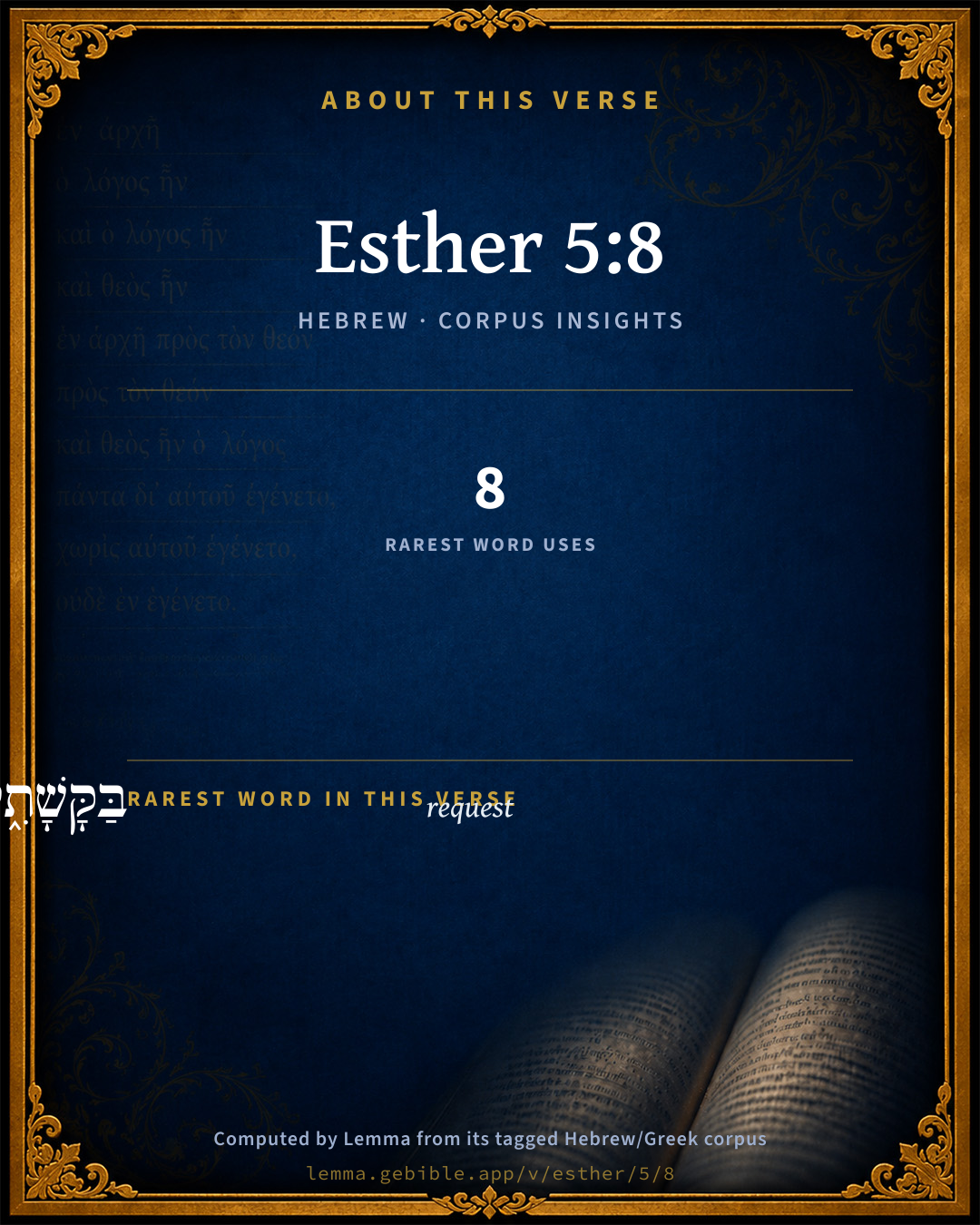
The rarest word here is בַּקָּשָׁתִ֑י request H1246 — appearing just 8 times in the whole Hebrew Bible.

Shared distinctive vocabulary

בַּקָּשָׁתִ֑י request H1246 occurs in 8 verses of the Hebrew Bible. Also found in:

Grammatical profile

  • 6 verbs
  • 12 nouns
  • 1 adjective
  • 3 prepositions
  • 2 conjunctions
  • 3 particles

Verb forms

  • מָצָ֨אתִי Qal · Perfect
  • לָתֵת֙ Qal · Infinitive Construct
  • וְלַעֲשׂ֖וֹת Qal · Infinitive Construct
  • יָב֧וֹא Qal · Imperfect
  • אֶֽעֱשֶׂ֣ה Qal · Imperfect
  • אֶֽעֱשֶׂ֖ה Qal · Imperfect

Repetition

Words recur within this verse — often emphatic in Hebrew:

  • הַמֶּ֗לֶךְ king H4428 ×4
  • וְלַעֲשׂ֖וֹת to do H6213 ×3
  • אִם if H518 ×2

Hebrew & Septuagint length

In English translation the verse runs 51 words from the Hebrew and 35 from the Septuagint (LXX English) — the Septuagint runs noticeably shorter here. See the side-by-side →

A rough comparison of the two English renderings, which tokenize alike — not a word-level alignment.

Word counts can differ between the Hebrew and the Greek without any difference in meaning — e.g. the Hebrew direct-object marker אֵת has no separate Greek word, and Greek often adds the article ὁ.

Cross-references

4

Topical passages linked to Esther 5:8 in the Treasury of Scripture Knowledge — connected by theme and wording, ordered by reader-vote popularity; previews shown in the World English Bible.

  • Proverbs 16:9 A man's heart plans his course, But Yahweh directs his steps.
  • Esther 7:3 Then Esther the queen answered, If I have found favor in your sight, O king, and if it please the king, let my life be given me at my petition, and my people at my request:
  • Esther 6:1–14 On that night the king couldn't sleep; and he commanded to bring the book of records of the chronicles, and they were read before the king.
  • Esther 8:5 She said, If it please the king, and if I have found favor in his sight, and the thing seem right before the king, and I be pleasing in his eyes, let it be written to reverse the letters devised by Haman, the son of Hammedatha the Agagite, which he wrote to destroy the Jews who are in all the king's provinces:

Cross-references courtesy of OpenBible.info (CC BY 4.0).

Hebrew and Greek witnesses Masoretic Hebrew ↔ Greek Septuagint

The same verse in the two great witnesses to the Old Testament, shown verse-for-verse.

Here the Septuagint runs noticeably shorter than the Hebrew — LXX2012 (modern English Septuagint) 35 words vs World English Bible 51. A rough length comparison of the two English translations, not a word-level alignment — read both below.

These are two independent witnesses, not word-aligned to each other, and the Septuagint is shown in lemma (dictionary) form.

Hebrew Esther 5:8 Masoretic · Westminster Leningrad Codex

אִם מָצָ֨אתִי חֵ֜ן בְּעֵינֵ֣י הַמֶּ֗לֶךְ וְאִם עַל הַמֶּ֨לֶךְ֙ ט֔וֹב לָתֵת֙ אֶת שְׁאֵ֣לָתִ֔י וְלַעֲשׂ֖וֹת אֶת בַּקָּשָׁתִ֑י יָב֧וֹא הַמֶּ֣לֶךְ וְהָמָ֗ן אֶל הַמִּשְׁתֶּה֙ אֲשֶׁ֣ר אֶֽעֱשֶׂ֣ה לָהֶ֔ם וּמָחָ֥ר אֶֽעֱשֶׂ֖ה כִּדְבַ֥ר הַמֶּֽלֶךְ

if I have found favor in the sight of the king, and if it please the king to grant my petition, and to perform my request, let the king and Haman come to the banquet that I shall prepare for them, and I will do tomorrow as the king has said.

World English Bible · Public Domain

Greek LXX Esther 5:8 Septuagint · lemma form

καί εἰςἔρχομαι εἰς ὁ ἴδιος καλέω ὁ φίλος καί ζωσαρα ὁ γυνή αὐτός

if I have found favor in the sight of the king, let the king and Aman come again to-morrow to the feast which I shall prepare for them, and to-morrow I will do the same.

LXX2012 (modern English Septuagint) · Public Domain

Hebrew: Westminster Leningrad Codex (CC BY 4.0). Greek: Septuagint (public domain); English from LXX2012 (modern English Septuagint) (Public Domain). How the Septuagint differs from the Hebrew →

Commentary

Notes on Esther 5:8 from classic Christian and Jewish commentators (each source and its license shown beneath its notes). The classic Christian expositions comment on the surrounding passage and are grouped to its opening verse, so a note may address several verses; the Jewish commentaries on the Tanakh (Rashi and others) are per-verse, so they appear only where the commentator wrote on this verse.

Lemma curates 59 commentaries, every one of them public domain or Creative Commons licensed, each selected and text-cleaned for this edition rather than reprinted as found. About our sources →

Trapp's Complete Commentary

John Trapp

Est 5:8 If I have found favour in the sight of the king, and if it please the king to grant my petition, and to perform my request, let the king and Haman come to the banquet that I shall prepare for them, and I will do to morrow as the king hath said.

Ver. 8. If I have found favour in the sight of the king] As she had, not so much by her beauty and bravery (wherein Vashti perhaps might easily have compared with her), but by the finger of God, who tames for his elect the fiercest creatures (as he did the lions to Daniel, and other savage beasts to the martyrs, whom they would not meddle with), and turneth the king’s heart, as the rivers of water, into what channel soever he pleaseth to put it, Pro 21:1, as the ploughman doth the watercourse with his paddle, or the gardener with his hand.

And if it please the king] See Est 5:4, and submit to God, Jas 4:7.

And I will do tomorrow as the king hath said] She had learned to prefer opportunity before time. There might be some by at this first banquet whose company she liked not; or she might not yet have so clear an answer in her own heart to her former prayers, and therefore desireth some further time that night to seek God: whatever the reason of her putting it off till next day was, God’s holy hand was in it, that Mordecai might be first so greatly honoured, and Haman’s high gallows prepared: Ilium utique magis securum, Regem autem magis benevolum magisque fecit attentum, saith Rupertus. Hereby she made Haman more secure, and the king more kind and attentive.

John Trapp, A Commentary or Exposition upon All the Books of the Old and New Testament (1647–1656) — public domain. Text from a community e-Sword module.

The Biblical Illustrator

Joseph S. Exell

Est_5:8

Let the king and Haman come to the banquet that I shall prepare for them, and I will do to-morrow as the king hath said.

Do not hasten providence

The very persons are here before whom it will be told to-morrow--the king, the queen, Haman! Then why delay? Nine people out of ten would have said, if consulted beforehand, All, she is losing her case, through fear or through finesse, or by some evil counsel. She is losing the ripe and favourable hour, which will never return. Tomorrow! O Queen, why not to-night? And so, oftentimes, we would hasten providence in our own affairs, fretting against His wise delays, and laying our poor shoulders to the great wheels of God, as though He were not moving them fast enough, when, in fact, they are going as evenly as the sun, as sublimely as time itself. The king is here; why not speak? Yes, he is here, and he is not here. He is not here as he will be to-morrow night. To-night he will be sleepless. To-night he will be reminded, through his sleeplessness, of an act of loyal faithfulness on the part of Mordecai, which has been hitherto unrewarded. To-night the order will be given for the preparation of a gallows. In a word, when the same three meet at to-morrows banquet, they will be the same, and yet not the same. They will be really in different relations to each other, and to many beyond. So the banquet is ended, as if by the utterance of the word wait. He that believeth shall not make haste. (A. Raleigh, D. D.)

Wisdom to act in critical situations

When persons are placed in critical situations, and endeavour to act singly and honestly, wisdom is granted to them to direct their course. Though she had met with a reception equal to her most sanguine expectations, Esther did not immediately present the request which was nearest her heart, but contented herself with begging that the king, accompanied with Haman, would come to the banquet of wine which she had prepared. By this she testified her disinterestedness. She was afraid of precipitating the decision, and sought to avail herself of every prudent method for ensuring success. (T. McCrie.)

The Biblical Illustrator, edited by Joseph S. Exell (c. 1880s–1900s) — public domain. Text from a community e-Sword module.

Joseph Benson's Commentary

Est 5:8. I will do to-morrow as the king hath said — I will acquaint thee with my humble request. She did not present her petition at this time, but delayed it till the next meeting; either, because she was a little daunted with the king’s presence, and had not yet courage to propose it; or, because she would further engage the king’s affection to her, by a second entertainment, and would also intimate to him, that her petition was of a more than ordinary nature: but principally by direction of the divine providence, which took away her courage of utterance for this time, that she might have a better opportunity to present her request the next time, by that great accident which happened before it. For the high honour which the king bestowed on Mordecai the next day made way for her petition, which came in very seasonably at the banquet of wine.

Joseph Benson's Commentary on the Old and New Testaments (1811–1818) — public domain. Text from a community e-Sword module.

Tyndale Open Study Notes

Tyndale Open Resources

5:8 please come . . . tomorrow: It was a customary protocol not to appear anxious about asking for a favor or negotiating an agreement. The delay provided opportunity for Xerxes to discover Mordecai’s act of loyalty, which led to the foiling of Haman’s plot (see 6:1-14).

Tyndale Open Study Notes — © Tyndale Open Resources, licensed CC BY-SA 4.0. Text via the HelloAO Bible API.

Geneva Bible (1599)

Geneva Bible translators

I will declare what thing I demand.

Geneva Bible (1599) marginal notes — public domain. Text via Bolls.life.

Jamieson, Fausset & Brown

Robert Jamieson, A. R. Fausset & David Brown

let the king and Haman come to the banquet that I shall prepare--The king ate alone, and his guests in an adjoining hall; but they were admitted to sit with him at wine. Haman being the only invited guest with the king and queen, it was natural that he should have been elated with the honor.

Next: Esther Chapter 6

Jamieson, Fausset & Brown — Commentary Critical and Explanatory on the Whole Bible (1871) — public domain (CC PDM 1.0). Text via the HelloAO Bible API.

Adam Clarke's Commentary

Verse 8. I will do to-morrow] She saw she was gaining on the king's affections; but she was not yet sufficiently confident; and therefore wished another interview, that she might ingratiate herself more fully in the king's favour, and thus secure the success of her design. But Providence disposed of things thus, to give time for the important event mentioned in the succeeding chapter.

Adam Clarke's Commentary on the Bible (1810–1826) — public domain. Text from a community e-Sword/MySword module.

John Gill's Exposition

Then went Haman forth that day, joyful, and with a glad heart,.... From court to his own house

but when Haman saw Mordecai in the king's gate, that he stood not up, nor moved for him; did not show him the least degree even of civil respect; which he refused to do, partly lest it should be interpreted an adoration of him, and partly because it was well known to him he had formed a scheme for the destruction of him and all his people; and the rather he refused it to him, as Esther was about to make intercession with the king to revoke his decree, of the success of which he had no doubt; and therefore had nothing to fear from him, but treated him with the utmost contempt, as he deserved:

he was full of wrath against Mordecai; it was a sad mortification to him, and a great allay of that joy and elation of mind on account of the favour he was in; not with the king only, but the queen also, as he imagined.

John Gill's Exposition of the Whole Bible (1746–1763) — public domain (CC PDM 1.0). Text via the HelloAO Bible API.

Matthew Poole's English Annotations

I will acquaint thee with my humble request. She did not present her petition at this time, but delayed it till the next meeting; either through modesty, or because she was a little daunted with the king’s presence, and had not yet good courage to propose her request; or in policy, because she would further engage the king’s affection to her by a second entertainment, and would also intimate to him that her petition was of a more than ordinary nature; and principally by direction and disposition of the Divine Providence, which took away her courage or utterance for this time, that she might have a better opportunity for it the next time, by that great accident which happened before it.

Matthew Poole's English Annotations on the Holy Bible (1683–1685) — public domain. Text from a community e-Sword/MySword module.

Whedon's Commentary on the Bible

Daniel D. Whedon

8. To-morrow — Her heart seems to fail her when the decisive moment comes. She hopes, by another day, to be better prepared to present her case successfully.

As the king hath said — That is, make known the request.

Daniel D. Whedon (gen. ed.), Commentary on the Old and New Testaments (1874–1909) — public domain. Text from a community e-Sword module.

John Wesley's Explanatory Notes

Tomorrow - I will acquaint thee with my humble request. She did not present her petition at this time, but delayed it 'till the next meeting; either because she was a little daunted with the king's presence, or, because she would farther engage the king's affection to her, and would also intimate to him that her petition was of a more than ordinary nature: but principally by direction of Divine providence, which took away her courage of utterance for this time, that she might have a better opportunity for it the next time, by that great accident which happened before it.

John Wesley, Explanatory Notes Upon the Whole Bible (1754–1765) — public domain. Text via the GEBible commentary corpus.

Rashi

Rabbi Shlomo Yitzchaki (Rashi)

and tomorrow I will do the king’s bidding that which you requested of me all these days, i.e., to reveal my nationality and my lineage to you.

Rashi on the Tanakh — English translations: “The Judaica Press complete Tanach with Rashi, translated by A. J. Rosenberg” (CC BY 4.0); “Pentateuch with Rashi's commentary by M. Rosenbaum and A.M. Silbermann, 1929-1934” (public domain); “The Metsudah Tanach series, Lakewood, N.J” (CC BY 4.0); and “The Book of Joshua, Metsudah Publications, 1997” (CC BY 4.0). Text via Sefaria.

Lesson kit

Teaching starters — assembled from the data on this page, not authored interpretation. Every prompt links to the verse data it draws on. Edit before teaching.

Esther, in the Historical, opens this verse with 27 words (19 distinct Hebrew lemmas). Its most distinctive word is baqqâshâh (“request”). The Greek Septuagint runs shorter here. A historical commentator’s framing appears above. Read the whole chapter for the surrounding context.

Discussion questions

  1. How does “request” (baqqâshâh) shape what this verse is saying?
  2. Ezra 7:6 shares the word «request» with this verse. How do the two illuminate each other?
  3. “king” occurs 4× in this one verse. What is the effect of the repetition?
  4. Compared with the Hebrew, the Septuagint runs shorter here. What questions does that raise?
  5. These translations render this verse differently. What is at stake in choosing one wording over another?
  6. The verb «מָצָ֨אתִי» is Qal Perfect. How does its form color the action?
  7. Reading how Trapp's Complete Commentary and The Biblical Illustrator read this verse, where do the two commentators agree and where do they part?

Things to notice

Reading settings

Reading text

Shown beneath each verse's original-language words.

Old Testament
Old Testament edition

Read the OT as the Masoretic Hebrew (MT) or the Greek Septuagint (LXX).

English shown for the Greek Septuagint (in the Hebrew ↔ Greek comparison).

Comparing translations? Open the Compare panel on any verse page to stack up to four side by side.