
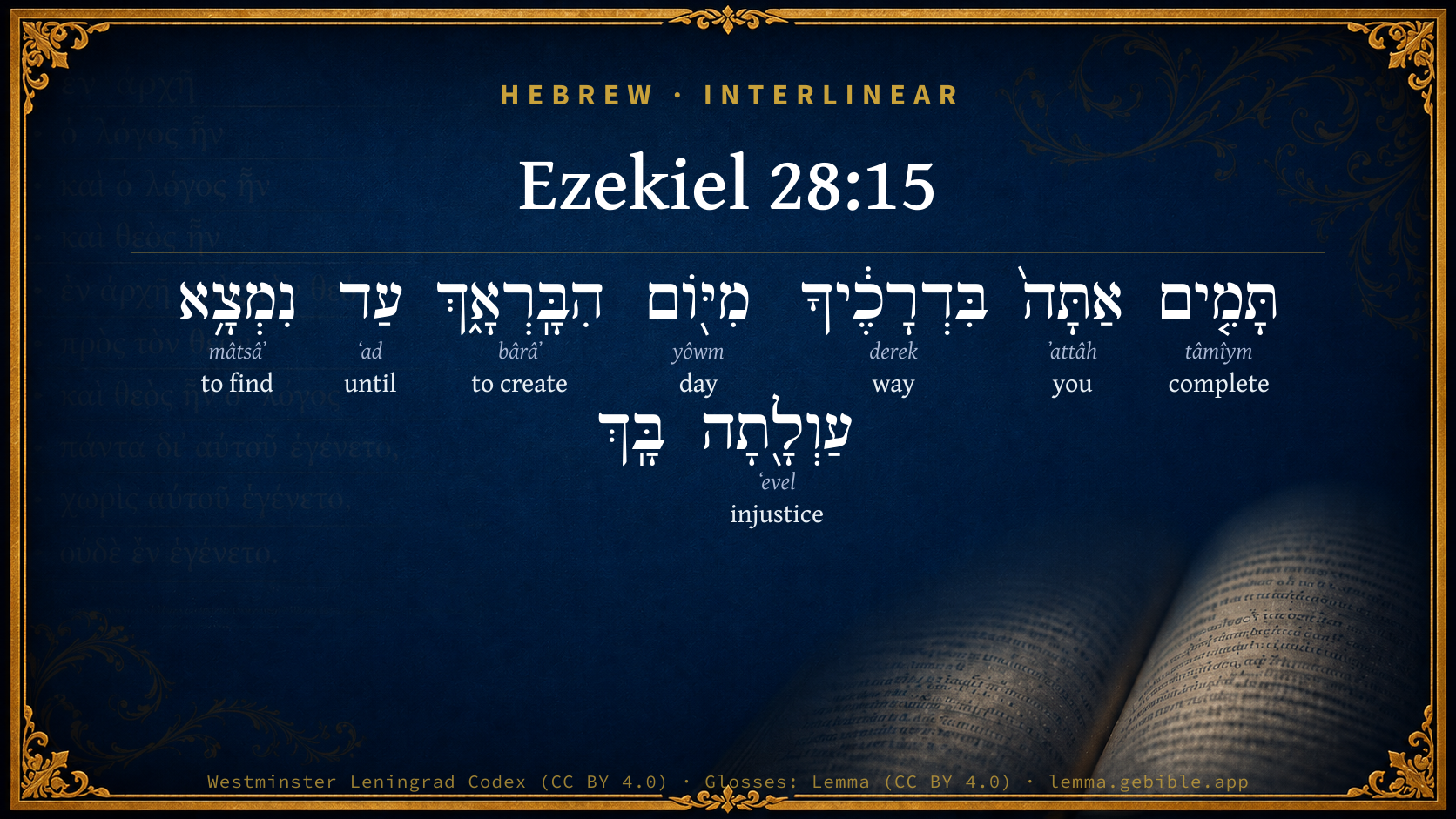
Ezekiel 28:15

Hebrew (Westminster Leningrad Codex) Ezekiel 28:15 appears in the Hebrew Old Testament. The text above is from the Westminster Leningrad Codex. Each word links to its Strong’s number, a concise gloss, and parsing drawn from the Open Scriptures Hebrew Bible morphology. Click any word for its full Brown-Driver-Briggs (BDB) entry.
Download image
Cite this verse

Ezekiel 28:15 (World English Bible). Public Domain. Lemma interlinear Bible study tool, https://lemma.gebible.app/v/ezekiel/28/15.

Show BibTeX & RIS
BibTeX
RIS
English Translation
You were perfect in your ways from the day that you were created, until unrighteousness was found in you.
World English Bible · Public Domain
Download a study sheet

One document with this verse’s original text, its word-by-word gloss line, the meaning frame, cross-references with their text, attributed commentary, and full source and license credits — printable, and it pastes into notes with its structure intact.

This verse Autodidact and up

Study sheet (.html) Plain text (.txt)

A passage Seminary Student

Up to 50 verses in one chapter. A passage sheet keeps up to 6 commentary sources and 12 cross-references per verse, in the order this page ranks them, and says so on the sheet whenever that leaves anything out. Ask for a single verse and you get the Autodidact verse sheet above.

Everything on this page stays free to read, with no account — the sheet is a download of what is already on screen, not access to it.

Want to remove ads? Support Godless Engineer
Compare translations 3

The same verse in 3 English versions, stacked beneath the original-language interlinear above. Click any original word for its lexicon entry.

Each is an independent rendering of the whole verse — the interlinear is not word-aligned to these translations.

Highlighted words mark where these versions differ — a whole-verse word diff, not a word-by-word alignment.

  • World English Bible Public Domain
    You were perfect in your ways from the day that you were created, until unrighteousness was found in you.
  • King James Version Public Domain
    Thou wast perfect in thy ways from the day that thou wast created, till iniquity was found in thee.
  • unfoldingWord Literal Text CC BY-SA 4.0
    You had integrity in your ways from the day you were created until injustice was found within you.

unfoldingWord Literal Text — © unfoldingWord, licensed CC BY-SA 4.0. Word-aligned USFM3 via Door43 (git.door43.org/unfoldingWord/en_ult).

Versions to compare (up to 4)

3 of 4 selected

Show all 18 translations

Every available English version of this verse, each an independent rendering of the whole verse.

  • World English Bible Public Domain
    You were perfect in your ways from the day that you were created, until unrighteousness was found in you.
  • Berean Standard Bible Public Domain
    From the day you were created you were blameless in your ways—until wickedness was found in you.
  • Majority Standard Bible Public Domain
    From the day you were created you were blameless in your ways—until wickedness was found in you.
  • King James Version Public Domain
    Thou wast perfect in thy ways from the day that thou wast created, till iniquity was found in thee.
  • American Standard Version (1901) Public Domain
    Thou wast perfect in thy ways from the day that thou wast created, till unrighteousness was found in thee.
  • Revised Version (1885) Public Domain
    Thou wast perfect in thy ways from the day that thou wast created, till unrighteousness was found in thee.
  • Geneva Bible (1599) Public Domain
    Thou wast perfite in thy wayes from the day that thou wast created, till iniquitie was found in thee.
  • Douay-Rheims (1899) Public Domain
    Thou wast perfect in thy ways from the day of thy creation, until iniquity was found in thee.
  • Young's Literal Translation Public Domain
    Perfect `art' thou in thy ways, From the day of thy being produced, Till perversity hath been found in thee.
  • Literal Standard Version CC BY-SA 4.0
    You [were] perfect in your ways, || From [the] day of your being created, || Until perversity was found in you.
  • Unlocked Literal Bible CC BY-SA 4.0
    You had integrity in your ways from the day you were created until injustice was found within you.
  • unfoldingWord Literal Text CC BY-SA 4.0
    You had integrity in your ways from the day you were created until injustice was found within you.
  • Darby Bible Public Domain
    Thou wast perfect in thy ways, from the day that thou wast created, till unrighteousness was found in thee.
  • World Messianic Bible Public Domain
    You were perfect in your ways from the day that you were created, until unrighteousness was found in you.
  • Webster's Bible Public Domain
    Thou wast perfect in thy ways from the day that thou wast created, till iniquity was found in thee.
  • Free Bible Version CC BY-SA 4.0
    You were innocent in everything you did from the day you were created until you were found to be doing evil.
  • Bible in Basic English Public Domain
    There has been no evil in your ways from the day when you were made, till sin was seen in you.
  • JPS Tanakh (1917) Public Domain
    Thou wast perfect in thy ways from the day that thou wast created, till unrighteousness was found in thee.

Literal Standard Version (2020), Covenant Press — licensed CC BY-SA 4.0. Text via the HelloAO Bible API (eBible.org). Unlocked Literal Bible (unfoldingWord) — licensed CC BY-SA 4.0. Text via the HelloAO Bible API (eBible.org). unfoldingWord Literal Text — © unfoldingWord, licensed CC BY-SA 4.0. Word-aligned USFM3 via Door43 (git.door43.org/unfoldingWord/en_ult). Free Bible Version, Dr. Jonathan Gallagher — licensed CC BY-SA 4.0. Text via the HelloAO Bible API (eBible.org).

Word by word

More ways to search: Search by grammar → Find every occurrence → Compare this word →

Practice this passage: Drill this verse → Learn its vocabulary →

הִבָּֽרְאָ֑ךְ
bârâʼ
H1254
“to create · you”
Verb, Niphal, Infinitive Construct + Suffix, Personal, 2nd Person, Feminine, Singular
Part of Speech
Verb
Stem
Niphal
Form
Infinitive Construct
Full BDB Definition

Origin: a primitive root

TWOT: 278

to create, shape, form - (Qal) to shape, fashion, create (always with God as subject) - of heaven and earth - of individual man - of new conditions and circumstances - of transformations - (Niphal) to be created - of heaven and earth - of birth - of something new - of miracles - (Piel) - to cut down - to cut out - to be fat - (Hiphil) to make yourselves fat
  1. תָּמִ֤ים tâmîym H8549 “complete” Adjective, Adjective, Masculine, Singular, Absolute
  2. אַתָּה֙ ʼattâh H859 “you” Pronoun, Personal, 2nd Person, Masculine, Singular
  3. בִּדְרָכֶ֔יךָ derek H1870 “in/at · ways · your” Preposition + Noun, Common, Both, Plural, Construct + Suffix, Personal, 2nd Person, Masculine, Singular
  4. מִיּ֖וֹם yôwm H3117 “from · day of” Preposition + Noun, Common, Masculine, Singular, Construct
  5. עַד ʻad H5704 “until” Preposition
  6. נִמְצָ֥א mâtsâʼ H4672 “to find” Verb, Niphal, Perfect, 3rd Person, Masculine, Singular
  7. עַוְלָ֖תָה ʻevel H5766 “injustice” Noun, Common, Both, Singular, Absolute + Suffix, h

About this verse

These counts appear in no published source. They are computed here, from the morphology-tagged text and Lemma’s own curated glosses. What Lemma adds →

9
words
8
distinct lemmas
Prophets
section

Shared distinctive vocabulary

הִבָּֽרְאָ֑ךְ to create H1254 occurs in 46 verses of the Hebrew Bible. Also found in:

Grammatical profile

  • 2 verbs
  • 3 nouns
  • 1 adjective
  • 1 pronoun
  • 2 prepositions

Verb forms

  • הִבָּֽרְאָ֑ךְ Niphal · Infinitive Construct
  • נִמְצָ֥א Niphal · Perfect

Hebrew & Septuagint length

In English translation the verse runs 19 words from the Hebrew and 19 from the Septuagint (LXX English) — the same length.

A rough comparison of the two English renderings, which tokenize alike — not a word-level alignment.

Word counts can differ between the Hebrew and the Greek without any difference in meaning — e.g. the Hebrew direct-object marker אֵת has no separate Greek word, and Greek often adds the article ὁ.

Cross-references

13

Topical passages linked to Ezekiel 28:15 in the Treasury of Scripture Knowledge — connected by theme and wording, ordered by reader-vote popularity; previews shown in the World English Bible.

  • 2 Peter 2:4 For if God didn't spare angels when they sinned, but cast them down to Tartarus, and committed them to pits of darkness, to be reserved to judgment;
  • Ezekiel 28:17–18 Your heart was lifted up because of your beauty; you have corrupted your wisdom by reason of your brightness: I have cast you to the ground; I have laid you before kings, that they may see you.
  • Genesis 1:26–27 God said, "Let us make man in our image, after our likeness: and let them have dominion over the fish of the sea, and over the birds of the sky, and over the cattle, and over all the earth, and over every creeping thing that creeps on the earth."
  • Romans 7:9 I was alive apart from the law once, but when the commandment came, sin revived, and I died.
  • Ezekiel 27:3–4 and tell Tyre, you who dwell at the entry of the sea, who are the merchant of the peoples to many isles, thus says the Lord Yahweh: You, Tyre, have said, I am perfect in beauty.
  • Ezekiel 28:3–6 behold, you are wiser than Daniel; there is no secret that is hidden from you;
  • Ezekiel 28:12 Son of man, take up a lamentation over the king of Tyre, and tell him, Thus says the Lord Yahweh: You seal up the sum, full of wisdom, and perfect in beauty.
  • Lamentations 5:16 The crown is fallen from our head: Woe to us! for we have sinned.
  • Ecclesiastes 7:29 Behold, this only have I found: that God made man upright; but they search for many schemes.
  • Isaiah 14:12 How you are fallen from heaven, day-star, son of the morning! How you are cut down to the ground, who laid the nations low!
  • Genesis 1:31 God saw everything that he had made, and, behold, it was very good. There was evening and there was morning, the sixth day.
  • Genesis 6:5–6 Yahweh saw that the wickedness of man was great in the earth, and that every imagination of the thoughts of his heart was only evil continually.
  • Proverbs 14:34 Righteousness exalts a nation, But sin is a disgrace to any people.

Cross-references courtesy of OpenBible.info (CC BY 4.0).

Hebrew and Greek witnesses Masoretic Hebrew ↔ Greek Septuagint

The same verse in the two great witnesses to the Old Testament, shown verse-for-verse.

These are two independent witnesses, not word-aligned to each other, and the Septuagint is shown in lemma (dictionary) form.

Hebrew Ezekiel 28:15 Masoretic · Westminster Leningrad Codex

תָּמִ֤ים אַתָּה֙ בִּדְרָכֶ֔יךָ מִיּ֖וֹם הִבָּֽרְאָ֑ךְ עַד נִמְצָ֥א עַוְלָ֖תָה בָּֽךְ

You were perfect in your ways from the day that you were created, until unrighteousness was found in you.

World English Bible · Public Domain

Greek LXX Ezekiel 28:15 Septuagint · lemma form

γίγνομαι ἄμωμος σύ ἐν ὁ ἡμέρα σύ ἀπό ὅς ἡμέρα σύ κτίζω ἕως εὑρίσκω ὁ ἀδίκημα ἐν σύ

You were faultless in your days, from the day that you were created, until iniquity was found in you.

LXX2012 (modern English Septuagint) · Public Domain

Hebrew: Westminster Leningrad Codex (CC BY 4.0). Greek: Septuagint (public domain); English from LXX2012 (modern English Septuagint) (Public Domain). How the Septuagint differs from the Hebrew →

Targum (Aramaic paraphrase)

1

The Targum is the ancient Jewish Aramaic paraphrase of the Hebrew Scriptures — an interpretive translation, not the Hebrew text itself. Onkelos (literal) and Pseudo-Jonathan (expansive) render the Torah, and Jonathan the Prophets. Coverage is partial: where no permissively-licensed English translation exists for a verse, only the Aramaic is shown. This is verse-level text, not a word-by-word alignment to the Hebrew.

  1. Targum Jonathan Prophets (Joshua–Malachi)
    שְׁלִים אַתְּ בְּאוֹרְחָךְ מִיוֹמָא דְאִתְבְּרֵיתָא עַד דְאִשְׁתַּכַּח שְׁקַר בִּיךְ:

    (no public-domain English translation for this verse)

    Targum Jonathan — Aramaic: “Mikraot Gedolot” (public domain). English: “Sefaria Community Translation” (CC0 1.0 (public-domain dedication)); “London "Chaldee Paraphrase," 1871” (public domain). Text via Sefaria.

Commentary

Notes on Ezekiel 28:15 from classic Christian and Jewish commentators (each source and its license shown beneath its notes). The classic Christian expositions comment on the surrounding passage and are grouped to its opening verse, so a note may address several verses; the Jewish commentaries on the Tanakh (Rashi and others) are per-verse, so they appear only where the commentator wrote on this verse.

Lemma curates 59 commentaries, every one of them public domain or Creative Commons licensed, each selected and text-cleaned for this edition rather than reprinted as found. About our sources →

Trapp's Complete Commentary

John Trapp

Eze 28:15 Thou [wast] perfect in thy ways from the day that thou wast created, till iniquity was found in thee.

Ver. 15. Thou wast perfect in thy ways] As the evil angels also were; but now it is otherwise. Heaven spued out them in the very first act of their sin, and soon after they were created. Look thou therefore to speed accordingly, since iniquity is found in thee. Potentes potenter torquebuntur.

John Trapp, A Commentary or Exposition upon All the Books of the Old and New Testament (1647–1656) — public domain. Text from a community e-Sword module.

Tyndale Open Study Notes

Tyndale Open Resources

28:15-18 This sarcastic description of the prince of Tyre’s greatness and pride sets him up for his coming fall, which is cast in terms reminiscent of the fall of humanity (Gen 3). As with Adam, the king of Tyre’s supposedly blameless condition was not permanent, but came to an abrupt end when evil was found in him. His rich commerce and dishonest trade led him to violence (cp. Ezek 26:17). One who claimed to be greater than Adam could experience a fall from favor similar to Adam’s and be banished . . . from the mountain of God, the place of God’s favor. The prince of Tyre’s God-given beauty and wisdom were corrupted by his pride, which inevitably led to disaster and exposed his true nature.

Tyndale Open Study Notes — © Tyndale Open Resources, licensed CC BY-SA 4.0. Text via the HelloAO Bible API.

Geneva Bible (1599)

Geneva Bible translators

Which was when I first called thee to this dignity.

Geneva Bible (1599) marginal notes — public domain. Text via Bolls.life.

Jamieson, Fausset & Brown

Robert Jamieson, A. R. Fausset & David Brown

perfect--prosperous [GROTIUS], and having no defect. So Hiram was a sample of the Tyrian monarch in his early days of wisdom and prosperity (Kg1 5:7, &c.).

till iniquity . . . in thee--Like the primeval man thou hast fallen by abusing God's gifts, and so hast provoked God's wrath.

Jamieson, Fausset & Brown — Commentary Critical and Explanatory on the Whole Bible (1871) — public domain (CC PDM 1.0). Text via the HelloAO Bible API.

Adam Clarke's Commentary

Verse 15. Thou wast perfect in thy ways] The irony seems still to be kept up. Thou hast been like the angels, like Moses, like the cherubs, like Adam, like God, till thy iniquity was found out.

Adam Clarke's Commentary on the Bible (1810–1826) — public domain. Text from a community e-Sword/MySword module.

Ellicott's Commentary for English Readers

(15) Till iniquity was found in thee.—This and the following verse renew still more clearly the comparison with Adam. The king was altogether prosperous until his sin became manifest; then, when his heart was corrupted by his prosperity (Eze_28:16), he was cast out for ever, like Adam from his paradise.

A Bible Commentary for English Readers, edited by Charles John Ellicott (1878–1897) — public domain. Text from a community e-Sword module.

The Cambridge Bible for Schools and Colleges

gen. ed. J. J. S. Perowne

15. The sin and fall of the prince. The terms “the day when thou vast created” are very unsuitable if applied to the cherub. The sons of God existed before creation, Job_38:7.

The Cambridge Bible for Schools and Colleges (gen. ed. J. J. S. Perowne; Cambridge University Press, 1878–1918) — public domain. Text from a community e-Sword module.

John Gill's Exposition

Thou wast perfect in thy ways from the day that thou wast created,.... From the time that Tyre became a kingdom, or this king was set over it, everything was wisely conducted, and all things happily succeeded; so when the church of Rome was first formed in the times of the apostles, it was laid on a good foundation; it was set up according to the rule of the word; its bishop or pastor was one of a sound judgment, a good life and conversation, and so continued In succession for a considerable time; these held the true faith and doctrine of Christ, and kept it incorrupt, and lived holy lives:

till iniquity was found in thee; pride, blasphemy against God, and contempt of his people, as well as violence and deceit; all this was found in the king of Tyre in later times: so in the church of Rome, when the man of sin was revealed, there were pride, haughtiness, and ambition, found in it; blasphemy against God and Christ, and the saints: false doctrine, false worship, superstition, and idolatry.

John Gill's Exposition of the Whole Bible (1746–1763) — public domain (CC PDM 1.0). Text via the HelloAO Bible API.

Haydock's Catholic Bible Commentary

Iniquity. Tyre was before wicked; but when the king pretended to be a god, (ver. 2.) it could no longer be endured. (Worthington)

George Leo Haydock (1774–1849), Haydock's Catholic Family Bible and Commentary, 1859 edition — public domain. Excludes Psalms (Douay-Rheims chapter numbering differs from Protestant) and Deuterocanonical books (Catholic canon only).

Matthew Poole's English Annotations

I think the prophet continues his irony: The prince of Tyre would be a god. Yes. Now God is perfect in all his ways or works; and thou, O prince, wert so too. Wert thou, and from thy original? But remember what a god is he, that hath a beginning, that was created, that at last was found full of iniquity! And this reproof and taunt leads us to look with the prophet from the proud claim of this prince to his great miscarriages. If any else will think all these things in the 14th and 15th verses to be asserters of God’s bounty to this prince, and of his great magnificence and state, in hyperboles and allusions, nothing I have said shall contradict them, for they have their liberty, as I have mine, to think what seems most like the truth.

Matthew Poole's English Annotations on the Holy Bible (1683–1685) — public domain. Text from a community e-Sword/MySword module.

The Pulpit Commentary

Thou wast perfect in thy ways. The glory of the King of Tyre was, the prophet goes on to say, conditional. He began his reign in righteousness, but afterwards iniquity was found in him. And the root of that iniquity was the pride of wealth engendered by the greatness of his commerce (Ver. 16). He was no longer like the cherub who guarded the Paradise of God, but like Adam when he was east out from it. Wealth and pride had tempted him to violence and to wrong, and he was no longer an "anointed" or consecrated, but a profaned and desecrated, king. The, "stones of fire," the thunders and lightnings of the Divine Majesty, should no longer protect him.

The innocence of early days.

I THERE IS AN INNOCENCE OF EARLY DAYS.

1. In the race. The Bible represents Adam and Eve as commencing life in primitive innocence. However we may interpret the narrative in Genesis-as literal history or as allegory if we attach any inspired authority to it we must see that it points back to a time when man lived in childlike innocence and ignorance of evil.

2. In the nation. Even Tyre, wicked, corrupt Tyre, had once known better days. Nearly every people has traditions of a good age preceding the later corruptions. We do not see that the heathen are advancing. On the other hand, behind idolatry there are often to be discovered shreds of an ancient faith in one spiritual God. Thus the Vedas show a purer religion and a higher thought than are to be found in modern Hinduism. We may believe that God is educating the world, and yet see that vast portions of it do not as yet respond to the uplifting influences.

3. In the individual. Children begin life in innocency. Though they come into the world with hereditary tendencies to evil, those tendencies are at first latent, and until they have received the consent of the will they cannot be accounted elements of guilt. Concerning little children our Lord said, "Of such is the kingdom of God". (Mar_10:14)

II THIS PRIMITIVE INNOCENCE AGGRAVATES THE GUILT OF LATER YEARS.

1. In the community. Man was not created corrupt. He cannot lay the charge of his sin against his Maker. There has been a fall. Degeneracy is especially evil. To go from good to bad and from bad to worse in a descending scale of wickedness is to be without excuse in sin.

2. In the individual. The child who has never known goodness can scarcely be blamed for living a bad life. He can hardly be said to have chosen evil rather than good, for he has had no alternative set before him. But it is otherwise with one who has begun well. Israel is the more to blame because her goodness was like the morning cloud. (Hos_6:4) The child of a Christian home is exceptionally wicked when he turns his back on the good influences of his early days, and deliberately descends into the lower paths of sin. There is this guilt with sin in some measure for all of us. For we have all turned aside. When the hardened sinner looks back on his child-days, when he remembers his simple, innocent life in the old home, when he sees his younger condition reflected in the frank countenance of some little child, be may well learn that his own self will be his accuser in the day of judgment.

III THE INNOCENCE OF EARLY DAYS INSPIRES US WITH HOPES OF RESTORATION. Man is not naturally a brute. What he has been suggests what he may yet become. Absolute primitive innocence is indeed irrecoverably lost. The bloom of childhood can never be restored. Yet as Naaman"s flesh became like the flesh of a little child after he had bathed seven times in the Jordan, (2Ki_5:14) it is possible to be converted, and become as a little child again (Mat_18:3) in simplicity and a new purity of heart. This is the great Christian hope. The most abandoned sinner may, through Christ, be restored. He need not despair when he compares his present shame with his past innocence. The old fallen world may be recovered. The gospel of Christ goes forth to arrest the deepening degeneracy of mankind.

The Pulpit Commentary (1880–1919), ed. H.D.M. Spence-Jones & Joseph S. Exell — public domain. Text from a community e-Sword module.

John Wesley's Explanatory Notes

Thou wast perfect - Is not this an irony?

John Wesley, Explanatory Notes Upon the Whole Bible (1754–1765) — public domain. Text via the GEBible commentary corpus.

Rashi

Rabbi Shlomo Yitzchaki (Rashi)

until wrongdoing was found in you in your saying, “I am a god.”

Rashi on the Tanakh — English translations: “The Judaica Press complete Tanach with Rashi, translated by A. J. Rosenberg” (CC BY 4.0); “Pentateuch with Rashi's commentary by M. Rosenbaum and A.M. Silbermann, 1929-1934” (public domain); “The Metsudah Tanach series, Lakewood, N.J” (CC BY 4.0); and “The Book of Joshua, Metsudah Publications, 1997” (CC BY 4.0). Text via Sefaria.

Lesson kit

Teaching starters — assembled from the data on this page, not authored interpretation. Every prompt links to the verse data it draws on. Edit before teaching.

Ezekiel, in the Prophets, opens this verse with 9 words (8 distinct Hebrew lemmas). Its most distinctive word is bârâʼ (“to create”). A historical commentator’s framing appears above. Read the whole chapter for the surrounding context.

Discussion questions

  1. The word bârâʼ carries the sense “to create.” How does it shape the verse?
  2. How does Genesis 1:1, which shares the word «to create», read alongside this verse?
  3. The translations on this page render this verse differently — a whole-verse word diff, not a word-by-word alignment. What might account for the different wordings?
  4. «הִבָּֽרְאָ֑ךְ» is a Niphal Infinitive Construct verb. How does that grammatical form shape the action described?
  5. Compare how Trapp's Complete Commentary and Tyndale Open Study Notes read this verse. Where do they agree or differ?

Things to notice

Reading settings

Reading text

Shown beneath each verse's original-language words.

Old Testament
Old Testament edition

Read the OT as the Masoretic Hebrew (MT) or the Greek Septuagint (LXX).

English shown for the Greek Septuagint (in the Hebrew ↔ Greek comparison).

Comparing translations? Open the Compare panel on any verse page to stack up to four side by side.