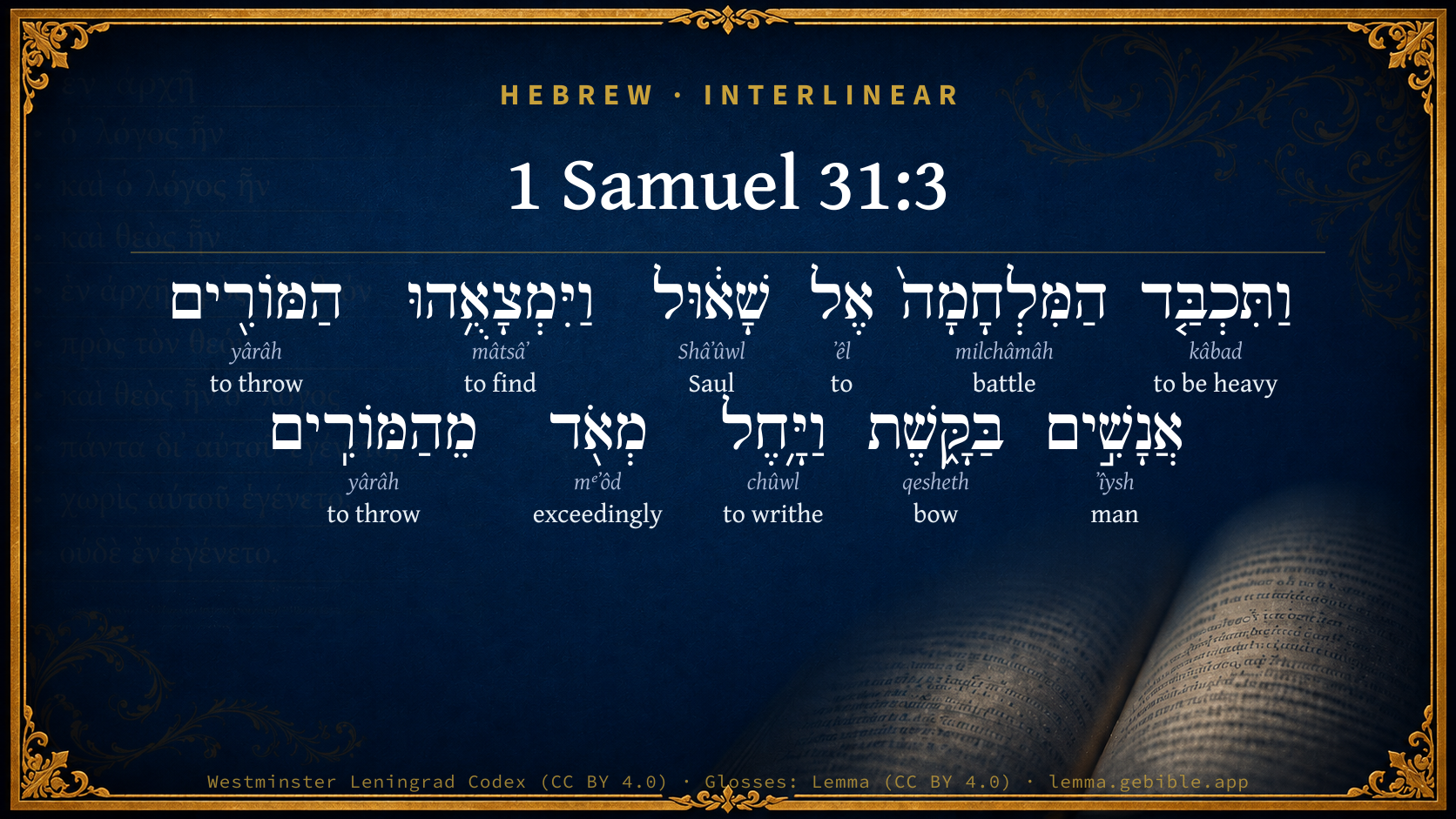
1 Samuel 31:3

Hebrew (Westminster Leningrad Codex) 1 Samuel 31:3 appears in the Hebrew Old Testament. The text above is from the Westminster Leningrad Codex. Each word links to its Strong’s number, a concise gloss, and parsing drawn from the Open Scriptures Hebrew Bible morphology. Click any word for its full Brown-Driver-Briggs (BDB) entry.
Download image
Cite this verse

1 Samuel 31:3 (World English Bible). Public Domain. Lemma interlinear Bible study tool, https://lemma.gebible.app/v/1-samuel/31/3.

Show BibTeX & RIS
BibTeX
RIS
English Translation
The battle went sore against Saul, and the archers overtook him; and he was greatly distressed by reason of the archers.
World English Bible · Public Domain
Download a study sheet

One document with this verse’s original text, its word-by-word gloss line, the meaning frame, cross-references with their text, attributed commentary, and full source and license credits — printable, and it pastes into notes with its structure intact.

This verse Autodidact and up

Study sheet (.html) Plain text (.txt)

A passage Seminary Student

Up to 50 verses in one chapter. A passage sheet keeps up to 6 commentary sources and 12 cross-references per verse, in the order this page ranks them, and says so on the sheet whenever that leaves anything out. Ask for a single verse and you get the Autodidact verse sheet above.

Everything on this page stays free to read, with no account — the sheet is a download of what is already on screen, not access to it.

Want to remove ads? Support Godless Engineer
Compare translations 3

The same verse in 3 English versions, stacked beneath the original-language interlinear above. Click any original word for its lexicon entry.

Each is an independent rendering of the whole verse — the interlinear is not word-aligned to these translations.

Highlighted words mark where these versions differ — a whole-verse word diff, not a word-by-word alignment.

  • World English Bible Public Domain
    The battle went sore against Saul, and the archers overtook him; and he was greatly distressed by reason of the archers.
  • King James Version Public Domain
    And the battle went sore against Saul, and the archers hit him; and he was sore wounded of the archers.
  • unfoldingWord Literal Text CC BY-SA 4.0
    And the battle was heavy against Saul. And the shooters, the men with the bow, found him. And he writhed greatly from the shooters.

unfoldingWord Literal Text — © unfoldingWord, licensed CC BY-SA 4.0. Word-aligned USFM3 via Door43 (git.door43.org/unfoldingWord/en_ult).

Versions to compare (up to 4)

3 of 4 selected

Show all 18 translations

Every available English version of this verse, each an independent rendering of the whole verse.

  • World English Bible Public Domain
    The battle went sore against Saul, and the archers overtook him; and he was greatly distressed by reason of the archers.
  • Berean Standard Bible Public Domain
    When the battle intensified against Saul, the archers overtook him and wounded him critically.
  • Majority Standard Bible Public Domain
    When the battle intensified against Saul, the archers overtook him and wounded him critically.
  • King James Version Public Domain
    And the battle went sore against Saul, and the archers hit him; and he was sore wounded of the archers.
  • American Standard Version (1901) Public Domain
    And the battle went sore against Saul, and the archers overtook him; and he was greatly distressed by reason of the archers.
  • Revised Version (1885) Public Domain
    And the battle went sore against Saul, and the archers overtook him; and he was greatly distressed by reason of the archers.
  • Geneva Bible (1599) Public Domain
    And when the battel went sore against Saul, the archers and bowmen hit him, and hee was sore wounded of the archers.
  • Douay-Rheims (1899) Public Domain
    And the whole weight of the battle was turned upon Saul: and the archers overtook him, and he was grievously wounded by the archers.
  • Young's Literal Translation Public Domain
    And the battle is hard against Saul, and the archers find him -- men with bow -- and he is pained greatly by the archers;
  • Literal Standard Version CC BY-SA 4.0
    And the battle is hard against Saul, and the archers find him—men with bow—and he is greatly pained by the archers;
  • Unlocked Literal Bible CC BY-SA 4.0
    The battle went heavily against Saul, and the archers overtook him. He was in severe pain because of them.
  • unfoldingWord Literal Text CC BY-SA 4.0
    And the battle was heavy against Saul. And the shooters, the men with the bow, found him. And he writhed greatly from the shooters.
  • Darby Bible Public Domain
    And the battle went sore against Saul, and the archers came up with him; and he was much terrified by the archers.
  • World Messianic Bible Public Domain
    The battle went hard against Saul, and the archers overtook him; and he was greatly distressed by reason of the archers.
  • Webster's Bible Public Domain
    And the battle was severe against Saul, and the archers hit him; and he was severely wounded by the archers.
  • Free Bible Version CC BY-SA 4.0
    The fighting became very intense around Saul, and the arrows of the Philistine archers found their target, wounding Saul very badly.
  • Bible in Basic English Public Domain
    And the fight was going badly for Saul, and the archers came across him, and he was wounded by the archers.
  • JPS Tanakh (1917) Public Domain
    And the battle went sore against Saul, an the archers overtook him; and he was in great anguish by reason of the archers.

Literal Standard Version (2020), Covenant Press — licensed CC BY-SA 4.0. Text via the HelloAO Bible API (eBible.org). Unlocked Literal Bible (unfoldingWord) — licensed CC BY-SA 4.0. Text via the HelloAO Bible API (eBible.org). unfoldingWord Literal Text — © unfoldingWord, licensed CC BY-SA 4.0. Word-aligned USFM3 via Door43 (git.door43.org/unfoldingWord/en_ult). Free Bible Version, Dr. Jonathan Gallagher — licensed CC BY-SA 4.0. Text via the HelloAO Bible API (eBible.org).

Word by word

More ways to search: Search by grammar → Find every occurrence → Compare this word →

Practice this passage: Drill this verse → Learn its vocabulary →

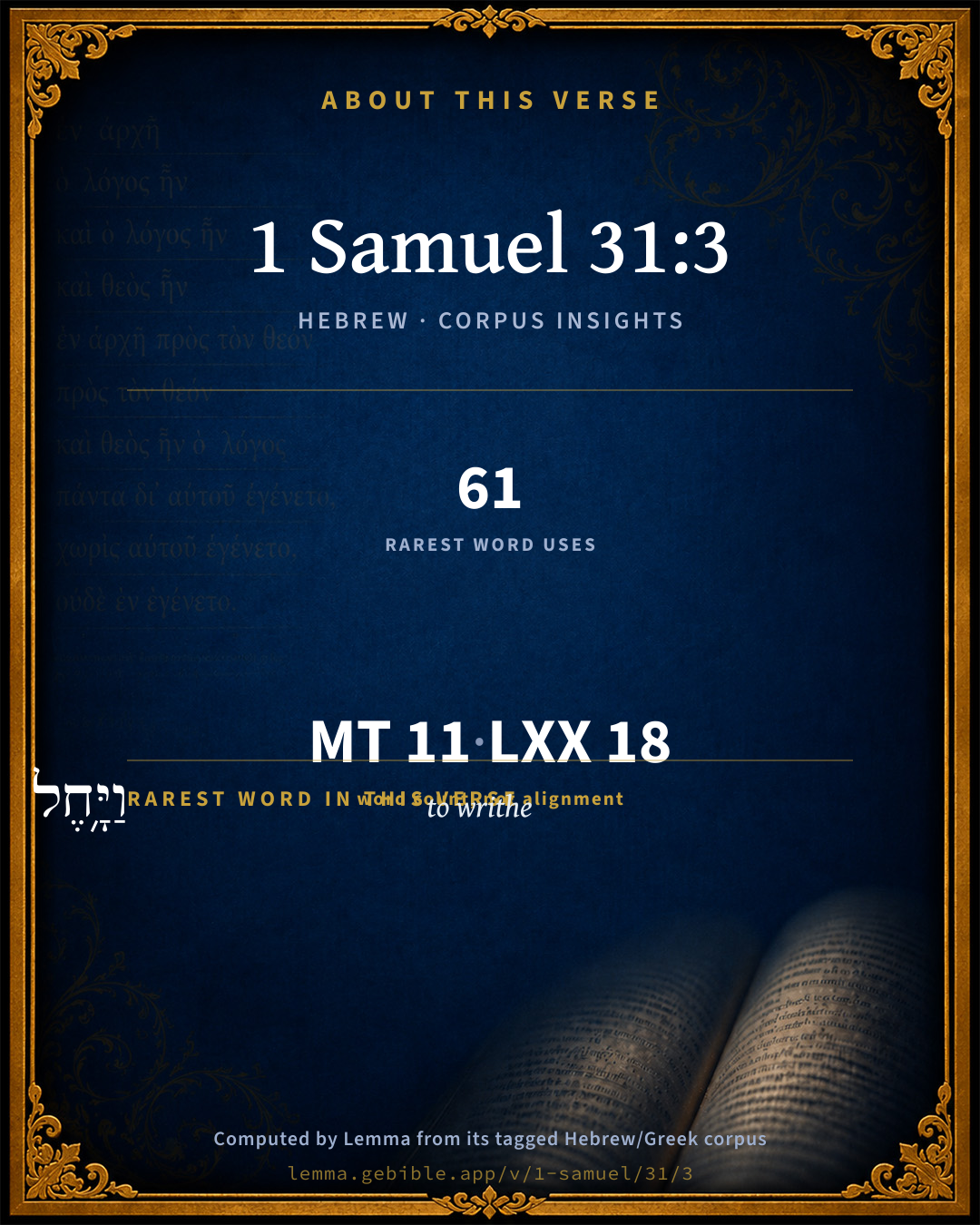
וַיָּ֥חֶל
chûwl
H2342
“and · to writhe”
Conjunction + Verb, Qal, Sequential Imperfect, 3rd Person, Masculine, Singular
Part of Speech
Conjunction + Verb
Stem
Qal
Form
Sequential Imperfect
Person
3rd Person
Gender
Masculine
Number
Singular
Full BDB Definition

Origin: a primitive root

TWOT: 623

to twist, whirl, dance, writhe, fear, tremble, travail, be in anguish, be pained - (Qal) - to dance - to twist, writhe - to whirl, whirl about - (Polel) - to dance - to writhe (in travail with), bear, bring forth - to wait anxiously - (Pulal) - to be made to writhe, be made to bear - to be brought forth - (Hophal) to be born - (Hithpolel) - whirling (participle) - writhing, suffering torture (participle) - to wait longingly - (Hithpalpel) to be distressed
  1. וַתִּכְבַּ֤ד kâbad H3513 “and · to be heavy” Conjunction + Verb, Qal, Sequential Imperfect, 3rd Person, Feminine, Singular
  2. הַמִּלְחָמָה֙ milchâmâh H4421 “the · battle” Particle, Definite Article + Noun, Common, Feminine, Singular, Absolute
  3. אֶל ʼêl H413 “to” Preposition
  4. שָׁא֔וּל Shâʼûwl H7586 “Saul” Noun, Proper
  5. וַיִּמְצָאֻ֥הוּ mâtsâʼ H4672 “and · to find · him” Conjunction + Verb, Qal, Sequential Imperfect, 3rd Person, Masculine, Plural + Suffix, Personal, 3rd Person, Masculine, Singular
  6. הַמּוֹרִ֖ים yârâh H3384 “the · throwing” Particle, Definite Article + Verb, Hiphil, Participle Active, Masculine, Plural, Absolute
  7. אֲנָשִׁ֣ים ʼîysh H376 “men” Noun, Common, Masculine, Plural, Absolute
  8. בַּקָּ֑שֶׁת qesheth H7198 “in/at the · bow” Preposition, Determined + Noun, Common, Feminine, Singular, Absolute
  9. מְאֹ֖ד mᵉʼôd H3966 “exceedingly” Adverb
  10. מֵהַמּוֹרִֽים yârâh H3384 “from · the · archers” Preposition + Particle, Definite Article + Noun, Common, Masculine, Plural, Absolute

About this verse

These counts appear in no published source. They are computed here, from the morphology-tagged text and Lemma’s own curated glosses. What Lemma adds →

11
words
10
distinct lemmas
Historical
section

Grammatical profile

  • 4 verbs
  • 5 nouns
  • 1 preposition
  • 1 adverb

Verb forms

  • וַתִּכְבַּ֤ד Qal · Sequential Imperfect
  • וַיִּמְצָאֻ֥הוּ Qal · Sequential Imperfect
  • הַמּוֹרִ֖ים Hiphil · Participle Active
  • וַיָּ֥חֶל Qal · Sequential Imperfect

Repetition

A word recurs within this verse — often emphatic in Hebrew:

  • הַמּוֹרִ֖ים to throw H3384 ×2

Hebrew & Septuagint length

In English translation the verse runs 21 words from the Hebrew and 23 from the Septuagint (LXX English) — closely comparable.

A rough comparison of the two English renderings, which tokenize alike — not a word-level alignment.

Word counts can differ between the Hebrew and the Greek without any difference in meaning — e.g. the Hebrew direct-object marker אֵת has no separate Greek word, and Greek often adds the article ὁ.

In the original languages it is 11 Hebrew tokens and 18 Greek tokens — but the two are counted differently (Hebrew bundles its prefixes and suffixes into one token; the Greek is in lemma form), so that isn’t a like-for-like length.

Cross-references

5

Topical passages linked to 1 Samuel 31:3 in the Treasury of Scripture Knowledge — connected by theme and wording, ordered by reader-vote popularity; previews shown in the World English Bible.

  • 2 Samuel 1:6 The young man who told him said, As I happened by chance on Mount Gilboa, behold, Saul was leaning on his spear; and, behold, the chariots and the horsemen followed hard after him.
  • Genesis 49:23 The archers have sorely grieved him, Shot at him, and persecute him:
  • 2 Samuel 1:4 David said to him, How went the matter? Please tell me. He answered, The people are fled from the battle, and many of the people also are fallen and dead; and Saul and Jonathan his son are dead also.
  • 1 Kings 22:34 A certain man drew his bow at a venture, and struck the king of Israel between the joints of the armor: therefore he said to the driver of his chariot, Turn your hand, and carry me out of the host; for I am severely wounded.
  • Amos 2:14 Flight will perish from the swift; And the strong won't strengthen his force; Neither shall the mighty deliver himself;

Cross-references courtesy of OpenBible.info (CC BY 4.0).

Hebrew and Greek witnesses Masoretic Hebrew ↔ Greek Septuagint

The same verse in the two great witnesses to the Old Testament, shown verse-for-verse.

These are two independent witnesses, not word-aligned to each other, and the Septuagint is shown in lemma (dictionary) form.

Hebrew 1 Samuel 31:3 Masoretic · Westminster Leningrad Codex

וַתִּכְבַּ֤ד הַמִּלְחָמָה֙ אֶל שָׁא֔וּל וַיִּמְצָאֻ֥הוּ הַמּוֹרִ֖ים אֲנָשִׁ֣ים בַּקָּ֑שֶׁת וַיָּ֥חֶל מְאֹ֖ד מֵהַמּוֹרִֽים

The battle went sore against Saul, and the archers overtook him; and he was greatly distressed by reason of the archers.

World English Bible · Public Domain

Greek LXX 1 Samuel 31:3 Septuagint · lemma form

καί βαρύνω ὁ πόλεμος ἐπί σαούλ καί εὑρίσκω αὐτός ὁ ἀκοντιστής ἀνήρ τοξότης καί τραυματίζω εἰς ὁ ὑποχόνδριον

And the battle prevails against Saul, and the shooters with arrows, even the archers find him, and he was wounded under the ribs.

LXX2012 (modern English Septuagint) · Public Domain

On this verse, Haydock's Catholic Bible Commentary discusses the Septuagint’s reading. Read the note in Commentary ↓

Hebrew: Westminster Leningrad Codex (CC BY 4.0). Greek: Septuagint (public domain); English from LXX2012 (modern English Septuagint) (Public Domain). How the Septuagint differs from the Hebrew →

Targum (Aramaic paraphrase)

1

The Targum is the ancient Jewish Aramaic paraphrase of the Hebrew Scriptures — an interpretive translation, not the Hebrew text itself. Onkelos (literal) and Pseudo-Jonathan (expansive) render the Torah, and Jonathan the Prophets. Coverage is partial: where no permissively-licensed English translation exists for a verse, only the Aramaic is shown. This is verse-level text, not a word-by-word alignment to the Hebrew.

  1. Targum Jonathan Prophets (Joshua–Malachi)
    וְתַקִיפוּ עָבְדֵי קְרָבָא עַל שָׁאוּל וְאַשְׁכְּחוֹהִי קַשְׁתַּיָא גַבְרִין דְאוּמָנִין לְמֵיגַד בְּקַשְׁתָּא וּדְחִיל לַחֲדָא מִקַשְׁתַּיָא:

    (no public-domain English translation for this verse)

    Targum Jonathan — Aramaic: “Mikraot Gedolot” (public domain). English: “Sefaria Community Translation” (CC0 1.0 (public-domain dedication)); “London "Chaldee Paraphrase," 1871” (public domain). Text via Sefaria.

Commentary

Notes on 1 Samuel 31:3 from classic Christian and Jewish commentators (each source and its license shown beneath its notes). The classic Christian expositions comment on the surrounding passage and are grouped to its opening verse, so a note may address several verses; the Jewish commentaries on the Tanakh (Rashi and others) are per-verse, so they appear only where the commentator wrote on this verse.

Lemma curates 59 commentaries, every one of them public domain or Creative Commons licensed, each selected and text-cleaned for this edition rather than reprinted as found. About our sources →

Trapp's Complete Commentary

John Trapp

1Sa 31:3 And the battle went sore against Saul, and the archers hit him; and he was sore wounded of the archers.

Ver. 3. And he was sore wounded of the archers.] Sulpitius Severus saith he was so wounded that he fell from his horse. {a} But this he addeth of his own; for neither in the Scriptures nor yet in Josephus read we any such thing.

{a} Saul equo delapsus. - Sac. Hist., lib. i.

John Trapp, A Commentary or Exposition upon All the Books of the Old and New Testament (1647–1656) — public domain. Text from a community e-Sword module.

Joseph Benson's Commentary

1Sa 31:3. The archers hit him — Hebrews ימצאהו jim-stauhu, found him. Houbigant renders it, rushed upon him. It seems by this that the Philistines gained the battle, chiefly by the advantage of their archers. Probably these were some hired troops, for we meet with no mention before this of any archers in any of the Philistines’ armies or battles; and it seems to have been a way of fighting that Saul and the Israelites were not prepared for, and therefore they were soon thrown into confusion by it. “The use of the bow, however,” says Dr. Dodd, “was not unknown. Jonathan is celebrated for his skill and dexterity in it; and so were some of the worthies who resorted to David; but it seems not yet to have been brought into common practice, if, as has been collected from 2Sa 1:18, David, after this battle, had the Israelites taught the use of it.”

Joseph Benson's Commentary on the Old and New Testaments (1811–1818) — public domain. Text from a community e-Sword module.

Geneva Bible (1599)

Geneva Bible translators

Hebrew, found him.

Or, afraid.

Geneva Bible (1599) marginal notes — public domain. Text via Bolls.life.

Jamieson, Fausset & Brown

Robert Jamieson, A. R. Fausset & David Brown

the battle went sore against Saul, &c.--He seems to have bravely maintained his ground for some time longer; but exhausted with fatigue and loss of blood, and dreading that if he fell alive into the enemy's hands, they would insolently maltreat him (Jos 8:29; Jos 10:24; Jdg 8:21), he requested his armor bearer to despatch him. However, that officer refused to do so. Saul then falling on the point of his sword killed himself; and the armor bearer, who, according to Jewish writers, was Doeg, following the example of his master, put an end to his life also. They died by one and the same sword--the very weapon with which they had massacred the Lord's servants at Nob.

Jamieson, Fausset & Brown — Commentary Critical and Explanatory on the Whole Bible (1871) — public domain (CC PDM 1.0). Text via the HelloAO Bible API.

Adam Clarke's Commentary

Verse 3. He was sore wounded of the archers.] It is likely that Saul's sons were slain by the archers, and that Saul was now mortally wounded by the same. Houbigant translates, The archers rushed upon him, from whom he received a grievous wound. He farther remarks that had not Saul been grievously wounded, and beyond hope of recovery, he would not have wished his armour-bearer to despatch him; as he might have continued still to fight, or have made his escape from this most disastrous battle. Some of the versions render it, He FEARED the archers greatly; but this is by no means likely.

Adam Clarke's Commentary on the Bible (1810–1826) — public domain. Text from a community e-Sword/MySword module.

Ellicott's Commentary for English Readers

(3) And the battle went sore against Saul.—That is, after the death of Jonathan and his brothers. The great warrior king no doubt fought like a lion, but one by one his brave defenders fell in harness by his side; and the enemy seems to have directed their principal attention, at this period of the fight, to killing or capturing the famous Saul.

And the archers hit him.—It would seem as though, in that deadly combat, none could strike down that giant kingly form, so the archers—literally, as in the margin of our Version, shooters, men with bows, skilful shots—were told off, and these, aiming at the warrior towering above the other combatants, with the crown on his head (2Sa_1:10), hit him.

And he was sore wounded by the archers.—This is the usual rendering of the word, but the more accurate translation is, He was sore afraid (or was greatly alarmed at them): so Gesenius, Keil, Lange, &c. All seemed against him. His army was routed, his sons were dead, his faithful captains and companions were gone, and these bow-men were shooting at him from a distance where his strong arm could not reach them. Gradually weakened through loss of blood—perhaps with the words he had heard only a few hours before at En-dor from the dead prophet ringing in his ears, “To-morrow shalt thou and thy sons be with me”—the great undaunted courage at last failed him, and he turned to his armourbearer, who was still by his side.

A Bible Commentary for English Readers, edited by Charles John Ellicott (1878–1897) — public domain. Text from a community e-Sword module.

The Cambridge Bible for Schools and Colleges

gen. ed. J. J. S. Perowne

3. the battle went sore against Saul] Cp. 1Ki_22:31 ff. The Vulg. has a striking paraphrase: “the whole weight of the battle was directed against Saul,” (totumque pondus praelii versum est in Saul).

he was sore wounded] So the Sept. and Vulg. But the Heb. may also be rendered, “and he was sore afraid.” Despair and the fear of insult paralysed his courage. For “of the archers” the Sept. reads “in the abdomen,” but the Heb. text is preferable.

The Cambridge Bible for Schools and Colleges (gen. ed. J. J. S. Perowne; Cambridge University Press, 1878–1918) — public domain. Text from a community e-Sword module.

John Gill's Exposition

And the battle went sore against Saul,.... Pressed heavy upon him; he was the butt of the Philistines, they aimed at his person and life:

and the archers hit him; or "found him" (a); the place where was, and directed their arrows at him:

and he was sore wounded of the archers; or rather "he was afraid" of them, as the Targum, for as yet he was not wounded; and so the Syriac and Arabic versions render it, and is the sense Kimchi and Ben Melech give of the word: he was not afraid of death, as Abarbinel observes, he chose to die; but he was afraid he should be hit by the archers in such a way that he should not die immediately, and should be taken alive and ill used; the Philistines, especially the Cherethites, were famous for archery; See Gill on Zep 2:5.

(a) "et inveserust cum", Pagninus, Montanus.

John Gill's Exposition of the Whole Bible (1746–1763) — public domain (CC PDM 1.0). Text via the HelloAO Bible API.

Albert Barnes' Notes on the Bible

He was sore wounded - Better, “he was sore afraid” (compare Deu 2:25). Saul’s fear is explained in 1Sa 31:4.

Albert Barnes' Notes on the Bible (1834–1885) — public domain. Text from a community e-Sword/MySword module.

Haydock's Catholic Bible Commentary

Overtook. Hebrew, "attacked, found, or hit him." He was running away. (Haydock) --- Wounded. Some translate Hebrew, "terrified," as they believe the words of the Amalecite, "my whole life is in me." But that wretch deserves no credit; and Saul would probably not take the desperate resolution of killing himself, till he saw there was no possibility of escaping. Septuagint, "the archers find him, and they wounded him in the lower belly." Theodotion, "in the part near the liver."

George Leo Haydock (1774–1849), Haydock's Catholic Family Bible and Commentary, 1859 edition — public domain. Excludes Psalms (Douay-Rheims chapter numbering differs from Protestant) and Deuterocanonical books (Catholic canon only).

Whedon's Commentary on the Bible

Daniel D. Whedon

3. Battle went sore — This verse is rendered better thus: Then the battle was heavy against Saul, and the archers, men with the bow, discovered him, and he became greatly terrified because of the archers — After his sons had fallen, Saul was in worse straits than ever, for now the brunt of the battle came on him.

Archers — מורים, shooters; explained further by the phrase men with the bow; that is, men who shot arrows with the bow. ימצאהו, found him; discovered him; singled him out; not hit him, as our version. After the fall of his sons, the archers discovered Saul, and began to aim their missiles at him. ויחל, imperfect, shortened from חול, to writhe, to quake with pain. The word nowhere means to be wounded, as our version has it here. It is, indeed, probable that some of their arrows struck him, and this caused his alarm. He saw that he was the mark of the Philistine sharp-shooters, and he therefore writhed and quaked with terror at the thought of falling by such hands.

Daniel D. Whedon (gen. ed.), Commentary on the Old and New Testaments (1874–1909) — public domain. Text from a community e-Sword module.

The Pulpit Commentary

Vers. 3, 4. The archers. Literally, as in the margin, "shooters, men with bows." As the first word would equally apply to men who threw javelins, the explanation is added to make the meaning clear. Hit him. Literally, "found him, i.e. found out his position, and came up to where he was. He was sore wounded. Rather, "he was sore distressed." In Deu_2:25 the verb is rendered "be in anguish." The meaning is that Saul, finding himself surrounded by these archers, and that he could neither escape nor come to close quarters with them, and die fighting, ordered his armour bearer to kill him, that he might be spared the degradation of being slain by "uncircumcised" heathen. Abuse me. This verb is translated mock in Jer_38:19. "Maltreat" would be a better rendering in both places, and also in Jud_1:19:25, where, too, the word occurs. Its exact meaning is to practise upon another all that passion, lust, anger, or malice dictate. Probably Saul thought that they would treat him as they had previously treated Samson. (Jud 16:21-25)

HOMILIES BY D. FRASER Vers. 3-6.

The bitter end.

The tragic element, so conspicuous in this history, is intense in the last scene of all.

I SAUL"S DEATH.

1. His despair. When the battle went against him, and the Philistines, keeping beyond reach of his long arm and terrible sword, hit him from a distance with their arrows, the king"s spirit suddenly failed and died within him. "He trembled sore because of the archers." Always fitful in his moods,

2. liable to sudden elation and sudden depression, he gave up all for lost. He would not flee, but he would fight no more. Probably the horrible recollection of the words spoken to him by the spectre at Endor increased his despair, and he thought only how to die.

3. His pride. Saul had never shown much regard for the sacredness of human life, but he cherished a most exalted sense of the sacredness of his own person as the Lord"s anointed. No descendant of a long line of so styled Christian or Catholic sovereigns has held a loftier claim of personal inviolability. So he resolved that no heathen should cut him down in battle. Anything rather than this. If his armour bearer would not kill him, he would kill himself.

1. His suicide. With all his horror of being slain by a heathen, Saul died like a heathen dismissed himself from life after the manner of the pagan heroes; not with any sanction from the word of God or the history of his servants. (Illustrate from the stories of Brutus and Cassius and the younger Cato.) The only instance of what can be called self-destruction among the men of Israel prior to the days of Saul was that of Samson, and his was a self-devotion for the destruction of his country"s enemies which ranks with the heroism of one dying in battle rather than with cases of despairing suicide. There is a case after the days of Saul, viz., that of Ahithophel, who, in a fit of deep chagrin, deliberately hanged himself. To the servants of God suicide must always appear as a form of murder, and one that implies more cowardice than courage. English law regards it as a very grave crime, and to mark this our old statutes, unable to punish the self-murderer, assigned to his body ignominious burial It is, however, the charitable custom of our times to assume that one who kills himself must be bereft of reason, and so to hold him morally irresponsible. Apology of this kind may be pleaded for King Saul, and pity for his disordered brain takes away the sharpness from our censure. Still we must not overlook

2. The admonition which his death conveys. Saul had really prepared for himself this wretched death. He had disregarded the prophet, and so was without consolation. He had killed the priests, and so was without sacrifice or intercession. He had driven away David, and so was without the help of the best soldier in the nation, a leader of 600 men inured to service and familiar with danger. He had lived, in his later years at least, like a madman; and, like a madman, he threw himself on his sword and died. Here lies admonition for us. As a man sows he reaps. As a life is shaped, so is the death determined. We speak of the penalty on evil doers, but it is no mere arbitrary infliction; it is the natural fruit and necessary result of the misconduct. One leads a sensual life, and the penalty on him is that of exhaustion, disease, and premature decay. One leads a selfish life, hardening his heart against appeal or reproach, and his doom is to lose all power and experience of sympathy, to pass through the world winning no love, and pass out of the world drawing after him no regret.

II JONATHAN"S DEATH.

1. Its innocence. Look at the pious, generous prince, as well as the proud and wilful king, slain on that woeful day. A man who loves God and whom God loves may be innocently involved in a cause which is bound to fail. It may be by ties of family, or by official position which he cannot renounce; and, unable to check the fatal course of his comrades, he is dragged down in the common catastrophe. Jonathan died in the same battle with his father, but not as his father died. Let us remember that men are so involved with one another in the world, in ways quite defensible, sometimes unavoidable, that as one may share the success of another without deserving any part of the praise, so also may one share the downfall of others without being at all to blame for the courses or transactions which brought about the disastrous issue.

2. Its timeliness. The death of Jonathan: occurring when it did, brought more advantage to the nation than his continued life could possibly have rendered. It opened the way for David"s succession to the throne. Had Jonathan survived his father, be might have been willing to cede the succession to David, but it is not at all probable that the people would have allowed his obvious claim to be set aside, and any conflict between the partisans of two such devoted friends would have been most painful to both. So it was well ordered and well timed that Jonathan died as a brave soldier in the field. He missed an earthly throne indeed, but he gained all the sooner a heavenly home. So is it with many a death which seems to be sad and untimely. A man of God cannot lose by dying. To die is gain. But he may by dying advance the cause of God more than he could by living. His departure may clear the ground for other arrangements under Divine providence, for which the time is ripe, or open the way for some one who is chosen and called to do a work for God and man that must no longer be delayed. F.

The Pulpit Commentary (1880–1919), ed. H.D.M. Spence-Jones & Joseph S. Exell — public domain. Text from a community e-Sword module.

Scofield Reference Notes

C. I. Scofield

hit him

Cf. 2Sa 1:10; 2Sa 21:12. The order is:

(1) Saul is "hit"--wounded mortally, potentially "slain," by the Philistines;

(2) either to escape agony, or insult by the enemy, he falls upon his sword, and his armour-bearer, supposing him to be dead, slew himself;

(3) but Saul was not dead; raising himself upon his spear, he besought the Amalekite to put him to death. 2Sa 1:10; 2Sa 21:12.

The Scofield Reference Bible (1917 edition), notes by C. I. Scofield — public domain. Text from a community e-Sword module.

Lesson kit

Teaching starters — assembled from the data on this page, not authored interpretation. Every prompt links to the verse data it draws on. Edit before teaching.

1 Samuel, in the Historical, opens this verse with 11 words (10 distinct Hebrew lemmas). Its most distinctive word is chûwl (“to writhe”). A historical commentator’s framing appears above. Read the whole chapter for the surrounding context.

Discussion questions

  1. The word chûwl carries the sense “to writhe.” How does it shape the verse?
  2. How does 2 Samuel 1:6, which shares this passage’s theme, read alongside this verse?
  3. What does the repetition of “to throw” (2× in this one verse) do in this verse?
  4. These translations render this verse differently; the difference is in the English rendering, not the original. What questions does that raise?
  5. «וַתִּכְבַּ֤ד» is a Qal Sequential Imperfect verb. How does that grammatical form shape the action described?
  6. Compare how Trapp's Complete Commentary and Joseph Benson's Commentary read this verse. Where do they agree or differ?

Things to notice

Reading settings

Reading text

Shown beneath each verse's original-language words.

Old Testament
Old Testament edition

Read the OT as the Masoretic Hebrew (MT) or the Greek Septuagint (LXX).

English shown for the Greek Septuagint (in the Hebrew ↔ Greek comparison).

Comparing translations? Open the Compare panel on any verse page to stack up to four side by side.