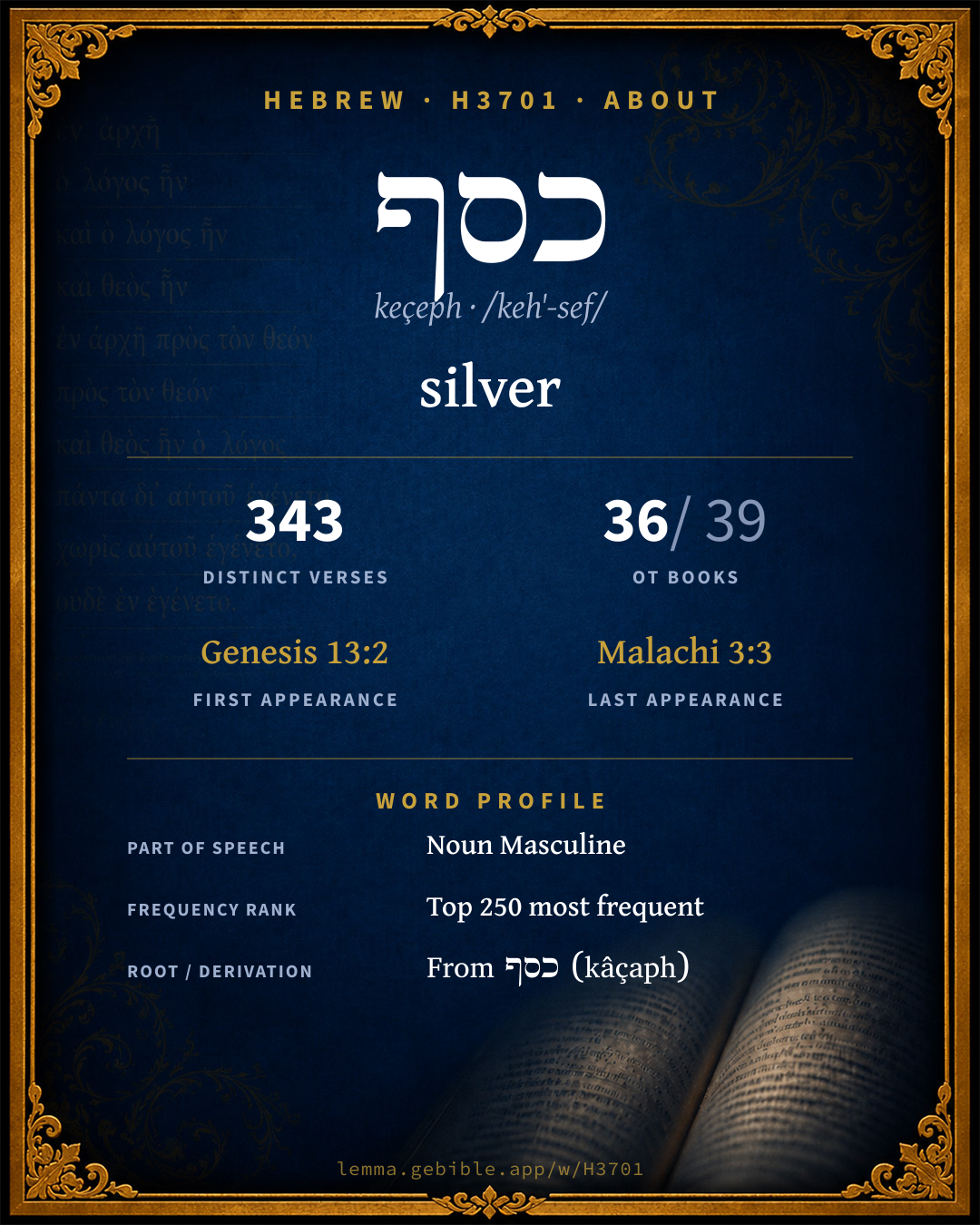
כֶּ֫סֶף
silver
‘silver’ is one of 3 main senses fuller range ↓
Full lexicon entry — Brown-Driver-Briggs (BDB)
From Brown-Driver-Briggs (BDB)
Where this word appears
See every Absolute-state word in the Hebrew Bible →
Grammar key — what these labels mean
Part of speech
- Noun
- A naming word — a person, place, thing, or idea.
Noun type
- Common
- A common noun — a general class of person, place, or thing (“king,” “city,” “water”), not a specific name.
State
- Absolute
- The independent form of a noun, not bound to a following word.
- Construct
- A noun bound to a following noun in a possessive / “of” relationship (the construct chain).
Gender
- Masculine
- Grammatically masculine.
Number
- Singular
- One.
- Plural
- More than one (in Hebrew, generally three or more).
Every verse where H3701 appears in the Book of Genesis — 32 distinct verses. Click any verse to open its interlinear word-by-word view. Verse text shown in the World English Bible for context — . Each verse’s Hebrew form is shown with its reference; the English is not keyword-highlighted, since the data carries no word-level English alignment. Use “Compare translations” on any verse to read it across multiple English versions. This concordance covers the Hebrew Bible; Septuagint (Greek Old Testament) occurrences are not indexed here.
Genesis
- Genesis 13:2 בַּ/כֶּ֖סֶף prep det + n c ms Abram was very rich in cattle, in silver, and in gold.
- Genesis 17:12 כֶּ֨סֶף֙ n c ms He who is eight days old will be circumcised among you, every male throughout your generations, he who is born in the house, or bought with money of any foreigner who is not of your seed.
- Genesis 17:13 כַּסְפֶּ֑/ךָ n c ms cs + sfx pers 2ms He who is born in your house, and he who is bought with your money, must be circumcised. My covenant will be in your flesh for an everlasting covenant.
- Genesis 17:23 כַּסְפּ֔/וֹ n c ms cs + sfx pers 3ms Abraham took Ishmael his son, all who were born in his house, and all who were bought with his money; every male among the men of Abraham's house, and circumcised the flesh of their foreskin in the same day, as God had said to him.
- Genesis 17:27 כֶּ֖סֶף n c ms All the men of his house, those born in the house, and those bought with money of a foreigner, were circumcised with him.
- Genesis 20:16 כֶּ֨סֶף֙ n c ms To Sarah he said, "Behold, I have given your brother a thousand pieces of silver. Behold, it is for you a covering of the eyes to all that are with you. In front of all you are vindicated."
- Genesis 23:9 בְּ/כֶ֨סֶף prep + n c ms that he may give me the cave of Machpelah, which he has, which is in the end of his field. For the full price let him give it to me in the midst of you for a possession of a burying-place."
- Genesis 23:13 כֶּ֤סֶף n c ms cs He spoke to Ephron in the audience of the people of the land, saying, "But if you will, please hear me. I will give the price of the field. Take it from me, and I will bury my dead there."
- Genesis 23:15 כֶּ֛סֶף n c ms "My lord, listen to me. What is a piece of land worth four hundred shekels of silver between me and you? Therefore bury your dead."
- Genesis 23:16 הַ/כֶּ֕סֶף כֶּ֔סֶף ptcl def.art + n c ms n c ms Abraham listened to Ephron. Abraham weighed to Ephron the silver which he had named in the audience of the children of Heth, four hundred shekels of silver, according to the current merchants' standard.
- Genesis 24:35 וְ/כֶ֣סֶף conj + n c ms Yahweh has blessed my master greatly. He has become great. He has given him flocks and herds, silver and gold, men-servants and maid-servants, and camels and donkeys.
- Genesis 24:53 כֶ֨סֶף n c ms The servant brought forth jewels of silver, and jewels of gold, and clothing, and gave them to Rebekah. He gave also to her brother and to her mother precious things.
- Genesis 31:15 כַּסְפֵּֽ/נוּ n c ms cs + sfx pers 1cp Aren't we accounted by him as foreigners? For he has sold us, and has also quite devoured our money.
- Genesis 37:28 כָּ֑סֶף n c ms Midianites who were merchants passed by, and they drew and lifted up Joseph out of the pit, and sold Joseph to the Ishmaelites for twenty pieces of silver. They brought Joseph into Egypt.
- Genesis 42:25 כַּסְפֵּי/הֶם֙ n c mp cs + sfx pers 3mp Then Joseph commanded to fill their bags with grain, and to restore every man's money into his sack, and to give them food for the way. So it done to them.
- Genesis 42:27 כַּסְפּ֔/וֹ n c ms cs + sfx pers 3ms As one of them opened his sack to give his donkey food in the lodging-place, he saw his money. Behold, it was in the mouth of his sack.
- Genesis 42:28 כַּסְפִּ֔/י n c ms cs + sfx pers 1cs He said to his brothers, "My money is restored! Behold, it is even in my sack." Their hearts failed them, and they turned trembling one to another, saying, "What is this that God has done to us?"
- Genesis 42:35 כַּסְפּ֖/וֹ כַּסְפֵּי/הֶ֛ם n c ms cs + sfx pers 3ms n c mp cs + sfx pers 3mp It happened as they emptied their sacks, that behold, every man's bundle of money was in his sack. When they and their father saw their bundles of money, they were afraid.
- Genesis 43:12 וְ/כֶ֥סֶף הַ/כֶּ֜סֶף conj + n c ms cs ptcl def.art + n c ms and take double money in your hand, with the money that was returned in the mouth of your sacks carry again in your hand. Perhaps it was an oversight.
- Genesis 43:15 כֶּ֛סֶף n c ms The men took that present, and they took double money in their hand, and Benjamin; and rose up, went down to Egypt, and stood before Joseph.
- Genesis 43:18 הַ/כֶּ֨סֶף֙ ptcl def.art + n c ms The men were afraid, because they were brought to Joseph's house; and they said, "Because of the money that was returned in our sacks at the first time are we brought in; that he may seek occasion against us, and fall on us, and take us for bondservants, along with our donkeys."
- Genesis 43:21 כֶֽסֶף כַּסְפֵּ֖/נוּ n c ms cs n c ms cs + sfx pers 1cp and it happened, when we came to the lodging-place, that we opened our sacks, and, behold, every man's money was in the mouth of his sack, our money in full weight. We have brought it again in our hand.
- Genesis 43:22 וְ/כֶ֧סֶף כַּסְפֵּ֖/נוּ conj + n c ms n c ms cs + sfx pers 1cp We have brought down other money in our hand to buy food. We don't know who put our money in our sacks."
- Genesis 43:23 כַּסְפְּ/כֶ֖ם n c ms cs + sfx pers 2mp He said, "Peace be to you. Don't be afraid. Your God, and the God of your father, has given you treasure in your sacks. I received your money." He brought Simeon out to them.
- Genesis 44:1 כֶּֽסֶף n c ms cs He commanded the steward of his house, saying, "Fill the men's sacks with food, as much as they can carry, and put every man's money in his sack's mouth.
- Genesis 44:2 הַ/כֶּ֗סֶף כֶּ֣סֶף ptcl def.art + n c ms n c ms cs Put my cup, the silver cup, in the sack's mouth of the youngest, with his grain money." He did according to the word that Joseph had spoken.
- Genesis 44:8 כֶּ֗סֶף כֶּ֖סֶף n c ms n c ms Behold, the money, which we found in our sacks' mouths, we brought again to you out of the land of Canaan. How then should we steal silver or gold out of your lord's house?
- Genesis 45:22 כֶּ֔סֶף n c ms To all of them he gave each man changes of clothing, but to Benjamin he gave three hundred pieces of silver and five changes of clothing.
- Genesis 47:14 הַ/כֶּ֨סֶף֙ הַ/כֶּ֖סֶף ptcl def.art + n c ms ptcl def.art + n c ms Joseph gathered up all the money that was found in the land of Egypt, and in the land of Canaan, for the grain which they bought: and Joseph brought the money into Pharaoh's house.
- Genesis 47:15 הַ/כֶּ֗סֶף כָּֽסֶף ptcl def.art + n c ms n c ms When the money was all spent in the land of Egypt, and in the land of Canaan, all the Egyptians came to Joseph, and said, "Give us bread, for why should we die in your presence? For our money fails."
- Genesis 47:16 כָּֽסֶף n c ms Joseph said, "Give your cattle; and I will give you food for your cattle, if money fails."
- Genesis 47:18 הַ/כֶּ֔סֶף ptcl def.art + n c ms When that year was ended, they came to him the second year, and said to him, "We will not hide from my lord how our money is all spent, and the herds of cattle are my lord's. There is nothing left in the sight of my lord, but our bodies, and our lands.
About this entry
At a glance — auto-summarized from this page’s data, not written by a person. Every figure links to its source below. This summary describes the numbers; it doesn’t interpret them.
“silver” is the headline sense of the Hebrew noun כסף (keçeph). First canonically at Genesis 13:2, it enters the text early. It turns up in 343 verses across 36 books, a common footprint. Carrying more than one sense, it rewards its full sense range. From the same root come כסף, כסף and כספיא. See the sense tree, 343-verse concordance, and the renderings breakdown below.
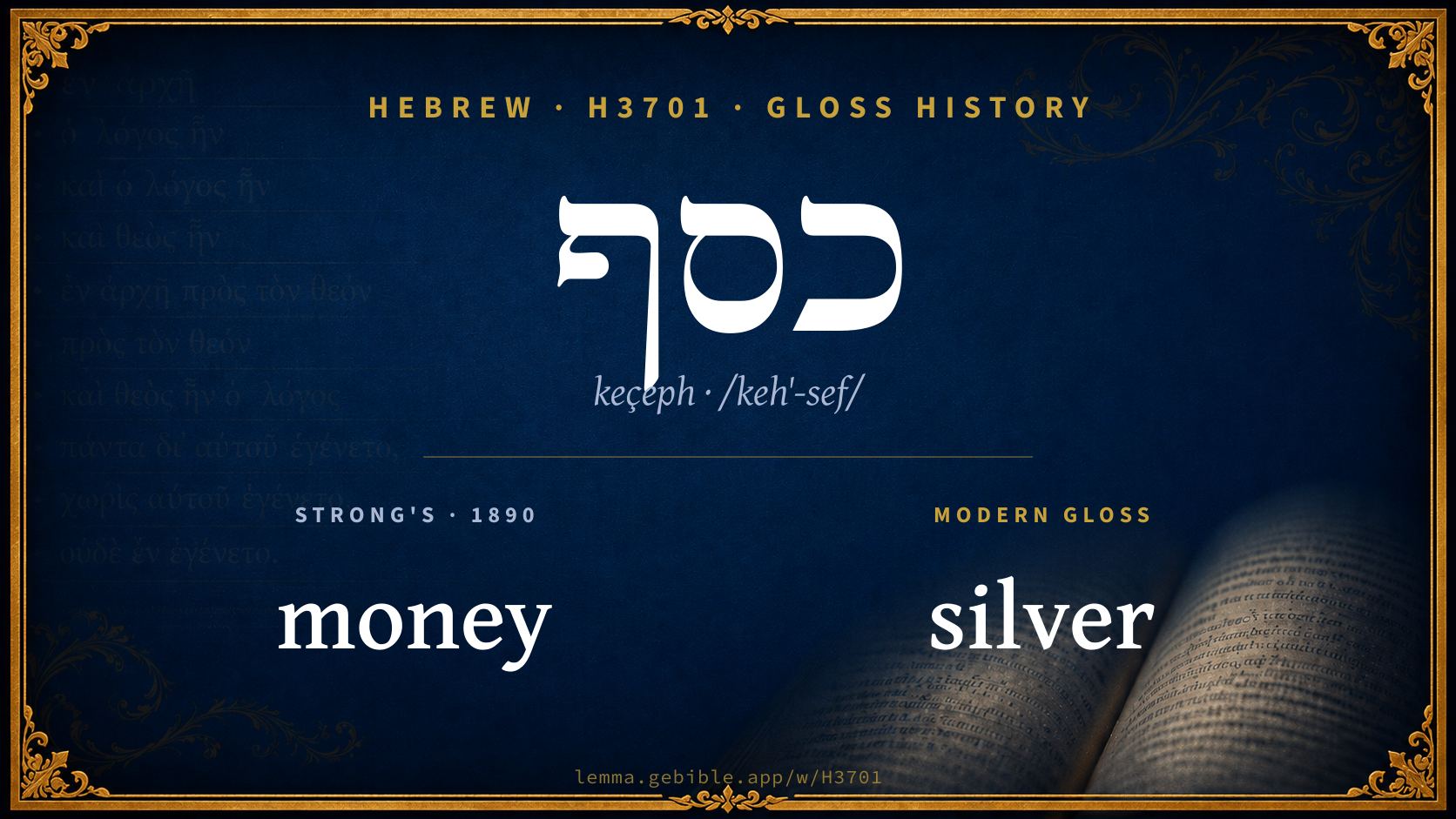
Gloss history
Strong's 1890 vs modern scholarship
About this word
Strong's H3701 catalogs a Hebrew word from the Hebrew Old Testament.
These counts are not copied from any lexicon or concordance. They are computed here, from the morphology-tagged Hebrew Old Testament. What Lemma adds →
- 343
- distinct verses
- The word appears in 343 distinct verses.
- 36 / 39
- OT books
- The word appears in 36 of 39 Old Testament books.
- #123
- by frequency
- Top 250 most frequent Hebrew words (rank 123 of 8,640 Hebrew words by occurrence).
View all 343 occurrences in the concordance →
By section of the Old Testament
By traditional corpus
Conventional, traditional groupings — biblical authorship is debated, so this is a traditional corpus grouping, not an authorship claim. Each share is this word’s portion of its verses in that division of the Hebrew canon. Each figure is a share of the word’s 343 distinct verses.
- Prophets (Nevi'im) 122 verses · 36%
- Torah (Pentateuch) 115 verses · 34%
- Writings (Ketuvim) 106 verses · 31%
How translations render this word
Counts come from each version’s own published word-to-Strong’s tagging or interlinear alignment — an approximate guide to how each version renders this word, not a word-level alignment the data otherwise carries. Because each total is that version’s own tagged count, the per-version totals vary from one another and need not match the appearance or distinct-verse counts above. These counts may also differ from a printed concordance because Lemma counts each distinctly tagged rendering and does not collapse phrase taggings into a single head-word total. This is a fixed set of word-tagged versions (KJV, ASV, BSB, ULT) and does not change with the reading translation you choose elsewhere. Each version’s license is shown beside its name below (and on Sources).
- King James Version: Silver 235×, Money 90×, Pieces of silver 11×
- American Standard Version: Silver 211×, Money 80×, Pieces of silver 17×
- Berean Standard Bible: Silver 281×, Money 57×, Price 8×
- unfoldingWord Literal Text: Silver 337×, Silver of 16×, Money 15×
King James Version Public Domain
Renders H3701 across 403 tagged occurrences — most commonly:
Plus other, less common renderings. Plus 31 renderings that appear only once — usually multi-word phrases or single function words the recovered tagging swept in, not distinct renderings.
American Standard Version Public Domain
Renders H3701 across 403 tagged occurrences — most commonly:
Plus other, less common renderings. Plus 46 renderings that appear only once — usually multi-word phrases or single function words the recovered tagging swept in, not distinct renderings.
Berean Standard Bible Public Domain
Renders H3701 across 386 tagged occurrences — most commonly:
Plus 21 renderings that appear only once — usually multi-word phrases or single function words the recovered tagging swept in, not distinct renderings. Not rendered by a distinct English word in 16 further occurrences.
unfoldingWord Literal Text CC BY-SA 4.0
Renders H3701 across 416 tagged occurrences — most commonly:
Plus other, less common renderings. Plus 12 renderings that appear only once — usually multi-word phrases or single function words the recovered tagging swept in, not distinct renderings.
14 senses and sub-senses in the full BDB
What do BDB’s symbols mean?
BDB uses these scholarly abbreviations:
| Symbol | Meaning |
|---|---|
| 𝔊 | the Septuagint (the ancient Greek translation, LXX) |
| 𝔙 | the Vulgate (the Latin translation) |
| 𝔖 | the Syriac version (the Peshitta) |
| 𝔗 | the Targum (the Aramaic translation) |
| ψ | the Psalms |
| √ | root (the underlying root or stem) |
| ‖ | parallel passage (a synonymous or contrasted parallel) |
| † | the dagger: every passage where the word occurs is cited |
The 14 senses and sub-senses the full Brown-Driver-Briggs lexicon distinguishes for this word, in lexicon order (not ranked by frequency), with BDB’s own verbatim wording and sub-sense lettering. Shown in Hebrew script with BDB’s own scholarly abbreviations. The condensed entry is in the Lexicon Entry tab. See also the Forms in the corpus table below.
- 1. = silver ore, raw silver (rare and mostly late) Jb 28:1, also (in fig.) Ez 22:20, 22 Zc 13:9 Pr 2:4; 17:3; 27:21 Mal 3:3(×2) ψ 12:7; 66:10 Is 48:10; הָגוֹ סִיגים מִכּ׳ Pr 25:4 remove dross from silver, cf. כ׳ סִיגִים 26:23 and סִגִים כ׳ Ez 22:18 (MT; 𝔊 כ׳ ס׳; Co del. in view of v 20); כ׳ נִמְאָס Je 6:30 (cf. v 29), כַּסְפֵּךְ הָיָה לְסִיגִים Is 1:22. e.g. Job 28:1
- 2. silver as bright, shining, fig. of dove’s wings כַּנְפֵי יוֹנָה נֶחְפָּה בַכֶּ֑סֶף ψ 68:14. e.g. Psalms 68:14
- 3. silver, as wealth, Gn 13:2 (J) + often (c. 54 times in all; frequently with gold, etc., v. זהב); מְלֹא בֵיתוֹ כ׳ וזהב Nu 22:18; 24:13; fig. of a slave as valuable, כַּסְפּוֹ הוּא Ex 21:21 (all JE); silver as less valuable than gold 1 K 10:21 = 2 Ch 9:20; cf. also 1 K 10:27 = 2 Ch 1:15; 9:27; כ׳ נִבְחָר choice silver, Pr 8:19; 10:20. e.g. Genesis 13:2
- 4. silver as spoil of war (c. זהב, q.v.) Ju 5:19 2 S 8:11 = 1 Ch 18:11 + 11 times e.g. Judges 5:19
- 5. silver as merchandise Ez 27:12 Pr 3:14 (סְחַר־כ׳), Zp 1:12; cf. also 1 K 10:22 = 2 Ch 9:21. e.g. Ezekiel 27:12
- 6. silver as costly gift (c. זהב, q.v.) 1 K 15:18, 19 = 2 Ch 16:2, 3, 2 K 16:8; 18:15 2 Ch 9:14; 17:11; 21:3 Is 60:9 Dn 11:38 (other instances under 8). e.g. 1 Kings 15:18
- 7. silver as material (c. 117 times in all; often c. זהב, q.v.), of cup Gn 44:2 cf. v 8 (J), trumpets Nu 10:2 (P), כְּלֵי־כ׳ Gn 24:53 (J) +; of idols Ex 20:23 Is 2:20 Dt 29:16 Ez 16:17 ψ 115:4; 135:15 + 4 times, cf. Dt 7:25 Je 10:4 Hb 2:19; especially of fittings of tabern. Ex 26, 27, 36, 38 (19 times), and those offered by chiefs of people Nu 7 (28 times), etc. e.g. Genesis 44:2
- 8. silver as measure of weight and value (c. 184 times):—
- a. shekels:—כ׳ שְׁלֹשִׁים שְׁקָלִים Ex 21:32 (JE), cf. 2 S 24:24 Lv 5:15 Nu 18:16 (both P), Ne 5:15; also (diff. order) חֲמִשָּׁה שׁקלים כ׳ Lv 27:6(×2) (P), cf. Jos 7:21 (JE), 2 K 15:20, and אַרְבַּע מֵאֹת שֶׁקֶל כ׳ Gn 23:15, 16, cf. Lv 27:3, 16 (all P), 1 S 9:8; once שִׁבְעָה שְׁקָלִים וַעֲשָׂרָה הַכּ׳ Je 32:9. e.g. Exodus 21:32
- b. more often om. שׁקל Gn 20:16; 45:22 (E), 37:28 (J), Ho 3:2 Ct 8:11 + 17 times e.g. Genesis 20:16
- c. talents:—כִּכַּר (הַ)כּ׳ Ex 38:27 (P), cf. 1 K 20:39 2 K 5:22; 15:19; 18:14; 23:33 = 2 Ch 36:3, 1 Ch 19:6 2 Ch 25:6; 27:5 Est 3:9; עֶשֶׂר כִּכְּרֵי־כ׳ 2 K 5:5; כִּכְּרַיִם כ׳ 1 K 16:24 2 K 5:23; כ׳ אלף אלפים ככרים 1 Ch 22:14 cf. 29:7 Ezr 8:26. e.g. Exodus 38:27
- d. minas:—כ׳ מָנִים חֲמֵשֶׁת אֲלָפִים Ezr 2:69 cf. Ne 7:70, 71. e.g. Ezra 2:69
- e. more often = money, measure of value and exchange (c. 112 times; not necess. coined) Gn 31:15 42:25, 27 (E), 43:12(×2), 15, 18 (J), Gn 23:13 Lv 27:18 Nu 3:48 (P), Ju 16:18 1 K 21:2 2 K 12:5 etc.; so ψ 68:31 Che, but see De Grill Bae, and Checrit. n.; מִקְנַת כ׳ one bought for money Gn 17:12, 13, 23, 27 Ex 12:44 (all P); כ׳ מִקְנָתוֹ Lv 25:51 (H) money for which he was bought; כ׳ מָלֵא full price Gn 23:9 (P) 1 Ch 21:22, 24; כַּסְפֵּנוּ בְּמִשְׁקָלוֹ Gn 43:21 i.e. our money in full; כ׳ מִמְכָּרוֹ Lv 25:50 the price of his sale; כ׳ אָשָׁם 2 K 12:17 trespass-money, כ׳ חַטָּאוֹת v 17 sin-money, כ׳ הַכִּפֻּרִים Ex 30:16 atonement-money, כ׳ הַפִּדְיוֹן Nu 3:49 redemption-money (both P); כ׳ עֶרְכְּךָ Lv 27:15, 19 i.e. estimated value, etc. e.g. Genesis 31:15
- 9. among vbs. and phr. with כ׳ are:—צרף try, refine, Zc 13:9 Is 48:10 Mal 3:3a ψ 12:7; 66:10; זִקַּק Mal 3:3b, (cf. הִתּוּךְ Ez 22:22, √ נתך, see v 20, 21); יפּה beautify בכ׳ Je 10:4; תָּפוּשׂ כ׳ Hb 2:19 encased with gold and silver; שָׁקַל את־הַכּ׳ לְ weigh out the silver to or for a person Je 32:9 Gn 23:16 (P) Ezr 8:25, without לְ Je 32:10, cf. Ex 22:16 (E), 1 K 20:39; שׁקל כ׳ ב׳ Is 55:2 = spend money for; לֹא יִשָּׁקֵל כ׳ מְחִירָהּ Jb 28:15; וַיִּשְׁקְלוּ אֶת־שְׂבָרִי שׁלשׁים כ׳ Zc 11:12; כ׳ בַּקָּנֶה ישׁקלו Is 46:6, of weighing material for idol; מָכַר בכ׳ sell for money Am 2:6 Gn 37:28 (J), Dt 21:14; נָתַן בכ׳ Dt 2:28b 1 K 21:6, 15 Gn 23:9 (P), 1 Ch 21:22; also, of food, הִשְׁבִּיר ב׳ Dt 2:28a; נתן כ׳ השׂדה Gn 23:13 (P) pay the price of the field; קָנָה בְכ׳ buy something for money Am 8:6 Je 32:25, 44 Is 43:24 1 Ch 21:24, cf. קָנָה נֶפֶשׁ קִנְיַן כ׳ Lv 22:11 (H); שׁבר בכ׳ Dt 2:6a Is 55:1; כרה בכ׳ Dt 2:6b; peculiar is its use with פָּדָה, redeem (q.v.) in Nu 18:16; לקח כ׳ receive money 2 K 5:26; 12:8, 9; לָוָה כ׳ Ne 5:4 borrow money; הִלְוָה Ex 22:24 (JE) lend money to (c. 2 acc.); נתן כ׳ בְּנֶשֶׁךְ give money on usury Lv 25:37 (H), ψ 15:5; cf. לֹא תַשִּׁיךְ לְאָחִיךָ נֶשֶׁךְ כ׳ Dt 23:20. e.g. Zechariah 13:9
Senses from the full Brown-Driver-Briggs lexicon (Brown, Driver, Briggs; Oxford 1906 — public domain), digitized via Sefaria, supplemented by the OpenScriptures HebrewLexicon (CC BY 4.0). Full attribution on Sources.
Word origin
n.m. Gn 23:9 silver, money (NH id.; Ph. Zinj. כסף; Aramaic כַּסְפָּא, ܟܶܣܦܳܐ; Palm. כספא VogNo. 23; Assyrian kaspu; prob. the pale metal Thes al., cf. RSJPh. xiv, 125)—כ׳ abs. Gn 20:16 +, כָּ֑סֶף Ex 21:11 +; cstr. 43:21 +; sf. כַּסְפִּי Gn 42:28 + 3 times, כַּסְפְּךָ 1 K 20:3 + 2 times, כַּסְפֶּ֑ךָ Gn 17:13 Is 30:22, כַּסְפֵּךְ Is 1:22, כַּסְפֵּנוּ Gn 31:15 + 2 times, כַּסְפָּם Ho 8:4 + 6 times; pl. sf. כַּסְפֵּיהֶם Gn 42:25, 35;—silver,
— Brown-Driver-Briggs (Oxford 1906, public domain), digitized via Sefaria, supplemented by the OpenScriptures HebrewLexicon (CC BY 4.0). See Sources.
Derived from כסף (kâçaph) (H3700) — to long for.
Jastrow Dictionary
A second Hebrew/Aramaic lexicon for comparison, covering Aramaic and post-biblical (Talmudic, Targumic, Midrashic) usage that the biblical-Hebrew BDB does not. Matched by lemma rather than by Strong’s number, so a lemma may carry more than one Jastrow headword (shown separately below), and the entries cover usage well beyond the Bible.
כָּסַף
- (b. h.) to peel, whiten (cmp. חָסַף).—Part. pass. כָּסוּף, pl. כְּסוּפִים bright. Sifré Deut. 13 וותיקים כ׳ distinguished (of position), bright of intellect; ib. Num. 92 וכסופים.
- 1. to grow pale, fade, wither. Pes. III, 5 (expl. שיאור) כל שהִכְסִיפוּ פניו כאדם וכ׳ a dough the surface of which becomes pale and wrinkled, like (the sight of) a man whose hair (שַׂעַר) stands up from fright. Nidd. 47ᵃ משיַכְסִיף ראש וכ׳ when the centre of the oblate portion of the breast begins to be wrinkled; Tosef. ib. VI, 4 משיִכָּסֵף (Nif.). Sabb. 34ᵇ ה׳ התחתון when the lower horizon becomes pale (is no longer red); Y. Ber. I, 2ᵇ bot.—Pes. 39ᵃ פניו מַכְסִיפִין the leaves look faded (and curled); a. e.
- 2. to deteriorate, fall in value, opp. השביח (cmp. חָסַר). Arakh. 30ᵃ וה׳ ועמד על מנה and fell until it was worth only one Manah. Keth. 80ᵇ שמא תַכְסִיף the soil may deteriorate (through neglect); a. e.
- 3. to put to shame; to frighten, to alarm. Ex. R. s. 35 (play on כֶּסֶף, I Chr. XXIX, 4) שהיה מַכְסִיף כל הזהבים it alarmed all gold-workers (emptying their shops); Cant. R. to III, 10; Y. Yoma IV, 41ᵈ top שהיה מ׳ בעד וכ׳ spread alarm among all the shops of &c. e.g. 1 Chronicles 29:4
- to grow pale &c., v. supra.
כְּסַף I
- , to feel ashamed, frightened. Targ. Y. Num. XII, 14 (h. text הכלם); a. e.—Arakh. 16ᵇ דלִיכְסוֹף זרעיה וכ׳ that the seed of Rab should be put to shame through me. Taan. 22ᵃ וכְסִיפָא להו מילתא וכ׳ Ms. M. 2 a. Rashi (Ms. M. 1 only וכסיפא להו, ed. ואִכְּסִיפוּ Ithpe.) and the gentlemen (you) felt abashed to tell us; a. fr.—[Targ. Ps. XLI, 7 יכסף some ed., read: יכנף, v. כְּנַף I.]
- , Af. אַכְסֵיף
- 1. to frighten; to put to shame. Targ. Ps. XLIV, 10; a. fr.—Kidd. 81ᵃ כַּסִּיפְתִּינָן (כַּסַּפְ׳) thou didst frighten us (by a false alarm). Ḥag. 5ᵃ וכַסַּפְתֵּיה and thou didst put him to shame; Koh. R. end וכַסִּיפְתֵּיה. Sabb. 3ᵇ דאי לאו … כספתיה וכ׳ for if he were not a great man, thou mightst have put him to shame, for he might have given thee an inappropriate reply. Hor. 13ᵇ מַכְסְפִיתוּ לי Ms. M. (ed. כסיפיתנן, corr. כַּסִּיפְתּוּנָן) you might have put me to shame; a. e.
- 2. to reduce in value, to cause deterioration. Keth. 104ᵇ מְכַסְּפֵי (or מַכְסְפֵי) they (the heirs) will neglect it (instead of improving).—[
- 3. to feel ashamed. Targ. Ps. LXXIV, 21 מַכְסִיף (prob. to be read: מַכְסַף or מְכַסַּף, part. pass.).]
- to be made pale, to be frightened, to be put to shame. Targ. Job VI, 20; a. e.—Kidd. l. c. מוטב תִּיכַּסְּפוּ … ולא תיכספו מיני וכ׳ it is better that you of the house of Amram be frightened through me in this world, than that you should be ashamed of me (as a sinner) in the world to come. B. Bath. 111ᵃ; Ab. Zar. 36ᵃ איכ׳ he felt alarmed. Taan. 25ᵃ אִיכַּסְּפָא ועיילא וכ׳ (missing in Ms. M.) she felt abashed and went &c.; a. fr.
כֶּסֶף
- preced. wds.) silver; (sub. מעה) a silver piece, M’ah (one sixth of a Denar, v. Zuckerm. Jüd. Münz. p. 15; p. 33, note 203); in gen. money, value. Kidd. I, 1 בכ׳ by (handing to her) an object of value. Yeb. 63ᵇ שמזונותיו תלויין בכַסְפּוֹ whose livelihood depends on his money (a money-lender). Shebu. VI, 1 הטענה שתי כ׳ the claim must amount to no less than two M’ah. Tosef. Keth. XIII (XII), 3 כ׳ בבל the Babylonian silver standard; כ׳ א"י the Palestinean &c. Ib. כ׳ שדיברה … זו היא כ׳ צורי זה ירושלמי wherever the Torah speaks of Kesef (as fines), it must be paid according to the Tyrian standard … that is the Jerusalem kesef (eight times the provincial kesef כ׳ מדינה, v. Zuckerm. l. c.); a. v. fr.—Pl. כְּסָפִים. B. Mets. 42ᵃ; Pes. 31ᵇ כ׳ אין להם שמירה וכ׳ coins given in trust are not duly guarded unless they are buried in the ground. Y. Yoma IV, beg. 41ᵇ בשלשה … ובכ׳ by three methods was the land of Israel divided, by lots, by the Urim and Tummim, and according to the value of property; a. e.
כְּסַף II
- Targ. Gen. XX, 16. Ib. XLIV, 8; a. fr.—Y. Kidd. I, 58ᵈ יַקִּירָא. Y. Bicc. III, 65ᵈ top מתמני בכ׳ appointed to office for money. B. Kam. 87ᵃ אפחתה מכַּסְפָּהּ Ms. M. he lessened her value; a. fr.—Pl. כַּסְפַּיָּיא. Targ. Gen. XLII, 25; 35.—Y. Bicc. l. c. לא בכ׳ אתמני was it not through gifts of money that he was appointed?
כַּסָּף
- (denom. of כֶּסֶף) silver-smith.—Pl. כַּסָּפִים, כַּסָּפִין. Succ. 51ᵇ. Cant. R. to V, 5.
A Dictionary of the Targumim, the Talmud Babli and Yerushalmi, and the Midrashic Literature (Marcus Jastrow; London, Luzac, 1903) — Public Domain. Digitized via Sefaria. Digitized via Sefaria. Full attribution on Sources.
Forms in the corpus
The 130 distinct written forms H3701 takes in the Hebrew Bible, most frequent first — each parse links to that state’s occurrences in the concordance. Hebrew forms include their vowel points and cantillation, so a single lemma takes many written forms.
The 60 most common forms are shown; 70 rarer forms follow in the full concordance.
Same root — word family
Other BDB entries built from the same root as H3701, grouped by Strong’s listed origin. These share a root / origin per the lexicon — not necessarily a shared meaning. Each links to that word’s own entry.
Derives from
Derived from this word
Proper names from this root
People and places named from this root — a name, not an additional meaning of the word.
Compare all same-root words → 1 of the same-root words is a proper name (a person or place). They share a root, not necessarily a meaning.
Septuagint verse parallels
This word appears in 332 verses that also exist in the Greek Old Testament (Septuagint), out of the 343 Hebrew verses it occurs in. You can read those verses in Greek by switching the Old Testament edition to the Septuagint.
Read these verses in the Septuagint
- Genesis 13:2
- Exodus 3:22
- Leviticus 5:15
- Numbers 3:48
- Deuteronomy 2:6
- Joshua 6:19
- Judges 5:19
- 1 Samuel 2:36
- 2 Samuel 8:10
- 1 Kings 10:21
- 2 Kings 5:5
- 1 Chronicles 18:10
This is a verse-level parallel only — the same verses exist in both the Hebrew and Greek Old Testaments. No word-level Hebrew↔Greek correspondence is claimed: the data carries no such alignment, so no Greek word is shown as this Hebrew word’s translation. Coverage is not total — the Septuagint omits the deuterocanon and renumbers the Psalms, so some Hebrew verses have no direct Greek parallel.