Zechariah 6:11

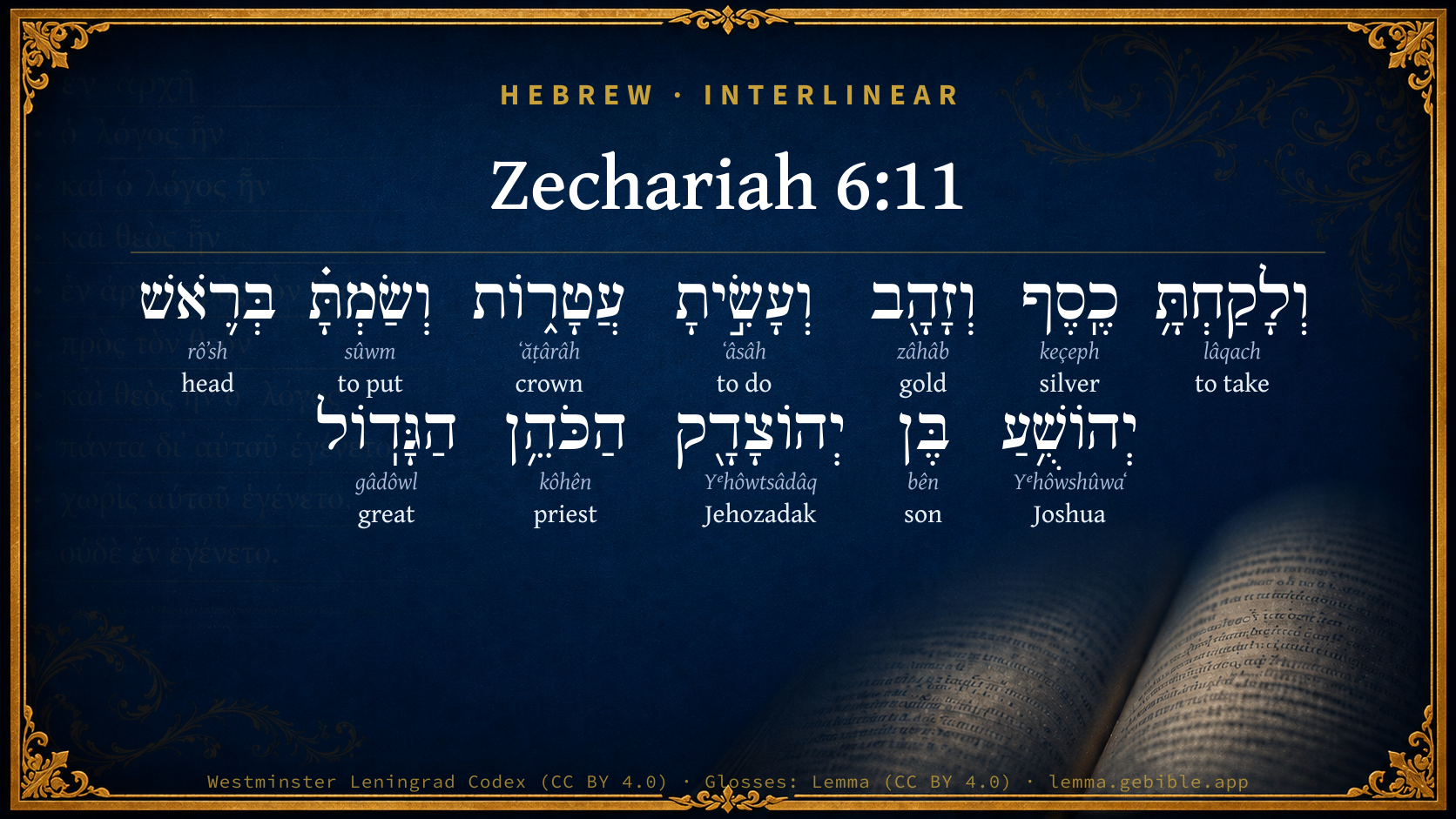
Hebrew (Westminster Leningrad Codex) Zechariah 6:11 appears in the Hebrew Old Testament. The text above is from the Westminster Leningrad Codex. Each word links to its Strong’s number, a concise gloss, and parsing drawn from the Open Scriptures Hebrew Bible morphology. Click any word for its full Brown-Driver-Briggs (BDB) entry.
Download image
Cite this verse

Zechariah 6:11 (World English Bible). Public Domain. Lemma interlinear Bible study tool, https://lemma.gebible.app/v/zechariah/6/11.

Show BibTeX & RIS
BibTeX
RIS
English Translation
Yes, take silver and gold, and make crowns, and set them on the head of Joshua the son of Jehozadak, the high priest;
World English Bible · Public Domain
Download a study sheet

One document with this verse’s original text, its word-by-word gloss line, the meaning frame, cross-references with their text, attributed commentary, and full source and license credits — printable, and it pastes into notes with its structure intact.

This verse Autodidact and up

Study sheet (.html) Plain text (.txt)

A passage Seminary Student

Up to 50 verses in one chapter. A passage sheet keeps up to 6 commentary sources and 12 cross-references per verse, in the order this page ranks them, and says so on the sheet whenever that leaves anything out. Ask for a single verse and you get the Autodidact verse sheet above.

Everything on this page stays free to read, with no account — the sheet is a download of what is already on screen, not access to it.

Want to remove ads? Support Godless Engineer
Compare translations 3

The same verse in 3 English versions, stacked beneath the original-language interlinear above. Click any original word for its lexicon entry.

Each is an independent rendering of the whole verse — the interlinear is not word-aligned to these translations.

Highlighted words mark where these versions differ — a whole-verse word diff, not a word-by-word alignment.

  • World English Bible Public Domain
    Yes, take silver and gold, and make crowns, and set them on the head of Joshua the son of Jehozadak, the high priest;
  • King James Version Public Domain
    Then take silver and gold, and make crowns, and set them upon the head of Joshua the son of Josedech, the high priest;
  • unfoldingWord Literal Text CC BY-SA 4.0
    And you shall take silver and gold, and you shall make crowns, and you shall set on the head of Joshua the son of Jehozadak, the high priest.

unfoldingWord Literal Text — © unfoldingWord, licensed CC BY-SA 4.0. Word-aligned USFM3 via Door43 (git.door43.org/unfoldingWord/en_ult).

Versions to compare (up to 4)

3 of 4 selected

Show all 18 translations

Every available English version of this verse, each an independent rendering of the whole verse.

  • World English Bible Public Domain
    Yes, take silver and gold, and make crowns, and set them on the head of Joshua the son of Jehozadak, the high priest;
  • Berean Standard Bible Public Domain
    Take silver and gold, make an ornate crown, and set it on the head of the high priest, Joshua son of Jehozadak.
  • Majority Standard Bible Public Domain
    Take silver and gold, make an ornate crown, and set it on the head of the high priest, Joshua son of Jehozadak.
  • King James Version Public Domain
    Then take silver and gold, and make crowns, and set them upon the head of Joshua the son of Josedech, the high priest;
  • American Standard Version (1901) Public Domain
    yea, take `of them' silver and gold, and make crowns, and set them upon the head of Joshua the son of Jehozadak, the high priest;
  • Revised Version (1885) Public Domain
    yea, take of them silver and gold, and make crowns, and set them upon the head of Joshua the son of Jehozadak, the high priest;
  • Geneva Bible (1599) Public Domain
    Take euen siluer, and golde, and make crownes, and set them vpon the head of Iehoshua, the sonne of Iehozadak the hie Priest,
  • Douay-Rheims (1899) Public Domain
    And thou shalt take gold and silver: and shalt make crowns, and thou shalt set them on the head of Jesus the son of Josedec, the high priest.
  • Young's Literal Translation Public Domain
    and thou hast taken silver and gold, and hast made a crown, and hast placed on the head of Joshua son of Josedech, the high priest,
  • Literal Standard Version CC BY-SA 4.0
    and you have taken silver and gold, and have made a crown, and have placed [it] on the head of Joshua son of Josedech, the high priest,
  • Unlocked Literal Bible CC BY-SA 4.0
    Then take the silver and gold, make a crown and set it upon the head of Joshua son of Jehozadak, the high priest.
  • unfoldingWord Literal Text CC BY-SA 4.0
    And you shall take silver and gold, and you shall make crowns, and you shall set on the head of Joshua the son of Jehozadak, the high priest.
  • Darby Bible Public Domain
    yea, take silver and gold, and make crowns, and set [them] upon the head of Joshua the son of Jehozadak, the high priest;
  • World Messianic Bible Public Domain
    Yes, take silver and gold, and make crowns, and set them on the head of Joshua the son of Jehozadak, the high priest;
  • Webster's Bible Public Domain
    Then take silver and gold, and make crowns, and set them upon the head of Joshua the son of Josedech, the high priest.
  • Free Bible Version CC BY-SA 4.0
    Use the silver and the gold they brought to make a crown, and place it on the head of Josiah, son of Jehozadak, the high priest.
  • Bible in Basic English Public Domain
    And take silver and gold and make a crown and put it on the head of Zerubbabel;
  • JPS Tanakh (1917) Public Domain
    yea, take silver and gold, and make crowns, and set the one upon the head of Joshua the son of Jehozadak, the high priest;

Literal Standard Version (2020), Covenant Press — licensed CC BY-SA 4.0. Text via the HelloAO Bible API (eBible.org). Unlocked Literal Bible (unfoldingWord) — licensed CC BY-SA 4.0. Text via the HelloAO Bible API (eBible.org). unfoldingWord Literal Text — © unfoldingWord, licensed CC BY-SA 4.0. Word-aligned USFM3 via Door43 (git.door43.org/unfoldingWord/en_ult). Free Bible Version, Dr. Jonathan Gallagher — licensed CC BY-SA 4.0. Text via the HelloAO Bible API (eBible.org).

Word by word

More ways to search: Search by grammar → Find every occurrence → Compare this word →

Practice this passage: Drill this verse → Learn its vocabulary →

יְהוֹצָדָ֖ק
Yᵉhôwtsâdâq
H3087
“Jehozadak”
Noun, Proper
Part of Speech
Noun
Type
Proper
Full BDB Definition

Origin: from H3068 and H6663

TWOT: None

Jehozadak or Josedech = "Jehovah is righteous" - grandson of the high priest Hilkiah; son of the high priest Seraiah; and father of the high priest Joshua; he never attained the office of high priest himself because he was carried captive to Babylon by Nebuchadnezzar
  1. וְלָקַחְתָּ֥ lâqach H3947 “and · to take” Conjunction + Verb, Qal, Sequential Perfect, 2nd Person, Masculine, Singular
  2. כֶֽסֶף keçeph H3701 “silver” Noun, Common, Masculine, Singular, Absolute
  3. וְזָהָ֖ב zâhâb H2091 “and · gold” Conjunction + Noun, Common, Masculine, Singular, Absolute
  4. וְעָשִׂ֣יתָ ʻâsâh H6213 “and · to do” Conjunction + Verb, Qal, Sequential Perfect, 2nd Person, Masculine, Singular
  5. עֲטָר֑וֹת ʻăṭârâh H5850 “crowns” Noun, Common, Feminine, Plural, Absolute
  6. וְשַׂמְתָּ֗ sûwm H7760 “and · to put” Conjunction + Verb, Qal, Sequential Perfect, 2nd Person, Masculine, Singular
  7. בְּרֹ֛אשׁ rôʼsh H7218 “in/at · head of” Preposition + Noun, Common, Masculine, Singular, Construct
  8. יְהוֹשֻׁ֥עַ Yᵉhôwshûwaʻ H3091 “Joshua” Noun, Proper
  9. בֶּן bên H1121 “son of” Noun, Common, Masculine, Singular, Construct
  10. הַכֹּהֵ֥ן kôhên H3548 “the · priest” Particle, Definite Article + Noun, Common, Masculine, Singular, Absolute
  11. הַגָּדֽוֹל gâdôwl H1419 “the · great” Particle, Definite Article + Adjective, Adjective, Masculine, Singular, Absolute

About this verse

These counts appear in no published source. They are computed here, from the morphology-tagged text and Lemma’s own curated glosses. What Lemma adds →

12
words
12
distinct lemmas
Prophets
section

Notable vocabulary

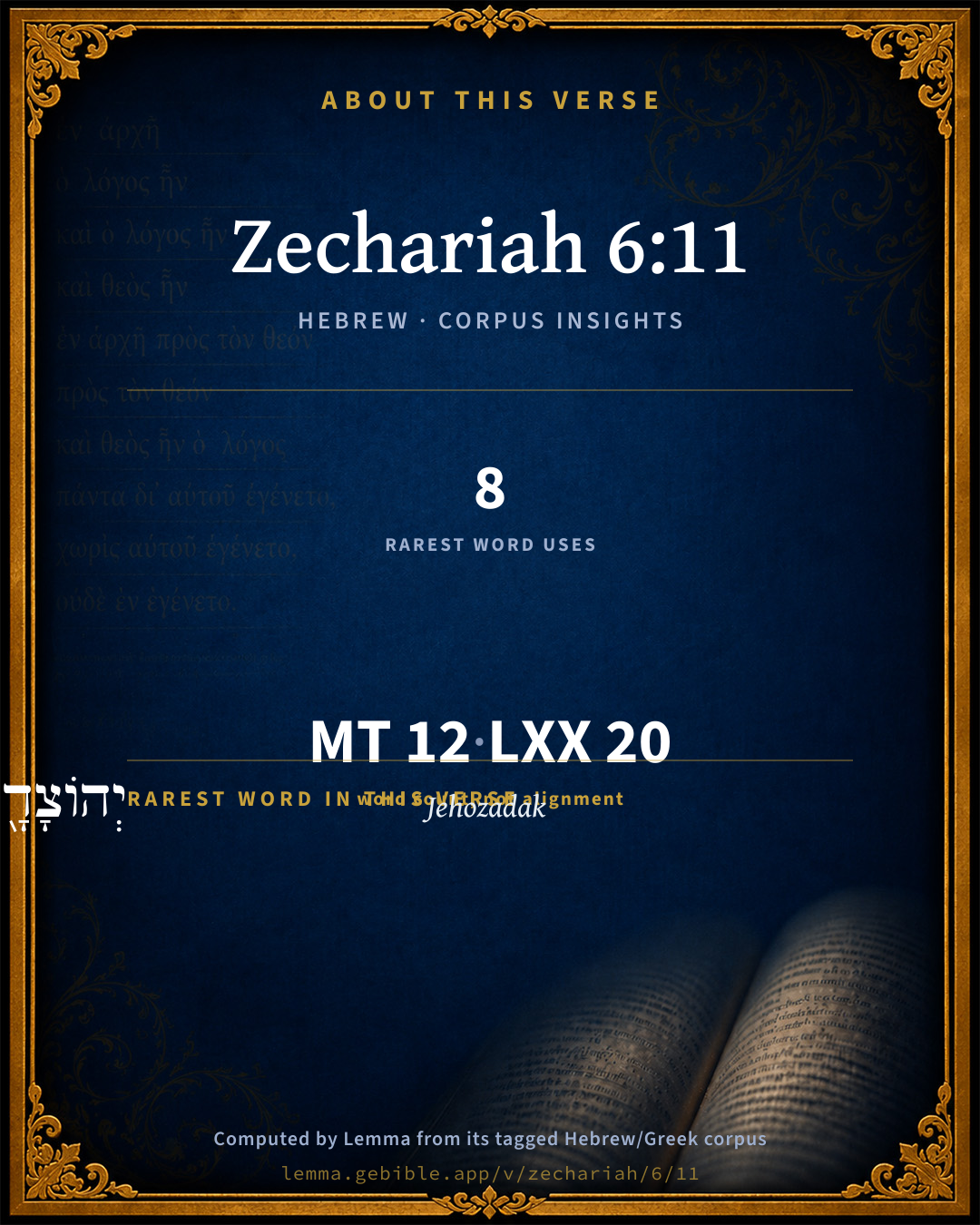
The rarest word here is יְהוֹצָדָ֖ק Jehozadak H3087 — appearing just 8 times in the whole Hebrew Bible.

Shared distinctive vocabulary

יְהוֹצָדָ֖ק Jehozadak H3087 occurs in 8 verses of the Hebrew Bible. Also found in:

Grammatical profile

  • 3 verbs
  • 8 nouns
  • 1 adjective

Verb forms

  • וְלָקַחְתָּ֥ Qal · Sequential Perfect
  • וְעָשִׂ֣יתָ Qal · Sequential Perfect
  • וְשַׂמְתָּ֗ Qal · Sequential Perfect

Hebrew & Septuagint length

In English translation the verse runs 23 words from the Hebrew and 27 from the Septuagint (LXX English) — closely comparable.

A rough comparison of the two English renderings, which tokenize alike — not a word-level alignment.

Word counts can differ between the Hebrew and the Greek without any difference in meaning — e.g. the Hebrew direct-object marker אֵת has no separate Greek word, and Greek often adds the article ὁ.

In the original languages it is 12 Hebrew tokens and 20 Greek tokens — but the two are counted differently (Hebrew bundles its prefixes and suffixes into one token; the Greek is in lemma form), so that isn’t a like-for-like length.

Cross-references

14

Topical passages linked to Zechariah 6:11 in the Treasury of Scripture Knowledge — connected by theme and wording, ordered by reader-vote popularity; previews shown in the World English Bible.

  • Psalms 21:3 For you meet him with the blessings of goodness; You set a crown of fine gold on his head.
  • Zechariah 3:1 He showed me Joshua the high priest standing before the angel of Yahweh, and Satan standing at his right hand to be his adversary.
  • Song of Solomon 3:11 Go forth, you daughters of Zion, and see king Solomon, With the crown with which his mother has crowned him, In the day of his weddings, In the day of the gladness of his heart. Lover
  • Exodus 39:30 They made the plate of the holy crown of pure gold, and wrote on it a writing, like the engravings of a signet: "HOLY TO YAHWEH."
  • Leviticus 8:9 He set the turban on his head; and on the turban, in front, he set the golden plate, the holy crown; as Yahweh commanded Moses.
  • Haggai 1:1 In the second year of Darius the king, in the sixth month, in the first day of the month, the Word of Yahweh came by Haggai, the prophet, to Zerubbabel, the son of Shealtiel, governor of Judah, and to Joshua, the son of Jehozadak, the high priest, saying,
  • Zechariah 3:5 I said, "Let them set a clean turban on his head." So they set a clean turban on his head, and clothed him; and the angel of Yahweh was standing by.
  • Revelation 19:12 His eyes are a flame of fire, and on his head are many crowns. He has names written and a name written which no one knows but he himself.
  • Haggai 1:14 Yahweh stirred up the spirit of Zerubbabel, the son of Shealtiel, governor of Judah, and the spirit of Joshua, the son of Jehozadak, the high priest, and the spirit of all the remnant of the people; and they came and worked on the house of Yahweh of Hosts, their God,
  • Hebrews 2:9 But we see him who has been made a little lower than the angels, Jesus, because of the suffering of death crowned with glory and honor, that by the grace of God he should taste of death for everyone.
  • Exodus 28:36–38 "You shall make a plate of pure gold, and engrave on it, like the engravings of a signet, 'HOLY TO YAHWEH.'
  • Exodus 29:6 and you shall set the turban on his head, and put the holy crown on the turban.
  • Ezra 3:2 Then stood up Jeshua the son of Jozadak, and his brothers the priests, and Zerubbabel the son of Shealtiel, and his brothers, and built the altar of the God of Israel, to offer burnt offerings thereon, as it is written in the law of Moses the man of God.
  • Haggai 2:4 Yet now be strong, Zerubbabel,' says Yahweh. 'Be strong, Joshua, son of Jehozadak, the high priest. Be strong, all you people of the land,' says Yahweh, 'and work, for I am with you,' says Yahweh of Hosts.

Cross-references courtesy of OpenBible.info (CC BY 4.0).

Hebrew and Greek witnesses Masoretic Hebrew ↔ Greek Septuagint

The same verse in the two great witnesses to the Old Testament, shown verse-for-verse.

These are two independent witnesses, not word-aligned to each other, and the Septuagint is shown in lemma (dictionary) form.

Hebrew Zechariah 6:11 Masoretic · Westminster Leningrad Codex

וְלָקַחְתָּ֥ כֶֽסֶף וְזָהָ֖ב וְעָשִׂ֣יתָ עֲטָר֑וֹת וְשַׂמְתָּ֗ בְּרֹ֛אשׁ יְהוֹשֻׁ֥עַ בֶּן יְהוֹצָדָ֖ק הַכֹּהֵ֥ן הַגָּדֽוֹל

Yes, take silver and gold, and make crowns, and set them on the head of Joshua the son of Jehozadak, the high priest;

World English Bible · Public Domain

Greek LXX Zechariah 6:11 Septuagint · lemma form

καί λαμβάνω ἀργύριον καί χρυσίον καί ποιέω στέφανος καί ἐπιτίθημι ἐπί ὁ κεφαλή ἰησοῦς ὁ ιωσεδεκ ὁ ἱερεύς ὁ μέγας

And you shall take silver and gold, and make crowns, and you shall put them upon the head of Jesus the son of Josedec the high priest;

LXX2012 (modern English Septuagint) · Public Domain

On this verse, Haydock's Catholic Bible Commentary discusses the Septuagint’s reading. Read the note in Commentary ↓

Hebrew: Westminster Leningrad Codex (CC BY 4.0). Greek: Septuagint (public domain); English from LXX2012 (modern English Septuagint) (Public Domain). How the Septuagint differs from the Hebrew →

Targum (Aramaic paraphrase)

1

The Targum is the ancient Jewish Aramaic paraphrase of the Hebrew Scriptures — an interpretive translation, not the Hebrew text itself. Onkelos (literal) and Pseudo-Jonathan (expansive) render the Torah, and Jonathan the Prophets. Coverage is partial: where no permissively-licensed English translation exists for a verse, only the Aramaic is shown. This is verse-level text, not a word-by-word alignment to the Hebrew.

  1. Targum Jonathan Prophets (Joshua–Malachi)
    וְתִסַב כְּסַף וּדְהַב וְתַעְבֵּיד כְּלִיל רַב וּתְשַׁוֵי בְּרֵישׁ יְהוֹשֻׁעַ בַּר יְהוֹצָדָק כַּהֲנָא רַבָּא:

    (no public-domain English translation for this verse)

    Targum Jonathan — Aramaic: “Mikraot Gedolot” (public domain). English: “Sefaria Community Translation” (CC0 1.0 (public-domain dedication)); “London "Chaldee Paraphrase," 1871” (public domain). Text via Sefaria.

Commentary

Notes on Zechariah 6:11 from classic Christian and Jewish commentators (each source and its license shown beneath its notes). The classic Christian expositions comment on the surrounding passage and are grouped to its opening verse, so a note may address several verses; the Jewish commentaries on the Tanakh (Rashi and others) are per-verse, so they appear only where the commentator wrote on this verse.

Lemma curates 59 commentaries, every one of them public domain or Creative Commons licensed, each selected and text-cleaned for this edition rather than reprinted as found. About our sources →

Trapp's Complete Commentary

John Trapp

Zec 6:11 Then take silver and gold, and make crowns, and set [them] upon the head of Joshua the son of Josedech, the high priest;

Ver. 11. Make crowns] Two, saith Piscator; one of gold, for the kingly dignity, another of silver, for the priesthood. Three, saith a Lapide, who makes it a type, as of Christ’s threefold office, so of the Pope’s triple crown; which latter relates rather to Pride’s picture drawn by the old Romans, with three crowns on her head: on the first whereof was inscribed Transcendo; I pass on, on the second Non obedio; I disobey, the third Perturbo. I throw into confusion, Danaeus thinks it likely, by Zec 6:14, that here were four crowns made, according to the number of the four persons here mentioned, that brought in the gold and silver. Ribera will have it to be all but one crown made of both metals, and called crowns for the greatness of it; as wisdoms, for singular wisdom, Pro 1:20 marg; Behemoth, beasts, for a huge beast, Job 40:15. The verb singular, tihieh, Zec 6:14, seems most to favour this conceit of his. But in Hebrew the singular is often put for the plural (Chald. vertit Facies coronam magnam).

John Trapp, A Commentary or Exposition upon All the Books of the Old and New Testament (1647–1656) — public domain. Text from a community e-Sword module.

Tyndale Open Study Notes

Tyndale Open Resources

6:11 This crown was probably made of two bands of metal, one gold and one silver. Each band represented one of the offices (king and priest) to which Jeshua was appointed.

Tyndale Open Study Notes — © Tyndale Open Resources, licensed CC BY-SA 4.0. Text via the HelloAO Bible API.

Geneva Bible (1599)

Geneva Bible translators

Because this could not be attributed to anyone according to the Law, therefore it followeth that Joshua must represent the Messiah, who was both Priest and king.

Geneva Bible (1599) marginal notes — public domain. Text via Bolls.life.

Jamieson, Fausset & Brown

Robert Jamieson, A. R. Fausset & David Brown

The high priest wore a crown above the miter (Zac 3:5; Lev 8:9). Messiah shall wear many crowns, one surmounting the other (Rev 19:12). It was a thing before unknown in the Levitical priesthood that the same person should wear at once the crown of a king and that of a high priest (Psa 110:4; Heb 5:10). Messiah shall be revealed fully in this twofold dignity when He shall "restore the kingdom to Israel" (Act 1:6).

Jamieson, Fausset & Brown — Commentary Critical and Explanatory on the Whole Bible (1871) — public domain (CC PDM 1.0). Text via the HelloAO Bible API.

Adam Clarke's Commentary

Verse 11. Make crowns] עטרות ataroth; but seven MSS. of Kennicott's and De Rossi's, and one ancient of my own, with the Syriac and Chaldee, have עטרת atereth, a crown, or tiara. And as Joshua the high priest is alone concerned here, I think one crown only is intended.

Adam Clarke's Commentary on the Bible (1810–1826) — public domain. Text from a community e-Sword/MySword module.

John Calvin's Commentaries

The Prophet is bid to set the two crowns on the head of the high priest. This, as I have said, was intended as a symbol to denote the union of the two dignities in the person of Christ. It was necessary until the coming of Christ to select the high priest from the posterity of Aaron; and it was also required that the kings should be from the seed of David; so that we observe a distinction between the royal office and the priesthood, not only as to the persons, but also as to the families. It would have indeed been a strange thing to see a king from the tribe of Levi; and it would have been contrary to God’s appointed order to see a priest from the tribe of Judah and from the family of David. Since then the king was adorned with his own diadem, and since the high priest had his own proper mitre, what could this mean, but that the same man was to wear two crowns? Doubtless we observe that there is here some change in the past order of things, and that there is something unusual set forth. But there is nothing new in this, — that the Redeemer, who had been promised, should be eminent as a king and a priest; for this had been predicted in the hundred and tenth Psalm, “Jehovah said to my Lord, sit on my right hand,” — this is what belongs to the right of a king; it afterwards follows, “Thou art a priest for ever, according to the order of Melchizedec.” Though kings must then have been chosen from the family of David and the tribe of Judah, and though priests must have then been taken from the Levitical tribe, yet the Spirit foretold, that a king would come who was to be a priest, as had been the case with Melchisedec. This very thing is what the Prophet now confirms.

Zechariah being ordered to set the crowns on the head of Joshua, we are not so to regard this, as though Joshua had immediately undertaken the two offices of a king and a priest; for he was satisfied with his own: but the Prophet shows in the type what was to be looked for at the coming of the Messiah; for the time had not yet come, when Christ should receive the royal diadem, as it is said in Ezekiel, —

“Take away the diadem; set it aside, set it aside, set it aside, until he shall come, whose it is.” (Ezekiel 21:26,27.)

We here see that the Prophet points out a length of time, during which the royal diadem was to be trodden as it were under foot. Though the royal crown had not yet laid in the dust sufficiently long, yet the Prophet did nothing presumptuously; for the Jews could not have conceived in their mind what is here promised, had not the typical priest come forth, wearing the two crowns. Nor could this have been so suitable to the person of Zerubbabel; for though he was of the family of David, and was a type of Christ, he had not yet the name of a king, nor had he any regal power: he could not therefore have been so suitable a person. It is then no wonder that God brought forth the high priest Joshua, who was a type and representative of Christ; and he brought him forth with a double crown, because he who was to come would unite, according to what follows, the priesthood with the kingly office.

John Calvin's Commentaries (1540-1563) — public domain. Text from the Calvin Translation Society English edition (1840s-50s) via the Christian Classics Ethereal Library (ccel.org). Calvin's coverage is partial (roughly two-thirds of the Bible); uncommented books and verses are honest gaps, never fabricated. The 19th-century editor's footnotes and remarks are omitted so the notes are faithfully Calvin's own voice.

Ellicott's Commentary for English Readers

(11) Then take.—Better, yea take: viz., from the three mentioned above.

Crowns.—Better, a composite crown, since the word is construed with a singular verb in Zec_6:14, and though plural in form it seems to be used of a single crown or fillet in Job_31:36. Zechariah is commanded to go to the house of Josiah son of Zephaniah, who was entertaining certain Jews, who seem to have come from Babylon with gifts and offerings for the House of the Lord. From these men he was to take gold and silver, and to cause to be made thereof a composite diadem, with which he was to crown Joshua the high-priest. We cannot, of course, venture with Ewald to insert the words “and upon the head of Zerubbabel” after the words “upon the head of Joshua”; and to insert the name “Joshua” in the clause “and will be a priest upon his throne.” Even if such an arbitrary alteration of the text were admissible, it would be most inappropriate. No crown was placed on Zerubbabel, for such an act would have been a seeming restoration of the kingdom, when it was not to be restored. God had foretold that none of the race of Jehoiakim should prosper, “sitting on the throne of David, and ruling any more in Judah” (Jer_22:30). Moreover, the crown had been definitely taken away in the time of Zedekiah, “until he come whose right is” (Eze_21:27 [32]): viz., the “king who should reign in righteousness” (Is. xxxii, 1), “and prosper,” a Branch of righteousness (Jer_23:5).

But there was placed upon the head of Joshua, the high priest, this “royal” (2Sa_12:30) crown—for the high priest did not properly wear a crown, and this word is never used for “mitre “—that in his person might be symbolised the twofold office of the Messiah, who, like Melchizedek, was to be a priest and king (Psalms 110). That the high priests during a succeeding period were practically the rulers of the nation is not sufficient to account for the terms of this prophecy, especially for the emphatic personality of the royal priest mentioned in the next verses.

A Bible Commentary for English Readers, edited by Charles John Ellicott (1878–1897) — public domain. Text from a community e-Sword module.

The Cambridge Bible for Schools and Colleges

gen. ed. J. J. S. Perowne

11. crowns] The plural may perhaps be used for one crown (a crown, R. V. margin), as it is apparently in Job_31:36. Or there may have been two wreaths or fillets, possibly one of each precious metal, woven into a crown. In Zec_6:14 where the word again occurs it is joined with a verb in the singular: lit. the crowns (it) shall be. In any case it refers exclusively to the royal crown or crowns (Rev_19:12). The High-priest’s mitre is never called a crown.

Josedech] Jehozadak. R. V.

The Cambridge Bible for Schools and Colleges (gen. ed. J. J. S. Perowne; Cambridge University Press, 1878–1918) — public domain. Text from a community e-Sword module.

John Gill's Exposition

And speak unto him, saying,.... That is, to Joshua the high priest, having the crowns on his head:

thus speaketh the Lord of hosts, saying, behold the man whose name is The BRANCH; which is not to be understood of Zerubbabel, as some Jewish writers interpret it; for he was not "the Branch", by way of eminency, much less that righteous Branch of David, called the Lord our righteousness, Jer 23:5 the same that is here meant; besides, he was already grown up out of his place; nor did he build a temple, from which he had great glory; nor was he either king or priest, only governor of Judah; and, however, not both, as this person is represented to be; and who is no other than the Messiah; and so the Targum paraphrases the words,

"behold the man Messiah is his name;''

and Jarchi owns that some of their Rabbins interpret the words of the King Messiah. The "Branch" is a name by which the Messiah goes in the Talmud (k), and in other Jewish writings. It is asked (l), what is the name of the King Messiah? it is answered, among others, his name is the "Branch"; as it is said, "behold the man whose name is the Branch; he shall grow up out of his place": elsewhere (m) they speak of five letters doubled, which are the foundation of deliverance to certain persons, or point thereat. The first four, they observe, were accomplished in the deliverance of Abraham from Ur of the Chaldees, of Isaac from the Philistines, of Jacob from Esau, and of the Israelites from Egypt; and the fifth, which is the letter the first letter of "Tzemach", the Branch, by it they say the holy blessed God will redeem Israel at the end of the four monarchies; as it is said, "behold the man whose name is the Branch", &c.; Philo the Jew (n) interprets this passage of a divine Person, the Son of God, by whom no other than the Messiah is meant,

"we have heard (says he) one of the friends of Moses, i. e. Zechariah, saying thus, behold the man "whose name is the east", or rising sun (so the Greek version renders the words); a new appellation, if you can think it said of one consisting of soul and body; but if of that incorporeal one, bearing the divine image, you will own that the name is fitly given him, the ancient Sun, the Father of beings will cause to arise; whom otherwise he names the first begotten, and who, being begotten, imitates the ways of his Father; and looking at his archetypal exemplars, forms the same.''

Abendana (o), a modern Jew, observes, that

"it is right that the Targum interprets it of the Messiah, for of him it is spoken; therefore it is written, "and he shall grow up out of his place"; for he shall go forth from him, and shall be of the seed of Zerubbabel,--and the King Messiah shall bear the glory of the kingdom, and he shall rule upon the throne of his kingdom;''

and when he is called a man, the meaning is not that he is a mere man, nor was he really man before his incarnation; but as he was to be man, and his incarnation was drawing near, he is so called: of his name the "Branch", see Isa 4:2, and Joshua, he is directed to look upon himself, with the crowns on his head, as a type of him; and so were the prophet, and those that were with him; and he is to be beheld, as before in type, so now in truth, by faith, with love and affection, with diligent attention, and great admiration:

and he shall grow up out of his place: or, "from under him" (p); which may regard his natural descent as man, and the persons or person from whom he sprung; as from Abraham, Jacob, Judah, Jesse, and particularly from David, from the royal seed, as Jarchi interprets it: or else the place from whence this Branch arose, the land of Judea, the tribe of Judah, the city of Bethlehem, where he was born; or Galilee, and particularly Nazareth, where he was brought up, and grew, and increased in the stature of his body, and in the wisdom of his mind: or it may be rendered, "from his inferior place" (q); his superior, place, as the Son of God, is heaven; his inferior place, as the Son of man, is the earth; from whence he may be said to be, being born of a woman; and so this Branch is called "the fruit of the earth", and said to spring out of it, Isa 4:2 or it is same as from himself, as Aben Ezra observes; and so Calvin; for this Branch did not grow up through any sowing and planting of man, but without any hand or concern of his in it; Christ was born of a virgin, through the power of the Highest, and through his own power, as God:

and he shall build the temple of the Lord; not a material temple, but the spiritual temple, the Church; called so in allusion to the temple of Jerusalem, built by Solomon; which was typical of the church, in the builder of it, Solomon, the church being built by Christ the antitypical Solomon, the true Peace, and Peacemaker; in the situation of it on a mount, which denotes the safety, visibility, and exalted state of the church; in the matter of it, being made of choice stones, and excellent timber, to which believers in Christ, who as lively stones are built up a spiritual house, are fitly compared; in the magnificence and stateliness of it, especially as the church will be in the latter day, when the glorious things spoken of it will be fulfilled; and in its strength and firmness, as well as in its holiness: and it is called "the temple of the Lord", because it is of his building, where he dwells, and where he is worshipped; and in the building of it Christ has a great concern; he is not only the foundation and cornerstone of it, but he is the chief, the master builder of it; he builds it on himself, and builds it up by his Spirit, his ministers, his word and ordinances, making thereby continually an increase of it, and additions to it; see Mat 16:18.

(k) T. Hieros. Beracot, fol. 5. 1. (l) Echa Rabbati, fol. 50. 1. (m) Pirke Eliezer, c. 48. fol. 58. 1. Bemidbar Rabba, sect. 18. fol. 223. 2. (n) De Confus. Ling. p. 329. (o) Not. in Miclol Yophi in loc. (p) "subter eum", V. L. Pagninus; "ad verbum, de sub se", Calvin, Drusius; "de subter se", Cocceius; "ex sub eo", Burkius. (q) "Ex inferiore loco", Vitringa in Jesaiam, c. iv. 2. "E leco suo humili", Hiller. Onomastic. Sacr. p. 47.

John Gill's Exposition of the Whole Bible (1746–1763) — public domain (CC PDM 1.0). Text via the HelloAO Bible API.

Albert Barnes' Notes on the Bible

And make crowns - Or a “crown” , as in Job, “I would bind it as a crown unto me,” and our Lord is seen in the Revelation, “on His Head were many crowns” . The singular is used of “a royal crown” , apparently of a festive crown ; and figuratively; (Job 19:9, (plur. Job 31:36) Pro 4:9; Pro 12:4; Pro 14:24; Pro 16:31. Pro 17:6); even of Almighty God Himself as a crown ; but no where of the mitre of the high priest.

The characteristic of the act is, that “the crown” or crowns (it is not in the context said, which) were placed on the head of the one high priest, Joshua; “and thou shall place” (it or them, it is not said which) “upon the head of Joshua son of Josedech the high priest, and shalt say unto him.” If crowns were made of each material, there were two crowns. But this is not said, and the silver might have formed a circlet in the crown of gold, as, in modern times, the iron crown of Lombardy, was called iron, because it had “a plate of iron in its summit, being else of gold and most precious” . In any case the symbolical act was completed by the placing of a royal crown upon the head of the high priest. This, in itself, represented that He, whom he and all other priests represented, would be also our King. It is all one then, whether the word designate one single crown, so entitled for its greatness, or one united royal crown, that is, one crown uniting many crowns, symbolizing the many kingdoms of the earth, over which our High Priest and King should rule.

Either symbol, of separate crowns “the golden at Rome.” Du Cang. Otto of Frisingen said that Frederic received 5 crowns; the first at Aix for the kingdom of the Franks; a second at Ratisban for that of Germany; a third at Pavia for the kingdom of Lombardy; the fourth at Rome for the Roman empire from Adrian iv; the fifth of Monza for the kingdom of Italy.” In our own memory, Napoleon I. having been crowned in France, was crowned with the iron crown at Monza), or an united crown , has been used in the same meaning, to symbolize as many empires, as there were crowns.

On Zerubbabel no crown was placed. It would have been confusing; a seeming restoration of the kingdom, when it was not to be restored; an encouragement of the temporal hopes, which were the bane of Israel. God had foretold, that none of the race of Jehoiakim should prosper, “sitting on the throne of David, or ruling any more in Israel.” Nehemiah rejects the imputation of Sanballat, “Thou hast also appointed prophets to preach of thee at Jerusalem,” There is “a king in Judah.” He answers, “There are no such things done as thou sayest; and thou feignest them out of thine own heart” Neh 6:6-8. But Isaiah had foretold much of the king who should reign: Zechariah, by placing the royal crown on the head of Joshua, foreshowed that the kingdom was not to be of this world. The royal crown had been taken away in the time of Zedekiah, “Thus saith the Lord God, Remove the diadem and take away the crown; this shall not be this; exalt the low and abase the high; an overthrow, overthrow, overthrow will I make it; this too is not; until he come whose the right is, and I will give it” (Eze 21:31-32 (Eze 21:26-27 in English)).

But the Messiah, it was foretold, was to be both priest and king; “a priest after the order of Melchizedec” Psa 110:4, and a king, set by the Lord “upon His holy hill of Zion” Psa 2:6. The act of placing the crown on the head of Joshua the high priest, pictured not only the union of the offices of priest and king in the person of Christ, but that He should be King, being first our High Priest. Joshua was already high priest; being such, the kingly crown was added to him. It says in act, what Paul says, that “Christ Jesus, being found in fashion as a man, humbled Himself and became obedient unto death, even the death of the Cross. Wherefore God also hath highly exalted Him” Phi 2:8-9.

Albert Barnes' Notes on the Bible (1834–1885) — public domain. Text from a community e-Sword/MySword module.

Haydock's Catholic Bible Commentary

CHAPTER VI.

Crowns. Chaldean, "a great crown." Septuagint, ver. 14., "a crown;" perhaps like the pope’s (Menochius) --- Jesus. When the prophet set the crown on the high priest’s head, in order to shew that it did not belong to him, except as a figure of the Messias, he added, behold a man, who is also God, called Orient, or "raising up," and establishing the kingdom, which was promised to David. (St. Jerome) (Worthington)

George Leo Haydock (1774–1849), Haydock's Catholic Family Bible and Commentary, 1859 edition — public domain. Excludes Psalms (Douay-Rheims chapter numbering differs from Protestant) and Deuterocanonical books (Catholic canon only).

Matthew Poole's English Annotations

Then take silver and gold: this reiterating the command both confirms and explains the former command.

Make crowns; two, the one of silver, the other of gold.

Set them, put both of them, i.e. one after the other,

upon the head of Joshua, who now in this circumstance stands a type of Christ, King and Priest for ever for his people, and this extraordinary act was to represent something extraordinary in the Messiah.

Matthew Poole's English Annotations on the Holy Bible (1683–1685) — public domain. Text from a community e-Sword/MySword module.

The Pulpit Commentary

Silver and gold. That which had been brought from Babylon. However unwilling the Jews were to let the Samaritans take part in the good work, they were quite ready to receive contributions from their brethren in the dispersion, and likewise from heathen kings and princes. (see Ezr_6:8, etc.; Ezr_7:15, etc.) Make crowns. The prophet was to get the crowns made. comp. Ex 25, passim) The plural may here be used intensively for "a noble crown," as in Job_31:36; or it may signify the two metals of which the crown was made, two or more wreaths being intertwined to form it. It is certain that only one crown was to be made, and that that was to be placed on Joshua"s head. There is no mention of Zerubbabel in the passage; so the plural cannot be taken to intimate that there was a crown for the high priest and a crown for the princely ruler, as Ewald and Bunsen assert. These critics, followed by Hitzig and Wellhausen, supply the passage thus: "on the head of Zerubbabel and on the head of Joshua." Zerubbabel had no kingly position. Rather, all mention of Zerubbabel is expressly excluded, in order to denote that in the Person of him whom Joshua symbolized, the offices of priest and king were united. (Ps 110) We may note that in Rev_19:12 Christ is said to have on his head many crowns, by which is meant a diadem composed of many circlets. The high priest"s mitre is never called a crown. That which was placed on Joshua"s head was a royal crown, a token of royal dignity, not his own, but his whom he represented Christ the eternal Priest, the universal King.

The Pulpit Commentary (1880–1919), ed. H.D.M. Spence-Jones & Joseph S. Exell — public domain. Text from a community e-Sword module.

John Wesley's Explanatory Notes

Make crowns - One of silver, the other of gold. Set them - Put both of them, one after another. Joshua - Who herein is now a type of Christ, king and priest forever for his people.

John Wesley, Explanatory Notes Upon the Whole Bible (1754–1765) — public domain. Text via the GEBible commentary corpus.

Scofield Reference Notes

C. I. Scofield

crowns

Following the earth-judgments symbolized in the horsed chariots (Zec 6:1-8) comes the manifestation of Christ in His kingdom glory (Zec 6:9-15). This is the invariable prophetic order: first the judgments of the day of the Lord; Isa 2:10-22; Rev 19:11-21 then the kingdom (cf); Psa 2:5; Psa 2:6; Isa 3:24-26; Isa 4:2-6; Isa 10:33; Isa 10:34; Isa 11:1-10; Rev 19:19-21; Rev 20:4-6. This is set forth symbolically by the crowning of Joshua, which was not a vision, but actually done (cf); Isa 8:3; Isa 8:4; Eze 37:16-22. The fulfilment in the BRANCH will infinitely transcend the symbol. He "shall bear the glory"; Zec 6:13; Mat 16:27; Mat 24:30; Mat 25:31 as the Priest-King on His own throne (Zec 6:12; Zec 6:13; Heb 7:1-3). Christ is now a Priest, but still in the holiest within the veil; Lev 16:15; Heb 9:11-14; Heb 9:24 and seated on the Father’s throne Rev 3:21. He has not yet come out to take His own throne Heb 9:28. The crowns made for the symbolical crowning of Joshua were to be laid up in the temple as a memorial to keep alive this larger hope of Israel.

The Scofield Reference Bible (1917 edition), notes by C. I. Scofield — public domain. Text from a community e-Sword module.

Lesson kit

Teaching starters — assembled from the data on this page, not authored interpretation. Every prompt links to the verse data it draws on. Edit before teaching.

Zechariah, in the Prophets, opens this verse with 12 words (12 distinct Hebrew lemmas). Its most distinctive word is Yᵉhôwtsâdâq (“Jehozadak”). A historical commentator’s framing appears above. Read the whole chapter for the surrounding context.

Discussion questions

  1. The word Yᵉhôwtsâdâq carries the sense “Jehozadak.” How does it shape the verse?
  2. How does 1 Chronicles 6:14, which shares the word «Jehozadak», read alongside this verse?
  3. These translations render this verse differently; the difference is in the English rendering, not the original. What questions does that raise?
  4. «וְלָקַחְתָּ֥» is a Qal Sequential Perfect verb. How does that grammatical form shape the action described?
  5. Compare how Trapp's Complete Commentary and Tyndale Open Study Notes read this verse. Where do they agree or differ?

Things to notice

Reading settings

Reading text

Shown beneath each verse's original-language words.

Old Testament
Old Testament edition

Read the OT as the Masoretic Hebrew (MT) or the Greek Septuagint (LXX).

English shown for the Greek Septuagint (in the Hebrew ↔ Greek comparison).

Comparing translations? Open the Compare panel on any verse page to stack up to four side by side.