Deuteronomy 29:17

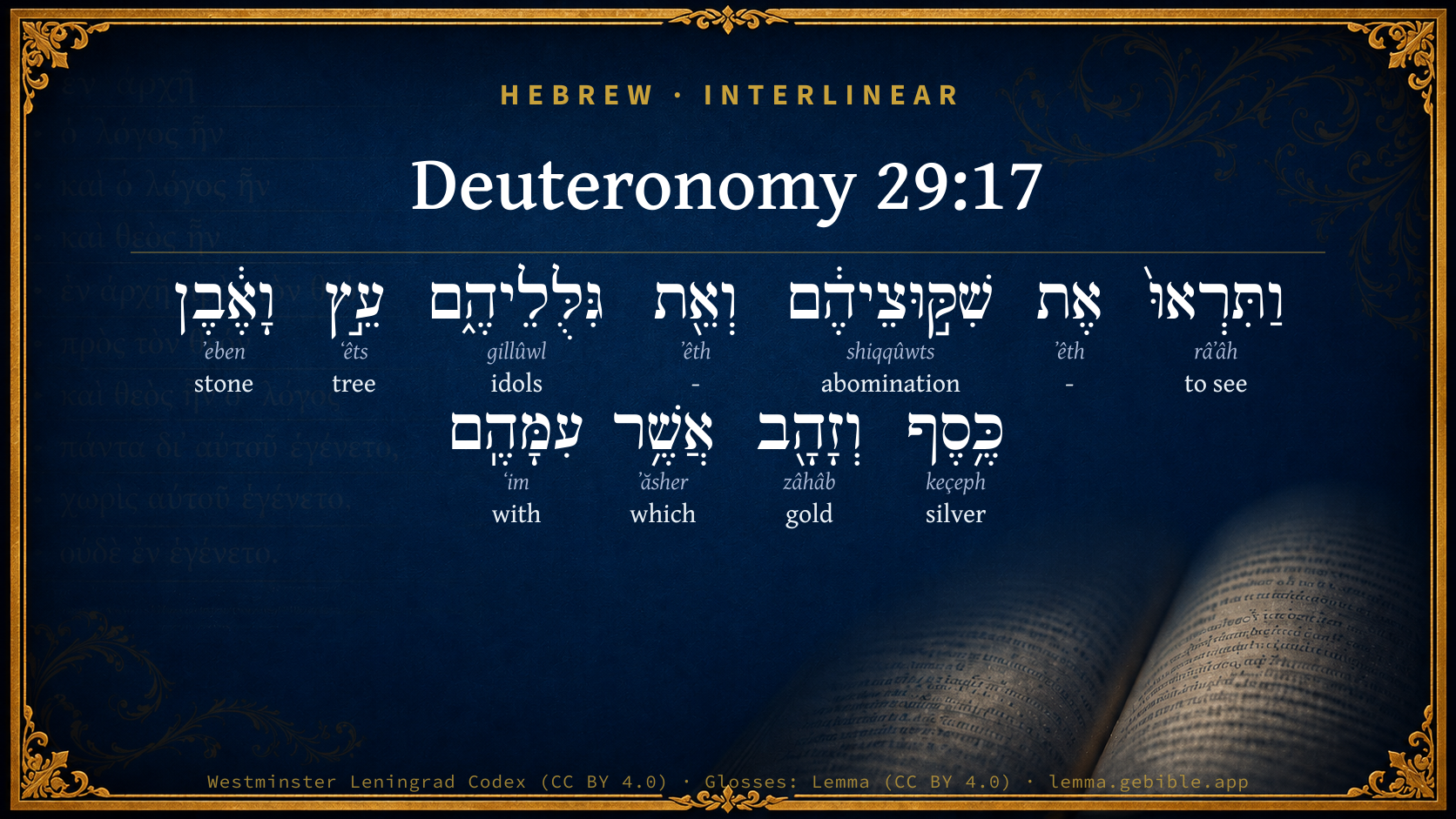
Hebrew (Westminster Leningrad Codex) Deuteronomy 29:17 appears in the Hebrew Old Testament. The text above is from the Westminster Leningrad Codex. Each word links to its Strong’s number, a concise gloss, and parsing drawn from the Open Scriptures Hebrew Bible morphology. Click any word for its full Brown-Driver-Briggs (BDB) entry.
Download image
Cite this verse

Deuteronomy 29:17 (World English Bible). Public Domain. Lemma interlinear Bible study tool, https://lemma.gebible.app/v/deuteronomy/29/17.

Show BibTeX & RIS
BibTeX
RIS
English Translation
and you have seen their abominations, and their idols, wood and stone, silver and gold, which were among them);
World English Bible · Public Domain
Highlights
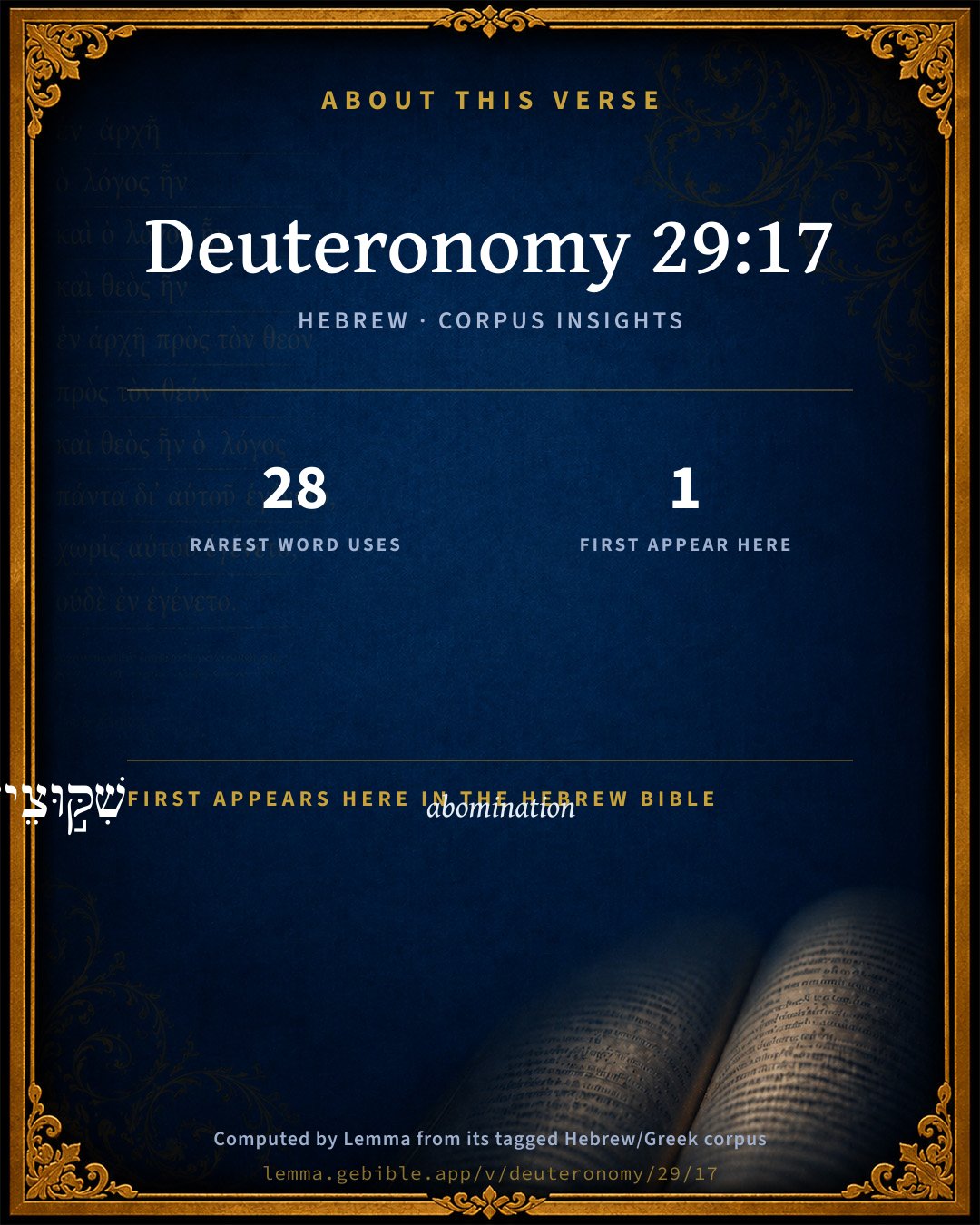
  • 1 first appearance in the Hebrew Bible
Full analysis ↓
Download a study sheet

One document with this verse’s original text, its word-by-word gloss line, the meaning frame, cross-references with their text, attributed commentary, and full source and license credits — printable, and it pastes into notes with its structure intact.

This verse Autodidact and up

Study sheet (.html) Plain text (.txt)

A passage Seminary Student

Up to 50 verses in one chapter. A passage sheet keeps up to 6 commentary sources and 12 cross-references per verse, in the order this page ranks them, and says so on the sheet whenever that leaves anything out. Ask for a single verse and you get the Autodidact verse sheet above.

Everything on this page stays free to read, with no account — the sheet is a download of what is already on screen, not access to it.

Want to remove ads? Support Godless Engineer
Compare translations 3

The same verse in 3 English versions, stacked beneath the original-language interlinear above. Click any original word for its lexicon entry.

Each is an independent rendering of the whole verse — the interlinear is not word-aligned to these translations.

Highlighted words mark where these versions differ — a whole-verse word diff, not a word-by-word alignment.

  • World English Bible Public Domain
    and you have seen their abominations, and their idols, wood and stone, silver and gold, which were among them);
  • King James Version Public Domain
    And ye have seen their abominations, and their idols, wood and stone, silver and gold, which were among them:)
  • unfoldingWord Literal Text CC BY-SA 4.0
    and you have seen their abominations and their idols of wood and stone, silver and gold, that among them,

unfoldingWord Literal Text — © unfoldingWord, licensed CC BY-SA 4.0. Word-aligned USFM3 via Door43 (git.door43.org/unfoldingWord/en_ult).

Versions to compare (up to 4)

3 of 4 selected

Show all 18 translations

Every available English version of this verse, each an independent rendering of the whole verse.

  • World English Bible Public Domain
    and you have seen their abominations, and their idols, wood and stone, silver and gold, which were among them);
  • Berean Standard Bible Public Domain
    You saw the abominations and idols among them made of wood and stone, of silver and gold.
  • Majority Standard Bible Public Domain
    You saw the abominations and idols among them made of wood and stone, of silver and gold.
  • King James Version Public Domain
    And ye have seen their abominations, and their idols, wood and stone, silver and gold, which were among them:)
  • American Standard Version (1901) Public Domain
    and ye have seen their abominations, and their idols, wood and stone, silver and gold, which were among them);
  • Revised Version (1885) Public Domain
    and ye have seen their abominations, and their idols, wood and stone, silver and gold, which were among them:)
  • Geneva Bible (1599) Public Domain
    And ye haue seene their abominations and their idoles (wood, and stone, siluer and golde) which were among them,
  • Douay-Rheims (1899) Public Domain
    You have seen their abominations and filth, that is to say, their idols, wood and stone, silver and gold, which they worshipped.
  • Young's Literal Translation Public Domain
    and ye see their abominations, and their idols, wood and stone, silver and gold, which `are' with them,
  • Literal Standard Version CC BY-SA 4.0
    and you see their abominations, and their idols of wood and stone, silver and gold, which [are] with them,
  • Unlocked Literal Bible CC BY-SA 4.0
    You have seen their disgusting idols made of wood and stone, silver and gold, that were among them.
  • unfoldingWord Literal Text CC BY-SA 4.0
    and you have seen their abominations and their idols of wood and stone, silver and gold, that among them,
  • Darby Bible Public Domain
    and ye have seen their abominations, and their idols, wood and stone, silver and gold, which were among them);
  • World Messianic Bible Public Domain
    and you have seen their abominations and their idols of wood, stone, silver, and gold, which were among them);
  • Webster's Bible Public Domain
    And ye have seen their abominations, and their idols, wood and stone, silver and gold, which were among them:)
  • Free Bible Version CC BY-SA 4.0
    You saw their disgusting religious practices and their idols of wood and stone, and silver and gold.
  • Bible in Basic English Public Domain
    And you have seen their disgusting doings, and the images of wood and stone and silver and gold which were among them:)
  • JPS Tanakh (1917) Public Domain
    (29-16) and ye have seen their detestable things, and their idols, wood and stone, silver and gold, which were with them —

Literal Standard Version (2020), Covenant Press — licensed CC BY-SA 4.0. Text via the HelloAO Bible API (eBible.org). Unlocked Literal Bible (unfoldingWord) — licensed CC BY-SA 4.0. Text via the HelloAO Bible API (eBible.org). unfoldingWord Literal Text — © unfoldingWord, licensed CC BY-SA 4.0. Word-aligned USFM3 via Door43 (git.door43.org/unfoldingWord/en_ult). Free Bible Version, Dr. Jonathan Gallagher — licensed CC BY-SA 4.0. Text via the HelloAO Bible API (eBible.org).

Word by word

More ways to search: Search by grammar → Find every occurrence → Compare this word →

Practice this passage: Drill this verse → Learn its vocabulary →

שִׁקּ֣וּצֵיהֶ֔ם
shiqqûwts
H8251
“abominations · their”
Noun, Common, Masculine, Plural, Construct + Suffix, Personal, 3rd Person, Masculine, Plural
Part of Speech
Noun
Type
Common
Gender
Masculine
Number
Plural
State
Construct
Full BDB Definition

Origin: from H8262

TWOT: 2459b

detestable thing or idol, abominable thing, abomination, idol, detested thing
  1. וַתִּרְאוּ֙ râʼâh H7200 “and · to see” Conjunction + Verb, Qal, Sequential Imperfect, 2nd Person, Masculine, Plural
  2. אֶת ʼêth H853 “-” Particle, Direct Object
  3. וְאֵ֖ת ʼêth H853 “and · -” Conjunction + Particle, Direct Object
  4. גִּלֻּלֵיהֶ֑ם gillûwl H1544 “idols · their” Noun, Common, Masculine, Plural, Construct + Suffix, Personal, 3rd Person, Masculine, Plural
  5. עֵ֣ץ ʻêts H6086 “tree” Noun, Common, Masculine, Singular, Absolute
  6. וָאֶ֔בֶן ʼeben H68 “and · stone” Conjunction + Noun, Common, Feminine, Singular, Absolute
  7. כֶּ֥סֶף keçeph H3701 “silver” Noun, Common, Masculine, Singular, Absolute
  8. וְזָהָ֖ב zâhâb H2091 “and · gold” Conjunction + Noun, Common, Masculine, Singular, Absolute
  9. אֲשֶׁ֥ר ʼăsher H834 “which” Particle, Relative
  10. עִמָּהֶֽם ʻim H5973 “with · them” Preposition + Suffix, Personal, 3rd Person, Masculine, Plural

About this verse

These counts appear in no published source. They are computed here, from the morphology-tagged text and Lemma’s own curated glosses. What Lemma adds →

11
words
10
distinct lemmas
Pentateuch
section

First appearance in Scripture

This word makes its first canonical appearance in the Hebrew Bible here:

  • שִׁקּ֣וּצֵיהֶ֔ם abomination H8251

Shared distinctive vocabulary

שִׁקּ֣וּצֵיהֶ֔ם abomination H8251 occurs in 26 verses of the Hebrew Bible. Also found in:

Grammatical profile

  • 1 verb
  • 6 nouns
  • 1 preposition
  • 3 particles

Verb forms

  • וַתִּרְאוּ֙ Qal · Sequential Imperfect

Hebrew & Septuagint length

In English translation the verse runs 19 words from the Hebrew and 18 from the Septuagint (LXX English) — closely comparable.

A rough comparison of the two English renderings, which tokenize alike — not a word-level alignment.

Word counts can differ between the Hebrew and the Greek without any difference in meaning — e.g. the Hebrew direct-object marker אֵת has no separate Greek word, and Greek often adds the article ὁ.

Cross-references

1

Topical passages linked to Deuteronomy 29:17 in the Treasury of Scripture Knowledge — connected by theme and wording, ordered by reader-vote popularity; previews shown in the World English Bible.

  • Deuteronomy 28:36 Yahweh will bring you, and your king whom you shall set over you, to a nation that you have not known, you nor your fathers; and there shall you serve other gods, wood and stone.

Cross-references courtesy of OpenBible.info (CC BY 4.0).

Hebrew and Greek witnesses Masoretic Hebrew ↔ Greek Septuagint

The same verse in the two great witnesses to the Old Testament, shown verse-for-verse.

These are two independent witnesses, not word-aligned to each other, and the Septuagint is shown in lemma (dictionary) form.

Hebrew Deuteronomy 29:17 Masoretic · Westminster Leningrad Codex

וַתִּרְאוּ֙ אֶת שִׁקּ֣וּצֵיהֶ֔ם וְאֵ֖ת גִּלֻּלֵיהֶ֑ם עֵ֣ץ וָאֶ֔בֶן כֶּ֥סֶף וְזָהָ֖ב אֲשֶׁ֥ר עִמָּהֶֽם

and you have seen their abominations, and their idols, wood and stone, silver and gold, which were among them);

World English Bible · Public Domain

Greek LXX Deuteronomy 29:17 Septuagint · lemma form

μή τίς εἰμί ἐν σύ ἀνήρ ἤ γυνή ἤ πατριά ἤ φυλή τίς ὁ διάνοια ἐκκλίνω ἀπό κύριος ὁ θεός σύ πορεύομαι λατρεύω ὁ θεός ὁ ἔθνος ἐκεῖνος μή τίς εἰμί ἐν σύ ῥίζα ἄνω φύω ἐν χολή καί πικρία

And you⌃ saw their abominations, and their idols, wood and stone, silver and gold, which are among them.

LXX2012 (modern English Septuagint) · Public Domain

On this verse, Haydock's Catholic Bible Commentary discusses the Septuagint’s reading. Read the note in Commentary ↓

Hebrew: Westminster Leningrad Codex (CC BY 4.0). Greek: Septuagint (public domain); English from LXX2012 (modern English Septuagint) (Public Domain). How the Septuagint differs from the Hebrew →

Targum (Aramaic paraphrase)

2

The Targum is the ancient Jewish Aramaic paraphrase of the Hebrew Scriptures — an interpretive translation, not the Hebrew text itself. Onkelos (literal) and Pseudo-Jonathan (expansive) render the Torah, and Jonathan the Prophets. Coverage is partial: where no permissively-licensed English translation exists for a verse, only the Aramaic is shown. This is verse-level text, not a word-by-word alignment to the Hebrew.

  1. Targum Onkelos Torah (Genesis–Deuteronomy)
    דִילְמָא אִית בְּכוֹן גְבַר אוֹ אִתְּתָא אוֹ זַרְעִית אוֹ שִׁבְטָא דִי לִבֵּהּ פָּנֵי יוֹמָא דֵין מִדַחַלְתָּא דַייָ אֱלָהָנָא לִמְהַךְ לְמִפְלַח יָת טַעֲוַת עַמְמַיָא הָאִנוּן דִילְמָא אִית בְּכוֹן גְבַר מְהַרְהַר חֶטְאִין אוֹ זָדוֹן

    (no public-domain English translation for this verse)

    Targum Onkelos — Aramaic: “Onkelos Genesis” (public domain); “Onkelos Exodus” (public domain); “Onkelos Leviticus” (public domain); “Onkelos Numbers” (public domain); “Onkelos Deuteronomy” (public domain). English: “Sefaria Community Translation” (CC0 1.0 (public-domain dedication)); “J.W. Etheridge. The Targums of Onkelos and Jonathan Ben Uzziel on the Pentateuch. London: Longmans, Green, 1862” (public domain). Text via Sefaria.

  2. Targum Pseudo-Jonathan Torah (Genesis–Deuteronomy)
    אִזְדַהֲרוּן דִלְמָא אִית בְּכוֹן הַשְׁתָּא וְלָא יֶהֱוֵי בָּתַר דְנָא בַּר נַשׁ אוֹ אִיתָא אוֹ גְנִיסָא אוֹ שִׁיבְטָא דְלִבֵּיהּ מִתְפְּנֵי לְמִטְעֵי יוֹמָנָא מִדַחַלְתָּא דַיְיָ אֱלָהָנָא לְמִפְלַח יַת טַעֲוַות עַמְמַיָא הָאִינוּן דִלְמָא אִית בְּכוֹן טְעוּ דְשָׁרִישׁ דְלִבֵּיהּ מְהַרְהַר עֲלוֹי בָּתַר חִיטָאֵיהּ דְשֵׁירוֹי חִיטָאֵיהּ חוֹלִי וְסוֹפֵיהּ מְרִיר כְּאַגְרָנַיָא דְמוֹתָא

    Beware, then, lest there be among you now or hereafter a man, woman, family, or tribe, whose heart may be turned away to wander any day from the service of the Lord our God to worship the idols of those nations; or lest there be among you the error which striketh root (in them) whose heart wandereth after his sin; for the beginning of sin may be sweet, but its end is bitter as the deadly wormwood;

    Targum Pseudo-Jonathan — Aramaic: “Targum Jonathan on Genesis” (public domain); “Targum Jonathan on Exodus” (public domain); “Targum Jonathan on Leviticus” (public domain); “Targum Jonathan on Numbers” (public domain); “Targum Jonathan on Deuteronomy” (public domain). English: “The Targum of Jonathan ben Uzziel, trans. J. W. Etheridge, London, 1862” (public domain). Text via Sefaria.

Commentary

Notes on Deuteronomy 29:17 from classic Christian and Jewish commentators (each source and its license shown beneath its notes). The classic Christian expositions comment on the surrounding passage and are grouped to its opening verse, so a note may address several verses; the Jewish commentaries on the Tanakh (Rashi and others) are per-verse, so they appear only where the commentator wrote on this verse.

Lemma curates 59 commentaries, every one of them public domain or Creative Commons licensed, each selected and text-cleaned for this edition rather than reprinted as found. About our sources →

Trapp's Complete Commentary

John Trapp

Deu 29:17 And ye have seen their abominations, and their idols, wood and stone, silver and gold, which [were] among them:)

Ver. 17. A root that beareth gall] An evil heart of unbelief, {Heb 3:12} a deceitful and deceived heart, {Jer 17:9 Isa 44:20} that is ever either weaving spiders’ webs - i.e., loving vanity, seeking after leasing {Psa 4:2} - or hatching cockatrice’ eggs, that is, acting mischief. {Isa 59:5} As in that first chaos were the seeds of all creatures; so in man’s heart, here therefore fitly called, a root of rottenness, of all sins. {a} Holy Bradford would never look upon any one’s lewd life with one eye, but presently reflect upon himself with the other, and say, In this my vile heart remains that sin, which without God’s special grace I should have committed as well as he.

{a} πανσπερμια.

John Trapp, A Commentary or Exposition upon All the Books of the Old and New Testament (1647–1656) — public domain. Text from a community e-Sword module.

Tyndale Open Study Notes

Tyndale Open Resources

29:17 The detestable practices were abominable manifestations of paganism, especially regarding worship (see 7:25-26; 12:31; 13:14). • idols: The Hebrew term, meaning round things, probably alludes to dung. These objects were so reprehensible that they were compared to excrement.

Tyndale Open Study Notes — © Tyndale Open Resources, licensed CC BY-SA 4.0. Text via the HelloAO Bible API.

Ellicott's Commentary for English Readers

(17) Their abominations.—This word occurs here for the first time, but the verb appears in Deu_7:26 (“utterly detest “), and in Lev_11:11; Lev_11:13; Lev_11:43; Lev_20:25. In the later scriptures of the Old Testament this word “abomination” is frequently used to denote an idol.

Their idols.—Either “great blocks,” or as in the margin, a term of extreme contempt. (See Lev_26:30, where the word first occurs. ) It is a favourite term with the prophet Ezekiel, who uses it four times as often as other writers in the Old Testament.

A Bible Commentary for English Readers, edited by Charles John Ellicott (1878–1897) — public domain. Text from a community e-Sword module.

The Cambridge Bible for Schools and Colleges

gen. ed. J. J. S. Perowne

17. abominations] Rather detestable things, not to ‘ebôth, as in Deu_7:25, but shiḳḳuṣîm, frequent in Jer. and Ezek. of idols, nowhere else in Deut., but the vb. from which it comes is found in Deu_7:26.

idols] Heb. gillulîm, a scornful term meaning either things gross or coarse, such as some forms of the root in Ar. mean (applied to dung, etc.), or things round or podgy, as from Heb. galal, to roll (cp. the nicknames ‘round-head’ and ‘rolling-pin’). In the Hex. only here and Lev_26:30 (H); Jer_50:2; Jer_50:39 times in Ezek. The gods of the heathen were mere blocks or boulders!

wood and stone] Deu_4:28, Deu_28:36; Deu_28:64.

The Cambridge Bible for Schools and Colleges (gen. ed. J. J. S. Perowne; Cambridge University Press, 1878–1918) — public domain. Text from a community e-Sword module.

John Gill's Exposition

Lest there should be among you man or woman, or family, or tribe,.... These words stand in connection with Deu 29:15, with Deu 29:16 being in a parenthesis, as may be observed, and show the design of this solemn appearance of the people, and their entering afresh into covenant; which was to prevent their falling into idolatry, and preserve them from it, whether a single person of either sex, or a whole family, or even a tribe, which might be in danger of being infected with it, and so all the people:

whose heart turneth away this day from the Lord our God, to go and serve the gods of those nations; whose heart is enticed and drawn aside at the remembrance of the idols he has seen worshipped by others; and is looking off from the Lord God, his faith in him being weakened, his fear of him removed, and his affections for him lessened; and is looking towards the idols of the nations, with a hankering mind to serve and worship them:

lest there should be among you a root that beareth gall and wormwood: the word "rosh", which we render "gall", signifies, according to Jarchi, a bitter herb, which better suits with a root than gall, and is elsewhere by us rendered "hemlock", Hos 10:4; and is by him very rightly interpreted of a wicked man among them; for not a principle of immorality, or heresy, rooted in the mind, productive of bitter fruits, or evil actions, is meant; but a bad man, particularly an idolater, who is rooted in idolatry, and is guilty of and commits abominable actions; the issue of which will be bitterness and death, if not recovered; which agrees with what the apostle says, Heb 12:15; who manifestly alludes to this passage; see the Apocrypha:"In those days went there out of Israel wicked men, who persuaded many, saying, Let us go and make a covenant with the heathen that are round about us: for since we departed from them we have had much sorrow.'' (1 Maccabees 1:11)and is confirmed by what follows.

John Gill's Exposition of the Whole Bible (1746–1763) — public domain (CC PDM 1.0). Text via the HelloAO Bible API.

Albert Barnes' Notes on the Bible

Idols - See the margin, “dungy gods;” i. e. clods or stocks which can be rolled about (compare Lev 26:30).

Albert Barnes' Notes on the Bible (1834–1885) — public domain. Text from a community e-Sword/MySword module.

Haydock's Catholic Bible Commentary

Idols. Hebrew, "you have seen their abominations and their filth, (or idols,) wood," &c. Septuagint, "their abominations and their idols."

George Leo Haydock (1774–1849), Haydock's Catholic Family Bible and Commentary, 1859 edition — public domain. Excludes Psalms (Douay-Rheims chapter numbering differs from Protestant) and Deuterocanonical books (Catholic canon only).

Matthew Poole's English Annotations

What sorry tools they are, what senseless and ridiculous deities; so that you have great reason to value your God, and to cleave to him in covenant, and to take heed of such abominable idolatries.

Matthew Poole's English Annotations on the Holy Bible (1683–1685) — public domain. Text from a community e-Sword/MySword module.

unfoldingWord translationNotes

Door43 World Missions Community

whose heart is turning away today from Yahweh our God

Here "heart" refers to the whole person, and "turning away" means to stop obeying. AT: "who no longer obeys Yahweh our God" (See: Synecdoche)

any root that produces gall and wormwood

Moses speaks of someone who secretly worships another God as if he were a root, and the evil deeds he does to serve that god, and which he encourages others to do, as a bitter plant that poisons people. AT: "any person who worships idols and causes others to disobey Yahweh" (See: Metaphor)

that person

The person described in verse 18.

bless himself in his heart

This is an idiom. AT: "congratulate himself" or "encourage himself" (See: Idiom)

though I walk in the stubbornness of my heart

This is an idiom. AT: "even though I still refuse to obey Yahweh" (See: Idiom)

This would destroy the wet together with the dry

Here the words "wet" and "dry" are metaphors for the righteous people and the wicked people. This forms a merism for "everyone." AT: "This would cause Yahweh to destroy both the righteous people and the wicked people in the land" (See: Metaphor and Merism)

wet ... dry

These nominal adjectives can be translated as nouns. Because the land was usually dry and the people needed rain so their crops would grow, these words are metaphors for "living ... dead" or "good ... bad." AT: "wet things ... dry things" or "good people ... bad people" (See: Nominal Adjectives and Metaphor)

translationWords

false god

silver

gold

family

tribe

heart

turn

God

worship

false god

nation

word

curse

bless

peace

walk

stiff-necked

unfoldingWord translationNotes — © Distant Shores Media and the Door43 World Missions Community, licensed CC BY-SA 4.0. Source: git.door43.org/Door43/en_tn.

Rashi

Rabbi Shlomo Yitzchaki (Rashi)

פן יש בכם means PERHAPS (שמא = פן) THERE IS AMONG YOU,

אשר לבבו פנה היום [A MAN …] WHOSE HEART TURNETH AWAY THIS DAY from accepting the covenant upon himself,

שרש פרה ראש ולענה [PERHAPS THERE IS AMONG YOU] A ROOT THAT IS FRUITFUL IN POISONOUS HERB AND WORMWOOD — i.e. a root that brings forth herbs bitter as wormwood-plants, which are very bitter. The meaning is: Lest there be a man or woman or family or tribe that fruitfully produces and increases wickedness in your midst.

Rashi on the Tanakh — English translations: “The Judaica Press complete Tanach with Rashi, translated by A. J. Rosenberg” (CC BY 4.0); “Pentateuch with Rashi's commentary by M. Rosenbaum and A.M. Silbermann, 1929-1934” (public domain); “The Metsudah Tanach series, Lakewood, N.J” (CC BY 4.0); and “The Book of Joshua, Metsudah Publications, 1997” (CC BY 4.0). Text via Sefaria.

Ramban (Nachmanides)

Rabbi Moshe ben Nachman (Ramban / Nachmanides)

LEST THERE SHOULD BE AMONG YOU etc. Therefore, I must place you under an oath.” Thus far is Rashi’s language. He has commented well. And the purport thereof is to state, “I must bring you now into this covenant with an imprecation and an oath on account of my fear that perhaps the hearts of some of you have been beguiled into following the abominations of Egypt as you did at the [affair of the golden] calf, or the abominations of Ammon and Moab that you saw on the road when you had the affair with Baal-peor,” for at the first covenant at the time of the Giving of the Torah there were no imprecations and curses. He stated [lest there should be among you] man or woman because a woman is frivolous [and can easily be led into idol-worship]. He stated a similar expression in [the chapter dealing with an individual] worshipping the idols. He mentioned individuals, family, and tribe [lest there should be among you man, or woman, or family, or tribe] meaning a multitude, but he did not say it [lest they should worship the idols] concerning all of them, out of respect [to them]. Or it may be that it was impossible for the hearts of all of them to turn to the idols on that day, because, if so, they would not have come into the covenant of G-d and His oath, for who could have compelled them. A family or tribe, however, might have come into the covenant for fear of the majority. He stated lest there should be among you [man, or woman etc.] whose heart turneth away this day referring to him who has already been beguiled to idol-worship and who secretly believes in them that day. Or lest there should be among you an evil root that will blossom and grow and in the coming days will bring forth poisonous buds and grow bitter herbs. This refers back to him that is not here with us this day, for the father is the root and the son is the twig that shall grow forth out of his roots. He mentioned the root in order to state that he can bring the coming generations into this oath, for the root from which the coming generations will grow is before him this day, and it comes within this covenant and oath. He stated a root that beareth gall to suggest that from a sweet root no bitter plant will issue, and that all those whose hearts are perfect with the Glorious Name and gave no thought to the idols, will not give birth to a child, who will avow idolatry. Now, do not refute me in this matter on the basis of the verse If he [a man who is just, and does that which is lawful and right] beget a son that is a robber, for the matter is true, there being a great secret therein which I cannot explain.

‘Rosh v’la’anah’ (gall and wormwood) are bitter or poisonous herbs. These are their names in the Sacred Language. Or it may be that they are surnames, one called rosh (“the head”) because it is the head of the bitter herbs, the bitterest of all, and the second is called la’anah, from the expression ‘lei’anoth’ (to humble thyself) before Me, for he who eats it becomes oppressed and is humbled, because he eats it only in order to afflict his soul.

Ramban (Nachmanides) on the Tanakh — English translation: “Commentary on the Torah by Ramban (Nachmanides). Translated and annotated by Charles B. Chavel. New York, Shilo Pub. House, 1971-1976” (CC BY 4.0). Text via Sefaria.

Sforno

Rabbi Ovadia Sforno

Lest their hearts lead them astray, to the foolishness of the Moavites who dwell nearby, and they think in their hearts that they can nullify the covenant. Therefore I said that all of you are standing before Hashem, who examines the mind, and you are unable to fool him.

Sforno on the Tanakh — English translation: “Yalkut, Sifsei Chachomim Chumash, Metsudah Publications, 2009” (CC BY 4.0). Text via Sefaria.

Lesson kit

Teaching starters — assembled from the data on this page, not authored interpretation. Every prompt links to the verse data it draws on. Edit before teaching.

Deuteronomy, in the Pentateuch, opens this verse with 11 words (10 distinct Hebrew lemmas). Its most distinctive word is shiqqûwts (“abomination”). A historical commentator’s framing appears above. Read the whole chapter for the surrounding context.

Discussion questions

  1. How does “abomination” (shiqqûwts) shape what this verse is saying?
  2. The word “abomination” first appears here in Scripture. What is being introduced at this debut?
  3. 1 Kings 11:5 shares the word «abomination» with this verse. How do the two illuminate each other?
  4. The translations on this page render this verse differently — a whole-verse word diff, not a word-by-word alignment. What might account for the different wordings?
  5. The verb «וַתִּרְאוּ֙» is Qal Sequential Imperfect. How does its form color the action?
  6. Reading how Trapp's Complete Commentary and Tyndale Open Study Notes read this verse, where do the two commentators agree and where do they part?

Things to notice

  • 1 word makes its first canonical appearance in Scripture here.
  • These translations choose different wording for 2 words in this verse.
  • 10 distinct Hebrew lemmas span 11 words in this verse.

Reading settings

Reading text

Shown beneath each verse's original-language words.

Old Testament
Old Testament edition

Read the OT as the Masoretic Hebrew (MT) or the Greek Septuagint (LXX).

English shown for the Greek Septuagint (in the Hebrew ↔ Greek comparison).

Comparing translations? Open the Compare panel on any verse page to stack up to four side by side.