
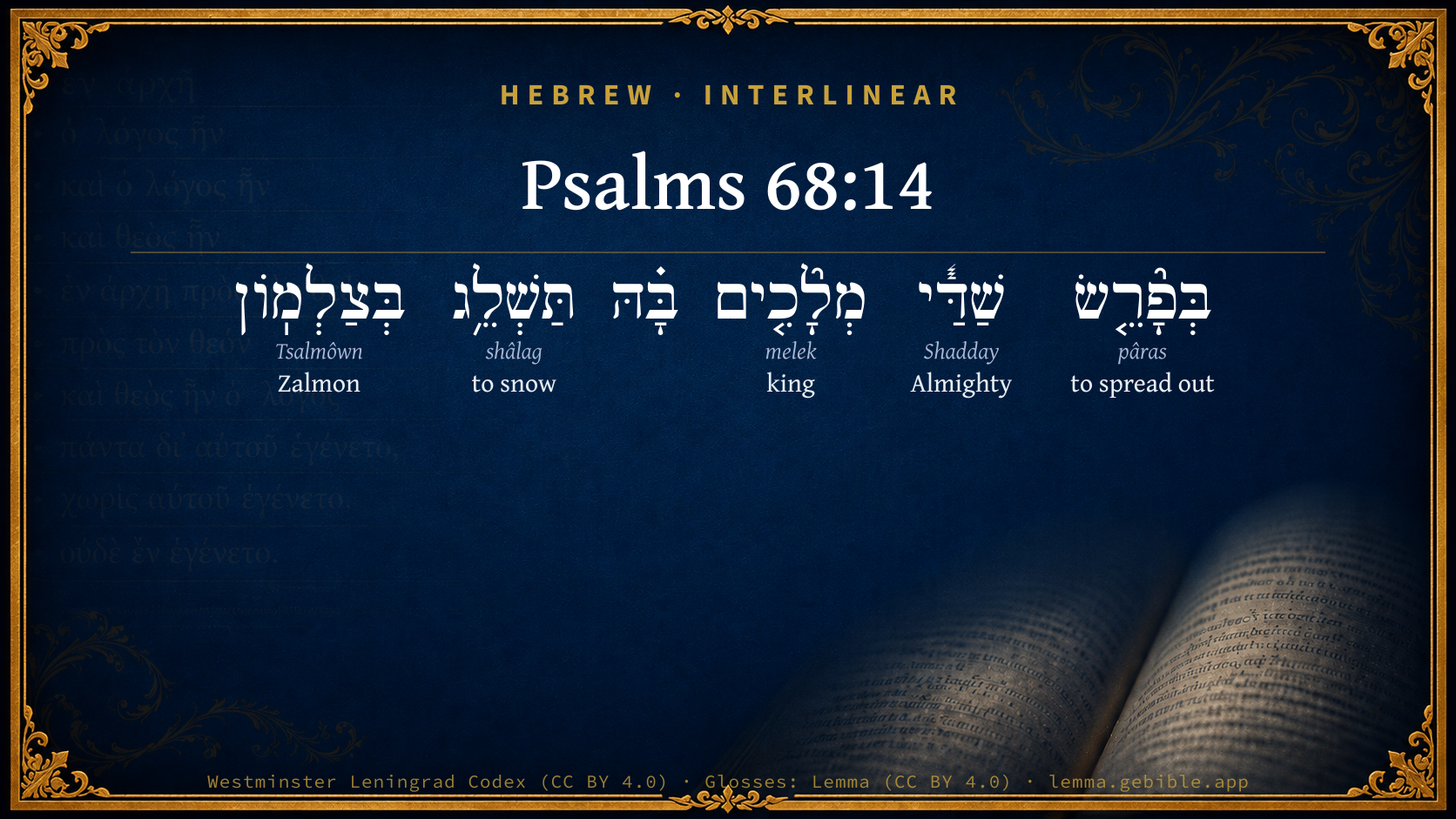
Psalms 68:14

Hebrew (Westminster Leningrad Codex) Psalms 68:14 appears in the Hebrew Old Testament. The text above is from the Westminster Leningrad Codex. Each word links to its Strong’s number, a concise gloss, and parsing drawn from the Open Scriptures Hebrew Bible morphology. Click any word for its full Brown-Driver-Briggs (BDB) entry.
Download image
Cite this verse

Psalms 68:14 (World English Bible). Public Domain. Lemma interlinear Bible study tool, https://lemma.gebible.app/v/psalms/68/14.

Show BibTeX & RIS
BibTeX
RIS
English Translation
When the Almighty scattered kings in her, It snowed on Zalmon.
World English Bible · Public Domain
Highlights
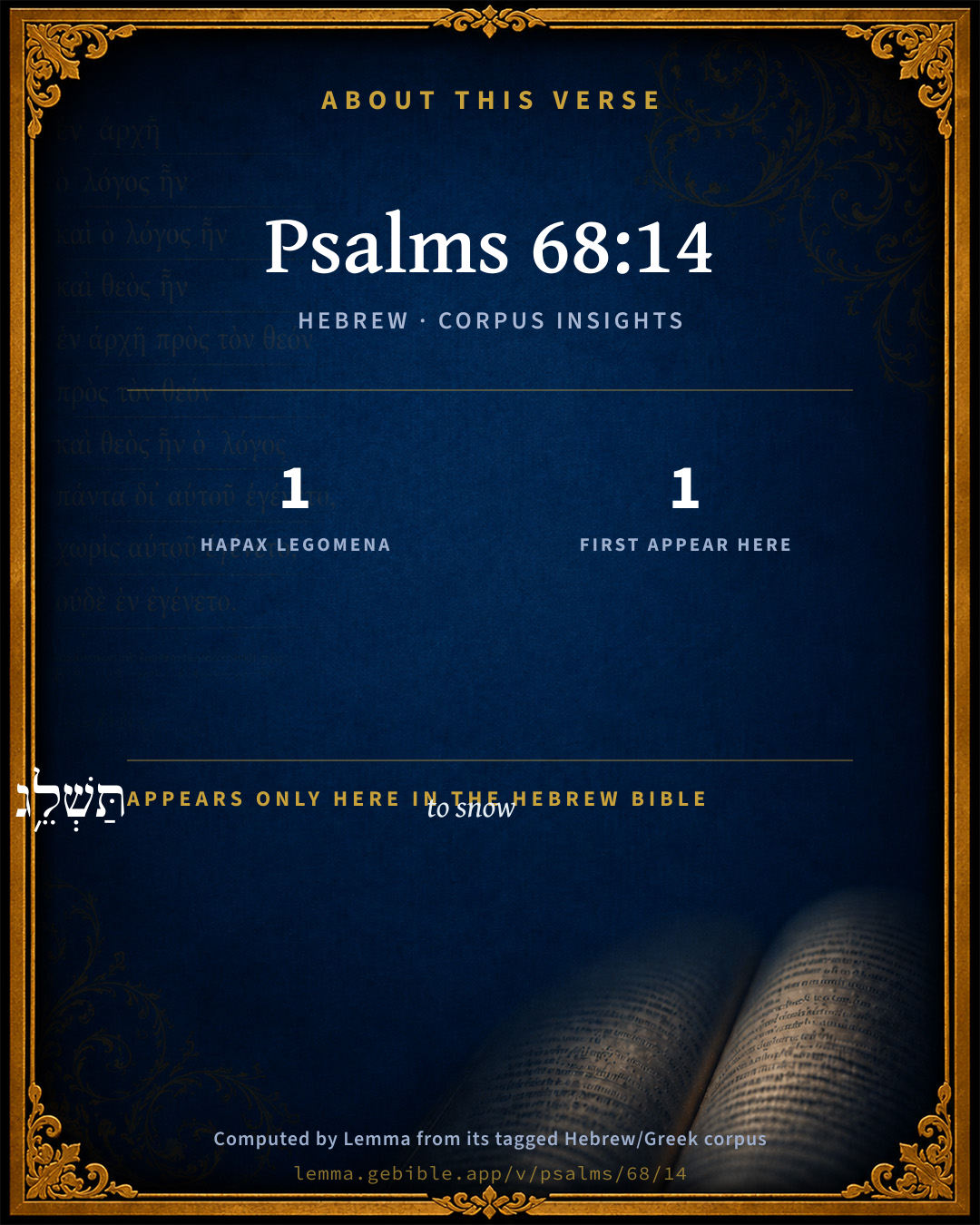
  • 1 hapax legomenon — only here in the Hebrew Bible
  • 1 first appearance in the Hebrew Bible
Full analysis ↓
Download a study sheet

One document with this verse’s original text, its word-by-word gloss line, the meaning frame, cross-references with their text, attributed commentary, and full source and license credits — printable, and it pastes into notes with its structure intact.

This verse Autodidact and up

Study sheet (.html) Plain text (.txt)

A passage Seminary Student

Up to 50 verses in one chapter. A passage sheet keeps up to 6 commentary sources and 12 cross-references per verse, in the order this page ranks them, and says so on the sheet whenever that leaves anything out. Ask for a single verse and you get the Autodidact verse sheet above.

Everything on this page stays free to read, with no account — the sheet is a download of what is already on screen, not access to it.

Want to remove ads? Support Godless Engineer
Compare translations 3

The same verse in 3 English versions, stacked beneath the original-language interlinear above. Click any original word for its lexicon entry.

Each is an independent rendering of the whole verse — the interlinear is not word-aligned to these translations.

Highlighted words mark where these versions differ — a whole-verse word diff, not a word-by-word alignment.

  • World English Bible Public Domain
    When the Almighty scattered kings in her, It snowed on Zalmon.
  • King James Version Public Domain
    When the Almighty scattered kings in it, it was white as snow in Salmon.
  • unfoldingWord Literal Text CC BY-SA 4.0
    When Shaddai scattered kings in it, it snowed on Zalmon.

unfoldingWord Literal Text — © unfoldingWord, licensed CC BY-SA 4.0. Word-aligned USFM3 via Door43 (git.door43.org/unfoldingWord/en_ult).

Versions to compare (up to 4)

3 of 4 selected

Show all 18 translations

Every available English version of this verse, each an independent rendering of the whole verse.

  • World English Bible Public Domain
    When the Almighty scattered kings in her, It snowed on Zalmon.
  • Berean Standard Bible Public Domain
    When the Almighty scattered the kings in the land, it was like the snow falling on Zalmon.
  • Majority Standard Bible Public Domain
    When the Almighty scattered the kings in the land, it was like the snow falling on Zalmon.
  • King James Version Public Domain
    When the Almighty scattered kings in it, it was white as snow in Salmon.
  • American Standard Version (1901) Public Domain
    When the Almighty scattered kings therein, `It was as when' it snoweth in Zalmon.
  • Revised Version (1885) Public Domain
    When the Almighty scattered kings therein, it was as when it snoweth in Zalmon.
  • Geneva Bible (1599) Public Domain
    When the Almightie scattered Kings in it, it was white as the snowe in Zalmon.
  • Douay-Rheims (1899) Public Domain
    If you sleep among the midst of lots, you shall be as the wings of a dove covered with silver, and the hinder parts of her back with the paleness of gold.
  • Young's Literal Translation Public Domain
    When the Mighty spreadeth kings in it, It doth snow in Salmon.
  • Literal Standard Version CC BY-SA 4.0
    When the Mighty spreads kings in it, it snows in Salmon.
  • Unlocked Literal Bible CC BY-SA 4.0
    The Almighty scattered kings there, it was as when it snowed on Mount Zalmon.
  • unfoldingWord Literal Text CC BY-SA 4.0
    When Shaddai scattered kings in it, it snowed on Zalmon.
  • Darby Bible Public Domain
    When the Almighty scattered kings in it, it became snow-white as Zalmon.
  • World Messianic Bible Public Domain
    When the Almighty scattered kings in her, it snowed on Zalmon.
  • Webster's Bible Public Domain
    \\68:13\\Though ye have lain among the pots, yet shall ye be as the wings of a dove covered with silver, and her feathers with yellow gold.
  • Free Bible Version CC BY-SA 4.0
    The Almighty scattered the foreign kings like a snowstorm on Mount Zalmon.
  • Bible in Basic English Public Domain
    When the Most High put the kings to flight, it was as white as snow in Salmon.
  • JPS Tanakh (1917) Public Domain
    (68-15) When the Almighty scattereth kings therein, it snoweth in Zalmon.

Literal Standard Version (2020), Covenant Press — licensed CC BY-SA 4.0. Text via the HelloAO Bible API (eBible.org). Unlocked Literal Bible (unfoldingWord) — licensed CC BY-SA 4.0. Text via the HelloAO Bible API (eBible.org). unfoldingWord Literal Text — © unfoldingWord, licensed CC BY-SA 4.0. Word-aligned USFM3 via Door43 (git.door43.org/unfoldingWord/en_ult). Free Bible Version, Dr. Jonathan Gallagher — licensed CC BY-SA 4.0. Text via the HelloAO Bible API (eBible.org).

Word by word

More ways to search: Search by grammar → Find every occurrence → Compare this word →

Practice this passage: Drill this verse → Learn its vocabulary →

About this verse

These counts appear in no published source. They are computed here, from the morphology-tagged text and Lemma’s own curated glosses. What Lemma adds →

6
words
5
distinct lemmas
Wisdom
section

Notable vocabulary

1 hapax legomenon — a word that appears only here in the entire Hebrew Bible:

  • תַּשְׁלֵ֥ג to snow H7949

First appearance in Scripture

This word makes its first canonical appearance in the Hebrew Bible here:

  • תַּשְׁלֵ֥ג to snow H7949

Shared distinctive vocabulary

בְּצַלְמֽוֹן Zalmon H6756 occurs in 3 verses of the Hebrew Bible. Also found in:

Grammatical profile

  • 2 verbs
  • 3 nouns
  • 1 preposition

Verb forms

  • בְּפָ֘רֵ֤שׂ Piel · Infinitive Construct
  • תַּשְׁלֵ֥ג Hiphil · Imperfect

Hebrew & Septuagint length

In English translation the verse runs 11 words from the Hebrew and 15 from the Septuagint (LXX English) — closely comparable.

A rough comparison of the two English renderings, which tokenize alike — not a word-level alignment.

Word counts can differ between the Hebrew and the Greek without any difference in meaning — e.g. the Hebrew direct-object marker אֵת has no separate Greek word, and Greek often adds the article ὁ.

Cross-references

10

Topical passages linked to Psalms 68:14 in the Treasury of Scripture Knowledge — connected by theme and wording, ordered by reader-vote popularity; previews shown in the World English Bible.

  • Isaiah 1:18 "Come now, and let us reason together," says Yahweh: "Though your sins be as scarlet, they shall be as white as snow. Though they be red like crimson, they shall be as wool.
  • Joshua 10:10–43 Yahweh confused them before Israel, and he killed them with a great slaughter at Gibeon, and chased them by the way of the ascent of Beth Horon, and struck them to Azekah, and to Makkedah.
  • Judges 2:7 The people served Yahweh all the days of Joshua, and all the days of the elders who outlived Joshua, who had seen all the great work of Yahweh that he had worked for Israel.
  • Judges 9:48 Abimelech got him up to Mount Zalmon, he and all the people who were with him; and Abimelech took an axe in his hand, and cut down a bough from the trees, and took it up, and laid it on his shoulder: and he said to the people who were with him, What you have seen me do, make haste, and do as I have done.
  • Psalms 51:7 Purify me with hyssop, and I will be clean. Wash me, and I will be whiter than snow.
  • Revelation 19:14–21 The armies which are in heaven followed him on white horses, clothed in white, pure, fine linen.
  • Numbers 21:3 Yahweh listened to the voice of Israel, and delivered up the Canaanites; and they utterly destroyed them and their cities: and the name of the place was called Hormah.
  • Numbers 21:21–35 Israel sent messengers to Sihon king of the Amorites, saying,
  • Joshua 12:1–24 Now these are the kings of the land, whom the children of Israel struck, and possessed their land beyond the Jordan toward the sunrise, from the valley of the Arnon to Mount Hermon, and all the Arabah eastward:
  • Jeremiah 2:3 Israel [was] holiness to Yahweh, the first fruits of his increase: all who devour him shall be held guilty; evil shall come on them, says Yahweh.

Cross-references courtesy of OpenBible.info (CC BY 4.0).

Hebrew and Greek witnesses Masoretic Hebrew ↔ Greek Septuagint

The same verse in the two great witnesses to the Old Testament, shown verse-for-verse.

You’re reading Greek Psalm 67 (Hebrew Psalm 68). The Septuagint counts the superscription, so verse numbers can differ from the Hebrew — chapter-level alignment, not verse-by-verse. Numbering follows Rahlfs.

These are two independent witnesses, not word-aligned to each other, and the Septuagint is shown in lemma (dictionary) form.

Hebrew Psalms 68:14 Masoretic · Westminster Leningrad Codex

בְּפָ֘רֵ֤שׂ שַׁדַּ֓י מְלָ֘כִ֤ים בָּ֗הּ תַּשְׁלֵ֥ג בְּצַלְמֽוֹן

When the Almighty scattered kings in her, It snowed on Zalmon.

World English Bible · Public Domain

Greek LXX Greek Psalm 67:14 Septuagint · lemma form

ἐάν κοιμάω ἀνά μέσος ὁ κλῆρος πτέρυξ περιστερά περιἀργυρόω καί ὁ μετάφρενον αὐτός ἐν χλωρότης χρυσίον διάψαλμα

When the heavenly One scatters kings upon it, they shall be made snow-white in Selmon.

LXX2012 (modern English Septuagint) · Public Domain

On this verse, Joseph Benson's Commentary discusses the Septuagint’s reading. Read the note in Commentary ↓

Hebrew: Westminster Leningrad Codex (CC BY 4.0). Greek: Septuagint (public domain); English from LXX2012 (modern English Septuagint) (Public Domain). How the Septuagint differs from the Hebrew →

Commentary

Notes on Psalms 68:14 from classic Christian and Jewish commentators (each source and its license shown beneath its notes). The classic Christian expositions comment on the surrounding passage and are grouped to its opening verse, so a note may address several verses; the Jewish commentaries on the Tanakh (Rashi and others) are per-verse, so they appear only where the commentator wrote on this verse.

Lemma curates 59 commentaries, every one of them public domain or Creative Commons licensed, each selected and text-cleaned for this edition rather than reprinted as found. About our sources →

Trapp's Complete Commentary

John Trapp

Psa 68:14 When the Almighty scattered kings in it, it was [white] as snow in Salmon.

Ver. 14. When the Almighty scattered kings in it] i.e. In the wilderness as they passed; or in Canaan which they possessed, according to Psa 68:1. Or, scattered kings for her, that is, for his Church, or for her that tarrieth at home, Psa 68:12, a periphrasis of the Church, in the times of primitive persecution especially, till the Almighty scattered those persecuting princes. Some of the Jewish doctors understand it to be Gog and Magog.

It was white as snow in Salmon] Or, she was white as snow in Salmon; not only as the wings of a dove, but glorious and glittering as snow on that high hill, Jdg 9:47-48. At the top of the Alps nothing is to be seen but snow, which hath lain there beyond the memory of man, and, as some say, ever since the flood. The same may be as true of Salmon, which some here take for a noun substantive common, and render it, albesces in caligine, thou shalt wax white in darkness. The old Emperor Andronicus, lighting upon this verse in his psalter, and applying it to himself, was much settled and satisfied concerning his troubles (Turk. Hist. fol. 164).

John Trapp, A Commentary or Exposition upon All the Books of the Old and New Testament (1647–1656) — public domain. Text from a community e-Sword module.

Joseph Benson's Commentary

Psa 68:14. When the Almighty scattered kings in it — In Canaan, at the coming of the Israelites thither; it was white as snow in Salmon — “The Almighty appeared most illustrious as Salmon,” says Bishop Patrick, that is, as mount Salmon covered with snow: “The land and nation,” says Mr. Samuel Clark, “were then in a very flourishing, joyful condition, and resplendent, by the establishment of God’s pure worship there.” Dr. Hammond explains and confirms this interpretation of the passage more at large, as follows: “The construction lies thus: בפרשׂ שׁדי מלכים בה, O God, by scattering kings there; or, when thou, O God Almighty, didst scatter kings in, or on it, επ αυτης, say the LXX., that is, on Salmon, תשׁלג, tashleg, thou wast white as snow; or, thou didst snow, that is, thou didst there appear in the most shining, bright, propitious form; thy mercies made that place more beautiful than the crown of snow doth the head of that mountain, when it melts in fertile moisture on the neighbouring valleys.” “Salmon,” he adds, “was the name of a very high hill on this side Jordan, in the portion of the tribe of Ephraim, Jdg 9:40, and consequently used to have snow lying long upon it.” Poole however thinks, with many other interpreters, both Hebrew and Christian, and the Chaldee among the rest, that the word Salmon ought to be taken here, not for a proper, but a common name, signifying darkness, or a shadow, and therefore proposes rendering the clause, It was snow-white, or, Thou madest it snow-white in darkness; or, Thou didst cause light to shine out of darkness: that is, at a time when the state of thy people, and the land of Canaan, which thou hadst given them, was dark and dismal, or bloody, by reason of the wars raised against them by the Canaanitish kings, thou didst quickly change it, and whereas it was red like scarlet, or crimson, thou madest it whiter than snow. Thus Buxtorf translates תשׁלג בצלמון, tashleg betsalmon, nivesces, thou didst snow, or albesces sicut nix, in caligine. Thou didst grow white in darkness. Henry understands it of the church of God that then was: “She was white as snow in Salmon, purified and refined by the mercies of God.” Chandler renders the clause, When the Almighty scattered kings therein, thou didst make them joyful in Salmon; or, There was great joy in Salmon. Dr. Horne who doubtless had consulted the commentators above quoted and many others on the passage, acquiesces in this interpretation, observing, “The purport of this difficult verse seems to be, that all was white as snow, that is, all was brightness, joy, and festivity about mount Salmon, when the Almighty, fighting for his people Israel, vanquished their enemies in or about that part of the country.”

Joseph Benson's Commentary on the Old and New Testaments (1811–1818) — public domain. Text from a community e-Sword module.

J. A. Alexander on Psalms

Joseph Addison Alexander

15. (Psa 68:14). When the Almighty scatters kings therein, it snows in Zalmon. The change from war to peace is likened to the dazzling whiteness of snow in the midst of blackness or darkness. This last idea is conveyed by Zalmon, an unimportant eminence near Shechem, partly perhaps in reference to the dark forests which covered it (Jdg 9:48), but chiefly to the meaning of the name itself, to wit, shade or shadow. The parallel term, snow, suggests the idea of the brightest light. See Psa 51:7, Isa 1:18, Mar 9:3, Mat 28:3, Rev 1:14, and compare Mat 17:2. Some, with far less probability, explain the verse as meaning that the land was whitened with the slain, as Zalmon was with snow; but this ascribes too great an altitude to Zalmon. The Hebrew construction in the first clause is, in the Almighty's scattering kings, i.e. at the time of his so doing. The divine name here used is not the one so frequently translated Mighty in the Psalms, but the patriarchal title mentioned in Exo 6:3. Compare Gen 17:1; Gen 28:3. It is here introduced because the events in question were remarkable exertions and displays of God's omnipotence. Scattered here means routed, put to flight. See above, Psa 68:12, and compare the use of the same Hebrew verb in Zec 2:6.

Joseph Addison Alexander, The Psalms Translated and Explained (1850) — public domain. Text from a community e-Sword module.

Tyndale Open Study Notes

Tyndale Open Resources

68:14 The Almighty (Hebrew Shaddai) is an ancient designation for God (see 91:1; Gen 17:1). • The identification of Mount Zalmon is uncertain; it was possibly a mountain in Bashan (see Ps 68:15).

Tyndale Open Study Notes — © Tyndale Open Resources, licensed CC BY-SA 4.0. Text via the HelloAO Bible API.

Geneva Bible (1599)

Geneva Bible translators

In the land of Canaan, where his Church was.

Geneva Bible (1599) marginal notes — public domain. Text via Bolls.life.

Jamieson, Fausset & Brown

Robert Jamieson, A. R. Fausset & David Brown

Their enemies dispersed, the contrast of their prosperity with their former distress is represented by that of the snow with the dark and somber shades of Salmon.

Jamieson, Fausset & Brown — Commentary Critical and Explanatory on the Whole Bible (1871) — public domain (CC PDM 1.0). Text via the HelloAO Bible API.

John Calvin's Commentaries

14. When the Almighty scattered kings in it We might read extended, or divided kings, etc., and then the allusion would be to his leading them in triumph. But the other reading is preferable, and corresponds better with what was said above of their being put to flight. There is more difficulty in the second part of the verse, some reading, it was white in Salmon; that is, the Church of God presented a fair and beautiful appearance. Or the verb may be viewed as in the second person — Thou, O God! Didst make it fair and white as mount Salmon with snows The reader may adopt either construction, for the meaning is the same. It is evident that David insists still upon the figure of the whiteness of silver, which he had previously introduced. The country had, as it were, been blackened or sullied by the hostile confusions into which it was thrown, and he says that it had now recovered its fair appearance, and resembled Salmon, which is well known to have been ordinarily covered with snows. Others think that Salmon is not the name of a place, but an appellative, meaning a dark shade. I would retain the commonly received reading. At the same time, I think that there may have been an allusion to the etymology. It comes from the word צלם, tselem, signifying a shade, and mount Salmon had been so called on account of its blackness. This makes the comparison more striking; for it intimates, that as the snows whitened this black mountain, so the country had resumed its former beauty, and put on an aspect of joy, when God dispelled the darkness which had lain upon it during the oppression of enemies.

John Calvin's Commentaries (1540-1563) — public domain. Text from the Calvin Translation Society English edition (1840s-50s) via the Christian Classics Ethereal Library (ccel.org). Calvin's coverage is partial (roughly two-thirds of the Bible); uncommented books and verses are honest gaps, never fabricated. The 19th-century editor's footnotes and remarks are omitted so the notes are faithfully Calvin's own voice.

The Cambridge Bible for Schools and Colleges

gen. ed. J. J. S. Perowne

14. Of this verse, as of Psa_68:13, the meaning is uncertain. Possibly it too is a fragment, significant to those who remembered its original context, but necessarily obscure to us. It is doubtful, too, if the text is sound. In it, R.V. therein, must mean ‘in the land.’ Salmon, R.V. Zalmon, is only known to us as the name of a wooded hill near Shechem, from which Abimelech fetched wood to burn the tower of Shechem (Jdg_9:48). But the name, which means ‘dark’ or ‘shady’ (cp. Black Mountain, Black Forest), may have been borne by other mountains. If Zalmon near Shechem is intended, it may be mentioned either as a central point in the land, or from its connexion with some historical incident of which no record has been preserved, or simply to heighten the picturesqueness of the simile by representing the snowstorm as seen against the background of the dark mountain. Shaddai, ‘The Almighty’, only occurs once again in the Psalter (Psa_91:1).

(1) Taking the second line as a simile, we may render with R.V.,

When the Almighty scattered kings therein,

(It was as when) it snoweth in Zalmon.

But what is meant by the simile? It has been supposed to refer to the bones of the enemy bleaching on the field of battle (cp. Verg. Aen. xii. 36, campiqiu ingentes ossibus albent: “The vast plains are white with bones”): or to the glistening of the armour &c. dropped by the fugitives in their flight: but it is far more suggestive to think, not of fallen snow lying on the ground, but of falling snow. The snowflakes driven before the storm are an apt emblem of the kings driven in pell-mell flight by the breath of the Lord, and this explanation suits the context. By the thought of the victory won for Israel by God in spite of the sloth of many an Israelite (Psa_68:13) the poet is naturally carried back to the battle-scene, and desires to emphasise the fact that the Almighty had fought for Israel, sweeping the foe before Him like the snowflakes swept along by the hurricane.

(2) Taking the second line literally, we may render with R.V. marg., It snowed in Zalmon. The words will then refer to a snowstorm which accompanied and completed the rout of the kings. They can scarcely refer to the hardships endured by those who took up arms amid the rigours of an exceptionally severe winter, in contrast to the luxurious ease of the cowards who are chidden in Psa_68:13; still less can they be the words of those cowards excusing themselves from taking part in the war by the severity of the weather.

(3) Some combine the literal and figurative explanations, interpreting it snowed in Zalmon to mean that “the mountain clothed itself in a bright garment of light in celebration of the joyful event. Whoever has been in Palestine knows how refreshing is the sight of the distant mountain peaks covered with snow.” This however is too far-fetched an explanation to be probable.

The Cambridge Bible for Schools and Colleges (gen. ed. J. J. S. Perowne; Cambridge University Press, 1878–1918) — public domain. Text from a community e-Sword module.

John Gill's Exposition

When the Almighty scattered kings in it,.... His inheritance, his congregation, the church, Psa 68:9. Which some understand of his diffusing, and spreading and giving, in large numbers, ministers and preachers of the Gospel, pastors and teachers; who are kings and spiritual governors, are over churches, and have the rule over them in the Lord: and so Jarchi interprets them of the disciples of the wise men. Or they may be understood of the Lord's bringing into his churches such as are made kings and priests unto God, and in whose hearts grace reigns; and even of kings, in a literal sense, who will be brought into the church in the latter day, Isa 49:23. Though they may be interpreted of wicked kings, and the destruction of them "by it" (f), the dove, the church of Christ; which will be done at the battle of Armageddon, at which time we read of the church being clothed in white, as follows; see Rev 16:14. The name of "Almighty" well agrees with Christ, Rev 1:8; or "Shaddai", who is sufficient, all sufficient; and whose grace is sufficient for his people, Co2 12:9;

it was white as snow in Salmon; a mountain near to Shechem, Jdg 9:48; which seems to have had its name from the shady trees upon it; and which also, as it seems from hence, was sometimes covered with snow; as was Lebanon, so called from the whiteness of the snow on it; and Olympus is called snowy by Homer, from the snow continually on it (g). Jarchi and Kimchi interpret it, "in darkness", or "in the shadow of death"; denoting, as Ainsworth observes, light in darkness; joy in tribulation: but rather it may design the purity of the church and people of God, through the imputation of Christ's righteousness to them, which is as fine linen, clean and white; and through his pardoning blood, whereby their scarlet and crimson sins are as white as wool, as white as snow; and through the sanctifying grace of the Spirit, by which they are washed and cleansed, and made all glorious within; and through the holiness of their lives and conversations, they hating the garment spotted with the flesh; and washing their garments, and making them white in the blood of the Lamb: or they may be said to be so, as having got the victory over all their enemies; and especially this will be the case when the kings of the earth will be scattered and destroyed by the Almighty Saviour, Rev 7:9.

(f) "per eam, vel propter eam", Gejerus. (g) Iliad. c. v. 420. & 18. v. 615.

John Gill's Exposition of the Whole Bible (1746–1763) — public domain (CC PDM 1.0). Text via the HelloAO Bible API.

Albert Barnes' Notes on the Bible

When the Almighty scattered kings in it - The Hebrew here is, “In the scattering of (that is, by) the Almighty of kings.” The reference is to the act of God in causing kings to abandon their purposes of invasion, or to flee when their own countries were invaded. Compare Psa 48:5-6. The language here is so general that it might be applied to any such acts in the history of the Hebrew people; to any wars of defense or offence which they waged. It may have reference to the scattering of kings and people when Joshua invaded the land of Canaan, and when he discomfited the numerous forces, led by different kings, as the Israelites took possession of the country. The close connection of the passage with the reference to the journey through the wilderness Psa 68:7-9 would make it probable that this is the allusion. The phrase “in it,” (margin, for her), refers doubtless to the land of Canaan, and to the victories achieved there.

It was white as snow in Salmon - Margin, She was. The allusion is to the land of Canaan. But about the meaning of the phrase “white as snow in Salmon,” there has been great diversity of opinion. The word rendered “was white as snow” is correctly rendered. It means to be snowy; then, to be white like snow. The verb occurs nowhere else. The noun is of frequent occurrence, and is always rendered snow. Exo 4:6; Num 12:10; 2Sa 23:20; 2Ki 5:27; et al. The word Salmon properly means shady, and was applied to the mountain here referred to, probably on account of the dark forests which covered it. That mountain was in Samaria, near Shechem. Jdg 9:48. It is not known why the snow of that mountain is particularly alluded to here, as if there was any special whiteness or purity in it. It is probably specified by name only to give more vivacity to the description. There is much difference of opinion as to what is the meaning of the expression, or in what respects the land was thus white.

The most common opinion has been that it was from the bones of the slain which were left to bleach unburied, and which covered the land so that it seemed to be white. Compare Virg. AEn. v. 865; xii. 36. Ovid uses similar language, Fast. i: “Humanis ossibus albet humus.”So also Horace, Serra. 1, 8: “Albis informem spectabant ossibus agrum.” This interpretation of the passage is adopted by Rosenmuller, Gesenius, and DeWette. Others suppose it to mean that the land was like the dazzling whiteness of snow in the midst of blackness or darkness. This was the opinion of Kimchi, and this interpretation is adopted by Prof. Alexander. Tholuck supposes it to mean that, when war was waged on the kings and people, they fell as fast as snow-flakes on Mount Salmon; and that the idea is not so much the whiteness of the land, as the fact that they fell in great numbers, covering the land as the snow-flakes do. It is perhaps not possible to determine which of these explanations is correct. Either of them would accord with the meaning of the words and the general sense of the psalm. That of Tholuck is the most poetical, but it is less obvious from the Hebrew words used.

Albert Barnes' Notes on the Bible (1834–1885) — public domain. Text from a community e-Sword/MySword module.

Matthew Poole's English Annotations

In it; in Canaan, at the coming of the Israelites thither. The land was as white as Mount Salmon is with the snow, which falls and lies for a long time upon it; which is opposed to the native obscurity of that mountain by the many shady trees which were there, Jdg 9:48. But because there is nothing certain, either concernirig the great height of this mountain, or concerning its snow, as we do read of snow of Lebanon, Jer 18:14, other interpreters, both Hebrew and Christian, and the Chaldee among the rest, take this word Salmon for a common, and not a proper name, signifying darkness or a shadow, as the root from whence it comes unquestionably signifies. Nor is it strange if this word be no where else taken in that sense but here, because that is the lot of many Hebrew words, or of some significations of them, that they are to be found but in one text of Scripture. This being granted, the words are or may be rendered thus, it was snow-white, or thou madest it snow-white in darkness, or, as the Chaldee renders this word, in the shadow of death, i.e. thou didst cause light to shine out of darkness. When the state of thy people, and of the land of Canaan which thou hadst given to them, was dark and dismal or bloody, by reason of the wars raised against them by the Canaanitish kings, thou didst quickly change it; and whereas it was red like scarlet or crimson, thou madest it whiter than snow.

Matthew Poole's English Annotations on the Holy Bible (1683–1685) — public domain. Text from a community e-Sword/MySword module.

The Treasury of David

Charles H. Spurgeon

Ver. 14. When the almighty scattered kings in it, it was white as snow in Salmon. The victory was due to the Almighty arm alone; he scattered the haughty ones who came against his people, and he did it as easily as snow is driven from the bleak sides of Salmon. The word white appears to be imported into the text, and by leaving it out the sense is easy. A traveller informed the writer that on a raw and gusty day, he saw the side of what he supposed to be Mount Salmon suddenly swept bare by a gust of wind, so that the snow was driven hither and thither into the air like the down of thistles, or the spray of the sea: thus did the Omnipotent one scatter all the potentates that defied Israel. If our authorized version must stand, the conjectures that the bleached bones of the enemy, or the royal mantles cast away in flight, whitened the battle field, appear to be rather too far fetched for sacred poetry. Another opinion is, that Salmon was covered with dark forests, and appeared black, but presented quite another aspect when the snow covered it, and that by this noteworthy change from sombre shade to gleaming whiteness, the poet sets forth the change from war to peace. Whatever may be the precise meaning, it was intended to pourtray the glory and completeness of the divine triumph over the greatest foes. In this let all believers rejoice.

Ver. 14. Salmon or Zalmon, properly Tsalmon, Nwmlu a woody hill near Shechem (Jud 9:48). Whether it is this that's referred to in Ps 69:14, is disputed. Some interpreters take Nwmlu here in its etymological meaning of darkness, Mlu; thus Luther renders the clause "so wird es helle wo es dunkel ist, "thus it be bright where it is dark, and understands it with a Messianic reference. Ewald adopts much the same rendering. The majority, however, retain the name as a proper name, but exhibit great variety in their explanation of the passage. Hengstenberg thinks that the phrase, "it snows on Tsalmon, "is equivalent to "there is brightness where there was darkness, "the hill, originally dark with wood, is now white with snow. De Dieu supposes a comparison: Tsalmon is white with the bones of the slaughtered kings, as if with snow. Some suppose that there is here a mere note of time: it was winter, the snow was on Tsalmon (Herder); and this Hupfeld adopts, with the explanation that the statement is made derisively, with reference to those who tarried at home, deterred by the winter's snow. He considers the passage (Ps 68:12-14) as a fragment of an ancient song, celebrating some of the early conquests of Israel in Canaan, and deriding those, who, from indolence or fear, shrank from the enterprise. He translates thus:

"The kings of the armies, flee, flee,

And the housewife shares the spoil!

Will ye lie among the shippens?

Pigeons feathers decked with silver,

And their wings with yellow gold!

As the Almighty scattered kings therein,

It was snowing on Tsalmon."

William Lindsay Alexander, in "A Cyclopaedia of Biblical Literature." 1866.

Ver. 14. The verb may be viewed as in the second person-- Thou, O God! didst make it fair and white as Mount Salmon with snow. The reader may adopt either construction, for the meaning is the same. It is evident that David insists still upon the figure of the whiteness of silver, which he had previously introduced. The country had, as it were, been blackened or sullied by the hostile confusion into which it was thrown, and he says that it had now recovered its fair appearance, and resembled Salmon, which is well known to have been ordinarily covered with snows. Others think that Salmon is not the name of a place, but an appellative, meaning a dark shade. I would retain the commonly received reading. At the same time, I think that there may have been an allusion to the etymology. It comes from the word Mlu, tselem, signifying a shade, and Mount Salmon had been so called on account of its blackness. This makes the comparison more striking; for it intimates that as the snows whitened this black mountain, so the country had resumed its former beauty, and put on an aspect of joy, when God dispelled the darkness which had lain upon it during the oppression of enemies. John Calvin.

Ver. 14. It was as white as snow in Salmon. That is, this thine inheritance, thy peculiar people, appeared as bright and glorious in the sight of their neighbours, as the snowy head of Salmon glistens by the reflection of the sunbeams. Thomas Fenton.

Ver. 14. White as snow in Salmon. The expression here used seems to denote, that everything seemed as bright and cheerful to the mind of God's people, as Salmon does to their eyes, when glistening with snow. As snow is much less common, and lies a much shorter time in Judaea than in England, no wonder that it is much more admired; accordingly, the son of Sirach speaks of it with a kind of rapture. "The eye will be astonished at the beauty of its whiteness, and the heart transported at the raining of it." Ecclus. 43:18 or 20. Samuel Burder.

Ver. 14. Salmon. Dean Stanley conjectures that Salmon in another name for Mount Ebal; it was certainly near Shechem (see Jud 9:48), but it is almost hopeless to expect to identify it, for Mr. Mills, the industrious author of "Nablus and the modern Samaritans, "could not find any one who knew the name of Salmon, neither could he discover any traditions in reference to it, or indeed any allusion to it in Samaritan literature. The word signifies a shade, and may, perhaps, popularly be accepted as identical with the name the "Black Forest." C. H. S.

Ver. 14.

I. Where earth's greatest battles are fought.

"Scattered, ""in it, "i.e., in Zion. "There

brake he, "etc.

II. By whom? The Almighty.

III. When? In answer to his people's faith and prayer.

IV. How?

1. Without noise, gently: as the fall of snow.

2. Without human aid: as untrodden snow.

3. Without violence: "All bloodless lay the untrodden snow." G. R.

Psalms 68:15*

Charles H. Spurgeon's The Treasury of David (1869–1885) — public domain. Psalms only. Text from a community e-Sword/MySword module.

Whedon's Commentary on the Bible

Daniel D. Whedon

14. Scattered kings—These kings are enumerated in Joshua 12.

In it— That is, in the land. The allusion seems to be specially to the conquest of the nations of Canaan by Joshua. See chapters 10 and 12.

White as snow in Salmon—It is not necessary to add the word “white” to the translation, and the Hebrew conjunction for “as” is wanting. The English Version proceeds upon the supposition that the whiteness of “snow” is the point of the figure. But the word is a verb in Hiphil, and simply means, Thou wilt cause it to snow; or, understanding it in the preterite, Thou didst cause it to snow. It is the falling of snow flakes, not the whiteness of snow, which is the point intended; and if we are to seek a historical basis of the allusion as in the preceding member of the verse, taking “Salmon” or Zalmon, (the words are the same in Hebrew,) not as an appellative, but the name of a mountain near Shechem, Jdg_9:48, it is easy to perceive that an atmosphere that would discharge so terrible a hail storm at Bethhoron (see Jos_10:11) might be darkened by snowflakes at Salmon, twenty-five miles distant, and thus, by such an unprecedented phenomenon, spread alarm among the mustering tribes of the northern section.

Daniel D. Whedon (gen. ed.), Commentary on the Old and New Testaments (1874–1909) — public domain. Text from a community e-Sword module.

The Pulpit Commentary

When the Almighty scattered kings in it; i.e. "in the land" (comp. ver. 10). Most of the defeats of kings, referred to above (see the comment on ver. 12), took place within the limits of Palestine. It was white as snow in Salmon. The present text has only the two words which mean, "it snows on Salmon;" whence it is concluded that something must have fallen out. Professor Cheyne supplies glVh ewOmK like snow," and understands the passage to mean that, when the kings were scattered, "it was like snow when it snows on Salmon the ground was all covered with glistering arms, armour, and garments. Salmon was a wooded hill near Shechem. (Jud_1:9:48)

The Pulpit Commentary (1880–1919), ed. H.D.M. Spence-Jones & Joseph S. Exell — public domain. Text from a community e-Sword module.

John Wesley's Explanatory Notes

Therein - In Canaan, at the coming of the Israelites. The land was as white as mount Salmon is with the snow.

John Wesley, Explanatory Notes Upon the Whole Bible (1754–1765) — public domain. Text via the GEBible commentary corpus.

unfoldingWord translationNotes

Door43 World Missions Community

scattered kings there ... snowed on Mount Zalmon

There were so many dead kings and soldiers on the mountain that they are spoken of as if they were snow covering the mountain. AT: "defeated so many enemy kings and soldiers there that they were like snowflakes covering Mount Zalmon" (See: Simile)

scattered kings

Here "kings" refers to their armies as well. AT: "scattered the enemy kings and their armies" (See: Synecdoche)

Mount Zalmon

This is the name of a mountain. (See: How to Translate Names)

A mighty mountain is the ... a high mountain is the

These two phrase have similar meanings and are used together to strengthen each other. AT: "a mighty and high mountain is the hill country of Bashan" (See: Parallelism)

Why do you look in envy ... for the place he will live?

This question can be written as a statement. AT: "The high hill country of Bashan should not look in envy at the mountain which God desires for the place he will live." (See: Rhetorical Question)

translationWords

Almighty

king

might

Bashan

envy

life

eternity

unfoldingWord translationNotes — © Distant Shores Media and the Door43 World Missions Community, licensed CC BY-SA 4.0. Source: git.door43.org/Door43/en_tn.

Rashi

Rabbi Shlomo Yitzchaki (Rashi)

If you lie between the borders, etc. All this is the word. He says to them, “If you had lain between your borders and had enjoyed pleasures, this My dove, My congregation, whose feathers are covered with silver.” Now what is the silver, and what is the gold? (15) When the Almighty spreads out, etc. When the Holy One, blessed be He, explained His Torah, with which the kings are “snowed and whitened” in a land of the Shadow of Death and darkness then its feathers (dove’s feathers) were covered with the desire and yearning for the Torah and [its] Commandments. the feathers of a dove Plumes in French.

and its pinions Its wings, with which it flies.

with brilliant gold Heb. בירקרק חרוץ. Dunash the son of Labrat interpreted חרוּץ as gold. Therefore, the Psalmist juxtaposed it to silver, and ירקרק חרוץ is the gold brought from the land of Havilah and from the land of Cush; very good gold, neither yellow nor red. Therefore, it is called ירקרק, as (Lev. 13:42): “reddish white (לבן אדמדם),” which is neither white nor red. Therefore, it is doubled: אדמדם, ירקרק.

Rashi on the Tanakh — English translations: “The Judaica Press complete Tanach with Rashi, translated by A. J. Rosenberg” (CC BY 4.0); “Pentateuch with Rashi's commentary by M. Rosenbaum and A.M. Silbermann, 1929-1934” (public domain); “The Metsudah Tanach series, Lakewood, N.J” (CC BY 4.0); and “The Book of Joshua, Metsudah Publications, 1997” (CC BY 4.0). Text via Sefaria.

Lesson kit

Teaching starters — assembled from the data on this page, not authored interpretation. Every prompt links to the verse data it draws on. Edit before teaching.

Psalms, in the Wisdom, opens this verse with 6 words (5 distinct Hebrew lemmas). Its most distinctive word is shâlag (“to snow”). A historical commentator’s framing appears above. Read the whole chapter for the surrounding context.

Discussion questions

  1. What does “to snow” (shâlag) contribute to the verse as a whole?
  2. 1 word here appears nowhere else in the Hebrew Bible. Why might the author reach for such rare wording?
  3. This is the first place “to snow” appears in Scripture (first appears here). What does its debut here establish?
  4. How does Judges 9:48, which shares the word «Zalmon», read alongside this verse?
  5. These translations render this verse differently; the difference is in the English rendering, not the original. What questions does that raise?
  6. «בְּפָ֘רֵ֤שׂ» is a Piel Infinitive Construct verb. How does that grammatical form shape the action described?
  7. Compare how Trapp's Complete Commentary and Joseph Benson's Commentary read this verse. Where do they agree or differ?

Things to notice

  • 1 word in this verse appears nowhere else in the Hebrew Bible.
  • 1 word makes its first canonical appearance in Scripture here.
  • These translations choose different wording for 7 words in this verse.
  • 5 distinct Hebrew lemmas span 6 words in this verse.

Reading settings

Reading text

Shown beneath each verse's original-language words.

Old Testament
Old Testament edition

Read the OT as the Masoretic Hebrew (MT) or the Greek Septuagint (LXX).

English shown for the Greek Septuagint (in the Hebrew ↔ Greek comparison).

Comparing translations? Open the Compare panel on any verse page to stack up to four side by side.