
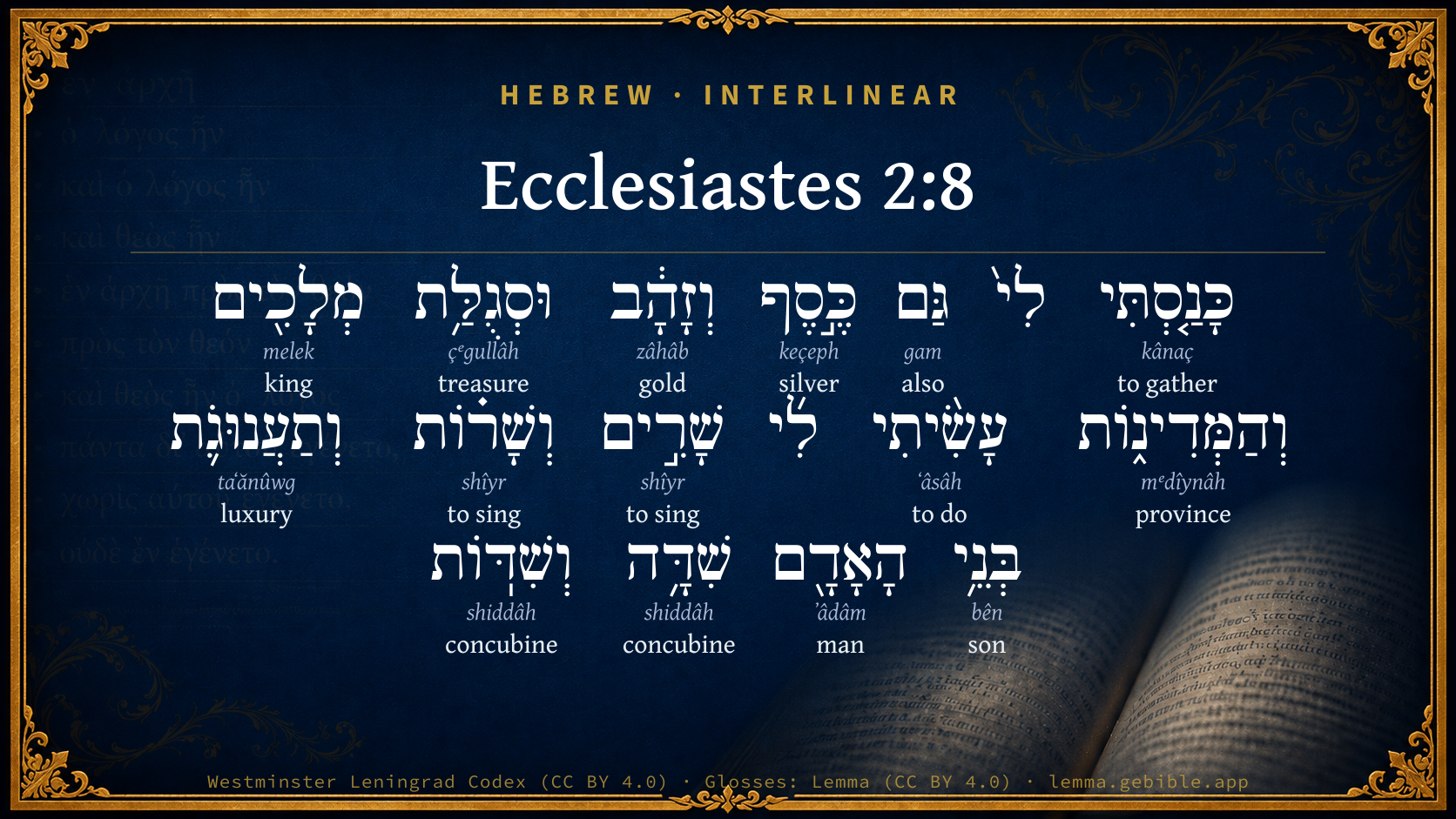
Ecclesiastes 2:8

Hebrew (Westminster Leningrad Codex) Ecclesiastes 2:8 appears in the Hebrew Old Testament. The text above is from the Westminster Leningrad Codex. Each word links to its Strong’s number, a concise gloss, and parsing drawn from the Open Scriptures Hebrew Bible morphology. Click any word for its full Brown-Driver-Briggs (BDB) entry.
Download image
Cite this verse

Ecclesiastes 2:8 (World English Bible). Public Domain. Lemma interlinear Bible study tool, https://lemma.gebible.app/v/ecclesiastes/2/8.

Show BibTeX & RIS
BibTeX
RIS
English Translation
I also gathered silver and gold for myself, and the treasure of kings and of the provinces. I got myself men-singers and women-singers, and the delights of the sons of men--musical instruments, and that of all sorts.
World English Bible · Public Domain
Highlights
  • 1 first appearance in the Hebrew Bible
Full analysis ↓
Download a study sheet

One document with this verse’s original text, its word-by-word gloss line, the meaning frame, cross-references with their text, attributed commentary, and full source and license credits — printable, and it pastes into notes with its structure intact.

This verse Autodidact and up

Study sheet (.html) Plain text (.txt)

A passage Seminary Student

Up to 50 verses in one chapter. A passage sheet keeps up to 6 commentary sources and 12 cross-references per verse, in the order this page ranks them, and says so on the sheet whenever that leaves anything out. Ask for a single verse and you get the Autodidact verse sheet above.

Everything on this page stays free to read, with no account — the sheet is a download of what is already on screen, not access to it.

Want to remove ads? Support Godless Engineer
Compare translations 3

The same verse in 3 English versions, stacked beneath the original-language interlinear above. Click any original word for its lexicon entry.

Each is an independent rendering of the whole verse — the interlinear is not word-aligned to these translations.

Highlighted words mark where these versions differ — a whole-verse word diff, not a word-by-word alignment.

  • World English Bible Public Domain
    I also gathered silver and gold for myself, and the treasure of kings and of the provinces. I got myself men-singers and women-singers, and the delights of the sons of men--musical instruments, and that of all sorts.
  • King James Version Public Domain
    I gathered me also silver and gold, and the peculiar treasure of kings and of the provinces: I gat me men singers and women singers, and the delights of the sons of men, as musical instruments, and that of all sorts.
  • unfoldingWord Literal Text CC BY-SA 4.0
    I also amassed for myself silver and gold and the treasure of kings and provinces. I appointed for myself male singers and female singers and the pleasures of the sons of humanity: breast and breasts.

unfoldingWord Literal Text — © unfoldingWord, licensed CC BY-SA 4.0. Word-aligned USFM3 via Door43 (git.door43.org/unfoldingWord/en_ult).

Versions to compare (up to 4)

3 of 4 selected

Show all 18 translations

Every available English version of this verse, each an independent rendering of the whole verse.

  • World English Bible Public Domain
    I also gathered silver and gold for myself, and the treasure of kings and of the provinces. I got myself men-singers and women-singers, and the delights of the sons of men--musical instruments, and that of all sorts.
  • Berean Standard Bible Public Domain
    and I accumulated for myself silver and gold and the treasure of kings and provinces. I gathered to myself male and female singers, and the delights of the sons of men—many concubines.
  • Majority Standard Bible Public Domain
    and I accumulated for myself silver and gold and the treasure of kings and provinces. I gathered to myself male and female singers, and the delights of the sons of men—many concubines.
  • King James Version Public Domain
    I gathered me also silver and gold, and the peculiar treasure of kings and of the provinces: I gat me men singers and women singers, and the delights of the sons of men, as musical instruments, and that of all sorts.
  • American Standard Version (1901) Public Domain
    I gathered me also silver and gold, and the treasure of kings and of the provinces; I gat me men-singers and women-singers, and the delights of the sons of men, musical instruments, and that of all sorts.
  • Revised Version (1885) Public Domain
    I gathered me also silver and gold, and the peculiar treasure of kings and of the provinces: I gat me men singers and women singers, and the delights of the sons of men, concubines very many.
  • Geneva Bible (1599) Public Domain
    I haue gathered vnto me also siluer and gold, and the chiefe treasures of Kings and prouinces: I haue prouided me men singers and women singers, and the delites of the sonnes of men, as a woman taken captiue, and women taken captiues.
  • Douay-Rheims (1899) Public Domain
    I heaped together for myself silver and gold, and the wealth of kings, and provinces: I made me singing men, and singing women, and the delights of the sons of men, cups and vessels to serve to pour out wine:
  • Young's Literal Translation Public Domain
    I gathered for me also silver and gold, and the peculiar treasure of kings and of the provinces. I prepared for me men-singers and women-singers, and the luxuries of the sons of man -- a wife and wives.
  • Literal Standard Version CC BY-SA 4.0
    I also gathered for myself silver and gold, and the peculiar treasure of kings and of the provinces. I prepared for myself men-singers and women-singers, and the luxuries of the sons of man—a wife and wives.
  • Unlocked Literal Bible CC BY-SA 4.0
    I also accumulated for myself silver and gold, the treasures of kings and provinces. I got male and female singers for myself—the delights of the children of humanity—and many concubines.
  • unfoldingWord Literal Text CC BY-SA 4.0
    I also amassed for myself silver and gold and the treasure of kings and provinces. I appointed for myself male singers and female singers and the pleasures of the sons of humanity: breast and breasts.
  • Darby Bible Public Domain
    I gathered me also silver and gold, and the peculiar treasure of kings and of the provinces; I got me men-singers and women-singers, and the delights of the children of men, a wife and concubines.
  • World Messianic Bible Public Domain
    I also gathered silver and gold for myself, and the treasure of kings and of the provinces. I got myself male and female singers, and the delights of the sons of men: musical instruments of all sorts.
  • Webster's Bible Public Domain
    I gathered me also silver and gold, and the peculiar treasure of kings, and of the provinces: I procured me men-singers and women-singers, and the delights of the sons of men, as musical instruments, and of all sorts.
  • Free Bible Version CC BY-SA 4.0
    I collected for myself great quantities of silver and gold, paid to me as tribute by kings and provinces. I brought in for myself male and female singers, and enjoyed many concubines —all a man could want!
  • Bible in Basic English Public Domain
    I got together silver and gold and the wealth of kings and of countries. I got makers of song, male and female; and the delights of the sons of men--girls of all sorts to be my brides.
  • JPS Tanakh (1917) Public Domain
    I gathered me also silver and gold, and treasure such as kings and the provinces have as their own; I got me men-singers and women-singers, and the delights of the sons of men, women very many.

Literal Standard Version (2020), Covenant Press — licensed CC BY-SA 4.0. Text via the HelloAO Bible API (eBible.org). Unlocked Literal Bible (unfoldingWord) — licensed CC BY-SA 4.0. Text via the HelloAO Bible API (eBible.org). unfoldingWord Literal Text — © unfoldingWord, licensed CC BY-SA 4.0. Word-aligned USFM3 via Door43 (git.door43.org/unfoldingWord/en_ult). Free Bible Version, Dr. Jonathan Gallagher — licensed CC BY-SA 4.0. Text via the HelloAO Bible API (eBible.org).

Word by word

More ways to search: Search by grammar → Find every occurrence → Compare this word →

Practice this passage: Drill this verse → Learn its vocabulary →

שִׁדָּ֥ה
shiddâh
H7705
“concubine”
Noun, Common, Feminine, Singular, Absolute
Part of Speech
Noun
Type
Common
Gender
Feminine
Number
Singular
State
Absolute
Full BDB Definition

Origin: from H7703

TWOT: 2332b

concubine, wife, harem - meaning unknown
  1. כָּנַ֤סְתִּי kânaç H3664 “to gather” Verb, Qal, Perfect, 1st Person, Common, Singular
  2. גַּם gam H1571 “also” Particle, Accusative
  3. כֶּ֣סֶף keçeph H3701 “silver” Noun, Common, Masculine, Singular, Absolute
  4. וְזָהָ֔ב zâhâb H2091 “and · gold” Conjunction + Noun, Common, Masculine, Singular, Absolute
  5. וּסְגֻלַּ֥ת çᵉgullâh H5459 “and · treasure of” Conjunction + Noun, Common, Feminine, Singular, Construct
  6. מְלָכִ֖ים melek H4428 “kings” Noun, Common, Masculine, Plural, Absolute
  7. וְהַמְּדִינ֑וֹת mᵉdîynâh H4082 “and · the · provinces” Conjunction + Particle, Definite Article + Noun, Common, Feminine, Plural, Absolute
  8. עָשִׂ֨יתִי ʻâsâh H6213 “to do” Verb, Qal, Perfect, 1st Person, Common, Singular
  9. שָׁרִ֣ים shîyr H7891 “singing” Verb, Qal, Participle Active, Masculine, Plural, Absolute
  10. וְשָׁר֗וֹת shîyr H7891 “and · singing” Conjunction + Verb, Qal, Participle Active, Feminine, Plural, Absolute
  11. וְתַעֲנוּגֹ֛ת taʻănûwg H8588 “and · luxuries of” Conjunction + Noun, Common, Masculine, Plural, Construct
  12. בְּנֵ֥י bên H1121 “sons of” Noun, Common, Masculine, Plural, Construct
  13. הָאָדָ֖ם ʼâdâm H120 “the · man” Particle, Definite Article + Noun, Common, Masculine, Singular, Absolute
  14. וְשִׁדּֽוֹת shiddâh H7705 “and · concubines” Conjunction + Noun, Common, Feminine, Plural, Absolute

About this verse

These counts appear in no published source. They are computed here, from the morphology-tagged text and Lemma’s own curated glosses. What Lemma adds →

17
words
13
distinct lemmas
Wisdom
section

Notable vocabulary

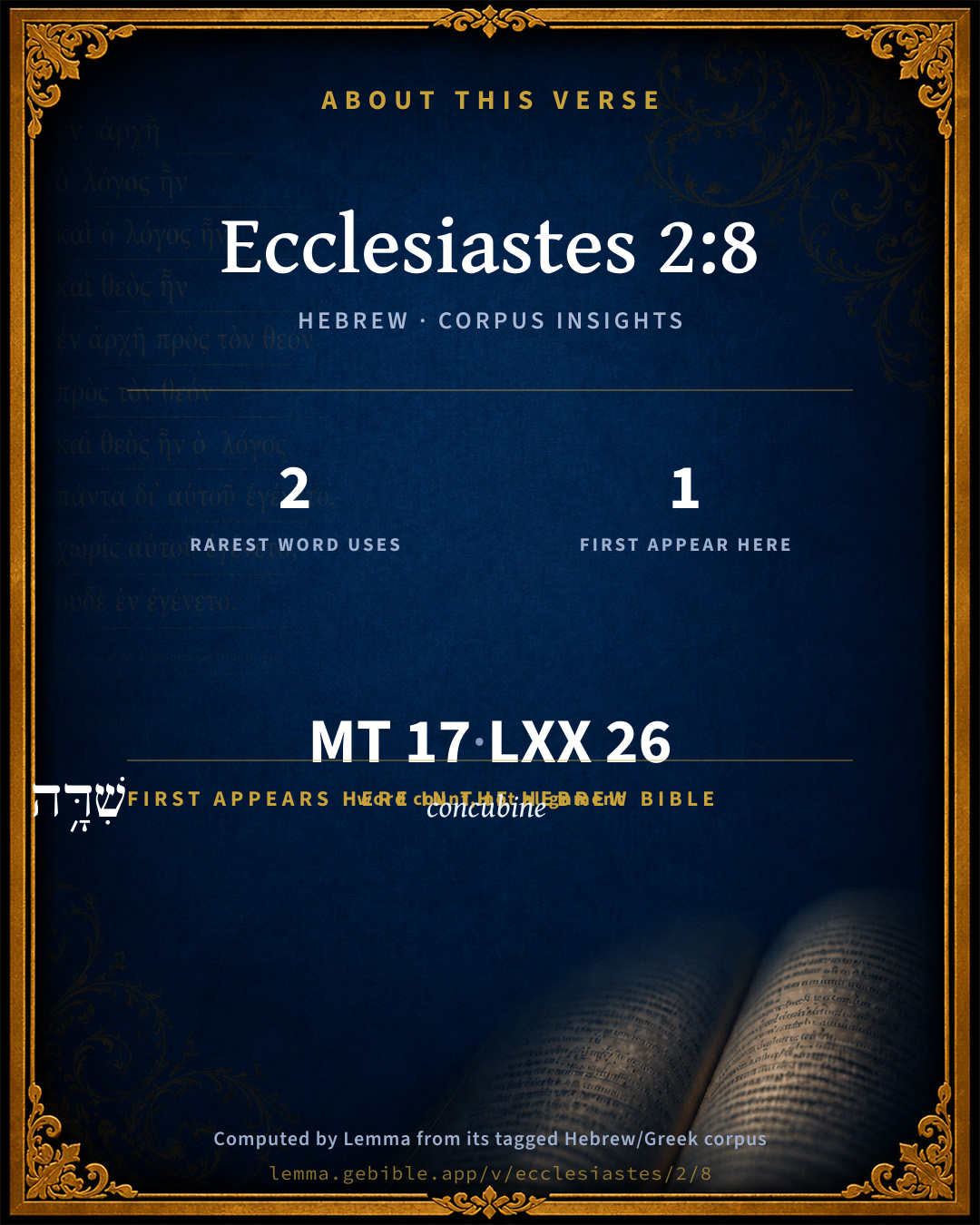
The rarest word here is שִׁדָּ֥ה concubine H7705 — appearing just 2 times in the whole Hebrew Bible.

First appearance in Scripture

This word makes its first canonical appearance in the Hebrew Bible here:

  • שִׁדָּ֥ה concubine H7705

Grammatical profile

  • 4 verbs
  • 10 nouns
  • 2 prepositions
  • 1 particle

Verb forms

  • כָּנַ֤סְתִּי Qal · Perfect
  • עָשִׂ֨יתִי Qal · Perfect
  • שָׁרִ֣ים Qal · Participle Active
  • וְשָׁר֗וֹת Qal · Participle Active

Repetition

Words recur within this verse — often emphatic in Hebrew:

  • שָׁרִ֣ים to sing H7891 ×2
  • שִׁדָּ֥ה concubine H7705 ×2

Hebrew & Septuagint length

In English translation the verse runs 37 words from the Hebrew and 38 from the Septuagint (LXX English) — closely comparable.

A rough comparison of the two English renderings, which tokenize alike — not a word-level alignment.

Word counts can differ between the Hebrew and the Greek without any difference in meaning — e.g. the Hebrew direct-object marker אֵת has no separate Greek word, and Greek often adds the article ὁ.

In the original languages it is 17 Hebrew tokens and 26 Greek tokens — but the two are counted differently (Hebrew bundles its prefixes and suffixes into one token; the Greek is in lemma form), so that isn’t a like-for-like length.

Cross-references

19

Topical passages linked to Ecclesiastes 2:8 in the Treasury of Scripture Knowledge — connected by theme and wording, ordered by reader-vote popularity; previews shown in the World English Bible.

  • 1 Kings 10:10 She gave the king one hundred twenty talents of gold, and of spices very great store, and precious stones: there came no more such abundance of spices as these which the queen of Sheba gave to king Solomon.
  • 2 Samuel 19:35 I am this day eighty years old: can I discern between good and bad? can your servant taste what I eat or what I drink? can I hear any more the voice of singing men and singing women? why then should your servant be yet a burden to my lord the king?
  • 1 Kings 9:28 They came to Ophir, and fetched from there gold, four hundred and twenty talents, and brought it to king Solomon.
  • 1 Kings 10:14 Now the weight of gold that came to Solomon in one year was six hundred sixty-six talents of gold,
  • 1 Kings 9:14 Hiram sent to the king one hundred twenty talents of gold.
  • 1 Kings 10:21 All king Solomon's drinking vessels were of gold, and all the vessels of the house of the forest of Lebanon were of pure gold: none were of silver; it was nothing accounted of in the days of Solomon.
  • 1 Kings 14:21–22 Rehoboam the son of Solomon reigned in Judah. Rehoboam was forty-one years old when he began to reign, and he reigned seventeen years in Jerusalem, the city which Yahweh had chosen out of all the tribes of Israel, to put his name there: and his mother's name was Naamah the Ammonitess.
  • 1 Kings 14:27 King Rehoboam made in their place shields of brass, and committed them to the hands of the captains of the guard, who kept the door of the king's house.
  • 1 Chronicles 25:1 Moreover, David and the captains of the host set apart for the service certain of the sons of Asaph, and of Heman, and of Jeduthun, who should prophesy with harps, with psalteries, and with cymbals: and the number of those who did the work according to their service was:
  • 1 Chronicles 25:6 All these were under the hands of their father for song in the house of Yahweh, with cymbals, psalteries, and harps, for the service of the house of God; Asaph, Jeduthun, and Heman being under the order of the king.
  • 2 Chronicles 9:11 The king made of the algum trees terraces for the house of Yahweh, and for the king's house, and harps and psalteries for the singers: and there were none such seen before in the land of Judah.
  • 2 Chronicles 9:15–21 King Solomon made two hundred bucklers of beaten gold; six hundred [shekels] of beaten gold went to one buckler.
  • Ezra 2:65 besides their men-servants and their maid-servants, of whom there were seven thousand three hundred thirty-seven: and they had two hundred singing men and singing women.
  • Job 21:11–12 They send forth their little ones like a flock. Their children dance.
  • Psalms 150:3–5 Praise him with the sounding of the trumpet! Praise him with harp and lyre!
  • Daniel 3:5 that whenever you hear the sound of the horn, flute, zither, lyre, harp, pipe, and all kinds of music, you fall down and worship the golden image that Nebuchadnezzar the king has set up;
  • Daniel 3:7 Therefore at that time, when all the peoples heard the sound of the horn, flute, zither, lyre, harp, pipe, and all kinds of music, all the peoples, the nations, and the languages, fell down and worshiped the golden image that Nebuchadnezzar the king had set up.
  • Daniel 3:15 Now if you are ready whenever you hear the sound of the horn, flute, zither, lyre, harp, pipe, and all kinds of music to you fall down and worship the image which I have made, [well]: but if you don't worship, you shall be cast the same hour into the midst of a burning fiery furnace; and who is that god that shall deliver you out of my hands?
  • Amos 6:5 Who strum on the strings of a harp; Who invent for themselves instruments of music, like David;

Cross-references courtesy of OpenBible.info (CC BY 4.0).

Hebrew and Greek witnesses Masoretic Hebrew ↔ Greek Septuagint

The same verse in the two great witnesses to the Old Testament, shown verse-for-verse.

These are two independent witnesses, not word-aligned to each other, and the Septuagint is shown in lemma (dictionary) form.

Hebrew Ecclesiastes 2:8 Masoretic · Westminster Leningrad Codex

כָּנַ֤סְתִּי לִי֙ גַּם כֶּ֣סֶף וְזָהָ֔ב וּסְגֻלַּ֥ת מְלָכִ֖ים וְהַמְּדִינ֑וֹת עָשִׂ֨יתִי לִ֜י שָׁרִ֣ים וְשָׁר֗וֹת וְתַעֲנוּגֹ֛ת בְּנֵ֥י הָאָדָ֖ם שִׁדָּ֥ה וְשִׁדּֽוֹת

I also gathered silver and gold for myself, and the treasure of kings and of the provinces. I got myself men-singers and women-singers, and the delights of the sons of men--musical instruments, and that of all sorts.

World English Bible · Public Domain

Greek LXX Ecclesiastes 2:8 Septuagint · lemma form

συνἄγω ἐγώ καί γέ ἀργύριον καί χρυσίον καί περιουσιασμός βασιλεύς καί ὁ χώρα ποιέω ἐγώ ᾄδω καί ᾄδω καί ἐντρύφημα υἱός ὁ ἄνθρωπος οἰνοχόος καί οἰνοχόος

Moreover I collected for myself both silver and gold also, and the peculiar treasures of kings and provinces: I procured me singing men and singing women, and delights of the sons of men, a butler and female cupbearers.

LXX2012 (modern English Septuagint) · Public Domain

On this verse, The Cambridge Bible for Schools and Colleges discusses the Septuagint’s reading. Read the note in Commentary ↓

Hebrew: Westminster Leningrad Codex (CC BY 4.0). Greek: Septuagint (public domain); English from LXX2012 (modern English Septuagint) (Public Domain). How the Septuagint differs from the Hebrew →

Commentary

Notes on Ecclesiastes 2:8 from classic Christian and Jewish commentators (each source and its license shown beneath its notes). The classic Christian expositions comment on the surrounding passage and are grouped to its opening verse, so a note may address several verses; the Jewish commentaries on the Tanakh (Rashi and others) are per-verse, so they appear only where the commentator wrote on this verse.

Lemma curates 59 commentaries, every one of them public domain or Creative Commons licensed, each selected and text-cleaned for this edition rather than reprinted as found. About our sources →

Trapp's Complete Commentary

John Trapp

Ecc 2:8 I gathered me also silver and gold, and the peculiar treasure of kings and of the provinces: I gat me men singers and women singers, and the delights of the sons of men, [as] musical instruments, and that of all sorts.

Ver. 8. I gathered me also silver and gold.] Gold of Ophir, now called Peru, where the Spaniards are said to meet with more gold ore than earth; besides his great gifts from other princes, as Hiram, [the] queen of Sheba, &c., his royal revenue, his tributes from foreign nations subdued by his father David, to a very great value. Sextus IV was wont to say, that a pope could never want money while he could hold a pen in his hand. His predecessor, John XXII, left in his treasury to his heirs two hundred and fifty tons of gold. {a} Boniface VIII being plundered by the French, was found to have more wealth, saith mine author, {b} than all the kings of the earth could have raised by one year’s revenue. It should seem, by the people’s complaint after Solomon’s death, {1Ki 12:4} that he lay over heavy upon them by his exactors and gold gatherers, which caused the revolt of the ten tribes. One act of injustice oft loseth much that was justly gotten. Chedorlaomer and his fellow kings were deprived of the whole victory, because they spared not a man whom they should have spared. Ill-gotten gold hath a poisonful operation, and will bring up the good food, together with ill humours. {Job 20:15}

And the delights of the sons of men.] These drew out his spirits and dissolved him, and brought him to so low an ebb in grace; his wealth did him far more hurt than his wisdom did him good. It is as hard to bear prosperity as to drink much wine and not be giddy. It is also dangerous to take pleasure in pleasure, to spend too much time in it; as Solomon, for seven years spent in building God’s house, spent thirteen in his own. Lovers of pleasures, φιληδονοι, are set as last and worst in that catalogue of wickedness in the last days. {2Ti 3:4}

{a} Petrarch.

{b} Heidfield.

John Trapp, A Commentary or Exposition upon All the Books of the Old and New Testament (1647–1656) — public domain. Text from a community e-Sword module.

Joseph Benson's Commentary

Ecc 2:8. I gathered me silver and gold — Vast riches; and the peculiar treasure of kings — Riches, answerable to the state of a king, or, he means, the greatest jewels and rarities of other kings, which they gave to me, either as a tribute, or by way of present; and of the provinces — Which were imposed upon or presented by all the provinces of my dominions.

Joseph Benson's Commentary on the Old and New Testaments (1811–1818) — public domain. Text from a community e-Sword module.

Tyndale Open Study Notes

Tyndale Open Resources

2:8 silver and gold . . . kings and provinces: Solomon ruled from the Fertile Crescent (north and east of Israel) to the border of Egypt in the south. His wealth in precious metals came from trade, gifts from admiring rulers of other nations, and taxes from lands he held within his empire (1 Kgs 4:21; 9:28; 10:14, 22-25; 1 Chr 29:4; 2 Chr 9:26-27). • many beautiful concubines: Solomon had 700 wives and 300 concubines by the end of his reign (1 Kgs 11:3).

Tyndale Open Study Notes — © Tyndale Open Resources, licensed CC BY-SA 4.0. Text via the HelloAO Bible API.

Geneva Bible (1599)

Geneva Bible translators

That is, whatsoever men take pleasure in.

Which were the most beautiful of them that were taken in war, as Judg. 5:30. Some understand by these words, no women, but instruments of music.

Geneva Bible (1599) marginal notes — public domain. Text via Bolls.life.

Jamieson, Fausset & Brown

Robert Jamieson, A. R. Fausset & David Brown

(Kg1 10:27; Ch2 1:15; Ch2 9:20).

peculiar treasure of kings and . . . provinces--contributed by them, as tributary to him (Kg1 4:21, Kg1 4:24); a poor substitute for the wisdom whose "gain is better than fine gold" (Pro 3:14-15).

singers--so David (Sa2 19:35).

musical instruments . . . of all sorts--introduced at banquets (Isa 5:12; Amo 6:5-6); rather, "a princess and princesses," from an Arabic root. One regular wife, or queen (Est 1:9); Pharaoh's daughter (Kg1 3:1); other secondary wives, "princesses," distinct from the "concubines" (Kg1 11:3; Psa 45:10; Sol 6:8) [WEISS, GESENIUS]. Had these been omitted, the enumeration would be incomplete.

Jamieson, Fausset & Brown — Commentary Critical and Explanatory on the Whole Bible (1871) — public domain (CC PDM 1.0). Text via the HelloAO Bible API.

Adam Clarke's Commentary

Verse 8. The peculiar treasure of kings and of the provinces]

1. The taxes levied off his subjects.

2. The tribute given by the neighboring potentates. Both these make the "peculiar treasure of kings;" taxes and tribute.

Men singers and women singers] This includes all instrumental and vocal performers. These may be called the delights of the sons of men.

Musical instruments, and that of all sorts.] For these seven words, there are only two in the original, שדה ושדות shiddah veshiddoth. These words are acknowledged on all hands to be utterly unknown, if not utterly inexplicable. Some render them male and female captives; others, cups and flagons; others, cooks and confectioners; others, a species of musical compositions derived from a celebrated Phoenician woman named Sido, to whom Sanchoniatha attributes the invention of music. Others, with more probability, wives and concubines; of the former of whom Solomon had seven hundred, and of the latter, three hundred; and if these be not spoken of here, they are not mentioned at all; whereas music, and every thing connected with that, was referred to before. The author of Choheleth paraphrases thus: -

"To complete

This scene of earthly bliss, how large a span

Of that which most delights the sons of men

Fell to my portion! What a lovely train

Of blooming beauties, by connubial ties,

By purchase, or the gifts of neighboring kings,

Or spoils of war, made mine."

If, after all this, I may add one conjecture, it shall be this; שדה sadeh, in Hebrew, is a field, and occurs in various parts of the Bible. שדות sadoth is fields, 1Sa 22:7, the points in such a case are of no consideration. May not Solomon be speaking here of farms upon farms, or estates upon estates, which he had added by purchase to the common regal portion? We know that a king of Israel (Ahab) once desired to have a vineyard (Naboth's) which he could not obtain: now, Solomon having spoken before of gardens, orchards, and vineyards, why may he not here speak of supernumerary estates? Perhaps every man who critically examines the place will be dissatisfied, and have a conjecture of his own.

Adam Clarke's Commentary on the Bible (1810–1826) — public domain. Text from a community e-Sword/MySword module.

Ellicott's Commentary for English Readers

(8) Peculiar treasure.—The word is used of the Jewish people (Exo_19:9; Psa_135:4; Mal_3:17; but generally 1Ch_29:3). That Solomon had tributary kings is stated (1Ki_4:21; 2Ch_9:24; Psa_72:10; Ezr_4:20). The word used for “provinces” here and in Ecc_5:8, occurs in reference to the provinces of the Persian Empire repeatedly in the Book of Esther; Ezr_2:1; Neh_7:6; Dan_8:2. (See also Lam_1:1; Eze_19:8.) The word is almost wholly absent from the earlier books, save that it occurs where the “princes of the provinces” are mentioned (1 Kings 20).

Singers.—Music was regarded as a necessary accompaniment of feasts (Isa_5:12; Amo_6:5; Sir_32:5; Sir_49:1). For David’s employment of professional singers, see 2Sa_19:35.

Delights.—Son_7:6; Pro_19:10; Mic_1:16; Mic_2:9.

Musical instruments.—The Hebrew word here used occurs nowhere else, and commentators are reduced to look to the etymology for the explanation of it. Their guesses are so numerous that it would be wearisome to recount them. That adopted in our version is by no means one of the most probable. The interpretation “concubines” is most in favour with commentators, though they differ among themselves as to the grounds on which they justify this translation. And it does appear unlikely that this notorious feature of Solomon’s court should be omitted in an enumeration of his luxury. It will be seen from the margin that the words “of all sorts” have nothing corresponding to them in the original, but are intended as an equivalent for a Hebrew idiom, in which a plural is intensified by prefixing a noun in the singular.

A Bible Commentary for English Readers, edited by Charles John Ellicott (1878–1897) — public domain. Text from a community e-Sword module.

The Cambridge Bible for Schools and Colleges

gen. ed. J. J. S. Perowne

8. I gathered me also silver and gold] Here also we find a counterpart in what is recorded of the wealth of Solomon, the ships of Hiram that brought gold from Ophir, to the amount of 420 talents (1Ki_9:28), the gifts from the queen of Sheba (1Ki_10:1), the total revenue of 666 talents (1Ki_10:15), the 200 targets and 300 shields of beaten gold, and the throne of gold and ivory and the drinking vessels of the house of the forest of Lebanon, and the silver that was in Jerusalem as stones (1Ki_10:16-27).

the peculiar treasure of kings and of the provinces] The words may point to the special gifts which came to Solomon by way of tribute from other lands, from Seba and Sheba (Psa_72:10), from the “kings of Arabia and the governors of the country” (1Ki_9:15; 1Ki_10:27). Many commentators, however, see in the phrase a description of the treasures of Solomon as being such as were the special possessions of sovereign rulers and sovereign states as distinct from the wealth of private citizens. The word for “province” may be noted as a comparatively late word, hardly coming into use till the time of the Captivity (Lam_1:1; Eze_19:8), and prominent chiefly in the books of the Persian period, Ezra, Nehemiah, Esther and Daniel. It probably designates here the twelve districts into which Solomon divided his empire (1Ki_4:7-19).

men singers and women singers] The mention of women shews that the singers meant are not those connected with the choir of the Temple, but those who, as in the speech of Barzillai (2Sa_19:35), figured at state banquets. These women, as in Isa_23:6, were commonly taken from the class of harlot aliens, and as such were condemned by the counsel of the wise of heart (Sir_9:4). For the general use of music at feasts, comp. Isa_5:11-12; Amo_6:5; Sir_32:5-6; Sir_49:1.

the delights of the sons of men] The use of the word in Song Son_7:6 leaves little doubt that the phrase is an euphemism for sensual pleasures, and as such it helps to determine the meaning of the words that follow.

musical instruments, and that of all sorts] The Hebrew substantive, which is not found elsewhere, is first given in the singular and then in the plural, as an emphatic way of expressing multitude, and has been very variously interpreted, as meaning, with the A.V., following Luther, a “musical instrument,” or with the Vulgate “cups,” or with the LXX. “cup-bearers,” or a “bath,” or “heaps” of treasure, or a “chariot,” or a “palanquin,” or even “male and female demons.” Most modern scholars however agree, though differing as to its etymology, some finding its root-meaning in “couch,” and some in the “female breast,” and others in “captives taken in war,” in rendering it as a “concubine.” This agrees, it is obvious, with the context and with what is recorded of Solomon’s seraglio with its thousand inmates (Song Son_6:8; 1Ki_11:3). It was not likely, we may add, that so characteristic a feature in that monarch’s prodigal excesses should have been altogether passed over in a picture so elaborate. “Musical instruments,” it may be added, would have formed a somewhat poor climax to the long catalogue of kingly luxuries. The interpolated “as” should be omitted.

The Cambridge Bible for Schools and Colleges (gen. ed. J. J. S. Perowne; Cambridge University Press, 1878–1918) — public domain. Text from a community e-Sword module.

John Gill's Exposition

I gathered me also silver and gold,.... In great quantities: the weight of gold which came to him in one year was six hundred threescore and six talents; see Kg1 9:14;

and the peculiar treasure of kings and of the provinces; whatsoever was valuable and precious, such as is laid up in the cabinets of kings, as jewels and precious stones; and everything rare and curious, to be found in all provinces of the earth, or which were brought from thence as presents to him; the Targum is,

"and the treasures of kings and provinces, given to me for tribute:''

wherefore, if any pleasure arises from these things, as do to the virtuosi, Solomon enjoyed it. Moreover, among the treasures of kings were precious garments of various sorts, as were in the treasury of Ahasuerus (l); and when Alexander took Shushan, he found in the king's treasures, of Hermionic purple, to the value of five thousand talents, which had been laid up there almost two hundred years (m); and to such treasure Christ alludes, Mat 6:19;

I got me men singers and women singers; the harmony and music of whose voices greatly delight; see Sa2 19:35; the Targum interprets it both of instruments of music for the Levites to use in the temple, and of singing men and women at a feast: and such persons were employed among other nations (n), on such occasions, to entertain their guests; and are called the ornaments of feasts (o); as were also "choraules", or pipers (p);

and the delights of the sons of men; as musical instruments, and that of all sorts; such as David his father invented; and to which he might add more, and indeed got all that were to be obtained; see Amo 6:5. The two last words, rendered "musical instruments, of all sorts", are differently interpreted; the Targum interprets them of hot waters and baths, having pipes to let out hot water and cold; Aben Ezra, of women taken captive; Jarchi, of chariots and covered wagons; the Septuagint, Syriac, and Arabic versions, of cup bearers, men, and women, that pour out wine and serve it; and the Vulgate Latin version, of cups and pots, to pour out wine. It seems best to understand it of musical instruments, or of musical compositions (q); sung either with a single voice, or in concert; which, according to Bochart (r), were called "sidoth", from Sido, a Phoenician woman of great note, the inventor of them or rather from giving unequal sounds, which, by their grateful mixture and temperament, broke and destroyed (s) one another.

(l) Targum Sheni in Esther vi. 10. (m) Plutarch. in Alexandro, p. 686. Vid. Homer. Iliad. 24. v. 224-234. (n) Vid. A. Geli. Noct. Attic. l. 19. c. 9. Homer. Odyss. 8. v. 62, 73, 74. & 9. v. 5-7. (o) Homer. Odyss. 21. v. 430. (p) Vid. Gutberleth. Conjectanea, &c. p. 162, &c. (q) Vid. Gusset. Comment. Heb. p. 832. (r) Hierozoic. par. 2. l. 6. c. 13. col. 847. (s) Buxtorf. in voce See Weemse's Christian Synagog. p. 144.

John Gill's Exposition of the Whole Bible (1746–1763) — public domain (CC PDM 1.0). Text via the HelloAO Bible API.

Albert Barnes' Notes on the Bible

Kings - Both tributary 1Ki 10:15 and independent 1Ki 5:1; 1Ki 9:14; 1Ki 10:2; the “provinces” probably correspond to the kingdoms mentioned in 1Ki 4:21.

As musical ... sorts - Rather, Many women (compare 1Ki 11:1-3).

Albert Barnes' Notes on the Bible (1834–1885) — public domain. Text from a community e-Sword/MySword module.

Haydock's Catholic Bible Commentary

Silver, which became, in consequence, of little value. --- Singing. At the court of Persia, people sung all night, and during the feasts. (Atheneus xii., and 14.) --- Cups and vessels; (Aquila and Symmachus) or, "men and women to," &c., (Septuagint) or, "a field and fields;" (Calmet) or, Protestants, "as musical instruments, and that of all sorts." Hebrew shidda beshiddoth. (Haydock)

George Leo Haydock (1774–1849), Haydock's Catholic Family Bible and Commentary, 1859 edition — public domain. Excludes Psalms (Douay-Rheims chapter numbering differs from Protestant) and Deuterocanonical books (Catholic canon only).

Matthew Poole's English Annotations

The peculiar treasure of kings; either,

1. Vast riches, answerable to the state of a king. Or,

2. The greatest jewels and rarities of other kings, which they gave to me either as a tribute, or by way of present; of which see 1Ki 4:21; 9:11; 10:2,10.

Of the provinces; which were imposed upon or presented by all the provinces of my dominions.

Women singers; whose voices were more sweet than the men’s.

And the delights of the sons of men; either,

1. All other delightful things. Or,

2. That in which men generally delight, to wit, musical instruments, as it follows.

Matthew Poole's English Annotations on the Holy Bible (1683–1685) — public domain. Text from a community e-Sword/MySword module.

Whedon's Commentary on the Bible

Daniel D. Whedon

8. Gathered… silver and gold — Solomon’s income, in gold, from trade, was over $3,300,000, besides all other revenue. He made silver like stones for abundance in Jerusalem. 1Ki_10:27, and elsewhere. Gold and silver are the peculiar treasure which kings derive from provinces, as distinct from land, cattle, etc., the usual wealth of subjects. The delights of the sons of men, is explained as consisting in all sorts of musical instruments, doubtless including the revelries with which their strains were accompanied. A few commentators translate “musical instruments” as woman and women, that is, as mistress and mistresses, making the words designate Solomon’s wives and concubines; others render the words cupbearers. Neither of these translations appears justifiable. See Lange.

Daniel D. Whedon (gen. ed.), Commentary on the Old and New Testaments (1874–1909) — public domain. Text from a community e-Sword module.

The Pulpit Commentary

I gathered me also silver and gold. Much is said of the wealth of the historical Solomon, who had all his vessels of gold, armed his bodyguard with golden shields, sat on an ivory throne overlaid with gold, received tribute and presents of gold from all quarters, sent his navies to distant lands to import precious metals, and made silver as common in Jerusalem as stones. (see 1Ki_9:28 1Ki_10:14-27; 2Ch_1:15 2Ch_9:20-27) The peculiar treasure of kings and of the provinces. The word rendered "the provinces" (hammedinoth), in spite of the article, seems to mean, not the twelve districts into which Solomon divided his kingdom for fiscal and economical purposes, (1Ki_4:7, etc.) but countries generally exterior to Palestine, with which he had commercial or political relations, and which sent to him the productions for which they were each most celebrated. So the districts of the Persian empire were required to furnish the monarch with a certain portion of their chief commodities. His friendship with Hiram of Tyro brought him into connection with the Phoeni-clans, the greatest commercial nation of antiquity, and through them he accumulated riches and stores from distant and various lands beyond the limits of the Mediterranean Sea. The word hn; ydim (medinah) occurs again in Ecc_5:7 and in 1Ki_20:14, etc.; but is found elsewhere only in exilian or post-exilian books (Lam_1:1; Est_1:1, etc.; Dan_2:48, etc.) The "kings" may be the tributary monarchs, such as those of Arabia; (1Ki_4:21, 24 10:15) or the expression in the text may imply simply such treasure as only kings, and not private persons, could possess. Men-singers and women-singers. These, of course, are not the choir of the temple, of which women formed no part, bur. musicians introduced at banquets and social festivals, to enhance the pleasures of the scene. They are mentioned in David"s days (2Sa_19:35) and later. (see Isa_5:12; Amo_6:5; Ecc 35:5; Ecc 49:1) The females who took part in these performances were generally of an abandoned class; hence the, warning of Ben-Sira, "Use not much the company of a woman that is a singer, lest thou be taken with her attempts" (Ecc_9:4). Such exhibitions were usually accompanied with dancing, the character of which in Eastern countries is well known. The Jews, as time went on, learned to tolerate many customs and practices, imported often from other lands, which tended to lower morality and self-respect. And the delights of the sons of men; the sensual pleasures that men enjoy. The expression is euphemistic. (Son_7:6) Musical instruments, and that of all sorts (shiddah veshiddoth). The word (given here first in the singular number and then in the plural emphatically to express multitude) occurs nowhere else, and has, therefore, been subjected to various interpretations. The Septuagint gives, oijnocoon kaiav, "a male cupbearer and female cupbearers;" and so the Syrian and. Vulgate, Scyphos et urceos in ministerio ad vina fundenda which introduces rather a bathos into the description. After the clause immediately preceding, one might expect mention of Solomon"s numerous harem, (1Ki_11:3; Son_6:8) and most modern commentators consider the word to mean "concubine," the whole expression denoting multiplicity, "wife and wives." The Authorized Version is not very probable, though somewhat supported by Kimchi, Luther, etc., and the Greek Venetian, which has, dudthma kaimata, a musical term signifying "combination of tones," or harmony. Other interpretations are "captives," "litters," "coaches," "baths," "treasures," "chests," "demons." Ewald, followed by Motais and others, suggests that the word implies a strong or high degree of a quality, so that, connecting the two clauses together, we should render, "And in a word, all the delights of the sons of men in abundance." This seems a more appropriate termination to the catalogue than any specification of further sources of pleasure; but there is no very strong etymological reason to recommend it; and we can hardly suppose that, in the enumeration of Solomon"s prodigalities, his multitudinous seraglio would be omitted. Rather it comes in here naturally as the climax and completion of his pursuit of earthly delight.

The Pulpit Commentary (1880–1919), ed. H.D.M. Spence-Jones & Joseph S. Exell — public domain. Text from a community e-Sword module.

John Wesley's Explanatory Notes

Peculiar treasure - The greatest jewels and rarities of other kings, which they gave to me, either as a tribute, or by way of present. Of provinces - Which were imposed upon or presented by all the provinces of my dominions.

John Wesley, Explanatory Notes Upon the Whole Bible (1754–1765) — public domain. Text via the GEBible commentary corpus.

Keil & Delitzsch

C. F. Keil & F. Delitzsch

"I heaped up for myself also silver and gold, and the peculiar property of kings and of countries; I gat me men singers and women singers, and the delights of the children of men: mistress and mistresses." The verb כּנשׁ כּנס, συνάγειν, is common to all Semitic dialects (also the to Assyr.), and especially peculiar to the more recent Heb., which forms from it the name of the religious community συναγωγή, כּנסת; it is used here of that which is brought together merely for the purpose of possession. Segūllah (from sagal, Targ., to make oneself possess), properly possession, and that something which specially and peculiarly belongs to one as his property; the word is here meant collect., as at Ch1 29:3 : that which only kings and individual countries possess. The interchange of melachim, which is without the article, with the determ. hammedinoth, is arbitrary: something special, such as that which a king possesses, the specialities which countries possess, - one country this, and another that. The hammedinoth are certainly not exclusively the regions embraced within the dominion of Solomon (Zckl.), as, according to Est 1:1, the Persian kingdom was divided into 127 medinoth. Solomon had a fleet which went to Ophir, was in a friendly relation with the royal house of Tyre, the metropolis of many colonies, and ruled over a widely-extended kingdom, bound by commerce with Central Asia and Africa. - His desires had thus ample opportunity to stretch beyond the limits of his own kingdom, and facilities enough for procuring the peculiar natural and artistic productions which other lands could boast of. Medinah is, first of all, a country, not as a territory, but as under one government (cf. Ecc 5:7); in the later philosophical language it is the Heb. word for the Greek πολιτεία; in the passage before us, medinoth is, however, not different from ארצות.

From the singing men and singing women who come into view here, not as appertaining to the temple service (vid., the Targ.), with which no singing women were connected, but as connected with the festivities of the court (Sa2 19:36; cf. Isa 5:12), advance is made to shiddah veshiddoth; and since these are designated by the preceding ותענגות (not ותענגּות) bene hāādam, especially as objects and means of earthly pleasure, and since, according to Heb 2:7, sexual love is the fairest and the most pleasant, in a word, the most attractive of all earthly delights (Solomon's luxus, also here contradicting the law of the king, Deu 17:17, came to a height, according to Kg1 11:3, after the example of Oriental rulers, in a harem of not fewer than one thousand women, princesses and concubines), of necessity, the expression shiddah veshiddoth must denote a multitude of women whom the king possessed for his own pleasure. Cup-bearers, male and female (Syr., lxx), cannot at all be understood, for although it may be said that the enumeration thus connects itself with the before-named בּיּין, yet this class of female attendants are not numbered among the highest human pleasures; besides, with such an explanation one must read שׁרה ושׁדות, and, in addition, שׁדא (to throw, to pour to, or pour out), to which this Heb. שׁדה may correspond, is nowhere used of the pouring out of wine. Rather might שׁדה, like שדא, hydria, be the name of a vessel from which one pours out anything, according to which Aq. translates by κυλίκιον καὶ κυλίκια, Symmachus, after Jerome, by mensurarum (read mensarum)

(Note: Thus, according to Vallarsi, a Cod. Vat. and Cod. Palat. of the first hand.)

species et appositioines, and Jerome, scyphos et urceos in ministerio ad vina fundenda; but this word for kelē mashkēh, Kg1 10:21 (= Ch2 9:20), is not found. Also the Targ., which translates by dimasaya uvē venavan, public baths (δημόσια), and balneae, vindicates this translation by referring the word to the verb שׁדא, "with pipes which pour out (דּשׁרין) tepid water, and pipes which pour out hot water." But this explanation is imaginary; שׁדּה occurs in the Mishna, Mikwaoth (of plunge-baths) Ecc 6:5, but there it denotes a chest which, when it swims in the water, makes the plunge-bath unsuitable. Such an untenable conceit also is the translation suggested by Kimchi, כלי זמר, according to which the Event. σύστεεμα καὶ συστήματα (in a musical sense: concentus), and Luther: "all kinds of musical instruments;" the word has not this meaning; Orelli, Sanchuniathon, p. 33, combines therewith Σιδών, according to the Phoenician myth, the inventress of the artistic song. The explanation by Kimchi is headed, "Splendour of every kind;" Ewald, Elster, and Zckler find therein a general expression, following taanugoth: great heap and heaps = in great abundance [die Hlle und Flle]. But the synon. of כבוד, "splendour," is not שׁד, but עז; and that שׁדד, like עצם, is referred to a great number, is without proof. Thus shiddah veshiddoth will denote something definite; besides, "a large number" finds its expression in the climactic union of words. In the Jerus. Talm. Taanith Ecc 4:5, shiddah must, according to the gloss, be the name of a chariot, although the subject there is not that of motion forward, or moving quickly; it is there announced that Schn, not far from Sepphoris, a place famed also for its pottery, formerly possessed 80 such shiddoth wholly of metal. The very same word is explained by Rashi, Baba kamma ix. 3, Shabbath 120a, Erubin 30b, Gittin 8b, 68a, Chagiga 25a, and elsewhere, of a carriage of wood, and especially of a chariot for women and distinguished persons. The combination of the synonyms, shiddah uthivah umigdal, does not in itself mean more than a chest; and Rashi himself explains, Kethuboth 65a, quolphi dashidah of the lock of a chest (argaz); and the author of Aruch knows no other meaning than that of a repository such as a chest. But in passages such as Gittin 8b, the shiddah is mentioned as a means of transport; it is to all appearance a chest going on wheels, moved forward by means of wheels, but on that very account not a state-chariot. Rashi's tradition cannot be verified.

Bttcher, in the Neue Aehrenlese, adduces for comparison the Syr. Shydlo, which, according to Castelli, signifies navis magna, corbita, arca; but from a merchant ship and a portable chest, it is a great way to a lady's palanquin.

He translates: palanquin and palinquins = one consignment to the harem after another. Gesen., according to Rdiger, Thes. 1365b, thinks that women are to be understood; for he compares the Arab. z'ynat, which signifies a women's carriage, and then the woman herself (cf. our Frauenzimmer, women's apartment, women, like Odaliske, from the Turk. oda, apartment). But this all stands or falls with that gloss of Rashi's: 'agalah lemerkavoth nashim usarim. Meanwhile, of all the explanations as yet advanced, this last of splendid coaches, palanquins is the best; for it may certainly be supposed that the words shiddah veshiddoth are meant of women. Aben Ezra explains on this supposition, shiddoth = shevuyoth, females captured in war; but unwarrantably, because as yet Solomon had not been engaged in war; others (vid., Pinsker's Zur Gesch. des Karaismus, p. 296), recently Bullock, connect it with shadim, in the sense of (Arab.) nahidah (a maiden with swelling breast); Knobel explains after shadad, to barricade, to shut up, occlusa, the female held in custody (cf. bethulah, the separated one, virgin, from bathal, cogn. badal); Hitzig, "cushions," "bolsters," from shanad, which, like (Arab.) firash, λέχος, is then transferred to the juncta toro. Nothing of all that is satisfactory. The Babyl. Gemara, Gittin 68a, glosses ותען וגו by "reservoirs and baths," and then further says that in the west (Palestine) they say שׁדּתא, chests (according to Rashi: chariots); but that here in this country (i.e., in Babylon) they translate shiddah veshiddoth by shēdah veshēdathin, which is then explained, "demons and demonesses," which Solomon had made subservient to him.

(Note: A demon, and generally a superhuman being, is called, as in Heb. שׁד, so in the Babyl.-Assyr. sîdu, vid., Norris' Assyrian Dictionary, II p. 668; cf. Schrader, in the Jena. Lit. Zeit. 1874, p. 218f., according to which sîdu, with alap, is the usual name of Adar formed like an ox.)

This haggadic-mytholog. interpretation is, linguistically at least, on the right track. A demon is not so named from fluttering or moving to and fro (Levy, Schnhak), for there is no evidence in the Semitic langauge of the existence of a verb שוד, to flee; also not from a verb sadad, which must correspond to the Heb. השׁתחוה, in the sense of to adore (Oppert's Inscription du palais de Khorsabad, 1863, p. 96); for this meaning is more than doubtful, and, besides, שׁד is an active, and not a passive idea-much rather שׁד, Assyr. sîd, Arab. sayyid, signifies the mighty, from שׁוּד, to force, Psa 91:6.

(Note: Vid., Friedrich Delitzsch's Assyr. Theirnamen, p. 37.)

In the Arab. (cf. the Spanish Cid) it is uniformly the name of a lord, as subduing, ruling, mastering (sabid), and the fem. sayyidat, of a lady, whence the vulgar Arab. sitti = my lady, and sîdi = my lord. Since שׁדד means the same as שׁוד, and in Heb. is more commonly used than it, so also the fem. form שׁדּה is possible, so much the more as it may have originated from שׁדה, 5 שׁיד = שׁד, by a sharpening contraction, like סגּים, from סיגים (Olsh. 83c), perhaps intentionally to make שׁדה, a demoness, and the name of a lady (donna = domina) unlike. Accordingly we translate, with Gesen. and Meyer in their Handwrt.: "lady and ladies;" for we take shiddoth as a name of the ladies of the harem, like shēglath (Assyr. saklâti) and lehhenath in the book of Daniel, on which Ahron b. Joseph the Karaite remarks: shedah hinqaroth shagal.

The connection expressing an innumerable quantity, and at the same time the greatest diversity, is different from the genitival dor dorim, generation of generations, i.e., lasting through all generations, Psa 72:5, from the permutative heightening the idea: rahham rahhamathaim, one damsel, two damsels, Jdg 5:30, and from that formed by placing together the two gram. genders, comprehending every species of the generic conception: mash'ēn umash'enah, Isa 3:3 (vid., comm. l.c., and Ewald, 172b). Also the words cited by Ewald (Syr.), rogo urogo, "all possible pleasures" (Cureton's Spicil. p. 10), do not altogether accord with this passage for they heighten, like meod meod, by the repetition of the same expression. But similar is the Arab. scheme, mal wamwal, "possession and possessions," i.e., exceeding great riches, where the collective idea, in itself according by its indetermination free scope to the imagination, is multiplied by the plur. being further added.

After Koheleth has enumerated all that he had provided for the purpose of gratifying his lusts, but without losing himself therein, he draws the conclusion, which on this occasion also shows a perceptible deficit.

Keil & Delitzsch — Biblical Commentary on the Old Testament (1861–1891) — public domain (CC PDM 1.0). Text via the HelloAO Bible API. (Old Testament only.)

Rashi

Rabbi Shlomo Yitzchaki (Rashi)

and the treasures of the kings the treasures of the kings—gold, silver and precious stones, which the kings collect in their treasure houses.

and the provinces the treasure of all merchants.

various types of musical instruments Heb. שָּׁרִים וְשָּׁרוֹת, various types of musical instruments.

wagons and coaches Heb. שִּׁדָה וְשִּׁדוֹת beautiful coaches, covered wagons, and in the Gemara, [we find] a coach (שִּׁדָה), a chest, and a closet.

Rashi on the Tanakh — English translations: “The Judaica Press complete Tanach with Rashi, translated by A. J. Rosenberg” (CC BY 4.0); “Pentateuch with Rashi's commentary by M. Rosenbaum and A.M. Silbermann, 1929-1934” (public domain); “The Metsudah Tanach series, Lakewood, N.J” (CC BY 4.0); and “The Book of Joshua, Metsudah Publications, 1997” (CC BY 4.0). Text via Sefaria.

Lesson kit

Teaching starters — assembled from the data on this page, not authored interpretation. Every prompt links to the verse data it draws on. Edit before teaching.

Ecclesiastes, in the Wisdom, opens this verse with 17 words (13 distinct Hebrew lemmas). Its most distinctive word is shiddâh (“concubine”). A historical commentator’s framing appears above. Read the whole chapter for the surrounding context.

Discussion questions

  1. How does “concubine” (shiddâh) shape what this verse is saying?
  2. The word “concubine” first appears here in Scripture. What is being introduced at this debut?
  3. 1 Kings 10:10 shares this passage’s theme. How do the two illuminate each other?
  4. “to sing” occurs 2× in this one verse. What is the effect of the repetition?
  5. These translations render this verse differently. What is at stake in choosing one wording over another?
  6. The verb «כָּנַ֤סְתִּי» is Qal Perfect. How does its form color the action?
  7. Reading how Trapp's Complete Commentary and Joseph Benson's Commentary read this verse, where do the two commentators agree and where do they part?

Things to notice

Reading settings

Reading text

Shown beneath each verse's original-language words.

Old Testament
Old Testament edition

Read the OT as the Masoretic Hebrew (MT) or the Greek Septuagint (LXX).

English shown for the Greek Septuagint (in the Hebrew ↔ Greek comparison).

Comparing translations? Open the Compare panel on any verse page to stack up to four side by side.