1 Chronicles 29:4

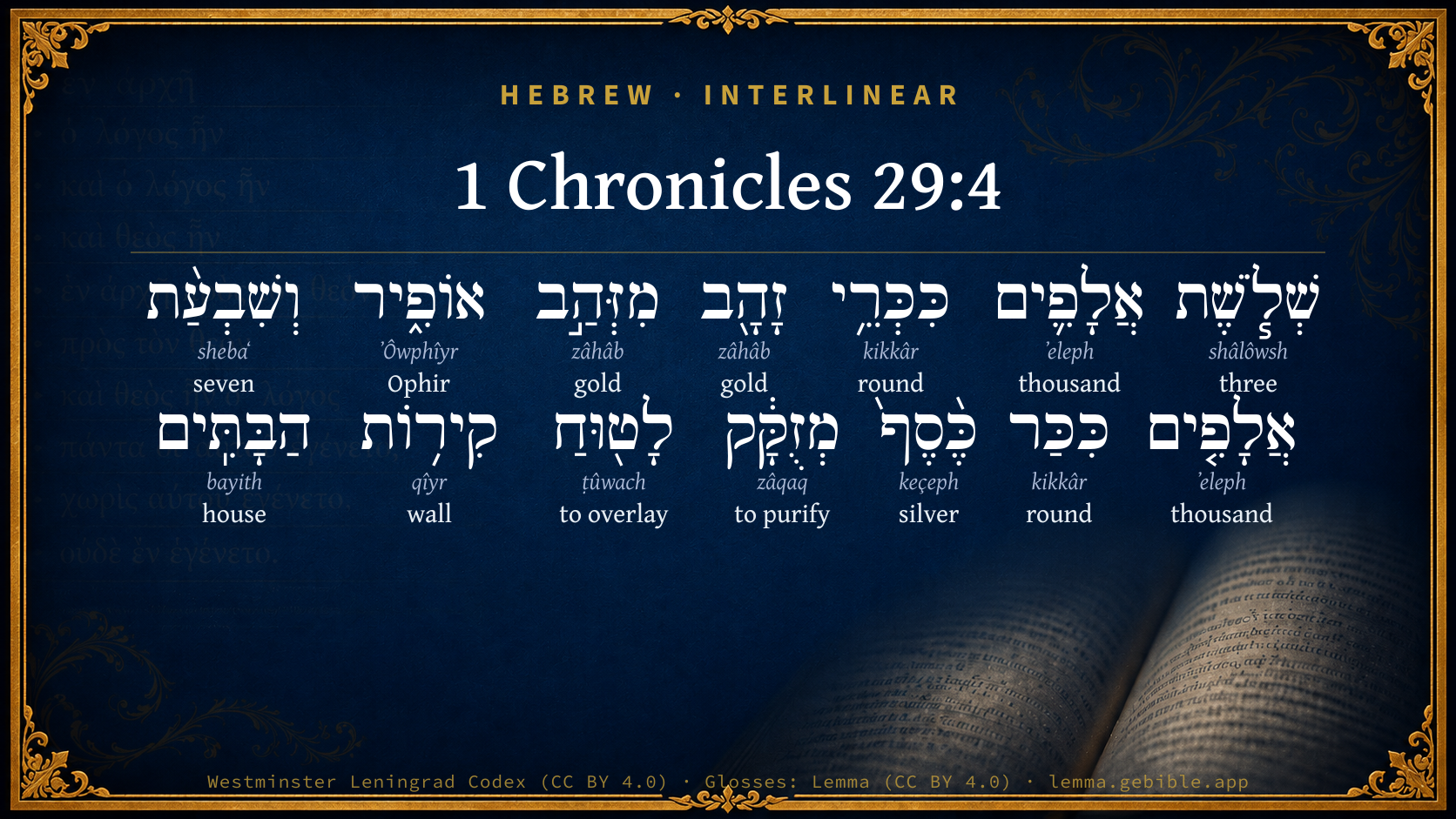
Hebrew (Westminster Leningrad Codex) 1 Chronicles 29:4 appears in the Hebrew Old Testament. The text above is from the Westminster Leningrad Codex. Each word links to its Strong’s number, a concise gloss, and parsing drawn from the Open Scriptures Hebrew Bible morphology. Click any word for its full Brown-Driver-Briggs (BDB) entry.
Download image
Cite this verse

1 Chronicles 29:4 (World English Bible). Public Domain. Lemma interlinear Bible study tool, https://lemma.gebible.app/v/1-chronicles/29/4.

Show BibTeX & RIS
BibTeX
RIS
English Translation
even three thousand talents of gold, of the gold of Ophir, and seven thousand talents of refined silver, with which to overlay the walls of the houses;
World English Bible · Public Domain
Download a study sheet

One document with this verse’s original text, its word-by-word gloss line, the meaning frame, cross-references with their text, attributed commentary, and full source and license credits — printable, and it pastes into notes with its structure intact.

This verse Autodidact and up

Study sheet (.html) Plain text (.txt)

A passage Seminary Student

Up to 50 verses in one chapter. A passage sheet keeps up to 6 commentary sources and 12 cross-references per verse, in the order this page ranks them, and says so on the sheet whenever that leaves anything out. Ask for a single verse and you get the Autodidact verse sheet above.

Everything on this page stays free to read, with no account — the sheet is a download of what is already on screen, not access to it.

Want to remove ads? Support Godless Engineer
Compare translations 3

The same verse in 3 English versions, stacked beneath the original-language interlinear above. Click any original word for its lexicon entry.

Each is an independent rendering of the whole verse — the interlinear is not word-aligned to these translations.

Highlighted words mark where these versions differ — a whole-verse word diff, not a word-by-word alignment.

  • World English Bible Public Domain
    even three thousand talents of gold, of the gold of Ophir, and seven thousand talents of refined silver, with which to overlay the walls of the houses;
  • King James Version Public Domain
    Even three thousand talents of gold, of the gold of Ophir, and seven thousand talents of refined silver, to overlay the walls of the houses withal:
  • unfoldingWord Literal Text CC BY-SA 4.0
    3,000 kikkars of gold from the gold of Ophir and 7,000 kikkars of refined silver to overlay the walls of the houses,

unfoldingWord Literal Text — © unfoldingWord, licensed CC BY-SA 4.0. Word-aligned USFM3 via Door43 (git.door43.org/unfoldingWord/en_ult).

Versions to compare (up to 4)

3 of 4 selected

Show all 18 translations

Every available English version of this verse, each an independent rendering of the whole verse.

  • World English Bible Public Domain
    even three thousand talents of gold, of the gold of Ophir, and seven thousand talents of refined silver, with which to overlay the walls of the houses;
  • Berean Standard Bible Public Domain
    three thousand talents of gold (the gold of Ophir) and seven thousand talents of refined silver, to overlay the walls of the buildings,
  • Majority Standard Bible Public Domain
    three thousand talents of gold (the gold of Ophir) and seven thousand talents of refined silver, to overlay the walls of the buildings,
  • King James Version Public Domain
    Even three thousand talents of gold, of the gold of Ophir, and seven thousand talents of refined silver, to overlay the walls of the houses withal:
  • American Standard Version (1901) Public Domain
    even three thousand talents of gold, of the gold of Ophir, and seven thousand talents of refined silver, wherewith to overlay the walls of the houses;
  • Revised Version (1885) Public Domain
    even three thousand talents of gold, of the gold of Ophir, and seven thousand talents of refined silver, to overlay the walls of the houses withal:
  • Geneva Bible (1599) Public Domain
    Euen three thousand talents of gold of the golde of Ophir, and seuen thousand talents of fined siluer to ouerlay the walles of the houses.
  • Douay-Rheims (1899) Public Domain
    Three thousand talents of gold of the gold of Ophir: and seven thousand talents of refined silver, to overlay the walls of the temple.
  • Young's Literal Translation Public Domain
    three thousand talents of gold, of the gold of Ophir, and seven thousand talents of refined silver, to overlay the walls of the houses,
  • Literal Standard Version CC BY-SA 4.0
    three thousand talents of gold, of the gold of Ophir, and seven thousand talents of refined silver, to overlay the walls of the houses,
  • Unlocked Literal Bible CC BY-SA 4.0
    three thousand talents of gold from Ophir, and seven thousand talents of refined silver, in order to overlay the walls of the buildings.
  • unfoldingWord Literal Text CC BY-SA 4.0
    3,000 kikkars of gold from the gold of Ophir and 7,000 kikkars of refined silver to overlay the walls of the houses,
  • Darby Bible Public Domain
    three thousand talents of gold, of the gold of Ophir, and seven thousand talents of refined silver, to overlay the walls of the houses;
  • World Messianic Bible Public Domain
    even three thousand talents of gold, of the gold of Ophir, and seven thousand talents of refined silver, with which to overlay the walls of the houses;
  • Webster's Bible Public Domain
    Even three thousand talents of gold, of the gold of Ophir, and seven thousand talents of refined silver, to overlay the walls of the houses:
  • Free Bible Version CC BY-SA 4.0
    3,000 talents of gold—the gold of Ophir—and 7,000 talents of refined silver will go to cover the walls of the buildings,
  • Bible in Basic English Public Domain
    Even three thousand talents of gold of Ophir and seven thousand talents of the best silver, for plating the walls of the house:
  • JPS Tanakh (1917) Public Domain
    even three thousand talents of gold, of the gold of Ophir, and seven thousand talents of refined silver, wherewith to overlay the walls of the houses;

Literal Standard Version (2020), Covenant Press — licensed CC BY-SA 4.0. Text via the HelloAO Bible API (eBible.org). Unlocked Literal Bible (unfoldingWord) — licensed CC BY-SA 4.0. Text via the HelloAO Bible API (eBible.org). unfoldingWord Literal Text — © unfoldingWord, licensed CC BY-SA 4.0. Word-aligned USFM3 via Door43 (git.door43.org/unfoldingWord/en_ult). Free Bible Version, Dr. Jonathan Gallagher — licensed CC BY-SA 4.0. Text via the HelloAO Bible API (eBible.org).

Word by word

More ways to search: Search by grammar → Find every occurrence → Compare this word →

Practice this passage: Drill this verse → Learn its vocabulary →

מְזֻקָּ֔ק
zâqaq
H2212
“purified”
Verb, Pual, Participle Passive, Masculine, Singular, Absolute
Part of Speech
Verb
Stem
Pual
Form
Participle Passive
Gender
Masculine
Number
Singular
State
Absolute
Full BDB Definition

Origin: a primitive root

TWOT: 576

to purify, distil, strain, refine - (Qal) - to purify, distil, strain - to refine - (Piel) to purge, refine - (Pual) to refine, purify
  1. שְׁלֹ֧שֶׁת shâlôwsh H7969 “three” Adjective, Cardinal number, Masculine, Singular, Construct
  2. אֲלָפִ֛ים ʼeleph H505 “thousand” Adjective, Cardinal number, Both, Plural, Absolute
  3. כִּכְּרֵ֥י kikkâr H3603 “talents of” Noun, Common, Both, Plural, Construct
  4. זָהָ֖ב zâhâb H2091 “gold” Noun, Common, Masculine, Singular, Absolute
  5. מִזְּהַ֣ב zâhâb H2091 “from · gold of” Preposition + Noun, Common, Masculine, Singular, Construct
  6. אוֹפִ֑יר ʼÔwphîyr H211 “Ophir” Noun, Proper
  7. וְשִׁבְעַ֨ת shebaʻ H7651 “and · seven” Conjunction + Adjective, Cardinal number, Masculine, Singular, Construct
  8. אֲלָפִ֤ים ʼeleph H505 “thousand” Adjective, Cardinal number, Both, Plural, Absolute
  9. כִּכַּר kikkâr H3603 “round of” Noun, Common, Both, Singular, Construct
  10. כֶּ֨סֶף֙ keçeph H3701 “silver” Noun, Common, Masculine, Singular, Absolute
  11. לָט֖וּחַ ṭûwach H2902 “to overlay” Preposition + Verb, Qal, Infinitive Construct
  12. קִיר֥וֹת qîyr H7023 “walls of” Noun, Common, Masculine, Plural, Construct
  13. הַבָּתִּֽים bayith H1004 “the · houses” Particle, Definite Article + Noun, Common, Masculine, Plural, Absolute

About this verse

These counts appear in no published source. They are computed here, from the morphology-tagged text and Lemma’s own curated glosses. What Lemma adds →

14
words
11
distinct lemmas
Historical
section

Notable vocabulary

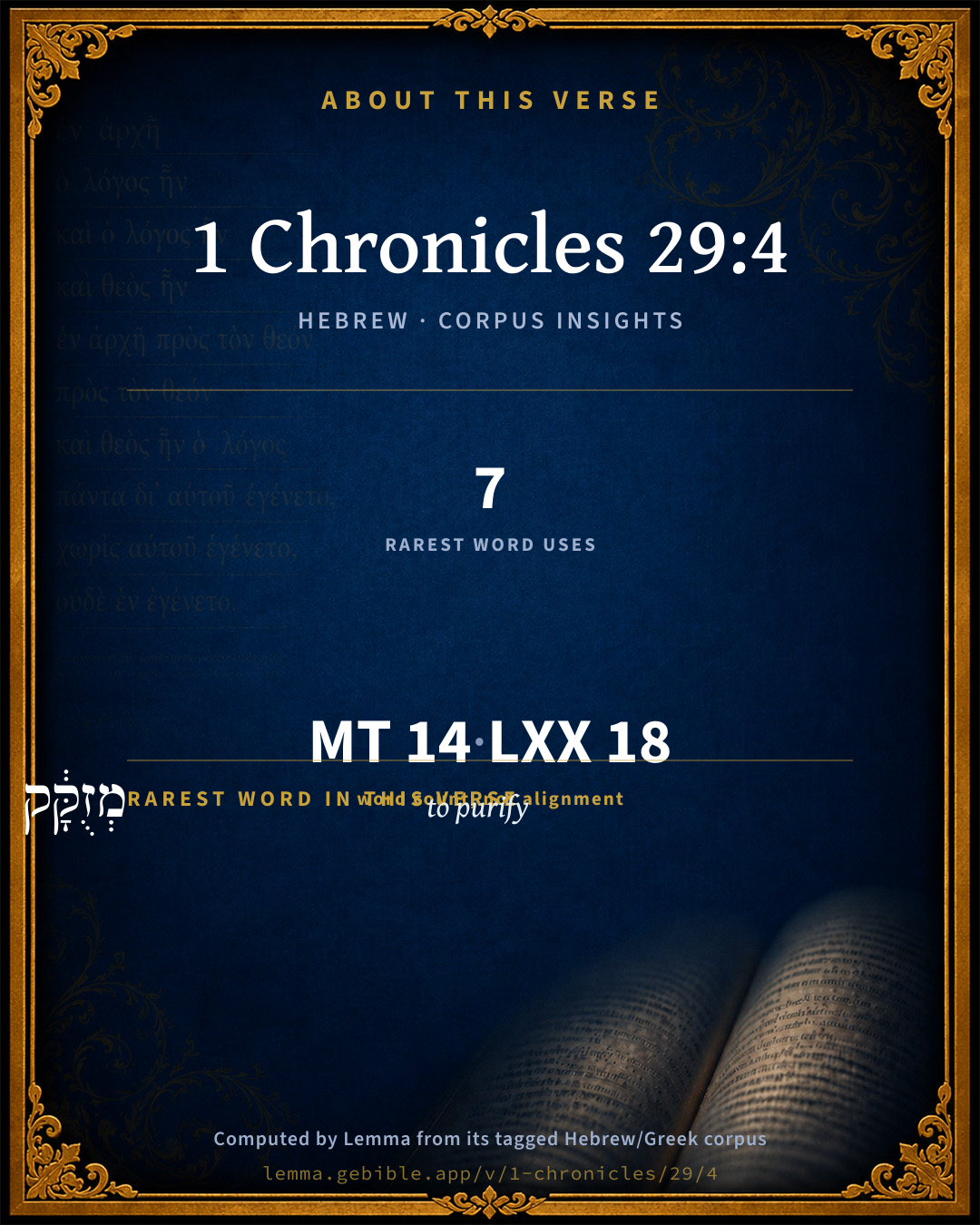
The rarest word here is מְזֻקָּ֔ק to purify H2212 — appearing just 7 times in the whole Hebrew Bible.

Shared distinctive vocabulary

מְזֻקָּ֔ק to purify H2212 occurs in 7 verses of the Hebrew Bible. Also found in:

Grammatical profile

  • 2 verbs
  • 8 nouns
  • 4 adjectives

Verb forms

  • מְזֻקָּ֔ק Pual · Participle Passive
  • לָט֖וּחַ Qal · Infinitive Construct

Repetition

Words recur within this verse — often emphatic in Hebrew:

  • אֲלָפִ֛ים thousand H505 ×2
  • כִּכְּרֵ֥י round H3603 ×2
  • זָהָ֖ב gold H2091 ×2

Hebrew & Septuagint length

In English translation the verse runs 27 words from the Hebrew and 23 from the Septuagint (LXX English) — closely comparable.

A rough comparison of the two English renderings, which tokenize alike — not a word-level alignment.

Word counts can differ between the Hebrew and the Greek without any difference in meaning — e.g. the Hebrew direct-object marker אֵת has no separate Greek word, and Greek often adds the article ὁ.

In the original languages it is 14 Hebrew tokens and 18 Greek tokens — but the two are counted differently (Hebrew bundles its prefixes and suffixes into one token; the Greek is in lemma form), so that isn’t a like-for-like length.

Cross-references

3

Topical passages linked to 1 Chronicles 29:4 in the Treasury of Scripture Knowledge — connected by theme and wording, ordered by reader-vote popularity; previews shown in the World English Bible.

  • 1 Kings 9:28 They came to Ophir, and fetched from there gold, four hundred and twenty talents, and brought it to king Solomon.
  • 1 Chronicles 22:14 Now, behold, in my affliction I have prepared for the house of Yahweh one hundred thousand talents of gold, and one thousand thousand talents of silver, and of brass and iron without weight; for it is in abundance: timber also and stone have I prepared; and you may add to them.
  • Job 28:16 It can't be valued with the gold of Ophir, With the precious onyx, or the sapphire.

Cross-references courtesy of OpenBible.info (CC BY 4.0).

Hebrew and Greek witnesses Masoretic Hebrew ↔ Greek Septuagint

The same verse in the two great witnesses to the Old Testament, shown verse-for-verse.

These are two independent witnesses, not word-aligned to each other, and the Septuagint is shown in lemma (dictionary) form.

Hebrew 1 Chronicles 29:4 Masoretic · Westminster Leningrad Codex

שְׁלֹ֧שֶׁת אֲלָפִ֛ים כִּכְּרֵ֥י זָהָ֖ב מִזְּהַ֣ב אוֹפִ֑יר וְשִׁבְעַ֨ת אֲלָפִ֤ים כִּכַּר כֶּ֨סֶף֙ מְזֻקָּ֔ק לָט֖וּחַ קִיר֥וֹת הַבָּתִּֽים

even three thousand talents of gold, of the gold of Ophir, and seven thousand talents of refined silver, with which to overlay the walls of the houses;

World English Bible · Public Domain

Greek LXX 1 Chronicles 29:4 Septuagint · lemma form

τρισχίλιοι τάλαντον χρυσίον ὁ ἐκ σουφιρ καί ἑπτακισχίλιοι τάλαντον ἀργύριον δόκιμος ἐκἀλείφω ἐν αὐτός ὁ τοῖχος ὁ ἱερός

Three thousand talents of gold of Suphir, and seven thousand talents of fine silver, for the overlaying of the walls of the sanctuary:

LXX2012 (modern English Septuagint) · Public Domain

On this verse, The Cambridge Bible for Schools and Colleges discusses the Septuagint’s reading. Read the note in Commentary ↓

Hebrew: Westminster Leningrad Codex (CC BY 4.0). Greek: Septuagint (public domain); English from LXX2012 (modern English Septuagint) (Public Domain). How the Septuagint differs from the Hebrew →

Commentary

Notes on 1 Chronicles 29:4 from classic Christian and Jewish commentators (each source and its license shown beneath its notes). The classic Christian expositions comment on the surrounding passage and are grouped to its opening verse, so a note may address several verses; the Jewish commentaries on the Tanakh (Rashi and others) are per-verse, so they appear only where the commentator wrote on this verse.

Lemma curates 59 commentaries, every one of them public domain or Creative Commons licensed, each selected and text-cleaned for this edition rather than reprinted as found. About our sources →

Trapp's Complete Commentary

John Trapp

1Ch 29:4 [Even] three thousand talents of gold, of the gold of Ophir, and seven thousand talents of refined silver, to overlay the walls of the houses [withal]:

Ver. 4. To overlay the walls.] Ad in crastandos parietes. The walls of the temple were overlaid with gold, and the walls of the other buildings adjoining to the temple, with silver.

John Trapp, A Commentary or Exposition upon All the Books of the Old and New Testament (1647–1656) — public domain. Text from a community e-Sword module.

Geneva Bible (1599)

Geneva Bible translators

He showeth what he had of his own store for the Lord’s house.

Geneva Bible (1599) marginal notes — public domain. Text via Bolls.life.

Ellicott's Commentary for English Readers

(4) Three thousand talents of gold.—Comp. 1Ch_22:14. The sum would be about £18,000,000 sterling.

Gold of Ophir.—Indian gold, from Abhîra, at the mouth of the Indus.

Seven thousand talents of refined silver.—About £2,800,000 sterling.

To overlay.—Strictly, to besmear (Isa_44:18).

The houses.—The chambers (1Ch_28:11; see 2Ch_3:4-9). The Syriac and Arabic have “a thousand thousand talents of gold,” and “twice a thousand thousand talents of silver.”

A Bible Commentary for English Readers, edited by Charles John Ellicott (1878–1897) — public domain. Text from a community e-Sword module.

The Cambridge Bible for Schools and Colleges

gen. ed. J. J. S. Perowne

4. gold of Ophir] Solomon brought much gold from Ophir. (2Ch_8:18; 2Ch_9:10 = 1Ki_9:28; 1Ki_10:11), which is probably to be identified with some part of the south-east coast of Arabia. LXX. gives Σουφεὶρ, i.e. perhaps India. For the amount see note on 1Ch_22:14.

to overlay] Cp. 2Ch_3:4-8.

the houses] i.e. the porch, the greater house, and the most holy house; 2Ch_3:4-5; 2Ch_3:8.

The Cambridge Bible for Schools and Colleges (gen. ed. J. J. S. Perowne; Cambridge University Press, 1878–1918) — public domain. Text from a community e-Sword module.

John Gill's Exposition

Even three thousand talents of gold,.... Which, according to Scheuchzer (c), amount to 36,660,000 ducats of gold; and, according to Brerewood (d), to 13,500,000 pounds of our money:

of the gold of Ophir; which was reckoned the best gold; not Ophir in India, which was not known till Solomon's time, but in Arabia, as Bochart (e) has shown; so Eupolemus (f), an Heathen writer, says, that David having built ships at Achan, a city of Arabia, sent miners to Urphe (supposed to be the same with Ophir) in the island of the Red sea, abounding with gold, and from thence fetched it; see Gill on 1Ki 9:28, and that he was able to give so great a sum out of his own substance, Dr. Prideaux (g) thinks, can only be accounted for by his great returns from this traffic; since these 3000 talents, according to him, amounted to 21,600,000 pounds sterling:

and seven thousand talents of refined silver; amounting, according to Scheuchzer (h), to 31,500,000 imperials, or rix dollars; and, according to Brerewood (i), to 2,625,000 pounds of our money:

to overlay the walls of the houses withal; the gold was to overlay the walls of the holy and most holy place, the silver to overlay the walls of the chambers built around the temple.

(c) Physica Sacra, vol. 4. p. 631. (d) De Ponder. & Pret. Vet. Num. c. 5. (e) Phaleg. l. 2. c. 27. col. 140. (f) Apud Euseb. Evangel. Praepar. l. 9. c. 30. p. 447. (g) Connection, par. 1. p. 5, 6. (h) Ut supra. (Physica Sacra, vol. 4. p. 631.) (i) Ut supra. (De Ponder. & Pret. Vet. Num. c. 5.)

John Gill's Exposition of the Whole Bible (1746–1763) — public domain (CC PDM 1.0). Text via the HelloAO Bible API.

Albert Barnes' Notes on the Bible

The numbers here have also suffered to some extent from the carelessness of copyists (compare the 1Ch 22:14 note). The amount of silver is not indeed improbable, since its value would not exceed three millions of our money; but as the gold would probably exceed in value thirty millions, we may suspect an error in the words “three thousand.”

Albert Barnes' Notes on the Bible (1834–1885) — public domain. Text from a community e-Sword/MySword module.

Matthew Poole's English Annotations

The gold of Ophir was accounted the best and purest gold; of which see Job 22:24; 28:16; Isa 13:12; by which it appears that those hundred thousand talents mentioned before, 1Ch 22:14, were a coarser and impurer sort of gold.

To overlay the walls of the houses withal; the walls of the temple with gold, and of the rooms adjoining to it with silver beaten out into plates, and put upon the other materials here and there as it was thought fit.

Matthew Poole's English Annotations on the Holy Bible (1683–1685) — public domain. Text from a community e-Sword/MySword module.

Whedon's Commentary on the Bible

Daniel D. Whedon

4. Ophir — See the note on 1Ki_9:28. Here it appears that “the gold of Ophir” was brought (probably by Arabian merchants) to Israel in the days of David.

Daniel D. Whedon (gen. ed.), Commentary on the Old and New Testaments (1874–1909) — public domain. Text from a community e-Sword module.

The Pulpit Commentary

Respecting the uncertainty of the amounts here denoted, even if the numbers of the present text be accepted as correct, see note on 1Ch_22:14. Bertheau and Keil make three thousand talents of gold the equivalent of thirteen millions and a half of our money, and seven thousand talents of silver the equivalent of two and a half millions of our money or, if the royal shekel instead of the sacred be supposed to be the standard, they make them the half of those two amounts respectively. Others calculate the value of the gold to reach thirty millions, and of the silver three millions of our money (see Conder"s "Bible Handbook," 2nd edit., pp. 63-65, 81). The situation of Ophir is still considered undetermined. The other occasions on which it is mentioned are as follows:

Gen_10:29; (1Ch_1:23) 1Ki_9:28 1Ki_10:11; 2Ch_8:18 2Ch_9:10; Job_22:24 Job_28:16; Psa_45:10; Isa_13:12. It must be understood also that it is to it that allusion ismade inv 1Ki_10:22, where we read that silver, ivory, apes, and peacocks, beside the gold, were imported into Judaea from it. The "almug" tree is also said to have been brought in the same ships which brought the gold of Ophir. The Septuagint always translates by some form of the word Soufi (except in, Gen_10:29) which word comes very near the Coptic name for India. There is also a place in India, mentioned by Ptolemy, Ammianus, and Abulfeda, the site of the present emporium of Goa, called Soupara, and which would explain Both the Hebrew and the Septuagint words. An Indian site for Ophir would also well suit the mention of the ivory and the particular wood which the ships brought. On the other hand, the first occasion of this name Ophir finds it placed among the tribes of Joktan"s descendants, who occupied South Arabia. It is there (Gen_10:29; 1Ch_1:23) placed between Sheba and Havilah, beth abounding in gold. There are other considerations that favour Arabia. Many other places have been suggested, and some of them supported by respectable authorities, such as Eastern Africa, South America and Peru, Phrygia, etc. If there be a real question about it, to the prejudice of Arabia, it would be to India we must look. That some of the commodities brought belonged more especially to India, though even in that case the majority belonged undoubtedly to Arabia, is very true. This circumstance throws great probability into the suggestion that whether Ophir were in Arabia or India, it was a great emporium, and not simply an exporter of its own particular produce (see Gesenius, "Lexicon," sub voce; Smith"s "Bible Dictionary"). The last sentence of this verse certainly says that the destined use of the refined silver, as well as of the gold of Ophir, was to overlay the walls of the houses. We know that gold was used for this purpose. (2Ch_3:5-10) But we do not read of the silver being used for overlaying purposes. We also read that none of the drinking-vessels of Solomon were of silver, as "it was nothing accounted of in the days of Solomon" (1Ki_10:21; 2Ch_9:20) It is possible, the order of the-sentences notwithstanding, that the mention of the refined silver is only to pro-pare the way for the contents of ver. 5, and that it mast not be applied to the last sentence of our present verse.

The Pulpit Commentary (1880–1919), ed. H.D.M. Spence-Jones & Joseph S. Exell — public domain. Text from a community e-Sword module.

John Wesley's Explanatory Notes

Of Ophir - The best and purest gold. The walls - The walls of the temple with God, and of the rooms adjoining to it, with silver beaten out into plates.

John Wesley, Explanatory Notes Upon the Whole Bible (1754–1765) — public domain. Text via the GEBible commentary corpus.

Keil & Delitzsch

C. F. Keil & F. Delitzsch

Even three thousand talents of gold,.... Which, according to Scheuchzer (c), amount to 36,660,000 ducats of gold; and, according to Brerewood (d), to 13,500,000 pounds of our money:

of the gold of Ophir; which was reckoned the best gold; not Ophir in India, which was not known till Solomon's time, but in Arabia, as Bochart (e) has shown; so Eupolemus (f), an Heathen writer, says, that David having built ships at Achan, a city of Arabia, sent miners to Urphe (supposed to be the same with Ophir) in the island of the Red sea, abounding with gold, and from thence fetched it; see Gill on 1Ki 9:28, and that he was able to give so great a sum out of his own substance, Dr. Prideaux (g) thinks, can only be accounted for by his great returns from this traffic; since these 3000 talents, according to him, amounted to 21,600,000 pounds sterling:

and seven thousand talents of refined silver; amounting, according to Scheuchzer (h), to 31,500,000 imperials, or rix dollars; and, according to Brerewood (i), to 2,625,000 pounds of our money:

to overlay the walls of the houses withal; the gold was to overlay the walls of the holy and most holy place, the silver to overlay the walls of the chambers built around the temple.

(c) Physica Sacra, vol. 4. p. 631. (d) De Ponder. & Pret. Vet. Num. c. 5. (e) Phaleg. l. 2. c. 27. col. 140. (f) Apud Euseb. Evangel. Praepar. l. 9. c. 30. p. 447. (g) Connection, par. 1. p. 5, 6. (h) Ut supra. (Physica Sacra, vol. 4. p. 631.) (i) Ut supra. (De Ponder. & Pret. Vet. Num. c. 5.)

Keil & Delitzsch — Biblical Commentary on the Old Testament (1861–1891) — public domain (CC PDM 1.0). Text via the HelloAO Bible API. (Old Testament only.)

Rashi

Rabbi Shlomo Yitzchaki (Rashi)

refined very white.

to overlay the walls of the houses and no one can overlay anything, either with silver or with gold, unless it is refined.

Rashi on the Tanakh — English translations: “The Judaica Press complete Tanach with Rashi, translated by A. J. Rosenberg” (CC BY 4.0); “Pentateuch with Rashi's commentary by M. Rosenbaum and A.M. Silbermann, 1929-1934” (public domain); “The Metsudah Tanach series, Lakewood, N.J” (CC BY 4.0); and “The Book of Joshua, Metsudah Publications, 1997” (CC BY 4.0). Text via Sefaria.

Lesson kit

Teaching starters — assembled from the data on this page, not authored interpretation. Every prompt links to the verse data it draws on. Edit before teaching.

1 Chronicles, in the Historical, opens this verse with 14 words (11 distinct Hebrew lemmas). Its most distinctive word is zâqaq (“to purify”). A historical commentator’s framing appears above. Read the whole chapter for the surrounding context.

Discussion questions

  1. The word zâqaq carries the sense “to purify.” How does it shape the verse?
  2. 1 Chronicles 28:18 shares the word «to purify» with this verse. How do the two illuminate each other?
  3. “thousand” occurs 2× in this one verse. What is the effect of the repetition?
  4. The translations on this page render this verse differently — a whole-verse word diff, not a word-by-word alignment. What might account for the different wordings?
  5. The verb «מְזֻקָּ֔ק» is Pual Participle Passive. How does its form color the action?
  6. Reading how Trapp's Complete Commentary and Geneva Bible (1599) read this verse, where do the two commentators agree and where do they part?

Things to notice

Reading settings

Reading text

Shown beneath each verse's original-language words.

Old Testament
Old Testament edition

Read the OT as the Masoretic Hebrew (MT) or the Greek Septuagint (LXX).

English shown for the Greek Septuagint (in the Hebrew ↔ Greek comparison).

Comparing translations? Open the Compare panel on any verse page to stack up to four side by side.