
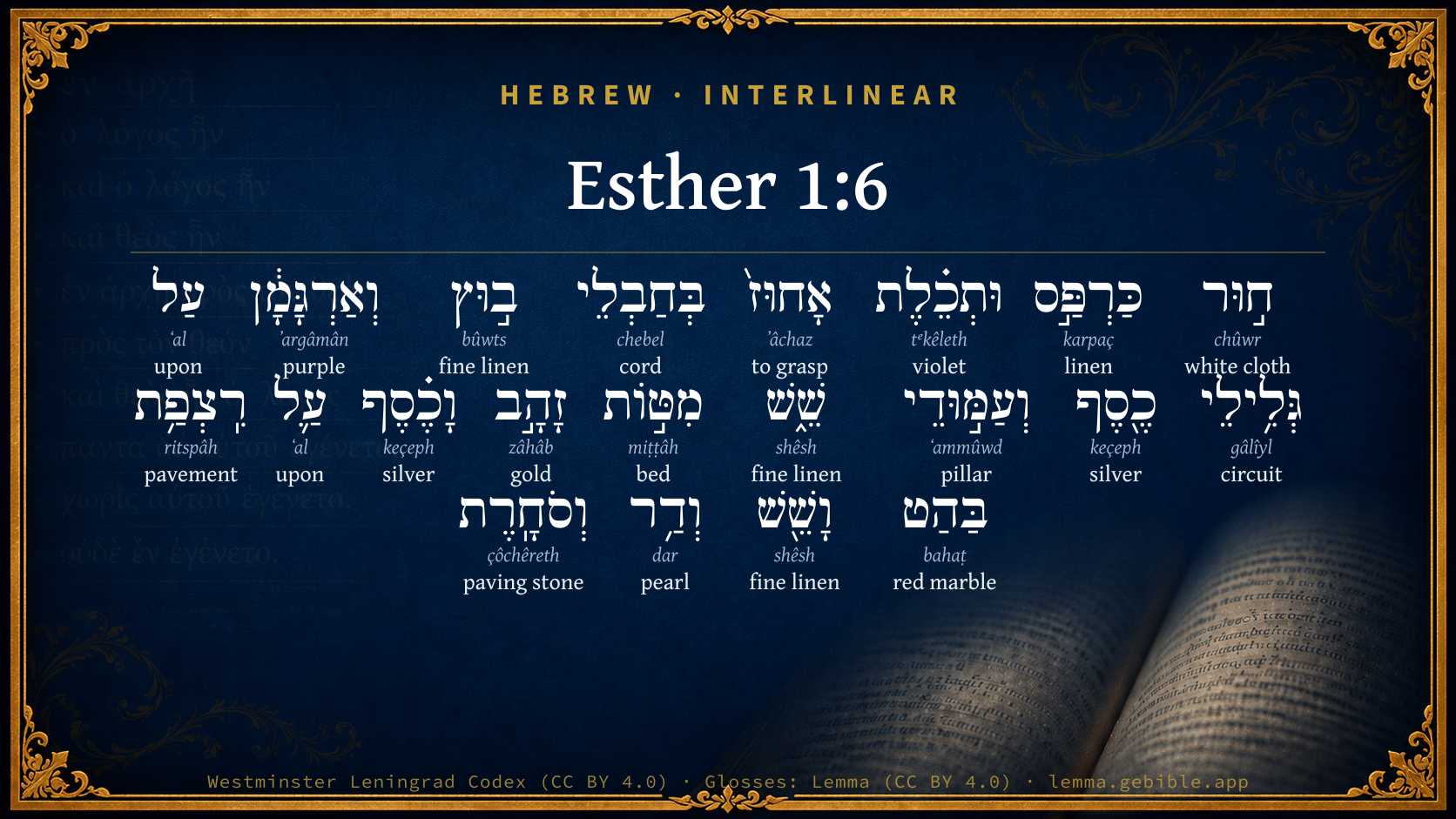
Esther 1:6

Hebrew (Westminster Leningrad Codex) Esther 1:6 appears in the Hebrew Old Testament. The text above is from the Westminster Leningrad Codex. Each word links to its Strong’s number, a concise gloss, and parsing drawn from the Open Scriptures Hebrew Bible morphology. Click any word for its full Brown-Driver-Briggs (BDB) entry.
Download image
Cite this verse

Esther 1:6 (World English Bible). Public Domain. Lemma interlinear Bible study tool, https://lemma.gebible.app/v/esther/1/6.

Show BibTeX & RIS
BibTeX
RIS
English Translation
[There were hangings of] white [cloth], [of] green, and [of] blue, fastened with cords of fine linen and purple to silver rings and pillars of marble: the couches were of gold and silver, on a pavement of red, and white, and yellow, and black marble.
World English Bible · Public Domain
Highlights
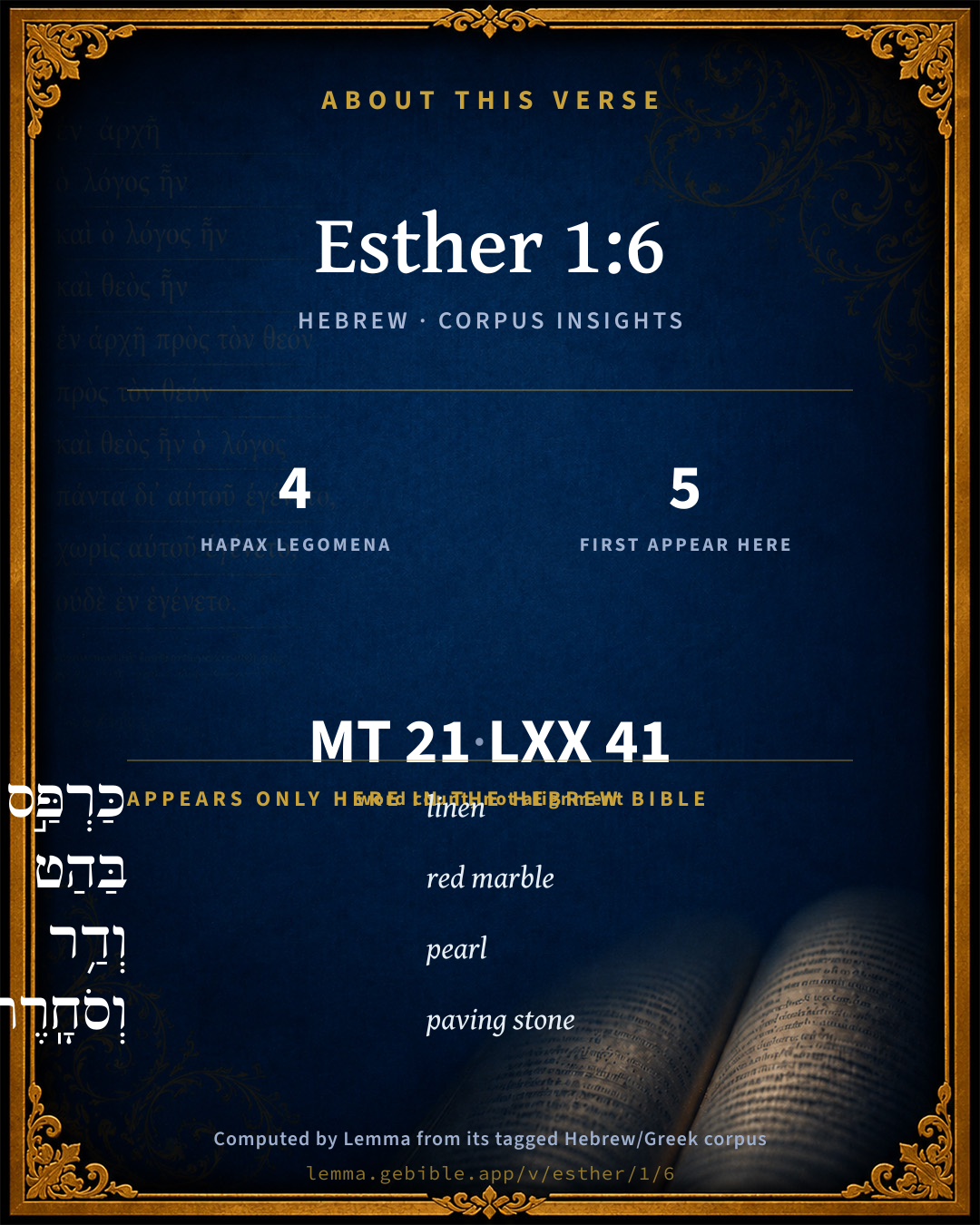
  • 4 hapax legomena — only here in the Hebrew Bible
  • 5 first appearances in the Hebrew Bible
Full analysis ↓
Download a study sheet

One document with this verse’s original text, its word-by-word gloss line, the meaning frame, cross-references with their text, attributed commentary, and full source and license credits — printable, and it pastes into notes with its structure intact.

This verse Autodidact and up

Study sheet (.html) Plain text (.txt)

A passage Seminary Student

Up to 50 verses in one chapter. A passage sheet keeps up to 6 commentary sources and 12 cross-references per verse, in the order this page ranks them, and says so on the sheet whenever that leaves anything out. Ask for a single verse and you get the Autodidact verse sheet above.

Everything on this page stays free to read, with no account — the sheet is a download of what is already on screen, not access to it.

Want to remove ads? Support Godless Engineer
Compare translations 3

The same verse in 3 English versions, stacked beneath the original-language interlinear above. Click any original word for its lexicon entry.

Each is an independent rendering of the whole verse — the interlinear is not word-aligned to these translations.

Highlighted words mark where these versions differ — a whole-verse word diff, not a word-by-word alignment.

  • World English Bible Public Domain
    [There were hangings of] white [cloth], [of] green, and [of] blue, fastened with cords of fine linen and purple to silver rings and pillars of marble: the couches were of gold and silver, on a pavement of red, and white, and yellow, and black marble.
  • King James Version Public Domain
    Where were white, green, and blue, hangings, fastened with cords of fine linen and purple to silver rings and pillars of marble: the beds were of gold and silver, upon a pavement of red, and blue, and white, and black, marble.
  • unfoldingWord Literal Text CC BY-SA 4.0
    Linens cotton and blue were hanging by cords of byssus and purple on rings of silver and pillars of marble. Couches of gold and silver were on the pavement of porphyry and alabaster and pearl and precious stone.

unfoldingWord Literal Text — © unfoldingWord, licensed CC BY-SA 4.0. Word-aligned USFM3 via Door43 (git.door43.org/unfoldingWord/en_ult).

Versions to compare (up to 4)

3 of 4 selected

Show all 18 translations

Every available English version of this verse, each an independent rendering of the whole verse.

  • World English Bible Public Domain
    [There were hangings of] white [cloth], [of] green, and [of] blue, fastened with cords of fine linen and purple to silver rings and pillars of marble: the couches were of gold and silver, on a pavement of red, and white, and yellow, and black marble.
  • Berean Standard Bible Public Domain
    Hangings of white and blue linen were fastened with cords of fine white and purple material to silver rings on the marble pillars. Gold and silver couches were arranged on a mosaic pavement of porphyry, marble, mother-of-pearl, and other costly stones.
  • Majority Standard Bible Public Domain
    Hangings of white and blue linen were fastened with cords of fine white and purple material to silver rings on the marble pillars. Gold and silver couches were arranged on a mosaic pavement of porphyry, marble, mother-of-pearl, and other costly stones.
  • King James Version Public Domain
    Where were white, green, and blue, hangings, fastened with cords of fine linen and purple to silver rings and pillars of marble: the beds were of gold and silver, upon a pavement of red, and blue, and white, and black, marble.
  • American Standard Version (1901) Public Domain
    `There were hangings of' white `cloth', `of' green, and `of' blue, fastened with cords of fine linen and purple to silver rings and pillars of marble: the couches were of gold and silver, upon a pavement of red, and white, and yellow, and black marble.
  • Revised Version (1885) Public Domain
    There were hangings of white cloth, of green, and of blue, fastened with cords of fine linen and purple to silver rings and pillars of marble: the couches were of gold and silver, upon a pavement of red, and white, and yellow, and black marble.
  • Geneva Bible (1599) Public Domain
    Vnder an hanging of white, greene, and blue clothes, fastened with cordes of fine linen and purple, in siluer rings, and pillars of marble: the beds were of golde, and of siluer vpon a pauement of porphyre, and marble and alabaster, and blue colour.
  • Douay-Rheims (1899) Public Domain
    And there were hung up on every side sky coloured, and green, and violet hangings, fastened with cords of silk, and of purple, which were put into rings of ivory, and were held up with marble pillars. The beds also were of gold and silver, placed in order upon a floor paved with porphyry and white marble: which was embellished with painting of wonderful variety.
  • Young's Literal Translation Public Domain
    white linen, white cotton, and blue, fastened with cords of fine linen and purple on rings of silver, and pillars of marble, couches of gold, and of silver, on a pavement of smaragdus, and white marble, and mother-of-pearl, and black marble --
  • Literal Standard Version CC BY-SA 4.0
    white linen, white cotton, and blue, fastened with cords of fine linen and purple on rings of silver, and pillars of marble, couches of gold, and of silver, on a pavement of smaragdus, and white marble, and mother-of-pearl, and black marble—
  • Unlocked Literal Bible CC BY-SA 4.0
    The courtyard of the garden was decorated with curtains of white cotton and violet, with cords of fine linen and purple, hung on silver rings from pillars of marble. There were couches of gold and silver on a mosaic pavement of porphyry, marble, mother-of-pearl, and colored paving stones.
  • unfoldingWord Literal Text CC BY-SA 4.0
    Linens cotton and blue were hanging by cords of byssus and purple on rings of silver and pillars of marble. Couches of gold and silver were on the pavement of porphyry and alabaster and pearl and precious stone.
  • Darby Bible Public Domain
    White, green, and blue [hangings] were fastened with cords of byssus and purple to silver rings and pillars of white marble; couches of gold and silver [lay] upon a pavement of red and white marble, and alabaster, and black marble.
  • World Messianic Bible Public Domain
    There were hangings of white and blue material, fastened with cords of fine linen and purple to silver rings and marble pillars. The couches were of gold and silver, on a pavement of red, white, yellow, and black marble.
  • Webster's Bible Public Domain
    Where were white, green, and blue hangings, fastened with cords of fine linen and purple to silver rings and pillars of marble: the beds were of gold and silver, upon a pavement of red, and blue, and white, and black marble.
  • Free Bible Version CC BY-SA 4.0
    It was decorated with white and blue cotton curtains tied with cords of fine linen and purple thread on silver rings, held up by marble pillars. Gold and silver couches were placed on a pavement made of purple porphyry, marble, mother-of-pearl, and expensive stones.
  • Bible in Basic English Public Domain
    There were fair hangings of white and green and blue, fixed with cords of purple and the best linen to silver rings and pillars of polished stone: the seats were of gold and silver on a floor of red and white and yellow and black stone.
  • JPS Tanakh (1917) Public Domain
    there were hangings of white, fine cotton, and blue, bordered with cords of fine linen and purple, upon silver rods and pillars of marble; the couches were of gold and silver, upon a pavement of green, and white, and shell, and onyx marble.

Literal Standard Version (2020), Covenant Press — licensed CC BY-SA 4.0. Text via the HelloAO Bible API (eBible.org). Unlocked Literal Bible (unfoldingWord) — licensed CC BY-SA 4.0. Text via the HelloAO Bible API (eBible.org). unfoldingWord Literal Text — © unfoldingWord, licensed CC BY-SA 4.0. Word-aligned USFM3 via Door43 (git.door43.org/unfoldingWord/en_ult). Free Bible Version, Dr. Jonathan Gallagher — licensed CC BY-SA 4.0. Text via the HelloAO Bible API (eBible.org).

Word by word

More ways to search: Search by grammar → Find every occurrence → Compare this word →

Practice this passage: Drill this verse → Learn its vocabulary →

כַּרְפַּ֣ס
karpaç
H3768
“linen”
Noun, Common, Masculine, Singular, Absolute
Part of Speech
Noun
Type
Common
Gender
Masculine
Number
Singular
State
Absolute
Full BDB Definition

Origin: of foreign origin

TWOT: 1045

cotton or fine linen
  1. ח֣וּר chûwr H2353 “white cloth” Noun, Common, Masculine, Singular, Absolute
  2. וּתְכֵ֗לֶת tᵉkêleth H8504 “and · violet” Conjunction + Noun, Common, Feminine, Singular, Absolute
  3. אָחוּז֙ ʼâchaz H270 “grasped” Verb, Qal, Participle Passive, Masculine, Singular, Absolute
  4. בְּחַבְלֵי chebel H2256 “in/at · cords of” Preposition + Noun, Common, Both, Plural, Construct
  5. ב֣וּץ bûwts H948 “fine linen” Noun, Common, Masculine, Singular, Absolute
  6. וְאַרְגָּמָ֔ן ʼargâmân H713 “and · purple” Conjunction + Noun, Common, Masculine, Singular, Absolute
  7. עַל ʻal H5921 “upon” Preposition
  8. גְּלִ֥ילֵי gâlîyl H1550 “rods of” Noun, Common, Masculine, Plural, Construct
  9. כֶ֖סֶף keçeph H3701 “silver” Noun, Common, Masculine, Singular, Absolute
  10. וְעַמּ֣וּדֵי ʻammûwd H5982 “and · pillars of” Conjunction + Noun, Common, Masculine, Plural, Construct
  11. שֵׁ֑שׁ shêsh H8336 “fine linen” Adjective, Cardinal number, Feminine, Singular, Absolute
  12. מִטּ֣וֹת miṭṭâh H4296 “beds of” Noun, Common, Feminine, Plural, Construct
  13. זָהָ֣ב zâhâb H2091 “gold” Noun, Common, Masculine, Singular, Absolute
  14. וָכֶ֗סֶף keçeph H3701 “and · silver” Conjunction + Noun, Common, Masculine, Singular, Absolute
  15. עַ֛ל ʻal H5921 “upon” Preposition
  16. רִֽצְפַ֥ת ritspâh H7531 “pavement of” Noun, Common, Feminine, Singular, Construct
  17. בַּהַט bahaṭ H923 “red marble” Noun, Common, Masculine, Singular, Absolute
  18. וָשֵׁ֖שׁ shêsh H8336 “and · fine linen” Conjunction + Adjective, Cardinal number, Feminine, Singular, Absolute
  19. וְדַ֥ר dar H1858 “and · pearl” Conjunction + Noun, Common, Masculine, Singular, Absolute
  20. וְסֹחָֽרֶת çôchêreth H5508 “and · paving stone” Conjunction + Noun, Common, Feminine, Singular, Absolute

About this verse

These counts appear in no published source. They are computed here, from the morphology-tagged text and Lemma’s own curated glosses. What Lemma adds →

21
words
18
distinct lemmas
Historical
section

Notable vocabulary

4 hapax legomena — words that appear only here in the entire Hebrew Bible:

  • כַּרְפַּ֣ס linen H3768
  • בַּהַט red marble H923
  • וְדַ֥ר pearl H1858
  • וְסֹחָֽרֶת paving stone H5508

First appearance in Scripture

These words make their first canonical appearance in the Hebrew Bible here:

  • ח֣וּר white cloth H2353
  • כַּרְפַּ֣ס linen H3768
  • בַּהַט red marble H923
  • וְדַ֥ר pearl H1858
  • וְסֹחָֽרֶת paving stone H5508

Shared distinctive vocabulary

ח֣וּר white cloth H2353 occurs in 2 verses of the Hebrew Bible. Also found in:

Grammatical profile

  • 1 verb
  • 16 nouns
  • 2 adjectives
  • 2 prepositions

Verb forms

  • אָחוּז֙ Qal · Participle Passive

Repetition

Words recur within this verse — often emphatic in Hebrew:

  • עַל upon H5921 ×2
  • כֶ֖סֶף silver H3701 ×2
  • שֵׁ֑שׁ fine linen H8336 ×2

Hebrew & Septuagint length

In English translation the verse runs 45 words from the Hebrew and 59 from the Septuagint (LXX English) — closely comparable.

A rough comparison of the two English renderings, which tokenize alike — not a word-level alignment.

Word counts can differ between the Hebrew and the Greek without any difference in meaning — e.g. the Hebrew direct-object marker אֵת has no separate Greek word, and Greek often adds the article ὁ.

In the original languages it is 21 Hebrew tokens and 41 Greek tokens — but the two are counted differently (Hebrew bundles its prefixes and suffixes into one token; the Greek is in lemma form), so that isn’t a like-for-like length.

Cross-references

8

Topical passages linked to Esther 1:6 in the Treasury of Scripture Knowledge — connected by theme and wording, ordered by reader-vote popularity; previews shown in the World English Bible.

  • Amos 6:4 Who lie on beds of ivory, And stretch themselves on their couches, And eat the lambs out of the flock, And the calves out of the midst of the stall;
  • Ezekiel 23:41 and sit on a stately bed, with a table prepared before it, whereupon you did set my incense and my oil.
  • Esther 7:8 Then the king returned out of the palace garden into the place of the banquet of wine; and Haman was fallen on the couch whereon Esther was. Then said the king, Will he even force the queen before me in the house? As the word went out of the king's mouth, they covered Haman's face.
  • Amos 2:8 And they lay themselves down beside every altar on clothes taken in pledge; And in the house of their God they drink the wine of those who have been fined.
  • Exodus 26:1 "Moreover you shall make the tent with ten curtains; of fine twined linen, and blue, and purple, and scarlet, with cherubim. The work of the skillful workman you shall make them.
  • Exodus 26:31–32 "You shall make a veil of blue, and purple, and scarlet, and fine twined linen, with cherubim. The work of the skillful workman shall it be made.
  • Exodus 26:36–37 "You shall make a screen for the door of the Tent, of blue, and purple, and scarlet, and fine twined linen, the work of the embroiderer.
  • Esther 8:15 Mordecai went forth from the presence of the king in royal clothing of blue and white, and with a great crown of gold, and with a robe of fine linen and purple: and the city of Shushan shouted and was glad.

Cross-references courtesy of OpenBible.info (CC BY 4.0).

Hebrew and Greek witnesses Masoretic Hebrew ↔ Greek Septuagint

The same verse in the two great witnesses to the Old Testament, shown verse-for-verse.

These are two independent witnesses, not word-aligned to each other, and the Septuagint is shown in lemma (dictionary) form.

Hebrew Esther 1:6 Masoretic · Westminster Leningrad Codex

ח֣וּר כַּרְפַּ֣ס וּתְכֵ֗לֶת אָחוּז֙ בְּחַבְלֵי ב֣וּץ וְאַרְגָּמָ֔ן עַל גְּלִ֥ילֵי כֶ֖סֶף וְעַמּ֣וּדֵי שֵׁ֑שׁ מִטּ֣וֹת זָהָ֣ב וָכֶ֗סֶף עַ֛ל רִֽצְפַ֥ת בַּהַט וָשֵׁ֖שׁ וְדַ֥ר וְסֹחָֽרֶת

[There were hangings of] white [cloth], [of] green, and [of] blue, fastened with cords of fine linen and purple to silver rings and pillars of marble: the couches were of gold and silver, on a pavement of red, and white, and yellow, and black marble.

World English Bible · Public Domain

Greek LXX Esther 1:6 Septuagint · lemma form

κοσμέω βύσσινος καί καρπάσινος τείνω ἐπί σχοινίον βύσσινος καί πορφύρεος ἐπί κύβος χρυσοῦς καί ἀργυροῦς ἐπί στῦλος πάρινος καί λίθινος κλίνη χρυσοῦς καί ἀργυροῦς ἐπί λιθόστρωτος σμαραγδίτης λίθος καί πίννινος καί πάρινος λίθος καί στρωμνή διαφανής ποικίλως διαἀνθίζω κύκλος ῥόδον πάσσω

which was adorned with hangings of fine linen and flax on cords of fine linen and purple, fastened to golden and silver studs, on pillars of Parian marble and stone: there were golden and silver couches on a pavement of emerald stone, and of pearl, and of Parian stone, and open-worked coverings variously flowered, having roses worked round about;

LXX2012 (modern English Septuagint) · Public Domain

On this verse, Ellicott's Commentary for English Readers discusses the Septuagint’s reading. Read the note in Commentary ↓

Hebrew: Westminster Leningrad Codex (CC BY 4.0). Greek: Septuagint (public domain); English from LXX2012 (modern English Septuagint) (Public Domain). How the Septuagint differs from the Hebrew →

Commentary

Notes on Esther 1:6 from classic Christian and Jewish commentators (each source and its license shown beneath its notes). The classic Christian expositions comment on the surrounding passage and are grouped to its opening verse, so a note may address several verses; the Jewish commentaries on the Tanakh (Rashi and others) are per-verse, so they appear only where the commentator wrote on this verse.

Lemma curates 59 commentaries, every one of them public domain or Creative Commons licensed, each selected and text-cleaned for this edition rather than reprinted as found. About our sources →

Trapp's Complete Commentary

John Trapp

Est 1:6 [Where were] white, green, and blue, [hangings], fastened with cords of fine linen and purple to silver rings and pillars of marble: the beds [were of] gold and silver, upon a pavement of red, and blue, and white, and black, marble.

Ver. 6. Where were white, green, and blue hangings] Rich and royal tapestry, set forth with variety of colours, pleasant to the eye.

Fastened with cords of fine linen] More precious than silk.

And pillars of marble] To bear up the hangings, that the guests might the better behold them, and be defended by them from wind, dust, and heat.

The beds] Whereon they sat at meat (which was the manner of all those Eastern parts), their bodies so composed, as that the upper part thereof being somewhat bent and bowed, the rest lay along.

Were of gold and silver] The bedsteads were. See Amo 6:4; Amo 2:8; Jer 23:40.

Upon a pavement of red, and blue, and white, and black, marble] Or, porphyry or crystal. All very costly and stately; and these are those things that made us desirous to live longer here, as Charles V told the duke of Venice; who had showed him his fair palace richly furnished, Haec sunt quae nos faciunt invitos mori. These are what they make for us, [who are] unwilling to die. But what said Nugas, the Scythian prince, to certain ambassadors who brought him brave and rich presents? Will these save a man from sickness? Will they stave off death? Do not these outward gauds {festivities} and gaieties carry away the heart from the love and care of better things? (Val. Max. Christian). Solomon saith as much in his sacred retractations; and Charles V (who besides other territories and dominions, had twenty-eight kingdoms) voluntarily gave over the empire as a burden; and cursing his honours in his old age, his trophies, riches, royalties, said to them all, Abite hinc, abite longe, Be gone, all of you; get you hence. Abi perdita bestia quae me perdidisti, as Cornelius Agrippa said on his death bed, to his familiar devil, Be packing, thou wretched beast, that hast undone me for ever.

John Trapp, A Commentary or Exposition upon All the Books of the Old and New Testament (1647–1656) — public domain. Text from a community e-Sword module.

Joseph Benson's Commentary

Est 1:6. Where were white, green, and blue hangings — Set up like tents. The beds were of gold and silver — On which they sat, or rather lay, at their meat. The beds themselves, it is probable, were of the softest wool; but the bedsteads were of gold and silver, that is, studded with gold and silver, or overlaid with plates of them, as the fashion then was. Upon a pavement of red, and blue, and white, and black marble — The Hebrew words babat and shesh, and dar, and sochereth, signify several sorts of marble, as Bochart hath proved beyond contradiction.

Joseph Benson's Commentary on the Old and New Testaments (1811–1818) — public domain. Text from a community e-Sword module.

Tyndale Open Study Notes

Tyndale Open Resources

1:6 White and blue (or violet) were royal colors. Even the mosaic pavement was exquisitely opulent.

Tyndale Open Study Notes — © Tyndale Open Resources, licensed CC BY-SA 4.0. Text via the HelloAO Bible API.

Geneva Bible (1599)

Geneva Bible translators

Which they used in those countries instead of tables.

Geneva Bible (1599) marginal notes — public domain. Text via Bolls.life.

Jamieson, Fausset & Brown

Robert Jamieson, A. R. Fausset & David Brown

Where were white, green, and blue hangings, &c.--The fashion, in the houses of the great, on festive occasions, was to decorate the chambers from the middle of the wall downward with damask or velvet hangings of variegated colors suspended on hooks, or taken down at pleasure.

the beds were of gold and silver--that is, the couches on which, according to Oriental fashion, the guests reclined, and which were either formed entirely of gold and silver or inlaid with ornaments of those costly metals, stood on an elevated floor of parti-colored marble.

Jamieson, Fausset & Brown — Commentary Critical and Explanatory on the Whole Bible (1871) — public domain (CC PDM 1.0). Text via the HelloAO Bible API.

Adam Clarke's Commentary

Verse 6. White, green, and blue hangings] It was customary, on such occasions, not only to hang the place about with elegant curtains of the above colours, as Dr. Shaw and others have remarked, but also to have a canopy of rich stuffs suspended on cords from side to side of the place in which they feasted. And such courts were ordinarily paved with different coloured marbles, or with tiles painted, as above specified. And this was the origin of the Musive or Mosaic work, well known among the Asiatics, and borrowed from them by the Greeks and the Romans.

The beds of gold and silver mentioned here were the couches covered with gold and silver cloth, on which the guests reclined.

Adam Clarke's Commentary on the Bible (1810–1826) — public domain. Text from a community e-Sword/MySword module.

Ellicott's Commentary for English Readers

(6) Where were white. . . .—This should be [hangings of] “white cotton and blue.” The word translated “cotton” (Heb., carpas) occurs only here. Canon Rawlinson remarks that “white and blue (or violet) were the royal colours of Persia.”

Linen.—White linen; so the word is used, e.g., in 2Ch_5:12.

Marble.—White marble, as in the last clause of the verse.

Beds.—That is, the couches. The gold is not to be referred simply to the gold- mbroidered coverings, but to the framework of the couch.

Red and blue . . .—These words are not names of colours, but of actual stones, although the meaning of most is doubtful enough. The first (bahat) is rendered by the LXX. as a stone of emerald colour, and may perhaps be malachite. The second (shesh) is white marble, the third (dar) is pearly, and the last (sokhereth) black.

A Bible Commentary for English Readers, edited by Charles John Ellicott (1878–1897) — public domain. Text from a community e-Sword module.

The Cambridge Bible for Schools and Colleges

gen. ed. J. J. S. Perowne

6. there were hangings of white cloth, of green, and of blue] marg. fine cloth, white (or cotton) and blue. The word translated ‘green’ in the text is best rendered cotton, and is of Persian origin.[58] The cords, which by means of silver rings attached the hangings to the pillars, furnished a contrast of colour, viz. fine, white linen, mixed with a reddish purple.

[58] Karpas borrowed by the Greek in the form κάρπασος (Lat. carbasus).

pillars of marble] The remains of the pillars found at Susa are of a dark blue limestone, which the Heb. word may very well denote.

the couches were of gold and silver] i.e. with coverlets of gold and silver work, or possibly with a framework of these materials (so the Targum explains), like those which Herod. (ix. 82) tells us that Xerxes brought with him on his expedition against Greece.

of red, and white, and yellow, and black marble] marg. or, of porphyry, and white marble, and alabaster, and stone of blue colour. For the ‘white and yellow’ of R.V. A.V. had ‘blue and white.’ A mosaic pavement of various costly materials is apparently meant, but the precise meaning of the terms used is uncertain. Perhaps we may take it that each is the name of a material, not a colour, and render porphyry (or alabaster), marble, pearl-stone, and dark paving-stone. We should observe, however, that the second of these is the same word as that used in the description of the pillars (see note), and that the last may mean marble with dark spots or streaks. The LXX. adds that there were crystal couches scattered over with roses.

The Cambridge Bible for Schools and Colleges (gen. ed. J. J. S. Perowne; Cambridge University Press, 1878–1918) — public domain. Text from a community e-Sword module.

John Gill's Exposition

Where were white, green, and blue hangings,.... Or curtains of fine linen, as the Targum, which were of these several colours; the first letter of the word for "white" is larger than usual, to denote the exceeding whiteness of them. The next word is "carpas", which Ben Melech observes is a dyed colour, said to be green. Pausanias (q) makes mention of Carpasian linen, and which may be here meant; the last word used signifies blue, sky coloured, or hyacinth:

fastened with cords of fine linen and purple to silver rings, and pillars of marble; these pillars are said, in the Targum, to be of divers colours, red, green, and shining yellow and white, on which the silver rings were fixed, and into them were put linen strings of purple colour, which fastened the hangings to them, and so made an enclosure, within which the guests sat at the feast:

the beds were of gold and silver; the couches on which they sat, or rather reclined at eating, as was the manner of the eastern nations; these, according to the Targum, were of lambs' wool, the finest, and the softest, and the posts of them were of gold, and their feet of silver. Such luxury obtained among the Romans in later times (r):

these were placed in a pavement of red, and blue, and white, and black, marble; which, according to some, are the porphyrite, Parian, alabaster, and marble of various colours; the marble of the Persians is of four colours, white, black, red and black, and white and black (s); but others take them to be precious stones, as Jarchi and Aben Ezra; the first is by the Targum interpreted crystal, by others the emerald, one of which Theophrastus (t) speaks of as four cubits long, and three broad, which might be laid in a pavement; the third is, by Bochart (u), supposed to be the pearl; and in the Talmud (w) it is said to be of such a nature, that if placed in the middle of a dining room, will give light in it as at noonday, which seems to be what is called lychnites; to which Lucian (x) ascribes a like property: nor need all this seem strange, since great was the luxury of the eastern nations. Philostratus (y) speaks of a temple in India paved with pearls, and which he says all the Barbarians use in their temples; particularly it is said (z), that the roofs of the palaces of Shushan and Ecbatana, the palaces of the kings of Persia, shone with gold and silver, ivory, and amber; no wonder then that their pavements were of very valuable and precious stones: and from hence it appears, that the "lithostrata", the word here used by the Septuagint, or tesserated pavements, were in use four hundred years before the times of Sylla, where the beginning of them is placed by Pliny (a); there was a "lithostraton" in the second temple at Jerusalem, by us rendered the pavement, Joh 19:13, perhaps the same with the room Gazith, so called from its being laid with hewn stone. Aristeas (b), who lived in the times of Ptolemy Philadelphus, testifies that the whole floor of the temple was a "lithostraton", or was paved with stone: it is most likely therefore that these had their original in the eastern country, and not in Greece, as Pliny (c) supposed.

(q) Attica, sive, l. 1. p. 48. (r) Plin. Nat. Hist. l. 33. c. 11. Sueton. Vit. Caesar. c. 49. (s) Universal History, vol. 5. p. 87. (t) Apud Plin. l. 37. c. 5. (u) Hierozoic. par. 2. l. 5. c. 8. (w) T. Bab. Megillah, fol. 12. 1. (x) De Dea Syria. (y) Vit. Apollon. l. 2. c. 11. (z) Aristot. de Mundo, c. 6. Apuleius de Mundo. (a) Nat. Hist. l. 36. c. 25. (b) De 70 Interpret. p. 32. (c) Ut supra. (Nat. Hist. l. 36. c. 25.)

John Gill's Exposition of the Whole Bible (1746–1763) — public domain (CC PDM 1.0). Text via the HelloAO Bible API.

Albert Barnes' Notes on the Bible

Rather, “where was an awning of fine white cotton and violet.” White and blue (or violet) were the royal colors in Persia. Such awnings as are here described were very suitable to the pillared halls and porches of a Persian summer-palace, and especially to the situation of that of Susa.

The beds - Rather, “couches” or “sofas,” on which the guests reclined at meals.

A pavement ... - See the margin. It is generally agreed that the four substances named are stones; but to identify the stones, or even their colors, is difficult.

Albert Barnes' Notes on the Bible (1834–1885) — public domain. Text from a community e-Sword/MySword module.

Haydock's Catholic Bible Commentary

Were. Protestants, "where were," white, green, and blue hangings. --- Ivory. Hebrew, "silver." (Haydock) --- Beds, to lie down on at table; though sitting was formerly the fashion, Genesis xliii. 33. The other custom prevailed among the more luxurious nations, and was observed in our Saviour’s time, each person reclining upon his left arm, and having his feet behind the next. (Tirinus) --- These beds were made very low, in Persia; so that Alexander had one put under his feet, when he sat on the throne of Darius, as he was not so tall. (Curtius v. 7.) --- Their magnificence was surprising. (Herodotus ix. 81.) (Calmet) --- Variety, in Mosaic work. (Tirinus) --- They lay upon sheep skins. (Chaldean) Septuagint, "and the beds (or coverlets) were transparent, with various flowers, and full-blown roses, all round." (Haydock)

George Leo Haydock (1774–1849), Haydock's Catholic Family Bible and Commentary, 1859 edition — public domain. Excludes Psalms (Douay-Rheims chapter numbering differs from Protestant) and Deuterocanonical books (Catholic canon only).

Matthew Poole's English Annotations

The beds; for in those eastern countries and ancient times they did not sit at tables, as we do, but rested or leaned upon beds; of which we have many testimonies, both in Scripture, as Est 7:8; Amo 2:8; 6:4; Joh 13:23, and in all other authors.

Matthew Poole's English Annotations on the Holy Bible (1683–1685) — public domain. Text from a community e-Sword/MySword module.

Whedon's Commentary on the Bible

Daniel D. Whedon

6. White, green, and blue — White and blue, or violet, seem to have been royal colours in Persia. Comp. Est_8:15. The great hall of marble pillars was adorned with hangings of various colours and materials, which were fastened in festoon-like form to the pillars, and served probably both for ornament and awning. It is difficult to identify precisely the various colours and substances mentioned in this verse. Keil renders the whole verse thus: White stuff, variegated and purple hangings, fastened with cords of byssus and purple to silver rings and marble pillars; couches of gold and silver upon a pavement of malachite and marble, mother-of-pearl and tortoise-shell. “The description,” he remarks, “consists of mere allusions to, or exclamations at, the splendour of the preparations. In the first half of the verse the hangings of the room, in the second the couches for the guests, are noticed.” These couches (which were placed upon the tessellated pavement of the court, and on which the guests reclined at the banquet) were probably not of solid gold and silver, but either “covered with cloth woven of gold and silver thread,” (Keil,) or else mounted and beautifully set with plates of these precious metals. Herodotus (ix, 80-82) makes mention of the vast quantities of gold and silver vessels of various kinds, together with gold and silver couches and tables, and various coloured awnings, (παραπετασματα,) which Xerxes carried with him on his expedition to Greece. Strabo (xv, 3, 19) says of the Persians, “their couches, drinking cups, and other articles are so brilliantly ornamented that they gleam with gold and silver.” Other ancient writers also mention the immense wealth of Persia.

Daniel D. Whedon (gen. ed.), Commentary on the Old and New Testaments (1874–1909) — public domain. Text from a community e-Sword module.

The Pulpit Commentary

Where were white, green, and blue hangings. There is nothing in the original corresponding to "green." The "hangings," or rather awning, was of white cotton (karphas) and violet. Mr. Loftus supposes that it was carried across from the central pillared hall to the detached porticoes, thus shading the guests from the intense heat of the sun ("Chaldaea and Susiana," p. 375). Fastened with cords of fine linen and purple. Very strong cords would be needed to support the awning if it was carried across as above suggested, over a space of nearly sixty feet. To rings of silver. The exact use of the rings is doubtful. Perhaps they were inserted into the stone work in order that the cords might be made fast to them. Pillars of marble. The pillars at Susa are not of marble, but of a dark-blue limestone. Perhaps the Hebrew shesh designated this stone rather than marble. The beds were of gold and silver. The couches on which the guests reclined are intended (comp. Est_7:8) These were either covered with gold and silver cloth, or had their actual framework of the precious metals, like those which Xerxes took with him into Greece (see Herod., 9:82). Upon a pavement of red, and blue, and white, and black marble. The four words which follow "pavement" are not adjectives denoting colours, but the names of four different materials. One is shesh, the material of the pillars, which accords with the fact that such pavement slabs as have been found at Susa are, like the columns, of a blue limestone. The other materials are unknown to us, and we cannot say what the exact colours were; but no doubt the general result was a mosaic pavement of four different hues.

The Pulpit Commentary (1880–1919), ed. H.D.M. Spence-Jones & Joseph S. Exell — public domain. Text from a community e-Sword module.

John Wesley's Explanatory Notes

Beds - For in those eastern countries, they did not then sit at tables as we do, but rested or leaned upon beds or couches.

John Wesley, Explanatory Notes Upon the Whole Bible (1754–1765) — public domain. Text via the GEBible commentary corpus.

Rashi

Rabbi Shlomo Yitzchaki (Rashi)

white, fine cotton, and blue He spread out various types of colored garments for them for spreads.

embroidered with cords of linen and purple embroidered with threads of linen and purple; he spread these out for them on rods of silver and on columns of marble.

couches of gold and silver he set [them] up to sit upon for the feast.

on a pavement of floors of green and white, etc. Our Sages identified them as kinds of precious stones, and according to the apparent meaning of the verse, these were their names.

Rashi on the Tanakh — English translations: “The Judaica Press complete Tanach with Rashi, translated by A. J. Rosenberg” (CC BY 4.0); “Pentateuch with Rashi's commentary by M. Rosenbaum and A.M. Silbermann, 1929-1934” (public domain); “The Metsudah Tanach series, Lakewood, N.J” (CC BY 4.0); and “The Book of Joshua, Metsudah Publications, 1997” (CC BY 4.0). Text via Sefaria.

Lesson kit

Teaching starters — assembled from the data on this page, not authored interpretation. Every prompt links to the verse data it draws on. Edit before teaching.

Esther, in the Historical, opens this verse with 21 words (18 distinct Hebrew lemmas). Its most distinctive word is karpaç (“linen”). A historical commentator’s framing appears above. Read the whole chapter for the surrounding context.

Discussion questions

  1. The word karpaç carries the sense “linen.” How does it shape the verse?
  2. This verse holds 4 words here found nowhere else in the Hebrew Bible. What might the rare words draw attention to?
  3. 5 words here appear for the first time in Scripture. What is being introduced at this debut?
  4. Esther 8:15 shares the word «white cloth» with this verse. How do the two illuminate each other?
  5. “upon” occurs 2× in this one verse. What is the effect of the repetition?
  6. The translations on this page render this verse differently — a whole-verse word diff, not a word-by-word alignment. What might account for the different wordings?
  7. The verb «אָחוּז֙» is Qal Participle Passive. How does its form color the action?
  8. Reading how Trapp's Complete Commentary and Joseph Benson's Commentary read this verse, where do the two commentators agree and where do they part?

Things to notice

  • 4 words in this verse appear nowhere else in the Hebrew Bible.
  • 5 words make their first canonical appearance in Scripture here.
  • This verse counts 21 Hebrew ↔ 41 Greek words.
  • These translations choose different wording for 24 words in this verse.
  • “upon” occurs 2× in this single verse.

Reading settings

Reading text

Shown beneath each verse's original-language words.

Old Testament
Old Testament edition

Read the OT as the Masoretic Hebrew (MT) or the Greek Septuagint (LXX).

English shown for the Greek Septuagint (in the Hebrew ↔ Greek comparison).

Comparing translations? Open the Compare panel on any verse page to stack up to four side by side.