
Deuteronomy 14:25

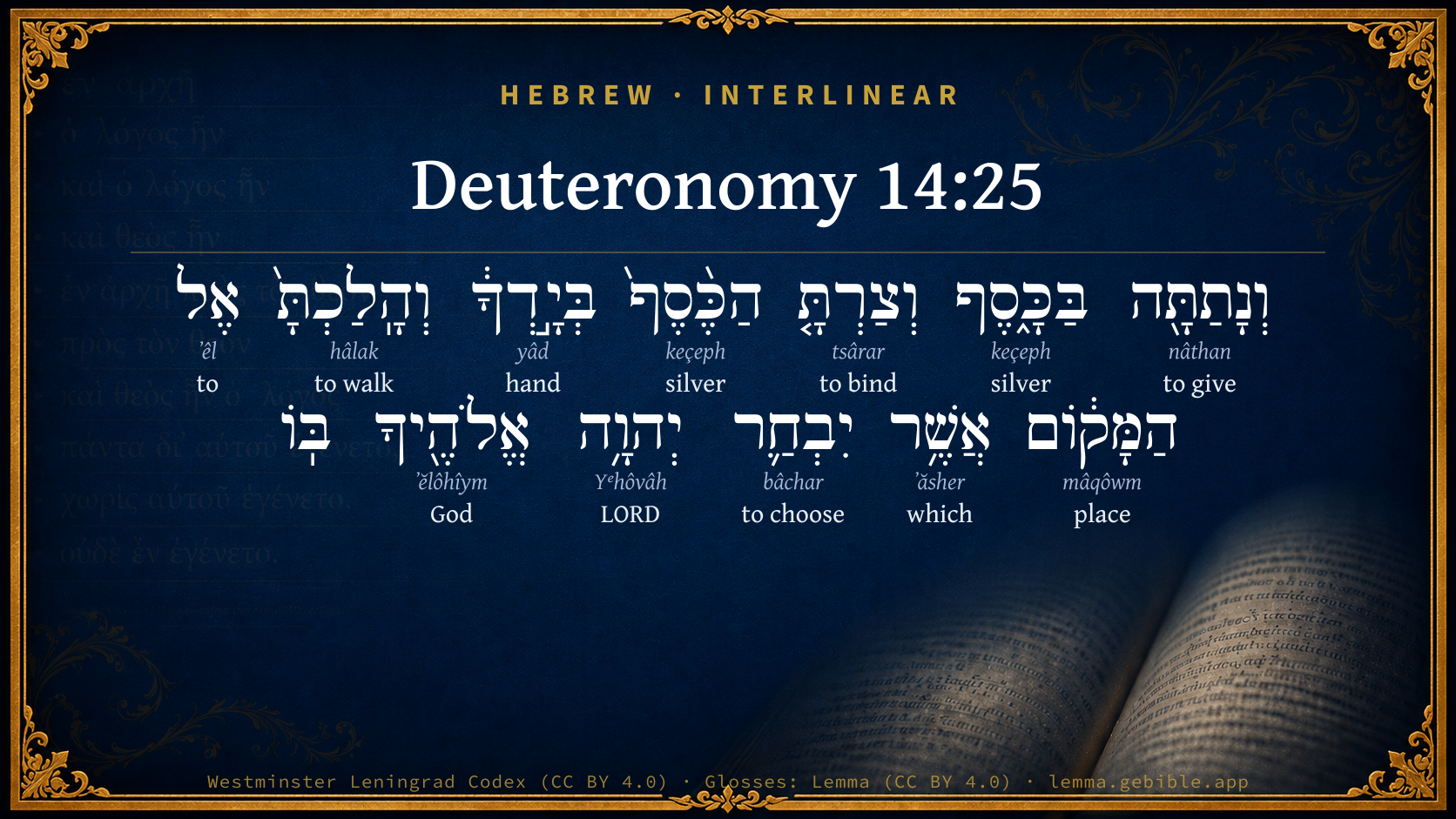
Hebrew (Westminster Leningrad Codex) Deuteronomy 14:25 appears in the Hebrew Old Testament. The text above is from the Westminster Leningrad Codex. Each word links to its Strong’s number, a concise gloss, and parsing drawn from the Open Scriptures Hebrew Bible morphology. Click any word for its full Brown-Driver-Briggs (BDB) entry.
Download image
Cite this verse

Deuteronomy 14:25 (World English Bible). Public Domain. Lemma interlinear Bible study tool, https://lemma.gebible.app/v/deuteronomy/14/25.

Show BibTeX & RIS
BibTeX
RIS
English Translation
then shall you turn it into money, and bind up the money in your hand, and shall go to the place which Yahweh your God shall choose:
World English Bible · Public Domain
Download a study sheet

One document with this verse’s original text, its word-by-word gloss line, the meaning frame, cross-references with their text, attributed commentary, and full source and license credits — printable, and it pastes into notes with its structure intact.

This verse Autodidact and up

Study sheet (.html) Plain text (.txt)

A passage Seminary Student

Up to 50 verses in one chapter. A passage sheet keeps up to 6 commentary sources and 12 cross-references per verse, in the order this page ranks them, and says so on the sheet whenever that leaves anything out. Ask for a single verse and you get the Autodidact verse sheet above.

Everything on this page stays free to read, with no account — the sheet is a download of what is already on screen, not access to it.

Want to remove ads? Support Godless Engineer
Compare translations 3

The same verse in 3 English versions, stacked beneath the original-language interlinear above. Click any original word for its lexicon entry.

Each is an independent rendering of the whole verse — the interlinear is not word-aligned to these translations.

Highlighted words mark where these versions differ — a whole-verse word diff, not a word-by-word alignment.

  • World English Bible Public Domain
    then shall you turn it into money, and bind up the money in your hand, and shall go to the place which Yahweh your God shall choose:
  • King James Version Public Domain
    Then shalt thou turn it into money, and bind up the money in thine hand, and shalt go unto the place which the LORD thy God shall choose:
  • unfoldingWord Literal Text CC BY-SA 4.0
    then you may give it in silver, and bind the silver in your hand, and go to the place that Yahweh your God will choose it.

unfoldingWord Literal Text — © unfoldingWord, licensed CC BY-SA 4.0. Word-aligned USFM3 via Door43 (git.door43.org/unfoldingWord/en_ult).

Versions to compare (up to 4)

3 of 4 selected

Show all 18 translations

Every available English version of this verse, each an independent rendering of the whole verse.

  • World English Bible Public Domain
    then shall you turn it into money, and bind up the money in your hand, and shall go to the place which Yahweh your God shall choose:
  • Berean Standard Bible Public Domain
    then exchange it for money, take the money in your hand, and go to the place the LORD your God will choose.
  • Majority Standard Bible Public Domain
    then exchange it for money, take the money in your hand, and go to the place the LORD your God will choose.
  • King James Version Public Domain
    Then shalt thou turn it into money, and bind up the money in thine hand, and shalt go unto the place which the LORD thy God shall choose:
  • American Standard Version (1901) Public Domain
    then shalt thou turn it into money, and bind up the money in thy hand, and shalt go unto the place which Jehovah thy God shall choose:
  • Revised Version (1885) Public Domain
    then shalt thou turn it into money, and bind up the money in thine hand, and shalt go unto the place which the LORD thy God shall choose:
  • Geneva Bible (1599) Public Domain
    Then shalt thou make it in money, and take the money in thine hand, and goe vnto the place which the Lord thy God shall chose.
  • Douay-Rheims (1899) Public Domain
    Thou shalt sell them all, and turn them into money, and shalt carry it in thy hand, and shalt go to the place which the Lord shall choose:
  • Young's Literal Translation Public Domain
    then thou hast given `it' in money, and hast bound up the money in thy hand, and gone unto the place on which Jehovah thy God doth fix;
  • Literal Standard Version CC BY-SA 4.0
    then you have given [it] in money, and have bound up the money in your hand, and gone to the place on which your God YHWH fixes;
  • Unlocked Literal Bible CC BY-SA 4.0
    you will convert the offering into money, tie up the money in your hand, and go to the place that Yahweh your God will choose.
  • unfoldingWord Literal Text CC BY-SA 4.0
    then you may give it in silver, and bind the silver in your hand, and go to the place that Yahweh your God will choose it.
  • Darby Bible Public Domain
    then shalt thou give it for money, and bind the money together in thy hand, and go to the place which Jehovah thy God will choose,
  • World Messianic Bible Public Domain
    then you shall turn it into money, bind up the money in your hand, and shall go to the place which the LORD your God shall choose.
  • Webster's Bible Public Domain
    Then shalt thou turn it into money, and bind up the money in thy hand, and shalt go to the place which the LORD thy God shall choose:
  • Free Bible Version CC BY-SA 4.0
    then you can exchange it for money, take the money with you and go to the place the Lord your God will choose.
  • Bible in Basic English Public Domain
    Then let these things be exchanged for money, and, taking the money in your hand, go to the place marked out by the Lord your God for himself;
  • JPS Tanakh (1917) Public Domain
    then shalt thou turn it into money, and bind up the money in thy hand, and shalt go unto the place which the LORD thy God shall choose.

Literal Standard Version (2020), Covenant Press — licensed CC BY-SA 4.0. Text via the HelloAO Bible API (eBible.org). Unlocked Literal Bible (unfoldingWord) — licensed CC BY-SA 4.0. Text via the HelloAO Bible API (eBible.org). unfoldingWord Literal Text — © unfoldingWord, licensed CC BY-SA 4.0. Word-aligned USFM3 via Door43 (git.door43.org/unfoldingWord/en_ult). Free Bible Version, Dr. Jonathan Gallagher — licensed CC BY-SA 4.0. Text via the HelloAO Bible API (eBible.org).

Word by word

More ways to search: Search by grammar → Find every occurrence → Compare this word →

Practice this passage: Drill this verse → Learn its vocabulary →

וְצַרְתָּ֤
tsârar
H6887
“and · to bind”
Conjunction + Verb, Qal, Sequential Perfect, 2nd Person, Masculine, Singular
Part of Speech
Conjunction + Verb
Stem
Qal
Form
Sequential Perfect
Person
2nd Person
Gender
Masculine
Number
Singular
Full BDB Definition

Origin: a primitive root

TWOT: 1973 , 1974

to bind, be narrow, be in distress, make narrow, cause distress, besiege, be straitened, be bound - (Qal) - to bind, tie up, shut up - to be scant, be cramped, be in straits - (Pual) to be bound, be tied up - (Hiphil) - to make narrow for, cause distress to, press hard upon - to suffer distress - to show hostility toward, vex - (Qal) - to show hostility toward, treat with enmity, vex, harass - vexer, harasser (participle)
  1. וְנָתַתָּ֖ה nâthan H5414 “and · to give” Conjunction + Verb, Qal, Sequential Perfect, 2nd Person, Masculine, Singular
  2. בַּכָּ֑סֶף keçeph H3701 “in/at the · silver” Preposition, Determined + Noun, Common, Masculine, Singular, Absolute
  3. הַכֶּ֨סֶף֙ keçeph H3701 “the · silver” Particle, Definite Article + Noun, Common, Masculine, Singular, Absolute
  4. בְּיָ֣דְךָ֔ yâd H3027 “in/at · hand · your” Preposition + Noun, Common, Both, Singular, Construct + Suffix, Personal, 2nd Person, Masculine, Singular
  5. וְהָֽלַכְתָּ֙ hâlak H1980 “and · to walk” Conjunction + Verb, Qal, Sequential Perfect, 2nd Person, Masculine, Singular
  6. אֶל ʼêl H413 “to” Preposition
  7. הַמָּק֔וֹם mâqôwm H4725 “the · place” Particle, Definite Article + Noun, Common, Masculine, Singular, Absolute
  8. אֲשֶׁ֥ר ʼăsher H834 “which” Particle, Relative
  9. יִבְחַ֛ר bâchar H977 “to choose” Verb, Qal, Imperfect, 3rd Person, Masculine, Singular
  10. יְהוָ֥ה Yᵉhôvâh H3068 “LORD” Noun, Proper
  11. אֱלֹהֶ֖יךָ ʼĕlôhîym H430 “God(s) · your” Noun, Common, Masculine, Plural, Construct + Suffix, Personal, 2nd Person, Masculine, Singular

About this verse

These counts appear in no published source. They are computed here, from the morphology-tagged text and Lemma’s own curated glosses. What Lemma adds →

13
words
11
distinct lemmas
Pentateuch
section

Shared distinctive vocabulary

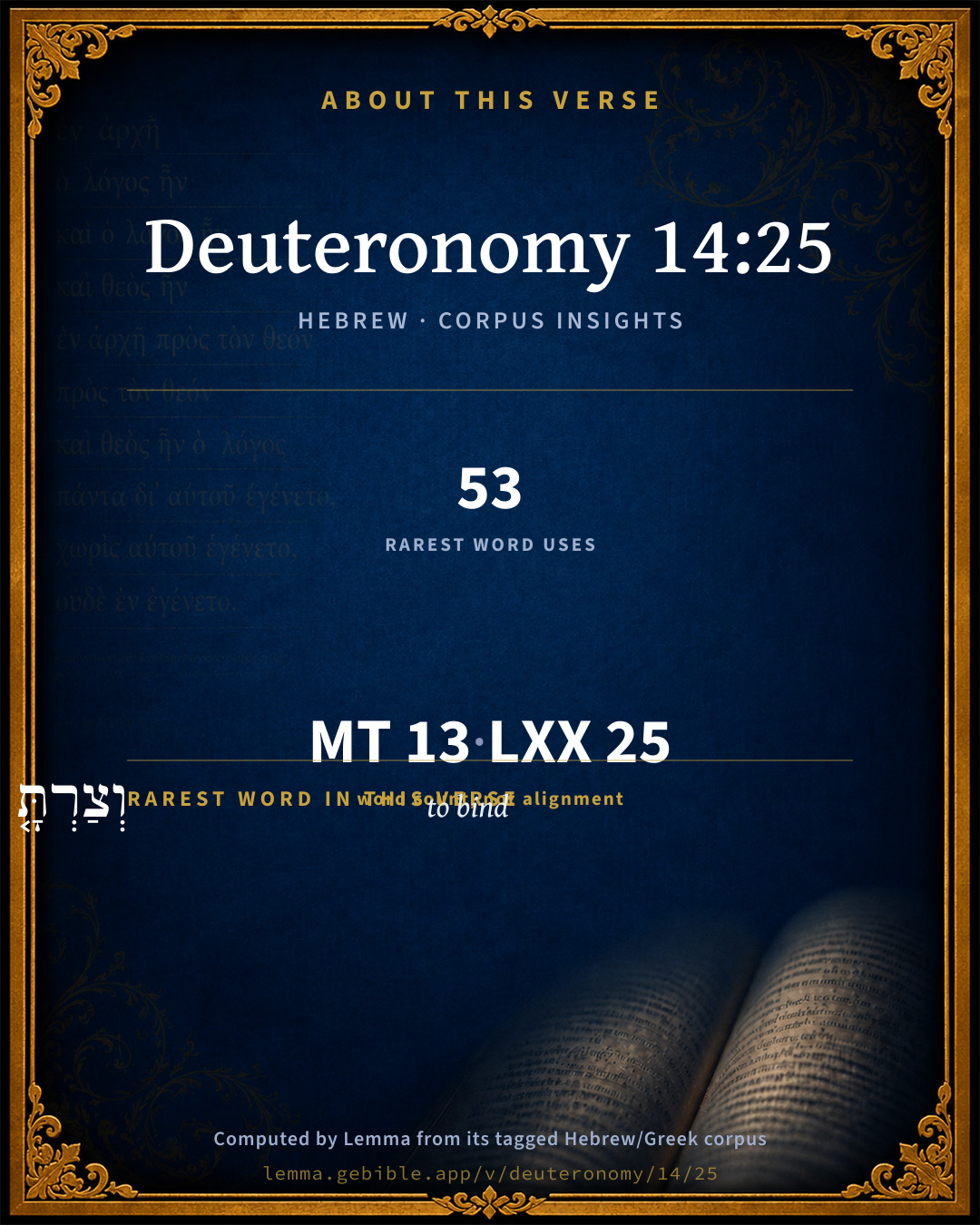
וְצַרְתָּ֤ to bind H6887 occurs in 52 verses of the Hebrew Bible. Also found in:

Grammatical profile

  • 4 verbs
  • 6 nouns
  • 2 prepositions
  • 1 particle

Verb forms

  • וְנָתַתָּ֖ה Qal · Sequential Perfect
  • וְצַרְתָּ֤ Qal · Sequential Perfect
  • וְהָֽלַכְתָּ֙ Qal · Sequential Perfect
  • יִבְחַ֛ר Qal · Imperfect

Repetition

A word recurs within this verse — often emphatic in Hebrew:

  • בַּכָּ֑סֶף silver H3701 ×2

Hebrew & Septuagint length

In English translation the verse runs 27 words from the Hebrew and 30 from the Septuagint (LXX English) — closely comparable.

A rough comparison of the two English renderings, which tokenize alike — not a word-level alignment.

Word counts can differ between the Hebrew and the Greek without any difference in meaning — e.g. the Hebrew direct-object marker אֵת has no separate Greek word, and Greek often adds the article ὁ.

In the original languages it is 13 Hebrew tokens and 25 Greek tokens — but the two are counted differently (Hebrew bundles its prefixes and suffixes into one token; the Greek is in lemma form), so that isn’t a like-for-like length.

Hebrew and Greek witnesses Masoretic Hebrew ↔ Greek Septuagint

The same verse in the two great witnesses to the Old Testament, shown verse-for-verse.

These are two independent witnesses, not word-aligned to each other, and the Septuagint is shown in lemma (dictionary) form.

Hebrew Deuteronomy 14:25 Masoretic · Westminster Leningrad Codex

וְנָתַתָּ֖ה בַּכָּ֑סֶף וְצַרְתָּ֤ הַכֶּ֨סֶף֙ בְּיָ֣דְךָ֔ וְהָֽלַכְתָּ֙ אֶל הַמָּק֔וֹם אֲשֶׁ֥ר יִבְחַ֛ר יְהוָ֥ה אֱלֹהֶ֖יךָ בּֽוֹ

then shall you turn it into money, and bind up the money in your hand, and shall go to the place which Yahweh your God shall choose:

World English Bible · Public Domain

Greek LXX Deuteronomy 14:25 Septuagint · lemma form

καί ἀποδίδωμι αὐτός ἀργύριον καί λαμβάνω ὁ ἀργύριον ἐν ὁ χείρ σύ καί πορεύομαι εἰς ὁ τόπος ὅς ἄν ἐκλέγω κύριος ὁ θεός σύ αὐτός

then you shall sell them for money, and you shall take the money in your hands, and you shall go to the place which the Lord your God shall choose.

LXX2012 (modern English Septuagint) · Public Domain

Hebrew: Westminster Leningrad Codex (CC BY 4.0). Greek: Septuagint (public domain); English from LXX2012 (modern English Septuagint) (Public Domain). How the Septuagint differs from the Hebrew →

Targum (Aramaic paraphrase)

2

The Targum is the ancient Jewish Aramaic paraphrase of the Hebrew Scriptures — an interpretive translation, not the Hebrew text itself. Onkelos (literal) and Pseudo-Jonathan (expansive) render the Torah, and Jonathan the Prophets. Coverage is partial: where no permissively-licensed English translation exists for a verse, only the Aramaic is shown. This is verse-level text, not a word-by-word alignment to the Hebrew.

  1. Targum Onkelos Torah (Genesis–Deuteronomy)
    וְתִתֵּן בְּכַסְפָּא וּתְצוּר כַּסְפָּא בִּידָךְ וּתְהַךְ לְאַתְרָא דִי יִתִּרְעֵי יְיָ אֱלָהָךְ בֵּהּ

    (no public-domain English translation for this verse)

    Targum Onkelos — Aramaic: “Onkelos Genesis” (public domain); “Onkelos Exodus” (public domain); “Onkelos Leviticus” (public domain); “Onkelos Numbers” (public domain); “Onkelos Deuteronomy” (public domain). English: “Sefaria Community Translation” (CC0 1.0 (public-domain dedication)); “J.W. Etheridge. The Targums of Onkelos and Jonathan Ben Uzziel on the Pentateuch. London: Longmans, Green, 1862” (public domain). Text via Sefaria.

  2. Targum Pseudo-Jonathan Torah (Genesis–Deuteronomy)
    וּתְחַלֵּל בְּכַסְפָּא וִיהוֹן פְּרִיטֵי צְרִירִין בִּידָךְ וּתְהַךְ לְאַתְרָא דְיִתְרְעֵי יְיָ אֱלָהֲכוֹן בֵּיהּ

    then thou mayest make exchange for it into silver, and bind the sum in thy hand, and proceed to the place which the Lord thy God shall choose,

    Targum Pseudo-Jonathan — Aramaic: “Targum Jonathan on Genesis” (public domain); “Targum Jonathan on Exodus” (public domain); “Targum Jonathan on Leviticus” (public domain); “Targum Jonathan on Numbers” (public domain); “Targum Jonathan on Deuteronomy” (public domain). English: “The Targum of Jonathan ben Uzziel, trans. J. W. Etheridge, London, 1862” (public domain). Text via Sefaria.

Commentary

Notes on Deuteronomy 14:25 from classic Christian and Jewish commentators (each source and its license shown beneath its notes). The classic Christian expositions comment on the surrounding passage and are grouped to its opening verse, so a note may address several verses; the Jewish commentaries on the Tanakh (Rashi and others) are per-verse, so they appear only where the commentator wrote on this verse.

Lemma curates 59 commentaries, every one of them public domain or Creative Commons licensed, each selected and text-cleaned for this edition rather than reprinted as found. About our sources →

Geneva Bible (1599)

Geneva Bible translators

Or, bind up.

Geneva Bible (1599) marginal notes — public domain. Text via Bolls.life.

John Gill's Exposition

At the end of three years thou shalt bring forth all the tithe of thine increase the same year,.... This, according to Aben Ezra, was a third tithe, and did not excuse the second tithe; so says:"I gave the third tithe to the repair of the temple,'' (Tobit 1:7)as in one copy, but, according to another, to the stranger, fatherless, and widow, which better agrees with what follows; but the Jewish writers generally understand this as the same with the second tithe, which on the two first years from the sabbatical year was carried to Jerusalem, or money in lieu of it, with which provisions were bought and eaten there, but on the third year were eaten in their own cities with the poor, and in the stead of the other; so says Maimonides (x), on the third and sixth years from the sabbatical year, after they have separated the first tithe they separate from what remains another tithe, and give it to the poor, and it is called the poor's tithe, and not on those two years is the second tithe, but the poor's tithe, as it is said, "at the end of three years", &c. and still more expressly elsewhere (y); after they have separated the first tithe every year, they separate the second tithe, Deu 14:22 and on the third and sixth years they separate the poor's tithe instead of the second; and this was done, not at the latter end of the third year, but, as Aben Ezra interprets it, at the beginning; for the word used signifies an extremity, and the beginning of the year is one extremity of it as well as the latter end of it:

and lay it up within thy gates; not to be hoarded up, or to be sold at a proper time, but to be disposed and made use of as follows.

(x) Hilchot Mattanot. Anayim, c. 6. sect. 4. (y) In Maaser Sheni, c. 1. sect. 1.

John Gill's Exposition of the Whole Bible (1746–1763) — public domain (CC PDM 1.0). Text via the HelloAO Bible API.

Matthew Poole's English Annotations

Bind up the money in thine hand, i.e. in a bag to be taken into thy hand and carried with thee.

Matthew Poole's English Annotations on the Holy Bible (1683–1685) — public domain. Text from a community e-Sword/MySword module.

John Wesley's Explanatory Notes

In thine hand - That is, in a bag to be taken into thy hand and carried with thee.

John Wesley, Explanatory Notes Upon the Whole Bible (1754–1765) — public domain. Text via the GEBible commentary corpus.

Keil & Delitzsch

C. F. Keil & F. Delitzsch

"Turn it into money," lit., "give it up for silver," sc., the produce of the tithe; "and bind the silver in thy hand," const. praegnans for "bind it in a purse and take it in thy hand...and give the silver for all that thy soul desireth, for oxen and small cattle, for wine and strong drink," to hold a joyous meal, to which the Levite was also to be invited (as in Deu 12:12, Deu 12:18, and Deu 12:19).

Keil & Delitzsch — Biblical Commentary on the Old Testament (1861–1891) — public domain (CC PDM 1.0). Text via the HelloAO Bible API. (Old Testament only.)

Lesson kit

Teaching starters — assembled from the data on this page, not authored interpretation. Every prompt links to the verse data it draws on. Edit before teaching.

Deuteronomy, in the Pentateuch, opens this verse with 13 words (11 distinct Hebrew lemmas). Its most distinctive word is tsârar (“to bind”). A historical commentator’s framing appears above. Read the whole chapter for the surrounding context.

Discussion questions

  1. The word tsârar carries the sense “to bind.” How does it shape the verse?
  2. How does Exodus 12:34, which shares the word «to bind», read alongside this verse?
  3. What does the repetition of “silver” (2× in this one verse) do in this verse?
  4. These translations render this verse differently; the difference is in the English rendering, not the original. What questions does that raise?
  5. «וְנָתַתָּ֖ה» is a Qal Sequential Perfect verb. How does that grammatical form shape the action described?
  6. Compare how Geneva Bible (1599) and John Gill's Exposition read this verse. Where do they agree or differ?

Things to notice

Reading settings

Reading text

Shown beneath each verse's original-language words.

Old Testament
Old Testament edition

Read the OT as the Masoretic Hebrew (MT) or the Greek Septuagint (LXX).

English shown for the Greek Septuagint (in the Hebrew ↔ Greek comparison).

Comparing translations? Open the Compare panel on any verse page to stack up to four side by side.