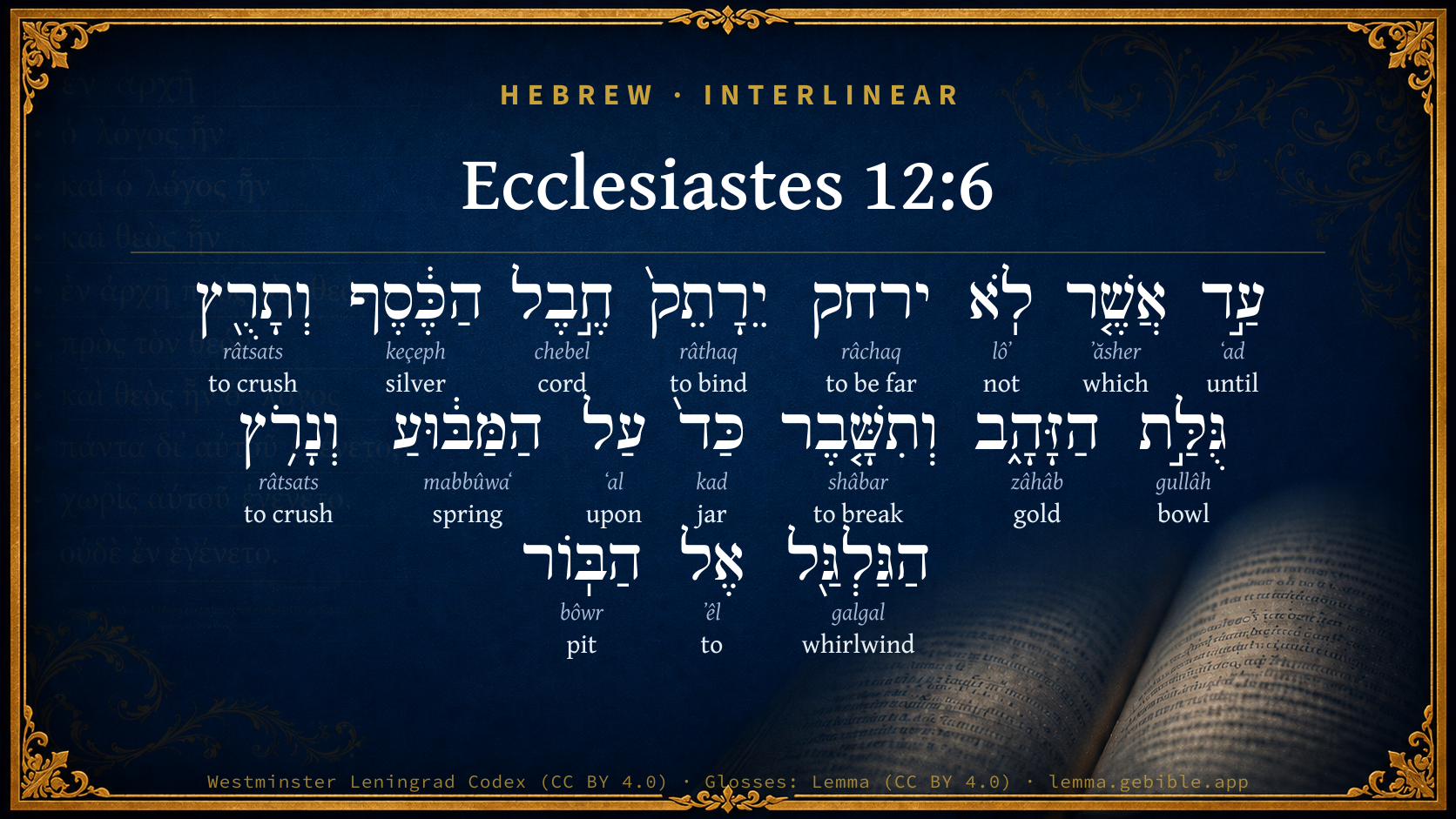
Ecclesiastes 12:6

Hebrew (Westminster Leningrad Codex) Ecclesiastes 12:6 appears in the Hebrew Old Testament. The text above is from the Westminster Leningrad Codex. Each word links to its Strong’s number, a concise gloss, and parsing drawn from the Open Scriptures Hebrew Bible morphology. Click any word for its full Brown-Driver-Briggs (BDB) entry.
Download image
Cite this verse

Ecclesiastes 12:6 (World English Bible). Public Domain. Lemma interlinear Bible study tool, https://lemma.gebible.app/v/ecclesiastes/12/6.

Show BibTeX & RIS
BibTeX
RIS
English Translation
Before the silver cord is severed, Or the golden bowl is broken, Or the pitcher is broken at the spring, Or the wheel broken at the cistern,
World English Bible · Public Domain
Highlights
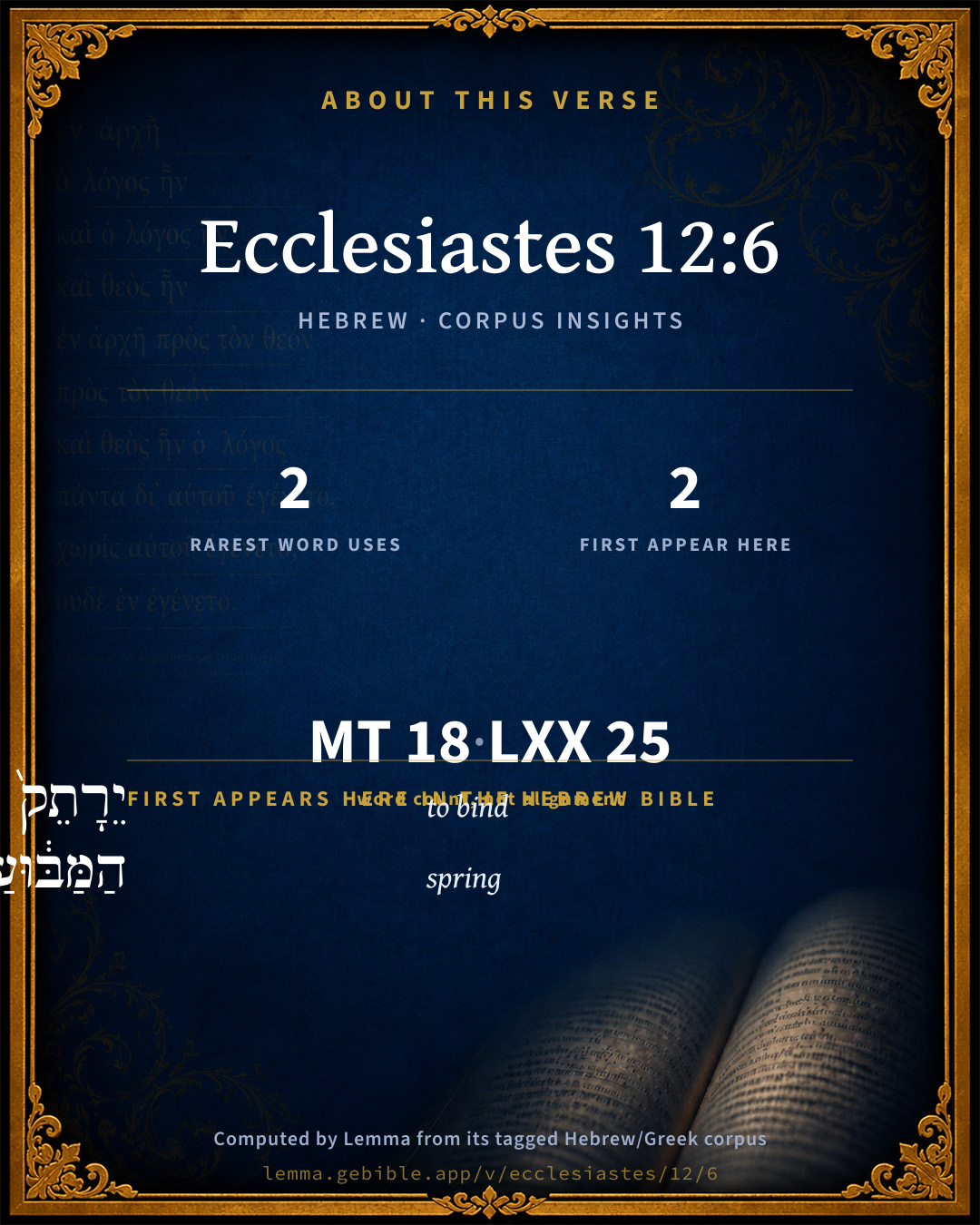
  • 2 first appearances in the Hebrew Bible
Full analysis ↓
Download a study sheet

One document with this verse’s original text, its word-by-word gloss line, the meaning frame, cross-references with their text, attributed commentary, and full source and license credits — printable, and it pastes into notes with its structure intact.

This verse Autodidact and up

Study sheet (.html) Plain text (.txt)

A passage Seminary Student

Up to 50 verses in one chapter. A passage sheet keeps up to 6 commentary sources and 12 cross-references per verse, in the order this page ranks them, and says so on the sheet whenever that leaves anything out. Ask for a single verse and you get the Autodidact verse sheet above.

Everything on this page stays free to read, with no account — the sheet is a download of what is already on screen, not access to it.

Want to remove ads? Support Godless Engineer
Compare translations 3

The same verse in 3 English versions, stacked beneath the original-language interlinear above. Click any original word for its lexicon entry.

Each is an independent rendering of the whole verse — the interlinear is not word-aligned to these translations.

Highlighted words mark where these versions differ — a whole-verse word diff, not a word-by-word alignment.

  • World English Bible Public Domain
    Before the silver cord is severed, Or the golden bowl is broken, Or the pitcher is broken at the spring, Or the wheel broken at the cistern,
  • King James Version Public Domain
    Or ever the silver cord be loosed, or the golden bowl be broken, or the pitcher be broken at the fountain, or the wheel broken at the cistern.
  • unfoldingWord Literal Text CC BY-SA 4.0
    before the cord of silver is removed, and the bowl of gold is broken, and the pitcher is shattered at the fountain, and the wheel is crushed at the cistern,

unfoldingWord Literal Text — © unfoldingWord, licensed CC BY-SA 4.0. Word-aligned USFM3 via Door43 (git.door43.org/unfoldingWord/en_ult).

Versions to compare (up to 4)

3 of 4 selected

Show all 18 translations

Every available English version of this verse, each an independent rendering of the whole verse.

  • World English Bible Public Domain
    Before the silver cord is severed, Or the golden bowl is broken, Or the pitcher is broken at the spring, Or the wheel broken at the cistern,
  • Berean Standard Bible Public Domain
    Remember Him before the silver cord is snapped and the golden bowl is crushed, before the pitcher is shattered at the spring and the wheel is broken at the well,
  • Majority Standard Bible Public Domain
    Remember Him before the silver cord is snapped and the golden bowl is crushed, before the pitcher is shattered at the spring and the wheel is broken at the well,
  • King James Version Public Domain
    Or ever the silver cord be loosed, or the golden bowl be broken, or the pitcher be broken at the fountain, or the wheel broken at the cistern.
  • American Standard Version (1901) Public Domain
    before the silver cord is loosed, or the golden bowl is broken, or the pitcher is broken at the fountain, or the wheel broken at the cistern,
  • Revised Version (1885) Public Domain
    or ever the silver cord be loosed, or the golden bowl be broken, or the pitcher be broken at the fountain, or the wheel broken at the cistern;
  • Geneva Bible (1599) Public Domain
    Whiles the siluer coarde is not lengthened, nor the golden ewer broken, nor the pitcher broken at the well, nor the wheele broken at the cisterne:
  • Douay-Rheims (1899) Public Domain
    Before the silver cord be broken, and the golden fillet shrink back, and the pitcher be crushed at the fountain, and the wheel be broken upon the cistern,
  • Young's Literal Translation Public Domain
    While that the silver cord is not removed, And the golden bowl broken, And the pitcher broken by the fountain, And the wheel broken at the well.
  • Literal Standard Version CC BY-SA 4.0
    While that the silver cord is not removed, || And the golden bowl broken, || And the pitcher broken by the fountain, || And the wheel broken at the well.
  • Unlocked Literal Bible CC BY-SA 4.0
    Call to mind your Creator before the silver cord is cut, or the golden bowl is crushed, or the pitcher is shattered at the spring, or the water wheel is broken at the well,
  • unfoldingWord Literal Text CC BY-SA 4.0
    before the cord of silver is removed, and the bowl of gold is broken, and the pitcher is shattered at the fountain, and the wheel is crushed at the cistern,
  • Darby Bible Public Domain
    -- before the silver cord be loosed, or the golden bowl be broken, or the pitcher be shattered at the fountain, or the wheel be broken at the cistern;
  • World Messianic Bible Public Domain
    before the silver cord is severed, or the golden bowl is broken, or the pitcher is broken at the spring, or the wheel broken at the cistern,
  • Webster's Bible Public Domain
    Or ever the silver cord shall be loosed, or the golden bowl be broken, or the pitcher be broken at the fountain, or the wheel broken at the cistern.
  • Free Bible Version CC BY-SA 4.0
    Before the silver cord is snapped and the golden bowl is broken; before the water jug is smashed at the spring, or the pulley is broken at the well.
  • Bible in Basic English Public Domain
    Before ever the silver cord is cut, or the vessel of gold is broken, or the pot is broken at the fountain, or the wheel broken at the water-hole;
  • JPS Tanakh (1917) Public Domain
    Before the silver cord is snapped asunder, and the golden bowl is shattered, and the pitcher is broken at the fountain, and the wheel falleth shattered, into the pit;

Literal Standard Version (2020), Covenant Press — licensed CC BY-SA 4.0. Text via the HelloAO Bible API (eBible.org). Unlocked Literal Bible (unfoldingWord) — licensed CC BY-SA 4.0. Text via the HelloAO Bible API (eBible.org). unfoldingWord Literal Text — © unfoldingWord, licensed CC BY-SA 4.0. Word-aligned USFM3 via Door43 (git.door43.org/unfoldingWord/en_ult). Free Bible Version, Dr. Jonathan Gallagher — licensed CC BY-SA 4.0. Text via the HelloAO Bible API (eBible.org).

Word by word

More ways to search: Search by grammar → Find every occurrence → Compare this word →

Practice this passage: Drill this verse → Learn its vocabulary →

יֵרָתֵק֙
râthaq
H7576
“to bind”
Verb, Niphal, Imperfect, 3rd Person, Masculine, Singular
Part of Speech
Verb
Stem
Niphal
Form
Imperfect
Person
3rd Person
Gender
Masculine
Number
Singular
Full BDB Definition

Origin: a primitive root

TWOT: 2227

to bind - (Niphal) to be snapped, be broken - (Pual) to be bound
  1. עַ֣ד ʻad H5704 “until” Preposition
  2. אֲשֶׁ֤ר ʼăsher H834 “which” Particle, Relative
  3. לֹֽא lôʼ H3808 “not” Particle, Negative
  4. ירחק râchaq H7368 “to be far” Verb, Qal, Imperfect, 3rd Person, Masculine, Singular
  5. חֶ֣בֶל chebel H2256 “cord of” Noun, Common, Both, Singular, Construct
  6. הַכֶּ֔סֶף keçeph H3701 “the · silver” Particle, Definite Article + Noun, Common, Masculine, Singular, Absolute
  7. וְתָרֻ֖ץ râtsats H7533 “and · to crush” Conjunction + Verb, Qal, Imperfect, 3rd Person, Feminine, Singular
  8. גֻּלַּ֣ת gullâh H1543 “bowl of” Noun, Common, Feminine, Singular, Construct
  9. הַזָּהָ֑ב zâhâb H2091 “the · gold” Particle, Definite Article + Noun, Common, Masculine, Singular, Absolute
  10. וְתִשָּׁ֤בֶר shâbar H7665 “and · to break” Conjunction + Verb, Niphal, Imperfect, 3rd Person, Feminine, Singular
  11. כַּד֙ kad H3537 “jar” Noun, Common, Feminine, Singular, Absolute
  12. עַל ʻal H5921 “upon” Preposition
  13. הַמַּבּ֔וּעַ mabbûwaʻ H4002 “the · spring” Particle, Definite Article + Noun, Common, Masculine, Singular, Absolute
  14. וְנָרֹ֥ץ râtsats H7533 “and · to crush” Conjunction + Verb, Niphal, Sequential Perfect, 3rd Person, Masculine, Singular
  15. הַגַּלְגַּ֖ל galgal H1534 “the · whirlwind” Particle, Definite Article + Noun, Common, Masculine, Singular, Absolute
  16. אֶל ʼêl H413 “to” Preposition
  17. הַבּֽוֹר bôwr H953 “the · pit” Particle, Definite Article + Noun, Common, Masculine, Singular, Absolute

About this verse

These counts appear in no published source. They are computed here, from the morphology-tagged text and Lemma’s own curated glosses. What Lemma adds →

18
words
17
distinct lemmas
Wisdom
section

Notable vocabulary

The rarest word here is יֵרָתֵק֙ to bind H7576 — appearing just 2 times in the whole Hebrew Bible.

First appearance in Scripture

These words make their first canonical appearance in the Hebrew Bible here:

  • יֵרָתֵק֙ to bind H7576
  • הַמַּבּ֔וּעַ spring H4002

Shared distinctive vocabulary

יֵרָתֵק֙ to bind H7576 occurs in 2 verses of the Hebrew Bible. Also found in:

Grammatical profile

  • 5 verbs
  • 8 nouns
  • 3 prepositions
  • 2 particles

Verb forms

  • ירחק Qal · Imperfect
  • יֵרָתֵק֙ Niphal · Imperfect
  • וְתָרֻ֖ץ Qal · Imperfect
  • וְתִשָּׁ֤בֶר Niphal · Imperfect
  • וְנָרֹ֥ץ Niphal · Sequential Perfect

Repetition

A word recurs within this verse — often emphatic in Hebrew:

  • וְתָרֻ֖ץ to crush H7533 ×2

Hebrew & Septuagint length

In English translation the verse runs 27 words from the Hebrew and 29 from the Septuagint (LXX English) — closely comparable.

A rough comparison of the two English renderings, which tokenize alike — not a word-level alignment.

Word counts can differ between the Hebrew and the Greek without any difference in meaning — e.g. the Hebrew direct-object marker אֵת has no separate Greek word, and Greek often adds the article ὁ.

In the original languages it is 18 Hebrew tokens and 25 Greek tokens — but the two are counted differently (Hebrew bundles its prefixes and suffixes into one token; the Greek is in lemma form), so that isn’t a like-for-like length.

Cross-references

1

Topical passages linked to Ecclesiastes 12:6 in the Treasury of Scripture Knowledge — connected by theme and wording, ordered by reader-vote popularity; previews shown in the World English Bible.

  • Zechariah 4:2–3 He said to me, "What do you see?" I said, "I have seen, and, behold, a lampstand all of gold, with its bowl on the top of it, and its seven lamps thereon; there are seven pipes to each of the lamps, which are on the top of it;

Cross-references courtesy of OpenBible.info (CC BY 4.0).

Hebrew and Greek witnesses Masoretic Hebrew ↔ Greek Septuagint

The same verse in the two great witnesses to the Old Testament, shown verse-for-verse.

These are two independent witnesses, not word-aligned to each other, and the Septuagint is shown in lemma (dictionary) form.

Hebrew Ecclesiastes 12:6 Masoretic · Westminster Leningrad Codex

עַ֣ד אֲשֶׁ֤ר לֹֽא ירחק יֵרָתֵק֙ חֶ֣בֶל הַכֶּ֔סֶף וְתָרֻ֖ץ גֻּלַּ֣ת הַזָּהָ֑ב וְתִשָּׁ֤בֶר כַּד֙ עַל הַמַּבּ֔וּעַ וְנָרֹ֥ץ הַגַּלְגַּ֖ל אֶל הַבּֽוֹר

Before the silver cord is severed, Or the golden bowl is broken, Or the pitcher is broken at the spring, Or the wheel broken at the cistern,

World English Bible · Public Domain

Greek LXX Ecclesiastes 12:6 Septuagint · lemma form

ἕως ὅστις μή ἀνατρέπω σχοινίον ὁ ἀργύριον καί συνθλίβω ἀνθέμιον ὁ χρυσίον καί συντρίβω ὑδρία ἐπί ὁ πηγή καί συντροχάζω ὁ τροχός ἐπί ὁ λάκκος

before the silver cord be let go, or the choice gold be broken, or the pitcher be broken at the fountain, or the wheel run down to the cistern;

LXX2012 (modern English Septuagint) · Public Domain

On this verse, Keil & Delitzsch discusses the Septuagint’s reading. Read the note in Commentary ↓

Hebrew: Westminster Leningrad Codex (CC BY 4.0). Greek: Septuagint (public domain); English from LXX2012 (modern English Septuagint) (Public Domain). How the Septuagint differs from the Hebrew →

Commentary

Notes on Ecclesiastes 12:6 from classic Christian and Jewish commentators (each source and its license shown beneath its notes). The classic Christian expositions comment on the surrounding passage and are grouped to its opening verse, so a note may address several verses; the Jewish commentaries on the Tanakh (Rashi and others) are per-verse, so they appear only where the commentator wrote on this verse.

Lemma curates 59 commentaries, every one of them public domain or Creative Commons licensed, each selected and text-cleaned for this edition rather than reprinted as found. About our sources →

Trapp's Complete Commentary

John Trapp

Ecc 12:6 Or ever the silver cord be loosed, or the golden bowl be broken, or the pitcher be broken at the fountain, or the wheel broken at the cistern.

Ver. 6. Or ever the silver cord be loosed.] Or, Lengthened - i.e., before the marrow of the back (which is of a silver colour) be consumed. From this cord many sinews are derived, which, when they are loosened, the back bendeth, motion is slow, and feeling faileth.

Or the golden bowl be broken,] i.e., The heart, say some, or the pericardium; the brain pan, say others, or the pia mater, compassing the brain like a swathing cloth, or inner rind of a tree.

Or the pitcher be broken at the fountain.] That is, The veins at the liver (which is the place of sanguification, or blood making, as one calls it), but especially Vena porta and Vena cava. Read the anatomists.

Or the wheel be broken at the cistern,] i.e., The head, which draws the power of life from the heart, to the which the blood runs back in any great fright, as to the fountain of life.

John Trapp, A Commentary or Exposition upon All the Books of the Old and New Testament (1647–1656) — public domain. Text from a community e-Sword module.

Joseph Benson's Commentary

Ecc 12:6. Or ever the silver cord be loosed — By the silver cord he seems to understand the spinal marrow, which comes from the brain, and goes down to the lowest end of the back-bone. And this is aptly compared to a cord, both for its figure, which is long and round, and for its use, which is to draw and move the parts of the body; and to silver, both for its excellence and colour, which is white and bright, in a dead, much more in a living body. This may properly be said to be loosed, or dissolved, because it is relaxed, or otherwise disabled for its proper service. And answerably hereto, by the golden bowl we may understand the membranes of the brain, and especially that inmost membrane which insinuates itself into all the parts of it, following it in its various windings, keeping each parcel of it in its proper place, and dividing one from another, to prevent disorder. This is not unfitly called a bowl, because it is round, and contains in it all the substance of the brain; and a golden bowl, partly for its great preciousness and usefulness; partly for its ductility, being drawn out into a great thinness or fineness; and partly for its colour, which is somewhat yellow, and comes nearer to that of gold than any other part of the body does. And this, upon the approach of death, is commonly shrivelled up, and many times broken. And as these clauses concern the brain, and the animal powers, so the two following respect the spring of the vital powers, and of the blood, the great instrument whereof is the heart. And so Solomon here describes the chief organs appointed for the production, distribution, and circulation of the blood. For though the circulation of the blood has been hid for many generations, yet it was well known to Solomon. According to this notion, the fountain is the right ventricle of the heart, which is now acknowledged to be the spring of life; and the pitcher is the arteries which convey the blood from it to other parts, and especially that arterious vein, by which it is transmitted to the lungs, and thence to the left ventricle, where it is better elaborated, and then thrust out into the great artery, called aorta, and by its branches dispersed into all the parts of the body. And the cistern is the left ventricle of the heart, and the wheel seems to be the great artery, which is fifty so called, because it is the great instrument of this circulation. The pitcher may be said to be broken at the fountain, when the veins do not return the blood to the heart, but suffer it to stand still and cool, whence comes that coldness of the outward parts, which is a near forerunner of death. And the wheel may be said to be broken at the cistern, when the great arteries do not perform their office of conveying the blood into the left ventricle of the heart, and of thrusting it out thence into the lesser arteries, whence comes that ceasing of the pulse, which is a certain sign of approaching death.

Joseph Benson's Commentary on the Old and New Testaments (1811–1818) — public domain. Text from a community e-Sword module.

Keil & Delitzsch

C. F. Keil & F. Delitzsch

A third 'ad asher lo now follows (cf. Ecc 5:1-2); the first placed the old man in view, with his dsagrment in general; the second described in detail his bodily weaknesses, presenting themselves as forerunners of death; the third brings to view the dissolution of the life of the body, by which the separation of the soul and the body, and the return of both to their original condition is completed. "Ere the silver cord is loosed, and the golden bowl is shattered, and the pitcher is broken at the fountain, and the wheel is shattered in the well, and the dust returns to the earth as that which it was, and the spirit returns to God who gave it." Before entering into the contents of these verses, we shall consider the form in which some of the words are presented. The Chethı̂b ירחק we readily let drop, for in any case it must be said that the silver cord is put out of action; and this word, whether we read it ירחק or ירחק (Venet. μακρυνθῇ), is too indefinite, and, supposing that by the silver cord a component part of the body is meant, even inappropriate, since the organs which cease to perform their functions are not removed away from the dead body, but remain in it when dead. But the Keri ירתק ("is unbound") has also its difficulty. The verb רתק signifies to bind together, to chain; the bibl. Heb. uses it of the binding of prisoners, Nah 3:18, cf. Isa 40:19; the post-bibl. Heb. of binding = shutting up (contrast of פתח, Pesikta, ed. Buber, 176a, whence Mezia 107b, שורא וריתקא, a wall and enclosure); the Arab. of shutting up and closing a hole, rent, split (e.g., murtatiḳ, a plant with its flower-buds as yet shut up; rutûḳ, inaccessibleness). The Targumist

(Note: Similarly the lxx understands ונרץ, καὶ συντροχάσῃ (i.e., as Jerome in his Comm. explains: si fuerit in suo funiculo convoluta), which is impossible.)

accordingly understands ירתק of binding = lameness (palsy); Rashi and Aben Ezra, of shrivelling; this may be possible, however, for נרתּק, used of a "cord," the meaning that first presents itself, is "to be firmly bound;" but this affords no appropriate sense, and we have therefore to give to the Niph. the contrasted meaning of setting free, discatenare (Parchon, Kimchi); this, however, is not justified by examples, for a privat. Niph. is unexampled, Ewald, 121e; נלבּב, Job 11:12, does not mean to be deprived of heart (understanding), but to gain heart (understanding). Since, however, we still need here the idea of setting loose or tearing asunder (lxx ἀνατραπῇ; Symm. κοπῆναι; Syr. נתפסק, from פּסק, abscindere; Jerome, rumpatur), we have only the choice of interpreting yērathēq either, in spite of the appearance to the contrary, in the meaning of constingitur, of a violent drawing together of the cord stretched out lengthwise; or, with Pfannkuche, Gesen., Ewald, to read ינּתק ("is torn asunder"), which one expects, after Isa 33:20; cf. Jdg 16:9; Jer 10:20. Hitzig reaches the same, for he explains ירחק = יחרק, from (Arab.) kharaḳ, to tear asunder (of the sound of the tearing);

(Note: Vid., my treatise, Psyciol. u. Musik, u.s.w., p. 31.)

and Bttcher, by adopting the reading יחרק; but without any support in Heb. and Chald. usus loq.

נּלּה, which is applied to the second figure, is certainly

(Note: The lxx, unsuitably, τὸ ἀνθέμιον, which, per synecdochen partis pro toto, signifies the capital (of a pillar). Thus, perhaps, also are meant Symm. τὸ περιφερές, Jerome vitta, Venet. τὸ στέφος, and the Syr. "apple." Among the Arabs, this ornament on the capital is called tabaryz ("prominence").)

a vessel of a round form (from גּלל, to roll, revolve round), like the נּלּה which received the oil and conducted it to the seven lamps of the candlestick in Zac 4:1-14; but to understand ותרץ of the running out of the oil not expressly named (Luther: "and the golden fountain runs out") would be contrary to the usus loq.; it is the metapl. form for ותרץ, et confringitur, as ירוּץ, Isa 42:4, for ירץ, from רצץ, cogn. רעע, Psa 2:9, whence נרץ, Ecc 12:6, the regularly formed Niph. (the fut. of which, תּרוץ, Eze 29:7). We said that oil is not expressly named. But perhaps it is meant by הזּהב. The gullah above the candlestick which Zechariah saw was, according to Zac 4:12, provided with two golden pipes, in which were two olive trees standing on either side, which sunk therein the tuft-like end of their branches, of which it is said that they emptied out of themselves hazzahav into the oil vessels. Here it is manifest that hazzahav means, in the one instance, the precious metal of which the pipes are formed; and in the other, the fluid gold of the oil contained in the olive branches. Accordingly, Hitzig understands gullath hazzahav here also; for he takes gullah as a figure of the body, the golden oil as a figure of the soul, and the silver cord as a figure of vital energy.

Thus, with Hitz., understanding gullath hazzahav after the passage in Zechariah, I have correctly represented the meaning of the figures in my Psychol. p. 228, as follows: - "The silver cord = the soul directing and bearing the body as living; the lamp hanging by this silver cord = the body animated by the soul, and dependent on it; the golden oil = the spirit, of which it is said, Pro 20:27, that it is a lamp of God." I think that this interpretation of the golden oil commends itself in preference to Zckler's interpretation, which is adopted by Dchsel, of the precious fluidum of the blood; for if hazzahav is a metaphorical designation of oil, we have to think of it as the material for burning and light; but the principle of bright life in man is the spirit (ruahh hhayim or nishmath hhayim); and in the passage in Zechariah also, oil, which makes the candlestick give light, is a figure of the spirit (Ecc 12:6, ki im-beruhhi). But, as one may also suppose, it is not probable that here, with the same genit. connection, הכסף is to be understood of the material and the quality; and hazzqahav, on the contrary, of the contents. A golden vessel is, according to its most natural meaning, a vessel which is made of gold, thus a vessel of a precious kind. A golden vessel cannot certainly be broken in pieces, but we need not therefore understand an earthenware vessel only gilded, as by a silver cord is to be understood only that which has a silver line running through it (Gesen. in the Thes.); רצוּץ may also denote that which is violently crushed or broken, Isa 42:3; cf. Jdg 9:53. If gullath hazzahav, however, designates a golden vessel, the reference of the figure to the body, and at the same time of the silver cord to the vital energy or the soul, is then excluded, - for that which animates stands yet above that which is animated, - the two metallic figures in this their distribution cannot be comprehended in this reference. We have thus to ask, since gullath hazzahav is not the body itself: What in the human body is compared to a silver cord and to a golden vessel? What, moreover, to a pitcher at the fountain, and to a wheel or a windlass? Winzer settles this question by finding in the two double figures only in general the thoughts represented: antequam vita ex tenui quasi filo suspensa pereat, and (which is essentially the same) antequam machina corporis destruatur.

Gurlitt also protests against the allegorical explanation of the details, but he cannot refrain from interpreting more specially than Winzer. Two momenta, he says, there are which, when a man dies, in the most impressive way present themselves to view: the extinction of consciousness, and the perfect cessation, complete ruin, of the bodily organism. The extinction of consciousness is figuratively represented by the golden lamp, which is hung up by a silver cord in the midst of a house or tent, and now, since the cord which holds it is broken, it falls down and is shattered to pieces, so that there is at once deep darkness; the destruction of the bodily organism, by a fountain, at which the essential parts of its machinery, the pitcher and windlass, are broken and rendered for ever useless. This interpretation of Gurlitt's affords sufficient support to the expectation of the allegorical meaning with which we approached Ecc 12:6; and we would be satisfied therewith, if one of the figures did not oppose us, without seeking long for a more special allegorical meaning: the pitcher at the fountain or well (כּד, not הכּד, because determined by 'al-hammabu'a) is without doubt the heart which beats to the last breath of the dying man, which is likened to a pitcher which, without intermission, receives and again sends forth the blood. That the blood flows through the body like living water is a fact cognizable and perceptible without the knowledge of its course; fountain (מקור) and blood appear also elsewhere as associated ideas, Lev 12:7; and nishbar, as here vetishshaběr, into a state of death, or near to death, Jer 23:9; Psa 69:21. From this gullath hazzahav must also have a special allegorical sense; and if, as Gurlitt supposes, the golden vessel that is about to be destroyed is a figure of the perishing self-consciousness (whereby it is always doubtful that, with this interpretation, the characteristic feature of light in the figure is wanting), then it is natural to go further, and to understand the golden vessel directly of the head of a man, and to compare the breaking of the skull, Jdg 9:53, expressed by vataritz eth-gulgolto, with the words here before us, vatharutz gullath hazzahav; perhaps by gullath the author thought of the cogn. - both as to root and meaning - גלגלת; but, besides, the comparison of the head, the bones of which form an oval bowl, with gullath is of itself also natural. It is true that, according to the ancient view, not the head, but the heart, is the seat of the life of the spirit; "in the heart, Ephrem said (Opp. Syr. ii. 316), the thinking spirit (shuschobo) acts as in its palace;" and the understanding, the Arabians

(Note: Vid., Noldeke's Poesien d. alten Araber, p. 190.)

also say, sits in the heart, and thus between the ribs. Everything by which בשׂר and נפשׁ is affected - thus, briefly formulated, the older bibl. idea - comes in the לב into the light of consciousness. But the Book of Koheleth belongs to a time in which spiritual-psychical actions began to be placed in mediate causal relation with the head; the Book of Daniel represents this newer mode of conception, Dan 2:28; Dan 4:2; Dan 7:10, Dan 7:15. The image of the monarchies seen in Nebuchadnezzar's dream, Dan 2:32, Dan 2:28, had a golden head; the head is described as golden, as it is the membrum praecipuum of the human body; it is compared to gold as to that which is most precious, as, on the other hand, ראשׁ is used as a metaphorical designation of that which is most precious. The breaking to pieces of the head, the death-blow which it receives, shows itself in this, that he who is sick unto death is unable to hold his head erect, that it sinks down against his will according to the law of gravity; as also in this, that the countenance assumes the aspect which we designate the facies hippocratica, and that feeling is gradually destroyed; but, above all, that is thought of which Ovid says of one who was dying: et resupinus humum moribundo vertice pulsat.

If we now further inquire regarding the meaning of the silver cord, nothing can obviously be meant by it which is locally above the golden bowl which would be hanging under it; also הכסף גלת itself certainly admits no such literal antitype, - the concavity of the גלגלת is below, and that of a גלה, on the other hand, is above. The silver cord will be found if a component part of the structure of the body is pointed to, which stands in a mutually related connection with the head and the brain, the rending asunder of which brings death with it. Now, as is well known, dying finally always depends on the brain and the upper spinal marrow; and the ancients already interpreted the silver cord of the spinal marrow, which is called by a figure terminologically related to the silver cord, חוּט השּׂדרה (the spinal cord), and as a cord-like lengthening of the brain into the spinal channel could not be more appropriately named; the centre is grey, but the external coating is white. We do not, however, maintain that hakkěsěph points to the white colour; but the spinal marrow is related, in the matter of its value for the life of man, to the brain as silver is to gold. Since not a violent but a natural death is the subject, the fatal stroke that falls on the spinal marrow is not some kind of mechanical injury, but, according as ירתק is unbound is explained or is changed into ינּתק is torn asunder, is to be thought of either as constriction = shrinking together, consuming away, exhaustion; or as unchanging = paralysis or disabling; or as tearing asunder = destruction of the connection of the individual parts. The emendation ינתק most commends itself; it remains, however, possible that ינתק is meant in the sense of morbid contraction (vid., Rashi); at any rate, the fate of the גלה is the consequence of the fate of the חבל, which carries and holds the gullah, and does not break without at the same time bringing destruction on it; as also the brain and the spinal marrow stand in a relation of solidarity to each other, and the head receives

(Note: Many interpreters (lately Ewald, Hengst., Zckl., Taylor, and others) understand the silver cord of the thread of life; the spinal marrow is, without any figure, this thread of life itself.)

from the spinal marrow (as distinguished from the so-called prolonged marrow) the death-stroke. As the silver cord and the bowl, so the pitcher and the well and the wheel stand in interchangeable relation to each other.

We do not say: the wheel at the fountain, as is translated by Hitz., Ewald, and others; for (1) the fountain is called בּאר, not בּור (באר), which, according to the usage (vid., Hitz. under Jer 7:9), signifies a pit;, and particularly a hole, for holding water, a cistern, reservoir; but for this there was no need for a wheel, and it is also excluded by that which had to be represented; (2) the expression galgal ěl-habor is purposely not used, but hagalgal ěl-habor, that we may not take ěl-habor as virtual adj. to galgal (the wheel being at the בור), but as the designation of the place into which the wheel falls when it is shattered. Rightly, the lxx renders 'al-hammabu'a by ἐπὶ τῇ πηγῇ, and el-habor by ἐπὶ τὸν λάκκον. The figure of a well (mabbu'a) formed by means of digging, and thus deep, is artistically conceived; out of this the water is drawn by means of a pitcher (כּד, Gen 24:14, a word as curiously according with the Greek κάδος as those mentioned in pp. 505 and 552, whence Arab. kadd, to exhaust, to pitcher-out, as it were; syn. דּלי, a vessel for drawing out water; Assyr. di-lu, the zodiacal sign of the water-carrier), and to facilitate this there is a wheel or windlass placed above (Syr. gilgla devira), by which a rope is wound up and down (vid., Smith's Bibl. Dict. under "well").

(Note: Wetzstein remarks, that it is translated by "cylinder" better than by "wheel," since the galgal is here not at a river, but over a draw-well.)

The Midrash refers to the deep draw-well of the hill town of Sepporis, which was supplied with such rollers serving as a pulley (polyspast). Wheel and pitcher stand in as close mutual relation as air and blood, which come into contact in the lungs. The wheel is the figure of the breathing organ, which expands and contracts (winds and unwinds) itself like a draw-rope by its inhaling and exhaling breath. The throat, as the organ of respiration and speech, is called גּרון (Psa 115:7) and גּרגּות (vid., under Pro 1:9), from גּרה or גּרר to draw, σπᾶν (τὸν ἀέρα, Wisd. 7:3). When this wheel makes its last laborious revolution, there is heard the death-rattle. There is a peculiar rattling sound, which they who once hear it never forget, when the wheel swings to an end-the so-called choking rheum, which consists in this, that the secretion which the dying cannot cough up moves up and down in the air-passage, and finally chokes him. When thus the breathings become always weaker, and sometimes are interrupted for a minute, and at last cease altogether, there takes place what is here designated as the breaking to pieces of the wheel in the pit within - the life is extinguished, he who has breathed his last will be laid as a corpse in the grave (בּור, Psa 28:1, and frequently), the σῶμα has become a πτῶμα (Mar 6:29; cf. Num 14:32). The dust, i.e., the dust of which the body was formed, goes back to the earth again like as it was (originally dust), and the spirit returns to God who gave it. וישׁב subordinates itself to the 'ad asher lo, also in the form as subjunct.; the interchange of the full and the abbreviated forms occurs, however, elsewhere is the indic. sense, e.g., Job 13:27; Ewald, 343b. Shuv 'al occurs also at Ch2 30:9; and אל and על interchange without distinction in the more modern language; but here, as also at Ecc 12:6, not without intention, the way downwards is to be distinguished from the way upwards (cf. Ecc 3:21). כּשׁהיה is = כּאשׁר היה, instar ejus quod fuit. The body returns to the dust from which it was taken, Gen 3:19, to the dust of its original material, Psa 104:29; and the spirit goes back to the God of its origin, to whom it belongs.

We have purposely not interrupted our interpretation of the enigmatical figures of Ecc 12:6 by the citation and criticism of diverging views, and content ourselves here with a specification of the oldest expositions. The interpretation of Shabbath 152a does not extend to Ecc 12:6. The Midrash says of the silver cord: זו חוט השדרה (as later, Rashi, Aben Ezra, and many others), of the golden vessel: גלגלת זו (as we), and it now adds only more in jest: "the throat which swallows up the gold and lets the silver run through." The pitcher becoming leaky must be כרס, the belly, which three days after death is wont to burst. And as for hagalgal, reference is made to the draw-wells of Sepporis; so for el havor, after Job 21:33, to the clods of Tiberias: he lies deep below, "like those clods of the deep-lying Tiberias." The Targ takes its own way, without following the Midrash, and translates: "before thy tongue [this of חבל] is bound and thou art unable to speak any more, and the brain of thy head [this the גלה] is shattered, and thy gall [= כד] is broken with thy liver [= המבוע], and thy body [= הגלגל] hastens away [נרץ of רוץ] into the grave." These interpretations have at least historical and linguistic value; they also contain separate correct renderings. A quodlibet of other interpretations

(Note: Geiger in the Deut. Morg. Zeitsch. xxvii. 800, translates Ecc 12:6 arbitrarily: and the stone-lid (גלגל in the sense of the Mish.-Targ. גולל) presses on the grave.)

is found in my Psychol. p. 229, and in Zckler, ad loc. A principal error in these consists in this, that they read Koheleth as if he had been a disciple of Boerhaave, and Harvey, and other masters. Wunderbar in his Bibl.-Talm. medicin (1850) takes all in earnest, that the author knew already of the nervous system and the circulation of the blood; for, as he himself says, there is nothing new under the sun. As far as concerns my opinion, says Oetinger in his exposition (Smmt. Schrift. herausg. von Ehmann, IV p. 254), I dare not affirm that Solomon had a knowledge systematis nervolymphatici, as also circuli sanguinis, such as learned physicians now possess; yet I believe that the Holy Spirit spake thus through Solomon, that what in subsequent times was discovered as to these matters might be found under these words. This judgment also goes too far; the figure of death which Koheleth presents contains no anticipation of modern discoveries; yet it is not without its value for the historical development of anthropology, for science and poetry combine in it; it is as true to fact as it is poetically beautiful.

The author has now reached the close. His Koheleth-Solomon has made all earthly things small, and at last remains seated on this dust-heap of vanitas vanitatum. The motto-like saying, Ecc 1:2, is here repeated as a quod erat demonstrandum, like a summary conclusion. The book, artistically constructed in whole and in its parts, comes to a close, rounding itself off as in a circle in the epiphonema:

Keil & Delitzsch — Biblical Commentary on the Old Testament (1861–1891) — public domain (CC PDM 1.0). Text via the HelloAO Bible API. (Old Testament only.)

Tyndale Open Study Notes

Tyndale Open Resources

12:6 The silver cord and the golden bowl, like human life, are very valuable. • The body is like a common earthen jar that is fragile and soon broken (cp. Isa 29:16; Jer 19:1, 10-11; 22:28; 2 Cor 4:7).

Tyndale Open Study Notes — © Tyndale Open Resources, licensed CC BY-SA 4.0. Text via the HelloAO Bible API.

Geneva Bible (1599)

Geneva Bible translators

Meaning, the liver.

That is, the heart, out of which the head draweth the powers of life.

Meaning, the marrow of the backbone and the sinews.

The little skin that covereth the brain, which is in color like gold.

That is, the veins.

Which is the head.

Geneva Bible (1599) marginal notes — public domain. Text via Bolls.life.

Jamieson, Fausset & Brown

Robert Jamieson, A. R. Fausset & David Brown

A double image to represent death, as in Ecc 12:1-5, old age: (1) A lamp of frail material, but gilded over, often in the East hung from roofs by a cord of silk and silver interwoven; as the lamp is dashed down and broken, when the cord breaks, so man at death; the golden bowl of the lamp answers to the skull, which, from the vital preciousness of its contents, may be called "golden"; "the silver cord" is the spinal marrow, which is white and precious as silver, and is attached to the brain. (2) A fountain, from which water is drawn by a pitcher let down by a rope wound round a wheel; as, when the pitcher and wheel are broken, water can no more be drawn, so life ceases when the vital energies are gone. The "fountain" may mean the right ventricle of the heart; the "cistern," the left; the pitcher, the veins; the wheel, the aorta, or great artery [SMITH]. The circulation of the blood, whether known or not to Solomon, seems to be implied in the language put by the Holy Ghost into his mouth. This gloomy picture of old age applies to those who have not "remembered their Creator in youth." They have none of the consolations of God, which they might have obtained in youth; it is now too late to seek them. A good old age is a blessing to the godly (Gen 15:15; Job 5:26; Pro 16:31; Pro 20:29).

Jamieson, Fausset & Brown — Commentary Critical and Explanatory on the Whole Bible (1871) — public domain (CC PDM 1.0). Text via the HelloAO Bible API.

Adam Clarke's Commentary

Verse 6. Or ever the silver cord be loosed] We have already had all the external evidences of old age, with all its attendant infirmities; next follow what takes place in the body, in order to produce what is called death, or the separation of body and soul.

1. The silver cord. - The medulla oblongata or spinal marrow, from which all the nerves proceed, as itself does from the brain. This is termed a cord, from its exact similitude to one; and a silver cord, from its colour, as it strikingly exhibits the silver gray; and from its preciousness. This is said to be loosed; as the nervous system became a little before, and at the article of death, wholly debilitated. The last loosing being the fall of the under jaw, the invariable and never-failing evidence of immediate death; a few struggles more, and the soul is dismissed from its clay tenement.

2. The golden bowl be broken] The brain contained in the cranium, or skull, and enveloped with the membranes called the dura and pia mater; here called a bowl, from its resemblance to such a vessel, the container being put for the contained; and golden because of its colour, and because of its exceeding preciousness, as has been noticed in the former case. Broken - be rendered unfit to perform its functions, neither supplying nor distributing any nervous energy.

3. Or the pitcher be broken at the fountain] The vena cava, which brings back the blood to the right ventricle of the heart, here called the fountain, המבוע hammabbua, the spring whence the water gushes up; properly applied here to the heart, which by its systole and diastole (contraction and expansion) sends out, and afterwards receives back, the blood; for all the blood flows from, and returns back to, the heart.

4. The wheel broken at the cistern] The great aorta, which receives the blood from the cistern, the left ventricle of the heart, and distributes it to the different parts of the system. These may be said, as in the case of the brain above, to be broken, i.e., rendered useless; when, through the loosening of the silver cord, the total relaxation of the nervous system, the heart becomes incapable of dilatation and contraction, so that the blood, on its return to the right ventricle of the heart, is not received, nor that already contained in the ventricles propelled into the great aorta. The wheel is used in allusion to the Asiatic wheels, by which they raise water from their wells and tanks, and deep cisterns, for domestic purposes, or to irrigate the grounds. Thus, then, the blood becomes stagnate; the lungs cease to respire; the blood is no longer oxidized; all motion, voluntary and involuntary, ceases; the body, the house of the immortal spirit, is no longer tenantable, and the soul takes its flight into the eternal world. The man D-I-E-S! This is expressed in the following verse: -

Adam Clarke's Commentary on the Bible (1810–1826) — public domain. Text from a community e-Sword/MySword module.

Ellicott's Commentary for English Readers

(6) Golden bowl.—Zec_4:3.

A Bible Commentary for English Readers, edited by Charles John Ellicott (1878–1897) — public domain. Text from a community e-Sword module.

The Cambridge Bible for Schools and Colleges

gen. ed. J. J. S. Perowne

6. or ever the silver cord be loosed, or the golden bowl be broken] The figurative character of the whole section, reaches its highest point here. It is clear however that the figures, whatever they may be, are symbolic of nothing less than death. We have had the notes of decay in organs and in functions brought before us one by one. Now we come to the actual dissolution of soul and body. It will help us to a right understanding to begin with the golden bowl. The noun is the same as that used in Zec_4:3-4, for the bowl of the golden seven-branched candlestick (better, lamp) of the Temple. It was the vessel, or reservoir, from which the oil flowed into the lamps. The lamp itself was, in the judgment of most students of the Mosaic ritual, the symbol of life—perhaps, even in its very form, of the Tree of life—in its highest manifestations. The symbolism of Greek thought harmonized with that of Hebrew, and “the lamp of life” was a familiar image. So when Pericles visited Anaxagoras, as he was dying of want and hunger, the sage said reproachfully “When we wish to keep the lamp burning, we take care to supply it with oil.” (Plutarch, Pericles.) So Plato (de Legg. p. 776) and Lucretius (ii:78) describe the succession of many generations of mankind, with an allusive reference to the Lampadephoria, or torch races of Athens.

“Et quasi cursores vitai lampada tradunt.”

“Like men who run a race, hand on the lamp of life.”

So the “light of life” appears in Greek epitaphs,

Νὺξ μὲν ἐμὸν κατέχει ζωῆς φάος ὑπνοδοτείρη

“Sleep-giving night hath quenched my light of life.”

Anthol. Graec. Ed. Jacobs, App. 265.

It can scarcely remain doubtful then that the “golden bowl” is life as manifested through the material fabric of man’s body. And if so, the “silver cord” in the imagery of the parable can only be the chain by which, as in houses or temples, the lamp hangs, i.e. when we interpret the parable, that on which the continuance of life depends. Death, elsewhere represented as the cutting of the thread of life by the “abhorred shears” of the Destinies, is here brought before us as the snapping of the chain, the extinction of the principle of life. The anatomist commentators have, as before, shewn their lack of poetic feeling by going in omnia alia as to the interpretation of the symbols. The “golden bowl” has been identified with the skull or the stomach, and the “silver cord” with the tongue or the spinal marrow, and so on into a region of details into which it is not always pleasant to follow the interpreter.

or the pitcher be broken at the fountain, or the wheel broken at the cistern] Better, or the pitcher be shattered. As with the Hebrews so also with the Greeks, life was represented by yet another symbol almost as universal as that of the burning lamp. The “fountain of life” was with God (Psa_36:9). It was identified in its higher aspects with “the law of the wise” (Pro_13:14), with “the fear of the Lord” (Pro_14:27). The “fountain of the water of life” was the highest symbol of eternal blessedness (Rev_21:6; Rev_22:17). Two aspects of this symbolism are brought before us. (1) There is the spring or fountain that flows out of the rock, as in Isa_35:7; Isa_49:10. When men go to that spring with their pitcher (an “earthen vessel” as in Gen_24:17) there is an obvious type of the action of the body (we may, perhaps, go so far with the Anatomists as to think specially of the action of the lungs) in drawing in the breath which sustains life. The “cistern” represents primarily the deep well or tank from which men draw water with a windlass and a rope and bucket (1Sa_19:22; Lev_11:36; Deu_6:11), a well like that of Sychar (Joh_4:6). Here obviously we have another parable of the mechanism of life, pointing to an action lying more remote than that of the fountain and the pitcher, and, if we have been right in connecting that with the act of breathing, we may as naturally see in this the action of the heart. Death is accordingly represented under both these figures. There will come a day when the pitcher shall be taken to the fountain for the last time and be broken as in the very act of drawing water, when the wheel that guides the current of the blood “which is the life” shall turn for the last time on its axis. Into the more detailed anatomical explanations which find in the pitcher and the wheel, the liver and the gall-duct, or the right and left ventricle, we refrain, as before, from entering.

The Cambridge Bible for Schools and Colleges (gen. ed. J. J. S. Perowne; Cambridge University Press, 1878–1918) — public domain. Text from a community e-Sword module.

John Gill's Exposition

Or ever the silver cord be loosed,.... As the above are the symptoms and infirmities of old age; these in this verse are the immediate symptoms of death, or what attend it, or certainly issue in it. Some by "the silver cord" understand the string of the tongue; and to this purpose is the Targum,

"before thy tongue is dumb from speaking;''

and it is observed (q) in favour of this sense, that the failing of the tongue is no fallacious sign of death, of which there is no mention at all in this account, unless here; and the tongue may not unfitly be called a "cord", both from the notation of the word because it binds, and because it scourges like a cord, Job 5:21; and is compared to silver, Pro 10:20, and in this verse rather the head than the back is treated of. But best, the bond of union between soul and body is meant: the Midrash and Jarchi, and the Jewish writers in general, interpret it of the "spina dorsi", or backbone; or rather of the marrow of it, which descends like a cord from the brain through the neck, and down the backbone to the bottom of it; from whence spring the nerves, fibres, tendons, and filaments of the body, on which the life of it much depends: this spinal marrow may be called a "cord" for the length of it, as well as what arise from it; and a silver cord, from the colour of it (r), this being white even after death; and for the excellency of it: and this may be said to be "loosened" when there is a solution of the nerves, or marrow; upon which a paralysis, or palsy, follows, and is often the immediate forerunner of death;

or the golden bowl be broken; the Targum renders it the top of the head; and the Midrash interprets it the skull, and very rightly; or rather the inward membrane of the skull, which contains the brain, called the "pia mater", or "meninx", is intended, said to be a bowl, from the form of it; a "golden" one, because of the preciousness of it, and the excellent liquor of life it contains, as also because of its colour; now when this "runs back", as the word (s) signifies, dries, shrinks up, and breaks, it puts a stop to all animal motion, and hence death;

or the pitcher be broken at the fountain; not the gall at the liver, as the Targum, which the ancients took to be the fountain of blood; but by the "fountain" is meant the heart, the fountain of life, which has two cavities, one on the right side, the other on the left, from whence come the veins and arteries, which carry the blood through the whole body; and here particularly it signifies the right ventricle of the heart, the spring and original of the veins, which are the pitcher that receives the blood and transmits it to the several parts of the body; but when thee are broke to shivers, as the word (t) signifies, or cease from doing their office, the blood stagnates in them, and death follows;

or the wheel broken at the cistern; which is the left ventricle of the heart, which by its "diastole" receives the blood brought to it through the lungs, as a cistern receives water into it; where staying a while in its "systole", it passes it into the great artery annexed to it; which is the wheel or instrument of rotation, which, together with all the instruments of pulsation, cause the circulation of the blood, found out in the last age by our countryman Dr. Harvey; but it seems by this it was well known by Solomon; now, whenever this wheel is broken, the pulse stops, the blood ceases to circulate, and death follows. For this interpretation of the several preceding passages, as I owe much to the Jewish writers, so to Rambachius and Patrick on these passages, and to Witsius's "Miscellanies", and especially to our countryman Dr. Smith, in his "Portrait of Old Age", a book worthy to be read on this subject; and there are various observations in the Talmud (u) agreeable hereunto.

(q) Vid. Castel. Lexic. Hept. col. 3662. (r) Vid. Waser. de Num. Heb. l. 1. c. 13. (s) "recurrat", V. L. "excurrit", Junius & Tremellius. (t) (u) T. Bab. Sabbat, fol. 151. 2. & 152. 1.

John Gill's Exposition of the Whole Bible (1746–1763) — public domain (CC PDM 1.0). Text via the HelloAO Bible API.

Albert Barnes' Notes on the Bible

Be loosed - The termination of life is signified generally by the snapping of the silver cord by which the lamp hangs from the ceiling; by the dashing in pieces of the cup or reservoir of oil; by the shattering of the pitcher used to bring water from the spring; and by the breaking of the wheel by which a bucket is let down into the well. Others discern in the silver cord, the soul which holds the body in life; in the bowl, the body; and in the golden oil (compare Zec 4:12) within it, the spirit.

Albert Barnes' Notes on the Bible (1834–1885) — public domain. Text from a community e-Sword/MySword module.

Haydock's Catholic Bible Commentary

Cord. The nerves. --- Fillet. Veins, or the spermatic vessels, (Calmet) and the soul. (St. Jerome) --- Cistern. When the bladder, &c., become disordered, Numbers xxiv. 7. (Calmet)

George Leo Haydock (1774–1849), Haydock's Catholic Family Bible and Commentary, 1859 edition — public domain. Excludes Psalms (Douay-Rheims chapter numbering differs from Protestant) and Deuterocanonical books (Catholic canon only).

Matthew Poole's English Annotations

This verse is to be understood either,

1. literally, of the ornaments of life, such as chains, and jewels, and vessels of gold and silver, and of the instruments by which the necessary provisions and supports of life are conveyed to us, such as fountains of water, and pitchers, &c.; which may be said to be loosed or broken, because they are neglected as useless things to the dead man. Or rather,

2. Allegorically, of those inward parts of man’s body which are the chief instruments of life, or sense and motion, and of the vital or animal operations, whether such from which they first proceed, or in which they are first elaborated and contained, which may fitly be compared to a bowl, and fountain, or cistern; or such by which they are derived or conveyed to the several parts of the body, which are very conveniently designed by the cord, and pitcher, and wheel; all which are truly said to be loosed or broken, i.e. dissolved, or become useless and insufficient for the performance of their several functions. This in the general. But it seems most probable that Solomon, who was so profound a philosopher, and doubtless had an accurate knowledge of all the parts of man’s body, and their several offices and operations, doth by these several expressions describe so many particular parts and offices. By

the silver cord, it is generally and most probably conceived that he understands the pith or marrow of the back-bone, which comes from the brain, and thence goeth down to the very lowest end of the back-bone, together with the nerves and sinews, which, as anatomists observe, are nothing else but the production and continuation of the marrow. And this is most aptly compared to a cord, both for its figure, which is very long and round, and for its use, which is to draw and move the parts of the body; and to silver, both for its excellency and colour, which is white and bright, even in a dead, and much more in a living body. And this may properly be said to be

loosed, or dissolved, or broken, or removed, as others render the word, the sense of all these translations being the same, because it is relaxed, or obstructed, or otherwise disenabled for its proper service. And answerably hereunto, by the

golden bowl he understands the membranes of the brain, and especially that innermost membrane which is called by anatomists the pious mother, because it doth with a motherly care defend the brain, and assist and govern its actions, which insinuates itself into all the parts of the brain, following it in its various windings and turnings, keeping each parcel of it in its proper place, and distinguishing and dividing one part from another, to prevent disorder and mischief. This is not unfitly called a bowl, partly because it is round, and partly because it receives and contains in it all the substance of the brain; and a golden bowl, partly, for its great preciousness and usefulness; partly, for its ductility, being drawn out into a great thinness or fineness, as gold is capable of being drawn forth into thinner plates than other metals can bear; and partly, for its colour, which is somewhat yellow, and comes nearer to that of gold than any other part of the body doth. And this is well said to be

broken, as for the reason above noted, so because upon the approach of death it is commonly shrivelled up, and many times broken. And as these two former clauses concern the brain and the animal powers, so the two following clauses of this verse respect the spring and seat of the vital powers and operations, and of the blood, the great instrument thereof, which hath been commonly conceived, and consequently is here understood, to be the liver, but more truly and certainly is the heart, which is now known and confessed to be the source of the blood. And so Solomon here describes the chief organs or vessels appointed for the production, and distribution, and circulation of the blood in man’s body. For although the doctrine of the circulation of the blood hath lain hid and unknown for very many generations together, and therefore the honour of the invention of it is justly ascribed to a famous physician of our country, yet it is not improbably supposed by some that it was well known to Solomon, although after his times it was lost, as doubtless many other things were, which he wrote concerning plants, and other things. According to this notion

the fountain here is the right ventricle of the heart, which is now acknowledged to be the spring of life, and of the vital spirits, and the pitcher is the veins which convey the blood from it to other parts, and especially that arterious vein, as anatomists call it, by which it is transmitted to the lungs, and thence to the left ventricle of the heart, where it is better elaborated, and then by the pulse thrust out into the great artery, called arteria aorta, and by its branches dispersed into all the parts of the body, to give them life and vigour, which being done, the residue of the blood is carried back by the veins into the right ventricle of the heart, whence it is disposed, as hath been now mentioned, and so runs in a perpetual round, unless it be obstructed by some disorder in the body. And the

cistern is the left ventricle of the heart, and the

wheel seems to be the great artery which is joined to it, which is very fitly so called, because it is the first and great instrument of this rotation or circulation of the blood, which by its pulse is forcibly thrust out into all the parts of the body, whence by various windings and turnings it returns thither again, and so is sent again upon the same journey, which in like manner it performs again and again, as long as life and health continue; and when any of these parts are disenabled for the discharge of their offices, then are they fitly said to be broken. The

pitcher may be said to be

broken at the fountain, when the veins do not return the blood to the heart, but suffer it to stand still and cool within them, whence comes that coldness of the outward parts, which is a near forerunner of death. And the wheel may be said to be

broken at the cistern, when the great arteries do not perform their office of conveying the blood lute the left ventricle of the heart, and of thrusting it out thence into the lesser arteries, whence comes that ceasing of the pulse, which is a certain sign of approaching death.

Matthew Poole's English Annotations on the Holy Bible (1683–1685) — public domain. Text from a community e-Sword/MySword module.

Whedon's Commentary on the Bible

Daniel D. Whedon

6. So far decay of age is depicted; now dissolution itself. We can hardly agree with the commentators who deny that the bowl, the pitcher, and the wheel, must not each be applied to a definite object or part of dying man. The analogy of Ecc_12:2-5 requires that these must not be construed as mere successive general images of crash and ruin, but must be individualized. Yet they cannot be individualized according to modern anatomy: but in accordance with old Hebrew ideas we may suppose the “bowl” to symbolize the head; the “pitcher,” the heart; and the “wheel,” with its cordage, the nervous and tendinous systems. The head, in Hebrew thought, did not represent the intellect, or refer to the brain; but, as the summit of man or animal, it represented the highest individuality. Gen_40:19; Lev_19:32. On it was placed the crown, or other ensigns, of honour. On it retribution falls, (Gen_3:15; Psa_7:16;) or blessing, Gen_49:26. To take off or break the head was a formula of death, 1Sa_31:9; 2Sa_16:9; Psa_74:13-14. Here the image is a golden, or gilded, yet fragile lamp — “bowl,” suspended by a cord, entwined with silver, to the ceiling above. The “cord” is loosed by decay, perhaps, or snapped by violence, and the falling “bowl” is, alas! broken. Such are life and death. Man’s existence is suspended by a thread of destiny, the severance of which is crash and destruction.

The heart, in Hebrew thought, might well be symbolized as a “pitcher” — the receptacle of the impressions, desires, and emotions drawn from the fountain of outside individual experience; yet able to so mingle its impressions as to form in itself reasonings and purposes. 2Ch_7:11; Job_9:4; Job_38:36. At the very “fountain” the “pitcher” is “broken” and death is the result. To the cistern — that is, the well or reservoir of drinkable water — there is a “wheel,” or windlass, with chains by which the bucket is let down or drawn up from the depths. So to the man there is the system of efferent, or out-carrying, nerves, and afferent, or in-bringing, nerves. With this accord the sinews and other machineries — the bones and muscles by which man’s will puts forth or withdraws action. Break this “wheel” at the “cistern” and life’s activity for ever ceases.

Daniel D. Whedon (gen. ed.), Commentary on the Old and New Testaments (1874–1909) — public domain. Text from a community e-Sword module.

The Pulpit Commentary

Or ever; i.e. before, ere (ad asher lo). The words recall us to vers. 1 and 2, bidding the youth make the best use of his time ere old age cuts him off. In the present paragraph the final dissolution is described under two figures. The silver cord be loosed, or the golden bowl be broken. This is evidently one figure, which would be made plainer by reading "and" instead of "or," the idea being that the lamp is shattered by the snapping of the cord that suspended it from the roof. But there are some difficulties in the closer explanation of the allegory. The "bowl" (gullah) is the reservoir of oil in a lamp, (see Zec_4:3, Zec_4:4) which supplies nourishment to the flame; when this is broken or damaged so as to be useless, the light, of course, is extinguished. The Septuagint calls it tomion tou crusion: the Vulgate, vitta aurea, "the golden fillet," or flower ornament on a column, which quite sinks the notion of a light being quenched. The "cord" is that by which the lamp is hung in a tent or a room. But of what in man are these symbols? Many fanciful interpretations have been given. The "silver cord" is the spine, the nerves generally, the tongue; the "golden bowl" is the head, the membrane of the brain, the stomach. But these anatomical details are not to be adopted; they have little to recommend them, and are incongruous with the rest of the parable. The general break-up of life is here delineated, not the progress of destruction in certain organs or parts of the human frame. The cord is what we should call the thread of life, on which hangs the body lit by the animating soul; when the connection between these is severed, the latter perishes, like a fallen lamp lying crushed on the ground. In this our view the cord is the living power which keeps the corporeal substance from failing to ruin; the bowl is the body itself thus upheld. The mention of gold and silver is introduced to denote the preciousness of man"s life and nature. But the analogy must not be pressed in all possible details. It is like the parables, where, if defined and examined too closely, incongruities appear. We should be inclined to make more of the lamp and the light and the oil, which are barely inferred in the passage, and endeavor to explain what these images import. Koheleth is satisfied with the general figure which adumbrates the dissolution of the material fabric by the withdrawal of the principle of life. What is the immediate cause of this dissolution, injury, paralysis, etc., is not handled; only the rupture is noticed and its fatal result. Another image to the same effect, though pointing to a different process, is added Or the pitcher be broken at the fountain, or (and) the wheel broken at (in) the cistern. The picture here is a deep well or cistern with an apparatus for drawing water; this apparatus consists of a wheel or windlass with a rope upon it, to which is attached a bucket; the wheel fails, falls into the well, the bucket is dashed to pieces, and no water can be drawn. It is best to regard the two clauses as intended to convey one idea, as the two at the beginning of the verse were found to do. Some commentators, not so suitably, distinguish between the two, making the former clause say that the pitcher is broken on its road to or from the spring, and the latter that the draw-wheel gives way. The imagery, points to one notion which would be weakened by being divided into two. The motion of the bucket, the winding up and down, by which water is drawn from the well, is an emblem of the movements of the heart, the organs of respiration, etc. When these cease to act, life is extinct. The fraction of the cord and the demolition of the bowl denoted the separation of soul and body; the breaking of the pitcher and the destruction of the wheel signify the overthrow of the bodily organs by which vital motion is diffused and maintained, and the man lives. The expressions in the text remind one of the term, "earthen vessel," applied by St. Paul (2Co_4:7) to the human body; and "the fountain of life," "the water of life." so often mentioned in Holy Scripture as typical of the grace of God and the blessedness of life with him. (see Psa_36:9; Pro_13:14; Joh_4:10, Joh_4:14; Rev_21:6)

The Pulpit Commentary (1880–1919), ed. H.D.M. Spence-Jones & Joseph S. Exell — public domain. Text from a community e-Sword module.

John Wesley's Explanatory Notes

The silver cord - By the silver cord he seems to understand the marrow of the back-bone, which comes from the brain, and goes down to the lowest end of it. And this is aptly compared to a cord, both for its figure, which is long and round, and for its use, which is to draw and move the parts of the body; and to silver, both for its excellency and colour, which is white and bright, in a dead, much more in a living body. This may properly be said to be loosed, or dissolved, because it is relaxed, or otherwise disabled for its proper service. And answerably hereto by the golden bowl we may understand, the membranes of the brain, and especially that inmost membrane which insinuates itself into all the parts of it, following it in its various windings, keeping each parcel of it in its proper place, and dividing one from another, to prevent disorder. This is not unfitly called a bowl, because It is round, and contains in it all the substance of the brain; and a golden bowl, partly for its great preciousness, partly for its ductility, being drawn out into a great thinness or fineness; and partly for its colour, which is some-what yellow, and comes nearer to that of gold than any other part of the body does. And this, upon the approach of death, is commonly shrivelled up, and many times broken. and as these clauses concern the brain, and the animal powers, so the two following respect the spring of the vital powers, and of the blood, the great instrument thereof is the heart. And so Solomon here describes the chief organs appointed for the production, distribution, and circulation of the blood. For tho' the circulation of the blood has been hid for many generations, yet it was well known to Solomon. According to this notion, the fountain is the right ventricle of the heart, which is now acknowledged to be the spring of life; and the pitcher is the veins which convey the blood from it to other parts, and especially that arterious vein by which it is transmitted to the lungs, and thence to the left ventricle, where it is better elabourated, and then thrust out into the great artery, called the Aorta, and by its branches dispersed into all the parts of the body. And the cistern is the left ventricle of the heart, and the wheel seems to be the great artery, which is fitly so called, because it is the great instrument of this circulation. The pitcher may be said to be broken at the fountain, when the veins do not return the blood to the heart, but suffer it to stand still and cool, whence comes that coldness of the outward parts, which is a near fore-runner of death. And the wheel may be said to be broken at the cistern, when the great arteries do not perform their office of conveying the blood into the left ventricle of the heart, and of thrusting it out thence into the lesser arteries, whence comes that ceasing of the pulse, which is a certain sign of approaching death.

John Wesley, Explanatory Notes Upon the Whole Bible (1754–1765) — public domain. Text via the GEBible commentary corpus.

unfoldingWord translationNotes

Door43 World Missions Community

Call to mind

This is an idiom. AT: "Remember" (See: Idiom)

before the silver cord is cut ... or the water wheel is broken at the well

The writer speaks of dying as if it were one of these various broken items. Death will break the body just as suddenly as people accidentally break these items while they are using them. (See: Metaphor)

the silver cord is cut

This can be stated in active form. AT: "someone cuts the silver cord" (See: Active or Passive)

the golden bowl is crushed

This can be stated in active form. AT: "someone crushes the golden bowl" (See: Active or Passive)

the pitcher is shattered

This can be stated in active form. AT: "someone shatters the pitcher" (See: Active or Passive)

the water wheel is broken

This can be stated in active form. AT: "someone breaks the water wheel" (See: Active or Passive)

dust returns to the earth

Here the word "dust" refers to the human body that has decomposed. (See: Metonymy)

translationWords

call

mind

create

silver

gold

fountain

cistern

earth

spirit

God

unfoldingWord translationNotes — © Distant Shores Media and the Door43 World Missions Community, licensed CC BY-SA 4.0. Source: git.door43.org/Door43/en_tn.

Rashi

Rabbi Shlomo Yitzchaki (Rashi)

Before the silver cord snaps This is the spinal cord, which is as white as silver, and when he dies, its marrow diminishes and empties out and dries and becomes crooked within the vertebrae, and it becomes like a chain. יֵרָתֵק is an expression of silver chains (רְתֻקוֹת).

and the golden fountain is shattered This is the male organ, which emits a flow of water (urine), which flows like a fountain, like (Josh. 15:19): “the upper springs (גֻלֹֹּת).” וְתָרֻץ is an expression of shattering (רְצִיצָה).

and the pitcher breaks at the fountain This is the stomach, which is thick and splits upon his death.

and the wheel falls shattered into the pit The eyeball will be shattered within its socket. According to its simple interpretation, this is a wheel with which they draw water from the cistern. So is this entire matter expounded in Tractate Shabbath (151b 152a). Midrash Kinoth (Lam. Rabbah, Proem 23), however, interprets it as referring to all Israel: [1] And remember your Creator in the days of your youth As long as your you are still called chosen, as long as the priesthood still endures, as it is said (I Sam. 2: 28): “And I did choose him from all the tribes of Israel to be My priest”; as long as the covenant of the Levites still endures, as it is said (Deut. 18:5): “For the Lord your God has chosen him out of all your tribes”; as long as the kingdom of the House of David still endures, as it is said (Ps. 78:70): “And He chose His servant David”; as long as Jerusalem still endures, as it is said (I Kings 11:32): “the city that I have chosen”; as long as the chosen Temple still endures, about which it is stated (II Chron. 7: 16): “And now I have chosen and consecrated this House”; as long as you still endure, as it is said (Deut. 7:6): “the Lord your God has chosen you.”

before the days of evil come These are the days of the exile.

[2] Before the sun...darken This is the kingdom of the House of David of which it is written (Ps. 89:37): “And his throne is like the sun before Me.”

and the light This is the Torah, as it is said (Prov. 6:23): “For a commandment is a candle and the Torah is light.”

and the moon This refers to the Sanhedrin, of which we learned (Sanh. 4:3): “The seating of the Sanhedrin was in the shape of a semi- circular threshing floor.”

and the stars These are the Rabbis, as it is said (Dan. 12:3): “and those who bring the multitudes to righteousness are like the stars.”

and the clouds return after the rain calamity after harsh calamity. You find concerning all the harsh prophecies that Jeremiah prophesied about them, that they befell them only after the destruction of the Temple.

[3] On the day that the keepers of the house tremble This refers to the watches of the priests and the Levites.

and the mighty men are seized by cramps These are the priests, who are mighty in strength. Said Rabbi Abba bar Kahana: Aaron lifted twenty-two thousand Levites in one day. Said Rabbi Hanina: The bird’s crop is a light thing, yet the priest would throw it more than thirty cubits.

and the grinders cease These are the great collections of Mishnah: the Mishnah of Rabbi Akiva, the Mishnah of Rabbi Hiyya, and the Mishnah of Bar Kappara.

and those who look...become darkened that the Talmud will be forgotten from the heart.

[4] And the doors are shut in the street for example, the doors of Nehushta the son (read: the daughter) of Elnathan, which were wide open.

when the sound of the mill is low because they did not engage in the words of Torah. Said Rabbi Samuel: Israel is compared to the grinding of the millstones; just as the millstones are idle neither by day nor by night, here too, (Josh. 1:8): “you shall meditate therein day and night.”

and one rises at the voice of a bird This is the wicked Nebuchadnezzar. Rabbi Levi said: For eighteen years a heavenly voice went forth and in Nebuchadnezzar’s palace and proclaimed: “Wicked slave, go and destroy your Master’s House because His children disobey Him.”

and all the songstresses are brought low (Isa. 24:9): “In song, they shall not drink wine.”

[5] Also from the Most High they fear He was afraid of He Who is Supreme in the universe, and his heart was concerned lest He do to him as He did to his predecessors.

and terrors on the road Because of this, he will seek omens and portents [to see if] he will succeed on the way that he will go, as it is stated (Ezek. 21:26): “For the king of Babylon stood at the crossroads, to divine; he furbished the arrows, he inquired of the teraphim.”

and the almond tree will blossom Jeremiah’s prophecy will grow, as it is said (Jer. 1:11): “I see the rod of an almond tree.” Said Rabbi Eliezer: This almond tree, from the time it blossoms until its fruits are ripe, are twenty-one days. Likewise, from the seventeenth of Tammuz until the ninth of Av are twenty-one days.

and the grasshopper will drag itself along This is Nebuchadnezzar’s image (Dan. 3:1): “its height sixty cubits, its width six cubits.” Now, if its thickness is not six, it cannot stand, and you say that, “he set it up in the plain of Dura”? Said Rav Beivai: They set it up and it fell; they set it up and it fell, until they brought all the gold in Jerusalem and poured it out as a base on its feet, to fulfill what is stated (Ezek. 7:19): “and their gold will be repugnant.”

and the avionah fails This is the ancestral merit; the support of your Patriarchs will fail; accordingly, אֲבִיוֹנָה is derived from אָב, father.

for man goes Israel, who were called (Ezek. 36: 37) “men like a flock of sheep”; (ibid. 34:31) “you are men.”

to his everlasting home They came from Babylon, and they returned to Babylon. Terah, the father of Abraham, was from the other side of the river [Euphrates].

and the mourners go about in the street The exile of Jeconiah preceded the exile of Zedekiah by eleven years. When Nebuchadnezzar exiled the exile of Zedekiah in neck irons, the exile of Jeconiah came out toward Nebuchadnezzar against their will, with the rest of the city dwellers, to praise him, that he was a hero and a victor, and they would see the captives and ask them, each one about his kinsman, what happened to him, and they would answer them, (Jer. 15:2): “Such as are for death to death, and such as are for captivity to captivity, and such as are for the sword to the sword.” And they would praise with one hand, and with their other hand, they would clap their hands and beat their sides in mourning for their brothers and for their children.

[6] before the silver cord snaps This is the genealogical chain.

and the golden fountain is shattered These are the words of Torah, as it is said (Ps. 19:11) “They are to be desired more than gold.”

and the pitcher breaks at the fountain The pitcher of Baruch the son of Neriah on the fountain of Jeremiah. They were both exiled to Babylon and stopped their studies because of the hardship of the journey. At first, they were exiled to Egypt, for Johanan the son of Kareah exiled them, and when Nebuchadnezzar destroyed Egypt, he exiled them to Babylon.

and the wheel falls shattered into the pit This is Babylon, which is the depository of the world.

Rashi on the Tanakh — English translations: “The Judaica Press complete Tanach with Rashi, translated by A. J. Rosenberg” (CC BY 4.0); “Pentateuch with Rashi's commentary by M. Rosenbaum and A.M. Silbermann, 1929-1934” (public domain); “The Metsudah Tanach series, Lakewood, N.J” (CC BY 4.0); and “The Book of Joshua, Metsudah Publications, 1997” (CC BY 4.0). Text via Sefaria.

Lesson kit

Teaching starters — assembled from the data on this page, not authored interpretation. Every prompt links to the verse data it draws on. Edit before teaching.

Ecclesiastes, in the Wisdom, opens this verse with 18 words (17 distinct Hebrew lemmas). Its most distinctive word is râthaq (“to bind”). A historical commentator’s framing appears above. Read the whole chapter for the surrounding context.

Discussion questions

  1. What does “to bind” (râthaq) contribute to the verse as a whole?
  2. 2 words make their first appearance in Scripture here. What does this debut establish?
  3. How does Nahum 3:10, which shares the word «to bind», read alongside this verse?
  4. What does the repetition of “to crush” (2× in this one verse) do in this verse?
  5. These translations render this verse differently. What is at stake in choosing one wording over another?
  6. «ירחק» is a Qal Imperfect verb. How does that grammatical form shape the action described?
  7. Compare how Trapp's Complete Commentary and Joseph Benson's Commentary read this verse. Where do they agree or differ?

Things to notice

Reading settings

Reading text

Shown beneath each verse's original-language words.

Old Testament
Old Testament edition

Read the OT as the Masoretic Hebrew (MT) or the Greek Septuagint (LXX).

English shown for the Greek Septuagint (in the Hebrew ↔ Greek comparison).

Comparing translations? Open the Compare panel on any verse page to stack up to four side by side.