Genesis 44:2

Hebrew (Westminster Leningrad Codex) Genesis 44:2 appears in the Hebrew Old Testament. The text above is from the Westminster Leningrad Codex. Each word links to its Strong’s number, a concise gloss, and parsing drawn from the Open Scriptures Hebrew Bible morphology. Click any word for its full Brown-Driver-Briggs (BDB) entry.
Download image
Cite this verse

Genesis 44:2 (World English Bible). Public Domain. Lemma interlinear Bible study tool, https://lemma.gebible.app/v/genesis/44/2.

Show BibTeX & RIS
BibTeX
RIS
English Translation
Put my cup, the silver cup, in the sack's mouth of the youngest, with his grain money." He did according to the word that Joseph had spoken.
World English Bible · Public Domain
Highlights
  • 1 first appearance in the Hebrew Bible
Full analysis ↓
Download a study sheet

One document with this verse’s original text, its word-by-word gloss line, the meaning frame, cross-references with their text, attributed commentary, and full source and license credits — printable, and it pastes into notes with its structure intact.

This verse Autodidact and up

Study sheet (.html) Plain text (.txt)

A passage Seminary Student

Up to 50 verses in one chapter. A passage sheet keeps up to 6 commentary sources and 12 cross-references per verse, in the order this page ranks them, and says so on the sheet whenever that leaves anything out. Ask for a single verse and you get the Autodidact verse sheet above.

Everything on this page stays free to read, with no account — the sheet is a download of what is already on screen, not access to it.

Want to remove ads? Support Godless Engineer
Compare translations 3

The same verse in 3 English versions, stacked beneath the original-language interlinear above. Click any original word for its lexicon entry.

Each is an independent rendering of the whole verse — the interlinear is not word-aligned to these translations.

Highlighted words mark where these versions differ — a whole-verse word diff, not a word-by-word alignment.

  • World English Bible Public Domain
    Put my cup, the silver cup, in the sack's mouth of the youngest, with his grain money." He did according to the word that Joseph had spoken.
  • King James Version Public Domain
    And put my cup, the silver cup, in the sack's mouth of the youngest, and his corn money. And he did according to the word that Joseph had spoken.
  • unfoldingWord Literal Text CC BY-SA 4.0
    And put my cup, the silver cup, in the mouth of the sack of the youngest, and his grain’s silver.” So he did according to Joseph’s word that he spoke.

unfoldingWord Literal Text — © unfoldingWord, licensed CC BY-SA 4.0. Word-aligned USFM3 via Door43 (git.door43.org/unfoldingWord/en_ult).

Versions to compare (up to 4)

3 of 4 selected

Show all 18 translations

Every available English version of this verse, each an independent rendering of the whole verse.

  • World English Bible Public Domain
    Put my cup, the silver cup, in the sack's mouth of the youngest, with his grain money." He did according to the word that Joseph had spoken.
  • Berean Standard Bible Public Domain
    Put my cup, the silver one, in the mouth of the youngest one’s sack, along with the silver for his grain.” So the steward did as Joseph had instructed.
  • Majority Standard Bible Public Domain
    Put my cup, the silver one, in the mouth of the youngest one’s sack, along with the silver for his grain.” So the steward did as Joseph had instructed.
  • King James Version Public Domain
    And put my cup, the silver cup, in the sack's mouth of the youngest, and his corn money. And he did according to the word that Joseph had spoken.
  • American Standard Version (1901) Public Domain
    And put my cup, the silver cup, in the sack's mouth of the youngest, and his grain money. And he did according to the word that Joseph had spoken.
  • Revised Version (1885) Public Domain
    And put my cup, the silver cup, in the sack’s mouth of the youngest, and his corn money. And he did according to the word that Joseph had spoken.
  • Geneva Bible (1599) Public Domain
    And put my cup, I meane the siluer cup, in the sackes mouth of the yongest, and his corne money. And he did according to the commandement that Ioseph gaue him.
  • Douay-Rheims (1899) Public Domain
    And in the mouth of the younger's sack put my silver cup, and the price which he gave for the wheat. And it was so done.
  • Young's Literal Translation Public Domain
    and my cup, the silver cup, thou dost put in the mouth of the bag of the young one, and his corn-money;' and he doth according to the word of Joseph which he hath spoken.
  • Literal Standard Version CC BY-SA 4.0
    and my cup, the silver cup, you put in the mouth of the bag of the young one, and his grain-money”; and he does according to the word of Joseph which he has spoken.
  • Unlocked Literal Bible CC BY-SA 4.0
    Put my cup, the silver cup, in the sack's opening of the youngest, and also his money for the grain.” The steward did as Joseph had said.
  • unfoldingWord Literal Text CC BY-SA 4.0
    And put my cup, the silver cup, in the mouth of the sack of the youngest, and his grain’s silver.” So he did according to Joseph’s word that he spoke.
  • Darby Bible Public Domain
    And put my cup, the silver cup, in the mouth of the sack of the youngest, and his grain-money. And he did according to the word of Joseph which he had spoken.
  • World Messianic Bible Public Domain
    Put my cup, the silver cup, in the sack’s mouth of the youngest, with his grain money.” He did according to the word that Joseph had spoken.
  • Webster's Bible Public Domain
    And put my cup, the silver cup, in the sack's mouth of the youngest, and his corn money: and he did according to the word that Joseph had spoken.
  • Free Bible Version CC BY-SA 4.0
    Then put my special silver cup at the top of the sack of the youngest, along with the money for his grain.” He did as Joseph told him.
  • Bible in Basic English Public Domain
    And put my cup, my silver cup, in the youngest one's bag, with his money. So he did as Joseph said.
  • JPS Tanakh (1917) Public Domain
    And put my goblet, the silver goblet, in the sack's mouth of the youngest, and his corn money.' And he did according to the word that Joseph had spoken.

Literal Standard Version (2020), Covenant Press — licensed CC BY-SA 4.0. Text via the HelloAO Bible API (eBible.org). Unlocked Literal Bible (unfoldingWord) — licensed CC BY-SA 4.0. Text via the HelloAO Bible API (eBible.org). unfoldingWord Literal Text — © unfoldingWord, licensed CC BY-SA 4.0. Word-aligned USFM3 via Door43 (git.door43.org/unfoldingWord/en_ult). Free Bible Version, Dr. Jonathan Gallagher — licensed CC BY-SA 4.0. Text via the HelloAO Bible API (eBible.org).

Word by word

More ways to search: Search by grammar → Find every occurrence → Compare this word →

Practice this passage: Drill this verse → Learn its vocabulary →

שִׁבְר֑וֹ
sheber
H7668
“grain · his”
Noun, Common, Masculine, Singular, Construct + Suffix, Personal, 3rd Person, Masculine, Singular
Part of Speech
Noun
Type
Common
Gender
Masculine
Number
Singular
State
Construct
Full BDB Definition

Origin: the same as H7667

TWOT: 2322a

grain, corn (as foodstuff)
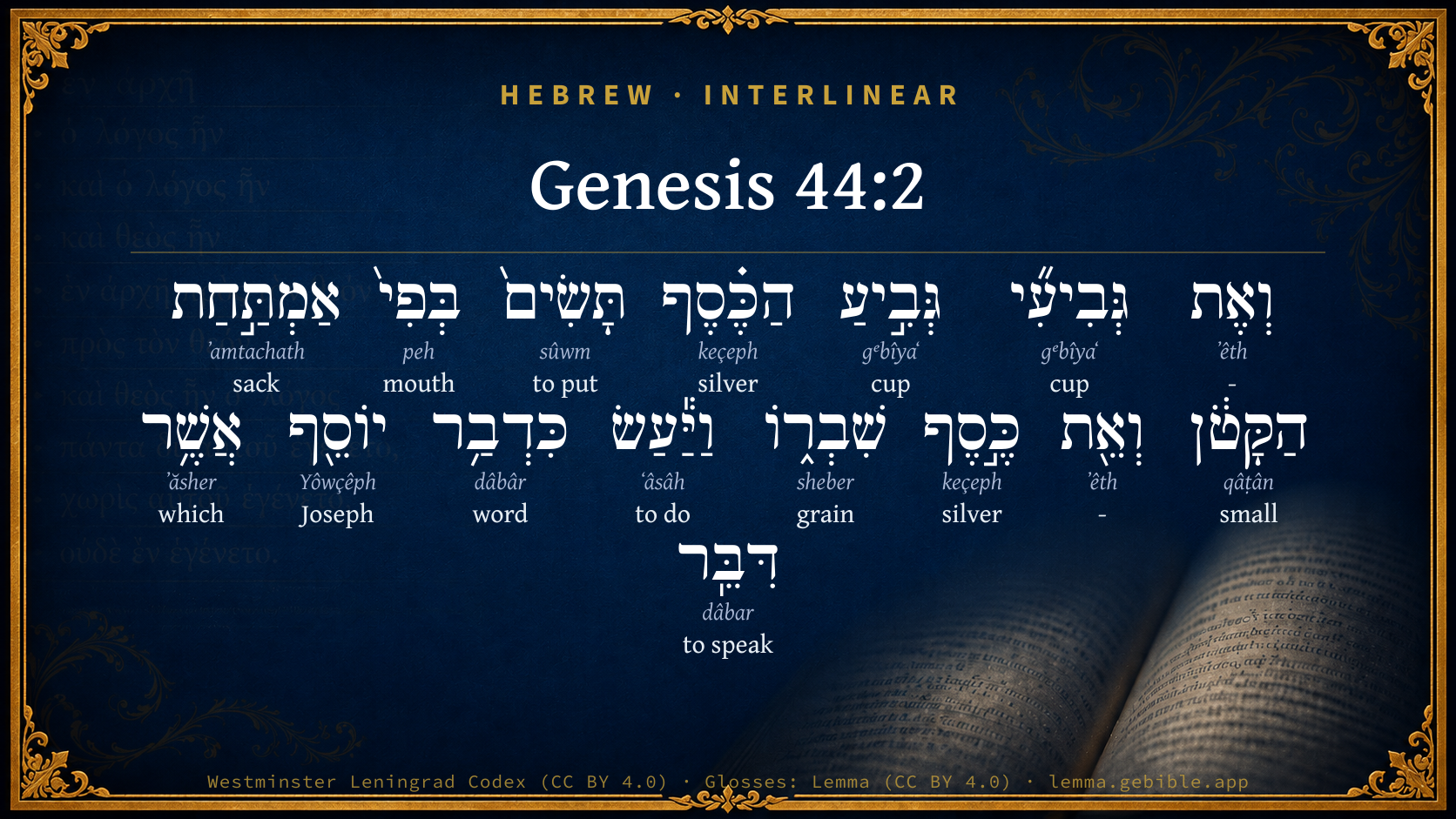
  1. וְאֶת ʼêth H853 “and · -” Conjunction + Particle, Direct Object
  2. גְּבִיעִ֞י gᵉbîyaʻ H1375 “cup · my” Noun, Common, Masculine, Singular, Construct + Suffix, Personal, 1st Person, Common, Singular
  3. גְּבִ֣יעַ gᵉbîyaʻ H1375 “cup of” Noun, Common, Masculine, Singular, Construct
  4. הַכֶּ֗סֶף keçeph H3701 “the · silver” Particle, Definite Article + Noun, Common, Masculine, Singular, Absolute
  5. תָּשִׂים֙ sûwm H7760 “to put” Verb, Qal, Imperfect, 2nd Person, Masculine, Singular
  6. בְּפִי֙ peh H6310 “in/at · mouth of” Preposition + Noun, Common, Masculine, Singular, Construct
  7. אַמְתַּ֣חַת ʼamtachath H572 “sack of” Noun, Common, Feminine, Singular, Construct
  8. הַקָּטֹ֔ן qâṭân H6996 “the · small” Particle, Definite Article + Adjective, Adjective, Masculine, Singular, Absolute
  9. וְאֵ֖ת ʼêth H853 “and · -” Conjunction + Particle, Direct Object
  10. כֶּ֣סֶף keçeph H3701 “silver of” Noun, Common, Masculine, Singular, Construct
  11. וַיַּ֕עַשׂ ʻâsâh H6213 “and · to do” Conjunction + Verb, Qal, Sequential Imperfect, 3rd Person, Masculine, Singular
  12. כִּדְבַ֥ר dâbâr H1697 “like/as · word of” Preposition + Noun, Common, Masculine, Singular, Construct
  13. יוֹסֵ֖ף Yôwçêph H3130 “Joseph” Noun, Proper
  14. אֲשֶׁ֥ר ʼăsher H834 “which” Particle, Relative
  15. דִּבֵּֽר dâbar H1696 “to speak” Verb, Piel, Perfect, 3rd Person, Masculine, Singular

About this verse

These counts appear in no published source. They are computed here, from the morphology-tagged text and Lemma’s own curated glosses. What Lemma adds →

16
words
13
distinct lemmas
Pentateuch
section

Notable vocabulary

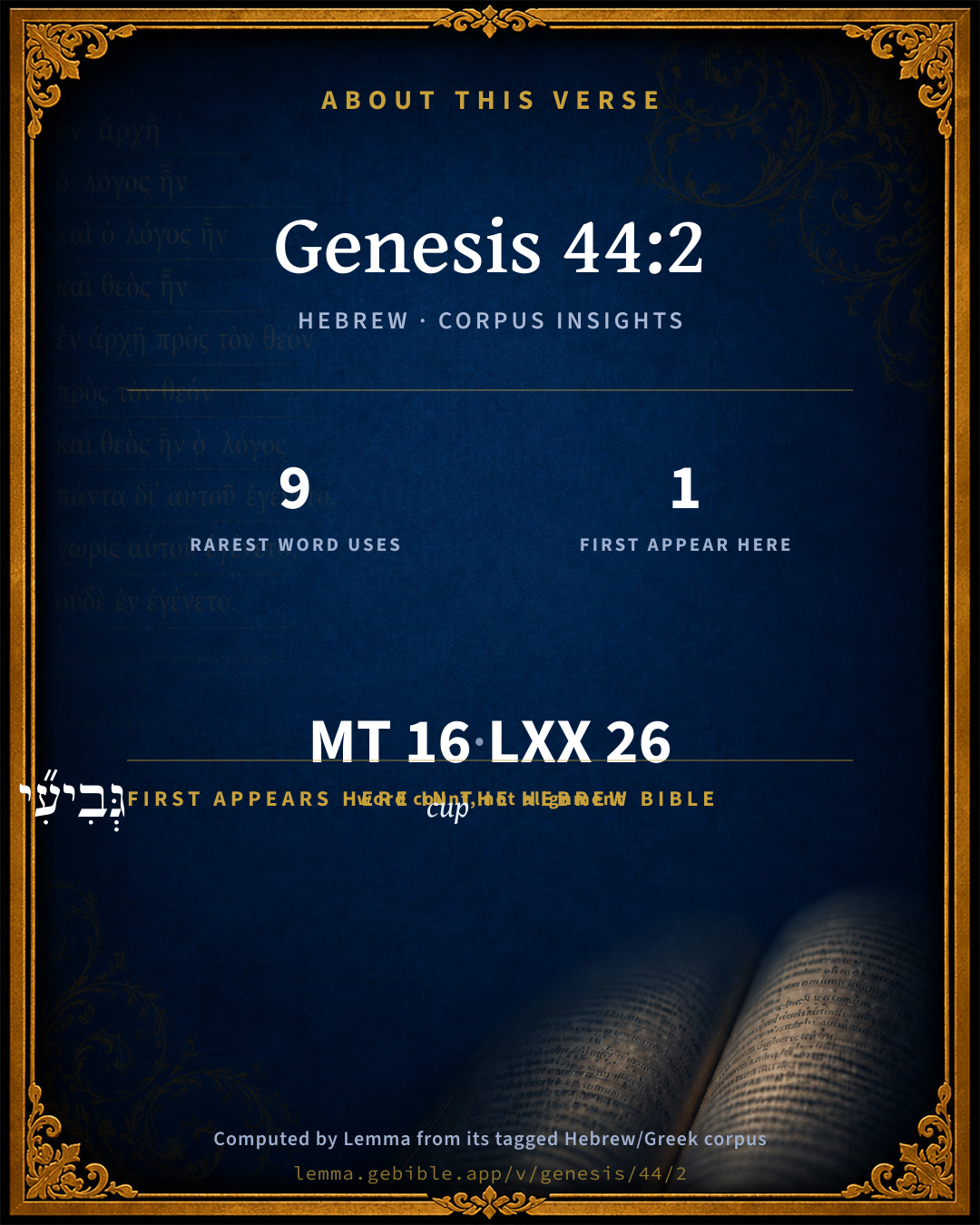
The rarest word here is שִׁבְר֑וֹ grain H7668 — appearing just 9 times in the whole Hebrew Bible.

First appearance in Scripture

This word makes its first canonical appearance in the Hebrew Bible here:

  • גְּבִיעִ֞י cup H1375

Shared distinctive vocabulary

שִׁבְר֑וֹ grain H7668 occurs in 9 verses of the Hebrew Bible. Also found in:

Grammatical profile

  • 3 verbs
  • 9 nouns
  • 1 adjective
  • 3 particles

Verb forms

  • תָּשִׂים֙ Qal · Imperfect
  • וַיַּ֕עַשׂ Qal · Sequential Imperfect
  • דִּבֵּֽר Piel · Perfect

Repetition

Words recur within this verse — often emphatic in Hebrew:

  • גְּבִיעִ֞י cup H1375 ×2
  • הַכֶּ֗סֶף silver H3701 ×2

Hebrew & Septuagint length

In English translation the verse runs 27 words from the Hebrew and 30 from the Septuagint (LXX English) — closely comparable.

A rough comparison of the two English renderings, which tokenize alike — not a word-level alignment.

Word counts can differ between the Hebrew and the Greek without any difference in meaning — e.g. the Hebrew direct-object marker אֵת has no separate Greek word, and Greek often adds the article ὁ.

In the original languages it is 16 Hebrew tokens and 26 Greek tokens — but the two are counted differently (Hebrew bundles its prefixes and suffixes into one token; the Greek is in lemma form), so that isn’t a like-for-like length.

Cross-references

8

Topical passages linked to Genesis 44:2 in the Treasury of Scripture Knowledge — connected by theme and wording, ordered by reader-vote popularity; previews shown in the World English Bible.

  • 2 Corinthians 8:8 I speak not by way of commandment, but as proving through the earnestness of others the sincerity also of your love.
  • Genesis 42:15–16 Hereby you shall be tested. By the life of Pharaoh you shall not go forth from here, unless your youngest brother come here.
  • Genesis 42:20 Bring your youngest brother to me; so will your words be verified, and you won't die." They did so.
  • Genesis 43:32 They served him by himself, and them by themselves, and the Egyptians, that ate with him, by themselves, because the Egyptians don't eat bread with the Hebrews, for that is an abomination to the Egyptians.
  • Deuteronomy 8:2 You shall remember all the way which Yahweh your God has led you these forty years in the wilderness, that he might humble you, to prove you, to know what was in your heart, whether you would keep his commandments, or not.
  • Deuteronomy 8:16 who fed you in the wilderness with manna, which your fathers didn't know; that he might humble you, and that he might prove you, to do you good at your latter end:
  • Deuteronomy 13:3 you shall not listen to the words of that prophet, or to that dreamer of dreams: for Yahweh your God proves you, to know whether you love Yahweh your God with all your heart and with all your soul.
  • Matthew 10:16 "Behold, I send you out as sheep in the midst of wolves. Therefore be wise as serpents, and harmless as doves.

Cross-references courtesy of OpenBible.info (CC BY 4.0).

Hebrew and Greek witnesses Masoretic Hebrew ↔ Greek Septuagint

The same verse in the two great witnesses to the Old Testament, shown verse-for-verse.

These are two independent witnesses, not word-aligned to each other, and the Septuagint is shown in lemma (dictionary) form.

Hebrew Genesis 44:2 Masoretic · Westminster Leningrad Codex

וְאֶת גְּבִיעִ֞י גְּבִ֣יעַ הַכֶּ֗סֶף תָּשִׂים֙ בְּפִי֙ אַמְתַּ֣חַת הַקָּטֹ֔ן וְאֵ֖ת כֶּ֣סֶף שִׁבְר֑וֹ וַיַּ֕עַשׂ כִּדְבַ֥ר יוֹסֵ֖ף אֲשֶׁ֥ר דִּבֵּֽר

Put my cup, the silver cup, in the sack's mouth of the youngest, with his grain money." He did according to the word that Joseph had spoken.

World English Bible · Public Domain

Greek LXX Genesis 44:2 Septuagint · lemma form

καί ὁ κόνδυ ἐγώ ὁ ἀργυροῦς ἐνβάλλω εἰς ὁ μάρσιππος ὁ νέος καί ὁ τιμή ὁ σῖτος αὐτός γίγνομαι δέ κατά ὁ ῥῆμα ιωσηφ καθώς εἶπον

And put my silver cup into the sack of the youngest, and the price of his corn. And it was done according to the word of Joseph, as he said.

LXX2012 (modern English Septuagint) · Public Domain

On this verse, The Cambridge Bible for Schools and Colleges discusses the Septuagint’s reading. Read the note in Commentary ↓

Hebrew: Westminster Leningrad Codex (CC BY 4.0). Greek: Septuagint (public domain); English from LXX2012 (modern English Septuagint) (Public Domain). How the Septuagint differs from the Hebrew →

Targum (Aramaic paraphrase)

2

The Targum is the ancient Jewish Aramaic paraphrase of the Hebrew Scriptures — an interpretive translation, not the Hebrew text itself. Onkelos (literal) and Pseudo-Jonathan (expansive) render the Torah, and Jonathan the Prophets. Coverage is partial: where no permissively-licensed English translation exists for a verse, only the Aramaic is shown. This is verse-level text, not a word-by-word alignment to the Hebrew.

  1. Targum Onkelos Torah (Genesis–Deuteronomy)
    וְיָת כַּלִּידִי כַּלִּידָא דְכַסְפָּא תְּשַׁוֵּי בְּפוּם טוֹעֲנָא דִּזְעֵירָא וְיָת כְּסַף זְבִינוֹהִי וַעֲבַּד כְּפִתְגָּמָא דְּיוֹסֵף דִּי מַלִּיל

    (no public-domain English translation for this verse)

    Targum Onkelos — Aramaic: “Onkelos Genesis” (public domain); “Onkelos Exodus” (public domain); “Onkelos Leviticus” (public domain); “Onkelos Numbers” (public domain); “Onkelos Deuteronomy” (public domain). English: “Sefaria Community Translation” (CC0 1.0 (public-domain dedication)); “J.W. Etheridge. The Targums of Onkelos and Jonathan Ben Uzziel on the Pentateuch. London: Longmans, Green, 1862” (public domain). Text via Sefaria.

  2. Targum Pseudo-Jonathan Torah (Genesis–Deuteronomy)
    וְיַת אוֹגְבִינִי אוֹגְבִין דְכַסְפָּא שַׁוֵי בְּפוּם טוֹנָא דִזְעֵירָא וְיַת כְּסַף זַבִּינוֹי וְעָבַד כְּפִתְגָמָא דְיוֹסֵף דְמַלֵיל

    And put my cup, the silver cup, in the mouth of the sack of the youngest, and his purchase money. And he did according to the word which Joseph had spoken.

    Targum Pseudo-Jonathan — Aramaic: “Targum Jonathan on Genesis” (public domain); “Targum Jonathan on Exodus” (public domain); “Targum Jonathan on Leviticus” (public domain); “Targum Jonathan on Numbers” (public domain); “Targum Jonathan on Deuteronomy” (public domain). English: “The Targum of Jonathan ben Uzziel, trans. J. W. Etheridge, London, 1862” (public domain). Text via Sefaria.

Commentary

Notes on Genesis 44:2 from classic Christian and Jewish commentators (each source and its license shown beneath its notes). The classic Christian expositions comment on the surrounding passage and are grouped to its opening verse, so a note may address several verses; the Jewish commentaries on the Tanakh (Rashi and others) are per-verse, so they appear only where the commentator wrote on this verse.

Lemma curates 59 commentaries, every one of them public domain or Creative Commons licensed, each selected and text-cleaned for this edition rather than reprinted as found. About our sources →

Trapp's Complete Commentary

John Trapp

Gen 44:2 And put my cup, the silver cup, in the sack’s mouth of the youngest, and his corn money. And he did according to the word that Joseph had spoken.

Ver. 2. He did according to the word.] Servus est nomen officii. A servant is not αυτοματος, one that moveth absolutely of himself, saith Aristotle; but the master’s instrument, and ολως εκεινου, wholly his. Such was this servant of Joseph; and such should we all be to God.

John Trapp, A Commentary or Exposition upon All the Books of the Old and New Testament (1647–1656) — public domain. Text from a community e-Sword module.

Joseph Benson's Commentary

Gen 44:2. Put my cup, the silver cup — Probably a large cup of great value, and much used by Joseph; in the sack’s mouth of the youngest — Hereby, it seems, Joseph meant to try his brethren’s affection to Benjamin, whether they would assist him in his extremity, and also their regard for their father, whether they would willingly give up and leave in confinement his favourite son. Had they hated Benjamin as they had Joseph, and been influenced by the same unfeeling disposition as they formerly were toward their father, they certainly would have discovered themselves on this occasion: and no doubt Joseph would have taken his measures in dealing with them accordingly.

Joseph Benson's Commentary on the Old and New Testaments (1811–1818) — public domain. Text from a community e-Sword module.

Tyndale Open Study Notes

Tyndale Open Resources

44:2 Joseph was giving his brothers the chance to abandon Benjamin if they wanted to. Joseph was testing them to see if they were loyal to the family and faithful to their father.

Tyndale Open Study Notes — © Tyndale Open Resources, licensed CC BY-SA 4.0. Text via the HelloAO Bible API.

Geneva Bible (1599)

Geneva Bible translators

We may not by this example use any unlawful practices, seeing God hath commanded us to walk in simplicity.

Geneva Bible (1599) marginal notes — public domain. Text via Bolls.life.

Jamieson, Fausset & Brown

Robert Jamieson, A. R. Fausset & David Brown

put my cup, the silver cup, in the sack's mouth--It was a large goblet, as the original denotes, highly valued by its owner, on account of its costly material or its elegant finish and which had probably graced his table at the sumptuous entertainment of the previous day.

Jamieson, Fausset & Brown — Commentary Critical and Explanatory on the Whole Bible (1871) — public domain (CC PDM 1.0). Text via the HelloAO Bible API.

Adam Clarke's Commentary

Verse 2. Put my cup in the sack's mouth of the youngest] The stratagem of the cup seems to have been designed to bring Joseph's brethren into the highest state of perplexity and distress, that their deliverance by the discovery that Joseph was their brother might have its highest effect.

Adam Clarke's Commentary on the Bible (1810–1826) — public domain. Text from a community e-Sword/MySword module.

John Calvin's Commentaries

2. And put my cup, the silver cup. It may seem wonderful that, considering his great opulence, Joseph had not rather drunk out of a golden cup. Doubtless, either the moderation of that age was still greater than has since prevailed, and the splendor of it less sumptuous; or else this conduct must be attributed to the moderation of the man, who, in the midst of universal license, yet was contented with a plain and decent, rather than with a magnificent style of living. Unless, perhaps, on account of the excellence of the workmanship, the silver was more valuable than gold: as it is manifest from secular history, that the workmanship has often been more expensive than the material itself. It is, however, probable, that Joseph was sparing in domestic splendor, for the sake of avoiding envy. For unless he had been prudently on his guard, a contention would have arisen between him and the courtiers, resulting from a spirit of emulation. Moreover, he commands the cup to be enclosed in Benjamin’s sack, in order that he might claim him as his own, when convicted of the theft, and might send the rest away: however, he accuses all alike, as if he knew not who among them had committed the crime. And first, he reproves their ingratitude, because, when they had been so kindly received, they made the worst possible return; next, he contends that the crime was inexpiable, because they had stolen what was most valuable to him; namely, the cup in which he was accustomed both to drink and to divine. And he does this through his steward, whom he had not trained to acts of tyranny and violence. Whence I infer, that the steward was not altogether ignorant of his master’s design.

John Calvin's Commentaries (1540-1563) — public domain. Text from the Calvin Translation Society English edition (1840s-50s) via the Christian Classics Ethereal Library (ccel.org). Calvin's coverage is partial (roughly two-thirds of the Bible); uncommented books and verses are honest gaps, never fabricated. The 19th-century editor's footnotes and remarks are omitted so the notes are faithfully Calvin's own voice.

The Cambridge Bible for Schools and Colleges

gen. ed. J. J. S. Perowne

2. the silver cup] i.e. a well-known, or favourite, goblet. The word for “cup,” the same as in Exo_25:31, Jer_35:5 (where it is rendered “bowl”), seems to denote a vessel shaped like the calyx of a flower. LXX renders κόνδυ; Lat. scyphum.

Observe that Joseph does not reveal his intention to the steward. He plays upon his brethren the same trick as in chap. 42; but brings matters to a point by associating Benjamin with the loss of the cup.

The Cambridge Bible for Schools and Colleges (gen. ed. J. J. S. Perowne; Cambridge University Press, 1878–1918) — public domain. Text from a community e-Sword module.

John Gill's Exposition

And put my cup, the silver cup, in the sack's mouth of the youngest,.... Benjamin; this he ordered to be done, partly to put him in apparent danger, and try how his brethren would behave towards him in such circumstances, and thereby know how they stood affected to him; and partly that he might have an excuse for retaining him with him. This cup was valuable both for the matter of it, being of silver, and for the use of it, being what Joseph himself drank out of: and by the word used to express it, it seems to have been a large embossed cup, a kind of goblet, for it has the signification of a little hill. Jarchi says it was a long cup, which they called "mederno". The Septuagint render it by "condy", which is said to be a Persian word, and a kind of an Attalic cup, that held ten cotylae (g), or four or five quarts, and weighed ninety ounces; but a cup so large seems to be too large to drink out of:

and his corn money; what he had paid for his corn:

and he did according to the word that Joseph had spoken; put every man's money in the mouth of his sack, and his silver cup with the corn money into Benjamin's sack.

(g) Nicomachus de festis Aegypt. apud Athenaeum, l. 11. c. 7.

John Gill's Exposition of the Whole Bible (1746–1763) — public domain (CC PDM 1.0). Text via the HelloAO Bible API.

Matthew Poole's English Annotations

It seems to have been a large cup, and of great price, and much used by Joseph.

In the sack’s mouth of the youngest, with design to discover their intentions and affections towards Benjamin, whether they did envy him, and would desert him in his danger, as they did Joseph; or would cleave to him; that hence he might take his measures how to deal with him and them.

Matthew Poole's English Annotations on the Holy Bible (1683–1685) — public domain. Text from a community e-Sword/MySword module.

Rashi

Rabbi Shlomo Yitzchaki (Rashi)

גביעי MY CUP — a long goblet called maderin in old French.

Rashi on the Tanakh — English translations: “The Judaica Press complete Tanach with Rashi, translated by A. J. Rosenberg” (CC BY 4.0); “Pentateuch with Rashi's commentary by M. Rosenbaum and A.M. Silbermann, 1929-1934” (public domain); “The Metsudah Tanach series, Lakewood, N.J” (CC BY 4.0); and “The Book of Joshua, Metsudah Publications, 1997” (CC BY 4.0). Text via Sefaria.

Lesson kit

Teaching starters — assembled from the data on this page, not authored interpretation. Every prompt links to the verse data it draws on. Edit before teaching.

Genesis, in the Pentateuch, opens this verse with 16 words (13 distinct Hebrew lemmas). Its most distinctive word is sheber (“grain”). A historical commentator’s framing appears above. Read the whole chapter for the surrounding context.

Discussion questions

  1. The word sheber carries the sense “grain.” How does it shape the verse?
  2. The word “cup” first appears here in Scripture. What is being introduced at this debut?
  3. Genesis 42:1 shares the word «grain» with this verse. How do the two illuminate each other?
  4. “cup” occurs 2× in this one verse. What is the effect of the repetition?
  5. These translations render this verse differently. What is at stake in choosing one wording over another?
  6. The verb «תָּשִׂים֙» is Qal Imperfect. How does its form color the action?
  7. Reading how Trapp's Complete Commentary and Joseph Benson's Commentary read this verse, where do the two commentators agree and where do they part?

Things to notice

Reading settings

Reading text

Shown beneath each verse's original-language words.

Old Testament
Old Testament edition

Read the OT as the Masoretic Hebrew (MT) or the Greek Septuagint (LXX).

English shown for the Greek Septuagint (in the Hebrew ↔ Greek comparison).

Comparing translations? Open the Compare panel on any verse page to stack up to four side by side.