Judges 5:19

Hebrew (Westminster Leningrad Codex) Judges 5:19 appears in the Hebrew Old Testament. The text above is from the Westminster Leningrad Codex. Each word links to its Strong’s number, a concise gloss, and parsing drawn from the Open Scriptures Hebrew Bible morphology. Click any word for its full Brown-Driver-Briggs (BDB) entry.
Download image
Cite this verse

Judges 5:19 (World English Bible). Public Domain. Lemma interlinear Bible study tool, https://lemma.gebible.app/v/judges/5/19.

Show BibTeX & RIS
BibTeX
RIS
English Translation
The kings came and fought; Then fought the kings of Canaan. In Taanach by the waters of Megiddo: They took no gain of money.
World English Bible · Public Domain
Download a study sheet

One document with this verse’s original text, its word-by-word gloss line, the meaning frame, cross-references with their text, attributed commentary, and full source and license credits — printable, and it pastes into notes with its structure intact.

This verse Autodidact and up

Study sheet (.html) Plain text (.txt)

A passage Seminary Student

Up to 50 verses in one chapter. A passage sheet keeps up to 6 commentary sources and 12 cross-references per verse, in the order this page ranks them, and says so on the sheet whenever that leaves anything out. Ask for a single verse and you get the Autodidact verse sheet above.

Everything on this page stays free to read, with no account — the sheet is a download of what is already on screen, not access to it.

Want to remove ads? Support Godless Engineer
Compare translations 3

The same verse in 3 English versions, stacked beneath the original-language interlinear above. Click any original word for its lexicon entry.

Each is an independent rendering of the whole verse — the interlinear is not word-aligned to these translations.

Highlighted words mark where these versions differ — a whole-verse word diff, not a word-by-word alignment.

  • World English Bible Public Domain
    The kings came and fought; Then fought the kings of Canaan. In Taanach by the waters of Megiddo: They took no gain of money.
  • King James Version Public Domain
    The kings came and fought, then fought the kings of Canaan in Taanach by the waters of Megiddo; they took no gain of money.
  • unfoldingWord Literal Text CC BY-SA 4.0
    Kings came, they fought; then the kings of Canaan fought at Taanach, by the waters of Megiddo. Plunder of silver they did not take.

unfoldingWord Literal Text — © unfoldingWord, licensed CC BY-SA 4.0. Word-aligned USFM3 via Door43 (git.door43.org/unfoldingWord/en_ult).

Versions to compare (up to 4)

3 of 4 selected

Show all 18 translations

Every available English version of this verse, each an independent rendering of the whole verse.

  • World English Bible Public Domain
    The kings came and fought; Then fought the kings of Canaan. In Taanach by the waters of Megiddo: They took no gain of money.
  • Berean Standard Bible Public Domain
    Kings came and fought; then the kings of Canaan fought at Taanach by the waters of Megiddo, but they took no plunder of silver.
  • Majority Standard Bible Public Domain
    Kings came and fought; then the kings of Canaan fought at Taanach by the waters of Megiddo, but they took no plunder of silver.
  • King James Version Public Domain
    The kings came and fought, then fought the kings of Canaan in Taanach by the waters of Megiddo; they took no gain of money.
  • American Standard Version (1901) Public Domain
    The kings came and fought; Then fought the kings of Canaan. In Taanach by the waters of Megiddo: They took no gain of money.
  • Revised Version (1885) Public Domain
    The kings came and fought; then fought the kings of Canaan; in Taanach by the waters of Meggido: they took no gain of money.
  • Geneva Bible (1599) Public Domain
    The Kings came and fought: then fought the Kings of Canaan in Taanach by the waters of Megiddo: they receiued no gaine of money.
  • Douay-Rheims (1899) Public Domain
    The kings came and fought, the kings of Chanaan fought in Thanach by the waters of Mageddo, and yet they took no spoils.
  • Young's Literal Translation Public Domain
    Kings came -- they fought; Then fought kings of Canaan, In Taanach, by the waters of Megiddo; Gain of money they took not!
  • Literal Standard Version CC BY-SA 4.0
    Kings came—they fought; Then kings of Canaan fought, || In Taanach, by the waters of Megiddo; They did not take gain of money!
  • Unlocked Literal Bible CC BY-SA 4.0
    The kings came, they fought; the kings of Canaan fought at Taanach by the waters of Megiddo. But they took away no silver as plunder.
  • unfoldingWord Literal Text CC BY-SA 4.0
    Kings came, they fought; then the kings of Canaan fought at Taanach, by the waters of Megiddo. Plunder of silver they did not take.
  • Darby Bible Public Domain
    "The kings came, they fought; then fought the kings of Canaan, at Ta'anach, by the waters of Megid'do; they got no spoils of silver.
  • World Messianic Bible Public Domain
    “The kings came and fought, then the kings of Canaan fought at Taanach by the waters of Megiddo. They took no plunder of silver.
  • Webster's Bible Public Domain
    The kings came and fought, then fought the kings of Canaan in Tanach by the waters of Megiddo; they took no gain of money.
  • Free Bible Version CC BY-SA 4.0
    Kings came and fought, the Canaanite kings fought at Taanach near the waters of Megiddo, but they didn't get any silver plunder.
  • Bible in Basic English Public Domain
    The kings came on to the fight, the kings of Canaan were warring; in Taanach by the waters of Megiddo: they took no profit in money.
  • JPS Tanakh (1917) Public Domain
    The kings came, they fought; then fought the kings of Canaan, in Taanach by the waters of Megiddo; they took no gain of money.

Literal Standard Version (2020), Covenant Press — licensed CC BY-SA 4.0. Text via the HelloAO Bible API (eBible.org). Unlocked Literal Bible (unfoldingWord) — licensed CC BY-SA 4.0. Text via the HelloAO Bible API (eBible.org). unfoldingWord Literal Text — © unfoldingWord, licensed CC BY-SA 4.0. Word-aligned USFM3 via Door43 (git.door43.org/unfoldingWord/en_ult). Free Bible Version, Dr. Jonathan Gallagher — licensed CC BY-SA 4.0. Text via the HelloAO Bible API (eBible.org).

Word by word

More ways to search: Search by grammar → Find every occurrence → Compare this word →

Practice this passage: Drill this verse → Learn its vocabulary →

בְּתַעְנַ֖ךְ
Taʻănâk
H8590
“in/at · Taanach”
Preposition + Noun, Proper
Part of Speech
Preposition + Noun
Type
Proper
Full BDB Definition

Origin: of uncertain derivation

TWOT: None

Taanach or Tanach = "sandy" - an ancient Canaanite city conquered by Joshua and allotted to the half tribe of Manasseh although in the territory of Issachar; given to the Kohathite Levites; located on the west of the Jordan and near the waters of Megiddo
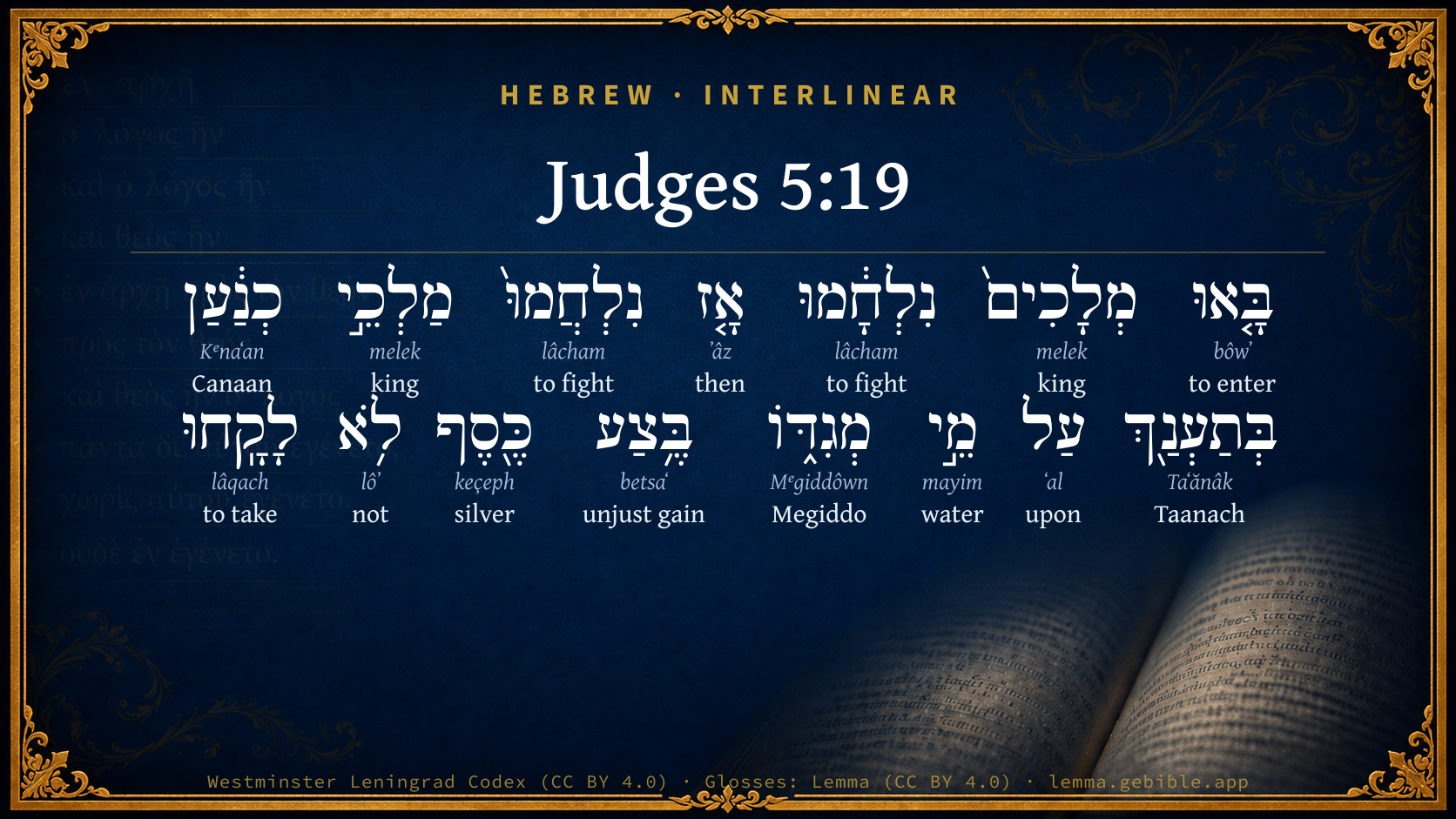
  1. בָּ֤אוּ bôwʼ H935 “to enter” Verb, Qal, Perfect, 3rd Person, Common, Plural
  2. מְלָכִים֙ melek H4428 “kings” Noun, Common, Masculine, Plural, Absolute
  3. נִלְחָ֔מוּ lâcham H3898 “to fight” Verb, Niphal, Perfect, 3rd Person, Common, Plural
  4. אָ֤ז ʼâz H227 “then” Adverb
  5. נִלְחֲמוּ֙ lâcham H3898 “to fight” Verb, Niphal, Perfect, 3rd Person, Common, Plural
  6. מַלְכֵ֣י melek H4428 “kings of” Noun, Common, Masculine, Plural, Construct
  7. כְנַ֔עַן Kᵉnaʻan H3667 “Canaan” Noun, Proper
  8. עַל ʻal H5921 “upon” Preposition
  9. מֵ֣י mayim H4325 “water(s) of” Noun, Common, Masculine, Plural, Construct
  10. מְגִדּ֑וֹ Mᵉgiddôwn H4023 “Megiddo” Noun, Proper
  11. בֶּ֥צַע betsaʻ H1215 “unjust gain of” Noun, Common, Masculine, Singular, Construct
  12. כֶּ֖סֶף keçeph H3701 “silver” Noun, Common, Masculine, Singular, Absolute
  13. לֹ֥א lôʼ H3808 “not” Particle, Negative
  14. לָקָֽחוּ lâqach H3947 “to take” Verb, Qal, Perfect, 3rd Person, Common, Plural

About this verse

These counts appear in no published source. They are computed here, from the morphology-tagged text and Lemma’s own curated glosses. What Lemma adds →

15
words
13
distinct lemmas
Historical
section

Notable vocabulary

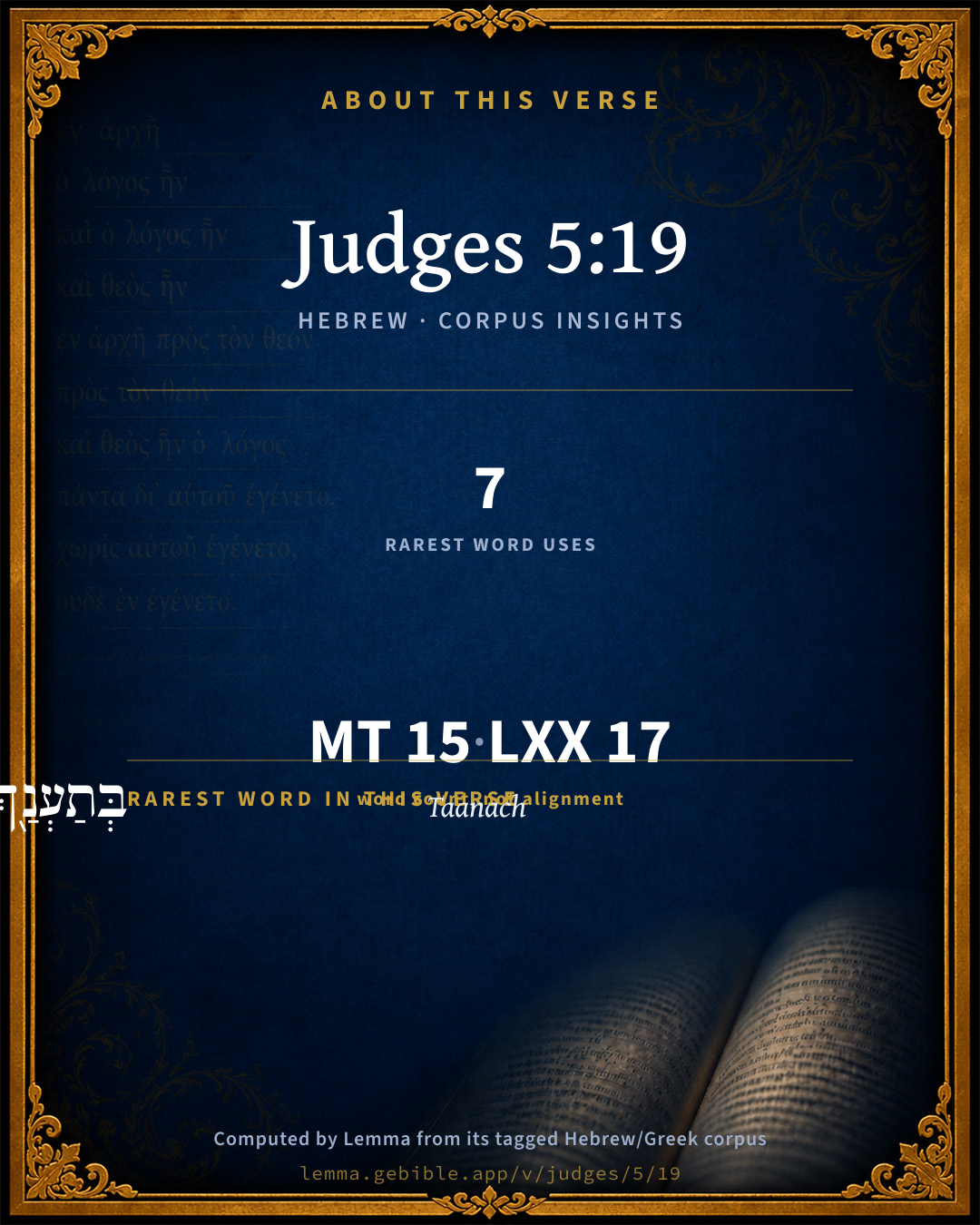
The rarest word here is בְּתַעְנַ֖ךְ Taanach H8590 — appearing just 7 times in the whole Hebrew Bible.

Shared distinctive vocabulary

בְּתַעְנַ֖ךְ Taanach H8590 occurs in 7 verses of the Hebrew Bible. Also found in:

Grammatical profile

  • 4 verbs
  • 8 nouns
  • 1 preposition
  • 1 adverb
  • 1 particle

Verb forms

  • בָּ֤אוּ Qal · Perfect
  • נִלְחָ֔מוּ Niphal · Perfect
  • נִלְחֲמוּ֙ Niphal · Perfect
  • לָקָֽחוּ Qal · Perfect

Repetition

Words recur within this verse — often emphatic in Hebrew:

  • מְלָכִים֙ king H4428 ×2
  • נִלְחָ֔מוּ to fight H3898 ×2

Hebrew & Septuagint length

In English translation the verse runs 24 words from the Hebrew and 24 from the Septuagint (LXX English) — the same length.

A rough comparison of the two English renderings, which tokenize alike — not a word-level alignment.

Word counts can differ between the Hebrew and the Greek without any difference in meaning — e.g. the Hebrew direct-object marker אֵת has no separate Greek word, and Greek often adds the article ὁ.

In the original languages it is 15 Hebrew tokens and 17 Greek tokens — but the two are counted differently (Hebrew bundles its prefixes and suffixes into one token; the Greek is in lemma form), so that isn’t a like-for-like length.

Cross-references

14

Topical passages linked to Judges 5:19 in the Treasury of Scripture Knowledge — connected by theme and wording, ordered by reader-vote popularity; previews shown in the World English Bible.

  • Judges 1:27 Manasseh did not drive out [the inhabitants of] Beth-shean and its towns, nor [of] Taanach and its towns, nor the inhabitants of Dor and its towns, nor the inhabitants of Ibleam and its towns, nor the inhabitants of Megiddo and its towns; but the Canaanites would dwell in that land.
  • Judges 5:30 Have they not found, have they not divided the spoil? A lady, two ladies to every man; To Sisera a spoil of dyed garments, A spoil of dyed garments embroidered, Of dyed garments embroidered on both sides, on the necks of the spoil?
  • 1 Kings 4:12 Baana the son of Ahilud, in Taanach and Megiddo, and all Beth-shean which is beside Zarethan, beneath Jezreel, from Beth-shean to Abel Meholah, as far as beyond Jokmeam;
  • Genesis 4:16 Cain went out from Yahweh's presence, and dwelt in the land of Nod, on the east of Eden.
  • Genesis 14:22 Abram said to the king of Sodom, "I have lifted up my hand to Yahweh, God Most High, possessor of heaven and earth,
  • Joshua 10:22–27 Then said Joshua, Open the mouth of the cave, and bring forth those five kings to me out of the cave.
  • Joshua 11:1–15 It happened, when Jabin king of Hazor heard of it, that he sent to Jobab king of Madon, and to the king of Shimron, and to the king of Achshaph,
  • Judges 4:13 Sisera gathered together all his chariots, even nine hundred chariots of iron, and all the people who were with him, from Harosheth of the Gentiles, to the river Kishon.
  • Psalms 44:12 You sell your people for nothing, And have gained nothing from their sale.
  • Psalms 48:4–6 For, behold, the kings assembled themselves, They passed by together.
  • Psalms 68:12–14 "Kings of armies flee! They flee!" She who waits at home divides the spoil,
  • Psalms 118:8–12 It is better to take refuge in Yahweh, Than to put confidence in man.
  • Revelation 17:12–14 The ten horns that you saw are ten kings who have received no kingdom as yet, but they receive authority as kings, with the beast, for one hour.
  • Revelation 19:19 I saw the beast, and the kings of the earth, and their armies, gathered together to make war against him who sat on the horse, and against his army.

Cross-references courtesy of OpenBible.info (CC BY 4.0).

Hebrew and Greek witnesses Masoretic Hebrew ↔ Greek Septuagint

The same verse in the two great witnesses to the Old Testament, shown verse-for-verse.

These are two independent witnesses, not word-aligned to each other, and the Septuagint is shown in lemma (dictionary) form.

Hebrew Judges 5:19 Masoretic · Westminster Leningrad Codex

בָּ֤אוּ מְלָכִים֙ נִלְחָ֔מוּ אָ֤ז נִלְחֲמוּ֙ מַלְכֵ֣י כְנַ֔עַן בְּתַעְנַ֖ךְ עַל מֵ֣י מְגִדּ֑וֹ בֶּ֥צַע כֶּ֖סֶף לֹ֥א לָקָֽחוּ

The kings came and fought; Then fought the kings of Canaan. In Taanach by the waters of Megiddo: They took no gain of money.

World English Bible · Public Domain

Greek LXX Judges 5:19 Septuagint · lemma form

ἔρχομαι αὐτός βασιλεύς παρατάσσω τότε πολεμέω βασιλεύς χανααν ἐν θανααχ ἐπί ὕδωρ μεγεδδω δῶρον ἀργύριον οὐ λαμβάνω

Kings set themselves in array, then the kings of Chanaan fought in Thanaach at the water of Mageddo; they took no gift of money.

LXX2012 (modern English Septuagint) · Public Domain

Hebrew: Westminster Leningrad Codex (CC BY 4.0). Greek: Septuagint (public domain); English from LXX2012 (modern English Septuagint) (Public Domain). How the Septuagint differs from the Hebrew →

Targum (Aramaic paraphrase)

1

The Targum is the ancient Jewish Aramaic paraphrase of the Hebrew Scriptures — an interpretive translation, not the Hebrew text itself. Onkelos (literal) and Pseudo-Jonathan (expansive) render the Torah, and Jonathan the Prophets. Coverage is partial: where no permissively-licensed English translation exists for a verse, only the Aramaic is shown. This is verse-level text, not a word-by-word alignment to the Hebrew.

  1. Targum Jonathan Prophets (Joshua–Malachi)
    אֲתוֹ מַלְכַיָא דַהֲווֹ עִם סִיסְרָא וְאַגִיחוּ קְרָבָא בְּכֵן אֲגִיחוּ קְרָבָא מַלְכֵי כְנַעַן בְּתַעְנָךְ הֲווֹ שָׁרָן וּמָטָן עַל מֵי מְגִדוֹ מָמוֹן דִכְסַף לָא קַבִּילוּ:

    (no public-domain English translation for this verse)

    Targum Jonathan — Aramaic: “Mikraot Gedolot” (public domain). English: “Sefaria Community Translation” (CC0 1.0 (public-domain dedication)); “London "Chaldee Paraphrase," 1871” (public domain). Text via Sefaria.

Commentary

Notes on Judges 5:19 from classic Christian and Jewish commentators (each source and its license shown beneath its notes). The classic Christian expositions comment on the surrounding passage and are grouped to its opening verse, so a note may address several verses; the Jewish commentaries on the Tanakh (Rashi and others) are per-verse, so they appear only where the commentator wrote on this verse.

Lemma curates 59 commentaries, every one of them public domain or Creative Commons licensed, each selected and text-cleaned for this edition rather than reprinted as found. About our sources →

Jamieson, Fausset & Brown

Robert Jamieson, A. R. Fausset & David Brown

describes the scene of battle and the issue. It would seem (Jdg 5:19) that Jabin was reinforced by the troops of other Canaanite princes. The battlefield was near Taanach (now Ta'annuk), on a tell or mound in the level plain of Megiddo (now Leijun), on its southwestern extremity, by the left bank of the Kishon.

they took no gain of money--They obtained no plunder.

Jamieson, Fausset & Brown — Commentary Critical and Explanatory on the Whole Bible (1871) — public domain (CC PDM 1.0). Text via the HelloAO Bible API.

Trapp's Complete Commentary

John Trapp

Jdg 5:19 The kings came [and] fought, then fought the kings of Canaan in Taanach by the waters of Megiddo; they took no gain of money.

Ver. 19. The kings came and fought.] They could combine, but so could not the Israelites. What a shame is it that the great Turk should be heard to say, that he sooner expected that his fingers should be all of one length than that the Christian princes should be all of one mind against him their common enemy.

They took no gain of money.] Desiderabile argentum non acceperunt, they served freely without pay, out of their love to the cause, and hopes of making themselves great gainers by the spoils of the Israelites. So George Fransperg, a general in the imperial army, under the conduct of Charles Bourbon, that sacked Rome in the time of Pope Clement VII, carried into Italy thirteen thousand soldiers of Germany, almost all Lutherans, with no other pay but of one crown apiece of his own goods, and a promise to lead them to Rome, where he would hang the Pope, and give them the spoil of the city. {a}

{a} Hist. of Council of Trent, 43.

John Trapp, A Commentary or Exposition upon All the Books of the Old and New Testament (1647–1656) — public domain. Text from a community e-Sword module.

Joseph Benson's Commentary

Jdg 5:19. The kings came and fought — There were divers petty kings in those parts who were subject to Jabin. Taanach and Megiddo were two eminent cities not far from mount Tabor, nor from the river Kishon. They took no gain of money — Some interpret this as meaning they fought without pay, whether from mere hatred of the Israelites, and a desire to be revenged on them, or from a full hope and confidence of paying themselves abundantly out of Israel’s spoils. But it may be intended as a sarcasm upon the kings of Canaan for their lucrative views in fighting against Israel. They came to the help of Jabin for lucre’s sake; namely, to enrich themselves with the spoils; but the Israelites fought for liberty.

Joseph Benson's Commentary on the Old and New Testaments (1811–1818) — public domain. Text from a community e-Sword module.

Geneva Bible (1599)

Geneva Bible translators

They won nothing, but lost all.

Geneva Bible (1599) marginal notes — public domain. Text via Bolls.life.

Adam Clarke's Commentary

Verse 19. The kings came and fought] It is conjectured that Jabin and his confederates had invaded Manasseh, as both Taanach and Megiddo were in that tribe: and that they were discomfited by the tribes of Zebulun and Naphtali at Taanach and Megiddo; while Barak defeated Sisera at Mount Tabor.

They took no gain of money] They expected much booty in the total rout of the Israelites; but they were defeated, and got no prey; or, if applied to the Israelites, They fought for liberty, not for plunder.

Adam Clarke's Commentary on the Bible (1810–1826) — public domain. Text from a community e-Sword/MySword module.

Ellicott's Commentary for English Readers

(19) The kings.—Comp. Jos_11:1. Jabin did not stand alone.

In Taanach.—See Jdg_1:27. The word means “sandy soil.”

By the waters of Megiddo.—The affluents of the Kishon, or the swollen waves of the river itself. There is a copious spring at Lejjûn, the ancient Megiddo, which in rainy seasons rapidly turns the plain into a morass (Thomson’s Land and Book. ch. 29).

They took no gain of money.—Literally, fragment of silver they did not take. They had doubtless hoped, if not for much actual spoil, at least for ransom from the numerous captives which they expected to win, or from the gain derived by selling them into slavery.

A Bible Commentary for English Readers, edited by Charles John Ellicott (1878–1897) — public domain. Text from a community e-Sword module.

The Cambridge Bible for Schools and Colleges

gen. ed. J. J. S. Perowne

19. the kings of Canaan] the chiefs of the principal Canaanite cities in the Plain and neighbourhood; Sisera, if not their overlord, was their leader. The kings of Canaan are mentioned in the Amarna letters, e.g. 101, 13; cf. Jos_5:1, and contrast the unhistorical term king of C. in ch. Jdg_4:2 n.

Taanach … Megiddo] See on Jdg_1:27; the waters of M. are the Kishon. The two towns are on the left bank of the river; ch. 4 rather implies that the battle took place at the foot of Tabor, which is about 15 m. from Taanach, cf. Jdg_4:14.

They took no gain of money] They expected spoil (Jdg_5:30, cf. Exo_15:9), but their expectations were disappointed.

19–22. The battle.

The Cambridge Bible for Schools and Colleges (gen. ed. J. J. S. Perowne; Cambridge University Press, 1878–1918) — public domain. Text from a community e-Sword module.

John Gill's Exposition

The kings came,.... Who were with Sisera, as the Targum adds; unless Deborah can be thought to refer to the battle, supposed to be fought about the same place, between Joshua and the kings in confederacy with Jabin, Jos 10:1.

then fought the kings of Canaan in Taanach by the waters of Megiddo; the other kings of Canaan, which came into the assistance of Jabin, either in the times of Joshua; or rather which now joined Sisera's army, in those places, which both belonged to Manasseh, but were in the tribe of Issachar, of which See Gill on Jos 17:11 and were at some distance from each other, as appears by the villages and country around, and belonging to each; and such was the largeness of Sisera's army, reinforced by those kings, that according to the Targum it reached from Taanach to Megiddo; the same is observed by the Jewish commentators; the waters of Megiddo are the same with the river Kishon, which ran near the city:

they took no gain of money; that is, either of Jabin king of Canaan, whom they came to serve; but freely engaged with him, and maintained their own troops, which they brought into the field, and had raised at their own expense; but according to Kimchi the sense is, they took no money of the Israelites that fell into their hands, but slew them, would not save their lives, though they offered them money, being like the merciless Medes, Isa 13:17 but rather the meaning is, that whereas they came big with expectation of a large booty among the Israelites, they were disappointed, and obliged to flee without any.

John Gill's Exposition of the Whole Bible (1746–1763) — public domain (CC PDM 1.0). Text via the HelloAO Bible API.

Albert Barnes' Notes on the Bible

The Canaanite hosts are now described, led to battle by their numerous kings. (Compare Jos 12:21.)

They took no gain of money - i. e. either they got no booty, as they expected, or, they did not fight for plunder, but for life and victory (compare Jdg 4:16 and Jdg 5:30).

Albert Barnes' Notes on the Bible (1834–1885) — public domain. Text from a community e-Sword/MySword module.

Haydock's Catholic Bible Commentary

Spoils. So far from it, they even lost their lives. (Menochius) --- Hebrew, "they took no piece (or gain) of money." If we understand this of the Israelites , we nay say that they stopped not to plunder the slain, nor would they suffer any to redeem their life by the promise of a great ransom. Whatever riches they found afterwards, they consecrated to the Lord, in testimony of their gratitude. (Calmet) (Numbers xxxi. 54.)

George Leo Haydock (1774–1849), Haydock's Catholic Family Bible and Commentary, 1859 edition — public domain. Excludes Psalms (Douay-Rheims chapter numbering differs from Protestant) and Deuterocanonical books (Catholic canon only).

Matthew Poole's English Annotations

The kings; either confederate with him, or subject to him: for it is known that there were divers petty kings in those parts; which also ofttimes were subject to one greater and more potent king; and particularly this Hazor, where this Jabin now reigned, Jdg 4:2, was beforetime the head of divers petty kingdoms, Jos 11:10. Taanach and Megiddo were two eminent cities, belonging indeed to Manasseh, Jdg 1:27, but seated in the tribe of Issachar, Jos 17:11, not far from Mount Tabor, Jos 17:10; Jdg 1:27, nor from the river Kishon.

They took no gain of money; either, first, From Sisera. They fought without pay, whether from mere hatred of the Israelites, and a desire to be revenged upon them; or from a full hope and confidence of paying themselves abundantly out of Israel’s spoils. Or, secondly, From the Israelites; so the sense is, They fell, lost all their hopes of money, and rich spoils, and booty, which they assured themselves of; instead of gaining a prey, they lost themselves.

Matthew Poole's English Annotations on the Holy Bible (1683–1685) — public domain. Text from a community e-Sword/MySword module.

Whedon's Commentary on the Bible

Daniel D. Whedon

19. There came kings — Canaanitish kings or princes confederate with Jabin. Compare Jos_11:1-5. As in Joshua’s time, so now, all these kings combined together to fight with Israel.

At Taanach — The modern Taannuk, in the southwestern part of the great Plain of Esdraelon. See at Jos_12:21.

Megiddo — The modern el-Lej-jun, about four miles northwest of Taunnuk. See again at Jos_12:21.

The waters of Megiddo are the numerous small streams in the neighbourhood, which flow into and help to form the ancient Kishon.

Spoil of silver they did not take — A caustic sentence. They gathered no spoils. Their plans of conquest ended in dire defeat.

Daniel D. Whedon (gen. ed.), Commentary on the Old and New Testaments (1874–1909) — public domain. Text from a community e-Sword module.

The Pulpit Commentary

The kings came and fought. (cf. Jos_11:1, Jos_11:2, Jos_11:5) They took no gain of money. These words may mean,

(1) they did not stop to plunder, they were intent only upon slaughter; or,

(2) they took no ransom for their enemies" lives; or,

(3) they got nothing by their fighting, for they were all killed themselves.

The Pulpit Commentary (1880–1919), ed. H.D.M. Spence-Jones & Joseph S. Exell — public domain. Text from a community e-Sword module.

John Wesley's Explanatory Notes

The kings - There were divers petty kings in those parts who were subject to Jabin. Megiddo - Taanah and Megiddo were two eminent cities, not far from mount Tabor, nor from the river Kishon. No gain - They fought without pay, whether from mere hatred of the Israelites, and a desire to be revenged upon them: or from a full hope and confidence of paying themselves abundantly out of Israel's spoils.

John Wesley, Explanatory Notes Upon the Whole Bible (1754–1765) — public domain. Text via the GEBible commentary corpus.

Keil & Delitzsch

C. F. Keil & F. Delitzsch

19 Kings came, ... they fought;

The kings of Canaan fought At Taanach, at the waters of Megiddo.

A piece of silver they did not take.

20 From heaven they fought,

The stars from their courses fought against Sisera.

21 The brook of Kishon swept them away,

The brook of the olden time, the brook Kishon.

Go on, my soul, in strength!

The advance of the foe is described in few words. Kings came on and fought. They were the kings of Canaan, since Jabin, like his ancestor (Jos 11:1.), had formed an alliance with other kings of northern Canaan, who went to the battle under the command of Sisera. The battle took place at Taanach (see at Jos 12:21), by the water of Megiddo, the present Lejun (see at Jos 12:21), i.e., by the brook Kishon (cf. Jdg 4:7). Taanach and Megiddo were not quite five miles apart, and beside and between them there were several brooks which ran into the southern arm of the Kishon, that flowed through the plain to the north of both these towns. The hostile kings went into the battle with the hope of slaying the Israelites and making a rich capture of booty. But their hopes were disappointed. They could not take with them a piece of silver as booty. בּצע, which generally signifies booty or gain, is probably to be taken here in its primary sense of frustum, from בּצע, to cut off or cut in pieces, a "piece of silver," equivalent to a single piece of valuable booty.

Keil & Delitzsch — Biblical Commentary on the Old Testament (1861–1891) — public domain (CC PDM 1.0). Text via the HelloAO Bible API. (Old Testament only.)

Kretzmann's Popular Commentary

Paul E. Kretzmann

The Defeat and Death of Sisera

v. 19. The kings came and fought, said figuratively of the leaders of Jabin’s army; then fought the kings of Canaan in Taanach by the waters of Megiddo, for the two cities are barely three miles apart, and the plain is watered by several small tributaries of the Kishon. They took no gain of money, they did not get so much as one piece of silver as booty nor one ounce of money to buy them off.

v. 20. They fought from heaven; the stars in their courses fought against Sisera, literally, "From heaven fought the stars, from their courses they fought against Sisera"; by an extraordinary phenomenon the Lord sent confusion into the ranks of the enemy.

v. 21. The river of Kishon swept them away, snatched them away, as they attempted to cross it in their headlong flight, that ancient river, the river Kishon; the very brook was an instrument of help against the foe. O my soul, thou hast trodden down strength, or, "Step forth with strength," as Deborah urges herself onward in singing of the mighty defeat.

v. 22. Then were the horse-hoofs broken by the means of the prancings, the prancings of their mighty ones, or, "Then stamped the hoofs of the horses from the rushing, the rushing of his champions," as the foe, panic-stricken before Israel, dashed away in furious flight.

v. 23. Curse ye: Meroz, said the Angel of the Lord, curse ye bitterly the inhabitants thereof, because they came not to the help of the Lord, to the help of the Lord against the mighty. When they could have been of assistance to the army of Barak, in destroying the fleeing foes, they refused to help.

v. 24. Blessed above women shall Jael, the wife of Heber, the Kenite, be; blessed shall she be above women in the tent. People of Meroz, members of the nation of Israel, refused to help, but Jael, though only a woman, though a mere dweller in tents and not of the descendants of Jacob, made use of the opportunity offered her.

v. 25. He asked water, and she gave him milk; she brought forth butter, the very thickest, the most excellent cream, in a lordly dish, in a show-bowl, the finest vessel in the tent.

v. 26. She put her hand to the nail, the tent-pin, and her right hand to the workmen’s hammer; and with the hammer she smote Sisera, she smote off his head, when she had pierced and stricken through his temples. The very fierce and vivid description may be rendered: She swung it upon Sisera, she pierces his head, and she crashes and pounds through his temples.

v. 27. At her feet he bowed, he fell, he lay down; at her feet he bowed, he fell; where he bowed, there he fell down dead. So the smitten chieftain drew himself together after the first blow was struck, sought to rise, and fell back. Twice more he writhed convulsively and then died. And now the last scene is pictured.

v. 28. The mother of Sisera looked out at a window, and cried through the lattice, full of uneasiness and impatience over the delay of her son, otherwise so quick in returning with rich booty, Why is his chariot so long in coming? Why tarry the wheels of his chariots? If he himself is delayed, why does he not at least send word of the success of his enterprise?

v. 29. Her wise ladies answered her, with the wisdom of pride that cannot conceive of a defeat for Sisera; yea, she returned answer to herself,

v. 30. Have they not sped? Have they not divided the prey, thereby being detained so long; to every man a damsel or two; to Sisera a prey of divers colors, beautiful colored or purple robes, a prey of divers colors of needlework, of divers colors of needlework on both sides, meet for the necks of them that take the spoil, color-embroidered vestments, two for his neck as booty? "The glowing heat of her prophetic enthusiasm shines through the irony with which she places the vain pride of unbelieving enemies over against the almighty power of God. It is not an irony of hatred, disfiguring the face with scornful smiles, but such as springs from the consciousness that God’s wisdom and power are superior to all heroes and heathen. " (Lange. )

v. 31. So let all thine enemies perish, O Lord, fallen and brought to naught like Sisera; but let them that love Him be as the sun when he goeth forth in his might. The rising of the sun in his full strength is a fitting picture of the rising of Israel to an ever more glorious manifestation of power, according to the intention of the Lord. And the land had rest forty years.

Paul E. Kretzmann, Popular Commentary of the Bible (1921–1924) — public domain. Text from a community e-Sword module.

unfoldingWord translationNotes

Door43 World Missions Community

The kings came, they fought ... the kings of Canaan fought

The king of a people group is used to refer to himself and the army he commands. AT: "The kings and their armies came and fought ... the kings of Canaan and their armies fought" (See: Synecdoche)

they fought ... fought

The word "us" is understood. AT: "they fought us ... fought us" (See: Ellipsis)

Taanach ... Megiddo

Translate the names of these places as you did in Judges 1:27.

no silver as plunder

Here "silver" represents any treasure in general. AT: "no silver or other treasures as plunder" (See: Synecdoche)

plunder

things taken by force, usually in battle or by thieves

From heaven the stars fought, from their paths across the heavens they fought against Sisera

Yahweh helping the Israelite to defeat Sisera and his army is spoken of as if the stars themselves fought against Sisera and his army. This may refer to Yahweh using natural elements, specifically rain storms, to defeat Sisera. (See: Personification)

against Sisera

Here "Sisera" represents himself and his whole army. AT: "Sisera and his army" (See: Synecdoche)

Sisera

See how you translated this name in Judges 4:2.

translationWords

king

Canaan

water

silver

heaven

unfoldingWord translationNotes — © Distant Shores Media and the Door43 World Missions Community, licensed CC BY-SA 4.0. Source: git.door43.org/Door43/en_tn.

Rashi

Rabbi Shlomo Yitzchaki (Rashi)

At Ta'anach to the waters of Megiddo. Targum Yonasan renders, "They were encamped at Ta'anach, and reached the waters of Megiddo." The upper section of the camp was at Ta'anach, and it extended to the waters of Megiddo.

Deigning no mercenary reward. They came to Sisera's assistance gratuitously—without requesting payment.

Rashi on the Tanakh — English translations: “The Judaica Press complete Tanach with Rashi, translated by A. J. Rosenberg” (CC BY 4.0); “Pentateuch with Rashi's commentary by M. Rosenbaum and A.M. Silbermann, 1929-1934” (public domain); “The Metsudah Tanach series, Lakewood, N.J” (CC BY 4.0); and “The Book of Joshua, Metsudah Publications, 1997” (CC BY 4.0). Text via Sefaria.

Radak

Rabbi David Kimhi (Radak)

At Taanakh, by Megiddo’s waters: Taanakh and Megiddo were two places in the portion of Menashe. And from what it seems, they were far from one another - as it stated (Yehoshua 17:11), "the inhabitants of Taanakh and its hamlets, and the inhabitants of Megiddo and its hamlets." If so, what is that which it stated, "at Taanakh, by Megiddo’s waters?" Yet it can likely be explained that the kings of Canaan came to fight - meaning Sisera and those that came with him to fight - in Taanakh. But his troops were so many that they reached Megiddo's waters. And likewise did Yonatan translate (in the Targum), "they dwelled in Taanakh, and they spread out to Meggido's waters."

They got no spoil of silver: They would take no money from the Children of Israel that would fall into their hands, but would rather kill them.

Radak on the Tanakh — English translations: “Sefaria Community Translation” (CC0 1.0 (public-domain dedication)); “Eliyahu Munk, HaChut Hameshulash” (CC BY 4.0); “Rabbi Mike Feuer, Jerusalem Anthology” (CC BY 4.0); and “R. David Kimhi on the first book of Psalms, Translated by R.G. Finch, London, 1919” (public domain). Text via Sefaria.

Lesson kit

Teaching starters — assembled from the data on this page, not authored interpretation. Every prompt links to the verse data it draws on. Edit before teaching.

Judges, in the Historical, opens this verse with 15 words (13 distinct Hebrew lemmas). Its most distinctive word is Taʻănâk (“Taanach”). A historical commentator’s framing appears above. Read the whole chapter for the surrounding context.

Discussion questions

  1. The word Taʻănâk carries the sense “Taanach.” How does it shape the verse?
  2. How does Joshua 12:21, which shares the word «Taanach», read alongside this verse?
  3. What does the repetition of “king” (2× in this one verse) do in this verse?
  4. These translations render this verse differently. What is at stake in choosing one wording over another?
  5. «בָּ֤אוּ» is a Qal Perfect verb. How does that grammatical form shape the action described?
  6. Compare how Jamieson, Fausset & Brown and Trapp's Complete Commentary read this verse. Where do they agree or differ?

Things to notice

Reading settings

Reading text

Shown beneath each verse's original-language words.

Old Testament
Old Testament edition

Read the OT as the Masoretic Hebrew (MT) or the Greek Septuagint (LXX).

English shown for the Greek Septuagint (in the Hebrew ↔ Greek comparison).

Comparing translations? Open the Compare panel on any verse page to stack up to four side by side.