
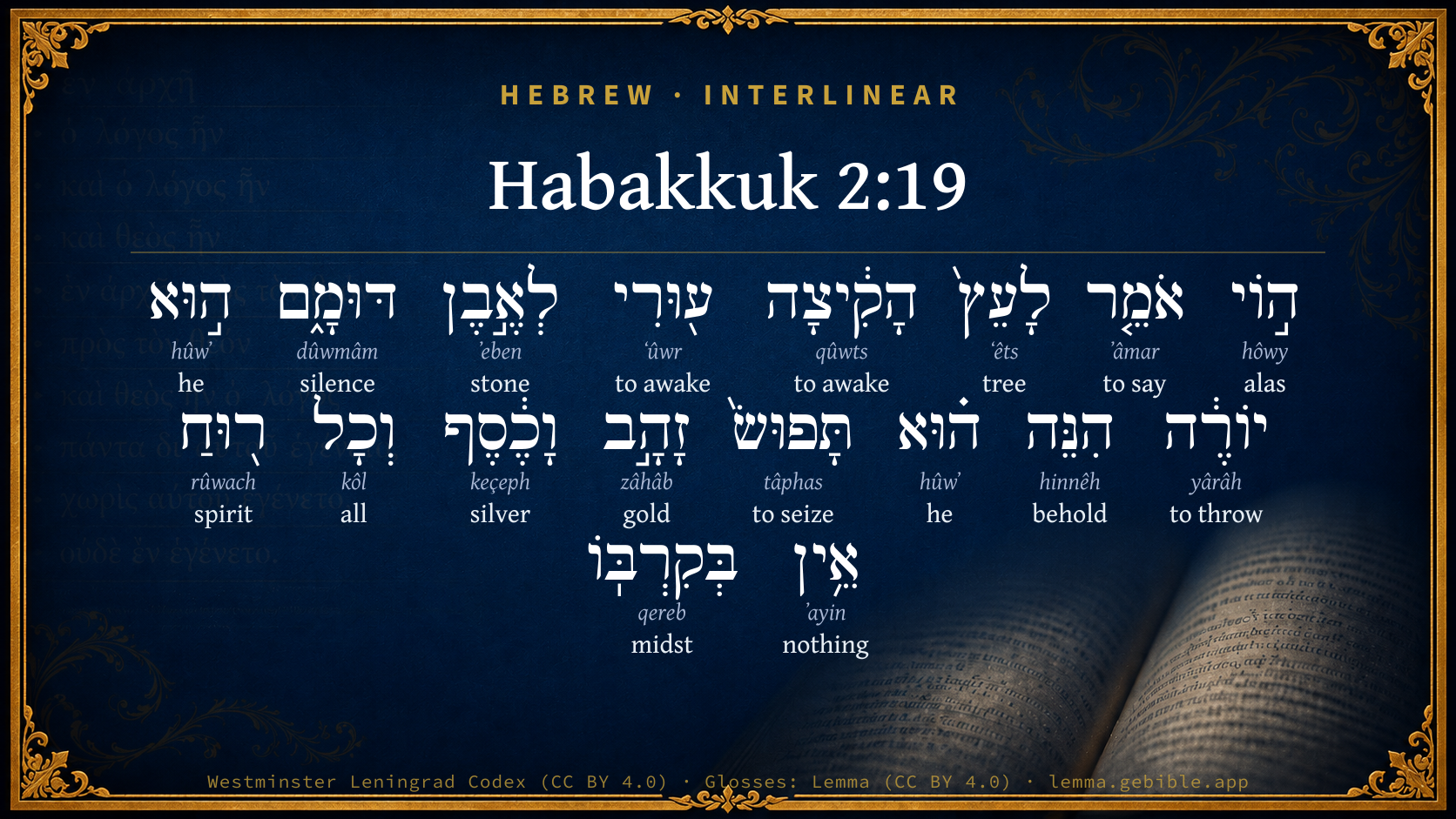
Habakkuk 2:19

Hebrew (Westminster Leningrad Codex) Habakkuk 2:19 appears in the Hebrew Old Testament. The text above is from the Westminster Leningrad Codex. Each word links to its Strong’s number, a concise gloss, and parsing drawn from the Open Scriptures Hebrew Bible morphology. Click any word for its full Brown-Driver-Briggs (BDB) entry.
Download image
Cite this verse

Habakkuk 2:19 (World English Bible). Public Domain. Lemma interlinear Bible study tool, https://lemma.gebible.app/v/habakkuk/2/19.

Show BibTeX & RIS
BibTeX
RIS
English Translation
Woe to him who says to the wood, 'Awake!' or to the mute stone, 'Arise!' Shall this teach? Behold, it is overlaid with gold and silver, and there is no breath at all in the midst of it.
World English Bible · Public Domain
Download a study sheet

One document with this verse’s original text, its word-by-word gloss line, the meaning frame, cross-references with their text, attributed commentary, and full source and license credits — printable, and it pastes into notes with its structure intact.

This verse Autodidact and up

Study sheet (.html) Plain text (.txt)

A passage Seminary Student

Up to 50 verses in one chapter. A passage sheet keeps up to 6 commentary sources and 12 cross-references per verse, in the order this page ranks them, and says so on the sheet whenever that leaves anything out. Ask for a single verse and you get the Autodidact verse sheet above.

Everything on this page stays free to read, with no account — the sheet is a download of what is already on screen, not access to it.

Want to remove ads? Support Godless Engineer
Compare translations 3

The same verse in 3 English versions, stacked beneath the original-language interlinear above. Click any original word for its lexicon entry.

Each is an independent rendering of the whole verse — the interlinear is not word-aligned to these translations.

Highlighted words mark where these versions differ — a whole-verse word diff, not a word-by-word alignment.

  • World English Bible Public Domain
    Woe to him who says to the wood, 'Awake!' or to the mute stone, 'Arise!' Shall this teach? Behold, it is overlaid with gold and silver, and there is no breath at all in the midst of it.
  • King James Version Public Domain
    Woe unto him that saith to the wood, Awake; to the dumb stone, Arise, it shall teach! Behold, it is laid over with gold and silver, and there is no breath at all in the midst of it.
  • unfoldingWord Literal Text CC BY-SA 4.0
    ‘Woe to the one saying to the wood, Awake, to the silent stone, Arise!’ It teaches! Behold, it is overlaid with gold and silver, but there is not any breath within it.

unfoldingWord Literal Text — © unfoldingWord, licensed CC BY-SA 4.0. Word-aligned USFM3 via Door43 (git.door43.org/unfoldingWord/en_ult).

Versions to compare (up to 4)

3 of 4 selected

Show all 18 translations

Every available English version of this verse, each an independent rendering of the whole verse.

  • World English Bible Public Domain
    Woe to him who says to the wood, 'Awake!' or to the mute stone, 'Arise!' Shall this teach? Behold, it is overlaid with gold and silver, and there is no breath at all in the midst of it.
  • Berean Standard Bible Public Domain
    Woe to him who says to wood, ‘Awake!’ or to silent stone, ‘Arise!’ Can it give guidance? Behold, it is overlaid with gold and silver, yet there is no breath in it at all.”
  • Majority Standard Bible Public Domain
    Woe to him who says to wood, ‘Awake!’ or to silent stone, ‘Arise!’ Can it give guidance? Behold, it is overlaid with gold and silver, yet there is no breath in it at all.”
  • King James Version Public Domain
    Woe unto him that saith to the wood, Awake; to the dumb stone, Arise, it shall teach! Behold, it is laid over with gold and silver, and there is no breath at all in the midst of it.
  • American Standard Version (1901) Public Domain
    Woe unto him that saith to the wood, Awake; to the dumb stone, Arise! Shall this teach? Behold, it is overlaid with gold and silver, and there is no breath at all in the midst of it.
  • Revised Version (1885) Public Domain
    Woe unto him that saith to the wood, Awake; to the dumb stone, Arise! Shall this teach? Behold, it is laid over with gold and silver, and there is no breath at all in the midst of it.
  • Geneva Bible (1599) Public Domain
    Wo vnto him that sayth to the wood, Awake, and to the dumme stone, Rise vp, it shall teach thee: beholde, it is layde ouer with golde and siluer, and there is no breath in it.
  • Douay-Rheims (1899) Public Domain
    Woe to him that saith to wood: Awake: to the dumb stone: Arise: can it teach? Behold, it is laid over with gold, and silver, and there is no spirit in the bowels thereof.
  • Young's Literal Translation Public Domain
    Wo `to' him who is saying to wood, `Awake,' `Stir up,' to a dumb stone, It a teacher! lo, it is overlaid -- gold and silver, And there is no spirit in its midst.
  • Literal Standard Version CC BY-SA 4.0
    Woe [to] him who is saying to wood, Awake, || To a mute stone, Stir up, || It [is] a teacher! Behold, it is overlaid—gold and silver, || And there is no spirit in its midst.
  • Unlocked Literal Bible CC BY-SA 4.0
    'Woe to the one saying to the wood, Wake up! Or to the silent stone, Arise!' Do these things teach? See, it is overlaid with gold and silver, but there is no breath at all within it.
  • unfoldingWord Literal Text CC BY-SA 4.0
    ‘Woe to the one saying to the wood, Awake, to the silent stone, Arise!’ It teaches! Behold, it is overlaid with gold and silver, but there is not any breath within it.
  • Darby Bible Public Domain
    Woe unto him that saith to the wood, Awake! to the dumb stone, Arise! Shall it teach? Behold it is overlaid with gold and silver, and there is no breath at all in the midst of it.
  • World Messianic Bible Public Domain
    Woe to him who says to the wood, ‘Awake!’ or to the mute stone, ‘Arise!’ Shall this teach? Behold, it is overlaid with gold and silver, and there is no breath at all within it.
  • Webster's Bible Public Domain
    Woe to him that saith to the wood, Awake; to the dumb stone, Arise, it shall teach! Behold, it is laid over with gold and silver, and there is no breath at all in the midst of it.
  • Free Bible Version CC BY-SA 4.0
    What disaster is coming to you who say to something made of wood, “Wake up!” or to lifeless stone, “Get up!” Can it teach you anything? Look at it! It's covered with gold and silver, but there is no life inside it.
  • Bible in Basic English Public Domain
    A curse on him who says to the wood, Awake! to the unbreathing stone, Up! let it be a teacher! See, it is plated with gold and silver, and there is no breath at all inside it.
  • JPS Tanakh (1917) Public Domain
    Woe unto him that saith to the wood: 'Awake', to the dumb stone: 'Arise!' Can this teach? Behold, it is overlaid with gold and silver, and there is no breath at all in the midst of it.

Literal Standard Version (2020), Covenant Press — licensed CC BY-SA 4.0. Text via the HelloAO Bible API (eBible.org). Unlocked Literal Bible (unfoldingWord) — licensed CC BY-SA 4.0. Text via the HelloAO Bible API (eBible.org). unfoldingWord Literal Text — © unfoldingWord, licensed CC BY-SA 4.0. Word-aligned USFM3 via Door43 (git.door43.org/unfoldingWord/en_ult). Free Bible Version, Dr. Jonathan Gallagher — licensed CC BY-SA 4.0. Text via the HelloAO Bible API (eBible.org).

Word by word

More ways to search: Search by grammar → Find every occurrence → Compare this word →

Practice this passage: Drill this verse → Learn its vocabulary →

דּוּמָ֑ם
dûwmâm
H1748
“silence”
Noun, Common, Masculine, Singular, Absolute
Part of Speech
Noun
Type
Common
Gender
Masculine
Number
Singular
State
Absolute
Full BDB Definition

Origin: from H1826

TWOT: 415c

silence (noun masculine) - in silence, silently (adverb)
  1. ה֣וֹי hôwy H1945 “alas” Particle, Interjection
  2. אֹמֵ֤ר ʼâmar H559 “saying” Verb, Qal, Participle Active, Masculine, Singular, Absolute
  3. לָעֵץ֙ ʻêts H6086 “to/for the · tree” Preposition, Determined + Noun, Common, Masculine, Singular, Absolute
  4. הָקִ֔יצָה qûwts H6974 “awake” Verb, Hiphil, Imperative, 2nd Person, Masculine, Singular + Suffix, h
  5. ע֖וּרִי ʻûwr H5782 “awake” Verb, Qal, Imperative, 2nd Person, Feminine, Singular
  6. לְאֶ֣בֶן ʼeben H68 “to/for · stone of” Preposition + Noun, Common, Feminine, Singular, Construct
  7. ה֣וּא hûwʼ H1931 “he” Pronoun, Personal, 3rd Person, Masculine, Singular
  8. יוֹרֶ֔ה yârâh H3384 “to throw” Verb, Hiphil, Imperfect, 3rd Person, Masculine, Singular
  9. הִנֵּה hinnêh H2009 “behold” Particle, Demonstrative
  10. ה֗וּא hûwʼ H1931 “he” Pronoun, Personal, 3rd Person, Masculine, Singular
  11. תָּפוּשׂ֙ tâphas H8610 “seized” Verb, Qal, Participle Passive, Masculine, Singular, Absolute
  12. זָהָ֣ב zâhâb H2091 “gold” Noun, Common, Masculine, Singular, Absolute
  13. וָכֶ֔סֶף keçeph H3701 “and · silver” Conjunction + Noun, Common, Masculine, Singular, Absolute
  14. וְכָל kôl H3605 “and · all of” Conjunction + Noun, Common, Masculine, Singular, Construct
  15. ר֖וּחַ rûwach H7307 “spirit” Noun, Common, Both, Singular, Absolute
  16. אֵ֥ין ʼayin H369 “nothing” Particle, Negative
  17. בְּקִרְבּֽוֹ qereb H7130 “in/at · midst · his” Preposition + Noun, Common, Masculine, Singular, Construct + Suffix, Personal, 3rd Person, Masculine, Singular

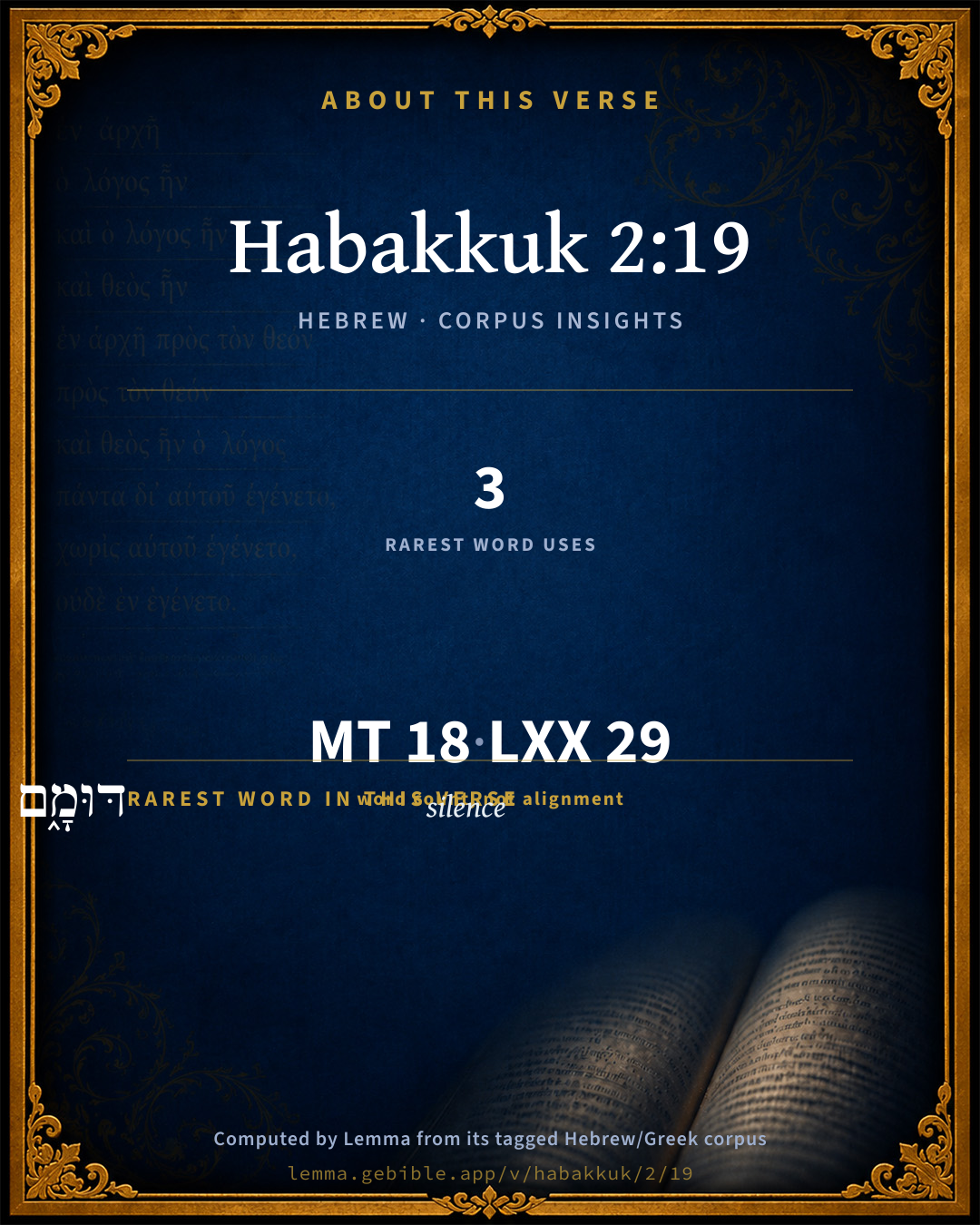
About this verse

These counts appear in no published source. They are computed here, from the morphology-tagged text and Lemma’s own curated glosses. What Lemma adds →

18
words
17
distinct lemmas
Prophets
section

Notable vocabulary

The rarest word here is דּוּמָ֑ם silence H1748 — appearing just 3 times in the whole Hebrew Bible.

Shared distinctive vocabulary

דּוּמָ֑ם silence H1748 occurs in 3 verses of the Hebrew Bible. Also found in:

Grammatical profile

  • 5 verbs
  • 8 nouns
  • 2 pronouns
  • 3 particles

Verb forms

  • אֹמֵ֤ר Qal · Participle Active
  • הָקִ֔יצָה Hiphil · Imperative
  • ע֖וּרִי Qal · Imperative
  • יוֹרֶ֔ה Hiphil · Imperfect
  • תָּפוּשׂ֙ Qal · Participle Passive

Repetition

A word recurs within this verse — often emphatic in Hebrew:

  • ה֣וּא he H1931 ×2

Hebrew & Septuagint length

In English translation the verse runs 38 words from the Hebrew and 38 from the Septuagint (LXX English) — the same length.

A rough comparison of the two English renderings, which tokenize alike — not a word-level alignment.

Word counts can differ between the Hebrew and the Greek without any difference in meaning — e.g. the Hebrew direct-object marker אֵת has no separate Greek word, and Greek often adds the article ὁ.

In the original languages it is 18 Hebrew tokens and 29 Greek tokens — but the two are counted differently (Hebrew bundles its prefixes and suffixes into one token; the Greek is in lemma form), so that isn’t a like-for-like length.

Cross-references

18

Topical passages linked to Habakkuk 2:19 in the Treasury of Scripture Knowledge — connected by theme and wording, ordered by reader-vote popularity; previews shown in the World English Bible.

  • Psalms 135:17 They have ears, but they can't hear; Neither is there any breath in their mouths.
  • Jeremiah 10:4 They deck it with silver and with gold; they fasten it with nails and with hammers, that it not move.
  • 1 Kings 18:26–29 They took the bull which was given them, and they dressed it, and called on the name of Baal from morning even until noon, saying, Baal, hear us. But there was no voice, nor any who answered. They leaped about the altar which was made.
  • Jeremiah 10:9 There is silver beaten into plates, which is brought from Tarshish, and gold from Uphaz, the work of the artificer and of the hands of the goldsmith; blue and purple for their clothing; they are all the work of skillful men.
  • Psalms 97:7 Let all them be shamed who serve engraved images, Who boast in their idols. Worship him, all you gods!
  • Isaiah 40:19 The image, a workman has cast [it], and the goldsmith overlays it with gold, and casts [for it] silver chains.
  • Isaiah 44:17 The residue of it he makes a god, even his engraved image; he falls down to it and worships, and prays to it, and says, Deliver me; for you are my god.
  • Isaiah 46:6 Some pour out gold from the bag, and weigh silver in the balance. They hire a goldsmith, and he makes it a god. They fall down--yes, they worship.
  • Jeremiah 10:14 Every man is become brutish [and is] without knowledge; every goldsmith is disappointed by his engraved image; for his molten image is falsehood, and there is no breath in them.
  • Jeremiah 51:47 Therefore, behold, the days come, that I will execute judgment on the engraved images of Babylon; and her whole land shall be confounded; and all her slain shall fall in the midst of her.
  • Daniel 3:1 Nebuchadnezzar the king made an image of gold, whose height was sixty cubits, and the breadth of it six cubits: he set it up in the plain of Dura, in the province of Babylon.
  • Daniel 3:7 Therefore at that time, when all the peoples heard the sound of the horn, flute, zither, lyre, harp, pipe, and all kinds of music, all the peoples, the nations, and the languages, fell down and worshiped the golden image that Nebuchadnezzar the king had set up.
  • Daniel 3:18 But if not, be it known to you, O king, that we will not serve your gods, nor worship the golden image which you have set up.
  • Daniel 3:29 Therefore I make a decree, that every people, nation, and language, which speak anything evil against the God of Shadrach, Meshach, and Abednego, shall be cut in pieces, and their houses shall be made a dunghill; because there is no other god who is able to deliver after this sort.
  • Daniel 5:23 but have lifted up yourself against the Lord of heaven; and they have brought the vessels of his house before you, and you and your lords, your wives and your concubines, have drunk wine from them; and you have praised the gods of silver and gold, of brass, iron, wood, and stone, which don't see, nor hear, nor know; and the God in whose hand your breath is, and whose are all your ways, you have not glorified.
  • Acts 17:29 Being then the offspring of God, we ought not to think that the Divine Nature is like gold, or silver, or stone, engraved by art and design of man.
  • Revelation 17:4 The woman was dressed in purple and scarlet, and decked with gold and precious stones and pearls, having in her hand a golden cup full of abominations and the impurities of the sexual immorality of the earth.
  • Jonah 1:5 Then the mariners were afraid, and cried every man to his god. They threw the cargo that was in the ship into the sea, to lighten it. But Jonah had gone down into the innermost parts of the ship, and he was laying down, and was fast asleep.

Cross-references courtesy of OpenBible.info (CC BY 4.0).

Hebrew and Greek witnesses Masoretic Hebrew ↔ Greek Septuagint

The same verse in the two great witnesses to the Old Testament, shown verse-for-verse.

These are two independent witnesses, not word-aligned to each other, and the Septuagint is shown in lemma (dictionary) form.

Hebrew Habakkuk 2:19 Masoretic · Westminster Leningrad Codex

ה֣וֹי אֹמֵ֤ר לָעֵץ֙ הָקִ֔יצָה ע֖וּרִי לְאֶ֣בֶן דּוּמָ֑ם ה֣וּא יוֹרֶ֔ה הִנֵּה ה֗וּא תָּפוּשׂ֙ זָהָ֣ב וָכֶ֔סֶף וְכָל ר֖וּחַ אֵ֥ין בְּקִרְבּֽוֹ

Woe to him who says to the wood, 'Awake!' or to the mute stone, 'Arise!' Shall this teach? Behold, it is overlaid with gold and silver, and there is no breath at all in the midst of it.

World English Bible · Public Domain

Greek LXX Habakkuk 2:19 Septuagint · lemma form

οὐαί ὁ λέγω ὁ ξύλον ἐκνήφω ἐκἐγείρω καί ὁ λίθος ὑψόω καί αὐτός εἰμί φαντασία οὗτος δέ εἰμί ἔλασμα χρυσίον καί ἀργύριον καί πᾶς πνεῦμα οὐ εἰμί ἐν αὐτός

Woe to him that says to the wood, Awake, arise; and to the stone, Be you exalted! whereas it is an image, and this is a casting of gold and silver, and there is no breath in it.

LXX2012 (modern English Septuagint) · Public Domain

On this verse, The Pulpit Commentary discusses the Septuagint’s reading. Read the note in Commentary ↓

Hebrew: Westminster Leningrad Codex (CC BY 4.0). Greek: Septuagint (public domain); English from LXX2012 (modern English Septuagint) (Public Domain). How the Septuagint differs from the Hebrew →

Targum (Aramaic paraphrase)

1

The Targum is the ancient Jewish Aramaic paraphrase of the Hebrew Scriptures — an interpretive translation, not the Hebrew text itself. Onkelos (literal) and Pseudo-Jonathan (expansive) render the Torah, and Jonathan the Prophets. Coverage is partial: where no permissively-licensed English translation exists for a verse, only the Aramaic is shown. This is verse-level text, not a word-by-word alignment to the Hebrew.

  1. Targum Jonathan Prophets (Joshua–Malachi)
    וַי דִי אֲמַר לִצְלַם אֲעָא קוּם וּלְדַחֲלַת אַבְנָא אִתְעֲרֵי וְהִיא שַׁתְקָא וְדַמְיָא הוּא מַכְלֵי הָא הוּא מַחֲפֵּי דְהַב וּכְסַף וְכָל רוּחַ לֵית בִּמְעוֹהִי:

    (no public-domain English translation for this verse)

    Targum Jonathan — Aramaic: “Mikraot Gedolot” (public domain). English: “Sefaria Community Translation” (CC0 1.0 (public-domain dedication)); “London "Chaldee Paraphrase," 1871” (public domain). Text via Sefaria.

Commentary

Notes on Habakkuk 2:19 from classic Christian and Jewish commentators (each source and its license shown beneath its notes). The classic Christian expositions comment on the surrounding passage and are grouped to its opening verse, so a note may address several verses; the Jewish commentaries on the Tanakh (Rashi and others) are per-verse, so they appear only where the commentator wrote on this verse.

Lemma curates 59 commentaries, every one of them public domain or Creative Commons licensed, each selected and text-cleaned for this edition rather than reprinted as found. About our sources →

Trapp's Complete Commentary

John Trapp

Hab 2:19 Woe unto him that saith to the wood, Awake; to the dumb stone, Arise, it shall teach! Behold, it [is] laid over with gold and silver, and [there is] no breath at all in the midst of it.

Ver. 19. Woe unto him that saith to the wood, Awake] It is wood still, and yet he saith to it, Awake, Arise, &c., as if he would deny his own reason, and unman himself. When Hezekiah saw that such was the venom of the Israelitish idolatry, that the brazen serpent stung worse than the fiery, he pulled it down, and in contempt called it Nehushtan, that is, a piece of brass, 2Ki 18:4. Pagnine rendereth it, aenusum. Marinus, aeniculum, that is, parum quid aeris, a little piece of sorry brass (Thes. Ling. Sanct.). The Jews to this day say that as long as they see the preacher direct his speech and prayer to that little wooden crucifix, that standeth in the pulpit by him, to call it his Lord and Saviour, to kneel to it, to embrace it, to kiss it, to weep upon it (as is the fashion of Italy), this is preaching sufficient for them; and persuadeth them more with the very sight of it to hate Christian religion, than any reason that the world can allege to love it. Woe, therefore, to those Popish idolaters, because of offences; destruction to them, that thus say to the wood, Awake, and

to the dumb stone, Arise] A prayer, fit to be preferred to God only, {as Psa 35:23} who giveth not his glory to any other, nor his honour to graven images, Isa 42:8. He that is the right object of men’s prayers must be omnipotent, omnipresent, omniscient, a God also in covenant with us, &c. Is any wood or stone so? Is it not inutile lignum, useless wood, a dead stock? Eben dumam, a dumb stone? Our English seems to come of the Hebrew.

It shall teach] Dumb, and yet teach? Others read it as a question, Ipse doceat? Can it teach? What better lesson can ye learn from it than a lie? as Hab 2:18. Bid adieu to it, therefore, as King Henry VIII did to the Pope (if he had done so to Popery too, it had been better for him) in his protestation against him. England is no more a babe, to be led and fed with lies - . Surely, except God take away our right wits, not only the Pope’s authority shall be driven out for ever, but his name also shortly shall be forgotten in England. We will from henceforth ask counsel of him and his when we wish to be deceived, when we covet to be in error, when we desire to offend God, truth, and honesty.

Behold, it is laid over with gold and silver] q.d. Come and see, believe your own eyes at least, behold the matter, form, workmanship of this newly made god, and grow wiser. The rood of grace with all its trinkets, the blood of Hales (that notable impostor) was laid open at Paul’s Cross by Cromwell, and there viewed and torn in pieces by the people.

There is no breath at all in the midst of it] No soul, not so much as that of a beast. O pulchrum caput, sed cerebrum non inest, said the ape in the fable, coming once into a carver’s shop. The best thing that an image can teach a man is, that itself is dumb and dead; and that the maker thereof cannot give life and breath to it, much less a deity.

John Trapp, A Commentary or Exposition upon All the Books of the Old and New Testament (1647–1656) — public domain. Text from a community e-Sword module.

Geneva Bible (1599)

Geneva Bible translators

If thou wilt consider what it is, and how that it hath neither breath nor life, but is a dead thing.

Geneva Bible (1599) marginal notes — public domain. Text via Bolls.life.

Jamieson, Fausset & Brown

Robert Jamieson, A. R. Fausset & David Brown

Awake--Arise to my help.

it shall teach!--rather, An exclamation of the prophet, implying an ironical question to which a negative answer must be given. What! "It teach?" Certainly not [MAURER]. Or, "It (the idol itself) shall (that is, ought to) teach you that it is deaf, and therefore no God" [CALVIN]. Compare "they are their own witnesses" (Isa 44:9).

Behold--The Hebrew is nominative, "There it is" [HENDERSON].

it is laid over with gold . . . no breath . . . in the midst--Outside it has some splendor, within none.

Jamieson, Fausset & Brown — Commentary Critical and Explanatory on the Whole Bible (1871) — public domain (CC PDM 1.0). Text via the HelloAO Bible API.

Adam Clarke's Commentary

Verse 19. Wo unto him] How foolish and contemptible to worship a thing formed by the hand of man out of wood, stone, gold, or silver! The meanest brute is superior to them all; it breathes and lives, but they have no breath in them. However, they are said above to be teachers of lies; that is, they appeared to give out oracles: but these were lies; and were not given by the statue, but by the priest.

Adam Clarke's Commentary on the Bible (1810–1826) — public domain. Text from a community e-Sword/MySword module.

John Calvin's Commentaries

He pursues, as I have said, the same subject, and sharply inveighs against the sottishness of men, that they call on wood and stone, as though there were some hidden power in them. They say to the wood, Awake; for they implored help from their idols. Shall it teach? Some render it thus as a question; but I take it in a simpler form, “It will teach;” that is, “It is a wonder that ye are so wilfully foolish; for were God to send to you no Prophet, were there no one to instruct you, yet the wood and the stone would be sufficient teachers to you: ask your idols, that is, ascertain rightly what is in them. Doubtless, the god that is made of wood or of stone, sufficiently declares by his silence that he is no god. For there is no motion in wood and stone. Where there is no vigor and no life, is it not right to feel assured, that there is no deity? There are, indeed, many creatures endued with feeling and motion; but the God who gives power, and motion, and feeling to the whole world, and to all its parts, does he not surpass in these respects all his creatures? Since, then, wood and stone are silent, they are teachers sufficient for you, provided ye be apt scholars.”

We hence see how the Prophet in this way amplifies the insensibility of men; for they did not perceive what was quite manifest. The design of what follows is the same. Behold, it is covered over with gold and silver; that is, it is made splendid: for idolaters think that their gods are better when adorned with gold and silver; but yet there is no breath in the midst of them. “Look,” he says, “within; look within, and ye shall see that they are dead.” The rest we shall dilate on to-morrow.

John Calvin's Commentaries (1540-1563) — public domain. Text from the Calvin Translation Society English edition (1840s-50s) via the Christian Classics Ethereal Library (ccel.org). Calvin's coverage is partial (roughly two-thirds of the Bible); uncommented books and verses are honest gaps, never fabricated. The 19th-century editor's footnotes and remarks are omitted so the notes are faithfully Calvin's own voice.

The Cambridge Bible for Schools and Colleges

gen. ed. J. J. S. Perowne

19. Woe unto him … Awake] 1Ki_18:27, “he (Baal) sleepeth and must be awaked.” The term is also used of Jehovah when He visibly interposes after apparent inactivity, Psa_78:65; Psa_35:23; Psa_44:23; Psa_59:5. As this verse begins with Woe many propose to place it before Hab_2:18.

it shall teach] Or, shall it teach! as an exclamation of contempt or wonder at the infatuation of those who consult it. A full stop is to be placed at Arise! Teach is equivalent to, give an answer or oracle when consulted or appealed to. Isa_41:26; Isa_46:7.

laid over with gold] This is probably the meaning, though the term is obscure. Perhaps: set in gold.

there is no breath] Psa_135:17; Jer_10:14; cf. Jer_51:17.

The Cambridge Bible for Schools and Colleges (gen. ed. J. J. S. Perowne; Cambridge University Press, 1878–1918) — public domain. Text from a community e-Sword module.

John Gill's Exposition

But the Lord is in his holy temple,.... Not in graven and molten images; not in idols of wood and stone, covered with gold and silver; but in heaven, the habitation of his holiness, the place of his residence, where he is seen and worshipped by the holy angels and glorified saints; and from whence he surveys all the children of men, and their actions; observes the folly and stupidity of idol worshippers; and hears and answers the prayers of his own people: or this intends his church, which is his temple, sanctified by him, and set apart for his service, worship, and glory: here he grants his gracious presence to those who worship him in spirit and in truth; and here he will appear as King of saints, in a most glorious manner, when these several woes before mentioned have taken place; as on Rome Pagan already, and in part on Rome Papal at the Reformation, so completely on it, and all worshippers of images hereafter. The word here used, signifies that part of the temple, called the holy place, as distinct from the holy of holies; which was the proper seat of the divine Majesty, and a figure of heaven, as the holy place was of the church; and so he was, as it were, removed from the one to the other; hence the more observable and remarkable, and the greater reason for what follows; and this serves to illustrate and confirm the sense given:

let all the earth keep silence before him; stand in awe of him, and reverence him; be subject to him, and silently adore him; as all the inhabitants of the earth will when the above enemies of his are entirely removed out of it; there will be no more clamours and objections against the Christian religion by Jews and Mahometans, on account of image worship, which will be no more; no more wars, or rumours of wars, but a profound peace everywhere; no more persecutions of the saints; no more will be heard the cry of violence and oppression, all their enemies being destroyed; no more repining and murmurings among the people of God, through impatience and unbelief, all afflictions being at an end; there will be an entire silence of this kind everywhere; only the voice of the Gospel, prayer, praise, and thanksgiving, will be heard. This is not the case now, nor was there ever as yet such a time on earth; this shows that the prophecy regards time to come.

Next: Habakkuk Chapter 3

John Gill's Exposition of the Whole Bible (1746–1763) — public domain (CC PDM 1.0). Text via the HelloAO Bible API.

Albert Barnes' Notes on the Bible

But then the greater is the “Woe” to him who deceiveth by them. The prophet passes away from the idols as “nothings” and pronounces “woe” on those who deceive by them. He . first expostulates with them on their folly, and would awaken them. “What hath it profited?” (As in Psa 115:5; 1Co 12:2) Then on the obstinate he denounces “woe.” “Woe unto him that saith to the wood, Awake; to the dumb stone, Arise.” Self-made blindness alone could, in the light of truth, so speak; but yet more lies in the emphatic word, “It.” The personal pronoun stands emphatically in Hebrew; He shall teach, lo, He (this same of whom he speaks) this is It which shall teach: It, and not the living God. And yet this same It (the word is again emphatic) he points, as with the finger, to it, “behold, It is laid over with, held fast by , gold and silver,” so that no voice could escape, if it had any. “And there is no breath at all in the midst of it” (Compare Jer 10:14 repeated Jer 51:17), literally “All breath, all which is breath, there is none within it;” he first suggests the thought, breath of every sort, and then energetically denies it all ; no life of any sort, of man, or bird, or beast, or creeping thing Isa 41:23; Jer 10:5; none, good or bad; from God or from Satan; none whereby it can do good or do evil; for which it should be loved or feared. Evil spirits may have made use of idols: they could not give them life, nor dwell in them.

The words addressed to it are the language of the soul in the seeming absence or silence of God (Psa 7:7; Psa 35:23; Psa 44:24; Psa 59:6; Isa 51:9; Delitszch), but mockery as spoken to the senseless stone, as Ehijah had mocked the Baal-priests, “peradventure he sleepeth and must be awaked” 1Ki 18:26-27.

Albert Barnes' Notes on the Bible (1834–1885) — public domain. Text from a community e-Sword/MySword module.

Matthew Poole's English Annotations

In the former verse the prophet declared the uselessness and unprofitableness of the idols of Babylon, now he threatens the idolaters. They sinned greatly by placing their confidence in them, and they should suffer the more for it.

The wood; whatever shape art may give it, or whatever veneration blind idolaters may bear to it, it is still wood, no better; a log, a worthless block.

Awake: this expresseth the idolater’s prayer to his idol. Awake; what! is he a sleepy god? No, not so much, it is a lifeless log, and its eyes never did see.

The dumb stone; another sort of their useless idols, senseless as the stones, and still as unable to rise or help as before they were graven and carved; it is a stone, no god.

Arise; another form of praying to this idol; and when the idol can rise Babylon shall be helped, till then it must abide its sorrows.

It shalt teach: sottish men! in misery to hope that lifeless idols shall counsel and direct. What! dumb, and without sense, and yet teach!

Behold; look, ye selfdeceiving idolaters, consult your own senses, see what matter they are made of.

It is laid over with gold and silver; see the facings or plates are different from that which is under, and can that be a god that is made up of such different materials? it were more like men to pull off the gold and silver, and with these to purchase your safety.

There is no breath at all; not so much as the soul of a brute in them.

Matthew Poole's English Annotations on the Holy Bible (1683–1685) — public domain. Text from a community e-Sword/MySword module.

Whedon's Commentary on the Bible

Daniel D. Whedon

19. Woe — To him who puts his trust into these lifeless nothings.

Awake — From slumber and inactivity (1Ki_18:27).

Arise — To help and deliver. Appeals addressed to Jehovah would receive an answer (Psa_35:23; Psa_44:23), but the idols can neither hear nor reply.

It shall teach — Better, R.V., “Shall this teach?” A question or exclamation of astonishment at the delusion. Teach is here equivalent to respond to the appeal to show a way of escape from the calamity. The prophet immediately makes it plain why help need not be expected. They have no life in themselves, how can they preserve the life of others?

Laid over — The word occurs only here, hence its meaning is not quite certain; the reference seems to be to the overlaying of idols made of wood or other cheap material with gold or silver.

No breath — The spirit of life is entirely absent (Jer_10:4 ff.; Isa_44:9 ff.).

Daniel D. Whedon (gen. ed.), Commentary on the Old and New Testaments (1874–1909) — public domain. Text from a community e-Sword module.

The Pulpit Commentary

The prophet now denounces the folly of the maker and worshipper of idols. With this and the following verses compare the taunts Isa_44:9-20. The wood. From which he carves the image. Awake! Come to my help, as good men pray to the living God. (comp. Psa_35:23 Psa_44:2-8; Isa_51:9) Arise, it shall teach! The Hebrew is bettor rendered, Arise! it teach! i.e. shall this teach? an emphatic question expressing astonishment. Vulgate, Numquid ipse docere poterit? The LXX paraphrases, kai ejsti fantasia, "and itself is a phantasy." It is laid, over. "It" is again emphatic, as if pointed at with the finger. Hence the Vulgate, Ecce iste coopertus est; and Henderson, "There it is, overlaid," etc. The wooden figure was encased in gold or silver plates. (see Isa_40:19; Dan_3:1)

The Pulpit Commentary (1880–1919), ed. H.D.M. Spence-Jones & Joseph S. Exell — public domain. Text from a community e-Sword module.

Rashi

Rabbi Shlomo Yitzchaki (Rashi)

Shall it teach? This is a question.

Rashi on the Tanakh — English translations: “The Judaica Press complete Tanach with Rashi, translated by A. J. Rosenberg” (CC BY 4.0); “Pentateuch with Rashi's commentary by M. Rosenbaum and A.M. Silbermann, 1929-1934” (public domain); “The Metsudah Tanach series, Lakewood, N.J” (CC BY 4.0); and “The Book of Joshua, Metsudah Publications, 1997” (CC BY 4.0). Text via Sefaria.

Lesson kit

Teaching starters — assembled from the data on this page, not authored interpretation. Every prompt links to the verse data it draws on. Edit before teaching.

Habakkuk, in the Prophets, opens this verse with 18 words (17 distinct Hebrew lemmas). Its most distinctive word is dûwmâm (“silence”). A historical commentator’s framing appears above. Read the whole chapter for the surrounding context.

Discussion questions

  1. What does “silence” (dûwmâm) contribute to the verse as a whole?
  2. Isaiah 47:5 shares the word «silence» with this verse. How do the two illuminate each other?
  3. “he” occurs 2× in this one verse. What is the effect of the repetition?
  4. The translations on this page render this verse differently — a whole-verse word diff, not a word-by-word alignment. What might account for the different wordings?
  5. The verb «אֹמֵ֤ר» is Qal Participle Active. How does its form color the action?
  6. Reading how Trapp's Complete Commentary and Geneva Bible (1599) read this verse, where do the two commentators agree and where do they part?

Things to notice

Reading settings

Reading text

Shown beneath each verse's original-language words.

Old Testament
Old Testament edition

Read the OT as the Masoretic Hebrew (MT) or the Greek Septuagint (LXX).

English shown for the Greek Septuagint (in the Hebrew ↔ Greek comparison).

Comparing translations? Open the Compare panel on any verse page to stack up to four side by side.