
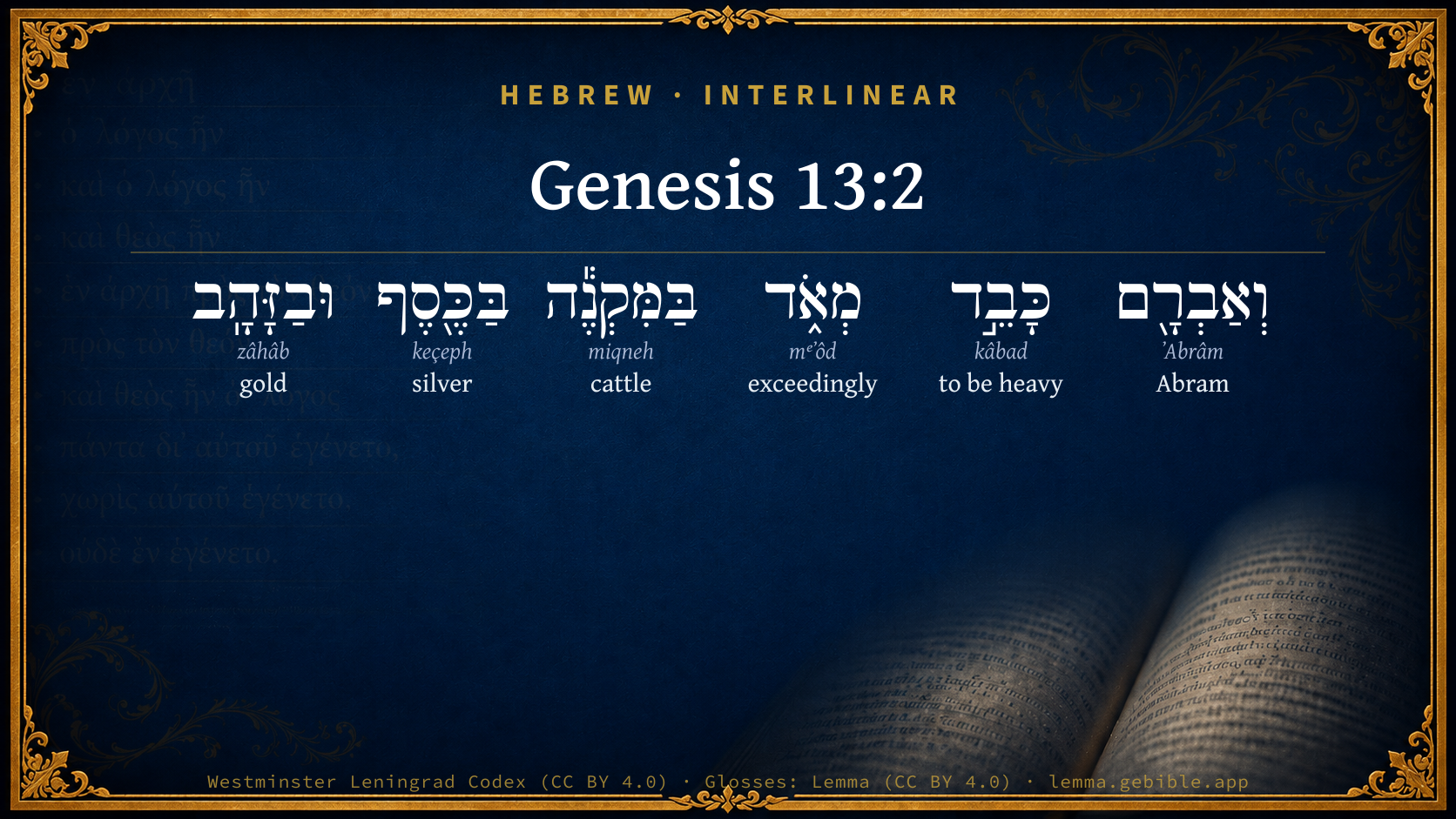
Genesis 13:2

Hebrew (Westminster Leningrad Codex) Genesis 13:2 appears in the Hebrew Old Testament. The text above is from the Westminster Leningrad Codex. Each word links to its Strong’s number, a concise gloss, and parsing drawn from the Open Scriptures Hebrew Bible morphology. Click any word for its full Brown-Driver-Briggs (BDB) entry.
Download image
Cite this verse

Genesis 13:2 (World English Bible). Public Domain. Lemma interlinear Bible study tool, https://lemma.gebible.app/v/genesis/13/2.

Show BibTeX & RIS
BibTeX
RIS
English Translation
Abram was very rich in cattle, in silver, and in gold.
World English Bible · Public Domain
Highlights
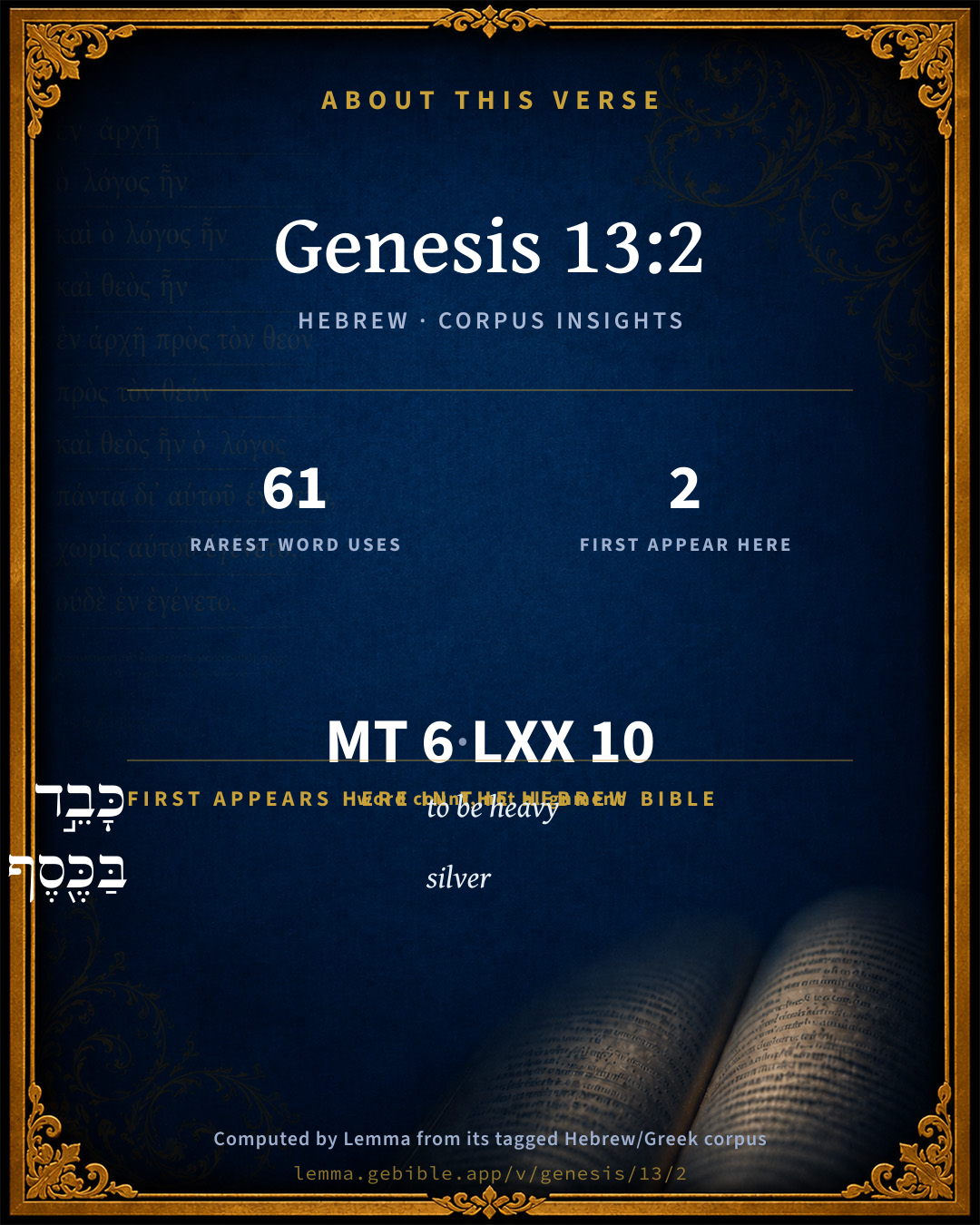
  • 2 first appearances in the Hebrew Bible
Full analysis ↓
Download a study sheet

One document with this verse’s original text, its word-by-word gloss line, the meaning frame, cross-references with their text, attributed commentary, and full source and license credits — printable, and it pastes into notes with its structure intact.

This verse Autodidact and up

Study sheet (.html) Plain text (.txt)

A passage Seminary Student

Up to 50 verses in one chapter. A passage sheet keeps up to 6 commentary sources and 12 cross-references per verse, in the order this page ranks them, and says so on the sheet whenever that leaves anything out. Ask for a single verse and you get the Autodidact verse sheet above.

Everything on this page stays free to read, with no account — the sheet is a download of what is already on screen, not access to it.

Want to remove ads? Support Godless Engineer
Compare translations 3

The same verse in 3 English versions, stacked beneath the original-language interlinear above. Click any original word for its lexicon entry.

Each is an independent rendering of the whole verse — the interlinear is not word-aligned to these translations.

Highlighted words mark where these versions differ — a whole-verse word diff, not a word-by-word alignment.

  • World English Bible Public Domain
    Abram was very rich in cattle, in silver, and in gold.
  • King James Version Public Domain
    And Abram was very rich in cattle, in silver, and in gold.
  • unfoldingWord Literal Text CC BY-SA 4.0
    And Abram very wealthy in livestock, in silver, and in gold.

unfoldingWord Literal Text — © unfoldingWord, licensed CC BY-SA 4.0. Word-aligned USFM3 via Door43 (git.door43.org/unfoldingWord/en_ult).

Versions to compare (up to 4)

3 of 4 selected

Show all 18 translations

Every available English version of this verse, each an independent rendering of the whole verse.

  • World English Bible Public Domain
    Abram was very rich in cattle, in silver, and in gold.
  • Berean Standard Bible Public Domain
    And Abram had become extremely wealthy in livestock and silver and gold.
  • Majority Standard Bible Public Domain
    And Abram had become extremely wealthy in livestock and silver and gold.
  • King James Version Public Domain
    And Abram was very rich in cattle, in silver, and in gold.
  • American Standard Version (1901) Public Domain
    And Abram was very rich in cattle, in silver, and in gold.
  • Revised Version (1885) Public Domain
    And Abram was very rich in cattle, in silver, and in gold.
  • Geneva Bible (1599) Public Domain
    And Abram was very rich in cattell, in siluer and in golde.
  • Douay-Rheims (1899) Public Domain
    And he was very rich in possession of gold and silver.
  • Young's Literal Translation Public Domain
    and Abram `is' exceedingly wealthy in cattle, in silver, and in gold.
  • Literal Standard Version CC BY-SA 4.0
    and Abram [is] exceedingly wealthy in livestock, in silver, and in gold.
  • Unlocked Literal Bible CC BY-SA 4.0
    Now Abram was very rich in animals, in silver, and in gold.
  • unfoldingWord Literal Text CC BY-SA 4.0
    And Abram very wealthy in livestock, in silver, and in gold.
  • Darby Bible Public Domain
    And Abram was very rich in cattle, in silver, and in gold.
  • World Messianic Bible Public Domain
    Abram was very rich in livestock, in silver, and in gold.
  • Webster's Bible Public Domain
    And Abram was very rich in cattle, in silver, and in gold.
  • Free Bible Version CC BY-SA 4.0
    Abram was very rich, having many herds of livestock and a great deal of silver and gold.
  • Bible in Basic English Public Domain
    Now Abram had great wealth of cattle and silver and gold.
  • JPS Tanakh (1917) Public Domain
    And Abram was very rich in cattle, in silver, and in gold.

Literal Standard Version (2020), Covenant Press — licensed CC BY-SA 4.0. Text via the HelloAO Bible API (eBible.org). Unlocked Literal Bible (unfoldingWord) — licensed CC BY-SA 4.0. Text via the HelloAO Bible API (eBible.org). unfoldingWord Literal Text — © unfoldingWord, licensed CC BY-SA 4.0. Word-aligned USFM3 via Door43 (git.door43.org/unfoldingWord/en_ult). Free Bible Version, Dr. Jonathan Gallagher — licensed CC BY-SA 4.0. Text via the HelloAO Bible API (eBible.org).

Word by word

More ways to search: Search by grammar → Find every occurrence → Compare this word →

Practice this passage: Drill this verse → Learn its vocabulary →

About this verse

These counts appear in no published source. They are computed here, from the morphology-tagged text and Lemma’s own curated glosses. What Lemma adds →

6
words
6
distinct lemmas
Pentateuch
section

First appearance in Scripture

These words make their first canonical appearance in the Hebrew Bible here:

  • כָּבֵ֣ד to be heavy H3513
  • בַּכֶּ֖סֶף silver H3701

Grammatical profile

  • 4 nouns
  • 1 adjective
  • 1 adverb

Hebrew & Septuagint length

In English translation the verse runs 11 words from the Hebrew and 11 from the Septuagint (LXX English) — the same length.

A rough comparison of the two English renderings, which tokenize alike — not a word-level alignment.

Word counts can differ between the Hebrew and the Greek without any difference in meaning — e.g. the Hebrew direct-object marker אֵת has no separate Greek word, and Greek often adds the article ὁ.

In the original languages it is 6 Hebrew tokens and 10 Greek tokens — but the two are counted differently (Hebrew bundles its prefixes and suffixes into one token; the Greek is in lemma form), so that isn’t a like-for-like length.

Cross-references

12

Topical passages linked to Genesis 13:2 in the Treasury of Scripture Knowledge — connected by theme and wording, ordered by reader-vote popularity; previews shown in the World English Bible.

  • Genesis 24:35 Yahweh has blessed my master greatly. He has become great. He has given him flocks and herds, silver and gold, men-servants and maid-servants, and camels and donkeys.
  • Psalms 112:1–3 Praise Yah! Blessed is the man who fears Yahweh, Who delights greatly in his commandments.
  • Genesis 26:12–13 Isaac sowed in that land, and reaped in the same year one hundred times what he planted. Yahweh blessed him.
  • Job 22:21–25 "Acquaint yourself with him, now, and be at peace. Thereby good shall come to you.
  • Proverbs 10:22 Yahweh's blessing brings wealth, And he adds no trouble to it.
  • Deuteronomy 8:18 But you shall remember Yahweh your God, for it is he who gives you power to get wealth; that he may establish his covenant which he swore to your fathers, as at this day.
  • Job 1:3 His possessions also were seven thousand sheep, three thousand camels, five hundred yoke of oxen, five hundred she-donkeys, and a very great household; so that this man was the greatest of all the children of the east.
  • Job 1:10 Haven't you made a hedge around him, and around his house, and around all that he has, on every side? You have blessed the work of his hands, and his substance is increased in the land.
  • 1 Samuel 2:7 Yahweh makes poor, and makes rich: He brings low, he also lifts up.
  • Proverbs 3:9–10 Honor Yahweh with your substance, With the first fruits of all your increase:
  • Matthew 6:33 But seek first God's Kingdom, and his righteousness; and all these things will be given to you as well.
  • 1 Timothy 4:8 For bodily exercise has some value, but godliness has value for all things, having the promise of the life which is now, and of that which is to come.

Cross-references courtesy of OpenBible.info (CC BY 4.0).

Hebrew and Greek witnesses Masoretic Hebrew ↔ Greek Septuagint

The same verse in the two great witnesses to the Old Testament, shown verse-for-verse.

These are two independent witnesses, not word-aligned to each other, and the Septuagint is shown in lemma (dictionary) form.

Hebrew Genesis 13:2 Masoretic · Westminster Leningrad Codex

וְאַבְרָ֖ם כָּבֵ֣ד מְאֹ֑ד בַּמִּקְנֶ֕ה בַּכֶּ֖סֶף וּבַזָּהָֽב

Abram was very rich in cattle, in silver, and in gold.

World English Bible · Public Domain

Greek LXX Genesis 13:2 Septuagint · lemma form

αβραμ δέ εἰμί πλούσιος σφόδρα κτῆνος καί ἀργύριον καί χρυσίον

And Abram was very rich in cattle, and silver, and gold.

LXX2012 (modern English Septuagint) · Public Domain

Hebrew: Westminster Leningrad Codex (CC BY 4.0). Greek: Septuagint (public domain); English from LXX2012 (modern English Septuagint) (Public Domain). How the Septuagint differs from the Hebrew →

Targum (Aramaic paraphrase)

2

The Targum is the ancient Jewish Aramaic paraphrase of the Hebrew Scriptures — an interpretive translation, not the Hebrew text itself. Onkelos (literal) and Pseudo-Jonathan (expansive) render the Torah, and Jonathan the Prophets. Coverage is partial: where no permissively-licensed English translation exists for a verse, only the Aramaic is shown. This is verse-level text, not a word-by-word alignment to the Hebrew.

  1. Targum Onkelos Torah (Genesis–Deuteronomy)
    וְאַבְרָם תַּקִּיף לַחֲדָא בִּבְעִירָא בְּכַסְפָּא וּבְדַהֲבָא

    And Abram was exceeding strong in cattle, in silver, and in gold;

    Targum Onkelos — Aramaic: “Onkelos Genesis” (public domain); “Onkelos Exodus” (public domain); “Onkelos Leviticus” (public domain); “Onkelos Numbers” (public domain); “Onkelos Deuteronomy” (public domain). English: “Sefaria Community Translation” (CC0 1.0 (public-domain dedication)); “J.W. Etheridge. The Targums of Onkelos and Jonathan Ben Uzziel on the Pentateuch. London: Longmans, Green, 1862” (public domain). Text via Sefaria.

  2. Targum Pseudo-Jonathan Torah (Genesis–Deuteronomy)
    וְאַבְרָם תַּקִיף לַחֲדָא בְּגֵיתֵי בְּכַסְפָּא וּבְדַהֲבָא

    And Abram had become very strong in cattle, in silver, and in gold.

    Targum Pseudo-Jonathan — Aramaic: “Targum Jonathan on Genesis” (public domain); “Targum Jonathan on Exodus” (public domain); “Targum Jonathan on Leviticus” (public domain); “Targum Jonathan on Numbers” (public domain); “Targum Jonathan on Deuteronomy” (public domain). English: “The Targum of Jonathan ben Uzziel, trans. J. W. Etheridge, London, 1862” (public domain). Text via Sefaria.

Commentary

Notes on Genesis 13:2 from classic Christian and Jewish commentators (each source and its license shown beneath its notes). The classic Christian expositions comment on the surrounding passage and are grouped to its opening verse, so a note may address several verses; the Jewish commentaries on the Tanakh (Rashi and others) are per-verse, so they appear only where the commentator wrote on this verse.

Lemma curates 59 commentaries, every one of them public domain or Creative Commons licensed, each selected and text-cleaned for this edition rather than reprinted as found. About our sources →

Trapp's Complete Commentary

John Trapp

Gen 13:2 And Abram [was] very rich in cattle, in silver, and in gold.

Ver. 2. And Abram was very rich.] All rich men therefore are not rejected of God, though it be hard for such to hit on heaven. Poor Lazarus lies in the bosom of rich Abraham there. Riches neither further nor hinder in themselves, but as they are used: as a cipher by itself is nothing, but a figure being set before it, it increaseth the sum. Wealth, if well used, is an ornament, an encouragement to duty, and an instrument of much good. All the danger lies in loving these things. Have them we may, and use them too, as a traveller doth his staff, to help him the sooner to his journey’s end; but when we pass away our hearts to them, they become a mischief, and as the word here rendered rich, signifies in the original a burden. Let not therefore the bramble be king: let not earthly things bear rule over thy affections; "fire will rise out of them that will consume thy cedars," {Jdg 9:15} emasculate all the powers of thy soul, as they did Solomon’s, whose wealth did him more hurt than his wisdom good. How many have we now-a-days, that when poor, could pray, read, &c., who, grown rich, resemble the moon, which, grown full, gets farthest off from the sun, never suffers eclipse but then, and that by earth’s interposition! Let rich men therefore take heed how they handle their thorns; let them gird up the loins of their minds, lest their long garments {a} hinder them in the way to heaven; let them see to it, that they be not tied to their abundance, as little Lentulus was said to have been to his long sword; {b} that they be not held prisoners in those golden fetters, as the king of Armenia was by Anthony, and so sent by him for a present to Cleopatra, {c} lest at length they send their mammon of unrighteousness, as Croesus did his fetters, for a present to the devil, who had deluded him with false hopes of victory. {d}

{a} Socrates divitias comparabat tunicis talaribus .

{b} Quis generum meum ad gladium alligavit ? - Cic.

{c} Dio in Augusto.

{d} Herodot.

John Trapp, A Commentary or Exposition upon All the Books of the Old and New Testament (1647–1656) — public domain. Text from a community e-Sword module.

The Biblical Illustrator

Joseph S. Exell

Gen_13:2

Abram was very rich

Wealth in both worlds

I.

Abram, whilst very rich, was TRULY GODLY.

II. Whilst very rich, Abram was VERY godly.

III. Abram, whilst very rich, highly VALUED A GOOD NAME.

IV. Abram, whilst very rich, TAUGHT HIS CHILDREN TO TRUST, not in uncertain riches, but IN THE LIVING GOD who gave them richly all things to enjoy.

V. Whilst very rich, he was VERY GENEROUS.

VI. Whilst very rich Abram did not forget that his riches were NOT HIS OWN.

VII. Whilst very rich in earthly possessions, HE SET NOT HIS HEART UPON THEM. Conclusion:

1. It is a very noticeable and suggestive fact, that the thought of the earthly riches of Abram has a very limited place in the minds of men.

2. Rich or poor in this world, we all need to be poor in spirit.

3. Rich or poor, we may have durable riches through Jesus Christ. (Joseph Elliot.)

Riches to be made useful to others

Wherefore doth the Lord make your cup run over, but that other mens lips might taste the liquor? The showers that fall upon the highest mountains should glide into the lowest valleys. (T. Secker.)

What can wealth do?

The following story is told of Jacob Ridgeway, a wealthy citizen of Philadelphia, who died many years ago, leaving a fortune of five or six million dollars. Mr. Ridgeway, said a young man with whom the millionaire was conversing, you are more to be envied than any gentleman I know. Why so? responded Mr. Ridgeway; I am not aware of any cause for which I should be particularly envied. What, sir! exclaimed the young man in astonishment. Why you are a millionaire! Think of the thousands your income brings every month! Well, what of that? replied Mr. Ridgeway. All I get out of it is my victuals and clothes, and I cant eat more than one mans allowance and wear more than a suit at a time. Pray cant you do as much? Ah, but, said the youth, think of the hundreds of fine houses you own, and the rentals they bring you. What better am I off for that? replied the rich man. I can only live in one house at a time; as for the money I receive for rents, why I cant eat it or wear it; I can only use it to buy other houses for other people to live in; they are the beneficiaries, not I. But you can buy splendid furniture, and costly pictures, and fine carriages and horses--in fact, anything you desire. And after I have bought them, responded Mr. Ridgeway, what then? I can only look at the furniture and pictures, and the poorest man, who is not blind, can do the same. I can ride no easier in a fine carriage than you can in an omnibus for five cents, without the trouble of attending to drivers, footmen, and ostlers; and as to anything I desire, I can tell you, young man, that the less we desire in this world, the happier we shall be. All my wealth cant buy a single day more of life--cannot buy back my youth--cannot procure me power to keep afar off the hour of death; and then, what will all avail, when in a few short years at most, I lie down in the grave and leave it all forever? Young man, you have no cause to envy me.

The Biblical Illustrator, edited by Joseph S. Exell (c. 1880s–1900s) — public domain. Text from a community e-Sword module.

Tyndale Open Study Notes

Tyndale Open Resources

13:2 Abram already had powerful resources (12:5); his Egyptian sojourn augmented his wealth and power (12:16).

Tyndale Open Study Notes — © Tyndale Open Resources, licensed CC BY-SA 4.0. Text via the HelloAO Bible API.

Jamieson, Fausset & Brown

Robert Jamieson, A. R. Fausset & David Brown

very rich--compared with the pastoral tribes to which Abraham belonged. An Arab sheik is considered rich who has a hundred or two hundred tents, from sixty to a hundred camels, a thousand sheep and goats respectively. And Abram being very rich, must have far exceeded that amount of pastoral property. "Gold and silver" being rare among these peoples, his probably arose from the sale of his produce in Egypt.

Jamieson, Fausset & Brown — Commentary Critical and Explanatory on the Whole Bible (1871) — public domain (CC PDM 1.0). Text via the HelloAO Bible API.

Adam Clarke's Commentary

Verse 2. Abram was very rich] The property of these patriarchal times did not consist in flocks only, but also in silver and gold; and in all these respects Abram was דבד מאד cabed meod, exceeding rich. Josephus says that a part of this property was acquired by teaching the Egyptians arts and sciences. Thus did God fulfil his promises to him, by protecting and giving him a great profusion of temporal blessings, which were to him signs and pledges of spiritual things.

Adam Clarke's Commentary on the Bible (1810–1826) — public domain. Text from a community e-Sword/MySword module.

The Cambridge Bible for Schools and Colleges

gen. ed. J. J. S. Perowne

2. cattle … silver … gold] Abram’s wealth described in an ascending scale of value. Cf. Gen_12:16, Gen_24:35.

on his journeys] i.e. by successive encampments.

the place … his tent] See Gen_12:8; to which passage also the phrases “at the beginning,” and “at the first” (Gen_13:3-4) refer.

The Cambridge Bible for Schools and Colleges (gen. ed. J. J. S. Perowne; Cambridge University Press, 1878–1918) — public domain. Text from a community e-Sword module.

John Gill's Exposition

And Abram was very rich,.... He was rich in spiritual things, in faith, and in all other graces, and was an heir of the kingdom of heaven; and in temporal things, as it sometimes is the lot of good men to be, though but rarely, at least to be exceeding rich, as Abram was; or "very heavy" (r), as the word signifies, he was loaded with wealth and riches, and sometimes an abundance of riches are a burden to a man, and, instead of making him more easy, create him more trouble; and, as we may observe presently, were the occasion of much trouble to Abram and Lot. Abram's riches lay

in cattle, in silver, and in gold; cattle are mentioned first, as being the principal part of the riches of men in those days, such as sheep and oxen, he and she asses and camels, see Gen 12:16 and besides these he had great quantities of silver and gold: the Jews say (s) he coined money in his own name, and that his coin had on one side an old man and an old woman, and on the other side a young man and a young woman. His riches no doubt were greatly increased by the gifts and presents he received from the king of Egypt during his stay there.

(r) "gravis valde", Montanus, Vatablus, Drusius, Schmidt. (s) Shalshalet Hakabala, fol. 2. 1.

John Gill's Exposition of the Whole Bible (1746–1763) — public domain (CC PDM 1.0). Text via the HelloAO Bible API.

Haydock's Catholic Bible Commentary

Rich in possession. Hebrew may be "heavy laden with cattle, gold," &c. (Menochius)

George Leo Haydock (1774–1849), Haydock's Catholic Family Bible and Commentary, 1859 edition — public domain. Excludes Psalms (Douay-Rheims chapter numbering differs from Protestant) and Deuterocanonical books (Catholic canon only).

Whedon's Commentary on the Bible

Daniel D. Whedon

2. Very rich in cattle — Largely acquired in Egypt. Comp. Gen_12:16.

In silver, and in gold — “This species of wealth is intended to describe a higher social scale to which the patriarch had risen, and which significantly points to a future more settled state, when the bare necessities of life would be adorned by comforts, and cheered by embellishments.” — Kalisch.

Daniel D. Whedon (gen. ed.), Commentary on the Old and New Testaments (1874–1909) — public domain. Text from a community e-Sword module.

The Pulpit Commentary

And Abram was very rich. Literally, weighty; used in the sense of abundance (Exo_12:38; 1Ki_10:2; 2Ki_6:14) In cattle. Mikneh, from kana, to acquire by purchase, may apply to slaves as well as cattle (cf. Gen_17:12, Gen_17:13, Gen_17:23) In silver and gold. Mentioned for the first time in Scripture; implying an acquaintance among the Egyptians with the operations of mining and the processes of refining the precious metals. Cf. the instructions of Amenemhat I, which speak of that monarch, belonging to the twelfth dynasty, as having built for himself a palace adorned with gold (vide "Records of the Past," vol. 2. p. 14).

The Pulpit Commentary (1880–1919), ed. H.D.M. Spence-Jones & Joseph S. Exell — public domain. Text from a community e-Sword module.

Rashi

Rabbi Shlomo Yitzchaki (Rashi)

כבד מאד VERY RICH (literally, very heavy) — heavily laden with burdens.

Rashi on the Tanakh — English translations: “The Judaica Press complete Tanach with Rashi, translated by A. J. Rosenberg” (CC BY 4.0); “Pentateuch with Rashi's commentary by M. Rosenbaum and A.M. Silbermann, 1929-1934” (public domain); “The Metsudah Tanach series, Lakewood, N.J” (CC BY 4.0); and “The Book of Joshua, Metsudah Publications, 1997” (CC BY 4.0). Text via Sefaria.

Radak

Rabbi David Kimhi (Radak)

ואברם כבד מאד, he was very wealthy both in herds and flocks, as well as in other possessions, all chattels. The attribute כבד for great wealth has been chosen since, seeing it consists of chattels, it is “weighty” in the truest sense of the words. Similar literary formulations are found in Isaiah 1,30 כאלה נובלת עליה, “as a terebinth wilted of its leaf,” the prophet uses the word עלה, leaf, as something descriptive of a small tree like the terebinth whose leaf patterns account for its character. Its leaves make it such an outstanding tree. Similarly, the expression קרועי בגדים. In Samuel II 13,31 “with their clothes rent,” or מגולחי זקן, “shorn of beard,” in Jeremiah 41,5. The adjectives used fit the noun they describe, so here too the adjective כבד “heavy,” fits such metals as silver and gold, so that wealth may be appropriately described in such terms. [The author explains why a simple term such as עשיר, “rich,” was not used instead of the adjective כבד, literally “heavy.” Ed.]

Radak on the Tanakh — English translations: “Sefaria Community Translation” (CC0 1.0 (public-domain dedication)); “Eliyahu Munk, HaChut Hameshulash” (CC BY 4.0); “Rabbi Mike Feuer, Jerusalem Anthology” (CC BY 4.0); and “R. David Kimhi on the first book of Psalms, Translated by R.G. Finch, London, 1919” (public domain). Text via Sefaria.

Lesson kit

Teaching starters — assembled from the data on this page, not authored interpretation. Every prompt links to the verse data it draws on. Edit before teaching.

Genesis, in the Pentateuch, opens this verse with 6 words (6 distinct Hebrew lemmas). Its most distinctive word is ʼAbrâm (“Abram”). A historical commentator’s framing appears above. Read the whole chapter for the surrounding context.

Discussion questions

  1. What does “Abram” (ʼAbrâm) contribute to the verse as a whole?
  2. 2 words here appear for the first time in Scripture. What is being introduced at this debut?
  3. Genesis 24:35 shares this passage’s theme. How do the two illuminate each other?
  4. The translations on this page render this verse differently — a whole-verse word diff, not a word-by-word alignment. What might account for the different wordings?
  5. Reading how Trapp's Complete Commentary and The Biblical Illustrator read this verse, where do the two commentators agree and where do they part?

Things to notice

Reading settings

Reading text

Shown beneath each verse's original-language words.

Old Testament
Old Testament edition

Read the OT as the Masoretic Hebrew (MT) or the Greek Septuagint (LXX).

English shown for the Greek Septuagint (in the Hebrew ↔ Greek comparison).

Comparing translations? Open the Compare panel on any verse page to stack up to four side by side.