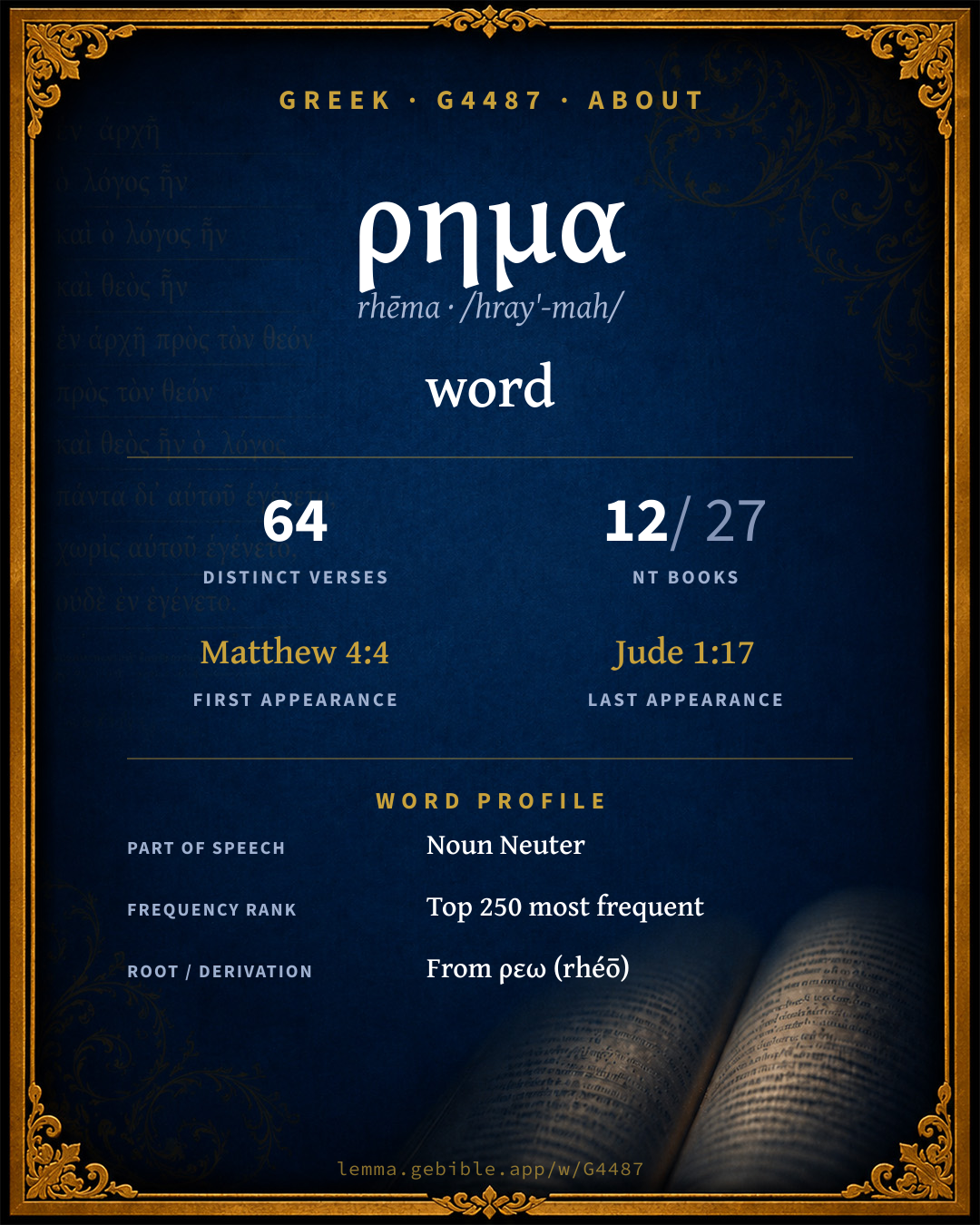
ῥῆμα
word
‘word’ is one of 2 main senses fuller range ↓
Full lexicon entry — Thayer's Greek Lexicon
From Thayer's Greek Lexicon
Where this word appears
See every Accusative-case word in the Greek New Testament →
Grammar key — what these labels mean
Part of speech
- Noun
- A naming word — a person, place, thing, or idea.
Case
- Accusative
- The case of the direct object and of extent.
- Nominative
- The case of the subject (and the predicate nominative).
- Genitive
- The case of source, possession, or “of” — answers “whose / from what.”
- Dative
- The case of the indirect object, means, or location — “to / for / with / in.”
Gender
- Neuter
- Grammatically neuter.
Number
- Plural
- More than one.
- Singular
- One.
Grammatical forms
- Noun, Accusative, Plural, Neuter 21 times (31%)
- Noun, Accusative, Singular, Neuter 11 times (16%)
- Noun, Nominative, Singular, Neuter 11 times (16%)
- Noun, Genitive, Plural, Neuter 6 times (9%)
- Noun, Genitive, Singular, Neuter 6 times (9%)
- Noun, Nominative, Plural, Neuter 6 times (9%)
- Noun, Dative, Singular, Neuter 5 times (7%)
- Noun, Dative, Plural, Neuter 1 time (1%)
Parsed forms decoded from the imported morphology (Robinson–Tischendorf, public domain), counted across 67 parsed occurrences — not distinct verses.
Every verse where G4487 appears — 64 distinct verses across 12 books. Click any verse to open its interlinear word-by-word view. Verse text shown in the World English Bible for context — . Each verse’s Greek form is shown with its reference; the English is not keyword-highlighted, since the data carries no word-level English alignment. Use “Compare translations” on any verse to read it across multiple English versions. This concordance covers the Greek New Testament; Septuagint (Greek Old Testament) occurrences of this word are not indexed here.
Matthew 5 verses
- Matthew 4:4 ῥήματι n dat sg neut But he answered, "It is written, 'Man shall not live by bread alone, but by every word that proceeds out of the mouth of God.'"
- Matthew 12:36 ῥῆμα n nom sg neut I tell you that every idle word that men speak, they will give account of it in the day of judgment.
- Matthew 18:16 ῥῆμα n nom sg neut But if he doesn't listen, take one or two more with you, that at the mouth of two or three witnesses every word may be established.
- Matthew 26:75 ῥήματος n gen sg neut Peter remembered the word which Jesus had said to him, "Before the rooster crows, you will deny me three times." He went out and wept bitterly.
- Matthew 27:14 ῥῆμα n acc sg neut He gave him no answer, not even one word, so that the governor marveled greatly.
Mark 2 verses
- Mark 9:32 ῥῆμα n acc sg neut But they didn't understand the saying, and were afraid to ask him.
- Mark 14:72 ῥῆμα n acc sg neut The rooster crowed the second time. Peter remembered the word, how that Jesus said to him, "Before the rooster crows twice, you will deny me three times." When he thought about that, he wept.
Luke 17 verses
- Luke 1:37 ῥῆμα n nom sg neut For everything spoken by God is possible."
- Luke 1:38 ῥῆμά n acc sg neut Mary said, "Behold, the handmaid of the Lord; be it to me according to your word." The angel departed from her.
- Luke 1:65 ῥήματα n nom pl neut Fear came on all who lived around them, and all these sayings were talked about throughout all the hill country of Judea.
- Luke 2:15 ῥήμα n acc sg neut It happened, when the angels went away from them into the sky, that the shepherds said one to another, "Let's go to Bethlehem, now, and see this thing that has happened, which the Lord has made known to us."
- Luke 2:17 ῥήματος n gen sg neut When they saw it, they publicized widely the saying which was spoken to them about this child.
- Luke 2:19 ῥήματα n acc pl neut But Mary kept all these sayings, pondering them in her heart.
- Luke 2:29 ῥῆμά n acc sg neut "Now you are releasing your servant, Master, According to your word, in peace;
- Luke 2:50 ῥῆμα n acc sg neut They didn't understand the saying which he spoke to them.
- Luke 2:51 ῥήματα n acc pl neut And he went down with them, and came to Nazareth. He was subject to them, and his mother kept all these sayings in her heart.
- Luke 3:2 ῥῆμα n nom sg neut in the high priesthood of Annas and Caiaphas, the word of God came to John, the son of Zacharias, in the wilderness.
- Luke 5:5 ῥήματί n dat sg neut Simon answered him, "Master, we worked all night, and took nothing; but at your word I will let down the net."
- Luke 7:1 ῥήματα n acc pl neut After he had finished speaking in the hearing of the people, he entered into Capernaum.
- Luke 9:45 ῥῆμα ῥήματος n acc sg neut n gen sg neut But they didn't understand this saying. It was concealed from them, that they should not perceive it, and they were afraid to ask him about this saying.
- Luke 18:34 ῥῆμα n nom sg neut They understood none of these things. This saying was hidden from them, and they didn't understand the things that were said.
- Luke 20:26 ῥήματος n gen sg neut They weren't able to trap him in his words before the people. They marveled at his answer, and were silent.
- Luke 24:8 ῥημάτων n gen pl neut They remembered his words,
- Luke 24:11 ῥήματα n nom pl neut These words seemed to them to be nonsense, and they didn't believe them.
John 12 verses
- John 3:34 ῥήματα n acc pl neut For he whom God has sent speaks the words of God; for God gives the Spirit without measure.
- John 5:47 ῥήμασιν n dat pl neut But if you don't believe his writings, how will you believe my words?"
- John 6:63 ῥήματα n nom pl neut It is the spirit who gives life. The flesh profits nothing. The words that I speak to you are spirit, and are life.
- John 6:68 ῥήματα n acc pl neut Simon Peter answered him, "Lord, to whom would we go? You have the words of eternal life.
- John 8:20 ῥήματα n acc pl neut Jesus spoke these words in the treasury, as he taught in the temple. Yet no one arrested him, because his hour had not yet come.
- John 8:47 ῥήματα n acc pl neut He who is of God hears the words of God. For this cause you don't hear, because you are not of God."
- John 10:21 ῥήματα n nom pl neut Others said, "These are not the sayings of one possessed by a demon. It isn't possible for a demon to open the eyes of the blind, is it?"
- John 12:47 ῥημάτων n gen pl neut If anyone listens to my sayings, and doesn't believe, I don't judge him. For I came not to judge the world, but to save the world.
- John 12:48 ῥήματά n acc pl neut He who rejects me, and doesn't receive my sayings, has one who judges him. The word that I spoke, the same will judge him in the last day.
- John 14:10 ῥήματα n acc pl neut Don't you believe that I am in the Father, and the Father in me? The words that I tell you, I speak not from myself; but the Father who lives in me does his works.
- John 15:7 ῥήματά n nom pl neut If you remain in me, and my words remain in you, you will ask whatever you desire, and it will be done for you.
- John 17:8 ῥήματα n acc pl neut for the words which you have given me I have given to them, and they received them, and knew for sure that I came forth from you, and they have believed that you sent me.
Acts 14 verses
- Acts 2:14 ῥήματά n acc pl neut But Peter, standing up with the eleven, lifted up his voice, and spoke out to them, "You men of Judea, and all you who dwell at Jerusalem, let this be known to you, and listen to my words.
- Acts 5:20 ῥήματα n acc pl neut "Go stand and speak in the temple to the people all the words of this life."
- Acts 5:32 ῥημάτων n gen pl neut We are His witnesses of these things; and so also is the Holy Spirit, whom God has given to those who obey him."
- Acts 6:11 ῥήματα n acc pl neut Then they secretly induced men to say, "We have heard him speak blasphemous words against Moses and God."
- Acts 6:13 ῥήματα n acc pl neut and set up false witnesses who said, "This man never stops speaking blasphemous words against this holy place and the law.
- Acts 10:22 ῥήματα n acc pl neut They said, "Cornelius, a centurion, a righteous man and one who fears God, and well spoken of by all the nation of the Jews, was directed by a holy angel to invite you to his house, and to listen to what you say."
- Acts 10:37 ῥῆμα n acc sg neut that spoken word you yourselves know, which was proclaimed throughout all Judea, beginning from Galilee, after the baptism which John preached;
- Acts 10:44 ῥήματα n acc pl neut While Peter was still speaking these words, the Holy Spirit fell on all those who heard the word.
- Acts 11:14 ῥήματα n acc pl neut who will speak to you words by which you will be saved, you and all your house.'
- Acts 11:16 ῥήματος n gen sg neut I remembered the word of the Lord, how he said, 'John indeed baptized in water, but you will be baptized in the Holy Spirit.'
- Acts 13:42 ῥήματα n acc pl neut So when the Jews went out of the synagogue, the Gentiles begged that these words might be preached to them the next Sabbath.
- Acts 16:38 ῥήματα n acc pl neut The sergeants reported these words to the magistrates, and they were afraid when they heard that they were Romans,
- Acts 26:25 ῥήματα n acc pl neut But he said, "I am not crazy, most excellent Festus, but boldly declare words of truth and reasonableness.
- Acts 28:25 ῥῆμα n acc sg neut When they didn't agree among themselves, they departed after Paul had spoken one word, "The Holy Spirit spoke rightly through Isaiah, the prophet, to our fathers,
Romans 3 verses
- Romans 10:8 ῥῆμά ῥῆμα n nom sg neut n nom sg neut But what does it say? "The word is near you, in your mouth, and in your heart;" that is, the word of faith, which we preach:
- Romans 10:17 ῥήματος n gen sg neut So faith comes by hearing, and hearing by the word of God.
- Romans 10:18 ῥήματα n nom pl neut But I say, didn't they hear? Yes, most assuredly, "Their sound went out into all the earth, Their words to the ends of the world."
2 Corinthians 2 verses
Ephesians 2 verses
Hebrews 4 verses
- Hebrews 1:3 ῥήματι n dat sg neut His Son is the radiance of his glory, the very image of his substance, and upholding all things by the word of his power, when he had by himself made purification for our sins, sat down on the right hand of the Majesty on high;
- Hebrews 6:5 ῥῆμα n acc sg neut and tasted the good word of God, and the powers of the age to come,
- Hebrews 11:3 ῥήματι n dat sg neut By faith, we understand that the universe has been framed by the word of God, so that what is seen has not been made out of things which are visible.
- Hebrews 12:19 ῥημάτων n gen pl neut the sound of a trumpet, and the voice of words; which those who heard it begged that not one more word should be spoken to them,
1 Peter 1 verse
2 Peter 1 verse
Jude 1 verse
About this entry
At a glance — auto-summarized from this page’s data, not written by a person. Every figure links to its source below. This summary describes the numbers; it doesn’t interpret them.
ρημα — transliterated rhēma — is a Greek noun carrying the sense “word.” Its earliest occurrence is Matthew 4:4. Spanning 64 verses in 12 books, it ranks among the moderately common words of the Greek New Testament. Its uses concentrate in Luke (27% of all occurrences). Thayer's distinguishes 2 senses for it. Each statement above links to its evidence; the full detail follows below.
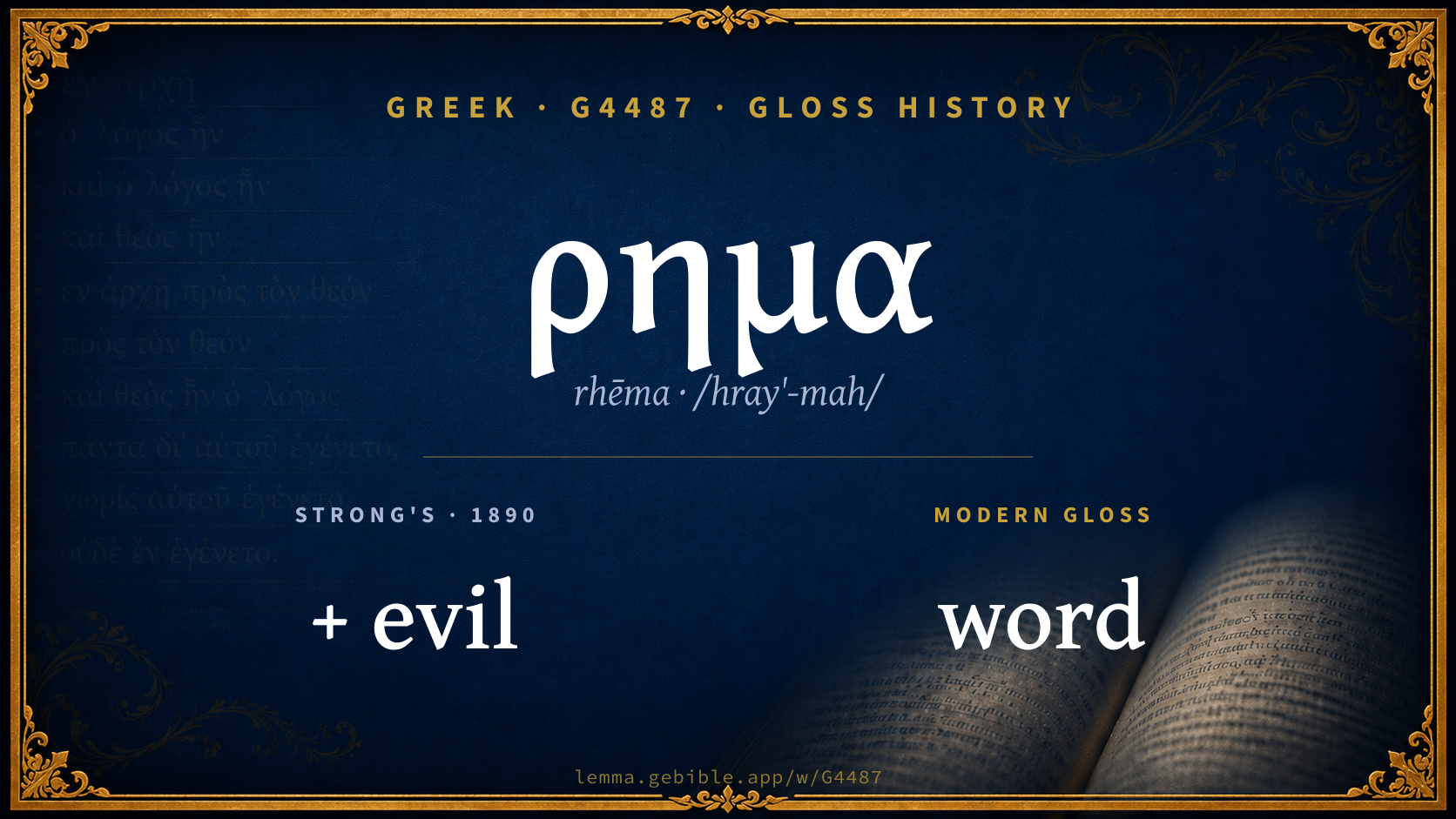
Gloss history
Strong's 1890 vs modern scholarship
About this word
Strong's G4487 catalogs a Greek word from the Greek New Testament.
These counts are not copied from any lexicon or concordance. They are computed here, from the morphology-tagged Greek New Testament. What Lemma adds →
- 64
- distinct verses
- The word appears in 64 distinct verses.
- 12 / 27
- NT books
- The word appears in 12 of 27 New Testament books.
- #247
- by frequency
- Top 250 most frequent Greek words (rank 247 of 5,347 Greek words by occurrence).
View all 64 occurrences in the concordance →
By section of the New Testament
By traditional corpus
Conventional, traditional groupings — biblical authorship is debated, so this is a traditional corpus grouping, not an authorship claim. Some books belong to more than one corpus (Luke is in both the Gospels and the Lukan corpus, and so on), so these shares overlap and need not total 100%. Each figure is a share of the word’s 64 distinct verses.
- Gospels 36 verses · 56%
- Lukan (Luke–Acts) 31 verses · 48%
- Johannine 12 verses · 19%
- Pauline corpus 7 verses · 11%
- Hebrews 4 verses · 6%
- General (Catholic) Epistles 3 verses · 5%
How translations render this word
Counts come from each version’s own published word-to-Strong’s tagging or interlinear alignment — an approximate guide to how each version renders this word, not a word-level alignment the data otherwise carries. Because each total is that version’s own tagged count, the per-version totals vary from one another and need not match the appearance or distinct-verse counts above. These counts may also differ from a printed concordance because Lemma counts each distinctly tagged rendering and does not collapse phrase taggings into a single head-word total. This is a fixed set of word-tagged versions (KJV, ASV, BSB, ULT) and does not change with the reading translation you choose elsewhere. Each version’s license is shown beside its name below (and on Sources).
- King James Version: Words 31×, Word 25×, Saying 5×
- American Standard Version: Words 24×, Word 21×, Saying 8×
- Berean Standard Bible: Words 19×, Word 17×, Message 6×
- unfoldingWord Literal Text: Word 31×, Words 29×, Things 4×
King James Version Public Domain
Renders G4487 across 67 tagged occurrences — most commonly:
Plus 1 rendering that appears only once — usually multi-word phrases or single function words the recovered tagging swept in, not distinct renderings. Not rendered by a distinct English word in 3 further occurrences.
American Standard Version Public Domain
Renders G4487 across 66 tagged occurrences — most commonly:
Plus 7 renderings that appear only once — usually multi-word phrases or single function words the recovered tagging swept in, not distinct renderings.
Berean Standard Bible Public Domain
Renders G4487 across 60 tagged occurrences — most commonly:
Plus 9 renderings that appear only once — usually multi-word phrases or single function words the recovered tagging swept in, not distinct renderings. Not rendered by a distinct English word in 5 further occurrences.
unfoldingWord Literal Text CC BY-SA 4.0
Renders G4487 across 70 tagged occurrences — most commonly:
Plus 6 renderings that appear only once — usually multi-word phrases or single function words the recovered tagging swept in, not distinct renderings.
Senses in Thayer's
The 2 senses Thayer's distinguishes for this word, in lexicon order (not ranked by frequency or importance). The full entry — with sub-senses — is in the Lexicon Entry tab.
- that which is or has been uttered by the living voice, thing spoken, word
- subject matter of speech, thing spoken of
Word origin
Derived from ρεω (rhéō) (G4483) — to utter.
From G4483 ; an utterance (individually collectively or specifically); by implication a matter or topic (especially of narration command or dispute); with a negative naught whatever : - + evil + nothing saying word.
— Strong’s Exhaustive Concordance (1890), public domain.
Forms in the corpus
The 10 distinct written forms G4487 takes in the Greek New Testament, most frequent first — each parse links to that case’s occurrences in the concordance.
| Form | Parsing | Example | Uses |
|---|---|---|---|
| ῥήματα rhḗmata | Noun, Accusative, Plural, Neuter | Luke 2:19 | 24 |
| ῥῆμα rhē̂ma | Noun, Nominative, Singular, Neuter | Matthew 12:36 | 18 |
| ῥήματος rhḗmatos | Noun, Genitive, Singular, Neuter | Matthew 26:75 | 6 |
| ῥημάτων rhēmátōn | Noun, Genitive, Plural, Neuter | Luke 24:8 | 6 |
| ῥήματι rhḗmati | Noun, Dative, Singular, Neuter | Matthew 4:4 | 4 |
| ῥήματά rhḗmatá | Noun, Accusative, Plural, Neuter | John 12:48 | 3 |
| ῥῆμά rhē̂má | Noun, Accusative, Singular, Neuter | Luke 1:38 | 3 |
| ῥήμα rhḗma | Noun, Accusative, Singular, Neuter | Luke 2:15 | 1 |
| ῥήμασιν rhḗmasin | Noun, Dative, Plural, Neuter | John 5:47 | 1 |
| ῥήματί rhḗmatí | Noun, Dative, Singular, Neuter | Luke 5:5 | 1 |
Same root — word family
Other Thayer's entries built from the same root as G4487, grouped by Strong’s listed origin. These share a root / origin per the lexicon — not necessarily a shared meaning. Each links to that word’s own entry.
Derives from
Shares the same root
Compare all same-root words → Showing 4 of 5 — not the complete family. They share a root, not necessarily a meaning.
Septuagint usage
The same Greek word ρημα appears 467 times in the Greek Old Testament (Septuagint), across 439 verses in 27 books.
- 467
- LXX occurrences
- Tagged occurrences of this Greek word in the Septuagint.
- 439
- verses
- Distinct Septuagint verses containing this word.
- 27 / 39
- OT books
- The word appears in 27 of the 39 Old Testament books.
Sample Septuagint occurrences
- Genesis 15:1 ῥῆμα
- Exodus 2:14 ῥῆμα
- Leviticus 4:13 ῥῆμα
- Numbers 11:14 ῥῆμα
- Deuteronomy 1:14 ῥῆμα
- Joshua 1:13 ῥῆμα
- Judges 6:29 ῥῆμα
- Ruth 3:18 ῥῆμα
- 1 Samuel 2:23 ῥῆμα
- 2 Samuel 2:6 ῥῆμα
- 1 Kings 1:27 ῥῆμα
- 2 Kings 1:17 ῥῆμα
Septuagint occurrences (same lexeme)
Every verse where the same Strong’s number (G4487) appears in the Greek Septuagint — showing the first 50 of 439. Verse text shown in the World English Bible for context; the Greek form is the matched word — the English is not keyword-highlighted.
- Genesis 15:1 ῥῆμα After these things the word of Yahweh came to Abram in a vision, saying, "Don't be afraid, Abram. I am your shield, your exceedingly great reward."
- Genesis 18:14 ῥῆμα Is anything too hard for Yahweh? At the set time I will return to you, when the season comes round, and Sarah will have a son."
- Genesis 18:25 ῥῆμα Be it far from you to do things like that, to kill the righteous with the wicked, that so the righteous should be as the wicked. May that be far from you. Shouldn't the Judge of all the earth do right?"
- Genesis 19:21 ῥῆμα He said to him, "Behold, I have granted your request concerning this thing also, that I will not overthrow the city of which you have spoken.
- Genesis 20:8 ῥῆμα Abimelech rose early in the morning, and called all his servants, and told all these things in their ear. The men were very scared.
- Genesis 21:11 ῥῆμα The thing was very grievous in Abraham's sight on account of his son.
- Genesis 21:12 ῥῆμα God said to Abraham, "Don't let it be grievous in your sight because of the boy, and because of your handmaid. In all that Sarah says to you, listen to her voice. For from Isaac will your seed be called.
- Genesis 22:1 ῥῆμα It happened after these things, that God tested Abraham, and said to him, "Abraham!" He said, "Here I am."
- Genesis 22:16 ῥῆμα and said, "I have sworn by myself, says Yahweh, because you have done this thing, and have not withheld your son, your only son,
- Genesis 22:20 ῥῆμα It happened after these things, that it was told Abraham, saying, "Behold, Milcah, she also has borne children to your brother Nahor:
- Genesis 24:9 ῥῆμα The servant put his hand under the thigh of Abraham his master, and swore to him concerning this matter.
- Genesis 24:28 ῥῆμα The young lady ran, and told her mother's house about these words.
- Genesis 24:30 ῥῆμα It happened, when he saw the ring, and the bracelets on his sister's hands, and when he heard the words of Rebekah his sister, saying, "This is what the man said to me," that he came to the man. Behold, he was standing by the camels at the spring.
- Genesis 24:33 ῥῆμα Food was set before him to eat. But he said, "I will not eat until I have told my message." He said, "Speak on."
- Genesis 24:52 ῥῆμα It happened that when Abraham's servant heard their words, he bowed himself down to the earth to Yahweh.
- Genesis 24:66 ῥῆμα The servant told Isaac all the things that he had done.
- Genesis 27:34 ῥῆμα When Esau heard the words of his father, he cried with an exceeding great and bitter cry, and said to his father, "Bless me, even me also, my father."
- Genesis 27:42 ῥῆμα The words of Esau, her elder son, were told to Rebekah. She sent and called Jacob her younger son, and said to him, "Behold, your brother Esau comforts himself about you by planning to kill you.
- Genesis 29:12 ῥῆμα Jacob told Rachel that he was her father's brother, and that he was Rebekah's son. She ran and told her father.
- Genesis 30:31 ῥῆμα He said, "What shall I give you?" Jacob said, "You shall not give me anything. If you will do this thing for me, I will again feed your flock and keep it.
- Genesis 30:34 ῥῆμα Laban said, "Behold, I desire it to be according to your word."
- Genesis 31:1 ῥῆμα He heard the words of Laban's sons, saying, "Jacob has taken away all that was our father's. From that which was our father's, has he gotten all this wealth."
- Genesis 32:20 ῥῆμα You shall say, 'Not only that, but behold, your servant, Jacob, is behind us.'" For, he said, "I will appease him with the present that goes before me, and afterward I will see his face. Perhaps he will accept me."
- Genesis 34:14 ῥῆμα and said to them, "We can't do this thing, to give our sister to one who is uncircumcised; for that is a reproach to us.
- Genesis 34:19 ῥῆμα The young man didn't wait to do this thing, because he had delight in Jacob's daughter, and he was honored above all the house of his father.
- Genesis 37:8 ῥῆμα His brothers said to him, "Will you indeed reign over us? Or will you indeed have dominion over us?" They hated him all the more for his dreams and for his words.
- Genesis 37:11 ῥῆμα His brothers envied him; but his father kept this saying in mind.
- Genesis 39:7 ῥῆμα It happened after these things, that his master's wife cast her eyes on Joseph; and she said, "Lie with me."
- Genesis 39:9 ῥῆμα He isn't greater in this house than I, neither has he kept back anything from me but you, because you are his wife. How then can I do this great wickedness, and sin against God?"
- Genesis 39:17 ῥῆμα She spoke to him according to these words, saying, "The Hebrew servant, whom you have brought to us, came in to me to mock me,
- Genesis 39:19 ῥῆμα It happened, when his master heard the words of his wife, which she spoke to him, saying, "This is what your servant did to me," that his wrath was kindled.
- Genesis 40:1 ῥῆμα It happened after these things, that the butler of the king of Egypt and his baker offended their lord, the king of Egypt.
- Genesis 41:28 ῥῆμα That is the thing which I spoke to Pharaoh. What God is about to do he has shown to Pharaoh.
- Genesis 41:32 ῥῆμα The dream was doubled to Pharaoh, because the thing is established by God, and God will shortly bring it to pass.
- Genesis 41:37 ῥῆμα The thing was good in the eyes of Pharaoh, and in the eyes of all his servants.
- Genesis 42:16 ῥῆμα Send one of you, and let him get your brother, and you shall be bound, that your words may be tested, whether there is truth in you, or else by the life of Pharaoh surely you are spies."
- Genesis 42:20 ῥῆμα Bring your youngest brother to me; so will your words be verified, and you won't die." They did so.
- Genesis 44:2 ῥῆμα Put my cup, the silver cup, in the sack's mouth of the youngest, with his grain money." He did according to the word that Joseph had spoken.
- Genesis 44:6 ῥῆμα He overtook them, and he spoke to them these words.
- Genesis 44:7 ῥῆμα They said to him, "Why does my lord speak such words as these? Far be it from your servants that they should do such a thing!
- Genesis 44:17 ῥῆμα He said, "Far be it from me that I should do so. The man in whose hand the cup is found, he will be my bondservant; but as for you, go up in peace to your father."
- Genesis 44:18 ῥῆμα Then Judah came near to him, and said, "Oh, my lord, please let your servant speak a word in my lord's ears, and don't let your anger burn against your servant; for you are even as Pharaoh.
- Genesis 44:24 ῥῆμα It happened when we came up to your servant my father, we told him the words of my lord.
- Genesis 47:30 ῥῆμα but when I sleep with my fathers, you shall carry me out of Egypt, and bury me in their burying place." He said, "I will do as you have said."
- Genesis 48:1 ῥῆμα It happened after these things, that someone said to Joseph, "Behold, your father is sick." He took with him his two sons, Manasseh and Ephraim.
- Exodus 2:14 ῥῆμα He said, "Who made you a prince and a judge over us? Do you plan to kill me, as you killed the Egyptian?" Moses was afraid, and said, "Surely this thing is known."
- Exodus 2:15 ῥῆμα Now when Pharaoh heard this thing, he sought to kill Moses. But Moses fled from the face of Pharaoh, and lived in the land of Midian, and he sat down by a well.
- Exodus 4:15 ῥῆμα You shall speak to him, and put the words in his mouth. I will be with your mouth, and with his mouth, and will teach you what you shall do.
- Exodus 4:30 ῥῆμα Aaron spoke all the words which Yahweh had spoken to Moses, and did the signs in the sight of the people.
- Exodus 9:5 ῥῆμα Yahweh appointed a set time, saying, "Tomorrow Yahweh shall do this thing in the land."
These are occurrences of the same Greek lexeme (G4487) in the Septuagint — not a translation of any one Hebrew word. The store carries no word-level Hebrew↔Greek alignment, so no Hebrew original is asserted here. Counts come from the recovered LXX Strong's tagging — high-frequency vocabulary is well covered, while rare or late forms may be untagged — so they reflect tagged occurrences and may slightly undercount.