Jude 1:17

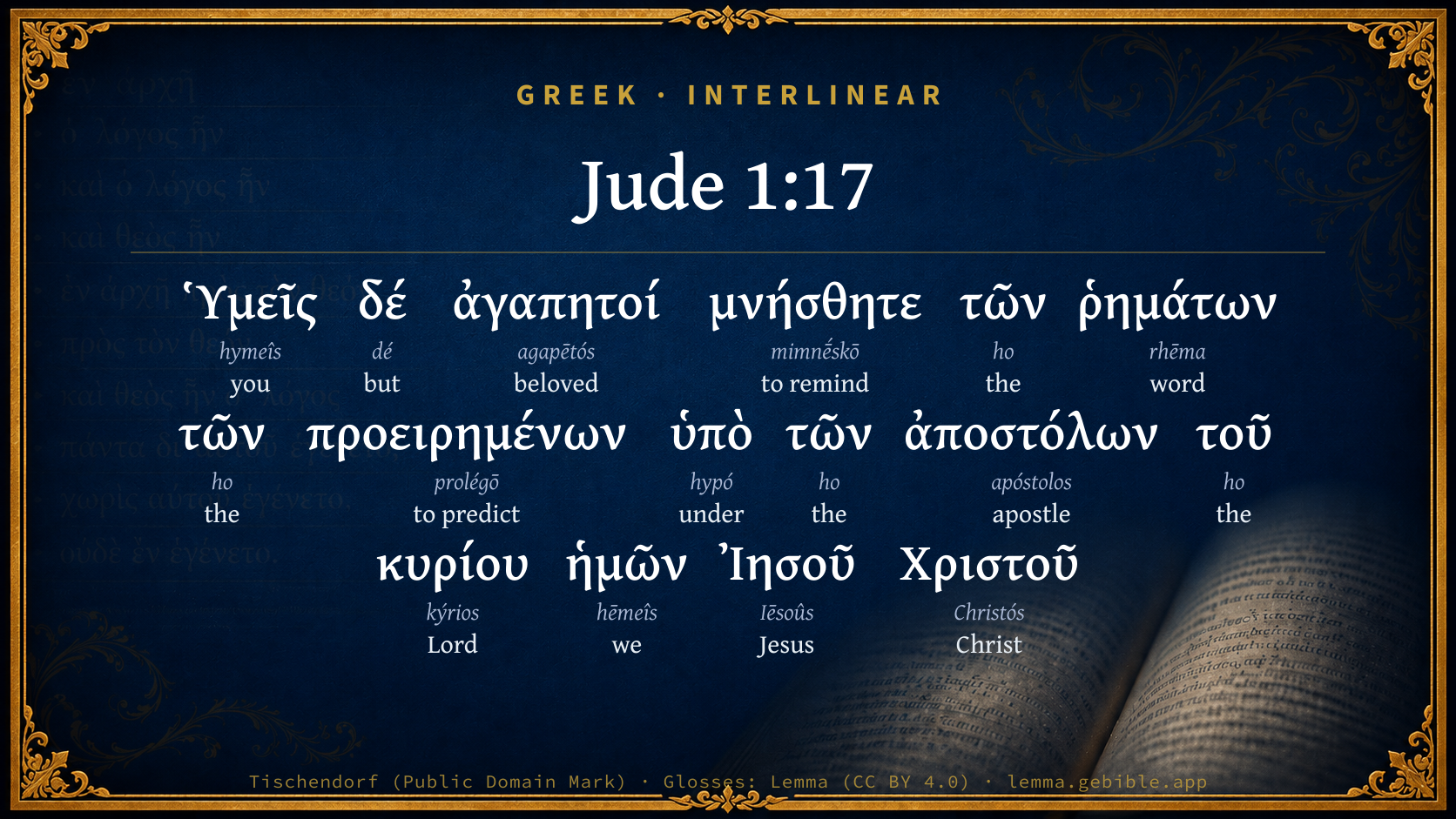
Greek (Tischendorf 8th ed.) Jude 1:17 appears in the Greek New Testament. The text above is from the Tischendorf 8th edition. Each word links to its Strong’s number and a concise gloss. Click any word for its full Thayer’s Greek Lexicon entry.
Download image
Cite this verse

Jude 1:17 (World English Bible). Public Domain. Lemma interlinear Bible study tool, https://lemma.gebible.app/v/jude/1/17.

Show BibTeX & RIS
BibTeX
RIS
English Translation
But you, beloved, remember the words which have been spoken before by the apostles of our Lord Jesus Christ.
World English Bible · Public Domain
Download a study sheet

One document with this verse’s original text, its word-by-word gloss line, the meaning frame, cross-references with their text, attributed commentary, and full source and license credits — printable, and it pastes into notes with its structure intact.

This verse Autodidact and up

Study sheet (.html) Plain text (.txt)

A passage Seminary Student

Up to 50 verses in one chapter. A passage sheet keeps up to 6 commentary sources and 12 cross-references per verse, in the order this page ranks them, and says so on the sheet whenever that leaves anything out. Ask for a single verse and you get the Autodidact verse sheet above.

Everything on this page stays free to read, with no account — the sheet is a download of what is already on screen, not access to it.

Want to remove ads? Support Godless Engineer
Compare translations 3

The same verse in 3 English versions, stacked beneath the original-language interlinear above. Click any original word for its lexicon entry.

Each is an independent rendering of the whole verse — the interlinear is not word-aligned to these translations.

Highlighted words mark where these versions differ — a whole-verse word diff, not a word-by-word alignment.

  • World English Bible Public Domain
    But you, beloved, remember the words which have been spoken before by the apostles of our Lord Jesus Christ.
  • King James Version Public Domain
    But, beloved, remember ye the words which were spoken before of the apostles of our Lord Jesus Christ;
  • unfoldingWord Literal Text CC BY-SA 4.0
    But you, beloved ones, remember the words that have been spoken beforehand by the apostles of our Lord Jesus Christ,

unfoldingWord Literal Text — © unfoldingWord, licensed CC BY-SA 4.0. Word-aligned USFM3 via Door43 (git.door43.org/unfoldingWord/en_ult).

Versions to compare (up to 4)

3 of 4 selected

Show all 19 translations

Every available English version of this verse, each an independent rendering of the whole verse.

  • World English Bible Public Domain
    But you, beloved, remember the words which have been spoken before by the apostles of our Lord Jesus Christ.
  • Berean Standard Bible Public Domain
    But you, beloved, remember what was foretold by the apostles of our Lord Jesus Christ
  • Majority Standard Bible Public Domain
    But you, beloved, remember what was foretold by the apostles of our Lord Jesus Christ
  • King James Version Public Domain
    But, beloved, remember ye the words which were spoken before of the apostles of our Lord Jesus Christ;
  • American Standard Version (1901) Public Domain
    But ye, beloved, remember ye the words which have been spoken before by the apostles of our Lord Jesus Christ;
  • Revised Version (1885) Public Domain
    But ye, beloved, remember ye the words which have been spoken before by the apostles of our Lord Jesus Christ;
  • Geneva Bible (1599) Public Domain
    But, yee beloued, remember the wordes which were spoken before of the Apostles of our Lord Iesus Christ,
  • Douay-Rheims (1899) Public Domain
    But you, my dearly beloved, be mindful of the words which have been spoken before by the apostles of our Lord Jesus Christ,
  • Young's Literal Translation Public Domain
    and ye, beloved, remember ye the sayings spoken before by the apostles of our Lord Jesus Christ:
  • Literal Standard Version CC BY-SA 4.0
    but you, beloved, remember the sayings spoken before by the apostles of our Lord Jesus Christ,
  • Unlocked Literal Bible CC BY-SA 4.0
    But you, beloved, remember the words that were spoken in the past by the apostles of our Lord Jesus Christ.
  • unfoldingWord Literal Text CC BY-SA 4.0
    But you, beloved ones, remember the words that have been spoken beforehand by the apostles of our Lord Jesus Christ,
  • Darby Bible Public Domain
    But *ye*, beloved, remember the words spoken before by the apostles of our Lord Jesus Christ,
  • World Messianic Bible Public Domain
    But you, beloved, remember the words which have been spoken before by the emissaries of our Lord Yeshua the Messiah.
  • Webster's Bible Public Domain
    But, beloved, remember ye the words which were spoken before by the apostles of our Lord Jesus Christ;
  • Free Bible Version CC BY-SA 4.0
    But you, my dear friends, please remember what you were told by the apostles of our Lord Jesus Christ.
  • Bible in Basic English Public Domain
    But you, my loved ones, keep in memory the words which were said before by the Apostles of our Lord Jesus Christ,
  • Text-Critical English NT CC BY 4.0
    But you, beloved, must remember what the apostles of our Lord Jesus Christ foretold,
  • Tyndale New Testament (1534) Public Domain
    But ye beloved remember the wordes which were spoken before of the Apostles of oure lorde Iesus Christ

Literal Standard Version (2020), Covenant Press — licensed CC BY-SA 4.0. Text via the HelloAO Bible API (eBible.org). Unlocked Literal Bible (unfoldingWord) — licensed CC BY-SA 4.0. Text via the HelloAO Bible API (eBible.org). unfoldingWord Literal Text — © unfoldingWord, licensed CC BY-SA 4.0. Word-aligned USFM3 via Door43 (git.door43.org/unfoldingWord/en_ult). Free Bible Version, Dr. Jonathan Gallagher — licensed CC BY-SA 4.0. Text via the HelloAO Bible API (eBible.org).

Word by word

More ways to search: Search by grammar → Find every occurrence → Compare this word →

Practice this passage: Drill this verse → Learn its vocabulary →

προειρημένων
prolégō
G4302
“to predict”
Verb, Perfect, Passive, Participle, Genitive, Plural, Neuter
Part of Speech
Verb
Tense
Perfect
Voice
Passive
Mood
Participle
Case
Genitive
Number
Plural
Gender
Neuter
Full Thayer's Definition

Origin: from G4253 and G3004

TDNT: None

1. to say beforehand, to predict
  1. Ὑμεῖς hymeîs G5210 “you” Personal pronoun, 2nd person, Nominative, Plural
  2. δέ dé G1161 “but” Conjunction
  3. ἀγαπητοί agapētós G27 “beloved” Adjective, Vocative, Plural, Masculine
  4. μνήσθητε mimnḗskō G3403 “to remind” Verb, Aorist, Passive, Imperative, 2nd person, Plural
  5. τῶν ho G3588 “the” Article, Genitive, Plural, Neuter
  6. ῥημάτων rhēma G4487 “word” Noun, Genitive, Plural, Neuter
  7. τῶν ho G3588 “the” Article, Genitive, Plural, Neuter
  8. ὑπὸ hypó G5259 “under” Preposition
  9. τῶν ho G3588 “the” Article, Genitive, Plural, Masculine
  10. ἀποστόλων apóstolos G652 “apostle” Noun, Genitive, Plural, Masculine
  11. τοῦ ho G3588 “the” Article, Genitive, Singular, Masculine
  12. κυρίου kýrios G2962 “Lord” Noun, Genitive, Singular, Masculine
  13. ἡμῶν hēmeîs G2249 “we” Personal pronoun, 1st person, Genitive, Plural
  14. Ἰησοῦ Iēsoûs G2424 “Jesus” Noun, Genitive, Singular, Masculine
  15. Χριστοῦ Christós G5547 “Christ” Noun, Genitive, Singular, Masculine

About this verse

These counts appear in no published source. They are computed here, from the morphology-tagged text and Lemma’s own curated glosses. What Lemma adds →

16
words
13
distinct lemmas
General Epistles
section

Notable vocabulary

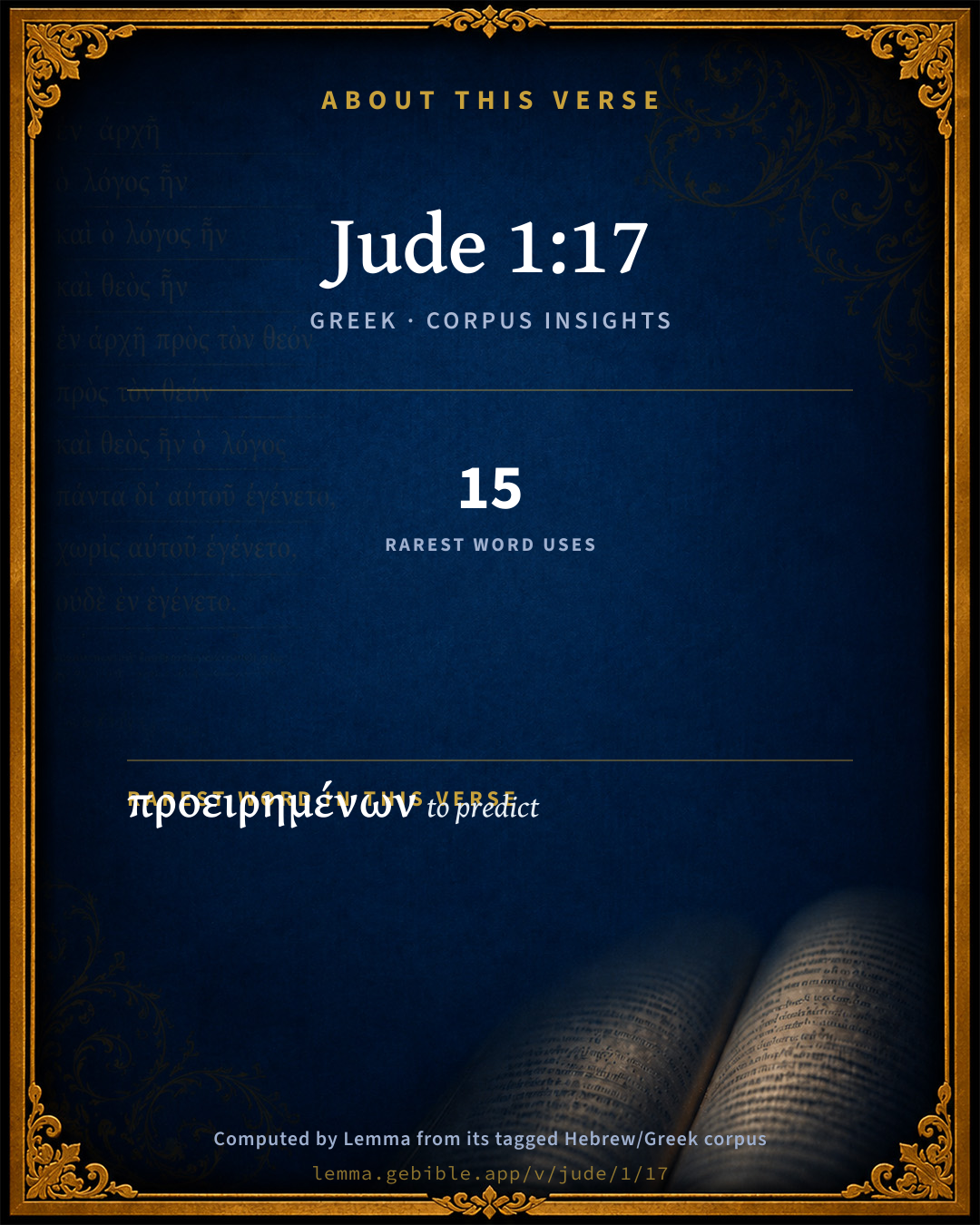
The rarest word here is προειρημένων to predict G4302 — appearing just 15 times in the whole Greek New Testament.

Shared distinctive vocabulary

προειρημένων to predict G4302 occurs in 13 verses of the Greek New Testament. Also found in:

Repetition

A word recurs within this verse:

Cross-references

6

Topical passages linked to Jude 1:17 in the Treasury of Scripture Knowledge — connected by theme and wording, ordered by reader-vote popularity; previews shown in the World English Bible.

  • 2 Peter 3:2 that you should remember the words which were spoken before by the holy prophets, and the commandments of us, the apostles of the Lord and Savior:
  • 1 John 4:6 We are of God. He who knows God listens to us. He who is not of God doesn't listen to us. By this we know the spirit of truth, and the spirit of error.
  • Ephesians 4:11 He gave some to be apostles; and some, prophets; and some, evangelists; and some, shepherds and teachers;
  • Acts 20:35 In all things I gave you an example, that so laboring you ought to help the weak, and to remember the words of the Lord Jesus, that he himself said, 'It is more blessed to give than to receive.'"
  • Malachi 4:4 "Remember the law of Moses my servant, which I commanded to him in Horeb for all Israel, even statutes and ordinances.
  • Ephesians 2:20 being built on the foundation of the apostles and prophets, Christ Jesus himself being the chief cornerstone;

Cross-references courtesy of OpenBible.info (CC BY 4.0).

Commentary

Notes on Jude 1:17 from classic Christian and Jewish commentators (each source and its license shown beneath its notes). The classic Christian expositions comment on the surrounding passage and are grouped to its opening verse, so a note may address several verses; the Jewish commentaries on the Tanakh (Rashi and others) are per-verse, so they appear only where the commentator wrote on this verse.

Lemma curates 59 commentaries, every one of them public domain or Creative Commons licensed, each selected and text-cleaned for this edition rather than reprinted as found. About our sources →

Albert Barnes' Notes on the Bible

But, beloved, remember ye ... - There is a striking similarity between these two verses and 2Pe 3:1-3. It occurs in the same connection, following the description of the false and dangerous teachers against whom the apostle would guard them, and couched almost in the same words. See it explained in the notes at the similar passage in Peter. When Jude (Jud 1:17) entreats them to remember the words which were spoken by “the apostles,” it is not necessarily to be inferred that he was not himself an apostle, for he is speaking of what was past, and there might have been a special reason why he should refer to something that they would distinctly remember which had been spoken by the “other” apostles on this point. Or it might be that he meant also to include himself among them, and to speak of the apostles collectively, without particularly specifying himself.

Mockers - The word rendered “mockers” here is the same which in the parallel place in 2Pe 3:3 is rendered “scoffers.” Peter has stated more fully what was the particular subject on which they scoffed, and has shown that there was no occasion for it 2Pe 3:4, following.

Albert Barnes' Notes on the Bible (1834–1885) — public domain. Text from a community e-Sword/MySword module.

The Biblical Illustrator

Joseph S. Exell

Jud_1:17-19

Remember ye the words … spoken before of the apostles.

Words to be remembered

1. Great should be the care of the ministers of Christ to warn the Church of approaching evils, especially of seducers.

2. It is our duty to acknowledge and commend the gifts and graces of God bestowed upon others with respect.

3. The consent between the penmen of Scripture is sweet and harmonious; they were all breathed upon by the same Spirit, and breathed forth the same truth and holiness.

4. Scripture is the best preservative against seduction.

5. They who are forewarned should be forearmed. (W. Jenkyn, M. A.)

Mockers in the last time.

Mockers

1. What is told to the Church in general, we must apprehend it as told to us. Paul telleth Timothy, and Peter telleth the distressed strangers, and Jude saith they told you. The Bible is a message sent from heaven to acquaint us with the mind of God; if we own the Divine authority of it, why do we regard it no more?

2. We should not be troubled at what is foretold; monsters expected are not wondered at; expectation forearmeth the mind against evil (Joh_16:4). We are the better prepared to entertain evils when we expect them before they come, and the evil to which the mind is accustomed seemeth the less. Again, we have an experience of Gods truth in the prediction. Finally, it assureth us that the Lord hath a hand and a counsel in all our troubles, for He told us of them before.

3. The Scriptures speak much of the evil of the latter times; there is more knowledge and yet more sin and error. The latter days are as the bottom and sink that receive the dregs of foregoing ages, and as the world groweth old it is much given to dreams and dotage.

4. Among other sins that are found in the latter times, there will be many scoffers, partly because in times of controversy men will lose all awe--when truths are made questionable assent is weakened; partly because in times of liberty men will give vent to their thoughts.

5. Mockers and scoffers are usually the worst of sinners. Scorning cometh from custom in sinning, and maketh way for freedom in sinning.

6. Those that cast off the awe of the Lords coming will certainly give up themselves to brutish lusts.

7. It argueth a state of wickedness to walk after our own lusts; that is, when sin and lust is our constant practice. (T. Manton.)

Mockers

By scoffing at things sacred, and ridiculing the notion that there is any harm in licentiousness, or anything estimable in holiness, they created a moral atmosphere in which men sinned with a light heart, because sin was made to look as if it were a matter of no moment, a thing to be indulged in without anxiety or remorse. It would be more reasonable and less reprehensible to make a mock at carnage or pestilence, and teach men to go with a light heart into a desolating war or plague-stricken neighbourhood. In such cases experience of the manifest horrors would soon cure the light-heartedness. But the horrible nature of sin is not so manifest, and with regard to that, experience teaches its lesson more slowly. It is like a poisoning of the blood rather than a wound in the flesh, and may have done incalculable mischief before any serious pain is felt, or any grave alarm excited. Hence it is quite easy for many to walk after their own ungodly lusts and at the same time mock at sin and its consequences. (A. Plummer, D. D.)

The Biblical Illustrator, edited by Joseph S. Exell (c. 1880s–1900s) — public domain. Text from a community e-Sword module.

Joseph Benson's Commentary

Jdg 1:17. But, beloved — To prevent you from giving heed to the vain speeches of these deceivers; remember the words which were spoken before — Or spoken prophetically; by the apostles — Who have preached the gospel to you in all its purity. He does not exempt himself from the number of apostles; for in the next verse he says, they told you, not us. The resemblance, as Doddridge justly observes, between this text and 1Pe 3:2, is very remarkable. It is such as would incline one to think that Jude had the text in Peter before him, and omitted what had a peculiar reference to the former part of St. Peter’s epistle, and to which there was nothing in his own to answer. Though Jude only cites the words spoken by Peter in particular concerning the coming of scoffers in the last time, yet his exhortation being general, it comprehends the words spoken by the other apostles concerning the coming of false teachers, such as Paul’s, 1Ti 4:1-5; 2Ti 3:4. Nay, it comprehends the words spoken by Jude himself in the preceding part of this epistle.

Joseph Benson's Commentary on the Old and New Testaments (1811–1818) — public domain. Text from a community e-Sword module.

Tyndale Open Study Notes

Tyndale Open Resources

1:17 completely destroyed: See Lev 27:28-29. • Hormah: See study note on Num 21:2-3.

1:17-23 After condemning the false teachers, Jude again encourages his readers directly (see 1:3-4). They had been warned by the apostles about false teaching (1:17-19). They should encourage each other in the faith (1:20-21) and reach out to those who might be going astray through the false teachers’ influence (1:22-23).

1:17 what the apostles of our Lord Jesus Christ predicted: Such predictions are in Acts 20:29-30; 1 Tim 4:1-3; 2 Tim 3:1-5.

Tyndale Open Study Notes — © Tyndale Open Resources, licensed CC BY-SA 4.0. Text via the HelloAO Bible API.

Bengel's Gnomon

Johann Albrecht Bengel

Jud 1:17. Ὑμεῖς δὲ, ἀγαπητοὶ, but ye, beloved) Thus also Jud 1:20.—μνήσθητε, remember) They therefore to whom Jude writes had also heard the other apostles.—ἀποστόλων, apostles) Jude does not exempt himself from the number of the apostles; for in the next verse he says, to you, not, to us.

Bengel's Gnomon of the New Testament — English translation (T&T Clark, Edinburgh, 1860) — public domain. Text from a community e-Sword module.

Meyer's Critical & Exegetical Commentary

Heinrich August Wilhelm Meyer

Jud_1:17-18. Jude now turns to his readers, comforting[42] and exhorting them in reference to the ungodly above described; see 2Pe_3:2-3.

ὑμεῖς δέ] an emphatic contrast to those above mentioned.

μνήσθητε] presupposes the words meant by Jude known to the readers, as learned from the apostles.

τῶν ῥημάτων τῶν προειρημένων] ῥῆμα; the word as an expression of thought. The προ in προειρημένων designates these words not as those which predict something future, but which were already spoken before (so also Hofmann).

ὑπὸ τῶν ἀποστόλων κ.τ.λ.] Jude would hardly have so expressed himself were he himself an apostle, which several expositors certainly do not grant, explaining this mode of expression partly from Judes modesty and partly from the circumstance that, except himself and John, the other apostles were already dead.

Jud_1:18. ὅτι ἔλεγον ὑμῖν] ὑμῖν here renders it probable that Jude means such sayings as the readers had heard from the mouth of the apostles themselves; yet the words which follow are not necessarily to be considered as a literally exact quotation, but may be a compression of the various predictions of the apostles concerning this subject.[43]

ἐπʼ ἐσχάτου [τοῦ] χρόνου] a designation of the time directly preceding the advent of Christ. In the reading ΤΟῦ ΧΡΌΝΟΥ, ἘΣΧΆΤΟΥ is the genitive neuter, as in Heb_1:1.

ἜΣΟΝΤΑΙ ἘΜΠΑῖΚΤΑΙ] only here and in 2Pe_3:3, a word occurring only in later Greek; the LXX. have translated תַּעֲלוּלִים by ἘΜΠ., as they render הִתְעַלֵּל by ἘΜΠΑΊΖΕΙΝ. Mockers, that is, men to whom the holy (not merely the resurrection, Grotius) serves for mockery. ΛΑΛΕῖΝ ὙΠΈΡΟΓΚΑ is a ἘΜΠΑΊΖΕΙΝ of the holy (which Hofmann without reason denies); this is naturally united with a surrender to their own lusts; therefore ΚΑΤᾺ ΤᾺς ἙΑΥΤῶΝ ἘΠΙΘΥΜΊΑς ΠΟΡΕΥΌΜΕΝΟΙ ΤῶΝ ἈΣΕΒΕΙῶΝ] ΤῶΝ ἈΣΕΒΕΙῶΝ, an echo of the saying of Enoch, is placed emphatically at the close, in order to render prominent the character and aim of ἘΠΙΘΥΜΊΑΙ.

That the apostles in their writings frequently prophesied of the entrance of heretical and ungodly men into the church, is well known; comp. Act_20:29; 1Ti_4:1; 2Ti_3:2 ff.; yet ἘΜΠΑΊΖΕΙΝ is not elsewhere stated as a characteristic mark of these men; this is only the case in 2Pe_3:3, where, however, the mockery is referred only to the denial of the advent of Christ.

[42] Why Jude should not have intended to comfort his readers by reminding them of what the apostles had, at an earlier period, said of the appearance of these men, as he here describes them, cannot be perceived (against Hofmann).

[43] Entirely without reason, Schott maintains that the intervening words: ὅτι ἔλεγον ὑμῖν, prove that Jude will here give a verbal quotation, and that this must be a writing earlier directed to the readers. ὅτι ἐλ. ὑμ. simply introduces the statement of the contents of the ῥήματα, which were earlier spoken by ths apostles. The plural is not to be referred to one apostle, and the verb does not in the least degree indicate that this word was written.

Meyer — Critical and Exegetical Commentary on the New Testament — English translation by Peter Christie, edited by Frederick Crombie (T&T Clark, 1880) — public domain. Text from a community e-Sword module.

Expositor's Greek Testament

ed. W. Robertson Nicoll

Jud 1:17-19 . The Faithful are bidden to call to mind the warnings of the Apostles . The Apostles warned you repeatedly that in the last time there would arise mockers led away by their own carnal lusts. It is these that are now breaking up the unity of the Church by their invidious distinctions, men of unsanctified minds, who have not the Spirit of God. See Introduction on the Early Heresies in the larger edition.

Jud 1:17 . ὑμεῖς δὲ , ἀγαπητοί , μνήσθητε τῶν ῥημάτων τῶν προειρημένων ὑπὸ τῶν ἀποστόλων . The writer turns again, as in Jud 1:20 below, to the faithful members of the Church (Jud 1:3 ) and reminds them, not now of primeval prophecy, but of warning words uttered by the Apostles. Some have taken this as a quotation by Jude from 2Pe 3:3 , where the quotation is given more fully. But, there also, the words are referred back to a prior authority, “holy prophets” and “your Apostles”. The words ὅτι ἔλεγον ὑμῖν , which follow, imply that the warning was spoken, not written, and that it was often repeated.

The Expositor's Greek Testament, edited by W. Robertson Nicoll (1897–1910) — public domain. Text from a community e-Sword module.

Geneva Bible (1599)

Geneva Bible translators

The rising up of such monsters was spoken of before, that we should not be troubled at the newness of the matter.

Geneva Bible (1599) marginal notes — public domain. Text via Bolls.life.

Jamieson, Fausset & Brown

Robert Jamieson, A. R. Fausset & David Brown

But; beloved . . . ye--in contrast to those reprobates, Jde 1:20, again.

remember--implying that his readers had been contemporaries of the apostles. For Peter uses the very same formula in reminding the contemporaries of himself and the other apostles.

spoken before--spoken already before now.

the apostles--Peter (see on Pe2 3:2-3), and Paul before Peter (Act 20:29; Ti1 4:1; Ti2 3:1). Jude does not exclude himself from the number of the apostles here, for in Jde 1:18, immediately after, he says, "they told You," not us (rather as Greek, "used to tell you" implying that Jude's readers were contemporaries of the apostles, who used to tell them).

Jamieson, Fausset & Brown — Commentary Critical and Explanatory on the Whole Bible (1871) — public domain (CC PDM 1.0). Text via the HelloAO Bible API.

Adam Clarke's Commentary

Verse 17. Remember - the words] Instead of following those teachers and their corrupt doctrine, remember what Christ and his apostles have said; for they foretold the coming of such false teachers and impostors.

Adam Clarke's Commentary on the Bible (1810–1826) — public domain. Text from a community e-Sword/MySword module.

John Calvin's Commentaries

17. But, beloved. To a most ancient prophecy he now adds the admonitions of the apostles, the memory of whom was recent. As to the verb μνήσθητε, it makes no great difference, whether you read it as declarative or as an exhortation; for the meaning remains the same, that being fortified by the prediction he quotes, they ought to be terrified.

John Calvin's Commentaries (1540-1563) — public domain. Text from the Calvin Translation Society English edition (1840s-50s) via the Christian Classics Ethereal Library (ccel.org). Calvin's coverage is partial (roughly two-thirds of the Bible); uncommented books and verses are honest gaps, never fabricated. The 19th-century editor's footnotes and remarks are omitted so the notes are faithfully Calvin's own voice.

The Cambridge Bible for Schools and Colleges

gen. ed. J. J. S. Perowne

17. remember ye the words which were spoken before of the apostles …] The passage stands in close parallelism with 2Pe_3:2, but differs in speaking only of “apostles” and not of prophets, and apparently also in referring only or chiefly to the predictions of the apostles and not to their commandments. If we could assume that 2 Peter was the earlier of the two Epistles, we might see in St Jude’s language a reference to that of the Apostle. It will be noticed also that St Jude does not say, as St Peter does, “of us the apostles” (see, however, note on 2Pe_3:2), and so far leaves it uncertain whether he includes himself.

The Cambridge Bible for Schools and Colleges (gen. ed. J. J. S. Perowne; Cambridge University Press, 1878–1918) — public domain. Text from a community e-Sword module.

John Gill's Exposition

But, beloved,.... Or "my beloved", as the Syriac and Arabic versions read; or "our brethren", as the Ethiopic version; the apostle addresses the saints in this manner, to distinguish them from the false teachers, and to show that he had a different opinion of them from them; and that be would have them beware of them, and not be surprised at them, since it was no other than what was foretold; and also to engage their attention and regard to the following exhortation:

remember ye the words which were spoken before of the apostles of our Lord Jesus Christ; these words mean not the doctrines of the apostles in general, but particularly the prophecies delivered out by them, as by the Apostles Paul and Peter, concerning the false teachers that should arise; and these being spoken of before, and by apostles, even by the apostles, of our Lord Jesus Christ, were worthy of regard, and deserved to be remembered; a remembrance of which is a preservative from error, and a relief in the worst of times, whether of persecution, or heresy. This does not suppose that Jude was not an apostle, only that there were other apostles besides him; and that these, some of them at least, had prophesied of these men, and that he had lived to see their predictions verified; nor does he exclude himself from being one of them; yea, the Ethiopic version reads, "which we the apostles of our Lord Jesus Christ have formerly declared unto you"; see Pe2 3:2.

John Gill's Exposition of the Whole Bible (1746–1763) — public domain (CC PDM 1.0). Text via the HelloAO Bible API.

Haydock's Catholic Bible Commentary

Be mindful, &c. He now exhorts the faithful to remain steadfast in the belief and practice of what they had heard from the apostles, who had also foretold that in after times (literally, in the last time,)[9] there should be false teachers, scoffing and ridiculing all revealed truths, abandoning themselves to their passions and lusts, who separate themselves from the Catholic communion by heresies and schisms; sensual men,[10] carried away, and enslaved by the pleasures of the senses. (Witham)

===============================

[BIBLIOGRAPHY]

In novissimo tempore, Greek: en eschato chrono, i.e. in this last age of the world.

===============================

[BIBLIOGRAPHY]

Animales, Greek: psuchikoi, ab anima. Tertullian turned Montanist, called the Catholics, Psychicos.

====================

George Leo Haydock (1774–1849), Haydock's Catholic Family Bible and Commentary, 1859 edition — public domain. Excludes Psalms (Douay-Rheims chapter numbering differs from Protestant) and Deuterocanonical books (Catholic canon only).

Matthew Poole's English Annotations

Especially Paul and Peter: see Act 20:29 and 2Pe 3:2, besides the places in the margin. From this passage it appears that this Epistle was written late, and, likely, after the other apostles, except John, were dead.

Matthew Poole's English Annotations on the Holy Bible (1683–1685) — public domain. Text from a community e-Sword/MySword module.

Whedon's Commentary on the Bible

Daniel D. Whedon

17. But, beloved—Turning, as it were, his face towards the purer part of the Church. Later prophets than Enoch have described these men, and with a more specific designation of their time and place.

Remember ye the words—This phrase naturally suggests spoken words; spoken by apostles whom they had, many of them, personally heard.

Spoken before— Forespoken; uttered long before their fulfilment, and so predictive. They were forespoken to the Ephesian Church by its founder-apostle, Paul, in his memorable address to the Ephesian elders. Act_20:28-31. Also, 2Ti_3:1-5; and 2Th_2:1-10. And 2Th_2:5, says the apostasy was topic of oral apostolic discourse.

Daniel D. Whedon (gen. ed.), Commentary on the Old and New Testaments (1874–1909) — public domain. Text from a community e-Sword module.

The Pulpit Commentary

Vers. 17, 18. A direct appeal is now introduced to the readers. Its object is to save them from being disconcerted by the rise of these impious men or beguiled by their pretensions. They are reminded, therefore, of apostolic words, by which from the beginning they had been taught to anticipate such perils and to be on their guard against them. But, beloved, remember ye the words which were (or, have been) spoken before of (i.e. by) the apostles of our Lord Jesus Christ. The Revised Version rightly restores the rendering "but ye, beloved," which the Authorized Version dropped. The older versions, Wickliffe, Tyndale, Cranmer, the Genevan, the Rhemish, agree in introducing this emphatic "ye," which sets the readers in sharpest contrast to these "murmurers," and gives greater point to Jude"s appeal. The teaching of the apostles on the subject in hand is referred to as something by no means strange to them. The terms would naturally suggest that the readers had been themselves hearers of the apostles. They are not decisive, however, of the question whether oral or written communications, direct or indirect instructions, are in view. The indeterminate sense of the term "apostle," and the general tenor of the reference, make it impossible to say that Jude ranks himself here among the twelve. The sentence would be more natural on the lips of one who was not himself an apostle. How that they told you there should be mockers in the last time, who should walk after their own ungodly lusts. The Revised Version is more literally true to the original in giving this the direct form, how that they said, to you, In the last time there shall be mockers, etc. This does not necessarily imply, however, that written words are referred to, or that a quotation is being made. The tense of the verb, "said," by which the words are introduced, points the other way. It means that they were in the way of saying such things, and makes it probable, therefore, that Jude refers to the substance of what the apostles were in the habit of saying about the future in their ordinary preaching and teaching. Christ"s own prophecies on the subject of the end (Mt 24,mt 25) would form the text for such declarations. We have examples of these apostolic predictions in the case of Paul, (Act_20:29 2Ti_3:1) in that of John, (1Jn_2:18) in that of Peter. (2Pe_3:2, 2Pe_3:3) The last resembles the present passage most closely, the same unusual word for "mockers," or "scoffers," being common to both. The stress of the statement is again on the sensual impiety of these men, as appears from the strong and peculiar phrase with which the prediction closes, "walking after their own lusts of ungodliness" (Revised Version, margin). By "the last time" (with which compare the expressions in 1Pe_1:5, 20 2Pe_3:3 Heb_1:1, etc.) is meant the time which closes the present order of things, and ushers in Christ"s return. It was a Hebrew idea that time was divided into two great periods age" and "the age to come," which were parted by the coming of Messiah. The "age to come," or the Messianic age, was in principle introduced by Messiah"s first advent, but it was to be finally brought in by his second advent an event conceived to be near. The time which heralded the conclusive termination of the one period and entrance of the other was "the last time a time of evils and of portents marking the end of the old order.

Vers. 17, 18. A quotation from recent prophecies.

Jude then refers to the warnings of apostles respecting these scoffing sensualists. "But ye, beloved, remember ye the words which have been spoken before by the apostles of our Lord Jesus Christ.

I CONFIRMATION OF HIS STATEMENTS BY THE AUTHORITY OF APOSTLES.

1. It is evident that Jude"s Epistle was written subsequent, perhaps long subsequent, to the Epistles of Peter and Paul, to which he refers. These sensual seducers had time to develop their corruptions and their audacity of position.

2. Jude recognizes the Divine authority and inspiration of these earlier writings of Scripture.

3. He throws back the saints upon the recollection of Scripture as their only authoritative guide. There is no evidence that he refers here to any oral traditions.

4. Jude believes in the fact of prophetic illumination.

5. It is the duty of ministers to warn their people against a approaching evils.

6. To be forewarned is to be forearmed.

II THE SUBSTANCE OF THE PROPHETIC WARNING. "In the last time there shall be mockers, walking after their own ungodly lusts." Note here the predicted appearance of wicked mockers.

1. They arise in "the last time. That is, in the period lying between the first and the second advents of Christ. They appear even under the purest dispensation of grace. The wicked are most wicked when grace is most abundant.

2. They are as wicked as they are scornful. Mockery is, indeed, a note of advanced corruption. Their mockeries are directed both against God and man. These mockers were probably those referred to by Peter as asking, "Where is the promise of his coming?

(1) Mockery is essentially a profane act. It argues contempt of God"s being as well as his attributes.

(2) It argues unbelief. It implies that God"s threatenings are a fable.

(3) It is a barrier against the reception of good. "Rebuke a scorner, and he will hate thee

(4) It is a from of persecution. (Gal_4:29)

(5) Great is the Divine forbearance with mockers.

(6) God will punish the mockers. He "scorneth the scorners"; (Pro_3:34) and will "mock at their calamities" in the day of their judgment.

III THE CONDUCT OF BELIEVERS IN THE PRESENCE OF MOCKERS.

1. We must bear mockings with patience, like our Lord, who "endured the cross, despising the shame". (Heb_12:2)

2. We must not render scoff for scoff, at the risk of hardening scoffers.

3. We must not allow scoffers to deter us from following the Lord fully. T.C.

Vers. 17-21. Believers urged to remember the prophecies of the apostles, and to note their fulfillment.

Jude acknowledges the truth that the apostles spake under the guidance of the Holy Spirit as really as Isaiah and Jeremiah; and their predictions of the working of Satan and his servants were delivered partly by word of mouth, and partly by writings addressed to the Churches, and to evangelists like Timothy. Paul affirms that there would be many whose characters resembled those described in this Epistle. (see 2Ti_3:1-6) These offenders would "mock" sacred things and sacred persons; and in the spirit of scorn would exclude themselves from saving knowledge, and repeat the experience of Herod, before whom the Son of God would work no miracle and utter no word; no, not even of reproof. The life of these men would be impure, their spirit factious and schismatic; and they would prove that they were in their natural state for "that which is born of the flesh is flesh and were therefore deprived of the life-giving and purifying presence of the Divine Spirit. These believers were to observe the inspired predictions of the apostles; and then mark how the prophecy corresponded with the facts. If they remembered these things they would find their memory a means of grace, and, instead of being shaken in mind, they might from these sad examples draw reasons for firmer faith and more steady profession of the gospel.

Here we have SPECIAL DUTIES AND PRIVILEGES OF BELIEVERS ASSOCIATED WITH THE OFFICES AND GRACE OF THE HOLY TRINITY. They are first encouraged to pursue the work of building up their spiritual life and character, which assumes that a foundation has been laid by faith in Christ; and that the fabric is to be carried up, by the addition of similar materials, to visibility and permanence. To realize this blessing there must be prayer in association with the help of the Divine Spirit, who will unfold the work of new covenant blessings, and prompt the suppliant to seek the "fruits of the Spirit" in all their variety and inexpressible value. Christians are then exhorted to keep themselves in the circle of the Father"s love, that they may realize all the benefits of adoption, and maintain a becoming confidence in the aim of all his discipline which is to prepare them for eternal life. However diversified his methods may be, his purpose is unchangeable and gracious; obedience to his will is the way to rest in his love, and to be in the way of his gracious manifestations to his children. All these counsels are concluded by an exhortation to look for eternal life through Christ. His mercy begins this spiritual life and the same mercy is seen in patience with our slowness the revival and strengthening of spiritual convictions, and supplies of Divine grace. The Lord Jesus often directed the minds of his disciples to the future life, in which would be found the consummation of his purposes in the peace, security, joy, and perfection of his followers. The completeness of these counsels is worth our observation. The greatness of the work of edification leads to prayer in the Spirit. Prayer in the Spirit will conduce to growing impressions of the Father"s love; and all will tend to promote anticipation and desire of eternal life through Jesus Christ our Lord. J.S.B.

The Pulpit Commentary (1880–1919), ed. H.D.M. Spence-Jones & Joseph S. Exell — public domain. Text from a community e-Sword module.

John Wesley's Explanatory Notes

By the apostles - He does not exempt himself from the number of apostles. For in the next verse he says, they told you, not us.

John Wesley, Explanatory Notes Upon the Whole Bible (1754–1765) — public domain. Text via the GEBible commentary corpus.

Kretzmann's Popular Commentary

Paul E. Kretzmann

An admonition to holy steadfastness:

v. 17. But, beloved, remember ye the words which were spoken before of the apostles of our Lord Jesus Christ,

v. 18. how that they told you there should be mockers in the last time, who should walk after their own ungodly lusts.

v. 19. These be they who separate themselves, sensual, having not the Spirit

v. 20. But ye, beloved, building up yourselves on your most holy faith, praying in the Holy Ghost,

v. 21. keep yourselves in the love of God, looking for the mercy of our Lord Jesus Christ unto eternal life.

v. 22. And of some have compassion, making a difference;

v. 23. and others save with fear, pulling them out of the fire; hating even the garment spotted by the flesh.

The apostle here addresses himself to the Christians in an earnest appeal: But you, beloved, remember the words which were spoken before by the apostles of our Lord Jesus Christ, that they told you. At the end of time there will be mockers who walk after their own impious lusts. The warning of Jude was not the first one which his readers had received; it was but necessary to remind them of words of solemn warning, spoken, for example, by Peter, when he wrote that there would come in the last days scoffers, walking after their own lusts, 2Pe 3:3, and by Paul, when he told the elders of Ephesus that men would arise of their own selves, speaking perverse things, Act 20:29-30. Op. 1Ti 4:1; 2Ti 3:1-9.

St. Jude completes the description: These are they that separate themselves, fleshly, not having the Spirit. That is the principal function of the false teachers: they cause divisions, dissensions, offenses contrary to the sound doctrine. They are sensuous creatures, seeking the gratification of their sensual appetites upon every occasion. The Spirit of God does not live in them, since they are servants of the Spirit of Darkness, Rom 16:17-18; Col 2:18-23. These words must be kept in mind at all times over against the false teachers that set aside the clear statements of God’s holy Word and try to entangle the souls in their nets of unbelief.

True believers have nothing in common with the false teachers and their ways: But you, beloved, building yourselves up on your most holy faith, with prayer in the Holy Ghost, keep yourselves in the love of God, accepting the mercy of our Lord Jesus Christ unto eternal life. Here the apostle offers at least a summary of the treatise which he had in mind before circumstances obliged him to write this letter. He urges the Christians to be established upon, to build themselves up on, their most holy faith, upon the foundation of Jesus Christ and the apostles, Eph 2:20; Col 2:7. They should continue steadfast in the words of Christ, in the most holy and precious Gospel of their salvation, and let no power in the universe move them from their allegiance, Joh 8:31-32; Rom 16:17-18. And since this is not a matter of the believer’s own reason and strength, he will seek and obtain strength from the Lord in daily prayer in the Holy Ghost, who Himself assists us with groanings which cannot be uttered, Rom 8:26-27. In this manner do Christians keep themselves in the love of God, God’s most wonderful gift to mankind, Joh 3:16. This love of God is shed abroad in our hearts by the Holy Ghost which is given unto us, Rom 5:5, and this love of God is bound to awaken love in our hearts in return, 1Jn 4:19. Thus we daily accept the mercy of our Lord Jesus Christ, His divine favor earned through His own suffering and death, which assures us eternal life by faith in Him, 1Jn 2:1-2; Rom 8:34; Heb 7:25. We are certain of everlasting salvation through the mercy of God in Jesus Christ.

This certainty of faith will then show itself in our behavior toward our brethren, in brotherly love: And some indeed admonish, making a distinction; but some deliver, snatching them from the fire; on still others have compassion in fear, hating also the garment which has been stained by the flesh. Three classes of weak brethren are here distinguished, and we are to make a distinction in our treatment of them. Those that are uncertain in their faith, always in doubt about placing their trust in the salvation of Christ, we should admonish to put aside their doubts. Others that have almost been led astray by the deceivers, we should snatch like a brand from the burning, Amo 4:11; Zec 3:2, tearing them away from the eager claws that would draw them down to perdition. Still others are just on the verge of turning aside from the right way, being inclined to listen to the voice of the deceivers. To such we should offer loving, merciful assistance, Gal 6:1-2. And this should be done in fear, in the spirit of meekness; we should always watch for ourselves lest we also be tempted. In our entire attitude there should not be the least indication of pride and presumption, but only a holy horror of sin, of the spotted garment of the flesh. And as for ourselves, it must be our constant effort to keep the garment of salvation, of the merit of Christ, with which God has clothed us, unspotted both by false doctrine and by carnal life, Rev 3:4-5.

Paul E. Kretzmann, Popular Commentary of the Bible (1921–1924) — public domain. Text from a community e-Sword module.

Burkitt's Expository Notes on the New Testament

William Burkitt

Having largely described those seducers, our apostle now comes to exhort those to whom he wrote to beware of them, assuring them that the apostles of Christ, St. Paul, and particularly St. Peter, had expressly foretold of those wicked scoffers that would arise in the church in the last times; which mockers and scoffers he shows were such as without any just cause separated themselves from the church’s communion, pretending greatly to sanctity, but addicted to sensuality, and destitute of the Holy Spirit.

Note here, 1. That the scripture speaks much of the sin and sinners that should be found in the latter times; we ought not therefore to be troubled at what is foretold, nor be unarmed when we are so often forewarned. It is a shame for them, who have oft heard and known the doctrines of the apostles, to be surprised by the seducers. St. Jude expects that these Christians, who know what the apostles had delivered, should vigorously oppose all seducers and seduction.

Learn, 2. That a causeless separation from a church of which we are members, is culpable and sinful: a separation from corruptions, and a separation from them that are corrupt, are two distinct things; the former is always a duty, the latter not so.

Learn, 3. That those that separate from the assemblies of the faithful, are unusually sensual, and have not the Spirit; they have not the spirit, either to guide them, or to quicken them, or to comfort them. These are they who separate themselves, sensual, having not the Spirit.

William Burkitt's Expository Notes on the New Testament (1700–1703) — public domain. Text from a community e-Sword module.

Godbey's Commentary on the New Testament

William B. Godbey

17, 18. “At the last time there will be mockers going forth according to their own lusts of the ungodly.” Jude quotes this as a trite prophecy of our Lord’s Apostles. In 2Pe 3:3 you find the same. Hence there is no dodging the issue. We are living amid the awful fulfillment of this terrible prophecy. Fallen churches in all ages have bred false prophets. The world this day is filled with fallen churches and flooded with false prophets. “Let God be true and every man a liar.” What is a fallen church? A church without the Holy Ghost. Just as the body is dead without the soul, the church is dead without the Holy Ghost. When deposed from the leadership He does not stay long in a church. Who is a false prophet? One who is led by an evil spirit (a devil) instead of the Holy Spirit. That evil spirit is dressed up like an angel of light, passing himself for the Holy Ghost and deceiving the man, who thinks he is a true Gospel preacher till he wakes up in hell. As a rule, false prophets are candid, honest (with men), often scholarly, high-toned gentlemen, who edify and delight the people by their nice soft speeches, “selling the people to the devil for money.” 2Pe 2:3. Satan has more intelligence than a thousand theologians. If you do not get rid of him altogether, he will get the wool over your eyes somewhere. Can I get rid of the devil? Yes; glory to God! In both of our Lord’s prayers (Mat 6:13 and Joh 17:15) we have “deliver us from evil.” The Greek for evil is tou poneerou, the evil one, i.e., the devil. It is your glorious privilege not only to get rid of all sin, but to get rid of the devil and all his myrmidons. Here is where the flood of counterfeit preachers, i.e., false prophets, have always come in. They do not get rid of the devil, so he leads them captive, passing himself off for God. If you would not get caught in Satan’s trap, get rid of him altogether. How can I? While the devil is so wise and strong that he can deceive and wrap you round his fingers, Jesus is omnipotent and can toss the devil beyond the North pole in the twinkling of an eye if you will perfectly submit to Him, letting Him have His way with your soul, body, life and and faltered on entire consecration, and fallen into the hands of Satan.

William B. Godbey, Commentary on the New Testament (1896–1900) — public domain. Text from a community e-Sword module.

The People's New Testament

B. W. Johnson

17. Remember ye the words … spoken before of the apostles. The language implies that Jude was not an apostle.

B. W. Johnson's The People's New Testament with Notes (1889–1891) — public domain. Electronic text from the Christian Classics Ethereal Library (CCEL) ThML edition.

unfoldingWord translationNotes

Door43 World Missions Community

will follow their own ungodly desires

These people are spoken of as if their desires were kings who ruled over them. AT: "are never able to stop dishonoring God by doing the evil things they wish to do" (See: Metaphor)

will follow their own ungodly desires

Ungodly desires are spoken of as if they were a path that a person will follow. (See: Metaphor)

It is these

"It is these mockers" or "These mockers are the ones"

are worldly

think as other ungodly people think, they value the things that unbelievers value (See: Metaphor)

they do not have the Spirit

The Holy Spirit is spoken of as if he were something that people can possess. AT: "the Spirit is not within them"

translationWords

beloved

apostle

Jesus

mock

Holy Spirit

unfoldingWord translationNotes — © Distant Shores Media and the Door43 World Missions Community, licensed CC BY-SA 4.0. Source: git.door43.org/Door43/en_tn.

Cambridge Greek Testament for Schools and Colleges

17. We find several examples in N.T. (e.g. Act 20:29, 1 Timothy 4, 2 Timothy 3 etc.) of predictions of false teaching and wickedness in the Christian body, but not of mockers, as here. Jude need not be referring to a written document, but to a spoken warning often uttered (ἔλεγον) by the Apostles. But see above on 2Pe 3:3. The mockers, teaching as they did the lawfulness of many lax practices, would deride those who held the stricter view.

Cambridge Greek Testament for Schools and Colleges (Cambridge University Press, 1896; 21 vols, various authors incl. Carr, Maclear, Plummer, Farrar, Lumby, Moule, M. R. James, Simcox) — public domain. Text from a community e-Sword module.

International Critical Commentary

17. ὑμεῖς δὲ … Ἰησοῦ Χριστοῦ. “But ye, beloved, remember ye the words which were spoken before by the apostles of our Lord Jesus Christ.” Ὑμεῖς is placed in front of the sentence with great emphasis in opposition to the οὗτοι of ver. 16. A comparison with 2Pe 3:2 will show that either Peter has greatly complicated the expression of Jude, or Jude has greatly simplified that of Peter. The latter seems more probable; see ver. 10 above. The substance of this apostolic warning may be found in 1Ti 4:1 (where the words τὸ δὲ Πνεῦμα ῥητῶς λέγει may introduce a prediction given orally by a Christian prophet); 2Ti 3:1-5; Act 20:29. These passages show that similar admonitions were current. But the exact form of the prophecy, as it is here expressed, is found only in 2Pe 3:3, and it is there given by an apostle as his own. Neither ῥῆμα nor the following λέγω need be taken to show that St. Jude was referring to mere words, for ῥῆμα is constantly used of scripture, and the phrase ἡ γραφὴ λέγει is familiar. But, even if the words are taken in their strict sense, the possibility of a direct quotation from 2 Peter is not excluded. St. Jude reminds his readers that the apostles had often said that mockers would come, and then proceeds to quote an apostolic document in which this saying was recorded in a particular shape. See Mansel, Gnostic Heresies, p. 70.

St. Jude here distinctly tells us that he was not an apostle himself.

International Critical Commentary — older volumes (1896–1929), various authors — public domain. Text from a community e-Sword module.

Lesson kit

Teaching starters — assembled from the data on this page, not authored interpretation. Every prompt links to the verse data it draws on. Edit before teaching.

Jude, in the General Epistles, opens this verse with 16 words (13 distinct Greek lemmas). Its most distinctive word is prolégō (“to predict”). A historical commentator’s framing appears above. Read the whole chapter for the surrounding context.

Discussion questions

  1. What does “to predict” (prolégō) contribute to the verse as a whole?
  2. How does Matthew 24:25, which shares the word «to predict», read alongside this verse?
  3. What does the repetition of “the” (4× in this one verse) do in this verse?
  4. These translations render this verse differently. What is at stake in choosing one wording over another?
  5. Compare how Albert Barnes' Notes on the Bible and The Biblical Illustrator read this verse. Where do they agree or differ?

Things to notice

Reading settings

Reading text

Shown beneath each verse's original-language words.

Old Testament
Old Testament edition

Read the OT as the Masoretic Hebrew (MT) or the Greek Septuagint (LXX).

English shown for the Greek Septuagint (in the Hebrew ↔ Greek comparison).

Comparing translations? Open the Compare panel on any verse page to stack up to four side by side.