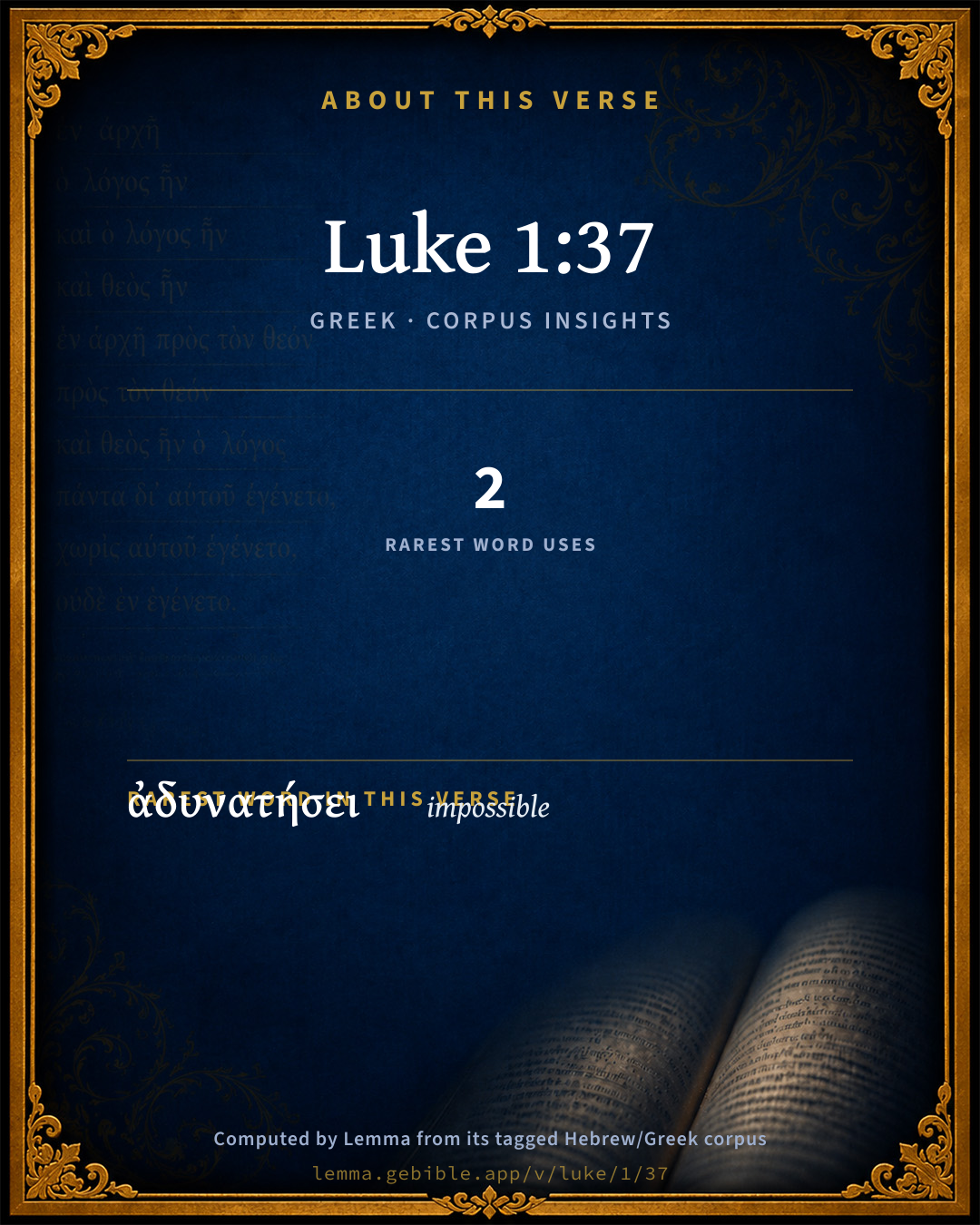
Luke 1:37

Greek (Tischendorf 8th ed.) Luke 1:37 appears in the Greek New Testament. The text above is from the Tischendorf 8th edition. Each word links to its Strong’s number and a concise gloss. Click any word for its full Thayer’s Greek Lexicon entry.
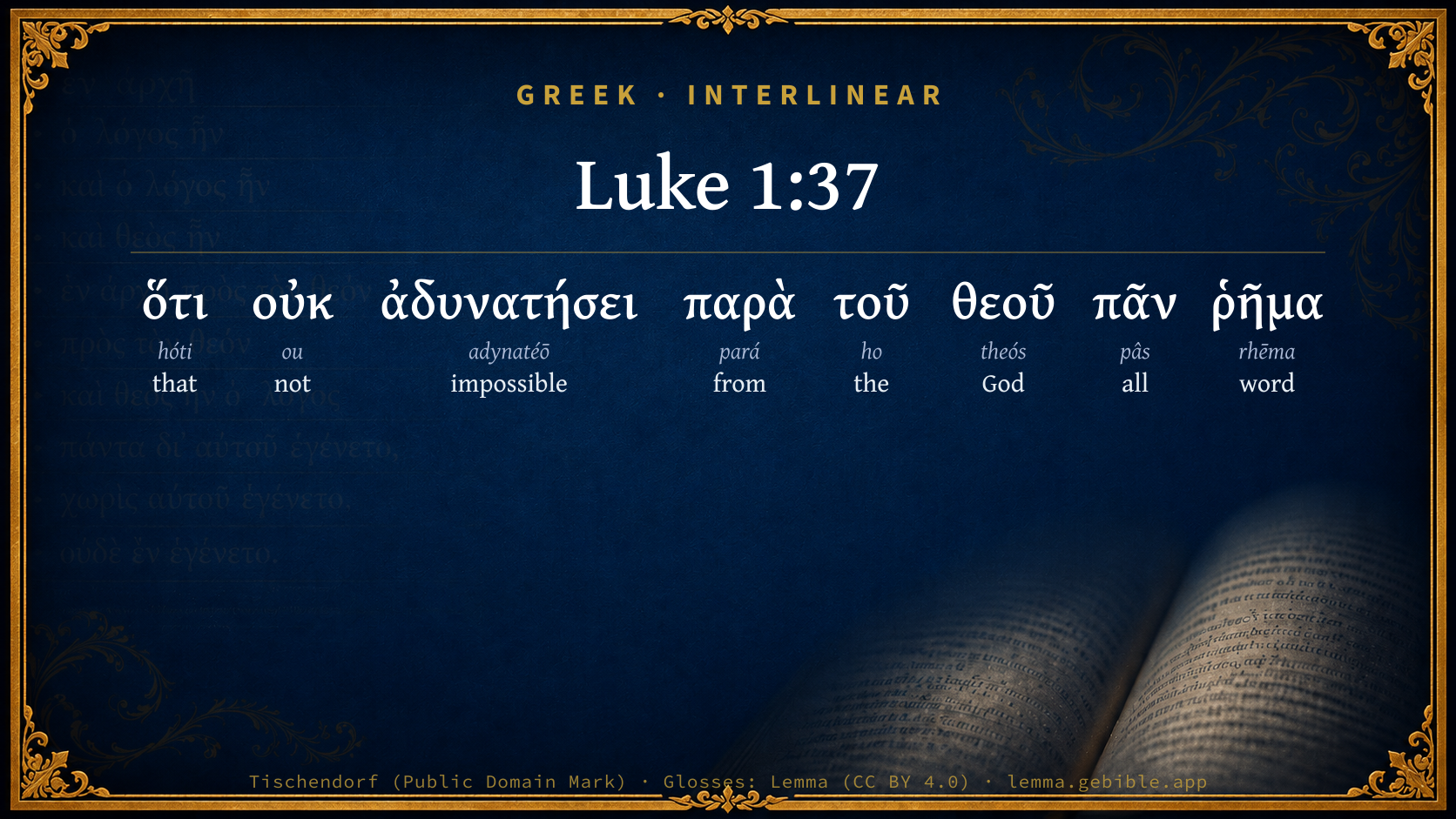
Download image
Cite this verse

Luke 1:37 (World English Bible). Public Domain. Lemma interlinear Bible study tool, https://lemma.gebible.app/v/luke/1/37.

Show BibTeX & RIS
BibTeX
RIS
English Translation
For everything spoken by God is possible."
World English Bible · Public Domain
Download a study sheet

One document with this verse’s original text, its word-by-word gloss line, the meaning frame, cross-references with their text, attributed commentary, and full source and license credits — printable, and it pastes into notes with its structure intact.

This verse Autodidact and up

Study sheet (.html) Plain text (.txt)

A passage Seminary Student

Up to 50 verses in one chapter. A passage sheet keeps up to 6 commentary sources and 12 cross-references per verse, in the order this page ranks them, and says so on the sheet whenever that leaves anything out. Ask for a single verse and you get the Autodidact verse sheet above.

Everything on this page stays free to read, with no account — the sheet is a download of what is already on screen, not access to it.

Want to remove ads? Support Godless Engineer
Compare translations 3

The same verse in 3 English versions, stacked beneath the original-language interlinear above. Click any original word for its lexicon entry.

Each is an independent rendering of the whole verse — the interlinear is not word-aligned to these translations.

Highlighted words mark where these versions differ — a whole-verse word diff, not a word-by-word alignment.

  • World English Bible Public Domain
    For everything spoken by God is possible."
  • King James Version Public Domain
    For with God nothing shall be impossible.
  • unfoldingWord Literal Text CC BY-SA 4.0
    For every word will not be impossible for God.”

unfoldingWord Literal Text — © unfoldingWord, licensed CC BY-SA 4.0. Word-aligned USFM3 via Door43 (git.door43.org/unfoldingWord/en_ult).

Versions to compare (up to 4)

3 of 4 selected

Show all 19 translations

Every available English version of this verse, each an independent rendering of the whole verse.

  • World English Bible Public Domain
    For everything spoken by God is possible."
  • Berean Standard Bible Public Domain
    For no word from God will ever fail.”
  • Majority Standard Bible Public Domain
    For no word from God will ever fail.”
  • King James Version Public Domain
    For with God nothing shall be impossible.
  • American Standard Version (1901) Public Domain
    For no word from God shall be void of power.
  • Revised Version (1885) Public Domain
    For no word from God shall be void of power.
  • Geneva Bible (1599) Public Domain
    For with God shall nothing be vnpossible.
  • Douay-Rheims (1899) Public Domain
    Because no word shall be impossible with God.
  • Young's Literal Translation Public Domain
    because nothing shall be impossible with God.'
  • Literal Standard Version CC BY-SA 4.0
    because nothing will be impossible with God.”
  • Unlocked Literal Bible CC BY-SA 4.0
    For nothing will be impossible for God.”
  • unfoldingWord Literal Text CC BY-SA 4.0
    For every word will not be impossible for God.”
  • Darby Bible Public Domain
    for nothing shall be impossible with God.
  • World Messianic Bible Public Domain
    For nothing spoken by God is impossible.”
  • Webster's Bible Public Domain
    For with God nothing will be impossible.
  • Free Bible Version CC BY-SA 4.0
    Nothing is impossible for God.”
  • Bible in Basic English Public Domain
    For there is nothing which God is not able to do.
  • Text-Critical English NT CC BY 4.0
    For nothing is impossible with God.”
  • Tyndale New Testament (1534) Public Domain
    for with god can nothinge be vnpossible.

Literal Standard Version (2020), Covenant Press — licensed CC BY-SA 4.0. Text via the HelloAO Bible API (eBible.org). Unlocked Literal Bible (unfoldingWord) — licensed CC BY-SA 4.0. Text via the HelloAO Bible API (eBible.org). unfoldingWord Literal Text — © unfoldingWord, licensed CC BY-SA 4.0. Word-aligned USFM3 via Door43 (git.door43.org/unfoldingWord/en_ult). Free Bible Version, Dr. Jonathan Gallagher — licensed CC BY-SA 4.0. Text via the HelloAO Bible API (eBible.org).

Word by word

More ways to search: Search by grammar → Find every occurrence → Compare this word →

Practice this passage: Drill this verse → Learn its vocabulary →

About this verse

These counts appear in no published source. They are computed here, from the morphology-tagged text and Lemma’s own curated glosses. What Lemma adds →

8
words
8
distinct lemmas
Gospels
section

Notable vocabulary

The rarest word here is ἀδυνατήσει impossible G101 — appearing just 2 times in the whole Greek New Testament.

Shared distinctive vocabulary

ἀδυνατήσει impossible G101 occurs in 2 verses of the Greek New Testament. Also found in:

Cross-references

10

Topical passages linked to Luke 1:37 in the Treasury of Scripture Knowledge — connected by theme and wording, ordered by reader-vote popularity; previews shown in the World English Bible.

  • Matthew 19:26 Looking at them, Jesus said, "With men this is impossible, but with God all things are possible."
  • Jeremiah 32:27 Behold, I am Yahweh, the God of all flesh: is there anything too hard for me?
  • Mark 10:27 Jesus, looking at them, said, "With men it is impossible, but not with God, for all things are possible with God."
  • Jeremiah 32:17 Ah Lord Yahweh! behold, you have made the heavens and the earth by your great power and by your outstretched arm; there is nothing too hard for you,
  • Luke 18:27 But he said, "The things which are impossible with men are possible with God."
  • Genesis 18:14 Is anything too hard for Yahweh? At the set time I will return to you, when the season comes round, and Sarah will have a son."
  • Numbers 11:23 Yahweh said to Moses, Has Yahweh's hand grown short? now shall you see whether my word shall happen to you or not.
  • Philippians 3:21 who will change the body of our humiliation to be conformed to the body of his glory, according to the working by which he is able even to subject all things to himself.
  • Zechariah 8:6 Thus says Yahweh of Hosts: "If it is marvelous in the eyes of the remnant of this people in those days, should it also be marvelous in my eyes?" says Yahweh of Hosts.
  • Job 13:2 What you know, I know also. I am not inferior to you.

Cross-references courtesy of OpenBible.info (CC BY 4.0).

Commentary

Notes on Luke 1:37 from classic Christian and Jewish commentators (each source and its license shown beneath its notes). The classic Christian expositions comment on the surrounding passage and are grouped to its opening verse, so a note may address several verses; the Jewish commentaries on the Tanakh (Rashi and others) are per-verse, so they appear only where the commentator wrote on this verse.

Lemma curates 59 commentaries, every one of them public domain or Creative Commons licensed, each selected and text-cleaned for this edition rather than reprinted as found. About our sources →

The Biblical Illustrator

Joseph S. Exell

Luk_1:37

Nothing shall be impossible

Gods omnipotence

It certainly is not possible for us to be in a position where omnipotence cannot assist us.

God hath servants everywhere; and, where we think He has none, His word can create a multitude. There are treasures hid in the sand, and the Lords chosen shall eat thereof. (C. H.Spurgeon.)

The scorn of impossibility

It is not a lucky word, this same impossible: no good comes of those who have it so often in their mouth. Who is he that says always, There is a lion in the way? Sluggard, thou must slay the lion, then; the way has to be travelled. In art, in practice, innumerable critics will demonstrate that most things are henceforth impossible; that we are got, once for all, into the region of perennial commonplace, and must contentedly continue there. Let such critics demonstrate; it is the nature of them: what harm is in it? Poetry once demonstrated to be impossible, arises the Burns, arises the Goethe. Unheroic commonplace being now clearly all we have to look for, comes Napoleon, comes the conquest of the world. It was proved by fluxionary calculus, that steamships could never get across from the farthest point of Ireland to the nearest of Newfoundland: impelling force, resisting force, maximum here, minimum there, by law of Nature and geometric demonstration. What could be done? The Great Eastern could weigh anchor from Bristol Port; that could be done. The Great Eastern, bounding safe through the gullets of the Hudson, threw her cable out on the capstan of New York, and left our still moist-paper demonstration to dry itself at leisure. Impossible he, cried Mirabeau, ne me dites jamais ce bete de mot (Never name to me that blockhead of a word). (Thomas Carlyle.)

The Biblical Illustrator, edited by Joseph S. Exell (c. 1880s–1900s) — public domain. Text from a community e-Sword module.

Bengel's Gnomon

Johann Albrecht Bengel

Luk 1:37. Πᾶν ῥῆμα, every word [thing]) As to things contradictory in the very terms, whether such are possible to happen, is not a subject which need be disputed; for they do not constitute a word [in the sense ῥῆμα, verbum, is here used, a true word or thing]: nor does a thing done and undone, i.e. true and false [a word verified and then falsified], constitute a word; for repentance of His deed or promise does not apply to God: Gen 18:14, μὴ ἀδυνατεῖ παρὰ τῷ Θεῷ ῥῆμα; Is any word impossible with God? (Surely not.)

Bengel's Gnomon of the New Testament — English translation (T&T Clark, Edinburgh, 1860) — public domain. Text from a community e-Sword module.

Expositor's Greek Testament

ed. W. Robertson Nicoll

Luk 1:37 . ἀδυνατήσει : the verb means, in classic Greek, to be weak, of persons. In Sept [5] and N. T. (here and in Mat 17:20 ) it means to be impossible, of things. Commentators differ as to whether we should render: no word of God shall be weak, inoperative, or no thing , with, on the part of, God, shall be impossible. ῥῆμα = דָּבָר may be rendered either word or thing . The reading παρὰ τοῦ θεοῦ ( [6] [7] [8] ) seems to demand the former of the two translations. Field, Otium Nor. , discusses this passage. Adopting the above reading, and adhering to the sense of ἀδυνατ . in reference to things, he translates: “for from God no word (or no thing) shall be impossible”.

[5] Septuagint.

[6] Codex Vaticanus (sæc. iv.), published in photographic facsimile in 1889 under the care of the Abbate Cozza-Luzi.

[7] Codex Bezae

[8] Codex Regius--eighth century, represents an ancient text, and is often in agreement with א and B.

Some recent critics find in this section two different views of the birth of Jesus, one implying natural paternity, the other supernatural causality, the former being the view in the original document, the other introduced by the evangelist, the former Jewish in its tendency of thought, the latter heathen-Christian. The subject is discussed by Hillmann in Jahrb. für prot. Theol. , 1891, and Usener, Religions-geschictliche Untersuchungen , 1888. J. Weiss, in his ed. of Meyer, p. 303, note, seems inclined to favour this view, and to see in Luk 1:31-33 the one version, and in Luk 1:34-35 the other, due to Lk. Against this view vide Feine, Vork. Überlief .

The Expositor's Greek Testament, edited by W. Robertson Nicoll (1897–1910) — public domain. Text from a community e-Sword module.

Jamieson, Fausset & Brown

Robert Jamieson, A. R. Fausset & David Brown

For, &c.--referring to what was said by the angel to Abraham in like case (Gen 18:14), to strengthen her faith.

Jamieson, Fausset & Brown — Commentary Critical and Explanatory on the Whole Bible (1871) — public domain (CC PDM 1.0). Text via the HelloAO Bible API.

Adam Clarke's Commentary

Verse 37. For with God nothing shall be impossible.] Words of the very same import with those spoken by the Lord to Sarah, when he foretold the birth of Isaac, Ge 18:14, Is any thing too hard for the Lord? As there can be no doubt that Mary perceived this allusion to the promise and birth of Isaac, so she must have had her faith considerably strengthened by reflecting on the intervention of God in that case.

Adam Clarke's Commentary on the Bible (1810–1826) — public domain. Text from a community e-Sword/MySword module.

The Cambridge Bible for Schools and Colleges

gen. ed. J. J. S. Perowne

37. nothing] Rather, no word. For the thought see Gen_18:14; Mat_19:26. “There is nothing too hard for thee,” Jer_32:17.

The Cambridge Bible for Schools and Colleges (gen. ed. J. J. S. Perowne; Cambridge University Press, 1878–1918) — public domain. Text from a community e-Sword module.

John Gill's Exposition

For with God nothing shall be impossible. That is consistent with his nature and perfections, with his counsels, purposes, and promises: every thing that he has said, purposed, or promised, he is able to do, and will; every word that he has spoken, every thing predicted by his prophets, or declared by his angels, and particularly this of a virgin's conceiving and bearing a Son: so that the angel not only answers her question, how this should be, but confirms her faith in it; partly by the instance of her cousin Elisabeth, and partly by observing the infinite omnipotence of God.

For with God nothing shall be impossible. That is consistent with his nature and perfections, with his counsels, purposes, and promises: every thing that he has said, purposed, or promised, he is able to do, and will; every word that he has spoken, every thing predicted by his prophets, or declared by his angels, and particularly this of a virgin's conceiving and bearing a Son: so that the angel not only answers her question, how this should be, but confirms her faith in it; partly by the instance of her cousin Elisabeth, and partly by observing the infinite omnipotence of God.

Luke 1:38

luk 1:38

luk 1:38

luk 1:38And Mary said, behold the handmaid of the Lord,.... In which words she expresses her obedience of faith; she owns herself to be the handmaid of the Lord, and desires to obey him, and be submissive to him as such; and tacitly acknowledges her meanness, and great unworthiness:

be it unto me according to thy word; she assented to what the angel said should be unto her; she earnestly desired it might be, and firmly believed it would be; she set her "Amen" to the angel's message:

and the angel departed from her; to the heavenly regions from whence he came; to his great Lord and master, that sent him; having dispatched the business he came about, and which he was accountable to him for.

John Gill's Exposition of the Whole Bible (1746–1763) — public domain (CC PDM 1.0). Text via the HelloAO Bible API.

Trapp's Complete Commentary

John Trapp

37 For with God nothing shall be impossible.

Ver. 37. For with God, &c.] We never doubt God’s will, but we do in some measure doubt his power. See them both running parallel, Job 42:2.

John Trapp, A Commentary or Exposition upon All the Books of the Old and New Testament (1647–1656) — public domain. Text from a community e-Sword module.

Whedon's Commentary on the Bible

Daniel D. Whedon

37. Nothing shall be impossible—Ages ago (Gen_18:14) “The LORD” had said in a similar announcement to Abraham, “Is any thing too hard for the Lord?” The angel refers to the analogous case of Elisabeth as proof to Mary that miraculous birth is an event that may now occur. The birth of an immortal being into existence is the greatest of natural events. The birth of an immortal being, without a human father, by a divine interposition, is one of the greatest of miracles. The birth of a human being from a true divine paternity, placing a God-man upon earth, is pre-eminently THE miracle of which all other miracles are but the subordinates and attendants. But all things are possible with God. To perform a contradiction is, indeed, not a possibility even with omnipotence. But then a contradiction is really nothing at all, and so does not come into the number of all things. God is fully able to suspend by miracle the laws of nature, and even reverse them all. For the laws of nature are nothing more than the ordinary action of the divine will, which God can vary just as easily as he can hold them uniform. The incarnation is just as easy a work with God as a maintenance of the ordinary laws of birth.

Daniel D. Whedon (gen. ed.), Commentary on the Old and New Testaments (1874–1909) — public domain. Text from a community e-Sword module.

Cambridge Greek Testament for Schools and Colleges

37. παρὰ τοῦ θεοῦ ‘from God’ R. V[7] following אBDL.

[7] R. V. Revised Version.

37. οὐκ … πᾶν ῥῆμα. Ῥῆμα means word or fact (דבר). The οὐ negatives the verb (every fact shall be possible). Cf. Mat 24:22, οὐκ ἂν ἐσώθη πᾶσα σάρξ; Rom 3:20; Act 10:14, &c. The idiom is Hebraic (Exo 12:16; Exo 12:44, &c. LXX[33]) See Winer, p. 215. It is a common idiom in emphatic gnomes, &c. The so-called ‘laws of nature’ cannot bind God, for Nature, in its highest use, is but a reverent synonym for God, and the laws of nature, so far from being limitations which He cannot break, are only gossamer-threads which He weaves at His will. For the thought see Gen 18:14; Mat 19:26. “There is nothing too hard for thee,” Jer 32:17.

[33] LXX. Septuagint.

παρὰ τοῦ θεοῦ. (אBDL) on the part of (lit. from) God. Rom 2:11 we have παρὰ θεῷ, with God.

Cambridge Greek Testament for Schools and Colleges (Cambridge University Press, 1896; 21 vols, various authors incl. Carr, Maclear, Plummer, Farrar, Lumby, Moule, M. R. James, Simcox) — public domain. Text from a community e-Sword module.

Alford’s Greek Testament

Henry Alford

37.] The future, in Hebrew, expresses that which does not belong to any fixed time, but shall ever be so.

ῥῆμα] See reff., and above on ver. 4. This place, and its original, Gen 18:14, which are sometimes quoted to shew that ῥῆμα may mean simply “a thing,” are in fact most decisive against any such supposition. For the declaration amounts to this, “Hath the Lord spoken and can He not do it?”

Henry Alford, The Greek Testament (1849–1861) — public domain. Text from a community e-Sword module.

International Critical Commentary

37. οὐκ ἀδυνατήσει παρὰ τοῦ Θεοῦ πᾶν ῥῆμα. The negative and the verb are to be closely combined and taken as the predicate of πᾶν ῥῆμα. We must not take οὐκ without πᾶν. This is plain from Gen 18:14: μὴ ἀδυνατεῖ παρὰ τῷ Θεῷ ῥῆμα; i.e. “Hath God said, and can He not do it ?” or, Is anything which God has promised impossible? RV. here has “be void of power” for ἀδυνατεῖν; but it is doubtful whether the verb ever has this signification. Of things, it means “to be impossible” (Mat 27:20); and of persons, “to be unable”; in which case, like δυνατεῖν (Rom 14:4; 2Co 9:8), it is followed by the infin. That “be impossible” is the meaning, both here and Gen 28:14, is probable from Job 42:2 οἶδα ὅτι πάντα δύνασαι, ἀδυνατεῖ δέ σοι οὐθέν; and from Zec 8:6, where ἀδυνατήσει is used of a thing being too hard for man but not too hard for God; and from Jer 32:17, where both Aquila and Symmachus have οὐκ ἀδυνατήσει for οὐ μὴ ἀποκρυβῇ of LXX. We render, therefore, “From God no word shall be impossible.” The idiom οὐ … πᾶς, in the sense of “all … not,” i.e. “none,” is probably Hebraic. Comp. Mat 24:22. It is less common in N.T. than in LXX (Exo 12:16, Exo 12:43, Exo 12:20:16; Dan 2:10, etc.), Win. 26:1, p. 214; Blass, Gr. p. 174

International Critical Commentary — older volumes (1896–1929), various authors — public domain. Text from a community e-Sword module.

Vincent's Word Studies in the New Testament

Marvin R. Vincent

With God nothing shall be impossible [ουκ αδυνατησει παρα του θεου παν ρημα] . JRhma, word, as distinguished from logov, word, in classical Greek, signifies a constituent part of a speech or writing, as distinguished from the contents as a whole. Thus it may be either a word or a saying. Sometimes a phrase, as opposed to onoma, a single word. The distinction in the New Testament is not sharp throughout. It is maintained that rJhma in the New Testament, like the Hebrew gabar, stands sometimes for the subject matter of the word; the thing, as in this passage. But there are only two other passages in the New Testament where this meaning is at all admissible, though the word occurs seventy times. These are Luk 2:15; Act 5:32. "Kept all these things" (Luk 2:19), should clearly be sayings, as the A. V. itself has rendered it in the almost identical passage, verse 51. In Act 5:32, Rev. gives sayings in margin. In Luk 2:15, though A. V. and Rev. render thing, the sense is evidently saying, as appears both from the connection with the angelic message and from the following words, which has come to pass : the saying which has become a fact. The Rev. rendering of this passage is, therefore, right, though a little stilted : No word of God shall be void of power; for the A. V. errs in joining oujk and pan, not every, and translating nothing. The two do not belong together. The statement is, Every [παν] word of God shall not [ουκ] be powerless. The A. V. also follows the reading, para tw Qew, with God; but all the later texts read para tou Qeou, from God, which fixes the meaning beyond question.

Marvin R. Vincent, Word Studies in the New Testament (1887–1900) — public domain. Text from a community e-Sword/MySword module.

Lesson kit

Teaching starters — assembled from the data on this page, not authored interpretation. Every prompt links to the verse data it draws on. Edit before teaching.

Luke, in the Gospels, opens this verse with 8 words (8 distinct Greek lemmas). Its most distinctive word is adynatéō (“impossible”). A historical commentator’s framing appears above. Read the whole chapter for the surrounding context.

Discussion questions

  1. How does “impossible” (adynatéō) shape what this verse is saying?
  2. Matthew 17:20 shares the word «impossible» with this verse. How do the two illuminate each other?
  3. These translations render this verse differently; the difference is in the English rendering, not the original. What questions does that raise?
  4. Reading how The Biblical Illustrator and Bengel's Gnomon read this verse, where do the two commentators agree and where do they part?

Things to notice

Reading settings

Reading text

Shown beneath each verse's original-language words.

Old Testament
Old Testament edition

Read the OT as the Masoretic Hebrew (MT) or the Greek Septuagint (LXX).

English shown for the Greek Septuagint (in the Hebrew ↔ Greek comparison).

Comparing translations? Open the Compare panel on any verse page to stack up to four side by side.