Ephesians 5:26

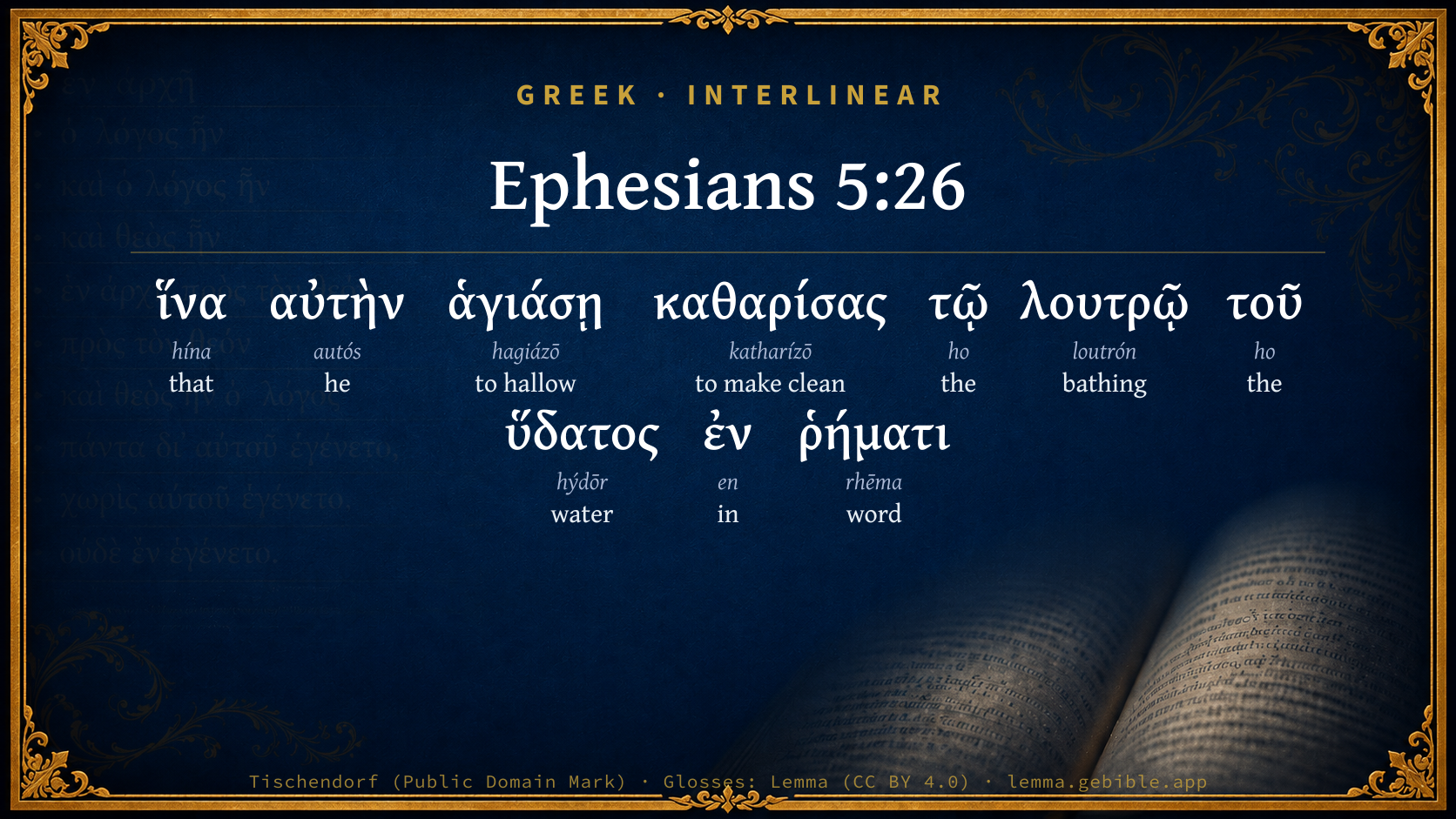
Greek (Tischendorf 8th ed.) Ephesians 5:26 appears in the Greek New Testament. The text above is from the Tischendorf 8th edition. Each word links to its Strong’s number and a concise gloss. Click any word for its full Thayer’s Greek Lexicon entry.
Download image
Cite this verse

Ephesians 5:26 (World English Bible). Public Domain. Lemma interlinear Bible study tool, https://lemma.gebible.app/v/ephesians/5/26.

Show BibTeX & RIS
BibTeX
RIS
English Translation
that he might sanctify it, having cleansed it by the washing of water with the word,
World English Bible · Public Domain
Highlights
  • 1 first appearance in the Greek New Testament
Full analysis ↓
Download a study sheet

One document with this verse’s original text, its word-by-word gloss line, the meaning frame, cross-references with their text, attributed commentary, and full source and license credits — printable, and it pastes into notes with its structure intact.

This verse Autodidact and up

Study sheet (.html) Plain text (.txt)

A passage Seminary Student

Up to 50 verses in one chapter. A passage sheet keeps up to 6 commentary sources and 12 cross-references per verse, in the order this page ranks them, and says so on the sheet whenever that leaves anything out. Ask for a single verse and you get the Autodidact verse sheet above.

Everything on this page stays free to read, with no account — the sheet is a download of what is already on screen, not access to it.

Want to remove ads? Support Godless Engineer
Compare translations 3

The same verse in 3 English versions, stacked beneath the original-language interlinear above. Click any original word for its lexicon entry.

Each is an independent rendering of the whole verse — the interlinear is not word-aligned to these translations.

Highlighted words mark where these versions differ — a whole-verse word diff, not a word-by-word alignment.

  • World English Bible Public Domain
    that he might sanctify it, having cleansed it by the washing of water with the word,
  • King James Version Public Domain
    That he might sanctify and cleanse it with the washing of water by the word,
  • unfoldingWord Literal Text CC BY-SA 4.0
    so that he might sanctify her, having cleansed her by the washing of the water with the word,

unfoldingWord Literal Text — © unfoldingWord, licensed CC BY-SA 4.0. Word-aligned USFM3 via Door43 (git.door43.org/unfoldingWord/en_ult).

Versions to compare (up to 4)

3 of 4 selected

Show all 19 translations

Every available English version of this verse, each an independent rendering of the whole verse.

  • World English Bible Public Domain
    that he might sanctify it, having cleansed it by the washing of water with the word,
  • Berean Standard Bible Public Domain
    to sanctify her, cleansing her by the washing with water through the word,
  • Majority Standard Bible Public Domain
    to sanctify her, cleansing her by the washing with water through the word,
  • King James Version Public Domain
    That he might sanctify and cleanse it with the washing of water by the word,
  • American Standard Version (1901) Public Domain
    that he might sanctify it, having cleansed it by the washing of water with the word,
  • Revised Version (1885) Public Domain
    that he might sanctify it, having cleansed it by the washing of water with the word,
  • Geneva Bible (1599) Public Domain
    That hee might sanctifie it, and clense it by the washing of water through the worde,
  • Douay-Rheims (1899) Public Domain
    That he might sanctify it, cleansing it by the laver of water in the word of life:
  • Young's Literal Translation Public Domain
    that he might sanctify it, having cleansed `it' with the bathing of the water in the saying,
  • Literal Standard Version CC BY-SA 4.0
    that He might sanctify it, having cleansed [it] with the bathing of the water in the saying,
  • Unlocked Literal Bible CC BY-SA 4.0
    Christ gave himself for the church so that he might make her holy, having cleansed her by the washing of water with the word,
  • unfoldingWord Literal Text CC BY-SA 4.0
    so that he might sanctify her, having cleansed her by the washing of the water with the word,
  • Darby Bible Public Domain
    in order that he might sanctify it, purifying [it] by the washing of water by [the] word,
  • World Messianic Bible Public Domain
    that he might sanctify her, having cleansed her by the washing of water with the word,
  • Webster's Bible Public Domain
    That he might sanctify and cleanse it with the washing of water by the word,
  • Free Bible Version CC BY-SA 4.0
    He made it holy, he made it clean by washing in the water of the word,
  • Bible in Basic English Public Domain
    So that he might make it holy, having made it clean with the washing of water by the word,
  • Text-Critical English NT CC BY 4.0
    to sanctify her by cleansing her with the washing of water by the word,
  • Tyndale New Testament (1534) Public Domain
    to sanctifie it and clensed it in the fountayne of water thorow the worde

Literal Standard Version (2020), Covenant Press — licensed CC BY-SA 4.0. Text via the HelloAO Bible API (eBible.org). Unlocked Literal Bible (unfoldingWord) — licensed CC BY-SA 4.0. Text via the HelloAO Bible API (eBible.org). unfoldingWord Literal Text — © unfoldingWord, licensed CC BY-SA 4.0. Word-aligned USFM3 via Door43 (git.door43.org/unfoldingWord/en_ult). Free Bible Version, Dr. Jonathan Gallagher — licensed CC BY-SA 4.0. Text via the HelloAO Bible API (eBible.org).

Word by word

More ways to search: Search by grammar → Find every occurrence → Compare this word →

Practice this passage: Drill this verse → Learn its vocabulary →

About this verse

These counts appear in no published source. They are computed here, from the morphology-tagged text and Lemma’s own curated glosses. What Lemma adds →

10
words
9
distinct lemmas
Pauline Epistles
section

Notable vocabulary

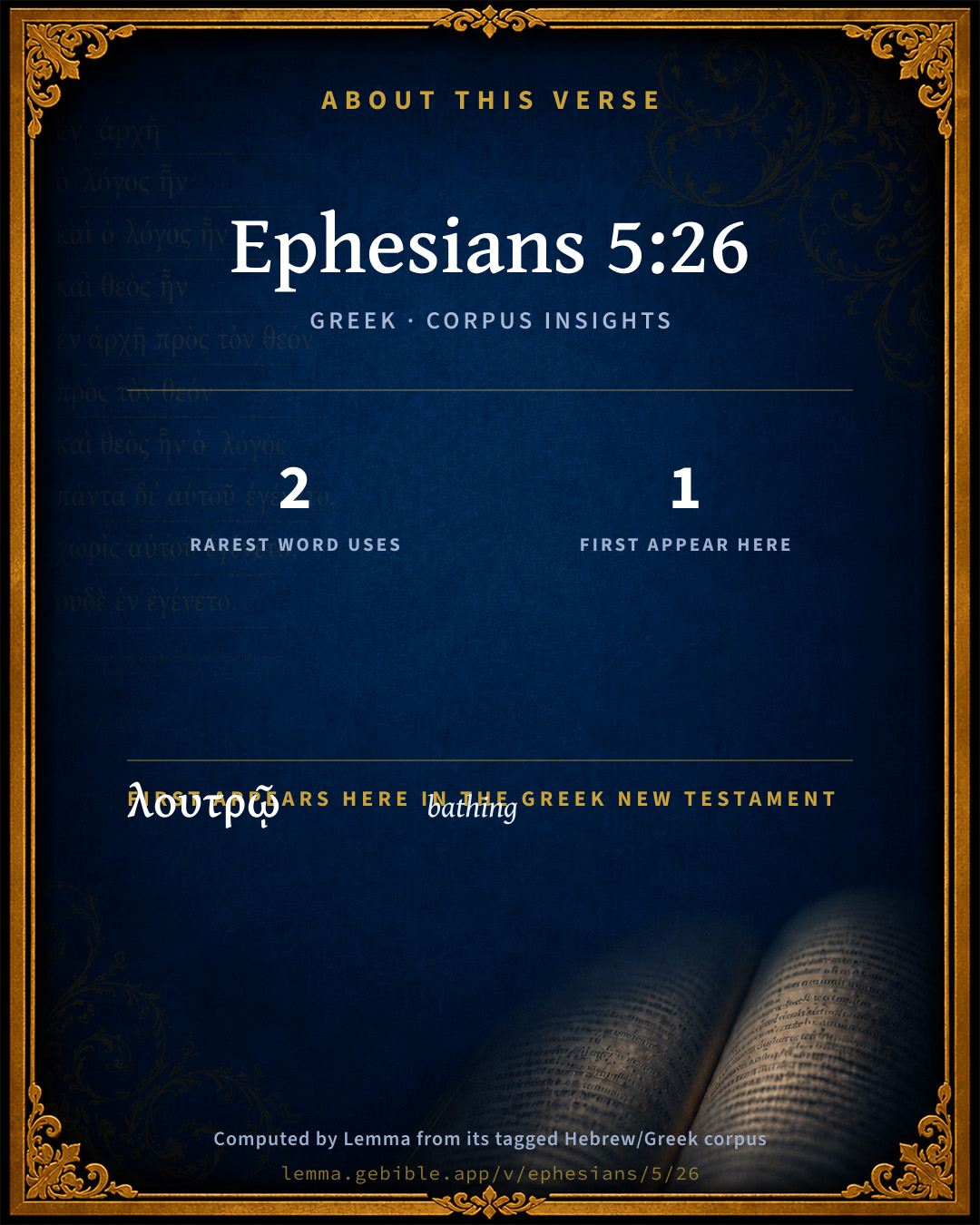
The rarest word here is λουτρῷ bathing G3067 — appearing just 2 times in the whole Greek New Testament.

First appearance in Scripture

This word makes its first canonical appearance in the Greek New Testament here:

  • λουτρῷ bathing G3067

Shared distinctive vocabulary

λουτρῷ bathing G3067 occurs in 2 verses of the Greek New Testament. Also found in:

Repetition

A word recurs within this verse:

Cross-references

23

Topical passages linked to Ephesians 5:26 in the Treasury of Scripture Knowledge — connected by theme and wording, ordered by reader-vote popularity; previews shown in the World English Bible.

  • Hebrews 10:22 let's draw near with a true heart in fullness of faith, having our hearts sprinkled from an evil conscience, and having our body washed with pure water,
  • John 15:3 You are already pruned clean because of the word which I have spoken to you.
  • Ezekiel 36:25 I will sprinkle clean water on you, and you shall be clean: from all your filthiness, and from all your idols, will I cleanse you.
  • John 3:5 Jesus answered, "Most assuredly I tell you, unless one is born of water and spirit, he can't enter into the Kingdom of God!
  • John 17:17–19 Sanctify them in your truth. Your word is truth.
  • 1 Corinthians 6:11 Such were some of you, but you were washed. But you were sanctified. But you were justified in the name of the Lord Jesus, and in the Spirit of our God.
  • Titus 3:5–7 not by works of righteousness, which we did ourselves, but according to his mercy, he saved us, through the washing of regeneration and renewing by the Holy Spirit,
  • 1 Peter 1:22–23 Seeing you have purified your souls in your obedience to the truth through the Spirit in sincere brotherly affection, love one another from the heart fervently:
  • Ephesians 6:17 And take the helmet of salvation, and the sword of the Spirit, which is the word of God;
  • 1 John 5:6 This is he who came by water and blood, Jesus Christ; not with the water only, but with the water and the blood. It is the Spirit who testifies, because the Spirit is the truth.
  • Zechariah 13:1 "In that day there will be a spring opened to the house of David and to the inhabitants of Jerusalem, for sin and for uncleanness.
  • Titus 2:14 who gave himself for us, that he might redeem us from all iniquity, and purify for himself a people for his own possession, zealous for good works.
  • Hebrews 9:14 how much more will the blood of Christ, who through the eternal Spirit offered himself without blemish to God, cleanse your conscience from dead works to serve the living God?
  • 1 Peter 3:21 This is a symbol of baptism, which now saves you-- not the putting away of the filth of the flesh, but the answer of a good conscience toward God, through the resurrection of Jesus Christ,
  • Hebrews 10:10 by which will we have been sanctified through the offering of the body of Jesus Christ once for all.
  • Acts 22:16 Now why do you wait? Arise, be baptized, and wash away your sins, calling on the name of the Lord.'
  • 1 Peter 1:2 according to the foreknowledge of God the Father, in sanctification of the Spirit, that you may obey Jesus Christ and be sprinkled in his blood: Grace to you and peace be multiplied.
  • Ezekiel 16:9 Then washed I you with water; yes, I thoroughly washed away your blood from you, and I anointed you with oil.
  • Acts 26:18 to open their eyes, that they may turn from darkness to light and from the power of Satan to God, that they may receive remission of sins and an inheritance among those who are sanctified by faith in me.'
  • James 1:18 Of his own will he brought us forth by the word of truth, that we should be a kind of first fruits of his creatures.
  • John 15:8 "In this is my Father glorified, that you bear much fruit; and so you will be my disciples.
  • Jude 1:1 Jude, a servant of Jesus Christ, and brother of James, to those who are called, sanctified by God the Father, and kept for Jesus Christ:
  • John 17:7 Now they have known that all things whatever you have given me are from you,

Cross-references courtesy of OpenBible.info (CC BY 4.0).

Commentary

Notes on Ephesians 5:26 from classic Christian and Jewish commentators (each source and its license shown beneath its notes). The classic Christian expositions comment on the surrounding passage and are grouped to its opening verse, so a note may address several verses; the Jewish commentaries on the Tanakh (Rashi and others) are per-verse, so they appear only where the commentator wrote on this verse.

Lemma curates 59 commentaries, every one of them public domain or Creative Commons licensed, each selected and text-cleaned for this edition rather than reprinted as found. About our sources →

Joseph Benson's Commentary

Eph 5:26-27. That he might sanctify and cleanse it — Might remove the guilt, power, and pollution of sin; with the washing of water — In baptism, as the sign of regeneration by the Holy Spirit, which can only renew, sanctify, and cleanse the soul. See 2Th 2:13; 1Pe 1:2; Tit 3:5. By the word — The ordinary channel by which justifying, regenerating, and sanctifying grace is communicated; (Joh 15:3; Jas 1:18; 1Pe 1:23; Joh 17:17;) and by which we are made perfect, and thoroughly furnished unto all good works, 2Ti 3:17. That he might present it to himself — That being purified, renewed, and adorned, as a bride prepared for her husband, he might place it in his own immediate presence; a glorious church — Perfectly holy, happy, and pleasing in his sight; not having spot — Of impurity from any remains of sin, or wrinkle — Of deformity from any decay, or any such thing — Any thing which could be called a defect; the perfection of the bodies of the saints, as well as that of their souls, being included in this description: but that it should be holy and without blemish — Or without blame; and he might survey it completely pure, beautiful, and resplendent, in that great day, when the whole number of the elect shall be gathered together, and the marriage of the Lamb shall be celebrated amidst the acclamations of the heavenly legions, to whose blissful world his bride shall be conducted in triumph. “How bright an idea,” says Dr. Doddridge, “does this give us of the grand plan and design of Christianity: namely, to bring all the millions of which the church consists, to such a state of perfect virtue and glory, that when the penetrating eye of Christ, its great and holy bridegroom, shall survey it, there shall not be one spot, or wrinkle, or any thing like it, in the least to impair its beauty, or offend his sight! Where is such a scheme of thought to be found in the world, but in the New Testament, and those who have been taught by it?”

Joseph Benson's Commentary on the Old and New Testaments (1811–1818) — public domain. Text from a community e-Sword module.

Whedon's Commentary on the Bible

Daniel D. Whedon

26. Eph_5:26-27 each begins with a that; the former depending on gave himself, the latter on sanctify and cleanse. It is to be specially noted that at this verse Paul reverses the discourse, and from illustrating marriage by the Church, gradually glides into illustrating the Church by marriage, as he intimates in the closing words of Eph_5:32. This is in accordance with what we have shown, in both our Plan (page 353) and our Commentary, to be the main topic of the epistle—mainly, the genesis and nature of a glorious Church.

With the washing of water—Referring, no doubt, to baptism, in which the water is the symbolical element of the sanctifying Spirit, which is the real element.

By the word—By the gospel word, which is preached, by which baptism is effected, and which is concentrated into the final baptism formula. For, as Augustine says, “Without the word the baptismal water is mere water. Add the word to the element and it becomes a sacrament, which is the word made visible.”

Daniel D. Whedon (gen. ed.), Commentary on the Old and New Testaments (1874–1909) — public domain. Text from a community e-Sword module.

Tyndale Open Study Notes

Tyndale Open Resources

5:26 washed by the cleansing of God’s word: The church has been cleansed by the message of good news. God has forgiven the sins of his people through Christ’s sacrificial death (John 15:3; cp. Titus 3:5; 1 Pet 3:21).

Tyndale Open Study Notes — © Tyndale Open Resources, licensed CC BY-SA 4.0. Text via the HelloAO Bible API.

Bengel's Gnomon

Johann Albrecht Bengel

Eph 5:26. Ἁγιάσῃ, might sanctify) Often holiness and glory are synonymous; wherefore here also follows, He might present it to Himself a glorious Church.—καθαρίσας, cleansing) Cleansing precedes the bestowal of glory and the formation of the nuptial tie.—ἵνα, that) The construction is, He gave Himself—cleansing (i.e. and cleansed); that [ἵνα] depends upon both [παρέδωκεν and καθαρίσας], being put twice [ἵνα ἁγιάσῃ and ἵνα παραστήσῃ Eph 5:26, and Eph 5:27] in the text. Sanctification is derived from the death or blood of Christ; comp. Heb 13:12: cleansing or purification, as we shall see presently, from baptism and the word. Holiness is internal glory; glory is holiness shining forth. Why did Christ love the Church and give Himself for it?—that He might sanctify it. Why did He cleanse it?—that He might present it to Himself. The former is the new right acquired by Christ over the Church; the latter shows how He adorned His bride, as befitted such a bride of such a Husband. And the mentioning of the bath [λουτρῷ, washing] and the word is presently urged conjointly, although the word is to be referred to the term cleansing.[91] The cleansing power is in the word, and it is put forth through the bath [the washing]. Water and the bath are the vehicle: but the word is a nobler instrumental cause.—τῷ λουτρῷ τοῦ ὕδατος ἐν ῥήματι, by the washing with water [lit. the bath of water] by the word) A remarkable testimony for baptism; Tit 3:5.—ἐν ῥήματι, in [by] the word) Baptism has the power of purifying owing to the word, Joh 15:3; in [by] to be construed with cleansing. אֹמֶר, ῥῆμα.

[91] ἐν ῥήματι follows καθαρίσας, not λουτρῷ.—ED.

Bengel's Gnomon of the New Testament — English translation (T&T Clark, Edinburgh, 1860) — public domain. Text from a community e-Sword module.

Meyer's Critical & Exegetical Commentary

Heinrich August Wilhelm Meyer

Eph_5:26. Aim, which Christ had in view in giving up Himself for the church, and therewith continued statement of the pattern of love given by Him.

ἵνα αὐτ. ἁγ. κ.τ.λ.] in order to sanctify it, after having cleansed it through the bath of water, by means of the word. In His sacrificial death, namely, Christs intention with regard to His future church had this aim, that, after having by baptism brought about for its members the forgiveness of their pre-Christian sins, He would make it partaker of Christian-moral holiness by means of the gospel. That cleansing is the negative side of that, which Christ contemplated with regard to His church in His death, and this sanctification by means of the gospel constantly influencing the baptized is the positive side; the former the antecedens, the latter the consequens; and both are caused by the atoning death, which is the causa meritoria of the forgiveness of sins brought about by means of baptism, and the contents of the gospel as the word of the cross. The sanctifying influence of the latter is the efficacy of the Holy Spirit, who works by means of the gospel (Eph_6:17); but the Holy Spirit is subject to Christ (2Co_3:18), and Christ also communicates Himself in the Spirit to mens hearts (Rom_8:9 f.); hence it is said with justice that Christ sanctifies the church through the word (comp. also Eph_2:21), in which case it is self-evident to the Christian consciousness that the operative principle therein is the Spirit operating by means of the word. The Vulgate translates καθαρ. mundans, and Zanchius says: modum exprimit, quo eam sanctificet. So, too, Harless, who holds ἁγιάσῃ and καθαρίσας not to be different notions, but the latter to be a more precise definition of the former, which signifies purum reddere a culpa peccati. The aorist participle would not be opposed to this view, because it could express that which is coincident in point of time with ἁγιάσῃ (see on Eph_1:9); but it is opposed by the fact that ἐν ῥήματι cannot be joined to καθαρίσας (see below), but sanctification by the word must of necessity be something other than the cleansing by baptism, as also at 1Co_6:11 (comp. Act_2:38; Act_22:16), the cleansing by means of baptism (ἀπελούσασθε) precedes the sanctification (ἡγίασθητε).[275] Comp. Tit_3:5-7. Hofmann, II. 2, p. 135, would, in opposition to the simple and clear course of the representation, combine καθαρίσας κ.τ.λ. with the following ἽΝΑ ΠΑΡΑΣΤΉΣῌ, but for the invalid reason that afterwards ΤῊΝ ἘΚΚΛΗΣΊΑΝ is repeated, and not the mere ΑὐΤΉΝ used. As if Paul might not have used the mere ΑὐΤΉΝ even with this combination! And how often do all writers repeat the noun with emphasis (so here), or for the sake of perspicuity, instead of using the pronoun! Comp. on Eph_4:16.

Τῷ ΛΟΥΤΡῷ ΤΟῦ ὝΔΑΤΟς] (genitive materiae) denotes the well-known bath of water κατʼ ἐξοχήν, which is administered by baptism. We have thus here not simply an allusion to baptism (Grotius, Homberg), but a designation of the same (comp. Tit_3:5; 1Co_6:11), and an allusion to the bath of the bride before the wedding day; see on Eph_5:27.

ἐν ῥήματι] belongs to ἉΓΙΆΣῌ (comp. Joh_17:17), but is not placed immediately after it, because the two verbal definitions ἉΓΙΆΣῌ and ΚΑΘΑΡΊΣΑς, and again the two instrumental definitions Τῷ ΛΟΥΤΡῷ ΤΟῦ ὝΔΑΤΟς and ἘΝ ῬΉΜΑΤΙ, are intended to stand together, whereby the structure of the discourse is arranged of set purpose conformably to the sense and with emphatic distinctness. ῬῆΜΑ is the gospel, τὸ ῥῆμα τῆς πίστεως, Rom_10:8, comp. 17, Eph_6:17, Heb_6:5, and here stands without an article, because it, denoting the word ΚΑΤʼ ἘΞΟΧΉΝ, could be treated like a proper noun, such as νόμος, ΧΆΡΙς, and the like. The connecting of ἘΝ ῬΉΜ. with ἉΓΙΆΣῌ is followed also by Jerome, Castalio, Calovius, Morus, Rosenmüller, Winer, p. 125 [E. T. 172], Rückert, Bisping, Bleek.[276] Others, however, join it to τῷ λουτρῷ τοῦ ὕδατος (Luther: by the water-bath in the word), in which case they understand by ῥῆμα either the baptismal formula (Chrysostom: ἐν ῥήματι ποίῳ; ἐν ὀνόματι τοῦ πατρὸς καὶ τοῦ υἱοῦ καὶ τοῦ ἁγίου πνεύματος; comp. Theodoret, Theophylact, Oecumenius, Ambrosiaster, Menochius, Calovius, Flatt, de Wette, and others), or the divine precept (lavationem … nitentem divino mandato, Storr), or the divine promise (qua vis et usus signi explicatur, Calvin; comp. Michaelis, Knapp, Tychsen), or lavacro invocatione divini nominis efficaci (Erasmus), or the gospel (Augustine, Estius, Flatt, Holzhausen, and others), or the divine power and efficacy in the word of truth, so that ἐν ῥήματι is equivalent to ἐν πνεύματι (! Olshausen). But all these explanations break down in presence of the fact, that we should need to read τῷ λουτρῷ τοῦ ὕδατος τῷ, or τοῦ ἐν ῥήμ., since neither τὸ λουτρόν nor τὸ ὕδωρ admits of being joined into unity of idea with ἐν ῥήματι (such as αἱ ἐντολαὶ ἐν δόγμασι, Eph_2:15, or ἡ πίστις ἐν Χρ., or the like); as well as of the fact, that the special interpretations of ῥῆμα, except that of gospel, are purely invented. Others have combined ἐν ῥήμ. with καθαρίσας (Syriac, which inserts καί before ἐν ῥήμ.; Bengel, Baumgarten, Matthies, Harless, Baumgarten-Crusius, Hofmann; perhaps also Beza and Calvin; Meier is quite indistinct), in which case likewise ἐν ῥήμ. has been explained by some of the words of the institution and their promise (Baumgarten), by others of the gospel (Syriac, Bengel: in verbo est vis mundifica, et haec exseritur per lavacrum, comp. Matthies and Baumgarten-Crusius, as also Schenkel), while Harless translates: by way of utterance, by way of promise, which can refer only to the promise given with the institution; and Hofmann: with a word, which is alleged to mean: so that Me uttered His effective will, that it should become clean. But it is altogether arbitrary, since καθαρίσας already has a modal definition, to attach ἐν ῥήματι thereto in addition, and on the other hand to leave ἁγιάσῃ isolated, although ἐν ῥήμ. can very suitably as regards sense be attached to ἁγιάσῃ; further, that which cleanses, i.e. that which not merely symbolically represents the cleansing (Schenkel), but does away with the pre-Christian guilt of sin, is baptism,[277] comp. also 1Pe_3:21, Act_2:38; Act_22:16, and not the ῥῆμα, whether we understand thereby the gospel or the words of the institution; lastly, the sense by way of promise Paul would have known how to express otherwise than in so indefinite and enigmatic a manner, such as, possibly, by κατʼ ἐπαγγελίαν, Gal_3:29; as, indeed, also the sense understood by Hofmann could not have been more indistinctly conveyed than by the bare ἐν ῥήματι.[278] Grotius combines ἘΝ ῬΉΜΑΤΙ with ΚΑΘΑΡ., but supplies Ὡς before ἘΝ Τῷ ΛΟΥΤΡῷ: verbo suo quasi balneo. As if one could simply thus supply ὡς! Lastly, Koppe is quite wrong in holding that ἘΝ ῬΉΜΑΤΙ ἽΝΑ is in accordance with the Hebrew על דבר אשר nothing more than the bare ἽΝΑ. Not even the LXX. have translated thus barbarously!

[275] In Act. Thom. p. 40 f.: κατάμιξον αὐτοὺς εἰς τὴν σὴν ποίμνην καθαρίσας αὐτοὺς ἐν τῷ σῷ λουτρῷ κ.τ.λ., the act of the κατάμιξον κ.τ.λ., is (in opposition to Harless) conceived of as immediately subsequent to the act of the καθαρίσας κ.τ.λ. The Fathers, too, separate the cleansing and the sanctifying of the person who receives baptism. So e.g. Justin Martyr, de resurrect. in Grabe, Spicil. II. p. 189. Tertull. de resurrect. 8: Caro abluitur, ut anima emaculetur; caro ungitur, ut anima consecretur. Cypr. ad Donat. de gratia, p. Ephesians 3 : Undae genitalis auxilio superioris aevi labe detersa in expiatum pectus serenum desuper se lumen infudit, etc.

[276] Against de Wettes objections is to be observed, (1) that, according to Rom_10:8; Rom_10:17, ῥῆμα can certainly be taken as the gospel; (2) that sanctification is wrought indeed through the Spirit, but the Spirit is mediated through the gospel, Gal_3:5; (3) that the order of the words is not forced, but purposely chosen.

[277] This also in opposition to Theile in Winers Exeget. Stud. p. 187: ἐν ῥήματι is a sort of correction of τῷ λουτρῷ τοῦ ὕδατος.

[278] What Hofmann, II. 2, p. 191, oddly enough adduces by way of elucidation: As the husband by the word, which expresses his will to make a woman his wife, takes away from her the reproach of her virgin state (comp. Isa_4:1; 1Co_7:36), so has Christ done for the church, drags in something entirely foreign to the matter, and, indeed, something very unsuitable, as though the church were thought of as παρθένος ὑπέρακμος!

Meyer — Critical and Exegetical Commentary on the New Testament — English translation by Peter Christie, edited by Frederick Crombie (T&T Clark, 1880) — public domain. Text from a community e-Sword module.

Expositor's Greek Testament

ed. W. Robertson Nicoll

Eph 5:26 . ἵνα αὐτὴν ἁγιάσῃ : that He might sanctify it . Statement of the great object with which Christ in His love for the Church gave Himself up to death for it. An object worthy of the self-sacrifice, described in definite terms and with a solemn significance the sanctification and cleansing of the Church with a view to its final presentation in perfect holiness at the great day. The verb ἁγιάζειν , a later form of ἁγίζειν (used, e.g. , by Soph., Oed. Col. , 1495; Pindar, O. , iii., 34, etc.), frequent in biblical and patristic Greek, means to set apart to a sacred use, to consecrate , by external or ceremonial cleansing (Heb 9:13 ; 1Ti 4:5 ); by an expiation (1Co 6:11 ; Heb 10:10 ; Heb 10:14 ; Heb 10:29 ); or by inward, ethical purification (1Th 5:23 ). Most exegetes take ἁγιάσῃ in the third sense here, and this is favoured by the terms which follow in Eph 5:27 . On the other hand, both in the Pauline writings and in the Epistle to the Hebrews ( cf. Pfleiderer, Paulinism , Engl. transl., vol. ii., 68, etc.) the dominant application of the verb is deliverance from the guilt of sin by means of an expiation. καθαρίσας : cleansing it . The verb καθαρίζειν , Hellenistic for καθαίρειν , has certain occasional applications in the NT ( e.g., literal cleansing. Mat 23:26 ; Luk 11:39 ; pronouncing ceremonially clean, Act 10:15 ; Act 11:9 ; consecrating by cleansing, Heb 9:22-23 ); but apart from these it has two main senses that of ethical purification (2Co 7:1 ; Jas 4:8 ), and that of forgiveness , freeing from the guilt of sin (Tit 2:14 ; Heb 9:14 ; 1Jn 1:7 ; 1Jn 1:9 ). In the case of this verb, again, the prevailing idea is that of the changed, rectified relation to God. The two ideas probably are not sharply divided in the writer’s mind. They are brought together again, both as definite acts of the past, in 1Co 6:11 , ἀλλὰ ἀπελούσασθε , ἀλλὰ ἡγιάσθητε , ἀλλὰ ἐδικαιώθητε . But the effect on standing appears to be the thing immediately in view here. In classical Greek, too, the term καθαρμός is used in the sense of a purification from guilt ( e.g. , Soph., O. T. , 1228). The participle is taken by many as, in relation to ἁγιάσῃ , a proper past = “that he might sanctify it after cleansing it” (Mey., Alf., Ell.; RV “having cleansed it,” etc.). The purification in view is thus made something prior to the sanctifying. But καθαρίσας , as is often the case with aor. participles connected with a fin. aorist (Bernh., Synt. , x. 9, p. 383), may also be of the same time as ἁγιάσῃ and express the way in which the sanctifying takes effect. The latter is the more probable view here (Syr., Vulg., Harl., Abb., etc.), especially as the aor. ἁγιάσῃ points to a single, definite act, and one predicated of the Church as a whole. τῷ λουτρῷ τοῦ ὕδατος : by the bath of the water . Designation of the means by which the purification takes place. The phrase is a difficult one. The word λουτρόν occurs only once again in the NT (Tit 3:5 ). It is used in both cases with reference to baptism (although some do not admit this), and it is so used in eccles. Greek. In classical Greek it has the occasional, secondary sense of a libation for the dead (Soph., El. , 84, 434; Eurip., Phoen. , 1667), but is used properly as = “ bath, bathing-place ( e.g. , Homer’s θερμὰ λοετρά , Il. , xiv., 6; λοετρὰ Ὠκεανοῖο , Il. , xviii., 489, etc.); bathing (Herod., vi., 52; Xen., Cyr. , vii., 5, 20); or the water for bathing or washing (Soph., Oed. Col. , 1599)”. It is doubtful whether any clear instance can be found of its use as = washing . The ὕδατος is prob. the gen. materiæ , and the articles mark the λουτρόν as the well-known bath of the (baptismal) water. The Versions vary in their renderings. The Vulg. gives lavacrum , and similarly the Syr. and the Goth. The Rhem. follows the Vulg. and renders laver . But the other old English Versions have either “the washing ” or “the fountain ” of water. The RV gives “the washing of water” in the text, but “the laver” in the margin. But “laver,” in the sense of the vessel , does not appear to be a legitimate translation. The only legitimate rendering is “the bath of water,” i.e., the bath of the baptismal water . Many interpreters find in the phrase an allusion to the bath taken by a bride before her wedding. The subsequent imagery, and especially the παραστῆσαι , may favour that; but the fact that the Subject here who cleanses by the bath of the water is Christ, while it was not the bridegroom who administered the pre-nuptial bath to the bride, makes that doubtful. ἐν ῥήματι : with (or through ) the word . In respect both of sense and of connection this is a peculiarly difficult phrase. With respect to the latter the ἐν ῥήματι is connected by some with the ἁγιάσῃ = “sanctify it by the word,” ἐν being taken as the instrum. dat. (Winer, Rück., Bisp., Bleek, Mey., etc.; cf. Win.-Moult., p. 172). The objection to this is the remoteness of the defining phrase from the verb. On the other hand it may be the case that the order is selected with a view to bringing things together, first the two verbs and then the two defining terms (so Meyer). The analogy of Joh 17:17 , ἁγίασον αὐτοὺς ἐν τῇ ἀληθείᾳ , is also urged. Others connect it with the λουτρῷ τοῦ ὕδατος , = “the bath of water in or by the word”. But to this there is the serious objection that the ἐν ῥήματι is anarthrous. The Greek would require either τῷ or τοῦ ἐν ῥήματι , the phrase not being one of the kind (like τῶν ἐντολῶν ἐν δόγμασι , chap. Eph 2:15 above) to make a single idea with the λουτρῷ τοῦ ὕδατος and so dispense with the article; cf. on chap. Eph 1:17 above. There remains the third course to connect it with καθαρίσας , or with the idea expressed by the clause καθαρίσας τῷ λουτρῷ τοῦ ὕδατος as a whole. This on the whole is the connection freest from difficulty, and it gives a congruous idea, which may take more than one form, e.g. , that the purification is effected by the ῥῆμα ; that it is accompanied by it; or that it takes place in it as its element or condition . But what of the sense of the ῥήματι ? How difficult it is to obtain a satisfactory meaning appears at once from the variety and the peculiarity of the interpretations proposed. Some, e.g. , take it to refer to the baptismal formula , “in the name of the Father, and of the Son, and of the Holy Ghost,” or “in the name of Jesus” (Chrys.); in which case, however, we should expect either καὶ ῥήματος or ἐν τῷ ῥήματι . Others give the noun the simple sense of “an utterance ” and take the phrase to mean “ attended or conditioned by an utterance”; with the explanation that the particular utterance in view is “the revelation of salvation embodied in the name of the Father, the Son, and the Holy Ghost” (Moule). Haupt, again, makes it = “by means of a word,” supposing the term to be added in order to bring out the wonderfulness of the purification as seen in the fact that it is effected simply by a word , that is to say the word spoken by the person who baptises. Hofmann also gives it the sense of “with a word,” i.e. = cleansing it by the utterance of His effective will . Others make it = “by the bath resting on a word,” viz. , the Divine command (Storr, Kl., etc.). If we look, however, at the use of the word ῥῆμα in the NT we find that it is applied to anything spoken a sound produced by the voice (2Co 12:4 ; Heb 12:19 ); a declaration (Mat 26:75 ; Mar 9:32 , Luk 2:50 , etc.); doctrine or instruction (Rom 10:17 , if not = command ); or a saying , whether in the form of a message (Rom 10:8 ), a command (Luk 5:5 ), or a promise (Luk 1:38 ; Luk 2:29 ). In Paul’s Epistles and in Hebrews, it appears to be used mostly, if not exclusively, of a word proceeding directly or indirectly from God ( cf. Ell. in loc ). It has indeed another sense, that of “thing,” corresponding to the Hebr. דָּבָר , “the thing spoken of,” “the thing enjoined,” etc. ( e.g. , Mat 18:16 ; Luk 1:37 ; Luk 2:15 ; Act 10:37 ; 2Co 13:1 ). This sense is claimed for it by some in Rom 1:8 ; Rom 1:13-21 . But it is scarcely applicable here. Hence here it may best be taken to refer either to the word of promise , that is the Divine promise of forgiveness (Mar 16:16 ), or to the preached Gospel . It has also the great advantage of being in harmony with the ῥῆμα Θεοῦ in chap. Eph 6:17 . It is true that ῥῆμα is not quite the same as λόγος , but carries with it the definite sense of the spoken word; and that, consequently, it may not be taken to designate the Gospel here in the subjective sense of divine truth , the Word of God in respect of its spiritual contents, or as a revelation of grace. But it may have the sense of that truth as proclaimed , the preached Word or Gospel. With the former sense the clause will define the purification as being in accordance with or dependent on the Divine promise, or having that promise as its ground . The latter interpretation (which is preferred by Meyer, etc.) is thought to be most in harmony with Rom 10:8 ; Rom 10:17 ; Eph 6:17 ; Heb 6:5 , and it gives a good sense however the ἐν is construed. The main objection urged against these two interpretations is the absence of the article, and the fact that where ῥῆμα has such a sense it is accompanied by some defining term, Θεοῦ (Eph 6:17 ), Χριστοῦ (Rom 10:17 ) or the like. To this the only reply is that the omission of the article is due to the presence of the preposition (Middleton, Gr. Artic. , vi. 1; cf. Ell. in loc. ), or that ῥῆμα may have become, like νόμος , χάρις , etc., so well-understood and constant a term in the sense of “the spoken word” par excellence , that it could dispense with the article (Mey.). Thus the import of the whole verse will be “that he might set apart and consecrate the Church by cleansing it of guilt by baptism in accordance with the Divine promise” (or, “on the ground of the preached word of the Gospel”). The clause defines the καθαρισμός as one that does not take effect by means of the λουτρὸν τοῦ ὕδατος in and by itself, but by that only as administered in the power or on the ground of the preached Word. It is to be observed also that the sanctifying and the purifying are referred to Christ’s giving up of Himself, His death being that in virtue of which these things take place.

The Expositor's Greek Testament, edited by W. Robertson Nicoll (1897–1910) — public domain. Text from a community e-Sword module.

Hodge's Commentary on Romans, Ephesians & First Corinthians

Charles Hodge

Eph_5:26, Eph_5:27

As the apostle unites with his design of teaching the duties arising from the conjugal relation, the purpose to illustrate the nature of the union between Christ and his church, these verses relate to the latter point and not to the former. They set forth the design of Christs death. Its remote design was to gain the church for himself as an object of delight. Its proximate design was to prepare it for that high destiny. These ideas are presented figuratively. The church is regarded as the bride of Christ. This is designed to teach

1. That it is an object of a peculiar and exclusive love. As the love which a bridegroom has for his bride is such as he has for no one else; so the love which Christ has for his church is such as he has for no other order of creatures in the universe, however exalted.

2. As the bride belongs exclusively to her husband, so the church belongs exclusively to Christ. It sustains a relation to him which it sustains to no other being, and in which no other being participates.

3. This relation is not only peculiar and exclusive, but the union between Christ and his church is more intimate than any which subsists between him and any other order of creatures. We are flesh of his flesh, and bone of his bones.

4. The church is the special object of delight to Christ. It is said of Zion, As the bridegroom rejoices over the bride, so shall thy God rejoice over thee, Isa_62:5. He is to present it to himself as his own peculiar joy. Such being the high destiny of the church, the proximate end of Christs death was to purify, adorn, and render it glorious, that it might be prepared to sit with him on his throne. She is to be a bride adorned for her husband.

These are not imaginations, nor exaggerations, nor empty figures; but simple, scriptural, sanctifying, and saving truths. And what is true of the church collectively, is true of its members severally. Each is the object of Christs peculiar love. Each sustains to him this peculiar, exclusive, and intimate relation. Each is the object in which he thus delights, and each is to be made perfectly holy, without spot, and glorious.

Though the general sense of this passage is thus plain, there is no little difficulty attending the interpretation of its details. Christ, it is said, gave himself for the church, ἵνα αὐτὴν ἁγιάσῃ, which Calvin renders, Ut segregaret eam sibi, that he might separate it for himself; which, he says, is done by the remission of sin, and the renewing of the Holy Ghost. Though the verb ἁγιάζειν has this sense, yet as in Pauls writings it is commonly used to express cleansing from pollution, and as this sense best suits the context, it is generally preferred. The design of Christs death was to make his people holy. It accomplishes this end by reconciling them to God, and by securing for them the gift of the Holy Ghost. Thus in Gal_3:13, Gal_3:14, it is said, Christ has redeemed us from the curse of the law, that we might receive the promise of the Spirit.

With regard to the next clause, καθαρίσας τῷ λουτρῷ τοῦ ὕδατος, having cleansed (or cleansing) it with the washing of water, we must inquire

1. What is intended by λουτρὸν τοῦ ὕδατος.

2. What is meant by καθαρίσας; and

3. In what relation this clause stands to the preceding. Does the washing of water here mean baptism, or a washing which is analogous to a washing with water? The latter interpretation is admissible.

The apostle may mean nothing more than a spiritual frustration. In Eze_16:9, speaking of Israel, God said, Then washed I thee with water; yea, I thoroughly washed away thy blood from thee, and I anointed thee with oil. And in Eze_36:25, Then will I sprinkle clean water upon you, and ye shall be clean. Also in Heb_10:22, it is said, Let us draw near with a true heart, in full assurance of faith, having our hearts sprinkled from an evil conscience, and our bodies washed with pure water. In all these cases washing with water is a figurative expression for spiritual purification. Commentators, however, almost without exception understand the expression in the text to refer to baptism. The great majority of them, with Calvin and other of the Reformers, do not even discuss the question, or seem to admit any other interpretation to be possible. The same view is taken by all the modern exegetical writers. This unanimity of opinion is itself almost decisive. Nothing short of a stringent necessity can justify any one in setting forth an interpretation opposed to this common consent of Christians. No such necessity here exists. Baptism is a washing with water. It was the washing with water with which Pauls readers as Christians were familiar, and which could not fail to occur to them as the washing intended. Besides, nothing more is here attributed to baptism than is attributed to it in many other passages of the word of God. Compare particularly Act_22:16, Arise, be baptized, and wash away thy sins, ἀπόλουσαι τὰς ἁμαρτίας σου. There can be little doubt, therefore, that by the washing with water, the apostle meant baptism.

As to the meaning of the participle καθαρίσας there is more doubt. The verb signifies to cleanse either literally, ceremonially, or figuratively. As the Scriptures speak of a twofold purification from sin, one from guilt by expiation, the other from pollution by the Spirit, and as καθαρίζειν is used in reference to both, the question is, which is here intended. Does the apostle speak of pardon, or of sanctification as effected by this washing with water? The word expresses sacrificial purification. Heb_9:22, Heb_9:23. 1Jo_1:7, The blood of Jesus Christ his Son cleanses us from all sin. Heb_9:14; Compare Heb_1:3, Having by himself made purification of our sin. In favor of taking it in this sense here, is the fact that baptism is elsewhere connected with the remission of sin; as in Act_22:16, and Act_2:38, Repent and be baptized every one of you in the name of Jesus Christ, for the remission of sins. The meaning of the word, however, depends upon its relation to the preceding clause. Καθαρίσας may be connected with ἁγιάσῃ, and taken in the same tense with it. It then expresses the mode in which Christ cleanses his church. He gave himself for it that he might cleanse it, purifying it by the washing of water.‹21› In this case, if ἁγιάσῃ expresses moral purification or sanctification, so must καθαρίσας. But if this participle be taken in the past tense, according to its form, then it must express something which precedes sanctification. The meaning would then be, Christ gave himself for the church, that he might sanctify it, having purified it by the washing with water. In this case καθαρίσας must refer to expiation or sacrificial purification, i.e. to washing away of guilt. The context is in favor of this view, and so is the analogy of Scripture. The Bible always represents remission of sin or the removal of guilt as preceding sanctification. We are pardoned and reconciled to God, in order that we may be made holy. Christ, therefore, having by his blood cleansed his church from guilt, sanctifies or renders it holy. In either view we are said to be cleansed (whether from guilt or from pollution) by baptism.

What does this mean? How does baptism in either of these senses wash away sin? The Protestant and scriptural answer to this question is, that baptism cleanses from sin just as the word does. We are said to be saved by the truth, to be begotten by the truth, to be sanctified by the truth. This does not mean

1. That there is any inherent, much less magic, power in the word of God as heard or read to produce these effects.

2. Nor that the word always and everywhere, when rightly presented, thus sanctifies and saves, so that all who hear are partakers of these benefits.

3. Nor does it mean that the Spirit of God is so tied to the word as never to operate savingly on the heart except in connection with it. For infants may be subjects of regeneration, though incapable of receiving the truth.

In like manner when the Scriptures speak of baptism as washing away sin, Act_22:16; or as uniting us to Christ, Gal_3:27; or as making Christs death our death, Rom_6:4; Col_2:12; or as saving us, 1Pe_3:21; they do not teach

1. That there is any inherent virtue in baptism, or in the administrator, to produce these effects; nor

2. That these effects always attend its right administration; nor

3. That the Spirit is so connected with baptism that it is the only channel through which he communicates the benefits of redemption, so that all the unbaptized perish.

These three propositions, all of which Romanism and Ritualism affirm, are contrary to the express declarations of Scripture and to universal experience. Multitudes of the baptized are unholy; many of the unbaptized are sanctified and saved.

How then is it true that baptism washes away sin, unites us to Christ, and secures salvation? The answer again is, that this is true of baptism in the same sense that it is true of the word. God is pleased to connect the benefits of redemption with the believing reception of the truth. And he is pleased to connect these same benefits with the believing reception of baptism. That is, as the Spirit works with and by the truth, so he works with and by baptism, in communicating the blessings of the covenant of grace. Therefore, as we are said to be saved by the word, with equal propriety we are said to be saved by baptism; though baptism without faith is as of little effect as is the word of God to unbelievers. The scriptural doctrine concerning baptism, according to the Reformed churches is

1. That it is a divine institution.

2. That it is one of the conditions of salvation. Whosoever believes and is baptized shall be saved, Mar_16:16. It has, however, the necessity of precept, not the necessity of a means sine qua non. It is in this respect analogous to confession. With the heart man believeth unto righteousness, and with the mouth confession is made unto salvation, Rom_10:10. And also to circumcision. God said, The uncircumcised male child should be cut off from his people, Gen_17:14. Yet children dying before the eighth day were surely not cut off from heaven. And the apostle teaches circumcision, Rom_3:26.

3. Baptism is a means of grace, that is, a channel through which the Spirit confers grace; not always, not upon all recipients, nor is it the only channel, nor is it designed as the ordinary means of regeneration. Faith and repentance are the gifts of the Spirit and fruits of regeneration, and yet they are required as conditions of baptism. Consequently the Scriptures contemplate regeneration as preceding baptism. But if faith, to which all the benefits of redemption are promised, precedes baptism, how can those benefits be said to be conferred; in any case, through baptism? Just as a father may give an estate to his son, and afterwards convey it to him formally by a deed. Besides, the benefits of redemption, the remission of sin, the gift of the Spirit, and the merits of the Redeemer, are not conveyed to the soul once for all. They are reconveyed and appropriated on every new act of faith, and on every new believing reception of the sacraments. The sinner coming to baptism in the exercise of repentance and faith, takes God the Father to be his Father; God the Son, to be his Savior; and God the Holy Ghost to be His Sanctifier, and his word to be the rule of his faith and practice. The administrator then, in the name and by the authority of God, washes him with water as a sign of the cleansing from sin by the blood of Christ, and of sanctification by the Holy Spirit; and as a seal to Gods promise to grant him those blessings on the condition of the repentance and faith thus publicly avowed. Whatever he may have experienced or enjoyed before, this is the public conveyance to him of the benefits of the covenant, and his inauguration into the number of the redeemed. If he is sincere in his part of the service, baptism really applies to him the blessings of which it is the symbol.

4. Infants are baptized on the faith of their parents. And their baptism secures to them all the benefits of the covenant of grace, provided they ratify that covenant by faith; just as circumcision secured the benefits of the theocracy, provided those circumcised in infancy kept the law. The doctrine of baptismal regeneration, that is, the doctrine that inward spiritual renovation always attends baptism rightly administered to the unresisting, and that regeneration is never effected without it, is contrary to Scripture, subversive of evangelical religion, and opposed to universal experience. It is, moreover, utterly irreconcilable with the doctrine of the Reformed churches. For that doctrine teaches that all the regenerated are saved. Whom God calls them he also glorifies, Rom_8:30. It is, however, plain from Scripture, and in accordance with the faith of the universal church, that multitudes of the baptized perish. The baptized, therefore, as such, are not the regenerated.

The foregoing remarks are intended to show in what sense the Reformed understand this and similar declarations of Scripture. Christ purifies his church by baptism. That is the initiatory rite; which signifies, seals, and applies to believers all the benefits of the Redeemers death. The apostle is speaking of the church, the body and bride of Christ, and of the effect of baptism on those who constitute that church, not of its effect on those who are not included in the covenant and are aliens from the commonwealth of Israel.‹22›

There is one other remark suggested by this passage. The turning point in the discussion between Baptists and Paedobaptists, so far as the mode of baptism is concerned, is, whether it is in its essential nature an immersion, or a washing. If the former, then there is but one mode in which it can be administered. If the latter, it may be administered in any mode by which washing can be effected, either by sprinkling, effusion, or immersion. In the passage before us, it is said to be a washing with water.

The principal exegetical difficulty in this verse is the explanation of the words ἐν ῥήματι, by the word. Ῥῆμα is used not only for any particular dictum, whether command, promise, or prophecy, but also for the word of God collectively, and that either with or without the article; Rom_10:8, Rom_10:17; Eph_6:17. These words may be connected, as is commonly done, with the preceding clause, washing of water. The idea then is that this washing with water is connected with the word. It is not an ordinary ablution, but one connected with the word of God. This is considered a description of baptism, which is by that connection distinguished from all other washings. By the word may then be understood either, the formula of baptism, or the promise of remission of sins and regeneration of which baptism is the sign and seal, and which is the special object of faith to the recipient of the sacrament. Luthers translation is, Durch das Wasserbad im Wort; according to the saying of Augustine, which he often quotes, accedit verbum ad elementum et fit sacramentum. To this interpretation it is objected,

1. That if ῥῆμα be made to mean anything more than the word of God in general, whether the command to baptize, or the promise, or the formula of baptism, it must have the article. It should be, with the word. But the article is wanting in the Greek.

2. The obscurity of the expression, washing of water with the word, or, baptism with the word.

3. That in order to justify the connection in question, the passage should read, τῷ λουτρῷ τοῦ ὕδατος τῶ or τοῦ ἐν ῥήματι.

Had Paul thus written there would, indeed, be no question as to the connection intended, but the exceptions to the rule requiring the connecting article in such cases, are very numerous in Pauls writings. Still its absence is certainly in favor of seeking another construction, if such can be found. Others connect the words ἐν ῥήματι with καθαρίσας, and make them explanatory of the preceding clause, Having purified it by the washing of water, i.e. having purified it by the word. But this is certainly unnatural, first because καθαρίσας has in τῷ λουτρῷ, κτλ., its limitation; and secondly, because the phrase washing with water, needs no explanation. The third method of explanation is to connect the words with ἁγιάσῃ, Christ cleansed his church, by the word, having purified it with the washing of water. The sense is thus good. In Joh_17:17, our Lord prays, Sanctify them by thy truth; and everywhere in Scripture the word of God is represented as the great means of sanctification. This interpretation is adopted by many of the best expositors, as Rückert, Meyer, and Winer. The position of the words, however, is so decidedly in favor of the first mentioned explanation, that it has commanded the assent of the great body of interpreters.

Charles Hodge — Commentary on Romans (1835), First Corinthians (1857), and Ephesians (1856) — public domain. Text from a community e-Sword module.

Geneva Bible (1599)

Geneva Bible translators

Because many men pretend the infirmities of their wives to excuse their own hardness and cruelty, the Apostle willeth us to mark what manner of Church Christ gat, when he joined it to himself, and how he doth not only not loathe all her filth and uncleanness, but ceaseth not to wipe the same away with his cleanness, until he have wholly purged it.

Make it holy.

Through the promise of free justification and sanctification in Christ, received by faith.

Geneva Bible (1599) marginal notes — public domain. Text via Bolls.life.

Jamieson, Fausset & Brown

Robert Jamieson, A. R. Fausset & David Brown

sanctify--that is, consecrate her to God. Compare Joh 17:19, meaning, "I devote Myself as a holy sacrifice, that My disciples also may be devoted or consecrated as holy in (through) the truth" [NEANDER] (Heb 2:11; Heb 10:10; Heb 13:12 see on Heb 10:10).

and cleanse--rather, as Greek, "cleansing," without the "and."

with the washing of water--rather as Greek, "with," or "by the laver of the water," namely, the baptismal water. So it ought to be translated in Tit 3:5, the only other passage in the New Testament where it occurs. As the bride passed through a purifying bath before marriage, so the Church (compare Rev 21:2). He speaks of baptism according to its high ideal and design, as if the inward grace accompanied the outward rite; hence he asserts of outward baptism whatever is involved in a believing appropriation of the divine truths it symbolizes, and says that Christ, by baptism, has purified the Church [NEANDER] (Pe1 3:21).

by the word--Greek, "IN the word." To be joined with "cleansing it," or "her." The "word of faith" (Rom 10:8-9, Rom 10:17), of which confession is made in baptism, and which carries the real cleansing (Joh 15:3; Joh 17:17) and regenerating power (Pe1 1:23; Pe1 3:21) [ALFORD]. So AUGUSTINE [Tract 80, in John], "Take away the word, and what is the water save water? Add the word to the element, and it becomes a sacrament, being itself as it were the visible word." The regenerating efficacy of baptism is conveyed in, and by, the divine word alone.

Jamieson, Fausset & Brown — Commentary Critical and Explanatory on the Whole Bible (1871) — public domain (CC PDM 1.0). Text via the HelloAO Bible API.

Adam Clarke's Commentary

Verse 26. That he might sanctify and cleanse it] The Church is represented as the spouse of Christ, as the woman is the spouse of the man; and, to prepare this Church for himself, he washes, cleanses, and sanctifies it. There is certainly an allusion here to the ancient method of purifying women, who were appointed to be consorts to kings; twelve months, it appears, were in some instances spent in this purification: Six months with oil of myrrh, and six months with sweet odours and with other things, for the purifying of women. See the case of Esther, Es 2:12; see also Ps 45:13; Ps 45:14; Eze 16:7-14.

With the washing of water] Baptism, accompanied by the purifying influences of the Holy Spirit.

By the word] The doctrine of Christ crucified, through which baptism is administered, sin cancelled, and the soul purified from all unrighteousness; the death of Christ giving efficacy to all.

Adam Clarke's Commentary on the Bible (1810–1826) — public domain. Text from a community e-Sword/MySword module.

John Calvin's Commentaries

26. That he might sanctify, — or, that he might separate it to himself; for such I consider to be the meaning of the word sanctify This is accomplished by the forgiveness of sins, and the regeneration of the Spirit.

Washing it with the washing of water. Having mentioned the inward and hidden sanctification, he now adds the outward symbol, by which it is visibly confirmed; as if he had said, that a pledge of that sanctification is held out to us by baptism. Here it is necessary to guard against unsound interpretation, lest the wicked superstition of men, as has frequently happened, change a sacrament into an idol. When Paul says that we are washed by baptism, his meaning is, that God employs it for declaring to us that we are washed, and at the same time performs what it represents. If the truth — or, which is the same thing, the exhibition of the truth — were not connected with baptism, it would be improper to say that baptism is the washing of the soul. At the same time, we must beware of ascribing to the sign, or to the minister, what belongs to God alone. We must not imagine that washing is performed by the minister, or that water cleanses the pollutions of the soul, which nothing but the blood of Christ can accomplish. In short, we must beware of giving any portion of our confidence to the element or to man; for the true and proper use of the sacrament is to lead us directly to Christ, and to place all our dependence upon him.

Others again suppose that too much importance is given to the sign, by saying that baptism is the washing of the soul. Under the influence of this fear, they labor exceedingly to lessen the force of the eulogium which is here pronounced on baptism. But they are manifestly wrong; for, in the first place, the apostle does not say that it is the sign which washes, but declares it to be exclusively the work of God. It is God who washes, and the honor of performing it cannot lawfully be taken from its Author and given to the sign. But there is no absurdity in saying that God employs a sign as the outward means. Not that the power of God is limited by the sign, but this assistance is accommodated to the weakness of our capacity. Some are offended at this view, imagining that it takes from the Holy Spirit a work which is peculiarly his own, and which is everywhere ascribed to him in Scripture. But they are mistaken; for God acts by the sign in such a manner, that its whole efficacy depends upon his Spirit. Nothing more is attributed to the sign than to be an inferior organ, utterly useless in itself, except so far as it derives its power from another source.

Equally groundless is their fear, that by this interpretation the freedom of God will be restrained. The grace of God is not confined to the sign; so that God may not, if he pleases, bestow it without the aid of the sign. Besides, many receive the sign who are not made partakers of grace; for the sign is common to all, to the good and to the bad alike; but the Spirit is bestowed on none but the elect, and the sign, as we have said, has no efficacy without the Spirit. The Greek participle καθαρίσας, is in the past tense, as if he had said, “After having washed.” But, as the Latin language has no active participle in the past tense, I chose rather to disregard this, and to translate it (mundans) washing, instead of (mundatam) having been washed; which would have kept out of view a matter of far greater importance, namely, that to God alone belongs the work of cleansing.

In the word. This is very far from being a superfluous addition; for, if the word is taken away, the whole power of the sacraments is gone. What else are the sacraments but seals of the word? This single consideration will drive away superstition. How comes it that superstitious men are confounded by signs, but because their minds are not directed to the Word, which would lead them to God? Certainly, when we look to anything else than to the word, there is nothing sound, nothing pure; but one absurdity springs out of another, till at length the signs, which were appointed by God for the salvation of men, become profane, and degenerate into gross idolatry. The only difference, therefore, between the sacraments of the godly and the contrivances of unbelievers, is found in the Word.

By the Word is here meant the promise, which explains the value and use of the signs. Hence it appears, that the Papists do not at all observe the signs in a proper manner. They boast indeed, of having “the Word,” but appear to regard it as a sort of enchantment; for they mutter it in an unknown tongue; as if it were addressed to dead matter, and not to men. No explanation of the mystery is made to the people; and in this respect, were there no other, the sacrament begins to be nothing more than the dead element of water. In the word is equivalent to “By the word.”

John Calvin's Commentaries (1540-1563) — public domain. Text from the Calvin Translation Society English edition (1840s-50s) via the Christian Classics Ethereal Library (ccel.org). Calvin's coverage is partial (roughly two-thirds of the Bible); uncommented books and verses are honest gaps, never fabricated. The 19th-century editor's footnotes and remarks are omitted so the notes are faithfully Calvin's own voice.

Ellicott's Commentary for English Readers

(26) That he might sanctify and cleanse it . . .—The true rendering is, that He might sanctify it, having cleansed it in the laver of the water in [the] Word. The reference in “the laver of the water” to baptism, is even more unquestionable than in “the laver of regeneration” of Tit_3:5. Hence we must conclude that the phrase “in the Word” is in some way connected with that sacrament. Of the two Greek words translated “word,” the one here used is that which signifies not “the word” existing as a definite thought in the mind, but “the word” as audibly spoken. It has, indeed, in the original no article, but this is probably because it had assumed so technical a sense as to resemble a proper name; and it is best connected with the phrase “having cleansed it,” thus being coordinated, not subordinated, to the “laver of the water.” Accordingly it would seem to signify all that element of baptism which is “in word”—that is, the question of faith, “the answer of a good conscience” (1Pe_3:21), and, lastly, the solemn formula of baptism “in the name of the Father, and of the Son, and of the Holy Ghost.” If we are to single out any of these, we must surely (with Chrysostom) take the last. But it is better to embrace the whole, and so include the whole spiritual element of baptism, both the acceptance of faith on the part of man, and the grace-giving blessing of God.

To “sanctify” is here to consecrate to Himself (comp. Joh_17:17; Joh_17:19) after purification. In the same connection we have in 1Co_6:11, “Ye were washed, ye were sanctified, ye were justified.” In virtue of such consecration the Church visible is “holy” in idea and in capacity—the Church invisible here (which will be the Church triumphant hereafter), holy in the actual purity which becomes a consecrated nature. Of such consecration baptism is unquestionably the means; as we see in command in Mat_28:19, and in fact in Act_2:38; Act_2:41.

A Bible Commentary for English Readers, edited by Charles John Ellicott (1878–1897) — public domain. Text from a community e-Sword module.

The Cambridge Bible for Schools and Colleges

gen. ed. J. J. S. Perowne

26. sanctify and cleanse it] Better, again, her. And the pronoun is slightly emphatic by position; as if to say, “It was in her interest that He did this, and so in the wife’s interest the husband should be ready for sacrifice.”

“Sanctify and cleanse:”—lit., sanctify, cleansing; both the verbs being in the aorist, and being thus most naturally referred to one and same crisis, not, as R.V. seems to imply, (“sanctify, having cleansed,”) to a sanctifying process consequent on a cleansing. The Church was decisively “sanctified,” separated from the claim and dominion of sin unto God, when she was decisively “cleansed,” accepted as guiltless.

It needs remembrance that the word “to sanctify” lends itself equally, according to context, to ideas of crisis and of process. In one aspect the human being, decisively claimed and regenerated by God for Himself, is sanctified. In another aspect, in view of each successive subjective experience of renunciation of self for God, he is being sanctified.—The sanctifying crisis here in view is that of regeneration. This is put before us ideally as the regeneration of the Church. The Idea is realized historically in the regeneration of individuals, with a view to the final total.—On this individual aspect of the matter, cp. Joh_3:3; Joh_3:5; 1Co_6:11.

with the washing of water] Lit., by the laver of the water. So Tit_3:5; “through the laver of regeneration,” the only other N.T. passage where the noun rendered “laver” occurs.

Here, undoubtedly, Holy Baptism is referred to. It is another and most important question, what is the precise bearing of the Rite upon regeneration; whether it is the special channel of infusion of the new life, or its federal and legal “conveyance,” the Seal upon the Covenant of it, and upon the actual grant of it. But in any case there is a connexion, divinely established, between Regeneration and Baptism. For ourselves, we hold that Baptism is a true analogue to the sacrament of Circumcision, and that its direct and essential work is that of a Divine seal. This view we believe to be (1) the view in truest harmony with the whole spirit of the Gospel, (2) the view most consonant with observed facts, (3) the view which, under wide varieties of expression, was held, in essence, by the pre-medieval Church (and not wholly forgotten even in the medieval Church), and by the great Anglican Protestant doctors of the 16th and 17th centuries. But it is to be remembered that this view leaves untouched the fact of a profound and sacred connexion between New Birth and Baptism. And it is entirely consonant with language of high reverence and honour for the Rite, language often applicable, properly, only to the related Blessing, under remembrance that the Rite derives all its greatness from the spiritual Reality to which it stands related.

by the word] Quite lit., in utterance, or in an utterance. The Gr. is rhêma, not logos. We may translate (having regard to the N. T. usage of “in,” similar cases), attended by, or conditioned by, an utterance: as if to say, not a mere laver of water, but one which is what it is only as joined to declared truth.—What is the “utterance” in question? The Gr. word (in the singular), occurs elsewhere in the Epistles, Rom_10:8; Rom_10:17; 2Co_13:1, below, Eph_6:17; Heb_1:3; Heb_6:5; Heb_11:3; 1Pe_1:25 (twice). In almost every case it refers to a definite Divine utterance, whether of truth or of will. We explain it here accordingly as the utterance of that New Covenant of the Gospel of which Baptism is the seal, or, to put it more generally, the revelation of salvation embodied in “the Name of the Father, Son, and Holy Ghost” (Mat_28:19), or in “the Name of the Lord Jesus” (Act_19:5). Baptism, in connexion with that revelation and the reception of it, is “the laver of new birth”(Tit_3:5).

Cp. the parallel 1Pe_3:21; in which we see the same care to correct any possible inferences from the material aspect of Baptism, as if the rite itself, apart from the moral surroundings of the rite, were a saving thing.

The Cambridge Bible for Schools and Colleges (gen. ed. J. J. S. Perowne; Cambridge University Press, 1878–1918) — public domain. Text from a community e-Sword module.

John Gill's Exposition

So ought men to love their wives as their own bodies,.... It is a common saying with the Jews, that a man's wife is "as his own body" (r); and it is one of the precepts of their wise men, that a man should honour his wife more than his body, , and "love her as his body" (s); for as they also say, they are but one body (t); the apostle seems to speak in the language of his countrymen; however, his doctrine and theirs agree in this point: wherefore

he that loveth his wife loveth himself; because she is one body and flesh with him.

(r) T. Bab. Beracot, fol. 24. 1. & Becorot, fol. 35. 2. Maimon. Hilchot Becorot, c. 2. sect. 17. Tzeror Hammor, fol. 18. 2. (s) T. Bab. Yebamot, fol. 62. 2. & Sanhedrin, fol. 76. 2. Derech Eretz, fol. 17. 4. Maimon Hilchot Ishot, c. 15. sect. 19. (t) Tzeror Hammor, fol. 6. 3.

John Gill's Exposition of the Whole Bible (1746–1763) — public domain (CC PDM 1.0). Text via the HelloAO Bible API.

Trapp's Complete Commentary

John Trapp

26 That he might sanctify and cleanse it with the washing of water by the word,

Ver. 26. That he might sanctify] The maids were first purified and perfumed before Ahasuerus chose one. But here it is otherwise. Sanctification is a fruit of justification. The Lord will not have a sluttish Church, and therefore he came not by blood only, but by water also, that clean water of his Spirit, whereby he washeth away the swinish nature of his saints, so that they desire no more to wallow in the mire.

John Trapp, A Commentary or Exposition upon All the Books of the Old and New Testament (1647–1656) — public domain. Text from a community e-Sword module.

Albert Barnes' Notes on the Bible

That he might sanctify - The great object of the Redeemer was to purify and save the church. The meaning here is, that a husband is to manifest similar love toward his wife, and a similar desire that she should be prepared to “walk before him in white”.

And cleanse it with the washing of water - In all this there is an allusion doubtless to the various methods of purifying and cleansing those who were about to be married, and who were to be united to monarchs as their brides. In some instances this previous preparation continued for twelve months. The means of purification were various, but consisted usually in the use of costly unguents; see Est 2:12. “Six months with oil of myrrh, and six months with sweet odors, and with other things for the purifying of women;” compare Psa 45:13-14; Eze 16:7-14. As such a virgin was purified and prepared for her husband by washing and by anointing, so the church is to be prepared for Christ. It is to be made pure and holy. Outwardly there is to be the application of water - the symbol of purity; and within there is to be holiness of heart; see the notes on 2Co 11:2, where Paul says of the Corinthians, “I have espoused you to one husband, that I may present you as a chaste virgin to Christ.”

By the word - There has been much diversity of opinion respecting the meaning of this. Probably the sense of the expression is, that all this was to be accomplished by the instrumentality of the truth - the Word of God. By that truth they were to be sanctified Joh 17:17; and in accordance with that the whole work from the commencement to the close was to be accomplished. It was not by external ceremonies, and not by any miraculous power on the heart, but by the faithful application of truth to the heart.

Albert Barnes' Notes on the Bible (1834–1885) — public domain. Text from a community e-Sword/MySword module.

Haydock's Catholic Bible Commentary

Cleansing it by the laver [3] of water, in the word of life. By this washing is generally understood the sacrament of baptism; and by the word of life, not the word of the gospel preached, but the words or form used in the administration of baptism, according to Christ’s institution: but this is not so certain. (Witham)

===============================

[BIBLIOGRAPHY]

Lavacro aquæ in verbo vitæ, Greek: to loutro tou udatos en remati loutron, be taken for a bath of water, or the water itself. See Titus iii. 5. Vitæ is now wanting in the Greek. See Estius. St. John Chrysostom, by the word, understands the form of baptism in the name of the Father, &c. (Hom. xx.)

====================

George Leo Haydock (1774–1849), Haydock's Catholic Family Bible and Commentary, 1859 edition — public domain. Excludes Psalms (Douay-Rheims chapter numbering differs from Protestant) and Deuterocanonical books (Catholic canon only).

Matthew Poole's English Annotations

That he might sanctify; purify from its filth, and consecrate unto God: implying the whole translation of it out of a state of sin and misery into a state of grace and life, consisting in the remission of sin, and renovation of nature.

And cleanse it; or, cleansing it, importing the means whereby he works the former effect.

With the washing of water, viz. in baptism, in which the external washing represents seals, and exhibits the internal cleansing from both the guilt and defilement of sin by the blood of Christ, Heb 9:14; Rev 1:5.

By the word; the word of the gospel, especially the promise of free justification and sanctification by Christ, which received by faith is a means of this sanctification, and without which the external washing is ineffectual; the sign, without the word whereof it is a seal, being no sacrament.

Matthew Poole's English Annotations on the Holy Bible (1683–1685) — public domain. Text from a community e-Sword/MySword module.

The Pulpit Commentary

That he might sanctify her, having cleansed her by the washing of water with the Word. The immediate object of Christ was to cleanse her, and for this end he used the Word as a purifying agent, washing her by means of it. The difference between selfish and unselfish love is seen here: a selfish lover cares for his wife in his own interest like Samson, desires to have her simply because she pleases him, and, in his converse with her, thinks, not of her good, but of his own enjoyment; but the love of an unselfish lover constrains him to seek her good, to do nothing that will hurt her and damage her in any manner of way, but to do everything that he believes will advance her well-being, especially in the highest sense. He finds her polluted, (comp. Eze 16) and his great instrument of cleansing is "the Word". (comp. Joh_15:3 Joh_17:5) the Word in all its searching, humbling, rebuking, correcting, informing, stimulating, refreshing, consoling power. There is no express allusion to baptism, tw loutrw tou udatov is explained by ejn rJhmati, "the Word" being the great sanctifying medium, and baptism a figure. (1Pe_3:21)

The Pulpit Commentary (1880–1919), ed. H.D.M. Spence-Jones & Joseph S. Exell — public domain. Text from a community e-Sword module.

John Wesley's Explanatory Notes

That he might sanctify it through the word - The ordinary channel of all blessings. Having cleansed it - From the guilt and power of sin. By the washing of water - In baptism; if, with "the outward and visible sign," we receive the "inward and spiritual grace."

John Wesley, Explanatory Notes Upon the Whole Bible (1754–1765) — public domain. Text via the GEBible commentary corpus.

Godbey's Commentary on the New Testament

William B. Godbey

26. “That he may sanctify her, and purify her by the washing of water through the Word.” No honest Bible reader will fail to see the second work of grace here revealed beyond the possibility of doubt. The regeneration of the Holy Ghost takes sinners out of Satan’s kingdom, transforms them into saints, and constitutes the Divine Ecclesia here mentioned. The Lord does not sanctify this wicked world, but Ecciesia, i.e., his own Church. Hence, no one can be so stupid as not to see that sanctification here revealed is a work distinct from regeneration, and subsequent to it. What is sanctification? The Holy Ghost here defines it a purification, illustrated by the “washing of water;” not literal water, as we here learn it is “through the Word.” The Bible teaches that we are sanctified by the Spirit, blood, faith, and Word. These are all in perfect harmony, either with other. The Holy Spirit is the omnipotent Agent who sanctifies us; the blood, the Divine elixir by which he effects the purgation; the Word, God’s appointed medium through which we are sanctified; and faith, the condition on which we receive it.

Hence, the Spirit, blood, Word, and faith are but counterparts of the same great transaction. The instantaneity of our sanctification is here confirmed by two infallible witnesses in this short verse; i.e., hagiasee, sanctify, and katharisas , purifying, are both in the aorist tense, which God put in the Greek language to reveal to all honest readers that he actually sanctifies in the twinkling of an eye. You may long approach the experience, but suddenly enter it, the gradualism always being on the human side, as Omnipotence needs but a moment to do his work. I write these pages in California, three thousand miles from home. I spent weeks on my western- bound tour, approaching the land of gold. But the time came when, in a moment, the iron horse leaped over the State line, and I found myself in the land of perennial fruits and fadeless flowers.

William B. Godbey, Commentary on the New Testament (1896–1900) — public domain. Text from a community e-Sword module.

The People's New Testament

B. W. Johnson

26. That he might sanctify it. The great love of Christ for the church, his bride, is shown as an example to Christian husbands. Christ gave himself for the church. His object was to sanctify it, make it holy. In order to do this it was needful to cleanse it with the washing of water by the word. All commentators of repute in all bodies refer this to baptism. All in the church pass through the waters of baptism. But the washing of the water would be of no avail without the word. The power is in the word of the Lord which offers the gospel and commands baptism.

B. W. Johnson's The People's New Testament with Notes (1889–1891) — public domain. Electronic text from the Christian Classics Ethereal Library (CCEL) ThML edition.

Cambridge Greek Testament for Schools and Colleges

26. ἵνα αὐτὴν ἁγιάσῃ καθαρίσας τῷ λουτρῷ τοῦ ὕδατος. “That he might expressly claim her for Himself after cleansing her by the bathing with the water.” Cleansing and sanctifying are two results of the one act of baptism, but St Paul (1Co 6:11) regards them separately, the removal of defilement preceding the consecration.

ἐν ῥήματι. τῷ λ. τ. ὕ. and ἐν ῥ. are syntactically independent and probably τῷ λ. should be taken closely with καθαρίσας and ἐν ῥ. with the main verb ἁγ. St Paul’s main business is with the duties of husbands and wives, so the antitype is indicated with the utmost conciseness. The ref. in τῷ λ. τ. ὕδατος is certainly to Baptism (cf. Tit 3:5; Heb 10:22), λουτρὸν being (see Robinson) the act of washing rather than the laver. This is naturally connected with καθαρίσας, nor does it seem to require any further definition to justify the effect claimed for it. ἐν ῥήματι ‘in the power of a word’ is best connected with ἁγιάσῃ as the means by which He ‘set her apart.’ The key to St Paul’s meaning is to be found in Rom 10:8-17, where the thought of τὸ ῥῆμα is dwelt upon in detail. He starts with a quotation from Deu 30:14 where ῥῆμα = ‘the commandment of the Lord.’ This corresponds under the new dispensation to τὸ ῥῆμα τῆς πίστεως, i.e. the Christian Creed Κύριους Ἰησοῦς, the living Lord, who is the perfect revelation of the Will of God, and is accepted as Sovereign in the confession of the Christian Faith. Then in Eph 5:14 St Paul asks, “How can men believe one whose voice they have not heard (οὗ οὐκ ἤκουσαν)? How can they hear without a preacher?” implying that the preacher not only brings a message about Christ but in a real sense speaks the words of Christ (2Co 13:3), or at least brings a message from Him. His conclusion is summed up in Eph 5:17, ἄρα ἡ πίστις ἐξ ἀκοῆς ἡ δὲ ἀκοὴ διὰ ῥήματος Χριστοῦ, where again Christ is the source and not only the subject of the ‘Word.’ So here ἐν ῥήματι in a sentence describing an action of Christ must refer to a word spoken by or at least in the name of Christ, i.e. to ‘the Gospel’ as resting on His commission to His Apostles, e.g. Luk 24:47; Act 26:17 f.; cf. Mat 28:19 f. The Gospel is primarily a declaration of the Lordship of Jesus and a call to baptism into that Name on the acceptance of that Creed. The Gospel therefore, thus linking men to Christ, is regarded as ‘a power of God unto salvation’ Rom 1:16. Through the Gospel the Gentiles enter into their inheritance with the Jew (Eph 3:6). It is the means by which men are ‘begotten anew,’ cf. 1Pe 1:23-25 and 1Co 4:15. Elsewhere both cleansing, Act 15:9, and consecration, Act 26:18, are ascribed to ‘faith,’ but this as we have seen implies a ‘word.’ Of course the ‘Gospel’ is identical both with the Baptismal Creed and the Baptismal Formula and a meaning can be extracted from ἐν ῥήματι if the phrase is connected with τῷ λ. τ. ὕδατος. But the form of expression is unnatural. The clue to the meaning and construction of the whole phrase is to be found no doubt in the marriage customs of the time. The reference to these customs is unmistakeable in παραστήσῃ (cf. 2Co 11:2). It is hardly less clear in τῷ λ. τ. ὕ. both in Greek and in Jewish marriage ceremonies. See esp. Eze 16:9. It is natural therefore to connect ἐν ῥήματι with the formal claiming of the Bride by the Bridegroom, which in the modern Jewish rite takes place at the bestowal of the ring, in words which Mr Abrahams tells me are at least as old as cent. II A.D.: ‘Behold, thou art sanctified to me.’ (Talmud, Qiddushim, pp. 5–8).

Cambridge Greek Testament for Schools and Colleges (Cambridge University Press, 1896; 21 vols, various authors incl. Carr, Maclear, Plummer, Farrar, Lumby, Moule, M. R. James, Simcox) — public domain. Text from a community e-Sword module.

International Critical Commentary

26. ἵνα αὐτὴν ἁγιάσῃ καθαρίσας τῷ λουτρῷ τοῦ ὕδατος ἐν ῥήματι. The immediate purpose of ἑαυτὸν παρέδωκεν, ver. 25. ἁγιάοῃ is clearly not to be limited to “consecration”; it includes the actual sanctification or infusion of holiness. It is the positive side, καθαρίσας expressing the negative, the purification from her former sins. But as the remoter object is ἵνα παραστήσῃ, the ceremonial idea of ἁγιάζειν appears to be the prominent one here. Logically, καθαρίζειν precedes ἁγιάζειν, chronologically they are coincident; cf. 1Co 6:11, ἀλλὰ ἀπελούσασθε, ἀλλὰ ἡγιάσθητε. The tense of καθαρίσας by no means requires the translation “after He had purified “(cf. 1:9), which would probably have been expressed by a passive participle agreeing with αὐτήν, indeed καθαρίζων would have been quite inappropriate.

τῷ τ.ὕ. “By the bath of water,” distinctly referring to baptism, and probably with an allusion in λουτεῷ to the usual bath of the bride before the marriage; the figure in the immediate context being that of marriage.

ἐν ῥήματι. The first question is as to the connexion. By Augustine the phrase is supposed to qualify τῷ λουτρῷ τοῦ ὕδ., “accedit verbum ad elementum et fit sacramentum.”

But as the combination is strange, and neither τὸ λουτρόν nor τὸ ὕδωρ can form with ἐν ῥήματι a single notion (like ἡ πίστις ἐν Χρ.), this would require the article to be repeated. The interpretation, “the bath resting on a command” (Storr, Peile, Klöpper), would require ἐν ῥ. Χριστοῦ. Meyer, following Jerome, connects the words with ἁγιάσῃ, “having purified with the bath of water, may sanctify her by the word.” The order of the words is strongly against this, and, besides, we should expect some addition to καθαπ., which should suggest the spiritual signification of “purifying with water.”

It is therefore best connected with καθαρίσας. But as to the meaning? Alford, Eadie, Ellicott, Meyer take ῥῆμα to mean the gospel or preached word taught preliminary to baptism. ῥῆμα is, no doubt, used in this sense (not in Act 10:37 but) Rom 10:17, ῥῆμα Χριστοῦ; but there it is defined by Χριστοῦ, as in ver. 8 by τῆς πίστεως; indeed, ῥῆμα is there used, not because of any special appropriateness, but for the sake of the quotation. Elsewhere we have ῥῆμα Θεοῦ, Eph 6:17. It is far, indeed, from being correct to say that “the gospel” is “the usual meaning of the Greek term,” as Eadie states, referring, in addition to the passages mentioned above, to Heb 6:5 (where the words are Θεοῦ ῥῆμα): Act 10:44, τὰ ῥήματα ταῦτα: 11:14, λαλήσει ῥήματα πρός σε. In these last two places it is obvious that ῥήματα means simply “words” or “sayings,” as in Act 26:25, where St. Paul says of his speech before Festus, ἀληθείας καὶ σωφροσύνης ῥήματα ἀποφθέγγομαι. See also Act 2:14, ἐνωτίσασθε τὰ ῥήματά μου. Needless to say that ῥῆμα is used of single sayings very frequently. There may be even πονηρὸν ῥῆμα or ἀργὸν ῥῆμα (not to mention cases where ῥῆμα is used for “a thing mentioned”: see on Luk 1:65). That the word is most frequently used, not to signify a Divine or sacred saying, but where the connexion implies such a saying, is simply a result of the fact that there was little occasion (in the Epp. none) to refer to other ῥήματα. There is no example of ῥῆμα by itself meaning “the gospel” or anything like this. Had it the article here, indeed, there would be good reason for maintaining this interpretation.

The Greek commentators understand ῥῆμα of the formula of baptism. ποίῳ says Chrysostom, ἐν ὀνόματι τοῦ πατρὸς καὶ τοῦ γἱοῦ καὶ τοῦ ἁγίου Πνεύματος. It is true, as Estius remarks, that if this were the sense we should expect καὶ ῥήματος; and Harless adds that these definite words could hardly be referred to except with the article, τῷ ῥήνατι. But although “of water and ῥῆμα” might, perhaps, have been expected, ἐν is quite admissible; compare ἐν ἐπαγγελίᾳ, 6:2. The objections from the absence of the article, and from the fact that ῥῆμα has not elsewhere this meaning, fall to the ground when we consider that it is not alleged or supposed that ῥῆμα of itself means the formula of baptism; it retains its indefinite meaning, and it is only the connexion with the reference to baptism in the preceding words that defines what ῥῆμα is intended. So Soden. Moule renders, “attended by, or conditioned by, an utterance,” which would agree well with this interpretation. He explains it as “the revelation of salvation embodied in the name of the Father, the Son, and Holy Ghost.” Macpherson denies the reference to baptism, and thinks it more natural to speak of the cleansing as effected by the bathing (“washing,” AV.) rather than in the bath, especially as “of water” is added. “The reference is most probably to the bath of the bride before marriage.” Yes, such a reference there is; but what is it which the reader is expected to compare with the bridal bath? As there is no particle of comparison, the words imply that there is a λοῦτρον ὕδατος, which is compared to the bath. And surely baptism could not fail to be suggested by these words to the original readers. As to λουτρόν, besides the meaning “water for bathing,” it has the two senses of the English “bath,” viz. the place for bathing and the action; but it does not mean “washing.”

International Critical Commentary — older volumes (1896–1929), various authors — public domain. Text from a community e-Sword module.

Lesson kit

Teaching starters — assembled from the data on this page, not authored interpretation. Every prompt links to the verse data it draws on. Edit before teaching.

Ephesians, in the Pauline Epistles, opens this verse with 10 words (9 distinct Greek lemmas). Its most distinctive word is loutrón (“bathing”). A historical commentator’s framing appears above. Read the whole chapter for the surrounding context.

Discussion questions

  1. How does “bathing” (loutrón) shape what this verse is saying?
  2. This is the first place “bathing” appears in Scripture (first appears here). What does its debut here establish?
  3. How does Titus 3:5, which shares the word «bathing», read alongside this verse?
  4. What does the repetition of “the” (2× in this one verse) do in this verse?
  5. These translations render this verse differently; the difference is in the English rendering, not the original. What questions does that raise?
  6. Compare how Joseph Benson's Commentary and Whedon's Commentary on the Bible read this verse. Where do they agree or differ?

Things to notice

  • 1 word makes its first canonical appearance in Scripture here.
  • These translations choose different wording for 3 words in this verse.
  • “the” occurs 2× in this single verse.
  • 9 distinct Greek lemmas span 10 words in this verse.

Reading settings

Reading text

Shown beneath each verse's original-language words.

Old Testament
Old Testament edition

Read the OT as the Masoretic Hebrew (MT) or the Greek Septuagint (LXX).

English shown for the Greek Septuagint (in the Hebrew ↔ Greek comparison).

Comparing translations? Open the Compare panel on any verse page to stack up to four side by side.