
Ephesians 6:17

Greek (Tischendorf 8th ed.) Ephesians 6:17 appears in the Greek New Testament. The text above is from the Tischendorf 8th edition. Each word links to its Strong’s number and a concise gloss. Click any word for its full Thayer’s Greek Lexicon entry.
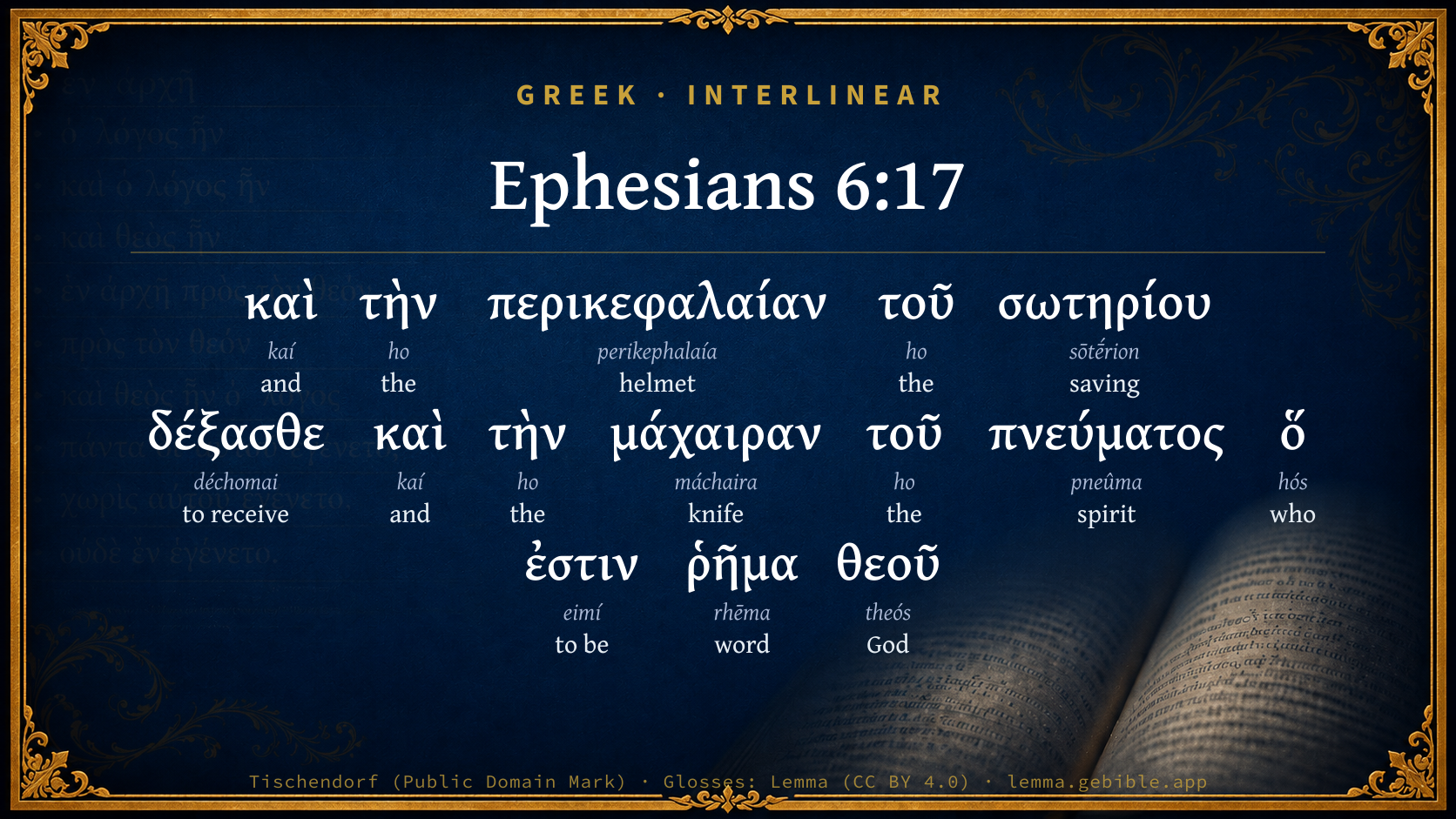
Download image
Cite this verse

Ephesians 6:17 (World English Bible). Public Domain. Lemma interlinear Bible study tool, https://lemma.gebible.app/v/ephesians/6/17.

Show BibTeX & RIS
BibTeX
RIS
English Translation
And take the helmet of salvation, and the sword of the Spirit, which is the word of God;
World English Bible · Public Domain
Highlights
  • 1 first appearance in the Greek New Testament
Full analysis ↓
Download a study sheet

One document with this verse’s original text, its word-by-word gloss line, the meaning frame, cross-references with their text, attributed commentary, and full source and license credits — printable, and it pastes into notes with its structure intact.

This verse Autodidact and up

Study sheet (.html) Plain text (.txt)

A passage Seminary Student

Up to 50 verses in one chapter. A passage sheet keeps up to 6 commentary sources and 12 cross-references per verse, in the order this page ranks them, and says so on the sheet whenever that leaves anything out. Ask for a single verse and you get the Autodidact verse sheet above.

Everything on this page stays free to read, with no account — the sheet is a download of what is already on screen, not access to it.

Want to remove ads? Support Godless Engineer
Compare translations 3

The same verse in 3 English versions, stacked beneath the original-language interlinear above. Click any original word for its lexicon entry.

Each is an independent rendering of the whole verse — the interlinear is not word-aligned to these translations.

Highlighted words mark where these versions differ — a whole-verse word diff, not a word-by-word alignment.

  • World English Bible Public Domain
    And take the helmet of salvation, and the sword of the Spirit, which is the word of God;
  • King James Version Public Domain
    And take the helmet of salvation, and the sword of the Spirit, which is the word of God:
  • unfoldingWord Literal Text CC BY-SA 4.0
    And take the helmet of salvation and the sword of the Spirit, which is the word of God.

unfoldingWord Literal Text — © unfoldingWord, licensed CC BY-SA 4.0. Word-aligned USFM3 via Door43 (git.door43.org/unfoldingWord/en_ult).

Versions to compare (up to 4)

3 of 4 selected

Show all 19 translations

Every available English version of this verse, each an independent rendering of the whole verse.

  • World English Bible Public Domain
    And take the helmet of salvation, and the sword of the Spirit, which is the word of God;
  • Berean Standard Bible Public Domain
    And take the helmet of salvation and the sword of the Spirit, which is the word of God.
  • Majority Standard Bible Public Domain
    And take the helmet of salvation and the sword of the Spirit, which is the word of God.
  • King James Version Public Domain
    And take the helmet of salvation, and the sword of the Spirit, which is the word of God:
  • American Standard Version (1901) Public Domain
    And take the helmet of salvation, and the sword of the Spirit, which is the word of God:
  • Revised Version (1885) Public Domain
    And take the helmet of salvation, and the sword of the Spirit, which is the word of God:
  • Geneva Bible (1599) Public Domain
    And take the helmet of saluation, and the sword of the Spirit, which is the worde of God.
  • Douay-Rheims (1899) Public Domain
    And take unto you the helmet of salvation, and the sword of the Spirit (which is the word of God).
  • Young's Literal Translation Public Domain
    and the helmet of the salvation receive, and the sword of the Spirit, which is the saying of God,
  • Literal Standard Version CC BY-SA 4.0
    and receive the helmet of the salvation, and the sword of the Spirit, which is the word of God,
  • Unlocked Literal Bible CC BY-SA 4.0
    And take the helmet of salvation and the sword of the Spirit, which is the word of God.
  • unfoldingWord Literal Text CC BY-SA 4.0
    And take the helmet of salvation and the sword of the Spirit, which is the word of God.
  • Darby Bible Public Domain
    Have also the helmet of salvation, and the sword of the Spirit, which is God's word;
  • World Messianic Bible Public Domain
    And take the helmet of salvation, and the sword of the Spirit, which is the word of God;
  • Webster's Bible Public Domain
    And take the helmet of salvation, and the sword of the Spirit, which is the word of God:
  • Free Bible Version CC BY-SA 4.0
    Wear the helmet of salvation, and carry the sword of the Spirit—the Spirit that's the word of God.
  • Bible in Basic English Public Domain
    And take salvation for your head-dress and the sword of the Spirit, which is the word of God:
  • Text-Critical English NT CC BY 4.0
    Take the helmet of salvation and the sword of the Spirit, which is the word of God.
  • Tyndale New Testament (1534) Public Domain
    And take the helmet of salvacion and the swearde of the sprete which is the worde of God.

Literal Standard Version (2020), Covenant Press — licensed CC BY-SA 4.0. Text via the HelloAO Bible API (eBible.org). Unlocked Literal Bible (unfoldingWord) — licensed CC BY-SA 4.0. Text via the HelloAO Bible API (eBible.org). unfoldingWord Literal Text — © unfoldingWord, licensed CC BY-SA 4.0. Word-aligned USFM3 via Door43 (git.door43.org/unfoldingWord/en_ult). Free Bible Version, Dr. Jonathan Gallagher — licensed CC BY-SA 4.0. Text via the HelloAO Bible API (eBible.org).

Word by word

More ways to search: Search by grammar → Find every occurrence → Compare this word →

Practice this passage: Drill this verse → Learn its vocabulary →

περικεφαλαίαν
perikephalaía
G4030
“helmet”
Noun, Accusative, Singular, Feminine
Part of Speech
Noun
Case
Accusative
Number
Singular
Gender
Feminine
Full Thayer's Definition

Origin: from a compound of G4012 and G2776

TDNT: 10:14,7

1. a helmet 2. metaph. a. the protection of the soul which consists in (the hope of) salvation
  1. καὶ kaí G2532 “and” Conjunction
  2. τὴν ho G3588 “the” Article, Accusative, Singular, Feminine
  3. τοῦ ho G3588 “the” Article, Genitive, Singular, Neuter
  4. σωτηρίου sōtḗrion G4992 “saving” Adjective, Genitive, Singular, Neuter
  5. δέξασθε déchomai G1209 “to receive” Verb, Aorist, Middle deponent, Imperative, 2nd person, Plural
  6. καὶ kaí G2532 “and” Conjunction
  7. τὴν ho G3588 “the” Article, Accusative, Singular, Feminine
  8. μάχαιραν máchaira G3162 “knife” Noun, Accusative, Singular, Feminine
  9. τοῦ ho G3588 “the” Article, Genitive, Singular, Neuter
  10. πνεύματος pneûma G4151 “spirit” Noun, Genitive, Singular, Neuter
  11. ὅ hós G3739 “who” Relative pronoun, Nominative, Singular, Neuter
  12. ἐστιν eimí G1510 “to be” Verb, Present, Active, Indicative, 3rd person, Singular
  13. ῥῆμα rhēma G4487 “word” Noun, Nominative, Singular, Neuter
  14. θεοῦ theós G2316 “God” Noun, Genitive, Singular, Masculine

About this verse

These counts appear in no published source. They are computed here, from the morphology-tagged text and Lemma’s own curated glosses. What Lemma adds →

15
words
11
distinct lemmas
Pauline Epistles
section

Notable vocabulary

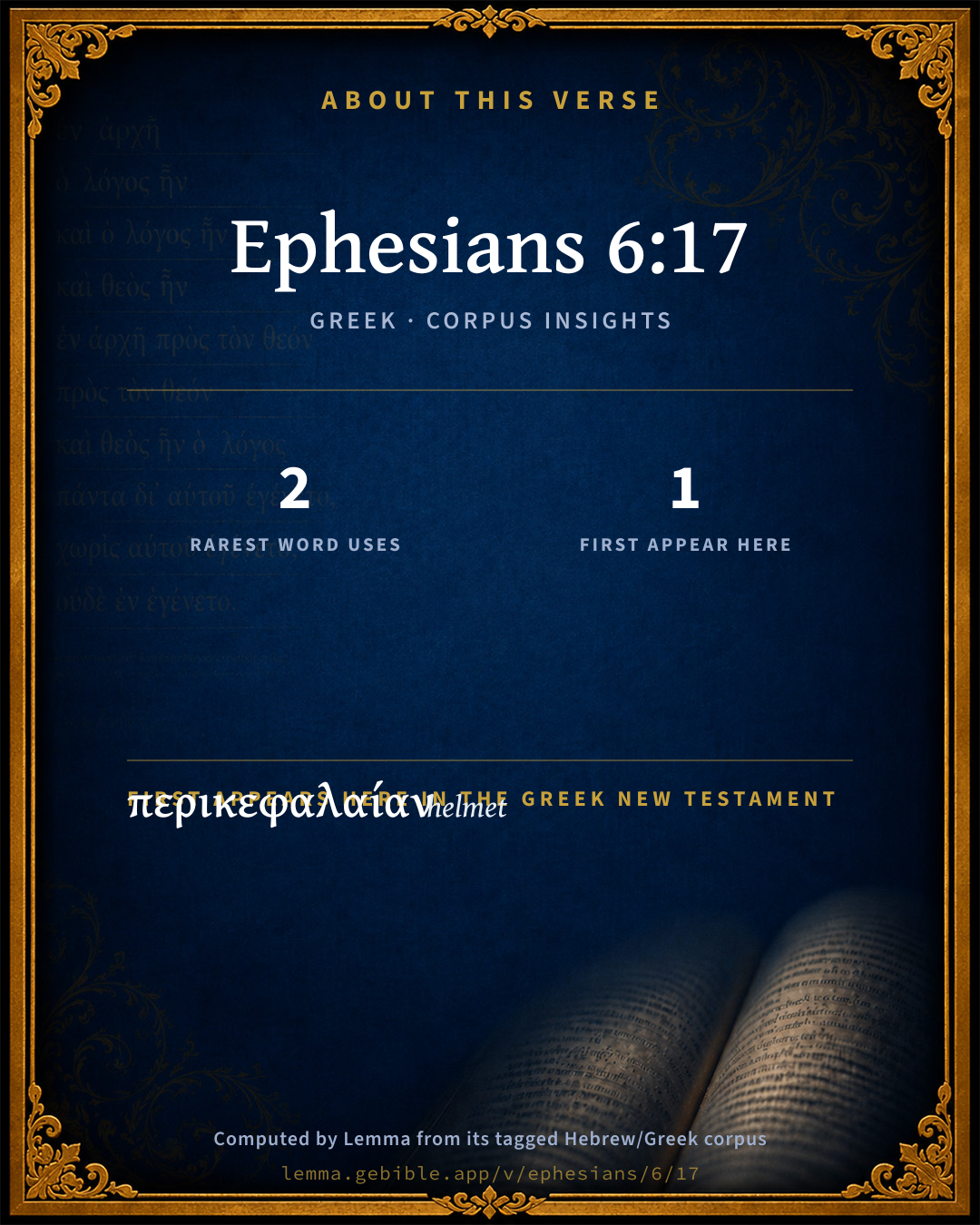
The rarest word here is περικεφαλαίαν helmet G4030 — appearing just 2 times in the whole Greek New Testament.

First appearance in Scripture

This word makes its first canonical appearance in the Greek New Testament here:

  • περικεφαλαίαν helmet G4030

Shared distinctive vocabulary

περικεφαλαίαν helmet G4030 occurs in 2 verses of the Greek New Testament. Also found in:
Repetition

Words recur within this verse:

Cross-references

15

Topical passages linked to Ephesians 6:17 in the Treasury of Scripture Knowledge — connected by theme and wording, ordered by reader-vote popularity; previews shown in the World English Bible.

  • Hebrews 4:12 For the word of God is living, and active, and sharper than any two-edged sword, and piercing even to the dividing of soul and spirit, of both joints and marrow, and is able to discern the thoughts and intentions of the heart.
  • Isaiah 59:17 He put on righteousness as a breastplate, and a helmet of salvation on his head; and he put on garments of vengeance for clothing, and was clad with zeal as a mantle.
  • Revelation 19:15 Out of his mouth proceeds a sharp, double-edged sword, that with it he should strike the nations. He will rule them with a rod of iron. He treads the winepress of the fierceness of the wrath of God, the Almighty.
  • 1 Thessalonians 5:8 But let us, since we belong to the day, be sober, putting on the breastplate of faith and love, and, for a helmet, the hope of salvation.
  • Isaiah 49:2 and he has made my mouth like a sharp sword; in the shadow of his hand has he hid me: and he has made me a polished shaft; in his quiver has he kept me close:
  • Matthew 4:10–11 Then Jesus said to him, "Get behind me, Satan! For it is written, 'You shall worship the Lord your God, and him only shall you serve.'"
  • Revelation 2:16 Repent therefore, or else I am coming to you quickly, and I will make war against them with the sword of my mouth.
  • Hosea 6:5 Therefore I have cut them to pieces with the prophets; I killed them with the words of my mouth. Your judgments are like a flash of lightning.
  • Revelation 12:11 They overcame him because of the Lamb's blood, and because of the word of their testimony. They didn't love their life, even to death.
  • Matthew 4:4 But he answered, "It is written, 'Man shall not live by bread alone, but by every word that proceeds out of the mouth of God.'"
  • Revelation 1:16 He had seven stars in his right hand. Out of his mouth proceeded a sharp two-edged sword. His face was like the sun shining at its brightest.
  • Matthew 4:7 Jesus said to him, "Again, it is written, 'You shall not test the Lord, your God.'"
  • Hebrews 12:5–6 and you have forgotten the exhortation which reasons with you as with children, "My son, don't take lightly the chastening of the Lord, Nor faint when you are reproved by him;
  • 1 Samuel 17:5 He had a helmet of brass on his head, and he was clad with a coat of mail; and the weight of the coat was five thousand shekels of brass.
  • Hebrews 13:5–6 Be free from the love of money, content with such things as you have, for he has said, "I will in no way leave you, neither will I in any way forsake you."

Cross-references courtesy of OpenBible.info (CC BY 4.0).

Where the printed editions differ

1 variant

Places in this verse where the major printed Greek editions disagree on the wording in a way that affects the translation — a comparison of editions, not a manuscript-by-manuscript collation. The editions are the modern critical texts (Nestlé-Aland 28/27, SBL, Westcott-Hort, Tregelles, Tyndale House) and the traditional texts behind the KJV (the Textus Receptus and the Byzantine/Majority text). It is not a claim about which reading is original.

  1. Different wording
    δέξασθε

    “do take”

    In NA28NA27TynSBLWHTregTR Not in Byz

    δέξασθαι (dexasthai) 'to receive' occurs in a few manuscripts (Byz) instead of δέξασθε (dexasthe) 'do take' in older manuscripts (NA28+NA27+Tyn+SBL+WH+Treg+TR)

Textual data: Translators Amalgamated Greek New Testament (STEPBible TAGNT) · CC BY 4.0.

Commentary

Notes on Ephesians 6:17 from classic Christian and Jewish commentators (each source and its license shown beneath its notes). The classic Christian expositions comment on the surrounding passage and are grouped to its opening verse, so a note may address several verses; the Jewish commentaries on the Tanakh (Rashi and others) are per-verse, so they appear only where the commentator wrote on this verse.

Lemma curates 59 commentaries, every one of them public domain or Creative Commons licensed, each selected and text-cleaned for this edition rather than reprinted as found. About our sources →

The Biblical Illustrator

Joseph S. Exell

Eph_6:17

And take the helmet of salvation.

The helmet

I. Describe the warriors helmet.

1. The object of hope. Salvation.

2. The origin and source of this hope. It is a grace of the Spirit, and the effect of a renewed heart.

3. The basis and ground of hope.

(1) The promises of the Father.

(2) The work of the Son.

(3) The influences of the Spirit.

II. The advantages he derives from it.

1. It animates for the warfare.

2. It supports in sufferings.

3. It will put us in possession of the victory and reward.

Application:

1. Cultivate and preserve this hope of salvation.

2. As your hope is, so will be your comfort and joy.

3. Address those who have not a good hope. (J. Burns, D. D.)

The hope of salvation

He (Knox) had a sore fight for an existence, wrestling with popes and principalities; in defeat, contention, life-long struggle; rowing as a galley slave, wandering in exile. A sore fight; but he won it. Have you hope? they asked him in his last moment, when he could no longer speak. He lifted his finger, pointed upwards with his finger, and so died. (T. Carlyle.)

The helmet of hope

No suit of armour could be complete without a protection for the head. This great ruling member, the very citadel of intelligence and vital energy, is too important to be left unguarded. Hence, from the remotest ages, the helmet has been in use amongst all martial nations. The champion of the Philistines had a helmet of brass upon his head, as had also the king of Israel who commanded the armies of the living God. The Persians and Ethiopians also wore this martial cap in the day of battle, as did likewise the warlike Greeks. The helmet of the latter was usually made of skins, rendered hard and impervious to the weapons then in use; but the glittering brass or iron helmet of the Jewish warrior seems the most fit type of that piece of panoply which the apostle places in the armour of the Christian soldier. With this brazen or iron casque upon his head, the Jewish warrior could stand unhurt under the strokes of the brandished sword, or come out uninjured from amidst the storm of arrows. With its dazzling brightness, its horrific devices of gorgons and chimeras, and its nodding plumes which overlooked the dreadful cone, his helmet struck terror into the hearts of his enemies. Hence the apostle very properly, when pointing out to us the panoply, designates the helmet as a piece of armour the Christian soldier must put on. In the letter to the Thessalonians, the nature of this helmet is more specially revealed, where we are exhorted to take for a helmet the hope of salvation. Hope, then, is the helmet of the Christian soldier; and as there was usually graven upon the ancient helmet some single word or sentence as a motto, so must the soldier of the cross have graven on his crest, as emblematic and descriptive of the spirit of his warfare, the word Hope. How aptly does this brief motto set forth his belief as to the ultimate result of his conflicts! This good hope of salvation is the helmet of the gospel panoply. Hope! how beautiful that word! how expressive and suggestive! How hope paints the future in bright and joyous colours! how it speaks in the hour of sorrow and trial, of the breaking away of the storm, and the sunshine to come after! Let me warn you, however, to be on your guard against availing yourself of false hopes in your onward march to eternity. See that you bind not on your brows such a helmet as the enemys sword may cleave in twain, or through which his arrows may enter to lay waste lifes citadel. You will beware, for instance, of taking for a helmet the hope of future repentance. A common refuge is this for the gospel-taught worldling. You must also be guarded against wearing for a helmet the hope of being saved by the mere general mercy of God. Nor must we pass from this part of the subject without warning you against wearing for a helmet the hope of being saved because you are in connection with the visible Church … The hope of the Christian has to do with better things than those which are confined within the bounds of time, or which derive their value solely from the estimate put upon them by a mere grovelling, earthly mind. But the hope of the believer stands on a firmer basis, rises higher, takes hold of better comforts, and speeds on the footsteps of the pilgrim soldier with the prospect of far brighter joys to come, than that mere common principle which cheers universal humanity on its march from the cradle to the grave. The hope of the believer has been well defined to be that grace whereby, through Christ, he expects and waits for all those good things of the promise he has not yet received. The helmet of hope and the shield of faith are intimately connected. The two pieces of armour are joined together, and serve a purpose to each other, much as their position would seem to separate them. Hope and faith are sister graces of the Spirit. Faith is in some sense the minister of hope. Had we no faith in things to come, how could we hope for them? Hope has not to do with things present, for what a man seeth, why does he yet hope for? But if we hope for that we see not, then do we with patience wait for it. Now, faith is the substance of things hoped for. Faith sits at home receiving the promise, whilst hope looks from the lattice for the approach of the blessing. Faith tells us the story of good things in reserve, and then hope quietly and peacefully expects them. Let us examine the qualities of the helmet of salvation. The believers hope is well-founded; unlike those refuges of lies to which your attention has been called. The hope of the Christian soldier is also reasonable. Be ready always, says the apostle, to give to every man that asketh you a reason of the hope that is in you. The spiritual warrior is supposed to be a social being; he is joined with others in the march from the city of destruction to the New Jerusalem; and it is to be presumed that these wayfaring warriors, in the midst of their long journeyings, and their night watches, will sometimes question each other as to their views and motives in joining the service. The hope of the Christian soldier has also a good object in view. How vain are oftentimes those objects which call out the hopes of the worldling. The difference between the hope of the Christian and that of the sinner, is worldwide in this, that the Christian has in his view objects which are always real, which never disappoint, and which are of immortal value. Then, once more, the hope of the Christian soldier is steadfast. Which hope, says Paul, we have as an anchor of the soul, both sure and steadfast. We freely admit that, practically, the Christians hope is not always as steadfast as it should be, or as it might be. The hopes of most believers are extremely fluctuating. The infirmities of our physical nature have much to do with shutting out the light of hope from the soul. We are beings of a two-fold organization, and the physical and spiritual man have an intimate relation. A diseased or wearied body may make a dull and beclouded mind. But these temporary fluctuations of the believers hope do not destroy it. We need only observe further, that the helmet of hope is strengthened and brightened by experience. We glory in tribulation also, says the apostle, knowing that tribulation worketh patience; and patience experience; and experience hope; and hope maketh not ashamed. It is the nature of successful experience to impart confidence. (J. Leyburn, D. D.)

The helmet of salvation

The helmet was necessary to the completion of the apostles military picture; and the grace to be symbolized by it we should suppose to be one vital to the souls prosperity. And such a grace is Hope. For it guards the vital parts; it enables us to exhibit a fearless front in the day of battle; it forbids the entrance of any unworthy and coward fears; saying to us in the thick of the spiritual encounter, Lift up your heads, for your redemption draweth nigh. And now we may proceed to take some other views of the Christians hope. For example, let us consider it in its source, as having God for its Author. And then, consider next, the strength of hope, as having Christ for its foundation. We must have something to hang such a hope upon, and this hope can come to us only through a Mediator, But take up another view, the victories of hope over all spiritual difficulties and impediments. Thus it is hope which makes us victorious over outward trials. And so, in like manner, hope makes us victorious over all difficulties and discouragements. Consider Him that endured such contradiction of sinners against Himself, lest ye be wearied and faint in your minds. Again, Scripture notices as an especial attribute of hope, that it should enable us to overcome shame, that it should take away all foolish regrets, all ungrateful misgivings as to whether in entering upon the Christian course we may have made a right choice or not. O Lord, let me not be ashamed of my hope, said David. They shall not be ashamed that wait for Me, said the Lord by His prophet. Hope maketh not ashamed, because the love of God is shed abroad in the heart by the Holy Ghost which He hath given unto us. But consider, lastly, the blessedness of hope, as having life and immortality for its end. Take the helmet of salvation, says the apostle. Now, salvation takes in the whole circle of the Divine promise, the entire aggregate of blessings promised for both the life that now is, and for that which is to come. It includes salvation from the curse of the law, salvation from the guilt of sin, salvation from the power of the grave, salvation from the tyranny of spiritual and eternal death. (D. Moore, M. A.)

The sword of the Spirit, which is the Word of God.--

The sword of the Spirit

I. Why the word is called the sword, etc.

1. The Spirit of God is the Author of the Word.

2. It is the agency of the Spirit that makes the Word effectual.

II. This sword is to be used.

1. For repelling Satans temptations.

2. For actually destroying Satans works.

(1) We are to aim, first, at the destruction of these works in ourselves.

(2) The works of the devil, wherever they appear, are to be the object of our opposition and enmity.

3. In opposing error.

4. In seeking the conversion of sinners. (W. R. Taylor, M. A.)

The Christians weapon of offence

I. The aptitude of the similitude which likens the Bible to a sword.

1. The sword is useless so long as it is confined to the scabbard; and the Bible is useless if it rest idle in the intellect.

2. This sword is that by which the Christian defends himself, and that by which he cuts down all his foes.

II. The propriety of the description which designates the Bible the sword of the Spirit.

1. The Spirit dictated its composition.

2. The Spirit alone can unfold its meaning. (H. Melvill, B. D.)

The sword

I. The sword recommended. Observe--

1. The sword itself. Is the Word of God.

2. The description given of this sword--Sword of the Spirit.

(1) It is the production of the Spirit--All Scripture is given by inspiration of God (2Ti_3:16. See also 2Pe_1:19-21).

(2) It is the instrument which the Holy Spirit makes use of in effecting His purposes.

(3) It is by the Spirits influence believers can profitably use the Word of God.

II. When the sword of the Spirit may be employed.

1. Satans assaults are to be resisted by it.

2. The worlds attacks are to be overcome by it.

3. When our own hearts would deceive us.

(1) By distrust and despondency.

(2) When in danger of self-complacency.

(3) When inclined to indolence.

III. Some directions for effectually wielding it.

1. Cultivate an intimate acquaintance with it.

2. Keep this sword polished and bright. This is only to be done by constant exercise.

3. Seek, by constant prayer, a renewal of spiritual strength.

Application:

1. Learn from this not to wage war with unhallowed weapons; such as human reason--such as human passion.

2. The weapon provided is all-sufficient.

3. Use it for all spiritual purposes. (J. Burns, D. D.)

The Word of God

I. The word of God. This denotes--

1. The importance of its contents (Psa_119:18; Mat_13:11).

2. The attention and reverence due to it (Isa_1:2).

3. The full credit which it demands (Joh_20:31).

II. The sword of the spirit.

1. As He is its Author (2Pe_1:21).

2. As it is His instrument in saving sinners.

3. As it has no power without His agency.

III. Take this. Learn to use it more and more. Show how Gods Word becomes victorious over all enemies.

1. It penetrates the most seared conscience (Act_2:37).

2. It lays open the evils and enemies concealed within (Heb_4:12).

3. It demolishes the walls of unbelief (2Co_10:4).

4. It cuts the sinews of error.

5. It repels Satans temptations (Mat_4:1, etc.).

6. It penetrates the storms of affliction (Psa_119:92).

7. It disarms death.

This sword has four peculiarities--

1. It decays not with use.

2. It cannot be broken.

3. It is suited to the strength and capacities of all. For when for the time ye ought to be teachers, ye have need that one teach you again, etc. (Heb_5:12-13).

4. Thousands may use it at the same time. A Christian soldier is a terror to the powers of darkness. The destruction of those who neglect or reject this sword is inevitable. (H. J. Foster.)

The sword of the Spirit

I. Scripture is here represented as the Word of God. And is it not so in the strictest sense? Does it not throughout bear evident marks that God is its Author? There have appeared, indeed, in the world men who have denied this, and endeavoured to prove it false. But the Bible has survived all their assaults. And to this day it continues to be received as the unpolluted fountain of Divine truth. Indeed, its own internal evidences, independently of every other consideration, must ever convince every candid and unprejudiced mind that its pretensions to be the Word of God are just and amply substantiated. Among these evidences, we may notice--

1. The great antiquity of its history.

2. The prophecies of the Old Testament, and their exact accomplishment in the New, what a strong argument have we that the Bible is the Word of God! For who can foretell future things but God Himself?

3. We find many doctrines revealed in the Bible, to the knowledge of which we could never have attained by the mere light of nature or reason.

4. The same truth is confirmed to us by a consideration of the laws which are published in the Bible. Never yet was it in the power of men to frame and enact laws which could bind the whole family of man, or be equally suitable to them all. But in the Scriptures we find laws given to all mankind, equally suitable to them all, wheresoever they live, and howsoever they may be circumstanced. And they are not only suitable to them, but also binding upon them.

5. The Scripture appears to be the Word of God from the concurrence of its testimony, or its unity with itself. Whatever is laid down as truth in one place, is neither contradicted nor overturned in another.

II. The Scripture is represented in the text as the sword of the Spirit. Now, a sword, we know, is an instrument of war, by which the warrior not only defends himself, but also repels and overcomes his enemies. When, therefore, the Christian is exhorted to take such an instrument in his hand, it is implied that he is here in a state of warfare.

1. But why is the Scripture called the sword of the Spirit? One reason why it is called so may be, that it was given by inspiration of the Spirit. Indeed, it is this circumstance which makes it so sharp and powerful.

2. Another reason why the Scripture is called the sword of the Spirit is that it is the instrument which the Holy Spirit employs to wound the conscience and destroy the false peace of a sinner. (D. Rees.)

The Bible the sword of the Spirit

Edward the Sixth had a high esteem for the Scriptures. When, therefore, at his coronation, the swords were delivered to him, as King of England, France, and Ireland, having received them, he said, There is yet another sword to be delivered to me; at which the lords wondering, I mean, said he, the sacred Bible, which is the sword of the Spirit, and without which we are nothing, neither can we do anything.

The power of the Bible

This remarkable name of the Bible, sword of the Spirit, teaches us much of the way and wisdom of God in His dealings with the children of men. What gave the Jews their valour, their compact unity, their wonderful tenacity and fortitude as Gods witnesses both in grace and in apostasy? The sword of the Spirit alone. What was it in the hand of the apostolic Church which overturned the temples of Paganism, smote to the dust the gorgeous systems of superstition, consecrated by time, and cemented by wealth, interest, and victory; and finally planted the cross on the palace of the Caesars? Nothing but the sword of the Spirit, which is the Word of God. See these men! They seem poor, and despised, and forsaken, but they are the heroes of the faith and the chosen instruments of God! (W. Graham, D. D.)

The Word of God likened to a sword

I. It has many of the properties of a sword.

1. It has the brightness of the sword. It is like the flaming falchion at Edens gate, which turned every way to preserve the garden from the unhallowed intrusion of fallen man. Even so the Bible blazes before the everlasting doors of the celestial paradise, so that there shall in no wise enter into it anything that defileth, neither whatsoever worketh abomination, or maketh a lie.

2. It has also the keenness of a sword. For the Word of God is quick and powerful, and sharper than any two-edged sword, piercing even to the dividing asunder of soul and spirit. When John saw the Son of man in vision, he tells us that out of His mouth went a sharp two-edged sword. This is a symbol of the penetrating power of the cutting reproofs and denunciations which issued from His lips.

3. The Word of God is like a sword because it is pointed. Common weapons can only smite the body, but this of the Spirit pierces far deeper, even to the inmost soul.

4. It may be added that a good sword will not easily break. It is even so, and more, with the Lords good sword. Oft has it been rudely struck by those who would parry its thrust or ward off its stroke. Oft has it crime down with cleaving force on hearts harder than flint. But it has never been shattered, nor can it be. It thus resembles a sword in the qualities of brightness of blade, sharpness of edge, keenness of point, and power of endurance.

II. It also resembles a sword in many of its uses.

1. It is a terror to evil-doers. How many have been deterred from sin, by seeing it sweeping in threatening circles over the path of transgression. How readily they would have run in the ways of iniquity but for the salutary restraints of the Book of God. It has flashed conviction like lightning, and struck the soul into submission like a bolt from heaven.

2. The Word of God is also like a sword in its cleaving energy. It divideth asunder the soul and spirit. It is a discerner of the thoughts and intents of the heart. It cuts right and left, with double edge, among all the false hopes of the self-deceived, and lays them in the dust.

3. The sword of the Spirit demolishes the defences under which the sinner shields himself. The spiritual weapons of our warfare is mighty, through God, to the pulling down of strongholds.

4. Moreover, the sword of the Spirit defeats the enemies of God. Every time the Spirit strikes with it, Satans empire totters, and the dark coasts of hell tremble at the blow. Wherever this burnished blade is guided by the hand of Omnipotence, it scatters light over the dark places of the earth.

5. The Word of God is used as a sword in defending His kingdom on earth.

Concluding reflections:

1. We learn how ministers of the gospel should arm themselves.

2. We learn that Christians are ever to act on the aggressive.

3. We learn that the Word of God is no mortal weapon, but the sword of the Spirit.

4. We learn from our subject that God has enemies in the world. Would you know, my hearers, where that enmity to God is found, against which He will fight with the sword of His mouth? Alas! you will find it strongly fortifying itself in that revolted and disobedient heart of yours. Your soul is opposed to God. Your only safety is in instant submission.

5. The impenitent must again meet the sword of the Spirit in the day of doom. It will be the sword of justice at the judgment of the great day. Then will its slightest warnings come up in remembrance against you. Its testimony will convict you of having despised its reproofs, and your awful doom is already pronounced in its threatenings. Ah! is there no shield? Yes, one; and only one. See it on the Saviours arm! Let Him hold it over thy head. Then the uplifted sword will lose its terrors. Thou mayest cry aloud with confidence, Behold, O God, our Shield; and look upon the face of Thine Anointed! (A. W. McClure.)

Gods Word a sword

One of Cromwells knights, a man zealously attached to his party, was sued by the minister of the parish for his tithes. While the dispute was pending Sir John fancied that the parson preached at him, as he called it, every Sunday; whereupon he made complaint to the Protector, who summoned the minister to appear before him. The poor man denied the charge, saying he had done nothing but his duty, and had only preached in general terms against vice and immorality, against drunkards, liars, thieves, and robbers, and defied Sir John to instance any particular allusion to himself. After Cromwell had attentively heard both parties he dismissed the knight, with this memorable reprimand, Sir John, go home, and hereafter live in friendship with your minister; the Word of the Lord is a searching word, and I am afraid it has now found you out. (Paxton Hood.)

Power of Gods Word

What is the meaning of this? said a minister, coming into a house and taking up a tattered copy of part of the Scriptures. I dont like to see Gods Word used so, for, indeed, the book had been torn right in two. Oh, sir, said the owner of the half Bible, dont scold till you hear how it came to be thus. This was my mothers Bible; and when she died I couldnt part with it; and my brother could not part with it; and we just cut it in two; and his half has been the power of God unto salvation to his soul; and my half the power of God unto salvation to mine. What a change came over the good mans countenance after this more than satisfactory explanation! And he left more than ever convinced that there is a mighty transforming power in Gods Word.

The sword of the Spirit

It is to be supposed that all true Christians admit the truth of that military maxim--the best defence is a swift attack. When our Lord was tempted in the wilderness, He did nothing more than just quote Scripture. He pressed Satan so vigorously that he began to quote Scripture too. Three texts of Deuteronomy--a book which sceptics are trying their best nowadays to get rid of--defeated the adversary finally. Jesus might have used any other form of deliverance, but He chose that in order that we who were to come after might know the devil could be certainly defeated with that. Apollos was an experienced and adroit swordsman; he was mighty in the Scriptures. To have a weapon in ones band that is certain to pierce the scales of Apollyon every thrust, is of itself enough to make everyone valiant. Most of us have been told the childs story about a mysterious sword which had in its construction a kind of life of its own. It was put in the hand of a coward in order to work his cure. When he tried to run away, it kept him right up to the front of the battle. Whenever he attempted to fling it from him, it clung to his grasp. Whenever he sought to slink out of sight and hide the bright blade in the folds of his uniform, of itself it would leap from the scabbard, and begin smiting the first foe it could touch. By and by, he learned to put confidence in it; for he perceived he never could be beaten so long as that invincible hilt was in his hand. Such a weapon is this sword of the Spirit, which is the Word of God. It will of itself fight, it will of itself conquer, and in the end it will defend and deliver every brave man who trusts it. I will fight you, said a hard-fisted man once to the saintly Hewitson. Very well, replied he, quietly, taking his Testament from his pocket; just wait till I get out my sword. It seems to me that this is what so interests us in the private Bibles of experienced and old veterans of the Cross. Marked and worn, bearing tokens of use, they fall into our hands; how reverently we look upon them! Anybody would touch Whitefields Bible gently, and turn over its pages with tenderness. Then there is the old family Bible, and our mothers Bible. All these make us think of those days when Scandinavian heroes hung up their historic swords as symbols of prowess among the statues of the demi-gods in the halls of the Walhalla. (C. S. Robinson, D. D.)

The sword of the Spirit

What if it were possible to gather together the swords of all the great and famous princes and generals that have ever lived; what if we had found the sword of Julius Caesar, or Alexander, or the great and mighty heroes of ancient and modern times? And what if, taking them up in our hands, we could recount the mighty battles that have been fought, and think of the plains of Marathon, and other famous places where distinguished heroes have fought, and where soldiers have bled? Yet here is a sword for you, Christian people, that would make all other swords look little: it is the sword of the Spirit, which is the Word of God. You ask, What has it done? Ask among the enemy; and they will tell you what it has done. Go to the chief enemy, the devil; if he could be honest enough to answer the question, and tell you what it has done in his dominions in putting to the rout his forces, he would have to tell of mighty battles, and deeds of valour and of blood, and of success beyond description. What are the three principal features of the character of Satan? I answer, pride, malignity, and deceit: his kingdom and his cause in the world have been maintained by pride, malignity, and deceit. But the sword of the Spirit has been drawn to oppose them. How many a proud, stout-hearted sinner has become humbled and abased: how have the malignant passions of man been put to the rout and the flight by it. Why it has given a clear evidence, that the fruit of the Spirit was love, and joy, and peace; all that was fair, all that was peaceful, all that was true, all that was sacred, heavenly, and blessed. Ask again among those enemies of the Christian, the world and the flesh. Well has it been said, that the world, the flesh, and the devil, are the devils triumvirate; and so they are; but they cannot stand against the sword of the Spirit, which is the Word of God. (T. Mortimer, B. D.)

The Bible a sword

There are many things in which the Bible is like a sword.

1. The Bible was not made by one man, and one man cannot make a sword. Moses, we may say, made the handle; Joshua, Samuel, David, the prophets, etc., made the blade; and the evangelists and apostles made the sharp edge and point, without which, the rest would not be of much use.

2. The Bible is like a sword because it took a long time to make it complete and fit for use. It was intended to last.

3. As a sword is used by a soldier in battle to kill his enemies, so the Bible is able to kill sin, which is everybodys greatest enemy. How does the Bible kill sin? By telling about Gods love to us.

4. Why does St. Paul here call the Bible the sword of the Spirit?

(1) Because the Holy Spirit taught men to write it. If you were a sword merchant, and knew how to prepare the iron and make it into steel fit for a sword, you would not make the swords with your own hands, but you would tell the workmen what to do, and they would make the swords. But when the swords were made, they would be called after your name.

(2) Because the Holy Spirit must teach us how to use it rightly.

Concluding lessons:

1. Remember that God has given you this sword to use. The Bible is a fighting sword. It is given to you that you may kill sin with it. Otherwise sin will kill you.

2. If this sword of the Spirit was used by everybody there would be no need to have other swords. The more the Bible is used to kill sin, the less fighting there will be. (W. Harris.)

The Christian warriors sword

The Bible is the sword of the Christian warrior. The very fact that you have the Bible today is an irrefutable argument to its divinity. Despised, and spoken against, assailed by more than a legion of powerful foes in every generation, it has still survived the attacks of malignity, the wreck of successive empires, and the ruin of every other production contemporaneous with itself. In the Word of God as the sword of your warfare, you are provided with an implement of heavenly workmanship. This weapon, as you may also perceive, is called the sword of the Spirit. In the great scheme for conquering the powers of darkness, all the persons of the Godhead are united. Christ, the Captain of Salvation, purchased the efficacious cooperation of the Holy Ghost, whose agency is indispensable to the triumphs of the Cross. The communication of the will of God to man was a most important work of this Person of the Trinity. The Spirit takes the things which are Gods, and shows them unto us. The prophecy came not in old time by the will of man; but holy men of God spake as they were moved by the Holy Ghost. The Word of God was indited by the Spirit. This appellation appears still more appropriate, too, when you remember that the agency of the Spirit alone can give such efficacy to the Word as to render it an available weapon. Of itself, the Word of God would remain a dead letter. Unless moved by the Holy Ghost, none would be disposed to use it; and if so disposed, it would not be effectual in putting to flight the armies of the adversary. The natural mind discerneth not the things of the Spirit, because they are spiritually discerned. How many are there, who have possessed the Bible all their lives long, had it in their houses, and been taught it from their childhood, in whose hearts the enemy is still unsubdued, and who are still led captive by the devil at his will! To such this sword has always been a sheathed weapon. Hence the Holy Ghost must accompany the truth, to give it power and energy. He must open the eyes of the spiritually blind to behold the excellence and utility of this weapon, and incline the affections to take pleasure in using it for vanquishing the powers of darkness in the soul and in the world without; he must bend the will to determination and perseverance in using it to push forward the aggressions of the armies of light. Without this agency, none would ever be disposed to enlist as soldiers of the Cross, and when enlisted, their puny efforts would be fruitless. A most important weapon is the sword of the Christian soldier, in promoting the great ends of his warfare. It is the chief instrument by which the work of extending the kingdom is accomplished. Some of its offices in this regard, we may examine in the present chapter. The Word of God is the primary instrument, as we have just seen, by which recruits are won to the armies of salvation. Other instrumentalities the Master does indeed use for making conquests to His cause from the ranks of the enemy, but these are all subordinate to that of the Word. The Captain of Salvation sends out the Word, thundering the curses of Sinai, holding up the wrath of an angry God, uncovering the evil and loathsomeness of sin, displaying the peace-speaking, blood-stained banner of the Cross, until, under the power of the Spirit, the hostility of those who have been His enemies is subdued, and they are brought to His feet as willing trophies of His grace. Thus, by the truth are recruits won from the kingdom of darkness to that of Gods dear Son; and thus also does the Word of God prove to be the sword of the Spirit. The Word of God is also the great agent in the sanctification of the Christian soldier. Sanctify them through Thy truth, Thy word is truth, was the prayer of the Saviour for such as had believed on His name, and whom He was about to leave in this world; and the prayer also for as many as should afterwards believe on His name. (J. Leyburn, D. D.)

The arm that wields the sword

It is reported of a great person, that being desirous to see the sword wherewith Scanderbeg had done so great exploits, when he saw it, replied, he saw no such great matter in that sword more than any other sword. It is truth, quoth one, standing by; you see the sword, but not the arm that wielded it. So, when we look upon the Scriptures, the bare Word, whether printed in our Bibles or audible in the pulpit, we shall find no such business in it more than in other writings; but when we consider the arm of Gods power that joins with it, when we look upon the operation of His Holy Spirit working therein, then we shall change our thoughts and say, Nec vox hominem sonat, O Deus certe! or as Jacob did of Bethel, Surely, of a certain, God is in this Word! (Spencer.)

The sword unsheathed by the Spirit

The Word of God is called the sword of the Spirit. It is the instrument by which the Spirit worketh. He does not tell us anything that is out of the record; but all that is within it He sends home with clearness and effect upon the mind. He does not make us wise above that which is written, but He makes us wise up to that which is written. When a telescope is directed to some distant landscape, it enables us to see what we could not otherwise have seen; but it does not enable us to see anything which has not a real existence in the prospect before us. It does not present to the eye any delusive imagery--neither is that a fanciful and fictitious scene which it throws open to our contemplation. The natural eye saw nothing but blue land stretching along the distant horizon. By the aid of the glass there bursts upon it a charming variety of fields, and woods, and spires, and villages. Yet who would say that the glass added one feature to this assemblage? It discovers nothing to us which is not there; nor out of that portion of the book of nature, which we are employed in cultivating, does it bring into view a single character which is not really and previously inscribed upon it. And so of the Spirit. He does not add a single truth or a single character to the book of revelation. He enables the spiritual man to see what the natural man cannot see; but the spectacle which He lays open is uniform and immutable. It is the Word of God which is ever the same; and he whom the Spirit of God has enabled to look to the Bible with a clear and affecting discernment sees no phantom passing before him; but, amid all the visionary extravagance with which he is charged, can, for every one article of his faith, and every one duty of his practice, make his triumphant appeal to the law and to the testimony. (T. Chalmers, D. D.)

The sword a chief weapon

The sword was ever esteemed a most necessary part of the soldiers furniture, and therefore hath obtained a more general use in all ages and among all nations than any other weapon. Most nations have some particular weapons proper to themselves; but few or none come into the field without a sword. A pilot without his chart, a scholar without his book, and a soldier without his sword, are alike ridiculous. But above all these, absurd is it for one to think of being a Christian, without knowledge of the Word of God, and some skill to use this weapon. The usual name in Scripture for war, is the sword, I will call for a sword upon all the inhabitants of the earth, i.e., I will send war. And this because the sword is the weapon of most universal rise in war, and also that whereby the greatest execution is done in the battle. Now such a weapon is the Word of God in the Christians hand. By the edge of this his enemies fall, and his great exploits are done--They overcame him by the blood of the Lamb and the word of their testimony. (W. Gurnall, M. A.)

The sword of the Spirit

We now come to the last part of the Christians armour, or the sword of the Spirit. Let us, first, observe on the fitness of the metaphor here employed by the apostle. Thus, the sword is a weapon common to all soldiers, of whatever rank, or however employed. In a battle, there may be some without the helmet, and some without the greaves; but there are to be none without the sword. So, likewise, the Word of God is to be put into the hands of every Christian, soldier. The Captain of our salvation wielded it first, and He would have it used by the meanest subaltern that fights under His banner. In no position, and under no circumstances, can the Christian be saved without his sword. Again, the sword is a sharp, piercing weapon: with one thrust it may enter into the seat of life. So also the Word of God is quick and powerful, and sharper than any two-edged sword, piercing even to the dividing asunder of the joints and marrow, of the soul and spirit, and is a discerner of the thoughts and intents of the heart. See what effect this sword wrought on the day of Pentecost, when Peter was addressing himself to the crucifiers of the Lord of glory: Now when they heard this, they were pricked in their heart. And now, for the further illustration of the apostles meaning, let us direct our attention to two points: first, our experience of the power of the sword; and, secondly, the enemies whom we are to slay by the sword.

I. First, with regard to our experience of the power of this sword. I put this down as an indispensable prerequisite to a compliance with the apostolical injunction. For the apostle is not supposed to be addressing a company of undisciplined recruits. He is speaking to soldiers, to believers, to veterans, who have had some experience of the use and power of the weapons they are to employ. I cannot see how a man can use the sword of the Spirit to resist the assaults of sin, who has not felt the power of that sword to awaken in himself a sense of sin.

II. But I come to our second point, or, the enemies to be slain by the sword. Of course, the great enemy is Satan himself, the father of lies, who therefore must be opposed by the Word of Truth. But, then, Satan has under him a large army of deceivers and impostors, who are ever on the watch to beguile unstable souls; and it is only by the power of Gods Truth that we shall be able to dissipate the illusions which these gather around us. Again, by the edge of this sword we are to slay false fears. Every Christian knows on entering the service of his Master that great trials are appointed for him; that the rightful and only entrance into the kingdom of heaven is through the gate of tribulation; and that, though his Master has given him armour enough to protect him against sin, He has given him no armour to ensure him against suffering. Again, it is to the sword of the Spirit we must look to preserve us from all false guides, false influence, false dependence, whether the example of the world, the persuasion of friends, the fear of men, or the dominant tendencies and desires of our own heart. (D. Moore, M. A.)

The Biblical Illustrator, edited by Joseph S. Exell (c. 1880s–1900s) — public domain. Text from a community e-Sword module.

Joseph Benson's Commentary

Eph 6:17. And take the helmet of salvation — That is, the hope of salvation, as it is expressed in the parallel passage, 1Th 5:8. The helmet was for the defence of the head, a part which it concerned them most carefully to defend, because one stroke there might easily have proved fatal. Thus it concerns the Christian to defend his mind, courage, and fortitude against all temptations to dejection and despondency, by a lively hope of eternal life, felicity, and glory, built on the promises of God, which ensure that salvation to those disciples of Christ, whose faith continues to the end to work by love. Armed with this helmet, the hope of the joy set before him, Christ endured the cross and despised the shame. Hence this hope is termed (Heb 6:19) an anchor of the soul, sure and steadfast, entering into that within the veil. Hitherto our armour has been only defensive: but we are to attack Satan, as well as to secure ourselves. The apostle therefore adds, and the sword of the Spirit, which is the word of God — Here the apostle calls the word of God the sword of the Spirit, because it was given by inspiration of the Spirit; and because the doctrines, promises, and precepts of it, are the most effectual means of putting our spiritual enemies to flight. Of this efficacy of the word of God, we have an illustrious example in our Lord’s temptations in the wilderness, who put the devil to flight by quotations from the Scriptures of the Old Testament. And if we would repel his attacks with success, we must not only take the fore-mentioned shield in one hand, but this sword of the Spirit in the other; for whoever fights with the powers of darkness, will need both. He that is covered with armour from head to foot, and neglects this, will be foiled after all.

We may observe here, with Beza, that all the parts of the complete armour of the ancients are elegantly introduced in the apostle’s account of the Christian’s complete armour. For there is, first, the military belt, called by the Greeks ζωστηρ, and by the Latins balteus. This covered the two parts of the breast-plate where they joined. The breast-plate was the second article of the complete armour, and consisted of two pieces; the one reaching from the neck to the navel, and the other hanging from thence to the knees. The former was called θωραξ, the latter ζωμα. Accordingly, in the parallel passage, 1Th 5:8, the breast-plate is said to consist of two parts, faith and love. Next to the breast-plate were the greaves, which made the third article of the complete armour. They were called by the Greeks κνημιδες, and by the Latins ocreæ, and were made of gold, or silver, or brass, or iron, and were designed to defend the legs and feet against the strokes of stones or arrows. Thus Goliah had greaves of brass upon his legs, 1Sa 17:6. The fourth article of the complete armour was the helmet, which likewise was made of metals of different sorts, and was used to defend the head against the strokes of swords, and missile weapons. Add, in the fifth place, the shield, and the whole body is completely covered. But, besides the defensive armour, just now described, offensive weapons were likewise necessary to render the soldier’s armour complete; particularly the sword, to which, as we have seen, the apostle alludes, in speaking of the Christian armour. They had darts, likewise, or javelins, referred to Eph 6:16. This whole description, given by St. Paul, shows how great a thing it is to be a Christian: the want of any one of the particulars here mentioned makes his character incomplete. Though he have his loins girt with truth, righteousness for a breast-plate, his feet shod with the peace of the gospel, the shield of faith, the helmet of hope, and the sword of the Spirit; yet one thing he wants after all. What is that? It follows in the next verse.

Joseph Benson's Commentary on the Old and New Testaments (1811–1818) — public domain. Text from a community e-Sword module.

MacLaren's Expositions of Holy Scripture

Alexander MacLaren

EPHESIANS

‘THE HELMET OF SALVATION’

Eph 6:17

We may, perhaps, trace a certain progress in the enumeration of the various pieces of the Christian armour in this context. Roughly speaking, they are in three divisions. There are first our graces of truth, righteousness, preparedness, which, though they are all conceived as given by God, are yet the exercises of our own powers. There is next, standing alone, as befits its all-comprehensive character, faith which is able to ward against and overcome not merely this and that temptation, but all forms of evil. That faith is the root of the three preceding graces, and makes the transition to the two which follow, because it is the hand by which we lay hold of God’s gifts. The two final parts of the Christian armour are God’s gifts, pure and simple-salvation and the word of God. So the progress is from circumference to centre, from man to God. From the central faith we have on the one hand that which it produces in us; on the other, that which it lays hold of from God. And these two last pieces of armour, being wholly God’s gift, we are bidden with especial emphasis which is shown by a change in construction, to take or receive these.

I. The Salvation.

Once more Old Testament prophecy suggests the words of this exhortation. In Isaiah’s grand vision of God, arising to execute judgment which is also redemption, we have a wonderful picture of His arraying Himself in armour. Righteousness is His flashing breastplate: on His head is an helmet of salvation. The gleaming steel is draped by garments of retributive judgment, and over all is cast, like a cloak, the ample folds of that ‘zeal’ which expresses the inexhaustible energy and intensity of the divine nature and action. Thus arrayed He comes forth to avenge and save. His redeeming work is the manifestation and issue of all these characteristics of His nature. It flames with divine fervour: it manifests the justice which repays, but its inmost character is righteousness, and its chief purpose is to save. His helmet is salvation; the plain, prose meaning of which would appear to be that His great purpose of saving men is its own guarantee that His purpose should be effected, and is the armour by which His work is defended.

The Apostle uses the old picture with perfect freedom, quoting the words indeed, but employing them quite differently. God’s helmet of salvation is His own purpose; man’s helmet of salvation is God’s gift. He is strong to save because He wills to save; we are strong and safe when we take the salvation which He gives.

It is to be further noticed that the same image appears in Paul’s rough draft of the Christian armour in Thessalonians, with the significant difference that there the helmet is ‘the hope of salvation,’ and here it is the salvation itself. This double representation is in full accord with all Scripture teaching, according to which we both possess and hope for salvation, and our possession determines the measure of our hope. That great word negatively implies deliverance from evil of any kind, and in its lower application, from sickness or peril of any sort. In its higher meaning in Scripture the evil from which we are saved is most frequently left unexpressed, but sometimes a little glimpse is given, as when we read that ‘we are saved from wrath through Him’ or ‘saved from sin.’ What Christ saves us from is, first and chiefly, from sin in all aspects, its guilt, its power, and its penalty; but His salvation reaches much further than any mere deliverance from threatening evil, and positively means the communication to our weakness and emptiness of all blessings and graces possible for men. It is inward and properly spiritual, but it is also outward, and it is not fully possessed until we are clothed with ‘salvation ready to be revealed in the last time.’

Hence, in Scripture our salvation is presented as past, as present, and as future. As past it is once for all received by initial faith in Christ; and, in view of their faith, Paul has no scruples as to saying to the imperfect Christians whose imperfections he scourges, ‘Ye have been saved,’ or in building upon that past fact his earnest exhortations and his scathing rebukes. The salvation is present if in any true sense it is past. There will be a daily growing deliverance from evil and a daily growing appropriation and manifestation of the salvation which we have received. And so Paul more than once speaks of Christians as ‘being saved.’ The process begun in the past is continued throughout the present, and the more a Christian man is conscious of its reality even amidst flaws, failures, stagnation, and lapses, the more assured will be his hope of the perfect salvation in the future, when all that is here, tendency often thwarted, and aspirations often balked, and sometimes sadly contradicted, will be completely, uninterruptedly, and eternally realised. If that hope flickers and is sometimes all but dead, the reason mainly lies in its flame not being fed by present experience.

II. The helmet of salvation.

This salvation in its present form will keep our heads in the day of battle. Its very characteristic is that it delivers us from evil, and all the graces with which Paul equips his ideal warrior are parts of the positive blessings which our salvation brings us. The more assured we are in our own happy consciousness of possessing the salvation of God, the more shall we be defended from all the temptations that seek to stir into action our lower selves. There will be no power in our fears to draw us into sin, and the possible evils that appeal to earthly passions of whatever sort will lose their power to disturb us, in the precise measure in which we know that we are saved in Christ. The consciousness of salvation will tend to damp down the magazine of combustibles that we all carry within us, and the sparks that fall will be as innocuous as those that light on wet gunpowder. If our thoughts are occupied with the blessings which we possess they will be guarded against the assaults of evil. The full cup has no room for poison. The eye that is gazing on the far-off white mountains does not see the filth and frivolities around. If we are living in conscious possession and enjoyment of what God gives us, we shall pass scatheless through the temptations which would otherwise fall on us and rend us. A future eagerly longed for, and already possessed in germ, will kill a present that would otherwise appeal to us with irresistible force.

III. Take the helmet.

We might perhaps more accurately read receive salvation, for that salvation is not won by any efforts of our own, but if we ever possess it, our possession is the result of our accepting it as a gift from God. The first word which the Gospel speaks to men and which makes it a Gospel, is not Do this or that, but Take this from the hands that were nailed to the Cross. The beginning of all true life, of all peace, of all self-control, of all hope, lies in the humble and penitent acceptance by faith of the salvation which Christ brings, and with which we have nothing to do but to accept it.

But Paul is here speaking to those whom he believes to have already exercised the initial faith which united them to Christ, and made His salvation theirs, and to these the exhortation comes with special force. To such it says, ‘See to it that your faith ever grasps and feeds upon the great facts on which your salvation reposes-God’s changeless love, Christ’s all-sufficient sacrifice and ascended life, which He imparts to us if we abide in Him. Hold fast and prolong by continual repetition the initial act by which you received that salvation. It is said that on his death-bed Oliver Cromwell asked the Puritan divine who was standing by it whether a man who had once been in the covenant could be lost, and on being assured that he could not, answered, ‘I know that I was once in it’; but such a building on past experiences is a building on sand, and nothing but continuous faith will secure a continuous salvation. A melancholy number of so-called Christians in this day have to travel far back through the years before they reach the period when they took the helmet of salvation. They know that they were far better men, and possessed a far deeper apprehension of Christ and His power in the old days than is theirs now, and they need not wonder if God’s great gift has unnoticed slipped from their relaxed grasp. A hand that clings to a rock while a swollen flood rushes past needs to perpetually be tightening its grip, else the man will be swept away; and the present salvation, and, still more, the hope of a future salvation, are not ours on any other terms than a continual repetition of the initial act by which we first received them. But there must also be a continually increased appropriation and manifestation in our lives of a progressive salvation that will come as a result of a constantly renewed faith; but it will not come unless there be continuous effort to work into our characters, and to work out in our lives, the transforming and vitalising power of the life given to us in Jesus Christ. If our present experience yields no sign of growing conformity to the image of our Saviour, there is only too abundant reason for doubting whether we have experienced a past salvation or have any right to anticipate a perfect future salvation.

The last word to be said is, Live in frequent anticipation of that perfect future. If that anticipation is built on memory of the past and experience of the present, it cannot be too confident. That hope maketh not ashamed. In the region of Christian experience alone the weakest of us has a right to reckon on the future, and to be sure that when that great to-morrow dawns for us, it ‘shall be as this day and much more abundant.’ With this salvation in its imperfect form brightening the present, and in its completeness filling the future with unimaginable glory, we can go into all the conflicts of this fighting world and feel that we are safe because God covers our heads in the day of battle. Unless so defended we shall go into the fight as the naked Indians did with the Spanish invaders, and be defeated as they were. The plumes may be shorn off the helmet, and it may be easily dinted, but the head that wore it will be unharmed. And when the battle and the noise of battle are past, the helmet will be laid aside, and we shall be able to say, ‘I have fought a good fight, henceforth there is laid up for me a crown of righteousness.’

Alexander MacLaren, Expositions of Holy Scripture (1904–1910) — public domain. Text from a community e-Sword module.

Tyndale Open Study Notes

Tyndale Open Resources

6:17 Put on salvation as your helmet: Protect the mind with the assurance that God has indeed saved and given eternal life to those who believe in Christ. • The sword of the Spirit pictures using the word of God to respond to an attack, either with the Good News or with the spoken or written word of God more generally (cp. Jer 23:29; Heb 4:12).

Tyndale Open Study Notes — © Tyndale Open Resources, licensed CC BY-SA 4.0. Text via the HelloAO Bible API.

Bengel's Gnomon

Johann Albrecht Bengel

Eph 6:17. Τοῦ σωτηρίου, of salvation) i.e. of Christ. Act 28:28, note. The mention of the Spirit elegantly follows; and therefore, by comparing Eph 6:13, we have here mention of the holy Trinity.[105] The head is exalted and defended by salvation, 1Th 5:8; Psa 3:3-4.—δέξασθε, receive [take to yourselves]) what is offered [implied in δέξασθε, receive] by the Lord.—ῥῆμα Θεοῦ, the word of God) Mat 4:4; Mat 4:7; Mat 4:10.

[105] Salvation = Christ: the sword of the Spirit, the word of God; so the whole armour of God, Eph 6:13.—ED.

Bengel's Gnomon of the New Testament — English translation (T&T Clark, Edinburgh, 1860) — public domain. Text from a community e-Sword module.

Meyer's Critical & Exegetical Commentary

Heinrich August Wilhelm Meyer

Eph_6:17. We have to prefix not a full stop, as is done by Lachmann and Tischendorf, seeing that Eph_6:18 has reference to the whole from στῆτε onward, Eph_6:14-17 (see on Eph_6:18), but only a comma. Paul, namely, passes over from the participial construction into that of the verbum finitum, as at Eph_1:20,a change to which he was drawn by the increasing vivacity of his figurative conception, which, moreover, induced him now to prefix the object (περικεφαλαίαν and μάχαιραν, Eph_6:17).

In natural sequence he brings forward first the taking of the helmet, and then that of the sword; because the left hand already grasps the shield (Eph_6:16), and thus after the taking of the sword there is no hand free.

τοῦ σωτηρίου] again genitive of apposition. The salvation, i.e. the salvation κατʼ ἐξοχήν the salvation of the Messianic kingdom, of which the Christian is partaker (before the Parousia, as an ideal possession, Rom_8:24[310]), serves, appropriated in his consciousness, to protect him against the assaults of the devil aimed at his everlasting life, like the helmet, which defends the warrior from deadly wounds on the head. As to the Roman helmets, see Lipsius, de milit. Rom. iii. 5, p. 122 ff. For the use of σωτήριον as a substantive, comp. Luk_2:20; Luk_3:6; Act_28:28; frequently met with in the classics and the LXX.; see Schleusner, Thes. sub voce. Neither Christ Himself (Theodoret, Bengel) nor the gospel (Holzhausen) is meant. It is true that the word σωτήριον is not elsewhere used by Paul; but here it is explained as a reminiscence from the LXX. Isa_59:17.

ΔΈΞΑΣΘΕ] receive, namely, from God (Eph_6:13), who offers you this helmet.

τὴν μάχαιραν τοῦ πνεύματος] The genitive cannot here be appositional (in opposition to Harless, Olshausen, Schenkel, and older expositors), since there follows the explanation ὅ ἐστι ῥῆμα Θεοῦ, from which it is clear that the sword of the Spirit is not the Spirit itself, but something distinct therefrom, namely, the word of God (comp. Heb_4:12). Comp. also Bleek. If Paul had wished to designate the Spirit itself as sword, the explanation ὅ ἐστι ῥῆμα Θεοῦ would have been inappropriate, inasmuch as the word of God and the Holy Spirit are different things;[311] in Romans, too, πνεῦμα means nothing else than the Holy Spirit. The ΜΆΧΑΙΡΑ ΤΟῦ ΠΝΕΎΜ. is the sword, which the Holy Spirit furnishes (comp. τὴν πανοπλίαν τοῦ Θεοῦ, Eph_6:11; Eph_6:13), and this sword is the word of God, the gospel (comp. on Eph_5:26), the contents of which the Spirit brings vividly to the consciousness of the Christian, in order that he may defend himself by the divine power of the gospel (Rom_1:16) against the assaults of the diabolic powers, and may vanquish them, as the warrior wards off and vanquishes the enemy with the sword. Limitations of the ῥῆμα Θεοῦ, either to the commandments of God (Flatt), or to the divine threatenings against the enemies of the Christians (Koppe), are as arbitrary and inappropriate as is the explaining τοῦ πνεύματος of the human spirit (Morus, Rosenmüller), or by πνευματικήν (Grotius, Michaelis, and others; comp. already Chrysostom and Erasmus), which, according to Grotius, is to serve molliendis translationibus, but yet would have again to be explained by τοῦ πνεύματος in the sense of the Holy Spirit.

ὅ ἐστι] applying, according to the ordinary attraction, to ΤῊΝ ΜΆΧΑΙΡΑΝ. Olshausen, in accordance with his erroneous conception of ΤΟῦ ΠΝΕΎΜΑΤΟς, refers it to the latter. So already Basil, contr. Eunom. 11, who proves from our passage that not only the Son, but also the Spirit is the Word!

[310] Hence Paul in 1Th_5:8 says: περικεφαλαίαν ἐλπίδα σωτηρίας, which, however, does not justify in our passage the explanation hope of salvation, given to it by Cajetanus, Calvin, Zanchius, Boyd, Estius, Grotius, Calixtus, Michaelis, Rosenmüller, Meier, Winzer, and others.

[311] It is true Olshausen observes that the Word as to its inner essence is Spirit, as the efflux of God the Spirit. But that is a quid pro quo; for the word would not here be termed Spirit (as Joh_6:63), but the Spirit, i.e. the Holy Spirit Himself. A like quid pro quo is made by Schenkel, namely, that the word of God is the most adequate expression of the absolute Spirit (Joh_4:24).

REMARK ON Eph_6:14-17.

In the exposition of these several portions of the armour of the spiritual warrior, it is just as unwarrantable to press the comparisons, by pursuing the points of comparison into such particular details as it may please us to select from the various uses of the pieces of armour in question (an error which several of the older expositors committed),whereby free room is given for the play of subjectivity, and the vivid objective delineation of the apostles figure is arbitrarily broken up,as it is, on the other hand, arbitrary to disregard the differences in the figures derived from military equipment, and to say: universa potius armorum notio tenenda est (Winzer, l.c. p. 14; comp. Moras, Rosenmüller, and others). The essential characteristicthe specific main pointwhereby the pieces named are distinguished from each other in respect of that for which they serve, must be furnished by the nature of the comparison with the respective means of spiritual conflict; so that Paul must have been conscious why he here designated, e.g., δικαιοσύνη as the breastplate, faith as the shield, etc., namely, inasmuch as he looked at the former really from the point of view of the essential destination of the breastplate, the latter from that of the essential destination of the shield, etc. Otherwise his representation would be a play of figures, of which the separate images, so different in themselves, would have no basis in the conception of what is represented. To this there is nothing opposed in the fact that here δικαιοσύνη appears as the breastplate, while at 1Th_5:8 it is faith and love which so appear; for the figurative mode of regarding the subject can by no means, with a mind so many-sided, rich, and versatile as that of St. Paul, be so stereotyped that the very same thing which he has here viewed under the figure of the protecting breastplate, must have presented itself another time under this very same figure. Thus, e.g., there appears to him, as an offering well-pleasing to God, at one time Christ (Eph_5:2), at another the gifts of love received (Php_4:18), at another time the bodies of Christians (Rom_12:1); under the figure of the seed-corn, at one time the body becoming buried (1Co_15:36 f.), at another time the moral conduct (Gal_6:7); under the figure of the leaven, once moral corruption (1Co_5:6), another time doctrinal corruption (Gal_5:9); under the figure of clothing which is put on, once the new man (Eph_4:24), another time Christ (Gal_3:27), at another time the body (2Co_5:3), and other similar instances.

Meyer — Critical and Exegetical Commentary on the New Testament — English translation by Peter Christie, edited by Frederick Crombie (T&T Clark, 1880) — public domain. Text from a community e-Sword module.

Expositor's Greek Testament

ed. W. Robertson Nicoll

Eph 6:17 . καὶ τὴν περικεφαλαίαν τοῦ σωτηρίου δέξασθε : and receive the helmet of salvation . The construction changes here, as is often the case with Paul, and passes from the participial form to the direct imperative. There is no necessity, however, for marking this by a full stop at the close of the preceding sentence (with Lach., Tisch., and RV). δέξασθε is omitted by [838] * [839] [840] , Cyp., etc., and becomes δέξασθαι in [841] [842] 3 [843] [844] [845] [846] , 17, etc. The verb has its proper sense here, not merely “take,” but “receive,” i.e. , as a gift from the Lord, a thing provided and offered by Him. The helmet required for the defence of the head is introduced both in Isa 59:17 and 1Th 5:8 . It is noticed before the sword ; for, the left hand holding the shield, when the sword is grasped by the right, there remains no hand free to put on any other part (Mey.). τοῦ σωτηρίου is again an appos. gen, = “the helmet which is salvation”. In 1Th 5:8 the helmet is not the salvation itself, as here and in Isa 59:17 , but the hope of it. Paul’s usual term is σωτηρία . In Tit 2:11 he uses the adj. σωτήριος in the sense of “bringing salvation”. This is the only instance of his use of the abstr. neuter for σωτηρία . It occurs, however, in Luke’s writings (Luk 2:30 ; Luk 3:6 ; Act 28:28 , and in the LXX). καὶ τὴν μάχαιραν τοῦ πνεύματος : and the sword of the Spirit . The gen. here cannot be that of appos. (although it is so taken by Harl., Olsh., etc.), for the following explanation renders that inept. It must be the gen. of origin , = “the sword supplied by the Spirit”. ὅ ἐστι ῥῆμα Θεοῦ : which is the word of God . Some strangely make the ὅ refer to the πνεύματος , = “the Spirit who is the Word of God” (Olsh., Von Sod., etc.); but nowhere else is the Spirit identified with the Word. The ὅ is explanatory of the μάχαιρα , the neut, form being due to the usual attraction. In Heb 4:2 we have the λόγος τοῦ Θεοῦ compared in respect of superior sharpness or penetrating power to a two-edged sword . Here we have the phrase ῥῆμα Θεοῦ , which is to be understood, in accordance with the proper sense of ῥῆμα , as the spoken Word, the preached Gospel, and this in its length and breadth not in the commandments of God only (Flatt), nor in His threatenings alone (Koppe), nor even yet in the sense of the written Word, the Scriptures (Moule). The sword is the only offensive weapon in the panoply. But it is indispensable. For, while the Christian soldier is exhibited here mainly in the attitude of defence, as one who stands , in order to take his position and keep his ground, thrust and cut will be required. The preached Gospel, “the power of God” (Rom 1:16 ; 1Co 1:18 ), is the weapon provided by the Spirit for meeting the lunge of the assailant and beating him back. With this the description of the panoply comes to an end. It has not followed the usual way, but has left out certain parts ( spear or lance , and greaves , to wit), and has introduced others (the girdle and the sandals ) which are not enumerated in Polybius’s list of the accoutrements of the man-at-arms. It has kept only in part by the Isaianic description (Isa 59:17 ), including the breastplate and the helmet, but passing over the “garments” and the “cloke”. Nor has it much more in common with the fuller description in Wis 5:18 ; Wis 5:20 , which may also have been more or less in the writer’s mind λήψεται πανοπλίαν τὸν ζῆλον αὐτοῦ … ἐνδύσεται θώρακα δικαιοσύνης , καὶ περιθήσεται κόρυθα κρίσιν ἀνυπόκριτον . λήψεται ἀσπίδα ἀκαταμάχητον ὁσιότητα , ὀξυνεῖ δὲ ἀπότομον ὀργὴν εἰς ῥομφαίαν . It differs also in the application of the figures of the breastplate and the helmet from the briefer Pauline description in 1Th 5:8 . But the capacity of bearing a variety of applications, each as just in its place as the other, is the quality of all figurative language that is apt and true to nature.

[838] Codex Claromontanus (sæc. vi.), a Græco-Latin MS. at Paris, edited by Tischendorf in 1852.

[839] Codex Augiensis (sæc. ix.), a Græco-Latin MS., at Trinity College, Cambridge, edited by Scrivener in 1859. Its Greek text is almost identical with that of G, and it is therefore not cited save where it differs from that MS. Its Latin version, f, presents the Vulgate text with some modifications.

[840] Codex Boernerianus (sæc. ix.), a Græco-Latin MS., at Dresden, edited by Matthæi in 1791. Written by an Irish scribe, it once formed part of the same volume as Codex Sangallensis ( δ ) of the Gospels. The Latin text, g, is based on the O.L. translation.

[841] Codex Alexandrinus (sæc. v.), at the British Museum, published in photographic facsimile by Sir E. M. Thompson (1879).

[842] Codex Claromontanus (sæc. vi.), a Græco-Latin MS. at Paris, edited by Tischendorf in 1852.

[843] Codex Sangermanensis (sæc. ix.), a Græco-Latin MS., now at St. Petersburg, formerly belonging to the Abbey of Saint-Germain-des-Prés. Its text is largely dependent upon that of D. The Latin version, e (a corrected copy of d), has been printed, but with incomplete accuracy, by Belsheim (18 5).

[844] Codex Mosquensis (sæc. ix.), edited by Matthæi in 1782.

[845] Codex Angelicus (sæc. ix.), at Rome, collated by Tischendorf and others.

[846] Codex Porphyrianus (sæc. ix.), at St. Petersburg, collated by Tischendorf. Its text is deficient for chap. Eph 2:13-16 .

The Expositor's Greek Testament, edited by W. Robertson Nicoll (1897–1910) — public domain. Text from a community e-Sword module.

Hodge's Commentary on Romans, Ephesians & First Corinthians

Charles Hodge

Eph_6:17

The most ornamental part of ancient armor, and scarcely less important than the breastplate or the shield, was the helmet. The Christian, therefore, is exhorted to take τὴν περικεφαλαίαν τοῦ σωτηρίου, the helmet of salvation. According to the analogy of the preceding expressions, the breastplate of righteousness, and shield of faith, salvation is itself the helmet. That which adorns and protects the Christian, which enables him to hold up his head with confidence and joy, is the fact that he is saved. He is one of the redeemed, translated from the kingdom of darkness into the kingdom of Gods dear Son. If still under condemnation, if still estranged from God, a foreigner and alien, without God and without Christ, he could have no courage to enter into this conflict. It is because he is a fellow citizen of the saints, a child of God, a partaker of the salvation of the Gospel, that he can face even the most potent enemies with confidence, knowing that he shall be brought off more than conqueror through him that loved him; Rom_8:37. When in 1Th_5:8, the apostle speaks of the hope of salvation as the Christians helmet, he presents the same idea in a different form. The latter passage does not authorize us to understand, in this place, helmet of salvation as a figurative designation of hope. The two passages although alike are not identical. In the one salvation is said to be our helmet, in the other, hope; just as in one place faith and love are said to be our breastplate, and in another, righteousness.

The armor hitherto mentioned is defensive. The only offensive weapon of the Christian is the sword of the Spirit. Here τοῦ πνεύματος cannot be the genitive of apposition. The Spirit is not the sword; this would be incongruous, as the sword is something which the soldier wields, but the Christian cannot thus control the Spirit. Besides, the explanation immediately follows, which is the word of God. The sword of the Spirit means the sword which the Spirit gives. By the ῥῆμα θεοῦ is not to be understood the divine precepts, nor the threatenings of God against his enemies. There is nothing to limit the expression. It is that which God has spoken, his word, the Bible. This is sharper than any two-edged sword. It is the wisdom of God and the power of God. It has a self evidencing light. It commends itself to the reason and conscience. It has the power not only of truth, but of divine truth. Our Lord promised to give to his disciples a word and wisdom which all their adversaries should not be able to gainsay or resist. In opposition to all error, to all false philosophy, to all false principles of morals, to all the sophistries of vice, to all the suggestions of the devil, the sole, simple, and sufficient answer is the word of God. This puts to flight all the powers of darkness. The Christian finds this to be true in his individual experience. It dissipates his doubts; it drives away his fears; it delivers him from the power of Satan. It is also the experience of the church collective. All her triumphs over sin and error have been effected by the word of God. So long as she uses this and relies on it alone, she goes on conquering; but when anything else, be it reason, science, tradition, or the commandments of men, is allowed to take its place or to share its office, then the church, or the Christian, is at the mercy of the adversary. Hoc signo vinces the apostle may be understood to say to every believer and to the whole church.

Charles Hodge — Commentary on Romans (1835), First Corinthians (1857), and Ephesians (1856) — public domain. Text from a community e-Sword module.

Jamieson, Fausset & Brown

Robert Jamieson, A. R. Fausset & David Brown

take--a different Greek word from that in Eph 6:13, Eph 6:16; translate, therefore, "receive," "accept," namely, the helmet offered by the Lord, namely, "salvation" appropriated, as Th1 5:8, "Helmet, the hope of salvation"; not an uncertain hope, but one that brings with it no shame of disappointment (Rom 5:5). It is subjoined to the shield of faith, as being its inseparable accompaniment (compare Rom 5:1, Rom 5:5). The head of the soldier was among the principal parts to be defended, as on it the deadliest strokes might fall, and it is the head that commands the whole body. The head is the seat of the mind, which, when it has laid hold of the sure Gospel "hope" of eternal life, will not receive false doctrine, or give way to Satan's temptations to despair. God, by this hope, "lifts up the head" (Psa 3:3; Luk 21:28).

sword of the Spirit--that is, furnished by the Spirit, who inspired the writers of the word of God (Pe2 1:21). Again the Trinity is implied: the Spirit here; and Christ in "salvation" and God the Father, Eph 6:13 (compare Heb 4:12; Rev 1:16; Rev 2:12). The two-edged sword, cutting both ways (Psa 45:3, Psa 45:5), striking some with conviction and conversion, and others with condemnation (Isa 11:4; Rev 19:15), is in the mouth of Christ (Isa 49:2), in the hand of His saints (Psa 149:6). Christ's use of this sword in the temptation is our pattern as to how we are to wield it against Satan (Mat 4:4, Mat 4:7, Mat 4:10). There is no armor specified for the back, but only for the front of the body; implying that we must never turn our back to the foe (Luk 9:62); our only safety is in resisting ceaselessly (Mat 4:11; Jam 4:7).

Jamieson, Fausset & Brown — Commentary Critical and Explanatory on the Whole Bible (1871) — public domain (CC PDM 1.0). Text via the HelloAO Bible API.

Adam Clarke's Commentary

Verse 17. Take the helmet of salvation] Or, as it is expressed, 1Th 5:8, And for a helmet, the hope of salvation. It has already been observed, in the description of the Grecian armour, that on the crest and other parts of the helmet were a great variety of emblematical figures, and that it is very likely the apostle refers to helmets which had on them an emblematical representation of hope; viz. that the person should be safe who wore it, that he should be prosperous in all his engagements, and ever escape safe from battle. So the hope of conquering every adversary and surmounting every difficulty, through the blood of the Lamb, is as a helmet that protects the head; an impenetrable one, that the blow of the battle-axe cannot cleave. The hope of continual safety and protection, built on the promises of God, to which the upright follower of Christ feels he has a Divine right, protects the understanding from being darkened, and the judgment from being confused by any temptations of Satan, or subtle arguments of the sophistical ungodly. He who carries Christ in his heart cannot be cheated out of the hope of his heaven,

The sword of the Spirit] See what is said before on ξιφος and μαχαιρα, in the account of the Greek armour (Eph 6:13 (note)). The sword of which St. Paul speaks is, as he explains it, the word of God; that is, the revelation which God has given of himself, or what we call the Holy Scriptures. This is called the sword of the Spirit, because it comes from the Holy Spirit, and receives its fulfilment in the soul through the operation of the Holy Spirit. An ability to quote this on proper occasions, and especially in times of temptation and trial, has a wonderful tendency to cut in pieces the snares of the adversary. In God's word a genuine Christian may have unlimited confidence, and to every purpose to which it is applicable it may be brought with the greatest effect. The shield, faith, and the sword-the word of God, or faith in God's unchangeable word, are the principal armour of the soul. He in whom the word of God dwells richly, and who has that faith by which he knows that he has redemption, even the forgiveness of sins, need not fear the power of any adversary. He stands fast in the liberty wherewith Christ hath made him free. Some suppose that του πνευματος, of the Spirit, should be understood of our own spirit or soul; the word of God being the proper sword of the soul, or that offensive weapon the only one which the soul uses. But though it is true that every Christian soul has this for its sword, yet the first meaning is the most likely.

Adam Clarke's Commentary on the Bible (1810–1826) — public domain. Text from a community e-Sword/MySword module.

John Calvin's Commentaries

17. And take the helmet of salvation. In a passage already quoted, (1 Thessalonians 5:8,) “the hope of salvation” is said to be a helmet, which I consider to be in the same sense as this passage. The head is protected by the best helmet, when, elevated by hope, we look up towards heaven to that salvation which is promised. It is only therefore by becoming the object of hope that salvation is a helmet.

John Calvin's Commentaries (1540-1563) — public domain. Text from the Calvin Translation Society English edition (1840s-50s) via the Christian Classics Ethereal Library (ccel.org). Calvin's coverage is partial (roughly two-thirds of the Bible); uncommented books and verses are honest gaps, never fabricated. The 19th-century editor's footnotes and remarks are omitted so the notes are faithfully Calvin's own voice.

Ellicott's Commentary for English Readers

(17) And take.—There is a break here. We are said not to put on, but to “take” (or rather, receive)—a word specially appropriate to “salvation.”

The helmet of salvation.—The word here (as in Luk_2:30; Luk_3:6; Act_28:28) rendered “salvation,” is not the word commonly so rendered in the New Testament. It is, indeed, not “salvation” in the abstract, but a general expression for “that which tends to salvation.” But it occurs in the LXX. version of Isa_59:17, which seems obviously referred to, “He put” a helmet of salvation upon his head.” In 1Th_5:8, where the breastplate is “of faith and love,” the helmet supplies the third member of the triad of Christian graces in “the hope of salvation.” Here the metaphor is probably somewhat different. The helmet guarding the head, the most noble and vital part, is “salvation” in the concrete—all that is of the Saviour, all that makes up our “state of salvation” by His atonement and grace—received in earnest now, hoped for in perfection hereafter.

The sword of the Spirit, which is the word of God.—In this we pass to the one offensive weapon of the Christian, “the sword of the Spirit”—i.e., given by the Holy Spirit—which, like the helmet, but unlike the rest of the defensive armour, does not become a part of himself, but is absolutely of God. The passage reminds us at once of Heb_4:12 : “The word of God is living and powerful, and sharper than any two-edged sword.” But there (as in 1Co_14:26; 2Co_2:17; Col_1:25; 2 Tim. 2:29) the original word is the larger and deeper word (Logos), signifying the truth of God in itself, and gradually leading up to the ultimate sense in which our Lord Himself is the “Word of God,” revealing the Godhead to man. Accordingly the work of the Word there, is that of the “engrafted Word,” “to divide asunder the soul and the spirit” within. Here, on the contrary, we have another expression (Rhema), signifying the Word as spoken; and St. Peter (in 1Pe_1:25) defines it exactly: “The word of the Lord endureth for ever; and this is the word which by the gospel is preached unto you.” We cannot, of course, limit it to Holy Scripture, though we naturally remember that our Lord used the Scriptures as His only weapon in the Temptation. It is the gospel of Christ, however and wherever spoken, able to put to shame and to flight the powers of evil.

A Bible Commentary for English Readers, edited by Charles John Ellicott (1878–1897) — public domain. Text from a community e-Sword module.

The Cambridge Bible for Schools and Colleges

gen. ed. J. J. S. Perowne

17. take] Lit., receive, as from the hands of Another, who presents it to all His soldiers.

the helmet] Cp. Isa_59:17; 1Th_5:8. See also Psa_140:7. The head needs protection not only as a vital part, but as the seat of sight. The believer “looks up, and lifts up his head, as his redemption draweth nigh” (Luk_21:28).

salvation] The Gr. is not the common word so rendered, sôtêria, (which is used 1Th_5:8), but sôtêrion, which occurs Luk_2:30; Luk_3:6; Act_28:28. It is frequent in the LXX.; occurring e.g. Psalms 51 (LXX. 50) 12, 91. (LXX. 90) 16; Isa_26:1; Isa_59:17; Isa_61:10. If the difference between the two forms is to be pressed, it may be suggested that sôtêria tends to denote “salvation” (deliverance from judgment and sin) as it is in the Divine Person who saves; sôtêria, “salvation” as it is applied and received. But the difference often vanishes.

In Isaiah 59 the Divine Warrior wears this helmet; doubtless in the sense of His being the Worker of deliverance, clothed and armed, as it were, with His great purpose. The Christian warrior here wears it in the sense of his being the receiver and possessor of deliverance, clothed and armed in the victory of his Head. In 1 Thessalonians 5 “the hope of salvation” is the helmet: the sure prospect of the final and absolute deliverance (cp. Rom_13:11), a deliverance of which the present peace and victory of faith is but the outline or prelude, “covers the head” of the soldier. The two passages supplement each other; the hope is based on the actual possession of the thing in its present phase; the sense of possession is vivified by the hope.

the sword] The one offensive weapon in the picture. The fight is stationary and defensive, but it continually requires the thrust and cut of the defender. The assailant is himself to be assailed; the accusing tempter to be silenced. Cp. Heb_4:12 for the only other N.T. passage where the “sword” appears in spiritual imagery. There, as well as here, the “Word” is the sword-like thing. In the O.T., cp. Psa_64:3; Isa_49:2.

of the Spirit] The great Conveyer of the “word of God,” as the Inspirer of the Prophets, under both O.T. and N.T. (above Eph_3:5; Heb_3:7; Heb_9:8; Heb_10:15; 1Pe_1:11; 2Pe_1:21) Thus the sword is of His forging; and as He works in the believer as the Spirit of truth (Joh_14:17), and faith (2Co_4:13), He puts the sword into his grasp and enables him to use it. See next note.

the word of God] The sure utterance of Revealed Truth. The Gr. word (as in ch. Eph_5:26, where see note,) is not logos but rhéma. Doubtless the reference is not to be limited to the very words of Scripture; for true conclusions from them, in the Creeds for example, are “utterances” of Divine truth. But the evidence of Scripture itself, as it indicates historically the principles and practice of the Lord and the Apostles in regard of the Written Word, is altogether in favour of interpreting the phrase here, as to its main and permanent meaning, of the believing use, in spiritual conflict, of the Scriptures; the Written Word, revealing the Living Word. It is true that when this Epistle was written, the Spirit, Whose work in producing Scripture was still in progress, was also speaking direct to the Church in other modes (see e.g. Act_11:28; 1 Corinthians 14; &c.). But that this was a great passing phase of the Church’s experience is indicated by 1Co_13:8, and by the broad facts of history. And meanwhile both Christ and the Apostles appeal to the Written Word for proof and certainty in a manner altogether peculiar, and which calls for the close personal study of the Christian disciple.

Above all, observe that the Lord Himself, in His Temptation, the history of which should be compared carefully with this whole passage, uses exclusively verbal citations, written “utterances,” from the Scriptures, as His sword; and this immediately after His Baptism and the Descent of the Holy Spirit (Mat_3:16 to Mat_4:11; Luk_4:1-13). No suggestion could be more pregnant than this as to the abiding position of the Written Word under the Dispensation of the Spirit.

With this verse the imagery of the passage gives way to unfigurative spiritual precepts. The writer is careless of literary symmetry, in favour of a higher order and beauty.

The Cambridge Bible for Schools and Colleges (gen. ed. J. J. S. Perowne; Cambridge University Press, 1878–1918) — public domain. Text from a community e-Sword module.

John Gill's Exposition

And take the helmet of salvation,.... Meaning either Christ himself, the Saviour; and so the Arabic version renders it, "the helmet of the Saviour": or the salvation itself, which he is the author of, and a well grounded hope of it; see Th1 5:8; the allusion is to Isa 59:17; and such an hope of salvation by Christ is a defence of the head against false doctrines; for the helmet is a piece of armour for the head; and it is an erecter of the head in times of difficulty, affliction, and distress; and it covers the head in the day of battle, when engaged with Satan, the enemy of souls:

and the sword of the Spirit, which is the word of God; the word of God is compared to a "sword", for its two edges, the law and Gospel; the one convicts of sin, and cuts to the heart for it, and the other cuts down all the goodliness of man; and the Scriptures in general are a sharp sword, in convincing of sin, reproving for it, and threatening with wrath and ruin, in refuting error and heresy, and repelling Satan's temptations, and will be used in the destruction of antichrist: and this word may be called "the sword of the Spirit", because it is not carnal, but of a spiritual nature; and is used by the spiritual man; and because the Holy Spirit, as the Ethiopic version here expresses it, is the author of it; and which he furnishes the saints with, and teaches them how to make use of, and makes it powerful and effectual. So the Jews say (t), the words of the law are like to a sword, and speak of "the sword of the law" (u).

(t) Targum in Cant. 3. 8. (u) Bereshit Rabba, sect. 21. fol. 19. 1.

John Gill's Exposition of the Whole Bible (1746–1763) — public domain (CC PDM 1.0). Text via the HelloAO Bible API.

Trapp's Complete Commentary

John Trapp

17 And take the helmet of salvation, and the sword of the Spirit, which is the word of God:

Ver. 17. The helmet of salvation] Hope which holds head above water, and maketh the soul with outstretched neck expect deliverance, Rom 8:19, crying out not only, Dum spiro, spero, While living I hope, but Dum expiro, spero. While dying, I hope.

And the sword of the Spirit] Wherewith our Saviour beat the devil on his own dunghill, the wilderness, fetching all out of that one book of Deuteronomy, Mat 4:4. {See Trapp on "Mat 4:4"}

John Trapp, A Commentary or Exposition upon All the Books of the Old and New Testament (1647–1656) — public domain. Text from a community e-Sword module.

Albert Barnes' Notes on the Bible

And take the helmet - The helmet was a cap made of thick leather, or brass, fitted to the head, and was usually crowned with a plume, or crest, as an ornament. Its use was to guard the head from a blow by a sword, or war-club, or battle-axe. The cuts will show its usual form.

Of salvation - That is, “of the hope of salvation;” for so it is expressed in the parallel place in 1Th 5:8. The idea is, that a well-founded hope of salvation will preserve us in the day of spiritual conflict, and will guard us from the blows which an enemy would strike. The helmet defended the head, a vital part; and so the hope of salvation will defend the soul, and keep it from the blows of the enemy. A soldier would not fight well without a hope of victory. A Christian could not contend with his foes, without the hope of final salvation; but, sustained by this, what has he to dread?

And the sword - The sword was an essential part of the armor of an ancient soldier. His other weapons were the bow, the spear, or the battle-axe. But, without a sword, no soldier would have regarded himself as well armed. The ancient sword was short, and usually two-edged, and resembled very much a dagger.

Of the Spirit - Which the Holy Spirit furnishes; the truth which he has revealed.

Which is the word of God - What God has spoken - his truth and promises; see the notes on Heb 4:12. It was with this weapon that the Saviour met the tempter in the wilderness; Matt. 4. It is only by this that Satan can now be met. Error and falsehood will not put back temptation; nor can we hope for victory, unless we are armed with truth. Learn, hence:

That we should study the Bible, that we may understand what the truth is.

(2)We should have texts of Scripture at command, as the Saviour did, to meet the various forms of temptation.

(3)We should not depend on our own reason, or rely on our own wisdom.

A single text of Scripture is better to meet a temptation, than all the philosophy which the world contains. The tempter can reason, and reason plausibly too. But he cannot resist a direct and positive command of the Almighty. Had Eve adhered simply to the Word of God, and urged his command, without attempting to “reason” about it, sire would have been safe. The Saviour Mat 4:4, Mat 4:7,Mat 4:10, met the tempter with the Word of God, and he was foiled. So we shah be safe if we adhere to the simple declarations of the Bible, and oppose a temptation by a positive command of God. But, the moment we leave that, and begin to parley with sin, that moment we are gone. It is as if a man should throw away his sword, and use his naked hands only in meeting an adversary. Hence,

(4) We may seethe importance of training up the young in the accurate study of the Bible. There is nothing which will furnish a better security to them in future life, when temptation comes upon them, than to have a pertinent text of Scripture at command. Temptation often assails us so suddenly that it checks all “reasoning;” but a text of Scripture will suffice to drive the tempter from us.

Albert Barnes' Notes on the Bible (1834–1885) — public domain. Text from a community e-Sword/MySword module.

Matthew Poole's English Annotations

Take the helmet of salvation: salvation, for the hope of salvation, 1Th 5:8. This follows faith, and is of kin to it. Soldiers dare not fight without their helmet: despair, to which the devil tempts us, makes us quit our combat; whereas hope of salvation makes us lift up our heads in the midst of temptations and afflictions. This likewise alludes to Isa 59:17.

The sword of the Spirit; either the spiritual sword, the war being spiritual, and the enemy spiritual, or rather the sword which the Spirit of God furnisheth us with, and makes effectual in our hands.

Which is the word of God; the doctrine of God in the Scripture, called a two-edged sword, Rev 1:16; 2:12; which enters into the soul, and divides between the most inward affections, Heb 4:12, and cuts the sinews of the strongest temptations, Mat 4:4,7,10; and conquers the devil, while it rescues sinners from under his power. This relates to Isa 49:2.

Matthew Poole's English Annotations on the Holy Bible (1683–1685) — public domain. Text from a community e-Sword/MySword module.

Whedon's Commentary on the Bible

Daniel D. Whedon

17. Helmet—The soldier’s cap, made of wood, of skins of wild beasts, or of metal, adorned with plumes, and framed to protect the head against the darts or blows of the foe.

Of salvation—Safety, moral, spiritual, and eternal; safety from the missiles of Satan, and from sin, death, and hell. This warrior, then, is well protected, crowned even now with eternal salvation; and, as said above, sure to conquer unless he turns coward or apostate. But besides all this defense, he bears the emblem of all offensive war, the sword.

The word of God—As the New Testament was not then written, this word of God must be the Old Testament, and the living word of the gospel as already preached, and being in process of writing by Christ’s authorized apostles. This sword is of the Spirit because the word is by the Spirit. And when the apostolic record was finished, and the volume of the book completed as the canon of Christ’s Church, then the Testaments, Old and New, are the sword of the Spirit wherewith we fight the battles of the faith. With this our Christian soldier will win his victories. He will not, indeed, kill the devil, or quickly drive him from the field; but he may deliver many a victim from his hand. And as for himself, the devil can never wrench the helmet of salvation from his head.

Daniel D. Whedon (gen. ed.), Commentary on the Old and New Testaments (1874–1909) — public domain. Text from a community e-Sword module.

The Pulpit Commentary

And take the helmet of salvation. This is the head-covering. (Psa_140:7) In 1Th_5:8 we read, "putting on for a helmet the hope of salvation." The glorious truth that we are saved (Eph_2:5, Eph_2:8) appropriated, rested on, rejoiced in, will protect even so vital a part as the head, will keep us from intellectual surrender and rationalistic doubt. And the sword of the Spirit, which is the Word of God. The sword supplied by the Spirit, the Word being inspired by him, and employed by the Spirit; for he enlightens us to know it, applies it to us, and teaches us to use it both defensively and offensively. Our Lord in his conflict with Satan, and also with the scribes and Pharisees, has taught us how this weapon is to be used, and with what wonderful effect. Paul, too, reasoning from the Scriptures and proving from them "that this Jesus whom I preach unto you is the Christ," or (going back to the Old Testament) the author of the hundred and nineteenth psalm, showing us how the soul is to be fed, quickened, strengthened and comforted out of God"s Law, indicates the manifold use of the sword, and shows how earnestly we should study and practice this sword exercise, for our own good and the good of others.

The Pulpit Commentary (1880–1919), ed. H.D.M. Spence-Jones & Joseph S. Exell — public domain. Text from a community e-Sword module.

John Wesley's Explanatory Notes

And take for an helmet the hope of salvation - 1 Thess. v, 8. The head is that part which is most carefully to be defended. One stroke here may prove fatal. The armour for this is the hope of salvation. The lowest degree of this hope is a confidence that God will work the whole work of faith in us; the highest is a full assurance of future glory, added to the experimental knowledge of pardoning love. Armed with this helmet, the hope of the joy set before him, Christ "endured the cross, and despised the shame," Heb. xii, 2. And the sword of the Spirit, the word of God - This Satan cannot withstand, when it is edged and wielded by faith. Till now our armour has been only defensive. But we are to attack Satan, as well as secure ourselves; the shield in one hand, and the sword in the other. Whoever fights with the powers of hell will need both. He that is covered with armour from head to foot, and neglects this, will be foiled after all. This whole description shows us how great a thing it is to be a Christian. The want of any one thing makes him incomplete. Though he has his loins girt with truth, righteousness for a breastplate, his feet shod with the preparation of the gospel, the shield of faith, the helmet of salvation, and the sword of the Spirit; yet one thing he wants after all. What is that? It follows,

John Wesley, Explanatory Notes Upon the Whole Bible (1754–1765) — public domain. Text via the GEBible commentary corpus.

Scofield Reference Notes

C. I. Scofield

salvation

(See Scofield "Rom 1:16").

The Scofield Reference Bible (1917 edition), notes by C. I. Scofield — public domain. Text from a community e-Sword module.

The People's New Testament

B. W. Johnson

17. Take the helmet of salvation. The Roman soldier wore on his head a metallic cap to protect it from blows, called a helmet. Isaiah 59:17 says: “He put a helmet of salvation on his head.” See also 1 Thess. 5:8. Salvation, the consciousness that we have a Savior “able to save unto the uttermost,” gives the Christian soldier courage for the conflict. And the sword of the Spirit. The armor before described is to protect; the sword to assail. It is the Christian soldier who is to wield the sword of the Spirit. That is, the Spirit conquers through him. The word is the word of God. Thus Peter conquered on Pentecost, and Paul in his labors. Thus always and everywhere. The Christian soldier filled with the Spirit must “preach the word.” See Heb. 4:12.

B. W. Johnson's The People's New Testament with Notes (1889–1891) — public domain. Electronic text from the Christian Classics Ethereal Library (CCEL) ThML edition.

unfoldingWord translationNotes

Door43 World Missions Community

take the helmet of salvation

Salvation given by God protects the believer's mind just as a helmet protects the head of a soldier. (See: Metaphor)

the sword of the Spirit, which is the word of God

The writer speaks of God's instructions to his people as if they were a sword that his people could use to fight an enemy, (See: Metaphor)

With every prayer and request, pray at all times in the Spirit

"Pray at all times in the Spirit as you pray and make specific requests"

To this end

"For this reason" or "Keeping this in mind." This refers to the attitude of taking God's armor.

be watching with all perseverance, as you offer prayers for all the saints

"persevere in being alert, and pray for all God's holy people" or "pray with constant alertness for all the believers"

translationWords

save

sword

Holy Spirit

word of God

pray

persevere

saint

unfoldingWord translationNotes — © Distant Shores Media and the Door43 World Missions Community, licensed CC BY-SA 4.0. Source: git.door43.org/Door43/en_tn.

Cambridge Greek Testament for Schools and Colleges

17. καὶ τὴν περικεφαλαίαν τοῦ σωτηρίου δέξασθε. So Isa 59:17; Wis 5:18 is again quite different καὶ περιθήσεται κόρυθα κρίσιν ἀνυπόκριτον. We pass now from defensive to offensive armour. The helmet belongs to both categories. It was adorned with plumes to increase the apparent size of the soldier and to strike terror into the heart of the enemy. So Verg. Aen. VIII. 620 speaks of ‘Terribilem cristis galeam.’ Hector’s helmet it will be remembered frightened Astyanax, Il. VI. 469 f.

τοῦ σωτηρίου. τὸ σωτήριον differs from σωτηρία as the cause from the effect. It occurs besides in N.T. in Luk 2:30; Luk 3:6; Act 28:28 (cf. Isa 40:5; Psalms 66(67):3), in each case denoting the power that brings salvation (Tit 2:11). ‘The Helmet’ therefore is not ‘the consciousness of being saved’ but ‘of being able to save.’ This is obvious in the Antitype (Isa 59:17). It is no less true of the Christian. What is pledged to us is not protection only, we are to be ‘more than conquerors’ Rom 8:37. Substantially the same thought is contained in the ἐλπίδα σωτηρίας of 1Th 5:8.

δέξασθε. The word suggests that the remaining powers are being definitely offered to us by God. Cf. Jas 1:21; 2Co 6:1.

καὶ τὴν μάχαιραν τοῦ πνεύματος, ὅ ἐστιν ῥῆμα θεοῦ. In Isa 11:4 we have πατάξει γῆν τῷ λόγῳ τοῦ στόματος αὐτοῦ καὶ ἐν πνεύματι διὰ χειλέων ἀνελεῖ ἀσεβῆ. In Wis 5:20 ὀξυνεῖ δὲ ἀπότομον ὀργὴν εἰς ῥομφαίαν. Once more quite distinct both in thought and language. The key to the interpretation is in the right understanding of ῥῆμα θεοῦ. This cannot mean ‘the Bible.’ It is ‘a word from God,’ ‘an utterance inspired by Him.’ Such were the utterances of the Old Testament Prophets, Hos 6:5. The words of ‘the Servant’ are to have the same character, Isa 49:2; Isa 51:16. Such words from one point of view are swords, Isa 11:4; Hos 6:5. It is not surprising therefore to find our Lord represented in Rev 1:16; Rev 19:15 as wielding from His Mouth ‘a sharp two-edged sword,’ cf. Heb 4:12. This weapon also is to be in the armoury of the Christian, Mat 10:20; cf. 1Pe 4:11; Act 2:17. As a Divine Sword its purpose can never be purely destructive. It wounds only to heal.

Cambridge Greek Testament for Schools and Colleges (Cambridge University Press, 1896; 21 vols, various authors incl. Carr, Maclear, Plummer, Farrar, Lumby, Moule, M. R. James, Simcox) — public domain. Text from a community e-Sword module.

Alford’s Greek Testament

Henry Alford

17.] And take (‘accipite oblatam a Domino.’ Beng.) the helmet (πρὸς δὲ τούτοις … περικεφαλαία χαλκῆ. Polyb. ubi supra) of (genitive of apposition as above) salvation (the neuter form, from LXX l. c.: otherwise confined to St. Luke. Beng. takes it masculine, ‘salutaris, i.e. Christi,’—but this is harsh, and does not correspond to the parallel, 1Th 5:8, where the helmet is the hope of salvation, clearly shewing its subjective character. Here, it is salvation appropriated, by faith), and the sword of (furnished, forged, by: cf. τ. πανοπλ. τ. θεοῦ vv. 11, 13: not here the genitive of apposition, for ὅ ἐστιν follows after) the Spirit, which (neuter, attracted to ῥῆμα: see ch. 3:13 and reff. there) is (see on ἐστιν, Gal 4:24 reff.) the word of God (the Gospel: see the obvious parallel, Heb 4:12: also Rom 1:16: and our pattern for the use of this sword of the Spirit, Mat 4:4, Mat 4:7, Mat 4:10); with (see reff.: as the state through which, as an instrument, the action takes place. The clause depends on στῆτε οὖν, the principal imperative of the former sentence—not on δέξασθε, which is merely a subordinate one, and which besides (Mey.) would express only how the weapons should be taken, and therefore would not satisfy πάσης and ἐν παντὶ καιρῷ) all (kind of) prayer and supplication (“it has been doubted whether there is any exact distinction between προσευχή and δέησις. Chrys. and Thdrt. on 1Ti 2:1 explain προσευχή as αἴτησις ἀγαθῶν (see Suicer, Thes. s. v. 1),—δέησις as ὑπὲρ ἀπαλλαγῆς λυπηρῶν ἱκετεία (so Grot. as ἀπὸ τοῦ δέους, but see 2Co 1:11): compare Orig. de Orat. c. 33 (vol. i. p. 271). Alii alia. The most natural and obvious distinction is that adopted by nearly all recent Commentators, viz. that προσευχή is a ‘vocabulum sacrum’ (see Harl.) denoting prayer in general, ‘precatio:’ δέησις a ‘vocabulum commune,’ denoting a special character or form of it, ‘petitum,’ rogatio: see Fritz. Rom 10:1, vol. ii. p. 372. Huther on Tim. l. c.” Ellicott) praying in every season (literal: cf. Luk 18:1 note, and 1Th 5:17. There seems to be an allusion to our Lord’s ἐν παντὶ καιρῷ δεόμενοι, ref. Luke) in the Spirit (the Holy Spirit: see especially Jud 1:20, and Rom 8:15, Rom 8:26; Gal 4:6:—not, heartily, as Est., Grot., al.), and thereunto (with reference to their employment which has been just mentioned. Continual habits of prayer cannot be kept up without watchfulness to that very end. This is better than to understand it, with Chr., &c. of persistence in the prayer itself, which indeed comes in presently) watching in (element in which: watching, being employed, in) all (kind of) importunity and supplication (not a hendiadys: rather the latter substantive is explanatory of the former, without losing its true force as coupled to it: ‘importunity and (accompanied with, i.e. exemplified by) supplication’) concerning all saints, and (καί brings into prominence a particular included in the general: see Hartung, i. 145) for me (certainly it seems that some distinction between ὑπέρ and περί should be marked: see Eadie’s note, where however he draws it too strongly. Krüger, § 68. 28. 3, regards the two in later writers as synonymous. So Meyer, who quotes Demosth. p. 74. 35, μὴ περὶ τῶν δικαίων μηδʼ ὑπὲρ τῶν ἔξω πραγμάτων εἶναι τὴν βουλήν, ἀλλʼ ὑπὲρ τῶν ἐν τῇ χώρᾳ; and Xen. Mem. i. 1. 17, ὑπὲρ τούτων περὶ αὐτοῦ παραγνῶναι) that (aim of the ὑπὲρ ἐμοῦ) there may be given me (I do not see the relevance of a special emphasis on δοθῇ as Mey., Ellic. That it is a gift, would be of course, if it were prayed for from God) speech in the opening of my mouth (many renderings have been proposed. First of all, the words must be joined with the preceding, not with the following, as in E. V., Grot., Kypke, De W., al., which would (see below) be too tame and prosaic for the solemnity of the passage. Œc. (and similarly Chr.? see Ellic.) regards the words as describing unpremeditated speech: ἐν αὐτῷ τῷ ἀνοῖξαι ὁ λόγος προῄει. But as Mey., this certainly would have been expressed by ἐν αὐτῇ τῇ ἀν. or the like. Calv., ‘os apertum cupit, quod erumpat in liquidam et firmam confessionem: ore enim semiclauso proferuntur ambigua et perplexa responsa,’ and similarly Rück., al., and De W. But this again is laying too much on the phrase: see below. The same objection applies to Beza and Piscator’s rendering, ‘ut aperiam os meum:’ and to taking the phrase of an opening of his mouth by God, as (Chrys. ἡ ἅλυσις ἐπίκειται τὴν παῤῥησίαν ἐπιστομίζουσα, ἀλλʼ ἡ εὐχὴ ἡ ὑμετέρα ἀνοίγει μου τὸ στόμα, ἵνα πάντα ἃ ἐπέμφθην εἰπεῖν, εἴπω) Corn.-a-lap., Grot., Harl., and Olsh. from Psa 50:17 and Eze 29:21. The best rendering is that of Est. (‘dum os meum aperio’), Meyer, Eadie, Ellic., al., ‘in (at) the opening of my mouth,’ i.e. ‘when I undertake to speak:’ thus we keep the meaning of ἀνοίγειν τὸ στόμα (reff. and Job 3:1; Dan 10:16), which always carries some solemnity of subject or occasion with it), in boldness ((subjective) freedom of speech, not as Grot. (‘ut ab hac custodia militari liber per omnem urbem perferre possem sermonem evangelicum,’ &c.), Koppe (objective), liberty of speech) to make known (the purpose of the gift of λόγος ἐν ἀνοίξει τοῦ στόματος) the mystery of the gospel (contained in the gospel: subjective genitive. ‘The genitive is somewhat different to τὸ μυστήρ. τοῦ θελήματος, ch. 1:9: there it was the mystery in the matter of, concerning the θέλημα, gen. objecti,’ Ellic.), on behalf of which (viz. τοῦ μυστ. τοῦ εὐαγγ.—for as Meyer remarks, this is the object of γνωρίσαι, and γνωρίσαι is pragmatically bound to πρεσβεύω) I am an ambassador (of Christ (ref.): to whom, is understood: we need not supply as Michaelis, to the court of Rome) in chains (the singular is not to be pressed, as has been done by Paley, Wieseler, al., to signify the chain by which he was bound to ‘the soldier that kept him’ (Act 28:20): for such singulars are often used collectively: see Bernhardy, Syntax, p. 58 f., Polyb. xxi. 3. 3, παρὰ μικρὸν εἰς τὴν ἅλυσιν ἐνέπεσον. Wetst. remarks, ‘alias legati, jure gentium sancti et inviolabiles, in vinculis haberi non poterant.’ His being thus a captive ambassador, was all the more reason why they should pray earnestly that he might have boldness, &c.), that (co-ordinate purpose with ἵνα δοθῇ, not subordinate to πρεσβεύω. See examples of such a co-ordinate ἵνα in Rom 7:13; Gal 3:14; 2Co 9:3. But no tautology (as Harl.) is involved: see below) in (the matter of, in dealing with: cf. λήθη ἐν τοῖς μαθήμασι, Plato, Phileb. p. 252 b: and see Bernhardy, p. 212: not as in 1Th 2:2, ἐπαῤῥησιασάμεθα ἐν τῷ θεῷ ἡμῶν, where ἐν denotes the source or ground of the confidence) it I may speak freely, as I ought to speak (no comma at με, as Koppe—‘that I may have confidence, as I ought, to speak;’ but the idea of speaking being already half understood in παῤῥησίᾳ, λαλῆσαι merely refers back to it. This last clause is a further qualification of the παῤῥησία—that it is a courage and free-spokenness ὡς δεῖ: and therefore involves no tautology).

Henry Alford, The Greek Testament (1849–1861) — public domain. Text from a community e-Sword module.

International Critical Commentary

17. καὶ τὴν περικεφαλαίαν τοῦ σωτηρίου δέξασθε. This verse is separated from ver. 16 by a full stop in RV. as well as by Lachm., Tisch., not Treg., WH. But though the construction is changed, as in 1:22, this is only a result of the rapidity of thought for which a strict adherence to the participial construction might be a hindrance. The same vividness of conception leads the writer to put τὴν περικ. first.

Σωτήριον is not used elsewhere by St. Paul; here it is taken with the preceding word from the Sept. Theodoret understands it as masculine, referring to Christ; and so Bengel, “salutaris, i.e. Christi”; but this is refuted by the parallel, 1Th 5:8, where the περικ. is the hope of salvation. Soden thinks that in that passage the apostle purposely corrects the σωτήριον of the Sept.

καὶ τὴν μάχαιραν τοῦ πνεύματος. This cannot well be a genitive of apposition, since the following clause explains the sword as ῥῆμα Θεοῦ. Olshausen, indeed, and Soden, take the relative ὅ as referring to πνεύματος. They understand the writer as speaking of the Holy Spirit in relation to man, as finding expression in the word of God. But there is no parallel for thus calling the Spirit ῥῆμα Θεοῦ. It is much more natural to interpret τοῦ πν. as “which is given by the Spirit’; nor is there any difficulty in taking this genitive differently from the others, since this alone is a genitive of a personal name. Chrysostom suggests the alternative: ἤτοι τὸ Πνεῦμά φησιν, ἤτοι ἐν τῇ πνευματικῇ μαχαίρᾳ (or ἤτοι τὸ χάρισμα τὸ πνευματικόν, διὰ γὰρ πνευματικῆς μαχαίρας, κ.τ.λ.).

ὅ ἐστιν ῥῆμα θεοῦ. Compare Heb 4:12, ὁ λόγος τοῦ Θεοῦ … τομώτερος ὑπὲρ πᾶσαν μάχαιραν δίστομον.

δέξασθε. “Accipite, oblatum a Domino,” Bengel.

A Dc K L, etc., read δέξασθαι, perhaps only by itacism. The verb is omitted by D* G, al.

International Critical Commentary — older volumes (1896–1929), various authors — public domain. Text from a community e-Sword module.

Vincent's Word Studies in the New Testament

Marvin R. Vincent

Take the helmet of salvation [την περικεφαλαιαν του σωτηριου δεξασθε] . Compare Isa 59:17; 1Th 5:8. Take is a different word from that used in vers. 13, 16. It is receive as from God. The meaning is the helmet which is salvation. The protection for the head. The helmet was originally of skin, strengthened with bronze or other metal, and surmounted with a figure adorned with a horsehair crest. It was furnished with a visor to protect the face.

Sword of the Spirit [μαχαιραν του πνευματος] . See on Rev 6:4. The word of God serves both for attack and to parry the thrusts of the enemy. Thus Christ used it in His temptation. It is the sword of the Spirit, because the Spirit of God gives it and inspires it. The Spirit's aid is needed for its interpretation. Compare Joh 14:10; Heb 4:12, in which latter passage the image is sacrificial.

Word of God [ρημα θεου] . See on Luk 1:37. See Luk 3:2; Luk 4:4; Rom 10:17; Heb 6:5; Heb 11:3.

Marvin R. Vincent, Word Studies in the New Testament (1887–1900) — public domain. Text from a community e-Sword/MySword module.

Lesson kit

Teaching starters — assembled from the data on this page, not authored interpretation. Every prompt links to the verse data it draws on. Edit before teaching.

Ephesians, in the Pauline Epistles, opens this verse with 15 words (11 distinct Greek lemmas). Its most distinctive word is perikephalaía (“helmet”). A historical commentator’s framing appears above. Read the whole chapter for the surrounding context.

Discussion questions

  1. How does “helmet” (perikephalaía) shape what this verse is saying?
  2. The word “helmet” first appears here in Scripture. What is being introduced at this debut?
  3. 1 Thessalonians 5:8 shares the word «helmet» with this verse. How do the two illuminate each other?
  4. “the” occurs 4× in this one verse. What is the effect of the repetition?
  5. Reading how The Biblical Illustrator and Joseph Benson's Commentary read this verse, where do the two commentators agree and where do they part?

Things to notice

Reading settings

Reading text

Shown beneath each verse's original-language words.

Old Testament
Old Testament edition

Read the OT as the Masoretic Hebrew (MT) or the Greek Septuagint (LXX).

English shown for the Greek Septuagint (in the Hebrew ↔ Greek comparison).

Comparing translations? Open the Compare panel on any verse page to stack up to four side by side.