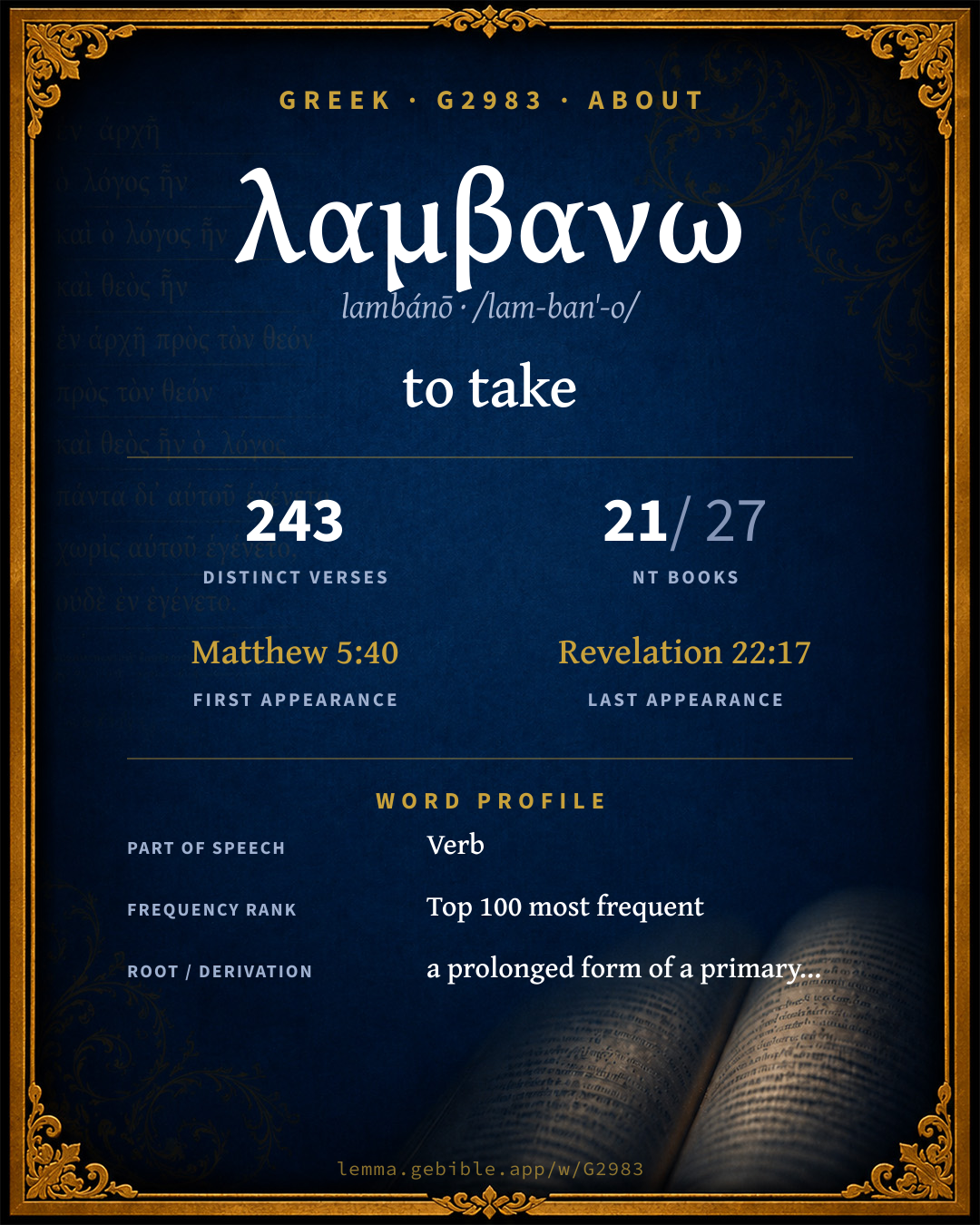
λαμβάνω
to take
‘to take’ is one of 7 main senses fuller range ↓
Full lexicon entry — Thayer's Greek Lexicon
From Thayer's Greek Lexicon
Where this word appears
See every Aorist-tense verb in the Greek New Testament →
Grammar key — what these labels mean
Part of speech
- Verb
- An action or state-of-being word.
Tense
- Aorist
- Action viewed as a simple whole, without regard to duration — often past (perfective aspect).
- Present
- Ongoing or general action in present time (imperfective aspect).
- Future
- Action expected in future time.
- Perfect
- A completed past action with continuing present results.
- Imperfect
- Continuous or repeated action in past time (“was writing”).
Voice
- Active
- The subject performs the action.
- Middle deponent
- Middle in form but active in meaning.
- Passive
- The subject receives the action.
Mood
- Participle
- A verbal adjective (“writing,” “having written”).
- Indicative
- States a fact or asks a factual question (the mood of reality).
- Infinitive
- A verbal noun (“to write”), unmarked for person or number.
- Subjunctive
- Expresses probability, purpose, or possibility (the mood of contingency).
- Imperative
- Expresses a command or request.
- Optative
- Expresses a wish or a remote possibility.
Case
- Nominative
- The case of the subject (and the predicate nominative).
- Accusative
- The case of the direct object and of extent.
Person
- 3rd person
- The one spoken about (“he / she / it / they”).
- 2nd person
- The one addressed (“you”).
- 1st person
- The speaker (“I / we”).
Gender
- Masculine
- Grammatically masculine.
- Feminine
- Grammatically feminine.
- Neuter
- Grammatically neuter.
Number
- Singular
- One.
- Plural
- More than one.
4 verses where G2983 appears in the Present tense in the Book of Revelation. Filtered view — show all forms. Click any verse to open its interlinear word-by-word view. Verse text shown in the World English Bible for context — . Each verse’s Greek form is shown with its reference; the English is not keyword-highlighted, since the data carries no word-level English alignment. Use “Compare translations” on any verse to read it across multiple English versions. This concordance covers the Greek New Testament; Septuagint (Greek Old Testament) occurrences of this word are not indexed here.
Revelation
- Revelation 2:17 λαμβάνων pres act ptcp nom sg masc He who has an ear, let him hear what the Spirit says to the assemblies. To him who overcomes, to him I will give of the hidden manna, and I will give him a white stone, and on the stone a new name written, which no one knows but he who receives it.
- Revelation 14:9 λαμβάνει pres act ind 3sg Another angel, a third, followed them, saying with a great voice, "If anyone worships the beast and his image, and receives a mark on his forehead, or on his hand,
- Revelation 14:11 λαμβάνει pres act ind 3sg The smoke of their torment goes up forever and ever. They have no rest day and night, those who worship the beast and his image, and whoever receives the mark of his name.
- Revelation 17:12 ἔλαβον λαμβάνουσιν aor act ind 3pl pres act ind 3pl The ten horns that you saw are ten kings who have received no kingdom as yet, but they receive authority as kings, with the beast, for one hour.
About this entry
At a glance — auto-summarized from this page’s data, not written by a person. Every figure links to its source below. This summary describes the numbers; it doesn’t interpret them.
At its core, λαμβανω (lambánō) means “to take.” Translators differ — “took” in the King James Version, then “having taken” (unfoldingWord Literal Text), as the renderings breakdown shows. With 243 verses in 21 books, it is a common word in the Greek New Testament. First canonically at Matthew 5:40, it enters the text early. Catalogued under 7 senses, its meaning is not single-sense. Each statement above links to its evidence; the full detail follows below.
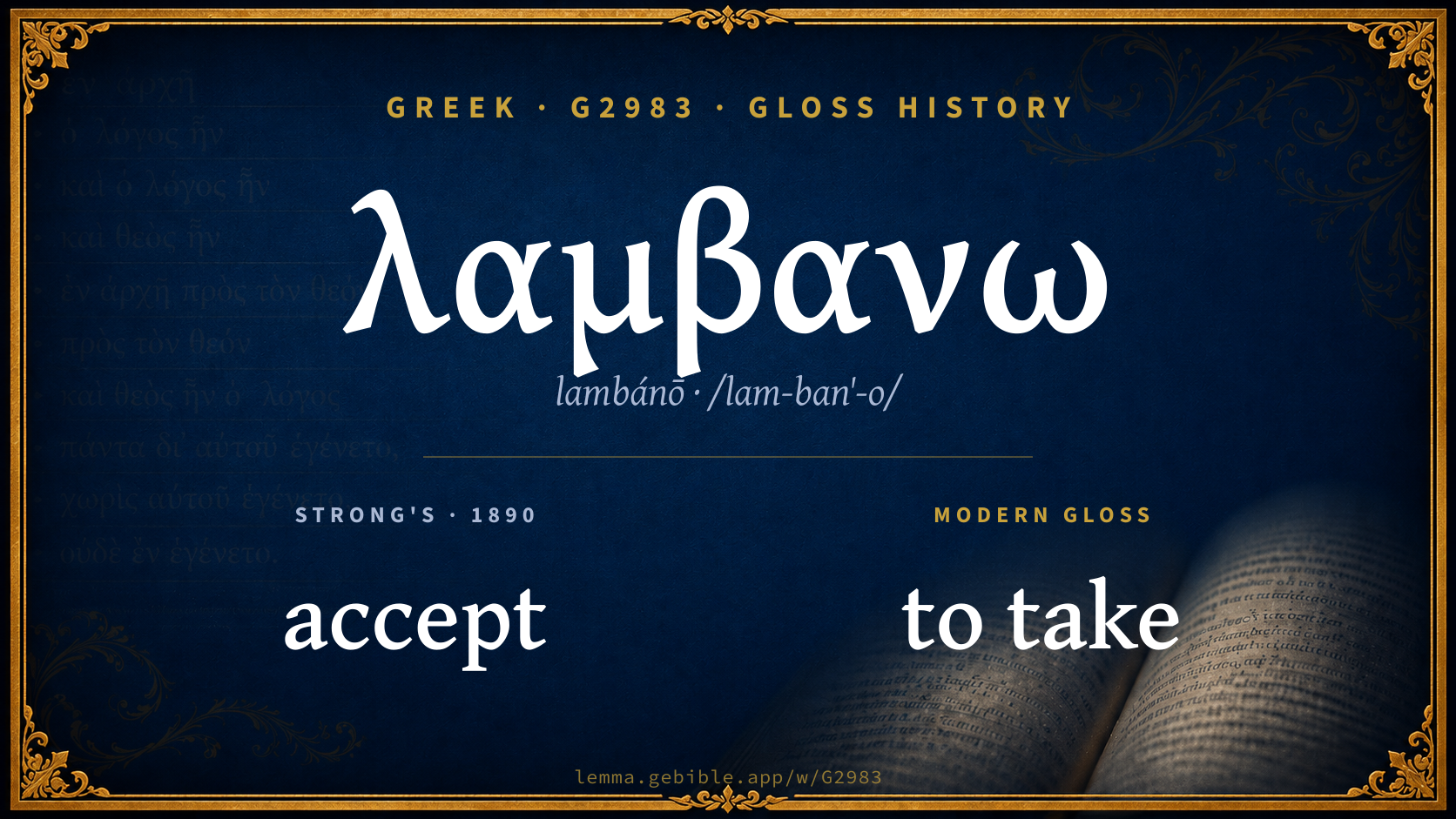
Gloss history
Strong's 1890 vs modern scholarship
About this word
Strong's G2983 catalogs a Greek word from the Greek New Testament.
These counts are not copied from any lexicon or concordance. They are computed here, from the morphology-tagged Greek New Testament. What Lemma adds →
- 243
- distinct verses
- The word appears in 243 distinct verses.
- 21 / 27
- NT books
- The word appears in 21 of 27 New Testament books.
- #62
- by frequency
- Top 100 most frequent Greek words (rank 62 of 5,347 Greek words by occurrence).
View all 243 occurrences in the concordance →
By section of the New Testament
By traditional corpus
Conventional, traditional groupings — biblical authorship is debated, so this is a traditional corpus grouping, not an authorship claim. Some books belong to more than one corpus (Luke is in both the Gospels and the Lukan corpus, and so on), so these shares overlap and need not total 100%. Each figure is a share of the word’s 243 distinct verses.
- Gospels 131 verses · 54%
- Johannine 69 verses · 28%
- Lukan (Luke–Acts) 50 verses · 21%
- Pauline corpus 30 verses · 12%
- Revelation 22 verses · 9%
- Hebrews 16 verses · 7%
- General (Catholic) Epistles 15 verses · 6%
How translations render this word
Counts come from each version’s own published word-to-Strong’s tagging or interlinear alignment — an approximate guide to how each version renders this word, not a word-level alignment the data otherwise carries. Because each total is that version’s own tagged count, the per-version totals vary from one another and need not match the appearance or distinct-verse counts above. These counts may also differ from a printed concordance because Lemma counts each distinctly tagged rendering and does not collapse phrase taggings into a single head-word total. This is a fixed set of word-tagged versions (KJV, ASV, BSB, ULT) and does not change with the reading translation you choose elsewhere. Each version’s license is shown beside its name below (and on Sources).
- King James Version: Took 36×, Take 23×, Receive 20×
- American Standard Version: Took 35×, Take 20×, Receive 18×
- Berean Standard Bible: Took 22×, Take 16×, Receive 15×
- unfoldingWord Literal Text: Having taken 34×, Receive 33×, Take 19×
King James Version Public Domain
Renders G2983 across 270 tagged occurrences — most commonly:
Plus other, less common renderings. Plus 60 renderings that appear only once — usually multi-word phrases or single function words the recovered tagging swept in, not distinct renderings. Not rendered by a distinct English word in 2 further occurrences.
American Standard Version Public Domain
Renders G2983 across 264 tagged occurrences — most commonly:
Plus other, less common renderings. Plus 60 renderings that appear only once — usually multi-word phrases or single function words the recovered tagging swept in, not distinct renderings.
Berean Standard Bible Public Domain
Renders G2983 across 241 tagged occurrences — most commonly:
Plus other, less common renderings. Plus 77 renderings that appear only once — usually multi-word phrases or single function words the recovered tagging swept in, not distinct renderings. Not rendered by a distinct English word in 7 further occurrences.
unfoldingWord Literal Text CC BY-SA 4.0
Renders G2983 across 299 tagged occurrences — most commonly:
Plus other, less common renderings. Plus 52 renderings that appear only once — usually multi-word phrases or single function words the recovered tagging swept in, not distinct renderings.
7 senses in Thayer's, in lexicon order
The 7 senses Thayer's distinguishes for this word, in lexicon order (not ranked by frequency or importance). The full entry — with sub-senses — is in the Lexicon Entry tab.
- to take with the hand, lay hold of, any person or thing in order to use it
- to take in order to carry away
- to take what is one's own, to take to one's self, to make one's own
- to associate with one's self as companion, attendant
- to take
- to regard any one's power, rank, external circumstances, and on that account to do some injustice or neglect something
- to receive (what is given), to gain, get, obtain, to get back
Word origin
Origin: a prolonged form of a primary verb, which is use only as an alternate in certain tenses
A prolonged form of a primary verb which is used only as an alternate in certain tenses; to take (in very many applications literally and figuratively [probably objective or active to get hold of; whereas G1209 is rather subjective or passive to have offered to one; while G138 is more violent to seize or remove ]): - accept + be amazed assay attain bring X when I call catch come on (X unto) + forget have hold obtain receive (X after) take (away up).
— Strong’s Exhaustive Concordance (1890), public domain.
Forms in the corpus
The 46 distinct written forms G2983 takes in the Greek New Testament, most frequent first — each parse links to that tense’s occurrences in the concordance.
Same root — word family
Other Thayer's entries built from the same root as G2983, grouped by Strong’s listed origin. These share a root / origin per the lexicon — not necessarily a shared meaning. Each links to that word’s own entry.
Derived from this word
Compare all same-root words → They share a root, not necessarily a meaning.
Septuagint usage
The same Greek word λαμβανω appears 1,084 times in the Greek Old Testament (Septuagint), across 1,009 verses in 35 books.
- 1,084
- LXX occurrences
- Tagged occurrences of this Greek word in the Septuagint.
- 1,009
- verses
- Distinct Septuagint verses containing this word.
- 35 / 39
- OT books
- The word appears in 35 of the 39 Old Testament books.
Sample Septuagint occurrences
- Genesis 2:15 λαμβάνω
- Exodus 2:1 λαμβάνω
- Leviticus 4:5 λαμβάνω
- Numbers 1:2 λαμβάνω
- Deuteronomy 1:15 λαμβάνω
- Joshua 2:4 λαμβάνω
- Judges 1:24 λαμβάνω
- Ruth 1:4 λαμβάνω
- 1 Samuel 2:14 λαμβάνω
- 2 Samuel 1:10 λαμβάνω
- 1 Kings 1:33 λαμβάνω
- 2 Kings 2:3 λαμβάνω
Septuagint occurrences (same lexeme)
Every verse where the same Strong’s number (G2983) appears in the Greek Septuagint — showing the first 50 of 1,009. Verse text shown in the World English Bible for context; the Greek form is the matched word — the English is not keyword-highlighted.
- Genesis 2:15 λαμβάνω Yahweh God took the man, and put him into the garden of Eden to dress it and to keep it.
- Genesis 2:21 λαμβάνω Yahweh God caused a deep sleep to fall on the man, and he slept; and he took one of his ribs, and closed up the flesh in its place.
- Genesis 2:22 λαμβάνω He made the rib, which Yahweh God had taken from the man, into a woman, and brought her to the man.
- Genesis 2:23 λαμβάνω The man said, "This is now bone of my bones, and flesh of my flesh. She will be called Woman, because she was taken out of Man."
- Genesis 3:6 λαμβάνω When the woman saw that the tree was good for food, and that it was a delight to the eyes, and that the tree was to be desired to make one wise, she took of the fruit of it, and ate; and she gave some to her husband with her, and he ate.
- Genesis 3:19 λαμβάνω By the sweat of your face will you eat bread until you return to the ground, for out of it you were taken. For you are dust, and to dust you shall return."
- Genesis 3:22 λαμβάνω Yahweh God said, "Behold, the man has become like one of us, knowing good and evil. Now, lest he put forth his hand, and also take of the tree of life, and eat, and live forever..."
- Genesis 3:23 λαμβάνω Therefore Yahweh God sent him forth from the garden of Eden, to till the ground from whence he was taken.
- Genesis 4:19 λαμβάνω Lamech took two wives: the name of the one was Adah, and the name of the other Zillah.
- Genesis 6:2 λαμβάνω that God's sons saw that men's daughters were beautiful, and they took for themselves wives of all that they chose.
- Genesis 6:21 λαμβάνω Take with you of all food that is eaten, and gather it to you; and it will be for food for you, and for them."
- Genesis 8:9 λαμβάνω but the dove found no place to rest her foot, and she returned to him into the ark; for the waters were on the surface of the whole earth. He put forth his hand, and took her, and brought her to him into the ark.
- Genesis 8:20 λαμβάνω Noah built an altar to Yahweh, and took of every clean animal, and of every clean bird, and offered burnt offerings on the altar.
- Genesis 9:23 λαμβάνω Shem and Japheth took a garment, and laid it on both their shoulders, went in backwards, and covered the nakedness of their father. Their faces were backwards, and they didn't see their father's nakedness.
- Genesis 11:29 λαμβάνω Abram and Nahor took wives. The name of Abram's wife was Sarai, and the name of Nahor's wife, Milcah, the daughter of Haran who was also the father of Iscah.
- Genesis 11:31 λαμβάνω Terah took Abram his son, Lot the son of Haran, his son's son, and Sarai his daughter-in-law, his son Abram's wife. They went forth from Ur of the Chaldees, to go into the land of Canaan. They came to Haran, and lived there.
- Genesis 12:5 λαμβάνω Abram took Sarai his wife, Lot his brother's son, all their substance that they had gathered, and the souls who they had gotten in Haran; and they went forth to go into the land of Canaan. Into the land of Canaan they came.
- Genesis 12:19 λαμβάνω Why did you say, 'She is my sister,' so that I took her to be my wife? Now therefore, see your wife, take her, and go your way."
- Genesis 14:11 λαμβάνω They took all the goods of Sodom and Gomorrah, and all their food, and went their way.
- Genesis 14:12 λαμβάνω They took Lot, Abram's brother's son, who lived in Sodom, and his goods, and departed.
- Genesis 14:21 λαμβάνω The king of Sodom said to Abram, "Give me the people, and take the goods to yourself."
- Genesis 14:23 λαμβάνω that I will not take a thread nor a shoe-latchet nor anything that is yours, lest you should say, 'I have made Abram rich.'
- Genesis 14:24 λαμβάνω Except only that which the young men have eaten, and the portion of the men who went with me, Aner, Eshcol, and Mamre: let them take their portion."
- Genesis 15:9 λαμβάνω He said to him, "Take me a heifer three years old, a female goat three years old, a ram three years old, a turtle-dove, and a young pigeon."
- Genesis 15:10 λαμβάνω He took him all these, and divided them in the middle, and laid each half opposite the other; but he didn't divide the birds.
- Genesis 16:3 λαμβάνω Sarai, Abram's wife, took Hagar the Egyptian, her handmaid, after Abram had lived ten years in the land of Canaan, and gave her to Abram her husband to be his wife.
- Genesis 17:23 λαμβάνω Abraham took Ishmael his son, all who were born in his house, and all who were bought with his money; every male among the men of Abraham's house, and circumcised the flesh of their foreskin in the same day, as God had said to him.
- Genesis 18:4 λαμβάνω Now let a little water be fetched, wash your feet, and rest yourselves under the tree.
- Genesis 18:5 λαμβάνω I will get a morsel of bread so you can refresh your heart. After that you may go your way, now that you have come to your servant." They said, "Very well, do as you have said."
- Genesis 18:7 λαμβάνω Abraham ran to the herd, and fetched a tender and good calf, and gave it to the servant. He hurried to dress it.
- Genesis 18:8 λαμβάνω He took butter, milk, and the calf which he had dressed, and set it before them. He stood by them under the tree, and they ate.
- Genesis 19:14 λαμβάνω Lot went out, and spoke to his sons-in-law, who were pledged to marry his daughters, and said, "Get up! Get out of this place, for Yahweh will destroy the city." But he seemed to his sons-in-law to be joking.
- Genesis 19:15 λαμβάνω When the morning arose, then the angels hurried Lot, saying, "Arise, take your wife, and your two daughters who are here, lest you be consumed in the iniquity of the city."
- Genesis 20:2 λαμβάνω Abraham said about Sarah his wife, "She is my sister." Abimelech king of Gerar sent, and took Sarah.
- Genesis 20:3 λαμβάνω But God came to Abimelech in a dream of the night, and said to him, "Behold, you are a dead man, because of the woman whom you have taken. For she is a man's wife."
- Genesis 20:14 λαμβάνω Abimelech took sheep and oxen, men-servants and women-servants, and gave them to Abraham, and restored Sarah, his wife to him.
- Genesis 21:14 λαμβάνω Abraham rose up early in the morning, and took bread and a bottle of water, and gave it to Hagar, putting it on her shoulder, and gave her the child, and sent her away. She departed, and wandered in the wilderness of Beersheba.
- Genesis 21:18 λαμβάνω Get up, lift up the boy, and hold him in your hand. For I will make him a great nation."
- Genesis 21:21 λαμβάνω He lived in the wilderness of Paran. His mother took a wife for him out of the land of Egypt.
- Genesis 21:27 λαμβάνω Abraham took sheep and oxen, and gave them to Abimelech. Those two made a covenant.
- Genesis 21:30 λαμβάνω He said, "You shall take these seven ewe lambs from my hand, that it may be a witness to me, that I have dug this well."
- Genesis 22:2 λαμβάνω He said, "Now take your son, your only son, whom you love, even Isaac, and go into the land of Moriah. Offer him there for a burnt offering on one of the mountains which I will tell you of."
- Genesis 22:6 λαμβάνω Abraham took the wood of the burnt offering and laid it on Isaac his son. He took in his hand the fire and the knife. They both went together.
- Genesis 22:10 λαμβάνω Abraham stretched forth his hand, and took the knife to kill his son.
- Genesis 22:13 λαμβάνω Abraham lifted up his eyes, and looked, and saw that behind him was a ram caught in the thicket by his horns. Abraham went and took the ram, and offered him up for a burnt offering instead of his son.
- Genesis 23:13 λαμβάνω He spoke to Ephron in the audience of the people of the land, saying, "But if you will, please hear me. I will give the price of the field. Take it from me, and I will bury my dead there."
- Genesis 24:3 λαμβάνω I will make you swear by Yahweh, the God of heaven and the God of the earth, that you shall not take a wife for my son of the daughters of the Canaanites, among whom I live.
- Genesis 24:4 λαμβάνω But you shall go to my country, and to my relatives, and take a wife for my son Isaac."
- Genesis 24:7 λαμβάνω Yahweh, the God of heaven, who took me from my father's house, and from the land of my birth, who spoke to me, and who swore to me, saying, 'I will give this land to your seed.' He will send his angel before you, and you shall take a wife for my son from there.
- Genesis 24:10 λαμβάνω The servant took ten camels, of his master's camels, and departed, having all goodly things of his master's in his hand. He arose, and went to Mesopotamia, to the city of Nahor.
These are occurrences of the same Greek lexeme (G2983) in the Septuagint — not a translation of any one Hebrew word. The store carries no word-level Hebrew↔Greek alignment, so no Hebrew original is asserted here. Counts come from the recovered LXX Strong's tagging — high-frequency vocabulary is well covered, while rare or late forms may be untagged — so they reflect tagged occurrences and may slightly undercount.