1 Samuel 11:12

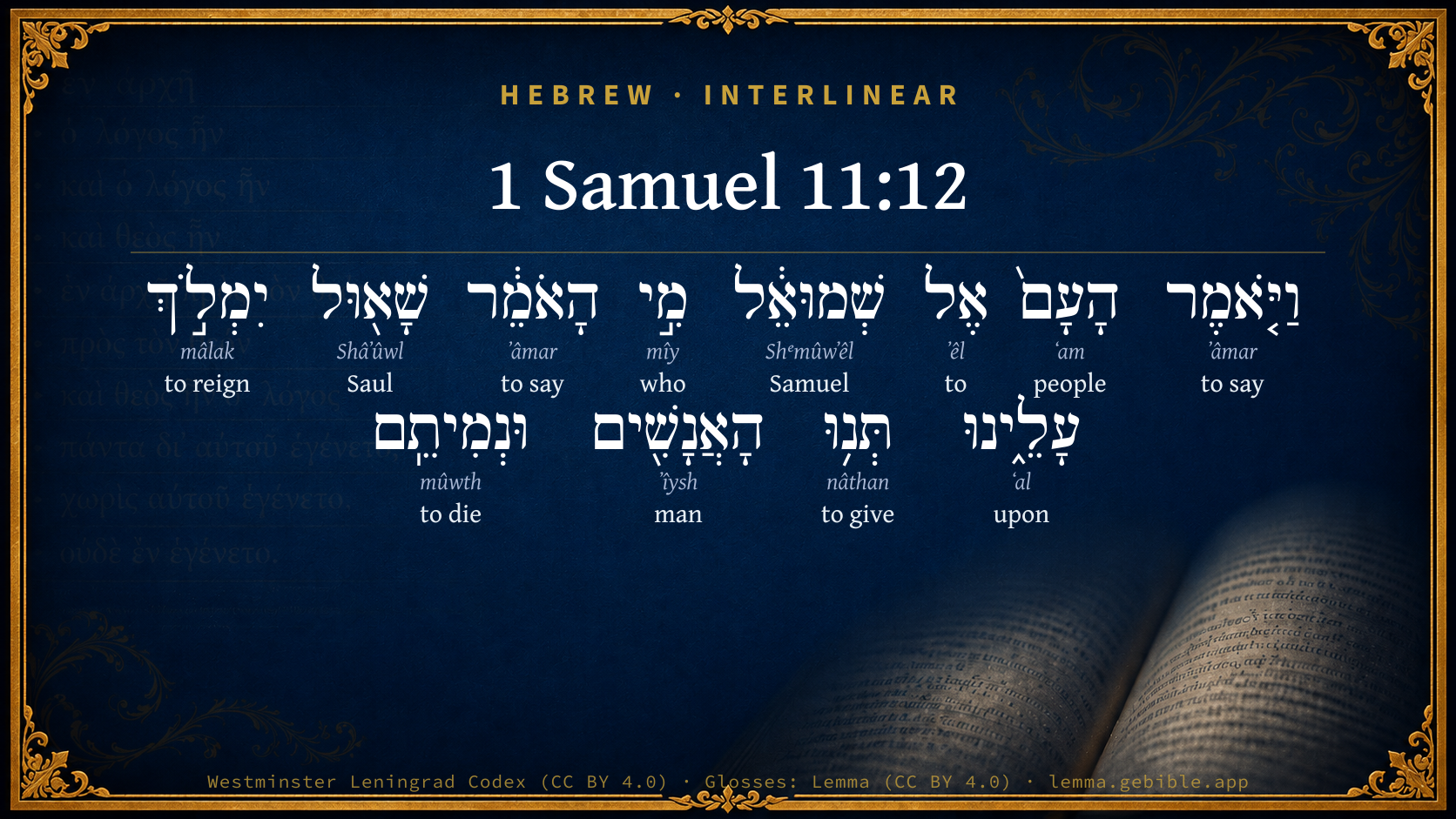
Hebrew (Westminster Leningrad Codex) 1 Samuel 11:12 appears in the Hebrew Old Testament. The text above is from the Westminster Leningrad Codex. Each word links to its Strong’s number, a concise gloss, and parsing drawn from the Open Scriptures Hebrew Bible morphology. Click any word for its full Brown-Driver-Briggs (BDB) entry.
Download image
Cite this verse

1 Samuel 11:12 (World English Bible). Public Domain. Lemma interlinear Bible study tool, https://lemma.gebible.app/v/1-samuel/11/12.

Show BibTeX & RIS
BibTeX
RIS
English Translation
The people said to Samuel, Who is he who said, Shall Saul reign over us? bring the men, that we may put them to death.
World English Bible · Public Domain
Download a study sheet

One document with this verse’s original text, its word-by-word gloss line, the meaning frame, cross-references with their text, attributed commentary, and full source and license credits — printable, and it pastes into notes with its structure intact.

This verse Autodidact and up

Study sheet (.html) Plain text (.txt)

A passage Seminary Student

Up to 50 verses in one chapter. A passage sheet keeps up to 6 commentary sources and 12 cross-references per verse, in the order this page ranks them, and says so on the sheet whenever that leaves anything out. Ask for a single verse and you get the Autodidact verse sheet above.

Everything on this page stays free to read, with no account — the sheet is a download of what is already on screen, not access to it.

Want to remove ads? Support Godless Engineer
Compare translations 3

The same verse in 3 English versions, stacked beneath the original-language interlinear above. Click any original word for its lexicon entry.

Each is an independent rendering of the whole verse — the interlinear is not word-aligned to these translations.

Highlighted words mark where these versions differ — a whole-verse word diff, not a word-by-word alignment.

  • World English Bible Public Domain
    The people said to Samuel, Who is he who said, Shall Saul reign over us? bring the men, that we may put them to death.
  • King James Version Public Domain
    And the people said unto Samuel, Who is he that said, Shall Saul reign over us? bring the men, that we may put them to death.
  • unfoldingWord Literal Text CC BY-SA 4.0
    And the people said to Samuel, “Who the having said, ‘Shall Saul reign over us?’ Give the men, that we may make them die.”

unfoldingWord Literal Text — © unfoldingWord, licensed CC BY-SA 4.0. Word-aligned USFM3 via Door43 (git.door43.org/unfoldingWord/en_ult).

Versions to compare (up to 4)

3 of 4 selected

Show all 18 translations

Every available English version of this verse, each an independent rendering of the whole verse.

  • World English Bible Public Domain
    The people said to Samuel, Who is he who said, Shall Saul reign over us? bring the men, that we may put them to death.
  • Berean Standard Bible Public Domain
    Then the people said to Samuel, “Who said that Saul should not reign over us? Bring those men here so we can kill them!”
  • Majority Standard Bible Public Domain
    Then the people said to Samuel, “Who said that Saul should not reign over us? Bring those men here so we can kill them!”
  • King James Version Public Domain
    And the people said unto Samuel, Who is he that said, Shall Saul reign over us? bring the men, that we may put them to death.
  • American Standard Version (1901) Public Domain
    And the people said unto Samuel, Who is he that said, Shall Saul reign over us? bring the men, that we may put them to death.
  • Revised Version (1885) Public Domain
    And the people said unto Samuel, Who is he that said, Shall Saul reign over us? bring the men, that we may put them to death.
  • Geneva Bible (1599) Public Domain
    Then the people said vnto Samuel, Who is he that saide, Shall Saul reigne ouer vs? bring those men that we may slaie them.
  • Douay-Rheims (1899) Public Domain
    And the people said to Samuel: Who is he that said: Shall Saul reign over us? Bring the men and we will kill them.
  • Young's Literal Translation Public Domain
    And the people say unto Samuel, `Who is he that saith, Saul doth reign over us! give ye up the men, and we put them to death.'
  • Literal Standard Version CC BY-SA 4.0
    And the people say to Samuel, “Who is he that says, Saul reigns over us? Give up the men, and we put them to death.”
  • Unlocked Literal Bible CC BY-SA 4.0
    Then the people said to Samuel, “Who was it who said, 'Will Saul reign over us?' Bring the men, so we can put them to death.”
  • unfoldingWord Literal Text CC BY-SA 4.0
    And the people said to Samuel, “Who the having said, ‘Shall Saul reign over us?’ Give the men, that we may make them die.”
  • Darby Bible Public Domain
    And the people said to Samuel, Who is he that said, Shall Saul reign over us? bring the men, that we may put them to death.
  • World Messianic Bible Public Domain
    The people said to Samuel, “Who is he who said, ‘Shall Saul reign over us?’ Bring those men, that we may put them to death!”
  • Webster's Bible Public Domain
    And the people said to Samuel, Who is he that said, Shall Saul reign over us? bring the men, that we may put them to death.
  • Free Bible Version CC BY-SA 4.0
    Then the people asked Samuel, “Who was saying, ‘Why should we have Saul as our king?’ Hand these men over so we can execute them.”
  • Bible in Basic English Public Domain
    And the people said to Samuel, Who was it who said, Is Saul to be our king? give the men up, so that we may put them to death.
  • JPS Tanakh (1917) Public Domain
    And the people said unto Samuel: 'Who is he that said: Shall Saul reign over us? bring the men, that we may put them to death.'

Literal Standard Version (2020), Covenant Press — licensed CC BY-SA 4.0. Text via the HelloAO Bible API (eBible.org). Unlocked Literal Bible (unfoldingWord) — licensed CC BY-SA 4.0. Text via the HelloAO Bible API (eBible.org). unfoldingWord Literal Text — © unfoldingWord, licensed CC BY-SA 4.0. Word-aligned USFM3 via Door43 (git.door43.org/unfoldingWord/en_ult). Free Bible Version, Dr. Jonathan Gallagher — licensed CC BY-SA 4.0. Text via the HelloAO Bible API (eBible.org).

Word by word

More ways to search: Search by grammar → Find every occurrence → Compare this word →

Practice this passage: Drill this verse → Learn its vocabulary →

שְׁמוּאֵ֔ל
Shᵉmûwʼêl
H8050
“Samuel”
Noun, Proper
Part of Speech
Noun
Type
Proper
Full BDB Definition

Origin: from the pass part of H8085 and H410

TWOT: None

Samuel = "his name is El" - son of Elkanah by his wife Hannah and judge or prophet of Israel during the days of Saul and David - son Ammihud and the prince of the tribe of Simeon who was chosen to divide the land of Canaan between the tribes. Spelled 'Shemuel' - son of Tola and grandson of Issachar. Spelled 'Shemuel'
  1. וַיֹּ֤אמֶר ʼâmar H559 “and · to say” Conjunction + Verb, Qal, Sequential Imperfect, 3rd Person, Masculine, Singular
  2. הָעָם֙ ʻam H5971 “the · people” Particle, Definite Article + Noun, Common, Masculine, Singular, Absolute
  3. אֶל ʼêl H413 “to” Preposition
  4. מִ֣י mîy H4310 “who” Particle, Interrogative
  5. הָאֹמֵ֔ר ʼâmar H559 “the · saying” Particle, Definite Article + Verb, Qal, Participle Active, Masculine, Singular, Absolute
  6. שָׁא֖וּל Shâʼûwl H7586 “Saul” Noun, Proper
  7. יִמְלֹ֣ךְ mâlak H4427 “to reign” Verb, Qal, Imperfect, 3rd Person, Masculine, Singular
  8. עָלֵ֑ינוּ ʻal H5921 “upon · us” Preposition + Suffix, Personal, 1st Person, Common, Plural
  9. תְּנ֥וּ nâthan H5414 “give” Verb, Qal, Imperative, 2nd Person, Masculine, Plural
  10. הָאֲנָשִׁ֖ים ʼîysh H376 “the · men” Particle, Definite Article + Noun, Common, Masculine, Plural, Absolute
  11. וּנְמִיתֵֽם mûwth H4191 “and · to die · them” Conjunction + Verb, Hiphil, Imperfect, 1st Person, Common, Plural + Suffix, Personal, 3rd Person, Masculine, Plural

About this verse

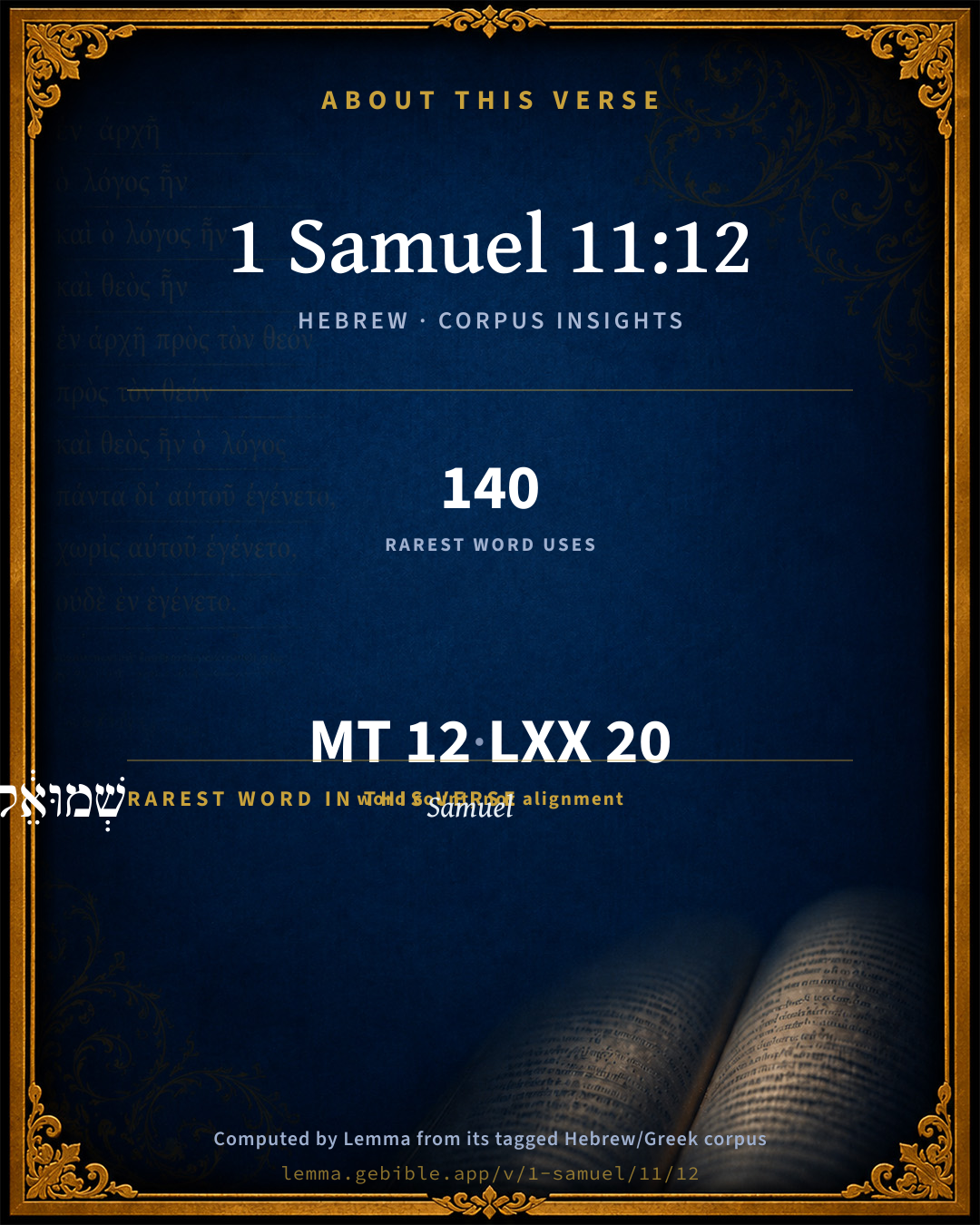
These counts appear in no published source. They are computed here, from the morphology-tagged text and Lemma’s own curated glosses. What Lemma adds →

12
words
11
distinct lemmas
Historical
section

Grammatical profile

  • 5 verbs
  • 4 nouns
  • 2 prepositions
  • 1 particle

Verb forms

  • וַיֹּ֤אמֶר Qal · Sequential Imperfect
  • הָאֹמֵ֔ר Qal · Participle Active
  • יִמְלֹ֣ךְ Qal · Imperfect
  • תְּנ֥וּ Qal · Imperative
  • וּנְמִיתֵֽם Hiphil · Imperfect

Repetition

A word recurs within this verse — often emphatic in Hebrew:

  • וַיֹּ֤אמֶר to say H559 ×2

Hebrew & Septuagint length

In English translation the verse runs 25 words from the Hebrew and 27 from the Septuagint (LXX English) — closely comparable.

A rough comparison of the two English renderings, which tokenize alike — not a word-level alignment.

Word counts can differ between the Hebrew and the Greek without any difference in meaning — e.g. the Hebrew direct-object marker אֵת has no separate Greek word, and Greek often adds the article ὁ.

In the original languages it is 12 Hebrew tokens and 20 Greek tokens — but the two are counted differently (Hebrew bundles its prefixes and suffixes into one token; the Greek is in lemma form), so that isn’t a like-for-like length.

Cross-references

3

Topical passages linked to 1 Samuel 11:12 in the Treasury of Scripture Knowledge — connected by theme and wording, ordered by reader-vote popularity; previews shown in the World English Bible.

  • 1 Samuel 10:27 But certain worthless fellows said, How shall this man save us? They despised him, and brought him no present. But he held his peace.
  • Luke 19:27 But bring those enemies of mine who didn't want me to reign over them here, and kill them before me.'"
  • Psalms 21:8 Your hand will find out all of your enemies. Your right hand will find out those who hate you.

Cross-references courtesy of OpenBible.info (CC BY 4.0).

Hebrew and Greek witnesses Masoretic Hebrew ↔ Greek Septuagint

The same verse in the two great witnesses to the Old Testament, shown verse-for-verse.

These are two independent witnesses, not word-aligned to each other, and the Septuagint is shown in lemma (dictionary) form.

Hebrew 1 Samuel 11:12 Masoretic · Westminster Leningrad Codex

וַיֹּ֤אמֶר הָעָם֙ אֶל שְׁמוּאֵ֔ל מִ֣י הָאֹמֵ֔ר שָׁא֖וּל יִמְלֹ֣ךְ עָלֵ֑ינוּ תְּנ֥וּ הָאֲנָשִׁ֖ים וּנְמִיתֵֽם

The people said to Samuel, Who is he who said, Shall Saul reign over us? bring the men, that we may put them to death.

World English Bible · Public Domain

Greek LXX 1 Samuel 11:12 Septuagint · lemma form

καί εἶπον ὁ λαός πρός σαμουηλ τίς ὁ εἶπον ὅτι σαούλ οὐ βασιλεύω ἐγώ παραδίδωμι ὁ ἀνήρ καί θανατόω αὐτός

And the people said to Samuel, Who has said that Saul shall not reign over us? Give up the men, and we will put them to death.

LXX2012 (modern English Septuagint) · Public Domain

Hebrew: Westminster Leningrad Codex (CC BY 4.0). Greek: Septuagint (public domain); English from LXX2012 (modern English Septuagint) (Public Domain). How the Septuagint differs from the Hebrew →

Targum (Aramaic paraphrase)

1

The Targum is the ancient Jewish Aramaic paraphrase of the Hebrew Scriptures — an interpretive translation, not the Hebrew text itself. Onkelos (literal) and Pseudo-Jonathan (expansive) render the Torah, and Jonathan the Prophets. Coverage is partial: where no permissively-licensed English translation exists for a verse, only the Aramaic is shown. This is verse-level text, not a word-by-word alignment to the Hebrew.

  1. Targum Jonathan Prophets (Joshua–Malachi)
    וַאֲמַר עַמָא לִשְׁמוּאֵל מָא דֵין דִי מְבַסֵר לְמֵימַר לָא כָשַׁר שָׁאוּל לְמִמְלַךְ עֲלָנָא אַיְתוֹ גַבְרַיָא וְנַקְטְלִינוּן:

    (no public-domain English translation for this verse)

    Targum Jonathan — Aramaic: “Mikraot Gedolot” (public domain). English: “Sefaria Community Translation” (CC0 1.0 (public-domain dedication)); “London "Chaldee Paraphrase," 1871” (public domain). Text via Sefaria.

Commentary

Notes on 1 Samuel 11:12 from classic Christian and Jewish commentators (each source and its license shown beneath its notes). The classic Christian expositions comment on the surrounding passage and are grouped to its opening verse, so a note may address several verses; the Jewish commentaries on the Tanakh (Rashi and others) are per-verse, so they appear only where the commentator wrote on this verse.

Lemma curates 59 commentaries, every one of them public domain or Creative Commons licensed, each selected and text-cleaned for this edition rather than reprinted as found. About our sources →

Matthew Henry's Commentary

We have here the improvement of the glorious victory which Saul had obtained, not the improvement of it abroad, though we take it for granted that the men of Jabesh-Gilead, having so narrowly saved their right eyes, would with them now discern the opportunity they had of avenging themselves upon these cruel enemies and disabling them from ever straitening them in like manner again; now shall they be avenged on the Ammonites for their right eyes condemned, as Samson on the Philistines for his two eyes put out, Jdg 16:28. But the account here given is of the improvement of this victory at home.

I. The people took this occasion to show their jealousy for the honour of Saul, and their resentment of the indignities done him. Samuel, it seems, was present, if not in the action (it was too far for him to march) yet to meet them when they returned victorious; and to him, as judge, the motion was made (for they knew Saul would not be judge in his own cause) that the sons of Belial that would not have him to reign over them should be brought forth and slain, Sa1 11:12. Saul's good fortune (as foolish men commonly call it) went further with them to confirm his title than either his choice by lot or Samuel's anointing him. They had not courage thus to move for the prosecution of those that opposed him when he himself looked mean, but, now that his victory made him look great, nothing would serve but they must be put to death.

II. Saul took this occasion to give further proofs of his clemency, for, without waiting for Samuel's answer, he himself quashed the motion (Sa1 11:13): There shall not a man be put to death this day, no, not those men, those bad men, that had abused him, and therein reflected on God himself, 1. Because it was a day of joy and triumph: "To day the Lord has wrought salvation in Israel; and, since God has been so good to us all, let us not be harsh one to another. Now that God has made the heart of Israel in general so glad, let not us make sad the hearts of any particular Israelites." 2. Because he hoped they were by this day's work brought to a better temper, were now convinced that this man, under God, could save them, now honoured him whom before they had despised; and, if they are but reclaimed, he is secured from receiving any disturbance by them, and therefore his point is gained. If an enemy be made a friend, that will be more to our advantage than to have him slain. And all good princes consider that their power is for edification, not for destruction.

III. Samuel took this occasion to call the people together before the Lord in Gilgal, Sa1 11:14, Sa1 11:15. 1. That they might publicly give God thanks for their late victory. There they rejoiced greatly, and, that God might have the praise of that which they had the comfort of, they sacrificed to him, as the giver of all their successes, sacrifices of peace-offerings. 2. That they might confirm Saul in the government, more solemnly than had been yet done, that he might not retire again to his obscurity. Samuel would have the kingdom renewed; he would renew his resignation, and the people should renew their approbation, and so in concurrence with, or rather in attendance upon, the divine nomination, they made Saul king, making it their own act and deed to submit to him.

Matthew Henry's Commentary on the Whole Bible (1708–1710) — public domain (CC PDM 1.0). Text via the HelloAO Bible API.

Jamieson, Fausset & Brown

Robert Jamieson, A. R. Fausset & David Brown

SAUL CONFIRMED KING. (Sa1 11:12-15)

the people said . . ., Who is he that said, Shall Saul reign over us?--The enthusiastic admiration of the people, under the impulse of grateful and generous feelings, would have dealt summary vengeance on the minority who opposed Saul, had not he, either from principle or policy, shown himself as great in clemency as in valor. The calm and sagacious counsel of Samuel directed the popular feelings into a right channel, by appointing a general assembly of the militia, the really effective force of the nation, at Gilgal, where, amid great pomp and religious solemnities, the victorious leader was confirmed in his kingdom [Sa1 11:15].

Next: 1 Samuel Chapter 12

Jamieson, Fausset & Brown — Commentary Critical and Explanatory on the Whole Bible (1871) — public domain (CC PDM 1.0). Text via the HelloAO Bible API.

Trapp's Complete Commentary

John Trapp

1Sa 11:12 And the people said unto Samuel, Who [is] he that said, Shall Saul reign over us? bring the men, that we may put them to death.

Ver. 12. Who is he that said?] Saul’s prudence and diligence crowned with so good success, had made him many friends. Those of Jabeshgilead showed their thankfulness many years after. {1Sa 31:11-12}

John Trapp, A Commentary or Exposition upon All the Books of the Old and New Testament (1647–1656) — public domain. Text from a community e-Sword module.

Joseph Benson's Commentary

1Sa 11:12-13. The people said unto Samuel — Who, it appears from hence, accompanied Saul in this expedition, to encourage him with hopes of good success. Saul said, There shall not a man be put to death this day — Saul had prudently dissembled his knowledge of their despising him before the kingdom was confirmed to him. But the moderation which he now manifested, after he had been so wonderfully victorious, argued still greater nobleness of mind, and benevolence, and mildness of disposition. For nothing is more glorious than to be humble and meek in the height of power.

Joseph Benson's Commentary on the Old and New Testaments (1811–1818) — public domain. Text from a community e-Sword module.

Whedon's Commentary on the Bible

Daniel D. Whedon

THE REACTION IN FAVOUR OF SAUL, AND RENEWAL OF THE KINGDOM AT GILGAL, 1Sa_11:12-15.

The aged Samuel, whose name had gone forth with Saul’s call to arms, (1Sa_11:7,) was with the army at the time of Saul’s triumph over the Ammonites, and when he saw the mighty host all flushed with the glory of their triumph, and all with one accord extolling Saul, he deemed it a most appropriate time to establish the new king in all the powers and prerogatives of the government, and secure for him national recognition.

12. Bring the men, that we may put them to death — The reference is to the outspoken disloyalty that showed itself at Mizpeh. 1Sa_10:27. But the new king’s magnanimity and piety forbade the shedding of Israelitish blood on that day of victory.

Daniel D. Whedon (gen. ed.), Commentary on the Old and New Testaments (1874–1909) — public domain. Text from a community e-Sword module.

Geneva Bible (1599)

Geneva Bible translators

By this victory the Lord won the hearts of the people to Saul.

Geneva Bible (1599) marginal notes — public domain. Text via Bolls.life.

Adam Clarke's Commentary

Verse 12. Who is he that said, Shall Saul reign] Now, flushed with victory and proud of their leader, they wished to give him a proof of their attachment by slaying, even in cool blood, the persons who were at first averse from his being intrusted with the supreme power! The common soldier is scarcely ever inspired by his victory to acts of magnanimity; he has shed blood-he wishes to shed more!

Adam Clarke's Commentary on the Bible (1810–1826) — public domain. Text from a community e-Sword/MySword module.

Ellicott's Commentary for English Readers

(12) And the people said unto Samuel.—The great weight and influence of the seer among the people is strikingly shown by this record of their turning to him, even in the first flush of this great victory of Saul’s. It was Samuel to whom the people looked to bring to punishment the men who had dared to question the wisdom of electing Saul as king. It should be remembered, too, that the royal summons to Israel which accompanied the bloody war-signal of King Saul, ran in the joint names of Saul and Samuel. (See 1Sa_11:7.)

A Bible Commentary for English Readers, edited by Charles John Ellicott (1878–1897) — public domain. Text from a community e-Sword module.

John Gill's Exposition

And Saul said,.... Preventing Samuel from giving an answer, being ready to forgive injuries; as it was in his power as a king, and him only, to pardon those persons that treated him in so ill a manner, and it was policy so to do, especially in the beginning of his reign; and it plainly appears that this temper did not always continue with him; though there is no reason to believe otherwise, that this was now owing to his lenity as well as his prudence:

there shall not be a man put to death this day; who by their appearance to his summons had testified their obedience, and by their courage and valour had showed their attachment to him, and to the interest of their country. Ben Gersom takes the sense to be, that it might be right after, but not on this day to put them to death; or that this was an artifice of Saul to deliver those men out of the hands of the Israelites, suggesting as if it was his intention hereafter to put them to death, though not now, for the following reason:

for today the Lord hath wrought salvation in Israel; he does not ascribe the victory to the quick dispatch he made, to his wisdom and prudence in forming the scheme he did, and to his valour and courage, and that of his troops, but to the power and goodness of God.

John Gill's Exposition of the Whole Bible (1746–1763) — public domain (CC PDM 1.0). Text via the HelloAO Bible API.

Haydock's Catholic Bible Commentary

Them. It seems there were but few discontented persons. (Salien) --- They address themselves to Samuel, who they knew had not regarded their request of a king with approbation, as if to give him a little mortification. But he makes a proposal of confirming the election with still greater solemnity, if they persevered in their resolution, (Haydock) as he intimated they might still recede, (Calmet) and be content with the former mode of government, as being far better. (Haydock)

George Leo Haydock (1774–1849), Haydock's Catholic Family Bible and Commentary, 1859 edition — public domain. Excludes Psalms (Douay-Rheims chapter numbering differs from Protestant) and Deuterocanonical books (Catholic canon only).

Matthew Poole's English Annotations

Shall Saul reign over us? they did not say so in terms, a we may see, 1Sa 10:27, but this was the design and consequence of their speech, as they rightly construe it.

That we may put them to death; which till this time they were not able to do, because that infection was then almost universal.

Matthew Poole's English Annotations on the Holy Bible (1683–1685) — public domain. Text from a community e-Sword/MySword module.

The Pulpit Commentary

Vers. 12, 13. The people said unto Samuel. Even after this glorious victory the people turn to Samuel, and doubtless his presence and influence had had great weight in gaining obedience to Saul"s command (ver. 7). They now, with the old tumultuous violence, demand" that those who had opposed Saul"s election should be put to death. Probably the ringleaders of Saul"s opponents were some of the ciders disappointed at not being chosen themselves. (see on 1Sa_10:27) But Saul displays, first, the kingly virtue of clemency, saying, There shall not a man be put to death this day a decision politic as well as generous, for bloodshed would have led only to future feuds; and, secondly, piety, in so humbly ascribing to Jehovah the salvation that had been wrought in Israel.

Vers. 12-15.

The concurrence of human and Divine action.

The facts are

1. On the completion of the victory over the Ammonites, the supporters ofSaul desire the punishment by death of the "men of Belial" who had reviled him.

2. Saul, recognising the merciful help of God, refuses to mar the joy of victory by personal retaliation.

3. At the invitation of Samuel the people assembled in Gilgal for the recognition of Saul as victorious king, coupled with thanksgiving to God. To an ordinary observer looking on the conflict between Israel and Ammon, it would seem to be simply a struggle of men with men. The preceding verses (6-11) show that an element more than human entered into the conflict, and Saul gratefully refers to this in saying", "Today the Lord hath wrought salvation in Israel." The subsequent celebration of worship by Samuel was a recognition of the same fact.

I It is THE CONCURRENCE OF GOD"S ACTION WITH THAT OF MAN WHICH BRINGS ABOUT RESULTS OF A JOYOUS CHARACTER. The personal will and muscular and mental energy of Saul, aided by the cooperating powers of the people, led to the defeat of the Ammonites. That was the visible human element. But these powers were set at work and sustained by the action directly on the nature of Saul by the Spirit of God (ver. 6), and indirectly through the awe inspired thereby on the minds and bodies of the people. The issue, therefore, is to be ascribed to concurrent action of the human and Divine, the latter partly direct and partly indirect. In a general way it may be said that all effects realised by man are by this concurrence of action. For even when they exercise their power of willing and devising in a wrong direction, it is only possible in consequence of the energy of God sustaining those powers of volition and thought. But the more specific sense in which the concurrence is true may be seen by taking instances.

1. In the realisation of Messianic purposes. The appearance of Christ on earth was the result of a long double line of action. The descendants of Abraham freely cherished the hope of Messiah, and by effort of their own will they contributed, as described in the Old Testament, the human line of action towards this issue. But all this time, and along with all these acts, the Spirit of God was at work, making them willing to be a separate people, controlling events to secure their isolation, inspiring their prophets with rapt vision of the future, and at last coming on the one honoured among women for the perfecting of all that had been hoped and laboured. (Luk_1:27-35)

1. In the production of the Bible. In revelation, as a whole, we have a long train of human events intertwined with a successive manifestation of the Divine will. The Bible is the record of the combination. This holy Book itself is what it is, in its historical portions, because human hands gathered out the selected facts in pursuance of a principle given of God. Moreover, the devout exercises of human spirits in such portions as the Psalms were free, yet concurrent with a Divine influence in their initiation; and as also in the selection of them subsequently for the benefit of mankind.

2. In the victories achieved by Christianity. The victories of Christianity have come about by the free effort of individual minds combining under forms of Church organisation. Men have spoken, written, entreated, sympathised, prayed. Some critics ascribe all success in heathen lands to sheer force of superior intelligence and moral influence; and in civilised lands to what of moral excellence there may be in connection with a great superstition, enforced as this is by a zeal that takes captive the uncritical. But the solution is that God is a coworker with the Church. The human and Divine action are concurrent, the one being the vehicle through which the other operates.

3. In the sanctification of the soul. The work to be done before the human soul can rise to the highest form of life is enormous. Few men consider what is involved in "entering into the kingdom of heaven even on earth. To rise to the life of the "kingdom" means work, conflict, suppression, elevation, excision, nurture, self-denial, aspiration, ambition, persistence within a sphere into which only the eye of God can penetrate. Yet all the expenditure of energy the greatest mind can command is of itself inadequate. We are conquerors and "more than conquerors through Christ," who helpeth us. He "worketh within us to will and to do." In this subtle concurrence of the Divine and human the highest form of life is realised for the "whole body, soul, and spirit.

II It is BEFITTING TO SEIZE OCCASION FOR RECOGNISING GOD"S CONCURRENT ACTION WITH US IN BRINGING GOOD ISSUES TO PASS. It was fit that Saul should publicly recognise the hand of God in his first victory. The spontaneity of the act, and the magnanimous spirit that would not mar the joy of the victory by personal retaliation on his despisers, indicate that at this period of his history he possessed some excellent moral qualities, which certainly were strengthened by this public expression of them. Samuel"s participation in the common joy was also proof of the good feelings of Saul.

1. It is good to pause in life"s struggles and consider gratefully our personal indebtedness to God s power working with us. There are dangers in activity. Absorption in the outgoing of our own energy may unconsciously induce the belief that by "our own arm" have we gotten the victory. Occasional reflection of the need and fact of the Power that "worketh all in all," with deeper dependence on God, awaken gratitude, give tone to our own exertions, and sustain hope of final triumph.

2. It is good in families to seize opportunities for recognising God"s help. The parent whose business has prospered, whose children are being happily settled in life, whose home has been kept free from great calamities, or who has come out of severe trials with honour, will do well to remember who giveth power to be rich, ordereth right paths, sheltereth from "the destruction that wasteth at noonday," and raiseth the needy from the dust, and not be ashamed to let his household know how much he owes to God. Such conduct will bear blessed fruit.

3. It is good for nations to recognise God in signal deliverances. God works with and forevery nation that loves and seeks righteousness. National homage is as proper as individual worship. Thanksgiving services are of Scriptural authority. The precedents are numerous in the Old Testament. It is no doubt owing solely to the fact that Christianity had not permeated nations as a whole, when the New Testament was written, that no precedents are found in its records. Yet the Church as such held special services for prayer and thanksgiving. (Act_4:23-33) Those who contend that vigorous human action is the true and only form of homage to God overlook the fact that there is in good results more than human action, and that positive acts of worship, in recognition of dependence and in expression of gratitude, not only pay honour to whom honour is due, but exercise a beneficial reflex influence on the worshippers. Such acts quicken the public conscience, raise thought to a higher level, nourish the religious feeling, offer excellent occasions and topics for instruction, strengthen the national sentiment, awaken the kindly interest of class for class, call forth the more generous and restrain the harsher impulses of life.

General lessons:

1. It should be a question with individuals and nations as to whether they in their aims and spirit fulfil the conditions on which alone the concurrent action of God can proceed.

2. Much of the non-success of effort may arise from an insufficientrecognition of God as a coworker with us.

3. Things and private persons rise in honour and influence as they display agenerous magnanimity.

4. The joy of great salvation should be undiminished by the intrusion of anybitter human feeling.

Vers. 12, 13.

Generosity toward enemies.

Some men are subject to noble impulses, under which they rise to a higher level of thought and feeling than that which they ordinarily occupy. The difference is sometimes so great that they do not seem to be the same persons. But the change is transient, and they speedily relapse into their former state. Their character is one of varying, wayward, and uncertain moods rather than high, steadfast, and consistent principle. Such a man was Saul. The impulse under which he spared his enemies after his victory over the Ammonites (probably due, as other impulses were, to the influence of Samuel, who may have accompanied him to the battle vers. 7, 12) displayed extraordinary magnanimity. The act is the noblest recorded of him, and stands out in strong relief against the dark background of his subsequent career. "Saul herein showeth his piety, humanity, wisdom. Hitherto he declareth himself an innocent man and a good prince; but afterward he forgot his own rule, when he would have killed Jonathan. (1Sa_14:45) This mutability in Saul and changeable nature, in falling from clemency to cruelty, from piety to profanity, from a good governor to become a tyrant, doth show that these virtues were not thoroughly grounded in him, but only superficially infused" (Wallet). Let us regard him as a pattern of a principle which ought always to be exhibited. His generosity toward his enemies was shown

I UNDER STRONG PROVOCATION, arising from

1. The recollection of their past conduct towards himself. (1Sa_10:27) He could not altogether forget it, and when he was disposed to put it away from his thoughts, he was reminded of it by others. Nothing is more provocative of wrath than brooding over the wrongs that have been received. On the other hand, the surest way to forgive is to forget.

1. The feeling of natural resentment toward them. "Revenge is sweet," say men who are not restrained by Divine wisdom and grace; and they are especially apt to say it when they have the power to avenge themselves, and when they persuade themselves that justice and prudence require that the wrong should not go unpunished. They do require it, doubtless, in some eases; but how large a place does the desire of gratifying personal animosity hold in most instances in which men seek to inflict punishment on others. "Say not, I will do so to him as he hath done to me: I will render

2. to the man according to his work". (Pro_24:29 Pro_20:22)

3. The urgency of others. Men are only too prone to indulge wrath without such an incitement, but they are often led by it to go beyond their own judgment and feeling, and he who, like Saul, overcomes it gains a double victory. "Thereby he gained another victory

(1) over himself he restrains himself in the exercise of a right;

(2) over the anger of those who demanded that justice be executed;

(3) over his former opponents, who now clearly see that which, under the influence of haughty contempt, they had doubted; and

(4) over the whole people, who must have been carried along by him in the path of noble moral conduct, and lifted above themselves to the height on which he stood" (Erdmann).

II IN A ROYAL MANNER. "There shall not a man be put to death this day.

1. Promptly. If he had waited till the morrow his purpose might have changed. When a generous emotion fills the heart it should be at once translated into word and deed. First thoughts in things moral, unlike first thoughts in things intellectual, are always best. Hesitation and delay dim their brightness and weaken their power.

2. Decisively. Saul spoke like a king. He refused to stain his laurels with blood. And whilst he resolved not to punish his enemies, he declared his determination that none other should punish them. "Where the word of a king is there is power.

3. Completely. "Not a man." Not a single example was to be made, but his clemency was to extend to all. In the same royal manner we may and ought to show mercy. "Blessed are the merciful, for they shall obtain mercy.

III FROM A PROPER MOTIVE. "For today the Lord hath wrought salvation in Israel." "Not only signifying that the public rejoicing should not be interrupted, but reminding them of the clemency of God, and urging that since Jehovah had shown such clemency upon that day, that he had overlooked their sins and given them a glorious victory, it was only right that they should follow his example and forgive their neighbours" sins without bloodshed" (Seb. Schmid).

Saul showed1. Regard for the transcendent excellence of mercy. Nothing is more beautiful or more pleasing to God, and its exercise is necessary that we may obtain mercy. (Mat_6:15) He is "merciful and gracious." "Mercy rejoiceth against judgment." (Pro_25:21; Rom_12:19, Rom_12:20; Jam_2:13)

It becomes The throned monarch better than his crown; His sceptre shows the force of temporal power The attribute to awe and majesty, Wherein doth sit the dread and fear of kings; But mercy is above this sceptred sway; It is enthroned in the heart of kings, It is an attribute to God himself, And earthly power doth then show likest God"s When mercy seasons justice ("Merchant of Venice).

To return good for good and evil for evil is natural, to return evil for good is devilish, but to return good for evil is Divine.

1. Gratitude for the abounding goodness of God. His hand was fully recognised in recent victory and deliverance. His kindness to us should constrain us to be kind to others, and his forgiveness is shown to have been experienced only when it leads us to forgive. (Mat_18:35)

2. Desire for the welfare of men. "The Lord hath wrought salvation in Israel, to whom these "worthless men" belonged. Even such men are objects of his forbearance and benevolence. "He maketh his sun to rise on the evil and on the good". (Mat_5:45) He does them good, and thereby seeks to subdue their hostility toward himself. (Eze_33:11) We ought to exhibit the same spirit, and by doing so we shall promote the general peace and happiness. "Be ye therefore merciful, even as your Father also is merciful". D. (Luk_6:36)

The Pulpit Commentary (1880–1919), ed. H.D.M. Spence-Jones & Joseph S. Exell — public domain. Text from a community e-Sword module.

Keil & Delitzsch

C. F. Keil & F. Delitzsch

Renewal of the Monarchy. - Saul had so thoroughly acted the part of a king in gaining this victory, and the people were so enthusiastic in his favour, that they said to Samuel, viz., after their return from the battle, "Who is he that said, Saul should reign over us!" The clause עלינוּ ימלך שׁאוּל contains a question, though it is indicated simply by the tone, and there is no necessity to alter שׁאוּל into השׁאוּל. These words refer to the exclamation of the worthless people in Sa1 10:27. "Bring the men (who spoke in this manner), that we may put them to death." But Saul said, "There shall not a man be put to death this day; for to-day Jehovah hath wrought salvation in Israel;" and proved thereby not only his magnanimity, but also his genuine piety.

(Note: "Not only signifying that the public rejoicing should not be interrupted, but reminding them of the clemency of God, and urging that since Jehovah had shown such clemency upon that day, that He had overlooked their sins, and given them a glorious victory, it was only right that they should follow His example, and forgive their neighbours' sins without bloodshed." - Seb. Schmidt.)

Keil & Delitzsch — Biblical Commentary on the Old Testament (1861–1891) — public domain (CC PDM 1.0). Text via the HelloAO Bible API. (Old Testament only.)

unfoldingWord translationNotes

Door43 World Missions Community

translationWords

Samuel

Saul (OT)

reign

die

Yahweh

Israel

unfoldingWord translationNotes — © Distant Shores Media and the Door43 World Missions Community, licensed CC BY-SA 4.0. Source: git.door43.org/Door43/en_tn.

Rashi

Rabbi Shlomo Yitzchaki (Rashi)

Who is it that says. Derisively, "Shaul will reign over us?" Give them over and we will execute them.

Will reign over us. As a question.

Rashi on the Tanakh — English translations: “The Judaica Press complete Tanach with Rashi, translated by A. J. Rosenberg” (CC BY 4.0); “Pentateuch with Rashi's commentary by M. Rosenbaum and A.M. Silbermann, 1929-1934” (public domain); “The Metsudah Tanach series, Lakewood, N.J” (CC BY 4.0); and “The Book of Joshua, Metsudah Publications, 1997” (CC BY 4.0). Text via Sefaria.

Lesson kit

Teaching starters — assembled from the data on this page, not authored interpretation. Every prompt links to the verse data it draws on. Edit before teaching.

1 Samuel, in the Historical, opens this verse with 12 words (11 distinct Hebrew lemmas). Its most distinctive word is Shᵉmûwʼêl (“Samuel”). A historical commentator’s framing appears above. Read the whole chapter for the surrounding context.

Discussion questions

  1. How does “Samuel” (Shᵉmûwʼêl) shape what this verse is saying?
  2. How does 1 Samuel 10:27, which shares this passage’s theme, read alongside this verse?
  3. What does the repetition of “to say” (2× in this one verse) do in this verse?
  4. These translations render this verse differently. What is at stake in choosing one wording over another?
  5. «וַיֹּ֤אמֶר» is a Qal Sequential Imperfect verb. How does that grammatical form shape the action described?
  6. Compare how Matthew Henry's Commentary and Jamieson, Fausset & Brown read this verse. Where do they agree or differ?

Things to notice

Reading settings

Reading text

Shown beneath each verse's original-language words.

Old Testament
Old Testament edition

Read the OT as the Masoretic Hebrew (MT) or the Greek Septuagint (LXX).

English shown for the Greek Septuagint (in the Hebrew ↔ Greek comparison).

Comparing translations? Open the Compare panel on any verse page to stack up to four side by side.