Psalms 99:6

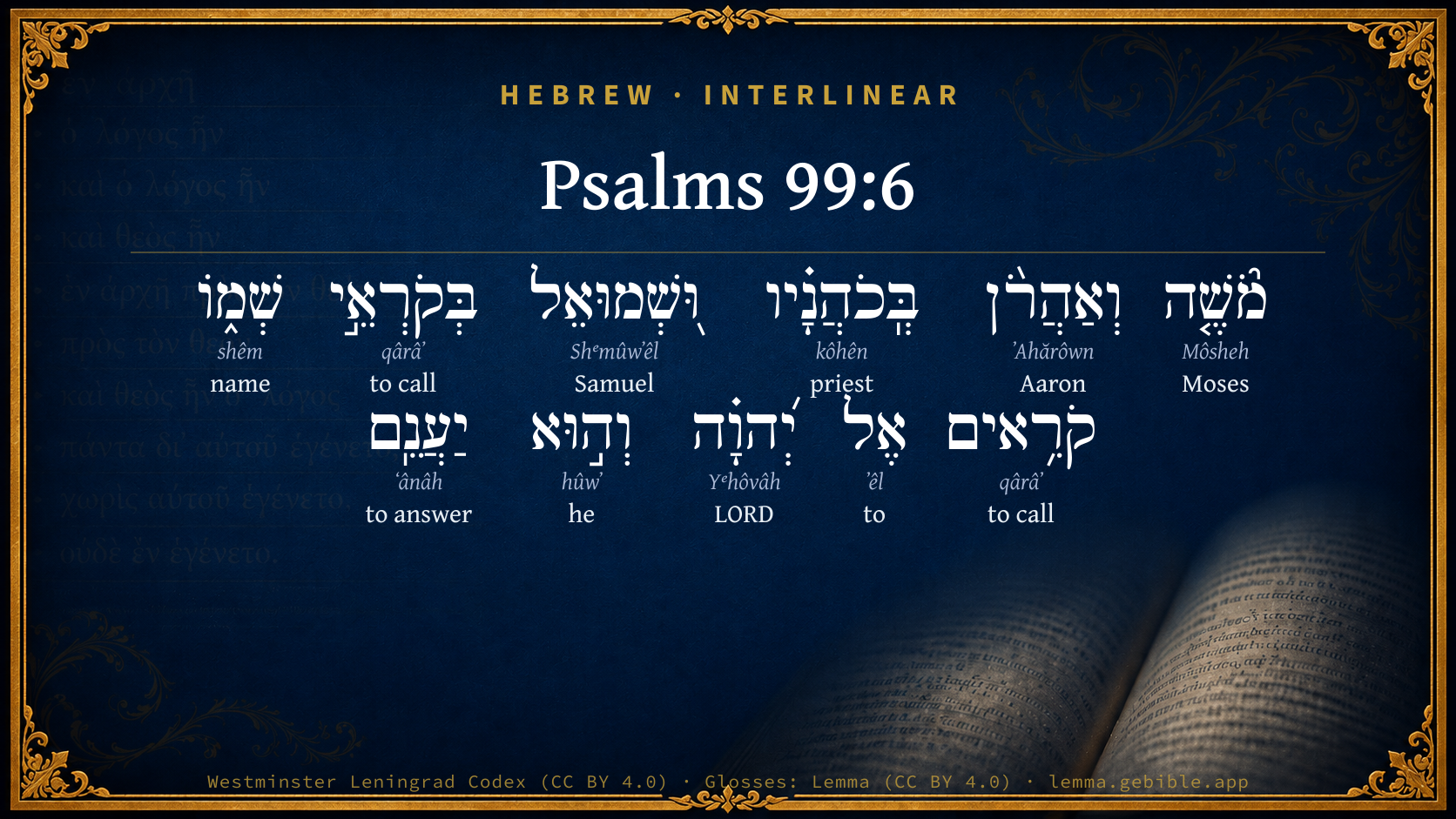
Hebrew (Westminster Leningrad Codex) Psalms 99:6 appears in the Hebrew Old Testament. The text above is from the Westminster Leningrad Codex. Each word links to its Strong’s number, a concise gloss, and parsing drawn from the Open Scriptures Hebrew Bible morphology. Click any word for its full Brown-Driver-Briggs (BDB) entry.
Download image
Cite this verse

Psalms 99:6 (World English Bible). Public Domain. Lemma interlinear Bible study tool, https://lemma.gebible.app/v/psalms/99/6.

Show BibTeX & RIS
BibTeX
RIS
English Translation
Moses and Aaron were among his priests, Samuel among those who call on his name; They called on Yahweh, and he answered them.
World English Bible · Public Domain
Download a study sheet

One document with this verse’s original text, its word-by-word gloss line, the meaning frame, cross-references with their text, attributed commentary, and full source and license credits — printable, and it pastes into notes with its structure intact.

This verse Autodidact and up

Study sheet (.html) Plain text (.txt)

A passage Seminary Student

Up to 50 verses in one chapter. A passage sheet keeps up to 6 commentary sources and 12 cross-references per verse, in the order this page ranks them, and says so on the sheet whenever that leaves anything out. Ask for a single verse and you get the Autodidact verse sheet above.

Everything on this page stays free to read, with no account — the sheet is a download of what is already on screen, not access to it.

Want to remove ads? Support Godless Engineer
Compare translations 3

The same verse in 3 English versions, stacked beneath the original-language interlinear above. Click any original word for its lexicon entry.

Each is an independent rendering of the whole verse — the interlinear is not word-aligned to these translations.

Highlighted words mark where these versions differ — a whole-verse word diff, not a word-by-word alignment.

  • World English Bible Public Domain
    Moses and Aaron were among his priests, Samuel among those who call on his name; They called on Yahweh, and he answered them.
  • King James Version Public Domain
    Moses and Aaron among his priests, and Samuel among them that call upon his name; they called upon the LORD, and he answered them.
  • unfoldingWord Literal Text CC BY-SA 4.0
    Moses and Aaron among his priests, and Samuel among those calling his name. They called to Yahweh, and he, he answered them.

unfoldingWord Literal Text — © unfoldingWord, licensed CC BY-SA 4.0. Word-aligned USFM3 via Door43 (git.door43.org/unfoldingWord/en_ult).

Versions to compare (up to 4)

3 of 4 selected

Show all 18 translations

Every available English version of this verse, each an independent rendering of the whole verse.

  • World English Bible Public Domain
    Moses and Aaron were among his priests, Samuel among those who call on his name; They called on Yahweh, and he answered them.
  • Berean Standard Bible Public Domain
    Moses and Aaron were among His priests; Samuel was among those who called on His name. They called to the LORD and He answered.
  • Majority Standard Bible Public Domain
    Moses and Aaron were among His priests; Samuel was among those who called on His name. They called to the LORD and He answered.
  • King James Version Public Domain
    Moses and Aaron among his priests, and Samuel among them that call upon his name; they called upon the LORD, and he answered them.
  • American Standard Version (1901) Public Domain
    Moses and Aaron among his priests, And Samuel among them that call upon his name; They called upon Jehovah, and he answered them.
  • Revised Version (1885) Public Domain
    Moses and Aaron among his priests, and Samuel among them that call on his name; they called upon the LORD, and he answered them.
  • Geneva Bible (1599) Public Domain
    Moses and Aaron were among his Priests, and Samuel among such as call vpon his Name: these called vpon the Lord, and he heard them.
  • Douay-Rheims (1899) Public Domain
    Moses and Aaron among his priests: and Samuel among them that call upon his name. They called upon the Lord, and he heard them:
  • Young's Literal Translation Public Domain
    Moses and Aaron among His priests, And Samuel among those proclaiming His name. They are calling unto Jehovah, And He doth answer them.
  • Literal Standard Version CC BY-SA 4.0
    Moses and Aaron among His priests, || And Samuel among those proclaiming His Name. They are calling to YHWH, || And He answers them.
  • Unlocked Literal Bible CC BY-SA 4.0
    Moses and Aaron were among his priests, and Samuel was among those who called on his name. They called to Yahweh, and he answered them.
  • unfoldingWord Literal Text CC BY-SA 4.0
    Moses and Aaron among his priests, and Samuel among those calling his name. They called to Yahweh, and he, he answered them.
  • Darby Bible Public Domain
    Moses and Aaron among his priests, and Samuel among them that call upon his name: they called unto Jehovah, and *he* answered them.
  • World Messianic Bible Public Domain
    Moses and Aaron were among his priests, Samuel was among those who call on his name. They called on the LORD, and he answered them.
  • Webster's Bible Public Domain
    Moses and Aaron among his priests, and Samuel among them that call upon his name; they called upon the LORD, and he answered them.
  • Free Bible Version CC BY-SA 4.0
    Moses and Aaron were among his priests; Samuel also prayed to him. They called out to the Lord for help, and he answered them.
  • Bible in Basic English Public Domain
    Moses and Aaron among his priests, and Samuel among those who gave honour to his name; they made prayers to the Lord, and he gave answers to them.
  • JPS Tanakh (1917) Public Domain
    Moses and Aaron among His priests, and Samuel among them that call upon His name, did call upon the LORD, and He answered them.

Literal Standard Version (2020), Covenant Press — licensed CC BY-SA 4.0. Text via the HelloAO Bible API (eBible.org). Unlocked Literal Bible (unfoldingWord) — licensed CC BY-SA 4.0. Text via the HelloAO Bible API (eBible.org). unfoldingWord Literal Text — © unfoldingWord, licensed CC BY-SA 4.0. Word-aligned USFM3 via Door43 (git.door43.org/unfoldingWord/en_ult). Free Bible Version, Dr. Jonathan Gallagher — licensed CC BY-SA 4.0. Text via the HelloAO Bible API (eBible.org).

Word by word

More ways to search: Search by grammar → Find every occurrence → Compare this word →

Practice this passage: Drill this verse → Learn its vocabulary →

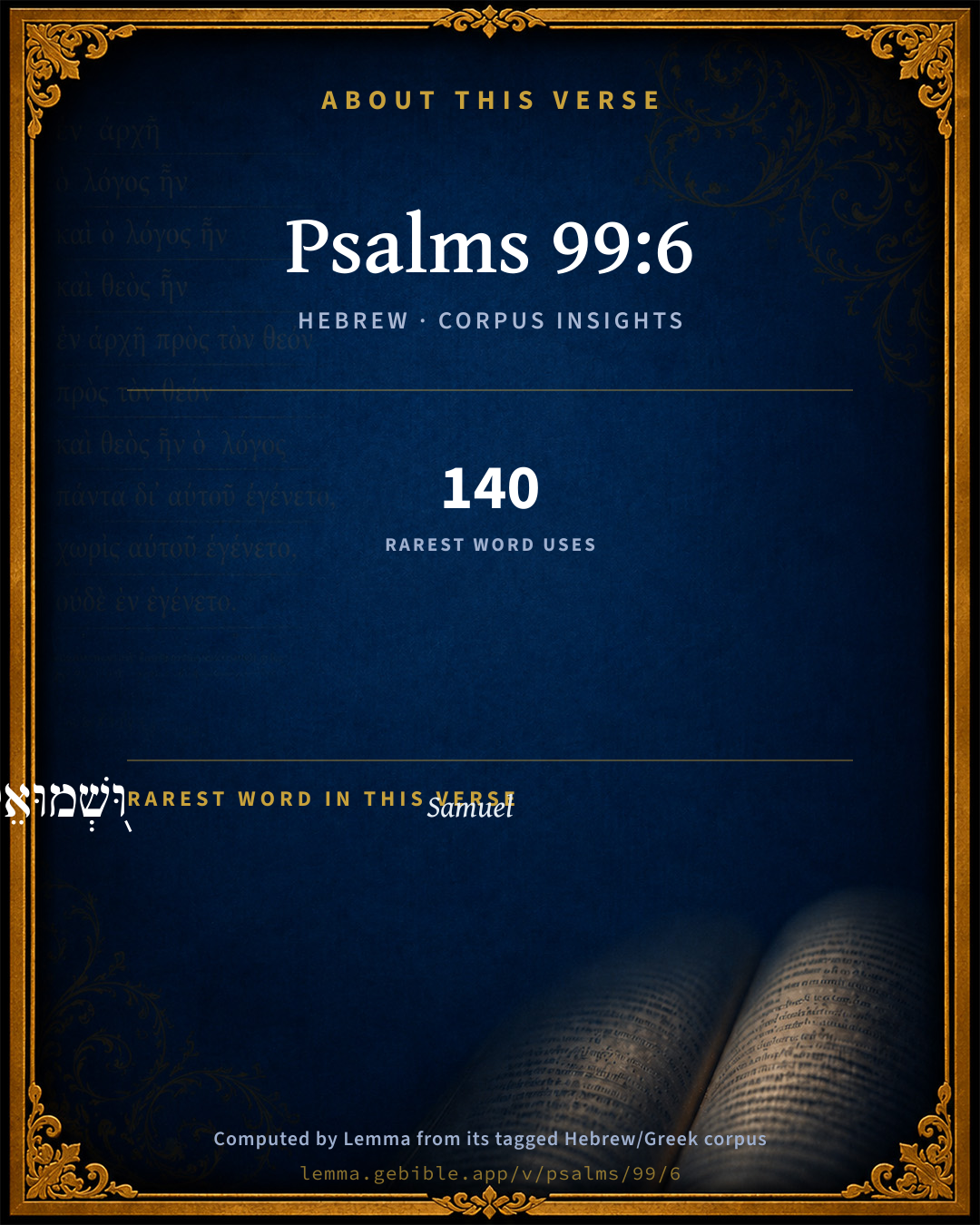
וּ֭שְׁמוּאֵל
Shᵉmûwʼêl
H8050
“and · Samuel”
Conjunction + Noun, Proper
Part of Speech
Conjunction + Noun
Type
Proper
Full BDB Definition

Origin: from the pass part of H8085 and H410

TWOT: None

Samuel = "his name is El" - son of Elkanah by his wife Hannah and judge or prophet of Israel during the days of Saul and David - son Ammihud and the prince of the tribe of Simeon who was chosen to divide the land of Canaan between the tribes. Spelled 'Shemuel' - son of Tola and grandson of Issachar. Spelled 'Shemuel'
  1. מֹ֘שֶׁ֤ה Môsheh H4872 “Moses” Noun, Proper
  2. וְאַהֲרֹ֨ן ʼAhărôwn H175 “and · Aaron” Conjunction + Noun, Proper
  3. בְּֽכֹהֲנָ֗יו kôhên H3548 “in/at · priests · his” Preposition + Noun, Common, Masculine, Plural, Construct + Suffix, Personal, 3rd Person, Masculine, Singular
  4. בְּקֹרְאֵ֣י qârâʼ H7121 “in/at · calling” Preposition + Verb, Qal, Participle Active, Masculine, Plural, Construct
  5. שְׁמ֑וֹ shêm H8034 “name · his” Noun, Common, Masculine, Singular, Construct + Suffix, Personal, 3rd Person, Masculine, Singular
  6. קֹרִ֥אים qârâʼ H7121 “calling” Verb, Qal, Participle Active, Masculine, Plural, Absolute
  7. אֶל ʼêl H413 “to” Preposition
  8. יְ֝הוָ֗ה Yᵉhôvâh H3068 “LORD” Noun, Proper
  9. וְה֣וּא hûwʼ H1931 “and · he” Conjunction + Pronoun, Personal, 3rd Person, Masculine, Singular
  10. יַעֲנֵֽם ʻânâh H6030 “to answer · them” Verb, Qal, Imperfect, 3rd Person, Masculine, Singular + Suffix, Personal, 3rd Person, Masculine, Plural

About this verse

These counts appear in no published source. They are computed here, from the morphology-tagged text and Lemma’s own curated glosses. What Lemma adds →

11
words
10
distinct lemmas
Wisdom
section

Grammatical profile

  • 3 verbs
  • 6 nouns
  • 1 pronoun
  • 1 preposition

Verb forms

  • בְּקֹרְאֵ֣י Qal · Participle Active
  • קֹרִ֥אים Qal · Participle Active
  • יַעֲנֵֽם Qal · Imperfect

Repetition

A word recurs within this verse — often emphatic in Hebrew:

  • בְּקֹרְאֵ֣י to call H7121 ×2

Hebrew & Septuagint length

In English translation the verse runs 23 words from the Hebrew and 24 from the Septuagint (LXX English) — closely comparable.

A rough comparison of the two English renderings, which tokenize alike — not a word-level alignment.

Word counts can differ between the Hebrew and the Greek without any difference in meaning — e.g. the Hebrew direct-object marker אֵת has no separate Greek word, and Greek often adds the article ὁ.

Cross-references

15

Topical passages linked to Psalms 99:6 in the Treasury of Scripture Knowledge — connected by theme and wording, ordered by reader-vote popularity; previews shown in the World English Bible.

  • Jeremiah 15:1 Then said Yahweh to me, Though Moses and Samuel stood before me, yet my mind would not be toward this people: cast them out of my sight, and let them go forth.
  • Exodus 15:25 Then he cried to Yahweh. Yahweh shown him a tree, and he threw it into the waters, and the waters were made sweet. There he made a statute and an ordinance for them, and there he tested them;
  • Exodus 24:6–8 Moses took half of the blood and put it in basins, and half of the blood he sprinkled on the altar.
  • Exodus 14:15 Yahweh said to Moses, "Why do you cry to me? Speak to the children of Israel, that they go forward.
  • 1 Samuel 7:9–12 Samuel took a sucking lamb, and offered it for a whole burnt-offering to Yahweh: and Samuel cried to Yahweh for Israel; and Yahweh answered him.
  • 1 Samuel 12:18–24 So Samuel called to Yahweh; and Yahweh sent thunder and rain that day: and all the people greatly feared Yahweh and Samuel.
  • Exodus 29:11–37 You shall kill the bull before Yahweh, at the door of the tent of meeting.
  • Exodus 32:11–14 Moses begged Yahweh his God, and said, "Yahweh, why does your wrath burn hot against your people, that you have brought forth out of the land of Egypt with great power and with a mighty hand?
  • Exodus 32:30 It happened on the next day, that Moses said to the people, "You have sinned a great sin. Now I will go up to Yahweh. Perhaps I shall make atonement for your sin."
  • Exodus 33:12–15 Moses said to Yahweh, "Behold, you tell me, 'Bring up this people:' and you haven't let me know whom you will send with me. Yet you have said, 'I know you by name, and you have also found favor in my sight.'
  • Leviticus 8:1–30 Yahweh spoke to Moses, saying,
  • Numbers 14:13–20 Moses said to Yahweh, Then the Egyptians will hear it; for you brought up this people in your might from among them;
  • Numbers 16:21–22 Separate yourselves from among this congregation, that I may consume them in a moment.
  • Numbers 16:47–48 Aaron took as Moses spoke, and ran into the midst of the assembly; and, behold, the plague was begun among the people: and he put on the incense, and made atonement for the people.
  • Exodus 40:23–29 He set the bread in order on it before Yahweh, as Yahweh commanded Moses.

Cross-references courtesy of OpenBible.info (CC BY 4.0).

Hebrew and Greek witnesses Masoretic Hebrew ↔ Greek Septuagint

The same verse in the two great witnesses to the Old Testament, shown verse-for-verse.

You’re reading Greek Psalm 98 (Hebrew Psalm 99). The Septuagint counts the superscription, so verse numbers can differ from the Hebrew — chapter-level alignment, not verse-by-verse. Numbering follows Rahlfs.

These are two independent witnesses, not word-aligned to each other, and the Septuagint is shown in lemma (dictionary) form.

Hebrew Psalms 99:6 Masoretic · Westminster Leningrad Codex

מֹ֘שֶׁ֤ה וְאַהֲרֹ֨ן בְּֽכֹהֲנָ֗יו וּ֭שְׁמוּאֵל בְּקֹרְאֵ֣י שְׁמ֑וֹ קֹרִ֥אים אֶל יְ֝הוָ֗ה וְה֣וּא יַעֲנֵֽם

Moses and Aaron were among his priests, Samuel among those who call on his name; They called on Yahweh, and he answered them.

World English Bible · Public Domain

Greek LXX Greek Psalm 98:6 Septuagint · lemma form

μωυσῆς καί ἀαρών ἐν ὁ ἱερεύς αὐτός καί σαμουήλ ἐν ὁ ἐπικαλέω ὁ ὄνομα αὐτός ἐπικαλέω ὁ κύριος καί αὐτός ἐπιἀκούω αὐτός

Moses and Aaron among his priests, and Samuel among them that call upon his name; they called upon the Lord, and he heard them.

LXX2012 (modern English Septuagint) · Public Domain

Hebrew: Westminster Leningrad Codex (CC BY 4.0). Greek: Septuagint (public domain); English from LXX2012 (modern English Septuagint) (Public Domain). How the Septuagint differs from the Hebrew →

Commentary

Notes on Psalms 99:6 from classic Christian and Jewish commentators (each source and its license shown beneath its notes). The classic Christian expositions comment on the surrounding passage and are grouped to its opening verse, so a note may address several verses; the Jewish commentaries on the Tanakh (Rashi and others) are per-verse, so they appear only where the commentator wrote on this verse.

Lemma curates 59 commentaries, every one of them public domain or Creative Commons licensed, each selected and text-cleaned for this edition rather than reprinted as found. About our sources →

Trapp's Complete Commentary

John Trapp

Psa 99:6 Moses and Aaron among his priests, and Samuel among them that call upon his name; they called upon the LORD, and he answered them.

Ver. 6. Moses and Aaron among his priests] Or chief officers, as 1Ch 18:17. Moses was, if not a priest, yet a continual intercessor for the people, and a type of Christ, the great mediator of his Church. Aben Ezra calleth him Cohen haccohanim, the priest of priests; and Philo, writing his Life, concludeth, this was the life and death of Moses the king, the lawgiver, the prophet, and the chief priest.

And Samuel] A man that could do much with God likewise, Jer 15:1, and is therefore (as some conceive) called Pethuel, that is, a persuader of God, Joe 1:1 (Alsted).

John Trapp, A Commentary or Exposition upon All the Books of the Old and New Testament (1647–1656) — public domain. Text from a community e-Sword module.

Joseph Benson's Commentary

Psa 99:6. Moses and Aaron among his priests, &c. — Or, with his princes, as the Hebrew, בכהניו, may be rendered, or his chiefs; that is, his principal and most famous ministers. Moses, however, might with propriety be ranked among the priests, because, before the institution of the priesthood, he executed that office, and because he often interceded with God for the people; which was a very considerable part of the priests’ work. And Samuel — Who used frequently and solemnly to intercede with God on behalf of the people. The meaning is, “Thus did Moses, and Aaron, and Samuel also, one of the greatest of those prophets who were wont to intercede for you.” Thus he urges them to perform the duty of praising and worshipping God, by the examples of three most eminent persons, who practised this duty with happy success.

Joseph Benson's Commentary on the Old and New Testaments (1811–1818) — public domain. Text from a community e-Sword module.

Keil & Delitzsch

C. F. Keil & F. Delitzsch

The vision of the third Sanctus looks into the history of the olden time prior to the kings. In support of the statement that Jahve is a living God, and a God who proves Himself in mercy and in judgment, the poet appeals to three heroes of the olden time, and the events recorded of them. The expression certainly sounds as though it had reference to something belonging to the present time; and Hitzig therefore believes that it must be explained of the three as heavenly intercessors, after the manner of Onias and Jeremiah in the vision 2 Macc. 15:12-14. But apart from this presupposing an active manifestation of life on the part of those who have fallen happily asleep, which is at variance with the ideas of the latest as well as of the earliest Psalms concerning the other world, this interpretation founders upon Psa 99:7, according to which a celestial discourse of God with the three "in the pillar of cloud" ought also to be supposed. The substantival clauses Psa 99:6 bear sufficient evident in themselves of being a retrospect, by which the futures that follow are stamped as being the expression of the contemporaneous past. The distribution of the predicates to the three is well conceived. Moses was also a mighty man in prayer, for with his hands uplifted for prayer he obtained the victory for his people over Amalek (Exo 17:11.), and on another occasion placed himself in the breach, and rescued them from the wrath of God and from destruction (Psa 106:23; Exo 32:30-32; cf. also Num 12:13); and Samuel, it is true, is only a Levite by descent, but by office in a time of urgent need a priest (cohen), for he sacrifices independently in places where, by reason of the absence of the holy tabernacle with the ark of the covenant, it was not lawful, according to the letter of the law, to offer sacrifices, he builds an altar in Ramah, his residence as judge, and has, in connection with the divine services on the high place (Bama) there, a more than high-priestly position, inasmuch as the people do not begin the sacrificial repasts before he has blessed the sacrifice (Sa1 9:13). But the character of a mighty man in prayer is outweighed in the case of Moses by the character of the priest; for he is, so to speak, the proto-priest of Israel, inasmuch as he twice performed priestly acts which laid as it were a foundation for all times to come, viz., the sprinkling of the blood at the ratification of the covenant under Sinai (Ex. 24), and the whole ritual which was a model for the consecrated priesthood, at the consecration of the priests (Lev. 8). It was he, too, who performed the service in the sanctuary prior to the consecration of the priests: he set the shew-bread in order, prepared the candlestick, and burnt incense upon the golden altar (Exo 40:22-27). In the case of Samuel, on the other hand, the character of the mediator in the religious services is outweighed by that of the man mighty in prayer: by prayer he obtained Israel the victory of Ebenezer over the Philistines (Sa1 7:8.), and confirmed his words of warning with the miraculous sign, that at his calling upon God it would thunder and rain in the midst of a cloudless season (Sa1 12:16, cf. Sir. 46:16f.).

The poet designedly says: Moses and Aaron were among His priests, and Samuel among His praying ones. This third twelve-line strophe holds good, not only of the three in particular, but of the twelve-tribe nation of priests and praying ones to which they belong. For Psa 99:7 cannot be meant of the three, since, with the exception of a single instance (Num 12:5), it is always Moses only, not Aaron, much less Samuel, with whom God negotiates in such a manner. אליהם refers to the whole people, which is proved by their interest in the divine revelation given by the hand of Moses out of the cloudy pillar (Exo 33:7.). Nor can Psa 99:6 therefore be understood of the three exclusively, since there is nothing to indicate the transition from them to the people: crying (קראים, syncopated like חטאים, Sa1 24:11) to Jahve, i.e., as often as they (these priests and praying ones, to whom a Moses, Aaron, and Samuel belong) cried unto Jahve, He answered them-He revealed Himself to this people who had such leaders (choragi), in the cloudy pillar, to those who kept His testimonies and the law which He gave them. A glance at Psa 99:8 shows that in Israel itself the good and the bad, good and evil, are distinguished. God answered those who could pray to Him with a claim to be answered. Psa 99:7, is, virtually at least, a relative clause, declaring the prerequisite of a prayer that may be granted. In Psa 99:8 is added the thought that the history of Israel, in the time of its redemption out of Egypt, is not less a mirror of the righteousness of God than of the pardoning grace of God. If Psa 99:7-8 are referred entirely to the three, then עלילות and נקם, referred to their sins of infirmity, appear to be too strong expressions. But to take the suffix of עלילותם objectively (ea quae in eos sunt moliti Core et socii ejus), with Symmachus (καὶ ἔκδικος ἐπὶ ταῖς ἐπηρείναις αὐτῶν) and Kimchi, as the ulciscens in omnes adinventiones eorum of the Vulgate is interpreted,

(Note: Vid., Raemdonck in his David propheta cet. 1800: in omnes injurias ipsis illatas, uti patuit in Core cet.)

is to do violence to it. The reference to the people explains it all without any constraint, and even the flight of prayer that comes in here (cf. Mic 7:18). The calling to mind of the generation of the desert, which fell short of the promise, is an earnest admonition for the generation of the present time. The God of Israel is holy in love and in wrath, as He Himself unfolds His Name in Exo 34:6-7. Hence the poet calls upon his fellow-countrymen to exalt this God, whom they may with pride call their own, i.e., to acknowledge and confess His majesty, and to fall down and worship at (ל cf. אל, Psa 5:8) the mountain of His holiness, the place of His choice and of His presence.

Keil & Delitzsch — Biblical Commentary on the Old Testament (1861–1891) — public domain (CC PDM 1.0). Text via the HelloAO Bible API. (Old Testament only.)

J. A. Alexander on Psalms

Joseph Addison Alexander

6. (Psa 99:6) Moses and Aaron among his priests, and Samuel among those calling on his name—calling to Jehovah, and he answers them. The structure of the sentence is elliptical, and may be completed either by supplying are or were before among, or by making the participle calling mean are calling, call. In explaining the sentence due regard must be had to its parallelstructure. As Moses and Aaron are evidently meant to be included among those who called upon the name of the Lord, so Samuel must be comprehended among his priests. Moses and Samuel are so described because they were theocratic mediators between God and the people, and as such performed occasionally what were strictly sacerdotal functions. See Lev 8:15-30, 1Sa 9:13. The prayers here referred to are their intercessions for the people. See Exo 18:19; Exo 32:11-30, Num 11:2; Num 14:9; Num 21:7, Deu 5:5; Deu 9:18-19, 1Sa 7:9; 1Sa 12:23, Psa 106:23. The connection of this verse with the foregoing context is obscure, but the idea seems to be, that as even the chiefs of the theocracy were under the necessity of seeking the divine favour, such prayer must, to say the least, be equally necessary in the case of others.

Joseph Addison Alexander, The Psalms Translated and Explained (1850) — public domain. Text from a community e-Sword module.

Tyndale Open Study Notes

Tyndale Open Resources

99:6-8 God showed favor by responding to his people in the past, while holding sinners accountable.

99:6 Moses and Samuel were great models and leaders who had prayed on behalf of the Lord’s people (Exod 32:31-32; 1 Sam 12:23).

Tyndale Open Study Notes — © Tyndale Open Resources, licensed CC BY-SA 4.0. Text via the HelloAO Bible API.

Geneva Bible (1599)

Geneva Bible translators

Under these three he comprehendeth the whole people of Israel, with whom God made his promise.

Geneva Bible (1599) marginal notes — public domain. Text via Bolls.life.

Matthew Henry's Commentary

The happiness of Israel in God's government is here further made out by some particular instances of his administration, especially with reference to those that were, in their day, the prime leaders and most active useful governors of that people - Moses, Aaron, and Samuel, in the two former of whom the theocracy or divine government began (for they were employed to form Israel into a people) and in the last of whom that form of government, in a great measure, ended; for when the people rejected Samuel, and urged him to resign, they are said to reject God himself, that he should not be so immediately their king as he had been (Sa1 8:7), for now they would have a king, like all the nations. Moses, as well as Aaron, is said to be among his priests, for he executed the priest's office till Aaron was settled in it and he consecrated Aaron and his sons; therefore the Jews call him the priest of the priests. Now concerning these three chief rulers observe,

I. The intimate communion they had with God, and the wonderful favour to which he admitted them. None of all the nations of the earth could produce three such men as these, that had such an intercourse with Heaven, and whom God knew by name, Exo 33:17. Here is, 1. Their gracious observance of God. No kingdom had men that honoured God as these three men of the kingdom of Israel did. They honoured him, (1.) By their prayers. Samuel, though not among his priests, yet was among those that called on his name; and for this they were all famous, They called upon the Lord; they relied not on their own wisdom or virtue, but in every emergency had recourse to God, towards him was their desire, and on him their dependence. (2.) By their obedience: They kept his testimonies, and the ordinances that he gave them; they made conscience of their duty, and in every thing made God's word and law their rule, as knowing that unless they did so they could not expect their prayers should be answered, Pro 28:9. Moses did all according to the pattern shown him; it is often repeated, According to all that God commanded Moses, so did he. Aaron and Samuel did likewise. Those were the greatest men and most honourable that were most eminent for keeping God's testimonies and conforming to the rule of his word. 2. God's gracious acceptance of them: He answered them, and granted them the things which they called upon him for. They all wonderfully prevailed with God in prayer; miracles were wrought at their special instance and request; nay, he not only condescended to do that for them which they desired, as a prince for a petitioner, but he communed with them as one friend familiarly converses with another (Psa 99:7): He spoke unto them in the cloudy pillar. He often spoke to Samuel; from his childhood the word of the Lord came to him, and, probably, sometimes he spoke to him by a bright cloud overshadowing him: however, to Moses and Aaron he often spoke out of the famous cloudy pillar, Exo 16:10; Num 12:5. Israel are now reminded of this, for the confirming of their faith, that though they had not every day such sensible tokens of God's presence as the cloudy pillar was, yet to those that were their first founders, and to him that was their great reformer, God was pleased thus to manifest himself.

II. The good offices they did to Israel. They interceded for the people, and for them also they obtained many an answer of peace. Moses stood in the gap, and Aaron between the living and the dead; and, when Israel was in distress, Samuel cried unto the Lord for them, Sa1 7:9. This is here referred to (Psa 99:8): "Thou answeredst them, O Lord our God! and, at their prayer, thou wast a God that forgavest the people they prayed for; and, though thou tookest vengeance of their inventions, yet thou didst not cut them off from being a people, as their sin deserved." "Thou wast a God that wast propitious for them (so Dr. Hammond), for their sakes, and sparedst the people at their request, even when thou wast about to take vengeance of their inventions, that is, when thy wrath was so highly provoked against them that it was just ready to break in upon them, to their utter overthrow." These were some of the many remarkable instances of God's dominion in Israel, more than in any other nation, for which the people are again called upon to praise God (Psa 99:9): "Exalt the Lord our God, on account of what he has done for us formerly, as well as of late, and worship at his holy hill of Zion, on which he has now set his temple and will shortly set his King (Psa 2:6), the former a type of the latter; there, as the centre of unity, let all God's Israel meet, with their adorations, for the Lord our God is holy, and appears so, not only in his holy law, but in his holy gospel."

Matthew Henry's Commentary on the Whole Bible (1708–1710) — public domain (CC PDM 1.0). Text via the HelloAO Bible API.

Adam Clarke's Commentary

Verse 6. Moses and Aaron] As Moses and Aaron among the priests, and as Samuel among the prophets, worshipped God in humility, gratitude, and the spirit of obedience, and received the strongest tokens of the Divine favour; so worship ye the Lord, that he may bless, support, and save you. Moses was properly the priest of the Hebrews before Aaron and his family were appointed to that office.

Adam Clarke's Commentary on the Bible (1810–1826) — public domain. Text from a community e-Sword/MySword module.

John Calvin's Commentaries

6. Moses and Aaron. The Psalmist magnifies the special grace which God in a very remarkable manner vouchsafed to the seed of Abraham, that thence he chose for himself prophets and priests to be, as it were, mediators between him and the people, to ratify the covenant of salvation. And he mentions three persons who were famous in former times. For Moses was, as it were, a mediator to reconcile the people unto God. Aaron was invested with the same office; and, subsequently, Samuel sustained the same character. There is no doubt, however, that under these three persons he included all the people with whom God had made a covenant. But he mentions the names of those who were the depositaries and guardians of this invaluable treasure. It may appear improper that he should speak of Moses as among the priests, since his sons were only among the common Levites, and that Moses himself, after the giving of the law, never held the office of high priest. But as the Hebrews call כוהנים, chohanim, those who are chief and very eminent personages, such as kings’ sons, there is nothing to prevent the prophet from giving this designation to Moses, as if he had said that he was one of the holy rulers of the Church. Moreover, if we go back to the first original — to the period prior to the publication of the law, it is certain that Moses was then invested with the high priest’s office. The design of the prophet must also be kept in mind, namely, that God not only adopted the seed of Abraham, but set apart some of them to act as mediators, whom he enjoined to call upon his name, in order that his covenant might be the more confirmed. For the invocation of which he speaks must not be understood indiscriminately of every manner of calling upon, but only of that which belongs to the priests, who were chosen by God, as intercessors to appear in his presence in the name of all the people, and to speak on their behalf.

They called upon Jehovah The Psalmist explains more fully what I have just now said, that God from the very first, and with a special reference to his gracious covenant, bestowed great benefits upon the descendants of Abraham — the Jews. And, therefore, as often as they experienced the loving-kindness of God, it behooved them to call to mind his former loving-kindness. The prophet, too, makes particular mention of the visible symbol of the cloudy pillar, by which God designed to testify in all ages that his presence was ever with his people, according as he employed temporal signs, not only for their benefit to whom they were exhibited, but also for the benefit of those who were to succeed them. Not that God always showed a cloudy pillar to his ancient people, but considering that the dullness of men is so great, that they do not perceive the presence of God unless they are put in mind by external signs, the prophet very properly reminds the Jews of this memorable token. And as God had appeared openly in the desert to their fathers, so their posterity might be well assured that he would also be near to them. He adds, that they had kept God’s testimonies, for the purpose of enforcing the duty of like obedience upon succeeding generations.

John Calvin's Commentaries (1540-1563) — public domain. Text from the Calvin Translation Society English edition (1840s-50s) via the Christian Classics Ethereal Library (ccel.org). Calvin's coverage is partial (roughly two-thirds of the Bible); uncommented books and verses are honest gaps, never fabricated. The 19th-century editor's footnotes and remarks are omitted so the notes are faithfully Calvin's own voice.

Ellicott's Commentary for English Readers

(6) Moses.—Better, a Moses and an Aaron among his friends, and a Samuel among them that call upon his name; calling upon the Lord, and he answers them; in the pillar of cloud he speaks unto them. The poet is enhancing the sacred character of the services of his own day by likening the priests and ministers to the sacred heroes of the past, as we might distinguish a period of great scientific achievement by saying, “We have a Newton or a Bacon among us.” To make it a mere historical reference, “Moses and Aaron were,” &c, would be altogether too abrupt and inaccurate, since Moses was not a khohen, nor did God speak to Samuel in the cloudy pillar. It is true that the present tense is changed in Psa_99:7 to the preterite, but it is quite natural that the psalmist should glide into the narrative style after the mention of the historical name. The Son of Sirach also makes special reference to the prayer of Samuel (Sir_46:16). Possibly, too, there is an allusion to the meaning of his name, “asked,” or “heard of God.”

A Bible Commentary for English Readers, edited by Charles John Ellicott (1878–1897) — public domain. Text from a community e-Sword module.

The Cambridge Bible for Schools and Colleges

gen. ed. J. J. S. Perowne

6. A Moses and an Aaron are among his priests,

And a Samuel among those that call upon his name:

When they call unto Jehovah, HE answereth them.

6. It was the office of the priests to intercede and mediate between God and man. This priestly function was exercised by Moses when Israel was fighting with Amalek (Exo_17:11 ff.), when they sinned by worshipping the calf (Exo_32:30 ff.; Deu_9:18 ff.), and when they murmured on the return of the spies (Num_14:13 ff.). It is to such occasions as these that the Psalmist refers, rather than to his exercise of priestly functions in the ratification of the covenant at Sinai (Exo_24:6 f.), or in the dedication of the Tabernacle (Exo_40:22 ff.), or in the consecration of Aaron and his sons (Leviticus 8). For an example of Aaron’s mediation see Num_16:46 ff. Samuel too was famous for the prevailing efficacy of his prayers. See 1Sa_7:8-9; 1Sa_12:16 ff.; and cp. Sir_46:16. In the clause when they call &c. all true Israelites seem to be included.

6–9. The holiness of Jehovah demonstrated by His dealings with Israel.

Two interpretations of these verses deserve consideration. (1) They may be understood, as in the A.V., as a historical retrospect, offered for the encouragement and warning of Israel of the restoration. Moses, Aaron, and Samuel, were prevailing intercessors in past time. God revealed Himself to His people, answering their prayers, but punishing while He pardoned, in order to demonstrate His holiness. That history, it is implied, will be repeated. God will still answer prayer, and reveal Himself to Israel; but when Israel sins and forgets that Jehovah is a Holy God, He must needs punish even when He pardons.

(2) They may however be taken to refer to the present, thus:

The Cambridge Bible for Schools and Colleges (gen. ed. J. J. S. Perowne; Cambridge University Press, 1878–1918) — public domain. Text from a community e-Sword module.

John Gill's Exposition

Moses and Aaron among his priests,.... The priests of the Lord, called and appointed by him, that ministered to him in that office, were the priests of Christ, types of him, and ceased when he came: these were the chief among them, or of them, as Kimchi observes: Moses officiated as a priest before Aaron was called and separated to that service; yea, it was he that consecrated and installed him in it, and that by offering sacrifice among other things, Exo 29:1, Num 7:1, and that Aaron was the chief of them there can be no question, seeing he was the first from whom a race of priests sprung, and who gave name to that order of priesthood which continued until the Messiah's coming:

and Samuel among them that call upon his name; these, according to Kimchi, describe the prophets, among whom Samuel was the chief; see Act 3:24 calling on the name of the Lord includes the whole worship of God, and is often used particularly of prayer; the object of which is God, and him only; and who is to be called upon at all times, and especially in a time of trouble, and always in faith, and with sincerity and truth; and an honour it is to be among such persons: now these three men, who were eminent for religion and piety, and particularly prayer, see Jer 15:1 are mentioned to animate and encourage the saints, by their example, to the worship and service of the Lord, before exhorted to: they called upon the Lord; the Lord Christ, who is the object of invocation, was so in the Old Testament dispensation, and should be so in the New; see Act 7:59. Moses called upon him, Exo 32:11; so did Aaron, Num 16:22, and also Samuel, Sa1 7:8,

and he answered them; as he does all his people, sooner or later, in one way or another; which is no small encouragement to pray unto him.

John Gill's Exposition of the Whole Bible (1746–1763) — public domain (CC PDM 1.0). Text via the HelloAO Bible API.

Albert Barnes' Notes on the Bible

Moses and Aaron among his priests - Among the ministers of religion; or, as officiating in the service of God. Let them come as representatives of their order - as representing those who conduct the public worship of God, and join in his praise. The idea is, that all mankind should join in his praise, and those mentioned here as among the most eminent of those who were engaged in directing the public worship of God. Moses could be called a “priest” only in the most general sense of the term, as having been employed in directing and arranging for public worship, and as being of the original tribe of Levi, from whom the whole sacerdotal order sprang.

And Samuel among them that call upon his name - Among those who are true worshippers, in distinction from the priests who were specially appointed to the public service of God. The idea is, that praise should be offered by “all” classes: by priests and by people. As Moses and Aaron were among the most eminent of the former class, so Samuel was among the most distinguished of those who were not of the priestly order. These were “representative men;” and the meaning is, that all who were of their order or rank - priests and people - should unite in the worship of God.

They called upon the Lord - They did call upon the Lord; they worshipped Yahweh. They gave the influence of their names and of their position to his public service. They thus showed their sense of the propriety of praising God; they gave the countenance of their example to public worship and praise; and the benefits which they received in answer to prayer showed the propriety and advantage of thus publicly acknowledging God.

And he answered them - They did not call upon him in vain. He heard their prayers. He bestowed blessings on them in connection with their worship. It was not a useless thing to praise and worship him. The worship of God is thus commended to us not merely from the propriety of the act itself, but from its advantages. It is unnecessary to refer to particular instances in the history of these people when their prayers were answered. Their lives were full of such instances - as the lives of all who truly call upon God are now. If a man who prays could “see” all that comes to him every day in answer to prayer - all the things bestowed which he had “desired” in prayer, and which would not have been conferred on him if he had not prayed, there would no longer be any doubt on the question whether God answers prayer.

Albert Barnes' Notes on the Bible (1834–1885) — public domain. Text from a community e-Sword/MySword module.

Matthew Poole's English Annotations

He presseth them to perform the duty of praising and worshipping God by the examples of three eminent persons who practised this duty, and that with happy success. He reckoneth Moses among the priests not without cause, partly because before the institution of the priesthood he executed that office, Exo 24:6; Num 7; and partly because he oft interceded to God for the people; which was a very considerable part of the priest’s work. See Num 6:23, &c.; Joe 2:17. That call upon his name; who used frequently and solemnly to intercede with God on the behalf of the people. So the general expression is here used synecdoehically for this particular kind of prayer; such synecdoches being very frequent in Scripture.

He answered them; Moses, Exo 32, and elsewhere; Aaron, Num 16; 1Sa 7:9; 12:19; compare Jer 15:1.

Matthew Poole's English Annotations on the Holy Bible (1683–1685) — public domain. Text from a community e-Sword/MySword module.

The Treasury of David

Charles H. Spurgeon

Ver. 6. Moses and Aaron among his priests, and Samuel among them that call upon his name. Though not ordained to the typical priesthood, Moses was a true priest, even as Melchizedek had been before him. God has ever had a priesthood beside and above that of the law. The three holy men here mentioned all stood in his courts, and saw his holiness, each one after his own order. Moses saw the Lord in flaming fire revealing each perfect law, Aaron full often watched the sacred fire devour the sin-offering, and Samuel witnessed the judgment of the Lord on Eli's house, because of the error of his way. These each one stood in the gap when the wrath of God broke forth, because his holiness had been insulted; and acting as intercessors, they screened the nation from the great and terrible God, who otherwise would in a dreadful manner have executed judgment in Jacob. Let these men, or such as these, lead us in our worship, and let us approach the Lord at the mercy-seat as they did, for he is as accessible to us as to them. They made it their life's business to call upon him in prayer, and by so doing brought down innumerable blessings upon themselves and others. Does not the Lord call us also to come up into the mount with Moses, and to enter the most holy place with Aaron? Do we not hear him call us by our name as he did Samuel? And do we not answer, "Speak, Lord, for thy servant heareth"?

They called upon the Lord, and he answered them. Not in vain were their prayers; but being a holy God he was true to his promises, and hearkened to them from off the mercy-seat. Here is reason for praise, for answers to the petitions of some are proofs of God's readiness to hear others. These three men asked large things, they pleaded for a whole nation, and they stayed great plagues and turned away fiery wrath; who would not exercise himself in adoring so great and merciful a God? If he were unholy he would be false to his word and refuse his people's cries; this, then, is recorded for our joy and for his glory, that holy men of old were not suffered to pray in vain.

Ver. 6. Moses and Aaron among his priests, or chief officers; as in 1Ch 18:17. Moses was, if not a priest, yet a continual intercessor for the people, and a type of Christ the great Mediator of his church. Aben-Ezra called him Cohen haccohanim, the priest of priests; and Philo, writing his life, concludeth, This was the life and death of Moses the king, the lawgiver, the prophet, and the chief priest. John Trapp.

Ver. 6. Moses twice performed acts essentially priestly (Ex 24:4-8 and Ex 40:22, compared with Le 8:1-36), at the ratification of the covenant, and at the consecration of the priests. For this reason he could the more readily be placed here among the priestly mediators. C. B. Moll.

Ver. 6. Priests. The word cohen is not confined as a title to the priests of the Levitical order, it is applied to Melchizedek and others. Moses is included among God's priests in accordance with the true idea of a priest, as being the official exponent of the divine love and mercyone who represented God though acting in the interests of man. Robert JBaker Girdlestone, in "Synonyms of the Old Testament."

Ver. 6. His priests. At the foundation of this there is another spiritual idiom, that, namely, according to which all are called priests who possess what constitutes the essence of the ordinary priestly office (although not the externals), inward connection with God, free access to the throne of grace, and the gift and power of intercessory prayer. This figurative idiom occurs even in the law itself, compare Ex 19:6, where it is said to all Israel, "Ye shall be unto me a kingdom of priests, and an holy nation." F.W. Hengstenberg.

Ver 6. Priests. The word cohen, Priest, is from cahan, to plead a cause, as an intercessor, mediator, or advocate; hence the strict propriety of its use here in reference to Moses. C. H. S.

Ver. 6. They that call upon his name. The Hebrew word which we translate to call upon God, notes a sort of men whose chief business or trade was to call upon or invocate the name of God, and in this instance it implies that it was the special calling of these men to call upon God. Joseph Caryl.

Ver. 6-9. This third strophe is in reality a prophetical picture of the future holy worship of God, in which Moses, Aaron, and Samuel appear as the living representatives of the redeemed church, like the four and twenty elders in the more fully developed Apocalyptic scene of St. John. Revelation 5. Joseph Francis Thrupp.

Ver. 6-7.

1. Prayer offered. Moses the prophet, Aaron the priest, Samuel the ruler, "They called, "&c.

2. Prayer answered. "He answered them, ""he spake, "&c.

3. Prayer vindicated. They kept the other testimonies, &c. G. R.

Psalms 99:7*

Charles H. Spurgeon's The Treasury of David (1869–1885) — public domain. Psalms only. Text from a community e-Sword/MySword module.

Whedon's Commentary on the Bible

Daniel D. Whedon

6. Moses and Aaron… Samuel—Three leading representatives of the old dispensation.

Among his priests—Not the only ones, but the most illustrious specimens of the class, as the preposition among, or with, denotes. The word כהן, (kohehn,) priest, seems here to be used in a broader sense than usual, to denote a prince, or chief. In 2Sa_8:18 the word means chief ruler, prince; and in 1Ch_18:17, it is explained by substituting another word, which also means first, or chief, minister. The same use of the word is seen in 2Sa_20:26, and elsewhere. Moses and Samuel, though of supreme civil dignity, were of the Levitical order, as well as Aaron, and on different occasions performed the functions of the priesthood in mediation, sacrifice, and purification of the people. See Exo_17:15; Exo_24:7-8; Lev_8:15-30; 1Sa_9:13; 1Sa_16:2-5. Their history is here cited to encourage prayer and trust in God, who, through these same means, would now, as of old, work salvation for his people. Particularly is this recital made to encourage faith in their leaders as God’s representatives.

Daniel D. Whedon (gen. ed.), Commentary on the Old and New Testaments (1874–1909) — public domain. Text from a community e-Sword module.

The Pulpit Commentary

Moses and Aaron among his priests. Moses, though not called a priest in the Pentateuch, performed many priestly acts, such as sprinkling the blood of the covenant at Mount Sinai, (Exo_24:6-8) setting in order the tabernacle, (Exo_40:18-33) consecrating Aaron and his sons, (Lev_8:6-30) interceding for the people, (Exo_32:30-32 Num_14:13-19) etc. He is therefore, not improperly, here included among God"s priests. And Samuel among them that call upon his Name. Samuel was not a priest, but a simple Levite. (1Ch_6:16-28) He was, however, a powerful intercessor with God, a righteous man whose effectual fervent prayer availed much. He is united with Moses by Jeremiah, as having weight with God through his prayers. (Jer_15:1; see also 1Sa_12:19-22) They called upon the Lord, and he answered them. (see Deu_11:19 Deu_10:10 1Sa_12:17, etc.)

Samuel.

The venerable figure of Samuel forms the living link between two great and very diverse stages in the history of ancient Israel. He was the last of the judges, (Act_13:29) he was the first of the prophets. (Act_3:24) Not that there were no prophets between Moses and Samuel, (Jud_1:4:4 1Sa_2:27) but from his time the prophetic gift and office took that leading place which belonged to it down to the days of Malachi. As judge, Samuel"s administration brought to a close the period of anarchy recorded in the Book of Judges; as prophet, he was commissioned to choose and anoint the first King of Israel; and, on Saul"s proving himself utterly unable to understand his position as the Lord"s servant, and thus unfit to reign, to declare his deposition, to anoint David, and probably to train him for his high office, and to promise to the seed of David an eternal throne and kingdom. The life and character of Samuel present at least three grand lessons and lines of thought (to be treated in different discourses).

I SAMUEL AN EXAMPLE OF A CONSECRATED LIFE. A consecrated childhood the preparation for one of the noblest, purest, grandest, and most useful lives history records. When we think of Samuel, the image that most naturally rises to our view (as Dean Stanley observes) is not of the aged ruler and seer, with his unshorn grey locks on his shoulders, (1Sa_1:11 1Sa_12:2) but of "the child Samuel". (1Sa_1:27, 28 2:11, 18, 21 3:1-10, 19) Excepting the holy Child Jesus, there is none other in Scripture whose childhood and early piety, consecration, and inspiration are thus prominently recorded. The whole life is of a piece. "Wild excesses in youth are often followed by energy, by zeal, by devotion. We read it in the examples of Augustine, of Loyola, of John Newton... But it is no less certain that they are rarely, very rarely, followed by moderation, by calmness, by impartial wisdom... whatever else is gained by sudden and violent conversions, this is lost. Whatever else, on the other hand, is lost by the experience of evil, by the calm and even life that needs no repentance, this is gained .... Samuel is the chief type, in ecclesiastical history, of quiet growth, of a new creation without conversion" (Stanley"s "History of the Jewish Church," 1:364, 365). To such a childhood, the keynote of which was "Speak, Lord; for thy servant heareth," the grey-headed saint could look back in his public appeal to the nation. (1Sa_12:2-5) Seldom has so great a life been so blameless. This view of Samuel"s life and character appeals:

1. To the young. You may neglect or throw off the fear and love of God, faith and prayer and duty, and yet be converted and saved, like the poor prodigal; but you will have flung away life"s morning, robbed God of the firstfruits of life, forfeited the honour and happiness that crown a consecrated life, and the right to say with St. Paul, Act_23:1 Act_24:16 Act_26:4, 5 2Ti_1:3.

2. To parents. Samuel was consecrated to God by his mother"s faith and prayers before he had any knowledge or choice.

3. To teachers of the young. The teacher who has trained one Samuel has richer reward and higher honour than one who has crammed a hundred prize winners.

II SAMUEL AN EXAMPLE OF THE POWER OF PRAYER. His name, "Heard of God" (q.d. granted in answer to prayer), was the memorial of his mother"s brokenhearted supplications. (1Sa_1:11, 1Sa_1:26, 1Sa_1:27) The first thing recorded of his childhood is that he "worshipped the Lord", (1Sa_1:28) "ministered to the Lord". (1Sa_2:11, 18 3:1)

His brief prayer (most of the mightiest recorded prayers are brief), "Speak; for thy servant heareth", (Ps 3) contains the very concentrated spirit of prayer, the open ear of faith, the loving heart of obedience. Therefore it is not wonderful that Samuel"s prayers had great power. (1Sa_7:8, 9 12:17, 18, 19, 23) Prayer was his refuge in trouble. (1Sa_8:6 1Sa_15:11) The text specially commemorates him "among them that call upon his Name." The truth of the necessity, duty, and value of prayer, and of the fact that God does indeed answer prayer, is one in which the teaching of the Old and New Testament Scriptures is most completely and emphatically one. The Christian could not afford to dispense with this witness loses much if he does not constantly feed his faith on it. Promises of prayer, and commands to pray, are even fuller and more emphatic (if possible) in the New Testament; but the Old Testament backs these up with the experience of two thousand years; and nearly two thousand years more have supplemented this experience, and tested and verified these promises. If there is a truth verified by human experience, it is this that God hears prayer. (Joh_16:23, 24 Jam_5:16)

III THE RELATION OF RELIGION TO NATIONAL LIFE. Christians make a tremendous mistake when they suppose they may neglect the Old Testament Scriptures. The New Testament Scriptures unfold a fuller gospel, richer promises, a clearer manifestation of Divine love, a world embracing message. But in the history of ancient Israel lessons were taught, experiments made, problems solved for the Church and for mankind in all ages. God will not either repeat or unteach them. Woe to us if we despise them, especially in an age in which the Christian Church is so loudly called to face the social, national, and international problems of today!

1. National life and well being need religion as their only secure foundation. Samuel, as prophet judge, not a military leader, like Othniel or Gideon, but a judge because he was a prophet, represented God in relation to Israel, and Israel in relation to God. (see 1Sa_7:2-15) All the miseries which befell Israel during the centuries from Joshua to Samuel were from one cause their provoking the Lord. When deliverance followed repentance, the monument set up was not a military trophy of their prowess, but a religious memorial. (1Sa_7:12) The special relation of Israel to God, constituted at Sinai, was doubtless unique, but the underlying principles are good for all time, all nations. (Pro_14:34) Life, private or public, is alone securely founded on truth. Righteousnessq.d. justice, good faith, temperance, purity, doing as you would be done by, this is the sure basis of national well being. And the only safeguard is true religion.

2. Yet Law is impotent to maintain true religion or spiritual life. The experiment (we may with reverence say) was bound to be tried. A universal religious society, like the Christian Church, was in earlier ages alike inconceivable and impossible. The national form of the Church was the only practicable. The history of Israel is the history of the failure of this experiment.

(1) First, the people themselves were tried. Endowed with laws they could neither repeal nor improve, sanctioned by God himself; with tribal and municipal magistrates, partly elective, partly hereditary; with an elaborate system of public religion, and careful provision for home education and public teaching; and with a perfect laud system, Israel was placed in uniquely favourable circumstances. The Book of Judges is the record of their trial, during some four centuries, and utter failure.

(2) Next, at the nation"s own wish, kings were tried for some five hundred years. A few splendid examples showed what good a wise, strong, pious ruler might effect if he understood his position as the servant of Jehovah and the father and yet brother of his subjects. But on the whole, national failure was yet more shameful, ending in the Babylonian captivity. Samuel"s life forms the link between these two stages. Remarkable that priestly government was guarded against by special fundamental laws the denial to Levi of any inheritance, and dispersion of the sacerdotal tribe throughout Israel. Samuel was a Levite, but the only priest judge, Eli, was a sad failure.

(3) Lastly, after the Captivity, came the rule of the teachers scribes and rabbis or, as we should say, clergy and universities, with an episode of priestly sovereignty under the Maccabees. The Gospels describe the utter and woeful failure of this last stage. (see Mt 23, and parallel passages; Gal_3:21)

3. Where the Law failed, what can the gospel do for national life? Christianity brought to an end the national pre-eminence of Israel, putting all nations on a level; but much more substituting, as the supreme rule of life, for public law personal obedience to Christ. (Isa_44:3-5 Heb_8:7-13) There are four possible relations of the Church to the State.

(1) Identical, as in Israel.

(2) The Church ruling the State, which is the theory of Rome.

(3) The State ruling the Church, which has been tried in various forms from Constantine"s days.

(4) The pervading influence of the Church as a spiritual community in the persons and lives of its members, moulding and inspiring legislation, policy, manners, business, and every form of public and social life. (Isa_60:21 Rev_11:15)

Model worshippers.

The reason for recalling these three worshippers belonging to the olden times, and these three only, does not immediately appear. And it is singular to find both Moses and Aaron classed as priests. Probably, before the appointment of the Levitical priesthood, Moses had been the priest as well as leader of the people. The thought appears to be that men may now call upon and worship God with the assured confidence that he receives worship and answers prayers even as he has always done. As specimens of God"s ways with his people who seek him, Moses and Aaron are brought as types of those who offer worship; and Samuel is brought as a type of those who present supplications. So the two sides of worship are presented, praise and prayer.

I MOSES AND AARON THE MODELS OF WORSHIP AS PRAISE. This is the Godward side of worship. It is knowing God, offering God his due, recognizing the Divine mercies and judgments, making offerings due unto his Name. And Moses and Aaron represent worship as presented in God"s own appointed way, in the line of his own arrangements. This brings in the element of obedience, and every true act of worship is an act of obedience, and an expression of the spirit of obedience. Worship may be wholly praise, and God says, "Whoso offereth praise glorifieth me." From the worship system of Moses and Aaron, show what are the essential elements of all acceptable worship, such as adoration, thanksgiving, confessions, and expressions of dependence. Symbolic rites only belong to particular times and people, but the spirit which the rites symbolize is required in every age and of every people. The underlying spirit of Mosaism is the spirit of all true and acceptable worship today.

II SAMUEL THE MODEL OF WORSHIP AS PRAYER. Probably Samuel is chosen because prayer was recognized as the most marked peculiarity of his life. He would spend nights in prayer. He seems to have had a peculiar cry, or scream, in prayer. Now, prayer is not essential to all worship; but prayer is true worship, because the act and expression of dependence on God is one of our best ways of doing honour to his Name. So the model worship is a holy blending of praise and prayer. R.T.

The Pulpit Commentary (1880–1919), ed. H.D.M. Spence-Jones & Joseph S. Exell — public domain. Text from a community e-Sword module.

John Wesley's Explanatory Notes

Moses - Moses before the institution of the priesthood executed that office, Exod. xxiv, 6. That call - Who used frequently and solemnly to intercede with God on the behalf of the people.

John Wesley, Explanatory Notes Upon the Whole Bible (1754–1765) — public domain. Text via the GEBible commentary corpus.

unfoldingWord translationNotes

Door43 World Missions Community

solemn

important, given seriously

translationWords

Moses

Aaron

priest

Samuel

pray

column

command

statute

unfoldingWord translationNotes — © Distant Shores Media and the Door43 World Missions Community, licensed CC BY-SA 4.0. Source: git.door43.org/Door43/en_tn.

Lesson kit

Teaching starters — assembled from the data on this page, not authored interpretation. Every prompt links to the verse data it draws on. Edit before teaching.

Psalms, in the Wisdom, opens this verse with 11 words (10 distinct Hebrew lemmas). Its most distinctive word is Shᵉmûwʼêl (“Samuel”). A historical commentator’s framing appears above. Read the whole chapter for the surrounding context.

Discussion questions

  1. The word Shᵉmûwʼêl carries the sense “Samuel.” How does it shape the verse?
  2. Jeremiah 15:1 shares this passage’s theme. How do the two illuminate each other?
  3. “to call” occurs 2× in this one verse. What is the effect of the repetition?
  4. These translations render this verse differently; the difference is in the English rendering, not the original. What questions does that raise?
  5. The verb «בְּקֹרְאֵ֣י» is Qal Participle Active. How does its form color the action?
  6. Reading how Trapp's Complete Commentary and Joseph Benson's Commentary read this verse, where do the two commentators agree and where do they part?

Things to notice

Reading settings

Reading text

Shown beneath each verse's original-language words.

Old Testament
Old Testament edition

Read the OT as the Masoretic Hebrew (MT) or the Greek Septuagint (LXX).

English shown for the Greek Septuagint (in the Hebrew ↔ Greek comparison).

Comparing translations? Open the Compare panel on any verse page to stack up to four side by side.