
1 Samuel 11:14

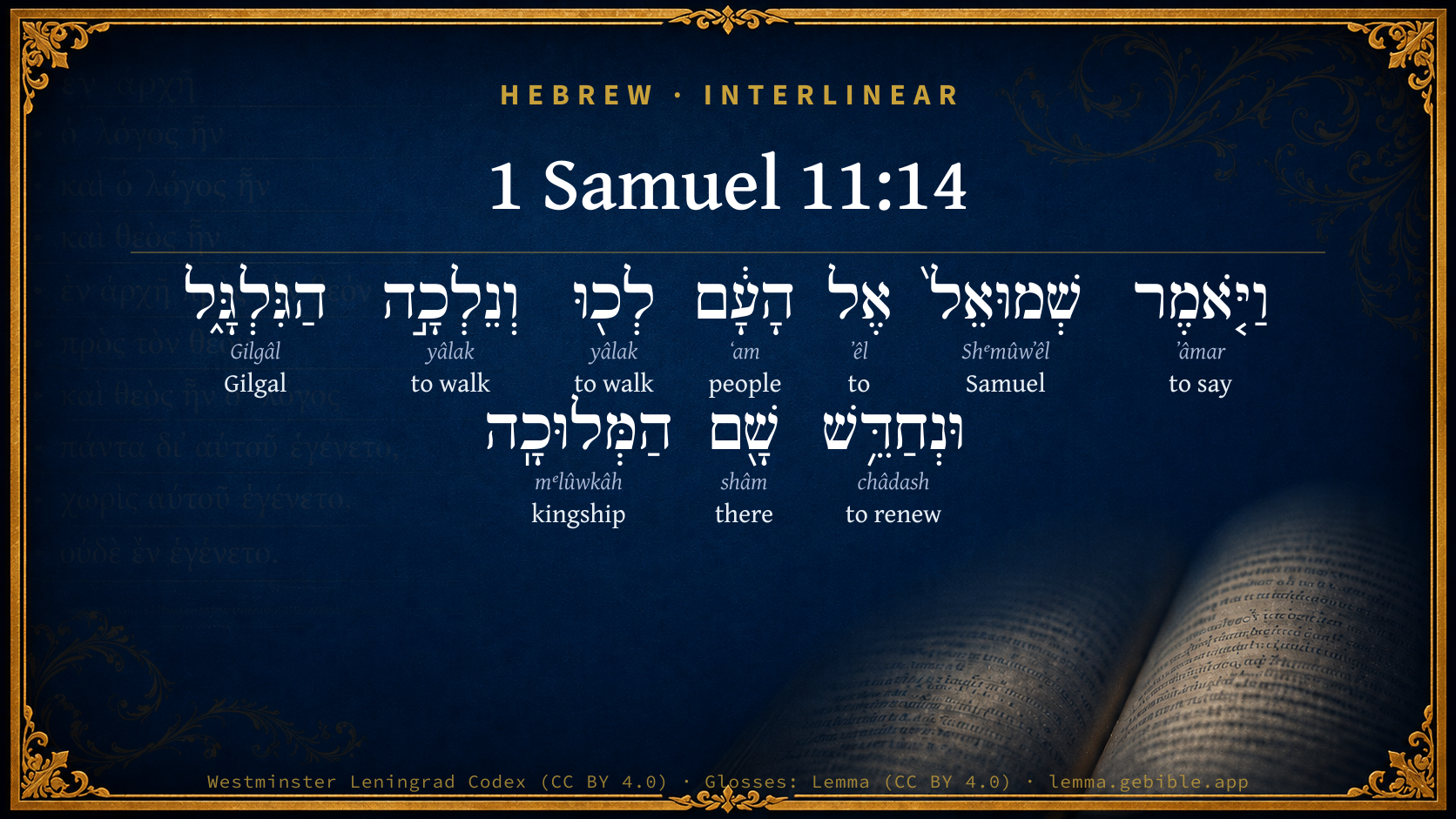
Hebrew (Westminster Leningrad Codex) 1 Samuel 11:14 appears in the Hebrew Old Testament. The text above is from the Westminster Leningrad Codex. Each word links to its Strong’s number, a concise gloss, and parsing drawn from the Open Scriptures Hebrew Bible morphology. Click any word for its full Brown-Driver-Briggs (BDB) entry.
Download image
Cite this verse

1 Samuel 11:14 (World English Bible). Public Domain. Lemma interlinear Bible study tool, https://lemma.gebible.app/v/1-samuel/11/14.

Show BibTeX & RIS
BibTeX
RIS
English Translation
Then said Samuel to the people, Come, and let us go to Gilgal, and renew the kingdom there.
World English Bible · Public Domain
Highlights
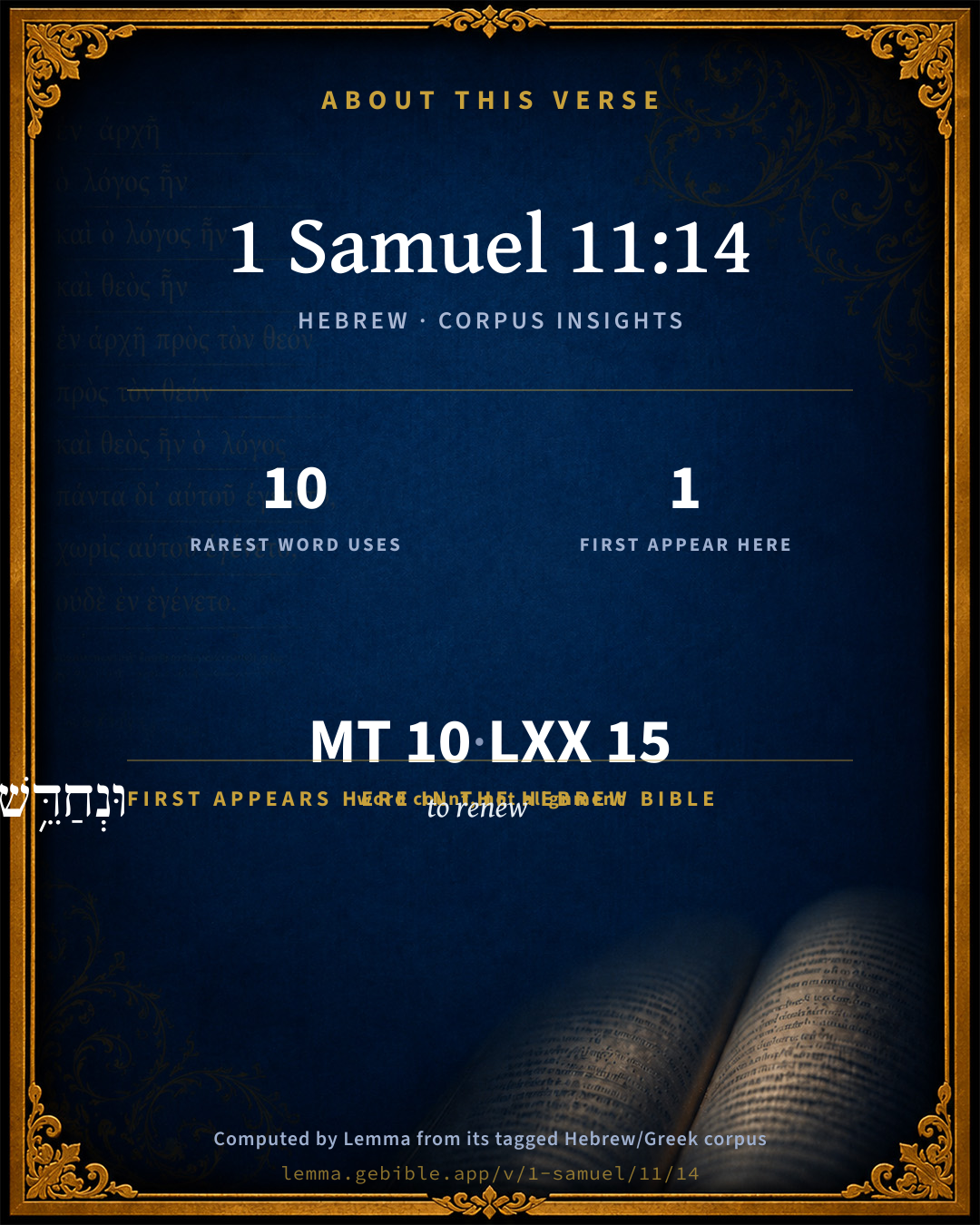
  • 1 first appearance in the Hebrew Bible
Full analysis ↓
Download a study sheet

One document with this verse’s original text, its word-by-word gloss line, the meaning frame, cross-references with their text, attributed commentary, and full source and license credits — printable, and it pastes into notes with its structure intact.

This verse Autodidact and up

Study sheet (.html) Plain text (.txt)

A passage Seminary Student

Up to 50 verses in one chapter. A passage sheet keeps up to 6 commentary sources and 12 cross-references per verse, in the order this page ranks them, and says so on the sheet whenever that leaves anything out. Ask for a single verse and you get the Autodidact verse sheet above.

Everything on this page stays free to read, with no account — the sheet is a download of what is already on screen, not access to it.

Want to remove ads? Support Godless Engineer
Compare translations 3

The same verse in 3 English versions, stacked beneath the original-language interlinear above. Click any original word for its lexicon entry.

Each is an independent rendering of the whole verse — the interlinear is not word-aligned to these translations.

Highlighted words mark where these versions differ — a whole-verse word diff, not a word-by-word alignment.

  • World English Bible Public Domain
    Then said Samuel to the people, Come, and let us go to Gilgal, and renew the kingdom there.
  • King James Version Public Domain
    Then said Samuel to the people, Come, and let us go to Gilgal, and renew the kingdom there.
  • unfoldingWord Literal Text CC BY-SA 4.0
    And Samuel said to the people, “Come, and let us go Gilgal, and let us renew the kingship there.”

unfoldingWord Literal Text — © unfoldingWord, licensed CC BY-SA 4.0. Word-aligned USFM3 via Door43 (git.door43.org/unfoldingWord/en_ult).

Versions to compare (up to 4)

3 of 4 selected

Show all 18 translations

Every available English version of this verse, each an independent rendering of the whole verse.

  • World English Bible Public Domain
    Then said Samuel to the people, Come, and let us go to Gilgal, and renew the kingdom there.
  • Berean Standard Bible Public Domain
    Then Samuel said to the people, “Come, let us go to Gilgal and renew the kingship there.”
  • Majority Standard Bible Public Domain
    Then Samuel said to the people, “Come, let us go to Gilgal and renew the kingship there.”
  • King James Version Public Domain
    Then said Samuel to the people, Come, and let us go to Gilgal, and renew the kingdom there.
  • American Standard Version (1901) Public Domain
    Then said Samuel to the people, Come, and let us go to Gilgal, and renew the kingdom there.
  • Revised Version (1885) Public Domain
    Then said Samuel to the people, Come and let us go to Gilgal, and renew the kingdom there.
  • Geneva Bible (1599) Public Domain
    Then saide Samuel vnto ye people, Come, that we may goe to Gilgal, and renue the kingdome there.
  • Douay-Rheims (1899) Public Domain
    And Samuel said to the people: Come and let us go to Galgal, and let us renew the kingdom there.
  • Young's Literal Translation Public Domain
    And Samuel saith unto the people, `Come and we go to Gilgal, and renew the kingdom there;'
  • Literal Standard Version CC BY-SA 4.0
    And Samuel says to the people, “Come and we go to Gilgal, and renew the kingdom there”;
  • Unlocked Literal Bible CC BY-SA 4.0
    Then Samuel said to the people, “Come, let us go to Gilgal and renew the monarchy there.”
  • unfoldingWord Literal Text CC BY-SA 4.0
    And Samuel said to the people, “Come, and let us go Gilgal, and let us renew the kingship there.”
  • Darby Bible Public Domain
    And Samuel said to the people, Come and let us go to Gilgal, and renew the kingdom there.
  • World Messianic Bible Public Domain
    Then Samuel said to the people, “Come! Let’s go to Gilgal, and renew the kingdom there.”
  • Webster's Bible Public Domain
    Then said Samuel to the people, Come, and let us go to Gilgal, and renew the kingdom there.
  • Free Bible Version CC BY-SA 4.0
    Then Samuel said to the people, “Come with me—let's go to Gilgal and renew the kingdom.”
  • Bible in Basic English Public Domain
    Then Samuel said to the people, Come, let us go to Gilgal and there make the kingdom strong in the hands of Saul.
  • JPS Tanakh (1917) Public Domain
    Then said Samuel to the people: 'Come and let us go to Gilgal, and renew the kingdom there.'

Literal Standard Version (2020), Covenant Press — licensed CC BY-SA 4.0. Text via the HelloAO Bible API (eBible.org). Unlocked Literal Bible (unfoldingWord) — licensed CC BY-SA 4.0. Text via the HelloAO Bible API (eBible.org). unfoldingWord Literal Text — © unfoldingWord, licensed CC BY-SA 4.0. Word-aligned USFM3 via Door43 (git.door43.org/unfoldingWord/en_ult). Free Bible Version, Dr. Jonathan Gallagher — licensed CC BY-SA 4.0. Text via the HelloAO Bible API (eBible.org).

Word by word

More ways to search: Search by grammar → Find every occurrence → Compare this word →

Practice this passage: Drill this verse → Learn its vocabulary →

וּנְחַדֵּ֥שׁ
châdash
H2318
“and · to renew”
Conjunction + Verb, Piel, Cohortative, 1st Person, Common, Plural
Part of Speech
Conjunction + Verb
Stem
Piel
Form
Cohortative
Person
1st Person
Gender
Common
Number
Plural
Full BDB Definition

Origin: a primitive root

TWOT: 613

to be new, renew, repair - (Piel) - to renew, make anew - to repair - (Hithpael) to renew oneself
  1. וַיֹּ֤אמֶר ʼâmar H559 “and · to say” Conjunction + Verb, Qal, Sequential Imperfect, 3rd Person, Masculine, Singular
  2. שְׁמוּאֵל֙ Shᵉmûwʼêl H8050 “Samuel” Noun, Proper
  3. אֶל ʼêl H413 “to” Preposition
  4. הָעָ֔ם ʻam H5971 “the · people” Particle, Definite Article + Noun, Common, Masculine, Singular, Absolute
  5. לְכ֖וּ yâlak H3212 “walk” Verb, Qal, Imperative, 2nd Person, Masculine, Plural
  6. וְנֵלְכָ֣ה yâlak H3212 “and · to walk” Conjunction + Verb, Qal, Cohortative, 1st Person, Common, Plural
  7. הַגִּלְגָּ֑ל Gilgâl H1537 “the · Gilgal” Particle, Definite Article + Noun, Proper
  8. שָׁ֖ם shâm H8033 “there” Adverb
  9. הַמְּלוּכָֽה mᵉlûwkâh H4410 “the · kingship” Particle, Definite Article + Noun, Common, Feminine, Singular, Absolute

About this verse

These counts appear in no published source. They are computed here, from the morphology-tagged text and Lemma’s own curated glosses. What Lemma adds →

10
words
9
distinct lemmas
Historical
section

Notable vocabulary

The rarest word here is וּנְחַדֵּ֥שׁ to renew H2318 — appearing just 10 times in the whole Hebrew Bible.

First appearance in Scripture

This word makes its first canonical appearance in the Hebrew Bible here:

  • וּנְחַדֵּ֥שׁ to renew H2318

Shared distinctive vocabulary

וּנְחַדֵּ֥שׁ to renew H2318 occurs in 10 verses of the Hebrew Bible. Also found in:

Grammatical profile

  • 4 verbs
  • 4 nouns
  • 1 preposition
  • 1 adverb

Verb forms

  • וַיֹּ֤אמֶר Qal · Sequential Imperfect
  • לְכ֖וּ Qal · Imperative
  • וְנֵלְכָ֣ה Qal · Cohortative
  • וּנְחַדֵּ֥שׁ Piel · Cohortative

Repetition

A word recurs within this verse — often emphatic in Hebrew:

  • לְכ֖וּ to walk H3212 ×2

Hebrew & Septuagint length

In English translation the verse runs 18 words from the Hebrew and 17 from the Septuagint (LXX English) — closely comparable.

A rough comparison of the two English renderings, which tokenize alike — not a word-level alignment.

Word counts can differ between the Hebrew and the Greek without any difference in meaning — e.g. the Hebrew direct-object marker אֵת has no separate Greek word, and Greek often adds the article ὁ.

In the original languages it is 10 Hebrew tokens and 15 Greek tokens — but the two are counted differently (Hebrew bundles its prefixes and suffixes into one token; the Greek is in lemma form), so that isn’t a like-for-like length.

Cross-references

5

Topical passages linked to 1 Samuel 11:14 in the Treasury of Scripture Knowledge — connected by theme and wording, ordered by reader-vote popularity; previews shown in the World English Bible.

  • 1 Samuel 10:8 You shall go down before me to Gilgal; and, behold, I will come down to you, to offer burnt offerings, and to sacrifice sacrifices of peace-offerings: seven days shall you wait, until I come to you, and show you what you shall do.
  • 1 Samuel 7:16 He went from year to year in circuit to Bethel and Gilgal, and Mizpah; and he judged Israel in all those places.
  • 1 Samuel 5:3 When they of Ashdod arose early on the next day, behold, Dagon was fallen on his face to the ground before the ark of Yahweh. They took Dagon, and set him in his place again.
  • 1 Samuel 10:24–25 Samuel said to all the people, "You see him whom Yahweh has chosen, that there is none like him among all the people?" All the people shouted, and said, [Long] live the king.
  • 1 Chronicles 12:38–39 All these being men of war, who could order the battle array, came with a perfect heart to Hebron, to make David king over all Israel: and all the rest also of Israel were of one heart to make David king.

Cross-references courtesy of OpenBible.info (CC BY 4.0).

Hebrew and Greek witnesses Masoretic Hebrew ↔ Greek Septuagint

The same verse in the two great witnesses to the Old Testament, shown verse-for-verse.

These are two independent witnesses, not word-aligned to each other, and the Septuagint is shown in lemma (dictionary) form.

Hebrew 1 Samuel 11:14 Masoretic · Westminster Leningrad Codex

וַיֹּ֤אמֶר שְׁמוּאֵל֙ אֶל הָעָ֔ם לְכ֖וּ וְנֵלְכָ֣ה הַגִּלְגָּ֑ל וּנְחַדֵּ֥שׁ שָׁ֖ם הַמְּלוּכָֽה

Then said Samuel to the people, Come, and let us go to Gilgal, and renew the kingdom there.

World English Bible · Public Domain

Greek LXX 1 Samuel 11:14 Septuagint · lemma form

καί εἶπον σαμουηλ πρός ὁ λαός λέγω πορεύομαι εἰς γάλγαλα καί ἐνκαινίζω ἐκεῖ ὁ βασιλεία

And Samuel spoke to the people, saying, Let us go to Galgala, and there renew the kingdom.

LXX2012 (modern English Septuagint) · Public Domain

On this verse, John Gill's Exposition discusses the Septuagint’s reading. Read the note in Commentary ↓

Hebrew: Westminster Leningrad Codex (CC BY 4.0). Greek: Septuagint (public domain); English from LXX2012 (modern English Septuagint) (Public Domain). How the Septuagint differs from the Hebrew →

Targum (Aramaic paraphrase)

1

The Targum is the ancient Jewish Aramaic paraphrase of the Hebrew Scriptures — an interpretive translation, not the Hebrew text itself. Onkelos (literal) and Pseudo-Jonathan (expansive) render the Torah, and Jonathan the Prophets. Coverage is partial: where no permissively-licensed English translation exists for a verse, only the Aramaic is shown. This is verse-level text, not a word-by-word alignment to the Hebrew.

  1. Targum Jonathan Prophets (Joshua–Malachi)
    וַאֲמַר שְׁמוּאֵל לְעַמָא אִיתוּ וְנֵזִיל לְגִלְגָלָא וּנְחַדַת תַּמָן מַלְכוּתָא:

    (no public-domain English translation for this verse)

    Targum Jonathan — Aramaic: “Mikraot Gedolot” (public domain). English: “Sefaria Community Translation” (CC0 1.0 (public-domain dedication)); “London "Chaldee Paraphrase," 1871” (public domain). Text via Sefaria.

Commentary

Notes on 1 Samuel 11:14 from classic Christian and Jewish commentators (each source and its license shown beneath its notes). The classic Christian expositions comment on the surrounding passage and are grouped to its opening verse, so a note may address several verses; the Jewish commentaries on the Tanakh (Rashi and others) are per-verse, so they appear only where the commentator wrote on this verse.

Lemma curates 59 commentaries, every one of them public domain or Creative Commons licensed, each selected and text-cleaned for this edition rather than reprinted as found. About our sources →

Trapp's Complete Commentary

John Trapp

1Sa 11:14 Then said Samuel to the people, Come, and let us go to Gilgal, and renew the kingdom there.

Ver. 14. And renew the kingdom there,] i.e., The covenant of the kingdom between the new king and his people, for the preventing of future rebellion.

John Trapp, A Commentary or Exposition upon All the Books of the Old and New Testament (1647–1656) — public domain. Text from a community e-Sword module.

The Biblical Illustrator

Joseph S. Exell

1Sa_11:14-15

Come and let us go to Gilgal and renew the kingdom there.

The renewing of the kingdom!

Gilgal! The word means a wheel, a revolution. And is not the great circumference of the year, measured as it is by a few hundred days in the poor chronicle of our lives, but by hundreds of millions of miles in the celestial spaces--is it not just rounding up into longer light, and beginning its benevolent motion for us afresh? We hear, too, of the renewing of a kingdom; and those words impress us at once with some idea, though it may be an indistinct one, of a renewal nearer home, that we are to solemnize; more important to us than the sweep of an unconscious planet, than the changes of empire past or to come, or any of the outward distinctions of the world. The shadows of the future gathered over Samuels serene brow and his religious spirit; and he replied in the words that I have read: Come, and let us go to Gilgal, and renew the kingdom there. That had been a hallowed place from the time that the Hebrew tribes entered the land. It had been consecrated by religion and good success. There was the proper spot to repeat their vows, to remember their obligations. It was aloof from public clamour and the highways of ordinary life. There, where the Almighty bad rolled away the reproach of His people, in the time when He alone was acknowledged as their sovereign, should they repeat their allegiance to the new monarch whom they had chosen. There, in the face of that dread majesty, soberly and apart, and not in the stir of a sudden triumph, and not among the scenes of everyday passions, they should renew the kingdom. Let the engagements that are made with a mans self be now established. Let the hopes of a Christian soul receive an increasing lustre. Let the pledges you owe to the powers of heaven be cheerfully brought.

I. We may observe, in the first place, that we are now renewing the kingdom of our earthly days. The year is renewed for us. The light is a little earlier in the eastern sky, and lingers a little upon its farewell in the west as if nature was unwilling to bring two of its greatest dreads upon man at once--at least in their fullest degree--the darkness gives way as the cold increases. A new account is opening with Time, that rigorous master. But bow, you may ask, can we make any compact with him? He calls all seasons and places and lives his own. His dominion is absolute. He accepts no conditions from us. Without asking whether or not we are ready to confirm his authority, he will lead us through his inevitable changes, he will bring us down to his universal level of dust. And yet, when we confront him, with God to help, and in the holy places of our nature, we feel that we are possessed of a dominion more enduring than his own; that we have thoughts which are independent of him, and hopes beyond his reach. We can oblige him to serve our best interests, which we are apparently but the subjects of his despotic rule. We are apt to consider him as a tyrant, the enemy of human liberty and enjoyment, inaccessible to pity, and producing but what he means to desolate. His symbol is the falling sands of an hourglass. His crown is an eternal baldness. His sceptre is a scythe for all the green growths of mortality. But we are thus paralysing our proper strength, and undervaluing our real importance in the comparison with him. What has Time to do with any of the conclusions of the reason, or any of the fruits of the Spirit; with the very thought of duty, or the recompenses of its award? The soul, in its purest exercises, soars far above him; and in its farthest abstractions cannot see that he exists. But call him a real king; and invest him with all the majesty that timid fancies have conceived. Even then we may meet him upon grounds of mutual respect. We may call a convention with him at Gilgal. We may stipulate concerning some of the powers of his government. We may say to him with firmness, and so that he shall be influenced by what we say--Sire, we are your children, in truth; we are your subjects, beyond the subjection that any earthly monarch receives or claims. Our limbs are at your disposal, and our furrowing cheeks, and the locks of our heads. Our treasure is yours, to consume or to divide. Our blood is yours, to chill in the veins of our age, or to shed by calamitous appointments. We offer you no resistance. But for all this you must perform something on your part. You must bestow upon us opportunity. You must yield to us supplies. The means of knowledge and improvement you must not, only leave unviolated, but increased. You must observe the just limits of your sway. The rights of conscience and of the whole mind you must scrupulously respect. You must lay no tyranny upon our honest wills. You shall not blight our hearts, through fear of you, with any of the strokes of that despotism to which we have surrendered our persons. So will we, on this new years day, stand in our Gilgal, and renew the kingdom with you there.

II. I now ask you to turn away from Time, and from every dominion of an outward sort, and consider the empire that is within us. Here we have to deal, indeed, with ourselves only. But that does not exclude the danger of being deceived, and oppressed, and defrauded. Evil temptations will arise, and unwise counsellors. Despotism will be attempted. Anarchy will be afoot. There will be rebellion. Licentious principles will spurn at the wholesome restraints of law. Ignorance will mistake, and presumption will be daring. Let us, in this respect above all others, renew the kingdom today. If the same prophet whom I have imagined speaking before, should again take up his parable, he would say:--

1. Now renew your good resolutions. What an uncertain kingdom is that of our purposes! We determine and fall short. We attempt in a feeble way, and fail, as every thing that is feeble must. Some tell us that we can do nothing if we try; and others tell us that we can gain nothing if we succeed. Fablers! We depend as much at least on the struggles that we make as on the destiny that is ordained. To aspire is better than the contented fools best portion. To work towards an approved end is infinitely richer than any counted and measured success.

2. Renew your affections. Balance them, and let none of them act the absolute king. Purify them from their soils. Brush away the rust and the dust that have gathered upon them from vulgar uses or a base inaction. Send them forth with a clearer light and a more blessed efficacy. Bring into a beautiful order the dispositions that bind you to your kindred, to your house, to your friendships, to your country, and to your kind.

3. Renew the course of your meditations upon the subjects that concern your most intimate welfare. You may find something faltering and unsettled in them. Establish the principles of your judgment. Bring your conclusions into a harmony. Set up within you a Divine and submissive order, that shall be after the pattern of that eternal one, in the circles of which you dwell.

4. Renew your faith. Is not that a kingdom of itself? Is there any thing to be compared to its undecaying dominion? It stands nobly apart from the worlds turmoil, the worlds command, the worlds destruction. You can receive no such strength as flows from that. It is all unsettled in your thoughts. You have allowed momentary interests to intercept its everlasting light. You bays allowed a shallow and sluggish scepticism to affront its all-embracing principles. Renew the kingdom of the immortal in the breasts that will soon cease to beat. Renew it, though in the absence of what you desire. Renew it, though in the face of discouragements. Renew it, in its simplicity, in its sovereign beauty, in its reasonableness, in its might. He who came to confirm the best truth with which such a faith is connected, when he ate the last supper with His disciples, said, I will not drink henceforth of this fruit of the vine until that day when I drink it new with you in my Fathers kingdom, We perceive that He was speaking, not of a kingdom that was subject to time; not of one that was to be established in His own heart, for nothing there needed confirming; but of that state of peace and glory which is preparing beyond this worlds troubles, by the faithful deeds of man, and the abundant love of his Maker. Let every believer anticipate it. Let him labour towards it. Let him make himself a believer indeed. (N. E. Frothingham.)

The oath of fidelity that Israel universally swears to the new King, where note

1.Samuels sublime wisdom in making no motion nor mention of this covenant of the kingdom, at Sauls first election, while the people were generally disaffected towards him, because of his mean extract, rustic life, etc., but now when Saul had given them such eminent proofs of his valour and virtue, and when God had honoured him with so glorious a victory, which had made the people place their affections upon him both eagerly and unanimously; then doth Samuel strike while the iron was hot and set in with this fit season.

2. Samuel calls a general assembly from Jabesh to Gilgal, which was in their way home to most of them, but more especially because it was a place famous for many public conventions there kept, and particularly for the covenant renewed by Joshua, between God and the people, when God rolled away reproach from Israel in their circumcision, therefore was the place called Gilgal, which signifies rolling, etc. (Jos_5:8.)

3. Here, he said, the people made Saul king, whereas it was the Lords immediate act to constitute him king, chap. 8, 9, and 10:1, and the people only accepted of that election the Lord had made for them, recognising the first Act by a renewed universal consent. All now personally swearing allegiance to him to prevent any future factions and insurrections, etc.

4. The ceremonies of Sauls inauguration before the Lord, and His prophet Samuel, some suppose to be these.

(1) They set the King upon his throne.

(2) They crowned him.

(3) They anointed him.

(4) They put the Book of the Law into his hand.

(5) They took an oath of him to observe it.

(6) They offered sacrifices of all sorts upon the altar that was at Gilgal, partly praising God for present mercy both in the victory over Ammon and in their settlement under Saul, from sad distractions, and partly praying to God for his future favour, etc.

(7) Shutting all up with sundry signs of public joy. (C. Ness.)

.

The Biblical Illustrator, edited by Joseph S. Exell (c. 1880s–1900s) — public domain. Text from a community e-Sword module.

Joseph Benson's Commentary

1Sa 11:14. Then said Samuel — While the people were together by Jabesh- gilead. Come, and let us renew the kingdom — That is, confirm our former choice, and more solemnly and unanimously inaugurate Saul for our king. Herein Samuel’s great prudence and fidelity to Saul appeared. He suspended the confirmation of Saul at first, while the generality of the people were disaffected, and now, when he had given such eminent proof of his princely virtues, and when the people’s hearts were eagerly set upon him, he takes this as the fittest season for that work.

Joseph Benson's Commentary on the Old and New Testaments (1811–1818) — public domain. Text from a community e-Sword module.

Tyndale Open Study Notes

Tyndale Open Resources

11:14 renew the kingdom: “Renew” indicates that someone or something had deteriorated or had been damaged (cp. Ps 51:10). Whatever effect the scoundrels (1 Sam 10:27; 11:12) might have had in undermining the people’s confidence was now rectified by Saul’s victory over the Ammonites.

Tyndale Open Study Notes — © Tyndale Open Resources, licensed CC BY-SA 4.0. Text via the HelloAO Bible API.

Adam Clarke's Commentary

Verse 14. Renew the kingdom] The unction of Saul, in the first instance, was a very private act; and his being appointed to be king was not known to the people in general. He had now shown himself worthy to command the people; and Samuel takes advantage of this circumstance to gain the general consent in his favour. Josephus says that Saul was anointed a second time at this convocation.

Adam Clarke's Commentary on the Bible (1810–1826) — public domain. Text from a community e-Sword/MySword module.

Ellicott's Commentary for English Readers

(14) Then said Samuel to the people, Come, and let us go to Gilgal.—This was the well-known sanctuary of that name, and was selected as the place of solemn assembly, no doubt, because it was in the now royal tribe of Benjamin. It is situated in the Jordan Valley, not far from Jericho, and has been the scene of many of the most striking events in Israelitic history.

And renew the kingdom there.—There had been, as Samuel and Saul well remembered, many murmurings on the occasion of the original royal election at Mizpeh. Then the people had by no means unanimously accepted as sovereign the Benjamite who was now crowned with the glory of a splendid success. The seer, with striking generosity to one who superseded him in his position as judge, again presented the hero Saul to Israel as their anointed king.

A Bible Commentary for English Readers, edited by Charles John Ellicott (1878–1897) — public domain. Text from a community e-Sword module.

The Cambridge Bible for Schools and Colleges

gen. ed. J. J. S. Perowne

14. Then said Samuel] From this verse to 1Sa_12:22 is the Haphtarah or lesson from the Prophets appointed to be read in the Synagogue in conjunction with the history of Korah (Numbers 16).

to Gilgal] See note on 1Sa_7:16.

renew the kingdom] Which had been founded in the national assembly at Mizpah (1Sa_10:25).

The Cambridge Bible for Schools and Colleges (gen. ed. J. J. S. Perowne; Cambridge University Press, 1878–1918) — public domain. Text from a community e-Sword module.

John Gill's Exposition

And all the people went to Gilgal,.... Agreed to the motion, and marched along with Saul and Samuel thither:

and there they made Saul king before the Lord in Gilgal; that is, they declared him to be king there; he was inaugurated into, and invested with his office, otherwise it was God only that made him king, who only had the power of making one, see Act 2:36. Josephus says (e) that Samuel anointed him with the holy oil; and so the Septuagint version here renders it,"and Samuel anointed Saul there to be king;''and it is not improbable, that as he privately anointed him, he did it publicly also; if not at the election of him, then at this time; and it is observable, that in the next chapter, and not before, he is called the Lord's anointed. Now this was "before the Lord"; in this place; this being, as Abarbinel observes, a sanctified place, where the tabernacle and ark of God had been; and he supposes it probable that the ark was brought hither; but it was enough that the people and congregation of the Lord were here, and who, when assembled in his name, his presence was with them:

and there they sacrificed sacrifices of peace offerings before the Lord; where an altar was built, and on which they offered these peace offerings by way of thanksgiving, partly for the victory obtained over the Ammonites, and partly for the renewal of the kingdom to Saul, and their unanimity in it, as well as to implore and obtain future peace and prosperity:

and there Saul, and all the people of Israel, rejoiced greatly; they in their king, and he in the good will of his people, and both in the great salvation God had wrought for them.

(e) Ut supra, (Antiqu. l. 6. c. 5.) sect. 4.

Next: 1 Samuel Chapter 12

John Gill's Exposition of the Whole Bible (1746–1763) — public domain (CC PDM 1.0). Text via the HelloAO Bible API.

Albert Barnes' Notes on the Bible

Let us go to Gilgal - i. e., to Gilgal by Jericho, where was a famous sanctuary, in the tribe of Benjamin.

Albert Barnes' Notes on the Bible (1834–1885) — public domain. Text from a community e-Sword/MySword module.

Matthew Poole's English Annotations

Then; whilst the people were together by Jabesh-gilead, wherein Samuel’s great prudence and fidelity to Saul is evident. He suspended the confirmation to Saul at first, whilst the generality of the people were disaffected and discontented at the meanness of his person; and now when he had given such eminent proof of his princely virtues, and when the people’s hearts were unanimously and eagerly set upon him, he takes this as the fittest season for that work.

Let us go to Gilgal: this place he chose, both because it was near, and, to most of them, in the way to their homes; and because thither the Israelites on this side, and beyond Jordan, might more easily resort; and because it was famous for public conventions there kept, and particularly for the covenant there renewed by Joshua between God and the people.

Renew the kingdom there, i.e. confirm our former choice, to prevent all such seditious expressions and actions as we had experience of at the former election.

Matthew Poole's English Annotations on the Holy Bible (1683–1685) — public domain. Text from a community e-Sword/MySword module.

Whedon's Commentary on the Bible

Daniel D. Whedon

14. Let us go to Gilgal — The ancient sacred camping ground of Israel, where, after the long exile in the wilderness, the reproach of Egypt was rolled away. Compare Jos_5:2-9, notes. Appropriately now, after long years of varied fortune, may the nation assemble, in the persons of its warriors, on that hallowed spot, and there recognise their new leader, who has shown himself to be another conqueror of Israel’s foes.

Renew the kingdom there — At Mizpeh he had only been designated as the chosen of the Lord, but not formally recognised as king, or set apart by solemn ceremonies as the Lord’s anointed. Such more solemn and impressive inauguration was reserved for this occasion, when, as Israel’s honoured and victorious chieftain, no envious tongue would dare malign him.

Daniel D. Whedon (gen. ed.), Commentary on the Old and New Testaments (1874–1909) — public domain. Text from a community e-Sword module.

The Pulpit Commentary

SAUL SOLEMNLY CONSECRATED AS KING (vers. 14, 15).

Let us go to Gilgal. The famous sanctuary (1Sa_7:16) of that name, situated lower down, in the Jordan valley, near Jericho. It was not far from Jabesh-Gilead, and naturally the victorious host would move from the field of battle to the nearest religious spot to consecrate their king.

The Pulpit Commentary (1880–1919), ed. H.D.M. Spence-Jones & Joseph S. Exell — public domain. Text from a community e-Sword module.

John Wesley's Explanatory Notes

Then - While the people were together by Jabesh-gilead, wherein Samuel's great prudence and fidelity to Saul is evident. He suspended the confirmation of Saul at first, whilst the generality of the people were disaffected, and now when he had given such eminent proof of his princely virtues, and when the peoples hearts were eagerly set upon him, he takes this as the fittest season for that work. Renew - That is, confirm our former choice.

John Wesley, Explanatory Notes Upon the Whole Bible (1754–1765) — public domain. Text via the GEBible commentary corpus.

Keil & Delitzsch

C. F. Keil & F. Delitzsch

Samuel turned this victory to account, by calling upon the people to go with him to Gilgal, and there renew the monarchy. In what the renewal consisted is not clearly stated; but it is simply recorded in Sa1 11:15 that "they (the whole people) made Saul king there before the Lord in Gilgal." Many commentators have supposed that he was anointed afresh, and appeal to David's second anointing (Sa2 2:4 and Sa2 5:3). But David's example merely proves as Seb. Schmidt has correctly observed, that the anointing could be repeated under certain circumstances; but it does not prove that it was repeated, or must have been repeated, in the case of Saul. If the ceremony of anointing had been performed, it would no doubt have been mentioned, just as it is in Sa2 2:4 and Sa2 5:3. But ימלכוּ does not mean "they anointed," although the lxx have rendered it ἔχρισε Σαμουήλ, according to their own subjective interpretation. The renewal of the monarchy may very well have consisted in nothing more than a solemn confirmation of the election that had taken place at Mizpeh, in which Samuel once more laid before both king and people the right of the monarchy, receiving from both parties in the presence of the Lord the promise to observe this right, and sealing the vow by a solemn sacrifice. The only sacrifices mentioned are zebachim shelamim, i.e., peace-offerings. These were thank-offerings, which were always connected with a sacrificial meal, and when presented on joyous occasions, formed a feast of rejoicing for those who took part, since the sacrificial meal shadowed forth a living and peaceful fellowship with the Lord. Gilgal is in all probability the place where Samuel judged the people every year (Sa1 7:16). But whether it was the Gilgal in the plain of the Jordan, or Jiljilia on higher ground to the south-west of Shiloh, it is by no means easy to determine. The latter is favoured, apart from the fact that Samuel did not say "Let us go down," but simply "Let us go" (cf. Sa1 10:8), by the circumstance that the solemn ceremony took place after the return from the war at Jabesh; since it is hardly likely that the people would have gone down into the valley of the Jordan to Gilgal, whereas Jiljilia was close by the road from Jabesh to Gibeah and Ramah.

Keil & Delitzsch — Biblical Commentary on the Old Testament (1861–1891) — public domain (CC PDM 1.0). Text via the HelloAO Bible API. (Old Testament only.)

unfoldingWord translationNotes

Door43 World Missions Community

made Saul king before Yahweh

"made Saul king while Yahweh watched"

There they sacrificed peace offerings before Yahweh

Part of Samuel's service to Yahweh is to offer sacrifices even though he is not from the line of Aaron or Levi.

translationWords

Gilgal

king

sacrifice

peace offering

Yahweh

joy

unfoldingWord translationNotes — © Distant Shores Media and the Door43 World Missions Community, licensed CC BY-SA 4.0. Source: git.door43.org/Door43/en_tn.

Rashi

Rabbi Shlomo Yitzchaki (Rashi)

And Shmuel said, "…and renew the kingdom there." Because at first there was opposition in the matter, but now they unanimously agreed.

Rashi on the Tanakh — English translations: “The Judaica Press complete Tanach with Rashi, translated by A. J. Rosenberg” (CC BY 4.0); “Pentateuch with Rashi's commentary by M. Rosenbaum and A.M. Silbermann, 1929-1934” (public domain); “The Metsudah Tanach series, Lakewood, N.J” (CC BY 4.0); and “The Book of Joshua, Metsudah Publications, 1997” (CC BY 4.0). Text via Sefaria.

Lesson kit

Teaching starters — assembled from the data on this page, not authored interpretation. Every prompt links to the verse data it draws on. Edit before teaching.

1 Samuel, in the Historical, opens this verse with 10 words (9 distinct Hebrew lemmas). Its most distinctive word is châdash (“to renew”). A historical commentator’s framing appears above. Read the whole chapter for the surrounding context.

Discussion questions

  1. How does “to renew” (châdash) shape what this verse is saying?
  2. This is the first place “to renew” appears in Scripture (first appears here). What does its debut here establish?
  3. How does 2 Chronicles 15:8, which shares the word «to renew», read alongside this verse?
  4. What does the repetition of “to walk” (2× in this one verse) do in this verse?
  5. The translations on this page render this verse differently — a whole-verse word diff, not a word-by-word alignment. What might account for the different wordings?
  6. «וַיֹּ֤אמֶר» is a Qal Sequential Imperfect verb. How does that grammatical form shape the action described?
  7. Compare how Trapp's Complete Commentary and The Biblical Illustrator read this verse. Where do they agree or differ?

Things to notice

Reading settings

Reading text

Shown beneath each verse's original-language words.

Old Testament
Old Testament edition

Read the OT as the Masoretic Hebrew (MT) or the Greek Septuagint (LXX).

English shown for the Greek Septuagint (in the Hebrew ↔ Greek comparison).

Comparing translations? Open the Compare panel on any verse page to stack up to four side by side.