
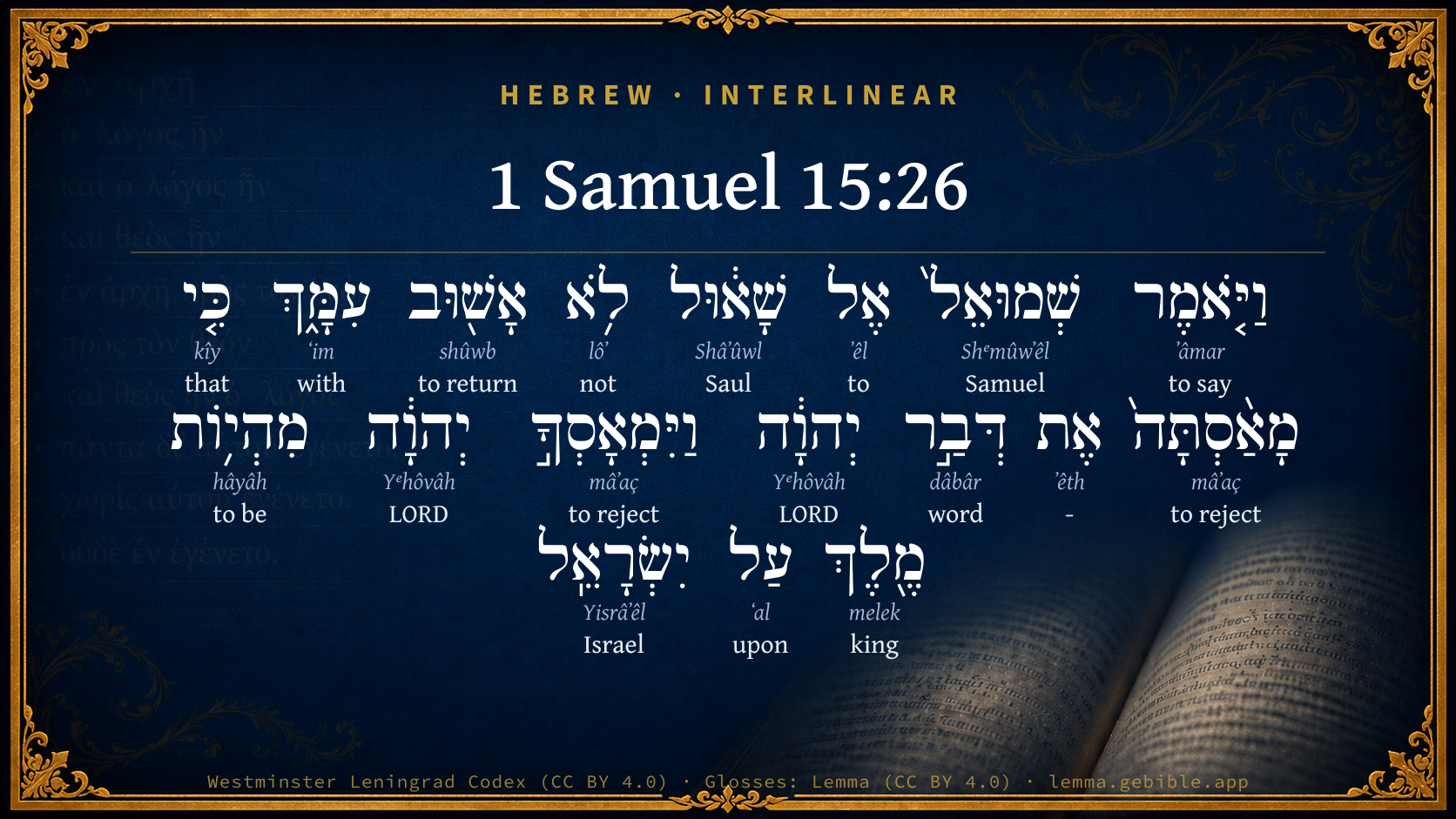
1 Samuel 15:26

Hebrew (Westminster Leningrad Codex) 1 Samuel 15:26 appears in the Hebrew Old Testament. The text above is from the Westminster Leningrad Codex. Each word links to its Strong’s number, a concise gloss, and parsing drawn from the Open Scriptures Hebrew Bible morphology. Click any word for its full Brown-Driver-Briggs (BDB) entry.
Download image
Cite this verse

1 Samuel 15:26 (World English Bible). Public Domain. Lemma interlinear Bible study tool, https://lemma.gebible.app/v/1-samuel/15/26.

Show BibTeX & RIS
BibTeX
RIS
English Translation
Samuel said to Saul, I will not return with you; for you have rejected the word of Yahweh, and Yahweh has rejected you from being king over Israel.
World English Bible · Public Domain
Download a study sheet

One document with this verse’s original text, its word-by-word gloss line, the meaning frame, cross-references with their text, attributed commentary, and full source and license credits — printable, and it pastes into notes with its structure intact.

This verse Autodidact and up

Study sheet (.html) Plain text (.txt)

A passage Seminary Student

Up to 50 verses in one chapter. A passage sheet keeps up to 6 commentary sources and 12 cross-references per verse, in the order this page ranks them, and says so on the sheet whenever that leaves anything out. Ask for a single verse and you get the Autodidact verse sheet above.

Everything on this page stays free to read, with no account — the sheet is a download of what is already on screen, not access to it.

Want to remove ads? Support Godless Engineer
Compare translations 3

The same verse in 3 English versions, stacked beneath the original-language interlinear above. Click any original word for its lexicon entry.

Each is an independent rendering of the whole verse — the interlinear is not word-aligned to these translations.

Highlighted words mark where these versions differ — a whole-verse word diff, not a word-by-word alignment.

  • World English Bible Public Domain
    Samuel said to Saul, I will not return with you; for you have rejected the word of Yahweh, and Yahweh has rejected you from being king over Israel.
  • King James Version Public Domain
    And Samuel said unto Saul, I will not return with thee: for thou hast rejected the word of the LORD, and the LORD hath rejected thee from being king over Israel.
  • unfoldingWord Literal Text CC BY-SA 4.0
    But Samuel said to Saul, “I will not return with you. For you have rejected the word of Yahweh, so Yahweh has rejected you from king over Israel.”

unfoldingWord Literal Text — © unfoldingWord, licensed CC BY-SA 4.0. Word-aligned USFM3 via Door43 (git.door43.org/unfoldingWord/en_ult).

Versions to compare (up to 4)

3 of 4 selected

Show all 18 translations

Every available English version of this verse, each an independent rendering of the whole verse.

  • World English Bible Public Domain
    Samuel said to Saul, I will not return with you; for you have rejected the word of Yahweh, and Yahweh has rejected you from being king over Israel.
  • Berean Standard Bible Public Domain
    “I will not return with you,” Samuel replied. “For you have rejected the word of the LORD, and He has rejected you as king over Israel.”
  • Majority Standard Bible Public Domain
    “I will not return with you,” Samuel replied. “For you have rejected the word of the LORD, and He has rejected you as king over Israel.”
  • King James Version Public Domain
    And Samuel said unto Saul, I will not return with thee: for thou hast rejected the word of the LORD, and the LORD hath rejected thee from being king over Israel.
  • American Standard Version (1901) Public Domain
    And Samuel said unto Saul, I will not return with thee; for thou hast rejected the word of Jehovah, and Jehovah hath rejected thee from being king over Israel.
  • Revised Version (1885) Public Domain
    And Samuel said unto Saul, I will not return with thee: for thou hast rejected the word of the LORD, and the LORD hath rejected thee from being king over Israel.
  • Geneva Bible (1599) Public Domain
    But Samuel saide vnto Saul, I will not returne with thee: for thou hast cast away the word of the Lord, and the Lord hath cast away thee, that thou shalt not be King ouer Israel.
  • Douay-Rheims (1899) Public Domain
    And Samuel said to Saul: I will not return with thee, because thou hast rejected the word of the Lord, and the Lord hath rejected thee from being king over Israel.
  • Young's Literal Translation Public Domain
    And Samuel saith unto Saul, `I do not turn back with thee; for thou hast rejected the word of Jehovah, and Jehovah doth reject thee from being king over Israel.'
  • Literal Standard Version CC BY-SA 4.0
    And Samuel says to Saul, “I do not return with you; for you have rejected the word of YHWH, and YHWH rejects you from being king over Israel.”
  • Unlocked Literal Bible CC BY-SA 4.0
    Samuel said to Saul, “I will not go back with you; for you have rejected the word of Yahweh, and Yahweh has rejected you from being king over Israel.”
  • unfoldingWord Literal Text CC BY-SA 4.0
    But Samuel said to Saul, “I will not return with you. For you have rejected the word of Yahweh, so Yahweh has rejected you from king over Israel.”
  • Darby Bible Public Domain
    And Samuel said to Saul, I will not turn again with thee; for thou hast rejected the word of Jehovah, and Jehovah has rejected thee from being king over Israel.
  • World Messianic Bible Public Domain
    Samuel said to Saul, “I will not return with you; for you have rejected the LORD’s word, and the LORD has rejected you from being king over Israel.”
  • Webster's Bible Public Domain
    And Samuel said to Saul, I will not return with thee: for thou hast rejected the word of the LORD, and the LORD hath rejected thee from being king over Israel.
  • Free Bible Version CC BY-SA 4.0
    But Samuel told him, “I'm not going back with you. You have rejected the Lord's orders, and the Lord has rejected you as king of Israel!”
  • Bible in Basic English Public Domain
    And Samuel said to Saul, I will not go back with you: for you have put away from you the word of the Lord, and the Lord has put you from your place as king over Israel.
  • JPS Tanakh (1917) Public Domain
    And Samuel said unto Saul: 'I will not return with thee; for thou hast rejected the word of the LORD, and the LORD hath rejected thee from being king over Israel.'

Literal Standard Version (2020), Covenant Press — licensed CC BY-SA 4.0. Text via the HelloAO Bible API (eBible.org). Unlocked Literal Bible (unfoldingWord) — licensed CC BY-SA 4.0. Text via the HelloAO Bible API (eBible.org). unfoldingWord Literal Text — © unfoldingWord, licensed CC BY-SA 4.0. Word-aligned USFM3 via Door43 (git.door43.org/unfoldingWord/en_ult). Free Bible Version, Dr. Jonathan Gallagher — licensed CC BY-SA 4.0. Text via the HelloAO Bible API (eBible.org).

Word by word

More ways to search: Search by grammar → Find every occurrence → Compare this word →

Practice this passage: Drill this verse → Learn its vocabulary →

מָאַ֨סְתָּה֙
mâʼaç
H3988
“to reject”
Verb, Qal, Perfect, 2nd Person, Masculine, Singular
Part of Speech
Verb
Stem
Qal
Form
Perfect
Person
2nd Person
Gender
Masculine
Number
Singular
Full BDB Definition

Origin: a primitive root

TWOT: 1139 , 1140

to reject, despise, refuse - (Qal) - to reject, refuse - to despise - (Niphal) to be rejected - (Niphal) to flow, run
  1. וַיֹּ֤אמֶר ʼâmar H559 “and · to say” Conjunction + Verb, Qal, Sequential Imperfect, 3rd Person, Masculine, Singular
  2. שְׁמוּאֵל֙ Shᵉmûwʼêl H8050 “Samuel” Noun, Proper
  3. אֶל ʼêl H413 “to” Preposition
  4. שָׁא֔וּל Shâʼûwl H7586 “Saul” Noun, Proper
  5. לֹ֥א lôʼ H3808 “not” Particle, Negative
  6. אָשׁ֖וּב shûwb H7725 “to return” Verb, Qal, Imperfect, 1st Person, Common, Singular
  7. עִמָּ֑ךְ ʻim H5973 “with · you” Preposition + Suffix, Personal, 2nd Person, Feminine, Singular
  8. כִּ֤י kîy H3588 “that” Conjunction
  9. אֶת ʼêth H853 “-” Particle, Direct Object
  10. דְּבַ֣ר dâbâr H1697 “word of” Noun, Common, Masculine, Singular, Construct
  11. יְהוָ֔ה Yᵉhôvâh H3068 “LORD” Noun, Proper
  12. וַיִּמְאָסְךָ֣ mâʼaç H3988 “and · to reject · you” Conjunction + Verb, Qal, Sequential Imperfect, 3rd Person, Masculine, Singular + Suffix, Personal, 2nd Person, Masculine, Singular
  13. יְהוָ֔ה Yᵉhôvâh H3068 “LORD” Noun, Proper
  14. מִהְי֥וֹת hâyâh H1961 “from · to be” Preposition + Verb, Qal, Infinitive Construct
  15. מֶ֖לֶךְ melek H4428 “king” Noun, Common, Masculine, Singular, Absolute
  16. עַל ʻal H5921 “upon” Preposition
  17. יִשְׂרָאֵֽל Yisrâʼêl H3478 “Israel” Noun, Proper

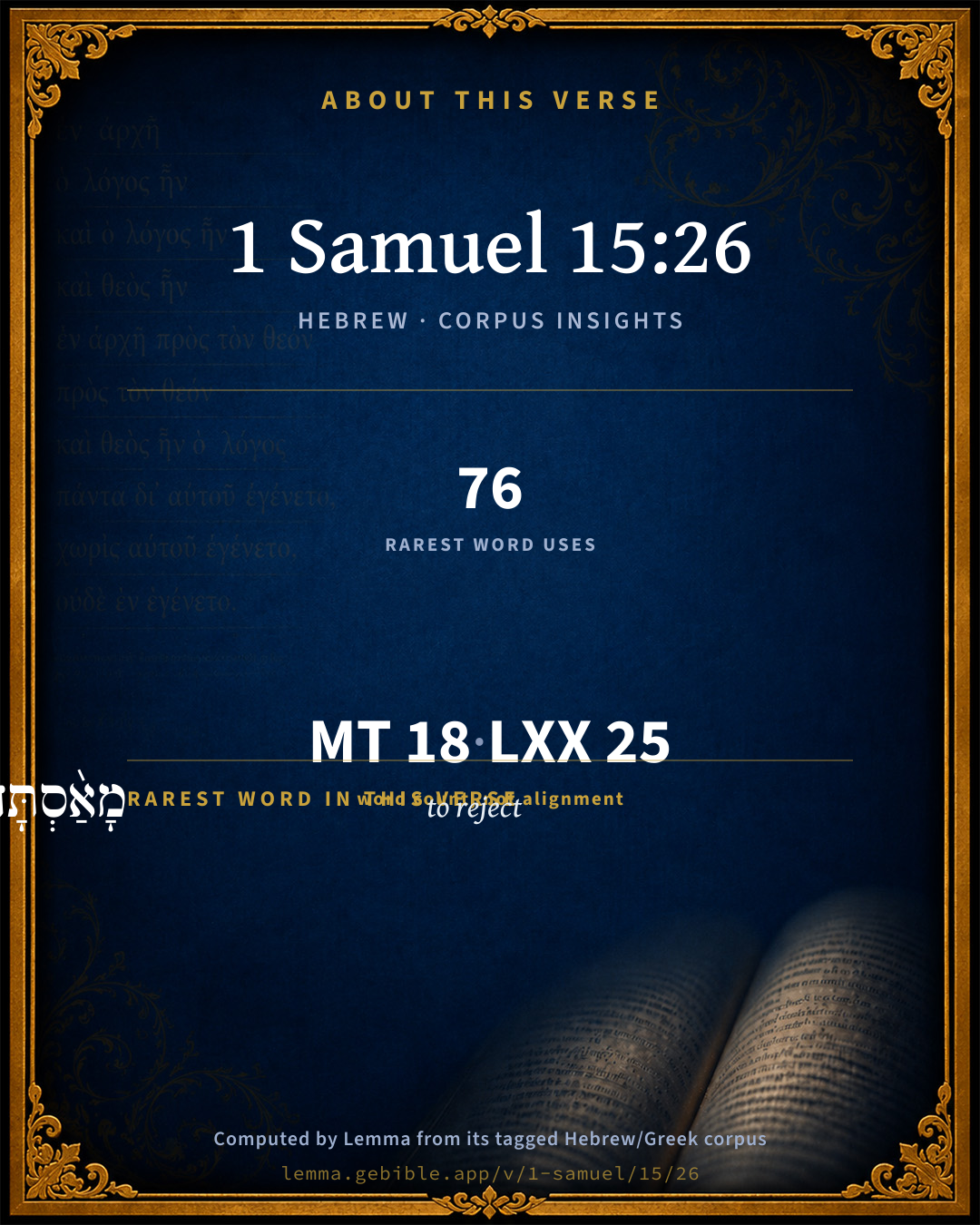
About this verse

These counts appear in no published source. They are computed here, from the morphology-tagged text and Lemma’s own curated glosses. What Lemma adds →

18
words
16
distinct lemmas
Historical
section

Grammatical profile

  • 5 verbs
  • 7 nouns
  • 3 prepositions
  • 1 conjunction
  • 2 particles

Verb forms

  • וַיֹּ֤אמֶר Qal · Sequential Imperfect
  • אָשׁ֖וּב Qal · Imperfect
  • מָאַ֨סְתָּה֙ Qal · Perfect
  • וַיִּמְאָסְךָ֣ Qal · Sequential Imperfect
  • מִהְי֥וֹת Qal · Infinitive Construct

Repetition

Words recur within this verse — often emphatic in Hebrew:

  • מָאַ֨סְתָּה֙ to reject H3988 ×2
  • יְהוָ֔ה LORD H3068 ×2

Hebrew & Septuagint length

In English translation the verse runs 28 words from the Hebrew and 32 from the Septuagint (LXX English) — closely comparable.

A rough comparison of the two English renderings, which tokenize alike — not a word-level alignment.

Word counts can differ between the Hebrew and the Greek without any difference in meaning — e.g. the Hebrew direct-object marker אֵת has no separate Greek word, and Greek often adds the article ὁ.

In the original languages it is 18 Hebrew tokens and 25 Greek tokens — but the two are counted differently (Hebrew bundles its prefixes and suffixes into one token; the Greek is in lemma form), so that isn’t a like-for-like length.

Cross-references

11

Topical passages linked to 1 Samuel 15:26 in the Treasury of Scripture Knowledge — connected by theme and wording, ordered by reader-vote popularity; previews shown in the World English Bible.

  • Hosea 4:6 My people are destroyed for lack of knowledge. Because you have rejected knowledge, I will also reject you, That you may be no priest to me. Because you have your God's law, I will also forget your children.
  • 1 Samuel 13:14 But now your kingdom shall not continue: Yahweh has sought him a man after his own heart, and Yahweh has appointed him to be prince over his people, because you have not kept that which Yahweh commanded you.
  • 1 Samuel 16:1 Yahweh said to Samuel, How long will you mourn for Saul, seeing I have rejected him from being king over Israel? fill your horn with oil, and go: I will send you to Jesse the Bethlehemite; for I have provided me a king among his sons.
  • 1 Samuel 15:23 For rebellion is as the sin of witchcraft, and stubbornness is as idolatry and teraphim. Because you have rejected the word of Yahweh, he has also rejected you from being king.
  • Jeremiah 6:19 Hear, earth: behold, I will bring evil on this people, even the fruit of their thoughts, because they have not listened to my words; and as for my law, they have rejected it.
  • 2 John 1:11 for he who welcomes him participates in his evil works.
  • Genesis 43:11–14 Their father, Israel, said to them, "If it be so now, do this. Take from the choice fruits of the land in your bags, and carry down a present for the man, a little balm, a little honey, spices and myrrh, nuts, and almonds;
  • 1 Samuel 2:30 Therefore Yahweh, the God of Israel, says, I said indeed that your house, and the house of your father, should walk before me forever: but now Yahweh says, Be it far from me; for those who honor me I will honor, and those who despise me shall be lightly esteemed.
  • 1 Samuel 15:31 So Samuel turned again after Saul; and Saul worshiped Yahweh.
  • Luke 24:28–29 They drew near to the village, where they were going, and he acted like he would go further.
  • Genesis 42:38 He said, "My son shall not go down with you; for his brother is dead, and he only is left. If harm happens to him by the way in which you go, then you will bring down my gray hairs with sorrow to Sheol."

Cross-references courtesy of OpenBible.info (CC BY 4.0).

Hebrew and Greek witnesses Masoretic Hebrew ↔ Greek Septuagint

The same verse in the two great witnesses to the Old Testament, shown verse-for-verse.

These are two independent witnesses, not word-aligned to each other, and the Septuagint is shown in lemma (dictionary) form.

Hebrew 1 Samuel 15:26 Masoretic · Westminster Leningrad Codex

וַיֹּ֤אמֶר שְׁמוּאֵל֙ אֶל שָׁא֔וּל לֹ֥א אָשׁ֖וּב עִמָּ֑ךְ כִּ֤י מָאַ֨סְתָּה֙ אֶת דְּבַ֣ר יְהוָ֔ה וַיִּמְאָסְךָ֣ יְהוָ֔ה מִהְי֥וֹת מֶ֖לֶךְ עַל יִשְׂרָאֵֽל

Samuel said to Saul, I will not return with you; for you have rejected the word of Yahweh, and Yahweh has rejected you from being king over Israel.

World English Bible · Public Domain

Greek LXX 1 Samuel 15:26 Septuagint · lemma form

καί εἶπον σαμουηλ πρός σαούλ οὐ ἀναστρέφω μετά σύ ὅτι ἐκοὐδενόω ὁ ῥῆμα κύριος καί ἐκοὐδενόω σύ κύριος ὁ μή εἰμί βασιλεύς ἐπί ὁ ἰσραήλ

And Samuel said to Saul, I will not turn back with you, for you have rejected the word of the Lord, and the Lord will reject you from being king over Israel.

LXX2012 (modern English Septuagint) · Public Domain

On this verse, Keil & Delitzsch discusses the Septuagint’s reading. Read the note in Commentary ↓

Hebrew: Westminster Leningrad Codex (CC BY 4.0). Greek: Septuagint (public domain); English from LXX2012 (modern English Septuagint) (Public Domain). How the Septuagint differs from the Hebrew →

Targum (Aramaic paraphrase)

1

The Targum is the ancient Jewish Aramaic paraphrase of the Hebrew Scriptures — an interpretive translation, not the Hebrew text itself. Onkelos (literal) and Pseudo-Jonathan (expansive) render the Torah, and Jonathan the Prophets. Coverage is partial: where no permissively-licensed English translation exists for a verse, only the Aramaic is shown. This is verse-level text, not a word-by-word alignment to the Hebrew.

  1. Targum Jonathan Prophets (Joshua–Malachi)
    וַאֲמַר שְׁמוּאֵל לְשָׁאוּל לָא אֲתוּב עִמָךְ אֲרֵי קַצְתָּא בְּפִתְגָמָא דַייָ וְרַחֲקָךְ יְיָ מִלְמֶהֱוֵי מַלְכָּא עַל יִשְׂרָאֵל:

    (no public-domain English translation for this verse)

    Targum Jonathan — Aramaic: “Mikraot Gedolot” (public domain). English: “Sefaria Community Translation” (CC0 1.0 (public-domain dedication)); “London "Chaldee Paraphrase," 1871” (public domain). Text via Sefaria.

Commentary

Notes on 1 Samuel 15:26 from classic Christian and Jewish commentators (each source and its license shown beneath its notes). The classic Christian expositions comment on the surrounding passage and are grouped to its opening verse, so a note may address several verses; the Jewish commentaries on the Tanakh (Rashi and others) are per-verse, so they appear only where the commentator wrote on this verse.

Lemma curates 59 commentaries, every one of them public domain or Creative Commons licensed, each selected and text-cleaned for this edition rather than reprinted as found. About our sources →

Trapp's Complete Commentary

John Trapp

1Sa 15:26 And Samuel said unto Saul, I will not return with thee: for thou hast rejected the word of the LORD, and the LORD hath rejected thee from being king over Israel.

Ver. 26. The Lord hath rejected thee.] God loveth to retaliate; and what wonder that the holy and true God casteth off him, whose best was dissimulation?

John Trapp, A Commentary or Exposition upon All the Books of the Old and New Testament (1647–1656) — public domain. Text from a community e-Sword module.

The Biblical Illustrator

Joseph S. Exell

1Sa_15:26

Thou hast rejected the word of the Lord, and the Lord hath rejected thee.

One sin too many

The whole story affords an extensive illustration of sin in almost all of its phases of manifestation as judged by the righteous law of God.

1. We discover the simple nature of sin: it is disobedience of a Divine command.

2. We learn, likewise, a lesson concerning the wide reach of sin. Saul felt quite independent in his disobedience It is not possible for any man to keep his sin all to himself. This universe is balanced with great nicety. It cannot endure a sinners perversity without suffering any more than an oarsman can tolerate a perverse boy in a boat; every time the self-willed creature steps across the thwart he rocks the vessel, and makes it uncomfortable and perilous for each one who has anything to do with him.

3. Next to this, we discover an illustration of the bold effrontery of sin. Iniquity often tries to carry off shame with a show of daring, and attempts to restore its self-confidence with a complacency of self-congratulation.

4. Now comes a lesson concerning the certain discovery of sin. Guilt always feels lonely; and yet, curiously enough, always imagines that everybody knows about the crime. Conscience keeps the culprit excited, for he understands that nature positively abhors transgression of law.

5. Once more: the story gives us an illustration of the evasive meanness of sin.

6. Then we have a lesson concerning the hypocritical excuses offered for sin.

7. Now just at this point we receive a lesson concerning the just condemnation of sin.

8. There is likewise here an illustration of the aggregating force of sin. It is hardly worth while to attempt to enumerate the acts of wickedness which followed directly upon this first dereliction of Saul: treachery, lying, vanity, covetousness, hypocrisy--these were among them. There are degrees of depravity, no doubt; but all sin is bad, and tends to what is worse.

9. Still another lesson meets us here, and now it is concerning the inevitable result of sin. Saul had reached the limit of Divine forbearance. Indeed, he had already committed one sin too many. It was of no use for him to plead for pardon any more. There is something very strange in the subsequent career of this monarch; he seems bewildered and off his balance. All sin left to itself is hopeless. The kingdom was taken from this man so that he should not injure anyone else any more. Even heathen people know that is lust. When we were at school we used to declaim this sentence from Demosthenes oration: It is not possible, O Athenians! that a power should be permanent which is marked with injustice, perjury, and falsehood. Hence, finally, sin becomes massed and destructive. It is an Arab saying that we so often quote: The last straw breaks the camels back. No; it is the whole load that kills the camel, but it is the last straw which makes the load complete and intolerable. When the fall of the beast comes, all the burden tells. A time arrives at the last when just one more little act of rebellion against God discharges all the violence of Divine wrath in an absolute reprobation. (C. S. Robinson, D. D.)

Samuel declaring the deposition of Saul

Few characters more blameless than that of Samuel.

I. His office. This was to declare the will of God. He was not called to decide or to adjudicate, but to declare. When Saul was called to the kingdom, Samuel was employed to declare to him the call of God (1Sa_9:17; 1Sa_9:20): He did not select, but declare Gods selection. So when Saul was to be set aside. Samuel was employed to declare his deposition (1Sa_15:28). He did not depose, but declared Gods deposition

II. The spirit in which he acted.

1. He was faithful to the Lord who sent him. He faithfully convicted Saul of his disobedience (1Sa_15:14; 1Sa_15:17). He showed him the hollowness of his vain excuses (1Sa_15:22-23). He fearlessly and faithfully told him that the Lord had that day rent the kingdom from him (1Sa_15:26). Learn that those who have a message from God must give it faithfully.

2. He was most tender to the sinner to whom he was sent. Had he given way to personal jealousy, he might have been pleased at the fall of Saul; for when he was old the people had asked for a king in a most ungrateful spirit.

But he showed no such mean jealousy.

1. When he heard of Sauls fault he was grieved and spent the whole night in prayer (1Sa_15:11). He did not give his reproof in a hard and unfeeling spirit, but with a sorrowing heart. The lips that seemed so severe in declaring judgment had been employed all night in pleading for mercy.

2. When the sentence of God was announced, he did all he could to mitigate the pain. It is the duty of the minister faithfully to denounce sin; but if he would do so effectually, he must prepare the way by tenderness, tears, and prayers; and he must accompany his painful message by a clear evidence of sorrowful tenderness towards the sinner. Nothing tends more to harden sinners than hard denunciation. (E. Horne, M. D.)

The Biblical Illustrator, edited by Joseph S. Exell (c. 1880s–1900s) — public domain. Text from a community e-Sword module.

Joseph Benson's Commentary

1Sa 15:26. I will not — This was no lie, though he afterward returned, because he spoke what he meant; his words and his intentions agreed together, though afterward he saw reason to change his intentions. Compare Gen 19:2-3. This may relieve many perplexed consciences, who think themselves obliged to do what they have said they would do, though they see just cause to change their minds. Hath rejected thee, &c. — But he does not say, he “hath rejected thee from salvation.” And who besides hath authority to say so?

Joseph Benson's Commentary on the Old and New Testaments (1811–1818) — public domain. Text from a community e-Sword module.

Adam Clarke's Commentary

Verse 26. I will not return with thee] I cannot acknowledge thee as king, seeing the Lord hath rejected thee.

Adam Clarke's Commentary on the Bible (1810–1826) — public domain. Text from a community e-Sword/MySword module.

Ellicott's Commentary for English Readers

(26) I will not return with thee.—Samuel too clearly sees what are the true springs of Saul’s repentance, and refuses at first. It was only, as C. a Lapide forcibly urges, a fear on the part of the king, of losing the kingdom and of incurring public disgrace. The prophet for reply again repeats the terrible Divine sentence of rejection.

A Bible Commentary for English Readers, edited by Charles John Ellicott (1878–1897) — public domain. Text from a community e-Sword module.

John Gill's Exposition

And Samuel said unto Saul, I will not return with thee,.... Not being satisfied with his repentance and confession, he still extenuating his sin, and laying the blame of it on the people. This he said by way of resentment, and as expressing his indignation at him, though he afterwards did return with him on a change of his mind; which a good man may be allowed to make, without any imputation of falsehood or a lie unto him:

for thou hast rejected the word of the Lord, and the Lord hath rejected thee from being king over Israel; which is repeated from Sa1 15:23 for the confirmation of it, and to let Saul know that his pretended confession and repentance had made no alteration in the decree and sentence of God respecting the kingdom.

John Gill's Exposition of the Whole Bible (1746–1763) — public domain (CC PDM 1.0). Text via the HelloAO Bible API.

Matthew Poole's English Annotations

I will not return with thee: this was no lie, though he afterwards returned, because he spoke what he meant; his words and intentions agreed together, though afterwards he saw reason to change his intentions: compare Gen 19:2,3; which may relieve many perplexed consciences, who think themselves obliged to do what they have said they would do, though they see just cause to change their minds.

Matthew Poole's English Annotations on the Holy Bible (1683–1685) — public domain. Text from a community e-Sword/MySword module.

The Pulpit Commentary

Vers. 26, 27, 28. At first the prophet refuses the king"s request. Saul had dishonoured God, and, therefore, had no claim to public homage from God"s minister. He turns, therefore, to go away, and Saul in his eagerness seizes hold of Samuel"s mantle. The A.V is very careless about the exact rendering of words of this description, and seems guided in its choice of terms simply by the ear. Now the mantle, addereth, though used of the Shinar shawl stolen by Achan, (Jos_7:21, Jos_7:24) was the distinctive dress of the prophets, but naturally was never worn by Samuel himself. Special dresses come into use only gradually, and Elijah is the first person described as being thus clad. Long before his time the schools of the prophets had grown into a national institution, and a loose wrapper of coarse cloth made of camel"s hair, fastened round the body at the waist by a leathern girdle, had become the usual prophetic dress, and continued so to be until the arrival of Israel"s last prophet, John the Baptist. (Mat_3:4) The garment here spoken of is the meil, on which see 1Sa_2:19, where it was shown to be the ordinary dress of people of various classes in easy circumstances. Now the meil was not a loosely flowing garment, but fitted rather closely to the body, and, therefore, the tearing of it implies a considerable amount of violence on Saul"s part. Skirt, moreover, gives a wrong idea. What Saul took hold of was the hem, the outer border of the garment, probably at Samuel"s neck or shoulder, as he turned to go away. He seized him, as we should say, by the collar, and endeavoured by main force to retain him, and in the struggle the hem rent. And Samuel, using it as an omen, said, Jehovah hath rent the kingdom of Israel from thee this day, and hath given it to a neighbour of thine, that is better than thou. Neighbour is used in Hebrew in a very indefinite manner, and here means generally "some one, whoever it may be," but one who will discharge the duties of thy office better than thou hast done. (Luk_10:36)

The Pulpit Commentary (1880–1919), ed. H.D.M. Spence-Jones & Joseph S. Exell — public domain. Text from a community e-Sword module.

John Wesley's Explanatory Notes

I will not - This was no lie, though he afterwards returned, because he spoke what he meant; his words and his intentions agreed together, though afterwards he saw reason to change his intentions. Compare Gen. xix, 2, 3. This may relieve many perplexed consciences, who think themselves obliged to do what they have said they would do, though they see just cause to change their minds. Hath rejected thee, &c. - But he does not say, he "hath rejected thee from salvation." And who besides hath authority to say so?

John Wesley, Explanatory Notes Upon the Whole Bible (1754–1765) — public domain. Text via the GEBible commentary corpus.

Keil & Delitzsch

C. F. Keil & F. Delitzsch

This request Samuel refused, repeating at the same time the sentence of rejection, and turned to depart. "Then Saul laid hold of the lappet of his mantle (i.e., his upper garment), and it tore" (lit. was torn off). That the Niphal ויּקּרע is correct, and is not to be altered into אתהּ ויּקרע, "Saul tore off the lappet," according to the rendering of the lxx, as Thenius supposes, is evident from the explanation which Samuel gave of the occurrence (Sa1 15:28): "Jehovah hath torn the sovereignty of Israel from thee to-day, and given it to thy neighbour, who is better than thou." As Saul was about to hold back the prophet by force, that he might obtain from him a revocation of the divine sentence, the tearing of the mantle, which took place accidentally, and evidently without any such intention on the part of Saul, was to serve as a sign of the rending away of the sovereignty from him. Samuel did not yet know to whom Jehovah would give it; he therefore used the expression לרעך, as רע is applied to any one with whom a person associates. To confirm his own words, he adds in Sa1 15:29 : "And also the Trust of Israel doth not lie and doth not repent, for He is not a man to repent." נצח signifies constancy, endurance, then confidence, trust, because a man can trust in what is constant. This meaning is to be retained here, where the word is used as a name for God, and not the meaning gloria, which is taken in Ch1 29:11 from the Aramaean usage of speech, and would be altogether unsuitable here, where the context suggests the idea of unchangeableness. For a man's repentance or regret arises from his changeableness, from the fluctuations in his desires and actions. This is never the case with God; consequently He is ישׂראל נצח, the unchangeable One, in whom Israel can trust, since He does not lie or deceive, or repent of His purposes. These words are spoken θεοπρεπῶς (theomorphically), whereas in Sa1 15:11 and other passages, which speak of God as repenting, the words are to be understood ἀνθρωποπαθῶς (anthropomorphically; cf. Num 23:19).

Keil & Delitzsch — Biblical Commentary on the Old Testament (1861–1891) — public domain (CC PDM 1.0). Text via the HelloAO Bible API. (Old Testament only.)

unfoldingWord translationNotes

Door43 World Missions Community

for you have rejected the word of Yahweh

Samuel made it clear that Saul understood that he was disobeying God at the time when he spared the best animals and did not kill Agag.

rejected the word of Yahweh

"rejected Yahweh's command" or "rejected Yahweh's message." This means that he refused to obey Yahweh's command. AT: "refused to obey Yahweh's command" (See: Assumed Knowledge and Implicit Information)

Saul took hold of the hem of his robe

Saul did this to try to stop Samuel from leaving. This can be stated explicitly. AT: "Saul tried to stop him by grabbing the edge of Samuel's robe" (See: Assumed Knowledge and Implicit Information)

the hem of his robe

"the edge of his robe" or "the fringe of his robe"

translationWords

Yahweh

king

Israel

robe

unfoldingWord translationNotes — © Distant Shores Media and the Door43 World Missions Community, licensed CC BY-SA 4.0. Source: git.door43.org/Door43/en_tn.

Lesson kit

Teaching starters — assembled from the data on this page, not authored interpretation. Every prompt links to the verse data it draws on. Edit before teaching.

1 Samuel, in the Historical, opens this verse with 18 words (16 distinct Hebrew lemmas). Its most distinctive word is mâʼaç (“to reject”). A historical commentator’s framing appears above. Read the whole chapter for the surrounding context.

Discussion questions

  1. What does “to reject” (mâʼaç) contribute to the verse as a whole?
  2. Hosea 4:6 shares this passage’s theme. How do the two illuminate each other?
  3. “to reject” occurs 2× in this one verse. What is the effect of the repetition?
  4. These translations render this verse differently; the difference is in the English rendering, not the original. What questions does that raise?
  5. The verb «וַיֹּ֤אמֶר» is Qal Sequential Imperfect. How does its form color the action?
  6. Reading how Trapp's Complete Commentary and The Biblical Illustrator read this verse, where do the two commentators agree and where do they part?

Things to notice

Reading settings

Reading text

Shown beneath each verse's original-language words.

Old Testament
Old Testament edition

Read the OT as the Masoretic Hebrew (MT) or the Greek Septuagint (LXX).

English shown for the Greek Septuagint (in the Hebrew ↔ Greek comparison).

Comparing translations? Open the Compare panel on any verse page to stack up to four side by side.