
1 Samuel 8:10

Hebrew (Westminster Leningrad Codex) 1 Samuel 8:10 appears in the Hebrew Old Testament. The text above is from the Westminster Leningrad Codex. Each word links to its Strong’s number, a concise gloss, and parsing drawn from the Open Scriptures Hebrew Bible morphology. Click any word for its full Brown-Driver-Briggs (BDB) entry.
Download image
Cite this verse

1 Samuel 8:10 (World English Bible). Public Domain. Lemma interlinear Bible study tool, https://lemma.gebible.app/v/1-samuel/8/10.

Show BibTeX & RIS
BibTeX
RIS
English Translation
Samuel told all the words of Yahweh to the people who asked of him a king.
World English Bible · Public Domain
Download a study sheet

One document with this verse’s original text, its word-by-word gloss line, the meaning frame, cross-references with their text, attributed commentary, and full source and license credits — printable, and it pastes into notes with its structure intact.

This verse Autodidact and up

Study sheet (.html) Plain text (.txt)

A passage Seminary Student

Up to 50 verses in one chapter. A passage sheet keeps up to 6 commentary sources and 12 cross-references per verse, in the order this page ranks them, and says so on the sheet whenever that leaves anything out. Ask for a single verse and you get the Autodidact verse sheet above.

Everything on this page stays free to read, with no account — the sheet is a download of what is already on screen, not access to it.

Want to remove ads? Support Godless Engineer
Compare translations 3

The same verse in 3 English versions, stacked beneath the original-language interlinear above. Click any original word for its lexicon entry.

Each is an independent rendering of the whole verse — the interlinear is not word-aligned to these translations.

Highlighted words mark where these versions differ — a whole-verse word diff, not a word-by-word alignment.

  • World English Bible Public Domain
    Samuel told all the words of Yahweh to the people who asked of him a king.
  • King James Version Public Domain
    And Samuel told all the words of the LORD unto the people that asked of him a king.
  • unfoldingWord Literal Text CC BY-SA 4.0
    And Samuel told all of the words of Yahweh to the people requesting a king from him.

unfoldingWord Literal Text — © unfoldingWord, licensed CC BY-SA 4.0. Word-aligned USFM3 via Door43 (git.door43.org/unfoldingWord/en_ult).

Versions to compare (up to 4)

3 of 4 selected

Show all 18 translations

Every available English version of this verse, each an independent rendering of the whole verse.

  • World English Bible Public Domain
    Samuel told all the words of Yahweh to the people who asked of him a king.
  • Berean Standard Bible Public Domain
    So Samuel spoke all the words of the LORD to the people who were asking him for a king.
  • Majority Standard Bible Public Domain
    So Samuel spoke all the words of the LORD to the people who were asking him for a king.
  • King James Version Public Domain
    And Samuel told all the words of the LORD unto the people that asked of him a king.
  • American Standard Version (1901) Public Domain
    And Samuel told all the words of Jehovah unto the people that asked of him a king.
  • Revised Version (1885) Public Domain
    And Samuel told all the words of the LORD unto the people that asked of him a king.
  • Geneva Bible (1599) Public Domain
    So Samuel told all the wordes of the Lord vnto the people that asked a King of him.
  • Douay-Rheims (1899) Public Domain
    Then Samuel told all the words of the Lord to the people that had desired a king of him,
  • Young's Literal Translation Public Domain
    And Samuel speaketh all the words of Jehovah unto the people who are asking from him a king,
  • Literal Standard Version CC BY-SA 4.0
    And Samuel speaks all the words of YHWH to the people who are asking [for] a king from him,
  • Unlocked Literal Bible CC BY-SA 4.0
    So Samuel told all the words of Yahweh to the people who were asking for a king.
  • unfoldingWord Literal Text CC BY-SA 4.0
    And Samuel told all of the words of Yahweh to the people requesting a king from him.
  • Darby Bible Public Domain
    And Samuel spoke all the words of Jehovah to the people that asked of him a king.
  • World Messianic Bible Public Domain
    Samuel told all the LORD’s words to the people who asked him for a king.
  • Webster's Bible Public Domain
    And Samuel told all the words of the LORD to the people that asked of him a king.
  • Free Bible Version CC BY-SA 4.0
    Samuel repeated all that the Lord had said to the people asking him to give them a king.
  • Bible in Basic English Public Domain
    And Samuel said all these words of the Lord to the people who were desiring a king.
  • JPS Tanakh (1917) Public Domain
    And Samuel told all the words of the LORD unto the people that asked of him a king.

Literal Standard Version (2020), Covenant Press — licensed CC BY-SA 4.0. Text via the HelloAO Bible API (eBible.org). Unlocked Literal Bible (unfoldingWord) — licensed CC BY-SA 4.0. Text via the HelloAO Bible API (eBible.org). unfoldingWord Literal Text — © unfoldingWord, licensed CC BY-SA 4.0. Word-aligned USFM3 via Door43 (git.door43.org/unfoldingWord/en_ult). Free Bible Version, Dr. Jonathan Gallagher — licensed CC BY-SA 4.0. Text via the HelloAO Bible API (eBible.org).

Word by word

More ways to search: Search by grammar → Find every occurrence → Compare this word →

Practice this passage: Drill this verse → Learn its vocabulary →

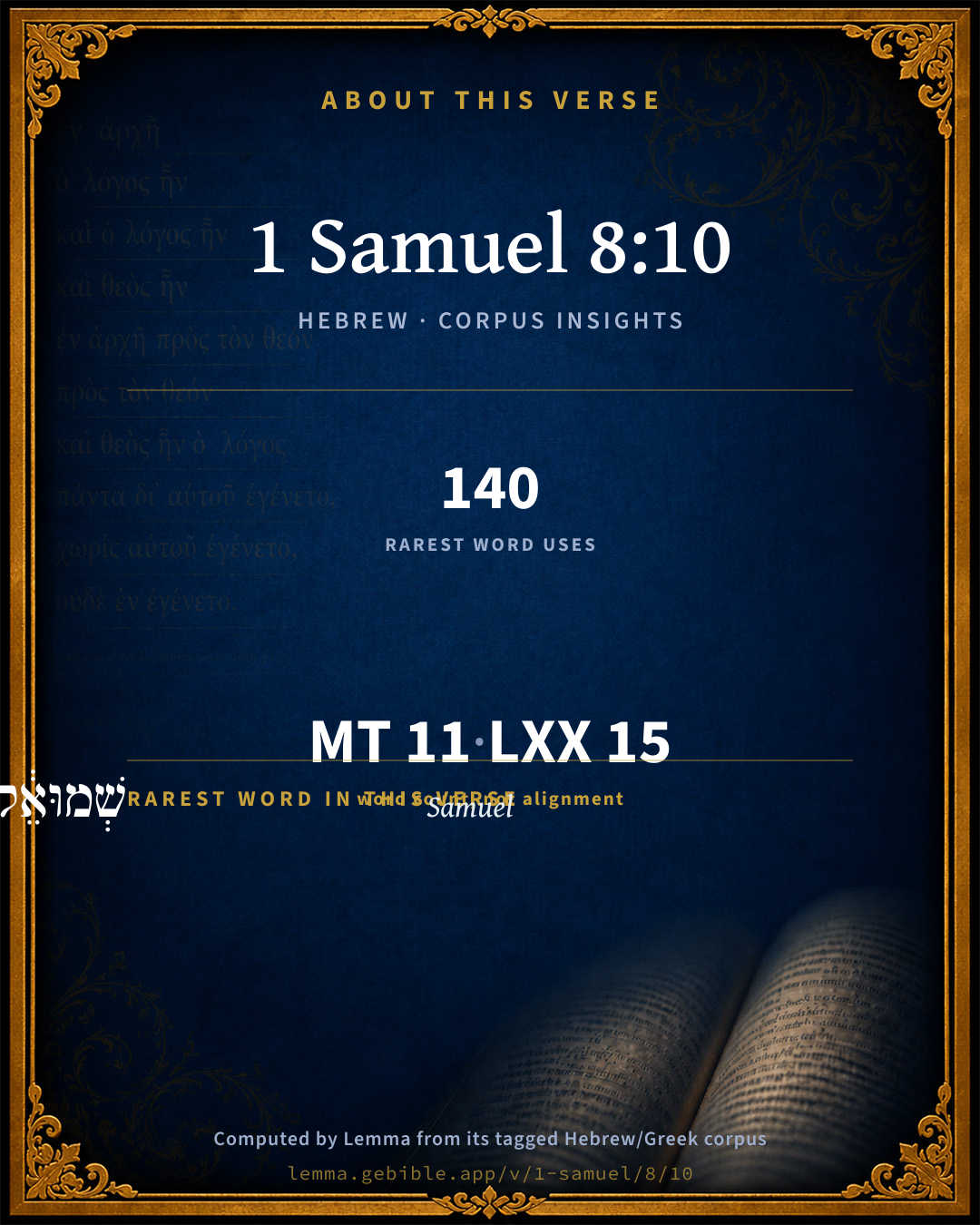
שְׁמוּאֵ֔ל
Shᵉmûwʼêl
H8050
“Samuel”
Noun, Proper
Part of Speech
Noun
Type
Proper
Full BDB Definition

Origin: from the pass part of H8085 and H410

TWOT: None

Samuel = "his name is El" - son of Elkanah by his wife Hannah and judge or prophet of Israel during the days of Saul and David - son Ammihud and the prince of the tribe of Simeon who was chosen to divide the land of Canaan between the tribes. Spelled 'Shemuel' - son of Tola and grandson of Issachar. Spelled 'Shemuel'
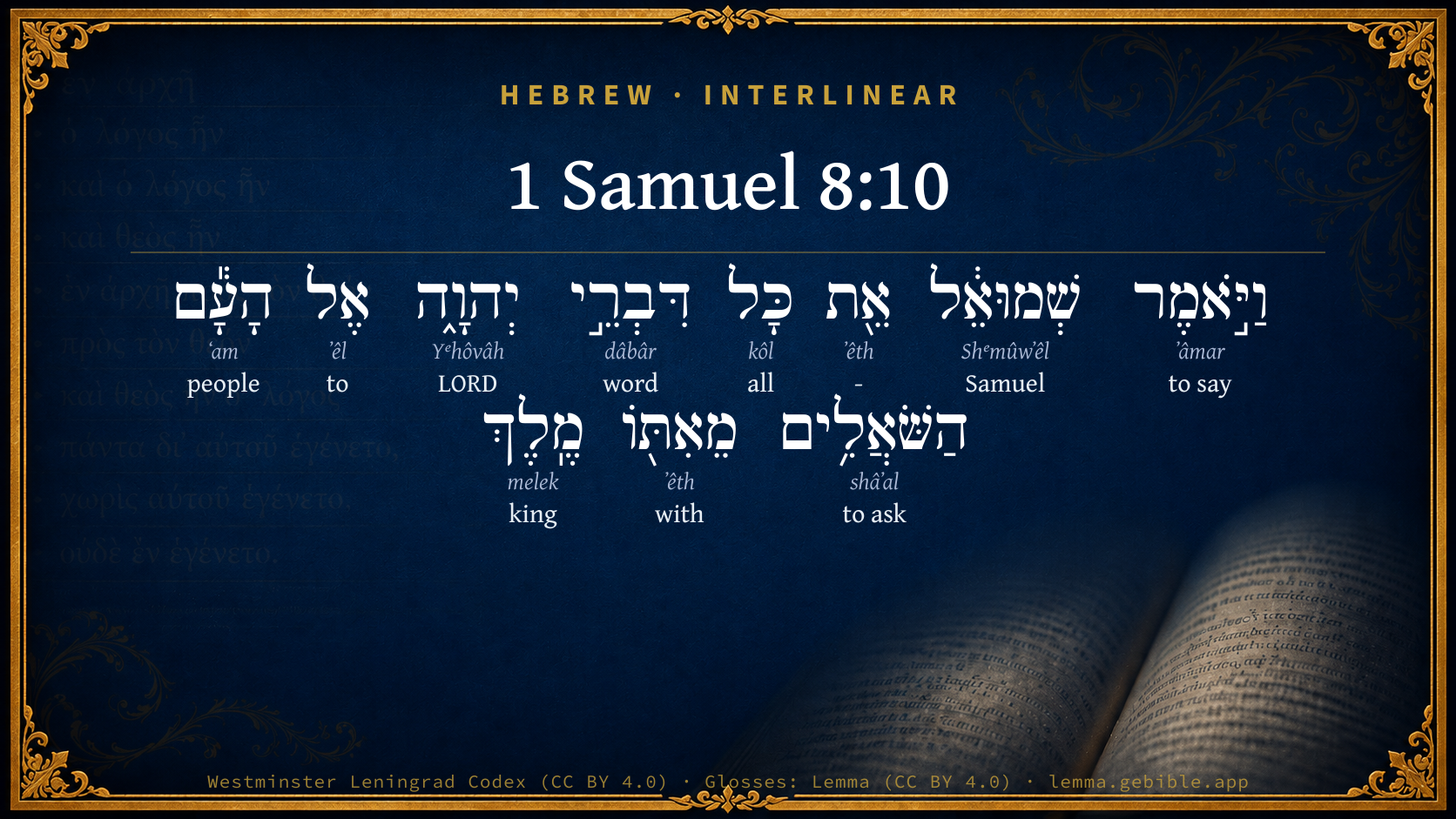
  1. וַיֹּ֣אמֶר ʼâmar H559 “and · to say” Conjunction + Verb, Qal, Sequential Imperfect, 3rd Person, Masculine, Singular
  2. אֵ֖ת ʼêth H853 “-” Particle, Direct Object
  3. כָּל kôl H3605 “all of” Noun, Common, Masculine, Singular, Construct
  4. דִּבְרֵ֣י dâbâr H1697 “words of” Noun, Common, Masculine, Plural, Construct
  5. יְהוָ֑ה Yᵉhôvâh H3068 “LORD” Noun, Proper
  6. אֶל ʼêl H413 “to” Preposition
  7. הָעָ֕ם ʻam H5971 “the · people” Particle, Definite Article + Noun, Common, Masculine, Singular, Absolute
  8. הַשֹּׁאֲלִ֥ים shâʼal H7592 “the · asking” Particle, Definite Article + Verb, Qal, Participle Active, Masculine, Plural, Absolute
  9. מֵאִתּ֖וֹ ʼêth H854 “from · with · him” Preposition + Preposition + Suffix, Personal, 3rd Person, Masculine, Singular
  10. מֶֽלֶךְ melek H4428 “king” Noun, Common, Masculine, Singular, Absolute

About this verse

These counts appear in no published source. They are computed here, from the morphology-tagged text and Lemma’s own curated glosses. What Lemma adds →

11
words
11
distinct lemmas
Historical
section

Grammatical profile

  • 2 verbs
  • 6 nouns
  • 2 prepositions
  • 1 particle

Verb forms

  • וַיֹּ֣אמֶר Qal · Sequential Imperfect
  • הַשֹּׁאֲלִ֥ים Qal · Participle Active

Hebrew & Septuagint length

In English translation the verse runs 16 words from the Hebrew and 17 from the Septuagint (LXX English) — closely comparable.

A rough comparison of the two English renderings, which tokenize alike — not a word-level alignment.

Word counts can differ between the Hebrew and the Greek without any difference in meaning — e.g. the Hebrew direct-object marker אֵת has no separate Greek word, and Greek often adds the article ὁ.

In the original languages it is 11 Hebrew tokens and 15 Greek tokens — but the two are counted differently (Hebrew bundles its prefixes and suffixes into one token; the Greek is in lemma form), so that isn’t a like-for-like length.

Hebrew and Greek witnesses Masoretic Hebrew ↔ Greek Septuagint

The same verse in the two great witnesses to the Old Testament, shown verse-for-verse.

These are two independent witnesses, not word-aligned to each other, and the Septuagint is shown in lemma (dictionary) form.

Hebrew 1 Samuel 8:10 Masoretic · Westminster Leningrad Codex

וַיֹּ֣אמֶר שְׁמוּאֵ֔ל אֵ֖ת כָּל דִּבְרֵ֣י יְהוָ֑ה אֶל הָעָ֕ם הַשֹּׁאֲלִ֥ים מֵאִתּ֖וֹ מֶֽלֶךְ

Samuel told all the words of Yahweh to the people who asked of him a king.

World English Bible · Public Domain

Greek LXX 1 Samuel 8:10 Septuagint · lemma form

καί εἶπον σαμουηλ πᾶς ὁ ῥῆμα κύριος πρός ὁ λαός ὁ αἰτέω παρά αὐτός βασιλεύς

And Samuel spoke every word of the Lord to the people who asked of him a king.

LXX2012 (modern English Septuagint) · Public Domain

On this verse, Keil & Delitzsch discusses the Septuagint’s reading. Read the note in Commentary ↓

Hebrew: Westminster Leningrad Codex (CC BY 4.0). Greek: Septuagint (public domain); English from LXX2012 (modern English Septuagint) (Public Domain). How the Septuagint differs from the Hebrew →

Targum (Aramaic paraphrase)

1

The Targum is the ancient Jewish Aramaic paraphrase of the Hebrew Scriptures — an interpretive translation, not the Hebrew text itself. Onkelos (literal) and Pseudo-Jonathan (expansive) render the Torah, and Jonathan the Prophets. Coverage is partial: where no permissively-licensed English translation exists for a verse, only the Aramaic is shown. This is verse-level text, not a word-by-word alignment to the Hebrew.

  1. Targum Jonathan Prophets (Joshua–Malachi)
    וַאֲמַר שְׁמוּאֵל יַת כָּל פִּתְגָמַיָא דַייָ לְעַמָא דְשַׁאֲלִין מִנֵיהּ מַלְכָּא:

    (no public-domain English translation for this verse)

    Targum Jonathan — Aramaic: “Mikraot Gedolot” (public domain). English: “Sefaria Community Translation” (CC0 1.0 (public-domain dedication)); “London "Chaldee Paraphrase," 1871” (public domain). Text via Sefaria.

Commentary

Notes on 1 Samuel 8:10 from classic Christian and Jewish commentators (each source and its license shown beneath its notes). The classic Christian expositions comment on the surrounding passage and are grouped to its opening verse, so a note may address several verses; the Jewish commentaries on the Tanakh (Rashi and others) are per-verse, so they appear only where the commentator wrote on this verse.

Lemma curates 59 commentaries, every one of them public domain or Creative Commons licensed, each selected and text-cleaned for this edition rather than reprinted as found. About our sources →

Trapp's Complete Commentary

John Trapp

1Sa 8:10 And Samuel told all the words of the LORD unto the people that asked of him a king.

Ver. 10. And Samuel told, &c.] But he lost his sweet words; for the people were set and would not be reclaimed.

John Trapp, A Commentary or Exposition upon All the Books of the Old and New Testament (1647–1656) — public domain. Text from a community e-Sword module.

The Biblical Illustrator

Joseph S. Exell

1Sa_8:10

And Samuel told all the words of the Lord unto the people that asked of him a king.

An admonition to the wilful

When about to frame the Tabernacle in the wilderness, Moses was specially instructed by God to make it after the pattern which had been shown him in the holy mount. When Jeremiah was set apart to the prophetical office, for which he confessed himself unfit, God said, Thou shalt go to all that I shall send thee; and whatsoever I command thee thou shalt speak (Jer_1:7). The rule with respect to all preachers of the gospel is after a similar form: If any man speak, let him speak as the oracles of God (1Pe_4:11); It is required of stewards that a man be found faithful (1Co_4:2). Ministerial fidelity is the full declaration of the word of God to the consciences of men. Who is a true and faithful steward? asked Latimer of old. He is true, he is faithful, that coineth no new money, but seeketh it ready coined of the goodman of the house; and neither changeth it nor clippeth it, after it is taken to him to spend, but spendeth even the selfsame that he had of his Lord; and spendeth it as his Lord commanded him. Such a man was Samuel, who told all the words of the Lord unto the people. This fidelity is essential to the proper discharge of the ministerial office, as it was of the prophetical. The fear of man may not alter the doctrine of the pulpit. The preacher of the word must declare all the counsel of God, whether men hear or whether they forbear. Ere the people proceeded to make a change of Government, Samuel declared the manner of the king that should reign over them. Samuel did not show the people what a king ought to be--that was written in the books of the law of Moses; but what he would be. In the East, kings maintain great magnificence, live in highest luxury, and indulge their passions. Followed by sycophants baser than themselves, they soon get beyond amendment, and, secure in their self-sufficiency, are heedless of the complaints and wrongs of their subjects. Such were the men who wore a crown in the days of Samuel, nor have Eastern monarchs much changed since then. But when an object is earnestly desired, all connected with it is viewed through the coloured glasses of the beholder, The people of Israel saw only the magnificence, not the luxury; the dignity, not the expense; the power, not the oppression of a king. They were willing to run before a royal chariot,--that would be no slavery. They would enlist in an army,--that would be no yoke. They would give the best to a Hebrew king,--that would be no sacrifice. The enthusiasm of the people saw no evil in a royal crown or a courtly retinue. Like little children, the passions of a people are blind to the future. They will have their desire, though it prove their ruin. Thus French factions would have their objects in the revolutionary era, regardless of the wrong they caused, the blood they shed, the religion they blasphemed, the God they dishonoured, until the Red Republic was more cruel than ever despotic monarchy had been. Thus the sinner will have his desire, though he imperil his soul foreverse The avaricious will have gold, though it becomes his idol, and his immortal spirit worships the golden calf. The inebriate will have his drink, though he degrade his being, blast his character, beggar his family, and damn his soul. The sinner will have his sin though it ruin him foreverse But there is personal danger resulting from the indulgence of wrong motives, and from the eager pursuit of sin. The soul is debased, made guilty, and exposed to retribution. It may awaken too late to retrace its steps, to secure pardon and salvation. Present decision to be right with God is therefore an imperative duty, as it is the guarantee of future blessing. Faithful as Samuel was to the people in declaring the words of God, he is none the less so in rehearsing the words of the people of God. The decided indication of the popular will does not alter Samuels views, or tempt him to depart from God. He can go back to the presence of God with the same uprightness as he bad come from that sacred place. The tides of popular feeling did not bear him away. He could stand alone in his devotedness to God if the people should all reject the word of the Most High. He acted as the commissioner of Jehovah, and therefore laid the wish of the people before the throne of God. He was willing to abide by the Divine decision. God granted the request of the people, and Samuel gave information accordingly. This did not indicate Divine approbation of their conduct; for it showed that they were to bear the responsibility of the step. They become new opportunities of well-doing if rightly improved, or means of conviction of the sin committed. They had confidence in Samuels prayers, and were willing to abide the issue. The history of the world, says a judicious commentator, cannot produce another instance in which a public determination was formed to appoint a king, and yet no one proposed either himself or any other person to be king, but referred the determination entirely to God. (R. Steel.)

The Biblical Illustrator, edited by Joseph S. Exell (c. 1880s–1900s) — public domain. Text from a community e-Sword module.

Tyndale Open Study Notes

Tyndale Open Resources

8:10-18 These verses list the disadvantages of kingship. Each sentence begins with something the king would take. A king would be a confiscator, not just a protector.

Tyndale Open Study Notes — © Tyndale Open Resources, licensed CC BY-SA 4.0. Text via the HelloAO Bible API.

The Cambridge Bible for Schools and Colleges

gen. ed. J. J. S. Perowne

10–18. The rights of a king

10. unto the people] Through their representatives the elders. Cp. note on 1Sa_8:4.

The Cambridge Bible for Schools and Colleges (gen. ed. J. J. S. Perowne; Cambridge University Press, 1878–1918) — public domain. Text from a community e-Sword module.

John Gill's Exposition

And Samuel told all the words of the Lord unto them,.... How he considered this request of theirs as a rejection of him as their king, and that it was acting the same ungrateful part they had always done; and since they were so importunate to have it granted, it should be done; but that he was ordered to lay before them all the inconveniences that would attend it, and the evils that would follow upon it unto them:

that asked of him a king; which is observed, not to distinguish a part of them from the rest; for this was an united request of the people.

John Gill's Exposition of the Whole Bible (1746–1763) — public domain (CC PDM 1.0). Text via the HelloAO Bible API.

The Pulpit Commentary

Vers. 10-22.

Permitted, not approved.

The facts are

1. Samuel points out to the people that their desired king will aggrandise himself at their expense, and that, once entering on their course, there will be no deliverance.

2. The people, nevertheless, decide to have a king, and assign the motive oftheir preference.

3. Samuel, on laying the matter before God, receives a command to makethem a king. The question at issue was not whether this or that form of government was intrinsically best, nor whether at some time in the near future God might or might not cause judgeship gradually to develop into kingship; but whether, at this juncture, it was God"s will to introduce a monarchy. The references in Deu_17:14-20 were probably a forecast of the events now brought to pass. At all events, God"s time for monarchy in Israel was not yet come; the people"s had come. The historian sets forth the bearings and result of the controversy. The instance is unique, but the principle involved is of frequent exemplification in human affairs.

I THERE ARE SPHERES OF ACTION IN WHICH GOD ALLOWS MEN TO TAKE THEIR CHOICE OF THE METHODS BY WHICH HIS PURPOSES ARE TO BE WROUGHT OUT. Israel was a nation working out a spiritual issue. The day must come when in the seed of Abraham" all nations shall be blessed Thus far, politically, this issue was being reached by a peculiar arrangement with as much success as the perverse spirit of the people would allow to any system. When "Samuel told all the words of the Lord unto the people that asked of him a king" (ver. 10), it was understood that, though they were not at liberty to set aside recognition of Jehovah, the institutions of worship, and the moral law, they were free, if they so willed, to adopt political methods of their own. They would not cease to be Messianic in purpose, but they would work toward the goal by a new method unusually characterised by human frailty. There is a marked distinction in the accomplishment of Divine purposes through irrational and rational agents. The one is a channel of necessity; the other the free organ of controllable actions. Every stone falls because it must; every will acts because it wills. The marvel and mystery is that the eternal Will should in the end get its own through, or in spite of, the free action of other wills.

Yet so it is. Likewise there are differences in the ruling of rational creatures. In one sense every free being can, and is left to, take what course he pleases. He may sin or not sin; he may love God or not; and this, too, while the obligation is most binding. But, nevertheless, God enforces some things and in others allows option. It is essential that God be loved; that Christ be the Medium through which saving mercy comes to all, infant and adult; that repentance and faith be exercised by all who bear the gospel call; and that certain duties to man be discharged. These are conditions of safety, purity, and bliss. But it is not essential to the same degree and in the same sense that men should pursue their calling in one way only. There is an option left as to how men shall obtain and use their knowledge; what methods shall be followed in pursuit of life"s calling; what means taken to promote spiritual culture and material advantage; what social and national arrangements may best subserve the common good. Having laid down the broad lines of faith in Christ and righteousness of principle in all things, God seems to have left a margin for the exercise of our discretion. It is as though the Eternal would thus mark his estimate of the great prerogative of freedom. He educates the individual and the race by the accumulation of varied experiences, the outgrowth of freedom.

II Any CHOICE OF MEN, AS TO METHODS of pursuing their course, is ATTENDED WITH INCONVENIENCE IN SO FAR AS IT DEVIATES FROM THAT WHICH GOD CLEARLY APPROVES. Samuel declares to the people that the choice of a monarchy would impose on them inconvenient burdens, and rob them of much of the happiness they enjoyed under the form of government already approved of God (vers. 1118). Personal pomp and splendour would mean taxation and regal aggrandisement. The sense, therefore, of this warning is that Israel might yet be God"s chosen people, subject to Mosaic law, guided in great affairs by prophets, and working to a Messianic goal; but the form of government chosen by man would be more costly and hindering than that at present approved by God. The teaching is true generally. There are clear lines of conduct laid down by Providence indicative of the way in which God would have us fulfil our purpose in the world. The man of business will not realise the end in view in so far as his methods are precisely contrary to the teachings of Providence. Statesmen may take a course of their own, heedless of what God prefers; their troubles will be proportionate. It is God"s method of developing the full manhood of Christian life that, while walking humbly with him in private, we do not "forsake the assembling of ourselves together." Men who chose a different course may do so, but must bear the consequences of a dwarfed Christianity.

III NOTWITHSTANDING A CLEAR STATEMENT OF THE PERILS OF DEVIATING FROM GOD"S METHODS, MEN, UNDER THE INFLUENCE OF A MASTERFUL PASSION, WILL SOMETIMES TAKE THEIR OWN COURSE. In vain did Samuel warn the people of the disapproval of God, and the costs of their desired monarchy; they refused to obey his voice, and said, "Nay; but we will have a king to reign over us" (ver. 19). It was not whether God approved or not; it was not a question of promoting righteousness; it was not a desire to see the Messianic purposes more speedily realised; but a longing to be like other nations, and consequently a desire to be less in direct connection with God as Ruler. The strength of this passion is obvious; for it disregards personal loss, the prophet"s aversion, and the declared disapproval of God.

1. The overpowering influence of a passion may be felt by the individual Christian. It is possible for Christian men, when piety is at low ebb, to hanker after the mode of life pursued by the Christless. The prayer of Christ that his people may "not be of the world" is sometimes either forgotten or freely interpreted. "Come out from among them, and be ye separate" may be admitted as a general duty, while its execution is sadly deficient. It is only when the soul has, in unguarded hours, come under the spell of the world passion that the clear lessons of Scripture and of experience are set aside for the paltry gratification of being like other men.

2. The same passion may lay hold of the Church. History shows that the Church has not been free from the spell which once laid hold of Israel. The simplicity of Christ has sometimes perished in the attempt to reproduce in the Church the formalities and pomp of the Philistines. "How far the Church can safely conform to the world" is a dangerous question, and should be substituted by "How may the Church best fashion the world to its own pure and lofty standard?

IV MEN DEGRADE THEMSELVES in so far as the METHODS THEY ADOPT DO NOT HARMONISE WITH THE SUPREME OBJECT FOR WHICH THEY LIVE. The ordinary reader feels that Israel was self-degraded in preferring to live like heathen nations when another course was open. The ends of Israel"s existence were highly moral; the mere love of pomp and splendour had no congruity with this end. What had grand military and regal parade to do with the righteousness which alone exalts a nation, and which was the peculiar qualification for advancing Messianic issues? It would not save them from the disasters consequent on loss of righteousness rather it would aggravate them (ver. 18); nor would it make the practice of righteousness more easy. There is an intellectual and moral debasement in choice of means for an end not congruous with it, and in face of warning. The individual Christian and the Church profess to live for spiritual purposes. They degenerate when, from sheer self-will and hankering after the outwardly sensational, they seek to promote private or public ends pertaining to their Christian calling by anything not spiritual in character and tendency.

V The CHOICE OF METHODS NOT APPROVED BY GOD IS NO BAR TO THE FINAL REALISATION OF THE DIVINE PURPOSE. As when men from discontent with God"s provision sought flesh, he sent them quails in abundance, so now he allows their freedom and gives a king. The quails and manna were only means of subsistence. "The life was more than meat." So the government by judges or kings was only method of training the people for their ultimate purpose in life. Men might sicken and die with excess of flesh, but the nation would live on. Trouble and sorrow might arise from a change of form of government, and the people might morally sink in the choice, yet God would overrule all and effect his purpose. The Church may suffer much from her perverseness, and comparatively tedious advance will be made in the world; yet Christ will at last subdue all to himself, albeit his foolish people have to learn many a bitter lesson. Likewise personally the image of Christ will some day be more perfect in the soul, though late in life, and after many a sorrow induced by our own self-will in deviating from his methods of perfecting character.

The Pulpit Commentary (1880–1919), ed. H.D.M. Spence-Jones & Joseph S. Exell — public domain. Text from a community e-Sword module.

Keil & Delitzsch

C. F. Keil & F. Delitzsch

In accordance with the instructions of God, Samuel told the people all the words of Jehovah, i.e., all that God had said to him, as related in Sa1 8:7-9, and then proclaimed to them the right of the king.

Sa1 8:11

"He will take your sons, and set them for himself upon his chariots, and upon his saddle-horses, and they will run before his chariot;" i.e., he will make the sons of the people his retainers at court, his charioteers, riders, and runners. The singular suffix attached to בּמרכּבתּו is not to be altered, as Thenius suggests, into the plural form, according to the lxx, Chald., and Syr., since the word refers, not to war-chariots, but to the king's state-carriage; and פּרשׁ does not mean a rider, but a saddle-horse, as in Sa2 1:6; Kg1 5:6, etc.

Sa1 8:12

"And to make himself chiefs over thousands and over fifties;" - the greatest and smallest military officers are mentioned, instead of all the soldiers and officers (comp. Num 31:14; Kg2 1:9., with Exo 18:21, Exo 18:25). ולשׂוּם is also dependent upon יקּח (Sa1 8:11), - "and to plough his field (חרישׁ, lit. the ploughed), and reap his harvest, and make his instruments of war and instruments of his chariots."

Sa1 8:13

"Your daughters he will take as preparers of ointments, cooks, and bakers," sc., for his court.

Sa1 8:14-17

All their possessions he would also take to himself: the good (i.e., the best) fields, vineyards, and olive-gardens, he would take away, and give to his servants; he would tithe the sowings and vineyards (i.e., the produce which they yielded), and give them to his courtiers and servants. סריס, lit. the eunuch; here it is used in a wider sense for the royal chamberlains. Even their slaves (men-servants and maid-servants) and their beasts of draught and burden he would take and use for his own work, and raise the tithe of the flock. The word בּחוּריכם, between the slaves (men-servants and maid-servants) and the asses, is very striking and altogether unsuitable; and in all probability it is only an ancient copyist's error for בּקריכם, your oxen, as we may see from the lxx rendering, τὰ βουκόλια. The servants and maids, oxen and asses, answer in that case to one another; whilst the young men are included among the sons in Sa1 8:11, Sa1 8:12. In this way the king would make all the people into his servants or slaves. This is the meaning of the second clause of Sa1 8:17; for the whole are evidently summed up in conclusion in the expression, "and ye shall be his servants."

Sa1 8:18

Israel would then cry out to God because of its king, but the Lord would not hear it then. This description, which contains a fearful picture of the tyranny of the king, is drawn from the despotic conduct of the heathen kings, and does not presuppose, as many have maintained, the times of the later kings, which were so full of painful experiences.

Keil & Delitzsch — Biblical Commentary on the Old Testament (1861–1891) — public domain (CC PDM 1.0). Text via the HelloAO Bible API. (Old Testament only.)

Kretzmann's Popular Commentary

Paul E. Kretzmann

The Disadvantages Set Forth to the People

v. 10. And Samuel told all the words of the Lord unto the people that asked of him a king, thereby exhorting them to repentance.

v. 11. And he said, This will be the manner of the king, the way in which he would probably comport himself, that shall reign over you: He will take your sons and appoint them for himself, press them into his own service, for his chariots, namely, as drivers, and to be his horsemen, to make up the cavalry in his army or in his body-guard; and some shall run before his chariots, as runners, or heralds. It is a description of the usual Oriental royal cavalcade on state occasions.

v. 12. And he will appoint him, simply press into service, captains over thousands and captains over fifties, men for every position in his army, from the highest to the lowest; and will set them to ear his ground, to till the soil of the royal dominion, and to reap his harvest, and to make his instruments of war and instruments of his chariots, the tools, vessels, and vehicles which he used in peace times.

v. 13. And he will take your daughters to be confectionaries, to prepare fine oils and ointments for perfumery, and to be cooks, and to be bakers, for the household of an Oriental prince was organized on a gigantic scale, with a great deal of luxury and pomp.

v. 14. And he will take your fields and your vineyards and your olive yards, even the best of them, the choicest land for agricultural and horticultural purposes,and give them to his servants, to his courtiers.

v. 15. And he will take the tenth of your seed and of your vineyards, and give to his officers, the eunuchs of the Oriental courts, and to his servants.

v. 16. And he will take your men-servants and your maid-servants, the very slaves whom they had purchased for their own work, and your goodliest young men, rather, your oxen, and your asses, and put them to his work.

v. 17. He will take the tenth of your sheep, the small cattle, including goats; and ye shall be his servants, they would lose all their political and social freedom and place a yoke upon their necks which they would not be able to remove.

v. 18. And ye shall cry out in that day because of your king which ye shall have chosen you; finding their condition unbearable, they would pray for deliverance; and the Lord will not hear you in that day, all their lamentation would be unavailing, as a just punishment of the Lord; the yoke once assumed they must bear forever. The description given by Samuel summarizes the tyranny and despotism of the average Oriental monarch, especially in ancient times, and some of the oppressions mentioned were later experienced by Israel in full measure.

v. 19. Nevertheless the people refused to obey the voice of Samuel, they would not be dissuaded from their intention; and they said, Nay; but we will have a king over us,

v. 20. that we also may be like all the nations, like all the heathen people surrounding them; they no longer wanted the proud distinction of being ruled by Jehovah only; and that our king may judge us, and go out before us, and fight our battles. Those were the duties of the king as they saw them, to be the leader and the governor of the people, in peace and in war.

v. 21. And Samuel heard all the words of the people, and he rehearsed them in the ears of the Lord, again laying the whole matter before the Lord, after his unsuccessful dealing with the people.

v. 22. And the Lord said to Samuel, Hearken unto their voice and make them a king. And Samuel said unto the men of Israel, Go ye, every man unto his city. He needed some time to consider, with the Lord’s advice, the necessary steps for the selection of a king. Thus the Lord, in yielding to the demand of the people, laid a punishment upon them. Sinful men cannot be kept in check but by force and oppression; that is a result of man’s natural disobedience.

Paul E. Kretzmann, Popular Commentary of the Bible (1921–1924) — public domain. Text from a community e-Sword module.

unfoldingWord translationNotes

Door43 World Missions Community

This will be the practice ... He will take

The practice of the king will be to take. This begins the list of things he will take.

This will be the practice of the king who will reign over you

The abstract noun "practice" can be translated as a verb. AT: "This is how the king who will reign over you will act" or "This is what the king who will reign over you will do" (See: Abstract Nouns)

appoint them to his chariots

"have them drive chariots in battle"

be his horsemen

They will ride horses into battle.

translationWords

word of God

reign

son

appoint

chariot

horseman

soldier

plow

reap

harvest

unfoldingWord translationNotes — © Distant Shores Media and the Door43 World Missions Community, licensed CC BY-SA 4.0. Source: git.door43.org/Door43/en_tn.

Lesson kit

Teaching starters — assembled from the data on this page, not authored interpretation. Every prompt links to the verse data it draws on. Edit before teaching.

1 Samuel, in the Historical, opens this verse with 11 words (11 distinct Hebrew lemmas). Its most distinctive word is Shᵉmûwʼêl (“Samuel”). A historical commentator’s framing appears above. Read the whole chapter for the surrounding context.

Discussion questions

  1. How does “Samuel” (Shᵉmûwʼêl) shape what this verse is saying?
  2. These translations render this verse differently. What is at stake in choosing one wording over another?
  3. «וַיֹּ֣אמֶר» is a Qal Sequential Imperfect verb. How does that grammatical form shape the action described?
  4. Compare how Trapp's Complete Commentary and The Biblical Illustrator read this verse. Where do they agree or differ?

Things to notice

Reading settings

Reading text

Shown beneath each verse's original-language words.

Old Testament
Old Testament edition

Read the OT as the Masoretic Hebrew (MT) or the Greek Septuagint (LXX).

English shown for the Greek Septuagint (in the Hebrew ↔ Greek comparison).

Comparing translations? Open the Compare panel on any verse page to stack up to four side by side.