1 Samuel 3:18

Hebrew (Westminster Leningrad Codex) 1 Samuel 3:18 appears in the Hebrew Old Testament. The text above is from the Westminster Leningrad Codex. Each word links to its Strong’s number, a concise gloss, and parsing drawn from the Open Scriptures Hebrew Bible morphology. Click any word for its full Brown-Driver-Briggs (BDB) entry.
Download image
Cite this verse

1 Samuel 3:18 (World English Bible). Public Domain. Lemma interlinear Bible study tool, https://lemma.gebible.app/v/1-samuel/3/18.

Show BibTeX & RIS
BibTeX
RIS
English Translation
Samuel told him every whit, and hid nothing from him. He said, It is Yahweh: let him do what seems him good.
World English Bible · Public Domain
Download a study sheet

One document with this verse’s original text, its word-by-word gloss line, the meaning frame, cross-references with their text, attributed commentary, and full source and license credits — printable, and it pastes into notes with its structure intact.

This verse Autodidact and up

Study sheet (.html) Plain text (.txt)

A passage Seminary Student

Up to 50 verses in one chapter. A passage sheet keeps up to 6 commentary sources and 12 cross-references per verse, in the order this page ranks them, and says so on the sheet whenever that leaves anything out. Ask for a single verse and you get the Autodidact verse sheet above.

Everything on this page stays free to read, with no account — the sheet is a download of what is already on screen, not access to it.

Want to remove ads? Support Godless Engineer
Compare translations 3

The same verse in 3 English versions, stacked beneath the original-language interlinear above. Click any original word for its lexicon entry.

Each is an independent rendering of the whole verse — the interlinear is not word-aligned to these translations.

Highlighted words mark where these versions differ — a whole-verse word diff, not a word-by-word alignment.

  • World English Bible Public Domain
    Samuel told him every whit, and hid nothing from him. He said, It is Yahweh: let him do what seems him good.
  • King James Version Public Domain
    And Samuel told him every whit, and hid nothing from him. And he said, It is the LORD: let him do what seemeth him good.
  • unfoldingWord Literal Text CC BY-SA 4.0
    So Samuel declared to him all of the words, and he did not hide from him. And he said, “It Yahweh. May he do the good in his eyes.”

unfoldingWord Literal Text — © unfoldingWord, licensed CC BY-SA 4.0. Word-aligned USFM3 via Door43 (git.door43.org/unfoldingWord/en_ult).

Versions to compare (up to 4)

3 of 4 selected

Show all 18 translations

Every available English version of this verse, each an independent rendering of the whole verse.

  • World English Bible Public Domain
    Samuel told him every whit, and hid nothing from him. He said, It is Yahweh: let him do what seems him good.
  • Berean Standard Bible Public Domain
    So Samuel told him everything and did not hide a thing from him. “He is the LORD,” replied Eli. “Let Him do what is good in His eyes.”
  • Majority Standard Bible Public Domain
    So Samuel told him everything and did not hide a thing from him. “He is the LORD,” replied Eli. “Let Him do what is good in His eyes.”
  • King James Version Public Domain
    And Samuel told him every whit, and hid nothing from him. And he said, It is the LORD: let him do what seemeth him good.
  • American Standard Version (1901) Public Domain
    And Samuel told him every whit, and hid nothing from him. And he said, It is Jehovah: let him do what seemeth him good.
  • Revised Version (1885) Public Domain
    And Samuel told him every whit, and hid nothing from him. And he said, It is the LORD: let him do what seemeth him good.
  • Geneva Bible (1599) Public Domain
    So Samuel tolde him euery whit, and hid nothing from him. Then hee said, It is the Lord: let him do what seemeth him good.
  • Douay-Rheims (1899) Public Domain
    So Samuel told him all the words, and did not hide them from him. And he answered: It is the Lord: let him do what is good in his sight.
  • Young's Literal Translation Public Domain
    And Samuel declareth to him the whole of the words, and hath not hid from him; and he saith, `It `is' Jehovah; that which is good in His eyes He doth.'
  • Literal Standard Version CC BY-SA 4.0
    And Samuel declares to him the whole of the words, and has not hid from him; and he says, “It [is] YHWH; that which is good in His eyes He does.”
  • Unlocked Literal Bible CC BY-SA 4.0
    Samuel told him everything; he hid nothing from him. Eli said, “It is Yahweh. Let him do what seems good to him.”
  • unfoldingWord Literal Text CC BY-SA 4.0
    So Samuel declared to him all of the words, and he did not hide from him. And he said, “It Yahweh. May he do the good in his eyes.”
  • Darby Bible Public Domain
    And Samuel told him all the words, and kept nothing back from him. And he said, It is Jehovah: let him do what is good in his sight.
  • World Messianic Bible Public Domain
    Samuel told him every bit, and hid nothing from him. He said, “It is the LORD. Let him do what seems good to him.”
  • Webster's Bible Public Domain
    And Samuel told him every whit, and hid nothing from him. And he said, It is the LORD: let him do what seemeth him good.
  • Free Bible Version CC BY-SA 4.0
    So Samuel told him everything and didn't hide anything from him. “It's the Lord,” Eli replied. “May he do what he thinks is good.”
  • Bible in Basic English Public Domain
    Then Samuel gave him an account of everything, keeping nothing back. And he said, It is the Lord; let him do what seems good to him.
  • JPS Tanakh (1917) Public Domain
    And Samuel told him all the words, and hid nothing from him. And he said: 'It is the LORD; let Him do what seemeth Him good.'

Literal Standard Version (2020), Covenant Press — licensed CC BY-SA 4.0. Text via the HelloAO Bible API (eBible.org). Unlocked Literal Bible (unfoldingWord) — licensed CC BY-SA 4.0. Text via the HelloAO Bible API (eBible.org). unfoldingWord Literal Text — © unfoldingWord, licensed CC BY-SA 4.0. Word-aligned USFM3 via Door43 (git.door43.org/unfoldingWord/en_ult). Free Bible Version, Dr. Jonathan Gallagher — licensed CC BY-SA 4.0. Text via the HelloAO Bible API (eBible.org).

Word by word

More ways to search: Search by grammar → Find every occurrence → Compare this word →

Practice this passage: Drill this verse → Learn its vocabulary →

כִחֵ֖ד
kâchad
H3582
“to hide”
Verb, Piel, Perfect, 3rd Person, Masculine, Singular
Part of Speech
Verb
Stem
Piel
Form
Perfect
Person
3rd Person
Gender
Masculine
Number
Singular
Full BDB Definition

Origin: a primitive root

TWOT: 972

to hide, conceal, cut off, cut down, make desolate, kick - (Niphal) - to be hidden - to be effaced, be destroyed, be cut off - (Piel) to cover, hide - (Hiphil) - to hide - to efface, annihilate
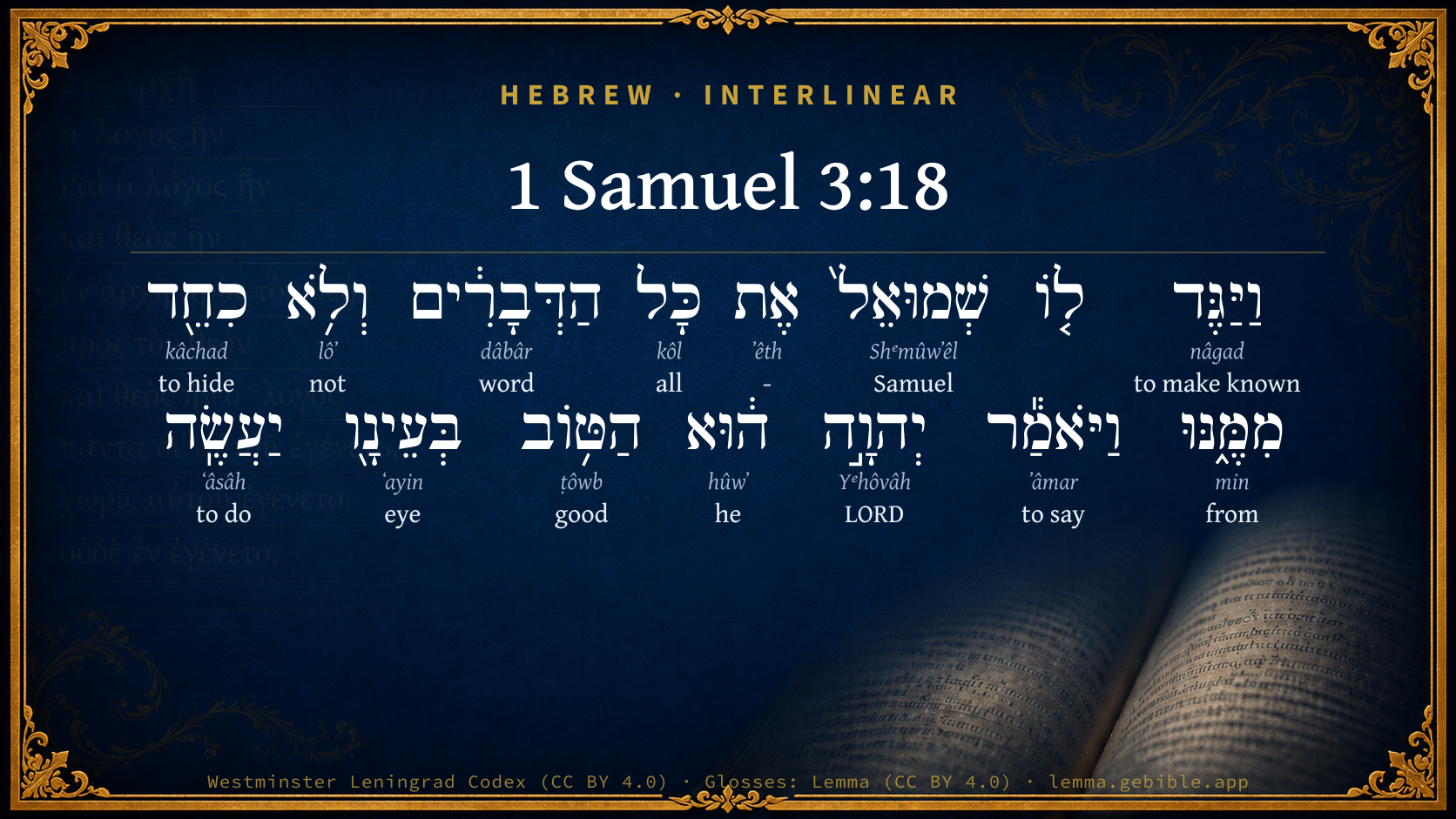
  1. וַיַּגֶּד nâgad H5046 “and · to make known” Conjunction + Verb, Hiphil, Sequential Imperfect, 3rd Person, Masculine, Singular
  2. שְׁמוּאֵל֙ Shᵉmûwʼêl H8050 “Samuel” Noun, Proper
  3. אֶת ʼêth H853 “-” Particle, Direct Object
  4. כָּל kôl H3605 “all of” Noun, Common, Masculine, Singular, Construct
  5. הַדְּבָרִ֔ים dâbâr H1697 “the · words” Particle, Definite Article + Noun, Common, Masculine, Plural, Absolute
  6. וְלֹ֥א lôʼ H3808 “and · not” Conjunction + Particle, Negative
  7. מִמֶּ֑נּוּ min H4480 “from · us” Preposition + Suffix, Personal, 1st Person, Common, Plural
  8. וַיֹּאמַ֕ר ʼâmar H559 “and · to say” Conjunction + Verb, Qal, Sequential Imperfect, 3rd Person, Masculine, Singular
  9. יְהוָ֣ה Yᵉhôvâh H3068 “LORD” Noun, Proper
  10. ה֔וּא hûwʼ H1931 “he” Pronoun, Personal, 3rd Person, Masculine, Singular
  11. הַטּ֥וֹב ṭôwb H2896 “the · good” Particle, Definite Article + Adjective, Adjective, Masculine, Singular, Absolute
  12. בְּעֵינָ֖ו ʻayin H5869 “in/at · eyes · his” Preposition + Noun, Common, Both, Dual, Construct + Suffix, Personal, 3rd Person, Masculine, Singular
  13. יַעֲשֶֽׂה ʻâsâh H6213 “to do” Verb, Qal, Imperfect, 3rd Person, Masculine, Singular

About this verse

These counts appear in no published source. They are computed here, from the morphology-tagged text and Lemma’s own curated glosses. What Lemma adds →

15
words
14
distinct lemmas
Historical
section

Shared distinctive vocabulary

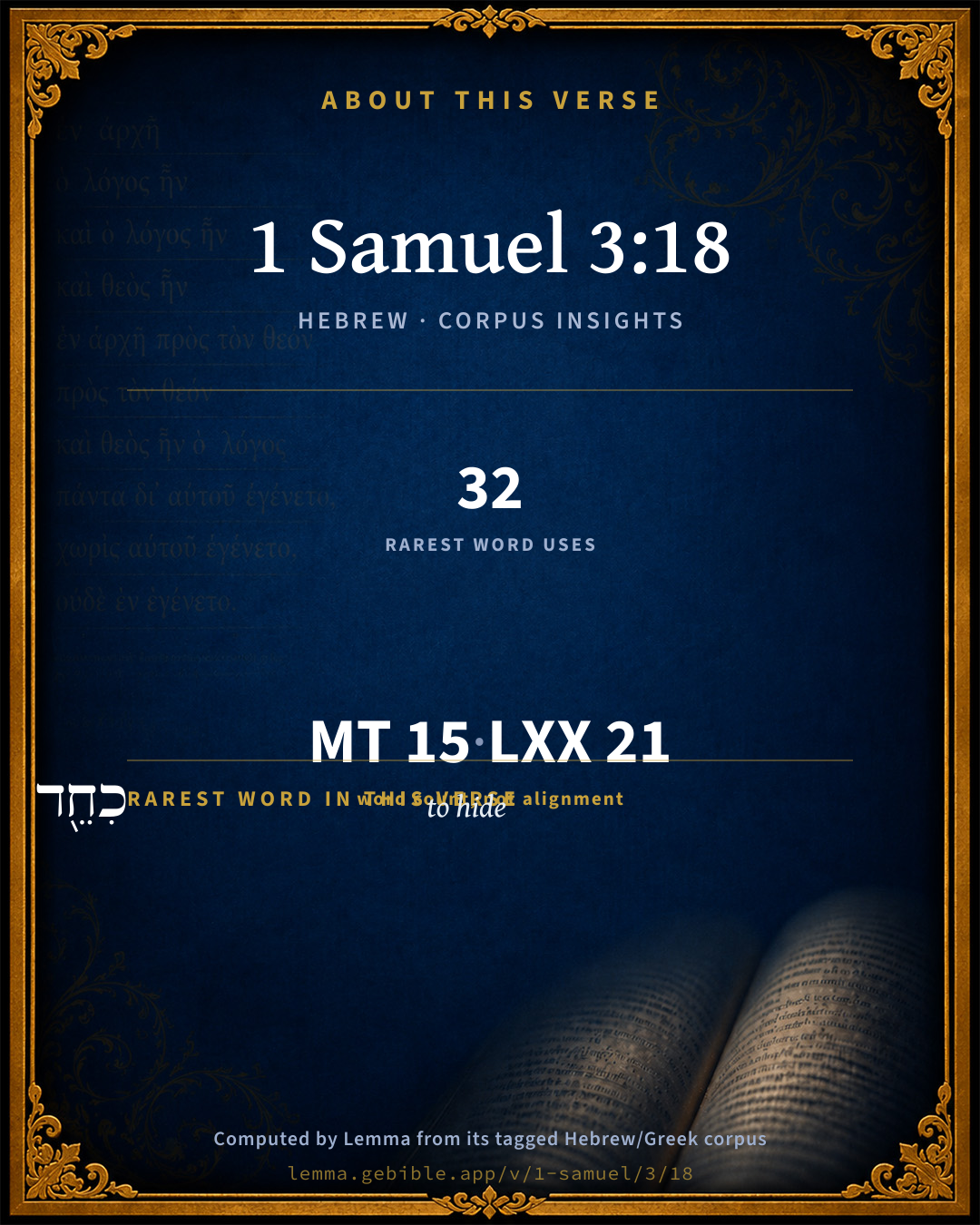
כִחֵ֖ד to hide H3582 occurs in 30 verses of the Hebrew Bible. Also found in:

Grammatical profile

  • 4 verbs
  • 5 nouns
  • 1 adjective
  • 1 pronoun
  • 2 prepositions
  • 2 particles

Verb forms

  • וַיַּגֶּד Hiphil · Sequential Imperfect
  • כִחֵ֖ד Piel · Perfect
  • וַיֹּאמַ֕ר Qal · Sequential Imperfect
  • יַעֲשֶֽׂה Qal · Imperfect

Hebrew & Septuagint length

In English translation the verse runs 22 words from the Hebrew and 29 from the Septuagint (LXX English) — closely comparable.

A rough comparison of the two English renderings, which tokenize alike — not a word-level alignment.

Word counts can differ between the Hebrew and the Greek without any difference in meaning — e.g. the Hebrew direct-object marker אֵת has no separate Greek word, and Greek often adds the article ὁ.

In the original languages it is 15 Hebrew tokens and 21 Greek tokens — but the two are counted differently (Hebrew bundles its prefixes and suffixes into one token; the Greek is in lemma form), so that isn’t a like-for-like length.

Cross-references

9

Topical passages linked to 1 Samuel 3:18 in the Treasury of Scripture Knowledge — connected by theme and wording, ordered by reader-vote popularity; previews shown in the World English Bible.

  • Job 2:10 But he said to her, "You speak as one of the foolish women would speak. What? Shall we receive good at the hand of God, and shall we not receive evil?" In all this Job didn't sin with his lips.
  • Isaiah 39:8 Then said Hezekiah to Isaiah, Good is the word of Yahweh which you have spoken. He said moreover, For there shall be peace and truth in my days.
  • Judges 10:15 The children of Israel said to Yahweh, We have sinned: do you to us whatever seems good to you; only deliver us, we pray you, this day.
  • 1 Peter 5:6 Humble yourselves therefore under the mighty hand of God, that he may exalt you in due time;
  • Job 1:21 He said, "Naked I came out of my mother's womb, and naked shall I return there. Yahweh gave, and Yahweh has taken away. Blessed be the name of Yahweh."
  • Psalms 39:9 I was mute. I didn't open my mouth, Because you did it.
  • Lamentations 3:39 Why does a living man complain, a man for the punishment of his sins?
  • Genesis 18:25 Be it far from you to do things like that, to kill the righteous with the wicked, that so the righteous should be as the wicked. May that be far from you. Shouldn't the Judge of all the earth do right?"
  • 2 Samuel 16:10–12 The king said, What have I to do with you, you sons of Zeruiah? Because he curses, and because Yahweh has said to him, Curse David; who then shall say, Why have you done so?

Cross-references courtesy of OpenBible.info (CC BY 4.0).

Hebrew and Greek witnesses Masoretic Hebrew ↔ Greek Septuagint

The same verse in the two great witnesses to the Old Testament, shown verse-for-verse.

These are two independent witnesses, not word-aligned to each other, and the Septuagint is shown in lemma (dictionary) form.

Hebrew 1 Samuel 3:18 Masoretic · Westminster Leningrad Codex

וַיַּגֶּד ל֤וֹ שְׁמוּאֵל֙ אֶת כָּל הַדְּבָרִ֔ים וְלֹ֥א כִחֵ֖ד מִמֶּ֑נּוּ וַיֹּאמַ֕ר יְהוָ֣ה ה֔וּא הַטּ֥וֹב בְּעֵינָ֖ו יַעֲשֶֽׂה

Samuel told him every whit, and hid nothing from him. He said, It is Yahweh: let him do what seems him good.

World English Bible · Public Domain

Greek LXX 1 Samuel 3:18 Septuagint · lemma form

καί ἀποἀγγέλλω σαμουηλ πᾶς ὁ λόγος καί οὐ κρύπτω ἀπό αὐτός καί εἶπον ηλι κύριος αὐτός ὁ ἀγαθός ἐνώπιον αὐτός ποιέω

And Samuel reported all the words, and hid them not from him. And Heli said, He is the Lord, he shall do that which is good in his sight.

LXX2012 (modern English Septuagint) · Public Domain

Hebrew: Westminster Leningrad Codex (CC BY 4.0). Greek: Septuagint (public domain); English from LXX2012 (modern English Septuagint) (Public Domain). How the Septuagint differs from the Hebrew →

Targum (Aramaic paraphrase)

1

The Targum is the ancient Jewish Aramaic paraphrase of the Hebrew Scriptures — an interpretive translation, not the Hebrew text itself. Onkelos (literal) and Pseudo-Jonathan (expansive) render the Torah, and Jonathan the Prophets. Coverage is partial: where no permissively-licensed English translation exists for a verse, only the Aramaic is shown. This is verse-level text, not a word-by-word alignment to the Hebrew.

  1. Targum Jonathan Prophets (Joshua–Malachi)
    וְחַוֵי לֵיהּ שְׁמוּאֵל יַת כָּל פִּתְגָמַיָא וְלָא כַסֵי מִנֵיהּ וַאֲמַר יְיָ הוּא דְתַקִין בְּעֵינוֹהִי יַעְבֵּיד:

    (no public-domain English translation for this verse)

    Targum Jonathan — Aramaic: “Mikraot Gedolot” (public domain). English: “Sefaria Community Translation” (CC0 1.0 (public-domain dedication)); “London "Chaldee Paraphrase," 1871” (public domain). Text via Sefaria.

Commentary

Notes on 1 Samuel 3:18 from classic Christian and Jewish commentators (each source and its license shown beneath its notes). The classic Christian expositions comment on the surrounding passage and are grouped to its opening verse, so a note may address several verses; the Jewish commentaries on the Tanakh (Rashi and others) are per-verse, so they appear only where the commentator wrote on this verse.

Lemma curates 59 commentaries, every one of them public domain or Creative Commons licensed, each selected and text-cleaned for this edition rather than reprinted as found. About our sources →

Trapp's Complete Commentary

John Trapp

1Sa 3:18 And Samuel told him every whit, and hid nothing from him. And he said, It [is] the LORD: let him do what seemeth him good.

Ver. 18. Told him every whit.] Bitter truths must be spoken, however they be taken; and if ministers be mannerly in the form, yet in the matter of their message let them be resolute.

It is the Lord.] Jehovah the Essentiator and the Promise keeper.

Let him do, {a} &c.] His holy will be done. This he speaketh not out of pervicacy or hypocrisy, as some have censured, but in a humble submission to his heavenly Father: for if Eli had been an ill father to his sons, yet he was a good son to God.

{a} Faciat quod vult, non discedo: Et si perire me volet, ipse perdat me, dum ego serve illi. - Tertul.

John Trapp, A Commentary or Exposition upon All the Books of the Old and New Testament (1647–1656) — public domain. Text from a community e-Sword module.

The Biblical Illustrator

Joseph S. Exell

1Sa_3:18

And Samuel told him every whit.

Speaking the truth in love

Samuel, so adjured, told him every whit, and hid nothing from him. How interesting it is to trace, at every stage of the history, the development of this holy childs character. He had been called to be a prophet, that is, an announcer of Gods word and will to His people. And what are the leading qualifications for the office of a prophet?

1. That he should speak the whole truth fully and without reserve.

2. He must speak the truth in love. He is not to speak harshly or bitterly, as if glorying in the prospect of sentence being executed, but tenderly, and in sympathy. What a good augury of his right discharge of the prophetical office--this fidelity combined with this sympathy! (Dean Goulburn.)

Samuels youthful virtues

1. His submission to Eli deserves particular notice. Early grace made him anxious to do well, and to obey those over him in the Lord.

2. Samuel showed great respect to Elis feelings. He had a regard for the feelings of the amiable old man, and had no desire to glory over him by being preferred as the channel of Divine communication, or to embitter his gray hairs by such mournful tidings. His conduct evinced great self-command and consideration for others--features of character of great worth and usefulness, and very beautiful in one so young. It is wrong even to tamper with the feelings of anyone, or to distress a heart unreasonably. There is a cruelty in annoying the aged by wantonly abusing them for the faults of other years, or reproaching them for the vices of their sons, or bearing to them the tales which irritate their souls, and make their lives unhappy, He was not forward to utter bad news, as young persons often are, but acted with becoming caution.

3. Samuels candour was remarkable. Samuels frank and candid statement is a model to every youth. (R. Steel.)

It is the Lord: let Him do what seemeth Him good.

I. A judicious discovery from whence all evils come. It is the Lord. He is omnipotent, and who hath withstood His power. He is just, and will bring no evil without good cause, He is wise, and whatsoever evil He bringeth He can draw it to a good end . . . He remaineth the same God in the fire and in the earthquake which He was in the still voice; the same when He slew the Israelites as when His light shone upon their tabernacle. His glorious attributes cross not one another. His justice taketh not from His mercy, nor His mercy from the equity of His justice; but He is just when He bindeth up, and merciful when He woundeth us . . . The same God that overthrew Pharaoh in the Red Sea, that slew great and mighty kings (Psa_136:15; Psa_136:17-18) did deliver up His own people, did deliver up the ark to Dagon: for His justice, His wisdom, and His mercy did endure forever.

II. A well-grounded resolution. Let us learn with Eli to kiss the Son, lest He be angry (Psa_2:12), nay, to kiss Him, and bow before Him when He is angry; to offer Him up a peace offering, our wills, of more power than a hecatomb, than all our numerous fasts and sermons, to appease His wrath . . . This is the truest surrendry we can make . . . I do not only obey God, and do what He would have me, but I am of His mind, saith the heathen Seneca. . . . The stubbornest knee may be made to bow, and obedience may be constrained. But the true Israelite doeth it with joy and readiness, and though he receive a blow he counteth it as a favour, for He that gave it hath taught him an art to make it so. (Anthony Faringdon.)

Peaceable fruit of righteousness

So long as things went well with Eli he had given no evidence of being one of Gods true children. But the sore pressure of Gods judgment upon him brings out the good in his character, which lay beneath the surface. The fragrant leaf must be crushed, before it will give out the perfume that is in it. The pebble must be cut and filed and rubbed by the jeweller, before the beautiful veining which runs through the heart of it can be brought to light. (Dean Goulburn.)

Archbishop Whitgift, when he was paralysed and his speech affected, could be heard to say nothing distinctly but this: Pro Ecclesia Dei, Pro Ecclesia Dei, (For the Church of God.) The Church of God was nearer to his heart than his own troubles and approaching death. (Dean Goulburn.)

Resignation in suffering

You are aware that in the Christian character there are what are called the active and the passive graces. It is not enough for us to ask what we do, but we must also ask how we suffer.

I. Let us attend to the nature of that submission to God of which we have an example in the memorable Eli.

1. Submission to God does not suppose insensibility to the afflictions under which we are called to cultivate it. We are allowed to mourn, though we are not allowed to murmur. Religion does not exact stoicism of its subjects.

2. This submission, in the second place, does not suppose that we are not to employ the means which are within our power, with a view to the prevention of evil. Our employment of means, with a view to prevent evil from falling upon us, is not at all inconsistent with a feeling of submission to the will of God.

3. Nor, in the third place, is prayer to God against evil, inconsistent with submission to Him under it, if He should see fit to visit us with it. We must not, indeed, open our mouth against God, but we may open our mouth to God.

But then, let us inquire what this submission actually implies.

1. Why, in the first place, it implies that we justify God in every thing that He does--that however much we may blame ourselves, we attach no blame to God. Now, this is something; and I am afraid it is more than all of us at all times experience.

2. But submission involves more than this: it involves in it, that we approve of all that God does.

3. Then, lastly, this submission supposes that we cleave to God in the midst of all.

II. Let us notice the grounds on which this submission to God rests. First, then, it rests on the sovereignty of God.

2. Then, secondly, on the ground of the righteousness and justice of God, we ought to submit to Him.

2. Then, again, the unchangeableness of God should also inspire us with a feeling of resignation and submission.

III. Some practical effects or fruits of this submission to God. Now, there are some evils which it will prevent, and there are some direct and absolute benefits which it will ensure. First, there are evils which it will prevent. It will prevent rash conclusions. Again, this submission to God will prevent immoderate sorrow. In the next place, this will prevent sinful staggerings. This is a scriptural phrase. It is said of Abraham that he staggered not. Sometimes a sudden affliction comes upon us; and, like a flash of lightning across our path, it surprises us. Then, as to the positive benefits which this feeling--this habit--this virtue of submission will insure to us, it will give us, in the first place, inward peace. Thou wilt keep him in perfect peace, whose mind is stayed on Thee. Therefore, this will also bring along with it enduring patience--a noble virtual Patience is one of the finest moral virtues! Lastly, another positive advantage is that it will excite praise and thanksgiving. The language, the spirit of the text, is not to be attained, perhaps, all at once. (J. E. Beaumont.)

Resignation to the Divine Will

Let us see what virtue Eli manifests in the text; then, how he displayed it; and, what lessons may be drawn from the subject.

I. The virtue.

1. It was conformity to the Will of God viewed in relation to God, this virtue is based upon the realisation of His goodness, and that therefore His will is always just and good and wise.

2. Further, that nothing happens unless it is designed or permitted by Him. Elis instinctive expression, It is the Lord, reveals the habit of his soul to discern Gods hand in all things.

3. But the words express the entire resignation of his own will to the will of God. In this lies the virtue. It was not a mere emotion, but an act of that within him must have been a habit. Difficult occasions do not create virtues, but call them into operation.

4. Holy Scripture supplies us with many instances of conformity of will to God, which is a law which holds good throughout the spiritual sphere, as that of gravitation does in the natural sphere: e.g. the answer of the Shunamite, when her child had died, It is well, or Peace (2Ki_4:26). Again, Jobs wonderful resignation, expressed by the words, The Lord gave, and the Lord hath taken away; blessed be the Name of the Lord (Job_1:21).

II. How displayed.

1. Promptly. There was no hesitation or delay. We know how, when some great loss is broken to us, for a time we are apt to be overwhelmed, dazed, and bewildered with grief, and want a little pause before we can gather ourselves together again and attempt to cry, Not my will, but Thine, be done. But with the aged Eli, the accents of resignation followed immediately upon the announcement of the evils which would befall him and his house. He apparently sustained the shock without perturbation, though evidently a man of deep affections.

2. Humbly. Men often disdain to be corrected by their juniors, but Eli displayed no such sensitiveness. Though judge and priest, he heard with humbleness of mind the tale of woes and denunciation from the lips of the innocent child, and expressed the justice of what God was about to bring upon him. Most painful and humiliating, and, as far as this life was concerned, irretrievable; yet no word of murmuring or self-defence escaped from his mouth.

3. Absolutely. Let Him do what seemeth Him good. Not what seemeth good to me. This is true liberty of spirit. So the greatness of Elis prompt, humble, and absolute resignation is accentuated by the consideration of the time when he lived and the circumstances of the period.

III. Lessons.

1. We are warned, by the judgments upon Eli and his family, of the momentousness of the duty of rebuking sin, and especially on the part of parents, rulers, and priests.

2. The practice of conforming the will to God in all the events of life, and that with the same features of promptness, lowliness, and entirety as Eli manifested, is the chief lesson from the text.

3. Further, to remember that we can learn conformity from the self-surrender of Christ to His Fathers will, especially in His Passion and death, and that we are aided in the production of this grace by the presence of the Holy Ghost; so that to say, Not my will, but Thine, be done, is easier for us than it was for Eli.

4. The root of his conformity of will comes to view at the moment of his death. He bore up when he heard the tidings of the great slaughter of the people, and that his two sons, Hophni and Phinehas, were dead; but when he was told that the ark of God was taken he fell backward and died. Evidently God, and the things of God--notwithstanding his past great and culpable negligence--held the first place in his heart; hence this submission to His Will. (Canon Hutchings, M. A.)

Faith surviving sorrow

A few weeks ago, in a city of Nebraska, I was holding meetings. There came to that city my dear friend, Commander Booth-Tucker. It was the city of Omaha. I shall never forget my talk with him there. I said to him, Commander, the passing of your beloved wife was one of the things that I freely confess I cannot understand. He looked at me across the breakfast table, his eyes wet with tears, and yet his face radiant with that light which never shone on sea or land, and he said to me, Dear man, do you not know that the Cross can only be preached by tragedy? Then he told me this incident: When I and my wife were last in Chicago, I was trying to lead a sceptic to Christ in a meeting. At last the sceptic said, with a cold, glittering eye and a sarcastic voice, It is all very well. You mean well; but I lost my faith in God when my wife was taken out of my horns. It is all very well; but if that beautiful woman at your side lay dead and cold by you, how would you believe in God? Within one month she had been taken through the awful tragedy of a railway accident, and the Commander went back to Chicago, and, in the hearing of a vast multitude, said, Here in the midst of the crowd, standing by the side of my dead wife as I take her to burial, I want to say that I still believe in God, and love Him, and know Him. (Campbell Morgan, D. D.)

The Biblical Illustrator, edited by Joseph S. Exell (c. 1880s–1900s) — public domain. Text from a community e-Sword module.

Joseph Benson's Commentary

1Sa 3:18. It is the Lord — This severe sentence is from the sovereign Lord of the world, who hath an absolute right to dispose of me and all his creatures; who is in a special manner the ruler of the people of Israel, to whom it properly belongs to punish all mine offences; whose chastisement I therefore accept. This was a pious and noble answer, and shows what a deep sense Eli had of the divine sovereignty over him, and the entire, implicit, and willing submission he owed to all God’s decrees, however hard they bore upon him. This ought to be our language; this ought to be the feeling of our hearts, under all the dispensations of the divine providence toward us, whether prosperous or adverse, whether pleasing or painful to flesh and blood. Under all, our will should be resigned, and all that is within us should say, It is the Lord; let him do what seemeth him good.

Joseph Benson's Commentary on the Old and New Testaments (1811–1818) — public domain. Text from a community e-Sword module.

Adam Clarke's Commentary

Verse 18. Samuel told him every whit] Our word whit, or wid, comes from the Anglo-Saxon [A.S.], which signifies person, thing, c. every whit is every thing. The Hebrew את כל הדברים et col haddebarim, "all these words."

It is the Lord] He is Sovereign, and will do what he pleases; he is righteous, and will do nothing but what is just.

Let him do what seemeth him good.] There is much of a godly submission, as well as a deep sense of his own unworthiness, found in these words. He also had sinned, so as to be punished with temporal death; but surely there is no evidence that the displeasure of the Lord against him was extended to a future state.

Adam Clarke's Commentary on the Bible (1810–1826) — public domain. Text from a community e-Sword/MySword module.

Ellicott's Commentary for English Readers

(18) It is the Lord.—Such a reply, and such a reception of the news of the terrible doom twice communicated to him by a direct message from the Eternal, indicates that Eli, in spite of his weakness and foolish partiality for his sons, was thoroughly devoted to the Lord in his heart. He saw how deeply he had failed in his high office, how he had allowed worldly considerations to influence his conduct, how he had been tried and found wanting; and now, without a murmur, he submits to the righteous judgment of his God, he leaves himself in God’s hands, and never tries to justify himself and his past conduct. Now it was probably too late to attempt any reformation in the priestly life. The influence and power of Hophni and Phinehas were too strong for his enfeebled will to set aside. Eli was probably in his last days little more than a puppet in their hands. He had sown the wind, and now must reap the whirlwind.

A Bible Commentary for English Readers, edited by Charles John Ellicott (1878–1897) — public domain. Text from a community e-Sword module.

The Cambridge Bible for Schools and Colleges

gen. ed. J. J. S. Perowne

18. every whit] Heb. ‘all the words,’ = every thing. Whit is derived from A.-S. wiht, thing.

It is the Lord] He is Jehovah. For the depth of meaning involved in this confession, see Exo_34:5-7. Eli, with all his faults, was still at heart faithful to God. He submits without a murmur to the divine sentence, leaving himself and his house in the hands of God. Compare the resignation of Aaron (Lev_10:3), Job (Job_1:21; Job_2:10), and Hezekiah (Isa_39:8). But it is the passive resignation of a weak character. Though he submits himself patiently to the will of God, he would not rouse himself to do it.

The Cambridge Bible for Schools and Colleges (gen. ed. J. J. S. Perowne; Cambridge University Press, 1878–1918) — public domain. Text from a community e-Sword module.

John Gill's Exposition

And Samuel told him every whit, and hid nothing from him,.... And so approved himself to be a faithful prophet of God, and man of God, as he is afterwards called; the whole counsel of God is to be declared by his servants the prophets, and the ministers of his word; nothing is to be concealed, which it is the will of God should be made known, whether it be pleasing or displeasing to man:

and he said, it is the Lord; that has said it, and there is nothing to be said against it, and that will do it; and there is no resisting him: or "the Lord is he" (w); who has a sovereign right to all his creatures, and may dispose of them as he pleases; he is all wise, and does all things well; he is holy and righteous in all his ways and works, and there is no unrighteousness in him; he is faithful to his word, whether in a way of promise or threatening; and all he does to his people is in love, mercy, and kindness:

let him do what seemeth him good; not what seems good to men, or is so in their esteem, but what seems good to the Lord, who knows what is best for his people, and can do nothing but what is good; all is good he does; there is nothing but goodness in him, and nothing but goodness comes from him; he does good, and nothing else, and even when he afflicts his people; all he does is well done in creation, providence, and grace: and Eli's desire is, that he would fulfil the good pleasure of his will; he appears to be in an excellent temper, not surly and morose, taking it ill that such a message should be sent him by a child; nor was he unaffected with the case of his family, but humbly submitted to the will of God, and acquiesces in it as good, and neither arraigns his justice, nor murmurs at his providences.

(w) , Sept. "Dominus ipse", Montanus.

John Gill's Exposition of the Whole Bible (1746–1763) — public domain (CC PDM 1.0). Text via the HelloAO Bible API.

Albert Barnes' Notes on the Bible

It is the Lord ... - Compare the devout submission of Aaron Lev 10:3, and of Hezekiah 2Ki 20:19. And, for the highest conceivable submission to the will of God, compare Luk 22:42.

Albert Barnes' Notes on the Bible (1834–1885) — public domain. Text from a community e-Sword/MySword module.

Haydock's Catholic Bible Commentary

Sight. Some of the Fathers think that these words proceeded from an habitual indifference, as he was not disposed to molest his sons any farther, let the consequences be what they might. (St. Gregory; St. Ephrem, &c.) --- But others believe, that Heli was actuated by the spirit of humanity and resignation, and saved his soul. (Calmet) See chap. iv. 18. --- Years. The author of the Concord. between the Books of Kings and of Chronicles, thinks Samuel was then 39. (Du Hamel)

George Leo Haydock (1774–1849), Haydock's Catholic Family Bible and Commentary, 1859 edition — public domain. Excludes Psalms (Douay-Rheims chapter numbering differs from Protestant) and Deuterocanonical books (Catholic canon only).

Matthew Poole's English Annotations

This severe sentence is from the sovereign Lord of the world, who hath an absolute power and right to dispose of me and all his creatures as he pleaseth, to whose good pleasure I therefore freely submit: from Israel’s God, who was known by this name of Jehovah, who is in a special manner the ruler of the people of Israel, to whom it properly belongs to punish all mine offences, whose chastisement I therefore accept.

Matthew Poole's English Annotations on the Holy Bible (1683–1685) — public domain. Text from a community e-Sword/MySword module.

The Pulpit Commentary

Resignation.

is the Lord: let him do what seemeth him good." The sentence which was pronounced on Eli and his house was almost as severe as can be conceived. But the manner in which it was received by him shows that, notwithstanding the defects of his character, he possessed the "spirit of faith," which shone like a spark of fire amidst the ashes and gloom of his closing days. He did not refuse to admit its Divine Author, did not question its justice, did not rebel against it and seek to reverse it, did not fret and murmur and give himself up to despair. His language expresses a spirit the exact opposite of all this. "When Samuel had told him every whit, Eli replied, It is the Lord. The highest religion could say no more. What more can there be than surrender to the will of God? In that one brave sentence you forget all Eli"s vacillation. Free from envy, free from priestcraft, earnest, humbly submissive; that is the bright side of Eli"s character, and the side least known or thought of" (F.W. Robertson).

I HE RECOGNISES THE APPOINTMENT OF GOD. "It is the Lord," or "he is the Lord," who has spoken. He believed that the voice was really his, notwithstanding

(1) it came to him indirectly through the agency of another;

(2) it came in an unexpected manner; and

(3) it announced what he naturally disliked to hear, and what was most grievous. These things sometimes dispose men to doubt "the word of the Lord," and are made excuses for rejecting it. It is not, in its mode of communication or in its contents, "according to their mind." But the spirit of faith ventures not to dictate to God how or what he shall say, and it perceives the Divine voice when those who are destitute of it perceive only what is purely natural and human.

II HE JUSTIFIES THE RECTITUDE OF GOD. Such justification (Psa_51:4)

1. Is implied in the acknowledgment that it comes from Jehovah, who alone is holy. (1Sa_2:2) "Shall not the Judge of all the earth do right?". (Gen_18:25)

2. Proceeds from the conviction that it is deserved on account of the iniquity of his sons, and his own sins of omission (Lam_3:39; Mic_7:9) They who have a due sense of the evil of sin are not disposed to complain of the severity of the sentence pronounced against it.

3. Is not the less real because not fully expressed, for silence itself is often the most genuine testimony to the perfect equity of the Divine procedure. "Aaron held his peace" (Lev_10:3; Psa_39:9, Psa_39:11)

III HE SUBMITS TO THE SOVEREIGNTY OF GOD. "Let him do what seemeth him good.

1. Very reverently and humbly. (1Pe_5:6) It is vain to contend against him.

2. Freely and cheerfully; not because he cannot be effectually resisted, but because what he does is right and good; the spontaneous surrender and sacrifice of the will.

3. Entirely. "The will of the Lord be done". (Act_21:14)

IV HE CONFIDES IN THE GOODNESS OF GOD. "Good." "Good is the word of the Lord". (2Ki_20:19) Eli could not have spoken as he did unless he believed that

(1) God is merciful and gracious;

(2) in wrath remembers mercy, mitigating the force of the storm to all who seek shelter in his bosom; and

(3) "out of evil still educes good". (Rom_8:28) Let us be thankful for the surpassing motives and influences afforded to us under the gospel (2Co_4:17; Heb_4:15 Heb_12:10, Heb_12:11; Rev_21:4 Rev_22:3) D.

The Pulpit Commentary (1880–1919), ed. H.D.M. Spence-Jones & Joseph S. Exell — public domain. Text from a community e-Sword module.

John Wesley's Explanatory Notes

It is the Lord - This severe sentence is from the sovereign Lord of the world, who hath an absolute right to dispose of me and all his creatures; who is in a special manner the ruler of the people of Israel, to whom it properly belongs to punish all mine offenses; whose chastisement I therefore accept.

John Wesley, Explanatory Notes Upon the Whole Bible (1754–1765) — public domain. Text via the GEBible commentary corpus.

Rashi

Rabbi Shlomo Yitzchaki (Rashi)

He is Adonoy. He is the Master and everything is His.

Rashi on the Tanakh — English translations: “The Judaica Press complete Tanach with Rashi, translated by A. J. Rosenberg” (CC BY 4.0); “Pentateuch with Rashi's commentary by M. Rosenbaum and A.M. Silbermann, 1929-1934” (public domain); “The Metsudah Tanach series, Lakewood, N.J” (CC BY 4.0); and “The Book of Joshua, Metsudah Publications, 1997” (CC BY 4.0). Text via Sefaria.

Lesson kit

Teaching starters — assembled from the data on this page, not authored interpretation. Every prompt links to the verse data it draws on. Edit before teaching.

1 Samuel, in the Historical, opens this verse with 15 words (14 distinct Hebrew lemmas). Its most distinctive word is kâchad (“to hide”). A historical commentator’s framing appears above. Read the whole chapter for the surrounding context.

Discussion questions

  1. What does “to hide” (kâchad) contribute to the verse as a whole?
  2. Genesis 47:18 shares the word «to hide» with this verse. How do the two illuminate each other?
  3. These translations render this verse differently. What is at stake in choosing one wording over another?
  4. The verb «וַיַּגֶּד» is Hiphil Sequential Imperfect. How does its form color the action?
  5. Reading how Trapp's Complete Commentary and The Biblical Illustrator read this verse, where do the two commentators agree and where do they part?

Things to notice

Reading settings

Reading text

Shown beneath each verse's original-language words.

Old Testament
Old Testament edition

Read the OT as the Masoretic Hebrew (MT) or the Greek Septuagint (LXX).

English shown for the Greek Septuagint (in the Hebrew ↔ Greek comparison).

Comparing translations? Open the Compare panel on any verse page to stack up to four side by side.