
1 Samuel 15:34

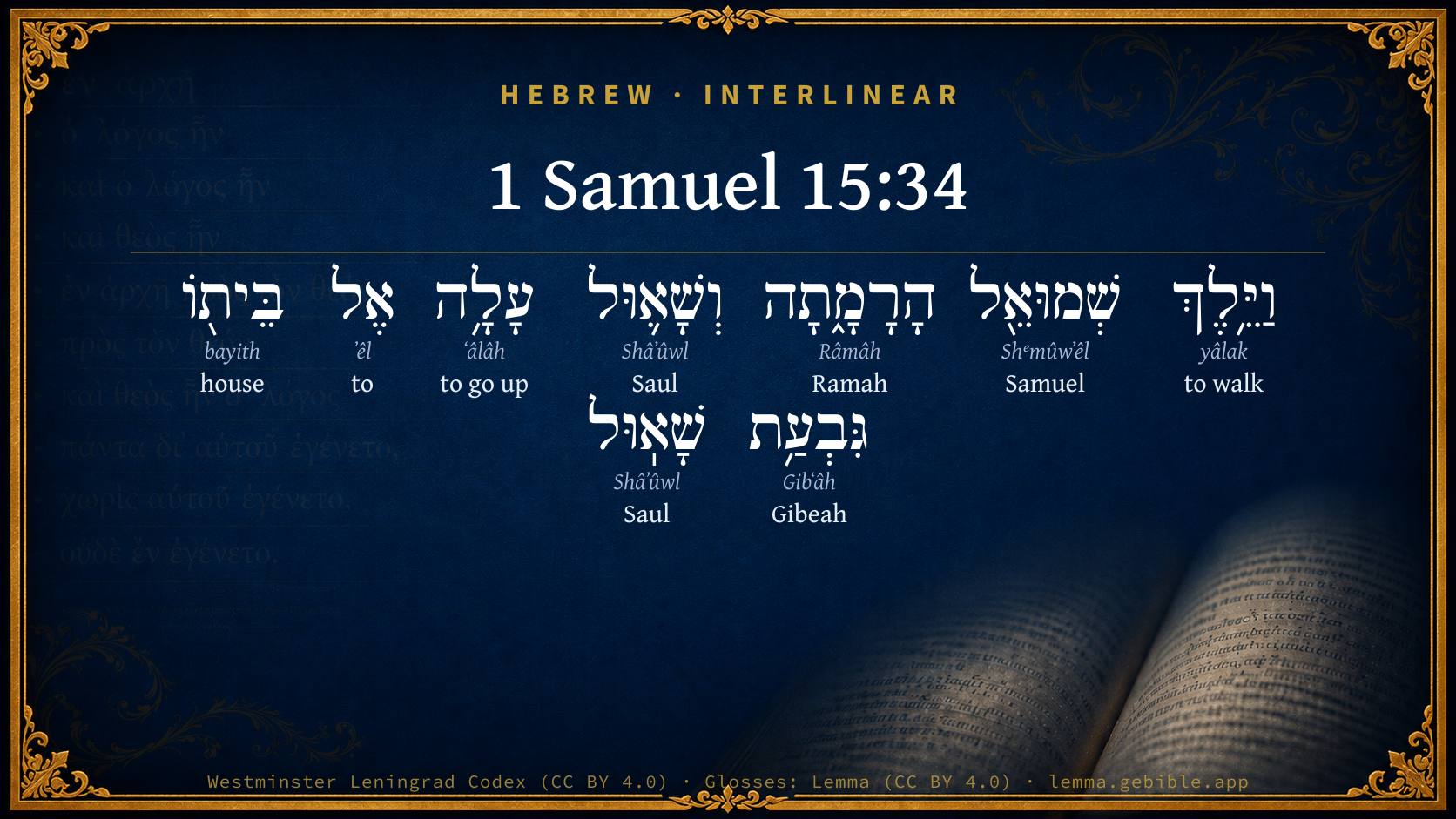
Hebrew (Westminster Leningrad Codex) 1 Samuel 15:34 appears in the Hebrew Old Testament. The text above is from the Westminster Leningrad Codex. Each word links to its Strong’s number, a concise gloss, and parsing drawn from the Open Scriptures Hebrew Bible morphology. Click any word for its full Brown-Driver-Briggs (BDB) entry.
Download image
Cite this verse

1 Samuel 15:34 (World English Bible). Public Domain. Lemma interlinear Bible study tool, https://lemma.gebible.app/v/1-samuel/15/34.

Show BibTeX & RIS
BibTeX
RIS
English Translation
Then Samuel went to Ramah; and Saul went up to his house to Gibeah of Saul.
World English Bible · Public Domain
Download a study sheet

One document with this verse’s original text, its word-by-word gloss line, the meaning frame, cross-references with their text, attributed commentary, and full source and license credits — printable, and it pastes into notes with its structure intact.

This verse Autodidact and up

Study sheet (.html) Plain text (.txt)

A passage Seminary Student

Up to 50 verses in one chapter. A passage sheet keeps up to 6 commentary sources and 12 cross-references per verse, in the order this page ranks them, and says so on the sheet whenever that leaves anything out. Ask for a single verse and you get the Autodidact verse sheet above.

Everything on this page stays free to read, with no account — the sheet is a download of what is already on screen, not access to it.

Want to remove ads? Support Godless Engineer
Compare translations 3

The same verse in 3 English versions, stacked beneath the original-language interlinear above. Click any original word for its lexicon entry.

Each is an independent rendering of the whole verse — the interlinear is not word-aligned to these translations.

Highlighted words mark where these versions differ — a whole-verse word diff, not a word-by-word alignment.

  • World English Bible Public Domain
    Then Samuel went to Ramah; and Saul went up to his house to Gibeah of Saul.
  • King James Version Public Domain
    Then Samuel went to Ramah; and Saul went up to his house to Gibeah of Saul.
  • unfoldingWord Literal Text CC BY-SA 4.0
    Then Samuel went to Ramah, and Saul went up to his house Gibeah of Saul.

unfoldingWord Literal Text — © unfoldingWord, licensed CC BY-SA 4.0. Word-aligned USFM3 via Door43 (git.door43.org/unfoldingWord/en_ult).

Versions to compare (up to 4)

3 of 4 selected

Show all 18 translations

Every available English version of this verse, each an independent rendering of the whole verse.

  • World English Bible Public Domain
    Then Samuel went to Ramah; and Saul went up to his house to Gibeah of Saul.
  • Berean Standard Bible Public Domain
    Then Samuel went to Ramah, but Saul went up to his home in Gibeah of Saul.
  • Majority Standard Bible Public Domain
    Then Samuel went to Ramah, but Saul went up to his home in Gibeah of Saul.
  • King James Version Public Domain
    Then Samuel went to Ramah; and Saul went up to his house to Gibeah of Saul.
  • American Standard Version (1901) Public Domain
    Then Samuel went to Ramah; and Saul went up to his house to Gibeah of Saul.
  • Revised Version (1885) Public Domain
    Then Samuel went to Ramah; and Saul went up to his house to Gibeah of Saul.
  • Geneva Bible (1599) Public Domain
    So Samuel departed to Ramah, and Saul went vp to his house to Gibeah of Saul.
  • Douay-Rheims (1899) Public Domain
    And Samuel departed to Ramatha: but Saul went up to his house in Gabaa.
  • Young's Literal Translation Public Domain
    And Samuel goeth to Ramath, and Saul hath gone unto his house -- to Gibeah of Saul.
  • Literal Standard Version CC BY-SA 4.0
    And Samuel goes to Ramath, and Saul has gone to his house—to Gibeah of Saul.
  • Unlocked Literal Bible CC BY-SA 4.0
    Samuel went to Ramah, and Saul went up to his house at Gibeah of Saul.
  • unfoldingWord Literal Text CC BY-SA 4.0
    Then Samuel went to Ramah, and Saul went up to his house Gibeah of Saul.
  • Darby Bible Public Domain
    And Samuel went to Ramah; and Saul went up to his house to Gibeah of Saul.
  • World Messianic Bible Public Domain
    Then Samuel went to Ramah; and Saul went up to his house to Gibeah of Saul.
  • Webster's Bible Public Domain
    Then Samuel went to Ramah; and Saul went up to his house to Gibeah of Saul.
  • Free Bible Version CC BY-SA 4.0
    Samuel left for Ramah, and Saul went home to his town called Gibeah of Saul.
  • Bible in Basic English Public Domain
    Then Samuel went to Ramah; and Saul went up to his house in Gibeah, in the land of Saul.
  • JPS Tanakh (1917) Public Domain
    Then Samuel went to Ramah; and Saul went up to his house to Gibeath-shaul.

Literal Standard Version (2020), Covenant Press — licensed CC BY-SA 4.0. Text via the HelloAO Bible API (eBible.org). Unlocked Literal Bible (unfoldingWord) — licensed CC BY-SA 4.0. Text via the HelloAO Bible API (eBible.org). unfoldingWord Literal Text — © unfoldingWord, licensed CC BY-SA 4.0. Word-aligned USFM3 via Door43 (git.door43.org/unfoldingWord/en_ult). Free Bible Version, Dr. Jonathan Gallagher — licensed CC BY-SA 4.0. Text via the HelloAO Bible API (eBible.org).

Word by word

More ways to search: Search by grammar → Find every occurrence → Compare this word →

Practice this passage: Drill this verse → Learn its vocabulary →

הָרָמָ֑תָה
Râmâh
H7414
“the · Ramah · toward”
Particle, Definite Article + Noun, Proper + Suffix, Demonstrative
Part of Speech
Particle + Noun
Type
Proper
Full BDB Definition

Origin: the same as H7413

TWOT: None

Ramah = "hill" - a town in Benjamin on the border of Ephraim about 5 miles (8 kilometers) from Jerusalem and near to Gibeah - the home place of Samuel located in the hill country of Ephraim - a fortified city in Naphtali - landmark on the boundary of Asher, apparently between Tyre and Zidon - a place of battle between Israel and Syria - also 'Ramoth-gilead' - a place rehabited by the Benjamites after the return from captivity
  1. וַיֵּ֥לֶךְ yâlak H3212 “and · to walk” Conjunction + Verb, Qal, Sequential Imperfect, 3rd Person, Masculine, Singular
  2. שְׁמוּאֵ֖ל Shᵉmûwʼêl H8050 “Samuel” Noun, Proper
  3. וְשָׁא֛וּל Shâʼûwl H7586 “and · Saul” Conjunction + Noun, Proper
  4. עָלָ֥ה ʻâlâh H5927 “to go up” Verb, Qal, Perfect, 3rd Person, Masculine, Singular
  5. אֶל ʼêl H413 “to” Preposition
  6. בֵּית֖וֹ bayith H1004 “house · his” Noun, Common, Masculine, Singular, Construct + Suffix, Personal, 3rd Person, Masculine, Singular
  7. גִּבְעַ֥ת Gibʻâh H1390 “Gibeah” Noun, Proper
  8. שָׁאֽוּל Shâʼûwl H7586 “Saul” Noun, Proper

About this verse

These counts appear in no published source. They are computed here, from the morphology-tagged text and Lemma’s own curated glosses. What Lemma adds →

9
words
8
distinct lemmas
Historical
section

Shared distinctive vocabulary

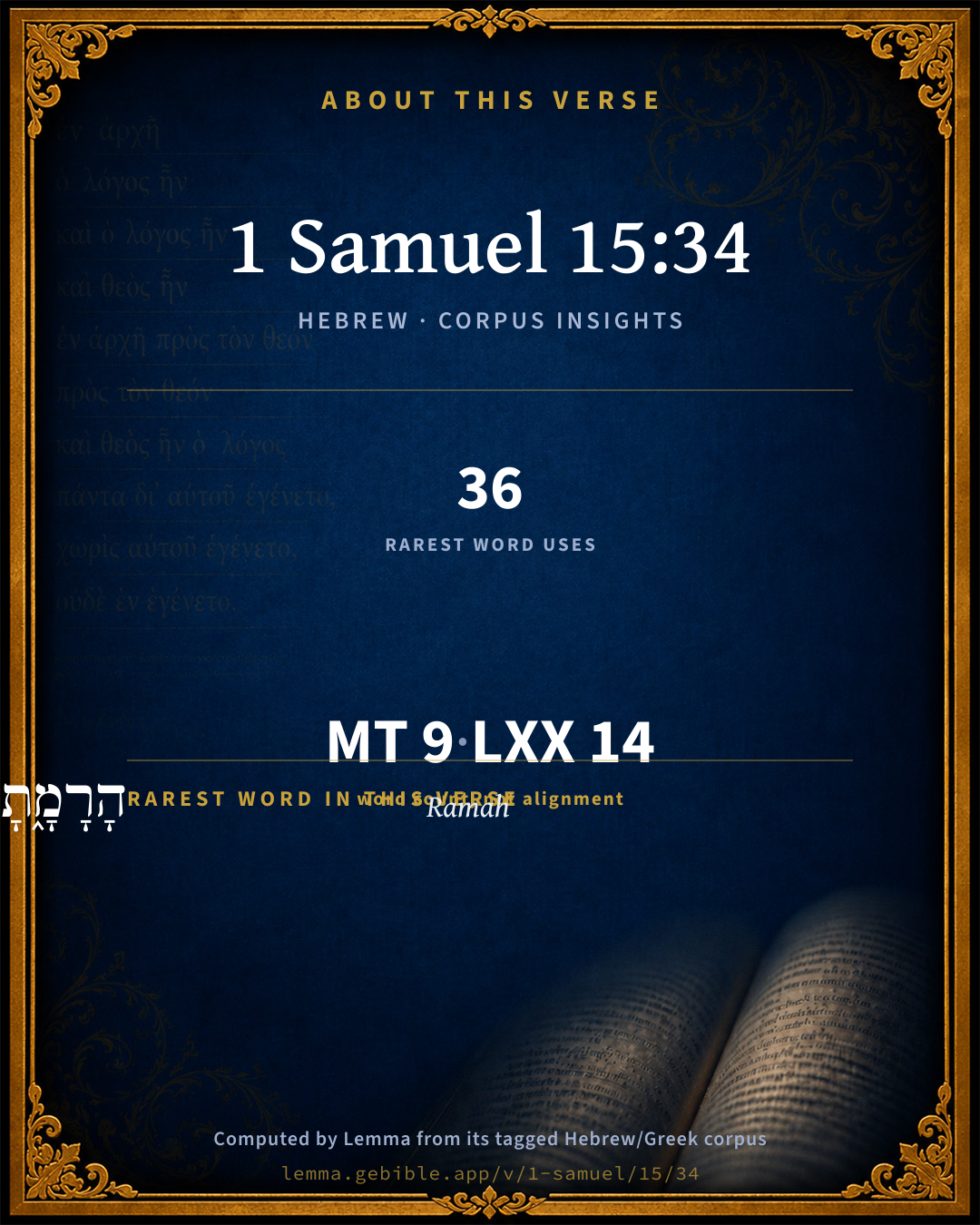
הָרָמָ֑תָה Ramah H7414 occurs in 34 verses of the Hebrew Bible. Also found in:

Grammatical profile

  • 2 verbs
  • 6 nouns
  • 1 preposition

Verb forms

  • וַיֵּ֥לֶךְ Qal · Sequential Imperfect
  • עָלָ֥ה Qal · Perfect

Repetition

A word recurs within this verse — often emphatic in Hebrew:

  • וְשָׁא֛וּל Saul H7586 ×2

Hebrew & Septuagint length

In English translation the verse runs 16 words from the Hebrew and 14 from the Septuagint (LXX English) — closely comparable.

A rough comparison of the two English renderings, which tokenize alike — not a word-level alignment.

Word counts can differ between the Hebrew and the Greek without any difference in meaning — e.g. the Hebrew direct-object marker אֵת has no separate Greek word, and Greek often adds the article ὁ.

In the original languages it is 9 Hebrew tokens and 14 Greek tokens — but the two are counted differently (Hebrew bundles its prefixes and suffixes into one token; the Greek is in lemma form), so that isn’t a like-for-like length.

Cross-references

2

Topical passages linked to 1 Samuel 15:34 in the Treasury of Scripture Knowledge — connected by theme and wording, ordered by reader-vote popularity; previews shown in the World English Bible.

  • 1 Samuel 11:4 Then came the messengers to Gibeah of Saul, and spoke these words in the ears of the people: and all the people lifted up their voice, and wept.
  • 1 Samuel 7:17 His return was to Ramah, for there was his house; and there he judged Israel: and he built there an altar to Yahweh.

Cross-references courtesy of OpenBible.info (CC BY 4.0).

Hebrew and Greek witnesses Masoretic Hebrew ↔ Greek Septuagint

The same verse in the two great witnesses to the Old Testament, shown verse-for-verse.

These are two independent witnesses, not word-aligned to each other, and the Septuagint is shown in lemma (dictionary) form.

Hebrew 1 Samuel 15:34 Masoretic · Westminster Leningrad Codex

וַיֵּ֥לֶךְ שְׁמוּאֵ֖ל הָרָמָ֑תָה וְשָׁא֛וּל עָלָ֥ה אֶל בֵּית֖וֹ גִּבְעַ֥ת שָׁאֽוּל

Then Samuel went to Ramah; and Saul went up to his house to Gibeah of Saul.

World English Bible · Public Domain

Greek LXX 1 Samuel 15:34 Septuagint · lemma form

καί ἀποἔρχομαι σαμουηλ εἰς αρμαθαιμ καί σαούλ ἀναβαίνω εἰς ὁ οἶκος αὐτός εἰς γαβαα

And Samuel departed to Armathaim, and Saul went up to his house at Gabaa.

LXX2012 (modern English Septuagint) · Public Domain

Hebrew: Westminster Leningrad Codex (CC BY 4.0). Greek: Septuagint (public domain); English from LXX2012 (modern English Septuagint) (Public Domain). How the Septuagint differs from the Hebrew →

Targum (Aramaic paraphrase)

1

The Targum is the ancient Jewish Aramaic paraphrase of the Hebrew Scriptures — an interpretive translation, not the Hebrew text itself. Onkelos (literal) and Pseudo-Jonathan (expansive) render the Torah, and Jonathan the Prophets. Coverage is partial: where no permissively-licensed English translation exists for a verse, only the Aramaic is shown. This is verse-level text, not a word-by-word alignment to the Hebrew.

  1. Targum Jonathan Prophets (Joshua–Malachi)
    וַאֲזַל שְׁמוּאֵל לְרָמָתָא וְשָׁאוּל סְלִיק לְבֵיתֵיהּ לְגִבְעֲתָא דְשָׁאוּל:

    (no public-domain English translation for this verse)

    Targum Jonathan — Aramaic: “Mikraot Gedolot” (public domain). English: “Sefaria Community Translation” (CC0 1.0 (public-domain dedication)); “London "Chaldee Paraphrase," 1871” (public domain). Text via Sefaria.

Commentary

Notes on 1 Samuel 15:34 from classic Christian and Jewish commentators (each source and its license shown beneath its notes). The classic Christian expositions comment on the surrounding passage and are grouped to its opening verse, so a note may address several verses; the Jewish commentaries on the Tanakh (Rashi and others) are per-verse, so they appear only where the commentator wrote on this verse.

Lemma curates 59 commentaries, every one of them public domain or Creative Commons licensed, each selected and text-cleaned for this edition rather than reprinted as found. About our sources →

Trapp's Complete Commentary

John Trapp

1Sa 15:34 Then Samuel went to Ramah; and Saul went up to his house to Gibeah of Saul.

Ver. 34. Then Samuel.] Little caring for one another’s company.

John Trapp, A Commentary or Exposition upon All the Books of the Old and New Testament (1647–1656) — public domain. Text from a community e-Sword module.

Geneva Bible (1599)

Geneva Bible translators

Where his house was.

Geneva Bible (1599) marginal notes — public domain. Text via Bolls.life.

John Gill's Exposition

And Samuel came no more to see Saul until the day of his death,.... Or "added not to see him" (x); not that he saw him no more, he saw him afterwards, Sa1 19:24, but it was accidentally, he did not go to see him, but Saul came to him; and Abarbinel supposes he might not see him then, but hid his face from him; and he observes that it is said:

until the day of his death; which intimates, he thinks, that he saw him after his death, when raised up by the witch of Endor; but that Samuel was then really raised, and was seen, wants proof. The meaning of the expression here is no more than this, that Samuel afterwards did not visit Saul as he used to do; he did not go to him, to give him his advice and counsel, as he wonted:

nevertheless Samuel mourned for Saul; because of his sin, his impenitence, and hypocrisy; and because of the loss of the kingdom to him, and to his posterity; and he might be concerned also about his eternal welfare; for he appears to have a natural affection for him, and was far from envying him as his rival, and rejoicing at his fall:

and the Lord repented that he made Saul king over Israel; nor was his mind altered, neither by the hypocritical confession of Saul, nor by the cordial prayers and heart of Samuel; see Sa1 15:11.

(x) "et non addidit ad videndum", Montanus.

Next: 1 Samuel Chapter 16

John Gill's Exposition of the Whole Bible (1746–1763) — public domain (CC PDM 1.0). Text via the HelloAO Bible API.

The Pulpit Commentary

Vers. 34, 35. (GILGAL.)

A melancholy parting.

The interview between Samuel and Saul was now ended. "It was a fearful meeting; it was followed by a lifelong parting." The earlier course of Saul (from the time the prophet met him in the gate at Ramah) was marked by modesty, prudence, generosity, and lofty spiritual impulses, and was one of brilliant promise. His subsequent course (from his first wrong step before the war of Michmash), although distinguished by external prosperity, was marked, by self-will, presumption, disobedience, and selfishness, and was one of rapid degeneracy. How must the prophet have lamented as he saw the wreck of that early brightened life!" On his part, more especially, the separation was

I NEEDFUL. A good man is compelled to separate from those to whom he has given his counsel and aid

1. When from lack of sympathy and opposition of aim he can no longereffectively cooperate with them.

2. When he cannot hope to exert a beneficial influence upon them.

3. When his continuance with them affords a sanction to a course which hecannot approve. His parting" is a condemnation of it, and is rendered necessary by truth and righteousness. "God"s ambassador was recalled from him; the intercourse of the God of Israel came to an end because Saul, sinking step by step away from God, had by continued disobedience and increasing impenitence given up communion with God" (Erdmann). "Had he spared this spiritual child, when to spare him would have been contrary to the fundamental law of the theocracy, the worst possible precedent would have been afforded for future ages by this first king" (Ewald).

II RESPECTFUL. Samuel acceded to the request of Saul to honour him before the people; and although it is not stated how far he participated with him in worship, yet he evidently avoided an open and violent rupture with him, and gave him honour, as civil ruler, to the last. Respect is due "not only to the good and gentle, but also to the froward," on account of

1. The authority and power that may be intrusted to them in the providenceof God. (Rom_13:1)

2. The natural dignity of man great in ruin, capable of restoration, andsusceptible to the influence of kindness or contempt. Jesus did not resent the kiss with which Judas betrayed him, but said, "Friend, wherefore comest thou hither?

3. The requirements of social order and peace. Saul was even yet the bestking the people were fit to receive, and the conduct of Samuel indicated the duty of submission, which, in the spirit of their king, they were not always disposed to render (ver. 24; 1Sa_14:45)

III SORROWFUL. "Nevertheless Samuel mourned for Saul." With heavy heart and weary feet the old prophet took his way up from Gilgal to Ramah, and mourned for Saul, who, on the opposite hill of Gibeah, pursued his wilful way, bringing upon himself and Israel inevitable and overwhelming woe; alive, yet dead; so near, yet so completely lost.

1. What object is more mournful than a soul "going astray" from God?

2. What sorrow is too great at such a sight?

3. How vast is that Divine sorrow of which the human is the product andreflection! "And the Lord repented," etc. The prophetic spirit is one of wide and deep sympathy at once with God and man, and it was perfectly possessed by "the Man of sorrows." "Samuel mourned for Saul, but we do not hear that Saul mourned for himself.

IV FINAL. He "came no more to see Saul gave him counsel no more as aforetime, which indeed was not desired; and he only saw him once again, when he forced himself into his presence (ch. 19:24). When good men are compelled by the conduct of the wicked to separate from them, the parting

1. Deprives the latter of incalculable benefits, however lightly they may beestimated at the time.

2. Tends to increase the moral distance between them, and render therestoration of their intercourse more and more impossible.

3. Is certain to be hereafter bitterly but vainly regretted (ch. 28:15, 18). Oh,the sad and perpetual separations that are caused by sin! The paths of Samuel and Saul (like those of Moses and Pharaoh, Paul and Demas) may be compared to the courses of two ships that meet on the ocean, and sail near each other for a season, not without danger of collision, and then part asunder, the one to reach a "desired haven," the other to make shipwreck and become a castaway. D.

The Pulpit Commentary (1880–1919), ed. H.D.M. Spence-Jones & Joseph S. Exell — public domain. Text from a community e-Sword module.

Keil & Delitzsch

C. F. Keil & F. Delitzsch

After the prophet had thus maintained the rights of Jehovah in the presence of Saul, and carried out the ban upon Agag, he returned to his own home at Ramah; and Saul went to his house at Gibeah. From that time forward Samuel broke off all intercourse with the king whom Jehovah had rejected. "For Samuel was grieved for Saul, and it repented the Lord that he had made Saul king," i.e., because Samuel had loved Saul on account of his previous election; and yet, as Jehovah had rejected him unconditionally, he felt that he was precluded from doing anything to effect a change of heart in Saul, and his reinstatement as king.

Keil & Delitzsch — Biblical Commentary on the Old Testament (1861–1891) — public domain (CC PDM 1.0). Text via the HelloAO Bible API. (Old Testament only.)

unfoldingWord translationNotes

Door43 World Missions Community

Ramah ... Gibeah

These are the names of places. (See: How to Translate Names)

went up to his house at Gibeah

Gibeah was higher in elevation than Gilgal where Saul and Samuel had been talking.

Samuel did not see Saul until the day of his death

This statement is very precise and should be translated carefully. Samuel died before Saul and did not see Saul again while he lived. However, Samuel did appear to Saul in 1 Samuel 28:11-19 after Samuel died.

translationWords

Ramah

house

mourn

unfoldingWord translationNotes — © Distant Shores Media and the Door43 World Missions Community, licensed CC BY-SA 4.0. Source: git.door43.org/Door43/en_tn.

Lesson kit

Teaching starters — assembled from the data on this page, not authored interpretation. Every prompt links to the verse data it draws on. Edit before teaching.

1 Samuel, in the Historical, opens this verse with 9 words (8 distinct Hebrew lemmas). Its most distinctive word is Râmâh (“Ramah”). A historical commentator’s framing appears above. Read the whole chapter for the surrounding context.

Discussion questions

  1. What does “Ramah” (Râmâh) contribute to the verse as a whole?
  2. How does Joshua 18:25, which shares the word «Ramah», read alongside this verse?
  3. What does the repetition of “Saul” (2× in this one verse) do in this verse?
  4. «וַיֵּ֥לֶךְ» is a Qal Sequential Imperfect verb. How does that grammatical form shape the action described?
  5. Compare how Trapp's Complete Commentary and Geneva Bible (1599) read this verse. Where do they agree or differ?

Things to notice

Reading settings

Reading text

Shown beneath each verse's original-language words.

Old Testament
Old Testament edition

Read the OT as the Masoretic Hebrew (MT) or the Greek Septuagint (LXX).

English shown for the Greek Septuagint (in the Hebrew ↔ Greek comparison).

Comparing translations? Open the Compare panel on any verse page to stack up to four side by side.