
1 Samuel 19:18

Hebrew (Westminster Leningrad Codex) 1 Samuel 19:18 appears in the Hebrew Old Testament. The text above is from the Westminster Leningrad Codex. Each word links to its Strong’s number, a concise gloss, and parsing drawn from the Open Scriptures Hebrew Bible morphology. Click any word for its full Brown-Driver-Briggs (BDB) entry.
Download image
Cite this verse

1 Samuel 19:18 (World English Bible). Public Domain. Lemma interlinear Bible study tool, https://lemma.gebible.app/v/1-samuel/19/18.

Show BibTeX & RIS
BibTeX
RIS
English Translation
Now David fled, and escaped, and came to Samuel to Ramah, and told him all that Saul had done to him. He and Samuel went and lived in Naioth.
World English Bible · Public Domain
Highlights
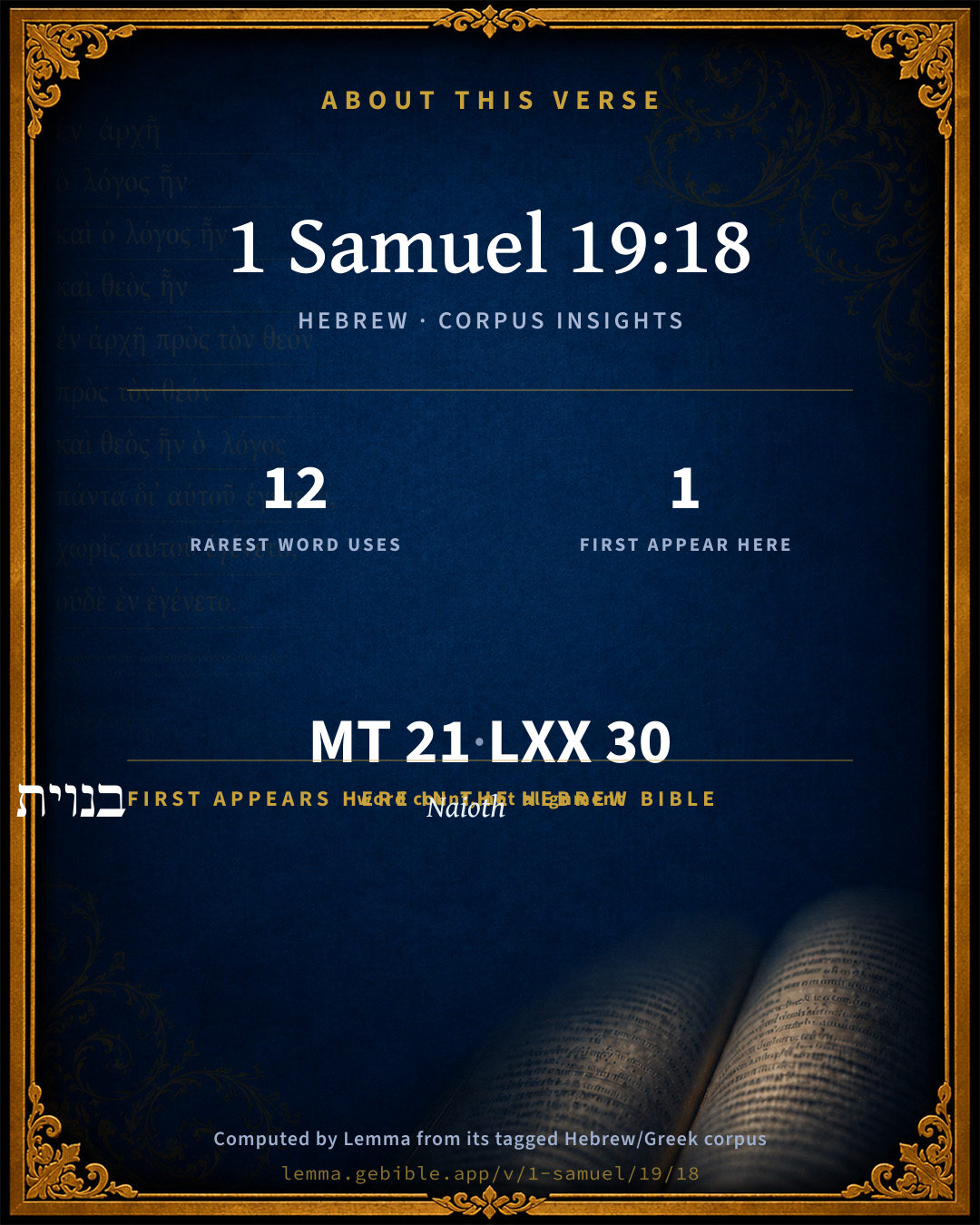
  • 1 first appearance in the Hebrew Bible
Full analysis ↓
Download a study sheet

One document with this verse’s original text, its word-by-word gloss line, the meaning frame, cross-references with their text, attributed commentary, and full source and license credits — printable, and it pastes into notes with its structure intact.

This verse Autodidact and up

Study sheet (.html) Plain text (.txt)

A passage Seminary Student

Up to 50 verses in one chapter. A passage sheet keeps up to 6 commentary sources and 12 cross-references per verse, in the order this page ranks them, and says so on the sheet whenever that leaves anything out. Ask for a single verse and you get the Autodidact verse sheet above.

Everything on this page stays free to read, with no account — the sheet is a download of what is already on screen, not access to it.

Want to remove ads? Support Godless Engineer
Compare translations 3

The same verse in 3 English versions, stacked beneath the original-language interlinear above. Click any original word for its lexicon entry.

Each is an independent rendering of the whole verse — the interlinear is not word-aligned to these translations.

Highlighted words mark where these versions differ — a whole-verse word diff, not a word-by-word alignment.

  • World English Bible Public Domain
    Now David fled, and escaped, and came to Samuel to Ramah, and told him all that Saul had done to him. He and Samuel went and lived in Naioth.
  • King James Version Public Domain
    So David fled, and escaped, and came to Samuel to Ramah, and told him all that Saul had done to him. And he and Samuel went and dwelt in Naioth.
  • unfoldingWord Literal Text CC BY-SA 4.0
    Now David fled and rescued himself, and he came to Samuel in Ramah, and he declared to him all that Saul had done to him. And he went, and Samuel, and they stayed in Naioth.

unfoldingWord Literal Text — © unfoldingWord, licensed CC BY-SA 4.0. Word-aligned USFM3 via Door43 (git.door43.org/unfoldingWord/en_ult).

Versions to compare (up to 4)

3 of 4 selected

Show all 18 translations

Every available English version of this verse, each an independent rendering of the whole verse.

  • World English Bible Public Domain
    Now David fled, and escaped, and came to Samuel to Ramah, and told him all that Saul had done to him. He and Samuel went and lived in Naioth.
  • Berean Standard Bible Public Domain
    So David ran away and escaped. And he went to Samuel at Ramah and told him all that Saul had done to him. Then he and Samuel went to Naioth and stayed there.
  • Majority Standard Bible Public Domain
    So David ran away and escaped. And he went to Samuel at Ramah and told him all that Saul had done to him. Then he and Samuel went to Naioth and stayed there.
  • King James Version Public Domain
    So David fled, and escaped, and came to Samuel to Ramah, and told him all that Saul had done to him. And he and Samuel went and dwelt in Naioth.
  • American Standard Version (1901) Public Domain
    Now David fled, and escaped, and came to Samuel to Ramah, and told him all that Saul had done to him. And he and Samuel went and dwelt in Naioth.
  • Revised Version (1885) Public Domain
    Now David fled, and escaped, and came to Samuel to Ramah, and told him all that Saul had done to him. And he and Samuel went and dwelt in Naioth.
  • Geneva Bible (1599) Public Domain
    So Dauid fled, and escaped, and came to Samuel to Ramah, and told him all that Saul had done to him: and he and Samuel went and dwelt in Naioth.
  • Douay-Rheims (1899) Public Domain
    But David fled and escaped, and came to Samuel in Ramatha, and told him all that Saul had done to him: and he and Samuel went and dwelt in Najoth.
  • Young's Literal Translation Public Domain
    And David hath fled, and is escaped, and cometh in unto Samuel to Ramath, and declareth to him all that Saul hath done to him, and he goeth, he and Samuel, and they dwell in Naioth.
  • Literal Standard Version CC BY-SA 4.0
    And David has fled, and escapes, and comes to Samuel at Ramath, and declares to him all that Saul has done to him, and he goes, he and Samuel, and they dwell in Naioth.
  • Unlocked Literal Bible CC BY-SA 4.0
    Now David fled and escaped, and went to Samuel in Ramah and told him all that Saul had done to him. Then he and Samuel went and stayed in Naioth.
  • unfoldingWord Literal Text CC BY-SA 4.0
    Now David fled and rescued himself, and he came to Samuel in Ramah, and he declared to him all that Saul had done to him. And he went, and Samuel, and they stayed in Naioth.
  • Darby Bible Public Domain
    And David fled, and escaped, and came to Samuel to Ramah, and told him all that Saul had done to him. And he and Samuel went and dwelt in Naioth.
  • World Messianic Bible Public Domain
    Now David fled and escaped, and came to Samuel at Ramah, and told him all that Saul had done to him. He and Samuel went and lived in Naioth.
  • Webster's Bible Public Domain
    So David fled, and escaped, and came to Samuel to Ramah, and told him all that Saul had done to him. And he and Samuel went and dwelt in Naioth.
  • Free Bible Version CC BY-SA 4.0
    This is how David got away and escaped. He went to Samuel at Ramah and explained to him everything that Saul had done to him. Then he and Samuel went to stay in Naioth.
  • Bible in Basic English Public Domain
    So David went in flight and got away and came to Ramah, to Samuel, and gave him an account of all Saul had done to him. And he and Samuel went and were living in Naioth.
  • JPS Tanakh (1917) Public Domain
    Now David fled, and escaped, and came to Samuel to Ramah, and told him all that Saul had done to him. And he and Samuel went and dwelt in Naioth.

Literal Standard Version (2020), Covenant Press — licensed CC BY-SA 4.0. Text via the HelloAO Bible API (eBible.org). Unlocked Literal Bible (unfoldingWord) — licensed CC BY-SA 4.0. Text via the HelloAO Bible API (eBible.org). unfoldingWord Literal Text — © unfoldingWord, licensed CC BY-SA 4.0. Word-aligned USFM3 via Door43 (git.door43.org/unfoldingWord/en_ult). Free Bible Version, Dr. Jonathan Gallagher — licensed CC BY-SA 4.0. Text via the HelloAO Bible API (eBible.org).

Word by word

More ways to search: Search by grammar → Find every occurrence → Compare this word →

Practice this passage: Drill this verse → Learn its vocabulary →

בנוית
Nâvîyth
H5121
“in/at · Naioth”
Preposition + Noun, Proper
Part of Speech
Preposition + Noun
Type
Proper
Full BDB Definition

Origin: from H5115

TWOT: None

Naioth = "habitations" - a dwelling place of prophets in the time of Samuel
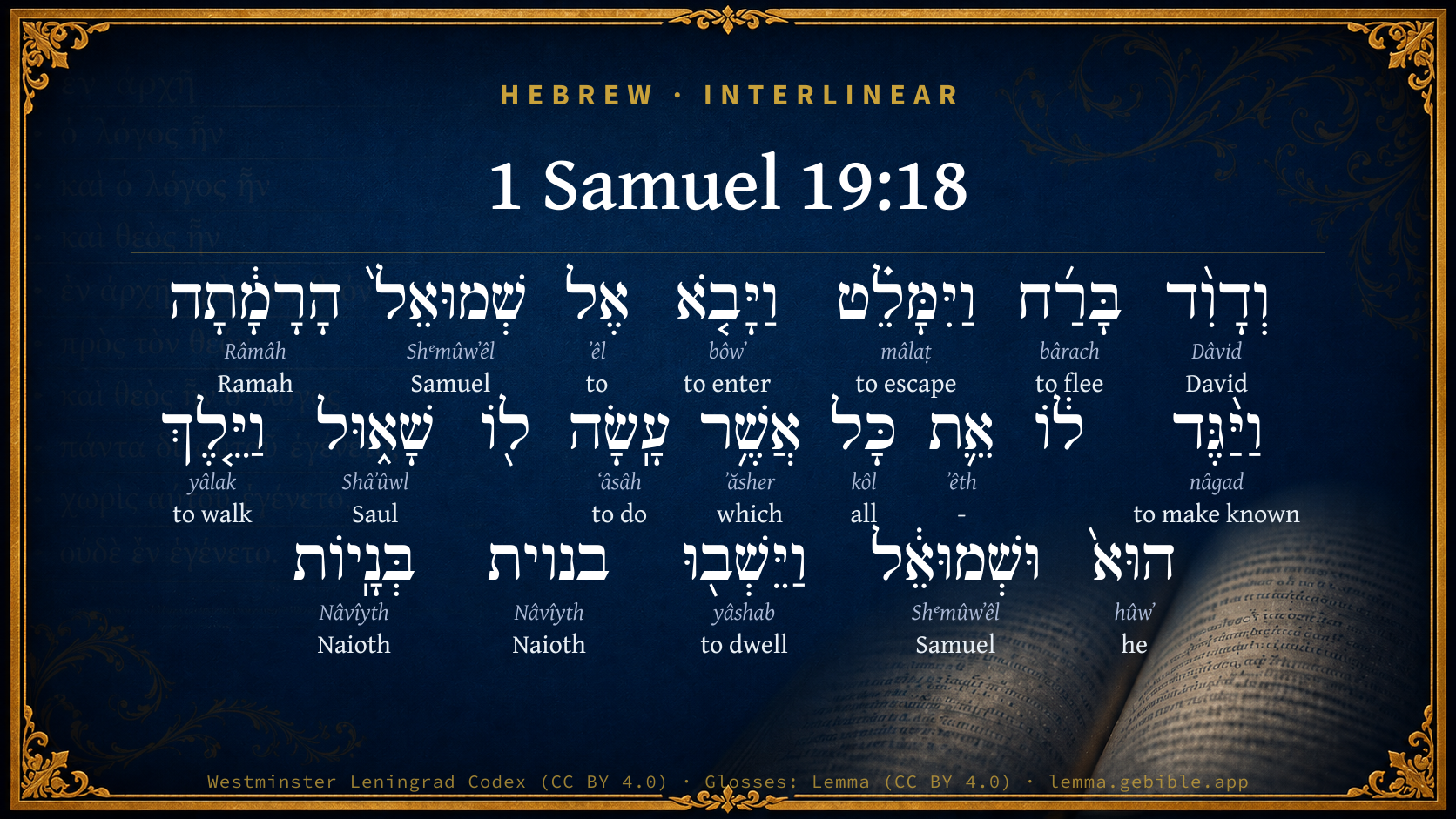
  1. וְדָוִ֨ד Dâvid H1732 “and · David” Conjunction + Noun, Proper
  2. בָּרַ֜ח bârach H1272 “to flee” Verb, Qal, Perfect, 3rd Person, Masculine, Singular
  3. וַיִּמָּלֵ֗ט mâlaṭ H4422 “and · to escape” Conjunction + Verb, Niphal, Sequential Imperfect, 3rd Person, Masculine, Singular
  4. וַיָּבֹ֤א bôwʼ H935 “and · to enter” Conjunction + Verb, Qal, Sequential Imperfect, 3rd Person, Masculine, Singular
  5. אֶל ʼêl H413 “to” Preposition
  6. שְׁמוּאֵל֙ Shᵉmûwʼêl H8050 “Samuel” Noun, Proper
  7. הָרָמָ֔תָה Râmâh H7414 “the · Ramah · toward” Particle, Definite Article + Noun, Proper + Suffix, Demonstrative
  8. וַיַּ֨גֶּד nâgad H5046 “and · to make known” Conjunction + Verb, Hiphil, Sequential Imperfect, 3rd Person, Masculine, Singular
  9. אֵ֛ת ʼêth H853 “-” Particle, Direct Object
  10. כָּל kôl H3605 “all of” Noun, Common, Masculine, Singular, Construct
  11. אֲשֶׁ֥ר ʼăsher H834 “which” Particle, Relative
  12. עָֽשָׂה ʻâsâh H6213 “to do” Verb, Qal, Perfect, 3rd Person, Masculine, Singular
  13. שָׁא֑וּל Shâʼûwl H7586 “Saul” Noun, Proper
  14. וַיֵּ֤לֶךְ yâlak H3212 “and · to walk” Conjunction + Verb, Qal, Sequential Imperfect, 3rd Person, Masculine, Singular
  15. הוּא֙ hûwʼ H1931 “he” Pronoun, Personal, 3rd Person, Masculine, Singular
  16. וּשְׁמוּאֵ֔ל Shᵉmûwʼêl H8050 “and · Samuel” Conjunction + Noun, Proper
  17. וַיֵּשְׁב֖וּ yâshab H3427 “and · to dwell” Conjunction + Verb, Qal, Sequential Imperfect, 3rd Person, Masculine, Plural
  18. בְּנָֽיוֹת Nâvîyth H5121 “in/at · Naioth” Preposition + Noun, Proper

About this verse

These counts appear in no published source. They are computed here, from the morphology-tagged text and Lemma’s own curated glosses. What Lemma adds →

21
words
17
distinct lemmas
Historical
section

Notable vocabulary

The rarest word here is בנוית Naioth H5121 — appearing just 12 times in the whole Hebrew Bible.

First appearance in Scripture

This word makes its first canonical appearance in the Hebrew Bible here:

  • בנוית Naioth H5121

Shared distinctive vocabulary

בנוית Naioth H5121 occurs in 5 verses of the Hebrew Bible. Also found in:

Grammatical profile

  • 7 verbs
  • 8 nouns
  • 1 pronoun
  • 3 prepositions
  • 2 particles

Verb forms

  • בָּרַ֜ח Qal · Perfect
  • וַיִּמָּלֵ֗ט Niphal · Sequential Imperfect
  • וַיָּבֹ֤א Qal · Sequential Imperfect
  • וַיַּ֨גֶּד Hiphil · Sequential Imperfect
  • עָֽשָׂה Qal · Perfect
  • וַיֵּ֤לֶךְ Qal · Sequential Imperfect
  • וַיֵּשְׁב֖וּ Qal · Sequential Imperfect

Repetition

Words recur within this verse — often emphatic in Hebrew:

  • שְׁמוּאֵל֙ Samuel H8050 ×2
  • בנוית Naioth H5121 ×2

Hebrew & Septuagint length

In English translation the verse runs 29 words from the Hebrew and 32 from the Septuagint (LXX English) — closely comparable.

A rough comparison of the two English renderings, which tokenize alike — not a word-level alignment.

Word counts can differ between the Hebrew and the Greek without any difference in meaning — e.g. the Hebrew direct-object marker אֵת has no separate Greek word, and Greek often adds the article ὁ.

In the original languages it is 21 Hebrew tokens and 30 Greek tokens — but the two are counted differently (Hebrew bundles its prefixes and suffixes into one token; the Greek is in lemma form), so that isn’t a like-for-like length.

Cross-references

5

Topical passages linked to 1 Samuel 19:18 in the Treasury of Scripture Knowledge — connected by theme and wording, ordered by reader-vote popularity; previews shown in the World English Bible.

  • 1 Samuel 7:17 His return was to Ramah, for there was his house; and there he judged Israel: and he built there an altar to Yahweh.
  • 1 Samuel 15:34 Then Samuel went to Ramah; and Saul went up to his house to Gibeah of Saul.
  • 1 Samuel 28:3 Now Samuel was dead, and all Israel had lamented him, and buried him in Ramah, even in his own city. Saul had put away those who had familiar spirits, and the wizards, out of the land.
  • Psalms 116:11 I said in my haste, "All men are liars."
  • James 5:16 Confess your offenses to one another, and pray one for another, that you may be healed. The effective, earnest prayer of a righteous man is powerfully effective.

Cross-references courtesy of OpenBible.info (CC BY 4.0).

Hebrew and Greek witnesses Masoretic Hebrew ↔ Greek Septuagint

The same verse in the two great witnesses to the Old Testament, shown verse-for-verse.

These are two independent witnesses, not word-aligned to each other, and the Septuagint is shown in lemma (dictionary) form.

Hebrew 1 Samuel 19:18 Masoretic · Westminster Leningrad Codex

וְדָוִ֨ד בָּרַ֜ח וַיִּמָּלֵ֗ט וַיָּבֹ֤א אֶל שְׁמוּאֵל֙ הָרָמָ֔תָה וַיַּ֨גֶּד ל֔וֹ אֵ֛ת כָּל אֲשֶׁ֥ר עָֽשָׂה ל֖וֹ שָׁא֑וּל וַיֵּ֤לֶךְ הוּא֙ וּשְׁמוּאֵ֔ל וַיֵּשְׁב֖וּ בנוית בְּנָֽיוֹת

Now David fled, and escaped, and came to Samuel to Ramah, and told him all that Saul had done to him. He and Samuel went and lived in Naioth.

World English Bible · Public Domain

Greek LXX 1 Samuel 19:18 Septuagint · lemma form

καί δαυίδ φεύγω καί διασώζω καί παραγίγνομαι πρός σαμουηλ εἰς αρμαθαιμ καί ἀποἀγγέλλω αὐτός πᾶς ὅσος ποιέω αὐτός σαούλ καί πορεύομαι δαυίδ καί σαμουηλ καί καταἵζω ἐν ναυαθ ἐν ραμα

So David fled, and escaped, and comes to Samuel to Armathaim, and tells him all that Saul had done to him: and Samuel and David went, and lived in Navath in Rama.

LXX2012 (modern English Septuagint) · Public Domain

Hebrew: Westminster Leningrad Codex (CC BY 4.0). Greek: Septuagint (public domain); English from LXX2012 (modern English Septuagint) (Public Domain). How the Septuagint differs from the Hebrew →

Targum (Aramaic paraphrase)

1

The Targum is the ancient Jewish Aramaic paraphrase of the Hebrew Scriptures — an interpretive translation, not the Hebrew text itself. Onkelos (literal) and Pseudo-Jonathan (expansive) render the Torah, and Jonathan the Prophets. Coverage is partial: where no permissively-licensed English translation exists for a verse, only the Aramaic is shown. This is verse-level text, not a word-by-word alignment to the Hebrew.

  1. Targum Jonathan Prophets (Joshua–Malachi)
    וְדָוִד עֲרַק וְאִשְׁתֵּיזֵיב וַאֲתָא לְוַת שְׁמוּאֵל לְרָמָתָא וְחַוֵי לֵיהּ יַת כָּל דִי עֲבַד לֵיהּ שָׁאוּל וַאֲזַל הוּא וּשְׁמוּאֵל וִיתִיבוּ בְּבֵית אוּלְפָנָא:

    (no public-domain English translation for this verse)

    Targum Jonathan — Aramaic: “Mikraot Gedolot” (public domain). English: “Sefaria Community Translation” (CC0 1.0 (public-domain dedication)); “London "Chaldee Paraphrase," 1871” (public domain). Text via Sefaria.

Commentary

Notes on 1 Samuel 19:18 from classic Christian and Jewish commentators (each source and its license shown beneath its notes). The classic Christian expositions comment on the surrounding passage and are grouped to its opening verse, so a note may address several verses; the Jewish commentaries on the Tanakh (Rashi and others) are per-verse, so they appear only where the commentator wrote on this verse.

Lemma curates 59 commentaries, every one of them public domain or Creative Commons licensed, each selected and text-cleaned for this edition rather than reprinted as found. About our sources →

Matthew Henry's Commentary

Here is, I. David's place of refuge. Having got away in the night from his own house, he fled not to Bethlehem to his relations, nor to any of the cities of Israel that had caressed and cried him up, to make an interest in them for his own preservation; but he ran straight to Samuel and told him all that Saul had done to him, Sa1 19:18. 1. Because Samuel was the man that had given him assurance of the crown, and his faith in that assurance now beginning to fail, and he being ready to say in his haste (or in his flight, as some read it, Psa 116:11), All men are liars ("not only Saul that promised me my life, but Samuel himself that promised me the throne"), whither should he go but to Samuel, for such encouragements, in this day of distress, as would support his faith? In flying to Samuel he made God his refuge, trusting in the shadow of his wings; where else can a good man think himself safe? 2. Because Samuel, as a prophet, was best able to advise him what to do in this day of his distress. In the psalm he penned the night before he had lifted up his prayer to God, and now he takes the first opportunity of waiting upon Samuel to receive direction and instruction from God. If we expect answers of peace to our prayers, we must have our ears open to God's word. 3. Because with Samuel there was a college of prophets with whom he might join in praising God, and the pleasure of this exercise would be the greatest relief imaginable to him in his present distress. He met with little rest or satisfaction in Saul's court, and therefore went to seek it in Samuel's church. And, doubtless, what little pleasure is to be had in this world those have it that live a life of communion with God; to this David retired in the time of trouble, Psa 27:4-6.

II. David's protection in this place: He and Samuel went and dwelt (or lodged) in Naioth, where the school of the prophets was, in Ramah, as in a privileged place, for the Philistines themselves would not disturb that meeting, Sa1 10:10. But Saul, having notice of it by some of his spies (Sa1 19:19), sent officers to seize David, Sa1 19:20. When they did not bring him he sent more; when they returned not he sent the third time (Sa1 19:21), and, hearing no tidings of these, he went himself, Sa1 19:22. So impatient was he in his thirst after David's blood, so restless to compass his design against him, that, though baffled by one providence after another, he could not perceive that David was under the special protection of Heaven. It was below the king to go himself on such an errand as this; but persecutors will stoop to any thing, and stick at nothing, to gratify their malice. Saul lays aside all public business to hunt David. How was David delivered, now that he was just ready to fall (like his own lamb formerly) into the mouth of the lions? Not as he delivered his lamb, by slaying the lion, or, as Elijah was delivered, by consuming the messengers with fire from heaven, but by turning the lions for the present into lambs.

1. When the messengers came into the congregation where David was among the prophets the Spirit of God came upon them, and they prophesied, that is, they joined with the rest in praising God. Instead of seizing David, they themselves were seized. And thus, (1.) God secured David; for either they were put into such an ecstasy by the spirit of prophecy that they could not think of any thing else, and so forgot their errand and never minded David, or they were by it put, for the present, into so good a frame that they could not entertain the thought of doing so bad a thing. 2. He put an honour upon the sons of the prophets and the communion of saints, and showed how he can, when he pleases, strike an awe upon the worst of men, by the tokens of his presence in the assemblies of the faithful, and force them to acknowledge that God is with them of a truth, Co1 14:24, Co1 14:25. See also the benefit of religious societies, and what good impressions may be made by them on minds that seemed unapt to receive such impressions. And where may the influences of the Spirit be expected but in the congregations of the saints? (3.) He magnified his power over the spirits of men. He that made the heart and tongue can manage both to serve his own purposes. Balaam prophesied the happiness of Israel, whom he would have cursed; and some of the Jewish writers think these messengers prophesied the advancement of David to the throne of Israel.

2. Saul himself was likewise seized with the spirit of prophecy before he came to the place. One would have thought that so bad a man as he was in no danger of being turned into a prophet; yet, when God will take this way of protecting David, even Saul had no sooner come (as bishop Hall expresses it) within smell of the smoke of Naioth but he prophesies, as his messengers did, Sa1 19:23. He stripped off his royal robe and warlike habiliments, because they were either too fine or too heavy for this service, and fell into a trance as it should seem, or into a rapture, which continued all that day and night. The saints at Damascus were delivered from the range of the New Testament Saul by a change wrought on his spirit, but of another nature from this. This was only amazing, but that sanctifying - this for a day, that for ever. Note, Many have great gifts and yet no grace, prophesy in Christ's name and yet are disowned by him, Mat 7:22, Mat 7:23. Now the proverb recurs, Is Saul among the prophets? See Sa1 10:12. Then it was different from what it had been, but now contrary. He is rejected of God, and actuated by an evil spirit, and yet among the prophets.

Matthew Henry's Commentary on the Whole Bible (1708–1710) — public domain (CC PDM 1.0). Text via the HelloAO Bible API.

Jamieson, Fausset & Brown

Robert Jamieson, A. R. Fausset & David Brown

DAVID FLEES TO SAMUEL. (Sa1 19:18-23)

David fled, . . . and came to Samuel to Ramah--Samuel was living in great retirement, superintending the school of the prophets, established in the little hamlet of Naioth, in the neighborhood of Ramah. It was a retreat congenial to the mind of David; but Saul, having found out his asylum, sent three successive bodies of men to apprehend him. The character of the place and the influence of the sacred exercises produced such an effect on them that they were incapable of discharging their commission, and were led, by a resistless impulse, to join in singing the praises of God. Saul, in a fit of rage and disappointment, determined to go himself. But, before reaching the spot, his mental susceptibilities were roused even more than his messengers, and he was found, before long, swelling the ranks of the young prophets. This singular change can be ascribed only to the power of Him who can turn the hearts of men even as the rivers of water.

Jamieson, Fausset & Brown — Commentary Critical and Explanatory on the Whole Bible (1871) — public domain (CC PDM 1.0). Text via the HelloAO Bible API.

Trapp's Complete Commentary

John Trapp

1Sa 19:18 So David fled, and escaped, and came to Samuel to Ramah, and told him all that Saul had done to him. And he and Samuel went and dwelt in Naioth.

Ver. 18. And came to Samuel to Ramah.] For direction and comfort, which is to be had, if anywhere upon earth, in the communion of saints, in the company of good people. Here also, if anywhere in the land, he might hope to be safe under Samuel’s wing, and in a college of prophets, as in a sanctuary of safety. See 1Sa 10:5, with the note.

And he and Samuel went and dwelt in Naioth.] Which was a college or school of prophets, adjoining to Ramah. The word Naioth signifieth a solitary place in the pastures and fields: this was fittest for study and meditation. Here was professed the true philosophy which is, saith Aristotle, {a} θειον τι και δαιμονιον οντως χρημα, a divine and heavenly doctrine indeed; far different from that vain deceitful philosophy which the apostle inveigheth against in Col 2:8. This is nothing else but sophistry; which, saith the same Aristotle, {b} is φαινομενη σοφια, ουσα δε μη; a seeming but not a substantial wisdom.

{a} Arist., De Mundo, cap. i.

{b} De Sophist. Elench., cap. i. partic. 6.

John Trapp, A Commentary or Exposition upon All the Books of the Old and New Testament (1647–1656) — public domain. Text from a community e-Sword module.

Joseph Benson's Commentary

1Sa 19:18. David escaped and came to Samuel — Both for comfort and direction in his distress, and for safety, supposing that Saul would be ashamed to execute his bloody designs in the presence of so venerable a person as Samuel. And told him all that Saul had done to him — Which, while it afforded relief to the mind of David amidst his distress and trouble, could not but exceedingly grieve the mind of Samuel, to be informed how low Saul had fallen. He and Samuel went and dwelt in Naioth — Or, as the Chaldee renders it, The school of learning. This was that famous school or college of the prophets, which was dedicated to the study of the Jewish law, and was in all respects a religious seminary.

Joseph Benson's Commentary on the Old and New Testaments (1811–1818) — public domain. Text from a community e-Sword module.

Whedon's Commentary on the Bible

Daniel D. Whedon

DAVID’S FLIGHT TO RAMAH, AND SAUL’S PURSUIT, 1Sa_19:18 to 1Sa_24:18.

David fled… to Samuel — Whither could he better go for help and counsel at a time like this? Surely, he thinks, Samuel will defend me against Saul.

He and Samuel went and dwelt in Naioth — Naioth is not to be regarded as a proper name. The word means habitations, dwelling places, and refers to the dwellings of the band of prophets over whom Samuel presided. The plural is used because of the number of cells or huts in this locality. The Targum renders the word house of instruction, and Ewald defines it as studium, or school. Here these disciples of Samuel dwelt, and disciplined themselves in holy exercises. How long David enjoyed this society of Samuel and these prophets before Saul ascertained whither he had fled we cannot determine, but probably not long.

Daniel D. Whedon (gen. ed.), Commentary on the Old and New Testaments (1874–1909) — public domain. Text from a community e-Sword module.

The Preacher's Complete Homiletical Commentary

Joseph S. Exell (gen. ed.)

CRITICAL AND EXPOSITORY NOTES—

1Sa_19:18. “Naioth.” “This word signifies dwellings, but it is here in a certain sense a proper name applied to the coenobium of the pupils of the prophets who had assembled round Samuel in the neighbourhood of Ramah. The plural form points to the fact that this coenobium consisted of a considerable number of dwelling-places or houses, connected together by a hedge or wall.” (Kiel.)

MAIN HOMILETICS OF 1Sa_19:18-19

DAVID’S VISIT TO RAMAH

I. The godly naturally seek the society of the godly in times of trouble. A desire to conform to the will of God is the basis of all true godliness, and those who are ruled by this desire are bound together by a common bond and are often involved in a common persecution. Under such circumstances it is natural and wise for them to seek each other’s society that they may strengthen each other by mutual sympathy and help, and especially that those who have had much experience may encourage and advise those who have but lately entered upon life. Sailors who in tempestuous weather put into harbour are likely to find sympathy and help from veteran seamen who once themselves ploughed the ocean—while they listen to the tale of their experience they gain fresh courage to meet new storms and perhaps valuable hints as to the best means of steering their vessel in dangerous waters. The common desire to serve their common God had created a strong tie between the aged prophet Samuel and the youthful warrior David, and when the latter found himself compelled by Saul’s envy to flee from home, it was natural he should seek the abode of one who had been driven into retirement by the same godless man. We can imagine what help David would gain from his aged friend at this time—how Samuel would strengthen his faith and animate his courage by reminding him of the word of the Lord which had come to him as God’s prophet in past days (1Sa_16:1), and how he would likewise, out of the experience of a long public life, give David much valuable counsel concerning not only the future immediately before him, but touching that more distant day when he should no longer be an outcast fleeing for his life but the ruler of Israel. During his short stay at Ramah he was strengthened for the long sojourn in the wilderness that came after, and he doubtless fully realised the truth that, “as iron sharpeneth iron, so a man sharpeneth the countenance of his friend.” And in such times of communion the gain is never on one side only. If the younger are helped and instructed by the elder, the elder are cheered and comforted by the younger. The veteran servants of God are gladdened by the energy and fervour of the younger men, and rejoice when they see others rising up to fill the places which they once occupied. We may be sure that Samuel gladly welcomed his young friend even although the visit was brought about by painful circumstances. In his retirement he doubtless often still grieved over the failure of his hopes concerning Saul, but when he saw David he would be cheered by the certainty that here was one who would not disappoint his expectations but would prove himself a faithful ruler of Israel.

II. When the godly find each other thus mutually helpful one great end of the existence of the visible church is attained. One great aim of every wise human father is to make his children mutually helpful to each other. Indeed one great reason for the existence of the family seems to be the formation of such strong and tender ties between the brothers and sisters, as shall enable them by the love which they bear to each other to lighten each other’s burdens as they journey through life. Those who are the objects of such love know well how often it has cheered them in the day of adversity and nerved them to face fresh trials and perplexities. And the children of God ought to look upon themselves as part of the one great “family in heaven and earth,” and to count it their duty to extend their sympathy and counsel to every afflicted member of that family. For this is indeed one of the great reasons why God’s children are required to form themselves into a community, and are required to make public profession of their faith in him. By so doing they become known to each other and are enabled to animate each other’s love and stimulate each other to persevere in the ways of godliness.

OUTLINES AND SUGGESTIVE COMMENTS

Besides this intercourse with Samuel, the pursuits of the sons of the prophets, alike in their practice of music and poetry, and in the study of the Word of God, were just such as David would most thoroughly enjoy, and as would most materially tend to soothe his spirit after the trials through which he had just passed, and brace it for the difficulties which lay before him. I do not presume to fix either the date or the authorship of all the productions which have been brought together into the one book of the Psalms, but if the 119th Psalm came from the pen of David, as multitudes believe, then I do not wonder that many have connected its composition with his residence in the school of the prophets at Naioth. The calm in which he then found himself, and the studies which he then prosecuted, might well have led his musings in the direction of that alphabetic ode, while there are in it not a few expressions which, to say the least, may have particular reference to the dangers out of which he had so recently escaped, and by which he was still threatened. Such, for example, are the following: “Princes also did sit and speak against me; but thy servant did meditate in thy statutes.” “The proud have had me in derision, yet have I not declined from thy law.” “Trouble and anguish have taken hold on me; yet thy commandments are my delights.” Then, in regard to his present enjoyment, we may quote these lines: “O how love I thy law! it is my meditation all the day.” “The law of thy mouth is better unto me than thousands of gold or silver;” and in reference to God’s dealings with him, he says, “I know, O Lord, that thy judgments are right, and that thou in faithfulness hast afflicted me.” “It is good for me that I have been afflicted; that I might learn thy statutes.” Dr. W. M. Taylor.

The Preacher's Complete Homiletical Commentary (gen. ed. Joseph S. Exell; Funk & Wagnalls, c. 1892) — public domain (pre-1929). A full-Bible homiletical/sermon-outline anthology covering 65 of 66 books (2 John is absent from the source module). Text from a community e-Sword module.

Keil & Delitzsch

C. F. Keil & F. Delitzsch

David fled to Samuel at Ramah, and reported to him all that Saul had done, partly to seek for further advice from the prophet who had anointed him, as to his further course, and partly to strengthen himself, by intercourse with him, for the troubles that still awaited him. He therefore went along with Samuel, and dwelt with him in Naioth. נוית (to be read נוית according to the Chethibh, for which the Masoretes have substituted the form ניות, Sa1 19:19, Sa1 19:23, and Sa1 20:1), from נוה or נוה, signifies dwellings; but here it is in a certain sense a proper name, applied to the coenobium of the pupils of the prophets, who had assembled round Samuel in the neighbourhood of Ramah. The plural נוית points to the fact, that this coenobium consisted of a considerable number of dwelling-places or houses, connected together by a hedge or wall.

Sa1 19:19-20

When Saul was told where this place was, he sent messengers to fetch David. But as soon as the messengers saw the company of prophets prophesying, and Samuel standing there as their leader, the Spirit of God came upon them, so that they also prophesied. The singular ויּרא is certainly very striking here; but it is hardly to be regarded as merely a copyist's error for the plural ויּראוּ, because it is extremely improbable that such an error as this should have found universal admission into the MSS; so that it is in all probability to be taken as the original and correct reading, and understood either as relating to the leader of the messengers, or as used because the whole company of messengers were regarded as one body. The ἁπ. λεγ. להקה signifies, according to the ancient versions, an assembly, equivalent to קהלה, from which it arose according to Kimchi and other Rabbins by simple inversion.

Sa1 19:21

The same thing happened to a second and third company of messengers, whom Saul sent one after another when the thing was reported to him.

Sa1 19:22-24

Saul then set out to Ramah himself, and inquired, as soon as he had arrived at the great pit at Sechu (a place near Ramah with which we are not acquainted), where Samuel and David were, and went, according to the answer he received, to the Naioth at Ramah. There the Spirit of God came upon him also, so that he went along prophesying, until he came to the Naioth at Ramah; and there he even took off his clothes, and prophesied before Samuel, and lay there naked all that day, and the whole night as well. ערום, γυμνός, does not always signify complete nudity, but is also applied to a person with his upper garment off (cf. Isa 20:2; Mic 1:8; Joh 21:7). From the repeated expression "he also," in Sa1 19:23, Sa1 19:24, it is not only evident that Saul came into an ecstatic condition of prophesying as well as his servants, but that the prophets themselves, and not merely the servants, took off their clothes like Saul when they prophesied. It is only in the case of ערם ויּפּל that the expression "he also" is not repeated; from which we must infer, that Saul alone lay there the whole day and night with his clothes off, and in an ecstatic state of external unconsciousness; whereas the ecstasy of his servants and the prophets lasted only a short time, and the clear self-consciousness returned earlier than with Saul. This different is not without significance in relation to the true explanation of the whole affair. Saul had experienced a similar influence of the Spirit of God before, namely, immediately after his anointing by Samuel, when he met a company of prophets who were prophesying at Gibeah, and he had been thereby changed into another man (Sa1 10:6.). This miraculous seizure by the Spirit of God was repeated again here, when he came near to the seat of the prophets; and it also affected the servants whom he had sent to apprehend David, so that Saul was obliged to relinquish the attempt to seize him. This result, however, we cannot regard as the principal object of the whole occurrence, as Vatablus does when he says, "The spirit of prophecy came into Saul, that David might the more easily escape from his power." Calvin's remarks go much deeper into the meaning: "God," he says, "changed their (the messengers') thoughts and purpose, not only so that they failed to apprehend David according to the royal command, but so that they actually became the companions of the prophets. And God effected this, that the fact itself might show how He holds the hearts of men in His hand and power, and turns and moves them according to His will." Even this, however, does not bring out the full meaning of the miracle, and more especially fails to explain why the same thing should have happened to Saul in an intensified degree. Upon this point Calvin simply observes, that "Saul ought indeed to have been strongly moved by these things, and to have discerned the impossibility of his accomplishing anything by fighting against the Lord; but he was so hardened that he did not perceive the hand of God: for he hastened to Naioth himself, when he found that his servants mocked him;" and in this proceeding on Saul's part he discovers a sign of his increasing hardness of heart. Saul and his messengers, the zealous performers of his will, ought no doubt to have learned, from what happened to them in the presence of the prophets, that God had the hearts of men in His power, and guided them at His will; but they were also to be seized by the might of the Spirit of God, which worked in the prophets, and thus brought to the consciousness, that Saul's raging against David was fighting against Jehovah and His Spirit, and so to be led to give up the evil thoughts of their heart. Saul was seized by this mighty influence of the Spirit of God in a more powerful manner than his servants were, both because he had most obstinately resisted the leadings of divine grace, and also in order that, if it were possible, his hard heart might be broken and subdued by the power of grace. If, however, he should nevertheless continue obstinately in his rebellion against God, he would then fall under the judgment of hardening, which would be speedily followed by his destruction. This new occurrence in Saul's life occasioned a renewal of the proverb: "Is Saul also among the prophets?" The words "wherefore they say" do not imply that the proverb was first used at this time, but only that it received a new exemplification and basis in the new event in Saul's experience. The origin of it has been already mentioned in Sa1 10:12, and the meaning of it was there explained.

This account is also worthy of note, as having an important bearing upon the so-called Schools of the Prophets in the time of Samuel, to which, however, we have only casual allusions. From the passage before us we learn that there was a company of prophets at Ramah, under the superintendence of Samuel, whose members lived in a common building (נוית), and that Samuel had his own house at Ramah (Sa1 7:17), though he sometimes lived in the Naioth (cf. Sa1 19:18.). The origin and history of these schools are involved in obscurity. If we bear in mind, that, according to Sa1 3:1, before the call of Samuel as prophet, the prophetic word was very rare in Israel, and prophecy was not widely spread, there can be no doubt that these unions of prophets arose in the time of Samuel, and were called into existence by him. The only uncertainty is whether there were other such unions in different parts of the land beside the one at Ramah. In Sa1 10:5, Sa1 10:10, we find a band of prophesying prophets at Gibeah, coming down from the sacrificial height there, and going to meet Saul; but it is not stated there that this company had its seat at Gibeah, although it may be inferred as probable, from the name "Gibeah of God" (see the commentary on Sa1 10:5-6). No further mention is made of these in the time of Samuel; nor do we meet with them again till the times of Elijah and Elisha, when we find them, under the name of sons of the prophets (Kg1 20:35), living in considerable numbers at Gilgal, Bethel, and Jericho (vid., Kg2 4:38; Kg2 2:3, Kg2 2:5,Kg2 2:7, Kg2 2:15; Kg2 4:1; Kg2 6:1; Kg2 9:1). According to Kg2 4:38, Kg2 4:42-43, about a hundred sons of the prophets sat before Elisha at Gilgal, and took their meals together. The number at Jericho may have been quite as great; for fifty men of the sons of the prophets went with Elijah and Elisha to the Jordan (comp. Kg2 2:7 with Kg2 2:16, Kg2 2:17). These passages render it very probable that the sons of the prophets also lived in a common house. And this conjecture is raised into a certainty by Kg2 6:1. In this passage, for example, they are represented as saying to Elisha: "The place where we sit before thee is too strait for us; let us go to the Jordan, and let each one fetch thence a beam, and build ourselves a place to dwell in there." It is true that we might, if necessary, supply לפניך from Kg2 6:1, after שׁם לשׁבת, "to sit before thee," and so understand the words as merely referring to the erection of a more commodious place of meeting. But if they built it by the Jordan, we can hardly imagine that it was merely to serve as a place of meeting, to which they would have to make pilgrimages from a distance, but can only assume that they intended to live there, and assemble together under the superintendence of a prophet. In all probability, however, only such as were unmarried lived in a common building. Many of them were married, and therefore most likely lived in houses of their own (Kg2 4:1.). We may also certainly assume the same with reference to the unions of prophets in the time of Samuel, even if it is impossible to prove that these unions continued uninterruptedly from the time of Samuel down to the times of Elijah and Elisha. Oehler argues in support of this, "that the historical connection, which can be traced in the influence of prophecy from the time of Samuel forwards, may be most easily explained from the uninterrupted continuance of these supports; and also that the large number of prophets, who must have been already there according to Kg1 18:13 when Elijah first appeared, points to the existence of such unions as these." But the historical connection in the influence of prophecy, or, in other words, the uninterrupted succession of prophets, was also to be found in the kingdom of Judah both before and after the times of Elijah and Elisha, and down to the Babylonian captivity, without our discovering the slightest trace of any schools of the prophets in that kingdom.

All that can be inferred from 1 Kings 18 is, that the large number of prophets mentioned there (Kg1 18:4 and Kg1 18:13) were living in the time of Elijah, but not that they were there when he first appeared. The first mission of Elijah to king Ahab (1 Kings 17) took place about three years before the events described in 1 Kings 18, and even this first appearance of the prophet in the presence of the king is not to be regarded as the commencement of his prophetic labours. How long Elijah had laboured before he announced to Ahab the judgment of three years' drought, cannot indeed be decided; but if we consider that he received instructions to call Elisha to be his assistant and successor not very long after this period of judgment had expired (Kg1 19:16.), we may certainly assume that he had laboured in Israel for many years, and may therefore have founded unions of the prophets. In addition, however, to the absence of any allusion to the continuance of these schools of the prophets, there is another thing which seems to preclude the idea that they were perpetuated from the time of Samuel to that of Elijah, viz., the fact that the schools which existed under Elijah and Elisha were only to be found in the kingdom of the ten tribes, and never in that of Judah, where we should certainly expect to find them if they had been handed down from Samuel's time. Moreover, Oehler also acknowledges that "the design of the schools of the prophets, and apparently their constitution, were not the same under Samuel as in the time of Elijah." This is confirmed by the fact, that the members of the prophets' unions which arose under Samuel are never called "sons of the prophets," as those who were under the superintendence of Elijah and Elisha invariably are (see the passages quoted above). Does not this peculiar epithet seem to indicate, that the "sons of the prophets" stood in a much more intimate relation to Elijah and Elisha, as their spiritual fathers, than the הנּביאים חבל or הנּביאים להקת did to Samuel as their president? (Sa1 19:20.) הנּביאים בּני does not mean filii prophetae, i.e., sons who are prophets, as some maintain, though without being able to show that בּני is ever used in this sense, but filii prophetarum, disciples or scholars of the prophets, from which it is very evident that these sons of the prophets stood in a relation of dependence to the prophets (Elijah and Elisha), i.e., of subordination to them, and followed their instructions and admonitions. They received commissions from them, and carried them out (vid., Kg2 9:1). On the other hand, the expressions חבל and להקה simply point to combinations for common working under the presidency of Samuel, although the words עליהם נצּב certainly show that the direction of these unions, and probably the first impulse to form them, proceeded from Samuel, so that we might also call these societies schools of the prophets.

The opinions entertained with regard to the nature of these unions, and their importance in relation to the development of the kingdom of God in Israel, differ very widely from one another. Whilst some of the fathers (Jerome for example) looked upon them as an Old Testament order of monks; others, such as Tennemann, Meiners, and Winer, compare them to the Pythagorean societies. Kranichfeld supposes that they were free associations, and chose a distinguished prophet like Samuel as their president, in order that they might be able to cement their union the more firmly through his influence, and carry out their vocation with the greater success.

(Note: Compare Jerome (Epist. iv. ad Rustic. Monach. c. 7): "The sons of the prophets, whom we call the monks of the Old Testament, built themselves cells near the streams of the Jordan, and, forsaking the crowded cities, lived on meal and wild herbs." Compare with this his Epist. xiii. ad Paulin, c. 5.)

The truth lies between these two extremes. The latter view, which precludes almost every relation of dependence and community, is not reconcilable with the name "sons of the prophets," or with Sa1 19:20, where Samuel is said to have stood at the head of the prophesying prophets as עליהם נצּב, and has no support whatever in the Scriptures, but is simply founded upon the views of modern times and our ideas of liberty and equality. The prophets' unions had indeed so far a certain resemblance to the monastic orders of the early church, that the members lived together in the same buildings, and performed certain sacred duties in common; but if we look into the aim and purpose of monasticism, they were the very opposite of those of the prophetic life. The prophets did not wish to withdraw from the tumult of the world into solitude, for the purpose of carrying on a contemplative life of holiness in this retirement from the earthly life and its affairs; but their unions were associations formed for the purpose of mental and spiritual training, that they might exert a more powerful influence upon their contemporaries. They were called into existence by chosen instruments of the Lord, such as Samuel, Elijah, and Elisha, whom the Lord had called to be His prophets, and endowed with a peculiar measure of His Spirit for this particular calling, that they might check the decline of religious life in the nation, and bring back the rebellious "to the law and the testimony." Societies which follow this as their purpose in life, so long as they do not lose sight of it, will only separate and cut themselves off from the external world, so far as the world itself opposes them, and pursues them with hostility and persecution. The name "schools of the prophets" is the one which expresses most fully the character of these associations; only we must not think of them as merely educational institutions, in which the pupils of the prophets received instruction in prophesying or in theological studies.

(Note: Thus the Rabbins regarded them as מדרשׁ בּתּי; and the earlier theologians as colleges, in which, as Vitringa expresses it, "philosophers, or if you please theologians, and candidates or students of theology, assembled for the purpose of devoting themselves assiduously to the study of divinity under the guidance of some one who was well skilled as a teacher;" whilst others regarded them as schools for the training of teachers for the people, and leaders in the worship of God. The English Deists - Morgan for example - regarded them as seats of scientific learning, in which the study of history, rhetoric, poetry, natural science, and moral philosophy was carried on.)

We are not in possession indeed of any minute information concerning their constitution. Prophesying could neither be taught nor communicated by instruction, but was a gift of God which He communicated according to His free will to whomsoever He would. But the communication of this divine gift was by no means an arbitrary thing, but presupposed such a mental and spiritual disposition on the part of the recipient as fitted him to receive it; whilst the exercise of the gift required a thorough acquaintance with the law and the earlier revelations of God, which the schools of the prophets were well adapted to promote. It is therefore justly and generally assumed, that the study of the law and of the history of the divine guidance of Israel formed a leading feature in the occupations of the pupils of the prophets, which also included the cultivation of sacred poetry and music, and united exercises for the promotion of the prophetic inspiration. That the study of the earlier revelations of God was carried on, may be very safely inferred from the fact that from the time of Samuel downwards the writing of sacred history formed an essential part of the prophet's labours, as has been already observed at pp. 8, 9 (translation). The cultivation of sacred music and poetry may be inferred partly from the fact that, according to Sa1 10:5, musicians walked in front of the prophesying prophets, playing as they went along, and partly also from the fact that sacred music not only received a fresh impulse from David, who stood in a close relation to the association of prophets at Ramah, but was also raised by him into an integral part of public worship. At the same time, music was by no means cultivated merely that the sons of the prophets might employ it in connection with their discourses, but also as means of awakening holy susceptibilities and emotions in the soul, and of lifting up the spirit of God, and so preparing it for the reception of divine revelations (see at Kg2 3:15). And lastly, we must include among the spiritual exercises prophesying in companies, as at Gibeah (Sa1 10:5) and Ramah (Sa1 19:20).

The outward occasion for the formation of these communities we have to seek for partly in the creative spirit of the prophets Samuel and Elijah, and partly in the circumstances of the times in which they lived. The time of Samuel forms a turning-point in the development of the Old Testament kingdom of God. Shortly after the call of Samuel the judgment fell upon the sanctuary, which had been profaned by the shameful conduct of the priests: the tabernacle lost the ark of the covenant, and ceased in consequence to be the scene of the gracious presence of God in Israel. Thus the task fell upon Samuel, as prophet of the Lord, to found a new house for that religious life which he had kindled, by collecting together into closer communities, those who had been awakened by his word, not only for the promotion of their own faith under his direction, but also for joining with him in the spread of the fear of God and obedience to the law of the Lord among their contemporaries. But just as, in the time of Samuel, it was the fall of the legal sanctuary and priesthood which created the necessity for the founding of schools of the prophets; so in the times of Elijah and Elisha, and in the kingdom of the ten tribes, it was the utter absence of any sanctuary of Jehovah which led these prophets to found societies of prophets, and so furnish the worshippers of Jehovah, who would not bend their knees to Baal, with places and means of edification, as a substitute for what the righteous in the kingdom of Judah possessed in the temple and the Levitical priesthood. But the reasons for the establishment of prophets' schools were not to be found merely in the circumstances of the times. There was a higher reason still, which must not be overlooked in our examination of these unions, and their importance in relation to the theocracy. We may learn from the fact that the disciples of the prophets who were associated together under Samuel are found prophesying (Sa1 10:10; Sa1 19:20), that they were also seized by the Spirit of God, and that the Divine Spirit which moved them exerted a powerful influence upon all who came into contact with them. Consequently the founding of associations of prophets is to be regarded as an operation of divine grace, which is generally manifested with all the greater might where sin most mightily abounds. As the Lord raised up prophets for His people at the times when apostasy had become great and strong, that they might resist idolatry with almighty power; so did He also create for himself organs of His Spirit in the schools of the prophets, who united with their spiritual fathers in fighting for His honour. It was by no means an accidental circumstance, therefore, that these unions are only met with in the times of Samuel and of the prophets Elijah and Elisha. These times resembled one another in the fact, that in both of them idolatry had gained the upper hand; though, at the same time, there were some respects in which they differed essentially from one another. In the time of Samuel the people did not manifest the same hostility to the prophets as in the time of Elijah. Samuel stood at the head of the nation as judge even during the reign of Saul; and after the rejection of the latter, he still stood so high in authority and esteem, that Saul never ventured to attack the prophets even in his madness. Elijah and Elisha, on the other hand, stood opposed to a royal house which was bent upon making the worship of Baal the leading religion of the kingdom; and they had to contend against priest of calves and prophets of Baal, who could only be compelled by hard strokes to acknowledge the Lord of Sabaoth and His prophets. In the case of the former, what had to be done was to bring the nation to a recognition of its apostasy, to foster the new life which was just awakening, and to remove whatever hindrances might be placed in its way by the monarchy. In the time of the latter, on the contrary, what was needed was "a compact phalanx to stand against the corruption which had penetrated so deeply into the nation." These differences in the times would certainly not be without their influence upon the constitution and operations of the schools of the prophets.

Keil & Delitzsch — Biblical Commentary on the Old Testament (1861–1891) — public domain (CC PDM 1.0). Text via the HelloAO Bible API. (Old Testament only.)

Tyndale Open Study Notes

Tyndale Open Resources

19:18 Ramah: Samuel’s hometown (1:1). • Naioth was a tiny village not far from the other Ramah in Benjamin.

Tyndale Open Study Notes — © Tyndale Open Resources, licensed CC BY-SA 4.0. Text via the HelloAO Bible API.

Geneva Bible (1599)

Geneva Bible translators

Naioth was a school where the word of God was studieth, near to Ramah.

Geneva Bible (1599) marginal notes — public domain. Text via Bolls.life.

Adam Clarke's Commentary

Verse 18. David fled, and escaped - to Samuel] He, no doubt, came to this holy man to ask advice; and Samuel thought it best to retain him for the present, with himself at Naioth, where it is supposed he had a school of prophets.

Adam Clarke's Commentary on the Bible (1810–1826) — public domain. Text from a community e-Sword/MySword module.

Ellicott's Commentary for English Readers

(18) And came to Samuel.—The influence and authority which Samuel still preserved in the nation even in the stormy close of Saul’s career, must have been very great for the frightened David to have sought a refuge in his quiet home of prayer and learning. The exile, fleeing before his sovereign, felt that in the residence of the old seer he would be safe from all pursuit, as in a sanctuary. David’s intimate connection with Samuel has been alluded to on several occasions. He stood to the old seer in the relation of a loved pupil.

A Bible Commentary for English Readers, edited by Charles John Ellicott (1878–1897) — public domain. Text from a community e-Sword module.

The Cambridge Bible for Schools and Colleges

gen. ed. J. J. S. Perowne

18–24. David takes refuge with Samuel at Ramah

18. to Samuel] Turning naturally for direction at this crisis to the prophet who had anointed him, and hoping that Saul would at least reverence the age and authority of Samuel. No doubt David had had much intercourse with Samuel since their first meeting at Bethlehem.

in Naioth] Naioth, which was at or near Ramah, is a quasi-proper name signifying dwellings, and in al probability denotes the College, or common residence of the society of prophets collected together at Ramah by Samuel. See Introd. ch. 6 p. 33. Cp. 2Ki_6:1-2. The Targum renders the word “house of instruction.” Hither Samuel took David, partly as being a safer place of refuge than his own house; partly that he might be spiritually strengthened by a share in the religious exercises of the society (1Sa_19:20).

The Cambridge Bible for Schools and Colleges (gen. ed. J. J. S. Perowne; Cambridge University Press, 1878–1918) — public domain. Text from a community e-Sword module.

John Gill's Exposition

So David fled and escaped,.... Fled from his own house, and escaped falling into the hands of the messengers of Saul, and so of Saul himself:

and came to Samuel to Ramah; the place where Samuel dwelt: to him David chose to come, by whom he had been anointed king, that his faith might be strengthened by him with respect to the kingdom, which might be weakened by what had happened to him; and that he might have some advice and direction from him what he should do, and what course he should take in his present circumstances, and that he might receive some comfort from him under his present troubles:

and told him all that Saul had done to him; how he had spoken to his servants to kill him, had cast a javelin at him himself, and had sent messengers to his house to slay him:

and he and Samuel went and dwelt in Naioth; which was in or near to Ramah, as appears by Sa1 19:19; which perhaps was a more retired place, and so chosen for the sake of conversation between them, or reckoned a more safe place. Here being a school or college of the prophets, might be a kind of an asylum, and where it might be thought Saul would not attempt to lay hands on David, should he know where he was; for if the Philistines gave no disturbance to the hill of God, and the prophets in it, Sa1 10:5; it might be reasonably concluded Saul would not; so the Targum paraphrases it, "he and Samuel went and dwelt in the house of doctrine", or in the school, the school of the prophets. R. Abimi the Nothite, or Naiothite, mentioned in the Talmud (i), is supposed (k) to be of this place; it is said (l) to be six miles from Jerusalem to the north.

(i) T. Bab. Sabbat, c. 1. fol. 17. 2. Avodah Zarah, c. 2. fol. 36. 1. (k) Aruch in voce fol. 98. 4. Juchasin, fol. 74. 2. (l) Adrichom, Theatrum T. S. fol. 28. 2.

John Gill's Exposition of the Whole Bible (1746–1763) — public domain (CC PDM 1.0). Text via the HelloAO Bible API.

Albert Barnes' Notes on the Bible

No such place as Naioth (or Nevaioth) is known, but the word means “dwellings.” Hence, it is considered that Naioth was the name of the collegiate residence of the prophets, in, or just outside, Ramah, to which Samuel removed with David from his own house, for greater safety, owing to the sanctity of the place and company.

Albert Barnes' Notes on the Bible (1834–1885) — public domain. Text from a community e-Sword/MySword module.

Matthew Poole's English Annotations

Came to Samuel to Ramah; partly for comfort and direction in his great distress; and partly for safety, supposing that Saul would be ashamed to execute his bloody designs in the presence of so venerable a person as Samuel, who had laid so great obligations upon Saul, and had such great and just reputation with the people.

Matthew Poole's English Annotations on the Holy Bible (1683–1685) — public domain. Text from a community e-Sword/MySword module.

The Pulpit Commentary

DAVID"S FLIGHT TO SAMUEL AT RAMAH (vers. 18-24).

David...came to Samuel. We have seen that there is every reason to believe that David had been taught and trained by Samuel among the sons of the prophets, and now, conscious of his innocence, he flees for refuge to his old master, trusting that Saul would reverence God"s prophet, and give credence to his intercession and his pledge that David was guiltless. He and Samuel went and dwelt in Naioth. Rather in Nevayoth, as in the written text. This is not the name of a place, but signifies "dwellings," "lodgings," and is always translated in the Chaldee "house of study," i.e. student"s lodgings. Somewhere near to Ramah Samuel had erected buildings to receive his young men, who were called "sons of the prophets," not because their fathers were prophets, but because they were under prophetic training, with prophets for their teachers, though not necessarily intended to be prophets themselves. At first Samuel, we may suppose, built one nevath, one simple hospice for his students, and then, as their numbers grew, another, and yet another, and so the plural, nevayoth, came into voile as the name of the students" quarters.

Vers. 18-24.

Saintly refuge and spiritual restraint.

The facts are

1. David takes refuge with Samuel at Naioth in Ramah.

2. The messengers sent by Saul to take David are restrained in the presenceof Samuel and the prophets, and themselves begin to prophesy.

3. Other messengers come under the same influence.

4. Venturing to go himself, he, on approaching the place, also falls underthe prophetic influence, and is utterly overcome by it in the presence of Samuel. Human wisdom may be almost confounded by the prominent facts of this section, but this must not be taken as proof of our infallibility, nor of the unfitness of the event with the order of Divine providence. Had it been left to man to invent and regulate the process by which the earth and life upon it arrived at the forms now familiar to us, would he have introduced some of those ancient physical conditions and changes which must have been so utterly unlike what now prevail? The convulsions, the transformations, the climatic conditions, the huge forms of life of some past ages are as much unlike the present facts as the spiritual manifestations of the prophetic schools are unlike the orderly course of Christian influence. It is only of late years that men have in some degree traced the naturalness of the physical process, and even now there is diversity of opinion on the subject. It is not to be wondered at, therefore, if, in man"s comparative ignorance of the unseen spiritual sphere in which the great development of God"s purpose in Christ really occurs, he should not be able to supply all the links connecting the spiritual manifestations of the era of Samuel with the rigid legal era of Moses and the more calm and orderly methods of the Christian dispensation.

Blind unbelief is sure to err, And scan his work in vain; God is his own interpreter, And he will make it plain.

Looking at the teaching of the section, we see

I As IMPORTANT SPIRITUAL POWER BEING NOURISHED AMIDST THE TURMOIL OF PUBLIC AFFAIRS. While battles were being fought, and the kingdom was troubled with the unsatisfactory condition of the court, Samuel was quietly gathering around himself a band of men who, devoting attention to the records of Israel"s history, the exercise of psalmody and music, and the spiritual interests of men, were becoming a power to influence the national life in days to come. The extent and strength of that influence cannot be minutely traced, because of its spiritual nature; but the higher tone of national life during the reigns of David and Solomon was doubtless largely due to it. Centres of spiritual influence are formed when the great political world is intent on its wars and intrigues. Notably, Christianity arose and found its first nourishment amidst the quiet valleys and hills of Palestine while Roman imperialism was intent on conquests and ignorant almost of its existence. The band of men and women who met for prayer in an upper room (Act_1:13, Act_1:14) cultivated there the power which afterwards penetrated into all parts of the Roman empire. The quiet retreats and colleges of the middle ages in some respects were the seats of an influence which the world could ill spare. During the close of the last century small bodies of Christians nourished here and there the missionary spirit which has since affected the destinies of millions in the East and South. Amidst all the conflicts of politics and controversies of science and worry of commerce there are quiet fellowships of Christians devoted to the nourishment of a life destined to conserve and elevate the national life. The Christian Church has need to form and sustain "schools of the prophets to meet the demands of the age. Samuel"s course and the injunctions of Paul to Timothy (1Ti_3:1-7 1Ti_5:21, 1Ti_5:22; 2Ti_2:4; cf. Eph_4:11-15) suggest that it is the duty of the Church as a whole, and not to be left as a private enterprise to a few zealous individuals, to provide for the training of men for spiritual service. Had more care been devoted to this in years past it had been well for the world.

II THE SORROWFUL SOUL SEEKS REFUGE FROM THE CARES AND TROUBLES OF LIFE IN FELLOWSHIP WITH THE DEVOUT. It was a spiritual instinct that drew David to Samuel. The penalties of public life had already fallen heavily upon him. He had found, even in the beginning of his career of service to mankind, that "offences must needs come." The whole tone of life around the throne was out of accord with his most cherished aspirations. He was conscious of being misunderstood and misrepresented. The earlier days of quiet service and holy communion with God were now but sweet memories, bringing the bitter realities of daily life into stronger relief. With bounding heart and rapid flight, therefore, did he seek consolation, counsel, and rest with the honoured man who once anointed him to some unexplained service. Many have been, and still are, in full sympathy with the troubled David. The devout heart is brave, and dares not shun to fight the holy battles of the Lord in daily life. Religion is to flourish in face of evil and care, and not away in solitude. The business of life must not be left to the greedy and the vile. The great prayer was not that the disciples should be taken from the world, but that they should be kept from its evil. (Joh_17:15; cf. 1Co_5:10) Yet human nature cries out under the strain; the spiritual mind is disgusted with the sins it witnesses; the sense of belonging to a higher citizenship rises in force; sympathy with kindred spirits is longed for; the support of stronger natures is a pressing need; and opportunities for prayer and for contemplation on the loftier aims of life are earnestly desired. Under this common inspiration, Jacob and Moses and Elijah sought each his "Bethel," and found strength for the coming trials and relief from present cares. It was in the same participation in human infirmities and sorrows that Christ loved to retire from the alien world to seek solace with his Father and with his people. (Mat_14:23 Mat_17:1; Mar_6:31; Joh_11:3, 32-36 12:1, 2; Heb_5:7) For the same reason we love to retire from the turmoil of life to the fellowship of a pious home, a meeting for prayer and counsel, and the service of the sanctuary. It is helpful to court occasional retirement. The "communion of saints" should be more than an article in our creed.

III A DIVINE RESTRAINT IS PUT ON THE ENEMIES OF GOD"S SERVANTS. Saul"s wicked desperation was great when he sent to Naioth to take David, and at its highest pitch when, after three despatches of men, he ventured to go to the abode of Samuel on a cruel errand. Hitherto Saul appeared to be fighting solely against David; but now that the mysterious spirit of prophecy came upon his messengers and rendered them harmless, it ought to have been obvious to him that in persecuting David he was at war with God. The knowledge of this mysterious restraint on them could not but add to his mental confusion, though it was not sufficient to the subjugation of his wild passion. Yet Saul was not bereft of reason; and could he have travelled to Ramah on such an errand without passing in review events prior and subsequent to his last intercourse with Samuel? (1Sa_15:26-35) Must he not have gone back in thought to the fearful day when the prophet declared the doom of his reign; the earlier days when as king he received the cheers of the people and the instructions of the prophet; (1Sa_10:24, 1Sa_10:25) and the still earlier time when, fresh from his anointing, on meeting a band of prophets, the spirit of prophecy came on him and turned him into another man?. (1Sa_10:5-9) And now, after long separation, he was drawing near to that revered man of God and the company of the prophets, not the former Saul, full of hope and courage, but a man sinking deeper and deeper in sin, and with only the courage bred of remorse. If he was to be restrained and rendered harmless, what more natural method more in harmony with the characteristics of the age and locality, and the psychological facts than that for a season the old prophetic excitement should come upon him? It is no solitary fact that the mental and moral atmosphere of a place exercises power over men. The main truth, however, is that God restrains. Divine restraint enters into all things. The nature of things is but their limit assigned by God. The original relation of forces in the physical world is so settled by God that their interaction shall be bounded by. definite results. To every effect wrought out in the development of the material universe it has been virtually said, "Thus far shalt thou go, and no farther." Scripture makes known the restraint which God puts on" hearts and on moral beings. Lions dare not touch a Daniel. Evil spirits beg permission of Christ before they can go forth. Men sent to seize the Saviour were unable to fulfil their mission, (Joh_7:46) and soldiers were powerless in his presence. (Joh 18:8-6) The history of the Church and of individual Christian life brings out instances of the restraining power which silently lays hold of man and renders his enmity innocuous. "It shall not come nigh thee" (Psa_91:7) has often been verified. In all these instances we have but glimpses of that unseen Power by which in due time all principalities and powers, and whatever opposeth itself to God and his Church, shall be either turned unto him or deprived of their power of injury (Isa_11:9 Isa_35:9, Isa_35:10; 1Co_15:24-26; Php_2:9-11; Col_1:19, Col_1:20; Rev_21:22-27)

HOMILIES BY G. WOOD Vers. 18-24.

Religious consolation and religious excitement.

The consolation was tasted by David; the excitement was shown by Saul.

I CONSOLATION. We are not surprised to learn that David, when driven from his house by the deadly malice of the king, betook himself to the prophet Samuel at his residence in Ramah. In reporting the treatment he had received to the venerable prophet, he reported it to God, whose authority was represented by Samuel. The path of his life seemed to be blocked by the undeserved ill will of Saul. Was there any further instruction for him from the Lord? There is no evidence that Samuel had held any communication with David from the time of his visit to Bethlehem to anoint the young shepherd; but it may be assumed that he had kept a watchful eye on his career, and prayed much for a youth with so great a destiny. Some painter ought to show us their meeting: the aged prophet, his countenance traced with sorrow for his own unworthy sons, and not less for the untoward career of Saul, receiving with outstretched arms and ready sympathy the fugitive David, in the very perfection of his gallant youth, yet coining with weary steps and dejected visage. The old man took the young chief to shelter with him in Naioth, where was a settlement of prophets a group of dwellings where servants of God lived in retreat and cultivated sacred song and fraternal fellowship. David was not to tarry long in such a refuge, but it was good for him to visit it. It solaced and strengthened his spirit in God. Undisturbed by the jealousies of the court and the dangerous frenzy of the king, surrounded by an atmosphere of devotion, mingling not merely with aged seers like Samuel, but also with young men of his own age whose time was spent in sacred study and brightened with music and song, David must have been in his best element. He was a good soldier, and happy at the head of his troops, charging the Philistines. But he was still more a thinker, a poet, a minstrel, a prophet, a man of fervent spirit toward God, and so must have been happier in the goodly fellowship of the prophets at Naioth than in the rush of battle and the pride of victory. There is no record of the words of consolation and counsel which Samuel spoke to him; but doubtless we have traces and echoes of them in those psalms in which David has discussed the afflictions of the servants of Jehovah, and sung of their ultimate deliverance and reward. Psalm 59. is traditionally ascribed to the period when the armed men sent by Saul surrounded David"s house to put him to death. As it is highly artificial in structure, it can hardly have been composed on the spur of the moment. Very probably it was written at Naioth while the impression of the danger was fresh, and was sung among the prophets there. In the case of David we read of no agitation or excitement. It would be little surprising if he, fleeing for his life, had been overcome by emotion when he found himself in safeguard. But all we read of his bearing is rational and calm.

II EXCITEMENT. It was in the servants of Saul, and subsequently in Saul himself, that a religious excitement appeared. Three successive bands were despatched by the king to seize his son-in-law, but with a strange result. As each band saw the venerated Samuel stand forth at the head of the prophets, they feared to do violence to one under such august protection. Nay, more; the spiritual enthusiasm of the prophets communicated itself to them and overmastered them, so that they forgot their errand and joined in the burst of holy song. King Saul himself, provoked by the failure of his emissaries, went to Naioth, and he was more completely overpowered than they. We have seen already that his temperament was exceedingly amenable to the impressions of music and song. We remember how he had flung himself among the prophets in the very outset of his history; and although sadly deteriorated in character, he still retained his early sensibilities. Indeed, through the very disorder of his faculties he had become more susceptible than ever of religious excitement; so when he reached Naioth he was quite beyond himself. The spiritual electricity of the place was too much for him, and he fell into a very paroxysm of enthusiasm. At first when, on the way to Naioth, he lifted his voice m some sacred chant, it was well, and the historian does not hesitate to say that "the Spirit of God was upon him." But at Naioth he behaved like a fanatical devotee of some heathen god, or a wild dervish of the East. He threw off his royal tunic, and after long and exhausting exercise of body and spirit lay in nothing but his under dress, prone and probably motionless, on the ground for "all that day and all that night." But though "among the prophets," he was not of them. It was a mere fit of fervour soon to pass away. The heart of Saul was by this time hopelessly "jangled and out of tune." The subject of temporary religious excitement needs to be carefully thought out and discreetly handled. But it can never be fully explained at all events not till more is known of the action of the nervous system, and till more light falls on the mysterious question of contagious emotion and imitative cerebral stimulation. One or two things, however, are plain enough, and deserve to be noted; e.g.

1. There is a religious excitation which carries with it no moral influencewhatever. It is not feigned or insincere. He who is the subject of it is really lifted up or carried along as with a rush of earnest feeling. He cries for mercy; he prays with strong supplication; or he sings of pardon and of unutterable joys. His emotions are all aglow, and his brain is stirred to unusual activity. This occurs the more easily if one who is constitutionally accessible to such gusts of feeling falls among others who are much in earnest. He finds himself where prayers burst forth from importunate souls, and hymns are sung with a swing of enthusiasm. At once he feels as those around him do. Yet there is no change of his moral nature; he is merely a person of susceptible or imitative constitution, who has caught the contagion of religion from others, yet has not come, and may never come, to repentance. It is not for a moment to be denied that in many cases a real moral and spiritual change is produced in the midst of much excitement; but the excitement is only an accompaniment of the change perhaps necessary for some minds, hut always fraught with some degree of danger. The only thing of lasting value is the exercise of conscience, and the turning of the affections and will to God in Christ.

2. The degree in which new religious emotion overpowers the body isgenerally proportioned to the previous ignorance of the mind, or its estrangement from God. David at Naioth fell into no frenzy, lay in no swoon, because he was a man of God, and devout feeling flowed through him unimpeded, found in him a congenial heart. But Saul had been in an evil mood; envy and murder were in his breast. So, when a pure and sacred impulse came upon him, it met resistance; and there were bodily manifestations which, far from being marks of grace, were signs of a moral state at variance with the Spirit of God. This case should teach caution in ascribing any religious value to prostrations, trances, and long fasts. These things most frequently recur in cases of a morbid hysterical temperament, or in very ignorant persons who are disturbed and terrified, or in instances where religious feeling, suddenly flowing in on unprepared minds, encounters obstinate obstruction. When the mind is thoughtful and refined, or when the heart is gentle and open to any good influx, religious fervour seldom causes any disorder in the nervous system or the physical constitution. We may be reminded here that David could show no small excitement, for he danced before the ark in the sight of all Israel. (2Sa_6:14) True; but in all the enthusiasm of that great occasion King David was sober minded and self-possessed. He had good reasons for leading the sacred processional dance, as may afterwards be shown; but, far from giving way to excitement, or losing his senses like Saul, he went calmly through the duties of an eventful and fatiguing day. He offered burnt offerings and peace offerings. Then he blessed the people, causing provisions to be distributed among them. And after all this "David returned to bless his house." Such is the enthusiasm we desire. To be full of joy before the Lord, but at the same time to be of a healthy mind, ready for public or private duty hour by hour. But we see no good in nervous excitement or hysterical ecstasy. When we consider that the Bible is a collection of Eastern books, and that the East has always been the home of strange religious extravagances, we recognise in the well balanced sobriety of mind which pervades the Bible a new proof of its Divine inspiration. It takes notice of the varied phenomenal effects of strong religious feeling on the human frame; it tells of long prostrations, excited movements, and prophetic trances; but it always attaches moral significance and value not to such abnormal conditions, but to the effects which appear and remain in character and life. The greatest of all, the Man Christ Jesus, the Lord whom we are to love and follow, is shown to us full of a sublime enthusiasm, but full at the same time of meekness and of wisdom. The Scriptures teach us to be calm and fervent, fervent and calm. If rushes of devout emotion come upon us, be it so. If men who have no faith call us fanatical and mad, be it so. Such men said of our Master, "He rageth, and hath a demon;" and of Paul, "Thou art beside thyself." But let the evidence of our Christian faith and principle be found not in any moods of excitement, but in the moral excellence we exhibit, the fruit of the Spirit we bring forth. So shall we find consolation and strength when others only expose their weakness; and every pause at Naioth, or the place of prayer and holy fellowship, will brace our spirits for the trials that must yet befall us before we are perfected. F.

The Pulpit Commentary (1880–1919), ed. H.D.M. Spence-Jones & Joseph S. Exell — public domain. Text from a community e-Sword module.

John Wesley's Explanatory Notes

To Samuel - Both for comfort and direction in his distress; and for safety, supposing that Saul would be ashamed to execute his bloody designs in the presence of so venerable a person as Samuel.

John Wesley, Explanatory Notes Upon the Whole Bible (1754–1765) — public domain. Text via the GEBible commentary corpus.

Kretzmann's Popular Commentary

Paul E. Kretzmann

Saul In Ramah

v. 18. So David fled, and escaped, and came to Samuel to Ramah, he turned to the prophet, his fatherly friend, first of all, and told him all that Saul had done to him. And he and Samuel went and dwelt in Naioth, the place where the children of the prophets lived, with Samuel at their head.

v. 19. And it was told Saul, saying, Behold, David is at Naioth in Ramah, where there was a complex of buildings enclosed with a fence or wall.

v. 20. And Saul sent messengers to take David; and when they saw the company of the prophets prophesying, praising God in a state of ecstasy, and Samuel standing as appointed over them, for he was the head of this prophets’ seminary, the Spirit of God was upon the messengers of Saul, and they also prophesied, singing divine praises under the direction of an influence which they could not resist.

v. 21. And when it was told Saul, he sent other messengers, and they prophesied likewise. And Saul sent messengers again the third time, and they prophesied also. All this was to be a hint, on the part of Divine Providence, that God was hindering the messengers from carrying out Saul’s command; it was He who was protecting David against willful murder.

v. 22. Then went he, Saul, also to Ramah, in a stubborn determination to carry out his will, and came to a great well that is in Sechu, a large cistern not far from Ramah; and he asked and said, Where are Samuel and David? And one said, Behold, they be at Naioth in Ramah.

v. 23. And he went thither to Naioth in Ramah; and the Spirit of God was upon him also, He took hold of him and held him in His power; and he went on and prophesied until he came to Naioth in Ramah. "The difference between Saul and his messengers was that the inspiration came on him as he was approaching the residence of the prophet, and that it attained a higher grade and lasted longer, completely suppressing his self-consciousness. "

v. 24. And he stripped off his clothes also, either by removing all his clothes or at least his outer garment, leaving only the inner shirt of linen or cotton, and prophesied before Samuel in like manner, and lay down, literally, "fell," naked all that day and all that night. The length and the vehemence of the attack of ecstasy which Saul experienced was to indicate to him and others that his persecution of David was a battling against Jehovah and His Spirit, which should therefore not be persisted in, lest more serious effects follow. Wherefore they say, Is Saul also among the prophets? The proverbial saying, which had first gone the rounds when Saul returned from Ramah after meeting Samuel, was now given new nourishment. Unfortunately the heart of Saul remained unchanged, just as the hearts and minds of unbelievers in our days are sometimes drawn into a wave of religious excitement, without a subsequent change of life. Nevertheless, God has even the hearts of His enemies in His power, and they sometimes confess the truth against their will, thus serving the interests of the Lord’s kingdom.

Paul E. Kretzmann, Popular Commentary of the Bible (1921–1924) — public domain. Text from a community e-Sword module.

unfoldingWord translationNotes

Door43 World Missions Community

General Information:

David flees to Samuel.

Now

This word is used here to show that the writer has started to tell a new part of the story.

It was told to Saul

This can be stated in active form. AT: "Someone told Saul" (See: Active or Passive)

See

"Look" or "Listen" or "Pay attention to what I am about to tell you"

standing as head over them

Here "head" refers to a position of authority. AT: "acting as their leader" (See: Metonymy)

translationWords

Samuel

Ramah

prophet

head

Holy Spirit

unfoldingWord translationNotes — © Distant Shores Media and the Door43 World Missions Community, licensed CC BY-SA 4.0. Source: git.door43.org/Door43/en_tn.

Lesson kit

Teaching starters — assembled from the data on this page, not authored interpretation. Every prompt links to the verse data it draws on. Edit before teaching.

1 Samuel, in the Historical, opens this verse with 21 words (17 distinct Hebrew lemmas). Its most distinctive word is Nâvîyth (“Naioth”). A historical commentator’s framing appears above. Read the whole chapter for the surrounding context.

Discussion questions

  1. What does “Naioth” (Nâvîyth) contribute to the verse as a whole?
  2. This is the first place “Naioth” appears in Scripture (first appears here). What does its debut here establish?
  3. How does 1 Samuel 19:19, which shares the word «Naioth», read alongside this verse?
  4. What does the repetition of “Samuel” (2× in this one verse) do in this verse?
  5. The translations on this page render this verse differently — a whole-verse word diff, not a word-by-word alignment. What might account for the different wordings?
  6. «בָּרַ֜ח» is a Qal Perfect verb. How does that grammatical form shape the action described?
  7. Compare how Matthew Henry's Commentary and Jamieson, Fausset & Brown read this verse. Where do they agree or differ?

Things to notice

Reading settings

Reading text

Shown beneath each verse's original-language words.

Old Testament
Old Testament edition

Read the OT as the Masoretic Hebrew (MT) or the Greek Septuagint (LXX).

English shown for the Greek Septuagint (in the Hebrew ↔ Greek comparison).

Comparing translations? Open the Compare panel on any verse page to stack up to four side by side.