
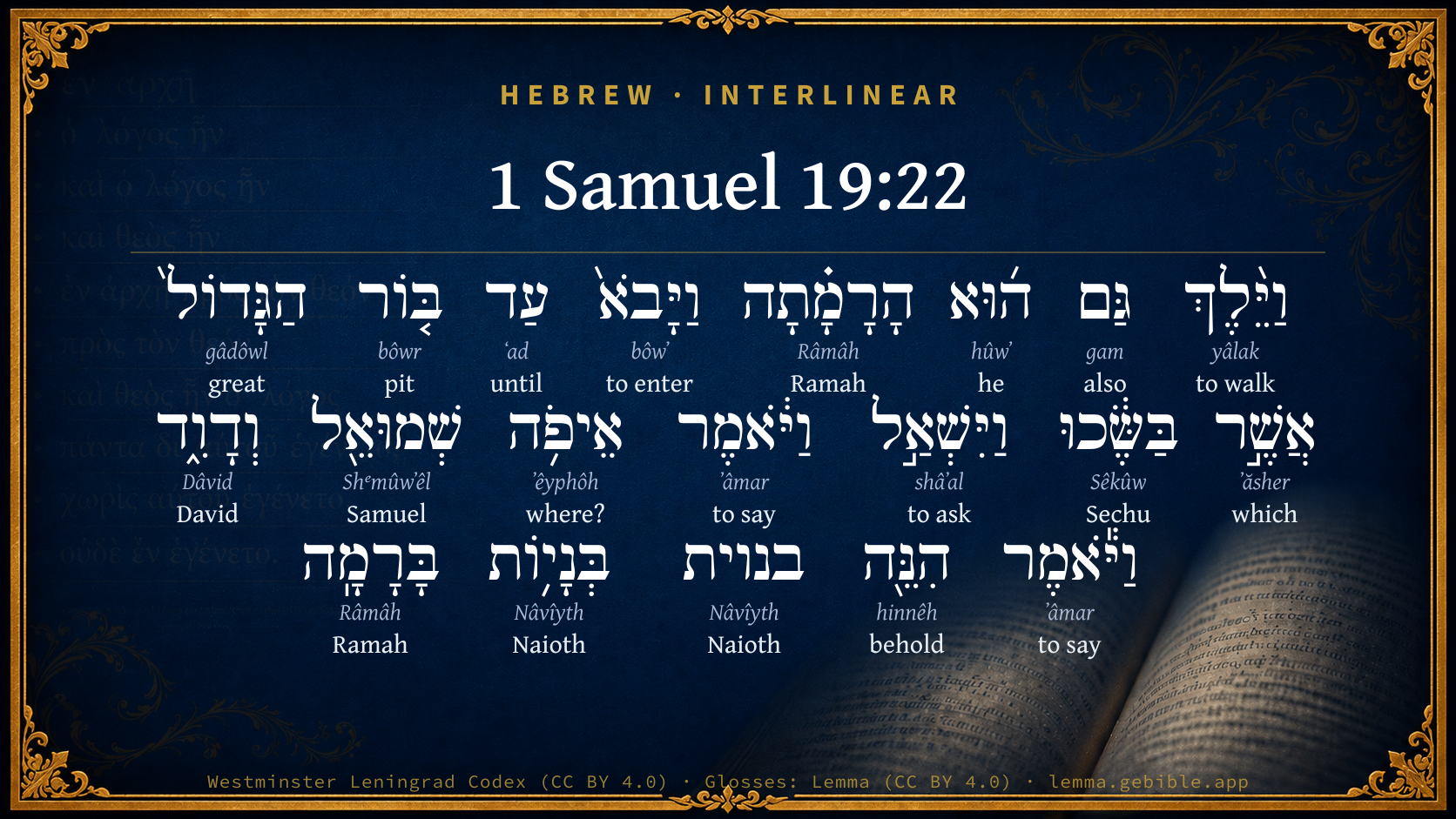
1 Samuel 19:22

Hebrew (Westminster Leningrad Codex) 1 Samuel 19:22 appears in the Hebrew Old Testament. The text above is from the Westminster Leningrad Codex. Each word links to its Strong’s number, a concise gloss, and parsing drawn from the Open Scriptures Hebrew Bible morphology. Click any word for its full Brown-Driver-Briggs (BDB) entry.
Download image
Cite this verse

1 Samuel 19:22 (World English Bible). Public Domain. Lemma interlinear Bible study tool, https://lemma.gebible.app/v/1-samuel/19/22.

Show BibTeX & RIS
BibTeX
RIS
English Translation
Then went he also to Ramah, and came to the great well that is in Secu: and he asked and said, Where are Samuel and David? One said, Behold, they are at Naioth in Ramah.
World English Bible · Public Domain
Highlights
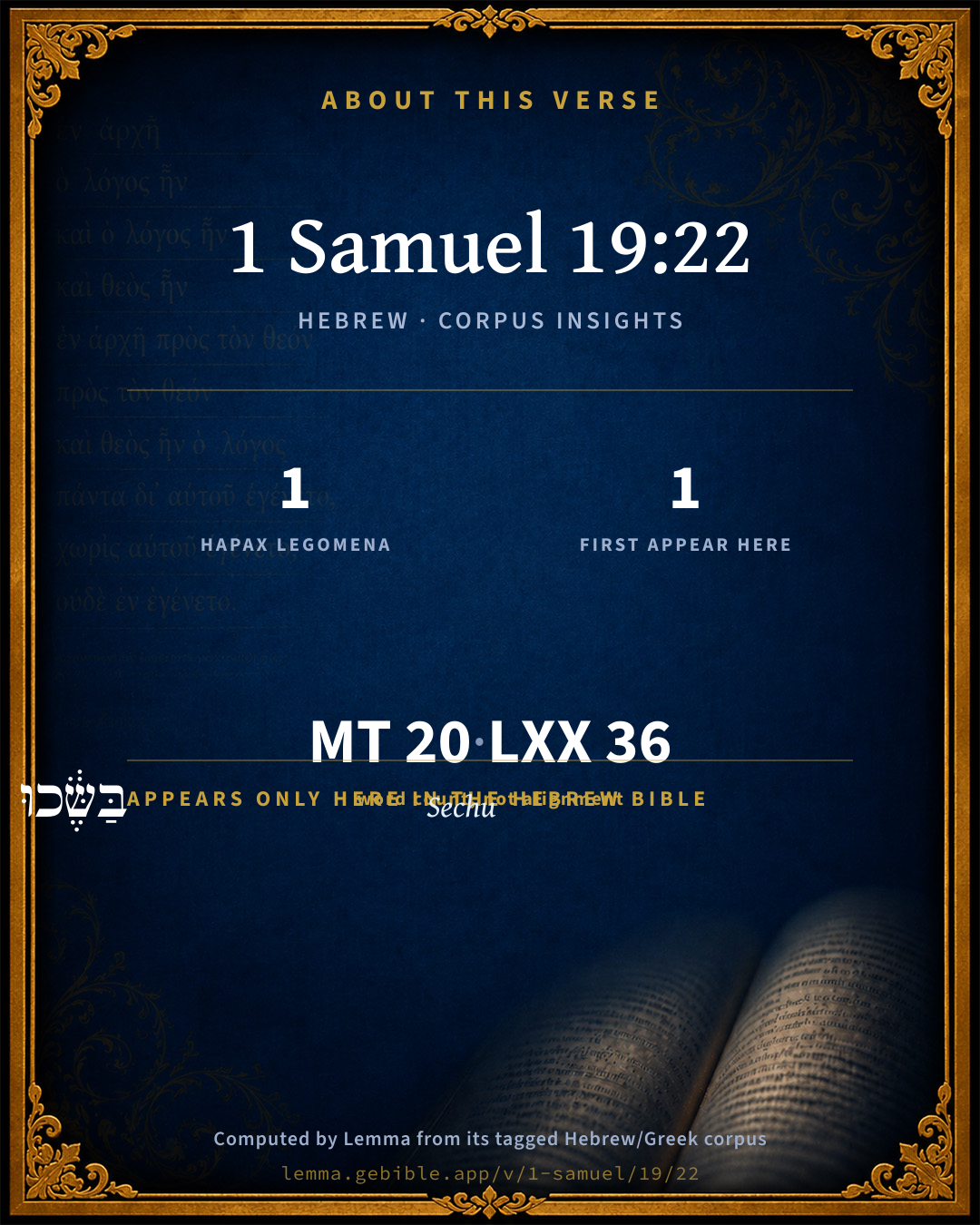
  • 1 hapax legomenon — only here in the Hebrew Bible
  • 1 first appearance in the Hebrew Bible
Full analysis ↓
Download a study sheet

One document with this verse’s original text, its word-by-word gloss line, the meaning frame, cross-references with their text, attributed commentary, and full source and license credits — printable, and it pastes into notes with its structure intact.

This verse Autodidact and up

Study sheet (.html) Plain text (.txt)

A passage Seminary Student

Up to 50 verses in one chapter. A passage sheet keeps up to 6 commentary sources and 12 cross-references per verse, in the order this page ranks them, and says so on the sheet whenever that leaves anything out. Ask for a single verse and you get the Autodidact verse sheet above.

Everything on this page stays free to read, with no account — the sheet is a download of what is already on screen, not access to it.

Want to remove ads? Support Godless Engineer
Compare translations 3

The same verse in 3 English versions, stacked beneath the original-language interlinear above. Click any original word for its lexicon entry.

Each is an independent rendering of the whole verse — the interlinear is not word-aligned to these translations.

Highlighted words mark where these versions differ — a whole-verse word diff, not a word-by-word alignment.

  • World English Bible Public Domain
    Then went he also to Ramah, and came to the great well that is in Secu: and he asked and said, Where are Samuel and David? One said, Behold, they are at Naioth in Ramah.
  • King James Version Public Domain
    Then went he also to Ramah, and came to a great well that is in Sechu: and he asked and said, Where are Samuel and David? And one said, Behold, they be at Naioth in Ramah.
  • unfoldingWord Literal Text CC BY-SA 4.0
    So he went, he also, to Ramah, and he came to the great cistern that in Secu. And he asked and said, “Where Samuel and David?” And one said, “Behold, in Naioth in Ramah.”

unfoldingWord Literal Text — © unfoldingWord, licensed CC BY-SA 4.0. Word-aligned USFM3 via Door43 (git.door43.org/unfoldingWord/en_ult).

Versions to compare (up to 4)

3 of 4 selected

Show all 18 translations

Every available English version of this verse, each an independent rendering of the whole verse.

  • World English Bible Public Domain
    Then went he also to Ramah, and came to the great well that is in Secu: and he asked and said, Where are Samuel and David? One said, Behold, they are at Naioth in Ramah.
  • Berean Standard Bible Public Domain
    Finally, Saul himself left for Ramah and came to the large cistern at Secu, where he asked, “Where are Samuel and David?” “At Naioth in Ramah,” he was told.
  • Majority Standard Bible Public Domain
    Finally, Saul himself left for Ramah and came to the large cistern at Secu, where he asked, “Where are Samuel and David?” “At Naioth in Ramah,” he was told.
  • King James Version Public Domain
    Then went he also to Ramah, and came to a great well that is in Sechu: and he asked and said, Where are Samuel and David? And one said, Behold, they be at Naioth in Ramah.
  • American Standard Version (1901) Public Domain
    Then went he also to Ramah, and came to the great well that is in Secu: and he asked and said, Where are Samuel and David? And one said, Behold, they are at Naioth in Ramah.
  • Revised Version (1885) Public Domain
    Then went he also to Ramah, and came to the great well that is in Secu: and he asked and said, Where are Samuel and David? And one said, Behold, they be at Naioth in Ramah.
  • Geneva Bible (1599) Public Domain
    Then went he himselfe to Ramah, and came to a great well that is in Sechu, and he asked, and sayd, Where are Samuel and Dauid? and one sayd, Behold, they be at Naioth in Ramah.
  • Douay-Rheims (1899) Public Domain
    Went also himself to Ramatha, and came as far as the great cistern, which is in Socho, and he asked, and said: In what place are Samuel and David? And it was told him: Behold they axe in Najoth in Ramatha.
  • Young's Literal Translation Public Domain
    And he goeth -- he also -- to Ramath, and cometh in unto the great well which `is' in Sechu, and asketh, and saith, `Where `are' Samuel and David?' and `one' saith, `Lo, in Naioth in Ramah.'
  • Literal Standard Version CC BY-SA 4.0
    And he goes—he also—to Ramath, and comes to the great well which [is] in Sechu, and asks and says, “Where [are] Samuel and David?” And [one] says, “Behold, in Naioth in Ramah.”
  • Unlocked Literal Bible CC BY-SA 4.0
    Then he also went to Ramah and came to the deep well that is in Seku. He asked, “Where are Samuel and David?” Someone said, “See, they are at Naioth in Ramah.”
  • unfoldingWord Literal Text CC BY-SA 4.0
    So he went, he also, to Ramah, and he came to the great cistern that in Secu. And he asked and said, “Where Samuel and David?” And one said, “Behold, in Naioth in Ramah.”
  • Darby Bible Public Domain
    Then went he also to Ramah, and came to the great well that is in Sechu; and he asked and said, Where are Samuel and David? And one said, Behold, at Naioth by Ramah.
  • World Messianic Bible Public Domain
    Then he also went to Ramah, and came to the great well that is in Secu: and he asked, “Where are Samuel and David?” One said, “Behold, they are at Naioth in Ramah.”
  • Webster's Bible Public Domain
    Then he went also to Ramah, and came to a great well that is in Sechu: and he asked and said, Where are Samuel and David? And one said, Behold, they are at Naioth in Ramah.
  • Free Bible Version CC BY-SA 4.0
    For the third time Saul sent messengers, and they also started prophesying.
  • Bible in Basic English Public Domain
    Then he himself went to Ramah, and came to the great water-spring in Secu; and questioning the people he said, Where are Samuel and David? And one said, They are at Naioth in Ramah.
  • JPS Tanakh (1917) Public Domain
    Then went he also to Ramah, and came to the great cistern that is in Secu; and he asked and said: 'Where are Samuel and David?' And one said: 'Behold, they are at Naioth in Ramah.'

Literal Standard Version (2020), Covenant Press — licensed CC BY-SA 4.0. Text via the HelloAO Bible API (eBible.org). Unlocked Literal Bible (unfoldingWord) — licensed CC BY-SA 4.0. Text via the HelloAO Bible API (eBible.org). unfoldingWord Literal Text — © unfoldingWord, licensed CC BY-SA 4.0. Word-aligned USFM3 via Door43 (git.door43.org/unfoldingWord/en_ult). Free Bible Version, Dr. Jonathan Gallagher — licensed CC BY-SA 4.0. Text via the HelloAO Bible API (eBible.org).

Word by word

More ways to search: Search by grammar → Find every occurrence → Compare this word →

Practice this passage: Drill this verse → Learn its vocabulary →

בַּשֶּׂ֔כוּ
Sêkûw
H7906
“in/at the · Sechu”
Preposition, Determined + Noun, Proper
Part of Speech
Preposition + Noun
Type
Proper
Full BDB Definition

Origin: from an unused root apparently meaning to surmount

TWOT: None

Sechu = "the watch-tower" - a place near Ramah with a great well
  1. וַיֵּ֨לֶךְ yâlak H3212 “and · to walk” Conjunction + Verb, Qal, Sequential Imperfect, 3rd Person, Masculine, Singular
  2. גַּם gam H1571 “also” Particle, Accusative
  3. ה֜וּא hûwʼ H1931 “he” Pronoun, Personal, 3rd Person, Masculine, Singular
  4. הָרָמָ֗תָה Râmâh H7414 “the · Ramah · toward” Particle, Definite Article + Noun, Proper + Suffix, Demonstrative
  5. וַיָּבֹא֙ bôwʼ H935 “and · to enter” Conjunction + Verb, Qal, Sequential Imperfect, 3rd Person, Masculine, Singular
  6. עַד ʻad H5704 “until” Preposition
  7. בּ֤וֹר bôwr H953 “pit of” Noun, Common, Masculine, Singular, Construct
  8. הַגָּדוֹל֙ gâdôwl H1419 “the · great” Particle, Definite Article + Adjective, Adjective, Masculine, Singular, Absolute
  9. אֲשֶׁ֣ר ʼăsher H834 “which” Particle, Relative
  10. וַיִּשְׁאַ֣ל shâʼal H7592 “and · to ask” Conjunction + Verb, Qal, Sequential Imperfect, 3rd Person, Masculine, Singular
  11. וַיֹּ֔אמֶר ʼâmar H559 “and · to say” Conjunction + Verb, Qal, Sequential Imperfect, 3rd Person, Masculine, Singular
  12. אֵיפֹ֥ה ʼêyphôh H375 “where?” Particle, Interrogative
  13. שְׁמוּאֵ֖ל Shᵉmûwʼêl H8050 “Samuel” Noun, Proper
  14. וְדָוִ֑ד Dâvid H1732 “and · David” Conjunction + Noun, Proper
  15. וַיֹּ֕אמֶר ʼâmar H559 “and · to say” Conjunction + Verb, Qal, Sequential Imperfect, 3rd Person, Masculine, Singular
  16. הִנֵּ֖ה hinnêh H2009 “behold” Particle, Demonstrative
  17. בנוית Nâvîyth H5121 “in/at · Naioth” Preposition + Noun, Proper
  18. בְּנָי֥וֹת Nâvîyth H5121 “in/at · Naioth” Preposition + Noun, Proper
  19. בָּרָמָֽה Râmâh H7414 “in/at the · Ramah” Preposition, Determined + Noun, Proper

About this verse

These counts appear in no published source. They are computed here, from the morphology-tagged text and Lemma’s own curated glosses. What Lemma adds →

20
words
17
distinct lemmas
Historical
section

Notable vocabulary

1 hapax legomenon — a word that appears only here in the entire Hebrew Bible:

  • בַּשֶּׂ֔כוּ Sechu H7906

First appearance in Scripture

This word makes its first canonical appearance in the Hebrew Bible here:

  • בַּשֶּׂ֔כוּ Sechu H7906

Shared distinctive vocabulary

אֵיפֹ֥ה where? H375 occurs in 10 verses of the Hebrew Bible. Also found in:

Grammatical profile

  • 5 verbs
  • 8 nouns
  • 1 adjective
  • 1 pronoun
  • 1 preposition
  • 4 particles

Verb forms

  • וַיֵּ֨לֶךְ Qal · Sequential Imperfect
  • וַיָּבֹא֙ Qal · Sequential Imperfect
  • וַיִּשְׁאַ֣ל Qal · Sequential Imperfect
  • וַיֹּ֔אמֶר Qal · Sequential Imperfect
  • וַיֹּ֕אמֶר Qal · Sequential Imperfect

Repetition

Words recur within this verse — often emphatic in Hebrew:

  • הָרָמָ֗תָה Ramah H7414 ×2
  • וַיֹּ֔אמֶר to say H559 ×2
  • בנוית Naioth H5121 ×2

Hebrew & Septuagint length

In English translation the verse runs 35 words from the Hebrew and 45 from the Septuagint (LXX English) — closely comparable.

A rough comparison of the two English renderings, which tokenize alike — not a word-level alignment.

Word counts can differ between the Hebrew and the Greek without any difference in meaning — e.g. the Hebrew direct-object marker אֵת has no separate Greek word, and Greek often adds the article ὁ.

In the original languages it is 20 Hebrew tokens and 36 Greek tokens — but the two are counted differently (Hebrew bundles its prefixes and suffixes into one token; the Greek is in lemma form), so that isn’t a like-for-like length.

Hebrew and Greek witnesses Masoretic Hebrew ↔ Greek Septuagint

The same verse in the two great witnesses to the Old Testament, shown verse-for-verse.

These are two independent witnesses, not word-aligned to each other, and the Septuagint is shown in lemma (dictionary) form.

Hebrew 1 Samuel 19:22 Masoretic · Westminster Leningrad Codex

וַיֵּ֨לֶךְ גַּם ה֜וּא הָרָמָ֗תָה וַיָּבֹא֙ עַד בּ֤וֹר הַגָּדוֹל֙ אֲשֶׁ֣ר בַּשֶּׂ֔כוּ וַיִּשְׁאַ֣ל וַיֹּ֔אמֶר אֵיפֹ֥ה שְׁמוּאֵ֖ל וְדָוִ֑ד וַיֹּ֕אמֶר הִנֵּ֖ה בנוית בְּנָי֥וֹת בָּרָמָֽה

Then went he also to Ramah, and came to the great well that is in Secu: and he asked and said, Where are Samuel and David? One said, Behold, they are at Naioth in Ramah.

World English Bible · Public Domain

Greek LXX 1 Samuel 19:22 Septuagint · lemma form

καί θυμόω ὀργή σαούλ καί πορεύομαι καί αὐτός εἰς αρμαθαιμ καί ἔρχομαι ἕως ὁ φρέαρ ὁ ἅλων ὁ ἐν ὁ σεφι καί ἐρωτάω καί εἶπον ποῦ σαμουηλ καί δαυίδ καί εἶπον ἰδού ἐν ναυαθ ἐν ραμα

And Saul was very angry, and went himself also to Armathaim, and he comes as far as the well of the threshing floor that is in Sephi; and he asked and said, Where are Samuel and David? And they said, Behold, in Navath in Rama.

LXX2012 (modern English Septuagint) · Public Domain

Hebrew: Westminster Leningrad Codex (CC BY 4.0). Greek: Septuagint (public domain); English from LXX2012 (modern English Septuagint) (Public Domain). How the Septuagint differs from the Hebrew →

Targum (Aramaic paraphrase)

1

The Targum is the ancient Jewish Aramaic paraphrase of the Hebrew Scriptures — an interpretive translation, not the Hebrew text itself. Onkelos (literal) and Pseudo-Jonathan (expansive) render the Torah, and Jonathan the Prophets. Coverage is partial: where no permissively-licensed English translation exists for a verse, only the Aramaic is shown. This is verse-level text, not a word-by-word alignment to the Hebrew.

  1. Targum Jonathan Prophets (Joshua–Malachi)
    וַאֲזַל אַף הוּא לְרָמָתָא וַאֲתָא עַד גוּבָא רַבָּא דִי בְשֵׂכוּ וּשְׁאַל וַאֲמַר אֵיכֹא שְׁמוּאֵל וְדָוִד וַאֲמַר הָא בְּבֵית אוּלְפָנָא בְּרָמָתָא:

    (no public-domain English translation for this verse)

    Targum Jonathan — Aramaic: “Mikraot Gedolot” (public domain). English: “Sefaria Community Translation” (CC0 1.0 (public-domain dedication)); “London "Chaldee Paraphrase," 1871” (public domain). Text via Sefaria.

Commentary

Notes on 1 Samuel 19:22 from classic Christian and Jewish commentators (each source and its license shown beneath its notes). The classic Christian expositions comment on the surrounding passage and are grouped to its opening verse, so a note may address several verses; the Jewish commentaries on the Tanakh (Rashi and others) are per-verse, so they appear only where the commentator wrote on this verse.

Lemma curates 59 commentaries, every one of them public domain or Creative Commons licensed, each selected and text-cleaned for this edition rather than reprinted as found. About our sources →

Trapp's Complete Commentary

John Trapp

1Sa 19:22 Then went he also to Ramah, and came to a great well that [is] in Sechu: and he asked and said, Where [are] Samuel and David? And [one] said, Behold, [they be] at Naioth in Ramah.

Ver. 22. Then went he also to Ramah.] As if he had a mind to try it out with God, to wrestle a fall with the Most High.

John Trapp, A Commentary or Exposition upon All the Books of the Old and New Testament (1647–1656) — public domain. Text from a community e-Sword module.

The Cambridge Bible for Schools and Colleges

gen. ed. J. J. S. Perowne

22. a great well] The great cistern, some well known landmark in Sechu, a place nowhere else mentioned, between Gibeah and Ramah. The reading is uncertain. The Sept. has “the well of the threshing-floor that is in Sephi (or, the hill).”

The Cambridge Bible for Schools and Colleges (gen. ed. J. J. S. Perowne; Cambridge University Press, 1878–1918) — public domain. Text from a community e-Sword module.

John Gill's Exposition

Then went he also to Ramah,.... That is, Saul; his messengers not returning to him, when he sent one after another to take David, at length he set out himself from Gibeah to Ramah:

and came to a great well that is in Sechu; which was either the name of a man, the owner of the well, or a place near to which the well was, and is commonly thought to be the same with Shochoh, Sa1 17:1; at such places there was generally a concourse of people at certain times, to fetch water for the inhabitants of the place, and for the watering of flocks and herds, and so a proper place to stop at, and ask the following questions:

and he asked and said, where are Samuel and David? for his messengers not returning to him, he could not be sure where they now were, though he had heard they were at Naioth:

and one said, behold, they be at Naioth in Ramah; at the house of doctrine, or school in Ramah, as the Targum; thus one at the well replied, in answer to his question, who had seen them go there, or knew they were there.

John Gill's Exposition of the Whole Bible (1746–1763) — public domain (CC PDM 1.0). Text via the HelloAO Bible API.

Albert Barnes' Notes on the Bible

To a great well - Some large well-known cistern at Sechu, the site of which is uncertain, which Saul passed on his way from Gibeah to Ramah.

Albert Barnes' Notes on the Bible (1834–1885) — public domain. Text from a community e-Sword/MySword module.

Matthew Poole's English Annotations

Where are Samuel and David? for, his messengers not returning, he knew not exactly where they were.

Matthew Poole's English Annotations on the Holy Bible (1683–1685) — public domain. Text from a community e-Sword/MySword module.

Whedon's Commentary on the Bible

Daniel D. Whedon

22. Well — Or pit, as the word is rendered 1Sa_13:6. In the Hebrew it is made emphatic by the article, to the great pit, referring to some well-known spot.

Sechu — This word means a watching place; and since it is made definite by the article, it is better to translate it as a common noun, thus: He came to the great pit which is by the watching place. Some spot near Ramah is meant; probably a height where watchmen were stationed, in the vicinity of a notable cistern or pit, which has since been filled up.

He asked — Probably of some watchman there.

Daniel D. Whedon (gen. ed.), Commentary on the Old and New Testaments (1874–1909) — public domain. Text from a community e-Sword module.

The Pulpit Commentary

Vers. 22-24. (RAMAH.)

The meeting of three remarkable men.

This appears to have been the only occasion on which Samuel, Saul, and David were present at the same time and place. The meeting was a notable one, and may be compared with others (Exo_10:16; Act_25:24) Besides the three men just mentioned, there was also present One infinitely greater, and, although invisible, his power was displayed in a marvellous manner. Considered in relation to the Divine power, the narrative sets before us

I AN AGED PROPHET IMBUED WITH FEARLESS DIGNITY. His danger was great. What Saul might do may be judged from the fear which Samuel expressed on a former occasion, (1Sa_16:2) and from what he actually did not long afterwards. (1Sa_22:18, 1Sa_22:19) But the prophet went on with his holy service calm and undismayed. He was inwardly sustained by Divine power, as others have since been in danger and suffering. (Act_16:25) Such fearlessness is possessed by God"s servants in connection with

1. A firm persuasion that they are in the path of duty. They have within "a peace above all earthly dignities, a still and quiet conscience." If conscience "does make cowards of us all," it also makes us heroes. And

He that hath light within his own clear breast May sit in the centre and enjoy bright day; But he that hides a dark soul and foul thoughts Benighted walks under the midday sun (Milton, "Comus).

2. A vivid realisation of the presence and might of the Lord. Faith "sees him who is invisible" and "the mountain full of horses and chariots of fire". (2Ki_6:17)

3. A strong assurance of deliverance from their adversaries.

II A PERSECUTING MONARCH TURNED INTO A HARMLESS ENTHUSIAST. The Divine power was exerted first upon Saul"s messengers and then upon himself. In a somewhat similar manner, if not to the same extent, it is often exerted upon evil and persecuting men

1. In connection with the utterances of the praises of God by his servants (2Ch_20:22; Psa_149:6) Instances are not unknown in which "one that believeth not" has come into their assembly, and, hearing their praises, has fallen down on his face and worshipped God. (1Co_14:24, 1Co_14:25) This was not the first time that Saul was so affected, and the recollection of his earlier experience had probably some influence upon him. But then it was a sign that the power of God was for him, now that it was against him.

2. In order to restrain the wicked from carrying out their evil designs. He who holds the hearts of men in his hand thereby says, "Do my prophets no. (1Ch_16:22)

3. In order to restore them to the right way. It was to Saul more than a warning that he was fighting against God. "He was seized by this mighty influence of the Spirit of God in a more powerful manner than his servants were, both because he had most obstinately resisted the leadings of Divine grace, and also in order that, if it were possible, his hard heart might be broken and subdued by the power of grace. If, however, he should nevertheless continue obstinately in his rebellion against God, he would then fall under the judgment of hardening, which would be speedily followed by his destruction" (Keil).

III AN INNOCENT FUGITIVE RESCUED FROM IMPENDING DESTRUCTION. David was saved from the hand of Saul, and even (as it would appear) formally reconciled to him. (1Sa_20:18, 1Sa_20:27) The putting forth of the power of God was to him

1. An indication of the varied and abundant resources of God to protect in the greatest peril.

2. An assurance of Divine approbation in the way of trust and obedience.

3 . An encouragement to patient endurance. He might be tempted to reach the goal for which, as he was now probably fully aware, he was destined (1Sa_20:15 1Sa_23:17) by violent measures; but ever as he thought on this scene, together with the counsel and the whole course of the venerable prophet, he would feel that "the way of order is the best.

The way of order, though it lead through windings, Is the best. Right forward goes the lightning And the cannon ball; quick, by the nearest path, They come, opening with murderous crash their way To blast and ruin! My son, the quiet road Which men frequent, where peace and blessings travel, Follows the river"s course, the valley"s bendings; Modestly skirts the cornfield and the vineyard, Revering property"s appointed bounds, And leading safe, though slower, to the mark (Schiller, "Wallenstein). D.

The Pulpit Commentary (1880–1919), ed. H.D.M. Spence-Jones & Joseph S. Exell — public domain. Text from a community e-Sword module.

Lesson kit

Teaching starters — assembled from the data on this page, not authored interpretation. Every prompt links to the verse data it draws on. Edit before teaching.

1 Samuel, in the Historical, opens this verse with 20 words (17 distinct Hebrew lemmas). Its most distinctive word is Sêkûw (“Sechu”). A historical commentator’s framing appears above. Read the whole chapter for the surrounding context.

Discussion questions

  1. What does “Sechu” (Sêkûw) contribute to the verse as a whole?
  2. This verse holds 1 word here found nowhere else in the Hebrew Bible. What might the rare word draw attention to?
  3. The word “Sechu” first appears here in Scripture. What is being introduced at this debut?
  4. Genesis 37:16 shares the word «where?» with this verse. How do the two illuminate each other?
  5. “Ramah” occurs 2× in this one verse. What is the effect of the repetition?
  6. These translations render this verse differently; the difference is in the English rendering, not the original. What questions does that raise?
  7. The verb «וַיֵּ֨לֶךְ» is Qal Sequential Imperfect. How does its form color the action?
  8. Reading how Trapp's Complete Commentary and The Cambridge Bible for Schools and Colleges read this verse, where do the two commentators agree and where do they part?

Things to notice

  • 1 word in this verse appears nowhere else in the Hebrew Bible.
  • 1 word makes its first canonical appearance in Scripture here.
  • This verse counts 20 Hebrew ↔ 36 Greek words.
  • These translations choose different wording for 4 words in this verse.
  • “Ramah” occurs 2× in this single verse.

Reading settings

Reading text

Shown beneath each verse's original-language words.

Old Testament
Old Testament edition

Read the OT as the Masoretic Hebrew (MT) or the Greek Septuagint (LXX).

English shown for the Greek Septuagint (in the Hebrew ↔ Greek comparison).

Comparing translations? Open the Compare panel on any verse page to stack up to four side by side.